MSTU 4050 Final presentation  Yaeji Chun
Online learning Text-based communication Lack of face-to-face interaction Hard to be connected with other students Socio-affective support is important due to its isolated nature
Social presence- definition The ability of online learners to project themselves into a textual environment (Stacey, 2002) The degree to which a person is perceived as “real” in mediated communication(Richardson & Swan, 2003)
Research question What is the relationship between social presence and students’ learning online? How can teachers enhance social presence in online learning
Social presence vs Interaction Interaction- indication of the level of social presence However, we can’t tell social presence has been built, though interaction takes place. (Nippard & Murphy, 2007)
Two views of social presence Media richness view Concentrated on the capacity of media to convey information Relational view  Emphasis on relational aspects of communication (kehrwald, 2008)
Conditions of social presence Ability- to send and to read social presence cues Opportunity- to interact with each other Motivation- to engage in relational exchanges (kehrwald, 2008)
Assessing social presence Affective responses: emotions, feelings, closeness, warmth… Interactive responses: post messages, complimenting, agreement and asking questions… Cohesive response: building and sustaining a sense of group commitment (Rourke et al.,2001)
Social presence & online learning Higher social presence -> higher satisfaction in learning Women perceive higher degree of social presence than men  (Richardson & Swan, 2003)
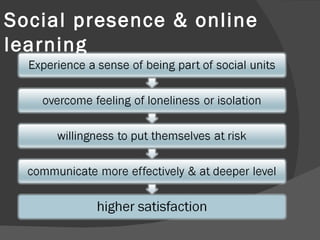
Social presence & online learning
Teachers’ role Helping students establish social presence Developing a secure learning environment Modeling social presence factors Continuing to monitor and facilitate interaction (Stacey, 2002)
Strategies for social presence Placing picture of students in course website Placing students voice Face-to-face first session Opportunities to work in a small group Ask students to respond to others as quickly as possible (Newberry, 2001)
Useful activities Text-based chat, audio conferencing Writing assignment Discussion & asking question and answering (Richardson & Swan, 2003)
Interview- Lydia Georgieva Strategies  she use for social presence Upload pictures Introduce themselves to the others Respond to the course expectation Group activities, blogs, social bookmarking
Interview- Lydia Georgieva Difficulties for building social presence online No opportunities to communicate with peers outside the classroom Not easy to establish common interest & develop friendship Everything evolves around the subject matter
Interview- Lydia Georgieva Factors for higher social presence Personal characteristics Intrinsic motivation Attitude to challenges Confidence with technology
Conclusion Social presence is integral part of online learning Novice students needs assistance Need K-12 level research

4050final presentation

  • 1.
    MSTU 4050 Finalpresentation Yaeji Chun
  • 2.
    Online learning Text-basedcommunication Lack of face-to-face interaction Hard to be connected with other students Socio-affective support is important due to its isolated nature
  • 3.
    Social presence- definitionThe ability of online learners to project themselves into a textual environment (Stacey, 2002) The degree to which a person is perceived as “real” in mediated communication(Richardson & Swan, 2003)
  • 4.
    Research question Whatis the relationship between social presence and students’ learning online? How can teachers enhance social presence in online learning
  • 5.
    Social presence vsInteraction Interaction- indication of the level of social presence However, we can’t tell social presence has been built, though interaction takes place. (Nippard & Murphy, 2007)
  • 6.
    Two views ofsocial presence Media richness view Concentrated on the capacity of media to convey information Relational view Emphasis on relational aspects of communication (kehrwald, 2008)
  • 7.
    Conditions of socialpresence Ability- to send and to read social presence cues Opportunity- to interact with each other Motivation- to engage in relational exchanges (kehrwald, 2008)
  • 8.
    Assessing social presenceAffective responses: emotions, feelings, closeness, warmth… Interactive responses: post messages, complimenting, agreement and asking questions… Cohesive response: building and sustaining a sense of group commitment (Rourke et al.,2001)
  • 9.
    Social presence &online learning Higher social presence -> higher satisfaction in learning Women perceive higher degree of social presence than men (Richardson & Swan, 2003)
  • 10.
    Social presence &online learning
  • 11.
    Teachers’ role Helpingstudents establish social presence Developing a secure learning environment Modeling social presence factors Continuing to monitor and facilitate interaction (Stacey, 2002)
  • 12.
    Strategies for socialpresence Placing picture of students in course website Placing students voice Face-to-face first session Opportunities to work in a small group Ask students to respond to others as quickly as possible (Newberry, 2001)
  • 13.
    Useful activities Text-basedchat, audio conferencing Writing assignment Discussion & asking question and answering (Richardson & Swan, 2003)
  • 14.
    Interview- Lydia GeorgievaStrategies she use for social presence Upload pictures Introduce themselves to the others Respond to the course expectation Group activities, blogs, social bookmarking
  • 15.
    Interview- Lydia GeorgievaDifficulties for building social presence online No opportunities to communicate with peers outside the classroom Not easy to establish common interest & develop friendship Everything evolves around the subject matter
  • 16.
    Interview- Lydia GeorgievaFactors for higher social presence Personal characteristics Intrinsic motivation Attitude to challenges Confidence with technology
  • 17.
    Conclusion Social presenceis integral part of online learning Novice students needs assistance Need K-12 level research

Editor's Notes

  • #2 My research is about social presence in online courses. I, first, explore research papers which deal with students’ social presence of online courses, and then I focus on the teachers’ perception of students’ social presence by a practitioner interview.
  • #3 Online learning mostly depends on text-based communication. Since face-to-face interaction, including non-verbal cues(body languages, eye contact,,), are missing in this environment, having a close relationship with other learners is harder than face-to-face settings.  It possibly makes learners feel isolated, so socio-affective support in online learning is important.
  • #4 Thus, I research the students' social presence in online environment which is important to make students feel being present and connected with other students and instructor. According to Stacey(2002) social presence is the ability of online learners to project themselves into a textual environment which has few visual or contextual cues. Similarly, Richardson & Swan(2003) defines social presence is the degree to which a person in perceived as "real" in mediated communication
  • #5 so, my research questions are these two. First, what is the social presence? and what is the relationship between social presence and students' learning online? Are social presence and student's achievement or satisfaction of the online courses related to each other? Second, if social presence is important in online learning, how can the teacher enhance social presence in this environment?
  • #6 Social presence is different from interaction. Interaction between students can be an indication of the level of social presence, but increasing interaction doesn't guarantee enhancing social presence. For example, it is possible for students to post several messages on discussion board without feeling being a part of a community.
  • #7 There are two views of social presence. First one is media richness view. This view emphasis on the capacity of media to convey information which make students perceived as "real". However, this view changes to the relational view recently. It concentrates on the relational aspects of communication, which is a sense of individuals' ability to perceive others in mediated communication.
  • #8 To establish effective social presence in online environment, three conditions are needed for students; ability, opportunity, and motivation. Students' ability to send and read social presence cues, opportunities for students to interact with each other (social presence cannot exit without interaction), and motivation for engaging in the online relationship.
  • #9 social presence can be assessed by three categories of responses. First, by affective responses, such as emotions, feelings, closeness, or warmth. Second, by interactive reposes. Posting messages to others' opinion, expressing compliment or agreement, and asking question can be a part of interactive responses. Cohesive responses are responses for building and sustaining  a sense of group commitment.
  • #10 Regarding the relationship between social presence and students' satisfaction, those who perceived higher social presence expressed higher satisfaction in their learning and to their instructor.  Richardson and Swan(2003) found out that women perceived higher degree of social presence than men and there were no statistically differences between age or number of credits earned and perceived social presence. However, further research is needed to draw more reliable results.
  • #11 As students experience a sense of being part of social units(perceived them as a "real" one), they could get a sense of strong group network. Thus, it is possible to overcome feeling of loneliness or isolation through the identification of others. When they establish strong social presence, they are willingness to put themselves at risk when they participate online activities. It makes communication more effective and at deeper level. Finally, it leads students satisfaction through a sense of well-being in the online classroom. Students with high social presence feel they learn more than others. 
  • #12 Teachers’ role is vital to raise students’ social presence in online class. In the early stage of the class, the teacher should help students establish social presence well (i.e. students were required to introduce themselves on the classweb..), and then, helps to develop secure learning environment as class continues. Modeling social presence factors, and continuing to monitor and facilitate interaction are also important.
  • #13 According to Newberry(2001), there are several strategies for raising students’ social presence. Placing pictures of students along with their introduction on course website, or placing students voice would be a good way to build social presence. When the class have face-to-face first session, they would know each other better. Providing opportunities to work in a small group, and asking students to respond to other students as quickly as possible could be also proper methods for enhancing social presence.
  • #14 For the useful activities, since synchronous media types tend to help create social presence, media such as text-based chat or audio conferencing should be selected for activities. Richardson and Swan(2003) found out that when they asked students about the type of activities that they perceived as enhancing social presence, students chose discussion, and writing assignment. Interestingly, students perceived writing assignment as an activity that raising social presence, though writing assignment is designated as an individual activity. Researchers indicate that students are asked to discuss their individual writing assignment with the instructor or other peers, so that’s the reason why writing assignment is perceived as an activity for enhancing social presence.
  • #15 Lydia Georgieva has been teaching for almost 20 years , mainly secondary school students. At present, she works full-time at Dulwich College Beijing, an international independent British college, related to the Dulwich College London. she teaches Economics both face-to-face and online. Her strategies for raising social presence for first few weeks include: class directory where each student needs to upload a picture, introduce herself/himself to the others the requirement to respond discussions about expectations of the course We also integrate group activities, blogs, social bookmarking
  • #16 She pointed out several limitations to build strong social presence in online learning environment. First, there are more personal interaction between peers, more sharing of happiness, distress happens in face-to-face learning than online learning, so it makes hard to establish common interest and develop friendship online. Also, there are not many opportunities to communicate with peers outside of the classroom, so it is not sure that they could make online community, and keep the relationship after the graduation. Teachers and peers get to know predominantly the academic side of them and do not really see their peers in a different situation or environment outside of the online classroom. Everything evolves around the subject matter. Thus, the level of trust in online learning is limited to only subject expertise of each other.
  • #17 Finally, she mentioned about the factors influence on establishing higher social presence. She indicates that personal characteristics, intrinsic motivation, desire to learn and attitude to challenges are important to build strong social presence. Also, having confidence and feeling comfortable with technology is also important for establishing social presence in online courses. Some students don't feel so comfortable with technology and if they don't have teacher's or peers' support, this may become discouraging to them with time. She believes that those highly motivated students establish a “very real” presence in online course, become an example for others.
  • #18 Since social presence is integral part of online learning, teacher should more focus on students’ social presence to build successful online learning environment. Especially, novice students, who don’t have online learning experience, need to be assisted to build strong social presence online. Finally, little research has been done on the social presence of K-12 level students, although social presence is vital to build online identity for them. Therefore, more research is needed in this area.