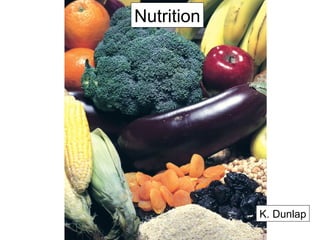
Nutrition
K. Dunlap
Nutrition
the study of food and how the body uses it
Function of Nutrients:
1) supply energy
2) supply materials for building and
replacing body tissues
3) supply other substances needed for
various life processes
Nutrition
• Nutrients:Nutrients: the components of food and drink
that provide growth, replacement, and energy:
1. Carbohydrates
2. Lipids
3. Proteins
4. Vitamins
5. Minerals
6. Water
• DigestionDigestion: the hydrolysis of starches, fats, and
proteins into smaller units that can be
absorbed and metabolized.
DRI- Dietary Reference index
Food and Nutrition Board, the institute of Meidcin andFood and Nutrition Board, the institute of Meidcin and
the National Academy of Sciences has established thethe National Academy of Sciences has established the
DRIsDRIs
•EAR:EAR: adequate amount for 50% of population
•EEREER: estimated energy requirements
•RDA:RDA: recommended dietary allowances are adequate
for most of the population based on measurable
parameteres
•AIAI: Adequate intakes are used when REDA & EARs
are not available
•ULUL: upper tolerance limit. Above would be detrimental
Calorimeter
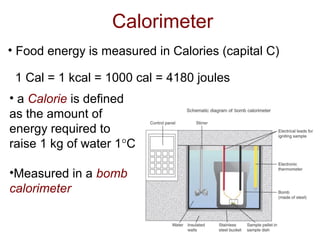
• Food energy is measured in Calories (capital C)
1 Cal = 1 kcal = 1000 cal = 4180 joules
• a Calorie is defined
as the amount of
energy required to
raise 1 kg of water 1°C
•Measured in a bomb
calorimeter
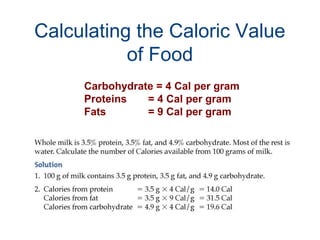
Calculating the Caloric Value
of Food
Carbohydrate = 4 Cal per gram
Proteins = 4 Cal per gram
Fats = 9 Cal per gram
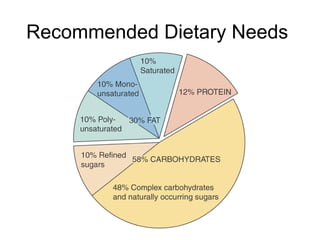
Recommended Dietary Needs
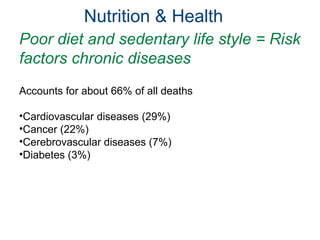
Nutrition & Health
Poor diet and sedentary life style = Risk
factors chronic diseases
Accounts for about 66% of all deaths
•Cardiovascular diseases (29%)
•Cancer (22%)
•Cerebrovascular diseases (7%)
•Diabetes (3%)
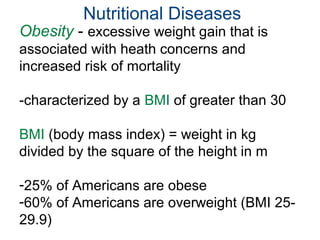
Nutritional Diseases
Obesity - excessive weight gain that is
associated with heath concerns and
increased risk of mortality
-characterized by a BMI of greater than 30
BMI (body mass index) = weight in kg
divided by the square of the height in m
-25% of Americans are obese
-60% of Americans are overweight (BMI 25-
29.9)
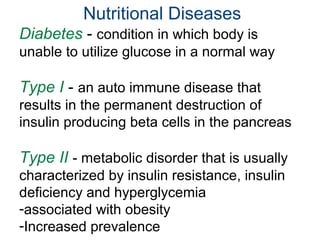
Nutritional Diseases
Diabetes - condition in which body is
unable to utilize glucose in a normal way
Type I - an auto immune disease that
results in the permanent destruction of
insulin producing beta cells in the pancreas
Type II - metabolic disorder that is usually
characterized by insulin resistance, insulin
deficiency and hyperglycemia
-associated with obesity
-Increased prevalence
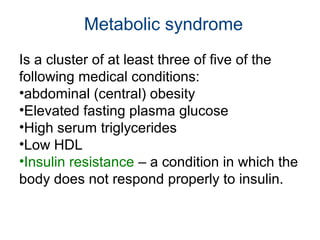
Is a cluster of at least three of five of the
following medical conditions:
•abdominal (central) obesity
•Elevated fasting plasma glucose
•High serum triglycerides
•Low HDL
•Insulin resistance – a condition in which the
body does not respond properly to insulin.
Metabolic syndrome
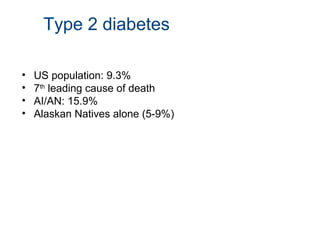
• US population: 9.3%
• 7th
leading cause of death
• AI/AN: 15.9%
• Alaskan Natives alone (5-9%)
Type 2 diabetes
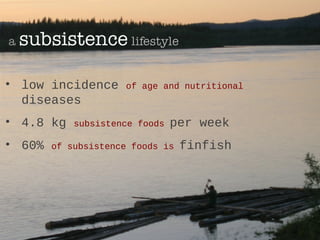
• low incidence of age and nutritional
diseases
• 4.8 kg subsistence foods per week
• 60% of subsistence foods is finfish
Human body is 10-20% protein
•40-50% in skeletal muscle
•20% in organs
•Rest in skin and blood
Recommended Daily Intake:
Adults: 0.8 g per kg of body weight
Children and Pregnancy: 1.5-2.0 g per kg body weight
Complete Protein - contains all essential amino acids
-meat, eggs, dairy, fish
Incomplete Protein - missing one or more essential amino acids
-legumes and grains combined make a complete protein
Proteins
Proteins
– Gelatin, which is denatured collagen, is an
incomplete protein because it lacks Trp, and is low
in Ile and Met.
– Corn protein is low in Lys and Trp.
– Rice is low in Lys and Thr.
– Wheat protein is low in Lys.
– Legumes are low in Met and Cys.
– Soy protein is very low in Met.
Protein complementation:Protein complementation: a diet in which two or
more proteins complementation each other’s
deficiencies; for example:
– grains + legumes (rice + beans)
Fats • recommended 30% of diet
-10% monounsaturated
-10% saturated
-10% unsaturated
Essential Fatty acids:
Omega-3
EPA, DHA, linoleic
Omega-6
Arachidonic acid, α-linolenic
• EPA, DHA, AA are 20
carbon hormone-like
fatty acids that play an
important part in the
immune function
Saturated Fats in the U.S. Diet
>90% of Fas in US diet:
•Palmitic (16:0)
•Stearic (18:0)
•Oleic (18:1)
•Linoleic (18:2)
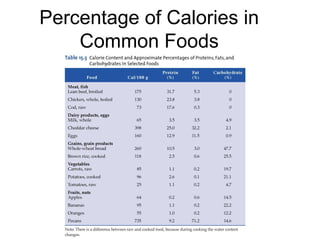
Percentage of Calories in
Common Foods
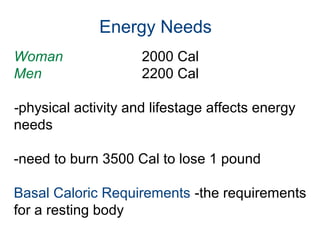
Energy Needs
Woman 2000 Cal
Men 2200 Cal
-physical activity and lifestage affects energy
needs
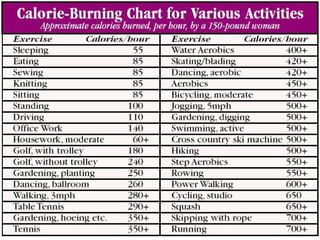
-need to burn 3500 Cal to lose 1 pound
Basal Caloric Requirements -the requirements
for a resting body
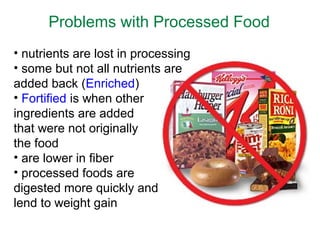
Problems with Processed Food
• nutrients are lost in processing
• some but not all nutrients are
added back (Enriched)
• Fortified is when other
ingredients are added
that were not originally
the food
• are lower in fiber
• processed foods are
digested more quickly and
lend to weight gain
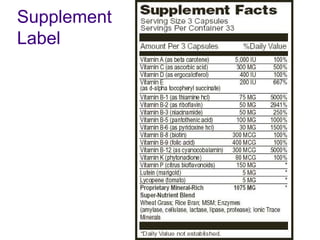
Food Supplements
- vitamins, minerals, herbal remedies, etc…
-$60 billion a year industry
-Balanced diet provides adequate needs
-Elderly, dieters, alcoholics, pregnant, lactation
may require supplementation
- often supplements are not in a form that is as
available as it is in food
Supplement
Label
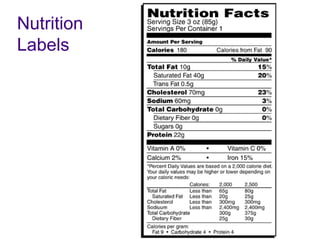
Nutrition
Labels
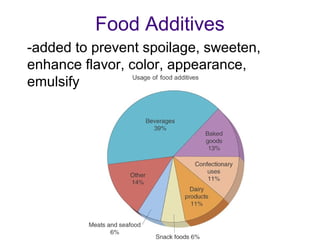
Food Additives
-added to prevent spoilage, sweeten,
enhance flavor, color, appearance,
emulsify
Food Preservatives
-mostly used to prevent food spoilage
Antimicrobial:
Nitrites
-clostridium botulism
- identified as cancer-causing
Sulfites
-wine and dried fruit
-can cause allergic rxn
Others
-Na, K, Ca salts, benzoic acid, propionic acid, sorbic acid
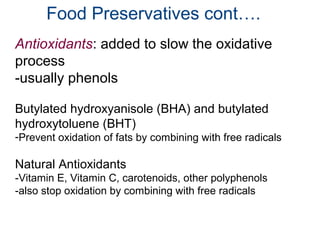
Food Preservatives cont….
Antioxidants: added to slow the oxidative
process
-usually phenols
Butylated hydroxyanisole (BHA) and butylated
hydroxytoluene (BHT)
-Prevent oxidation of fats by combining with free radicals
Natural Antioxidants
-Vitamin E, Vitamin C, carotenoids, other polyphenols
-also stop oxidation by combining with free radicals
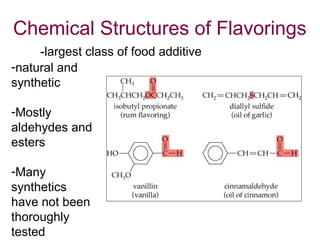
Chemical Structures of Flavorings
-largest class of food additive
-natural and
synthetic
-Mostly
aldehydes and
esters
-Many
synthetics
have not been
thoroughly
tested
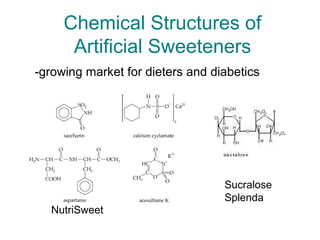
Chemical Structures of
Artificial Sweeteners
-growing market for dieters and diabetics
NutriSweet
Sucralose
Splenda
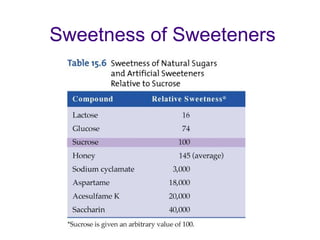
Sweetness of Sweeteners
1. How does the body store energy?
2. How many Cal of energy are released 180 grams of
glucose are converted to CO2 and H2O?
3. There are 2 fatty acids that the body needs but cannot
synthesize. What are they?
4. What is meant by a complete protein?

Nutrition intro

  • 1.
  • 2.
    Nutrition the study offood and how the body uses it Function of Nutrients: 1) supply energy 2) supply materials for building and replacing body tissues 3) supply other substances needed for various life processes
  • 3.
    Nutrition • Nutrients:Nutrients: thecomponents of food and drink that provide growth, replacement, and energy: 1. Carbohydrates 2. Lipids 3. Proteins 4. Vitamins 5. Minerals 6. Water • DigestionDigestion: the hydrolysis of starches, fats, and proteins into smaller units that can be absorbed and metabolized.
  • 4.
    DRI- Dietary Referenceindex Food and Nutrition Board, the institute of Meidcin andFood and Nutrition Board, the institute of Meidcin and the National Academy of Sciences has established thethe National Academy of Sciences has established the DRIsDRIs •EAR:EAR: adequate amount for 50% of population •EEREER: estimated energy requirements •RDA:RDA: recommended dietary allowances are adequate for most of the population based on measurable parameteres •AIAI: Adequate intakes are used when REDA & EARs are not available •ULUL: upper tolerance limit. Above would be detrimental
  • 5.
    Calorimeter • Food energyis measured in Calories (capital C) 1 Cal = 1 kcal = 1000 cal = 4180 joules • a Calorie is defined as the amount of energy required to raise 1 kg of water 1°C •Measured in a bomb calorimeter
  • 6.
    Calculating the CaloricValue of Food Carbohydrate = 4 Cal per gram Proteins = 4 Cal per gram Fats = 9 Cal per gram
  • 7.
  • 8.
    Nutrition & Health Poordiet and sedentary life style = Risk factors chronic diseases Accounts for about 66% of all deaths •Cardiovascular diseases (29%) •Cancer (22%) •Cerebrovascular diseases (7%) •Diabetes (3%)
  • 9.
    Nutritional Diseases Obesity -excessive weight gain that is associated with heath concerns and increased risk of mortality -characterized by a BMI of greater than 30 BMI (body mass index) = weight in kg divided by the square of the height in m -25% of Americans are obese -60% of Americans are overweight (BMI 25- 29.9)
  • 10.
    Nutritional Diseases Diabetes -condition in which body is unable to utilize glucose in a normal way Type I - an auto immune disease that results in the permanent destruction of insulin producing beta cells in the pancreas Type II - metabolic disorder that is usually characterized by insulin resistance, insulin deficiency and hyperglycemia -associated with obesity -Increased prevalence
  • 11.
    Is a clusterof at least three of five of the following medical conditions: •abdominal (central) obesity •Elevated fasting plasma glucose •High serum triglycerides •Low HDL •Insulin resistance – a condition in which the body does not respond properly to insulin. Metabolic syndrome
  • 12.
    • US population:9.3% • 7th leading cause of death • AI/AN: 15.9% • Alaskan Natives alone (5-9%) Type 2 diabetes
  • 13.
    • low incidenceof age and nutritional diseases • 4.8 kg subsistence foods per week • 60% of subsistence foods is finfish
  • 14.
    Human body is10-20% protein •40-50% in skeletal muscle •20% in organs •Rest in skin and blood Recommended Daily Intake: Adults: 0.8 g per kg of body weight Children and Pregnancy: 1.5-2.0 g per kg body weight Complete Protein - contains all essential amino acids -meat, eggs, dairy, fish Incomplete Protein - missing one or more essential amino acids -legumes and grains combined make a complete protein Proteins
  • 15.
    Proteins – Gelatin, whichis denatured collagen, is an incomplete protein because it lacks Trp, and is low in Ile and Met. – Corn protein is low in Lys and Trp. – Rice is low in Lys and Thr. – Wheat protein is low in Lys. – Legumes are low in Met and Cys. – Soy protein is very low in Met. Protein complementation:Protein complementation: a diet in which two or more proteins complementation each other’s deficiencies; for example: – grains + legumes (rice + beans)
  • 16.
    Fats • recommended30% of diet -10% monounsaturated -10% saturated -10% unsaturated Essential Fatty acids: Omega-3 EPA, DHA, linoleic Omega-6 Arachidonic acid, α-linolenic • EPA, DHA, AA are 20 carbon hormone-like fatty acids that play an important part in the immune function
  • 17.
    Saturated Fats inthe U.S. Diet >90% of Fas in US diet: •Palmitic (16:0) •Stearic (18:0) •Oleic (18:1) •Linoleic (18:2)
  • 18.
    Percentage of Caloriesin Common Foods
  • 19.
    Energy Needs Woman 2000Cal Men 2200 Cal -physical activity and lifestage affects energy needs -need to burn 3500 Cal to lose 1 pound Basal Caloric Requirements -the requirements for a resting body
  • 21.
    Problems with ProcessedFood • nutrients are lost in processing • some but not all nutrients are added back (Enriched) • Fortified is when other ingredients are added that were not originally the food • are lower in fiber • processed foods are digested more quickly and lend to weight gain
  • 22.
    Food Supplements - vitamins,minerals, herbal remedies, etc… -$60 billion a year industry -Balanced diet provides adequate needs -Elderly, dieters, alcoholics, pregnant, lactation may require supplementation - often supplements are not in a form that is as available as it is in food
  • 23.
  • 24.
  • 25.
    Food Additives -added toprevent spoilage, sweeten, enhance flavor, color, appearance, emulsify
  • 26.
    Food Preservatives -mostly usedto prevent food spoilage Antimicrobial: Nitrites -clostridium botulism - identified as cancer-causing Sulfites -wine and dried fruit -can cause allergic rxn Others -Na, K, Ca salts, benzoic acid, propionic acid, sorbic acid
  • 27.
    Food Preservatives cont…. Antioxidants:added to slow the oxidative process -usually phenols Butylated hydroxyanisole (BHA) and butylated hydroxytoluene (BHT) -Prevent oxidation of fats by combining with free radicals Natural Antioxidants -Vitamin E, Vitamin C, carotenoids, other polyphenols -also stop oxidation by combining with free radicals
  • 28.
    Chemical Structures ofFlavorings -largest class of food additive -natural and synthetic -Mostly aldehydes and esters -Many synthetics have not been thoroughly tested
  • 29.
    Chemical Structures of ArtificialSweeteners -growing market for dieters and diabetics NutriSweet Sucralose Splenda
  • 30.
  • 31.
    1. How doesthe body store energy? 2. How many Cal of energy are released 180 grams of glucose are converted to CO2 and H2O? 3. There are 2 fatty acids that the body needs but cannot synthesize. What are they? 4. What is meant by a complete protein?
Editor's Notes

  • #14 1800s that the phrase "mad as a hatter" was coined because of the chronic mercury exposure that the felters faced because mercury was used in hat making. Mercury toxicity in environmental pollution is a major concern because of increased usage of fossil fuels and agricultural products, both of which contain mercury. inorganic form can be further divided into elemental mercury and mercuric salts. Organic mercury can be found in long and short alkyl and aryl compounds. Mercury in any form is toxic. The difference lies in how it is absorbed, the clinical signs and symptoms, and the response to treatment modalities. Mercury poisoning can result from vapor inhalation, ingestion, injection, or absorption through the skin. Neurologic, gastrointestinal, and renal systems are the most commonly affected organ systems in mercury exposur