1
Chapter 1
Introduction to Nutrition
2
Factors Influencing What You Eat
 Flavor
 Taste
 Smell
 Appearance
 Texture
 Temperature
 Other Aspects of Food
 Cost
 Convenience
 Availability
 Familiarity
 Nutrition
3
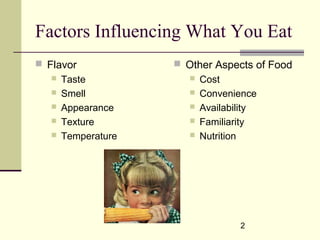
The most important consideration when
choosing something to eat is flavor.
The most important
consideration when
choosing something to
eat is flavor. (Courtesy
of PhotoDisc/Getty
Images)
4
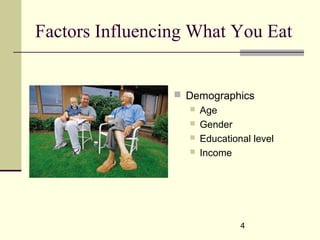
Factors Influencing What You Eat
 Demographics
 Age
 Gender
 Educational level
 Income
5
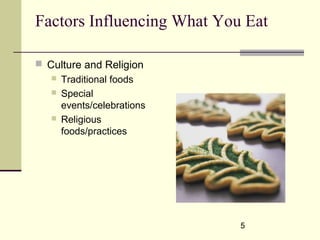
Factors Influencing What You Eat
 Culture and Religion
 Traditional foods
 Special
events/celebrations
 Religious
foods/practices
6
Factors Influencing What You Eat
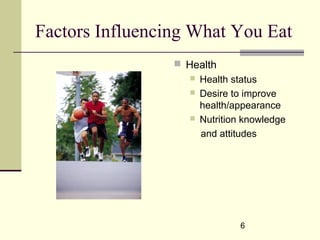
 Health
 Health status
 Desire to improve
health/appearance
 Nutrition knowledge
and attitudes
7
Factors Influencing What You Eat
 Social and Emotional
Influences
 Social status
 Peer pressure
 Emotional status
 Food associations
8
Factors Influencing What You Eat
 Food Industry and the Media
 Food industry
 Food advertising
 Food portrayal in
media
 Reporting of
nutrition/health studies
9
Factors Influencing What You Eat
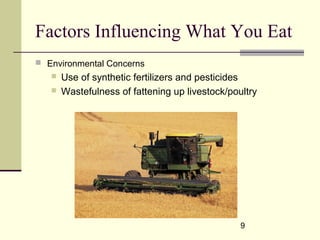
 Environmental Concerns
 Use of synthetic fertilizers and pesticides
 Wastefulness of fattening up livestock/poultry
10
What is Nutrition?
Nutrition is a science that:
 studies nutrients and other substances in
foods and in the body and how these
nutrients relate to health and disease, and
 explores why you choose particular foods and
the type of diet you eat.

11
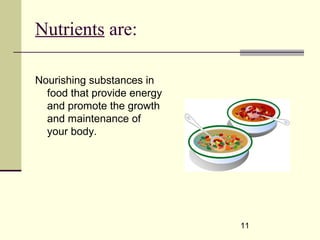
Nutrients are:
Nourishing substances in
food that provide energy
and promote the growth
and maintenance of
your body.
12
Kilocalories
 A measure of the energy in food.
 1 kilocalorie raises the temperature of 1
kilogram of water 1 degree Celsius.
 Also called a Calorie.
 Abbreviated as kcalorie or kcal.
 When you hear “calorie,” it is really a
kilocalorie.
13
The number of kilocalories you need is
based on:
 Basal metabolism (about 2/3 of total energy
needs for individuals who are not very active)
 Physical activity
 Thermic effect or specific dynamic action of
foods (5 to 10% of total energy needs)
14
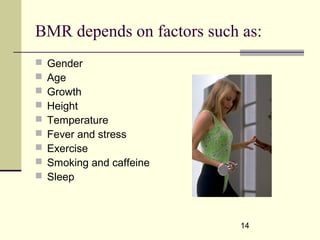
BMR depends on factors such as:
 Gender
 Age
 Growth
 Height
 Temperature
 Fever and stress
 Exercise
 Smoking and caffeine
 Sleep
15
Classes of Nutrients - Overview
 Carbohydrates
 Lipids (fats)
 Proteins
 Vitamins
 Minerals
 Water
16
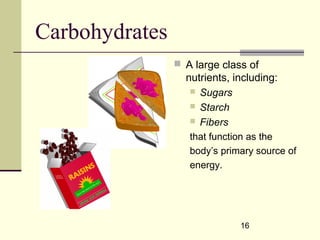
Carbohydrates
 A large class of
nutrients, including:
 Sugars
 Starch
 Fibers
that function as the
body’s primary source of
energy.
17
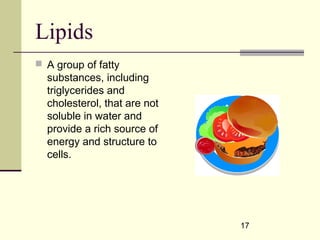
Lipids
 A group of fatty
substances, including
triglycerides and
cholesterol, that are not
soluble in water and
provide a rich source of
energy and structure to
cells.
18
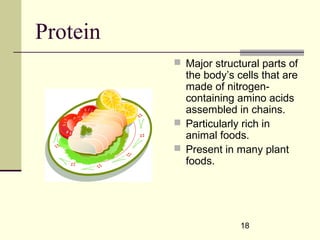
Protein
 Major structural parts of
the body’s cells that are
made of nitrogen-
containing amino acids
assembled in chains.
 Particularly rich in
animal foods.
 Present in many plant
foods.
19
Vitamins and Minerals
 Vitamins: Noncaloric,
organic nutrients found
in a wide variety of
foods that are essential
to:
 regulate body
processes.
 maintain the body.
 allow growth and
reproduction.
 Minerals: Noncaloric,
inorganic nutrients
found in a wide variety
of foods that are
essential to:
 regulate body
processes.
 maintain the body.
 allow growth and
reproduction.
20
Water
 Inorganic nutrient that
plays a vital role in all
bodily processes and
makes up just over half
of the body’s weight.
21
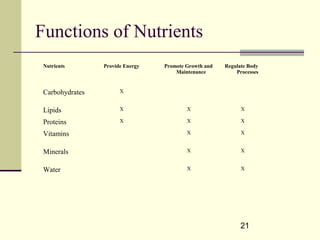
Functions of Nutrients
Nutrients Provide Energy Promote Growth and
Maintenance
Regulate Body
Processes
Carbohydrates X
Lipids X X X
Proteins X X X
Vitamins X X
Minerals X X
Water X X
22
Food Facts
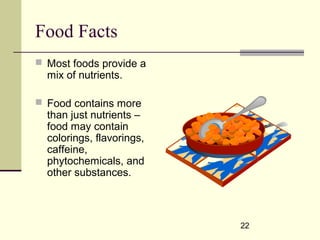
 Most foods provide a
mix of nutrients.
 Food contains more
than just nutrients –
food may contain
colorings, flavorings,
caffeine,
phytochemicals, and
other substances.
23
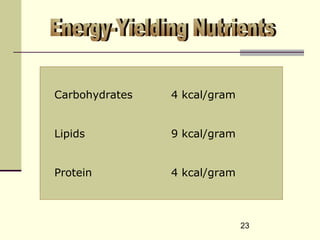
Carbohydrates 4 kcal/gram
Lipids 9 kcal/gram
Protein 4 kcal/gram
24
More Vocabulary
 Micronutrients
 Macronutrients
 Organic nutrients
 Inorganic nutrients
 Carbohydrates
 Lipids
 Proteins
 Vitamins
 Minerals
 Water
25
Essential Nutrients
Nutrients that either cannot be made in the
body or cannot be made in the quantities
needed by the body; therefore, we must obtain
them through food.
EXAMPLES
Glucose, vitamins, minerals, water, some lipids,
and some parts of protein.
26
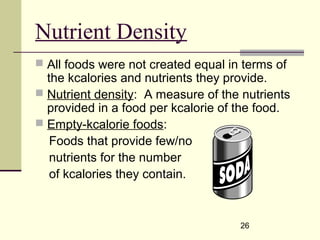
Nutrient Density
 All foods were not created equal in terms of
the kcalories and nutrients they provide.
 Nutrient density: A measure of the nutrients
provided in a food per kcalorie of the food.
 Empty-kcalorie foods:
Foods that provide few/no
nutrients for the number
of kcalories they contain.
27
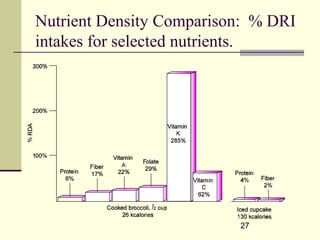
Nutrient Density Comparison: % DRI
intakes for selected nutrients.
28
Characteristics of A Nutritious Diet
 Adequate
 Balanced
 Moderate
 Varied
29
Dietary Reference Intakes (DRI)
 Recommended Dietary Allowance (RDA)
Intake value sufficient to meet nutrient requirements of 97-98% of all
healthy individuals in a group.
 Adequate Intake (AI)
Intake value used when a RDA cannot be based on an EAR because
there’s not enough scientific data.
 Tolerable Upper Intake Level (UL)
Maximum intake level above which toxicity would increase.
 Estimated Average Requirement (EAR)
Intake value estimated to meet requirement of half the healthy
individuals in a group.
30
Dietary Reference Intakes
 Estimated Energy Requirement (EER)
The dietary energy intake measured in kcalories that
is needed to maintain energy balance in a healthy
adult.
 Acceptable Macronutrient Distribution Ranges
(AMDR)
A range of intakes for a particular nutrient that is
associated with reduced risk of chronic disease while
providing adequate intake.
Adults: 45-65% of kcal from carbohydrates, 20-35% from fat,
and 10 to 35% from protein.
31
Dietary Reference Intakes
 RDA and AI – useful in planning diets for
individuals
 EAR - useful in planning diets for groups
32
Digestion, Absorption, & Metabolism
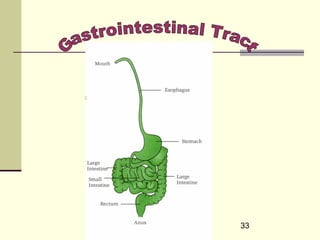
 Digestion: Process by which food is broken down
into its components in the gastrointestinal tract with
the help of digestive enzymes.
 Absorption: The passage of digested nutrients
through the walls of the intestines or stomach into the
blood or lymph, where they are transported to the
cells.
 Metabolism: All the chemical processes by which
nutrients are used to support life, includes anabolism
and catabolism.
33
34
Food Basics
1. Whole foods
2. Fresh foods
3. Organic foods
4. Processed foods
5. Enriched foods
6. Fortified foods
35
Organic Foods
 Organic food is produced without using most:
 Conventional pesticides
 Petroleum-based fertilizers or sewage sludge-
based fertilizers
 Bioengineering
 Ionizing radiation (irradiation)
 Organic farms must be inspected annually.
 All organically-raised animals may not be
given hormones or antibiotics, and must have
access to pasture.
36
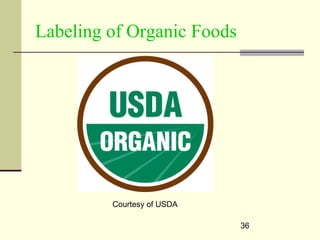
Labeling of Organic Foods
Courtesy of USDA
37
Clip art images may not be saved or downloaded and
are only to be used for viewing purposes.
Copyright ©2007 John Wiley & Sons, Inc.

oldPpt 01

  • 1.
  • 2.
    2 Factors Influencing WhatYou Eat  Flavor  Taste  Smell  Appearance  Texture  Temperature  Other Aspects of Food  Cost  Convenience  Availability  Familiarity  Nutrition
  • 3.
    3 The most importantconsideration when choosing something to eat is flavor. The most important consideration when choosing something to eat is flavor. (Courtesy of PhotoDisc/Getty Images)
  • 4.
    4 Factors Influencing WhatYou Eat  Demographics  Age  Gender  Educational level  Income
  • 5.
    5 Factors Influencing WhatYou Eat  Culture and Religion  Traditional foods  Special events/celebrations  Religious foods/practices
  • 6.
    6 Factors Influencing WhatYou Eat  Health  Health status  Desire to improve health/appearance  Nutrition knowledge and attitudes
  • 7.
    7 Factors Influencing WhatYou Eat  Social and Emotional Influences  Social status  Peer pressure  Emotional status  Food associations
  • 8.
    8 Factors Influencing WhatYou Eat  Food Industry and the Media  Food industry  Food advertising  Food portrayal in media  Reporting of nutrition/health studies
  • 9.
    9 Factors Influencing WhatYou Eat  Environmental Concerns  Use of synthetic fertilizers and pesticides  Wastefulness of fattening up livestock/poultry
  • 10.
    10 What is Nutrition? Nutritionis a science that:  studies nutrients and other substances in foods and in the body and how these nutrients relate to health and disease, and  explores why you choose particular foods and the type of diet you eat.
  • 11.
    11 Nutrients are: Nourishing substancesin food that provide energy and promote the growth and maintenance of your body.
  • 12.
    12 Kilocalories  A measureof the energy in food.  1 kilocalorie raises the temperature of 1 kilogram of water 1 degree Celsius.  Also called a Calorie.  Abbreviated as kcalorie or kcal.  When you hear “calorie,” it is really a kilocalorie.
  • 13.
    13 The number ofkilocalories you need is based on:  Basal metabolism (about 2/3 of total energy needs for individuals who are not very active)  Physical activity  Thermic effect or specific dynamic action of foods (5 to 10% of total energy needs)
  • 14.
    14 BMR depends onfactors such as:  Gender  Age  Growth  Height  Temperature  Fever and stress  Exercise  Smoking and caffeine  Sleep
  • 15.
    15 Classes of Nutrients- Overview  Carbohydrates  Lipids (fats)  Proteins  Vitamins  Minerals  Water
  • 16.
    16 Carbohydrates  A largeclass of nutrients, including:  Sugars  Starch  Fibers that function as the body’s primary source of energy.
  • 17.
    17 Lipids  A groupof fatty substances, including triglycerides and cholesterol, that are not soluble in water and provide a rich source of energy and structure to cells.
  • 18.
    18 Protein  Major structuralparts of the body’s cells that are made of nitrogen- containing amino acids assembled in chains.  Particularly rich in animal foods.  Present in many plant foods.
  • 19.
    19 Vitamins and Minerals Vitamins: Noncaloric, organic nutrients found in a wide variety of foods that are essential to:  regulate body processes.  maintain the body.  allow growth and reproduction.  Minerals: Noncaloric, inorganic nutrients found in a wide variety of foods that are essential to:  regulate body processes.  maintain the body.  allow growth and reproduction.
  • 20.
    20 Water  Inorganic nutrientthat plays a vital role in all bodily processes and makes up just over half of the body’s weight.
  • 21.
    21 Functions of Nutrients NutrientsProvide Energy Promote Growth and Maintenance Regulate Body Processes Carbohydrates X Lipids X X X Proteins X X X Vitamins X X Minerals X X Water X X
  • 22.
    22 Food Facts  Mostfoods provide a mix of nutrients.  Food contains more than just nutrients – food may contain colorings, flavorings, caffeine, phytochemicals, and other substances.
  • 23.
    23 Carbohydrates 4 kcal/gram Lipids9 kcal/gram Protein 4 kcal/gram
  • 24.
    24 More Vocabulary  Micronutrients Macronutrients  Organic nutrients  Inorganic nutrients  Carbohydrates  Lipids  Proteins  Vitamins  Minerals  Water
  • 25.
    25 Essential Nutrients Nutrients thateither cannot be made in the body or cannot be made in the quantities needed by the body; therefore, we must obtain them through food. EXAMPLES Glucose, vitamins, minerals, water, some lipids, and some parts of protein.
  • 26.
    26 Nutrient Density  Allfoods were not created equal in terms of the kcalories and nutrients they provide.  Nutrient density: A measure of the nutrients provided in a food per kcalorie of the food.  Empty-kcalorie foods: Foods that provide few/no nutrients for the number of kcalories they contain.
  • 27.
    27 Nutrient Density Comparison:% DRI intakes for selected nutrients.
  • 28.
    28 Characteristics of ANutritious Diet  Adequate  Balanced  Moderate  Varied
  • 29.
    29 Dietary Reference Intakes(DRI)  Recommended Dietary Allowance (RDA) Intake value sufficient to meet nutrient requirements of 97-98% of all healthy individuals in a group.  Adequate Intake (AI) Intake value used when a RDA cannot be based on an EAR because there’s not enough scientific data.  Tolerable Upper Intake Level (UL) Maximum intake level above which toxicity would increase.  Estimated Average Requirement (EAR) Intake value estimated to meet requirement of half the healthy individuals in a group.
  • 30.
    30 Dietary Reference Intakes Estimated Energy Requirement (EER) The dietary energy intake measured in kcalories that is needed to maintain energy balance in a healthy adult.  Acceptable Macronutrient Distribution Ranges (AMDR) A range of intakes for a particular nutrient that is associated with reduced risk of chronic disease while providing adequate intake. Adults: 45-65% of kcal from carbohydrates, 20-35% from fat, and 10 to 35% from protein.
  • 31.
    31 Dietary Reference Intakes RDA and AI – useful in planning diets for individuals  EAR - useful in planning diets for groups
  • 32.
    32 Digestion, Absorption, &Metabolism  Digestion: Process by which food is broken down into its components in the gastrointestinal tract with the help of digestive enzymes.  Absorption: The passage of digested nutrients through the walls of the intestines or stomach into the blood or lymph, where they are transported to the cells.  Metabolism: All the chemical processes by which nutrients are used to support life, includes anabolism and catabolism.
  • 33.
  • 34.
    34 Food Basics 1. Wholefoods 2. Fresh foods 3. Organic foods 4. Processed foods 5. Enriched foods 6. Fortified foods
  • 35.
    35 Organic Foods  Organicfood is produced without using most:  Conventional pesticides  Petroleum-based fertilizers or sewage sludge- based fertilizers  Bioengineering  Ionizing radiation (irradiation)  Organic farms must be inspected annually.  All organically-raised animals may not be given hormones or antibiotics, and must have access to pasture.
  • 36.
    36 Labeling of OrganicFoods Courtesy of USDA
  • 37.
    37 Clip art imagesmay not be saved or downloaded and are only to be used for viewing purposes. Copyright ©2007 John Wiley & Sons, Inc.