APPLICATION OF ASPEN GUIDELINES FOR
INTIATING TPN: A CASE OF SPONTANEOUS
NONTRAUMATIC HEMOPERITONEUM
By Liz Borders
BACKGROUND INFORMATION
o 65 year old Caucasian male
o Married; Businessman
o Denies any past medical history
o Past surgical history:
o Multiple inguinal hernia repairs
o Lipoma excision
o Appeared physically well-nourished
o 5’ 8” or 68”
o 175 lbs or 79 kg
o BMI of 26 kg/m2
o BMI within normal limits for age
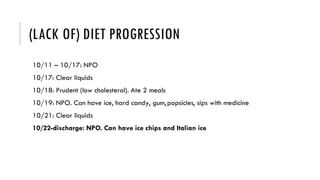
(LACK OF) DIET PROGRESSION
10/11 – 10/17: NPO
10/17: Clear liquids
10/18: Prudent (low cholesterol). Ate 2 meals
10/19: NPO. Can have ice, hard candy, gum, popsicles, sips with medicine
10/21: Clear liquids
10/22-discharge: NPO. Can have ice chips and Italian ice
COURSE OF HOSPITAL STAY
o 10/11 – Came to the emergency department with complaints of abdominal pain
and some non-bloody emesis
o CT of abdomen and pelvis showed significant amount of hemoperitoneum
o Became hypotensive and tachycardic and required massive blood transfusion
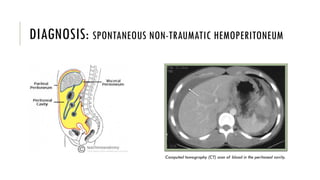
DIAGNOSIS: SPONTANEOUS NON-TRAUMATIC HEMOPERITONEUM
Computed tomography (CT) scan of blood in the peritoneal cavity.
COURSE OF HOSPITAL STAY
o10/11 – Admitted to ED, dx CT showing hemoperitoneum
oBecame hypotensive and tachycardic and required massive blood transfusion
o 10/11 - Exploratory laparotomy (ex-lap) with omental resection, small bowel
resection, repair of serosal tears
o Abdomen left open – patient was unstable and surgeons wanted to prevent abdominal
compartment syndrome. Wound VAC was placed
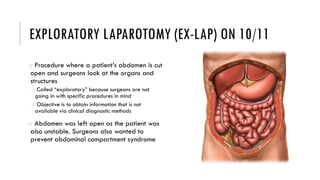
EXPLORATORY LAPAROTOMY (EX-LAP) ON 10/11
o Procedure where a patient’s abdomen is cut
open and surgeons look at the organs and
structures
o Called “exploratory” because surgeons are not
going in with specific procedures in mind
o Objective is to obtain information that is not
available via clinical diagnostic methods
o Abdomen was left open as the patient was
also unstable. Surgeons also wanted to
prevent abdominal compartment syndrome
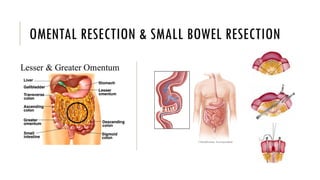
OMENTAL RESECTION & SMALL BOWEL RESECTION
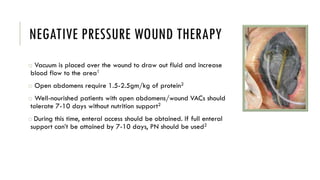
NEGATIVE PRESSURE WOUND THERAPY
o Vacuum is placed over the wound to draw out fluid and increase
blood flow to the area1
o Open abdomens require 1.5-2.5gm/kg of protein2
o Well-nourished patients with open abdomens/wound VACs should
tolerate 7-10 days without nutrition support2
o During this time, enteral access should be obtained. If full enteral
support can’t be attained by 7-10 days, PN should be used2
COURSE OF HOSPITAL STAY
o 10/11 – Admitted to ED, dx CT showing hemoperitoneum
oBecame hypotensive and tachycardic and required massive blood transfusion
o 10/11 – Ex-lap with omental resection, small bowel resection, repair of serosal
tears
o Abdomen left open as patient was unstable, and wound VAC was placed
o10/11 – Patient had post-operative ST-segment elevation myocardial infarction
(STEMI)
ST-ELEVATED MYOCARDIAL INFARCTION (STEMI)
o Also known as a heart attack. Occurs when the blood flow to the heart is stopped
o STEMI occurs by developing a complete occlusion of a major coronary artery
previously affected by atherosclerosis
o Cardiac complications occur in up to 5% of patients 45 years or older
o Myocardial infarction is the most common complication4
COURSE OF HOSPITAL STAY
o 10/11 – Admitted to ED, dx CT showing hemoperitoneum
oBecame hypotensive and tachycardic and required massive blood transfusion
o 10/11 – Ex-lap with omental resection, small bowel resection, repair of serosal tears
o Abdomen left open as patient was unstable, and wound VAC was placed
o 10/11 – Patient had post-operative ST-segment elevation myocardial infarction (STEMI)
o 10/12 – Initial nutrition assessment
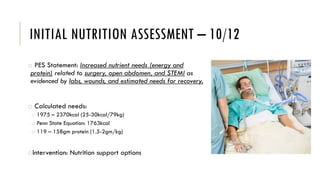
INITIAL NUTRITION ASSESSMENT – 10/12
o PES Statement: Increased nutrient needs (energy and
protein) related to surgery, open abdomen, and STEMI as
evidenced by labs, wounds, and estimated needs for recovery.
o Calculated needs:
o 1975 – 2370kcal (25-30kcal/79kg)
o Penn State Equation: 1763kcal
o 119 – 158gm protein (1.5-2gm/kg)
oIntervention: Nutrition support options
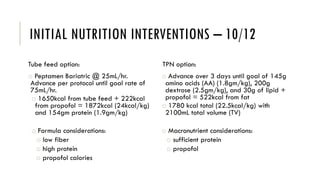
INITIAL NUTRITION INTERVENTIONS – 10/12
Tube feed option:
o Peptamen Bariatric @ 25mL/hr.
Advance per protocol until goal rate of
75mL/hr.
o 1650kcal from tube feed + 222kcal
from propofol = 1872kcal (24kcal/kg)
and 154gm protein (1.9gm/kg)
o Formula considerations:
o low fiber
o high protein
o propofol calories
TPN option:
o Advance over 3 days until goal of 145g
amino acids (AA) (1.8gm/kg), 200g
dextrose (2.5gm/kg), and 30g of lipid +
propofol = 522kcal from fat
o 1780 kcal total (22.5kcal/kg) with
2100mL total volume (TV)
o Macronutrient considerations:
o sufficient protein
o propofol
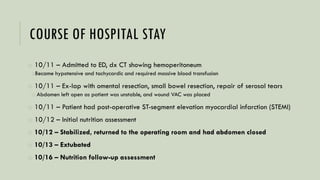
COURSE OF HOSPITAL STAY
o 10/11 – Admitted to ED, dx CT showing hemoperitoneum
oBecame hypotensive and tachycardic and required massive blood transfusion
o 10/11 – Ex-lap with omental resection, small bowel resection, repair of serosal tears
o Abdomen left open as patient was unstable, and wound VAC was placed
o 10/11 – Patient had post-operative ST-segment elevation myocardial infarction (STEMI)
o 10/12 – Initial nutrition assessment
o 10/12 – Stabilized, returned to the operating room and had abdomen closed
o 10/13 – Extubated
o 10/16 – Nutrition follow-up assessment
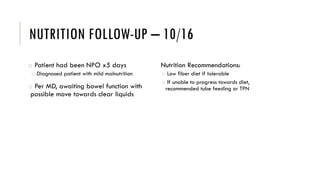
NUTRITION FOLLOW-UP – 10/16
o Patient had been NPO x5 days
o Diagnosed patient with mild malnutrition
o Per MD, awaiting bowel function with
possible move towards clear liquids
Nutrition Recommendations:
o Low fiber diet if tolerable
o If unable to progress towards diet,
recommended tube feeding or TPN
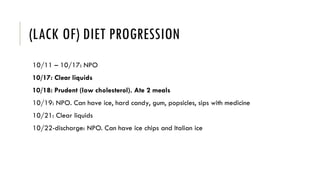
(LACK OF) DIET PROGRESSION
10/11 – 10/17: NPO
10/17: Clear liquids
10/18: Prudent (low cholesterol). Ate 2 meals
10/19: NPO. Can have ice, hard candy, gum, popsicles, sips with medicine
10/21: Clear liquids
10/22-discharge: NPO. Can have ice chips and Italian ice
COURSE OF HOSPITAL STAY
o 10/16 – Nutrition follow-up assessment
o 10/18 – Abdominal X-ray noted ileus
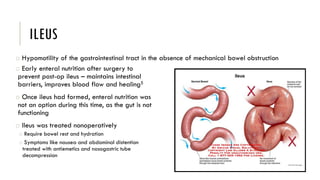
ILEUS
o Early enteral nutrition after surgery to
prevent post-op ileus – maintains intestinal
barriers, improves blood flow and healing5
o Once ileus had formed, enteral nutrition was
not an option during this time, as the gut is not
functioning
o Ileus was treated nonoperatively
o Require bowel rest and hydration
o Symptoms like nausea and abdominal distention
treated with antiemetics and nasogastric tube
decompression
o Hypomotility of the gastrointestinal tract in the absence of mechanical bowel obstruction
(LACK OF) DIET PROGRESSION
10/11 – 10/17: NPO
10/17: Clear liquids
10/18: Prudent (low cholesterol). Ate 2 meals
10/19: NPO. Can have ice, hard candy, gum, popsicles, sips with medicine
10/21: Clear liquids
10/22-discharge: NPO. Can have ice chips and Italian ice
COURSE OF HOSPITAL STAY
o 10/16 – Nutrition follow-up assessment
o 10/18 – X-ray noted ileus
o 10/21 – Developed anastomotic leak and had ex-lap for lysis of adhesions
(LoA), abscess drainage, fibrin reinforcement of staple line
EX-LAP ON 10/21
o Patient was having some return of bowel function in the form of loose, liquid stools
o It was decided to perform a CT scan due to continued delay of full bowel function
and sustained leukocytosis
o Discovered fluid collection from a bowel anastomosis
o Surgeons were forced to perform another ex-lap to drain the purulent collection of
fluid from the abdomen, lyse adhesions, and reinforce the anastomosis’ staple line
COURSE OF HOSPITAL STAY
o 10/16 – Nutrition follow-up assessment
o 10/18 – X-ray noted ileus
o 10/21 – Developed anastomotic leak and had ex-lap for lysis of adhesions (LoA),
abscess drainage, fibrin reinforcement of staple line
o 10/22 – Nutrition follow-up. Started on total parenteral nutrition (TPN)
NUTRITION FOLLOW UP – 10/22
oPatient had been NPO or on clears for 11 days
o Diagnosed patient with moderate malnutrition
o Spoke with doctor about urgent need for nutrition
o As patient did not have a functioning bowel (small bowel resection, ileus, anastomotic leak), TPN was
the only option
In the patient who was previously healthy prior to critical illness with no evidence
of protein-calorie malnutrition, use of PN should be reserved and initiated only
after the first 7 days of hospitalization (when EN is not available).3
PN therapy provided for a duration of <5-7 days would be expected to have
no outcome effect and may result in increased risk to the patient. Thus, PN should
be initiated only if the duration of therapy is anticipated to be ≥7 days.3
NUTRITION FOLLOW UP – 10/22
o New PES statement: Malnutrition related to decreased intakes, surgery, and altered GI
as evidenced by NPO/clears x11 days except 2 meals, wounds, labs, and calculated
needs.
o Patient had developed acute post-op moderate energy malnutrition from lack of
nutrition for over a week, wounds, labs, and calculated needs
o Recommended slow advancement of TPN to prevent refeeding syndrome6
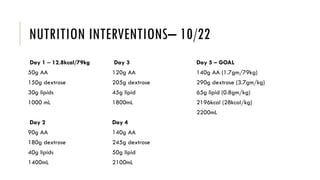
NUTRITION INTERVENTIONS– 10/22
Day 1 – 12.8kcal/79kg
50g AA
150g dextrose
30g lipids
1000 mL
Day 2
90g AA
180g dextrose
40g lipids
1400mL
Day 3
120g AA
205g dextrose
45g lipid
1800mL
Day 4
140g AA
245g dextrose
50g lipid
2100mL
Day 5 – GOAL
140g AA (1.7gm/79kg)
290g dextrose (3.7gm/kg)
65g lipid (0.8gm/kg)
2196kcal (28kcal/kg)
2200mL
(LACK OF) DIET PROGRESSION
10/11 – 10/17: NPO
10/17: Clear liquids
10/18: Prudent (low cholesterol). Ate 2 meals
10/19: NPO. Can have ice, hard candy, gum,popsicles, sips with medicine
10/21: Clear liquids
10/22-discharge: NPO. Can have ice chips and Italian ice
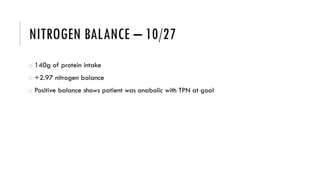
NITROGEN BALANCE – 10/27
o 140g of protein intake
o +2.97 nitrogen balance
o Positive balance shows patient was anabolic with TPN at goal
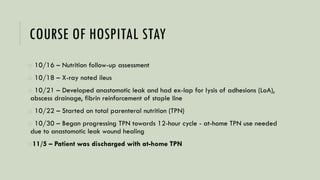
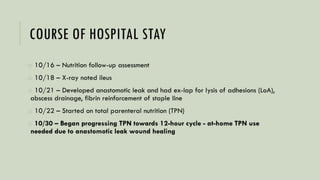
COURSE OF HOSPITAL STAY
o 10/16 – Nutrition follow-up assessment
o 10/18 – X-ray noted ileus
o 10/21 – Developed anastomotic leak and had ex-lap for lysis of adhesions (LoA),
abscess drainage, fibrin reinforcement of staple line
o 10/22 – Started on total parenteral nutrition (TPN)
o 10/30 – Began progressing TPN towards 12-hour cycle - at-home TPN use
needed due to anastomotic leak wound healing
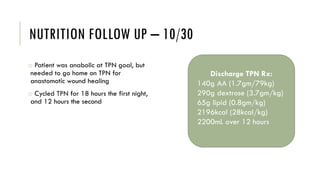
NUTRITION FOLLOW UP – 10/30
o Patient was anabolic at TPN goal, but
needed to go home on TPN for
anastomotic wound healing
o Cycled TPN for 18 hours the first night,
and 12 hours the second
Discharge TPN Rx:
140g AA (1.7gm/79kg)
290g dextrose (3.7gm/kg)
65g lipid (0.8gm/kg)
2196kcal (28kcal/kg)
2200mL over 12 hours
COURSE OF HOSPITAL STAY
o 10/16 – Nutrition follow-up assessment
o 10/18 – X-ray noted ileus
o 10/21 – Developed anastomotic leak and had ex-lap for lysis of adhesions (LoA),
abscess drainage, fibrin reinforcement of staple line
o 10/22 – Started on total parenteral nutrition (TPN)
o 10/30 – Began progressing TPN towards 12-hour cycle - at-home TPN use needed
due to anastomotic leak wound healing
o11/5 – Patient was discharged with at-home TPN
USING TPN WHEN THE GUT IS NOT FUNCTIONING
o Although using enteral nutrition is preferred, sometimes it is not an option
o If the GI tract is not functioning, TPN use may be needed
o Per ASPEN guidelines, TPN should not be used until around 7 days after admission
o This patient did not receive TPN until 11 days, so he was acutely malnourished post-
operatively
o However, he reached an anabolic state soon after reaching TPN goal
o Patient was on TPN for greater than 5-7 days, so guidelines show this as a
beneficial treatment to the patient
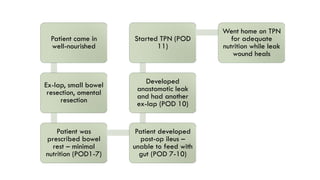
Patient came in
well-nourished
Ex-lap, small bowel
resection, omental
resection
Patient was
prescribed bowel
rest – minimal
nutrition (POD1-7)
Patient developed
post-op ileus –
unable to feed with
gut (POD 7-10)
Developed
anastomotic leak
and had another
ex-lap (POD 10)
Started TPN (POD
11)
Went home on TPN
for adequate
nutrition while leak
wound heals
WHAT DID I LEARN
o Post-op malnutrition
o Using TPN before tube feeding
o Early enteral nutrition as a possible benefit after
abdominal/intestinal surgery
REFERENCES
1. Gestring, M. Negative pressure wound therapy. In: UpToDate, Post TW (Ed), UpToDate,
Waltham, A. (Accessed on December 6, 2015.)
2. Friese, R. S. (2012). The open abdomen: Definitinos, management principles, and nutrition
support considerations. JPEN J Parenter Enteral Nutr, 27(4), 492-498.
3. McClave, S. A. et. al. (2009). Guidelines for the provision and assessment of nutrition
support therapy in the adult critically ill patient. JPEN J Parenter Enteral Nutr, 33(3), 277-
316.
4. Devereaux, PJ. Perioperative myocardial infarction after noncardiac surgery. In: UpToDate,
Post TW (Ed), UpToDate, Waltham, A. (Accessed December 6, 2015).
5. Warren, J. et. al. (2011). Postoperative diet advancement: surgical dogma vs evidence-
based medicine. JPEN J Parenter Enteral Nutr, 26(2), 115-125.
6. Boateng A. et. al. (2010). Refeeding syndrome: Treatment considerations based on
collective analysis of literature case reports. Elsevier Nutr, 26, 156-167.

liz borders case study ppt

  • 1.
    APPLICATION OF ASPENGUIDELINES FOR INTIATING TPN: A CASE OF SPONTANEOUS NONTRAUMATIC HEMOPERITONEUM By Liz Borders
  • 2.
    BACKGROUND INFORMATION o 65year old Caucasian male o Married; Businessman o Denies any past medical history o Past surgical history: o Multiple inguinal hernia repairs o Lipoma excision o Appeared physically well-nourished o 5’ 8” or 68” o 175 lbs or 79 kg o BMI of 26 kg/m2 o BMI within normal limits for age
  • 3.
    (LACK OF) DIETPROGRESSION 10/11 – 10/17: NPO 10/17: Clear liquids 10/18: Prudent (low cholesterol). Ate 2 meals 10/19: NPO. Can have ice, hard candy, gum, popsicles, sips with medicine 10/21: Clear liquids 10/22-discharge: NPO. Can have ice chips and Italian ice
  • 4.
    COURSE OF HOSPITALSTAY o 10/11 – Came to the emergency department with complaints of abdominal pain and some non-bloody emesis o CT of abdomen and pelvis showed significant amount of hemoperitoneum o Became hypotensive and tachycardic and required massive blood transfusion
  • 5.
    DIAGNOSIS: SPONTANEOUS NON-TRAUMATICHEMOPERITONEUM Computed tomography (CT) scan of blood in the peritoneal cavity.
  • 6.
    COURSE OF HOSPITALSTAY o10/11 – Admitted to ED, dx CT showing hemoperitoneum oBecame hypotensive and tachycardic and required massive blood transfusion o 10/11 - Exploratory laparotomy (ex-lap) with omental resection, small bowel resection, repair of serosal tears o Abdomen left open – patient was unstable and surgeons wanted to prevent abdominal compartment syndrome. Wound VAC was placed
  • 7.
    EXPLORATORY LAPAROTOMY (EX-LAP)ON 10/11 o Procedure where a patient’s abdomen is cut open and surgeons look at the organs and structures o Called “exploratory” because surgeons are not going in with specific procedures in mind o Objective is to obtain information that is not available via clinical diagnostic methods o Abdomen was left open as the patient was also unstable. Surgeons also wanted to prevent abdominal compartment syndrome
  • 8.
    OMENTAL RESECTION &SMALL BOWEL RESECTION
  • 9.
    NEGATIVE PRESSURE WOUNDTHERAPY o Vacuum is placed over the wound to draw out fluid and increase blood flow to the area1 o Open abdomens require 1.5-2.5gm/kg of protein2 o Well-nourished patients with open abdomens/wound VACs should tolerate 7-10 days without nutrition support2 o During this time, enteral access should be obtained. If full enteral support can’t be attained by 7-10 days, PN should be used2
  • 10.
    COURSE OF HOSPITALSTAY o 10/11 – Admitted to ED, dx CT showing hemoperitoneum oBecame hypotensive and tachycardic and required massive blood transfusion o 10/11 – Ex-lap with omental resection, small bowel resection, repair of serosal tears o Abdomen left open as patient was unstable, and wound VAC was placed o10/11 – Patient had post-operative ST-segment elevation myocardial infarction (STEMI)
  • 11.
    ST-ELEVATED MYOCARDIAL INFARCTION(STEMI) o Also known as a heart attack. Occurs when the blood flow to the heart is stopped o STEMI occurs by developing a complete occlusion of a major coronary artery previously affected by atherosclerosis o Cardiac complications occur in up to 5% of patients 45 years or older o Myocardial infarction is the most common complication4
  • 12.
    COURSE OF HOSPITALSTAY o 10/11 – Admitted to ED, dx CT showing hemoperitoneum oBecame hypotensive and tachycardic and required massive blood transfusion o 10/11 – Ex-lap with omental resection, small bowel resection, repair of serosal tears o Abdomen left open as patient was unstable, and wound VAC was placed o 10/11 – Patient had post-operative ST-segment elevation myocardial infarction (STEMI) o 10/12 – Initial nutrition assessment
  • 13.
    INITIAL NUTRITION ASSESSMENT– 10/12 o PES Statement: Increased nutrient needs (energy and protein) related to surgery, open abdomen, and STEMI as evidenced by labs, wounds, and estimated needs for recovery. o Calculated needs: o 1975 – 2370kcal (25-30kcal/79kg) o Penn State Equation: 1763kcal o 119 – 158gm protein (1.5-2gm/kg) oIntervention: Nutrition support options
  • 14.
    INITIAL NUTRITION INTERVENTIONS– 10/12 Tube feed option: o Peptamen Bariatric @ 25mL/hr. Advance per protocol until goal rate of 75mL/hr. o 1650kcal from tube feed + 222kcal from propofol = 1872kcal (24kcal/kg) and 154gm protein (1.9gm/kg) o Formula considerations: o low fiber o high protein o propofol calories TPN option: o Advance over 3 days until goal of 145g amino acids (AA) (1.8gm/kg), 200g dextrose (2.5gm/kg), and 30g of lipid + propofol = 522kcal from fat o 1780 kcal total (22.5kcal/kg) with 2100mL total volume (TV) o Macronutrient considerations: o sufficient protein o propofol
  • 15.
    COURSE OF HOSPITALSTAY o 10/11 – Admitted to ED, dx CT showing hemoperitoneum oBecame hypotensive and tachycardic and required massive blood transfusion o 10/11 – Ex-lap with omental resection, small bowel resection, repair of serosal tears o Abdomen left open as patient was unstable, and wound VAC was placed o 10/11 – Patient had post-operative ST-segment elevation myocardial infarction (STEMI) o 10/12 – Initial nutrition assessment o 10/12 – Stabilized, returned to the operating room and had abdomen closed o 10/13 – Extubated o 10/16 – Nutrition follow-up assessment
  • 16.
    NUTRITION FOLLOW-UP –10/16 o Patient had been NPO x5 days o Diagnosed patient with mild malnutrition o Per MD, awaiting bowel function with possible move towards clear liquids Nutrition Recommendations: o Low fiber diet if tolerable o If unable to progress towards diet, recommended tube feeding or TPN
  • 17.
    (LACK OF) DIETPROGRESSION 10/11 – 10/17: NPO 10/17: Clear liquids 10/18: Prudent (low cholesterol). Ate 2 meals 10/19: NPO. Can have ice, hard candy, gum, popsicles, sips with medicine 10/21: Clear liquids 10/22-discharge: NPO. Can have ice chips and Italian ice
  • 18.
    COURSE OF HOSPITALSTAY o 10/16 – Nutrition follow-up assessment o 10/18 – Abdominal X-ray noted ileus
  • 19.
    ILEUS o Early enteralnutrition after surgery to prevent post-op ileus – maintains intestinal barriers, improves blood flow and healing5 o Once ileus had formed, enteral nutrition was not an option during this time, as the gut is not functioning o Ileus was treated nonoperatively o Require bowel rest and hydration o Symptoms like nausea and abdominal distention treated with antiemetics and nasogastric tube decompression o Hypomotility of the gastrointestinal tract in the absence of mechanical bowel obstruction
  • 20.
    (LACK OF) DIETPROGRESSION 10/11 – 10/17: NPO 10/17: Clear liquids 10/18: Prudent (low cholesterol). Ate 2 meals 10/19: NPO. Can have ice, hard candy, gum, popsicles, sips with medicine 10/21: Clear liquids 10/22-discharge: NPO. Can have ice chips and Italian ice
  • 21.
    COURSE OF HOSPITALSTAY o 10/16 – Nutrition follow-up assessment o 10/18 – X-ray noted ileus o 10/21 – Developed anastomotic leak and had ex-lap for lysis of adhesions (LoA), abscess drainage, fibrin reinforcement of staple line
  • 22.
    EX-LAP ON 10/21 oPatient was having some return of bowel function in the form of loose, liquid stools o It was decided to perform a CT scan due to continued delay of full bowel function and sustained leukocytosis o Discovered fluid collection from a bowel anastomosis o Surgeons were forced to perform another ex-lap to drain the purulent collection of fluid from the abdomen, lyse adhesions, and reinforce the anastomosis’ staple line
  • 23.
    COURSE OF HOSPITALSTAY o 10/16 – Nutrition follow-up assessment o 10/18 – X-ray noted ileus o 10/21 – Developed anastomotic leak and had ex-lap for lysis of adhesions (LoA), abscess drainage, fibrin reinforcement of staple line o 10/22 – Nutrition follow-up. Started on total parenteral nutrition (TPN)
  • 24.
    NUTRITION FOLLOW UP– 10/22 oPatient had been NPO or on clears for 11 days o Diagnosed patient with moderate malnutrition o Spoke with doctor about urgent need for nutrition o As patient did not have a functioning bowel (small bowel resection, ileus, anastomotic leak), TPN was the only option In the patient who was previously healthy prior to critical illness with no evidence of protein-calorie malnutrition, use of PN should be reserved and initiated only after the first 7 days of hospitalization (when EN is not available).3 PN therapy provided for a duration of <5-7 days would be expected to have no outcome effect and may result in increased risk to the patient. Thus, PN should be initiated only if the duration of therapy is anticipated to be ≥7 days.3
  • 25.
    NUTRITION FOLLOW UP– 10/22 o New PES statement: Malnutrition related to decreased intakes, surgery, and altered GI as evidenced by NPO/clears x11 days except 2 meals, wounds, labs, and calculated needs. o Patient had developed acute post-op moderate energy malnutrition from lack of nutrition for over a week, wounds, labs, and calculated needs o Recommended slow advancement of TPN to prevent refeeding syndrome6
  • 26.
    NUTRITION INTERVENTIONS– 10/22 Day1 – 12.8kcal/79kg 50g AA 150g dextrose 30g lipids 1000 mL Day 2 90g AA 180g dextrose 40g lipids 1400mL Day 3 120g AA 205g dextrose 45g lipid 1800mL Day 4 140g AA 245g dextrose 50g lipid 2100mL Day 5 – GOAL 140g AA (1.7gm/79kg) 290g dextrose (3.7gm/kg) 65g lipid (0.8gm/kg) 2196kcal (28kcal/kg) 2200mL
  • 27.
    (LACK OF) DIETPROGRESSION 10/11 – 10/17: NPO 10/17: Clear liquids 10/18: Prudent (low cholesterol). Ate 2 meals 10/19: NPO. Can have ice, hard candy, gum,popsicles, sips with medicine 10/21: Clear liquids 10/22-discharge: NPO. Can have ice chips and Italian ice
  • 28.
    NITROGEN BALANCE –10/27 o 140g of protein intake o +2.97 nitrogen balance o Positive balance shows patient was anabolic with TPN at goal
  • 29.
    COURSE OF HOSPITALSTAY o 10/16 – Nutrition follow-up assessment o 10/18 – X-ray noted ileus o 10/21 – Developed anastomotic leak and had ex-lap for lysis of adhesions (LoA), abscess drainage, fibrin reinforcement of staple line o 10/22 – Started on total parenteral nutrition (TPN) o 10/30 – Began progressing TPN towards 12-hour cycle - at-home TPN use needed due to anastomotic leak wound healing
  • 30.
    NUTRITION FOLLOW UP– 10/30 o Patient was anabolic at TPN goal, but needed to go home on TPN for anastomotic wound healing o Cycled TPN for 18 hours the first night, and 12 hours the second Discharge TPN Rx: 140g AA (1.7gm/79kg) 290g dextrose (3.7gm/kg) 65g lipid (0.8gm/kg) 2196kcal (28kcal/kg) 2200mL over 12 hours
  • 31.
    COURSE OF HOSPITALSTAY o 10/16 – Nutrition follow-up assessment o 10/18 – X-ray noted ileus o 10/21 – Developed anastomotic leak and had ex-lap for lysis of adhesions (LoA), abscess drainage, fibrin reinforcement of staple line o 10/22 – Started on total parenteral nutrition (TPN) o 10/30 – Began progressing TPN towards 12-hour cycle - at-home TPN use needed due to anastomotic leak wound healing o11/5 – Patient was discharged with at-home TPN
  • 32.
    USING TPN WHENTHE GUT IS NOT FUNCTIONING o Although using enteral nutrition is preferred, sometimes it is not an option o If the GI tract is not functioning, TPN use may be needed o Per ASPEN guidelines, TPN should not be used until around 7 days after admission o This patient did not receive TPN until 11 days, so he was acutely malnourished post- operatively o However, he reached an anabolic state soon after reaching TPN goal o Patient was on TPN for greater than 5-7 days, so guidelines show this as a beneficial treatment to the patient
  • 33.
    Patient came in well-nourished Ex-lap,small bowel resection, omental resection Patient was prescribed bowel rest – minimal nutrition (POD1-7) Patient developed post-op ileus – unable to feed with gut (POD 7-10) Developed anastomotic leak and had another ex-lap (POD 10) Started TPN (POD 11) Went home on TPN for adequate nutrition while leak wound heals
  • 34.
    WHAT DID ILEARN o Post-op malnutrition o Using TPN before tube feeding o Early enteral nutrition as a possible benefit after abdominal/intestinal surgery
  • 35.
    REFERENCES 1. Gestring, M.Negative pressure wound therapy. In: UpToDate, Post TW (Ed), UpToDate, Waltham, A. (Accessed on December 6, 2015.) 2. Friese, R. S. (2012). The open abdomen: Definitinos, management principles, and nutrition support considerations. JPEN J Parenter Enteral Nutr, 27(4), 492-498. 3. McClave, S. A. et. al. (2009). Guidelines for the provision and assessment of nutrition support therapy in the adult critically ill patient. JPEN J Parenter Enteral Nutr, 33(3), 277- 316. 4. Devereaux, PJ. Perioperative myocardial infarction after noncardiac surgery. In: UpToDate, Post TW (Ed), UpToDate, Waltham, A. (Accessed December 6, 2015). 5. Warren, J. et. al. (2011). Postoperative diet advancement: surgical dogma vs evidence- based medicine. JPEN J Parenter Enteral Nutr, 26(2), 115-125. 6. Boateng A. et. al. (2010). Refeeding syndrome: Treatment considerations based on collective analysis of literature case reports. Elsevier Nutr, 26, 156-167.