SPORTS NUTRITION
NUTRITION FOR THE ATHLETE
Sports Nutrition Depends on
the following
 Additional Energy Expenditures that are Needed
 Sport Specific Needs for:
 Team Sports, Power Sports, Aesthetic Sports,
Endurance Sports, Winter Sports, Water Sports,
Mixed Sports, Individual Sports
 Food Function with Type of Sport
 Training Tools to Improve & Prepare Athletes
Food & Functionality
 Energy =
 High & Low-fiber Carbohydrates
 Animal & Vegetable Lean Proteins
 Low-fat Fats
 Food Choices that Impact Performance =
 Eat a Variety of Foods
 Eat Nutrient Dense Foods
 Eat High Vitamin & Mineral Foods
Carbohydrates
 Carbohydrates are the body’s primary source of
energy.
 Dietary carbohydrates include: Grains, Fruits,
Vegetables, Beans, Nuts & Dairy.
 These foods can be stored in the liver & in the muscles
as glycogen to be used later for energy.
 Glycogen is a polysaccharide that forms into a glucose
when it is hydrated.
Carbohydrate
Recommendations . . .
 Minimum Amounts
 5-7 oz. per day
 Athletes need to get 55 – 60% of their daily
calories from Carbohydrates the same as non-
athletes
 Considerations
 Size, Gender, Sport & Diet
 Caloric Density: Carbs are 4 cal/gram
 Carbohydrate Loading requires 8-10 oz.
 During Training use 30-60 grams of carbs/hr
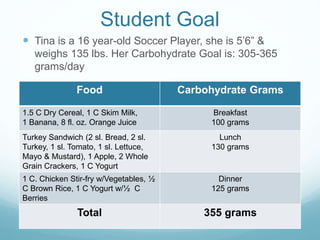
Student Goal
 Tina is a 16 year-old Soccer Player, she is 5’6” &
weighs 135 lbs. Her Carbohydrate Goal is: 305-365
grams/day
Food Carbohydrate Grams
1.5 C Dry Cereal, 1 C Skim Milk,
1 Banana, 8 fl. oz. Orange Juice
Breakfast
100 grams
Turkey Sandwich (2 sl. Bread, 2 sl.
Turkey, 1 sl. Tomato, 1 sl. Lettuce,
Mayo & Mustard), 1 Apple, 2 Whole
Grain Crackers, 1 C Yogurt
Lunch
130 grams
1 C. Chicken Stir-fry w/Vegetables, ½
C Brown Rice, 1 C Yogurt w/½ C
Berries
Dinner
125 grams
Total 355 grams
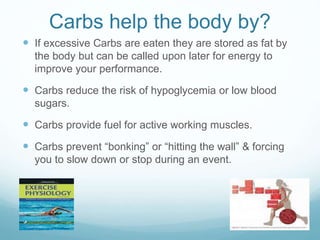
Carbs help the body by?
 If excessive Carbs are eaten they are stored as fat by
the body but can be called upon later for energy to
improve your performance.
 Carbs reduce the risk of hypoglycemia or low blood
sugars.
 Carbs provide fuel for active working muscles.
 Carbs prevent “bonking” or “hitting the wall” & forcing
you to slow down or stop during an event.
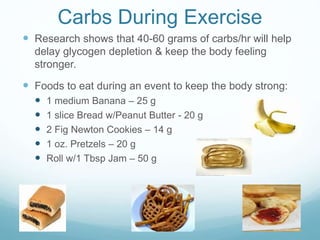
Carbs During Exercise
 Research shows that 40-60 grams of carbs/hr will help
delay glycogen depletion & keep the body feeling
stronger.
 Foods to eat during an event to keep the body strong:
 1 medium Banana – 25 g
 1 slice Bread w/Peanut Butter - 20 g
 2 Fig Newton Cookies – 14 g
 1 oz. Pretzels – 20 g
 Roll w/1 Tbsp Jam – 50 g
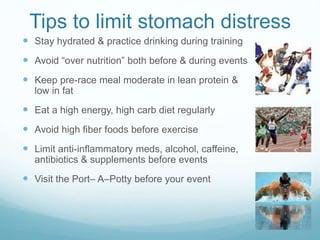
Tips to limit stomach distress
 Stay hydrated & practice drinking during training
 Avoid “over nutrition” both before & during events
 Keep pre-race meal moderate in lean protein &
low in fat
 Eat a high energy, high carb diet regularly
 Avoid high fiber foods before exercise
 Limit anti-inflammatory meds, alcohol, caffeine,
antibiotics & supplements before events
 Visit the Port– A–Potty before your event
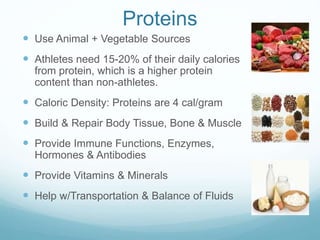
Proteins
 Use Animal + Vegetable Sources
 Athletes need 15-20% of their daily calories
from protein, which is a higher protein
content than non-athletes.
 Caloric Density: Proteins are 4 cal/gram
 Build & Repair Body Tissue, Bone & Muscle
 Provide Immune Functions, Enzymes,
Hormones & Antibodies
 Provide Vitamins & Minerals
 Help w/Transportation & Balance of Fluids
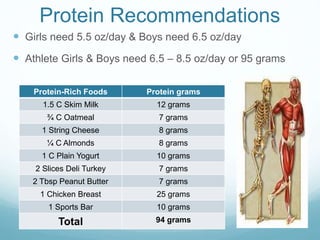
Protein Recommendations
 Girls need 5.5 oz/day & Boys need 6.5 oz/day
 Athlete Girls & Boys need 6.5 – 8.5 oz/day or 95 grams
Protein-Rich Foods Protein grams
1.5 C Skim Milk 12 grams
¾ C Oatmeal 7 grams
1 String Cheese 8 grams
¼ C Almonds 8 grams
1 C Plain Yogurt 10 grams
2 Slices Deli Turkey 7 grams
2 Tbsp Peanut Butter 7 grams
1 Chicken Breast 25 grams
1 Sports Bar 10 grams
Total 94 grams
Recovery Nutrition
 Well-balanced eating after a workout helps
the body replenish lost nutrient stores, repairs
damaged tissue & prepares for the next
workout.
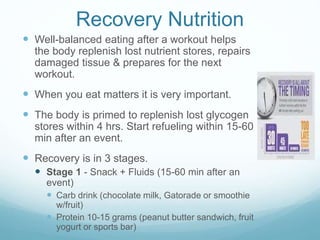
 When you eat matters it is very important.
 The body is primed to replenish lost glycogen
stores within 4 hrs. Start refueling within 15-60
min after an event.
 Recovery is in 3 stages.
 Stage 1 - Snack + Fluids (15-60 min after an
event)
 Carb drink (chocolate milk, Gatorade or smoothie
w/fruit)
 Protein 10-15 grams (peanut butter sandwich, fruit
yogurt or sports bar)
Recovery Nutrition Cont.
 Stage 2 – Meal + Fluid (within 2 hrs after event)
 Balance mostly carbs, some lean proteins, few low-fat)
 Pasta w/tomato sauce, veggies & chicken; Turkey sandwich,
whole wheat crackers & fruit; or Chicken stir-fry with brown
rice & veggies.
 Stage 3 – Snack + Fluid (within 4 hrs after event)
 Carb drink (chocolate milk, sports drinks, fruit waters, or
smoothies)
 Protein 10-15 grams (crackers & string cheese; graham
crackers w/peanut butter; or cereal w/low-fat milk)
 Certain types of training or competition require greater
detail.
 2 or more training sessions/day
 Less than 8 hrs between sessions
 Endurance training more than 90 min.
 Multi-Day competitions
Fats
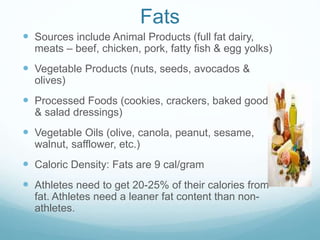
 Sources include Animal Products (full fat dairy,
meats – beef, chicken, pork, fatty fish & egg yolks)
 Vegetable Products (nuts, seeds, avocados &
olives)
 Processed Foods (cookies, crackers, baked goods
& salad dressings)
 Vegetable Oils (olive, canola, peanut, sesame,
walnut, safflower, etc.)
 Caloric Density: Fats are 9 cal/gram
 Athletes need to get 20-25% of their calories from
fat. Athletes need a leaner fat content than non-
athletes.
Fats help the body by?
 Providing lasting energy that can be used for
walking, jogging & easy cycling
 Providing heat, insulation, protect our vital
organs, start chemical reactions, aid
metabolism, can improve heart health, & help
with immune functions.
 Transporting fat soluble vitamins A, D, E, & K to
the body to be used.
 Providing Omega-3 Fatty acids (flax seeds,
walnuts, salmon), which are valuable nutrients &
reduce body inflammation
Fats help the body by? Cont.
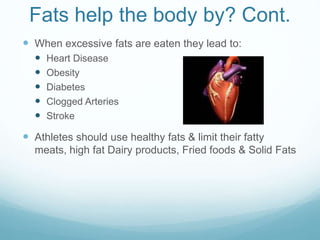
 When excessive fats are eaten they lead to:
 Heart Disease
 Obesity
 Diabetes
 Clogged Arteries
 Stroke
 Athletes should use healthy fats & limit their fatty
meats, high fat Dairy products, Fried foods & Solid Fats
Hydration
 All individuals need water, a minimum of 64 fl. oz.
a day.
 Fluids are found in most foods which helps the
body to consume 64 fl. oz.
 Fluids help to regulate the body’s temperature,
regulate blood pressure, provide structure &
lubricants for the body, maintain electrolyte
balances, help with nutrient transport & aid in a
quicker body recovery (dehydration delays
recovery)
 As exercise increases, weight loss due to
dehydration increases. A 2% weight loss can
impair body performance.
Hydration cont.
 Allowing the body to become dehydrated can cause
muscles to cramp, alter blood pressure & causes
weight loss.
 Drinking too much water can alter electrolytes &
cause hyponatremia – low levels of sodium in the
body which causes low blood levels.
 A good rule of thumb is to get 16 oz. of water with
each meal.
 Carry a water bottle with you whether you are
working out, working, at school, or doing whatever.
 Start to hydrate 4 hrs before any event. Drinking
about 10-16 fl. oz during this time.
Hydration cont.
 Urine color darkens as dehydration increases,
monitor urine color & lack of frequency.
 Fluid intake is influenced by: gender, age, body mass,
outside temperature, sweat rate, altitude & type of sport
involved in.
 How much should I drink?
 Always drink a glass of water, milk, or 100% juice at each
meal.
 Drink more when adapting to a new environment (altitude,
temperatures & humidity)
Hydration cont.
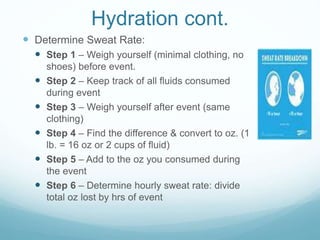
 Determine Sweat Rate:
 Step 1 – Weigh yourself (minimal clothing, no
shoes) before event.
 Step 2 – Keep track of all fluids consumed
during event
 Step 3 – Weigh yourself after event (same
clothing)
 Step 4 – Find the difference & convert to oz. (1
lb. = 16 oz or 2 cups of fluid)
 Step 5 – Add to the oz you consumed during
the event
 Step 6 – Determine hourly sweat rate: divide
total oz lost by hrs of event
Sweat Rate Example
 Tim practices for 2 hrs & drinks 20 oz (2.5 cups)
Steps Action Results
1 Weigh self before event 175 lbs
2 Keep track of fluids consumed 20 oz
3 Weigh self after event (same
clothing)
172 lbs
4 Find the difference & convert to
oz
Lost 3 lbs = 48 oz
5 Add the oz consumed to oz lost 20 oz + 48 oz = 68 oz (8.5
cups)
6 Determine hourly sweat rate:
divide oz lost by hrs in event
68 oz/2 hrs = 34 oz or 4
cups/hr lost
Supplements
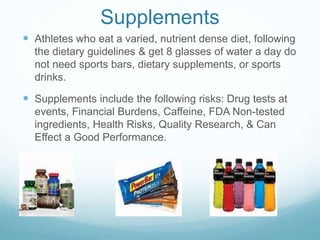
 Athletes who eat a varied, nutrient dense diet, following
the dietary guidelines & get 8 glasses of water a day do
not need sports bars, dietary supplements, or sports
drinks.
 Supplements include the following risks: Drug tests at
events, Financial Burdens, Caffeine, FDA Non-tested
ingredients, Health Risks, Quality Research, & Can
Effect a Good Performance.
Pre-Game Meals
 Before the Pre-Game Meal, usually the night before:
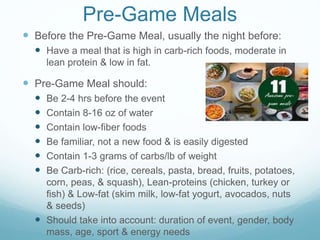
 Have a meal that is high in carb-rich foods, moderate in
lean protein & low in fat.
 Pre-Game Meal should:
 Be 2-4 hrs before the event
 Contain 8-16 oz of water
 Contain low-fiber foods
 Be familiar, not a new food & is easily digested
 Contain 1-3 grams of carbs/lb of weight
 Be Carb-rich: (rice, cereals, pasta, bread, fruits, potatoes,
corn, peas, & squash), Lean-proteins (chicken, turkey or
fish) & Low-fat (skim milk, low-fat yogurt, avocados, nuts
& seeds)
 Should take into account: duration of event, gender, body
mass, age, sport & energy needs
Pre-Game Meal Examples
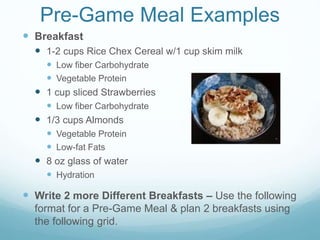
 Breakfast
 1-2 cups Rice Chex Cereal w/1 cup skim milk
 Low fiber Carbohydrate
 Vegetable Protein
 1 cup sliced Strawberries
 Low fiber Carbohydrate
 1/3 cups Almonds
 Vegetable Protein
 Low-fat Fats
 8 oz glass of water
 Hydration
 Write 2 more Different Breakfasts – Use the following
format for a Pre-Game Meal & plan 2 breakfasts using
the following grid.
Pre-Game Meal Examples
 Lunch
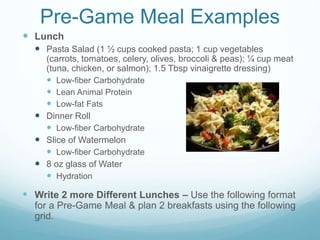
 Pasta Salad (1 ½ cups cooked pasta; 1 cup vegetables
(carrots, tomatoes, celery, olives, broccoli & peas); ¼ cup meat
(tuna, chicken, or salmon); 1.5 Tbsp vinaigrette dressing)
 Low-fiber Carbohydrate
 Lean Animal Protein
 Low-fat Fats
 Dinner Roll
 Low-fiber Carbohydrate
 Slice of Watermelon
 Low-fiber Carbohydrate
 8 oz glass of Water
 Hydration
 Write 2 more Different Lunches – Use the following format
for a Pre-Game Meal & plan 2 breakfasts using the following
grid.
Pre-Game Meal Examples
 Dinner
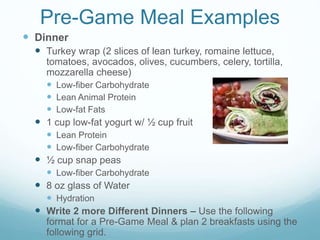
 Turkey wrap (2 slices of lean turkey, romaine lettuce,
tomatoes, avocados, olives, cucumbers, celery, tortilla,
mozzarella cheese)
 Low-fiber Carbohydrate
 Lean Animal Protein
 Low-fat Fats
 1 cup low-fat yogurt w/ ½ cup fruit
 Lean Protein
 Low-fiber Carbohydrate
 ½ cup snap peas
 Low-fiber Carbohydrate
 8 oz glass of Water
 Hydration
 Write 2 more Different Dinners – Use the following
format for a Pre-Game Meal & plan 2 breakfasts using the
following grid.

10072584.pptx

  • 1.
  • 2.
    Sports Nutrition Dependson the following  Additional Energy Expenditures that are Needed  Sport Specific Needs for:  Team Sports, Power Sports, Aesthetic Sports, Endurance Sports, Winter Sports, Water Sports, Mixed Sports, Individual Sports  Food Function with Type of Sport  Training Tools to Improve & Prepare Athletes
  • 3.
    Food & Functionality Energy =  High & Low-fiber Carbohydrates  Animal & Vegetable Lean Proteins  Low-fat Fats  Food Choices that Impact Performance =  Eat a Variety of Foods  Eat Nutrient Dense Foods  Eat High Vitamin & Mineral Foods
  • 4.
    Carbohydrates  Carbohydrates arethe body’s primary source of energy.  Dietary carbohydrates include: Grains, Fruits, Vegetables, Beans, Nuts & Dairy.  These foods can be stored in the liver & in the muscles as glycogen to be used later for energy.  Glycogen is a polysaccharide that forms into a glucose when it is hydrated.
  • 5.
    Carbohydrate Recommendations . ..  Minimum Amounts  5-7 oz. per day  Athletes need to get 55 – 60% of their daily calories from Carbohydrates the same as non- athletes  Considerations  Size, Gender, Sport & Diet  Caloric Density: Carbs are 4 cal/gram  Carbohydrate Loading requires 8-10 oz.  During Training use 30-60 grams of carbs/hr
  • 6.
    Student Goal  Tinais a 16 year-old Soccer Player, she is 5’6” & weighs 135 lbs. Her Carbohydrate Goal is: 305-365 grams/day Food Carbohydrate Grams 1.5 C Dry Cereal, 1 C Skim Milk, 1 Banana, 8 fl. oz. Orange Juice Breakfast 100 grams Turkey Sandwich (2 sl. Bread, 2 sl. Turkey, 1 sl. Tomato, 1 sl. Lettuce, Mayo & Mustard), 1 Apple, 2 Whole Grain Crackers, 1 C Yogurt Lunch 130 grams 1 C. Chicken Stir-fry w/Vegetables, ½ C Brown Rice, 1 C Yogurt w/½ C Berries Dinner 125 grams Total 355 grams
  • 7.
    Carbs help thebody by?  If excessive Carbs are eaten they are stored as fat by the body but can be called upon later for energy to improve your performance.  Carbs reduce the risk of hypoglycemia or low blood sugars.  Carbs provide fuel for active working muscles.  Carbs prevent “bonking” or “hitting the wall” & forcing you to slow down or stop during an event.
  • 8.
    Carbs During Exercise Research shows that 40-60 grams of carbs/hr will help delay glycogen depletion & keep the body feeling stronger.  Foods to eat during an event to keep the body strong:  1 medium Banana – 25 g  1 slice Bread w/Peanut Butter - 20 g  2 Fig Newton Cookies – 14 g  1 oz. Pretzels – 20 g  Roll w/1 Tbsp Jam – 50 g
  • 9.
    Tips to limitstomach distress  Stay hydrated & practice drinking during training  Avoid “over nutrition” both before & during events  Keep pre-race meal moderate in lean protein & low in fat  Eat a high energy, high carb diet regularly  Avoid high fiber foods before exercise  Limit anti-inflammatory meds, alcohol, caffeine, antibiotics & supplements before events  Visit the Port– A–Potty before your event
  • 10.
    Proteins  Use Animal+ Vegetable Sources  Athletes need 15-20% of their daily calories from protein, which is a higher protein content than non-athletes.  Caloric Density: Proteins are 4 cal/gram  Build & Repair Body Tissue, Bone & Muscle  Provide Immune Functions, Enzymes, Hormones & Antibodies  Provide Vitamins & Minerals  Help w/Transportation & Balance of Fluids
  • 11.
    Protein Recommendations  Girlsneed 5.5 oz/day & Boys need 6.5 oz/day  Athlete Girls & Boys need 6.5 – 8.5 oz/day or 95 grams Protein-Rich Foods Protein grams 1.5 C Skim Milk 12 grams ¾ C Oatmeal 7 grams 1 String Cheese 8 grams ¼ C Almonds 8 grams 1 C Plain Yogurt 10 grams 2 Slices Deli Turkey 7 grams 2 Tbsp Peanut Butter 7 grams 1 Chicken Breast 25 grams 1 Sports Bar 10 grams Total 94 grams
  • 12.
    Recovery Nutrition  Well-balancedeating after a workout helps the body replenish lost nutrient stores, repairs damaged tissue & prepares for the next workout.  When you eat matters it is very important.  The body is primed to replenish lost glycogen stores within 4 hrs. Start refueling within 15-60 min after an event.  Recovery is in 3 stages.  Stage 1 - Snack + Fluids (15-60 min after an event)  Carb drink (chocolate milk, Gatorade or smoothie w/fruit)  Protein 10-15 grams (peanut butter sandwich, fruit yogurt or sports bar)
  • 13.
    Recovery Nutrition Cont. Stage 2 – Meal + Fluid (within 2 hrs after event)  Balance mostly carbs, some lean proteins, few low-fat)  Pasta w/tomato sauce, veggies & chicken; Turkey sandwich, whole wheat crackers & fruit; or Chicken stir-fry with brown rice & veggies.  Stage 3 – Snack + Fluid (within 4 hrs after event)  Carb drink (chocolate milk, sports drinks, fruit waters, or smoothies)  Protein 10-15 grams (crackers & string cheese; graham crackers w/peanut butter; or cereal w/low-fat milk)  Certain types of training or competition require greater detail.  2 or more training sessions/day  Less than 8 hrs between sessions  Endurance training more than 90 min.  Multi-Day competitions
  • 14.
    Fats  Sources includeAnimal Products (full fat dairy, meats – beef, chicken, pork, fatty fish & egg yolks)  Vegetable Products (nuts, seeds, avocados & olives)  Processed Foods (cookies, crackers, baked goods & salad dressings)  Vegetable Oils (olive, canola, peanut, sesame, walnut, safflower, etc.)  Caloric Density: Fats are 9 cal/gram  Athletes need to get 20-25% of their calories from fat. Athletes need a leaner fat content than non- athletes.
  • 15.
    Fats help thebody by?  Providing lasting energy that can be used for walking, jogging & easy cycling  Providing heat, insulation, protect our vital organs, start chemical reactions, aid metabolism, can improve heart health, & help with immune functions.  Transporting fat soluble vitamins A, D, E, & K to the body to be used.  Providing Omega-3 Fatty acids (flax seeds, walnuts, salmon), which are valuable nutrients & reduce body inflammation
  • 16.
    Fats help thebody by? Cont.  When excessive fats are eaten they lead to:  Heart Disease  Obesity  Diabetes  Clogged Arteries  Stroke  Athletes should use healthy fats & limit their fatty meats, high fat Dairy products, Fried foods & Solid Fats
  • 17.
    Hydration  All individualsneed water, a minimum of 64 fl. oz. a day.  Fluids are found in most foods which helps the body to consume 64 fl. oz.  Fluids help to regulate the body’s temperature, regulate blood pressure, provide structure & lubricants for the body, maintain electrolyte balances, help with nutrient transport & aid in a quicker body recovery (dehydration delays recovery)  As exercise increases, weight loss due to dehydration increases. A 2% weight loss can impair body performance.
  • 18.
    Hydration cont.  Allowingthe body to become dehydrated can cause muscles to cramp, alter blood pressure & causes weight loss.  Drinking too much water can alter electrolytes & cause hyponatremia – low levels of sodium in the body which causes low blood levels.  A good rule of thumb is to get 16 oz. of water with each meal.  Carry a water bottle with you whether you are working out, working, at school, or doing whatever.  Start to hydrate 4 hrs before any event. Drinking about 10-16 fl. oz during this time.
  • 19.
    Hydration cont.  Urinecolor darkens as dehydration increases, monitor urine color & lack of frequency.  Fluid intake is influenced by: gender, age, body mass, outside temperature, sweat rate, altitude & type of sport involved in.  How much should I drink?  Always drink a glass of water, milk, or 100% juice at each meal.  Drink more when adapting to a new environment (altitude, temperatures & humidity)
  • 20.
    Hydration cont.  DetermineSweat Rate:  Step 1 – Weigh yourself (minimal clothing, no shoes) before event.  Step 2 – Keep track of all fluids consumed during event  Step 3 – Weigh yourself after event (same clothing)  Step 4 – Find the difference & convert to oz. (1 lb. = 16 oz or 2 cups of fluid)  Step 5 – Add to the oz you consumed during the event  Step 6 – Determine hourly sweat rate: divide total oz lost by hrs of event
  • 21.
    Sweat Rate Example Tim practices for 2 hrs & drinks 20 oz (2.5 cups) Steps Action Results 1 Weigh self before event 175 lbs 2 Keep track of fluids consumed 20 oz 3 Weigh self after event (same clothing) 172 lbs 4 Find the difference & convert to oz Lost 3 lbs = 48 oz 5 Add the oz consumed to oz lost 20 oz + 48 oz = 68 oz (8.5 cups) 6 Determine hourly sweat rate: divide oz lost by hrs in event 68 oz/2 hrs = 34 oz or 4 cups/hr lost
  • 22.
    Supplements  Athletes whoeat a varied, nutrient dense diet, following the dietary guidelines & get 8 glasses of water a day do not need sports bars, dietary supplements, or sports drinks.  Supplements include the following risks: Drug tests at events, Financial Burdens, Caffeine, FDA Non-tested ingredients, Health Risks, Quality Research, & Can Effect a Good Performance.
  • 23.
    Pre-Game Meals  Beforethe Pre-Game Meal, usually the night before:  Have a meal that is high in carb-rich foods, moderate in lean protein & low in fat.  Pre-Game Meal should:  Be 2-4 hrs before the event  Contain 8-16 oz of water  Contain low-fiber foods  Be familiar, not a new food & is easily digested  Contain 1-3 grams of carbs/lb of weight  Be Carb-rich: (rice, cereals, pasta, bread, fruits, potatoes, corn, peas, & squash), Lean-proteins (chicken, turkey or fish) & Low-fat (skim milk, low-fat yogurt, avocados, nuts & seeds)  Should take into account: duration of event, gender, body mass, age, sport & energy needs
  • 24.
    Pre-Game Meal Examples Breakfast  1-2 cups Rice Chex Cereal w/1 cup skim milk  Low fiber Carbohydrate  Vegetable Protein  1 cup sliced Strawberries  Low fiber Carbohydrate  1/3 cups Almonds  Vegetable Protein  Low-fat Fats  8 oz glass of water  Hydration  Write 2 more Different Breakfasts – Use the following format for a Pre-Game Meal & plan 2 breakfasts using the following grid.
  • 25.
    Pre-Game Meal Examples Lunch  Pasta Salad (1 ½ cups cooked pasta; 1 cup vegetables (carrots, tomatoes, celery, olives, broccoli & peas); ¼ cup meat (tuna, chicken, or salmon); 1.5 Tbsp vinaigrette dressing)  Low-fiber Carbohydrate  Lean Animal Protein  Low-fat Fats  Dinner Roll  Low-fiber Carbohydrate  Slice of Watermelon  Low-fiber Carbohydrate  8 oz glass of Water  Hydration  Write 2 more Different Lunches – Use the following format for a Pre-Game Meal & plan 2 breakfasts using the following grid.
  • 26.
    Pre-Game Meal Examples Dinner  Turkey wrap (2 slices of lean turkey, romaine lettuce, tomatoes, avocados, olives, cucumbers, celery, tortilla, mozzarella cheese)  Low-fiber Carbohydrate  Lean Animal Protein  Low-fat Fats  1 cup low-fat yogurt w/ ½ cup fruit  Lean Protein  Low-fiber Carbohydrate  ½ cup snap peas  Low-fiber Carbohydrate  8 oz glass of Water  Hydration  Write 2 more Different Dinners – Use the following format for a Pre-Game Meal & plan 2 breakfasts using the following grid.