A.M.T.B. ADIKARI
MSc, BSc, RN.
Principal
School of Nursing Kandy

WHAT IS RESEARCH?
Something that people undertake in order
to find out things in a systematic way,
thereby increasing their knowledge.
Research is a systematic inquiry that
uses orderly scientific methods to
answer question or solve problems (
Polit & Hungler, 1991).

Scientific Inquiry
A process in which observable,
verifiable data are systematically
collected using our senses to explore,
describe, explain, or predict events.

Characteristics of
Scientific Inquiry
Order. ( systematic approach)
Control (setting restriction)
Empiricism (evidence is gathered through
the human senses)
Generalization.
Operationalism ( define the term used in
the research process)

Replication ( data reproduced under
similar conditions.
Objectivity (agree on what observe
rather than on personal beliefs, values
& attitudes)
7/3/2024 A.M.T.B.ADIKARI 5
Characteristics of
Scientific Inquiry ….

Purpose of Scientific
Research
Description- describe the characteristics
of people, situations, & frequency of
occurrence.
Exploration – discovery of relationships.
Explanation – formal explanation(
theories)
Prediction & control – predicts that how
variable will behave in new settings &
with different individuals.

Characteristics of Good
Research
Purpose clearly identified.
Research process detailed.
Research design thoroughly planned.
High ethical standards applied.
Limitation frankly revealed.
Adequate analysis for decision maker’s
needs.

Findings presented unambiguously.
Conclusions justified.
Researcher’s experience reflected
7/3/2024 A.M.T.B.ADIKARI 8
Characteristics of Good
Research…

Approaches for research
1. Deductive approach
2. Inductive approach

Approaches for reach
Deductive approach
Developing a theory and then proceed
to gather data to test your theory.
Identify and verify the cause and effect
relationships between two or more
variables.
 it leads to findings that are capable of
generalization.

Approaches for research
Inductive approach
Carry out data collection and analysis
and then develop a theory on the basis
of the work you have done.
Theory follows the data
Deeper findings because the approach
gets closer to the people involved.

Broadly divided into two:
1. Quantitative
2. Qualitative
7/3/2024 A.M.T.B.ADIKARI 12
Types of Research
Methods

describe and measure the level of
occurrences on the basis of numbers
and calculations.
“how many?” and “how often?” are
often asked in quantitative studies.
collection of numerical data
uses the quantitative data to analysis.
7/3/2024 A.M.T.B.ADIKARI 13
Quantitative Research

based on words, feelings, emotions,
sounds and other non-numerical and
unquantifiable elements.
cannot be analysed by means of
mathematical techniques.
7/3/2024 A.M.T.B.ADIKARI 14
Qualitative Research

Types of Research( Based
on purpose)
Basic Research(pure Research)
Research conducted to develop
theories.
Applied Research
Research conducted to find
solutions to clinical problems in
nursing practice.
Most of the research done in nursing
trends to be more applied than basic.

Applied Research used
to
Make decisions.
Evaluate new programs
Evaluate new methods
Evaluate new products.

Types Of Research (Based on Method)
Descriptive
Analytical
Causal

Aim to identify the facts
Mainly deals with the “description of
the state of affairs as it is at present”
No control over variables
7/3/2024 A.M.T.B.ADIKARI 18
Descriptive research

Descriptive Research
Example
Woman about 40 years old
Household income of about Rs50,000
At least some college education
Trying to juggle children and a job

 Use facts or information already
available
Analyze these in order to make a
critical evaluation of the material
7/3/2024 A.M.T.B.ADIKARI 20
Analytical research

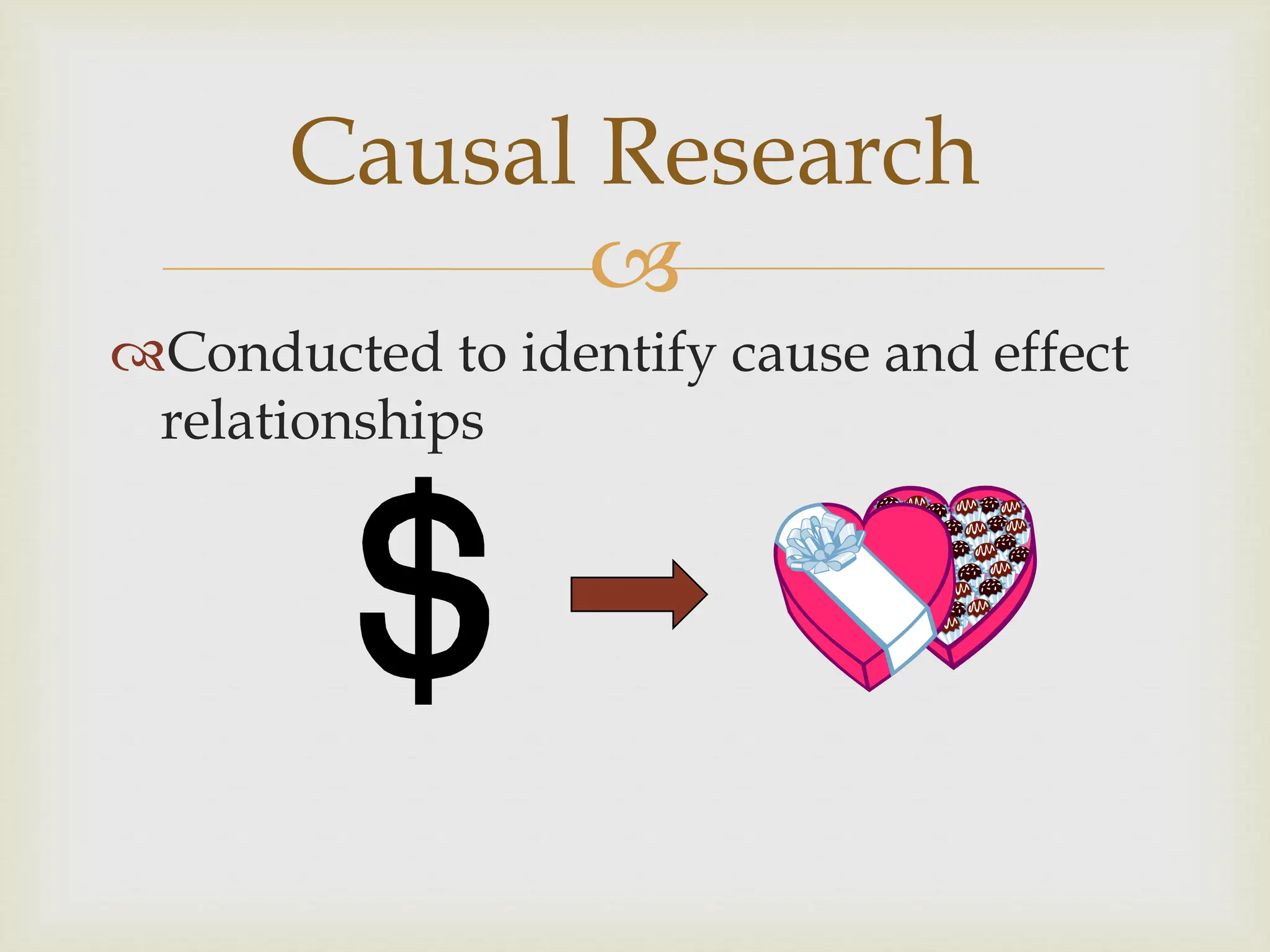
Causal Research
Conducted to identify cause and effect
relationships

Research Process
Conceptual phase
Empirical phase
Interpretive phase

Conceptual Phase
The problem
The variables.
The literature review.
The research question & hypotheses.

Empirical Phase
Design.
Population & sample.
Validity.
Collection of data.
Data analysis.

Interpretive Phase
Discussion & conclusion.

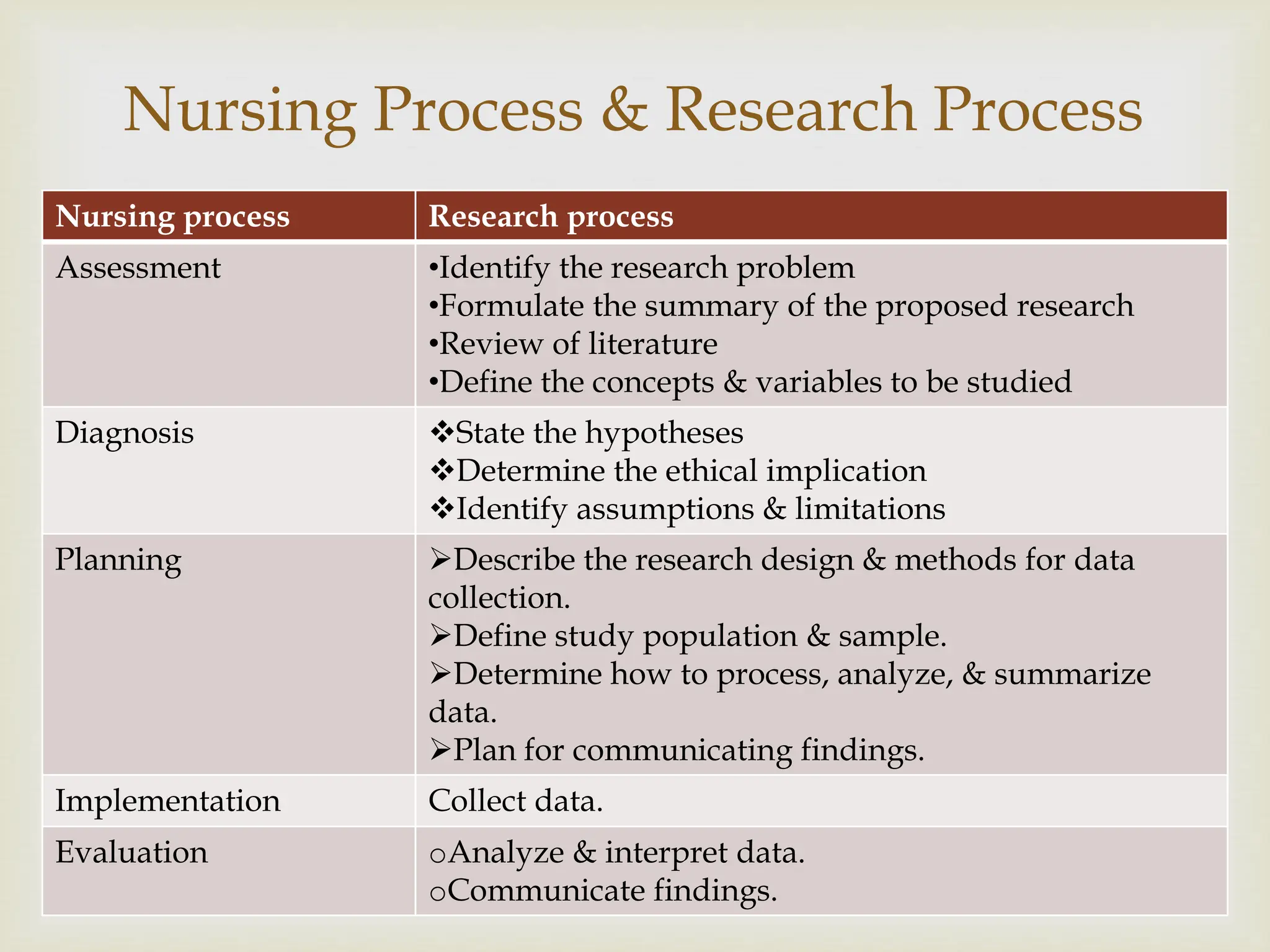
Nursing Process & Research Process
Nursing process Research process
Assessment •Identify the research problem
•Formulate the summary of the proposed research
•Review of literature
•Define the concepts & variables to be studied
Diagnosis State the hypotheses
Determine the ethical implication
Identify assumptions & limitations
Planning Describe the research design & methods for data
collection.
Define study population & sample.
Determine how to process, analyze, & summarize
data.
Plan for communicating findings.
Implementation Collect data.
Evaluation oAnalyze & interpret data.
oCommunicate findings.

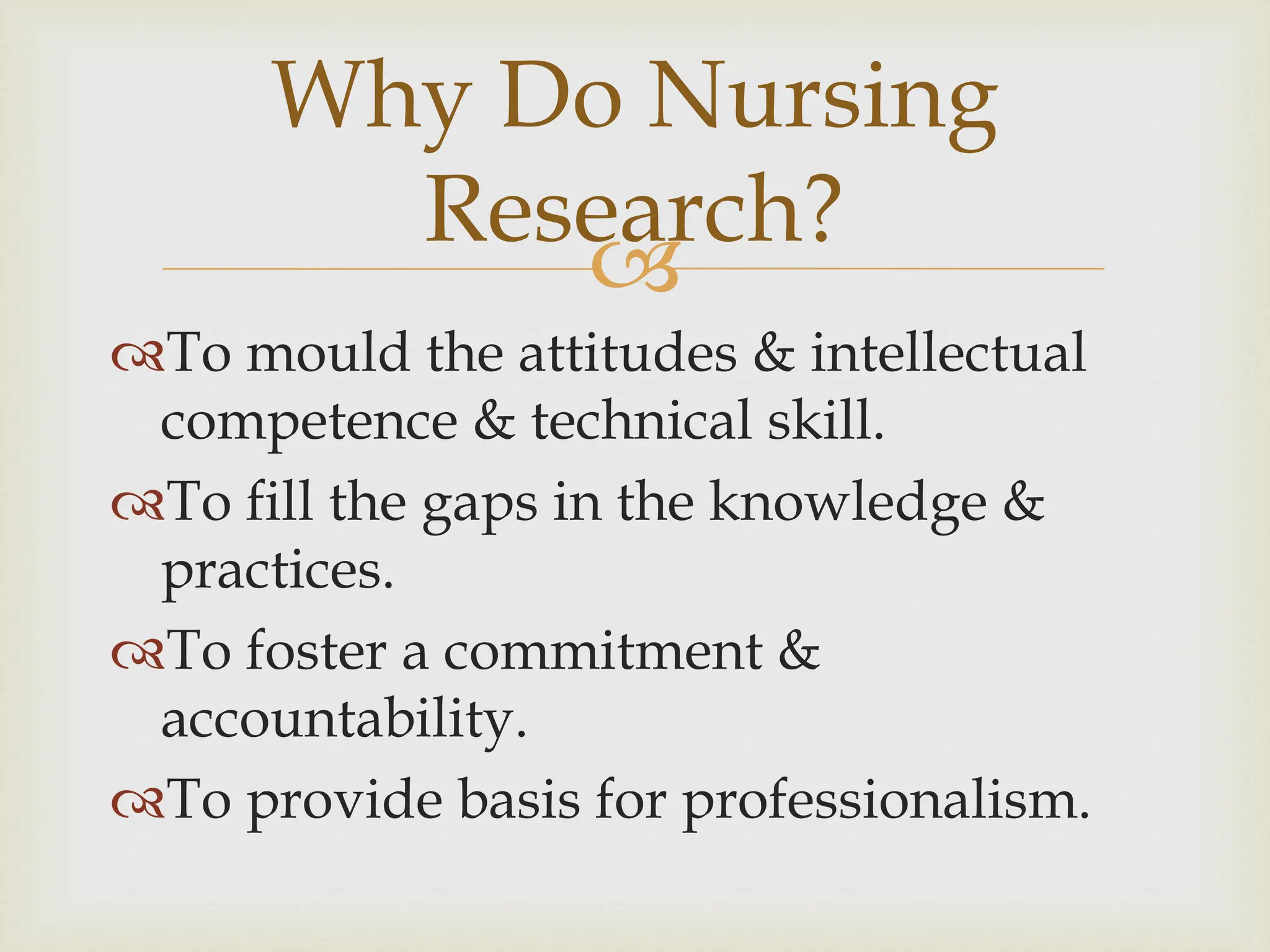
Why Do Nursing
Research?
To mould the attitudes & intellectual
competence & technical skill.
To fill the gaps in the knowledge &
practices.
To foster a commitment &
accountability.
To provide basis for professionalism.

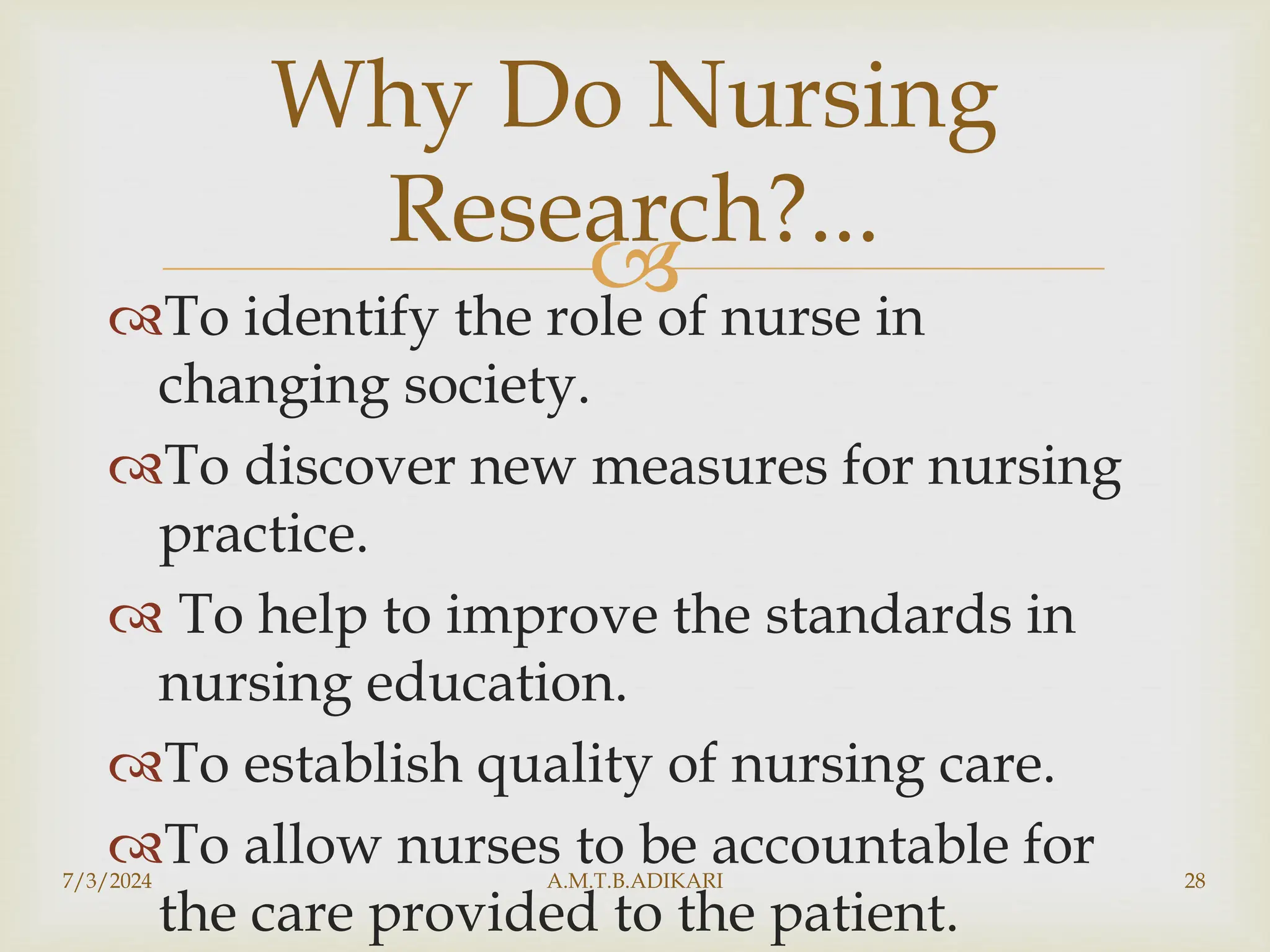
To identify the role of nurse in
changing society.
To discover new measures for nursing
practice.
 To help to improve the standards in
nursing education.
To establish quality of nursing care.
To allow nurses to be accountable for
the care provided to the patient.
7/3/2024 A.M.T.B.ADIKARI 28
Why Do Nursing
Research?...

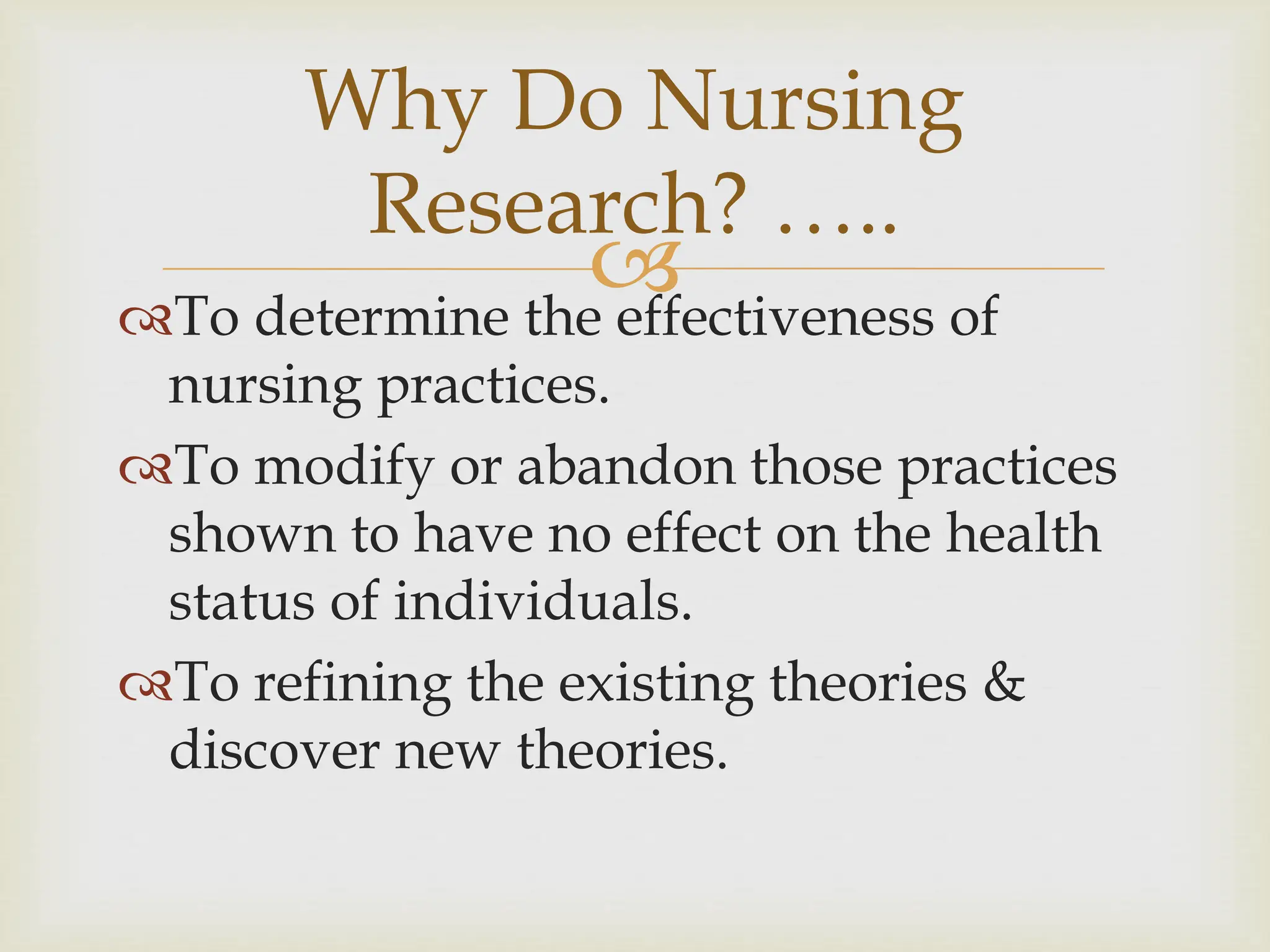
Why Do Nursing
Research? …..
To determine the effectiveness of
nursing practices.
To modify or abandon those practices
shown to have no effect on the health
status of individuals.
To refining the existing theories &
discover new theories.

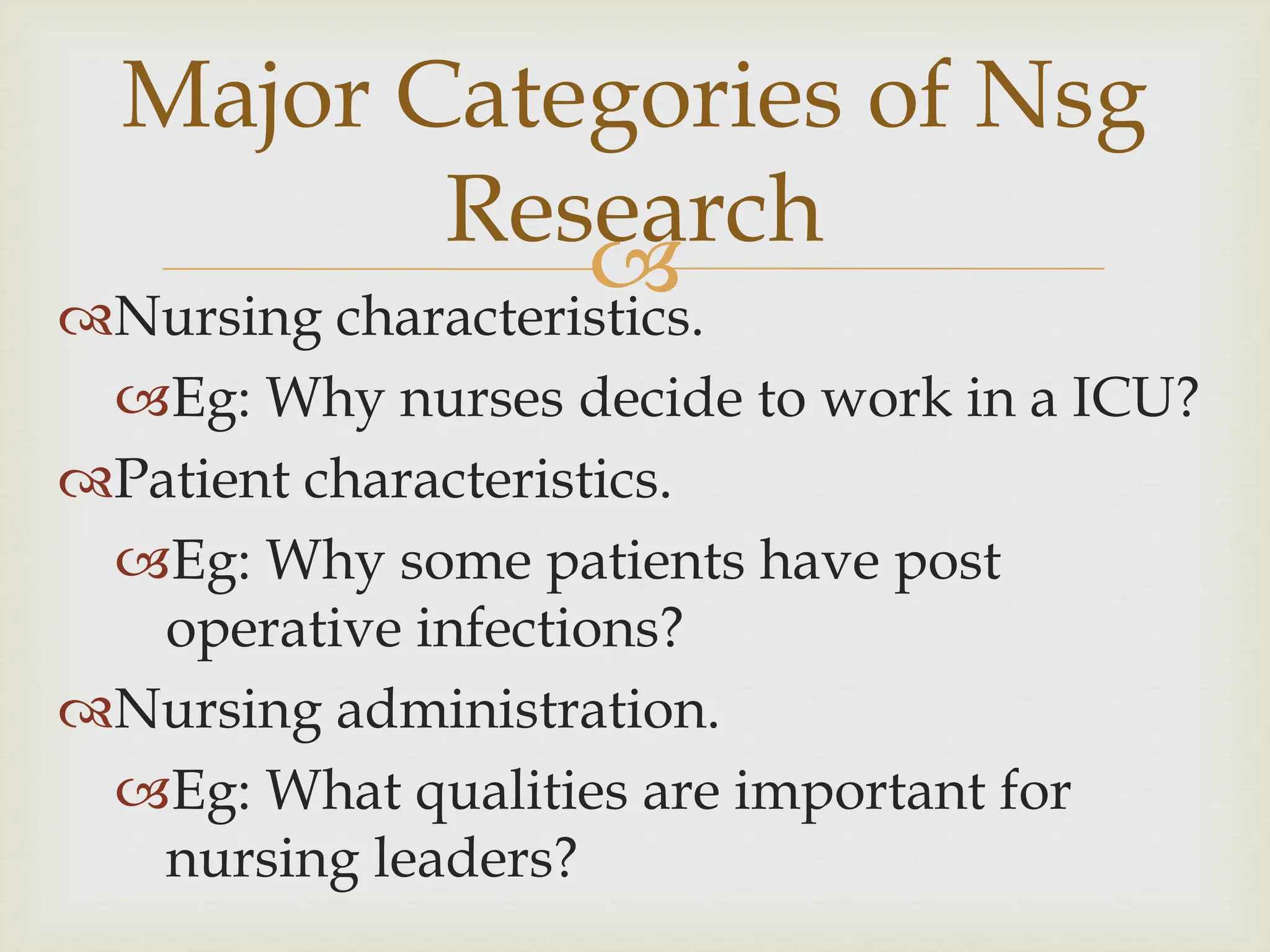
Major Categories of Nsg
Research
Nursing characteristics.
Eg: Why nurses decide to work in a ICU?
Patient characteristics.
Eg: Why some patients have post
operative infections?
Nursing administration.
Eg: What qualities are important for
nursing leaders?

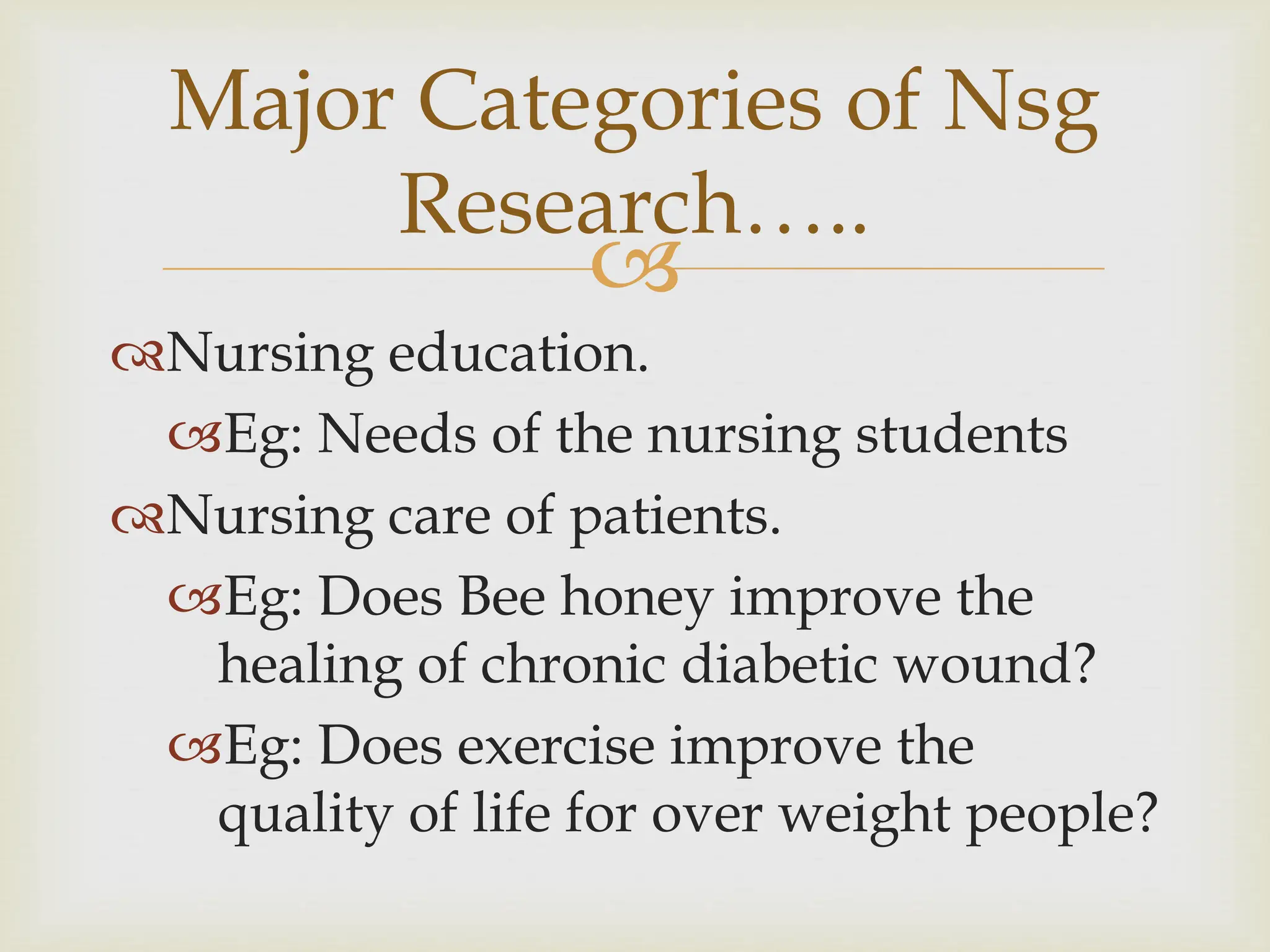
Major Categories of Nsg
Research…..
Nursing education.
Eg: Needs of the nursing students
Nursing care of patients.
Eg: Does Bee honey improve the
healing of chronic diabetic wound?
Eg: Does exercise improve the
quality of life for over weight people?

1. Introduction to research_0942377.pptx

  • 1.
    A.M.T.B. ADIKARI MSc, BSc,RN. Principal School of Nursing Kandy
  • 2.
     WHAT IS RESEARCH? Somethingthat people undertake in order to find out things in a systematic way, thereby increasing their knowledge. Research is a systematic inquiry that uses orderly scientific methods to answer question or solve problems ( Polit & Hungler, 1991).
  • 3.
     Scientific Inquiry A processin which observable, verifiable data are systematically collected using our senses to explore, describe, explain, or predict events.
  • 4.
     Characteristics of Scientific Inquiry Order.( systematic approach) Control (setting restriction) Empiricism (evidence is gathered through the human senses) Generalization. Operationalism ( define the term used in the research process)
  • 5.
     Replication ( datareproduced under similar conditions. Objectivity (agree on what observe rather than on personal beliefs, values & attitudes) 7/3/2024 A.M.T.B.ADIKARI 5 Characteristics of Scientific Inquiry ….
  • 6.
     Purpose of Scientific Research Description-describe the characteristics of people, situations, & frequency of occurrence. Exploration – discovery of relationships. Explanation – formal explanation( theories) Prediction & control – predicts that how variable will behave in new settings & with different individuals.
  • 7.
     Characteristics of Good Research Purposeclearly identified. Research process detailed. Research design thoroughly planned. High ethical standards applied. Limitation frankly revealed. Adequate analysis for decision maker’s needs.
  • 8.
     Findings presented unambiguously. Conclusionsjustified. Researcher’s experience reflected 7/3/2024 A.M.T.B.ADIKARI 8 Characteristics of Good Research…
  • 9.
     Approaches for research 1.Deductive approach 2. Inductive approach
  • 10.
     Approaches for reach Deductiveapproach Developing a theory and then proceed to gather data to test your theory. Identify and verify the cause and effect relationships between two or more variables.  it leads to findings that are capable of generalization.
  • 11.
     Approaches for research Inductiveapproach Carry out data collection and analysis and then develop a theory on the basis of the work you have done. Theory follows the data Deeper findings because the approach gets closer to the people involved.
  • 12.
     Broadly divided intotwo: 1. Quantitative 2. Qualitative 7/3/2024 A.M.T.B.ADIKARI 12 Types of Research Methods
  • 13.
     describe and measurethe level of occurrences on the basis of numbers and calculations. “how many?” and “how often?” are often asked in quantitative studies. collection of numerical data uses the quantitative data to analysis. 7/3/2024 A.M.T.B.ADIKARI 13 Quantitative Research
  • 14.
     based on words,feelings, emotions, sounds and other non-numerical and unquantifiable elements. cannot be analysed by means of mathematical techniques. 7/3/2024 A.M.T.B.ADIKARI 14 Qualitative Research
  • 15.
     Types of Research(Based on purpose) Basic Research(pure Research) Research conducted to develop theories. Applied Research Research conducted to find solutions to clinical problems in nursing practice. Most of the research done in nursing trends to be more applied than basic.
  • 16.
     Applied Research used to Makedecisions. Evaluate new programs Evaluate new methods Evaluate new products.
  • 17.
     Types Of Research(Based on Method) Descriptive Analytical Causal
  • 18.
     Aim to identifythe facts Mainly deals with the “description of the state of affairs as it is at present” No control over variables 7/3/2024 A.M.T.B.ADIKARI 18 Descriptive research
  • 19.
     Descriptive Research Example Woman about40 years old Household income of about Rs50,000 At least some college education Trying to juggle children and a job
  • 20.
      Use factsor information already available Analyze these in order to make a critical evaluation of the material 7/3/2024 A.M.T.B.ADIKARI 20 Analytical research
  • 21.
     Causal Research Conducted toidentify cause and effect relationships
  • 22.
  • 23.
     Conceptual Phase The problem Thevariables. The literature review. The research question & hypotheses.
  • 24.
     Empirical Phase Design. Population &sample. Validity. Collection of data. Data analysis.
  • 25.
  • 26.
     Nursing Process &Research Process Nursing process Research process Assessment •Identify the research problem •Formulate the summary of the proposed research •Review of literature •Define the concepts & variables to be studied Diagnosis State the hypotheses Determine the ethical implication Identify assumptions & limitations Planning Describe the research design & methods for data collection. Define study population & sample. Determine how to process, analyze, & summarize data. Plan for communicating findings. Implementation Collect data. Evaluation oAnalyze & interpret data. oCommunicate findings.
  • 27.
     Why Do Nursing Research? Tomould the attitudes & intellectual competence & technical skill. To fill the gaps in the knowledge & practices. To foster a commitment & accountability. To provide basis for professionalism.
  • 28.
     To identify therole of nurse in changing society. To discover new measures for nursing practice.  To help to improve the standards in nursing education. To establish quality of nursing care. To allow nurses to be accountable for the care provided to the patient. 7/3/2024 A.M.T.B.ADIKARI 28 Why Do Nursing Research?...
  • 29.
     Why Do Nursing Research?….. To determine the effectiveness of nursing practices. To modify or abandon those practices shown to have no effect on the health status of individuals. To refining the existing theories & discover new theories.
  • 30.
     Major Categories ofNsg Research Nursing characteristics. Eg: Why nurses decide to work in a ICU? Patient characteristics. Eg: Why some patients have post operative infections? Nursing administration. Eg: What qualities are important for nursing leaders?
  • 31.
     Major Categories ofNsg Research….. Nursing education. Eg: Needs of the nursing students Nursing care of patients. Eg: Does Bee honey improve the healing of chronic diabetic wound? Eg: Does exercise improve the quality of life for over weight people?