THE NURSING PROCESS
• UNIT 1
• FUNDAMENTALS OF NURSING II
• MS. CHIMBWALI
The Nursing Process
• The nursing process is a problem solving approach to
nursing that involves interaction with the client,
making decisions and carrying out nursing actions
based on an assessment of individual patient
situation.
• The use of the nursing process allows the nurse to
integrate elements of critical thinking to make
judgments and take actions based on reason. The
nursing process is used to identify, diagnose and treat
human responses to health and illness
Components of the Nursing Process
• The nursing process has 5 components. These
are:
Assessment
Nursing diagnosis
Planning
Implementation
Evaluation
ASSESSMENT
• This refers to the systematic collection of subjective
(what the patients feels and says) and objective (what
you observe) data with the goal of making clinical
nursing judgment about the patient or family.
• During assessment you have to consider the physical,
psychological, emotional, socio-cultural and spiritual
factors that may affect the health status of your client.
• This stage is characterized by data collection, grouping
of data into meaningful categories, physical
examinations, laboratory tests and observation skills.
Types of data
• Subjective data: this is the information that is
only obvious to the patient. It is also known as
covert data or symptoms, for example, pain.
• Objective data: this is information that is
detected by the observer, for example, pallor. It
is also known as overt data or signs.
Sources of data
• The following are the sources of assessment
data:
• Primary data: this information is obtained from
the patient. It is gathered through informal and
formal interviews, and physical examinations.
• Secondary data: this information is obtained
from the patient, patient’s family, patient
records, diagnostic tests, and reports.
Nursing Diagnosis
• This is a combination of signs and symptoms
that indicate an actual or potential health
problem that nurses are licensed to treat and
are capable of treating.
• Nursing diagnosis can be formulated in 2 ways,
that is, for an actual problem or for a potential
problem.
• Actual problem: this is a problem that already exists.
When the nurse interacts with the patient it can be
elicited because the patient is experiencing it. The
nursing diagnosis for an actual problem should have a
problem, cause and manifestation.
• For example, if you identify dyspnoea as a problem in
a patient with Pulmonary Tuberculosis, the nursing
diagnosis could be ‘Dyspnoea related to reduced lung
capacity evidenced by laboured breathing’.
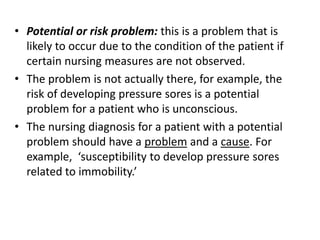
• Potential or risk problem: this is a problem that is
likely to occur due to the condition of the patient if
certain nursing measures are not observed.
• The problem is not actually there, for example, the
risk of developing pressure sores is a potential
problem for a patient who is unconscious.
• The nursing diagnosis for a patient with a potential
problem should have a problem and a cause. For
example, ‘susceptibility to develop pressure sores
related to immobility.’
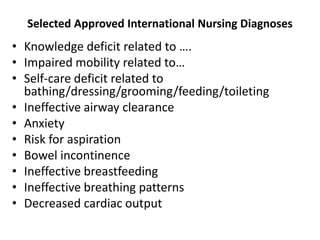
Selected Approved International Nursing Diagnoses
• Knowledge deficit related to ….
• Impaired mobility related to…
• Self-care deficit related to
bathing/dressing/grooming/feeding/toileting
• Ineffective airway clearance
• Anxiety
• Risk for aspiration
• Bowel incontinence
• Ineffective breastfeeding
• Ineffective breathing patterns
• Decreased cardiac output
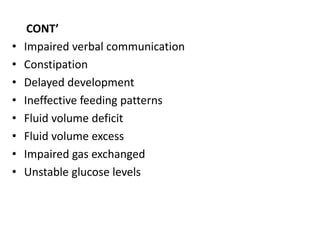
CONT’
• Impaired verbal communication
• Constipation
• Delayed development
• Ineffective feeding patterns
• Fluid volume deficit
• Fluid volume excess
• Impaired gas exchanged
• Unstable glucose levels
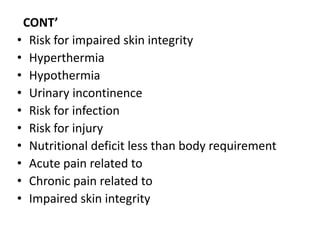
CONT’
• Risk for impaired skin integrity
• Hyperthermia
• Hypothermia
• Urinary incontinence
• Risk for infection
• Risk for injury
• Nutritional deficit less than body requirement
• Acute pain related to
• Chronic pain related to
• Impaired skin integrity
Planning
 Planning is creating an organized course of
action, that is designed to change negative
health response to a more positive one.
 The nurse, patient and family must participate
actively in this stage to set goals.
The stage involves four (4) main activities:
• Setting priorities from among identified
potential and actual problems.
• Setting objectives that must be Specific,
Measurable, Achievable, and Realistic and
Time bound (SMART).
• Select appropriate nursing interventions that
should be done with scientific reasoning.
• Writing of the care plan.
Implementation
• This is the step that involves action or doing, and
the actual carrying out of nursing interventions
outlined in the nursing care plan.
• This phase requires nursing interventions such as
applying a cardiac monitor or oxygen, direct or
indirect care, administration of medication, etc.
CONT’
• It involves therapeutic interaction between the
nurse and the client.
• This requires technical competence and proper
manual dexterity.
• The nursing actions focus on resolving,
dissolving or diminishing the patient’s
functional health status problem.
Evaluation
• This is the process of determining to what extent the
established goals have been achieved.
• Evaluation involves analysing the outcome of the
nursing action to see if the care given is effective.
• Observations are important in this stage and are
widely used. The outcome should be compared with
the objective. Evaluation is an on-going and
continuous process performed throughout the nursing
process.
Advantages of the nursing process to the client
• It is adaptable to every patient
• It contributes to individualized care.
• It contributes to high quality care.
• Client feels part of the care team.
• It helps the client to co-operate and become
involved in his/her care.
• It responds to the continually changing needs of a
client.
Disadvantages of the nursing process to the
client
• It may lead to frustration especially when the
patient’s need is not given the first priority
• It subjects the patient to a lot of talking and
thinking thereby disturbing rest and sleep.
Advantages of the nursing process to the Nurse
• It can be used in any situation in which a nurse
gives care.
• It provides for constant evaluation
• It is a basis for improving care
• It is a logical, organized way of approaching a
nursing care problem
• It allows for great creativity or innovation
CONT’
• It is oriented to obtaining objectives.
• It helps to make wise decisions
• It prevents duplication of work
• It helps the nurse to diagnose and treat human
response to actual or potential health Problems.
• It helps the nurse to help clients meet agreed
upon outcomes.
• It provides a common language and process for
nurses to think through client’s clinical problems.
Disadvantages of the nursing process to the
Nurse
• It requires a lot of stationary
• It is time consuming
• It is difficult to implement due to shortage of
manpower
• It requires use of observation skills such as cues
on non-verbal communication
Advantages of the nursing process to the Community
• Participation of the relatives in the care of the patient
helps the patient feel loved and supported.
• It helps the community participate in the care of the
patient or the health care system.
• The community is able to evaluate care provided to
the client and try to improve on it.
• The community is able to participate in identifying the
problem in their community.
Disadvantages of the nursing process to the
Community
• As the community is involved, the nursing process is
no longer client centred, because family members may
put their own needs, fears in the nursing process, thus
dictating the plan of care.
• The family members participating in the care of
patient may lack the required skill, knowledge and
resources needed to offer comprehensive care to the
client.
THE END

THE NURSING PROCESS FUNDAMENTAL II..pptx

  • 1.
    THE NURSING PROCESS •UNIT 1 • FUNDAMENTALS OF NURSING II • MS. CHIMBWALI
  • 2.
    The Nursing Process •The nursing process is a problem solving approach to nursing that involves interaction with the client, making decisions and carrying out nursing actions based on an assessment of individual patient situation. • The use of the nursing process allows the nurse to integrate elements of critical thinking to make judgments and take actions based on reason. The nursing process is used to identify, diagnose and treat human responses to health and illness
  • 3.
    Components of theNursing Process • The nursing process has 5 components. These are: Assessment Nursing diagnosis Planning Implementation Evaluation
  • 4.
    ASSESSMENT • This refersto the systematic collection of subjective (what the patients feels and says) and objective (what you observe) data with the goal of making clinical nursing judgment about the patient or family. • During assessment you have to consider the physical, psychological, emotional, socio-cultural and spiritual factors that may affect the health status of your client. • This stage is characterized by data collection, grouping of data into meaningful categories, physical examinations, laboratory tests and observation skills.
  • 5.
    Types of data •Subjective data: this is the information that is only obvious to the patient. It is also known as covert data or symptoms, for example, pain. • Objective data: this is information that is detected by the observer, for example, pallor. It is also known as overt data or signs.
  • 6.
    Sources of data •The following are the sources of assessment data: • Primary data: this information is obtained from the patient. It is gathered through informal and formal interviews, and physical examinations. • Secondary data: this information is obtained from the patient, patient’s family, patient records, diagnostic tests, and reports.
  • 7.
    Nursing Diagnosis • Thisis a combination of signs and symptoms that indicate an actual or potential health problem that nurses are licensed to treat and are capable of treating. • Nursing diagnosis can be formulated in 2 ways, that is, for an actual problem or for a potential problem.
  • 8.
    • Actual problem:this is a problem that already exists. When the nurse interacts with the patient it can be elicited because the patient is experiencing it. The nursing diagnosis for an actual problem should have a problem, cause and manifestation. • For example, if you identify dyspnoea as a problem in a patient with Pulmonary Tuberculosis, the nursing diagnosis could be ‘Dyspnoea related to reduced lung capacity evidenced by laboured breathing’.
  • 9.
    • Potential orrisk problem: this is a problem that is likely to occur due to the condition of the patient if certain nursing measures are not observed. • The problem is not actually there, for example, the risk of developing pressure sores is a potential problem for a patient who is unconscious. • The nursing diagnosis for a patient with a potential problem should have a problem and a cause. For example, ‘susceptibility to develop pressure sores related to immobility.’
  • 10.
    Selected Approved InternationalNursing Diagnoses • Knowledge deficit related to …. • Impaired mobility related to… • Self-care deficit related to bathing/dressing/grooming/feeding/toileting • Ineffective airway clearance • Anxiety • Risk for aspiration • Bowel incontinence • Ineffective breastfeeding • Ineffective breathing patterns • Decreased cardiac output
  • 11.
    CONT’ • Impaired verbalcommunication • Constipation • Delayed development • Ineffective feeding patterns • Fluid volume deficit • Fluid volume excess • Impaired gas exchanged • Unstable glucose levels
  • 12.
    CONT’ • Risk forimpaired skin integrity • Hyperthermia • Hypothermia • Urinary incontinence • Risk for infection • Risk for injury • Nutritional deficit less than body requirement • Acute pain related to • Chronic pain related to • Impaired skin integrity
  • 13.
    Planning  Planning iscreating an organized course of action, that is designed to change negative health response to a more positive one.  The nurse, patient and family must participate actively in this stage to set goals.
  • 14.
    The stage involvesfour (4) main activities: • Setting priorities from among identified potential and actual problems. • Setting objectives that must be Specific, Measurable, Achievable, and Realistic and Time bound (SMART). • Select appropriate nursing interventions that should be done with scientific reasoning. • Writing of the care plan.
  • 15.
    Implementation • This isthe step that involves action or doing, and the actual carrying out of nursing interventions outlined in the nursing care plan. • This phase requires nursing interventions such as applying a cardiac monitor or oxygen, direct or indirect care, administration of medication, etc.
  • 16.
    CONT’ • It involvestherapeutic interaction between the nurse and the client. • This requires technical competence and proper manual dexterity. • The nursing actions focus on resolving, dissolving or diminishing the patient’s functional health status problem.
  • 17.
    Evaluation • This isthe process of determining to what extent the established goals have been achieved. • Evaluation involves analysing the outcome of the nursing action to see if the care given is effective. • Observations are important in this stage and are widely used. The outcome should be compared with the objective. Evaluation is an on-going and continuous process performed throughout the nursing process.
  • 18.
    Advantages of thenursing process to the client • It is adaptable to every patient • It contributes to individualized care. • It contributes to high quality care. • Client feels part of the care team. • It helps the client to co-operate and become involved in his/her care. • It responds to the continually changing needs of a client.
  • 19.
    Disadvantages of thenursing process to the client • It may lead to frustration especially when the patient’s need is not given the first priority • It subjects the patient to a lot of talking and thinking thereby disturbing rest and sleep.
  • 20.
    Advantages of thenursing process to the Nurse • It can be used in any situation in which a nurse gives care. • It provides for constant evaluation • It is a basis for improving care • It is a logical, organized way of approaching a nursing care problem • It allows for great creativity or innovation
  • 21.
    CONT’ • It isoriented to obtaining objectives. • It helps to make wise decisions • It prevents duplication of work • It helps the nurse to diagnose and treat human response to actual or potential health Problems. • It helps the nurse to help clients meet agreed upon outcomes. • It provides a common language and process for nurses to think through client’s clinical problems.
  • 22.
    Disadvantages of thenursing process to the Nurse • It requires a lot of stationary • It is time consuming • It is difficult to implement due to shortage of manpower • It requires use of observation skills such as cues on non-verbal communication
  • 23.
    Advantages of thenursing process to the Community • Participation of the relatives in the care of the patient helps the patient feel loved and supported. • It helps the community participate in the care of the patient or the health care system. • The community is able to evaluate care provided to the client and try to improve on it. • The community is able to participate in identifying the problem in their community.
  • 24.
    Disadvantages of thenursing process to the Community • As the community is involved, the nursing process is no longer client centred, because family members may put their own needs, fears in the nursing process, thus dictating the plan of care. • The family members participating in the care of patient may lack the required skill, knowledge and resources needed to offer comprehensive care to the client.
  • 25.