Nursing Process
Nursing Process
It is an
It is an organized
organized,
, systematic
systematic
method for
method for providing a
providing a
comprehensive, individualized a
quality of patient care that focuses
upon identifying the actual and
potential alteration of health
responses (bipsychosocial needs/
problems).
problems).
Steps of the nursing process
:
:

Assessment
Assessment
.
.

Nursing diagnosis
Nursing diagnosis
.
.

Planning
Planning
.
.

Implementation
Implementation
.
.

Evaluation
Evaluation
.
.
1
1
.
.
Assessment
Assessment

Assessment is the first step of
the nursing process
the nursing process
.
.

1
1
-
-
It involves the systematic
collection of data about the
patient’s actual and potential
health problems and needs
.
.

2
2
-
-
It provides the scientific basis
for a nursing diagnosis and a
complete nursing care plan
.
.
Resources for data
Resources for data
collection
collection
:
:

Patient (Primary source)
.
.

Family / significant others
.
.

Nursing records
Nursing records
.
.

Medical records
Medical records
.
.

Verbal/written consultation (with
other health care professionals)
.
.

Records of diagnostic studies
.
.

Relevant literature
Relevant literature
.
.
How should data be gathered
?
?

Comprehensive data collection occurs
in 3 phases
in 3 phases

1
1
-
-

-
-
Before the nurse actually see the
patient in order to keep an open mind

2
2
-
-

Perform a nursing assessment
.
.

3
3
-
-

Review the resources, e.g., medical,
nursing, diagnostic records, and others
for additional information
.
.
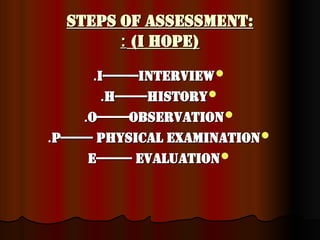
Steps of assessment:
(I HOPE)
(I HOPE)
:
:

I----------Interview
.
.

H---------History
H---------History
.
.

O---------Observation
.
.

P--------- Physical examination
.
.

E---------- Evaluation
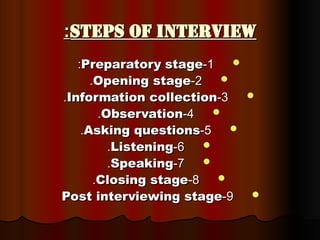
Steps of Interview
Steps of Interview
:
:

1
1
-
-
Preparatory stage
Preparatory stage
:
:

2
2
-
-
Opening stage
Opening stage
.
.

3
3
-
-
Information collection
.
.

4
4
-
-
Observation
Observation
.
.

5
5
-
-
Asking questions
Asking questions
.
.

6
6
-
-
Listening
Listening
.
.

7
7
-
-
Speaking
Speaking
.
.

8
8
-
-
Closing stage
Closing stage
.
.

9
9
-
-
Post interviewing stage
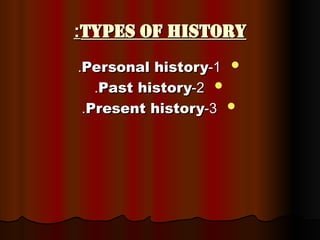
Types of history
Types of history
:
:

1
1
-
-
Personal history
Personal history
.
.

2
2
-
-
Past history
Past history
.
.

3
3
-
-
Present history
Present history
.
.
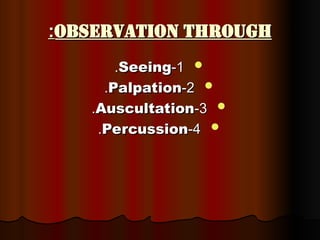
Observation through
Observation through
:
:

1
1
-
-
Seeing
Seeing
.
.

2
2
-
-
Palpation
Palpation
.
.

3
3
-
-
Auscultation
Auscultation
.
.

4
4
-
-
Percussion
Percussion
.
.
Types of problem
Types of problem

Physical
Physical
.
.

Psychological
Psychological
.
.

Social
Social
.
.

Mental
Mental
.
.
Nursing diagnosis
Nursing diagnosis

It is an alteration in human health
response either actual or
potential as regard to needs
.
.
Types of Nursing Diagnosis
:
:

(
(
1
1
)
)

Actual Nursing diagnosis : Three part
statement
statement
:
:

Problem statement +Etiology+ signs
and symptoms
and symptoms

For example
For example
:
:

Self care deficit related to inability to
move both arms as manifested by
casts on both hands and wrists
.
.

Potential OR possible nursing diagnosis
:
:
(
(
2
2
)
)
Potential OR possible nursing
diagnosis
diagnosis
:
:

Potential OR possible nursing
diagnosis
diagnosis
:
:

Problem statement +Etiology

For example
For example
:
:

Potential ineffective airway
clearance related to smoking
(
(
3
3
)
)
Collaborative nursing
diagnosis
diagnosis
:
:

Problem statement Etiology

For example
For example
:
:

Potential impaired skin integrity
(phlebitis) related to intravenous
therapy
therapy
.
.
2
2
.
.
Planning
Planning

It is the third steps of the nursing
process
process
.
.

Steps of planning
Steps of planning
:
:

Setting priorities
Setting priorities
.
.

Establishing goals
Establishing goals
.
.

Determining nursing interventions
.
.

Documenting the plan of care
.
.

Setting priorities
Setting priorities
:
:

Determining life threatening problems
and taking immediate appropriate
action
action
.
.
4
4
.
.
Implementation
Implementation

It is the fourth stage of the nursing
process
process
.
.

It is putting the nursing care into action
.
.

During the implementation stage the
nurse continues to
nurse continues to
:
:

Continuing data collection
.
.

Setting priorities
Setting priorities
.
.

Performing nursing interventions
.
.

Documenting nursing care (charting)
.
.

Giving verbal nursing reports
.
.

Maintating a current plan of care
.
.
5
5
.
.
Evaluation
Evaluation

It is measuring the expected outcomes
.
.

Assessment
Assessment
:
:

Performing an assessment to identify health status
tody and to make sure you have all the data
.
.

Nursing diagnosis
Nursing diagnosis
:
:

Making sure your list of diagnosis is accurate and
complete
complete
.
.

Planning
Planning
:
:

Checking whether the goals and interventions were
appropriate and how well goals were achieved
.
.

Implementation
Implementation
:
:

Determining whether the plan was implemented as
prescribed and identifying factors that helped or
hindered progress
hindered progress
.
.

Communication
Communication
:
:

Impaired verbal communication
.
.

Anxiety
Anxiety
.
.

Fear
Fear
.
.

Avoid danger
Avoid danger
:
:

High risk for /potential for
:
:

Infection
Infection
.
.

Injury
Injury
.
.

Suffocation
Suffocation
.
.

Poisoning
Poisoning
.
.

Trauma
Trauma
.
.

Aspiration
Aspiration
.
.

Altered protection
Altered protection
.
.

Worshipping
Worshipping
:
:

Spiritual distress
Spiritual distress
.
.

Perceiving
Perceiving
:
:

Body image disturbance
.
.

Self-esteem disturbance
.
.

Chronic low self esteem
.
.

Situational identity disturbance
.
.

Unilateral neglect
Unilateral neglect
.
.

Hopelessness
Hopelessness
.
.

Powerlessness
Powerlessness
.
.

Ineffective denial
Ineffective denial
.
.

1 NURSING PROCESS FOR PSYCHIATRIC NG process.ppt

  • 1.
    Nursing Process Nursing Process Itis an It is an organized organized, , systematic systematic method for method for providing a providing a comprehensive, individualized a comprehensive, individualized a quality of patient care that focuses quality of patient care that focuses upon identifying the actual and upon identifying the actual and potential alteration of health potential alteration of health responses (bipsychosocial needs/ responses (bipsychosocial needs/ problems). problems).
  • 2.
    Steps of thenursing process Steps of the nursing process : :  Assessment Assessment . .  Nursing diagnosis Nursing diagnosis . .  Planning Planning . .  Implementation Implementation . .  Evaluation Evaluation . .
  • 3.
    1 1 . . Assessment Assessment  Assessment is thefirst step of Assessment is the first step of the nursing process the nursing process . .  1 1 - - It involves the systematic It involves the systematic collection of data about the collection of data about the patient’s actual and potential patient’s actual and potential health problems and needs health problems and needs . .  2 2 - - It provides the scientific basis It provides the scientific basis for a nursing diagnosis and a for a nursing diagnosis and a complete nursing care plan complete nursing care plan . .
  • 4.
    Resources for data Resourcesfor data collection collection : :  Patient (Primary source) Patient (Primary source) . .  Family / significant others Family / significant others . .  Nursing records Nursing records . .  Medical records Medical records . .  Verbal/written consultation (with Verbal/written consultation (with other health care professionals) other health care professionals) . .  Records of diagnostic studies Records of diagnostic studies . .  Relevant literature Relevant literature . .
  • 5.
    How should databe gathered How should data be gathered ? ?  Comprehensive data collection occurs Comprehensive data collection occurs in 3 phases in 3 phases  1 1 - -  - - Before the nurse actually see the Before the nurse actually see the patient in order to keep an open mind patient in order to keep an open mind  2 2 - -  Perform a nursing assessment Perform a nursing assessment . .  3 3 - -  Review the resources, e.g., medical, Review the resources, e.g., medical, nursing, diagnostic records, and others nursing, diagnostic records, and others for additional information for additional information . .
  • 6.
    Steps of assessment: Stepsof assessment: (I HOPE) (I HOPE) : :  I----------Interview I----------Interview . .  H---------History H---------History . .  O---------Observation O---------Observation . .  P--------- Physical examination P--------- Physical examination . .  E---------- Evaluation E---------- Evaluation
  • 7.
    Steps of Interview Stepsof Interview : :  1 1 - - Preparatory stage Preparatory stage : :  2 2 - - Opening stage Opening stage . .  3 3 - - Information collection Information collection . .  4 4 - - Observation Observation . .  5 5 - - Asking questions Asking questions . .  6 6 - - Listening Listening . .  7 7 - - Speaking Speaking . .  8 8 - - Closing stage Closing stage . .  9 9 - - Post interviewing stage Post interviewing stage
  • 8.
    Types of history Typesof history : :  1 1 - - Personal history Personal history . .  2 2 - - Past history Past history . .  3 3 - - Present history Present history . .
  • 9.
  • 10.
    Types of problem Typesof problem  Physical Physical . .  Psychological Psychological . .  Social Social . .  Mental Mental . .
  • 11.
    Nursing diagnosis Nursing diagnosis  Itis an alteration in human health It is an alteration in human health response either actual or response either actual or potential as regard to needs potential as regard to needs . .
  • 12.
    Types of NursingDiagnosis Types of Nursing Diagnosis : :  ( ( 1 1 ) )  Actual Nursing diagnosis : Three part Actual Nursing diagnosis : Three part statement statement : :  Problem statement +Etiology+ signs Problem statement +Etiology+ signs and symptoms and symptoms  For example For example : :  Self care deficit related to inability to Self care deficit related to inability to move both arms as manifested by move both arms as manifested by casts on both hands and wrists casts on both hands and wrists . .  Potential OR possible nursing diagnosis Potential OR possible nursing diagnosis : :
  • 13.
    ( ( 2 2 ) ) Potential OR possiblenursing Potential OR possible nursing diagnosis diagnosis : :  Potential OR possible nursing Potential OR possible nursing diagnosis diagnosis : :  Problem statement +Etiology Problem statement +Etiology  For example For example : :  Potential ineffective airway Potential ineffective airway clearance related to smoking clearance related to smoking
  • 14.
    ( ( 3 3 ) ) Collaborative nursing Collaborative nursing diagnosis diagnosis : :  Problemstatement Etiology Problem statement Etiology  For example For example : :  Potential impaired skin integrity Potential impaired skin integrity (phlebitis) related to intravenous (phlebitis) related to intravenous therapy therapy . .
  • 15.
    2 2 . . Planning Planning  It is thethird steps of the nursing It is the third steps of the nursing process process . .  Steps of planning Steps of planning : :  Setting priorities Setting priorities . .  Establishing goals Establishing goals . .  Determining nursing interventions Determining nursing interventions . .  Documenting the plan of care Documenting the plan of care . .  Setting priorities Setting priorities : :  Determining life threatening problems Determining life threatening problems and taking immediate appropriate and taking immediate appropriate action action . .
  • 16.
    4 4 . . Implementation Implementation  It is thefourth stage of the nursing It is the fourth stage of the nursing process process . .  It is putting the nursing care into action It is putting the nursing care into action . .  During the implementation stage the During the implementation stage the nurse continues to nurse continues to : :  Continuing data collection Continuing data collection . .  Setting priorities Setting priorities . .  Performing nursing interventions Performing nursing interventions . .  Documenting nursing care (charting) Documenting nursing care (charting) . .  Giving verbal nursing reports Giving verbal nursing reports . .  Maintating a current plan of care Maintating a current plan of care . .
  • 17.
    5 5 . . Evaluation Evaluation  It is measuringthe expected outcomes It is measuring the expected outcomes . .  Assessment Assessment : :  Performing an assessment to identify health status Performing an assessment to identify health status tody and to make sure you have all the data tody and to make sure you have all the data . .  Nursing diagnosis Nursing diagnosis : :  Making sure your list of diagnosis is accurate and Making sure your list of diagnosis is accurate and complete complete . .  Planning Planning : :  Checking whether the goals and interventions were Checking whether the goals and interventions were appropriate and how well goals were achieved appropriate and how well goals were achieved . .  Implementation Implementation : :  Determining whether the plan was implemented as Determining whether the plan was implemented as prescribed and identifying factors that helped or prescribed and identifying factors that helped or hindered progress hindered progress . .
  • 18.
     Communication Communication : :  Impaired verbal communication Impairedverbal communication . .  Anxiety Anxiety . .  Fear Fear . .  Avoid danger Avoid danger : :  High risk for /potential for High risk for /potential for : :  Infection Infection . .  Injury Injury . .  Suffocation Suffocation . .  Poisoning Poisoning . .  Trauma Trauma . .  Aspiration Aspiration . .  Altered protection Altered protection . .
  • 19.
     Worshipping Worshipping : :  Spiritual distress Spiritual distress . .  Perceiving Perceiving : :  Bodyimage disturbance Body image disturbance . .  Self-esteem disturbance Self-esteem disturbance . .  Chronic low self esteem Chronic low self esteem . .  Situational identity disturbance Situational identity disturbance . .  Unilateral neglect Unilateral neglect . .  Hopelessness Hopelessness . .  Powerlessness Powerlessness . .  Ineffective denial Ineffective denial . .