1 
Puget Sound Restoration 
Ethan Davies 
Jessica Ketchum 
Karris Roland 
Will Wier
2 
TABLE OF CONTENTS 
1. Introduction to Sounds 
1.1 What is Puget Sound? 
1.2 Components of the Project 
a. Beaches 
b. Bluffs 
c. Estuaries 
d. Deltas 
2. Introduction to Estuaries 
2.1 Definition 
2.2 Productivity 
2.3 Issues with Degradation and Pollutants 
2.4 Restoration 
3. Introduction to Deltas 
3.1 Definition 
3.2 Components 
3.3 Importance of Flow Rates 
3.4 Decreasing the Gradient 
3.5 Types of Deltas 
3.6 Restoration Practices 
4. Introduction to Beaches and Barrier Embayments 
4.1 Definition 
4.2 Productivity 
4.3 Issues with Sediment Supply and Ecological Processes 
4.4 Forage Fish 
4.5 Restoration Practices 
6. Nooksack Delta 
6.1 Definition 
6.2 Layout 
6.3 Specific Goals and Key Design Elements 
6.4 Specific Improved Conditions 
6.5 Length of Project and Cost 
6.6 Rail, Roadway and Bridge Projects 
6.7 Sea Level 
6.8 Public Outreach 
7. Puget Sound Estuaries 
7.1 Estuary Introduction 
7.2 Processes Restored 
7.3 Conditions Improved 
7.4 Lilliwaup Causeway Replacement and Estuary Restoration 
7.4.1 Lilliwaup Introduction 
7.4.2 History 
7.4.3 Surrounding Environment 
7.4.4 Restoration Design 
7.4.4.1 Overview 
7.4.4.2 Primary Management
3 
7.4.4.3 Additional Management 
7.4.4.4 Considerations 
7.4.5 Expected Outcomes 
7.4.6 Uncertainties 
7.5 Figures
4 
INTRODUCTION TO SOUNDS AND PUGET 
A sound is a narrow sea of water between two bodies of land. Puget Sound is a 
sound located in the state of Washington in the US. The sound is an inlet for the Pacific 
Ocean and is a very complex coastal system, with several rivers and streams 
interconnecting basins, and also with connections to the Strait of Juan de Fuca. Puget 
Sound is approximately 100 miles long and averages a depth of 205 ft. Puget Sound is 
defined not just as the water bodies but also the regions of land encompassing the sound. 
Puget Sound Nearshore Ecosystem Restoration Project (PSNERP) has identified 
36 potential nearshore restoration projects. The conceptual Engineering Design Report 
was created to assess the costs and benefits of each of the 36 components. Along with 
providing a general conceptual design of the planned restoration, it is also a useful 
document since it allows the US Army Corps of Engineers to assess which sites best 
match their own restoration programs. It is still being decided which programs are better 
executed at the local, state, and federal levels. 
The sound breaks down restoration into 3 main components: beaches and bluffs, 
deltas, and estuaries. An estuary is a part coastal body of water, usually brackish, 
meaning it’s a mix of salty and fresh water, with connections of rivers and streams and 
also a pathway to the open ocean. Estuaries are unique in that they experience both river 
and ocean conditions. Influences such as salt concentration, tides and waves are all due 
to the sea component and influences such as flow rates, and nutrient/sediment flows are 
due to the river system attributes. Because of these conditions, estuaries have “the best of 
both worlds” and are one of the most productive ecosystems in the world. Other names 
for estuaries are used interchangeably such as bays, harbors, or lagoons, but all vary a tad 
in their actual definition. 
INTRODUCTION TO ESTUARIES 
Since banks of estuaries are some of the most productive habitats in the world, it’s 
no surprise that it’s also one of the most populated locations also. According to the US 
EPA, approximately 60% of the world’s populations live along estuaries and 
coastlines. Because of heavy population, estuaries are also some of the most degraded 
areas. Issues with soil erosion caused by poor farming practices, overgrazing, and 
deforestation are one of the main concerns. Several other issues also exist. Overfishing 
leads to a myriad of reactions in the ecosystem, excessive nutrients due to animal 
production lead to eutrophication. Pollutants ranging from heavy metals to dangerous 
chemical compounds such as BPA also pose a serious problem to the health of the 
estuaries within the sound and the whole geographical area of Puget Sound itself. 
To get a better idea of the process of restoration on a project this big, the main 
components of the Puget Sound project: beaches and bluffs, estuaries, and deltas have 
been selected and then magnified to include one specific beach, bluff, estuary and delta.
5 
INTRODUCTION TO DELTAS 
A river delta is a geological formation that is similar and often a component of an 
estuary. A river delta is a region that forms where the mouth of a river flows into the 
ocean, estuary, lake or other water body. This differs from an estuary in that the estuary 
is more the mixed brackish water bodies and the land surrounding it, while a river delta 
focuses more on the landform itself. The delta is made up of deposits of sediment carried 
out to the water body form the river over long periods of time. One factor to note is that 
the flow rate of water must be slow enough not to sweep the sediments away since the 
buildup of these sediments is the main characteristic of a delta. Other factors necessary 
to the creation of deltas is that the river must have enough sediment as a source to carry 
through its path and leave for deposition further down. When the delta reaches the 
water body from the river, the width of water is then expanded. As the width expands, 
the flow of water is again slowed, making it more difficult to transport sediment, and 
slowing the process down. What results is that the sediments drop out of the flow and are 
deposited. This delta formation that expands as it pushes out over time is sometimes 
referred to as a lobe. As this lobe further develops, it lowers the river channel gradient 
since the elevation remains constant but the river channel lengthens. 
As this gradient or slow of the river channel decreases, it starts to become 
unbalanced. This system becomes unbalanced for two main reasons. One, gravity is the 
driving force for the water and a steeper slope is usually more stable, especially when a 
big rain event occurs. And second, as the slope of the river channel is decreased, so it the 
shear stress on the river bed. When the shear stress on the river bed is reduced, the 
sediments will deposit more quickly and increase the bed elevation, causing a spill of 
water from a rain event to be more likely. If an event like this occurs, usually a network 
of channels begins formation. 
Three main categories of deltas exits: wave-dominated, tide-dominated, and 
Gilbert deltas. In the first category, wave-dominated, the waves are the main controller of 
the deltas shape, and the deposits of sediments are deflected along the coastline. Tide-dominated 
deltas tend to have more main distributaries than wave-dominated scenarios 
since in the wave situation when the new channels are formed; the old ones are usually 
abandoned. Lastly, Gilbert deltas form more course sediments and are not as muddy, 
soft, and sloping. 
NOOKSACK DELTA 
The Nooksack River Delta is a very complex and intricate system that 
incorporates both the Nooksack and Lummi River estuaries, both major water systems of 
Whatcom County. Three main problems this delta faces are the quality of water, 
floodplain habitats and also nearshore habitats. What has happened is that the Lummi 
River used to carry a substantial portion of water to the west of the Lummi River, 
providing the Lummi Peninsula and Bay with plenty of resources. However, due to the 
removal of many large trees, draining, diking, and construction, the flow has been almost 
entirely redirected to the east and now flows into the Nooksack River out into Bellingham 
Bay. This redirection of water allows a lot of productivity of the east side, but the west 
now lacks water and habitats and populations are suffering. The west side of the delta is 
also exposed to tidal flows since it has been separated by a constructed levee 
system. The main goals of the restoration project at Nooksack are removal or setting
6 
back of the levees obstructing tidal flow to allow more natural flows of river channels 
and floodplains. The site is comprised of several thousand acres so this presents no easy 
task. Essentially, the project aims to restore the site to its pre-disturbed condition. 
Specific goals for processes to restore include restoring a more natural process to 
the following: the erosion of beaches, formation of tidal zones and channels in estuaries, 
the flow of freshwater in rivers and streams, movement of saltwater in tidal channel in 
estuaries, and lastly, the buildup and retention of organic material from plants and marine 
life (PSNERP, 2012). Specific conditions improved would include the following: a 
reestablished large river delta providing for threatened species of marine life such as 
juvenile salmon (Chinook) that would increase their survival and support improving this 
population, re-establishing intertidal and sub tidal areas so to boost kelp and eelgrass 
growth (creating food and habitat for fish, birds and marine species), improved 
connectivity of nearshore and neighboring land, increased area, length, and intricacy of 
shoreline, improved elasticity to the shoreline from effects such as changing sea level and 
increasing frequency of storms. 
The total projected cost for this project is 414.6 million dollars. The specific 
elements would remove part of the levee along both Nooksack River banks, and setting 
back the levees on the North Red River Road and at entrance of the Nooksack 
estuary. The Lummi River channel would also be dredged and graded to re-join it to the 
water flowing form the Nooksack River. Old ditches made for past agriculture would be 
filled in and tidal channel would be recreated. The raising of several roads onto bridges 
would also tidal water to flow in and out of the delta. This project would demand for 
some residents to relocate. 
NOOKSACK DELTA’S NATURAL ENVIRONMENT 
The Nooksack delta drains approximately 825 square miles from Mount Baker to 
Bellingham Bay. It is composed of three major forks that join as they exit the Cascade 
Mountain foothills. The Nooksack River formerly was divided into channels in the 
delta; however, the main channel is now directed to flow east of the Lummi Peninsula, 
and is inhibited by levees for much of its span Freshwater flow into the Lummi 
River distributary channel doesn’t really exist except for flow through a culvert. The 
Lummi River has full tidal access but is essentially a blind channel since it’s separated 
from the main channel, the Nooksack River, by a levee, and only receives intermittent 
flow. The Lummi River has a freshwater intake from Shell Creek, which drains sections 
of the City of Ferndale to the north. Most of the former delta wetlands are separated from 
tides by a levee or dike system, running along the Lummi River and in other areas. Forest 
cover has been almost entirely removed from the western delta. Riparian forest needs to 
be reestablished. The Nooksack River system supports nine species of salmon IDs, 
including three listed under the Endangered Species Act: early Chinook, steelhead, and 
bull trout. Only three of the 25 salmonid stocks are currently considered healthy (Smith 
2002).
7 
HUMAN ENVIRONMENT 
Humans have influenced the area greatly and contributed to degradation in the 
following ways: 
 Establishing a major road network, with major roads including Slater Road, 
Ferndale Road, North Red River Road, South Red River Road, Marine Drive, 
Kwina Road, Hillaire Road, and Haxton Way. 
 Land conversion to agriculture (field crops, poplar plantations, and pasture). 
 Low-density residential development. 
 Levees constructed along the mainstay Nooksack River and Lummi River. 
 A seawall and berm system in the west delta. 
 Tide gates installed on channels and the Lummi River in the west delta. 
 Land use conversion to commercial (gas station/minimart, Silver Reef Hotel, 
Casino, Spa). 
The changes are altered land cover throughout the majority of the Nooksack 
delta. Tides and fluvial processes (flow and sediment related) that are blocked and 
eliminated, respectively; and altered sediment delivery to river floodplains and the 
nearshore. 
CONCEPTUAL DESIGN (10%) 
Typical design plans for this type of project to through many stages. The 
conceptual design is sometimes deemed as the ten percent design. This stage involves 
identifying the sites for restoration and coming up with action plans. Then the next step 
is to assess the cost, benefits and feasibility. The full restoration objective for River 
Deltas Ecosystem is to remove dominant stressors to a degree that allows undegraded 
tidal flows and freshwater inputs necessary to support a full range of delta ecosystem 
processes, focusing on the reestablishment of complex wetlands that include oligohaline 
transition and tidal freshwater components. This will be accomplished by berm or dike 
removal and also in combination with river channel restoration.
8 
RAIL, ROADWAYS, AND BRIDGES STANDARDS 
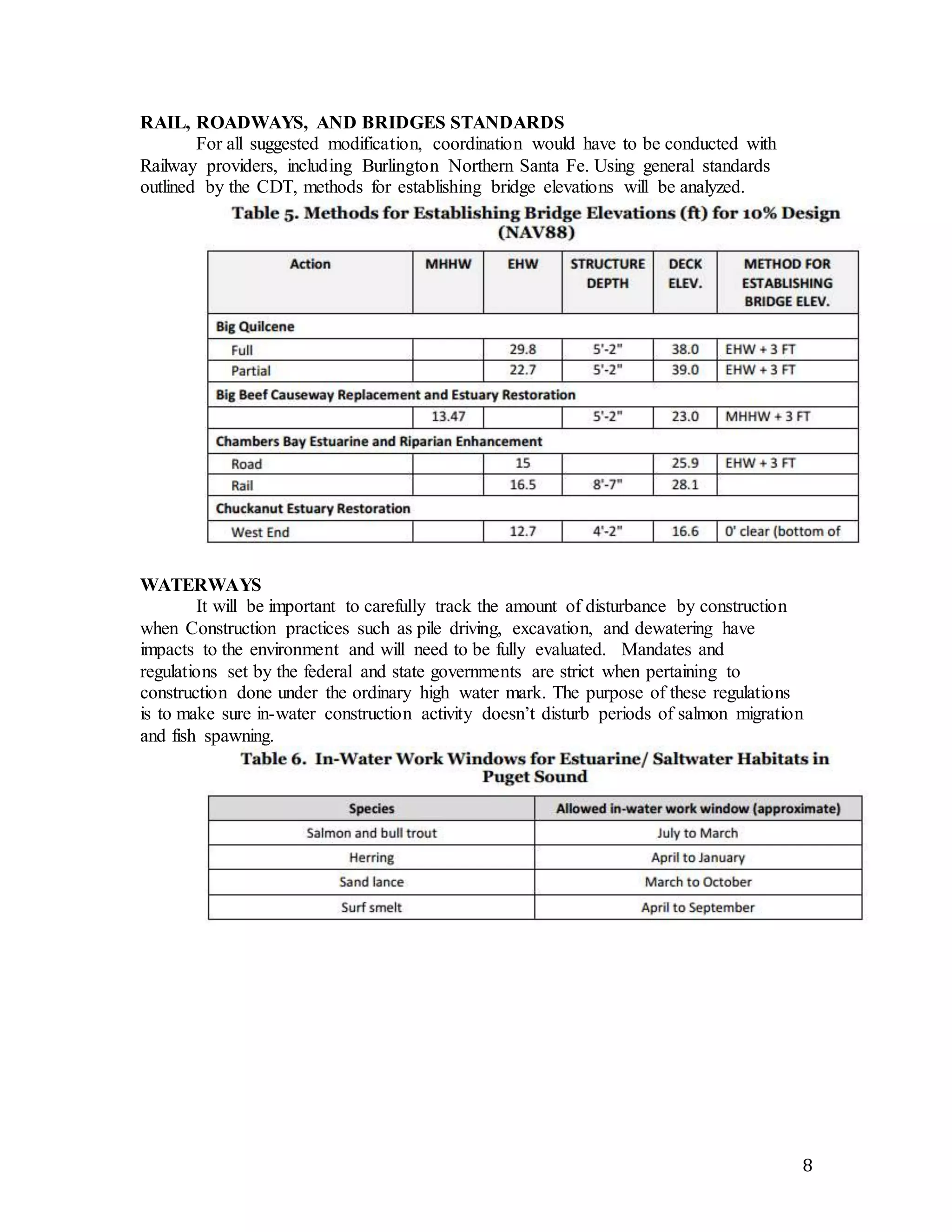
For all suggested modification, coordination would have to be conducted with 
Railway providers, including Burlington Northern Santa Fe. Using general standards 
outlined by the CDT, methods for establishing bridge elevations will be analyzed. 
WATERWAYS 
It will be important to carefully track the amount of disturbance by construction 
when Construction practices such as pile driving, excavation, and dewatering have 
impacts to the environment and will need to be fully evaluated. Mandates and 
regulations set by the federal and state governments are strict when pertaining to 
construction done under the ordinary high water mark. The purpose of these regulations 
is to make sure in-water construction activity doesn’t disturb periods of salmon migration 
and fish spawning.
9 
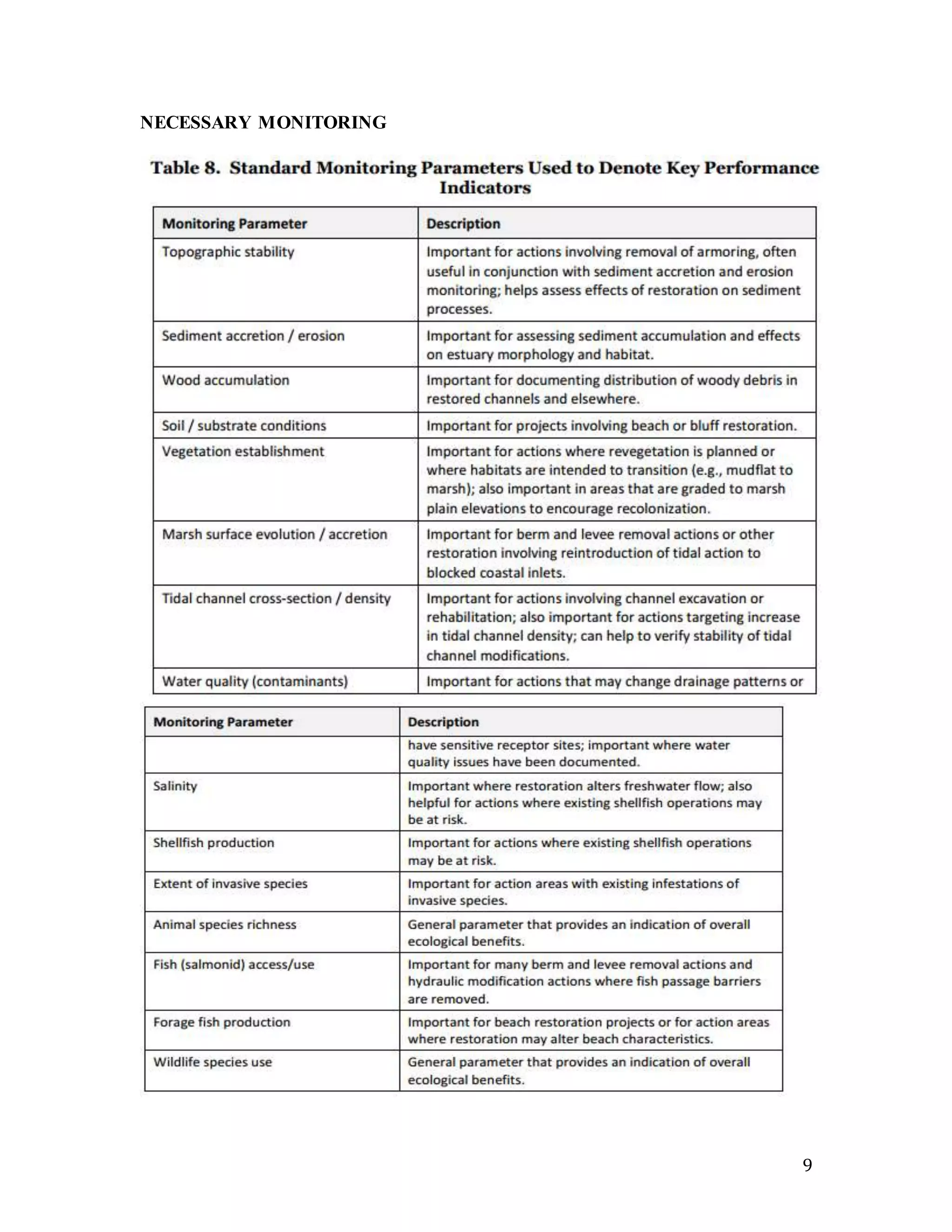
NECESSARY MONITORING
10 
PUBLIC OUTREACH AND PROPERTY ACQUISITION 
The public is a very important piece of the completion of this project. The 
public’s needs and concerns can be meet with education and fair compensation of 
property, but many other issues arise. Some of the proposed modifications occur on 
public lands such as recreational waterfowl hunting areas, and other public 
resources. Some commercial fishing and shellfish production and harvest are also 
located on this land. Dam removals required careful accessing of water rights and other 
amenities that have large parties interests involved. 
Embayments 
Another major issue affecting the welfare of the Puget Sound nearshore is the 
degradation of the coastal embayments. An embayment is “an indentation of the 
shoreline larger in size than a cove but smaller than a gulf.” Embayments are broken 
down into four primary shoreforms: Open coastal inlets, barrier estuaries, barrier lagoons, 
and closed lagoons and marshes. An open coastal inlet is a small inlet protected from 
wave action by their small size or shape, but not significantly enclosed by a barrier beach. 
Barrier estuaries are tidal inlets largely isolated by a barrier beach and with a significant 
input of freshwater from a stream or upland drainage. Barrier lagoons are tidal inlets 
largely isolated by a barrier beach and with no significant input of freshwater. Finally, 
closed lagoons and marshes are back-barrier wetlands with no surface connection to 
Puget Sound. These components are varyingly comprised of stream deltas, tide flats, salt 
marsh, channels, tidal deltas, and ponds or lakes. A single embayment could include 
portions of more than one embayment shoreform.(PSNERP 2012) 
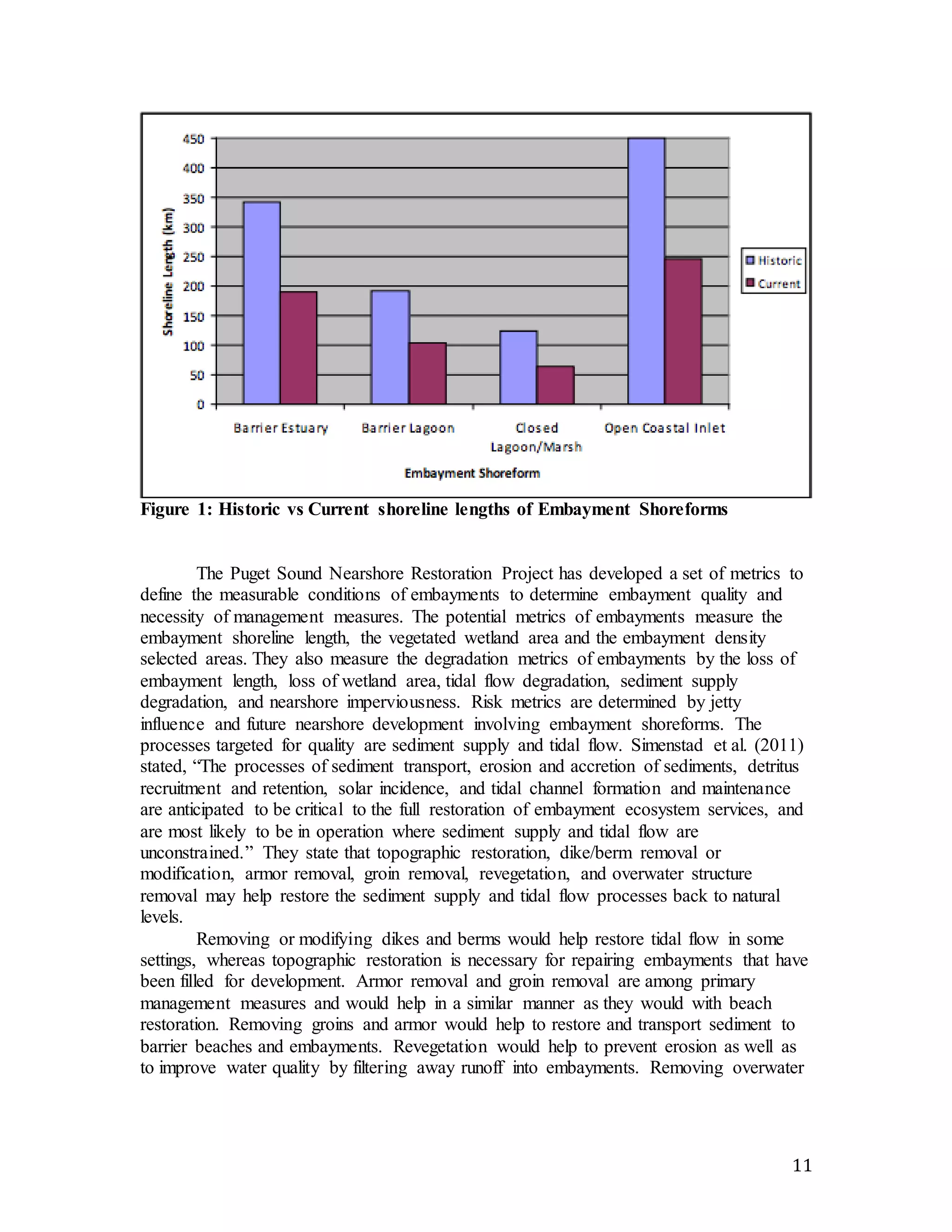
Historically, coastal embayments, including open coastal inlets, barrier estuaries 
and barrier lagoons, accounted for 1,100 km of shoreline in Puget Sound, now they make 
up a mere 600 km. Of the 173 open coastal inlets that once existed only 16 exist today, as 
well as 61 of the 240 barrier estuaries, and 80 of the 222 barrier lagoons that previously 
existed. The embayments that were separate from the Puget Sound shoreline (closed 
lagoons and marshes) were reduced from 2.6 km of shoreline to 1.6 km, making them the 
rarest shoreform in Puget Sound. Out of the 249 previously existing closed lagoons and 
marshes, 138 have been lost. Overall, there are 35% fewer of all four of the embayment 
shoreforms than historic records previously indicated. (PSNERP 2011)
11 
Figure 1: Historic vs Current shoreline lengths of Embayment Shoreforms 
The Puget Sound Nearshore Restoration Project has developed a set of metrics to 
define the measurable conditions of embayments to determine embayment quality and 
necessity of management measures. The potential metrics of embayments measure the 
embayment shoreline length, the vegetated wetland area and the embayment density 
selected areas. They also measure the degradation metrics of embayments by the loss of 
embayment length, loss of wetland area, tidal flow degradation, sediment supply 
degradation, and nearshore imperviousness. Risk metrics are determined by jetty 
influence and future nearshore development involving embayment shoreforms. The 
processes targeted for quality are sediment supply and tidal flow. Simenstad et al. (2011) 
stated, “The processes of sediment transport, erosion and accretion of sediments, detritus 
recruitment and retention, solar incidence, and tidal channel formation and maintenance 
are anticipated to be critical to the full restoration of embayment ecosystem services, and 
are most likely to be in operation where sediment supply and tidal flow are 
unconstrained.” They state that topographic restoration, dike/berm removal or 
modification, armor removal, groin removal, revegetation, and overwater structure 
removal may help restore the sediment supply and tidal flow processes back to natural 
levels. 
Removing or modifying dikes and berms would help restore tidal flow in some 
settings, whereas topographic restoration is necessary for repairing embayments that have 
been filled for development. Armor removal and groin removal are among primary 
management measures and would help in a similar manner as they would with beach 
restoration. Removing groins and armor would help to restore and transport sediment to 
barrier beaches and embayments. Revegetation would help to prevent erosion as well as 
to improve water quality by filtering away runoff into embayments. Removing overwater
12 
structures and roads would help to reopen up channels for natural sediment transport as 
well as reduce embayment exposure to runoff. 
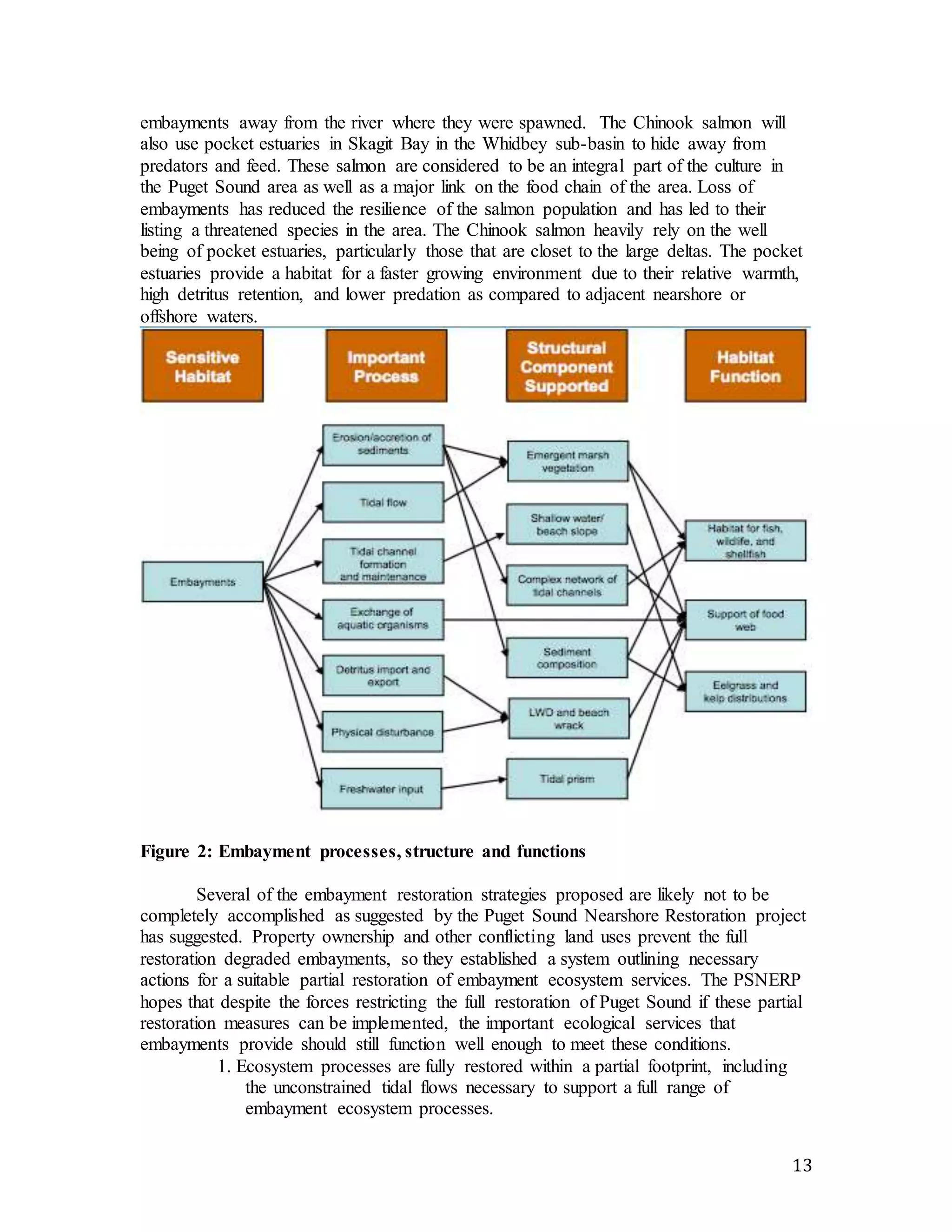
The tidal barriers and wetland filling practices disrupt several of the essential 
functions of the embayments and deltas. They impact important processes like sediment 
transport, tidal flow, tidal channel formation, distributary channel migration, detritus 
import and export, as well as the exchange of aquatic organisms. These impacted 
processes effect the overall composition of the embayments, making them less capable of 
supporting the native fauna, as well as diminishing the base of the local food web. The 
change in sediment transport and erosion causes the surface elevation of marshes to 
subside making the nearshore less resilient to rises in sea level, which could potentially 
lead to further damage. 
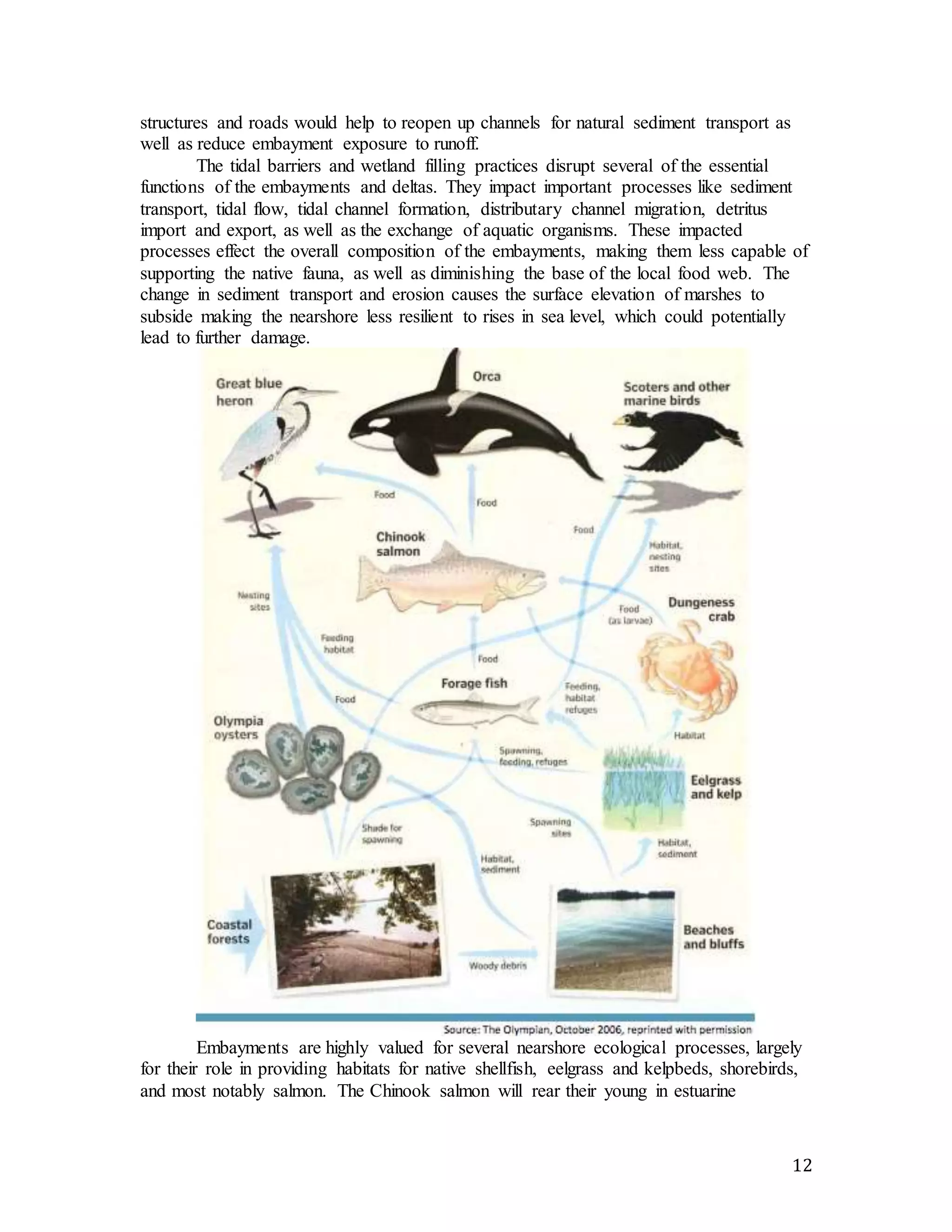
Embayments are highly valued for several nearshore ecological processes, largely 
for their role in providing habitats for native shellfish, eelgrass and kelpbeds, shorebirds, 
and most notably salmon. The Chinook salmon will rear their young in estuarine
embayments away from the river where they were spawned. The Chinook salmon will 
also use pocket estuaries in Skagit Bay in the Whidbey sub-basin to hide away from 
predators and feed. These salmon are considered to be an integral part of the culture in 
the Puget Sound area as well as a major link on the food chain of the area. Loss of 
embayments has reduced the resilience of the salmon population and has led to their 
listing a threatened species in the area. The Chinook salmon heavily rely on the well 
being of pocket estuaries, particularly those that are closet to the large deltas. The pocket 
estuaries provide a habitat for a faster growing environment due to their relative warmth, 
high detritus retention, and lower predation as compared to adjacent nearshore or 
offshore waters. 
13 
Figure 2: Embayment processes, structure and functions 
Several of the embayment restoration strategies proposed are likely not to be 
completely accomplished as suggested by the Puget Sound Nearshore Restoration project 
has suggested. Property ownership and other conflicting land uses prevent the full 
restoration degraded embayments, so they established a system outlining necessary 
actions for a suitable partial restoration of embayment ecosystem services. The PSNERP 
hopes that despite the forces restricting the full restoration of Puget Sound if these partial 
restoration measures can be implemented, the important ecological services that 
embayments provide should still function well enough to meet these conditions. 
1. Ecosystem processes are fully restored within a partial footprint, including 
the unconstrained tidal flows necessary to support a full range of 
embayment ecosystem processes.
14 
2. The system has redundant representation of the full range of embayment 
ecosystem components including stream delta or ponds (where historically 
present), tidal flats, salt marsh, channels, tidal delta, beach berm, beach 
face, and low tide terrace where historically present. 
3. The partially restored system is formed of a contiguous large patch that is 
well connected to adjacent terrestrial and marine landscapes. 
4. The wetland system is internally connected through a network of tidal 
channels that allow for the unconstrained movement of organisms, water, 
and sediments. 
5. The landward edges and freshwater inputs into the partial embayment 
ecosystem are managed to provide riparian functions and to protect the 
quantity and quality of freshwater inputs from surrounding land use 
impacts. 
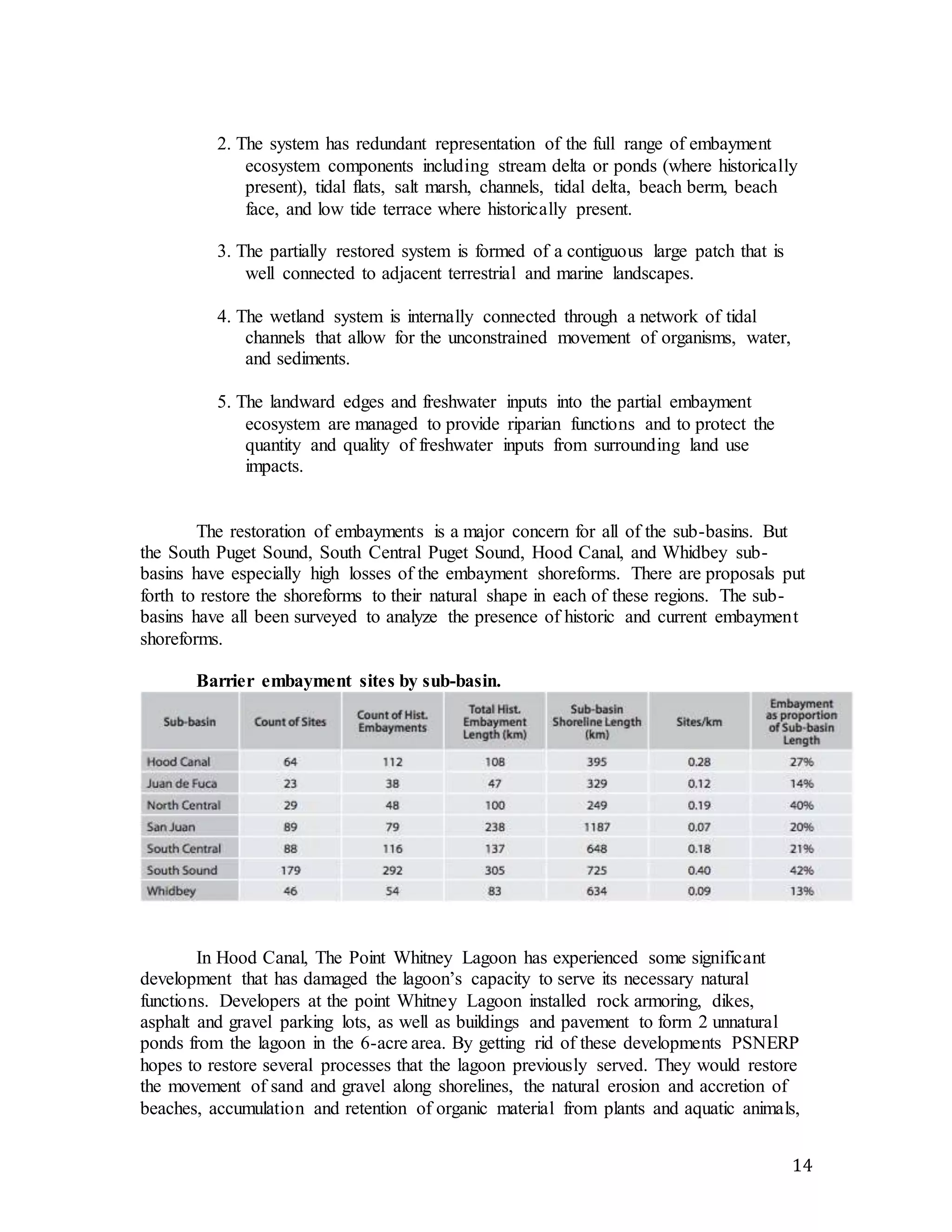
The restoration of embayments is a major concern for all of the sub-basins. But 
the South Puget Sound, South Central Puget Sound, Hood Canal, and Whidbey sub-basins 
have especially high losses of the embayment shoreforms. There are proposals put 
forth to restore the shoreforms to their natural shape in each of these regions. The sub-basins 
have all been surveyed to analyze the presence of historic and current embayment 
shoreforms. 
Barrier embayment sites by sub-basin. 
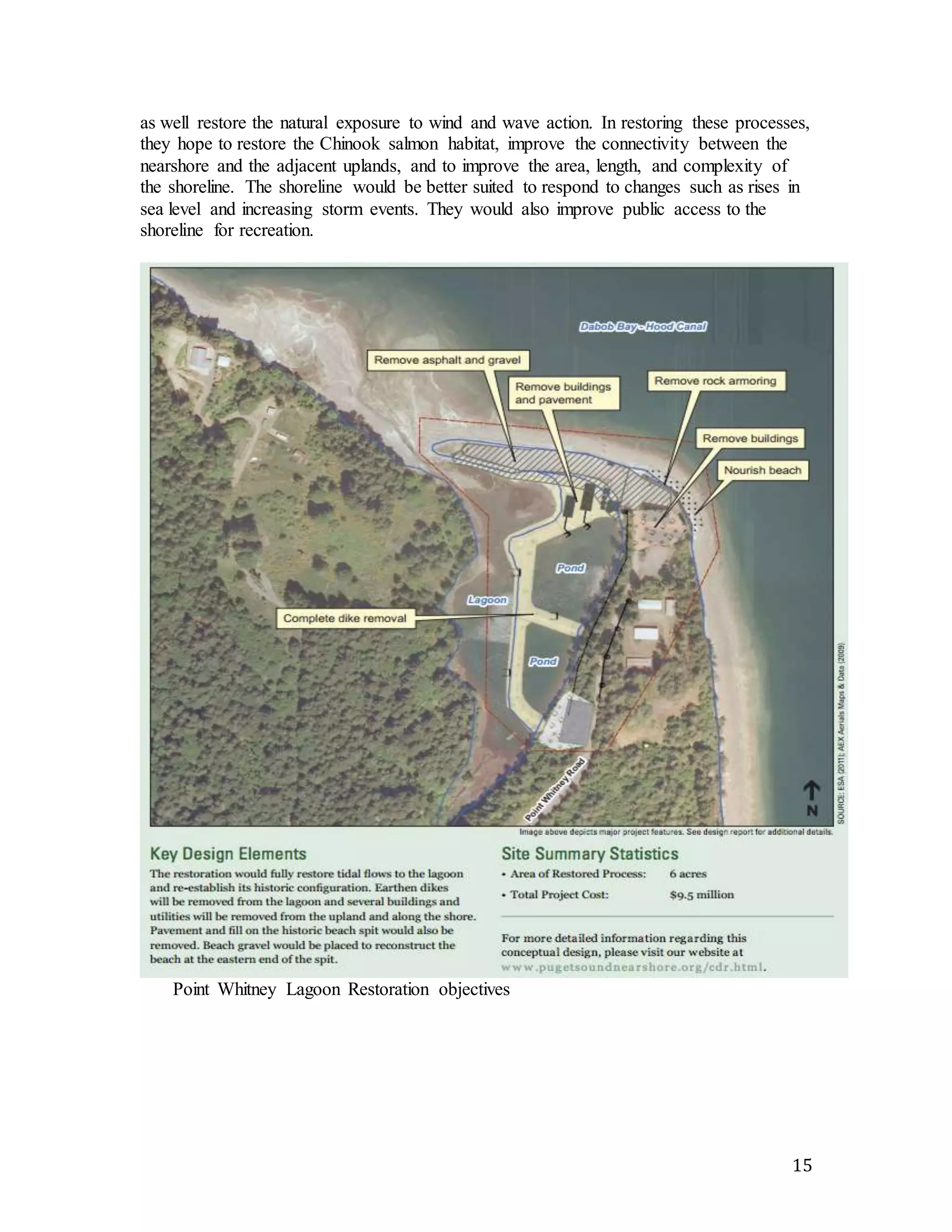
In Hood Canal, The Point Whitney Lagoon has experienced some significant 
development that has damaged the lagoon’s capacity to serve its necessary natural 
functions. Developers at the point Whitney Lagoon installed rock armoring, dikes, 
asphalt and gravel parking lots, as well as buildings and pavement to form 2 unnatural 
ponds from the lagoon in the 6-acre area. By getting rid of these developments PSNERP 
hopes to restore several processes that the lagoon previously served. They would restore 
the movement of sand and gravel along shorelines, the natural erosion and accretion of 
beaches, accumulation and retention of organic material from plants and aquatic animals,
as well restore the natural exposure to wind and wave action. In restoring these processes, 
they hope to restore the Chinook salmon habitat, improve the connectivity between the 
nearshore and the adjacent uplands, and to improve the area, length, and complexity of 
the shoreline. The shoreline would be better suited to respond to changes such as rises in 
sea level and increasing storm events. They would also improve public access to the 
shoreline for recreation. 
15 
Point Whitney Lagoon Restoration objectives
16 
Puget Sound Restoration Estuaries 
I. Estuary introduction 
Estuaries provide a key role to the Puget Sound system. Estuaries are the coastal 
waters where an incoming freshwater source meets a saltwater body. They tend to be 
partially enclosed, therefore making them ideal places for fish and other organisms to 
raise their young. Without estuaries many fish species would suffer as a result of their 
eggs and young not being protected, making them vulnerable to predators. The many 
estuaries in Puget Sound have been modified and don’t provide as much shelter for young 
fish as they used to. These estuaries need to be restored to their original condition in 
order for the fish in the region to thrive as well as they once did. A restored estuary 
would lead to a restored fishery, which would in turn lead to a stronger economy as many 
towns along the Puget Sound coast rely on fishing. 
II. Processes Restored 
The Puget Sound Nearshore Ecosystem Restoration Project emphasizes several 
aspects of restoration for estuaries in order to make the area more like it was before 
human intervention altered the Puget Sound natural processes. For starters, the natural 
formation of tidal channels in estuaries should be restored. Agricultural ditches have 
significantly altered the way that tidal channels form and the wildlife that use these tidal 
channels have been negatively affected. Also, the flow of freshwater streams into the 
estuaries and saltwater into the tidal channels should become unrestricted as it naturally 
was. Dikes and berms for bridges have restricted this natural flow of the water in the 
estuaries. Removing these or creating a way for the water to flow better will help create 
an unrestricted flow of water as well as an unrestricted movement and migration of fish 
and wildlife. This will also help in the accumulation and retention of organic material 
from plants and aquatic animals. Along the coastlines, the major goal is to restore the 
shore to the natural exposure to wind and wave action. 
III. Conditions Improved 
Restoring the natural processes of Puget Sound will help greatly in improving 
many conditions of the ecosystem. Historical tidal flat habitats would be re-established. 
These areas are important foraging and resting areas for shorebirds and marine birds like 
Dunlin and the Great Blue Heron. Intertidal and shallow subtidal areas would also be 
restored which would encourage the growth of kelp and eelgrass, in turn improving the 
conditions for fish, birds and other marine species. The area, length, and complexity of 
the shoreline would be increased as the Puget Sound area was originally. This would also 
improve the resiliency of the shoreline to respond to changes in the environment such as 
rising sea levels and a growing number of storms. Improvements would also be made for 
the coastal embayments and large river deltas that provide a nursery habitat for species of 
fish, including the threatened species of Chinook salmon. Another positive result would 
also include intertidal and subtidal areas that are used recreationally and culturally 
important shellfish such as oysters, clams, and mussels. All of these improved conditions 
will result in an improved quality of the water flowing through the estuary.
17 
IV. Lilliwaup Causeway Replacement and Estuary Restoration 
a. Lilliwaup Introduction 
The Lilliwaup estuary is currently obstructed by a roadway, changing the 
hydraulics, sediment transport, and geomorphology from the natural processes. 
Removing this causeway will restore tidal connectivity in the estuary. The proposed 
alternative to the current roadway that disrupts the tidal flow is a bridge that spans the 
entire delta and removing the earthen fill that partially blocked the estuary. 
Lilliwaup Creek is the largest creek in the southern part of the Hamma Hamma 
watershed. It provides a significant influent flow to wetlands and lakes and habitat for 
salmonids. Lilliwaup Falls farther upstream prevents anadromous fish from swimming 
far upstream. Most of the watershed is publically owned land with some residential 
homes and farms situated near the mouth of the creek. A small hatchery is located on 
Lilliwaup Creek where summer chum entering the creek are spawned and the offspring 
are released. A small privately owned hydroelectric power plant is located below 
Lilliwaup Falls. 
b. History 
The earliest records of the channel (a 1884 T-sheet) show a few small marsh 
islands at the upstream end of the estuary and two tidal channels at the mouth of the 
creek. No roadway or any sign of settlement is shown other than a fenced grassland north 
of the creek. A 1925 WSDOT roadway and bridge drawing is the first historical record of 
a road crossing the creek. It shows an existing “pile trestle” just east of the new road as 
well. Three distributary channels for Lilliwaup Creek are also shown: the South Fork 
South, the South Fork North, and the North Fork. The new bridge was aligned near the 
South Fork North channel and the road embankment blocked the other two channels. 
There were also plans to fill and develop parts of Lilliwaup Bay. A wharf of about 300 
feet extended into the bay east of the proposed roadway on the south bank. Tides reached 
up to Lilliwaup Falls prior to the aggradation of the streambed. 
c. Surrounding Environment 
Upstream of the bridge that Highway 101 crosses the estuary on, two definite 
channels flow with the eastern one being the main channel. There is some braiding in the 
mudflats and upstream of the bridge, and under the bridge, the channel deepens 
suggesting that the flow has been constricted. Just after the channel goes under the 
highway 101 bridge, it widens out into a large embayment before entering a large section 
of Puget Sound. 
The watershed for Lilliwaup Creek is small and narrow due to the steep terrain 
surrounding it. There is a weir-like concrete structure that has been placed near the 
waterfall and a sluiceway enters the canyon from the northeast. The sluiceway was going 
to be for a power plant, but several structural failures upstream prevented the plant from 
being built. Large gravel slide events due to inadvertent human actions between the 
waterfall and highway 101 in 2005 and 2007 caused the channel to become heavily 
aggraded. Photographs show that deposition of sediment have caused the creek to rise 10 
feet at an upstream bridge. These gravel slides has cased the stream’s groundwater to rise 
to a point that it is now drowning the roots of trees causing them to die. In 2008, 5000
cubic yards of this aggraded gravel and sediment were removed near the falls as a part of 
a rehabilitation project. 
18 
The 150 feet single-span bridge constricts the flow of Lilliwaup Creek at the 
mouth of the estuary directing all the flow to one opening as opposed to the two channels 
that the estuary historically had. Downstream roadway embankments are fortified with 
concrete rubble and armoring. The properties along the sides of the bay also have 
concrete bulkheads. The western side of the estuary has concrete in the marsh and along 
the bank both upstream and downstream of highway 101 to protect the roadway. The area 
is privately owned other than Highway 101 itself, but the property owner upstream is 
supportive of stream restoration plans. However the interest of other property owners 
nearer to Highway 101 are unknown. 
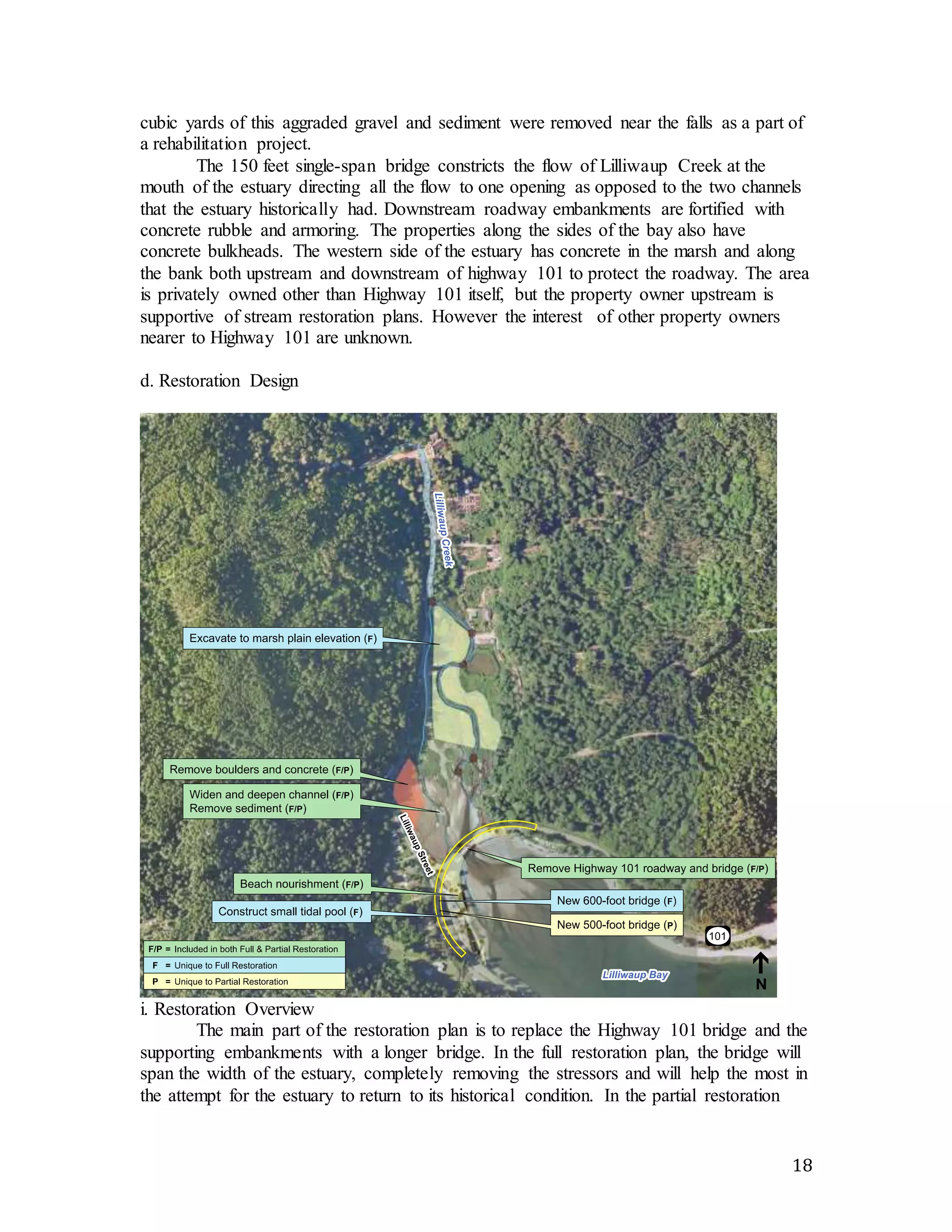
d. Restoration Design 
i. Restoration Overview 
The main part of the restoration plan is to replace the Highway 101 bridge and the 
supporting embankments with a longer bridge. In the full restoration plan, the bridge will 
span the width of the estuary, completely removing the stressors and will help the most in 
the attempt for the estuary to return to its historical condition. In the partial restoration
plan, the bridge will not span the entire estuary, but it will be longer than the existing 
bridge and it will not affect the nearby properties and structures as much. Only two 
structures would be removed under the partial restoration plan, compared to the seven 
structures that would have to be removed under the full restoration plan. The creek mouth 
would still be restricted somewhat, but tidal exchange should be restored upstream of the 
bridge. Both restoration plans also include sediment removal. The full restoration plan 
will remove all the sediment that has accumulated so that the sediment in the channel and 
estuary are back to the way it was according to the 1884 T-sheet. The partial restoration 
plan will only remove the sediment that has aggraded the channel. Removing aggraded 
sediment would help with tidal flow and prevent the sediment from going farther 
downstream and negatively impacting the estuary role in the ecosystem. The full 
restoration plan also calls for extensive channel excavating, shoreline modifications, and 
beach reconstruction and nourishment in an attempt to model the estuary in a way that it 
was historically. The partial restoration plan also calls for these alterations, but to a lesser 
degree. Some of the area might need to be purchased as it is on private property. 
19 
ii. Primary management 
The concrete armor on the downstream side of the causeway will be removed. 
Two additional bulkheads will be removed for the full restoration plan, but only one will 
be removed under the partial restoration plan. The current earthen embankments for the 
roadway will be removed along with the roadway once the new bridge is constructed. 
The landslides that occurred in 2005 and 2007 almost completely filled the western 
channel causing the bulk of Lilliwaup Creek to in the eastern channel. The main channels 
will be deepened and widened based on the review of historic channels, but more analysis 
is required to determine how much excavation needs to take place. Both channels would 
be moved closer to their historic paths and away from the center of the estuary. The 
restored tidal marsh will also require channels to be excavated in order to allow tidal flow 
in the area that is currently filled with aggraded sediment and earthen fill. The tidal marsh 
will have two new channels totaling 660 feet long and 12 feet wide as determined by 
hydraulic geometry analysis. As for the bridge removal, the current 150-foot-long bridge 
will be replaced by a 600-foot-long bridge under the full restoration plan or a 500-foot-long 
bridge under the partial restoration plan. Highway 101 will have to be realigned a 
total of 1200 feet due to the bridge being built in a different place than the current bridge. 
Two areas between the eastern and western channels of Lilliwaup Creek will be 
excavated to marsh plain elevation. The total area excavated will be about 22,000 cubic 
yards. A small tidal pool will be constructed downstream of the western side of the 
estuary in an area that is currently filled and developed to replicate the barrier lagoon that 
the 1884 T-sheet shows in this location. Approximately 750 cubic yards of material 
would be excavated to make this back beach tidal pool. 
Gravel and sediment excavated from the channel and marsh will be used to 
reconstruct the beach in a way that it would naturally be shaped. The 1884 T-sheet shows 
gravel beaches along the shores of Lilliwaup Estuary. The length of the new western 
beach will be approximately 850 feet under full restoration plan or 350 feet under the 
partial restoration plan. The length of the new eastern beach will be approximately 3250 
feet under both plans. The total gravel required for beach nourishment is approximately 
9200 cubic yards for full restoration and 5000 yards of partial restoration. Under both
alternatives, approximately 150 tons of large boulders and slabs of concrete spread across 
the western half of the estuary will be removed. Piles of wood will also be placed in 
along the channel and within the marsh to provide structure to maintain the channels and 
habitat for anadromous fish. About five wood structures of three or four logs each will be 
placed in the channel while three would be placed on the restored beaches. About one 
acre of riparian area will be planted with riparian vegetation where excavation of the 
channel has taken place. Additionally, the planting of upland vegetation will occur in the 
full restoration plan downstream of the western shore of the estuary. 
20 
iii. Additional management 
Structures will have to be demolished in both the full restoration and the partial 
restoration plans. Seven structures covering 16,500 square feet would be removed under 
the full restoration plan while only the northernmost building downstream of the bridge 
will be demolished under the partial plan. 2200 square feet of abandoned buildings on the 
western side of the bridge will be removed in both alternatives. Removing these 
structures will help restore the shore and the western channel to their natural conditions. 
Power, telephone, and telecommunications on the current bridge will be moved to the 
new bridge once it has been constructed. 
Private property and utilities in the area of action will assumedly have to be purchased for 
restoration modification to occur. WSDOT right-of-way may need to be acquired to 
allow for the new road alignment. 
iv. Considerations 
The new bridge will be built just north of the current one in order to prevent 
traffic from halting during construction. The full plan calls for a 600-foot-long bridge 
with six spans while the partial plan calls for a 500-foot-long bridge with five spans. The 
substructure of the bridge will have columns on drilled shafts 100 feet deep into the 
ground. Large-diameter casing shoring will be necessary when drilling the shafts for the 
bridge support columns. The current road will need to be realigned with the new bridge. 
The new road will consist of two 12-foot lanes along with 3-foot and 10-foot shoulders. 
The total length of roadway modifications will be approximately 1350 feet. Further 
analysis will be conducted on the disposal sites and possible reuses for the earth and 
gravel excavated during this project. Using the sediments as local roadway fill is a strong 
possibility. 
e. Expected Outcomes 
After restoration, the Lilliwaup Estuary area will evolve toward a state of 
dynamic equilibrium that is similar to its historic conditions. This will include more 
defined channels, a greater diversity of salinity and vegetation, and fluctuations in 
hydraulic and sediment processes. Without restoration, the unnaturally large sediment 
pulse and blockage caused by Highway 101 will continue to degrade the habitats of the 
flora and fauna that naturally occur in the area. 
f. Uncertainties 
A large uncertainty for this project concerns the area outside of the project area. 
Large depositions of gravel have occurred upstream from the target area. While
additional sediment volumes as large as the 2005 and 2007 rockslides are unlikely, 
sediments already downstream of the falls could become a risk of estuarine processes in 
the future by affecting morphology, habitat, and tidal exchange. The significance of this 
risk has not ben fully evaluated, but the full restoration plan greatly reduces the possible 
severity by removing sediment farther upstream towards the falls. Removing the 
embankment of Highway 101 will also reduce the risk by allowing for sediment passage 
into Hood Canal. Other risks possibly posed by this problem include privately owned 
shorelines downstream being affected by the sediment transport and creek channels, and 
the significant changes to the watershed since 1884 could make the natural hydrology and 
sediment process challenging to define and use as a basis for restoration. 
21 
Strait of Juan de Fuca - Nearshore Project 
Intertidal beaches of the Puget Sound provide key environmental factors 
contributing to the marine ecosystem. Forage fish such as surf smelt and sand lance 
spawn, feed, nurse, and migrate in these marine ecosystems. The fish are prey for 
predatory fish, birds, and other various mammals. The forage fish are a critical 
component of the complex marine food web and are important to the conservation, 
restoration, and economic concerns of the Pacific Northwest (Nearshore Drift Cells). The 
fish bind to sand and gravel for the eggs to be laid. The grain size must be suitable for 
spawning and varies depending on erosion, transport, and deposition. Sediment processes 
directly affect habitats suitable for forage fish. Sediment deposition varies with season, 
available wave energy, bluff land sliding, river deposits, shoreline alterations, and in-river 
damming. The sediment supply impacts the nearshore ecological functions and 
habitats of Puget Sound’s Strait of Juan de Fuca. 
The Nearshore Project included 4,000 km of shoreline, receiving runoff 36,000- 
km2 watershed that includes 16 major rivers. Three major ecosystem types including 
terrestrial, freshwater, and marine are the transitional zones for the Puget Sound. The 
project encompassed 812 beach systems intersecting with 2,800 small creeks, studded by 
884 embayments, and 16 major river deltas created by the last glacial retreat. The 
physical processes that sustain the beach systems are tidal flux, erosion and deposition, 
wave-driven bluff erosion, and long shore transport of sediment. The ecological 
processes are constantly changing the shoreline and the sea levels have adjusted creating 
exposed and protected habitats home to rich and productive biota. 
Since the last half of the 19th century, tidal and fill barriers have shortened the shoreline 
by approximately 430 miles. Thirty percent of the shoreline has been armored for the 
protection of private property from erosion. Overall 34.6% of all shorelines in the Puget 
Sound lack natural vegetation. The habitats for all types of species has been disturbed 
severely causing the Endangered Species Act to gain 20 more listings with many more 
being considered. The aim for the project was to achieve a shared understanding to guide 
and coordinate Puget Sound nearshore ecosystem restoration, including a 
recommendation to congress for authorization of an ecosystem restoration project 
through the Water Resources Development Act (Cereghino 2012). The restoration of 
nearshore ecosystems is important because the structure of the nearshore not only 
depends on the ecosystem processes but also provides habitat for many biota (Goetz et al. 
2004).
The project was designed to be cost effective by choosing ones that had the most 
potential of restoring function and protecting shorelines. The developed shorelines cannot 
be ignored because of water pollution and endangered species inhabiting these areas. 
Goetz et al (2004) and Greiner (2010) hypothesized these recommendations and 
assessments for the Puget Sound: 
22 
1. By restoring degraded physical processes we maximize the sustainability and 
resilience of a complex nearshore ecosystem structure that is similar to the 
historical template, and to which a diverse biota are best adapted. 
2. A complex and dynamic nearshore ecosystem, with intact physiographic 
processes, is most likely to continue to provide functions, goods, and services into 
the future, as compared to systems with degraded processes. 
3. This management of physiographic processes most reliably occurs at the scale at 
which those processes operate in the landscape. 
4. Protection of existing unimpaired systems is more effective and efficient then 
restoration of impaired systems, and protection and restoration must be used in 
combination to achieve ecosystem restoration goals at the necessary scale. 
The Puget Sound shoreline is composed of systems where waves transport beach 
sediments from eroding bluff-backed beaches. The barrier embayments, or bluffs, 
account for 9% of the shoreline length. Sediments come from coastal bluffs and move in 
the direction of the prevailing winds. 711 barrier-type embayments were accounted for 
and 518 of the sites historically were located at the convergence zone of two drift cells. 
The barrier embayments account for 6.9% of the Puget Sound tidal wetlands and are key 
for juvenile salmon survival. Improvements need to be made to the ecosystem functions. 
The de-vegetation reduces beach productivity. The beach no longer provides a critical 
food source for the endangered Juvenile Chinook Salmon. Shoreline armoring reduces 
the diversity and abundance of beach fauna as well as wood debris accumulation. Trying 
to stabilize the shoreline in response to coastal erosion can degrade supply and transport 
of sediments. The challenges the project faces are the complexity and unique character of 
the beaches, quantitative methods for predicting sediment supply, and the sea level rise. 
The strategy description for beaches was to protect and restore sediment input and 
transport processes in littoral drift cells where wave energy results in bluff erosion that 
sustains beach structure. The barrier embayments strategy includes all the beach aspects 
and adds restoring the tidal flow process. When considering the areas of focus the barrier 
beach backshore is important because it supports a unique set of biota and habitat 
services (Guttman 2009). Therefore the highest potential beaches are long systems with 
extensive barrier beaches and high density of stream mouths. 
The sub-basin for Strait of Juan de Fuca was one of the many sites studied in the 
Nearshore Project. It is exposed to Pacific Ocean waves more than any other sub basin, 
and much of the coastline is a primarily long drift cell punctuated by barrier embayments 
and rocky shorelines. 83% of beach sites are considered high potential, being the highest 
proportion in all of Puget Sound. The Dungeness spit had a high degradation of shoreline. 
23 of 29 beach systems in Juan de Fuca include some barrier embayment features with 
future risk projections indicating a moderate to low risk of restoration. The high potential 
sites that are surrounded by the growing population will be affected by population 
increase.
Physical features of the Pacific Northwest affect nearshore environment behavior. 
The tidal influence varies from season to season. There is a light limitation for the 
spawning of forage fish. The influence from tides extends from the tree line to 30 meters 
below water. The slightest atmospheric pressure changes the sea level dramatically. The 
atmospheric pressure change due to long-term climate change is referred to as a 
meteorological residual, where the passage of a weather system is a surge. 
Forage fish are vital to the complex marine food chain web. Surf smelt and sand 
lance are common forage fish in the Strait Juan de Fuca. They favor intertidal beaches 
with specific sediment grain size distributions (Nearshore drift cell). The nearshore 
habitat acts as a nursery corridor for the fish during the winter and summer months. 
Marine birds, mammals, and predatory fish including the endangered Pacific salmon prey 
on surf smelt and sand lance. Greater numbers of forage fish increase the changes of a 
diverse, functional marine ecosystem. The upper third of the tidal range facilitate the eggs 
of the forage fish attaching to sand and gravel during high tide in less than 10 cm of 
water. The fish are a vital part of the ecosystem function and habitat growth. 
Beach habitats are located within coastal drift cells. Coastal drift cells, also known 
as littoral cells, are segments that encompass a single system of sediment input, transport, 
and direction (Cereghino 2012). Drift cells are shaped by wave-driven sediment supply 
and transport. The available wave energy distributes the sediments from bluff landslides 
and rivers. Sedimentation deposits from rivers form deltas at the mouths of rivers due to 
bed-load transportation, which supply the beaches with gravel and sand. Erosion from the 
bluffs can vary between sand particles to boulders. The erosion from the bluffs transports 
alongshore within the drift cells to deposit on beaches. Humans, wave energy, 
precipitation and slope undercutting by beach erosion cause the bluffs to erode (Parks 
2013). The sediment delivery process impacts ecological habitats of the Puget Sound 
beaches. 
The bluffs can also be known as feeder bluffs. Erosion from the bluffs contributes 
to sand and gravel deposits on the intertidal beaches that facilitate forage fish spawning. 
A comparison study between intact Dungeness Bluffs and impaired Elwha Bay showed 
sediment delivery from bluffs occurred at sufficient, high rates with seasonal pulses. The 
seasonal pulses occurred late spring to early fall which correspond to spawning season 
for the forage fish. Spawning was discovered in both sites because of an active feeder 
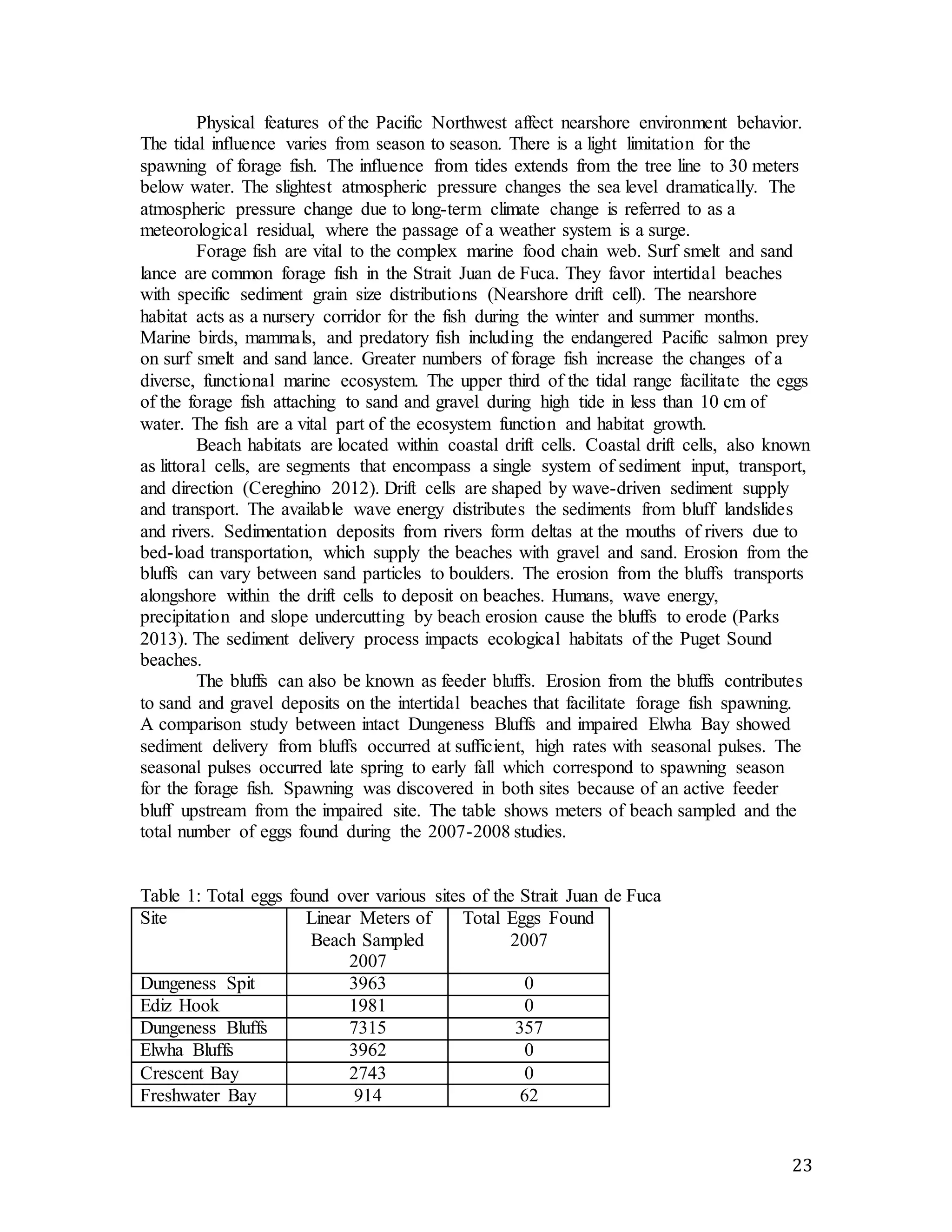
bluff upstream from the impaired site. The table shows meters of beach sampled and the 
total number of eggs found during the 2007-2008 studies. 
23 
Table 1: Total eggs found over various sites of the Strait Juan de Fuca 
Site Linear Meters of 
Beach Sampled 
2007 
Total Eggs Found 
2007 
Dungeness Spit 3963 0 
Ediz Hook 1981 0 
Dungeness Bluffs 7315 357 
Elwha Bluffs 3962 0 
Crescent Bay 2743 0 
Freshwater Bay 914 62
24 
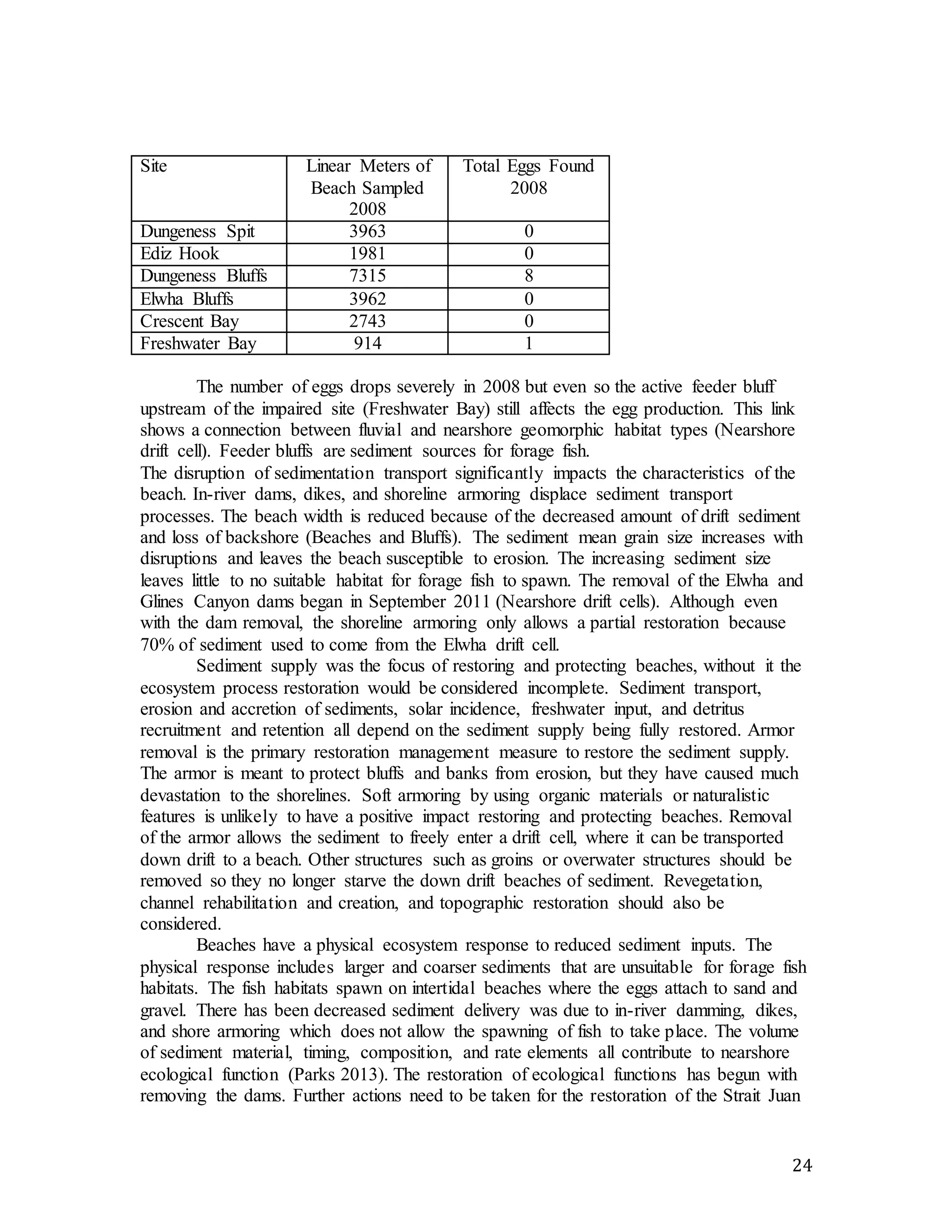
Site Linear Meters of 
Beach Sampled 
2008 
Total Eggs Found 
2008 
Dungeness Spit 3963 0 
Ediz Hook 1981 0 
Dungeness Bluffs 7315 8 
Elwha Bluffs 3962 0 
Crescent Bay 2743 0 
Freshwater Bay 914 1 
The number of eggs drops severely in 2008 but even so the active feeder bluff 
upstream of the impaired site (Freshwater Bay) still affects the egg production. This link 
shows a connection between fluvial and nearshore geomorphic habitat types (Nearshore 
drift cell). Feeder bluffs are sediment sources for forage fish. 
The disruption of sedimentation transport significantly impacts the characteristics of the 
beach. In-river dams, dikes, and shoreline armoring displace sediment transport 
processes. The beach width is reduced because of the decreased amount of drift sediment 
and loss of backshore (Beaches and Bluffs). The sediment mean grain size increases with 
disruptions and leaves the beach susceptible to erosion. The increasing sediment size 
leaves little to no suitable habitat for forage fish to spawn. The removal of the Elwha and 
Glines Canyon dams began in September 2011 (Nearshore drift cells). Although even 
with the dam removal, the shoreline armoring only allows a partial restoration because 
70% of sediment used to come from the Elwha drift cell. 
Sediment supply was the focus of restoring and protecting beaches, without it the 
ecosystem process restoration would be considered incomplete. Sediment transport, 
erosion and accretion of sediments, solar incidence, freshwater input, and detritus 
recruitment and retention all depend on the sediment supply being fully restored. Armor 
removal is the primary restoration management measure to restore the sediment supply. 
The armor is meant to protect bluffs and banks from erosion, but they have caused much 
devastation to the shorelines. Soft armoring by using organic materials or naturalistic 
features is unlikely to have a positive impact restoring and protecting beaches. Removal 
of the armor allows the sediment to freely enter a drift cell, where it can be transported 
down drift to a beach. Other structures such as groins or overwater structures should be 
removed so they no longer starve the down drift beaches of sediment. Revegetation, 
channel rehabilitation and creation, and topographic restoration should also be 
considered. 
Beaches have a physical ecosystem response to reduced sediment inputs. The 
physical response includes larger and coarser sediments that are unsuitable for forage fish 
habitats. The fish habitats spawn on intertidal beaches where the eggs attach to sand and 
gravel. There has been decreased sediment delivery was due to in-river damming, dikes, 
and shore armoring which does not allow the spawning of fish to take place. The volume 
of sediment material, timing, composition, and rate elements all contribute to nearshore 
ecological function (Parks 2013). The restoration of ecological functions has begun with 
removing the dams. Further actions need to be taken for the restoration of the Strait Juan
de Fuca even with the dam removal. The shore armoring could be softened, removed 
completely, or large woody debris structures placed on the shores of the beach to promote 
sediment deposits. The protection of unarmored beaches is very important because once 
armored it is very expensive and time consuming to only attempt for partial restoration. 
The sediment supply of the beaches impacts the nearshore ecological function and 
habitats of the Puget Sound. 
25
26 
References: 
Cereghino, Paul, Jason Toft, and Charles Simenstad. "Strategies for Nearshore Protection and 
Restoration in Puget Sound." Technical Report 2012 (2012): 1-140. Puget Sound 
Nearshore Ecosystem Restoration Project. Web. 20 Mar. 2014. 
<http://www.pugetsoundnearshore.org/technical_papers/psnerp_strategies_maps.pdf>. 
Clancy, M., I. Logan, J. Lowe, J. Johannessen, A. Maclennan, F.B. Van Cleve, J. Dillon, B. 
Lyons, R. Carman, P. Cereghino, B. Barnard, C. Tanner, D. Myers, R. Clark, J. White, 
C.A. Simenstad. M. Gilmer, and N. Chin. 2009. Management measures for protecting 
and restoring the Puget Sound nearshore. Puget Sound Nearshore Partnership Report 
No. 2009-01. Published by Seattle District, Washington Department of Fish and Wildlife, 
Olympia, Washington. 
Clancy, Margaret, Ilon Logan, and Jeremy Lowe. "Management Measure for Protecting and 
Restoring the Puget Sound Nearshore.” Technical Report 2009-01 (2009): 1-140. Puget 
Sound Nearshore Ecosystem Restoration Project. Web. 
<http://www.pugetsoundnearshore.org/technical_papers/psnerp_strategies_maps.pdf>. 
Environmental Science Associates (ESA), ESA PWA, Anchor QEA, Coastal Geologic Services, 
KPFF, and Pacific Survey & Engineering. 2011. Strategic Restoration Conceptual 
Engineering Final Design Report. Puget Sound Nearshore Ecosystem Restoration 
Project. Published by Washington Department of Fish and Wildlife, Olympia, 
Washington, and U.S. Army Corps of Engineers, Seattle, Washington. 
Goetz, F., C. Tanner, C. Simenstad, K. Fresh, T. Mumford, M. Logsdon. 2004. Guiding 
restoration principles. Puget Sound Nearshore Partnership Report No. 2004-03. Published 
by Washington Sea Grant Program, University of Washington, Seattle, Washington. 
Greiner, C.A. 2010. Principles for strategic conservation and restoration. Puget Sound 
Nearshore Report No. 2010-1. Published by Washington Department of Fish and 
Wildlife, Olympia, Washington. 
LLTK (Long Live the Kings). 2010. Draft Lilliwaup Creek Watershed Assessment and Project 
Design Evaluation. 
Parks, David, Anne Shaffer, and Dwight Barry. "Nearshore drift-cell sediment processes and 
ecological function for forage fish: implications for ecological restoration of impaired 
pacific northwest marine ecosystems." Journal of Coastal Research 29.4 (2013): 984+. 
Academic OneFile. Web. 28 Mar. 2014. 
Penttila, Dan. “Maine Forage Fishes in Puget Sound.” Technical Report 2007-03 (2007). 
Puget Sound Nearshore Ecosystem Restoration Project. Published by Wasington 
Department of Fish and Wildlife, Olympia, Washington 
Schlenger, Paul, Andrea MacLennan, Erin Iverson, and Kurt Fresh. "Strategic Needs 
Assessment: Analysis of Nearshore Ecosystem Process Degradation in Puget 
Sound." Pugetsoundnearshore.org. Puget Sound Nearshore Ecosystem Restoration 
Project, 2011. Web. 
<http://www.pugetsoundnearshore.org/technical_papers/strategic_needs_assessm 
ent_final.pdf>. 
Shaffer, J Anne, Ryan Moriarty, Jason Sikes, and Dan Penttila. "Nearshore Habitat Mapping 
of the Central and Western Strait of Juan De Fuca Phase 2: Final Report." Puget Sound. 
Washington Department of Fish and Wildlife, 30 June 2003. Web. 14 Mar. 2014. 
“Strategic Restoration Conceptual Engineering – Design Report.” Puget Sound Nearshore 
Ecosystem Restoration Project. May 2011

Puget Puget sound restoration 424 final

  • 1.
    1 Puget SoundRestoration Ethan Davies Jessica Ketchum Karris Roland Will Wier
  • 2.
    2 TABLE OFCONTENTS 1. Introduction to Sounds 1.1 What is Puget Sound? 1.2 Components of the Project a. Beaches b. Bluffs c. Estuaries d. Deltas 2. Introduction to Estuaries 2.1 Definition 2.2 Productivity 2.3 Issues with Degradation and Pollutants 2.4 Restoration 3. Introduction to Deltas 3.1 Definition 3.2 Components 3.3 Importance of Flow Rates 3.4 Decreasing the Gradient 3.5 Types of Deltas 3.6 Restoration Practices 4. Introduction to Beaches and Barrier Embayments 4.1 Definition 4.2 Productivity 4.3 Issues with Sediment Supply and Ecological Processes 4.4 Forage Fish 4.5 Restoration Practices 6. Nooksack Delta 6.1 Definition 6.2 Layout 6.3 Specific Goals and Key Design Elements 6.4 Specific Improved Conditions 6.5 Length of Project and Cost 6.6 Rail, Roadway and Bridge Projects 6.7 Sea Level 6.8 Public Outreach 7. Puget Sound Estuaries 7.1 Estuary Introduction 7.2 Processes Restored 7.3 Conditions Improved 7.4 Lilliwaup Causeway Replacement and Estuary Restoration 7.4.1 Lilliwaup Introduction 7.4.2 History 7.4.3 Surrounding Environment 7.4.4 Restoration Design 7.4.4.1 Overview 7.4.4.2 Primary Management
  • 3.
    3 7.4.4.3 AdditionalManagement 7.4.4.4 Considerations 7.4.5 Expected Outcomes 7.4.6 Uncertainties 7.5 Figures
  • 4.
    4 INTRODUCTION TOSOUNDS AND PUGET A sound is a narrow sea of water between two bodies of land. Puget Sound is a sound located in the state of Washington in the US. The sound is an inlet for the Pacific Ocean and is a very complex coastal system, with several rivers and streams interconnecting basins, and also with connections to the Strait of Juan de Fuca. Puget Sound is approximately 100 miles long and averages a depth of 205 ft. Puget Sound is defined not just as the water bodies but also the regions of land encompassing the sound. Puget Sound Nearshore Ecosystem Restoration Project (PSNERP) has identified 36 potential nearshore restoration projects. The conceptual Engineering Design Report was created to assess the costs and benefits of each of the 36 components. Along with providing a general conceptual design of the planned restoration, it is also a useful document since it allows the US Army Corps of Engineers to assess which sites best match their own restoration programs. It is still being decided which programs are better executed at the local, state, and federal levels. The sound breaks down restoration into 3 main components: beaches and bluffs, deltas, and estuaries. An estuary is a part coastal body of water, usually brackish, meaning it’s a mix of salty and fresh water, with connections of rivers and streams and also a pathway to the open ocean. Estuaries are unique in that they experience both river and ocean conditions. Influences such as salt concentration, tides and waves are all due to the sea component and influences such as flow rates, and nutrient/sediment flows are due to the river system attributes. Because of these conditions, estuaries have “the best of both worlds” and are one of the most productive ecosystems in the world. Other names for estuaries are used interchangeably such as bays, harbors, or lagoons, but all vary a tad in their actual definition. INTRODUCTION TO ESTUARIES Since banks of estuaries are some of the most productive habitats in the world, it’s no surprise that it’s also one of the most populated locations also. According to the US EPA, approximately 60% of the world’s populations live along estuaries and coastlines. Because of heavy population, estuaries are also some of the most degraded areas. Issues with soil erosion caused by poor farming practices, overgrazing, and deforestation are one of the main concerns. Several other issues also exist. Overfishing leads to a myriad of reactions in the ecosystem, excessive nutrients due to animal production lead to eutrophication. Pollutants ranging from heavy metals to dangerous chemical compounds such as BPA also pose a serious problem to the health of the estuaries within the sound and the whole geographical area of Puget Sound itself. To get a better idea of the process of restoration on a project this big, the main components of the Puget Sound project: beaches and bluffs, estuaries, and deltas have been selected and then magnified to include one specific beach, bluff, estuary and delta.
  • 5.
    5 INTRODUCTION TODELTAS A river delta is a geological formation that is similar and often a component of an estuary. A river delta is a region that forms where the mouth of a river flows into the ocean, estuary, lake or other water body. This differs from an estuary in that the estuary is more the mixed brackish water bodies and the land surrounding it, while a river delta focuses more on the landform itself. The delta is made up of deposits of sediment carried out to the water body form the river over long periods of time. One factor to note is that the flow rate of water must be slow enough not to sweep the sediments away since the buildup of these sediments is the main characteristic of a delta. Other factors necessary to the creation of deltas is that the river must have enough sediment as a source to carry through its path and leave for deposition further down. When the delta reaches the water body from the river, the width of water is then expanded. As the width expands, the flow of water is again slowed, making it more difficult to transport sediment, and slowing the process down. What results is that the sediments drop out of the flow and are deposited. This delta formation that expands as it pushes out over time is sometimes referred to as a lobe. As this lobe further develops, it lowers the river channel gradient since the elevation remains constant but the river channel lengthens. As this gradient or slow of the river channel decreases, it starts to become unbalanced. This system becomes unbalanced for two main reasons. One, gravity is the driving force for the water and a steeper slope is usually more stable, especially when a big rain event occurs. And second, as the slope of the river channel is decreased, so it the shear stress on the river bed. When the shear stress on the river bed is reduced, the sediments will deposit more quickly and increase the bed elevation, causing a spill of water from a rain event to be more likely. If an event like this occurs, usually a network of channels begins formation. Three main categories of deltas exits: wave-dominated, tide-dominated, and Gilbert deltas. In the first category, wave-dominated, the waves are the main controller of the deltas shape, and the deposits of sediments are deflected along the coastline. Tide-dominated deltas tend to have more main distributaries than wave-dominated scenarios since in the wave situation when the new channels are formed; the old ones are usually abandoned. Lastly, Gilbert deltas form more course sediments and are not as muddy, soft, and sloping. NOOKSACK DELTA The Nooksack River Delta is a very complex and intricate system that incorporates both the Nooksack and Lummi River estuaries, both major water systems of Whatcom County. Three main problems this delta faces are the quality of water, floodplain habitats and also nearshore habitats. What has happened is that the Lummi River used to carry a substantial portion of water to the west of the Lummi River, providing the Lummi Peninsula and Bay with plenty of resources. However, due to the removal of many large trees, draining, diking, and construction, the flow has been almost entirely redirected to the east and now flows into the Nooksack River out into Bellingham Bay. This redirection of water allows a lot of productivity of the east side, but the west now lacks water and habitats and populations are suffering. The west side of the delta is also exposed to tidal flows since it has been separated by a constructed levee system. The main goals of the restoration project at Nooksack are removal or setting
  • 6.
    6 back ofthe levees obstructing tidal flow to allow more natural flows of river channels and floodplains. The site is comprised of several thousand acres so this presents no easy task. Essentially, the project aims to restore the site to its pre-disturbed condition. Specific goals for processes to restore include restoring a more natural process to the following: the erosion of beaches, formation of tidal zones and channels in estuaries, the flow of freshwater in rivers and streams, movement of saltwater in tidal channel in estuaries, and lastly, the buildup and retention of organic material from plants and marine life (PSNERP, 2012). Specific conditions improved would include the following: a reestablished large river delta providing for threatened species of marine life such as juvenile salmon (Chinook) that would increase their survival and support improving this population, re-establishing intertidal and sub tidal areas so to boost kelp and eelgrass growth (creating food and habitat for fish, birds and marine species), improved connectivity of nearshore and neighboring land, increased area, length, and intricacy of shoreline, improved elasticity to the shoreline from effects such as changing sea level and increasing frequency of storms. The total projected cost for this project is 414.6 million dollars. The specific elements would remove part of the levee along both Nooksack River banks, and setting back the levees on the North Red River Road and at entrance of the Nooksack estuary. The Lummi River channel would also be dredged and graded to re-join it to the water flowing form the Nooksack River. Old ditches made for past agriculture would be filled in and tidal channel would be recreated. The raising of several roads onto bridges would also tidal water to flow in and out of the delta. This project would demand for some residents to relocate. NOOKSACK DELTA’S NATURAL ENVIRONMENT The Nooksack delta drains approximately 825 square miles from Mount Baker to Bellingham Bay. It is composed of three major forks that join as they exit the Cascade Mountain foothills. The Nooksack River formerly was divided into channels in the delta; however, the main channel is now directed to flow east of the Lummi Peninsula, and is inhibited by levees for much of its span Freshwater flow into the Lummi River distributary channel doesn’t really exist except for flow through a culvert. The Lummi River has full tidal access but is essentially a blind channel since it’s separated from the main channel, the Nooksack River, by a levee, and only receives intermittent flow. The Lummi River has a freshwater intake from Shell Creek, which drains sections of the City of Ferndale to the north. Most of the former delta wetlands are separated from tides by a levee or dike system, running along the Lummi River and in other areas. Forest cover has been almost entirely removed from the western delta. Riparian forest needs to be reestablished. The Nooksack River system supports nine species of salmon IDs, including three listed under the Endangered Species Act: early Chinook, steelhead, and bull trout. Only three of the 25 salmonid stocks are currently considered healthy (Smith 2002).
  • 7.
    7 HUMAN ENVIRONMENT Humans have influenced the area greatly and contributed to degradation in the following ways:  Establishing a major road network, with major roads including Slater Road, Ferndale Road, North Red River Road, South Red River Road, Marine Drive, Kwina Road, Hillaire Road, and Haxton Way.  Land conversion to agriculture (field crops, poplar plantations, and pasture).  Low-density residential development.  Levees constructed along the mainstay Nooksack River and Lummi River.  A seawall and berm system in the west delta.  Tide gates installed on channels and the Lummi River in the west delta.  Land use conversion to commercial (gas station/minimart, Silver Reef Hotel, Casino, Spa). The changes are altered land cover throughout the majority of the Nooksack delta. Tides and fluvial processes (flow and sediment related) that are blocked and eliminated, respectively; and altered sediment delivery to river floodplains and the nearshore. CONCEPTUAL DESIGN (10%) Typical design plans for this type of project to through many stages. The conceptual design is sometimes deemed as the ten percent design. This stage involves identifying the sites for restoration and coming up with action plans. Then the next step is to assess the cost, benefits and feasibility. The full restoration objective for River Deltas Ecosystem is to remove dominant stressors to a degree that allows undegraded tidal flows and freshwater inputs necessary to support a full range of delta ecosystem processes, focusing on the reestablishment of complex wetlands that include oligohaline transition and tidal freshwater components. This will be accomplished by berm or dike removal and also in combination with river channel restoration.
  • 8.
    8 RAIL, ROADWAYS,AND BRIDGES STANDARDS For all suggested modification, coordination would have to be conducted with Railway providers, including Burlington Northern Santa Fe. Using general standards outlined by the CDT, methods for establishing bridge elevations will be analyzed. WATERWAYS It will be important to carefully track the amount of disturbance by construction when Construction practices such as pile driving, excavation, and dewatering have impacts to the environment and will need to be fully evaluated. Mandates and regulations set by the federal and state governments are strict when pertaining to construction done under the ordinary high water mark. The purpose of these regulations is to make sure in-water construction activity doesn’t disturb periods of salmon migration and fish spawning.
  • 9.
  • 10.
    10 PUBLIC OUTREACHAND PROPERTY ACQUISITION The public is a very important piece of the completion of this project. The public’s needs and concerns can be meet with education and fair compensation of property, but many other issues arise. Some of the proposed modifications occur on public lands such as recreational waterfowl hunting areas, and other public resources. Some commercial fishing and shellfish production and harvest are also located on this land. Dam removals required careful accessing of water rights and other amenities that have large parties interests involved. Embayments Another major issue affecting the welfare of the Puget Sound nearshore is the degradation of the coastal embayments. An embayment is “an indentation of the shoreline larger in size than a cove but smaller than a gulf.” Embayments are broken down into four primary shoreforms: Open coastal inlets, barrier estuaries, barrier lagoons, and closed lagoons and marshes. An open coastal inlet is a small inlet protected from wave action by their small size or shape, but not significantly enclosed by a barrier beach. Barrier estuaries are tidal inlets largely isolated by a barrier beach and with a significant input of freshwater from a stream or upland drainage. Barrier lagoons are tidal inlets largely isolated by a barrier beach and with no significant input of freshwater. Finally, closed lagoons and marshes are back-barrier wetlands with no surface connection to Puget Sound. These components are varyingly comprised of stream deltas, tide flats, salt marsh, channels, tidal deltas, and ponds or lakes. A single embayment could include portions of more than one embayment shoreform.(PSNERP 2012) Historically, coastal embayments, including open coastal inlets, barrier estuaries and barrier lagoons, accounted for 1,100 km of shoreline in Puget Sound, now they make up a mere 600 km. Of the 173 open coastal inlets that once existed only 16 exist today, as well as 61 of the 240 barrier estuaries, and 80 of the 222 barrier lagoons that previously existed. The embayments that were separate from the Puget Sound shoreline (closed lagoons and marshes) were reduced from 2.6 km of shoreline to 1.6 km, making them the rarest shoreform in Puget Sound. Out of the 249 previously existing closed lagoons and marshes, 138 have been lost. Overall, there are 35% fewer of all four of the embayment shoreforms than historic records previously indicated. (PSNERP 2011)
  • 11.
    11 Figure 1:Historic vs Current shoreline lengths of Embayment Shoreforms The Puget Sound Nearshore Restoration Project has developed a set of metrics to define the measurable conditions of embayments to determine embayment quality and necessity of management measures. The potential metrics of embayments measure the embayment shoreline length, the vegetated wetland area and the embayment density selected areas. They also measure the degradation metrics of embayments by the loss of embayment length, loss of wetland area, tidal flow degradation, sediment supply degradation, and nearshore imperviousness. Risk metrics are determined by jetty influence and future nearshore development involving embayment shoreforms. The processes targeted for quality are sediment supply and tidal flow. Simenstad et al. (2011) stated, “The processes of sediment transport, erosion and accretion of sediments, detritus recruitment and retention, solar incidence, and tidal channel formation and maintenance are anticipated to be critical to the full restoration of embayment ecosystem services, and are most likely to be in operation where sediment supply and tidal flow are unconstrained.” They state that topographic restoration, dike/berm removal or modification, armor removal, groin removal, revegetation, and overwater structure removal may help restore the sediment supply and tidal flow processes back to natural levels. Removing or modifying dikes and berms would help restore tidal flow in some settings, whereas topographic restoration is necessary for repairing embayments that have been filled for development. Armor removal and groin removal are among primary management measures and would help in a similar manner as they would with beach restoration. Removing groins and armor would help to restore and transport sediment to barrier beaches and embayments. Revegetation would help to prevent erosion as well as to improve water quality by filtering away runoff into embayments. Removing overwater
  • 12.
    12 structures androads would help to reopen up channels for natural sediment transport as well as reduce embayment exposure to runoff. The tidal barriers and wetland filling practices disrupt several of the essential functions of the embayments and deltas. They impact important processes like sediment transport, tidal flow, tidal channel formation, distributary channel migration, detritus import and export, as well as the exchange of aquatic organisms. These impacted processes effect the overall composition of the embayments, making them less capable of supporting the native fauna, as well as diminishing the base of the local food web. The change in sediment transport and erosion causes the surface elevation of marshes to subside making the nearshore less resilient to rises in sea level, which could potentially lead to further damage. Embayments are highly valued for several nearshore ecological processes, largely for their role in providing habitats for native shellfish, eelgrass and kelpbeds, shorebirds, and most notably salmon. The Chinook salmon will rear their young in estuarine
  • 13.
    embayments away fromthe river where they were spawned. The Chinook salmon will also use pocket estuaries in Skagit Bay in the Whidbey sub-basin to hide away from predators and feed. These salmon are considered to be an integral part of the culture in the Puget Sound area as well as a major link on the food chain of the area. Loss of embayments has reduced the resilience of the salmon population and has led to their listing a threatened species in the area. The Chinook salmon heavily rely on the well being of pocket estuaries, particularly those that are closet to the large deltas. The pocket estuaries provide a habitat for a faster growing environment due to their relative warmth, high detritus retention, and lower predation as compared to adjacent nearshore or offshore waters. 13 Figure 2: Embayment processes, structure and functions Several of the embayment restoration strategies proposed are likely not to be completely accomplished as suggested by the Puget Sound Nearshore Restoration project has suggested. Property ownership and other conflicting land uses prevent the full restoration degraded embayments, so they established a system outlining necessary actions for a suitable partial restoration of embayment ecosystem services. The PSNERP hopes that despite the forces restricting the full restoration of Puget Sound if these partial restoration measures can be implemented, the important ecological services that embayments provide should still function well enough to meet these conditions. 1. Ecosystem processes are fully restored within a partial footprint, including the unconstrained tidal flows necessary to support a full range of embayment ecosystem processes.
  • 14.
    14 2. Thesystem has redundant representation of the full range of embayment ecosystem components including stream delta or ponds (where historically present), tidal flats, salt marsh, channels, tidal delta, beach berm, beach face, and low tide terrace where historically present. 3. The partially restored system is formed of a contiguous large patch that is well connected to adjacent terrestrial and marine landscapes. 4. The wetland system is internally connected through a network of tidal channels that allow for the unconstrained movement of organisms, water, and sediments. 5. The landward edges and freshwater inputs into the partial embayment ecosystem are managed to provide riparian functions and to protect the quantity and quality of freshwater inputs from surrounding land use impacts. The restoration of embayments is a major concern for all of the sub-basins. But the South Puget Sound, South Central Puget Sound, Hood Canal, and Whidbey sub-basins have especially high losses of the embayment shoreforms. There are proposals put forth to restore the shoreforms to their natural shape in each of these regions. The sub-basins have all been surveyed to analyze the presence of historic and current embayment shoreforms. Barrier embayment sites by sub-basin. In Hood Canal, The Point Whitney Lagoon has experienced some significant development that has damaged the lagoon’s capacity to serve its necessary natural functions. Developers at the point Whitney Lagoon installed rock armoring, dikes, asphalt and gravel parking lots, as well as buildings and pavement to form 2 unnatural ponds from the lagoon in the 6-acre area. By getting rid of these developments PSNERP hopes to restore several processes that the lagoon previously served. They would restore the movement of sand and gravel along shorelines, the natural erosion and accretion of beaches, accumulation and retention of organic material from plants and aquatic animals,
  • 15.
    as well restorethe natural exposure to wind and wave action. In restoring these processes, they hope to restore the Chinook salmon habitat, improve the connectivity between the nearshore and the adjacent uplands, and to improve the area, length, and complexity of the shoreline. The shoreline would be better suited to respond to changes such as rises in sea level and increasing storm events. They would also improve public access to the shoreline for recreation. 15 Point Whitney Lagoon Restoration objectives
  • 16.
    16 Puget SoundRestoration Estuaries I. Estuary introduction Estuaries provide a key role to the Puget Sound system. Estuaries are the coastal waters where an incoming freshwater source meets a saltwater body. They tend to be partially enclosed, therefore making them ideal places for fish and other organisms to raise their young. Without estuaries many fish species would suffer as a result of their eggs and young not being protected, making them vulnerable to predators. The many estuaries in Puget Sound have been modified and don’t provide as much shelter for young fish as they used to. These estuaries need to be restored to their original condition in order for the fish in the region to thrive as well as they once did. A restored estuary would lead to a restored fishery, which would in turn lead to a stronger economy as many towns along the Puget Sound coast rely on fishing. II. Processes Restored The Puget Sound Nearshore Ecosystem Restoration Project emphasizes several aspects of restoration for estuaries in order to make the area more like it was before human intervention altered the Puget Sound natural processes. For starters, the natural formation of tidal channels in estuaries should be restored. Agricultural ditches have significantly altered the way that tidal channels form and the wildlife that use these tidal channels have been negatively affected. Also, the flow of freshwater streams into the estuaries and saltwater into the tidal channels should become unrestricted as it naturally was. Dikes and berms for bridges have restricted this natural flow of the water in the estuaries. Removing these or creating a way for the water to flow better will help create an unrestricted flow of water as well as an unrestricted movement and migration of fish and wildlife. This will also help in the accumulation and retention of organic material from plants and aquatic animals. Along the coastlines, the major goal is to restore the shore to the natural exposure to wind and wave action. III. Conditions Improved Restoring the natural processes of Puget Sound will help greatly in improving many conditions of the ecosystem. Historical tidal flat habitats would be re-established. These areas are important foraging and resting areas for shorebirds and marine birds like Dunlin and the Great Blue Heron. Intertidal and shallow subtidal areas would also be restored which would encourage the growth of kelp and eelgrass, in turn improving the conditions for fish, birds and other marine species. The area, length, and complexity of the shoreline would be increased as the Puget Sound area was originally. This would also improve the resiliency of the shoreline to respond to changes in the environment such as rising sea levels and a growing number of storms. Improvements would also be made for the coastal embayments and large river deltas that provide a nursery habitat for species of fish, including the threatened species of Chinook salmon. Another positive result would also include intertidal and subtidal areas that are used recreationally and culturally important shellfish such as oysters, clams, and mussels. All of these improved conditions will result in an improved quality of the water flowing through the estuary.
  • 17.
    17 IV. LilliwaupCauseway Replacement and Estuary Restoration a. Lilliwaup Introduction The Lilliwaup estuary is currently obstructed by a roadway, changing the hydraulics, sediment transport, and geomorphology from the natural processes. Removing this causeway will restore tidal connectivity in the estuary. The proposed alternative to the current roadway that disrupts the tidal flow is a bridge that spans the entire delta and removing the earthen fill that partially blocked the estuary. Lilliwaup Creek is the largest creek in the southern part of the Hamma Hamma watershed. It provides a significant influent flow to wetlands and lakes and habitat for salmonids. Lilliwaup Falls farther upstream prevents anadromous fish from swimming far upstream. Most of the watershed is publically owned land with some residential homes and farms situated near the mouth of the creek. A small hatchery is located on Lilliwaup Creek where summer chum entering the creek are spawned and the offspring are released. A small privately owned hydroelectric power plant is located below Lilliwaup Falls. b. History The earliest records of the channel (a 1884 T-sheet) show a few small marsh islands at the upstream end of the estuary and two tidal channels at the mouth of the creek. No roadway or any sign of settlement is shown other than a fenced grassland north of the creek. A 1925 WSDOT roadway and bridge drawing is the first historical record of a road crossing the creek. It shows an existing “pile trestle” just east of the new road as well. Three distributary channels for Lilliwaup Creek are also shown: the South Fork South, the South Fork North, and the North Fork. The new bridge was aligned near the South Fork North channel and the road embankment blocked the other two channels. There were also plans to fill and develop parts of Lilliwaup Bay. A wharf of about 300 feet extended into the bay east of the proposed roadway on the south bank. Tides reached up to Lilliwaup Falls prior to the aggradation of the streambed. c. Surrounding Environment Upstream of the bridge that Highway 101 crosses the estuary on, two definite channels flow with the eastern one being the main channel. There is some braiding in the mudflats and upstream of the bridge, and under the bridge, the channel deepens suggesting that the flow has been constricted. Just after the channel goes under the highway 101 bridge, it widens out into a large embayment before entering a large section of Puget Sound. The watershed for Lilliwaup Creek is small and narrow due to the steep terrain surrounding it. There is a weir-like concrete structure that has been placed near the waterfall and a sluiceway enters the canyon from the northeast. The sluiceway was going to be for a power plant, but several structural failures upstream prevented the plant from being built. Large gravel slide events due to inadvertent human actions between the waterfall and highway 101 in 2005 and 2007 caused the channel to become heavily aggraded. Photographs show that deposition of sediment have caused the creek to rise 10 feet at an upstream bridge. These gravel slides has cased the stream’s groundwater to rise to a point that it is now drowning the roots of trees causing them to die. In 2008, 5000
  • 18.
    cubic yards ofthis aggraded gravel and sediment were removed near the falls as a part of a rehabilitation project. 18 The 150 feet single-span bridge constricts the flow of Lilliwaup Creek at the mouth of the estuary directing all the flow to one opening as opposed to the two channels that the estuary historically had. Downstream roadway embankments are fortified with concrete rubble and armoring. The properties along the sides of the bay also have concrete bulkheads. The western side of the estuary has concrete in the marsh and along the bank both upstream and downstream of highway 101 to protect the roadway. The area is privately owned other than Highway 101 itself, but the property owner upstream is supportive of stream restoration plans. However the interest of other property owners nearer to Highway 101 are unknown. d. Restoration Design i. Restoration Overview The main part of the restoration plan is to replace the Highway 101 bridge and the supporting embankments with a longer bridge. In the full restoration plan, the bridge will span the width of the estuary, completely removing the stressors and will help the most in the attempt for the estuary to return to its historical condition. In the partial restoration
  • 19.
    plan, the bridgewill not span the entire estuary, but it will be longer than the existing bridge and it will not affect the nearby properties and structures as much. Only two structures would be removed under the partial restoration plan, compared to the seven structures that would have to be removed under the full restoration plan. The creek mouth would still be restricted somewhat, but tidal exchange should be restored upstream of the bridge. Both restoration plans also include sediment removal. The full restoration plan will remove all the sediment that has accumulated so that the sediment in the channel and estuary are back to the way it was according to the 1884 T-sheet. The partial restoration plan will only remove the sediment that has aggraded the channel. Removing aggraded sediment would help with tidal flow and prevent the sediment from going farther downstream and negatively impacting the estuary role in the ecosystem. The full restoration plan also calls for extensive channel excavating, shoreline modifications, and beach reconstruction and nourishment in an attempt to model the estuary in a way that it was historically. The partial restoration plan also calls for these alterations, but to a lesser degree. Some of the area might need to be purchased as it is on private property. 19 ii. Primary management The concrete armor on the downstream side of the causeway will be removed. Two additional bulkheads will be removed for the full restoration plan, but only one will be removed under the partial restoration plan. The current earthen embankments for the roadway will be removed along with the roadway once the new bridge is constructed. The landslides that occurred in 2005 and 2007 almost completely filled the western channel causing the bulk of Lilliwaup Creek to in the eastern channel. The main channels will be deepened and widened based on the review of historic channels, but more analysis is required to determine how much excavation needs to take place. Both channels would be moved closer to their historic paths and away from the center of the estuary. The restored tidal marsh will also require channels to be excavated in order to allow tidal flow in the area that is currently filled with aggraded sediment and earthen fill. The tidal marsh will have two new channels totaling 660 feet long and 12 feet wide as determined by hydraulic geometry analysis. As for the bridge removal, the current 150-foot-long bridge will be replaced by a 600-foot-long bridge under the full restoration plan or a 500-foot-long bridge under the partial restoration plan. Highway 101 will have to be realigned a total of 1200 feet due to the bridge being built in a different place than the current bridge. Two areas between the eastern and western channels of Lilliwaup Creek will be excavated to marsh plain elevation. The total area excavated will be about 22,000 cubic yards. A small tidal pool will be constructed downstream of the western side of the estuary in an area that is currently filled and developed to replicate the barrier lagoon that the 1884 T-sheet shows in this location. Approximately 750 cubic yards of material would be excavated to make this back beach tidal pool. Gravel and sediment excavated from the channel and marsh will be used to reconstruct the beach in a way that it would naturally be shaped. The 1884 T-sheet shows gravel beaches along the shores of Lilliwaup Estuary. The length of the new western beach will be approximately 850 feet under full restoration plan or 350 feet under the partial restoration plan. The length of the new eastern beach will be approximately 3250 feet under both plans. The total gravel required for beach nourishment is approximately 9200 cubic yards for full restoration and 5000 yards of partial restoration. Under both
  • 20.
    alternatives, approximately 150tons of large boulders and slabs of concrete spread across the western half of the estuary will be removed. Piles of wood will also be placed in along the channel and within the marsh to provide structure to maintain the channels and habitat for anadromous fish. About five wood structures of three or four logs each will be placed in the channel while three would be placed on the restored beaches. About one acre of riparian area will be planted with riparian vegetation where excavation of the channel has taken place. Additionally, the planting of upland vegetation will occur in the full restoration plan downstream of the western shore of the estuary. 20 iii. Additional management Structures will have to be demolished in both the full restoration and the partial restoration plans. Seven structures covering 16,500 square feet would be removed under the full restoration plan while only the northernmost building downstream of the bridge will be demolished under the partial plan. 2200 square feet of abandoned buildings on the western side of the bridge will be removed in both alternatives. Removing these structures will help restore the shore and the western channel to their natural conditions. Power, telephone, and telecommunications on the current bridge will be moved to the new bridge once it has been constructed. Private property and utilities in the area of action will assumedly have to be purchased for restoration modification to occur. WSDOT right-of-way may need to be acquired to allow for the new road alignment. iv. Considerations The new bridge will be built just north of the current one in order to prevent traffic from halting during construction. The full plan calls for a 600-foot-long bridge with six spans while the partial plan calls for a 500-foot-long bridge with five spans. The substructure of the bridge will have columns on drilled shafts 100 feet deep into the ground. Large-diameter casing shoring will be necessary when drilling the shafts for the bridge support columns. The current road will need to be realigned with the new bridge. The new road will consist of two 12-foot lanes along with 3-foot and 10-foot shoulders. The total length of roadway modifications will be approximately 1350 feet. Further analysis will be conducted on the disposal sites and possible reuses for the earth and gravel excavated during this project. Using the sediments as local roadway fill is a strong possibility. e. Expected Outcomes After restoration, the Lilliwaup Estuary area will evolve toward a state of dynamic equilibrium that is similar to its historic conditions. This will include more defined channels, a greater diversity of salinity and vegetation, and fluctuations in hydraulic and sediment processes. Without restoration, the unnaturally large sediment pulse and blockage caused by Highway 101 will continue to degrade the habitats of the flora and fauna that naturally occur in the area. f. Uncertainties A large uncertainty for this project concerns the area outside of the project area. Large depositions of gravel have occurred upstream from the target area. While
  • 21.
    additional sediment volumesas large as the 2005 and 2007 rockslides are unlikely, sediments already downstream of the falls could become a risk of estuarine processes in the future by affecting morphology, habitat, and tidal exchange. The significance of this risk has not ben fully evaluated, but the full restoration plan greatly reduces the possible severity by removing sediment farther upstream towards the falls. Removing the embankment of Highway 101 will also reduce the risk by allowing for sediment passage into Hood Canal. Other risks possibly posed by this problem include privately owned shorelines downstream being affected by the sediment transport and creek channels, and the significant changes to the watershed since 1884 could make the natural hydrology and sediment process challenging to define and use as a basis for restoration. 21 Strait of Juan de Fuca - Nearshore Project Intertidal beaches of the Puget Sound provide key environmental factors contributing to the marine ecosystem. Forage fish such as surf smelt and sand lance spawn, feed, nurse, and migrate in these marine ecosystems. The fish are prey for predatory fish, birds, and other various mammals. The forage fish are a critical component of the complex marine food web and are important to the conservation, restoration, and economic concerns of the Pacific Northwest (Nearshore Drift Cells). The fish bind to sand and gravel for the eggs to be laid. The grain size must be suitable for spawning and varies depending on erosion, transport, and deposition. Sediment processes directly affect habitats suitable for forage fish. Sediment deposition varies with season, available wave energy, bluff land sliding, river deposits, shoreline alterations, and in-river damming. The sediment supply impacts the nearshore ecological functions and habitats of Puget Sound’s Strait of Juan de Fuca. The Nearshore Project included 4,000 km of shoreline, receiving runoff 36,000- km2 watershed that includes 16 major rivers. Three major ecosystem types including terrestrial, freshwater, and marine are the transitional zones for the Puget Sound. The project encompassed 812 beach systems intersecting with 2,800 small creeks, studded by 884 embayments, and 16 major river deltas created by the last glacial retreat. The physical processes that sustain the beach systems are tidal flux, erosion and deposition, wave-driven bluff erosion, and long shore transport of sediment. The ecological processes are constantly changing the shoreline and the sea levels have adjusted creating exposed and protected habitats home to rich and productive biota. Since the last half of the 19th century, tidal and fill barriers have shortened the shoreline by approximately 430 miles. Thirty percent of the shoreline has been armored for the protection of private property from erosion. Overall 34.6% of all shorelines in the Puget Sound lack natural vegetation. The habitats for all types of species has been disturbed severely causing the Endangered Species Act to gain 20 more listings with many more being considered. The aim for the project was to achieve a shared understanding to guide and coordinate Puget Sound nearshore ecosystem restoration, including a recommendation to congress for authorization of an ecosystem restoration project through the Water Resources Development Act (Cereghino 2012). The restoration of nearshore ecosystems is important because the structure of the nearshore not only depends on the ecosystem processes but also provides habitat for many biota (Goetz et al. 2004).
  • 22.
    The project wasdesigned to be cost effective by choosing ones that had the most potential of restoring function and protecting shorelines. The developed shorelines cannot be ignored because of water pollution and endangered species inhabiting these areas. Goetz et al (2004) and Greiner (2010) hypothesized these recommendations and assessments for the Puget Sound: 22 1. By restoring degraded physical processes we maximize the sustainability and resilience of a complex nearshore ecosystem structure that is similar to the historical template, and to which a diverse biota are best adapted. 2. A complex and dynamic nearshore ecosystem, with intact physiographic processes, is most likely to continue to provide functions, goods, and services into the future, as compared to systems with degraded processes. 3. This management of physiographic processes most reliably occurs at the scale at which those processes operate in the landscape. 4. Protection of existing unimpaired systems is more effective and efficient then restoration of impaired systems, and protection and restoration must be used in combination to achieve ecosystem restoration goals at the necessary scale. The Puget Sound shoreline is composed of systems where waves transport beach sediments from eroding bluff-backed beaches. The barrier embayments, or bluffs, account for 9% of the shoreline length. Sediments come from coastal bluffs and move in the direction of the prevailing winds. 711 barrier-type embayments were accounted for and 518 of the sites historically were located at the convergence zone of two drift cells. The barrier embayments account for 6.9% of the Puget Sound tidal wetlands and are key for juvenile salmon survival. Improvements need to be made to the ecosystem functions. The de-vegetation reduces beach productivity. The beach no longer provides a critical food source for the endangered Juvenile Chinook Salmon. Shoreline armoring reduces the diversity and abundance of beach fauna as well as wood debris accumulation. Trying to stabilize the shoreline in response to coastal erosion can degrade supply and transport of sediments. The challenges the project faces are the complexity and unique character of the beaches, quantitative methods for predicting sediment supply, and the sea level rise. The strategy description for beaches was to protect and restore sediment input and transport processes in littoral drift cells where wave energy results in bluff erosion that sustains beach structure. The barrier embayments strategy includes all the beach aspects and adds restoring the tidal flow process. When considering the areas of focus the barrier beach backshore is important because it supports a unique set of biota and habitat services (Guttman 2009). Therefore the highest potential beaches are long systems with extensive barrier beaches and high density of stream mouths. The sub-basin for Strait of Juan de Fuca was one of the many sites studied in the Nearshore Project. It is exposed to Pacific Ocean waves more than any other sub basin, and much of the coastline is a primarily long drift cell punctuated by barrier embayments and rocky shorelines. 83% of beach sites are considered high potential, being the highest proportion in all of Puget Sound. The Dungeness spit had a high degradation of shoreline. 23 of 29 beach systems in Juan de Fuca include some barrier embayment features with future risk projections indicating a moderate to low risk of restoration. The high potential sites that are surrounded by the growing population will be affected by population increase.
  • 23.
    Physical features ofthe Pacific Northwest affect nearshore environment behavior. The tidal influence varies from season to season. There is a light limitation for the spawning of forage fish. The influence from tides extends from the tree line to 30 meters below water. The slightest atmospheric pressure changes the sea level dramatically. The atmospheric pressure change due to long-term climate change is referred to as a meteorological residual, where the passage of a weather system is a surge. Forage fish are vital to the complex marine food chain web. Surf smelt and sand lance are common forage fish in the Strait Juan de Fuca. They favor intertidal beaches with specific sediment grain size distributions (Nearshore drift cell). The nearshore habitat acts as a nursery corridor for the fish during the winter and summer months. Marine birds, mammals, and predatory fish including the endangered Pacific salmon prey on surf smelt and sand lance. Greater numbers of forage fish increase the changes of a diverse, functional marine ecosystem. The upper third of the tidal range facilitate the eggs of the forage fish attaching to sand and gravel during high tide in less than 10 cm of water. The fish are a vital part of the ecosystem function and habitat growth. Beach habitats are located within coastal drift cells. Coastal drift cells, also known as littoral cells, are segments that encompass a single system of sediment input, transport, and direction (Cereghino 2012). Drift cells are shaped by wave-driven sediment supply and transport. The available wave energy distributes the sediments from bluff landslides and rivers. Sedimentation deposits from rivers form deltas at the mouths of rivers due to bed-load transportation, which supply the beaches with gravel and sand. Erosion from the bluffs can vary between sand particles to boulders. The erosion from the bluffs transports alongshore within the drift cells to deposit on beaches. Humans, wave energy, precipitation and slope undercutting by beach erosion cause the bluffs to erode (Parks 2013). The sediment delivery process impacts ecological habitats of the Puget Sound beaches. The bluffs can also be known as feeder bluffs. Erosion from the bluffs contributes to sand and gravel deposits on the intertidal beaches that facilitate forage fish spawning. A comparison study between intact Dungeness Bluffs and impaired Elwha Bay showed sediment delivery from bluffs occurred at sufficient, high rates with seasonal pulses. The seasonal pulses occurred late spring to early fall which correspond to spawning season for the forage fish. Spawning was discovered in both sites because of an active feeder bluff upstream from the impaired site. The table shows meters of beach sampled and the total number of eggs found during the 2007-2008 studies. 23 Table 1: Total eggs found over various sites of the Strait Juan de Fuca Site Linear Meters of Beach Sampled 2007 Total Eggs Found 2007 Dungeness Spit 3963 0 Ediz Hook 1981 0 Dungeness Bluffs 7315 357 Elwha Bluffs 3962 0 Crescent Bay 2743 0 Freshwater Bay 914 62
  • 24.
    24 Site LinearMeters of Beach Sampled 2008 Total Eggs Found 2008 Dungeness Spit 3963 0 Ediz Hook 1981 0 Dungeness Bluffs 7315 8 Elwha Bluffs 3962 0 Crescent Bay 2743 0 Freshwater Bay 914 1 The number of eggs drops severely in 2008 but even so the active feeder bluff upstream of the impaired site (Freshwater Bay) still affects the egg production. This link shows a connection between fluvial and nearshore geomorphic habitat types (Nearshore drift cell). Feeder bluffs are sediment sources for forage fish. The disruption of sedimentation transport significantly impacts the characteristics of the beach. In-river dams, dikes, and shoreline armoring displace sediment transport processes. The beach width is reduced because of the decreased amount of drift sediment and loss of backshore (Beaches and Bluffs). The sediment mean grain size increases with disruptions and leaves the beach susceptible to erosion. The increasing sediment size leaves little to no suitable habitat for forage fish to spawn. The removal of the Elwha and Glines Canyon dams began in September 2011 (Nearshore drift cells). Although even with the dam removal, the shoreline armoring only allows a partial restoration because 70% of sediment used to come from the Elwha drift cell. Sediment supply was the focus of restoring and protecting beaches, without it the ecosystem process restoration would be considered incomplete. Sediment transport, erosion and accretion of sediments, solar incidence, freshwater input, and detritus recruitment and retention all depend on the sediment supply being fully restored. Armor removal is the primary restoration management measure to restore the sediment supply. The armor is meant to protect bluffs and banks from erosion, but they have caused much devastation to the shorelines. Soft armoring by using organic materials or naturalistic features is unlikely to have a positive impact restoring and protecting beaches. Removal of the armor allows the sediment to freely enter a drift cell, where it can be transported down drift to a beach. Other structures such as groins or overwater structures should be removed so they no longer starve the down drift beaches of sediment. Revegetation, channel rehabilitation and creation, and topographic restoration should also be considered. Beaches have a physical ecosystem response to reduced sediment inputs. The physical response includes larger and coarser sediments that are unsuitable for forage fish habitats. The fish habitats spawn on intertidal beaches where the eggs attach to sand and gravel. There has been decreased sediment delivery was due to in-river damming, dikes, and shore armoring which does not allow the spawning of fish to take place. The volume of sediment material, timing, composition, and rate elements all contribute to nearshore ecological function (Parks 2013). The restoration of ecological functions has begun with removing the dams. Further actions need to be taken for the restoration of the Strait Juan
  • 25.
    de Fuca evenwith the dam removal. The shore armoring could be softened, removed completely, or large woody debris structures placed on the shores of the beach to promote sediment deposits. The protection of unarmored beaches is very important because once armored it is very expensive and time consuming to only attempt for partial restoration. The sediment supply of the beaches impacts the nearshore ecological function and habitats of the Puget Sound. 25
  • 26.
    26 References: Cereghino,Paul, Jason Toft, and Charles Simenstad. "Strategies for Nearshore Protection and Restoration in Puget Sound." Technical Report 2012 (2012): 1-140. Puget Sound Nearshore Ecosystem Restoration Project. Web. 20 Mar. 2014. <http://www.pugetsoundnearshore.org/technical_papers/psnerp_strategies_maps.pdf>. Clancy, M., I. Logan, J. Lowe, J. Johannessen, A. Maclennan, F.B. Van Cleve, J. Dillon, B. Lyons, R. Carman, P. Cereghino, B. Barnard, C. Tanner, D. Myers, R. Clark, J. White, C.A. Simenstad. M. Gilmer, and N. Chin. 2009. Management measures for protecting and restoring the Puget Sound nearshore. Puget Sound Nearshore Partnership Report No. 2009-01. Published by Seattle District, Washington Department of Fish and Wildlife, Olympia, Washington. Clancy, Margaret, Ilon Logan, and Jeremy Lowe. "Management Measure for Protecting and Restoring the Puget Sound Nearshore.” Technical Report 2009-01 (2009): 1-140. Puget Sound Nearshore Ecosystem Restoration Project. Web. <http://www.pugetsoundnearshore.org/technical_papers/psnerp_strategies_maps.pdf>. Environmental Science Associates (ESA), ESA PWA, Anchor QEA, Coastal Geologic Services, KPFF, and Pacific Survey & Engineering. 2011. Strategic Restoration Conceptual Engineering Final Design Report. Puget Sound Nearshore Ecosystem Restoration Project. Published by Washington Department of Fish and Wildlife, Olympia, Washington, and U.S. Army Corps of Engineers, Seattle, Washington. Goetz, F., C. Tanner, C. Simenstad, K. Fresh, T. Mumford, M. Logsdon. 2004. Guiding restoration principles. Puget Sound Nearshore Partnership Report No. 2004-03. Published by Washington Sea Grant Program, University of Washington, Seattle, Washington. Greiner, C.A. 2010. Principles for strategic conservation and restoration. Puget Sound Nearshore Report No. 2010-1. Published by Washington Department of Fish and Wildlife, Olympia, Washington. LLTK (Long Live the Kings). 2010. Draft Lilliwaup Creek Watershed Assessment and Project Design Evaluation. Parks, David, Anne Shaffer, and Dwight Barry. "Nearshore drift-cell sediment processes and ecological function for forage fish: implications for ecological restoration of impaired pacific northwest marine ecosystems." Journal of Coastal Research 29.4 (2013): 984+. Academic OneFile. Web. 28 Mar. 2014. Penttila, Dan. “Maine Forage Fishes in Puget Sound.” Technical Report 2007-03 (2007). Puget Sound Nearshore Ecosystem Restoration Project. Published by Wasington Department of Fish and Wildlife, Olympia, Washington Schlenger, Paul, Andrea MacLennan, Erin Iverson, and Kurt Fresh. "Strategic Needs Assessment: Analysis of Nearshore Ecosystem Process Degradation in Puget Sound." Pugetsoundnearshore.org. Puget Sound Nearshore Ecosystem Restoration Project, 2011. Web. <http://www.pugetsoundnearshore.org/technical_papers/strategic_needs_assessm ent_final.pdf>. Shaffer, J Anne, Ryan Moriarty, Jason Sikes, and Dan Penttila. "Nearshore Habitat Mapping of the Central and Western Strait of Juan De Fuca Phase 2: Final Report." Puget Sound. Washington Department of Fish and Wildlife, 30 June 2003. Web. 14 Mar. 2014. “Strategic Restoration Conceptual Engineering – Design Report.” Puget Sound Nearshore Ecosystem Restoration Project. May 2011