MAHANTESHAGOUD BASANAGOUD
PATIL
MSC(Nursing)1st year.
Presented By,
INTRODUCTION:
 A nursing education program is a structured curriculum designed to prepare individuals for a
career in nursing.
 It equips students with the knowledge, skills, and clinical experiences necessary to become
competent and compassionate nurses.
 These programs can vary in duration and level, ranging from diploma and associate degree
programs to bachelor's and master's degrees in nursing.
DEFINITION OF NURSING EDUCATION PROGRAMME:
A nursing education programme is a structured curriculum designed to
prepare individuals for careers in nursing. These programs provide students with the necessary
knowledge, skills, and clinical experiences to become competent and compassionate nurses.
 The programme typically covers a wide range of subjects including anatomy, physiology,
pharmacology, medical-surgical nursing, pediatric nursing, psychiatric nursing, obstetric
nursing, and more. Classroom lectures, laboratory sessions, and clinical rotations in healthcare
settings provide a comprehensive learning experience.
 Nursing education programmes play a crucial role in maintaining and improving the quality of
healthcare by producing competent and skilled nurses who contribute to patient well-being and
overall.
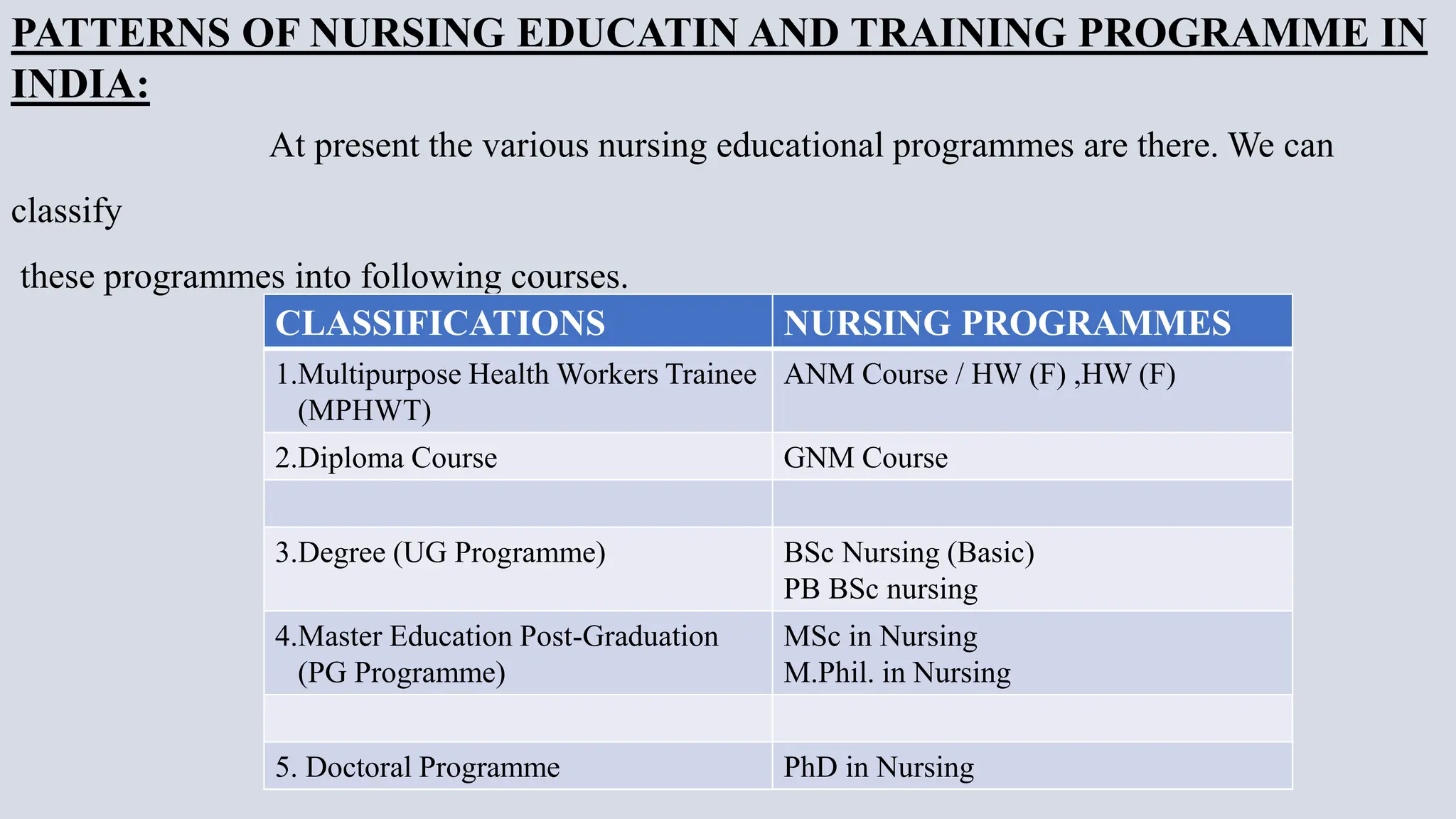
PATTERNS OF NURSING EDUCATIN AND TRAINING PROGRAMME IN
INDIA:
At present the various nursing educational programmes are there. We can
classify
these programmes into following courses.
CLASSIFICATIONS NURSING PROGRAMMES
1.Multipurpose Health Workers Trainee
(MPHWT)
ANM Course / HW (F) ,HW (F)
2.Diploma Course GNM Course
3.Degree (UG Programme) BSc Nursing (Basic)
PB BSc nursing
4.Master Education Post-Graduation
(PG Programme)
MSc in Nursing
M.Phil. in Nursing
5. Doctoral Programme PhD in Nursing
AUXILLARY NURSING AND MIDWIFERY COURSE
(ANM COURSE)
INTRODUCTION.
 Auxiliary Nurse Midwife (ANM) programs can be traced back to the early 20th century. The
concept emerged as a response to the need for trained healthcare workers, particularly in rural
and remote areas, where access to medical facilities was limited.
 The ANM role was initially developed in the United Kingdom as a part of the midwifery and
nursing programs. It aimed to train women to provide basic healthcare services, with a focus on
maternal and child health.
 The concept of ANM nursing gained traction as a way to bridge the gap between formal
medical care and the healthcare needs of communities in underserved regions. As the concept
spread, various countries adapted and implemented ANM programs according to their
healthcare systems and requirements.
 In India, for example, ANM training was introduced to address maternal and child health
issues in rural areas. The Indian government established ANM schools to train women in
providing essential healthcare services, including maternity care, family planning, and basic
medical assistance.
 In 1975, the Srivastava Committee recommended expansion in the role of ANM.
Recommended expansion included the role of an ANM as a multipurpose health worker. Along
with maternity care, the committee recommended that the ANM's work include child health
(immunization) and primary curative care of villagers.
 The Indian Nursing Council (INC) accepted the recommendations of the committee and
included them in the syllabus in 1977. This decision also reduced the training period of the
ANM from 24 months to 18 months.
 The General Nursing and Midwifery (GNM) course started before the Auxiliary Nursing
Midwifery (ANM) course in India
 The ANM course, on the other hand, was introduced later as a response to the need for basic
healthcare providers who could offer essential medical care, maternal and child health services,
and midwifery assistance within communities, especially in rural and underserved areas.
WHERE AND WHEN DID STARTED?
 The first Auxiliary Nurse Midwife (ANM) school in India was established in 1926 at the King
Edward Memorial Hospital in Mumbai, Maharashtra. This marked a crucial step in providing
formal training for healthcare workers to offer medical services in various communities.
 The first ANM school in Karnataka, India, was started in 1945 at Victoria Hospital in
Bangalore (now Bengaluru). This was a significant development in promoting healthcare
training and services in the state.
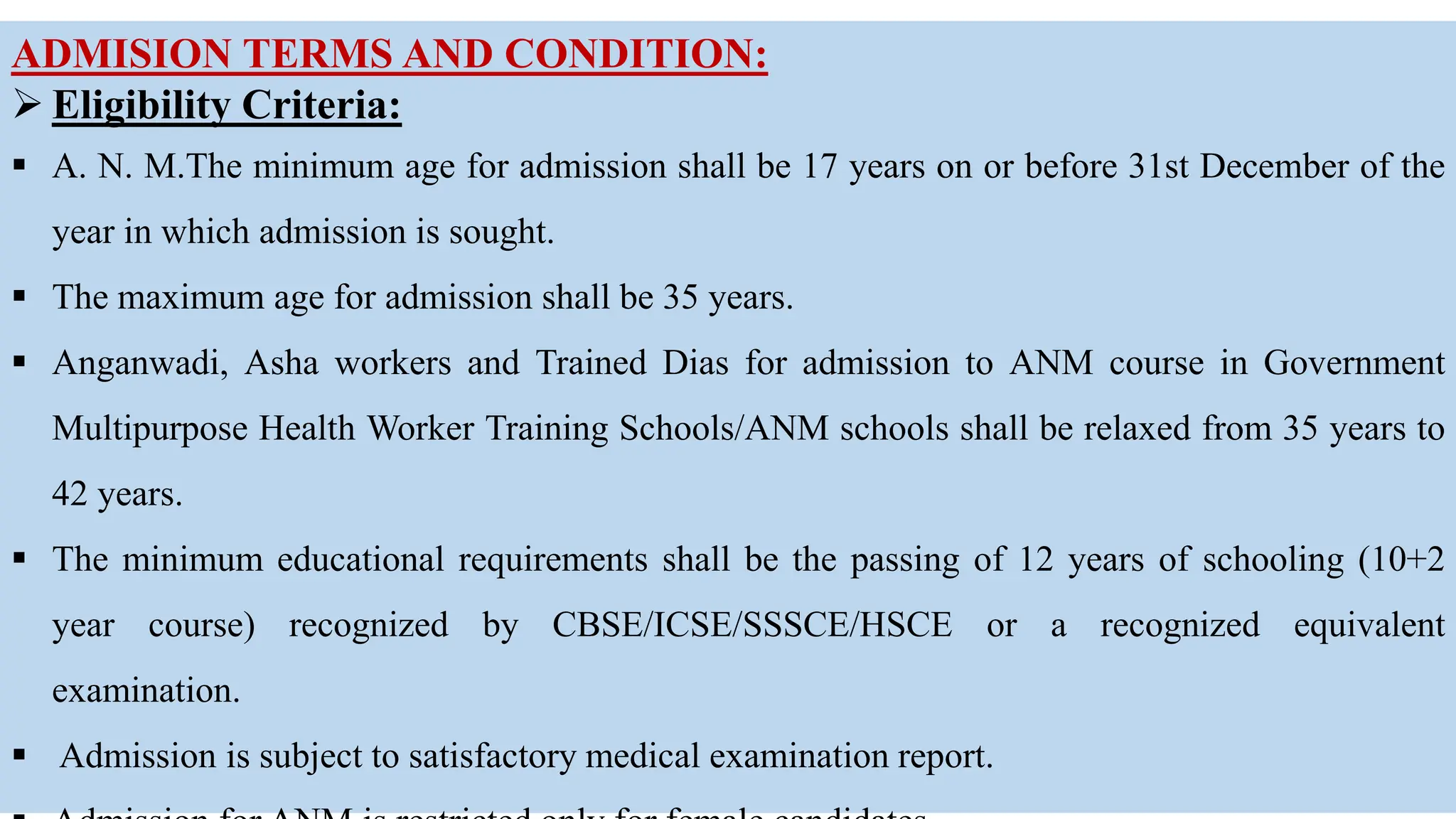
ADMISION TERMS AND CONDITION:
 Eligibility Criteria:
 A. N. M.The minimum age for admission shall be 17 years on or before 31st December of the
year in which admission is sought.
 The maximum age for admission shall be 35 years.
 Anganwadi, Asha workers and Trained Dias for admission to ANM course in Government
Multipurpose Health Worker Training Schools/ANM schools shall be relaxed from 35 years to
42 years.
 The minimum educational requirements shall be the passing of 12 years of schooling (10+2
year course) recognized by CBSE/ICSE/SSSCE/HSCE or a recognized equivalent
examination.
 Admission is subject to satisfactory medical examination report.
COURSE OVERVIEW:
 Duration:
 The ANM Course typically lasts about 18 months.
 Curriculum:
 The curriculum includes subjects related to nursing care, community health, midwifery, maternal
and child health, medical-surgical nursing, nutrition, and more. Students learn essential skills
like patient care, hygiene, first aid, and health promotion.
SCOPE OF ANM:
 Community Health Worker
 Home Nurse
 Health Visitor
 Basic Health Worker
 Rural Health Worker
ADMINISTRATION OF SCHOOL:
Administrative Head.
A Principal Nursing Officer should be appointed as an administrative head of the school training
center or training section.
Budget:
Regular budgetary allocation should be made for teaching equipment and supplies and office
equipment,Transport,Contingencies,Library books and journals. External lectures (for general
education subjects).
Staff:
For 30 students or less the following full time staff is required and Teaching
classroom and field.
Principle nursing Officer 1
Public Health Nurse 2
Nursing Tutor 2
Senior Sanitarian 1
S.NO TEACHING FACULTY QUALIFICATION AND EXPERIENCE
1. Principal M.Sc. Nursing with 3 years of teaching
experience or B.Sc. Nursing with 5 years of
teaching experience.
2. Nursing Tutor Nursing Tutor B.Sc. Nursing/Diploma in
Nursing Education
and Administration/Diploma in Public Health
Nursing with 2 years of clinical experience.
NOTE:
 Additional teaching staff would be required to assist in teaching and field supervision when
number of students exceeds 30,one public health nurse or nursing tutor should be appointed
for every additional 15 students.
 Ratio of female and male Nursing teachers in ANM programme is 4 female : 1 male
Non-teaching:
• Chowkidar/peon
• Cleaner
• Cook -8 for training school and hostel.
• Housekeeper-1 desirable if number of students exceed 30.
• Clerk-1 desirable if number of students exceed 30.
PHYSICAL FACILITIES:
Building:
i. There should be separate building/block for the school and hostel. It should have an open
space to facilitate outdoor games for the students.
ii. The nursing institution can have all the nursing programs in the same building but with
availability of requisite program wise infrastructure. However, labs can be shared.
iii. If the Trust has some other educational programs, the nursing program shall be in separate
block/floor with prescribed sq.ft. area.
iv. It is mandatory that institution shall have its own building within two years of its
establishment.
v. Own Building/Lease/Rented Building
• If one of the Trustees of Trust/Society desires to lease the building owned by him for nursing program, it should be
for a period of 30 years. It should also be ensured that lease deed that is entered into between the Trust and the
Trustee, owning the building, should contain a clause that the lease deed cannot be terminated for a period of 30
Further, it is clarified that, for a nursing institution (managed by a Trust/Society), own building would be a buiilding
either owned and controlled by the Trust/Society or owned and controlled by a member of the Trust/Society. That is,
if the owner of the building is a member of the Trust/Society and she/he leases the building to the Trust/Society for 30
years, it will be considered as own building of the nursing institution.
• A duly registered gift deed of the building in favor of the Trust/ Society should be construed to be ‘own building’.
Further it is clarified that if the lease of the building is between any government authority and the Trust/Nursing
institution and the lease is for 30 years or more, it will also be considered as own Building.
In cases of irrevocable power of attorney, documents of the building should be duly registered as per law.
• Penalty for not having own building: Institutions which do not have their own building within two years of
establishment has to pay the penalty for not having the own building. The penalty fees is Rs.50,000 for ANM
program for 6 consecutive years. Even after 6 years if the institution does not have own building then action shall
be taken under Section 14 of the INC Act, 1947..
 Office – There should be individual furnished office rooms for: Principal, Teachers, Clerical
Staff. A separate telephone connection for the school is necessary.
 Class-room – There should be two adequately large classrooms, accommodating required
number of students (i.e. for 20-40 students size of the room should be 720 sq. ft.). Rooms
should be well ventilated and properly lighted. There should be chairs with arms or desks
according to the number required. Suitable Black/ Green should be available in the class.
 Nursing Laboratory
 Nutrition Laboratory
 Library cum Study
 Audio visual aid
 Toilets
CLINICAL FACILITIES:
a. Maternity, childcare and basic medical surgical experiences. The hospital to have adequate nu
school for training of the ANMs should be located in a Community Health Centre (PHC
annexe) or a RuralHospital (RH) having minimum bed strength of 30 and maximum 50 and
serving an area with community health programmes. The school should also be affiliated to a
district hospital or a secondary care hospital in order to provide experiences of secondary level
health care and an extensive gynae-obstertical care.
b. An organization having a hospital with 150 beds withminimum 30-50 obstetrics and
gynecology beds, and100 delivery cases monthly can also open Auxiliary Nurse and
Midwives school. They should also have an affiliation of PHC/CHC for the community health
nursing field experience.
c. Existing ANM schools attached to District Hospitals should have PHC (accommodation
facility for 20-30 students) for community health field experience.
d. School has to be affiliated to district hospital or a secondary care hospital with minimum 150
beds, in order to provide adequate ber of trained nursing staff round the clock. Bed occupancy
on the average to be between 60% - 70%.
THANK YOU….

Nursing education programmes (ANM Course)

  • 1.
  • 3.
    INTRODUCTION:  A nursingeducation program is a structured curriculum designed to prepare individuals for a career in nursing.  It equips students with the knowledge, skills, and clinical experiences necessary to become competent and compassionate nurses.  These programs can vary in duration and level, ranging from diploma and associate degree programs to bachelor's and master's degrees in nursing.
  • 4.
    DEFINITION OF NURSINGEDUCATION PROGRAMME: A nursing education programme is a structured curriculum designed to prepare individuals for careers in nursing. These programs provide students with the necessary knowledge, skills, and clinical experiences to become competent and compassionate nurses.  The programme typically covers a wide range of subjects including anatomy, physiology, pharmacology, medical-surgical nursing, pediatric nursing, psychiatric nursing, obstetric nursing, and more. Classroom lectures, laboratory sessions, and clinical rotations in healthcare settings provide a comprehensive learning experience.  Nursing education programmes play a crucial role in maintaining and improving the quality of healthcare by producing competent and skilled nurses who contribute to patient well-being and overall.
  • 5.
    PATTERNS OF NURSINGEDUCATIN AND TRAINING PROGRAMME IN INDIA: At present the various nursing educational programmes are there. We can classify these programmes into following courses. CLASSIFICATIONS NURSING PROGRAMMES 1.Multipurpose Health Workers Trainee (MPHWT) ANM Course / HW (F) ,HW (F) 2.Diploma Course GNM Course 3.Degree (UG Programme) BSc Nursing (Basic) PB BSc nursing 4.Master Education Post-Graduation (PG Programme) MSc in Nursing M.Phil. in Nursing 5. Doctoral Programme PhD in Nursing
  • 6.
    AUXILLARY NURSING ANDMIDWIFERY COURSE (ANM COURSE) INTRODUCTION.  Auxiliary Nurse Midwife (ANM) programs can be traced back to the early 20th century. The concept emerged as a response to the need for trained healthcare workers, particularly in rural and remote areas, where access to medical facilities was limited.  The ANM role was initially developed in the United Kingdom as a part of the midwifery and nursing programs. It aimed to train women to provide basic healthcare services, with a focus on maternal and child health.  The concept of ANM nursing gained traction as a way to bridge the gap between formal medical care and the healthcare needs of communities in underserved regions. As the concept spread, various countries adapted and implemented ANM programs according to their healthcare systems and requirements.  In India, for example, ANM training was introduced to address maternal and child health issues in rural areas. The Indian government established ANM schools to train women in providing essential healthcare services, including maternity care, family planning, and basic medical assistance.
  • 7.
     In 1975,the Srivastava Committee recommended expansion in the role of ANM. Recommended expansion included the role of an ANM as a multipurpose health worker. Along with maternity care, the committee recommended that the ANM's work include child health (immunization) and primary curative care of villagers.  The Indian Nursing Council (INC) accepted the recommendations of the committee and included them in the syllabus in 1977. This decision also reduced the training period of the ANM from 24 months to 18 months.  The General Nursing and Midwifery (GNM) course started before the Auxiliary Nursing Midwifery (ANM) course in India  The ANM course, on the other hand, was introduced later as a response to the need for basic healthcare providers who could offer essential medical care, maternal and child health services, and midwifery assistance within communities, especially in rural and underserved areas.
  • 8.
    WHERE AND WHENDID STARTED?  The first Auxiliary Nurse Midwife (ANM) school in India was established in 1926 at the King Edward Memorial Hospital in Mumbai, Maharashtra. This marked a crucial step in providing formal training for healthcare workers to offer medical services in various communities.  The first ANM school in Karnataka, India, was started in 1945 at Victoria Hospital in Bangalore (now Bengaluru). This was a significant development in promoting healthcare training and services in the state.
  • 9.
    ADMISION TERMS ANDCONDITION:  Eligibility Criteria:  A. N. M.The minimum age for admission shall be 17 years on or before 31st December of the year in which admission is sought.  The maximum age for admission shall be 35 years.  Anganwadi, Asha workers and Trained Dias for admission to ANM course in Government Multipurpose Health Worker Training Schools/ANM schools shall be relaxed from 35 years to 42 years.  The minimum educational requirements shall be the passing of 12 years of schooling (10+2 year course) recognized by CBSE/ICSE/SSSCE/HSCE or a recognized equivalent examination.  Admission is subject to satisfactory medical examination report.
  • 10.
    COURSE OVERVIEW:  Duration: The ANM Course typically lasts about 18 months.  Curriculum:  The curriculum includes subjects related to nursing care, community health, midwifery, maternal and child health, medical-surgical nursing, nutrition, and more. Students learn essential skills like patient care, hygiene, first aid, and health promotion.
  • 11.
    SCOPE OF ANM: Community Health Worker  Home Nurse  Health Visitor  Basic Health Worker  Rural Health Worker
  • 12.
    ADMINISTRATION OF SCHOOL: AdministrativeHead. A Principal Nursing Officer should be appointed as an administrative head of the school training center or training section. Budget: Regular budgetary allocation should be made for teaching equipment and supplies and office equipment,Transport,Contingencies,Library books and journals. External lectures (for general education subjects). Staff: For 30 students or less the following full time staff is required and Teaching classroom and field. Principle nursing Officer 1 Public Health Nurse 2 Nursing Tutor 2 Senior Sanitarian 1
  • 13.
    S.NO TEACHING FACULTYQUALIFICATION AND EXPERIENCE 1. Principal M.Sc. Nursing with 3 years of teaching experience or B.Sc. Nursing with 5 years of teaching experience. 2. Nursing Tutor Nursing Tutor B.Sc. Nursing/Diploma in Nursing Education and Administration/Diploma in Public Health Nursing with 2 years of clinical experience. NOTE:  Additional teaching staff would be required to assist in teaching and field supervision when number of students exceeds 30,one public health nurse or nursing tutor should be appointed for every additional 15 students.  Ratio of female and male Nursing teachers in ANM programme is 4 female : 1 male
  • 14.
    Non-teaching: • Chowkidar/peon • Cleaner •Cook -8 for training school and hostel. • Housekeeper-1 desirable if number of students exceed 30. • Clerk-1 desirable if number of students exceed 30.
  • 15.
    PHYSICAL FACILITIES: Building: i. Thereshould be separate building/block for the school and hostel. It should have an open space to facilitate outdoor games for the students. ii. The nursing institution can have all the nursing programs in the same building but with availability of requisite program wise infrastructure. However, labs can be shared. iii. If the Trust has some other educational programs, the nursing program shall be in separate block/floor with prescribed sq.ft. area. iv. It is mandatory that institution shall have its own building within two years of its establishment. v. Own Building/Lease/Rented Building • If one of the Trustees of Trust/Society desires to lease the building owned by him for nursing program, it should be for a period of 30 years. It should also be ensured that lease deed that is entered into between the Trust and the Trustee, owning the building, should contain a clause that the lease deed cannot be terminated for a period of 30
  • 16.
    Further, it isclarified that, for a nursing institution (managed by a Trust/Society), own building would be a buiilding either owned and controlled by the Trust/Society or owned and controlled by a member of the Trust/Society. That is, if the owner of the building is a member of the Trust/Society and she/he leases the building to the Trust/Society for 30 years, it will be considered as own building of the nursing institution. • A duly registered gift deed of the building in favor of the Trust/ Society should be construed to be ‘own building’. Further it is clarified that if the lease of the building is between any government authority and the Trust/Nursing institution and the lease is for 30 years or more, it will also be considered as own Building. In cases of irrevocable power of attorney, documents of the building should be duly registered as per law. • Penalty for not having own building: Institutions which do not have their own building within two years of establishment has to pay the penalty for not having the own building. The penalty fees is Rs.50,000 for ANM program for 6 consecutive years. Even after 6 years if the institution does not have own building then action shall be taken under Section 14 of the INC Act, 1947..
  • 17.
     Office –There should be individual furnished office rooms for: Principal, Teachers, Clerical Staff. A separate telephone connection for the school is necessary.  Class-room – There should be two adequately large classrooms, accommodating required number of students (i.e. for 20-40 students size of the room should be 720 sq. ft.). Rooms should be well ventilated and properly lighted. There should be chairs with arms or desks according to the number required. Suitable Black/ Green should be available in the class.  Nursing Laboratory  Nutrition Laboratory  Library cum Study  Audio visual aid  Toilets
  • 18.
    CLINICAL FACILITIES: a. Maternity,childcare and basic medical surgical experiences. The hospital to have adequate nu school for training of the ANMs should be located in a Community Health Centre (PHC annexe) or a RuralHospital (RH) having minimum bed strength of 30 and maximum 50 and serving an area with community health programmes. The school should also be affiliated to a district hospital or a secondary care hospital in order to provide experiences of secondary level health care and an extensive gynae-obstertical care. b. An organization having a hospital with 150 beds withminimum 30-50 obstetrics and gynecology beds, and100 delivery cases monthly can also open Auxiliary Nurse and Midwives school. They should also have an affiliation of PHC/CHC for the community health nursing field experience. c. Existing ANM schools attached to District Hospitals should have PHC (accommodation facility for 20-30 students) for community health field experience. d. School has to be affiliated to district hospital or a secondary care hospital with minimum 150 beds, in order to provide adequate ber of trained nursing staff round the clock. Bed occupancy on the average to be between 60% - 70%.
  • 19.