Injuries
to
birth canal
INTRODUCTION
Injuries to the birth canal is
commonly occur during childbirth and
contribute significantly to maternal
morbidity. The maternal genital tract
injuries occur in both natural and
instrumental deliveries. Avoidance, early
detection and effective management can
minimize the morbidity and prevent
gynecological problems in future life.
Incidence
 Obstetrical sphincter injury affects about 5% - 7% of
primiparous women, who deliver vaginally (spinelli.A.et
al.2021).
 Vaginal injuries are common in 1% of all vaginal deliveries.
Pelvic muscles
Blood supply
Common injuries
Vulval
injurues
Perineal
tear
Vaginal
injury
Cervical
tear
Pelvic
hematom
as
Rupture of
uterus &
Visceral
injuries
Injuries to Vulva
 Lacerations of the vulval skin posteriorly and
the para urethral tear on the inner aspect of the
labia minora are common sites.
 Para urethral tears often bleed briskly as the
labia are highly vascular. Prompt repair may
be necessary to secure hemostasis.
Perineal Tears
 Factors causing perineal tears
 Over stretching of the perineum due to large baby, face delivery,
outlet contraction with narrow pubic arch, shoulder dystocia and
forceps delivery.
 Rapid stretching of the perineum due to rapid delivery of the head
during uterine contraction, precipitate labor and delivery of the
after coming head in breech.
 In elastic perineum as in rigid perineum in elderly primi gravida,
scar in the perineum following previous operations, such as
episiotomies or perineorrhaphy and vulval edema.
 Unattended delivery and inability of the woman to stop bearing
down.
Classifications of Perineal Injuries
 First Degree - Involves lacerations of the fourchette
(lower end of the posterior vagina) only.
 Second Degree - Involves the fourchette and the
superficial perineal muscles, namely the bulbo
cavernosus and the transverse perineal muscles and in
some cases the pubococcygeus.
 Third Degree (Complete Tear) - Involves in addition to
the above structures, the anal sphincter.
 Fourth Degree (Central Tear) -The tear extends to the
rectal mucosa.
Prevention of Perineal Injuries
 Conduct of second stage of delivery with due care in those with increased
likelihood of laceration.
 Maintain flexion of the head until the occiput comes under the symphysis pubis
so that lesser sub-occipito frontal (10 cm) diameter emerges out of the introitus
 Assure the woman not to bear down during contractions to avoid forcible
delivery of the head
 Deliver the head in between contractions
 Perform timely episiotomies
 Take care during delivery of the shoulders.
Repair of perineum
 First degree/second degree tears
 The vaginal mucosal to sutured first
 The first Suture is placed at or just above
the apex of the tear
 There after, the vaginal walls are
approved by interrupted sutures, with
chromic catgut from above downwards
until the fourchette is reached.
Third Degree Perineal Tears
 The rectal & anal mucosa are sutured first form above downwards with chrome by
interrupted stitches.
 Muscle walls & facia are than sutured by interrupted stitches.
 The torn ends of the sphincter ani are then reconstituted with a figure of 8, stitch using
chromic catgut.
 Repair of perineal muscle is done an two layers by interrupted sutures.
 The perineal skin is apposed by interrupted sutures either with chromic catgut or silk.
 The sutured area should be inspected in order to confirm hemostasis before the vaginal
pack is removed.
Repair of Complete perineal tear
 Step1: Prepare& position the patient and local Infiltration of 1% lignocaine
hydrochloride or with pudendal block of regional or general anaesthesia
 Step 2: The rectal and anal mucosa is first sutured from above downward with 3-0 vicryl,
atramatic needles, Interrupted stitches with knots inside the lumen are used, the rectal
muscles including the para-rectal facia are then sutured by interrupted sutures using the
same material. The torn ends of the sphincter ani extends are then exposed by Alli's tissue
forceps. The Sphincter is then reconstructed with figure of 8 stitches & it is supposed by
another layer of interrupted sutures.
 Step 3: Repair of perineal muscle is done by interrupted sutures. Surgical knots are
burried under the superficial muscles.
 Step 4: The vaginal wall & the perineal skin are apposed by interrupted sutures.
After Care
 A low residual diet consisting of milk, bread, eggs, biscuits, fist, sweets etc., to be
given form 3rd day onwards.
 Lactulose 8ml twice a day from the second day and 15ml from 3rd day to soften the
stool
 Broad spectrum antibiotics Iv dose & metronidazole 400 mg tid for 5-7 days
 Pelvic floor exercise advised after 6-12 weeks of delivery.
 Endoanal use & anorectal manometry should be done to detect any residual defects.
 Consultation with a colorectal surgeon opinion
Vaginal tear
 Isolated vaginal tears or lacerations
without involvement usually seen
following instrumental or
manipulative delivery.
 In such cases, the tears are extensive
and often associated with brisk
hemorrhage.
TREATMENT
 Tears associated with brisk hemorrhage requires exploration under general
anesthesia
 The tears are repaired by interrupted or continuous sutures using chromic catgut
No- "0".
 In case of extensive lacerations, in addition to sutures hemostasis may be
achieved by intra vaginal plugging by roller gauze soaked with glycerin and
acriflavine.
 The plug should be removed after 24 hours.
 Selective arterial embolization may also be done if bleeding persists
COLPORRHEXIS:
 Repair of the vault of the vagina is called
colporrhexis.
 It may be primary where only the vault is
involved or secondary when associated
with cervical tear (common).
 It is said to be complete when the
peritoneum is opened up.
 Posterior fornix usually ruptures and
cervical tear usually associated with tear of
the lateral fornix.
Treatment
 If the tear is limited to the vault close to the cervix the repair is
done from below.
 If, however, the cervical tear extends high up into the lower
segment or major branches of uterine vessels are damaged,
laparotomy is to be done
 Simultaneously with resuscitative measures.
 Evacuation of hematoma and arterial ligation may be needed.
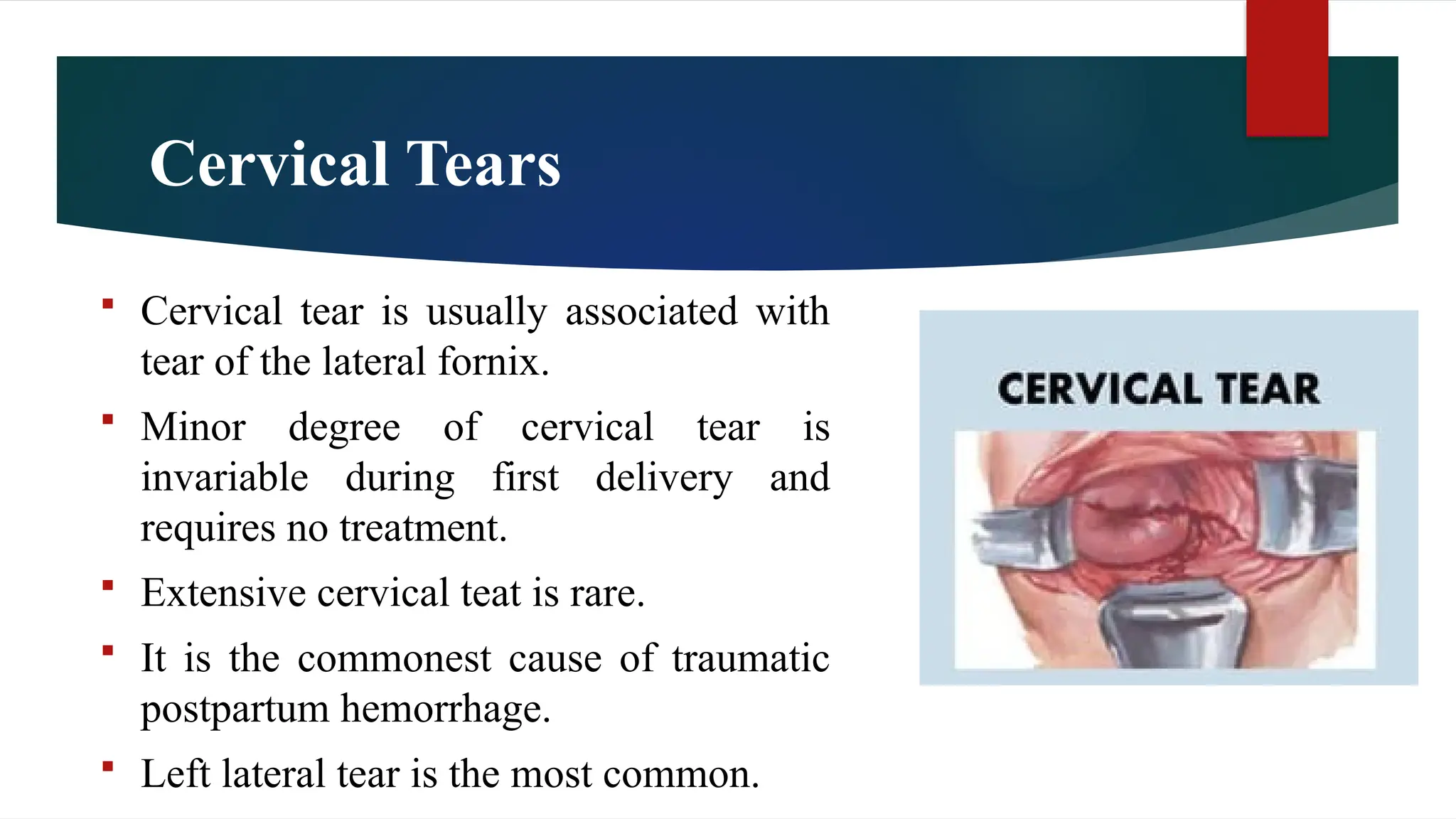
Cervical Tears
 Cervical tear is usually associated with
tear of the lateral fornix.
 Minor degree of cervical tear is
invariable during first delivery and
requires no treatment.
 Extensive cervical teat is rare.
 It is the commonest cause of traumatic
postpartum hemorrhage.
 Left lateral tear is the most common.
CAUSES OF CERVICAL TEAR
 Iatrogenic-Attempted forceps delivery or breech extraction through incompletely dilated
cervix.
 Rigid cervix-This may be congenital or more commonly following scar from previous
operations on the cervix like amputation, conization or presence of a lesion like carcinoma
cervix.
 Strong uterine contractions as in precipitate labor or extremely vascular cervix as in
placenta previa.
 Detachment-Detachment of the cervix may be annular which involved the entire
circumference of the cervix. This occurs following prolonged labor in primary cervical
dystocia. It may, however, involve only the anterior lip when it is nipped between the head
and the symphysis pubis in association with the sacral os. In both varieties, the bleeding is
minimal and healing occurs through epithelialization.
Signs of Cervical Tear
 Excessive vaginal bleeding following delivery in the
presence of a hard and contracted uterus is suggestive of
cervical tear.
 Exploration of the utero-vaginal canal under good light is
essential to confirm the diagnosis and assess the tear.
DANGERS
 Early-
 (1) Deep cervical tears involving the major vessels lead to severe
postpartum haemorrhage
 (2) Broad ligament hematoma
 (3) Pelvic cellulitis
 (4) Thrombophlebitis
 Late-
 (1) Ectropion;
 (2) Cervical incompetence with mid trimester abortion.
TREATMENT-PROCEDURE
 The anterior and posterior margins of the torn cervix are grasped by the
sponge holding forceps.
 The apex is to be identified first and the first vertical mattress sutures is
placed just above the apex. Using 0- chromic taking whole thickness of
the cervix
 The bleeding stops immediately.
 The rest of the tear is repaired by Similar mattress sutures.
 A helpful guide for proper exposure in inch a case us to start at the
proximal end using the suture for traction
 Distal tear area is exposed until the apex is in new and is repaired, the
tears to the lower segment's or vault with broad ligament hematoma are
managed as outlined us ruptured uterus.
PELVIC HEMATOMAS
 Definition
 Collections of blood anywhere in the area between
the pelvic peritoneum and the peritoneal skin are
called pelvic hematoma.
 Anatomical Types
 Depending upon the location of the hematoma,
whether below or above the levator ani muscle, it
is termed as:
 Infra levator hematoma
 Supra levator hematoma
Infra levator hematoma
 Vulval hematoma is the commonest in this type.
 Causes
 Trauma of spontaneous labor, prolonged labor and forceps operations resulting in
rupture of paravaginal venous plexus
 Improper hemostasis during repair of vaginal or perineal tears or episiotomy wound
 Rough uterine massage for controlling postpartum hemorrhage may cause development
of small hematomas in the supra- peritoneal connective tissue and in the broad
ligaments.
Manifestations
 Persistent, severe pain in the perineal region
 Rectal tenesmus or bearing down efforts when extension occurs to the ischio-rectal
fossa
 Retention of urine
 Variable degrees of shock or collapse
 Tense swelling at the vulva which becomes dusky and purple in color and tender to
touch
 Pallor, rapid pulse and low blood pressure
 A tender pelvic lump on palpation.
Treatment
 A small hematoma (<5 cm) is treated conservatively with cold compress.
 When it is larger than 5 cm or increasing in size, it needs to be evacuated.
 The patient is given blood and narcotic analgesics for pain.
 The hematoma is drained under general anesthesia and bleeding points
are secured.
 The dead space is to be obliterated by deep mattress sutures and a closed
suction drain may be kept for 24 hours.
 Prophylactic antibiotic is to be administered.
Supra levator Hematoma
 Causes
 Extension of cervical laceration or
primary vault rupture (colporrhexis)
 Lower uterine segment rupture
 Spontaneous rupture of para cervical
venous plexus adjacent to the vault.
Diagnosis
 Unexplained shock with features of shock following delivery
 Abdominal examination reveals swelling above the inguinal ligament
pushing the uterus to the opposite side
 Vaginal examination reveals occlusion of the vaginal canal by a bulge
or a bogy swelling felt through the fornix
 Ultrasonography may show the exact localization of the hematoma,
Management
 Treatment of shock
 Exploratory laparotomy and drainage of the hematoma (blood clots are
scooped out)
 Spontaneous and Traumatic Rupture-
 The bleeding points, if seen, are to be secured and ligated
 Any injury to the uterus and/or cervix is repaired
 The broad ligament is drained extra peritoneal using corrugated rubber drain
 Bilateral internal iliac artery ligation may be required to control bleeding.
RUPTURE OF THE UTERUS
 Rupture of the uterus is an uncommon injury and when it happens, it can be a
catastrophic event, as it places the mother and fetus at high risk for morbidity and
mortality.
 Definition
 A rupture is defined as an abrupt tearing of the uterus and can be complete or
incomplete.
 Incidence
 Prevalence varies from 1 in 2000 to 1 in 200 deliveries
 Etiology
 Spontaneous rupture
 Scar rupture
 Iatrogenic rupture
Classification of rupture
 Scar Rupture and Dehiscence
 In scar rupture disruption of the entire length of the scar occurs.
 With classical scars, rupture occurs late in pregnancy or early labor.
 Bleeding is slight unless the placenta is lying underneath.
 Rupture lower segment scars occur with obstructed labor. It is
accompanied by a "tearing pain".
 Bleeding may not be heavy
 Dehiscence is disruption of part of the scar and not the entire length.
It tends not to cause any bleeding and is without clinical significance.
Complete and Incomplete Rupture
 Complete uterine rupture - extends through the entire wall and peritoneum
with the entire contents spilling into the abdominal cavity
 An incomplete uterine rupture - extends through the endometrium and
myometrium without involving the peritoneum.
 A spontaneous rupture - is one that our during labor owing to a myometrium
weakened by a previous scar
 A traumatic uterine rupture - may be causes by trauma resulting from
obstetric instruments, obstetric interventions or accident such as fall or blow of
the abdomen.
Risk Factors
 A traumatous labor resulting from oxytocic induction when not controlled
carefully
 Multiparity combined with use of oxytocin
 Obstructed labor such as with absolute CPD
 Accidents such as falling face downwards
 Trauma due to forceps, breech extraction or internal version late in labor
 Excessive fundal pressure
 Shoulder dystocia.
Signs and Symptoms
 Exquisite abdominal pain
 Vaginal bleeding
 Intra-abdominal bleeding
 Blood may be confine retro-peritoneally as a broad ligament hematoma
 Lack of progress in labor
 Shock from hemorrhage
 Alteration in shape of abdominal swelling
 The uterus contracts and may be mistake for a fetal head in the supra-pubic region
 Restlessness and anxiety
Management
 Emergency cesarean delivery with repair of the rupture, if
the woman is undelivered and the symptoms are not severe
 Cesarean hysterectomy, if the tear is severe and cannot be
repaired.
Nursing Care
 Continuous assessment of the woman who is predisposed to develop a rupture. In those with classical
cesarean scar, the rupture is likely to occur even before labor begins
 Monitor the progress of labor carefully in order to facilitate early identification or abnormal symptoms
 Cautious use of oxytocin in women with uterine scar.
 Once a Rupture is diagnosed monitor maternal and fetal vital signs and fluid status
 Administer oxygen for the benefit of both mother and fetus
 Urinary catheterization to be done and mother to be prepared for surgery
 Provide information to the woman and her family of the situation, interventions planned and the prognosis
being
 Emotional support to the woman and her immediate family.
VISCERAL INJURIES
 Injury to bladder may be due to:
 Trauma
 1. During instrumental vaginal delivery such as
forceps delivery or destructive operations.
 2. Abdominal operation, such as hysterectomy for
rupture of uterus or repeat cesarean section.
 Sloughing fistula
 This results from prolonged compression of the
bladder between the fetal head and symphysis pubis
in obstructed labor.
Clinical Manifestations
 Traumatic Urine dribbles out following the operative surgery.
 Blood stained urine following caesarean section or hysterectomy.
 Sloughing fistula.
 Dribbling of urine occurs after varying interval following
prolonged labor (5-7 days)Missing of a chunk of tissue seen on
examination.
Management
 Immediate repair is preferable for traumatic fistula, if the woman's
general condition is good and facilities are available.
 In unfavorable condition, a self-retaining catheter is introduced and
kept for 10-14 days.
 Urinary antiseptics are given and bladder wash done daily.
 Spontaneous closure may occur and if it does not, repair is done after
three months.
Injury to the Rectum
 Rectal injury is rare because the middle third of the
rectum is protected by the curved sacral hollow and
the upper third is protected by the peritoneal lining.
 Prolonged compression of the rectum by the head in
mid-pelvic contraction with a flat sacrum predisposes
to ischemic necrosis of the anterior rectal wall and
results in recto-vaginal fistula.
 The repair in such cases should be postponed for at
least three months
Injury to the Urethra
 Urethral injury may be traumatic resulting
from instrumental delivery or during
pubotomy.
 It may occur due to ischemic sloughing, the
mechanism of which is similar to that of
bladder necrosis.
 The principles of management are similar to
those of bladder injury.
Complications
 Immediate
 Infection
 Bleeding
 Shock
 Remote
 Anemia
 Painful intercourse
 Urine incontinence
 Fecal incontinence
 Ongoing pain and soreness
Nurses Responsibility
Controlled
delivery of
head
Timely
episiotomy
Avoiding
fundal
pressure
Stabilization
Repair Education
Uterine
massage
Hemostasis
Summary:
 So far we have seen about the injures to birth canal by means of
injuries to the following vulva, perineal, vagina, cervix, pelvic
hematomas, rupture of uterus & visceral injuries and their
nursing management.
Conclusion:
 Through this Seminar, I have gained more knowledge regarding
the topic of injuries to birth canal in wide range. I would like to
thank our OBG nursing specialty madam for giving this
opportunity.
Theory Application- Jean Ball Deck
Chair Theory
Journal application
 Antonio spinelli et al. 2021, conducted a perspective study, titled as
Diagnosis & Treatment of obstetric Anal Sphincter Injuries. The available
pre clinical studies suggest a promising beneficial effect of regenerative
medicine on fecal incontinence. Further research in this field is needed to
translate regenerative medicine in a concrete alternative for the treatment
of fetal incontinence following post delivery injuries.
Assignment
 Which type of Birth canal injury needs Immediate life Saving
action & describe the type of injury in detail.
Injuries to birth canal- Obstetrics and gynaecological nursing

Injuries to birth canal- Obstetrics and gynaecological nursing

  • 2.
  • 3.
    INTRODUCTION Injuries to thebirth canal is commonly occur during childbirth and contribute significantly to maternal morbidity. The maternal genital tract injuries occur in both natural and instrumental deliveries. Avoidance, early detection and effective management can minimize the morbidity and prevent gynecological problems in future life.
  • 4.
    Incidence  Obstetrical sphincterinjury affects about 5% - 7% of primiparous women, who deliver vaginally (spinelli.A.et al.2021).  Vaginal injuries are common in 1% of all vaginal deliveries.
  • 6.
  • 8.
  • 9.
  • 10.
    Injuries to Vulva Lacerations of the vulval skin posteriorly and the para urethral tear on the inner aspect of the labia minora are common sites.  Para urethral tears often bleed briskly as the labia are highly vascular. Prompt repair may be necessary to secure hemostasis.
  • 11.
    Perineal Tears  Factorscausing perineal tears  Over stretching of the perineum due to large baby, face delivery, outlet contraction with narrow pubic arch, shoulder dystocia and forceps delivery.  Rapid stretching of the perineum due to rapid delivery of the head during uterine contraction, precipitate labor and delivery of the after coming head in breech.  In elastic perineum as in rigid perineum in elderly primi gravida, scar in the perineum following previous operations, such as episiotomies or perineorrhaphy and vulval edema.  Unattended delivery and inability of the woman to stop bearing down.
  • 12.
    Classifications of PerinealInjuries  First Degree - Involves lacerations of the fourchette (lower end of the posterior vagina) only.  Second Degree - Involves the fourchette and the superficial perineal muscles, namely the bulbo cavernosus and the transverse perineal muscles and in some cases the pubococcygeus.  Third Degree (Complete Tear) - Involves in addition to the above structures, the anal sphincter.  Fourth Degree (Central Tear) -The tear extends to the rectal mucosa.
  • 13.
    Prevention of PerinealInjuries  Conduct of second stage of delivery with due care in those with increased likelihood of laceration.  Maintain flexion of the head until the occiput comes under the symphysis pubis so that lesser sub-occipito frontal (10 cm) diameter emerges out of the introitus  Assure the woman not to bear down during contractions to avoid forcible delivery of the head  Deliver the head in between contractions  Perform timely episiotomies  Take care during delivery of the shoulders.
  • 14.
    Repair of perineum First degree/second degree tears  The vaginal mucosal to sutured first  The first Suture is placed at or just above the apex of the tear  There after, the vaginal walls are approved by interrupted sutures, with chromic catgut from above downwards until the fourchette is reached.
  • 15.
    Third Degree PerinealTears  The rectal & anal mucosa are sutured first form above downwards with chrome by interrupted stitches.  Muscle walls & facia are than sutured by interrupted stitches.  The torn ends of the sphincter ani are then reconstituted with a figure of 8, stitch using chromic catgut.  Repair of perineal muscle is done an two layers by interrupted sutures.  The perineal skin is apposed by interrupted sutures either with chromic catgut or silk.  The sutured area should be inspected in order to confirm hemostasis before the vaginal pack is removed.
  • 16.
    Repair of Completeperineal tear  Step1: Prepare& position the patient and local Infiltration of 1% lignocaine hydrochloride or with pudendal block of regional or general anaesthesia  Step 2: The rectal and anal mucosa is first sutured from above downward with 3-0 vicryl, atramatic needles, Interrupted stitches with knots inside the lumen are used, the rectal muscles including the para-rectal facia are then sutured by interrupted sutures using the same material. The torn ends of the sphincter ani extends are then exposed by Alli's tissue forceps. The Sphincter is then reconstructed with figure of 8 stitches & it is supposed by another layer of interrupted sutures.  Step 3: Repair of perineal muscle is done by interrupted sutures. Surgical knots are burried under the superficial muscles.  Step 4: The vaginal wall & the perineal skin are apposed by interrupted sutures.
  • 17.
    After Care  Alow residual diet consisting of milk, bread, eggs, biscuits, fist, sweets etc., to be given form 3rd day onwards.  Lactulose 8ml twice a day from the second day and 15ml from 3rd day to soften the stool  Broad spectrum antibiotics Iv dose & metronidazole 400 mg tid for 5-7 days  Pelvic floor exercise advised after 6-12 weeks of delivery.  Endoanal use & anorectal manometry should be done to detect any residual defects.  Consultation with a colorectal surgeon opinion
  • 18.
    Vaginal tear  Isolatedvaginal tears or lacerations without involvement usually seen following instrumental or manipulative delivery.  In such cases, the tears are extensive and often associated with brisk hemorrhage.
  • 19.
    TREATMENT  Tears associatedwith brisk hemorrhage requires exploration under general anesthesia  The tears are repaired by interrupted or continuous sutures using chromic catgut No- "0".  In case of extensive lacerations, in addition to sutures hemostasis may be achieved by intra vaginal plugging by roller gauze soaked with glycerin and acriflavine.  The plug should be removed after 24 hours.  Selective arterial embolization may also be done if bleeding persists
  • 20.
    COLPORRHEXIS:  Repair ofthe vault of the vagina is called colporrhexis.  It may be primary where only the vault is involved or secondary when associated with cervical tear (common).  It is said to be complete when the peritoneum is opened up.  Posterior fornix usually ruptures and cervical tear usually associated with tear of the lateral fornix.
  • 21.
    Treatment  If thetear is limited to the vault close to the cervix the repair is done from below.  If, however, the cervical tear extends high up into the lower segment or major branches of uterine vessels are damaged, laparotomy is to be done  Simultaneously with resuscitative measures.  Evacuation of hematoma and arterial ligation may be needed.
  • 22.
    Cervical Tears  Cervicaltear is usually associated with tear of the lateral fornix.  Minor degree of cervical tear is invariable during first delivery and requires no treatment.  Extensive cervical teat is rare.  It is the commonest cause of traumatic postpartum hemorrhage.  Left lateral tear is the most common.
  • 23.
    CAUSES OF CERVICALTEAR  Iatrogenic-Attempted forceps delivery or breech extraction through incompletely dilated cervix.  Rigid cervix-This may be congenital or more commonly following scar from previous operations on the cervix like amputation, conization or presence of a lesion like carcinoma cervix.  Strong uterine contractions as in precipitate labor or extremely vascular cervix as in placenta previa.  Detachment-Detachment of the cervix may be annular which involved the entire circumference of the cervix. This occurs following prolonged labor in primary cervical dystocia. It may, however, involve only the anterior lip when it is nipped between the head and the symphysis pubis in association with the sacral os. In both varieties, the bleeding is minimal and healing occurs through epithelialization.
  • 24.
    Signs of CervicalTear  Excessive vaginal bleeding following delivery in the presence of a hard and contracted uterus is suggestive of cervical tear.  Exploration of the utero-vaginal canal under good light is essential to confirm the diagnosis and assess the tear.
  • 25.
    DANGERS  Early-  (1)Deep cervical tears involving the major vessels lead to severe postpartum haemorrhage  (2) Broad ligament hematoma  (3) Pelvic cellulitis  (4) Thrombophlebitis  Late-  (1) Ectropion;  (2) Cervical incompetence with mid trimester abortion.
  • 26.
    TREATMENT-PROCEDURE  The anteriorand posterior margins of the torn cervix are grasped by the sponge holding forceps.  The apex is to be identified first and the first vertical mattress sutures is placed just above the apex. Using 0- chromic taking whole thickness of the cervix  The bleeding stops immediately.  The rest of the tear is repaired by Similar mattress sutures.  A helpful guide for proper exposure in inch a case us to start at the proximal end using the suture for traction  Distal tear area is exposed until the apex is in new and is repaired, the tears to the lower segment's or vault with broad ligament hematoma are managed as outlined us ruptured uterus.
  • 27.
    PELVIC HEMATOMAS  Definition Collections of blood anywhere in the area between the pelvic peritoneum and the peritoneal skin are called pelvic hematoma.  Anatomical Types  Depending upon the location of the hematoma, whether below or above the levator ani muscle, it is termed as:  Infra levator hematoma  Supra levator hematoma
  • 28.
    Infra levator hematoma Vulval hematoma is the commonest in this type.  Causes  Trauma of spontaneous labor, prolonged labor and forceps operations resulting in rupture of paravaginal venous plexus  Improper hemostasis during repair of vaginal or perineal tears or episiotomy wound  Rough uterine massage for controlling postpartum hemorrhage may cause development of small hematomas in the supra- peritoneal connective tissue and in the broad ligaments.
  • 29.
    Manifestations  Persistent, severepain in the perineal region  Rectal tenesmus or bearing down efforts when extension occurs to the ischio-rectal fossa  Retention of urine  Variable degrees of shock or collapse  Tense swelling at the vulva which becomes dusky and purple in color and tender to touch  Pallor, rapid pulse and low blood pressure  A tender pelvic lump on palpation.
  • 30.
    Treatment  A smallhematoma (<5 cm) is treated conservatively with cold compress.  When it is larger than 5 cm or increasing in size, it needs to be evacuated.  The patient is given blood and narcotic analgesics for pain.  The hematoma is drained under general anesthesia and bleeding points are secured.  The dead space is to be obliterated by deep mattress sutures and a closed suction drain may be kept for 24 hours.  Prophylactic antibiotic is to be administered.
  • 31.
    Supra levator Hematoma Causes  Extension of cervical laceration or primary vault rupture (colporrhexis)  Lower uterine segment rupture  Spontaneous rupture of para cervical venous plexus adjacent to the vault.
  • 32.
    Diagnosis  Unexplained shockwith features of shock following delivery  Abdominal examination reveals swelling above the inguinal ligament pushing the uterus to the opposite side  Vaginal examination reveals occlusion of the vaginal canal by a bulge or a bogy swelling felt through the fornix  Ultrasonography may show the exact localization of the hematoma,
  • 33.
    Management  Treatment ofshock  Exploratory laparotomy and drainage of the hematoma (blood clots are scooped out)  Spontaneous and Traumatic Rupture-  The bleeding points, if seen, are to be secured and ligated  Any injury to the uterus and/or cervix is repaired  The broad ligament is drained extra peritoneal using corrugated rubber drain  Bilateral internal iliac artery ligation may be required to control bleeding.
  • 34.
    RUPTURE OF THEUTERUS  Rupture of the uterus is an uncommon injury and when it happens, it can be a catastrophic event, as it places the mother and fetus at high risk for morbidity and mortality.  Definition  A rupture is defined as an abrupt tearing of the uterus and can be complete or incomplete.  Incidence  Prevalence varies from 1 in 2000 to 1 in 200 deliveries  Etiology  Spontaneous rupture  Scar rupture  Iatrogenic rupture
  • 35.
    Classification of rupture Scar Rupture and Dehiscence  In scar rupture disruption of the entire length of the scar occurs.  With classical scars, rupture occurs late in pregnancy or early labor.  Bleeding is slight unless the placenta is lying underneath.  Rupture lower segment scars occur with obstructed labor. It is accompanied by a "tearing pain".  Bleeding may not be heavy  Dehiscence is disruption of part of the scar and not the entire length. It tends not to cause any bleeding and is without clinical significance.
  • 36.
    Complete and IncompleteRupture  Complete uterine rupture - extends through the entire wall and peritoneum with the entire contents spilling into the abdominal cavity  An incomplete uterine rupture - extends through the endometrium and myometrium without involving the peritoneum.  A spontaneous rupture - is one that our during labor owing to a myometrium weakened by a previous scar  A traumatic uterine rupture - may be causes by trauma resulting from obstetric instruments, obstetric interventions or accident such as fall or blow of the abdomen.
  • 37.
    Risk Factors  Atraumatous labor resulting from oxytocic induction when not controlled carefully  Multiparity combined with use of oxytocin  Obstructed labor such as with absolute CPD  Accidents such as falling face downwards  Trauma due to forceps, breech extraction or internal version late in labor  Excessive fundal pressure  Shoulder dystocia.
  • 38.
    Signs and Symptoms Exquisite abdominal pain  Vaginal bleeding  Intra-abdominal bleeding  Blood may be confine retro-peritoneally as a broad ligament hematoma  Lack of progress in labor  Shock from hemorrhage  Alteration in shape of abdominal swelling  The uterus contracts and may be mistake for a fetal head in the supra-pubic region  Restlessness and anxiety
  • 39.
    Management  Emergency cesareandelivery with repair of the rupture, if the woman is undelivered and the symptoms are not severe  Cesarean hysterectomy, if the tear is severe and cannot be repaired.
  • 40.
    Nursing Care  Continuousassessment of the woman who is predisposed to develop a rupture. In those with classical cesarean scar, the rupture is likely to occur even before labor begins  Monitor the progress of labor carefully in order to facilitate early identification or abnormal symptoms  Cautious use of oxytocin in women with uterine scar.  Once a Rupture is diagnosed monitor maternal and fetal vital signs and fluid status  Administer oxygen for the benefit of both mother and fetus  Urinary catheterization to be done and mother to be prepared for surgery  Provide information to the woman and her family of the situation, interventions planned and the prognosis being  Emotional support to the woman and her immediate family.
  • 41.
    VISCERAL INJURIES  Injuryto bladder may be due to:  Trauma  1. During instrumental vaginal delivery such as forceps delivery or destructive operations.  2. Abdominal operation, such as hysterectomy for rupture of uterus or repeat cesarean section.  Sloughing fistula  This results from prolonged compression of the bladder between the fetal head and symphysis pubis in obstructed labor.
  • 42.
    Clinical Manifestations  TraumaticUrine dribbles out following the operative surgery.  Blood stained urine following caesarean section or hysterectomy.  Sloughing fistula.  Dribbling of urine occurs after varying interval following prolonged labor (5-7 days)Missing of a chunk of tissue seen on examination.
  • 43.
    Management  Immediate repairis preferable for traumatic fistula, if the woman's general condition is good and facilities are available.  In unfavorable condition, a self-retaining catheter is introduced and kept for 10-14 days.  Urinary antiseptics are given and bladder wash done daily.  Spontaneous closure may occur and if it does not, repair is done after three months.
  • 44.
    Injury to theRectum  Rectal injury is rare because the middle third of the rectum is protected by the curved sacral hollow and the upper third is protected by the peritoneal lining.  Prolonged compression of the rectum by the head in mid-pelvic contraction with a flat sacrum predisposes to ischemic necrosis of the anterior rectal wall and results in recto-vaginal fistula.  The repair in such cases should be postponed for at least three months
  • 45.
    Injury to theUrethra  Urethral injury may be traumatic resulting from instrumental delivery or during pubotomy.  It may occur due to ischemic sloughing, the mechanism of which is similar to that of bladder necrosis.  The principles of management are similar to those of bladder injury.
  • 46.
    Complications  Immediate  Infection Bleeding  Shock  Remote  Anemia  Painful intercourse  Urine incontinence  Fecal incontinence  Ongoing pain and soreness
  • 47.
  • 48.
    Summary:  So farwe have seen about the injures to birth canal by means of injuries to the following vulva, perineal, vagina, cervix, pelvic hematomas, rupture of uterus & visceral injuries and their nursing management.
  • 49.
    Conclusion:  Through thisSeminar, I have gained more knowledge regarding the topic of injuries to birth canal in wide range. I would like to thank our OBG nursing specialty madam for giving this opportunity.
  • 50.
    Theory Application- JeanBall Deck Chair Theory
  • 51.
    Journal application  Antoniospinelli et al. 2021, conducted a perspective study, titled as Diagnosis & Treatment of obstetric Anal Sphincter Injuries. The available pre clinical studies suggest a promising beneficial effect of regenerative medicine on fecal incontinence. Further research in this field is needed to translate regenerative medicine in a concrete alternative for the treatment of fetal incontinence following post delivery injuries.
  • 52.
    Assignment  Which typeof Birth canal injury needs Immediate life Saving action & describe the type of injury in detail.