

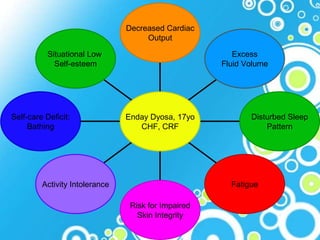

Nursing Care Plan for Congestive Heart Failure, Chronic Renal Failure
Identified Problem: prolonged capillary refill, cold, clammy skinNursing Diagnosis:Decreased Cardiac Output r/t altered myocardial contractility 2° CHF
CuesSubjective:Pt verbalized, “maglisod man ko ug ginhawa samot na kung gahigda”Objective:Wt gain of 2kgs in 4 daysCold, clammy skin+ murmursCough
ObjectivesShort Term:After 8° of rendering nursing care, pt will participate in activities that reduce the cardiac workload of the heart such as stress management, rest plan, cessation of smoking.Long Term:After 3 days of rendering nursing care, pt will report decreased episodes of dyspnea.
Interventions and RationalesIndependentDetermined baseline vital signs to provide opportunities to track changes.Noted response to activity and time required to return to baseline vital signs to assess degree of debilitation.Provided adequate rest, positioning pt for maximum comfort. Assisted pt in performing self-care activities to prevent fatigue.
5. Provided fever control interventions (tepid sponge bath) to minimize contributing factors.6. Weighed the pt daily to monitor for fluid retention.7. Encouraged pt to breathe deeply in and out during activities that increase risk of Valsalva effect to prevent arrhythmia.8. Encouraged relaxation techniques to reduce anxiety.9. Encouraged position changes slowly (dangling legs before standing) to reduce risk for orthostatic hypotension10. Encouraged pt to eat small meals and rest afterwards to decrease myocardial workload.
EvaluationSTOOutcome met: pt participated in activities that reduce the cardiac workload of the heart such as stress management, rest plan, cessation of smokingLTOOutcome partially met: pt reported “talagsa na lang ko maglisod ug ginhawa”.
Identified Problem: weight gain, edema, crackles noted Nursing Diagnosis:Excess fluid volume r/t sodium and water retention
CuesSubjective:Pt verbalized, “maglisod man ko ug ginhawa”Objective:Wt gain of 2kgs in 4 days+ CracklesRestlessnessEdema
ObjectivesShort Term:After 8° of rendering nursing care, pt will verbalize understanding of dietary and fluid restrictions.Long Term:After 3 days of rendering nursing care, pt will demonstrate behaviours to monitor fluid status and reduce recurrence of fluid excess such as low sodium, low water diet.
Interventions and RationalesIndependentNoted amount and rate of fluid intake from all sources (PO, IV) to monitor fluid balance.Reviewed intake of sodium and protein to assess for precipitating factors.Compared current weight with baseline data to evaluate degree of excess.Maintained in chair or semi-Fowler’s position to enhance urination.Noted patterns and amount of urination to monitor output.
6. Provided privacy during urination to avoid embarrassment.7.Promoted pt ambulation to promote elimination of excess fluid.8. Auscultated breath sounds q2h for the presence of crackles and monitor for sputum production.9. Encouraged pt to follow low sodium, low water diet to decrease water retention.10. Administered diuretic therapy as ordered by physician to increase urine output.
EvaluationSTOOutcome met: pt verbalized understanding of dietary and fluid restrictions.LTOOutcome partially met: pt demonstrated behaviours to monitor fluid status and reduce recurrence of fluid excess such as low sodium, low water diet.
Identified Problem: disruption of sleep Nursing Diagnosis:Disturbed Sleep Pattern r/t shortness of breath
CUESSubjective:“Maglisud ko ug ginhawa sa gabie,unya motukar akong ubo, maong dili jud ko katulog”, as verbalized by patient.Objective:Increasing irritabilityRestlessnessDark circles under eyes
ObjectivesShort Term:After 8° of rendering nursing care, pt will identify appropriate interventions to promote sleep.Long Term:After 3 days of rendering nursing care, pt will report improvement in sleep/rest pattern.
Interventions and RationalesIndependentAssessed sleep pattern disturbances that are assoc. with underlying illness to identify causative factors.Evaluated use of alcoholic beverages as one cause of sleep interference.Observed pt usual bedtime routines, number of hours of sleep and time of arising to determine usual sleep pattern and provide comparative baseline.Observed for physical signs of fatigue (e.g., restlessness).Provided quiet environment to promote sleep.
6. Recommended limiting intake of alcoholic beverages especially prior to bedtime to prevent interference of sleep.7. Limit intake of fluid in the evening to reduce the need for night time awakening.8. Encouraged intake of warm milk prior to bedtime to promote relaxation and sleep.9. Arranged care to allow for uninterrupted  periods of rest to help pt establish optimal sleep patterns.10. Provided comfort measures (e.g., back rub, hand washing cleaning bed) to promote sleep.
EvaluationSTOOutcome met: pt identified appropriate interventions to promote sleep.LTOOutcome met: pt  reported improvement in sleep/rest pattern.
Identified Problem: sense of exhaustion Nursing Diagnosis:Fatigue r/t poor physical condition
CUESSubjective:Pt verbalized, “Kapoyan na ko ug lihok oy kay hangoson ra gihapon ko”  and “pirme man ko gikapoy”Objective:Decreased performanceCompromised concentrationDisinterest in surroundings
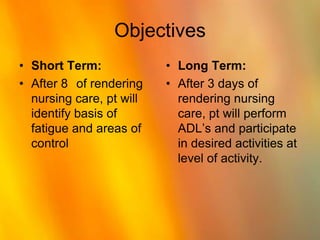
ObjectivesShort Term:After 8° of rendering nursing care, pt will identify basis of fatigue and areas of controlLong Term:After 3 days of rendering nursing care, pt will perform ADL’s and participate in desired activities at level of activity.
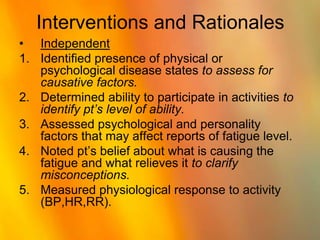
Interventions and RationalesIndependentIdentified presence of physical or psychological disease states to assess for causative factors.Determined ability to participate in activities to identify pt’s level of ability.Assessed psychological and personality factors that may affect reports of fatigue level.Noted pt’s belief about what is causing the fatigue and what relieves it to clarify misconceptions.Measured physiological response to activity (BP,HR,RR).
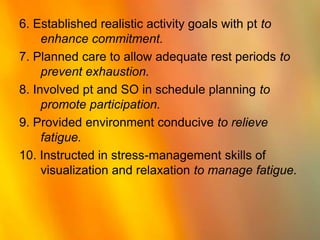
6. Established realistic activity goals with pt to enhance commitment.7. Planned care to allow adequate rest periods to prevent exhaustion.8. Involved pt and SO in schedule planning to promote participation.9. Provided environment conducive to relieve fatigue.10. Instructed in stress-management skills of visualization and relaxation to manage fatigue.
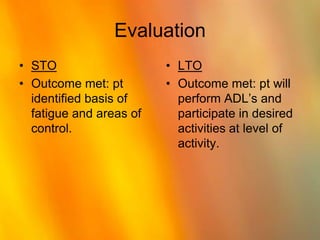
EvaluationSTOOutcome met: pt identified basis of fatigue and areas of control.LTOOutcome met: pt will perform ADL’s and participate in desired activities at level of activity.
Identified Problem: at risk for skin being altered Nursing Diagnosis:Risk for Impaired Skin Integrity
Risk FactorsExternalPhysical immobilizationInternalAltered peripheral circulationPresence of edema
ObjectivesShort Term:After 8° of rendering nursing care, pt will verbalize understanding of treatment/therapy regimen.Long Term:After 3 days of rendering nursing care, pt will demonstrate behaviours to prevent skin breakdown.
Interventions and RationalesIndependentNoted general debilitation, reduced mobility, changes in skin and muscle mass to assess for causative factors.Maintained strict skin hygiene, using mild soap and lubricate with lotion.Massaged bony prominences gently and avoid friction in moving client to prevent shearing of the skin surface.Provided adequate clothing and covers to prevent vasoconstriction.Provided protection by use of pads and pillows to increase circulation.
Inspected skin surfaces and pressure points routinely to check for the integrity of skin.Observed for reddened and blanched and instituted treatment immediately to prevent progression to skin breakdown.Emphasized importance of adequate nutritional and fluid intake to maintain general good health and skin turgor.Encouraged abstinence from tobacco to prevent vasoconstriction.Recommended elevation of legs to enhance venous return and reduce edema formation.
EvaluationSTOOutcome met: pt   verbalized understanding of treatment/therapy regimen.LTOOutcome met: pt   demonstrated behaviours to prevent skin breakdown
Identified Problem: insufficient physiologic to complete desired activities Nursing Diagnosis:Activity intolerance r/t imbalance between oxygen supply and demand
CuesSubjective:Pt verbalized, “Kapoyan na ko ug lihok oy kay hangoson ra gihapon ko”. Objective:Functional Level: III (walk no more than 50 ft on level without stopping; unable to climb one flight of stairs without stopping)Nasal flaringdiaphoresisRR=44cpm; BP=140/100
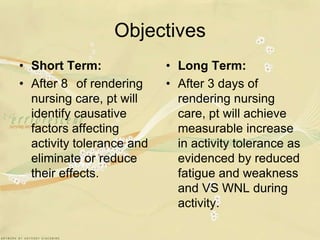
ObjectivesShort Term:After 8° of rendering nursing care, pt will identify causative factors affecting activity tolerance and eliminate or reduce their effects.Long Term:After 3 days of rendering nursing care, pt will achieve measurable increase in activity tolerance as evidenced by reduced fatigue and weakness and VS WNL during activity.
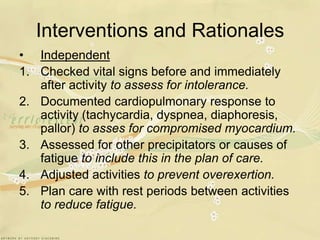
Interventions and RationalesIndependentChecked vital signs before and immediately after activity to assess for intolerance.Documented cardiopulmonary response to activity (tachycardia, dyspnea, diaphoresis, pallor) to asses for compromised myocardium.Assessed for other precipitators or causes of fatigue to include this in the plan of care.Adjusted activities to prevent overexertion.Plan care with rest periods between activities to reduce fatigue.
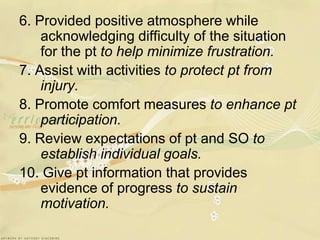
6. Provided positive atmosphere while acknowledging difficulty of the situation for the pt to help minimize frustration.7. Assist with activities to protect pt from injury.8. Promote comfort measures to enhance pt participation.9. Review expectations of pt and SO to establish individual goals.10. Give pt information that provides evidence of progress to sustain motivation.
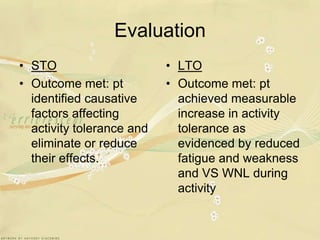
EvaluationSTOOutcome met: pt identified causative factors affecting activity tolerance and eliminate or reduce their effects.LTOOutcome met: pt achieved measurable increase in activity tolerance as evidenced by reduced fatigue and weakness and VS WNL during activity
Identified Problem: disinterest to perform bathing for oneself Nursing Diagnosis:Self-care Deficit: bathing r/t lack of motivation
CuesSubjective:Pt verbalized, “wala pa ko kaligo sukad atong biyernes” (for five days)Objective:Unable to get bath suppliesUnable to get to water sourcePt refused bed bathPt has offensive odour
ObjectivesShort Term:After 8° of rendering nursing care, pt will identify bathing needs and weaknessLong Term:After 3 days of rendering nursing care, pt will perform self-care within level of own ability.
Interventions and RationalesIndependentDetermined existing conditions affecting ability to bath to develop plan of care.Scheduled activities to conform to pt’s normal schedule.Assisted with necessary adaptations to accomplish ADL’s beginning with familiar, easy tasks to encourage pt and build on successes.Reviewed safety concerns during bathing to promote safety.
5. Encouraged use of energy-saving techniques (e.g., sitting) to conserve energy and reduce fatigue.6. Modified environment to reduce risk of injury.7. Explained to pt the importance of bathing to encourage participation.8. Prepared the necessary materials to encourage pt to bath.9. Prepared safety devices to avoid injury.10. Provided privacy to avoid embarrassment.
EvaluationSTOOutcome met: After 8° of rendering nursing care, pt identified bathing needs and weakness.LTOOutcome met: pt performed self-care within level of own ability.
Identified Problem: low self-	esteem Nursing Diagnosis:Situational Low Self-esteem r/t dependency and role changes 2° physical illness
CuesSubjective:Pt verbalized, “Nawad-an na jud ko ug gana. Wala na man gani ikapalit si mama ug tambal. Wala na pud ko katrabaho. Pabug-at na ko sa ila.”Objective:Reluctance to make decisionNegative attitude towards self
ObjectivesShort Term:After 8° of rendering nursing care, pt will verbalize understanding of factors that precipitated current situation.Long Term:After 3 days of rendering nursing care, pt will demonstrate behaviours to restore positive self-esteem.
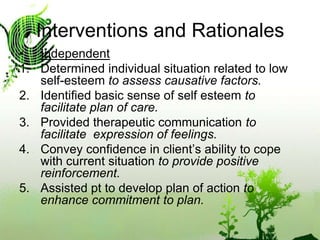
Interventions and RationalesIndependentDetermined individual situation related to low self-esteem to assess causative factors.Identified basic sense of self esteem to facilitate plan of care.Provided therapeutic communication to facilitate  expression of feelings.Convey confidence in client’s ability to cope with current situation to provide positive reinforcement.Assisted pt to develop plan of action to enhance commitment to plan.
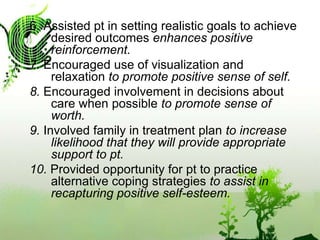
6. Assisted pt in setting realistic goals to achieve desired outcomes enhances positive reinforcement.7. Encouraged use of visualization and relaxation to promote positive sense of self.8. Encouraged involvement in decisions about care when possible to promote sense of worth.9. Involved family in treatment plan to increase likelihood that they will provide appropriate support to pt.10. Provided opportunity for pt to practice alternative coping strategies to assist in recapturing positive self-esteem.
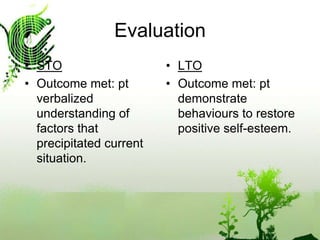
EvaluationSTOOutcome met: pt verbalized understanding of factors that precipitated current situation.LTOOutcome met: pt demonstrate behaviours to restore positive self-esteem.

Nursing Care Plan for CHF, CRF

  • 1.
    Nursing Care Planfor Congestive Heart Failure, Chronic Renal Failure
  • 3.
    Identified Problem: prolongedcapillary refill, cold, clammy skinNursing Diagnosis:Decreased Cardiac Output r/t altered myocardial contractility 2° CHF
  • 4.
    CuesSubjective:Pt verbalized, “maglisodman ko ug ginhawa samot na kung gahigda”Objective:Wt gain of 2kgs in 4 daysCold, clammy skin+ murmursCough
  • 5.
    ObjectivesShort Term:After 8°of rendering nursing care, pt will participate in activities that reduce the cardiac workload of the heart such as stress management, rest plan, cessation of smoking.Long Term:After 3 days of rendering nursing care, pt will report decreased episodes of dyspnea.
  • 6.
    Interventions and RationalesIndependentDeterminedbaseline vital signs to provide opportunities to track changes.Noted response to activity and time required to return to baseline vital signs to assess degree of debilitation.Provided adequate rest, positioning pt for maximum comfort. Assisted pt in performing self-care activities to prevent fatigue.
  • 7.
    5. Provided fevercontrol interventions (tepid sponge bath) to minimize contributing factors.6. Weighed the pt daily to monitor for fluid retention.7. Encouraged pt to breathe deeply in and out during activities that increase risk of Valsalva effect to prevent arrhythmia.8. Encouraged relaxation techniques to reduce anxiety.9. Encouraged position changes slowly (dangling legs before standing) to reduce risk for orthostatic hypotension10. Encouraged pt to eat small meals and rest afterwards to decrease myocardial workload.
  • 8.
    EvaluationSTOOutcome met: ptparticipated in activities that reduce the cardiac workload of the heart such as stress management, rest plan, cessation of smokingLTOOutcome partially met: pt reported “talagsa na lang ko maglisod ug ginhawa”.
  • 9.
    Identified Problem: weightgain, edema, crackles noted Nursing Diagnosis:Excess fluid volume r/t sodium and water retention
  • 10.
    CuesSubjective:Pt verbalized, “maglisodman ko ug ginhawa”Objective:Wt gain of 2kgs in 4 days+ CracklesRestlessnessEdema
  • 11.
    ObjectivesShort Term:After 8°of rendering nursing care, pt will verbalize understanding of dietary and fluid restrictions.Long Term:After 3 days of rendering nursing care, pt will demonstrate behaviours to monitor fluid status and reduce recurrence of fluid excess such as low sodium, low water diet.
  • 12.
    Interventions and RationalesIndependentNotedamount and rate of fluid intake from all sources (PO, IV) to monitor fluid balance.Reviewed intake of sodium and protein to assess for precipitating factors.Compared current weight with baseline data to evaluate degree of excess.Maintained in chair or semi-Fowler’s position to enhance urination.Noted patterns and amount of urination to monitor output.
  • 13.
    6. Provided privacyduring urination to avoid embarrassment.7.Promoted pt ambulation to promote elimination of excess fluid.8. Auscultated breath sounds q2h for the presence of crackles and monitor for sputum production.9. Encouraged pt to follow low sodium, low water diet to decrease water retention.10. Administered diuretic therapy as ordered by physician to increase urine output.
  • 14.
    EvaluationSTOOutcome met: ptverbalized understanding of dietary and fluid restrictions.LTOOutcome partially met: pt demonstrated behaviours to monitor fluid status and reduce recurrence of fluid excess such as low sodium, low water diet.
  • 15.
    Identified Problem: disruptionof sleep Nursing Diagnosis:Disturbed Sleep Pattern r/t shortness of breath
  • 16.
    CUESSubjective:“Maglisud ko ugginhawa sa gabie,unya motukar akong ubo, maong dili jud ko katulog”, as verbalized by patient.Objective:Increasing irritabilityRestlessnessDark circles under eyes
  • 17.
    ObjectivesShort Term:After 8°of rendering nursing care, pt will identify appropriate interventions to promote sleep.Long Term:After 3 days of rendering nursing care, pt will report improvement in sleep/rest pattern.
  • 18.
    Interventions and RationalesIndependentAssessedsleep pattern disturbances that are assoc. with underlying illness to identify causative factors.Evaluated use of alcoholic beverages as one cause of sleep interference.Observed pt usual bedtime routines, number of hours of sleep and time of arising to determine usual sleep pattern and provide comparative baseline.Observed for physical signs of fatigue (e.g., restlessness).Provided quiet environment to promote sleep.
  • 19.
    6. Recommended limitingintake of alcoholic beverages especially prior to bedtime to prevent interference of sleep.7. Limit intake of fluid in the evening to reduce the need for night time awakening.8. Encouraged intake of warm milk prior to bedtime to promote relaxation and sleep.9. Arranged care to allow for uninterrupted periods of rest to help pt establish optimal sleep patterns.10. Provided comfort measures (e.g., back rub, hand washing cleaning bed) to promote sleep.
  • 20.
    EvaluationSTOOutcome met: ptidentified appropriate interventions to promote sleep.LTOOutcome met: pt reported improvement in sleep/rest pattern.
  • 21.
    Identified Problem: senseof exhaustion Nursing Diagnosis:Fatigue r/t poor physical condition
  • 22.
    CUESSubjective:Pt verbalized, “Kapoyanna ko ug lihok oy kay hangoson ra gihapon ko” and “pirme man ko gikapoy”Objective:Decreased performanceCompromised concentrationDisinterest in surroundings
  • 23.
    ObjectivesShort Term:After 8°of rendering nursing care, pt will identify basis of fatigue and areas of controlLong Term:After 3 days of rendering nursing care, pt will perform ADL’s and participate in desired activities at level of activity.
  • 24.
    Interventions and RationalesIndependentIdentifiedpresence of physical or psychological disease states to assess for causative factors.Determined ability to participate in activities to identify pt’s level of ability.Assessed psychological and personality factors that may affect reports of fatigue level.Noted pt’s belief about what is causing the fatigue and what relieves it to clarify misconceptions.Measured physiological response to activity (BP,HR,RR).
  • 25.
    6. Established realisticactivity goals with pt to enhance commitment.7. Planned care to allow adequate rest periods to prevent exhaustion.8. Involved pt and SO in schedule planning to promote participation.9. Provided environment conducive to relieve fatigue.10. Instructed in stress-management skills of visualization and relaxation to manage fatigue.
  • 26.
    EvaluationSTOOutcome met: ptidentified basis of fatigue and areas of control.LTOOutcome met: pt will perform ADL’s and participate in desired activities at level of activity.
  • 27.
    Identified Problem: atrisk for skin being altered Nursing Diagnosis:Risk for Impaired Skin Integrity
  • 28.
    Risk FactorsExternalPhysical immobilizationInternalAlteredperipheral circulationPresence of edema
  • 29.
    ObjectivesShort Term:After 8°of rendering nursing care, pt will verbalize understanding of treatment/therapy regimen.Long Term:After 3 days of rendering nursing care, pt will demonstrate behaviours to prevent skin breakdown.
  • 30.
    Interventions and RationalesIndependentNotedgeneral debilitation, reduced mobility, changes in skin and muscle mass to assess for causative factors.Maintained strict skin hygiene, using mild soap and lubricate with lotion.Massaged bony prominences gently and avoid friction in moving client to prevent shearing of the skin surface.Provided adequate clothing and covers to prevent vasoconstriction.Provided protection by use of pads and pillows to increase circulation.
  • 31.
    Inspected skin surfacesand pressure points routinely to check for the integrity of skin.Observed for reddened and blanched and instituted treatment immediately to prevent progression to skin breakdown.Emphasized importance of adequate nutritional and fluid intake to maintain general good health and skin turgor.Encouraged abstinence from tobacco to prevent vasoconstriction.Recommended elevation of legs to enhance venous return and reduce edema formation.
  • 32.
    EvaluationSTOOutcome met: pt verbalized understanding of treatment/therapy regimen.LTOOutcome met: pt demonstrated behaviours to prevent skin breakdown
  • 33.
    Identified Problem: insufficientphysiologic to complete desired activities Nursing Diagnosis:Activity intolerance r/t imbalance between oxygen supply and demand
  • 34.
    CuesSubjective:Pt verbalized, “Kapoyanna ko ug lihok oy kay hangoson ra gihapon ko”. Objective:Functional Level: III (walk no more than 50 ft on level without stopping; unable to climb one flight of stairs without stopping)Nasal flaringdiaphoresisRR=44cpm; BP=140/100
  • 35.
    ObjectivesShort Term:After 8°of rendering nursing care, pt will identify causative factors affecting activity tolerance and eliminate or reduce their effects.Long Term:After 3 days of rendering nursing care, pt will achieve measurable increase in activity tolerance as evidenced by reduced fatigue and weakness and VS WNL during activity.
  • 36.
    Interventions and RationalesIndependentCheckedvital signs before and immediately after activity to assess for intolerance.Documented cardiopulmonary response to activity (tachycardia, dyspnea, diaphoresis, pallor) to asses for compromised myocardium.Assessed for other precipitators or causes of fatigue to include this in the plan of care.Adjusted activities to prevent overexertion.Plan care with rest periods between activities to reduce fatigue.
  • 37.
    6. Provided positiveatmosphere while acknowledging difficulty of the situation for the pt to help minimize frustration.7. Assist with activities to protect pt from injury.8. Promote comfort measures to enhance pt participation.9. Review expectations of pt and SO to establish individual goals.10. Give pt information that provides evidence of progress to sustain motivation.
  • 38.
    EvaluationSTOOutcome met: ptidentified causative factors affecting activity tolerance and eliminate or reduce their effects.LTOOutcome met: pt achieved measurable increase in activity tolerance as evidenced by reduced fatigue and weakness and VS WNL during activity
  • 39.
    Identified Problem: disinterestto perform bathing for oneself Nursing Diagnosis:Self-care Deficit: bathing r/t lack of motivation
  • 40.
    CuesSubjective:Pt verbalized, “walapa ko kaligo sukad atong biyernes” (for five days)Objective:Unable to get bath suppliesUnable to get to water sourcePt refused bed bathPt has offensive odour
  • 41.
    ObjectivesShort Term:After 8°of rendering nursing care, pt will identify bathing needs and weaknessLong Term:After 3 days of rendering nursing care, pt will perform self-care within level of own ability.
  • 42.
    Interventions and RationalesIndependentDeterminedexisting conditions affecting ability to bath to develop plan of care.Scheduled activities to conform to pt’s normal schedule.Assisted with necessary adaptations to accomplish ADL’s beginning with familiar, easy tasks to encourage pt and build on successes.Reviewed safety concerns during bathing to promote safety.
  • 43.
    5. Encouraged useof energy-saving techniques (e.g., sitting) to conserve energy and reduce fatigue.6. Modified environment to reduce risk of injury.7. Explained to pt the importance of bathing to encourage participation.8. Prepared the necessary materials to encourage pt to bath.9. Prepared safety devices to avoid injury.10. Provided privacy to avoid embarrassment.
  • 44.
    EvaluationSTOOutcome met: After8° of rendering nursing care, pt identified bathing needs and weakness.LTOOutcome met: pt performed self-care within level of own ability.
  • 45.
    Identified Problem: lowself- esteem Nursing Diagnosis:Situational Low Self-esteem r/t dependency and role changes 2° physical illness
  • 46.
    CuesSubjective:Pt verbalized, “Nawad-anna jud ko ug gana. Wala na man gani ikapalit si mama ug tambal. Wala na pud ko katrabaho. Pabug-at na ko sa ila.”Objective:Reluctance to make decisionNegative attitude towards self
  • 47.
    ObjectivesShort Term:After 8°of rendering nursing care, pt will verbalize understanding of factors that precipitated current situation.Long Term:After 3 days of rendering nursing care, pt will demonstrate behaviours to restore positive self-esteem.
  • 48.
    Interventions and RationalesIndependentDeterminedindividual situation related to low self-esteem to assess causative factors.Identified basic sense of self esteem to facilitate plan of care.Provided therapeutic communication to facilitate expression of feelings.Convey confidence in client’s ability to cope with current situation to provide positive reinforcement.Assisted pt to develop plan of action to enhance commitment to plan.
  • 49.
    6. Assisted ptin setting realistic goals to achieve desired outcomes enhances positive reinforcement.7. Encouraged use of visualization and relaxation to promote positive sense of self.8. Encouraged involvement in decisions about care when possible to promote sense of worth.9. Involved family in treatment plan to increase likelihood that they will provide appropriate support to pt.10. Provided opportunity for pt to practice alternative coping strategies to assist in recapturing positive self-esteem.
  • 50.
    EvaluationSTOOutcome met: ptverbalized understanding of factors that precipitated current situation.LTOOutcome met: pt demonstrate behaviours to restore positive self-esteem.