COPD is also known as chronic obstructive
lung disease (COLD), chronic obstructive
airway disease (COAD), chronic airflow
limitation (CAL) and chronic obstructive
respiratory disease (CORD)
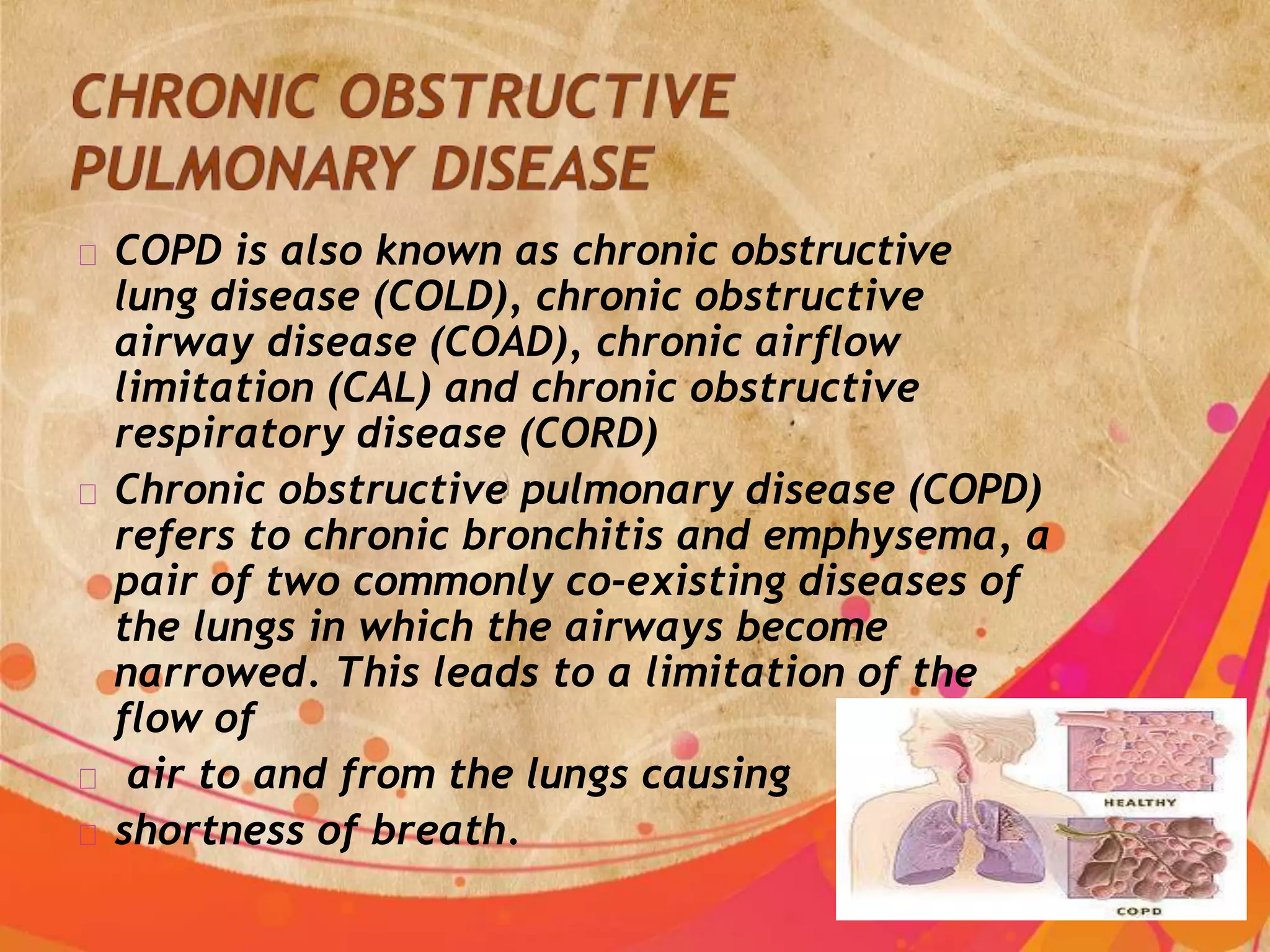
Chronic obstructive pulmonary disease (COPD)
refers to chronic bronchitis and emphysema, a
pair of two commonly co-existing diseases of
the lungs in which the airways become
narrowed. This leads to a limitation of the
flow of
air to and from the lungs causing
shortness of breath.
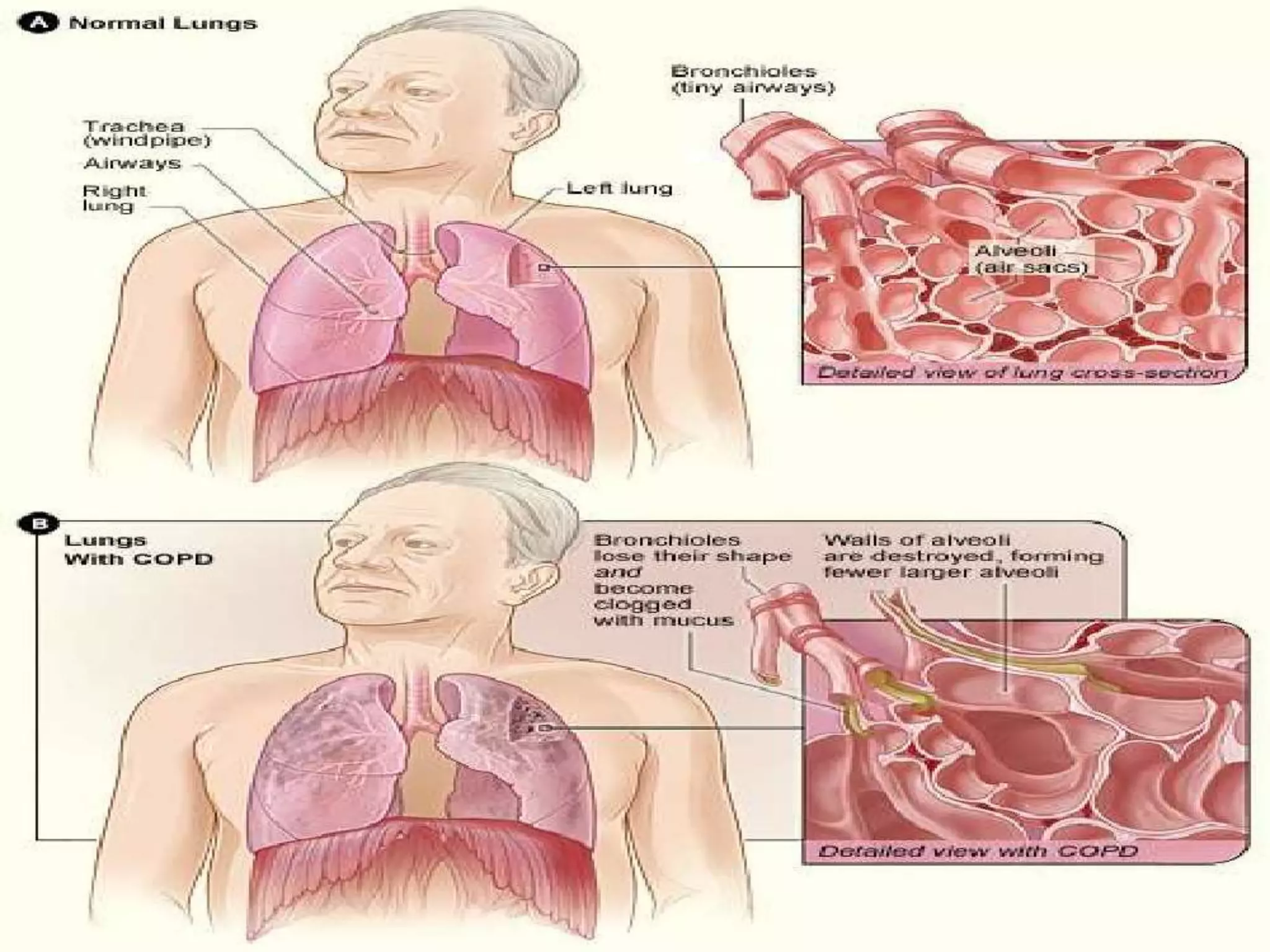
In COPD, less air flows in and out ofthe
airways because of one or more of the
following:
 The airways and air sacs lose their
elastic quality.
 The walls between many of the air sacs
are destroyed.
 The walls of the airways become thick
and inflamed.
 The airways make more mucus than
usual, which tends to clog them.
It is the 4th leading cause of mortality and
12th leading cause of disability in the
united states.
In 2020 COPD is the 3rd leading cause of
death.
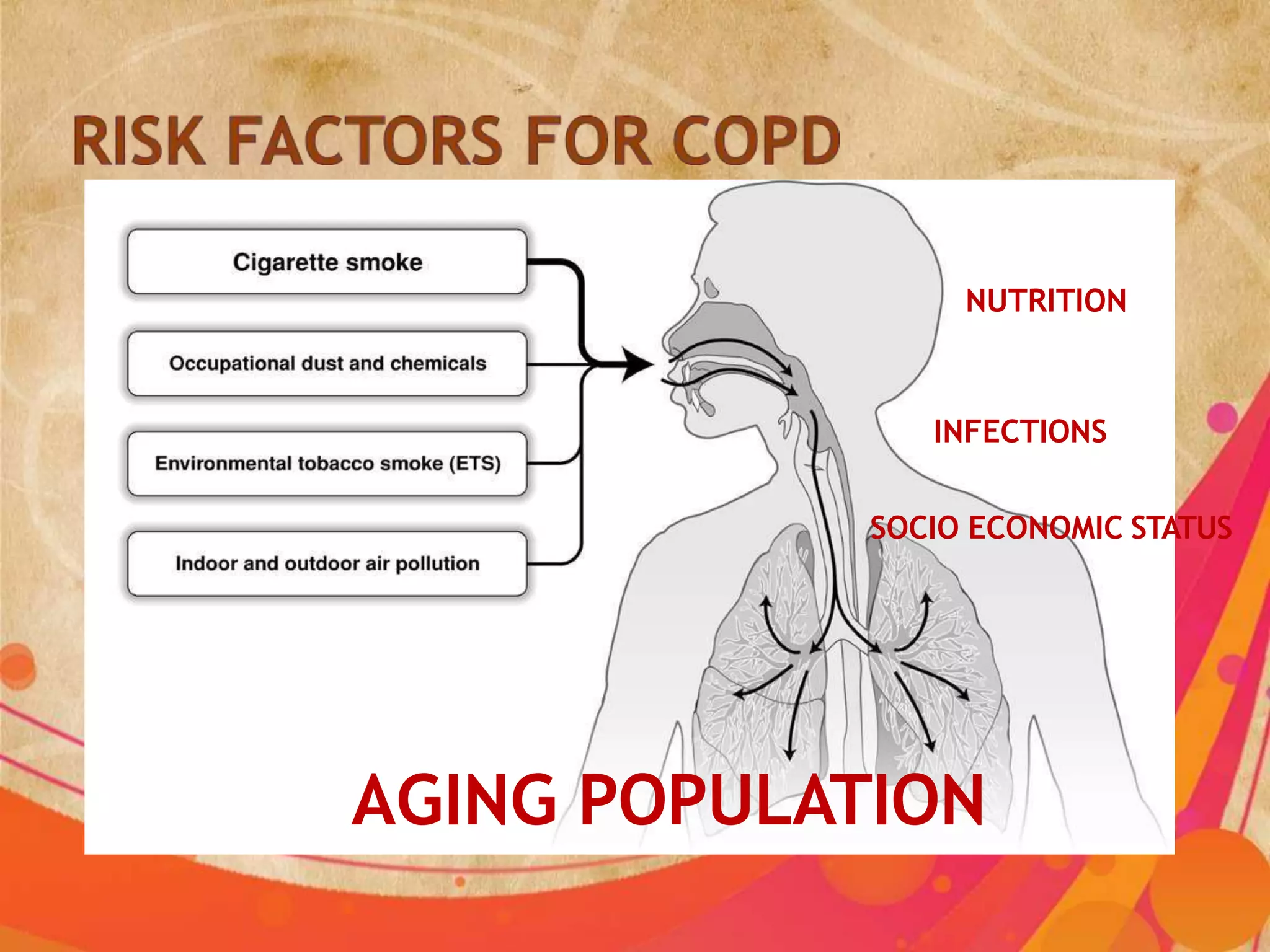
1)Smoking
2) Occupational exposures- exposure to
workplace dusts found in coal mining, gold
mining, and the cotton textile industry and
chemicals such as cadmium, isocyanates, and
fumes from welding have been implicated in
the development of airflow obstruction.
3) Air pollution
4) sudden airway constriction in response to
inhaled irritants,
5) Bronchial hyperresponsiveness, is a
characteristic of asthma.
6) Genetics-Alpha 1-antitrypsindeficiency
is a genetic condition that is responsible
for about 2% of cases of COPD. In this
condition, the body does not make enough
of a protein, alpha 1-antitrypsin. Alpha 1-
antitrypsin protects the lungs from
damage caused by protease enzymes, such
as elastase and trypsin, that can be
released as a result of an inflammatory
response to tobacco smoke.
NUTRITION
INFECTIONS
SOCIO ECONOMIC STATUS
AGING POPULATION
Abnormal inflammatory response of the
lungs due to toxic gases.
Response occurs in the airways
,parenchyma & pulmonary vasculature.
Narrowing of the airway takes place
Destruction of parenchyma leads to
emphysema.
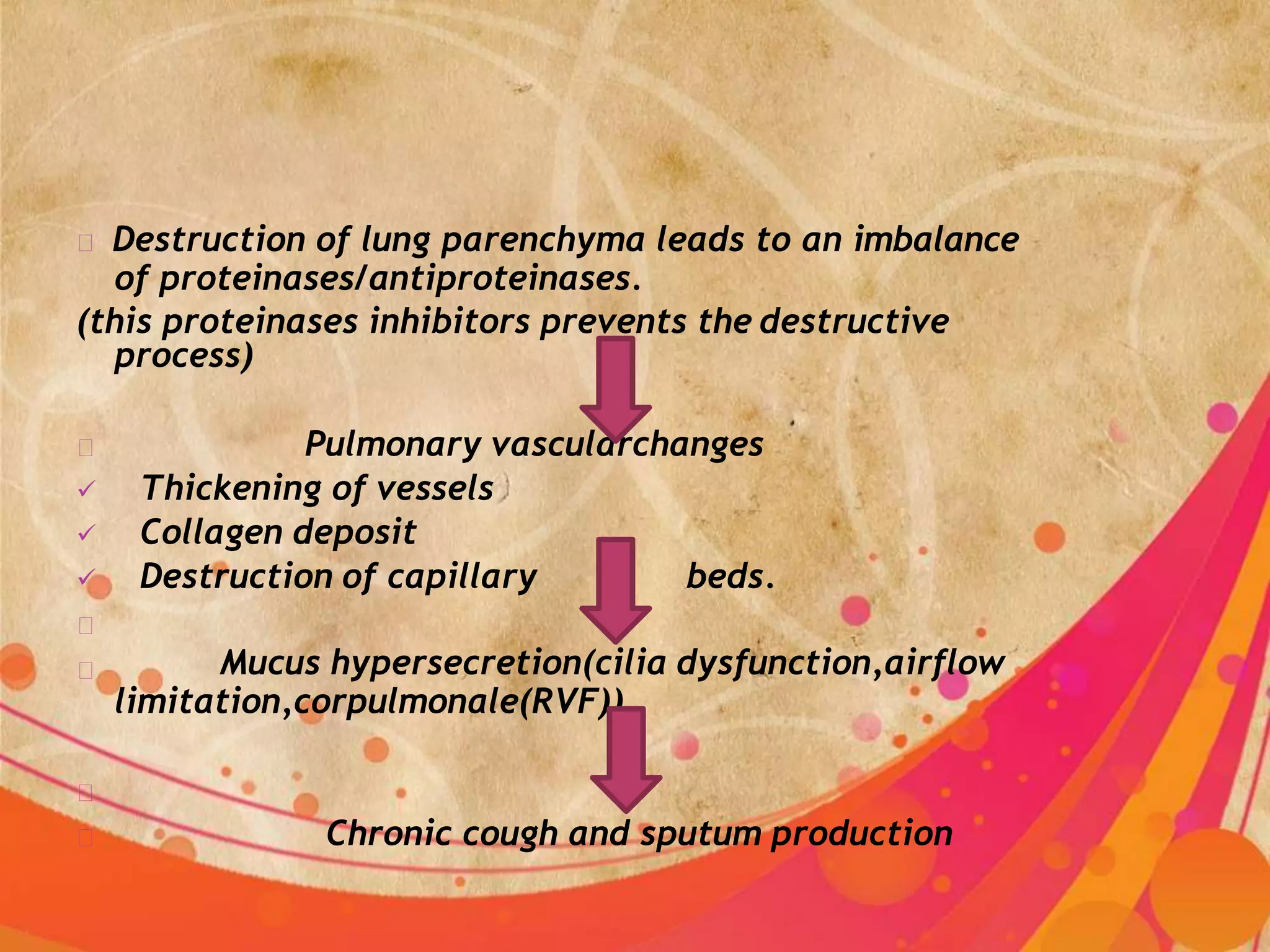
Destruction of lung parenchyma leads to an imbalance
of proteinases/antiproteinases.
(this proteinases inhibitors prevents the destructive
process)
Pulmonary vascularchanges
 Thickening of vessels
 Collagen deposit
 Destruction of capillary beds.
Mucus hypersecretion(cilia dysfunction,airflow
limitation,corpulmonale(RVF))
Chronic cough and sputum production
 Chronic cough
 Sputum production
 Wheezing
 Chest tightness
 Dyspnoea on exertion
 Wt.loss
 Respiratory insufficiency
 Respiratory infections
 Barrel chest- chronic hyperinflation leads
to loss of lung elasticity.
1) Bronchitis
2) Emphysema
Bronchitis :-
Bronchitis (bron-KI-tis) is a condition in which
the bronchial tubes become inflamed.
 acute (short term) and
 chronic (ongoing).
Infections or lung irritants cause acute
bronchitis.
Chronic bronchitis is an ongoing, serious
condition. It occurs if the lining of the
bronchial tubes is constantly irritated and
inflamed, causing a long-term cough with
mucus.
Chronic bronchitis:
It is defined as the presence of cough and
sputum production for atleast 3 months.
Irritants irrritate the airway
Excess mucus production
Inflammation
Cause the mucus secreting glands and goblet cells to
increase in number.
Ciliary function is reduced.
More mucus production
Bronchial walls become thickened and lumen narrows and
mucus plug the airway
Alveoli adjacent tto the bronchioles may
become damaged and fibrosed.
Alter function of alveolar macrophages.
infection
 sore throat,
 fatigue (tiredness),
 fever, body aches,
 stuffy or runny nose,
 vomiting, and
 Diarrhea
 persistent cough
 cough may produce clear mucus
 shortness of breath
 coughing,
 wheezing, and
 chest discomfort.
 The coughing may produce large amounts
of mucus. This type of cough often is
called a smoker's cough.
History - medical history
•Whether you've recently had a cold or
the flu
•Whether you smoke or spend time around
others who smoke
•Whether you've been exposed to dust,
fumes, vapors, or air pollution -
Mucus -to see whether you have a
bacterial infection
chest x ray,
lung function tests,
CBC
ABG analysis
MEDICAL MANAGEMENT
SURGICAL MANAGEMENT
NURSING MANAGEMENT
IMPROVEVENTILLATION
1. BRONCHO DILATORS LIKE BETA2
AGONISTS(ALBUTEROL),ANTICHOLINERGIC
S(IPRATROPIUM BROMIDE-ATROVENT).
2. METHYLXANTHINES(THEOPHYLLINE,AMIN
OPHYLLINE)
3. CORTICOSTEROIDS
4. OXYGEN ADMINISTRATION
REMOVE BRONCHIAL SECRETION
PROMOTE EXERCISES
CONTROL COMPLICATIONS
IMPROVE GENERAL HEALTH
BULLECTOMY
BULLAE ARE ENLARGED AIRSPACES THAT
DO NOT CONTRIBUTE TO VENTILLATION BUT
OCCUPY SPACE IN THE THORAX,THESEAREAS
MAY BE SURGICALLY EXCISED
LUNG VOLUME REDUCTION SURGERY
IT INVOLVES THE REMOVAL OF A PORTION
OF THE DISEASED LUNG PARENCHYMA.THIS
ALLOWS THE FUNCTIONAL TISSUE TO EXPAND.
LUNG TRANSPLANTATION
ASSESSMENT
PHYSICAL EXAMINATION
DIAGNOSIS
INTERVENTION
IMPAIRED GAD EXCHANGE RELATED TO
DECREASED VENTILLATION AND MUCOUS
PLUGS
INEFFECTIVE AIRWAY CLEARENCE RELATED
TO EXCESSIVE SECRETION AND INEFFECTIVE
COUGHING
ANXIETY RELATED TO ACUTE BREATHING
DIFFICULTIES AND FEAR OF SUFFOCATION
ACTIVITY INTOLERENCE RELATED TO
INADEQUATE OXYGENATION AND DYSPNOEA
 IMBALANCED NUTRITION LESS THAN BODY REQUIREMENT
RELATED TO REDUCED APPETITE,DECREASED ENERGY LEVEL
AND DYSPNOEA
DISTURBED SLEEP PATTERN RELATED TO
DYSPNOEA AND EXTERNALSTIMULI
RISK FOR INFECTION RELATED TO
INEFFECTIVE PULMONARY CLEARENCE
Definition:-Emphysema is defined as
enlargement of the air spaces distal to
the terminal bronchioles, with
destruction of their walls of the alveoli.
Pathology :
As the alveoli are destroyed the alveolar
surface area in contact with the
capillaries decreases.
Causing dead spaces (no gas exchange
takes place)
Leads to hypoxia.
In later stages:
CO2 elimination is disturbed and
increase in CO2 tension in arterial blood
causing
Respiratory acidosis
(Decrease pulmonary blood flowis
increased forcing the RV to maintain high
B.P. in PA.)
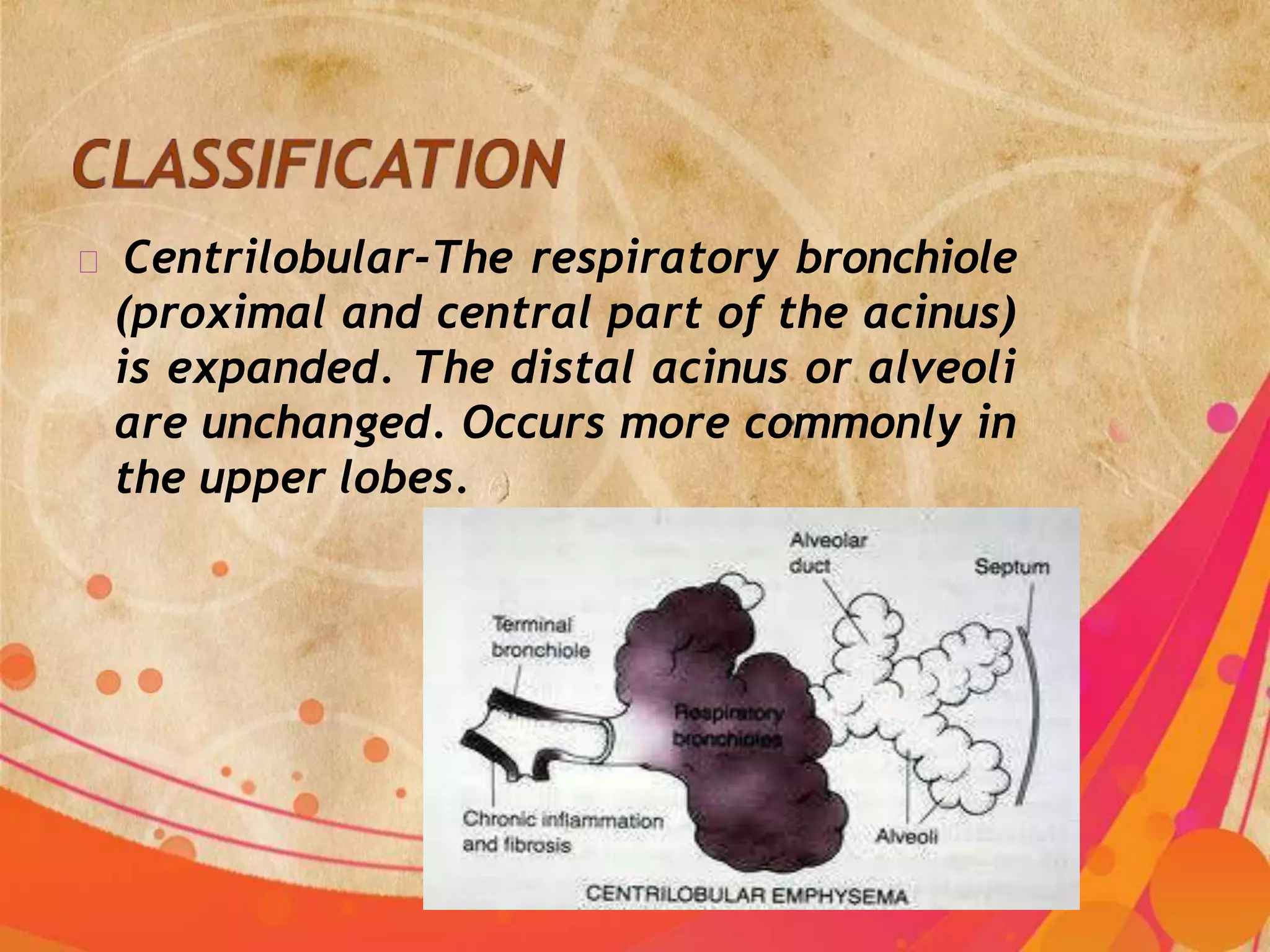
Centrilobular-The respiratory bronchiole
(proximal and central part of the acinus)
is expanded. The distal acinus or alveoli
are unchanged. Occurs more commonly in
the upper lobes.
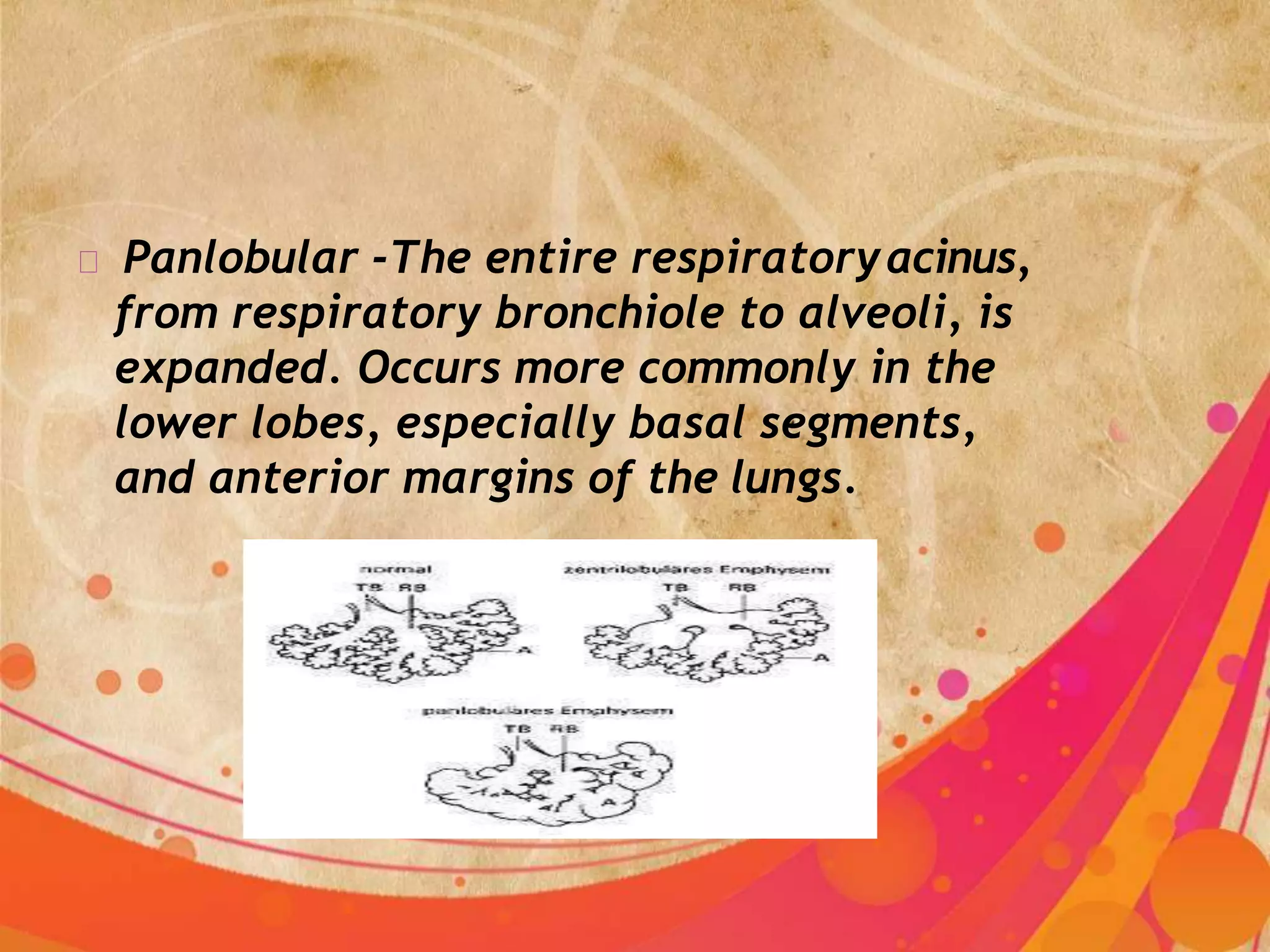
Panlobular -The entire respiratoryacinus,
from respiratory bronchiole to alveoli, is
expanded. Occurs more commonly in the
lower lobes, especially basal segments,
and anterior margins of the lungs.
a) History
b) PFT
c) Spirometry-to find out airflow
obstruction.
d) ABG analysis
e) CT scan of the lung.
f) Screening of alpha antitrypsin deficiency
g) X-ray radiography may aid in the
diagnosis.
MEDICAL MANAGEMENT
SURGICAL MANAGEMENT
NURSING MANAGEMENT
IMPROVEVENTILLATION
1. BRONCHO DILATORS LIKE BETA2
AGONISTS(ALBUTEROL),ANTICHOLINERGIC
S(IPRATROPIUM BROMIDE-ATROVENT).
2. METHYLXANTHINES(THEOPHYLLINE,AMIN
OPHYLLINE)
3. CORTICOSTEROIDS
4. OXYGEN ADMINISTRATION
REMOVE BRONCHIAL SECRETION
PROMOTE EXERCISES
CONTROL COMPLICATIONS
IMPROVE GENERAL HEALTH
BULLECTOMY
BULLAE ARE ENLARGED AIRSPACES THAT
DO NOT CONTRIBUTE TO VENTILLATION BUT
OCCUPY SPACE IN THE THORAX,THESEAREAS
MAY BE SURGICALLY EXCISED
LUNG VOLUME REDUCTION SURGERY
IT INVOLVES THE REMOVAL OF A PORTION
OF THE DISEASED LUNG PARENCHYMA.THIS
ALLOWS THE FUNCTIONAL TISSUE TO EXPAND.
LUNG TRANSPLANTATION
ASSESSMENT
PHYSICAL EXAMINATION
DIAGNOSIS
INTERVENTION
IMPAIRED GAD EXCHANGE RELATED TO
DECREASED VENTILLATION AND MUCOUS
PLUGS
INEFFECTIVE AIRWAY CLEARENCE RELATED
TO EXCESSIVE SECRETION AND INEFFECTIVE
COUGHING
ANXIETY RELATED TO ACUTE BREATHING
DIFFICULTIES AND FEAR OF SUFFOCATION
ACTIVITY INTOLERENCE RELATED TO
INADEQUATE OXYGENATION AND DYSPNOEA
DISTURBED SLEEP PATTERN RELATED TO
DYSPNOEA AND EXTERNALSTIMULI
RISK FOR INFECTION RELATED TO
INEFFECTIVE PULMONARY CLEARENCE
IMBALANCED NUTRITION LESS THAN BODY
REQUIREMENT RELATED TO REDUCED
APPETITE,DECREASED ENERGY LEVELAND
DYSPNOEA
 Respiratory insufficiency
 Respiratory failure
 Pneumonia
 Pneumothorax
 Pulmonary artery hypertension.
TAKE YOUR MEDICATIONS REGULARLY AS
PRESCRIBED,IF YOU HAVE ANY DOUBT RING
YOUR HOSPITAL.
EXERCISE REGULARLY EVERYDAY ORELSE
ATLEAST 4 OUT OF 7 DAYS.
THANK YOU!
Copd ppt (1)
Copd ppt (1)
Copd ppt (1)
Copd ppt (1)
Copd ppt (1)
Copd ppt (1)
Copd ppt (1)
Copd ppt (1)
Copd ppt (1)
Copd ppt (1)
Copd ppt (1)

Copd ppt (1)

  • 2.
    COPD is alsoknown as chronic obstructive lung disease (COLD), chronic obstructive airway disease (COAD), chronic airflow limitation (CAL) and chronic obstructive respiratory disease (CORD) Chronic obstructive pulmonary disease (COPD) refers to chronic bronchitis and emphysema, a pair of two commonly co-existing diseases of the lungs in which the airways become narrowed. This leads to a limitation of the flow of air to and from the lungs causing shortness of breath.
  • 3.
    In COPD, lessair flows in and out ofthe airways because of one or more of the following:  The airways and air sacs lose their elastic quality.  The walls between many of the air sacs are destroyed.  The walls of the airways become thick and inflamed.  The airways make more mucus than usual, which tends to clog them.
  • 5.
    It is the4th leading cause of mortality and 12th leading cause of disability in the united states. In 2020 COPD is the 3rd leading cause of death.
  • 6.
    1)Smoking 2) Occupational exposures-exposure to workplace dusts found in coal mining, gold mining, and the cotton textile industry and chemicals such as cadmium, isocyanates, and fumes from welding have been implicated in the development of airflow obstruction. 3) Air pollution 4) sudden airway constriction in response to inhaled irritants, 5) Bronchial hyperresponsiveness, is a characteristic of asthma.
  • 7.
    6) Genetics-Alpha 1-antitrypsindeficiency isa genetic condition that is responsible for about 2% of cases of COPD. In this condition, the body does not make enough of a protein, alpha 1-antitrypsin. Alpha 1- antitrypsin protects the lungs from damage caused by protease enzymes, such as elastase and trypsin, that can be released as a result of an inflammatory response to tobacco smoke.
  • 8.
  • 9.
    Abnormal inflammatory responseof the lungs due to toxic gases. Response occurs in the airways ,parenchyma & pulmonary vasculature. Narrowing of the airway takes place Destruction of parenchyma leads to emphysema.
  • 10.
    Destruction of lungparenchyma leads to an imbalance of proteinases/antiproteinases. (this proteinases inhibitors prevents the destructive process) Pulmonary vascularchanges  Thickening of vessels  Collagen deposit  Destruction of capillary beds. Mucus hypersecretion(cilia dysfunction,airflow limitation,corpulmonale(RVF)) Chronic cough and sputum production
  • 11.
     Chronic cough Sputum production  Wheezing  Chest tightness  Dyspnoea on exertion  Wt.loss  Respiratory insufficiency  Respiratory infections  Barrel chest- chronic hyperinflation leads to loss of lung elasticity.
  • 12.
    1) Bronchitis 2) Emphysema Bronchitis:- Bronchitis (bron-KI-tis) is a condition in which the bronchial tubes become inflamed.
  • 13.
     acute (shortterm) and  chronic (ongoing). Infections or lung irritants cause acute bronchitis. Chronic bronchitis is an ongoing, serious condition. It occurs if the lining of the bronchial tubes is constantly irritated and inflamed, causing a long-term cough with mucus.
  • 14.
    Chronic bronchitis: It isdefined as the presence of cough and sputum production for atleast 3 months.
  • 15.
    Irritants irrritate theairway Excess mucus production Inflammation Cause the mucus secreting glands and goblet cells to increase in number. Ciliary function is reduced. More mucus production Bronchial walls become thickened and lumen narrows and mucus plug the airway
  • 16.
    Alveoli adjacent ttothe bronchioles may become damaged and fibrosed. Alter function of alveolar macrophages. infection
  • 17.
     sore throat, fatigue (tiredness),  fever, body aches,  stuffy or runny nose,  vomiting, and  Diarrhea  persistent cough  cough may produce clear mucus  shortness of breath
  • 18.
     coughing,  wheezing,and  chest discomfort.  The coughing may produce large amounts of mucus. This type of cough often is called a smoker's cough.
  • 19.
    History - medicalhistory •Whether you've recently had a cold or the flu •Whether you smoke or spend time around others who smoke •Whether you've been exposed to dust, fumes, vapors, or air pollution -
  • 20.
    Mucus -to seewhether you have a bacterial infection chest x ray, lung function tests, CBC ABG analysis
  • 21.
  • 22.
    IMPROVEVENTILLATION 1. BRONCHO DILATORSLIKE BETA2 AGONISTS(ALBUTEROL),ANTICHOLINERGIC S(IPRATROPIUM BROMIDE-ATROVENT). 2. METHYLXANTHINES(THEOPHYLLINE,AMIN OPHYLLINE) 3. CORTICOSTEROIDS 4. OXYGEN ADMINISTRATION
  • 23.
    REMOVE BRONCHIAL SECRETION PROMOTEEXERCISES CONTROL COMPLICATIONS IMPROVE GENERAL HEALTH
  • 24.
    BULLECTOMY BULLAE ARE ENLARGEDAIRSPACES THAT DO NOT CONTRIBUTE TO VENTILLATION BUT OCCUPY SPACE IN THE THORAX,THESEAREAS MAY BE SURGICALLY EXCISED LUNG VOLUME REDUCTION SURGERY IT INVOLVES THE REMOVAL OF A PORTION OF THE DISEASED LUNG PARENCHYMA.THIS ALLOWS THE FUNCTIONAL TISSUE TO EXPAND. LUNG TRANSPLANTATION
  • 25.
  • 26.
    IMPAIRED GAD EXCHANGERELATED TO DECREASED VENTILLATION AND MUCOUS PLUGS INEFFECTIVE AIRWAY CLEARENCE RELATED TO EXCESSIVE SECRETION AND INEFFECTIVE COUGHING ANXIETY RELATED TO ACUTE BREATHING DIFFICULTIES AND FEAR OF SUFFOCATION ACTIVITY INTOLERENCE RELATED TO INADEQUATE OXYGENATION AND DYSPNOEA
  • 27.
     IMBALANCED NUTRITIONLESS THAN BODY REQUIREMENT RELATED TO REDUCED APPETITE,DECREASED ENERGY LEVEL AND DYSPNOEA DISTURBED SLEEP PATTERN RELATED TO DYSPNOEA AND EXTERNALSTIMULI RISK FOR INFECTION RELATED TO INEFFECTIVE PULMONARY CLEARENCE
  • 29.
    Definition:-Emphysema is definedas enlargement of the air spaces distal to the terminal bronchioles, with destruction of their walls of the alveoli. Pathology : As the alveoli are destroyed the alveolar surface area in contact with the capillaries decreases. Causing dead spaces (no gas exchange takes place)
  • 30.
    Leads to hypoxia. Inlater stages: CO2 elimination is disturbed and increase in CO2 tension in arterial blood causing Respiratory acidosis (Decrease pulmonary blood flowis increased forcing the RV to maintain high B.P. in PA.)
  • 31.
    Centrilobular-The respiratory bronchiole (proximaland central part of the acinus) is expanded. The distal acinus or alveoli are unchanged. Occurs more commonly in the upper lobes.
  • 32.
    Panlobular -The entirerespiratoryacinus, from respiratory bronchiole to alveoli, is expanded. Occurs more commonly in the lower lobes, especially basal segments, and anterior margins of the lungs.
  • 33.
    a) History b) PFT c)Spirometry-to find out airflow obstruction. d) ABG analysis e) CT scan of the lung. f) Screening of alpha antitrypsin deficiency g) X-ray radiography may aid in the diagnosis.
  • 34.
  • 35.
    IMPROVEVENTILLATION 1. BRONCHO DILATORSLIKE BETA2 AGONISTS(ALBUTEROL),ANTICHOLINERGIC S(IPRATROPIUM BROMIDE-ATROVENT). 2. METHYLXANTHINES(THEOPHYLLINE,AMIN OPHYLLINE) 3. CORTICOSTEROIDS 4. OXYGEN ADMINISTRATION
  • 36.
    REMOVE BRONCHIAL SECRETION PROMOTEEXERCISES CONTROL COMPLICATIONS IMPROVE GENERAL HEALTH
  • 37.
    BULLECTOMY BULLAE ARE ENLARGEDAIRSPACES THAT DO NOT CONTRIBUTE TO VENTILLATION BUT OCCUPY SPACE IN THE THORAX,THESEAREAS MAY BE SURGICALLY EXCISED LUNG VOLUME REDUCTION SURGERY IT INVOLVES THE REMOVAL OF A PORTION OF THE DISEASED LUNG PARENCHYMA.THIS ALLOWS THE FUNCTIONAL TISSUE TO EXPAND. LUNG TRANSPLANTATION
  • 38.
  • 39.
    IMPAIRED GAD EXCHANGERELATED TO DECREASED VENTILLATION AND MUCOUS PLUGS INEFFECTIVE AIRWAY CLEARENCE RELATED TO EXCESSIVE SECRETION AND INEFFECTIVE COUGHING ANXIETY RELATED TO ACUTE BREATHING DIFFICULTIES AND FEAR OF SUFFOCATION ACTIVITY INTOLERENCE RELATED TO INADEQUATE OXYGENATION AND DYSPNOEA
  • 40.
    DISTURBED SLEEP PATTERNRELATED TO DYSPNOEA AND EXTERNALSTIMULI RISK FOR INFECTION RELATED TO INEFFECTIVE PULMONARY CLEARENCE IMBALANCED NUTRITION LESS THAN BODY REQUIREMENT RELATED TO REDUCED APPETITE,DECREASED ENERGY LEVELAND DYSPNOEA
  • 41.
     Respiratory insufficiency Respiratory failure  Pneumonia  Pneumothorax  Pulmonary artery hypertension.
  • 42.
    TAKE YOUR MEDICATIONSREGULARLY AS PRESCRIBED,IF YOU HAVE ANY DOUBT RING YOUR HOSPITAL. EXERCISE REGULARLY EVERYDAY ORELSE ATLEAST 4 OUT OF 7 DAYS.
  • 50.