Range Kutta Methods
summary
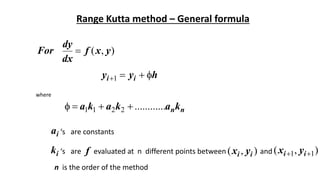
Range Kutta method – General formula
h
y
y i
i 


1
where
)
,
( y
x
f
dx
dy
For 
n
nk
a
k
a
k
a ..
..........
2
2
1
1 



i
a ‘s are constants
i
k ‘s are evaluated at n different points between and
f )
,
( i
i y
x )
,
( 1
1 
 i
i y
x
n is the order of the method
 The methods considered so far in class are Explicit Range Kutta Methods
 The formula for an nth order Range Kutta method is based on a Taylor series expansion with
n derivatives
 For n > 2, there can be multiple solutions for a1, a2, …etc The 4th order R-K method
discussed in class is the most popularly used, and called “Classical 4th order R-K method”
 As n increases, so does the accuracy, but also increases computational cost and
programming complexity. So n = 4 is considered a good compromise between these two
factors.
 The k’s (k1, k2, k3,…..) are recurrence relationships making R-K methods efficient for
computer programming
 These methods can be extended to a system of equations, where each ki will be a column
vector containing functions of x, y1, y2, y3……. etc
Some Notes on R-K Methods
Range Kutta methods.pptx

Range Kutta methods.pptx

  • 1.
  • 2.
    Range Kutta method– General formula h y y i i    1 where ) , ( y x f dx dy For  n nk a k a k a .. .......... 2 2 1 1     i a ‘s are constants i k ‘s are evaluated at n different points between and f ) , ( i i y x ) , ( 1 1   i i y x n is the order of the method
  • 3.
     The methodsconsidered so far in class are Explicit Range Kutta Methods  The formula for an nth order Range Kutta method is based on a Taylor series expansion with n derivatives  For n > 2, there can be multiple solutions for a1, a2, …etc The 4th order R-K method discussed in class is the most popularly used, and called “Classical 4th order R-K method”  As n increases, so does the accuracy, but also increases computational cost and programming complexity. So n = 4 is considered a good compromise between these two factors.  The k’s (k1, k2, k3,…..) are recurrence relationships making R-K methods efficient for computer programming  These methods can be extended to a system of equations, where each ki will be a column vector containing functions of x, y1, y2, y3……. etc Some Notes on R-K Methods