LECTURE NOTES ON
DESIGN AND ANALYSIS OF ALGORITHMS
B. TECH.
III YR I SEM
PREPARED BY
PRATIBHA SWAMY
SRIDEVI WOMENS ENGINEERING COLLEGE,
GANDIPET, HYDERABAD,
TELANGANA 500075
SYLLABUS
UNIT – I: Introduction-Algorithm definition, Algorithm Specification, Performance
Analysis-Space complexity, Time complexity, Randomized Algorithms. Divide and conquer-
General method, applications – Binary search, Merge sort, Quick sort, Strassen’s Matrix
Multiplication.
UNIT – II: Disjoint set operations, union and find algorithms, AND/OR graphs, Connected
Components and Spanning trees, Bi-connected components Backtracking-General method,
applications The 8-queen problem, sum of subsets problem, graph coloring, Hamiltonian
cycles.
UNIT – III: Greedy method- General method, applications- Knapsack problem, Job
sequencing with deadlines, Minimum cost spanning trees, Single source shortest path
problem.
UNIT – IV: Dynamic Programming- General Method, applications- Chained matrix
multiplication, All pairs shortest path problem, Optimal binary search trees, 0/1 knapsack
problem, Reliability design, Traveling sales person problem.
UNIT – V: Branch and Bound- General Method, applications-0/1 Knapsack problem, LC
Branch and Bound solution, FIFO Branch and Bound solution, Traveling sales person
problem. NP-Hard and NP-Complete problems- Basic concepts, Non-deterministic
algorithms, NP – Hard and NP- Complete classes, Cook’s theorem.
Design and Analysis of Algorithms
Dept. of CSE, SWEC, Hyderaba. Page 1
UNIT – I
INTRODUCTION TO ALGORITHMS
Analysis of Algorithm:
INTRODUCTION – ANALYZING CONTROL STRUCTURES- AVERAGE CASE ANALYSIS-
SOLVING RECURRENCES.
ALGORITHM
Informal Definition:
An Algorithm is any well-defined computational procedure that takes some value or set
of values as Input and produces a set of values or some value as output. Thus algorithm is
a sequence of computational steps that transforms the i/p into the o/p.
Formal Definition:
An Algorithm is a finite set of instructions that, if followed, accomplishes a particular
task. In addition, all algorithms should satisfy the following criteria.
1. INPUT : Zero or more quantities are externally supplied.
2. OUTPUT : At least one quantity is produced.
3. DEFINITENESS: Each instruction is clear and unambiguous.
4. FINITENESS : If we trace out the instructions of an algorithm, then for all cases,
the algorithm terminates after a finite number of steps.
5. EFFECTIVENESS : Every instruction must very basic so that it can be carried
out, in principle, by a person using only pencil & paper.
Issues or study of Algorithm:
• How to device or design an algorithm creating and algorithm.
• How to express an algorithm definiteness.
• How to analysis an algorithm time and space complexity.
• How to validate an algorithm fitness.
• Testing the algorithm checking for error.
Algorithm Specification:
Algorithm can be described in three ways.
Design and Analysis of Algorithms
Dept. of CSE, SWEC, Hyderaba. Page 2
1. Natural language like English:
When this way is choused care should be taken, we
should ensure that each & every statement is definite.
2. Graphic representation called flowchart: This method will work well when the
algorithm is small& simple.
3. Pseudo-code Method:
In this method, we should typically describe algorithms as
program, which resembles language like Pascal & algol.
Pseudo-Code Conventions:
1. Comments begin with // and continue until the end of line.
2. Blocks are indicated with matching braces {and}.
3. An identifier begins with a letter. The data types of variables are not explicitly
declared.
4. Compound data types can be formed with records. Here is an example,
Node. Record
{
data type – 1 data-1;
.
.
. data
type – n data – n;
node * link;
}
Here link is a pointer to the record type node. Individual data items of a record can
be accessed with and period.
5. Assignment of values to variables is done using the assignment statement.
<Variable>:= <expression>;
6. There are two Boolean values TRUE and FALSE.
Design and Analysis of Algorithms
Dept. of CSE, SWEC, Hyderaba. Page 3
Logical Operators AND, OR, NOT
Relational Operators <, <=,>,>=, =, !=
7. The following looping statements are employed.
For, while and repeat-
until While Loop:
While < condition > do
{
<statement-1>
.
.
.
<statement-n>
}
For Loop:
For variable: = value-1 to value-2 step step do
{ <state
ment-1>
.
.
.
<statement-n>
}
repeat
-until:
repeat
<statement-1>
.
.
.
<statement-n>
until<condition>
8. A conditional statement has the following forms.
Design and Analysis of Algorithms
Dept. of CSE, SWEC, Hyderaba. Page 4
If <condition> then <statement>
If <condition> then <statement-1>
Else <statement-1>
Case statement:
Case
{
: <condition-1> : <statement-1>
.
.
.
: <condition-n> : <statement-n>
: else : <statement-n+1>
}
9. Input and output are done using the instructions read & write.
10. There is only one type of procedure:
Algorithm, the heading takes the form,
Algorithm Name (Parameter lists)
As an example, the following algorithm fields & returns the maximum of ‘n’
given
numbers:
1. algorithm Max(A,n)
2. // A is an array of size n
3. {
4. Result := A[1];
5. for I:= 2 to n do
6. if A[I] > Result then
7. Result :=A[I];
8. return Result;
9. }
Design and Analysis of Algorithms
Dept. of CSE, SWEC, Hyderaba. Page 5
In this algorithm (named Max), A & n are procedure parameters. Result & I are
Local variables.
Next we present 2 examples to illustrate the process of translation problem into
an
algorithm.
Selection Sort:
• Suppose we Must devise an algorithm that sorts a collection of n>=1
elements of arbitrary type.
• A Simple solution given by the following.
• ( From those elements that are currently unsorted ,find the smallest & place
it next in the sorted list.)
Algorithm:
1. For i:= 1 to n do
2. {
3. Examine a[I] to a[n] and suppose the smallest element is at a[j];
4. Interchange a[I] and a[j];
5. }
Finding the smallest element (sat a[j]) and interchanging it with a[ i ]
• We can solve the latter problem using the code,
t := a[i];
a[i]:=a[j];
a[j]:=t;
• The first subtask can be solved by assuming the minimum is a[ I ];checking
a[I] with a[I+1],a[I+2]…….,and whenever a smaller element is found,
regarding it as the new minimum. a[n] is compared with the current
minimum.
• Putting all these observations together, we get the algorithm Selection sort.
Design and Analysis of Algorithms
Dept. of CSE, SWEC, Hyderaba. Page 6
Theorem:
Algorithm selection sort(a,n) correctly sorts a set of n>=1 elements .The result
remains is a a[1:n] such that a[1] <= a[2] ….<=a[n].
Selection Sort:
Selection Sort begins by finding the least element in the list. This element is moved to
the front. Then the least element among the remaining element is found out and put into
second position. This procedure is repeated till the entire list has been studied.
Example:
LIST L = 3,5,4,1,2
1 is selected , 1,5,4,3,2 2 is selected,
1,2,4,3,5
3 is selected, 1,2,3,4,5
4 is selected, 1,2,3,4,5
Proof:
• We first note that any I, say I=q, following the execution of lines 6 to 9,it
is the case that a[q] Þ a[r],q<r<=n.
• Also observe that when ‘i’ becomes greater than q, a[1:q] is unchanged.
Hence, following the last execution of these lines (i.e. I=n).We have a[1]
<= a[2] <=……a[n].
• We observe this point that the upper limit of the for loop in the line 4 can
be changed to n-1 without damaging the correctness of the algorithm.
Algorithm:
1. Algorithm selection sort (a,n)
2. // Sort the array a[1:n] into non-decreasing order.
3.{
4. for I:=1 to n do
5. {
6. j:=I;
7. for k:=i+1 to n do
8. if (a[k]<a[j])
Design and Analysis of Algorithms
Dept. of CSE, SWEC, Hyderaba. Page 7
9. t:=a[I];
10. a[I]:=a[j];
11. a[j]:=t;
12. }
13. }
Recursive Algorithms:
• A Recursive function is a function that is defined in terms of itself.
• Similarly, an algorithm is said to be recursive if the same algorithm is invoked in
the body.
• An algorithm that calls itself is Direct Recursive.
• Algorithm ‘A’ is said to be Indirect Recursive if it calls another algorithm which
in turns calls ‘A’.
• The Recursive mechanism, are externally powerful, but even more importantly,
many times they can express an otherwise complex process very clearly. Or these
reasons we introduce recursion here.
• The following 2 examples show how to develop a recursive algorithms.
In the first, we consider the Towers of Hanoi problem, and in
the second, we generate all possible permutations of a list of
characters.
Tower A Tower B Tower C
• It is Fashioned after the ancient tower of Brahma ritual.
1. Towers of Hanoi:
.
.
.
Design and Analysis of Algorithms
Dept. of CSE, SWEC, Hyderaba. Page 8
• According to legend, at the time the world was created, there was a diamond
tower (labeled A) with 64 golden disks.
• The disks were of decreasing size and were stacked on the tower in decreasing
order of size bottom to top.
• Besides these tower there were two other diamond towers(labeled B & C)
• Since the time of creation, Brehman priests have been attempting to move the
disks from tower A to tower B using tower C, for intermediate storage.
• As the disks are very heavy, they can be moved only one at a time.
• In addition, at no time can a disk be on top of a smaller disk.
• According to legend, the world will come to an end when the priest have
completed this task.
• A very elegant solution results from the use of recursion.
• Assume that the number of disks is ‘n’.
• To get the largest disk to the bottom of tower B, we move the remaining ‘n-1’
disks to tower C and then move the largest to tower B.
• Now we are left with the tasks of moving the disks from tower C to B.
• To do this, we have tower A and B available.
• The fact, that towers B has a disk on it can be ignored as the disks larger than the
disks being moved from tower C and so any disk scan be placed on top of it.
Algorithm:
1. Algorithm TowersofHanoi(n,x,y,z)
2. //Move the top ‘n’ disks from tower x to tower y.
3. {
.
.
.
4.if(n>=1) then
5. {
6. TowersofHanoi(n-1,x,z,y);
7. Write(“move top disk from tower “ X ,”to top of tower “ ,Y);
8. Towersofhanoi(n-1,z,y,x);
9. }
10. }
2. Permutation Generator:
Design and Analysis of Algorithms
Dept. of CSE, SWEC, Hyderaba. Page 9
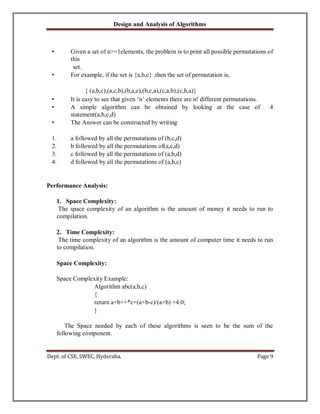
• Given a set of n>=1elements, the problem is to print all possible permutations of
this
set.
• For example, if the set is {a,b,c} ,then the set of permutation is,
{ (a,b,c),(a,c,b),(b,a,c),(b,c,a),(c,a,b),(c,b,a)}
• It is easy to see that given ‘n’ elements there are n! different permutations.
• A simple algorithm can be obtained by looking at the case of 4
statement(a,b,c,d)
• The Answer can be constructed by writing
1. a followed by all the permutations of (b,c,d)
2. b followed by all the permutations of(a,c,d)
3. c followed by all the permutations of (a,b,d)
4. d followed by all the permutations of (a,b,c)
Performance Analysis:
1. Space Complexity:
The space complexity of an algorithm is the amount of money it needs to run to
compilation.
2. Time Complexity:
The time complexity of an algorithm is the amount of computer time it needs to run
to compilation.
Space Complexity:
Space Complexity Example:
Algorithm abc(a,b,c)
{
return a+b++*c+(a+b-c)/(a+b) +4.0;
}
The Space needed by each of these algorithms is seen to be the sum of the
following component.
Design and Analysis of Algorithms
Dept. of CSE, SWEC, Hyderaba. Page 10
1.A fixed part that is independent of the characteristics (eg:number,size)of the inputs
and outputs.
The part typically includes the instruction space (ie. Space for the code), space
for simple variable and fixed-size component variables (also called aggregate) space
for constants, and so on.
2. A variable part that consists of the space needed by component variables whose
size is dependent on the particular problem instance being solved, the space
needed by referenced variables (to the extent that is depends on instance
characteristics), and the recursion stack space.
• The space requirement s(p) of any algorithm p may therefore be
written as,
S(P) = c+ Sp(Instance characteristics)
Where ‘c’ is a constant.
Example 2:
Algorithm sum(a,n)
{
s=0.0;
for I=1 to n do s=
s+a[I];
return s;
}
• The problem instances for this algorithm are characterized by n,the
number of elements to be summed. The space needed d by ‘n’ is one
word, since it is of type integer.
• The space needed by ‘a’a is the space needed by variables of tyepe
array of floating point numbers.
• This is atleast ‘n’ words, since ‘a’ must be large enough to hold the ‘n’
elements to be summed.
• So,we obtain Ssum(n)>=(n+s)
[ n for a[],one each for n,I a& s]
Time Complexity:
The time T(p) taken by a program P is the sum of the compile time and the
run time(execution time)
Design and Analysis of Algorithms
Dept. of CSE, SWEC, Hyderaba. Page 11
The compile time does not depend on the instance characteristics. Also we
may assume that a compiled program will be run several times without
recompilation .This rum time is denoted by tp(instance characteristics).
The number of steps any problem statemn t is assigned depends on the kind
of statement.
For example, comments 0 steps.
Assignment statements 1 steps.
[Which does not involve any calls to other algorithms]
Interactive statement such as for, while & repeat-until Control part of the statement.
1. We introduce a variable, count into the program statement to increment count with
initial value 0.Statement to increment count by the appropriate amount are
introduced into the program.
This is done so that each time a statement in the original program is executes
count is incremented by the step count of that statement.
Algorithm:
Algorithm sum(a,n)
{ s= 0.0; count
=
count+1;
for I=1 to
n do
{
count =count+1;
s=s+a[I];
count=count+1;
} count=count+1;
count=count+1; return s;
}
If the count is zero to start with, then it will be 2n+3 on termination. So each
invocation of sum execute a total of 2n+3 steps.
Design and Analysis of Algorithms
Dept. of CSE, SWEC, Hyderaba. Page 12
2. The second method to determine the step count of an algorithm is to build
a table in which we list the total number of steps contributes by each
statement.
First determine the number of steps per execution (s/e) of the statement and the
total number of times (ie., frequency) each statement is executed.
By combining these two quantities, the total contribution of all statements, the
step count for the entire algorithm is obtained.
Statement S/e Frequency Total
1. Algorithm Sum(a,n)
2.{
3. S=0.0;
4. for I=1 to n do
5. s=s+a[I];
6. return s;
7. }
0
0
1
1
1
1
0
-
-
1
n+1
n
1
-
0
0
1
n+1
n 1
0
Total 2n+3
AVERAGE –CASE ANALYSIS
• Most of the time, average-case analysis are performed under the more or less
realistic assumption that all instances of any given size are equally likely.
• For sorting problems, it is simple to assume also that all the elements to be
sorted are distinct.
• Suppose we have ‘n’ distinct elements to sort by insertion and all n!
permutation of these elements are equally likely.
• To determine the time taken on a average by the algorithm ,we could add the
times required to sort each of the possible permutations ,and then divide by n!
the answer thus obtained.
• An alternative approach, easier in this case is to analyze directly the time
required by the algorithm, reasoning probabilistically as we proceed.
• For any I,2≤ I≤n, consider the sub array, T[1….i].
Design and Analysis of Algorithms
Dept. of CSE, SWEC, Hyderaba. Page 13
• The partial rank of T[I] is defined as the position it would occupy if the sub
array were sorted.
• For Example, the partial rank of T[4] in [3,6,2,5,1,7,4] in 3 because T[1….4]
once sorted is [2,3,5,6].
• Clearly the partial rank of T[I] does not depend on the order of the element in
• Sub array T[1…I-1].
Analysis
Best case:
This analysis constrains on the input, other than size. Resulting in the fasters possible run
time
Worst case:
This analysis constrains on the input, other than size. Resulting in the fasters
possible run time
Average case:
This type of analysis results in average running time over every type of input.
Complexity:
Complexity refers to the rate at which the storage time grows as a function of
the problem size
Asymptotic analysis:
Expressing the complexity in term of its relationship to know function.
This type analysis is called asymptotic analysis.
Asymptotic notation:
Big ‘oh’: the function f(n)=O(g(n)) iff there exist positive constants c and no such that
f(n)≤c*g(n) for all n, n ≥ no.
Omega: the function f(n)=Ω(g(n)) iff there exist positive constants c and no such that f(n)
≥ c*g(n) for all n, n ≥ no.
Theta: the function f(n)=ө(g(n)) iff there exist positive constants c1,c2 and no such that
c1 g(n) ≤ f(n) ≤ c2 g(n) for all n, n ≥ no.
Design and Analysis of Algorithms
Dept. of CSE, SWEC, Hyderaba. Page 14
Recursion:
Recursion may have the following definitions:
-The nested repetition of identical algorithm is recursion.
-It is a technique of defining an object/process by itself.
-Recursion is a process by which a function calls itself repeatedly until some specified
condition has been satisfied.
When to use recursion:
Recursion can be used for repetitive computations in which each action is stated
in terms of previous result. There are two conditions that must be satisfied by any
recursive procedure.
1. Each time a function calls itself it should get nearer to the solution.
2. There must be a decision criterion for stopping the process.
In making the decision about whether to write an algorithm in recursive or non-recursive
form, it is always advisable to consider a tree structure for the problem. If the structure is
simple then use non-recursive form. If the tree appears quite bushy, with little duplication
of tasks, then recursion is suitable.
The general procedure for any recursive algorithm is as follows,
1. Save the parameters, local variables and return addresses.
2. If the termination criterion is reached perform final computation and goto step 3
otherwise perform final computations and goto step 1
3. Restore the most recently saved parameters, local variable and return address and
goto the latest return address.
Design and Analysis of Algorithms
Dept. of CSE, SWEC, Hyderaba. Page 15
Iteration v/s Recursion:
Demerits of recursive algorithms:
1. Many programming languages do not support recursion; hence, recursive
mathematical function is implemented using iterative methods.
2. Even though mathematical functions can be easily implemented using recursion it
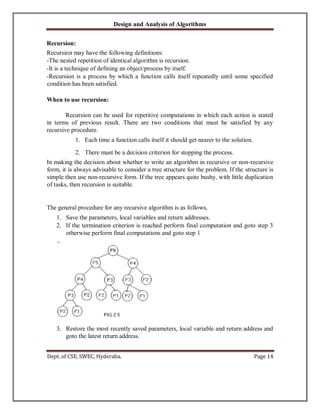
is always at the cost of execution time and memory space. For example, the
recursion tree for generating 6 numbers in a Fibonacci series generation is given
in fig 2.5. A Fibonacci series is of the form 0,1,1,2,3,5,8,13,…etc, where the third
number is the sum of preceding two numbers and so on. It can be noticed from the
fig 2.5 that, f(n-2) is computed twice, f(n-3) is computed thrice, f(n-4) is
computed 5 times.
3. A recursive procedure can be called from within or outside itself and to ensure its
proper functioning it has to save in some order the return addresses so that, a
return to the proper location will result when the return to a calling statement is
made.
4. The recursive programs needs considerably more storage and will take more time.
Demerits of iterative methods :
• Mathematical functions such as factorial and Fibonacci series generation can be
easily implemented using recursion than iteration.
• In iterative techniques looping of statement is very much necessary.
Recursion is a top down approach to problem solving. It divides the problem into pieces
or selects out one key step, postponing the rest.
Iteration is more of a bottom up approach. It begins with what is known and from this
constructs the solution step by step. The iterative function obviously uses time that is
O(n) where as recursive function has an exponential time complexity.
It is always true that recursion can be replaced by iteration and stacks. It is also true that
stack can be replaced by a recursive program with no stack.
Design and Analysis of Algorithms
Dept. of CSE, SWEC, Hyderaba. Page 16
SOLVING RECURRENCES :-( Happen again (or) repeatedly)
• The indispensable last step when analyzing an algorithm is often to solve a
recurrence equation.
• With a little experience and intention, most recurrence can be solved by
intelligent guesswork.
• However, there exists a powerful technique that can be used to solve certain
classes of recurrence almost automatically.
• This is a main topic of this section the technique of the characteristic equation.
1. Intelligent guess work:
This approach generally proceeds in 4 stages.
1. Calculate the first few values of the recurrence
2. Look for regularity.
3. Guess a suitable general form.
4. And finally prove by mathematical induction(perhaps constructive induction).
Then this form is correct.
Consider the following recurrence,
0 if n=0
T(n) = 3T(n ÷ 2)+n otherwise
• First step is to replace n ÷ 2 by n/2
Design and Analysis of Algorithms
Dept. of CSE, SWEC, Hyderaba. Page 17
• It is tempting to restrict ‘n’ to being ever since in that case n÷2 = n/2, but
recursively dividing an even no. by 2, may produce an odd no. larger than 1.
• Therefore, it is a better idea to restrict ‘n’ to being an exact power of 2.
• First, we tabulate the value of the recurrence on the first few powers of 2.
n 1 2 4 8 16 32
T(n) 1 5 19 65 211 665
* For instance, T(16) = 3 * T(8) +16
= 3 *
65 +16
= 211.
* Instead of writing T(2) = 5, it is more useful to write T(2) = 3 * 1 +2.
Then,
T(A)
= 3 *
T(2)
+4
= 3 *
(3 *
1
+2) +4
= (32
* 1) + (3 * 2) +4
* We continue in this way, writing ‘n’ as an explicit power of 2.
2 3 * 1 + 3 * 2 + 3 * 2 + 3 * 2 + 3 * 2 + 2
n T(n)
1 1
2 3 * 1 +2
22
32
* 1 + 3 * 2 + 22
23
33
* 1 + 32
* 2 + 3 * 22
+ 23
24
34
* 1 + 33
* 2 + 32
* 22
+ 3 * 23
+ 24
5 5 4 3 2 2 3 4 5
Design and Analysis of Algorithms
Dept. of CSE, SWEC, Hyderaba. Page 18
• The pattern is now obvious.
T(2k
) = 3k
20
+ 3k-1
21
+ 3k-2
22
+…+31
2k-1
+ 30
2k
.
= ∑ 3k-i
2i
= 3k
∑ (2/3)i
= 3k
* [(1 – (2/3)k + 1
) / (1 – (2/3)]
= 3k+1
– 2k+1
Proposition: (Geometric Series)
Let Sn be the sum of the first n terms of the geometric series a, ar,
ar2
….Then Sn = a(1-rn
)/(1-r), except in the special case when r = 1; when Sn =
an.
= 3k
* [ (1 – (2/3) k+1
) / (1 – (2/3))]
= 3k
* [((3 k+1
– 2 k+1
)/ 3 k+1
) / ((3 – 2) / 3)]
3 k+1
– 2k+1
3
= 3k
* -----------------
* ---- 3
k+1
1
3 k+1
– 2k+
1
= 3k
* ---------------
-- 3k+1-1
= 3k+1
– 2k+1
* It is easy to check this formula against our earlier tabulation.
EG : 2
Design and Analysis of Algorithms
Dept. of CSE, SWEC, Hyderaba. Page 19
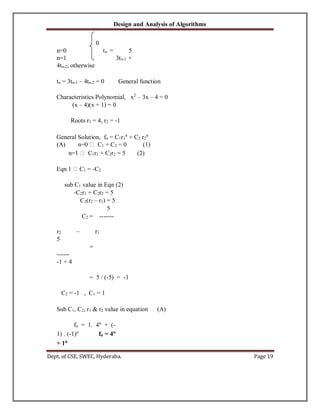
0
n=0 tn = 5
n=1 3tn-1 +
4tn-2, otherwise
tn = 3tn-1 – 4tn-2 = 0 General function
Characteristics Polynomial, x2
– 3x – 4 = 0
(x – 4)(x + 1) = 0
Roots r1 = 4, r2 = -1
General Solution, fn = C1r1
n
+ C2 r2
n
(A) n=0 C1 + C2 = 0 (1)
n=1 C1r1 + C2r2 = 5 (2)
Eqn 1 C1 = -C2
sub C1 value in Eqn (2)
-C2r1 + C2r2 = 5
C2(r2 – r1) = 5
5
C2 = -------
r2 – r1
5
=
------
-1 + 4
= 5 / (-5) = -1
C2 = -1 , C1 = 1
Sub C1, C2, r1 & r2 value in equation (A)
fn = 1. 4n
+ (-
1) . (-1)n
fn = 4n
+ 1n
Design and Analysis of Algorithms
Dept. of CSE, SWEC, Hyderaba. Page 20
2. Homogenous Recurrences :
* We begin our study of the technique of the characteristic equation with the resolution
of homogenous linear recurrences with constant co-efficient, i.e the recurrences of the
form, a0tn + a1tn-1 + ….. + aktn-k = 0
where the ti are the values we are looking for.
* The values of ti on ‘K’ values of i (Usually 0 ≤ i ≤ k-1 (or) 0 ≤ i ≤ k) are needed to
determine the sequence.
* The initial condition will be considered later.
* The equation typically has infinitely many solution.
* The recurrence is, linear because it does not contain terms of the form t n-i, t n-j, t2
n-i,
and soon homogeneous because the linear combination of the t n-i is equal to zero.
With constant co-efficient because the ai are constants
* Consider for instance our non familiar recurrence for the Fibonacci sequence,
fn = f n-1 + f n-2
* This recurrence easily fits the mould of equation after obvious rewriting.
* fn – fn-1 – f n-2 = 0
* Therefore, the fibonacci sequence corresponds to a homogenous linear recurrence
with constant co-efficient with k=2,a0=1&a1=a2 = -1.
* In other words, if fn & gn satisfy equation. k
So ∑ ai f n-i = 0 & similarly for gn
& fn i=0
We set tn = C fn + d gn for arbitrary constants C & d, then tn is also a solution to
equation.
* This is true because,
a0tn + a1tn-1 + … + aktn-k
= a0(C fn +d gn) + a1(C fn-1 + d gn-1) + …+ ak(C fn-k + d gn-k)
Design and Analysis of Algorithms
Dept. of CSE, SWEC, Hyderaba. Page 21
= C(a0 fn + a1 fn-1 + … +
ak fn-k)+ d(a0 gn + a1 gn-
1 + … + ak gn-k) = C * 0
+ d * 0 = 0.
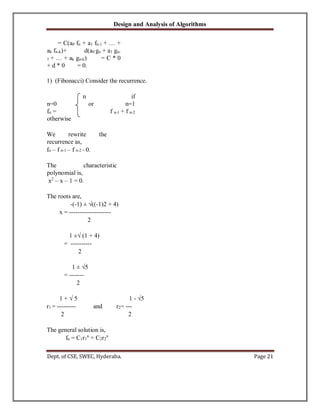
1) (Fibonacci) Consider the recurrence.
n if
n=0 or n=1
fn = f n-1 + f n-2
otherwise
We rewrite the
recurrence as,
fn – f n-1 – f n-2 = 0.
The characteristic
polynomial is,
x2
– x – 1 = 0.
The roots are,
-(-1) ± √((-1)2 + 4)
x = --------------------
2
1 ±√ (1 + 4)
= ----------
2
1 ± √5
= -------
2
1 + √ 5 1 - √5
r1 = --------- and r2= ---
2 2
The general solution is,
fn = C1r1
n
+ C2r2
n
Design and Analysis of Algorithms
Dept. of CSE, SWEC, Hyderaba. Page 22
when n=0, f0 = C1 + C2 = 0
when n=1, f1 = C1r1 + C2r2 = 1
C1 + C2 = 0 (1)
C1r1 + C2r2 = 1 (2)
From equation (1)
C1 = -C2
Substitute C1 in equation(2)
-C2r1 + C2r2 = 1
C2[r2 – r1] = 1
Substitute r1 and r2 values
1 - √5 1 - √5
C2 --------- - --------- = 1
2 2
1 – √5 – 1 – √5
C2 --------------------- = 1
2
-C2 * 2√5
-------------- = 1
2
– √5C2 = 1
C1 = 1/√5 C2 = -1/√5
Thus,
1 1 + √5 n
-1 1
- √5 n
fn = ---- --------- +
---- -------- √5 2
√5 2
1 1 + √5 n
1 – √5 n
= ---- --------- - ---------
√5 2 2
Design and Analysis of Algorithms
Dept. of CSE, SWEC, Hyderaba. Page 23
3. Inhomogeneous recurrence :
* The solution of a linear recurrence with constant co-efficient becomes more
difficult when the recurrence is not homogeneous, that is when the linear
combination is not equal to zero.
* Consider the following recurrence
a0tn + a1 t n-1 + … + ak t n-k = bn
p(n)
* The left hand side is the same as before,(homogeneous) but on the right-hand side
we have bn
p(n), where, b is a constant p(n) is a polynomial in ‘n’ of
degree ‘d’.
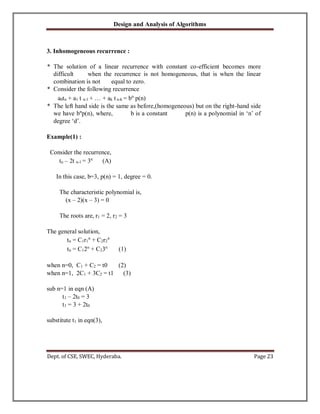
Example(1) :
Consider the recurrence,
tn – 2t n-1 = 3n
(A)
In this case, b=3, p(n) = 1, degree = 0.
The characteristic polynomial is,
(x – 2)(x – 3) = 0
The roots are, r1 = 2, r2 = 3
The general solution,
tn = C1r1
n
+ C2r2
n
tn = C12n
+ C23n
(1)
when n=0, C1 + C2 = t0 (2)
when n=1, 2C1 + 3C2 = t1 (3)
sub n=1 in eqn (A)
t1 – 2t0 = 3
t1 = 3 + 2t0
substitute t1 in eqn(3),
Design and Analysis of Algorithms
Dept. of CSE, SWEC, Hyderaba. Page 24
(2) * 2 2C1 + 2C2 = 2t0
2C1 + 3C2 = (3 + 2t0)
-------------------------------
-C2 = -3
C2 = 3
Sub C2 = 3 in eqn (2)
C1 + C2 = t0
C1 + 3 = t0
C1 = t0 – 3
Therefore tn = (t0-3)2n
+ 3. 3n
= Max[O[(t0 – 3) 2n
], O[3.3n
]]
= Max[O(2n
), O(3n
)] constants
= O[3n
]
Example :(2)
tn – 2t n-1 = (n + 5)3n
, n ≥ 1 (A)
This is Inhomogeneous
In this case, b=3, p(n) = n+5, degree = 1
So, the characteristic polynomial is,
(x-2)(x-3)2
= 0
The roots are,
r1 = 2, r2 = 3, r3 = 3
The general equation, tn
= C1r1
n
+ C2r2
n
+ C3nr3
n
(1)
when n=0, t0 = C1 + C2 (2)
when n=1, t1 = 2C1 + 3C2 + 3C3 (3)
substituting n=1 in eqn(A),
t1 –
2t0 = 6 . 3
Design and Analysis of Algorithms
Dept. of CSE, SWEC, Hyderaba. Page 25
t1 – 2t0 = 18
t1 = 18 + 2t0
substituting t1 value in eqn(3)
2C1 + 3C2 + 3C3 = 18 + 2t0
(4) C1 + C2 + = t0
(2)
Sub. n=2 in eqn(1)
4C1 + 9C2 + 18C3 = t2 (5)
sub n=2 in eqn (A)
t2 – 2t1 = 7. 9
t2 = 63 + 2t1
= 63 + 2[18 +
2t0] t2 = 63 +
36 +4t0 t2 =
99 +4t0
sub. t2 value in eqn(3), 4C1
+9C2 + 18C3 = 99 + 4t0
(5)
solve eqn (2),(4) & (5)
n=0, C1 + C2 = t0
(2) n=1, 2C1 + 3C2 + 3C3 = 18 +
2t0 (4) n=2, 4C1 + 9C2 + 18C3
= 99 + 4t0 (5)
(4) * 6 12C1 + 18C2 +18C3 = 108 + 2t0 (4)
(5) 4C1 + 9C2 + 18C3 = 99 + 4t0 (5)
------------------------------------------------
8C1 + 9C2 = 9 + 8t0 (6)
(2) * 8 8C1 + 8C2 = 8t0 (2)
(6) 8C1 + 9C2 = 9 +8t0 (6)
--------------------------
-C2 = -9
C2 = 9
Design and Analysis of Algorithms
Dept. of CSE, SWEC, Hyderaba. Page 26
Sub, C2 = 9 in eqn(2)
C1 + C2 = t0
C1 + 9 = t0
C1 = t0-9
Sub C1 & C2 in eqn (4)
2C1 + 3C2 + 3C3 = 18 + 2t0
2(t0-9) + 3(9) + 3C3 = 18 + 2t0
2t0 – 18 + 27 + 3C3 = 18 + 2t0
2t0 + 9 + 3C3 = 18 + 2t0
3C3 = 18 – 9 + 2t0 – 2t0
3C3 = 9
C3 = 9/3
C3 = 3
Sub. C1, C2, C3, r1, r2, r3 values in
eqn (1) tn = C12n
+ C23n
+
C3.n.3n
= (t0 – 9)2n
+ 9.3n
+ 3.n.3n
= Max[O[(t0-9),2n
], O[9.3n
], O[3.n.3n
]]
= Max[O(2n
), O(3n
),
O(n3n
)] tn = O[n3n
]
Example: (3)
Consider the recurrence,
1
if n=0 tn =
4t n-1 – 2n
otherwise
tn – 4t n-1 = -2n (A)
In this case , c=2, p(n) = -1, degree =0
(x-4)(x-2) = 0
The roots are, r1 = 4, r2 = 2
Design and Analysis of Algorithms
Dept. of CSE, SWEC, Hyderaba. Page 27
The general
solution ,
tn = C1r1
n
+ C2r2
n
tn = C14n
+ C22n
(1)
when n=0, in (1) C1 + C2 = 1 (2)
when n=1, in (1) 4C1 + 2C2 = t1 (3)
sub n=1 in (A),
tn – 4t n-1 = -2n
t1 – 4t0 = -2 t1 =
4t0 – 2 [since t0 = 1]
t1 = 2
sub t1 value in eqn (3)
4C1 + 2C2 = 4t0 – 2 (3)
(2) * 4 4C1 + 4C2 = 4
----------------------------
-2C2 = 4t0 - 6
= 4(1) - 6
= -2
C2 = 1
-2C2 = 4t0 - 6
2C2 = 6 – 4t0
C2 = 3 – 2t0
3 – 2(1) = 1
C2 = 1
Sub. C2 value in eqn(2),
C1 + C2 = 1
C1 + (3-2t0) = 1
C1 + 3 – 2t0 = 1
C1 = 1 – 3 + 2t0
C1 = 2t0 - 2
= 2(1) –
2 = 0 C1 = 0
Design and Analysis of Algorithms
Dept. of CSE, SWEC, Hyderaba. Page 28
Sub C1 & C2 value in
eqn (1) tn = C14n
+
C22n
= Max[O(2t0 – 2).4n
, O(3 – 2t0).2n
]
= Max[O(2n
)]
tn = O(2n
)
Example : (4)
0
if n=0 tn =
2t n-1 + n +2n
otherwise
tn – 2t n-1 = n + 2n
(A)
There are two polynomials.
For n; b=1, p(n), degree = 1
For 2n; b=2, p(n) = 1, degree =0
The characteristic polynomial is,
(x-2)(x-1)2
(x-2) = 0
The roots are, r1 = 2, r2 = 2, r3 = 1,
r4 = 1. So, the general solution,
tn = C1r1
n
+ C2nr2
n
+ C3r3
n
+ C4 n
r4
n
sub r1, r2, r3 in the above eqn
tn = 2n
C1 + 2n
C2 n + C3 . 1n
+ C4 .n.1n
(1)
sub. n=0 C1 + C3 = 0
(2) sub. n=1 2C1 + 2C2 + C3 + C4 = t1
(3)
sub. n=1 in eqn (A)
tn -2t n-1 = n + 2n
t1 – 2t0 = 1 + 2 t1
Design and Analysis of Algorithms
Dept. of CSE, SWEC, Hyderaba. Page 29
– 2t0 = 3 t1
= 3 [since t0 = 0]
sub. n=2 in eqn (1)
22
C1 + 2. 22
.C2 + C3 + 2.C4 = t2
4C1 + 8C2 + C3 + 2C4 = t2
sub n=2 in eqn (A)
t2 – 2t1 = 2 + 22
t2 – 2t1 =
2 + 4 t2
– 2t1 = 6
t2 = 6 + 2t1
t2 = 6 + 2.3
t2 = 6 + 6
t2 = 12
 4C1 + 8C2 + C3 + 2C4 = 12 (4)
sub n=3 in eqn (!)
23
C1 + 3.23
.C2 + C3 + 3C4 = t3
3C1 + 24C2 + C3 + 3C4 = t3
sub n=3 in eqn (A)
t3 – 2t2 =
3 + 23
t3
– 2t2 = 3 + 8
t3 – 2(12) =
11 t3 – 24
= 11
t3 = 11 + 24
t3 = 35
 8C1 + 24C2 + C3 + 3C4 = 35 (5)
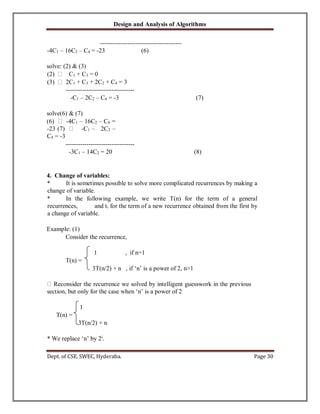
n=0, solve; C1 + C3 = 0 (2)
n=1,(2), (3), (4)&(5) 2C1 + 2C2 + C3 + C4 = 3 (3)
n=2, 4C1 + 8C2 + C3 + 2C4 = 12 (4)
n=3, 8C1 + 24C2 + C3 + 3C4 = 35 (5)
Design and Analysis of Algorithms
Dept. of CSE, SWEC, Hyderaba. Page 30
---------------------------------------
-4C1 – 16C2 – C4 = -23 (6)
solve: (2) & (3)
(2) C1 + C3 = 0
(3) 2C1 + C3 + 2C2 + C4 = 3
---------------------------------
-C1 – 2C2 – C4 = -3 (7)
solve(6) & (7)
(6) -4C1 – 16C2 – C4 =
-23 (7) -C1 – 2C2 –
C4 = -3
---------------------------------
-3C1 – 14C2 = 20 (8)
4. Change of variables:
* It is sometimes possible to solve more complicated recurrences by making a
change of variable.
* In the following example, we write T(n) for the term of a general
recurrences, and ti for the term of a new recurrence obtained from the first by
a change of variable.
Example: (1)
Consider the recurrence,
1 , if n=1
T(n) =
3T(n/2) + n , if ‘n’ is a power of 2, n>1
Reconsider the recurrence we solved by intelligent guesswork in the previous
section, but only for the case when ‘n’ is a power of 2
1
T(n) =
3T(n/2) + n
* We replace ‘n’ by 2i
.
Design and Analysis of Algorithms
Dept. of CSE, SWEC, Hyderaba. Page 31
* This is achieved by introducing new recurrence ti, define by ti = T(2i
) *
This transformation is useful because n/2 becomes (2i
)/2 = 2 i-1
* In other words, our original recurrence in which T(n) is defined as a
function of T(n/2) given way to one in which ti is defined as a
function of t i-1, precisely the type of recurrence we have learned to
solve.
ti = T(2i
) = 3T(2 i-
1
) + 2i
ti = 3t i-1 +
2i
ti – 3t i-1 = 2i
(A)
In this case,
b = 2, p(n) = 1, degree = 0
So, the characteristic equation,
(x – 3)(x – 2) = 0
The roots are, r1 = 3, r2 = 2.
The general equation,
tn = C1 r1
i
+ C2 r2
i
sub. r1 & r2: tn = 3n
C1 +
C2 2n
tn =
C1 3i
+ C2 2i
We use the fact that, T(2i
) = ti & thus T(n) = tlogn when n= 2i
to obtain,
T(n) = C1. 3 log
2
n
+ C2. 2log
2
n
T(n) = C1 . nlog
2
3
+ C2.n [i = logn]
When ‘n’ is a power of 2, which is sufficient to conclude that,
T(n) = O(n log3
) ‘n’ is a power of 2
Example: (2)
Consider the recurrence,
T(n) = 4T(n/2) + n2
(A)
Where ‘n’ is a power of 2, n ≥ 2.
Design and Analysis of Algorithms
Dept. of CSE, SWEC, Hyderaba. Page 32
ti = T(2i
) = 4T(2 i-1
) + (2i
)2
ti = 4t i-1 + 4i
ti – 4t i-1 = 4i
In this eqn,
b = 4, P(n) = 1, degree = 0
The characteristic polynomial,
(x – 4)(x – 4) = 0
The roots are, r1 = 4, r2 = 4.
So, the general equation, ti = C14i
+ C24i
.i [since i = logn]
= C1 4 log n
+ C2. 4 logn
. logn [since 2i
= n]
= C1 . n log 4 + C2. n log4.nlog1
T(n) = O(n log4
) ‘n’ is the power of 2.
EXAMPLE : 3
T(n) = 2T(n/2) + n logn
When ‘n’ is a power of 2, n ≥ 2
ti = T(2i
) = 2T(2i
/2) + 2i
.i [since 2i
= n; i =logn] ti
– 2t i-1 = i. 2i
In this case,
b = 2, P(n) = i, degree = 1
(x – 2)(x – 2)2
= 0
The roots are, r1 = 2, r2 = 2, r3 = 2
The general solution is,
tn = C12i
+ C2. 2i
. i + C3. i2
.
Design and Analysis of Algorithms
Dept. of CSE, SWEC, Hyderaba. Page 33
2i
= nC1 + nC2 +
nC3(log n2
2n)
tn = O(n.log2
2n)
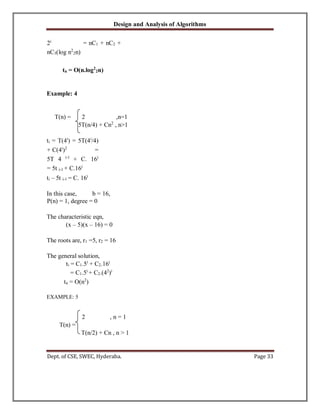
Example: 4
T(n) = 2 ,n=1
5T(n/4) + Cn2
, n>1
ti = T(4i
) = 5T(4i
/4)
+ C(4i
)2
=
5T 4 i-1
+ C. 16i
= 5t i-1 + C.16i
ti – 5t i-1 = C. 16i
In this case, b = 16,
P(n) = 1, degree = 0
The characteristic eqn,
(x – 5)(x – 16) = 0
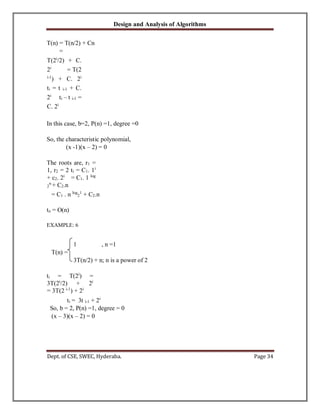
The roots are, r1 =5, r2 = 16
The general solution,
ti = C1.5i
+ C2.16i
= C1.5i
+ C2.(42
)i
tn = O(n2
)
EXAMPLE: 5
2 , n = 1
T(n) =
T(n/2) + Cn , n > 1
Design and Analysis of Algorithms
Dept. of CSE, SWEC, Hyderaba. Page 34
T(n) = T(n/2) + Cn
=
T(2i
/2) + C.
2i
= T(2
i-1
) + C. 2i
ti = t i-1 + C.
2i
ti – t i-1 =
C. 2i
In this case, b=2, P(n) =1, degree =0
So, the characteristic polynomial,
(x -1)(x – 2) = 0
The roots are, r1 =
1, r2 = 2 ti = C1. 1i
+ c2. 2i
= C1. 1 log
2
n
+ C2.n
= C1 . n log
2
1
+ C2.n
tn = O(n)
EXAMPLE: 6
1 , n =1
T(n) =
3T(n/2) + n; n is a power of 2
ti = T(2i
) =
3T(2i
/2) + 2i
= 3T(2 i-1
) + 2i
ti = 3t i-1 + 2i
So, b = 2, P(n) =1, degree = 0
(x – 3)(x – 2) = 0
Design and Analysis of Algorithms
Dept. of CSE, SWEC, Hyderaba. Page 35
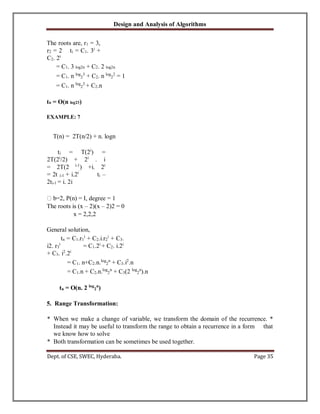
The roots are, r1 = 3,
r2 = 2 ti = C1. 3i
+
C2. 2i
= C1. 3 log2n + C2. 2 log2n
= C1. n log
2
3
+ C2. n log
2
2
= 1
= C1. n log
2
3
+ C2.n
tn = O(n log23)
EXAMPLE: 7
T(n) = 2T(n/2) + n. logn
ti = T(2i
) =
2T(2i
/2) + 2i
. i
= 2T(2 i-1
) +i. 2i
= 2t i-1 + i.2i
ti –
2ti-1 = i. 2i
b=2, P(n) = I, degree = 1
The roots is (x – 2)(x – 2)2 = 0
x = 2,2,2
General solution,
tn = C1.r1
i
+ C2.i.r2
i
+ C3.
i2. r3
i
= C1.2i
+ C2. i.2i
+ C3. i2
.2i
= C1. n+C2.n.log
2
n
+ C3.i2
.n
= C1.n + C2.n.log
2
n
+ C3(2 log
2
n
).n
tn = O(n. 2 log
2
n
)
5. Range Transformation:
* When we make a change of variable, we transform the domain of the recurrence. *
Instead it may be useful to transform the range to obtain a recurrence in a form that
we know how to solve
* Both transformation can be sometimes be used together.
Design and Analysis of Algorithms
Dept. of CSE, SWEC, Hyderaba. Page 36
EXAMPLE: 1
Consider the following recurrence , which defines T(n). where ‘n’ is the power
Of 2
1/3 , if n=1
T(n) =
n T2
(n/2) , otherwise
The first step is a change of
variable, Let ti denote T(2i
)
ti = T(2i
) = 2i
T2
(2 i-1
)
= 2i
t2
i-1
* This recurrence is not clear, furthermore the co-efficient 2i
is not a constant.
* To transform the range, we create another recurrence by using ui to denote
lg ti ui = lgti = i + 2lg t i-1 = i + 2u i-1
ui – 2u i-1 = i
(x – 2)(x – 1)2
= 0
The roots are, x = 2, 1,
1. G.S, ui = C1.2i
+ C2.1i
+ C3.i.1i
Sub. This solution into the recurrence,
For ui yields,
i = ui – 2u i-1
= C12i
+ C2 + C3.i – 2(C1. 2 i-1
+ C2 + C3 (i-1))
= (2C3 – C2) – C3i.
C3 = -1 & C2 =
2C3 = -2 ui =
C12i
– i – 2
This gives us the G.S for ti
& T(n) ti = 2ui =
2C12i – i-2
T(n) = t lgn = 2C1n – logn - 2
Design and Analysis of Algorithms
Dept. of CSE, SWEC, Hyderaba. Page 37
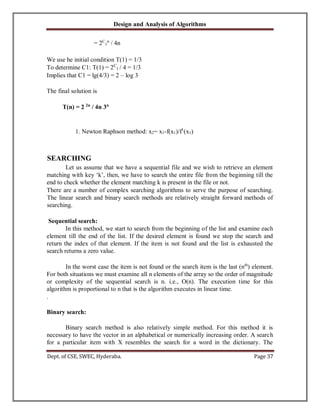
= 2C
1
n
/ 4n
We use he initial condition T(1) = 1/3
To determine C1: T(1) = 2C
1 / 4 = 1/3
Implies that C1 = lg(4/3) = 2 – log 3
The final solution is
T(n) = 2 2n
/ 4n 3n
1. Newton Raphson method: x2= x1-f(x1)/f1
(x1)
SEARCHING
Let us assume that we have a sequential file and we wish to retrieve an element
matching with key ‘k’, then, we have to search the entire file from the beginning till the
end to check whether the element matching k is present in the file or not.
There are a number of complex searching algorithms to serve the purpose of searching.
The linear search and binary search methods are relatively straight forward methods of
searching.
Sequential search:
In this method, we start to search from the beginning of the list and examine each
element till the end of the list. If the desired element is found we stop the search and
return the index of that element. If the item is not found and the list is exhausted the
search returns a zero value.
In the worst case the item is not found or the search item is the last (nth
) element.
For both situations we must examine all n elements of the array so the order of magnitude
or complexity of the sequential search is n. i.e., O(n). The execution time for this
algorithm is proportional to n that is the algorithm executes in linear time.
.
Binary search:
Binary search method is also relatively simple method. For this method it is
necessary to have the vector in an alphabetical or numerically increasing order. A search
for a particular item with X resembles the search for a word in the dictionary. The
Design and Analysis of Algorithms
Dept. of CSE, SWEC, Hyderaba. Page 38
approximate mid entry is located and its key value is examined. If the mid value is greater
than X, then the list is chopped off at the (mid-1)th
location. Now the list gets reduced to
half the original list. The middle entry of the left-reduced list is examined in a similar
manner. This procedure is repeated until the item is found or the list has no more
elements. On the other hand, if the mid value is lesser than X, then the list is chopped off
at (mid+1)th
location. The middle entry of the right-reduced list is examined and the
procedure is continued until desired key is found or the search interval is exhausted.
The algorithm for binary search is as follows,
Algorithm : binary search
Input : A, vector of n elements
K, search element
Output : low –index of k
Method : low=1,high=n
While(low<=high-1)
{
mid=(low+high)/2
if(k<a[mid])
high=mid
else
low=mid
if end
}
if(k=A[low])
{
write("search successful")
write(k is at location low)
exit(); } else write
(search
unsuccessful);
if end;
algorithm
ends.
SORTING
One of the major applications in computer science is the sorting of information in
a table. Sorting algorithms arrange items in a set according to a predefined ordering
relation. The most common types of data are string information and numerical
Design and Analysis of Algorithms
Dept. of CSE, SWEC, Hyderaba. Page 39
information. The ordering relation for numeric data simply involves arranging items in
sequence from smallest to largest and from largest to smallest, which is called ascending
and descending order respectively.
The items in a set arranged in non-decreasing order are {7,11,13,16,16,19,23}. The items
in a set arranged in descending order is of the form {23,19,16,16,13,11,7}
Similarly for string information, {a, abacus, above, be, become, beyond}is in ascending
order and { beyond, become, be, above, abacus, a}is in descending order.
There are numerous methods available for sorting information. But, not even one of them
is best for all applications. Performance of the methods depends on parameters like, size
of the data set, degree of relative order already present in the data etc.
Selection sort :
The idea in selection sort is to find the smallest value and place it in an order, then
find the next smallest and place in the right order. This process is continued till the entire
table is sorted.
Consider the unsorted
array, a[1] a[2] a[8]
20 35 18 8 14 41 3 39
The resulting array should be
a[1] a[2] a[8]
3 8 14 18 20 35 39 41
One way to sort the unsorted array would be to perform the following steps:
• Find the smallest element in the unsorted array
• Place the smallest element in position of a[1]
i.e., the smallest element in the unsorted array is 3 so exchange the values of a[1]
and a[7]. The array now becomes,
a[1] a[2] a[8]
3 35 18 8 14 41 20 39
Design and Analysis of Algorithms
Dept. of CSE, SWEC, Hyderaba. Page 40
Now find the smallest from a[2] to a[8] , i.e., 8 so exchange the values of a[2] and
a[4] which results with the array shown below,
a[1] a[2] a[8]
3 8 18 35 14 41 20 39
Repeat this process until the entire array is sorted. The changes undergone by the array is
shown in fig 2.2.The number of moves with this technique is always of the order O(n).
Bubble sort:
Bubble Sort is an elementary sorting algorithm. It works by repeatedly exchanging
adjacent elements, if necessary. When no exchanges are required, the file is sorted.
BUBBLESORT (A)
for i ← 1 to length [A] do
for j ← length [A] downto i+1 do
If A[A]
Exchange A[j] ↔ A[j-1]
< A[j-1] then
Here the number
1 + 2 + 3 + . . . + (n-1) = n(n-1)/2 = O(n2
)
of comparison made
Another well-known sorting method is bubble sort. It differs from the selection
sort in that instead of finding the smallest record and then performing an interchange two
records are interchanged immediately upon discovering that they are of out of order.
Design and Analysis of Algorithms
Dept. of CSE, SWEC, Hyderaba. Page 41
When this approach is used there are at most n-1 passes required. During the first pass
k1and k2 are compared, and if they are out of order, then records R1 AND R2 are
interchanged; this process is repeated for records R2 and R3, R3 and R4 and so on .this
method will cause with small keys to bubble up. After the first pass the record with the
largest key will be in the nth position. On each successive pass, the records with the next
largest key will be placed in the position n-1, n-2 …2 respectively, thereby resulting in a
sorted table.
After each pass through the table, a check can be made to determine whether any
interchanges were made during that pass. If no interchanges occurred then the table must
be sorted and no further passes are required.
Insertion sort :
Insertion sort is a straight forward method that is useful for small collection of
data. The idea here is to obtain the complete solution by inserting an element from the
unordered part into the partially ordered solution extending it by one element. Selecting
an element from the unordered list could be simple if the first element of that list is
selected.
a[1] a[2] a[8]
20 35 18 8 14 41 3 39
Initially the whole array is unordered. So select the minimum and put it in place of
a[1] to act as sentinel. Now the array is of the form,
a[1] a[2] a[8]
Now we have one element in the sorted list
and the remaining elements are in the unordered set. Select the next element to be
inserted. If the selected element is less than the preceding element move the preceding
element by one position and insert the smaller element.
In the above array the next element to be inserted is x=35, but the preceding element is 3
which is less than x. Hence, take the next element for insertion i.e., 18. 18 is less than 35,
so move 35 one position ahead and place 18 at that place. The resulting array will be,
a[1] a[2] a[8]
3 18 35 8 14 41 20 39
3 35 18 8 14 41 20 39
Design and Analysis of Algorithms
Dept. of CSE, SWEC, Hyderaba. Page 42
Now the element to be inserted is 8. 8 is less than 35 and 8 is also less than 18 so
move 35 and 18 one position right and place 8 at a[2]. This process is carried till the
sorted array is obtained.
The changes undergone are shown in fig 2.3.
One of the disadvantages of the insertion sort method is the amount of movement of data.
In the worst case, the number of moves is of the order O(n2
). For lengthy records it is
quite time consuming.
Heaps and Heap sort:
A heap is a complete binary tree with the property that the value at each node is
atleast as large as the value at its children.
The definition of a max heap implies that one of the largest elements is at the root of the
heap. If the elements are distinct then the root contains the largest item. A max heap can
be implemented using an array an[ ].
To insert an element into the heap, one adds it "at the bottom" of the heap and
then compares it with its parent, grandparent, great grandparent and so on, until it is less
than or equal to one of these values. Algorithm insert describes this process in detail.
Algorithm Insert(a,n)
{
// Insert a[n] into the heap which is stored in a[1:n-1]
Design and Analysis of Algorithms
Dept. of CSE, SWEC, Hyderaba. Page 43
I=n; item=a[n]; while( (I>n)
and (a[ I!/2 ] < item)) do
{
a[I] = a[I/2];
I=I/2
; }
a[I]=
item;
retur
n
(true
);
}
The figure shows one example of how insert would insert a new value into an
existing heap of five elements. It is clear from the algorithm and the figure that the time
for insert can vary. In the best case the new elements are correctly positioned initially and
Design and Analysis of Algorithms
Dept. of CSE, SWEC, Hyderaba. Page 44
no new values need to be rearranged. In the worst case the number of executions of the
while loop is proportional to the number of levels in the heap. Thus if there are n
elements in the heap, inserting new elements takes O(log n) time in the worst case.
To delete the maximum key from the max heap, we use an algorithm called
Adjust. Adjust takes as input the array a[ ] and integer I and n. It regards a[1..n] as a
complete binary tree. If the subtrees rooted at 2I and 2I+1 are max heaps, then adjust will
rearrange elements of a[ ] such that the tree rooted at I is also a max heap. The maximum
elements from the max heap a[1..n] can be deleted by deleting the root of the
corresponding complete binary tree. The last element of the array, i.e. a[n], is copied to
the root, and finally we call Adjust(a,1,n-1).
Algorithm Adjust(a,I,n)
{
j=
2I
;
ite
m
=a
[I]
;
while (j<=n) do
{
if ((j<=n) and (a[j]< a[j+1]))
then j=j+1;
//compare left and right child and let j be the
right //child
if ( item >= a[I]) then
break; // a position
for item is found
a[i/2]=a[j]; j=2I; }
a[j/2]=item;
}
Algorithm Delmac(a,n,x)
// Delete the maximum from the heap a[1..n] and store it in x
{
if (n=0) then
{
write(‘heap is empty");
Design and Analysis of Algorithms
Dept. of CSE, SWEC, Hyderaba. Page 45
return (false);
} x=a[1]; a[1]=a[n];
Adjust(a,1,n-1);
Return(true);
}
Note that the worst case run time of adjust is also proportional to the height of the
tree. Therefore if there are n elements in the heap, deleting the maximum can be done in
O(log n) time.
To sort n elements, it suffices to make n insertions followed by n deletions from a
heap since insertion and deletion take O(log n) time each in the worst case this sorting
algorithm has a complexity of O(n log n).
Algorithm sort(a,n)
{
for i=1 to n do
Insert(a,i);
for i= n to 1 step –1 do
{
Delmax(a,i,x);
a[i]=x;
}
}
Design and Analysis of Algorithms
Dept. of CSE, SWEC, Hyderaba. Page 46
CHAPTER- 2
DIVIDE AND CONQUER:
General method:
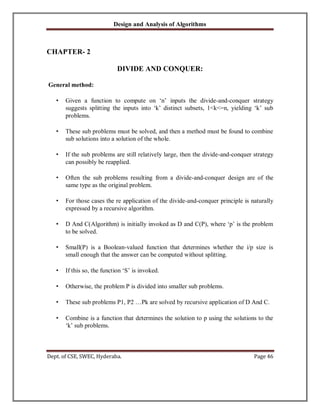
• Given a function to compute on ‘n’ inputs the divide-and-conquer strategy
suggests splitting the inputs into ‘k’ distinct subsets, 1<k<=n, yielding ‘k’ sub
problems.
• These sub problems must be solved, and then a method must be found to combine
sub solutions into a solution of the whole.
• If the sub problems are still relatively large, then the divide-and-conquer strategy
can possibly be reapplied.
• Often the sub problems resulting from a divide-and-conquer design are of the
same type as the original problem.
• For those cases the re application of the divide-and-conquer principle is naturally
expressed by a recursive algorithm.
• D And C(Algorithm) is initially invoked as D and C(P), where ‘p’ is the problem
to be solved.
• Small(P) is a Boolean-valued function that determines whether the i/p size is
small enough that the answer can be computed without splitting.
• If this so, the function ‘S’ is invoked.
• Otherwise, the problem P is divided into smaller sub problems.
• These sub problems P1, P2 …Pk are solved by recursive application of D And C.
• Combine is a function that determines the solution to p using the solutions to the
‘k’ sub problems.
Design and Analysis of Algorithms
Dept. of CSE, SWEC, Hyderaba. Page 47
• If the size of ‘p’ is n and the sizes of the ‘k’ sub problems are n1, n2 ….nk,
respectively, then the computing time of D And C is described by the recurrence
relation.
T(n)= { g(n) n small
T(n1)+T(n2)+……………+T(nk)+f(n); otherwise.
Where T(n) is the time for D And C on any I/p of size ‘n’.
g(n) is the time of compute the answer directly for small I/ps.
f(n) is the time for dividing P & combining the solution to
sub problems.
1. Algorithm D And C(P)
2. {
3. if small(P) then return S(P);
4. else
5. {
6. divide P into smaller instances
P1, P2… Pk, k>=1;
7. Apply D And C to each of these sub problems;
8. return combine (D And C(P1), D And C(P2),…….,D And C(Pk));
9. }
10. }
• The complexity of many divide-and-conquer algorithms is given by recurrences
of the form
T(n) = { T(1) n=1
AT(n/b)+f(n) n>1
Where a & b are known constants.
We assume that T(1) is known & ‘n’ is a power of b(i.e., n=b^k)
• One of the methods for solving any such recurrence relation is called the
substitution method.
• This method repeatedly makes substitution for each occurrence of the function. T
is the Right-hand side until all such occurrences disappear.
Example:
1) Consider the case in which a=2 and b=2. Let T(1)=2 & f(n)=n.
We have,
T(n) = 2T(n/2)+n
Design and Analysis of Algorithms
Dept. of CSE, SWEC, Hyderaba. Page 48
= 2[2T(n/2/2)+n/2]+n
= [4T(n/4)+n]+n
= 4T(n/4)+2n
= 4[2T(n/4/2)+n/4]+2n
= 4[2T(n/8)+n/4]+2n
= 8T(n/8)+n+2n
= 8T(n/8)+3n
*
*
*
• In general, we see that T(n)=2^iT(n/2^i )+in., for any log n >=I>=1.
T(n) =2^log n T(n/2^log n) + n log n
Corresponding to the choice of i=log n
Thus, T(n) = 2^log n T(n/2^log n) + n log n
= n. T(n/n) + n log n
= n. T(1) + n log n [since, log 1=0, 2^0=1]
= 2n + n log n
BINARY SEARCH
1. Algorithm Bin search(a,n,x)
2. // Given an array a[1:n] of elements in non-decreasing 3. //order,
n>=0,determine whether ‘x’ is present and
4. // if so, return ‘j’ such that x=a[j]; else return 0.
5. {
6. low:=1; high:=n;
7. while (low<=high) do
8. {
9. mid:=[(low+high)/2];
10. if (x<a[mid]) then high; 11. else if(x>a[mid]) then
low=mid+1;
12. else return mid;
13. }
14. return 0;
Design and Analysis of Algorithms
Dept. of CSE, SWEC, Hyderaba. Page 49
15. }
• Algorithm, describes this binary search method, where Binsrch has 4I/ps a[], I , l
& x.
• It is initially invoked as Binsrch (a,1,n,x) • A non-recursive version of Binsrch is
given below.
• This Binsearch has 3 i/ps a,n, & x.
• The while loop continues processing as long as there are more elements left to
check.
• At the conclusion of the procedure 0 is returned if x is not present, or ‘j’ is
returned, such that a[j]=x.
• We observe that low & high are integer Variables such that each time through the
loop either x is found or low is increased by at least one or high is decreased at
least one.
Thus we have 2 sequences of integers approaching each other and eventually low
becomes > than high & causes termination in a finite no. of steps if ‘x’ is not present.
Example:
1) Let us select the 14 entries.
-15,-6,0,7,9,23,54,82,101,112,125,131,142,151.
Place them in a[1:14], and simulate the steps Binsearch goes through as it searches for
different values of ‘x’.
Only the variables, low, high & mid need to be traced as we simulate the algorithm.
We try the following values for x: 151, -14 and 9.
for 2 successful searches &
1 unsuccessful search.
• Table. Shows the traces of Bin search on these 3 steps.
X=151 low high mid
1 14 7
8 14 11
12 14 13
14 14 14
Found
x=-14 low high mid
1 14 7
Design and Analysis of Algorithms
Dept. of CSE, SWEC, Hyderaba. Page 50
1 6 3
1 2 1
2 2 2
2 1 Not found
x=9 low high mid
1 14 7
1 6 3
4 6 5
Found
Theorem: Algorithm Binsearch(a,n,x) works correctly.
Proof:
We assume that all statements work as expected and that comparisons such as x>a[mid]
are appropriately carried out.
• Initially low =1, high= n,n>=0, and a[1]<=a[2]<=……..<=a[n].
• If n=0, the while loop is not entered and is returned.
Otherwise we observe that each time thro’ the loop the possible elements to be
checked of or equality with x and a[low], a[low+1],……..,a[mid],……a[high].
• If x=a[mid], then the algorithm terminates successfully.
• Otherwise, the range is narrowed by either increasing low to (mid+1) or
decreasing high to (mid-1).
• Clearly, this narrowing of the range does not affect the outcome of the search.
• If low becomes > than high, then ‘x’ is not present & hence the loop is exited.
Maximum and Minimum:
• Let us consider another simple problem that can be solved by the divide-
andconquer technique.
• The problem is to find the maximum and minimum items in a set of ‘n’ elements.
• In analyzing the time complexity of this algorithm, we once again concentrate on
the no. of element comparisons.
Design and Analysis of Algorithms
Dept. of CSE, SWEC, Hyderaba. Page 51
• More importantly, when the elements in a[1:n] are polynomials, vectors, very
large numbers, or strings of character, the cost of an element comparison is much
higher than the cost of the other operations.
• Hence, the time is determined mainly by the total cost of the element comparison.
1. Algorithm straight MaxMin(a,n,max,min)
2. // set max to the maximum & min to the minimum of a[1:n]
3. {
4. max:=min:=a[1];
5. for I:=2 to n do
6. {
7. if(a[I]>max) then max:=a[I];
8. if(a[I]<min) then min:=a[I];
9. }
10. }
Algorithm: Straight forward Maximum & Minimum
• Straight MaxMin requires 2(n-1) element comparison in the best, average & worst
cases.
• An immediate improvement is possible by realizing that the comparison a[I]<min
is necessary only when a[I]>max is false.
Hence we can replace the contents of the for loop by,
If(a[I]>max) then max:=a[I];
Else if (a[I]<min) then min:=a[I];
• Now the best case occurs when the elements are in increasing order. The no.
of element comparison is (n-1).
• The worst case occurs when the elements are in decreasing order. The no. of
elements comparison is 2(n-1)
• The average no. of element comparison is < than 2(n-1)
• On the average a[I] is > than max half the time, and so, the avg. no. of
comparison is 3n/2-1.
Design and Analysis of Algorithms
Dept. of CSE, SWEC, Hyderaba. Page 52
• A divide- and conquer algorithm for this problem would proceed as follows:
Let P=(n, a[I] ,……,a[j]) denote an arbitrary instance of the problem.
Here ‘n’ is the no. of elements in the list (a[I],….,a[j]) and we are interested in
finding the maximum and minimum of the list.
• If the list has more than 2 elements, P has to be divided into smaller instances.
• For example , we might divide ‘P’ into the 2
instances,
P1=([n/2],a[1],……..a[n/2]) & P2= (n-[n/2],a[[n/2]+1],…..,a[n])
• After having divided ‘P’ into 2 smaller sub problems, we can solve them by
recursively invoking the same divide-and-conquer algorithm.
Algorithm: Recursively Finding the Maximum & Minimum
1. Algorithm MaxMin (I,j,max,min)
2. //a[1:n] is a global array, parameters I & j
3. //are integers, 1<=I<=j<=n.The effect is to 4. //set max & min to the largest &
smallest value
5. //in a[I:j], respectively.
6. {
7. if(I=j) then max:= min:= a[I];
8. else if (I=j-1) then // Another case of small(p)
9. {
10. if (a[I]<a[j]) then
11. {
12. max:=a[j];
13. min:=a[I];
14. } else
15. {
16. max:=a[I];
17. min:=a[j];
18. }
19. }
20. else
21. {
Design and Analysis of Algorithms
Dept. of CSE, SWEC, Hyderaba. Page 53
22. // if P is not small, divide P into subproblems.
23. // find where to split the set mid:=[(I+j)/2];
24. //solve the subproblems
25. MaxMin(I,mid,max.min);
26. MaxMin(mid+1,j,max1,min1);
27. //combine the solution
28. if (max<max1) then max=max1;
29. if(min>min1) then min = min1;
30. }
31. }
• The procedure is initially invoked by the statement,
MaxMin(1,n,x,y)
• Suppose we simulate MaxMin on the following 9 elements
A: [1] [2] [3] [4] [5] [6] [7] [8] [9]
22 13 -5 -8 15 60 17 31 47
• A good way of keeping track of recursive calls is to build a tree by adding a node
each time a new call is made.
• For this Algorithm, each node has 4 items of information: I, j, max & imin.
• Examining fig: we see that the root node contains 1 & 9 as the values of I &j
corresponding to the initial call to MaxMin.
• This execution produces 2 new calls to MaxMin, where I & j have the values 1, 5
& 6, 9 respectively & thus split the set into 2 subsets of approximately the same
size.
• From the tree, we can immediately see the maximum depth of recursion is 4.
(including the 1st
call)
• The include no.s in the upper left corner of each node represent the order in which
max & min are assigned values.
No. of element Comparison:
• If T(n) represents this no., then the resulting recurrence relations is
T(n)={ T([n/2]+T[n/2]+2 n>2
n=2
0 n=1
When ‘n’ is a power of 2, n=2^k for some +ve integer ‘k’, then
T(n) = 2T(n/2) +2
Design and Analysis of Algorithms
Dept. of CSE, SWEC, Hyderaba. Page 54
= 2(2T(n/4)+2)+2
= 4T(n/4)+4+2
*
*
= 2^k-1T(2)+
= 2^k-1+2^k-2
= 2^k/2+2^k-2
= n/2+n-2
= (n+2n)/2)-2
T(n)=(3n/2)-2
*Note that (3n/3)-3 is the best-average, and worst-case no. of comparisons when ‘n’
is a power of 2.
MERGE SORT
• As another example divide-and-conquer, we investigate a sorting algorithm that
has the nice property that is the worst case its complexity is O(n log n)
• This algorithm is called merge sort
• We assume throughout that the elements are to be sorted in non-decreasing order.
• Given a sequence of ‘n’ elements a[1],…,a[n] the general idea is to imagine then
split into 2 sets a[1],…..,a[n/2] and a[[n/2]+1],….a[n].
• Each set is individually sorted, and the resulting sorted sequences are merged to
produce a single sorted sequence of ‘n’ elements.
• Thus, we have another ideal example of the divide-and-conquer strategy in which
the splitting is into 2 equal-sized sets & the combining operation is the merging of
2 sorted sets into one.
Algorithm For Merge Sort:
1. Algorithm MergeSort(low,high)
2. //a[low:high] is a global array to be sorted
3. //Small(P) is true if there is only one element 4. //to sort. In this case the list is
already sorted.
5. {
6. if (low<high) then //if there are more than one element
7. {
8. //Divide P into subproblems
9. //find where to split the set
Design and Analysis of Algorithms
Dept. of CSE, SWEC, Hyderaba. Page 55
10. mid = [(low+high)/2]; 11. //solve the subproblems.
12. mergesort (low,mid);
13. mergesort(mid+1,high);
14. //combine the solutions .
15. merge(low,mid,high);
16. }
17. }
Algorithm: Merging 2 sorted subarrays using auxiliary storage.
1. Algorithm merge(low,mid,high)
2. //a[low:high] is a global array containing
3. //two sorted subsets in a[low:mid]
4. //and in a[mid+1:high].The goal is to merge these 2 sets into
5. //a single set residing in a[low:high].b[] is an auxiliary global array.
6. {
7. h=low; I=low; j=mid+1;
8. while ((h<=mid) and (j<=high)) do
9. {
10. if (a[h]<=a[j]) then
11. {
12. b[I]=a[h];
13. h = h+1;
14. }
15. else
16. {
17. b[I]= a[j];
18. j=j+1;
19. }
20. I=I+1;
21. }
22. if (h>mid) then
23. for k=j to high do
24. {
25. b[I]=a[k];
26. I=I+1;
27. }
28. else
29. for k=h to mid do
Design and Analysis of Algorithms
Dept. of CSE, SWEC, Hyderaba. Page 56
30. {
31. b[I]=a[k];
32. I=I+1;
33. }
34. for k=low to high do a[k] = b[k];
35. }
• Consider the array of 10 elements a[1:10] =(310, 285, 179, 652, 351, 423, 861,
254, 450, 520)
• Algorithm Mergesort begins by splitting a[] into 2 sub arrays each of size five
(a[1:5] and a[6:10]).
• The elements in a[1:5] are then split into 2 sub arrays of size 3 (a[1:3] ) and
2(a[4:5])
• Then the items in a a[1:3] are split into sub arrays of size 2 a[1:2] & one(a[3:3])
• The 2 values in a[1:2} are split to find time into one-element sub arrays, and now
the merging begins.
(310| 285| 179| 652, 351| 423, 861, 254, 450, 520)
Where vertical bars indicate the boundaries of sub arrays.
Elements a[I] and a[2] are merged to yield,
(285, 310|179|652, 351| 423, 861, 254, 450, 520)
Then a[3] is merged with a[1:2] and
(179, 285, 310| 652, 351| 423, 861, 254, 450, 520)
Next, elements a[4] & a[5] are merged.
(179, 285, 310| 351, 652 | 423, 861, 254, 450, 520)
And then a[1:3] & a[4:5]
(179, 285, 310, 351, 652| 423, 861, 254, 450, 520)
Repeated recursive calls are invoked producing the following sub arrays.
(179, 285, 310, 351, 652| 423| 861| 254| 450, 520)
Elements a[6] &a[7] are merged.
Design and Analysis of Algorithms
Dept. of CSE, SWEC, Hyderaba. Page 57
Then a[8] is merged with a[6:7]
(179, 285, 310, 351, 652| 254,423, 861| 450, 520)
Next a[9] &a[10] are merged, and then a[6:8] & a[9:10]
(179, 285, 310, 351, 652| 254, 423, 450, 520, 861 )
At this point there are 2 sorted sub arrays & the final merge produces the fully
sorted result.
(179, 254, 285, 310, 351, 423, 450, 520, 652, 861)
• If the time for the merging operations is proportional to ‘n’, then the computing time
for merge sort is described by the recurrence relation.
T(n) = { a n=1,’a’ a constant
2T(n/2)+cn n>1,’c’ a constant.
When ‘n’ is a power of 2, n= 2^k, we can solve this equation by successive
substitution.
T(n) =2(2T(n/4) +cn/2) +cn
= 4T(n/4)+2cn
= 4(2T(n/8)+cn/4)+2cn
*
*
= 2^k T(1)+kCn.
= an + cn log n.
It is easy to see that if s^k<n<=2^k+1, then T(n)<=T(2^k+1). Therefore,
T(n)=O(n log n)
QUICK SORT
• The divide-and-conquer approach can be used to arrive at an efficient sorting
method different from merge sort.
• In merge sort, the file a[1:n] was divided at its midpoint into sub arrays which
were independently sorted & later merged.
Design and Analysis of Algorithms
Dept. of CSE, SWEC, Hyderaba. Page 58
• In Quick sort, the division into 2 sub arrays is made so that the sorted sub arrays
do not need to be merged later.
• This is accomplished by rearranging the elements in a[1:n] such that a[I]<=a[j] for
all I between 1 & n and all j between (m+1) & n for some m, 1<=m<=n.
• Thus the elements in a[1:m] & a[m+1:n] can be independently sorted.
• No merge is needed. This rearranging is referred to as partitioning.
• Function partition of Algorithm accomplishes an in-place partitioning of the
elements of a[m:p-1]
• It is assumed that a[p]>=a[m] and that a[m] is the partitioning element. If m=1 &
p-1=n, then a[n+1] must be defined and must be greater than or equal to all
elements in a[1:n]
• The assumption that a[m] is the partition element is merely for convenience, other
choices for the partitioning element than the first item in the set are better in
practice.
• The function interchange (a,I,j) exchanges a[I] with a[j].
Algorithm: Partition the array a[m:p-1] about a[m]
1. Algorithm Partition(a,m,p)
2. //within a[m],a[m+1],…..,a[p-1] the elements
3. // are rearranged in such a manner that if
4. //initially t=a[m],then after completion
5. //a[q]=t for some q between m and
6. //p-1,a[k]<=t for m<=k<q, and 7. //a[k]>=t for q<k<p. q is returned
8. //Set a[p]=infinite.
9. {
10. v=a[m];I=m;j=p;
11. repeat
12. {
13. repeat
14. I=I+1;
15. until(a[I]>=v);
Design and Analysis of Algorithms
Dept. of CSE, SWEC, Hyderaba. Page 59
16. repeat
17. j=j-1;
18. until(a[j]<=v);
19. if (I<j) then interchange(a,i.j);
20. }until(I>=j);
21. a[m]=a[j]; a[j]=v;
22. retun j;
23. }
1. Algorithm Interchange(a,I,j)
2. //Exchange a[I] with a[j]
3. {
4. p=a[I];
5. a[I]=a[j];
6. a[j]=p;
7. }
Algorithm: Sorting by Partitioning
1. Algorithm Quicksort(p,q)
2. //Sort the elements a[p],….a[q] which resides
3. //is the global array a[1:n] into ascending
4. //order; a[n+1] is considered to be defined
5. // and must be >= all the elements in a[1:n]
6. {
7. if(p<q) then // If there are more than one element
8. {
9. // divide p into 2 subproblems
10. j=partition(a,p,q+1);
11. //’j’ is the position of the partitioning element.
12. //solve the subproblems.
13. quicksort(p,j-1);
14. quicksort(j+1,q);
15. //There is no need for combining solution.
16. }
17. }
Record Program: Quick Sort
Design and Analysis of Algorithms
Dept. of CSE, SWEC, Hyderaba. Page 60
#include <stdio.h>
#include
<conio.h> int
a[20]; main() {
int n,I;
clrscr();
printf(“QUICK SORT”); printf(“n
Enter the no. of elements “);
scanf(“%d”,&n); printf(“nEnter the
array elements”); for(I=0;I<n;I++)
scanf(“%d”,&a[I]); quicksort(0,n-1);
printf(“nThe array elements are”);
for(I=0;I<n;I++) printf(“n%d”,a[I]);
getch(); }
quicksort(int p, int q)
{
int j;
if(p,q)
{ j=partition(p,q+
1); quicksort(p,j-
1);
quicksort(j+1,q);
}
}
Partition(int m, int p)
{
int v,I,j; v=a[m];
i=m; j=p; do
{ do
i=i+1;
while(a[i]<v); if
(i<j)
interchange(I,j); }
while (I<j); a[m]=a[j];
a[j]=v; return j; }
Interchange(int I, int j)
{
Design and Analysis of Algorithms
Dept. of CSE, SWEC, Hyderaba. Page 61
int p;
p= a[I];
a[I]=a[j];
a[j]=p;
}
Output:
Enter the no. of elements 5
Enter the array elements
3
8
1
5
2
The sorted elements are,
1
2
3
5
8
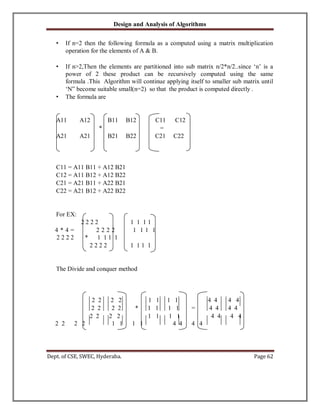
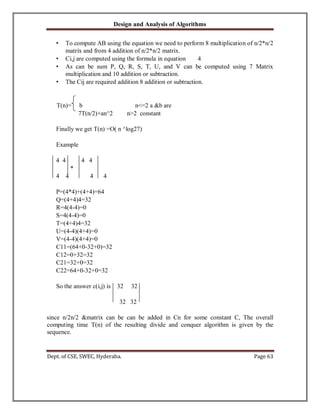
STRASSON’S MATRIX MULTIPLICAION
• Let A and B be the 2 n*n Matrix. The product matrix C=AB is calculated by using
the formula,
C (i ,j )= A(i,k) B(k,j) for all ‘i’ and and j between 1 and n.
• The time complexity for the matrix Multiplication is O(n^3).
• Divide and conquer method suggest another way to compute the product of n*n
matrix.
• We assume that N is a power of 2 .In the case N is not a power of 2 ,then enough
rows and columns of zero can be added to both A and B .SO that the resulting
dimension are the powers of two.
Design and Analysis of Algorithms
Dept. of CSE, SWEC, Hyderaba. Page 62
• If n=2 then the following formula as a computed using a matrix multiplication
operation for the elements of A & B.
• If n>2,Then the elements are partitioned into sub matrix n/2*n/2..since ‘n’ is a
power of 2 these product can be recursively computed using the same
formula .This Algorithm will continue applying itself to smaller sub matrix until
‘N” become suitable small(n=2) so that the product is computed directly .
• The formula are
A11 A12 B11 B12 C11 C12
* =
A21 A21 B21 B22 C21 C22
C11 = A11 B11 + A12 B21
C12 = A11 B12 + A12 B22
C21 = A21 B11 + A22 B21
C22 = A21 B12 + A22 B22
For EX:
2 2 2 2 1 1 1 1
4 * 4 = 2 2 2 2 1 1 1 1
2 2 2 2 * 1 1 1 1
2 2 2 2 1 1 1 1
The Divide and conquer method
2 2 2 2 1 1 1 1 4 4 4 4
2 2 2 2 * 1 1 1 1 = 4 4 4 4
2 2 2 2 1 1 1 1 4 4 4 4
2 2 2 2 1 1 1 1 4 4 4 4
Design and Analysis of Algorithms
Dept. of CSE, SWEC, Hyderaba. Page 63
• To compute AB using the equation we need to perform 8 multiplication of n/2*n/2
matrix and from 4 addition of n/2*n/2 matrix.
• Ci,j are computed using the formula in equation 4
• As can be sum P, Q, R, S, T, U, and V can be computed using 7 Matrix
multiplication and 10 addition or subtraction.
• The Cij are required addition 8 addition or subtraction.
T(n)= b n<=2 a &b are
7T(n/2)+an^2 n>2 constant
Finally we get T(n) =O( n ^log27)
Example
4 4 4 4
*
4 4 4 4
P=(4*4)+(4+4)=64
Q=(4+4)4=32
R=4(4-4)=0
S=4(4-4)=0
T=(4+4)4=32
U=(4-4)(4+4)=0
V=(4-4)(4+4)=0
C11=(64+0-32+0)=32
C12=0+32=32
C21=32+0=32
C22=64+0-32+0=32
So the answer c(i,j) is 32 32
32 32
since n/2n/2 &matrix can be can be added in Cn for some constant C, The overall
computing time T(n) of the resulting divide and conquer algorithm is given by the
sequence.
Design and Analysis of Algorithms
Dept. of CSE, SWEC, Hyderaba. Page 64
T(n)= b n<=2 a &b are
8T(n/2)+cn^2 n>2 constant
That is T(n)=O(n^3)
* Matrix multiplication are more expensive then the matrix addition O(n^3).We can
attempt to reformulate the equation for Cij so as to have fewer multiplication and
possibly more addition .
• Stressen has discovered a way to compute the Cij of equation (2) using only 7
multiplication and 18 addition or subtraction.
• Strassen’s formula are
P= (A11+A12)(B11+B22)
Q= (A12+A22)B11
R= A11(B12-B22)
S= A22(B21-B11)
T= (A11+A12)B22
U= (A21-A11)(B11+B12)
V= (A12-A22)(B21+B22)
C11=P+S-T+V
C!2=R+t
C21=Q+T
C22=P+R-Q+V
Design and Analysis of Algorithms
Dept. of CSE, SWEC, Hyderabad Page 65
UNIT-III
GREEDY METHOD:
Greedy Method:
The greedy method is perhaps (maybe or possible) the most straight forward design
technique, used to determine a feasible solution that may or may not be optimal.
Feasible solution:- Most problems have n inputs and its solution contains a subset of
inputs that satisfies a given constraint(condition). Any subset that satisfies the constraint
is called feasible solution.
Optimal solution: To find a feasible solution that either maximizes or minimizes a given
objective function. A feasible solution that does this is called optimal solution.
The greedy method suggests that an algorithm works in stages, considering one input at a
time. At each stage, a decision is made regarding whether a particular input is in an
optimal solution.
Greedy algorithms neither postpone nor revise the decisions (ie., no back tracking).
Example: Kruskal’s minimal spanning tree. Select an edge from a sorted list, check,
decide, and never visit it again.
Application of Greedy Method:
 Job sequencing with deadline
 0/1 knapsack problem
 Minimum cost spanning trees
 Single source shortest path problem.
Algorithm for Greedy method
Algorithm Greedy(a,n)
//a[1:n] contains the n inputs.
{
Solution :=0;
For i=1 to n do
{
X:=select(a);
If Feasible(solution, x) then
Solution :=Union(solution,x);
}
Return solution;
Design and Analysis of Algorithms
Dept. of CSE, SWEC, Hyderabad Page 66
}
Selection  Function, that selects an input from a[] and removes it. The selected input’s
value is assigned to x.
Feasible  Boolean-valued function that determines whether x can be included into the
solution vector.
Union  function that combines x with solution and updates the objective function.
Knapsack problem
The knapsack problem or rucksack (bag) problem is a problem in combinatorial
optimization: Given a set of items, each with a mass and a value, determine the number
of each item to include in a collection so that the total weight is less than or equal to a
given limit and the total value is as large as possible
There are two versions of the problems
1. 0/1 knapsack problem
2. Fractional Knapsack problem
a. Bounded Knapsack problem.
b. Unbounded Knapsack problem.
Solutions to knapsack problems
 Brute-force approach:-Solve the problem with a straight farward algorithm
 Greedy Algorithm:- Keep taking most valuable items until maximum weight is
reached or taking the largest value of eac item by calculating vi=valuei/Sizei
 Dynamic Programming:- Solve each sub problem once and store their solutions
in an array.
 0/1 knapsack problem:
Design and Analysis of Algorithms
Dept. of CSE, SWEC, Hyderabad Page 67
 Let there be items, to where has a value and weight . The maximum
weight that we can carry in the bag is W. It is common to assume that all values and
weights are nonnegative. To simplify the representation, we also assume that the items
are listed in increasing order of weight.
 Maximize subject to
 Maximize the sum of the values of the items in the knapsack so that the sum of the weights must
be less than the knapsack's capacity.
Greedy algorithm for knapsack
Algorithm GreedyKnapsack(m,n)
// p[i:n] and [1:n] contain the profits and weights respectively
// if the n-objects ordered such that p[i]/w[i]>=p[i+1]/w[i+1], m size of knapsack
and x[1:n] the solution vector
{
For i:=1 to n do x[i]:=0.0
U:=m;
For i:=1 to n do
{
if(w[i]>U) then break;
x[i]:=1.0;
U:=U-w[i];
}
If(i<=n) then x[i]:=U/w[i];
}
 Ex: - Consider 3 objects whose profits and weights are defined as
 (P1, P2, P3) = ( 25, 24, 15 )
 W1, W2, W3) = ( 18, 15, 10 )
 n=3number of objects
 m=20Bag capacity

 Consider a knapsack of capacity 20. Determine the optimum strategy for placing the
objects in to the knapsack. The problem can be solved by the greedy approach where in
the inputs are arranged according to selection process (greedy strategy) and solve the
problem in stages. The various greedy strategies for the problem could be as follows.
(x1, x2, x3) ∑ xiwi ∑ xipi
Design and Analysis of Algorithms
Dept. of CSE, SWEC, Hyderabad Page 68
(1, 2/15, 0)
18x1+
15
2
x15 = 20 25x1+
15
2
x 24 = 28.2
(0, 2/3, 1)
3
2
x15+10x1= 20
3
2
x 24 +15x1 = 31
(0, 1, ½ )
1x15+
2
1
x10 = 20 1x24+
2
1
x15 = 31.5
(½, ⅓, ¼ ) ½ x 18+⅓ x15+ ¼ x10 = 16. 5 ½ x 25+⅓ x24+ ¼ x15 =
12.5+8+3.75 = 24.25
 Analysis: - If we do not consider the time considered for sorting the inputs then
all of the three greedy strategies complexity will be O(n).
 Job Sequence with Deadline:
 There is set of n-jobs. For any job i, is a integer deadling di≥0 and profit Pi>0, the
profit Pi is earned iff the job completed by its deadline.
 To complete a job one had to process the job on a machine for one unit of time.
Only one machine is available for processing jobs.
 A feasible solution for this problem is a subset J of jobs such that each job in this
subset can be completed by its deadline.
 The value of a feasible solution J is the sum of the profits of the jobs in J, i.e.,
∑i∈jPi
 An optimal solution is a feasible solution with maximum value.
 The problem involves identification of a subset of jobs which can be completed
by its deadline. Therefore the problem suites the subset methodology and can be
solved by the greedy method.
 Ex: - Obtain the optimal sequence for the following jobs.
 j1 j2 j3 j4
 (P1, P2, P3, P4) = (100, 10, 15, 27)

 (d1, d2, d3, d4) = (2, 1, 2, 1)
 n =4
Design and Analysis of Algorithms
Dept. of CSE, SWEC, Hyderabad Page 69
Feasible
solution
Processing
sequence
Value
j1 j2
(1, 2)
(2,1) 100+10=110
(1,3) (1,3) or (3,1) 100+15=115
(1,4) (4,1) 100+27=127
(2,3) (2,3) 10+15=25
(3,4) (4,3) 15+27=42
(1) (1) 100
(2) (2) 10
(3) (3) 15
(4) (4) 27
 In the example solution ‘3’ is the optimal. In this solution only jobs 1&4 are
processed and the value is 127. These jobs must be processed in the order j4
followed by j1. the process of job 4 begins at time 0 and ends at time 1. And the
processing of job 1 begins at time 1 and ends at time2. Therefore both the jobs are
completed within their deadlines. The optimization measure for determining the
next job to be selected in to the solution is according to the profit. The next job to
include is that which increases ∑pi the most, subject to the constraint that the
resulting “j” is the feasible solution. Therefore the greedy strategy is to consider
the jobs in decreasing order of profits.
 The greedy algorithm is used to obtain an optimal solution.
 We must formulate an optimization measure to determine how the next job is
chosen.
Design and Analysis of Algorithms
Dept. of CSE, SWEC, Hyderabad Page 70
algorithm js(d, j, n)
//d dead line, jsubset of jobs ,n total number of jobs
// d[i]≥1 1 ≤ i ≤ n are the dead lines,
// the jobs are ordered such that p[1]≥p[2]≥---≥p[n]
//j[i] is the ith job in the optimal solution 1 ≤ i ≤ k, k subset range
{
d[0]=j[0]=0;
j[1]=1;
k=1;
for i=2 to n do{
r=k;
while((d[j[r]]>d[i]) and [d[j[r]]≠r)) do
r=r-1;
if((d[j[r]]≤d[i]) and (d[i]> r)) then
{
for q:=k to (r+1) setp-1 do j[q+1]= j[q];
j[r+1]=i;
k=k+1;
}
}
return k;
}
 Note: The size of sub set j must be less than equal to maximum deadline in given list.
Single Source Shortest Paths:
 Graphs can be used to represent the highway structure of a state or country with
vertices representing cities and edges representing sections of highway.
 The edges have assigned weights which may be either the distance between the 2
cities connected by the edge or the average time to drive along that section of
highway.
 For example if A motorist wishing to drive from city A to B then we must answer
the following questions
o Is there a path from A to B
o If there is more than one path from A to B which is the shortest path
 The length of a path is defined to be the sum of the weights of the edges on that
path.
Design and Analysis of Algorithms
Dept. of CSE, SWEC, Hyderabad Page 71
Given a directed graph G(V,E) with weight edge w(u,v). e have to find a shortest path
from source vertex S∈v to every other vertex v1∈ v-s.
 To find SSSP for directed graphs G(V,E) there are two different algorithms.
 Bellman-Ford Algorithm
 Dijkstra’s algorithm
 Bellman-Ford Algorithm:- allow –ve weight edges in input graph. This algorithm
either finds a shortest path form source vertex S∈V to other vertex v∈V or detect
a –ve weight cycles in G, hence no solution. If there is no negative weight cycles
are reachable form source vertex S∈V to every other vertex v∈V
 Dijkstra’s algorithm:- allows only +ve weight edges in the input graph and finds a
shortest path from source vertex S∈V to every other vertex v∈V.
 Consider the above directed graph, if node 1 is the source vertex, then shortest
path from 1 to 2 is 1,4,5,2. The length is 10+15+20=45.
 To formulate a greedy based algorithm to generate the shortest paths, we must
conceive of a multistage solution to the problem and also of an optimization
measure.
 This is possible by building the shortest paths one by one.
Design and Analysis of Algorithms
Dept. of CSE, SWEC, Hyderabad Page 72
 As an optimization measure we can use the sum of the lengths of all paths so far
generated.
 If we have already constructed ‘i’ shortest paths, then using this optimization
measure, the next path to be constructed should be the next shortest minimum
length path.
 The greedy way to generate the shortest paths from Vo to the remaining vertices
is to generate these paths in non-decreasing order of path length.
 For this 1st
, a shortest path of the nearest vertex is generated. Then a shortest path
to the 2nd
nearest vertex is generated and so on.
Algorithm for finding Shortest Path
Algorithm ShortestPath(v, cost, dist, n)
//dist[j], 1≤j≤n, is set to the length of the shortest path from vertex v to vertex j in graph g
with n-vertices.
// dist[v] is zero
{
for i=1 to n do{
s[i]=false;
dist[i]=cost[v,i];
}
s[v]=true;
dist[v]:=0.0; // put v in s
for num=2 to n do{
// determine n-1 paths from v
choose u form among those vertices not in s such that dist[u] is minimum.
s[u]=true; // put u in s
for (each w adjacent to u with s[w]=false) do
if(dist[w]>(dist[u]+cost[u, w])) then
dist[w]=dist[u]+cost[u, w];
}
}
Minimum Cost Spanning Tree:
Design and Analysis of Algorithms
Dept. of CSE, SWEC, Hyderabad Page 73
SPANNING TREE: - A Sub graph ‘n’ of o graph ‘G’ is called as a spanning tree if
(i) It includes all the vertices of ‘G’
(ii) It is a tree
Minimum cost spanning tree: For a given graph ‘G’ there can be more than one
spanning tree. If weights are assigned to the edges of ‘G’ then the spanning tree which
has the minimum cost of edges is called as minimal spanning tree.
The greedy method suggests that a minimum cost spanning tree can be obtained by
contacting the tree edge by edge. The next edge to be included in the tree is the edge that
results in a minimum increase in the some of the costs of the edges included so far.
There are two basic algorithms for finding minimum-cost spanning trees, and both are
greedy algorithms
Prim’s Algorithm
Kruskal’s Algorithm
Prim’s Algorithm: Start with any one node in the spanning tree, and repeatedly add the
cheapest edge, and the node it leads to, for which the node is not already in the spanning
tree.
Design and Analysis of Algorithms
Dept. of CSE, SWEC, Hyderabad Page 74
Design and Analysis of Algorithms
Dept. of CSE, SWEC, Hyderabad Page 75
PRIM’S ALGORITHM: -
i) Select an edge with minimum cost and include in to the spanning tree.
ii) Among all the edges which are adjacent with the selected edge, select the one
with minimum cost.
iii) Repeat step 2 until ‘n’ vertices and (n-1) edges are been included. And the sub
graph obtained does not contain any cycles.
Notes: - At every state a decision is made about an edge of minimum cost to be included
into the spanning tree. From the edges which are adjacent to the last edge included in the
spanning tree i.e. at every stage the sub-graph obtained is a tree.
Prim's minimum spanning tree algorithm
Algorithm Prim (E, cost, n,t)
// E is the set of edges in G. Cost (1:n, 1:n) is the
// Cost adjacency matrix of an n vertex graph such that
// Cost (i,j) is either a positive real no. or ∞ if no edge (i,j) exists.
//A minimum spanning tree is computed and
//Stored in the array T(1:n-1, 2).
//(t (i, 1), + t(i,2)) is an edge in the minimum cost spanning tree. The final cost is returned
{
Let (k, l) be an edge with min cost in E
Min cost: = Cost (x,l);
T(1,1):= k; + (1,2):= l;
for i:= 1 to n do//initialize near
if (cost (i,l)<cost (i,k) then n east (i): l;
else near (i): = k;
near (k): = near (l): = 0;
for i: = 2 to n-1 do
{//find n-2 additional edges for t
Design and Analysis of Algorithms
Dept. of CSE, SWEC, Hyderabad Page 76
let j be an index such that near (i) 0 & cost (j, near (i)) is minimum;
t (i,1): = j + (i,2): = near (j);
min cost: = Min cost + cost (j, near (j));
near (j): = 0;
for k:=1 to n do // update near ()
if ((near (k) 0) and (cost {k, near (k)) > cost (k,j)))
then near Z(k): = ji
}
return mincost;
}
The algorithm takes four arguments E: set of edges, cost is nxn adjacency matrix cost of
(i,j)= +ve integer, if an edge exists between i&j otherwise infinity. ‘n’ is no/: of vertices.
‘t’ is a (n-1):2matrix which consists of the edges of spanning tree.
E = { (1,2), (1,6), (2,3), (3,4), (4,5), (4,7), (5,6), (5,7), (2,7) }
n = {1,2,3,4,5,6,7)
Design and Analysis of Algorithms
Dept. of CSE, SWEC, Hyderabad Page 77
i) The algorithm will start with a tree that includes only minimum cost edge
of G. Then edges are added to this tree one by one.
ii) The next edge (i,j) to be added is such that i is a vertex which is already
included in the treed and j is a vertex not yet included in the tree and cost
of i,j is minimum among all edges adjacent to ‘i’.
iii) With each vertex ‘j’ next yet included in the tree, we assign a value near
‘j’. The value near ‘j’ represents a vertex in the tree such that cost (j, near
(j)) is minimum among all choices for near (j)
iv) We define near (j):= 0 for all the vertices ‘j’ that are already in the tree.
v) The next edge to include is defined by the vertex ‘j’ such that (near (j))  0
and cost of (j, near (j)) is minimum.
Analysis: -
The time required by the prince algorithm is directly proportional to the no/: of vertices.
If a graph ‘G’ has ‘n’ vertices then the time required by prim’s algorithm is 0(n2
)
Kruskal’s Algorithm: Start with no nodes or edges in the spanning tree, and
repeatedly add the cheapest edge that does not create a cycle.
In Kruskals algorithm for determining the spanning tree we arrange the edges in the
increasing order of cost.
i) All the edges are considered one by one in that order and deleted from the
graph and are included in to the spanning tree.
ii) At every stage an edge is included; the sub-graph at a stage need not be a tree.
Infect it is a forest.
iii) At the end if we include ‘n’ vertices and n-1 edges without forming cycles
then we get a single connected component without any cycles i.e. a tree with
minimum cost.
At every stage, as we include an edge in to the spanning tree, we get disconnected trees
represented by various sets. While including an edge in to the spanning tree we need to
check it does not form cycle. Inclusion of an edge (i,j) will form a cycle if i,j both are in
same set. Otherwise the edge can be included into the spanning tree.
Kruskal minimum spanning tree algorithm
Algorithm Kruskal (E, cost, n,t)
//E is the set of edges in G. ‘G’ has ‘n’ vertices
//Cost {u,v} is the cost of edge (u,v) t is the set
//of edges in the minimum cost spanning tree
//The final cost is returned
{ construct a heap out of the edge costs using heapify;
for i:= 1 to n do parent (i):= -1 // place in different sets
//each vertex is in different set {1} {1} {3}
Design and Analysis of Algorithms
Dept. of CSE, SWEC, Hyderabad Page 78
i: = 0; min cost: = 0.0;
While (i<n-1) and (heap not empty))do
{
Delete a minimum cost edge (u,v) from the heaps; and reheapify using adjust;
j:= find (u); k:=find (v);
if (jk) then
{ i: = 1+1;
+ (i,1)=u; + (i, 2)=v;
mincost: = mincost+cost(u,v);
Union (j,k);
}
}
if (in-1) then write (“No spanning tree”);
else return mincost;
}
Consider the above graph of , Using Kruskal's method the edges of this graph are
considered for inclusion in the minimum cost spanning tree in the order (1, 2), (3, 6), (4,
6), (2, 6), (1, 4), (3, 5), (2, 5), (1, 5), (2, 3), and (5, 6). This corresponds to the cost
sequence 10, 15, 20, 25, 30, 35, 40, 45, 50, 55. The first four edges are included in T. The
next edge to be considered is (I, 4). This edge connects two vertices already connected in
T and so it is rejected. Next, the edge (3, 5) is selected and that completes the spanning
tree.
Design and Analysis of Algorithms
Dept. of CSE, SWEC, Hyderabad Page 79
Analysis: - If the no/: of edges in the graph is given by /E/ then the time for Kruskals
algorithm is given by 0 (|E| log |E|).
Design and Analysis of Algorithms
Dept. of CSE, SWEC, Hyderabad Page 80
UNIT-IV
DYNAMIC PROGRAMMING
Introduction to Dynamic programming; a method for solving optimization problems.
Dynamic programming vs. Divide and Conquer
A few examples of Dynamic programming
– the 0-1 Knapsack Problem
– Chain Matrix Multiplication
– All Pairs Shortest Path
– The Floyd Warshall Algorithm: Improved All
Pairs Shortest Path
Recalling Divide-and-Conquer
1. Partition the problem into particular subproblems.
2. Solve the subproblems.
3. Combine the solutions to solve the original one.
5.1 MULTI STAGE GRAPHS
A multistage graph G = (V, E) is a directed graph in which the vertices are
partitioned into k > 2 disjoint sets Vi, 1 < i < k. In addition, if <u, v> is an
edge in E, then u E Vi and v E Vi+1 for some i, 1 < i < k.
Let the vertex ‘s’ is the source, and ‘t’ the sink. Let c (i, j) be the cost of edge
<i, j>. The cost of a path from ‘s’ to ‘t’ is the sum of the costs of the edges
on the path. The multistage graph problem is to find a minimum cost path
from ‘s’ to ‘t’. Each set Vi defines a stage in the graph. Because of the
constraints on E, every path from ‘s’ to ‘t’ starts in stage 1, goes to stage 2,
then to stage 3, then to stage 4, and so on, and eventually terminates in stage
k.
Design and Analysis of Algorithms
Dept. of CSE, SWEC, Hyderabad Page 81
A dynamic programming formulation for a k-stage graph problem is
obtained by first noticing that every s to t path is the result of a
sequence of k – 2 decisions. The ith decision involves determining
which vertex in vi+1, 1 < i < k - 2, is to be on the path. Let c (i, j) be the
cost of the path from source to destination. Then using the forward
approach, we obtain:
cost (i, j) = min {c (j, l) + cost (i + 1, l)}
l c Vi + 1
<j, l> c E
ALGORITHM:
Algorithm Fgraph (G, k, n, p)
// The input is a k-stage graph G = (V, E) with
n vertices // indexed in order or stages. E is a
set of edges and c [i, j] // is the cost of (i, j). p
[1 : k] is a minimum cost path.
{ co
s
t
[
n
]
:
=
0
.
0
;
for j:= n - 1 to 1 step – 1 do
{ // compute cost [j]
let r be a vertex such that (j, r) is
an edge of G and c [j, r] + cost
[r] is minimum; cost [j] := c
Design and Analysis of Algorithms
Dept. of CSE, SWEC, Hyderabad Page 82
[
j
,
r
]
+
c
o
s
t
[
r
]
;
d
[
j
]
:
=
r
:
}
p [1] := 1; p [k] := n; // Find a minimum cost path. for j := 2
to k - 1 do p [j] := d [p [j - 1]];}
The multistage graph problem can also be solved using the backward
approach. Let bp(i, j) be a minimum cost path from vertex s to j vertex in Vi.
Let Bcost(i, j) be the cost of bp(i,
j). From the backward approach we obtain:
Design and Analysis of Algorithms
Dept. of CSE, SWEC, Hyderabad Page 83
Bcost (i, j) = min { Bcost (i
–1, l) + c (l,
j)} l e Vi - 1
<l, j> e E
Algorithm Bgraph (G, k, n, p)
// Same function as Fgraph {
Bcost [1] := 0.0; for j := 2 to n do { / / C o m p u t e
B c o s t [ j ] .
Let r be such that (r, j) is an edge of
G and Bcost [r] + c [r, j] is minimum;
Bcost [j] :=
Bcost [r] + c
[r, j]; D [j] :=
r;
} //find a minimum cost path p [1] := 1; p [k] := n;
for j:= k - 1 to 2 do p [j] := d [p [j + 1]];
}
Complexity Analysis:
The complexity analysis of the algorithm is fairly straightforward. Here, if G
has ~E~ edges, then the time for the first for loop is CJ ( V~ +~E ).
EXAMPLE 1:
Find the minimum cost path from s to t in the multistage graph of five stages
shown below. Do this first using forward approach and then using backward
approach.
FORWARD APPROACH:
We use the following equation to find the minimum cost path
from s to t: cost (i, j) = min {c (j, l) + cost (i + 1, l)}
l c Vi + 1
<j, l> c E
Design and Analysis of Algorithms
Dept. of CSE, SWEC, Hyderabad Page 84
cost (1, 1) = min {c (1, 2) + cost (2, 2), c (1, 3) + cost (2, 3), c (1, 4) + cost
(2, 4), c (1, 5) + cost (2, 5)}
= min {9 + cost (2, 2), 7 + cost (2, 3), 3 + cost (2, 4), 2 + cost (2, 5)}
Now first starting with,
cost (2, 2) = min{c (2, 6) + cost (3, 6), c (2, 7) + cost (3, 7), c (2, 8) + cost (3,
8)} = min {4 + cost (3, 6), 2 + cost (3, 7), 1 + cost (3, 8)}
cost (3, 6) = min {c (6, 9) + cost (4, 9), c (6, 10) +
cost (4, 10)} = min {6 + cost (4, 9), 5 + cost (4,
10)}
cost (4, 9) = min {c (9, 12) + cost (5, 12)} = min {4 + 0) = 4 cost (4,
10) = min {c (10, 12) + cost (5, 12)} = 2
Therefore, cost (3, 6) = min {6 + 4, 5 + 2} = 7
cost (3, 7) = min {c (7, 9) + cost (4, 9) , c (7, 10) + cost (4, 10)}
= min {4 + cost (4, 9), 3 + cost (4, 10)}
cost (4, 9) = min {c (9, 12) + cost (5, 12)} = min {4 + 0} = 4 Cost (4, 10)
The path is,
s
2 4 6
2 6 __________ 9
9 1 2 5 4
4
7 3 7 2
7 ___________ 1 0 _____ 1 2
1 3 3
t
2 4 11
5
11 8 1 1
6
5
5 8
Design and Analysis of Algorithms
Dept. of CSE, SWEC, Hyderabad Page 85
cost (3, 8) = min {c (8, 10) + cost (4, 10), c (8, 11) +
cost (4, 11)} = min {5 + cost (4, 10), 6 + cost (4 +
11)}
cost (4, 11) = min {c (11, 12) + cost (5, 12)} = 5
Therefore, cost (3, 8) = min {5 + 2, 6 + 5} = min {7, 11} = 7
Therefore, cost (2, 3) = min {c (3, 6) + cost (3, 6), c (3, 7) + cost (3, 7)}
= min {2 + cost (3, 6), 7 + cost (3, 7)}
= min {2 + 7, 7 + 5} = min {9, 12} = 9
cost (2, 4) = min {c (4, 8) + cost (3, 8)} = min {11 +
7} = 18 cost (2, 5) = min {c (5, 7) + cost (3, 7), c
(5, 8) + cost (3, 8)} = min {11 + 5, 8 + 7} = min
{16, 15} = 15
Therefore, cost (1, 1) = min {9 + 7, 7 + 9, 3 + 18, 2 + 15} = min
{16, 16, 21, 17} = 16
The minimum cost path is 16.
BACKWARD APPROACH:
We use the following equation to find the minimum cost path from t to s:
Bcost (i, J) = min
{Bcost (i – 1, l) + c (l, J)}
l c vi – 1
<l, j> c E
Bcost (5, 12) = min {Bcost (4, 9) + c (9, 12), Bcost (4, 10) +
c (10, 12), Bcost (4, 11) + c (11, 12)}
= min {Bcost (4, 9) + 4, Bcost (4, 10) + 2, Bcost (4, 11) + 5}
The path is 1 2 7
1 3 6 10 12
or
10 12
Design and Analysis of Algorithms
Dept. of CSE, SWEC, Hyderabad Page 86
Bcost (4, 9) = min {Bcost (3, 6) + c (6, 9), Bcost (3,
7) + c (7, 9)} = min {Bcost (3, 6) + 6, Bcost (3, 7)
+ 4}
Bcost (3, 6) = min {Bcost (2, 2) + c (2, 6), Bcost (2,
3) + c (3, 6)} = min {Bcost (2, 2) + 4, Bcost (2, 3)
+ 2}
Bcost (2, 2) = min {Bcost (1, 1) + c (1, 2)} = min {0 + 9} = 9
Bcost (2, 3) = min {Bcost (1, 1) + c (1, 3)} = min {0 + 7} = 7
Bcost (3, 6) = min {9 + 4, 7 + 2} = min {13, 9} = 9
Bcost (3, 7) = min {Bcost (2, 2) + c (2, 7), Bcost (2, 3) + c (3, 7),
Bcost (2, 5) + c (5, 7)}
Bcost (2, 5) = min {Bcost (1, 1) + c (1, 5)} = 2
Bcost (3, 7) = min {9 + 2, 7 + 7, 2 + 11} = min {11, 14, 13} = 11 Bcost (4,
9) = min {9
+ 6, 11 + 4} = min {15, 15} = 15
Bcost (4, 10) = min {Bcost (3, 6) + c (6, 10), Bcost (3, 7)
+ c (7, 10), Bcost (3, 8) + c (8,
10)}
Bcost (3, 8) = min {Bcost (2, 2) + c (2, 8), Bcost (2, 4) + c (4,
8),
Bcost (2, 5) + c (5, 8)}
Bcost (2, 4) = min {Bcost (1, 1) + c (1, 4)} = 3
Bcost (3, 8) = min {9 + 1, 3 + 11, 2 + 8} = min {10, 14, 10} = 10 Bcost (4,
10) = min {9
+ 5, 11 + 3, 10 + 5} = min {14, 14, 15) = 14
Bcost (4, 11) = min {Bcost (3, 8) + c (8, 11)} = min {Bcost (3, 8) + 6} = min
{10 + 6} =
16 Bcost (5, 12) = min {15 + 4, 14 + 2, 16 + 5} = min {19, 16,
21} = 16. EXAMPLE 2:
Design and Analysis of Algorithms
Dept. of CSE, SWEC, Hyderabad Page 87
Find the minimum cost path from s to t in the multistage graph of five
stages shown below. Do this first using forward approach and then using
backward approach.
s 1 t
8 6 2
2 5
3
SOLUTION:
FORWARD APPROACH:
cost (i, J) = min {c (j, l) + cost (i + 1, l)}
l c Vi + 1
<J, l> EE
cost (1, 1) = min {c (1, 2) + cost (2, 2), c (1,
3) + cost (2, 3)} = min {5 + cost (2, 2), 2 +
cost (2, 3)}
cost (2, 2) = min {c (2, 4) + cost (3, 4), c (2,
6) + cost (3, 6)} = min {3+ cost (3, 4), 3 +
cost (3, 6)}
cost (3, 4) = min {c (4, 7) + cost (4, 7), c (4,
8) + cost (4, 8)} = min {(1 + cost (4, 7), 4 +
cost (4, 8)}
cost (4, 7) = min {c (7, 9) + cost (5, 9)} = min {7 + 0) = 7 cost (4, 8)
= min {c (8, 9) + cost (5, 9)} = 3
3
8
6
3 4 1
2 4 7
7
5 6
3 6
5 2 9
Design and Analysis of Algorithms
Dept. of CSE, SWEC, Hyderabad Page 88
Therefore, cost (3, 4) = min {8, 7} = 7
cost (3, 6) = min {c (6, 7) + cost (4, 7), c (6, 8) + cost (4, 8)}
Therefore, cost (2, 2) = min {10, 8} = 8 cost (2, 3) = min {c (3, 4)
+ cost (3, 4), c (3, 5) + cost (3, 5), c (3, 6) + cost (3,6)} cost (3, 5)
= min {c (5, 7) + cost (4, 7), c (5, 8) + cost (4, 8)}= min {6 + 7, 2
+ 3} = 5
104
Therefore, cost (2, 3) = min {13, 10, 13} = 10
cost (1, 1) = min {5 + 8, 2 + 10} = min {13, 12} = 12
BACKWARD APPROACH:
Bcost (i, J) = min {Bcost (i
– 1, l) = c (l,
J)} l E vi – 1
<l ,j>E E
Bcost (5, 9) = min {Bcost (4, 7) + c (7, 9), Bcost (4, 8) + c (8, 9)}
= min {Bcost (4, 7) + 7, Bcost (4, 8) + 3}
Bcost (4, 7) = min {Bcost (3, 4) + c (4, 7), Bcost (3, 5) + c (5, 7),
Bcost (3, 6) + c (6, 7)}
= min {Bcost (3, 4) + 1, Bcost (3, 5) + 6, Bcost (3, 6) + 6}
Bcost (3, 4) = min {Bcost (2, 2) + c (2, 4), Bcost (2, 3) + c (3, 4)}
= min {Bcost (2, 2) + 3, Bcost (2, 3) + 6}
Bcost (2, 2) = min {Bcost (1, 1) + c (1, 2)} = min {0
+ 5} = 5 Bcost (2, 3) = min (Bcost (1, 1) + c (1, 3)} =
min {0 + 2} = 2
Therefore, Bcost (3, 4) = min {5 + 3, 2 + 6} = min {8, 8} = 8
Bcost (3, 5) = min {Bcost (2, 3) + c (3, 5)} = min {2 + 5} = 7
Design and Analysis of Algorithms
Dept. of CSE, SWEC, Hyderabad Page 89
Bcost (3, 6) = min {Bcost (2, 2) + c (2, 6), Bcost (2, 3) +
c (3, 6)} = min {5 + 5, 2 + 8} = 10
Therefore, Bcost (4, 7) = min {8 + 1, 7 + 6, 10 + 6} = 9
Bcost (4, 8) = min {Bcost (3, 4) + c (4, 8), Bcost (3, 5) + c (5, 8), Bcost
(3, 6) + c (6, 8)}
= min {8 + 4, 7 + 2, 10 + 2} = 9
Therefore, Bcost (5, 9) = min {9 + 7, 9 + 3} = 12 All
pairs shortest paths
In the all pairs shortest path problem, we are to find a shortest path
between every pair of vertices in a directed graph G. That is, for every
pair of vertices (i, j), we are to find a shortest path from i to j as well as
one from j to i. These two paths are the same when G is undirected.
When no edge has a negative length, the all-pairs shortest path problem
may be solved by using Dijkstra’s greedy single source algorithm n times,
once with each of the n vertices as the source vertex.
The all pairs shortest path problem is to determine a matrix A such that A
(i, j) is the length of a shortest path from i to j. The matrix A can be
obtained by solving n single-source
105
problems using the algorithm shortest Paths. Since each application of
this procedure requires O (n2
) time, the matrix A can be obtained in O (n3
)
time.
The dynamic programming solution, called Floyd’s algorithm, runs in O
(n3
) time. Floyd’s algorithm works even when the graph has negative
length edges (provided there are no negative length cycles).
The shortest i to j path in G, i ≠ j originates at vertex i and goes through
some intermediate vertices (possibly none) and terminates at vertex j. If k
is an intermediate vertex on this shortest path, then the subpaths from i to
Design and Analysis of Algorithms
Dept. of CSE, SWEC, Hyderabad Page 90
k and from k to j must be shortest paths from i to k and k to j,
respectively. Otherwise, the i to j path is not of minimum length. So, the
principle of optimality holds. Let Ak
(i, j) represent the length of a
shortest path from i to j going through no vertex of index greater than k,
we obtain:
Ak (i, j) = {min {min {Ak-1
(i, k) + Ak-1
(k, j)}, c (i, j)} 1<k< n
Algorithm All Paths (Cost, A, n)
// cost [1:n, 1:n] is the cost adjacency matrix
of a graph which // n vertices; A [I, j] is the
cost of a shortest path from vertex // i to
vertex j. cost [i, i] = 0.0, for 1 < i < n.
{ for i := 1 to
n do
for
j:= 1
to n
do
A [i, j] := cost [i, j]; // copy cost into A.
for k := 1 to n
do for
i := 1
to n
do for
j := 1
to n
do
A [i, j] := min (A [i, j], A [i, k] + A [k, j]);
}
Complexity Analysis: A Dynamic programming algorithm based on this
recurrence involves in calculating n+1 matrices, each of size n x n.
Therefore, the algorithm has a complexity of O (n3
).
Example 1:
Design and Analysis of Algorithms
Dept. of CSE, SWEC, Hyderabad Page 91
Given a weighted digraph G = (V, E) with weight. Determine the
length of the shortest path between all pairs of vertices in G. Here we
assume that there are no cycles with zero or negative cost.
0
~r 0 4 112 ~
Cost adjacency matrix (A ) = ~6 0 ~
~L3 ~
General formula: min {Ak-1
(i, k) + Ak-1
(k, j)}, c (i, j)}
1<k<n
Solve the problem for different values of k = 1,
2 and 3 Step 1: Solving the equation for, k = 1;
A1 (1, 1) = min {(Ao
(1, 1) + Ao
(1, 1)), c (1, 1)} = min {0 + 0, 0} = 0 A1 (1,
2) = min {(Ao
(1, 1) + Ao
(1, 2)), c (1, 2)} = min {(0 + 4), 4} = 4
A1 (1, 3) = min {(Ao
(1, 1) + Ao
(1, 3)), c (1, 3)} = min {(0 + 11), 11} = 11 A1
(2, 1) = min {(Ao
(2, 1) + Ao
(1, 1)), c (2, 1)} = min {(6 + 0), 6} = 6
A1 (2, 2) = min {(Ao
(2, 1) + Ao
(1, 2)), c (2, 2)} = min {(6 + 4), 0)} = 0 A1
(2, 3) = min {(Ao
(2, 1) + Ao
(1, 3)), c (2, 3)} = min {(6 + 11), 2} = 2 A1 (3,
1) = min {(Ao
(3, 1) + Ao
(1, 1)), c (3, 1)} = min {(3 + 0), 3} = 3 A1 (3, 2) =
min
{(Ao
(3, 1) + Ao
(1, 2)), c (3, 2)} = min {(3 + 4), oc} = 7 A1 (3, 3) = min
{(Ao
(3, 1) + Ao
(1, 3)), c (3, 3)} = min {(3 + 11), 0} = 0
A(1) = ~0
~
~6
~L3
4
0
7
11
~
2 ~
0 ~U
6
1 2
4
3 1 1 2
3
Design and Analysis of Algorithms
Dept. of CSE, SWEC, Hyderabad Page 92
Step 2: Solving the equation for, K = 2;
A2 (1,
1) = min {(A1 (1, 2) + A1
(2, 1), c (1, 1)} = min {(4 + 6), 0} + A1
= 0
1 (1, 2) (2, 2), c (1, 2)} = min {(4 + 0), 4} + A
A2 (1,
2) = min {(A 1
(2, = 4
A2 (1,
3) = min {(A1
(1, 2) 3), c (1, 3)} = min {(4 + 2), 11} = 6
A2 (2,
1) = min {(A (2, 2) + A (2, 1), c (2, 1)} = min {(0 + 6), 6} =
6
A2 (2,
2) = min {(A (2, 2) + A (2, 2), c (2, 2)} = min {(0 + 0), 0} =
0 A2 (2,
3) = min {(A (2, 2) + A (2, 3), c (2, 3)} = min {(0 + 2), 2} =
2 A2 (3,
A2 (3, 1) = min {(A (3, 2) + A (2, 1), c (3, 1)} = min {(7 + 6), 3} = 3
A2 (3, 2) = min {(A (3, 2) + A (2, 2), c (3, 2)} = min {(7 + 0), 7} = 7
3) = min {(A (3, 2) + A (2, 3), c (3, 3)} = min {(7 + 2), 0} = 0
A(2) = ~~0 4 62~ 1
~6 0 ~
~L3 0 ~~
7
Step 3: Solving the equation for, k = 3;
Design and Analysis of Algorithms
Dept. of CSE, SWEC, Hyderabad Page 93
A3 (1, 1) = min {A2
(1, 3) + A2
(3, 1), c (1,
A3 (1, 2) = min {A2
(1, 3) + A2
(3, 2), c (1,
A3 (1, 3) = min {A2
(1, 3) + A2
(3, 3), c (1, A3
(2, 1) = min {A2
(2, 3) + A2
(3, 1), c (2,
A3 (2, 2) = min {A2
(2, 3) + A2
(3, 2), c (2,
A3 (2, 3) = min {A2
(2, 3) + A2
(3, 3), c (2, A3
(3, 1) = min {A2
(3, 3) + A2
(3, 1), c (3,
A3 (3, 2) = min {A2
(3, 3) + A2
(3, 2), c (3,
1)} = min {(6 + 3), 0} = 0
2)} = min {(6 + 7), 4} = 4
3)} = min {(6 + 0), 6} = 6
1)} = min {(2 + 3), 6} = 5
2)} = min {(2 + 7), 0} = 0
3)} = min {(2 + 0), 2} = 2
1)} = min {(0 + 3), 3} = 3
2)} = min {(0 + 7), 7} = 7
107
A3 (3, 3) = min {A2
(3, 3) + A2
(3, 3), c (3, 3)} = min {(0 + 0), 0} = 0
A(3) = ~ 0
~ ~
5~~ 3
4
0
7
6 ~
~
2~
0
~]
TRAVELLING SALESPERSON PROBLEM
Let G = (V, E) be a directed graph with edge costs Cij. The variable cij is defined such
that cij > 0 for all I and j and cij = a if < i, j> o E. Let |V| = n and assume n > 1. A tour
of G is a directed simple cycle that includes every vertex in V. The cost of a tour is the
sum of the cost of the edges on the tour. The traveling sales person problem is to find a
tour of minimum cost. The tour is to be a simple path that starts and ends at vertex 1.
Let g (i, S) be the length of shortest path starting at vertex i, going through all vertices
in S, and terminating at vertex 1. The function g (1, V – {1}) is the length of an optimal
salesperson tour. From the principal of optimality it follows that:
g(1, V - {1 }) = 2 ~ k ~ n ~c1k ~ g ~ k, V ~ ~ 1, k ~~ -- 1
~
min
-- 2
Generalizing equation 1, we obtain (for i o S)
g ( i, S ) = min{ci j j ES
The Equation can be solved for g (1, V – 1}) if we know g (k, V – {1, k})
for all choices of k.
Design and Analysis of Algorithms
Dept. of CSE, SWEC, Hyderabad Page 94
Complexity Analysis:
For each value of |S| there + g (
i, S
-{
j } ) } are n – 1 choices for i. The number of distinct
sets S of
size k not including 1 and i is I k ~
~
~ .
n - 2
~
~
~ ~
Hence, the total number of g (i, S)’s to be computed before computing g (1, V – {1}) is:
~ n - 2 ~
~ ~n ~1~ ~
~ k ~
k ~ 0 ~ ~
To calculate this sum, we use the binominal theorem:
[((n - 2) ((n - 2) ((n - 2) ((n - 2)1 n - 1 (n – 1) 111 11+ ii iI+
ii iI+ - - - - ~ ~~
~~ 0 ) ~ 1 ) ~ 2 ) ~(n ~ 2
)~~
According to the binominal theorem:
[((n - 2) ((n - 2) ((n - 2 ((n - 2)1
il 11+ ii iI+ ii ~~~ ~ ~ ~ ~ ~ ~~ ~~~ = 2n - 2
~~ 0 ~ ~ 1 ~ ~ 2 ~ ~(n - 2))]
Therefore,
n - 1 ~ n _ 2'
~ ( n _ 1~ ~~ ~k = (n - 1) 2n ~ 2
k ~ 0 ~ ~
This is Φ (n 2n-2
), so there are exponential number of calculate. Calculating one g (i, S)
require finding the minimum of at most n quantities. Therefore, the entire algorithm is
Φ (n2
2n-2
). This is better than enumerating all n! different tours to find the best one. So,
we have traded on exponential growth for a much smaller exponential growth.
The most serious drawback of this dynamic programming solution is the space needed,
which is O (n 2n
). This is too large even for modest values of n.
Example 1:
Design and Analysis of Algorithms
Dept. of CSE, SWEC, Hyderabad Page 95
For the following graph find minimum cost tour for the traveling
salesperson problem:
r0 10 15 2
~ 10
~
The cost adjacency matrix = ~
0 9 12~
5 13 0 ~ ~6 8 9 0 1]
~
Let us start the tour from vertex 1:
g (1, V – {1}) = min {c1k + g (k, V – {1, K})}
2<k<n
More generally writing:
- (1)
g (i, s) = min {cij + g (J, s – {J})} - (2)
Clearly, g (i, T) = ci1 , 1 ≤ i ≤ n. So,
g (2, T) = C21
= 5 g (3, T) = C31 = 6
g (4, ~) = C41 = 8
Using equation – (2)
we obtain:
g (1, {2, 3, 4}) = min {c12 + g (2, {3,
4}, c13 + g (3, {2, 4}), c14 + g (4, {2, 3})}
g (2, {3, 4}) = min {c23 + g (3, {4}), c24 + g (4, {3})}
= min {9 + g (3, {4}), 10 + g (4, {3})} g (3,
{4}) = min {c34 + g (4, T)} = 12 + 8 = 20 g
(4, {3}) = min {c43 + g (3, ~)} = 9 + 6 = 15
Therefore, g (2, {3, 4}) = min {9 + 20, 10 +
1 2
3 4
Design and Analysis of Algorithms
Dept. of CSE, SWEC, Hyderabad Page 96
15} = min {29, 25} = 25 g (3, {2, 4}) = min
{(c32 + g (2, {4}), (c34 + g (4, {2})} g (2, {4})
= min {c24 + g (4, T)} = 10 + 8 = 18
g (4, {2}) = min {c42 + g (2, ~)} = 8 + 5 = 13
Therefore, g (3, {2, 4}) = min {13 + 18, 12 + 13} = min {41,
25} = 25 g (4, {2, 3}) = min {c42 + g (2, {3}), c43 + g (3,
{2})}
g (2, {3}) = min {c23 + g (3, ~} = 9 + 6
= 15 g (3, {2}) = min {c32 + g (2, T}
= 13 + 5 = 18
Therefore, g (4, {2, 3}) = min {8 + 15, 9 + 18} = min {23, 27} = 23
g (1, {2, 3, 4}) = min {c12 + g (2, {3, 4}), c13 + g (3, {2, 4}), c14 + g (4, {2, 3})}
= min {10 + 25, 15 + 25, 20 + 23} = min {35, 40, 43} = 35
The optimal tour for the graph has length = 35
The optimal tour is: 1, 2, 4, 3, 1.
OPTIMAL BINARY SEARCH TREE
Let us assume that the given set of identifiers is {a1, . . . , an} with a1 < a2 < . . . .
< an. Let p (i) be the probability with which we search for ai. Let q (i) be the
probability that the identifier x being searched for is such that ai < x < ai+1, 0 < i
< n (assume a0 = - ~ and an+1 = +oc). We have to arrange the identifiers in a
binary search tree in a way that minimizes the expected total access time.
In a binary search tree, the number of comparisons needed to access an
element at depth 'd' is d + 1, so if 'ai' is placed at depth 'di', then we want to
minimize: n
~ Pi (1 +
di ) . i ~1
Design and Analysis of Algorithms
Dept. of CSE, SWEC, Hyderabad Page 97
Let P (i) be the probability with which we shall be searching for 'ai'. Let Q (i) be
the probability of an un-successful search. Every internal node represents a point
where a successful search may terminate. Every external node represents a point
where an unsuccessful search may terminate.
The expected cost contribution for the internal node for 'ai' is:
P (i) * level (ai ) .
Unsuccessful search terminate with I = 0 (i.e at an external node). Hence the
cost contribution for this node is:
Q (i) * level ((Ei) - 1)
110
The expected cost of binary
search tree is: n n
~ P(i) * level (ai) + ~ Q (i) * level ((Ei ) - 1)
Given a fixed set of identifiers, we wish to create a binary search tree
organization. We may expect different binary search trees for the same identifier
set to have different performance characteristics.
The computation of each of these c(i, j)’s requires us to find the minimum of m
quantities. Hence, each such c(i, j) can be computed in time O(m). The total time
for all c(i, j)’s with j – i = m is therefore O(nm – m2
).
The total time to
evaluate all the c(i, j)’s
and r(i, j)’s is therefore:
~ (nm
- m2
) = O (n3
) 1 < m
< n
Example 1: The possible binary
search trees for the identifier set
Tree 1
Design and Analysis of Algorithms
Dept. of CSE, SWEC, Hyderabad Page 98
(a1, a2, a3) = (do, if, stop) are as follows. Given the equal
probabilities p (i) = Q (i) = 1/7 for all i, we have:
st o p
if
do
Tree 2
do
if
st o p
Tree 3
( 1 x 1 + 1 x 2 + 1 x 3~
Cost (tree # 1) = ~ +
~ 7 7 7 )
1 + 2 + 3 1 + 2 + 3 + 3 6 + 9 15
Cost (tree # 3) = ~
~
~ 1 7 x 1 + 17 x 2 + 1 7x 3~ ~ +) (~~ 1 7 x 1 + 17 x 2 +
17 x 3 + 1 7x 3~ ~)
= 1 +7 2 + 3 + 1 + 2 +7 3 + 3 ~ 6
+
7( 19 x ~1 15 +7 1
Cost (tree # 4) = ~~~ 1 7 x 1 + 17 x 2 ~ 1 7x 3~ ~ ~) ~~ 7
7 x 2 + 17 x 3 + 1 7x 3~ ~)
( 1 x 1 +
~
~ 7
Design and Analysis of Algorithms
Dept. of CSE, SWEC, Hyderabad Page 99
= 1 + 7 2 + 3 -I- ~6 +7 9 ~15
= 7 + 7 ~ 7 ~ 7
( 1 x 1 + 1 1 x 2~
( 1 x 2 + 1 x 2 + 1 x 2 + 1 x 2~
Cost (tree # 2) = ~~ 7 7 x 2 + 7 ) + ~~ 7 7 7 7 )
= 1 + 2 + 2 2 + 2 + 2 + 2 5 + 8 13
7 + 7 ~ 7 ~ 7
Huffman coding tree solved by a greedy algorithm has a limitation of having the
data only at the leaves and it must not preserve the property that all nodes to the
left of the root have keys, which are less etc. Construction of an optimal binary
search tree is harder, because the data is not constrained to appear only at the
leaves, and also because the tree must satisfy the binary search tree property and
it must preserve the property that all nodes to the left of the root have keys, which
are less.
A dynamic programming solution to the problem of obtaining an optimal binary
search tree can be viewed by constructing a tree as a result of sequence of
decisions by holding the principle of optimality. A possible approach to this is to
make a decision as which of the ai's be arraigned to the root node at 'T'. If we
choose 'ak' then is clear that the internal nodes for a1, a2, . . . . . ak-1 as well as
the external nodes for the classes Eo, E1, . . . . . . . Ek-1 will lie in the left sub
tree, L, of the root. The remaining nodes will be in the right subtree, ft. The
structure of an optimal binary search tree is:
K K
~
Cost (L) = P(i)* level (ai ) +~ Q(i)* (level (Ei ) - 1)
i ~ 1 i ~ 0
n n
~
L ft
ak
Design and Analysis of Algorithms
Dept. of CSE, SWEC, Hyderabad Page 100
Cost (ft) = P(i)* level (ai ) +~ Q(i)* (level (Ei ) - 1)
i ~ K i ~ K
The C (i, J) can be computed as:
C (i, J) = min {C (i, k-1) + C (k, J) + P (K) + w (i, K-1) + w (K, J)}
i<k<J
= min {C (i, K-1) + C (K, J)} + w (i, J) i<k<J -- (1)
Where W (i, J) = P (J) + Q (J) + w (i, J-1) -- (2)
Initially C (i, i) = 0 and w (i, i) = Q (i) for 0 < i < n.
Equation (1) may be solved for C (0, n) by first computing all C (i, J) such that J - i =
1 Next, we can compute all C (i, J) such that J - i = 2, Then all C (i, J) with J - i = 3
and so on.
C (i, J) is the cost of the optimal binary search tree 'Tij' during computation we record
the root R (i, J) of each tree 'Tij'. Then an optimal binary search tree may be
constructed from these R (i, J). R (i, J) is the value of 'K' that minimizes equation (1).
We solve the problem by knowing W (i, i+1), C (i, i+1) and R (i, i+1), 0
≤ i < 4;
Knowing W (i, i+2), C (i, i+2) and R (i, i+2), 0 ≤ i < 3 and repeating until W (0, n), C
(0, n) and R (0, n) are obtained.
The results are tabulated to recover the actual tree.
Example 1:
Let n = 4, and (a1, a2, a3, a4) = (do, if, need, while) Let P (1: 4) = (3, 3, 1, 1) and Q (0:
4) = (2, 3, 1, 1, 1)
Solution:
Table for recording W (i, j), C (i, j) and R (i, j):
Column
Row
0 1 2 3 4
Design and Analysis of Algorithms
Dept. of CSE, SWEC, Hyderabad Page 101
0 2, 0, 0 3, 0, 0 1, 0, 0 1, 0, 0, 1, 0, 0
1 8, 8, 1 7, 7, 2 3, 3, 3 3, 3, 4
2 12, 19, 1 9, 12, 2 5, 8, 3
3 14, 25, 2 11, 19, 2
4 16, 32, 2
This computation is carried out row-wise from row 0 to row 4. Initially, W (i, i) = Q (i)
and C (i, i) = 0 and R (i, i) = 0, 0 < i < 4.
Solving for C (0, n):
First, computing all C (i, j) such that j - i = 1; j = i + 1 and as 0 < i < 4; i = 0, 1, 2 and
3; i < k ≤ J. Start with i = 0; so j = 1; as i < k ≤ j, so the possible value for k = 1
W (0, 1) = P (1) + Q (1) + W (0, 0) = 3 + 3 + 2 = 8
C (0, 1) = W (0, 1) + min {C (0, 0) + C (1, 1)} = 8
R (0, 1) = 1 (value of 'K' that is minimum in the above equation).
Next with i = 1; so j = 2; as i < k ≤ j, so the possible value for k = 2
W (1, 2) = P (2) + Q (2) + W (1, 1) = 3 + 1 + 3 = 7
C (1, 2) = W (1, 2) + min {C (1, 1) + C (2, 2)} = 7
R (1, 2) = 2
Next with i = 2; so j = 3; as i < k ≤ j, so the possible value for k = 3
W (2, 3) = P (3) + Q (3) + W (2, 2) = 1 + 1 + 1 = 3
C (2, 3) = W (2, 3) + min {C (2, 2) + C (3, 3)} = 3 + [(0 + 0)] = 3 ft
(2, 3) = 3
Next with i = 3; so j = 4; as i < k ≤ j, so the possible value for k = 4
W (3, 4) = P (4) + Q (4) + W (3, 3) = 1 + 1 + 1 = 3
C (3, 4) = W (3, 4) + min {[C (3, 3) + C (4, 4)]} = 3 + [(0 + 0)] = 3 ft
(3, 4) = 4
Second, Computing all C (i, j) such that j - i = 2; j = i + 2 and as 0 < i < 3; i = 0, 1, 2; i
< k ≤ J. Start with i = 0; so j = 2; as i < k ≤ J, so the possible values for k = 1 and 2.
W (0, 2) = P (2) + Q (2) + W (0, 1) = 3 + 1 + 8 = 12
Design and Analysis of Algorithms
Dept. of CSE, SWEC, Hyderabad Page 102
C (0, 2) = W (0, 2) + min {(C (0, 0) + C (1, 2)), (C (0, 1) + C (2, 2))} = 12
+ min {(0 + 7, 8 + 0)} = 19
ft (0, 2) = 1
Next, with i = 1; so j = 3; as i < k ≤ j, so the possible value for k = 2 and 3.
W (1, 3) = P (3) + Q (3) + W (1, 2) = 1 + 1+ 7 = 9
C (1, 3) = W (1, 3) + min {[C (1, 1) + C (2, 3)], [C (1, 3) 2) + C (3, 3)]}
= W (1, + min {(0 + 3), (7 + 0)} = 9 + 3 = 12
ft (1, 3) = 2
Next, with i = 2; so j = 4; as i < k ≤ j, so the possible value for k = 3 and 4.
W (2, 4) = P (4) + Q (4) + W (2, 3) = 1 + 1 + 3 = 5
C (2, 4) = W (2, 4) + min {[C (2, 2) + C (3, 4)], [C (2, 3) + C (4, 4)]
= 5 + min {(0 + 3), (3 + 0)} = 5 + 3 = 8
ft (2, 4) = 3
Third, Computing all C (i, j) such that J - i = 3; j = i + 3 and as 0 < i < 2; i = 0, 1; i < k
≤ J. Start with i = 0; so j = 3; as i < k ≤ j, so the possible values for k = 1, 2 and 3.
W (0, 3) = P (3) + Q (3) + W (0, 2) = 1 + 1 =
+ 12 = 14
C (0, 3) W (0, 3) + min {[C (0, 0) + C (1,
3)], [C (0,
1) + C (2,
3)],
[C (0, 2) + C (3, =
3)]}
14 + min {(0 + 12), (8 + 3), (19 = 2 + 0)} = 14 + 11 = 25
ft (0, 3)
Start with i = 1; so j = 4; as i < k ≤ j, so the possible values for k = 2, 3 and
4.
W (1, 4) = P (4) + Q (4) + W (1, 3) = 1 + 1 + 9 = 11 = W 2)
C (1, 4) (1, 4) + min {[C (1, 1) + C (2, 4)], [C (1, + C (3, 4)],
= 11 + min {(0 + 8), (7 + 3), (12 + 0)} = 11 [C (1, 3) + C (4, 4)]} = 2 + 8 = 19
ft (1, 4)
Fourth, Computing all C (i, j) such that j - i = 4; j = i + 4 and as 0 < i < 1; i = 0; i < k ≤
J.
Start with i = 0; so j = 4; as i < k ≤ j, so the possible values for k = 1, 2, 3 and 4.
Design and Analysis of Algorithms
Dept. of CSE, SWEC, Hyderabad Page 103
W (0, 4) = P (4) + Q (4) + W (0, 3) = 1 + 1 + 14 = 16
C (0, 4) = W (0, 4) + min {[C (0, 0) + C (1, 4)], [C (0, 1) + C (2, 4)],
[C (0, 2) + C (3, 4)], [C (0, 3) + C (4, 4)]}
= 16 + min [0 + 19, 8 + 8, 19+3, 25+0] = 16 + 16 = 32 ft (0,
4) = 2
From the table we see that C (0, 4) = 32 is the minimum cost of a binary search tree for
(a1, a2, a3, a4). The root of the tree 'T04' is 'a2'.
Hence the left sub tree is 'T01' and right sub tree is T24. The root of 'T01' is 'a1' and the
root of 'T24' is a3.
The left and right sub trees for 'T01' are 'T00' and 'T11' respectively. The root of T01 is
'a1'
The left and right sub trees for T24 are T22 and T34 respectively.
The root of T24 is 'a3'.
The root of T22 is null
The root of T34 is a4.
Example 2:
Consider four elements a1, a2, a3 and a4 with Q0 = 1/8, Q1 = 3/16, Q2 = Q3 = Q4 =
1/16 and p1 = 1/4, p2 = 1/8, p3 = p4 =1/16. Construct an optimal binary search tree.
Solving for C (0, n):
First, computing all C (i, j) such that j - i = 1; j = i + 1 and as 0 < i < 4; i = 0, 1, 2 and
3; i
< k ≤ J. Start with i = 0; so j = 1; as i < k ≤ j, so the possible value for k = 1
W (0, 1) = P (1) + Q (1) + W (0, 0) = 4 + 3 + 2 = 9
a2
T 04
a1 a3
T 01 T 24
T 00 T 11 T 22 T 34
a4
do read
if
while
Design and Analysis of Algorithms
Dept. of CSE, SWEC, Hyderabad Page 104
C (0, 1) = W (0, 1) + min {C (0, 0) + C (1, 1)} = 9 + [(0 + 0)] = 9 ft
(0, 1) = 1 (value of 'K' that is minimum in the above equation).
Next with i = 1; so j = 2; as i < k ≤ j, so the possible value for k = 2
W (1, 2) = P (2) + Q (2) + W (1, 1) = 2 + 1 + 3 = 6
C (1, 2) = W (1, 2) + min {C (1, 1) + C (2, 2)} = 6 + [(0 + 0)] = 6 ft
(1, 2) = 2
Next with i = 2; so j = 3; as i < k ≤ j, so the possible value for k = 3
+ 1 = 3
W (2, 3) = P (3) + Q (3) + W (2, 2) = 1 + 1 3)} = 3 + [(0 + 0)] = 3 C (2,
3) = W (2, 3) + min {C (2, 2) + C (3, ft (2, 3) = 3
Next with i = 3; so j = 4; as i < k ≤ j, so the possible value for k = 4
W (3, 4) = P (4) + Q (4) + W (3, 3) = 1 + 1 + 1 = 3
C (3, 4) = W (3, 4) + min {[C (3, 3) + C (4, 4)]} = 3 + [(0 + 0)] = 3 ft
(3, 4) = 4
Second, Computing all C (i, j) such that j - i = 2; j = i + 2 and as 0 < i < 3; i = 0, 1, 2;
i < k ≤ J
Start with i = 0; so j = 2; as i < k ≤ j, so the possible values for k = 1 and 2.
W (0, 2) = P (2) + Q (2) + W (0, 1) = 2 + 1 + 9 = 12
C (0, 2) = W (0, 2) + min {(C (0, 0) + C (1, 2)), (C (0, 1) + C (2, 2))} =
12 + min {(0 + 6, 9 + 0)} = 12 + 6 = 18 ft (0, 2) = 1
Next, with i = 1; so j = 3; as i < k ≤ j, so the possible value for k = 2 and 3.
W (1, 3) = P (3) + Q (3) + W (1, 2) = 1 + 1+ 6 = 8
C (1, 3) = W (1, 3) + min {[C (1, 1) + C (2, 3)], [C (1, 2) + C (3, 3)]}
= W (1, 3) + min {(0 + 3), (6 + 0)} = 8 + 3 = 11
ft (1, 3) = 2
Next, with i = 2; so j = 4; as i < k ≤ j, so the possible value for k = 3 and 4.
W (2, 4) = P (4) + Q (4) + W (2, 3) = 1 + 1 + 3 = 5
C (2, 4) = W (2, 4) + min {[C (2, 2) + C (3, 4)], [C (2, 3) + C (4, 4)]
= 5 + min {(0 + 3), (3 + 0)} = 5 + 3 = 8
ft (2, 4) = 3
Design and Analysis of Algorithms
Dept. of CSE, SWEC, Hyderabad Page 105
Third, Computing all C (i, j) such that J - i = 3; j = i + 3 and as 0 < i < 2; i = 0, 1; i < k
≤ J. Start with i = 0; so j = 3; as i < k ≤ j, so the possible values for k = 1, 2 and 3.
W (0, 3) = P (3) + Q (3) + W (0, 2) = 1 + 1 + 12 = 14
C (0, 3) = W (0, 3) + min {[C (0, 0) + C (1, 3)], [C (0, 1) + C (2, 3)], [C (0,
2) + C (3, 3)]}
= 14 + min {(0 + 11), (9 + 3), (18 + 0)} = 14 + 11 = 25 ft (0,
3) = 1
Start with i = 1; so j = 4; as i < k ≤ j, so the possible values for k = 2, 3 and
4.
W (1, 4) = P (4) + Q (4) + W (1, 3) = 1 + 1 + 8 = 10 = W 2)
C (1, 4) (1, 4) + min {[C (1, 1) + C (2, 4)], [C (1, + C (3, 4)],
= 10 + min {(0 + 8), (6 + 3), (11 + 0)} = 10 [C (1, 3) + C (4, 4)]} = 2 + 8 = 18
ft (1, 4)
Fourth, Computing all C (i, j) such that J - i = 4; j = i + 4 and as 0 < i < 1; i = 0; i <
k ≤ J. Start with i = 0; so j = 4; as i < k ≤ j, so the possible values for k = 1, 2, 3 and
4.
W (0, 4) = P (4) + Q (4) + W (0, 3) = 1 + 1 + 14 = 16
C (0, 4) = W (0, 4) + min {[C (0, 0) + C (1, 4)], [C (0, 1) + C (2, 4)],
[C (0, 2) + C (3, 4)], [C (0, 3) + C (4, 4)]}
= 16 + min [0 + 18, 9 + 8, 18 + 3, 25 + 0] = 16 + 17 = 33 R (0, 4)
= 2
Table for recording W (i, j), C (i, j) and R (i, j)
Column
Row
0 1 2 3 4
0 2, 0, 0 1, 0, 0 1, 0, 0 1, 0, 0, 1, 0, 0
1 9, 9, 1 6, 6, 2 3, 3, 3 3, 3, 4
2 12, 18, 1 8, 11, 2 5, 8, 3
3 14, 25, 2 11, 18, 2
Design and Analysis of Algorithms
Dept. of CSE, SWEC, Hyderabad Page 106
4 16, 33, 2
From the table we see that C (0, 4) = 33 is the minimum cost of a binary search tree for
(a1, a2, a3, a4)
The root of the tree 'T04' is 'a2'.
Hence the left sub tree is 'T01' and right sub tree is T24. The root of 'T01' is 'a1' and the
root of 'T24' is a3.
The left and right sub trees for 'T01' are 'T00' and 'T11' respectively. The root of T01 is
'a1'
The left and right sub trees for T24 are T22 and T34 respectively.
The root of T24 is 'a3'.
The root of T22 is null.
The root of T34 is a4.
0/1 – KNAPSACK
We are given n objects and a knapsack. Each object i has a positive weight wi and a
positive value Vi. The knapsack can carry a weight not exceeding W. Fill the knapsack
so that the value of objects in the knapsack is optimized.
A solution to the knapsack problem can be obtained by making a sequence of decisions
on the variables x1, x2, . . . . , xn. A decision on variable xi involves determining which
of the values 0 or 1 is to be assigned to it. Let us assume that
decisions on the xi are made in the order xn, xn-1, . . . .x1. Following a decision on xn,
we may be in one of two possible states: the capacity remaining in m – wn and a profit of
pn has accrued. It is clear that the remaining decisions xn-1, . . . , x1 must be optimal
a2
T 04
a1 a3
T 01 T 24
T 00 T 11 T 22 T 34
a4
a1 a3
a2
a4
Design and Analysis of Algorithms
Dept. of CSE, SWEC, Hyderabad Page 107
with respect to the problem state resulting from the decision on xn. Otherwise, xn,. . . . ,
x1 will not be optimal. Hence, the principal of optimality holds.
Fn (m) = max {fn-1 (m), fn-1 (m - wn) + pn} -- 1
For arbitrary fi (y), i > 0, this equation generalizes to:
Fi (y) = max {fi-1 (y), fi-1 (y - wi) + pi} -- 2
Equation-2 can be solved for fn (m) by beginning with the knowledge fo (y) = 0 for all y
and fi (y) = - ~, y < 0. Then f1, f2, . . . fn can be successively computed using equation–2.
When the wi’s are integer, we need to compute fi (y) for integer y, 0 < y < m. Since fi
(y) = - ~ for y < 0, these function values need not be computed explicitly. Since each fi
can be computed from fi - 1 in Θ (m) time, it takes Θ (m n) time to compute fn. When
the wi’s are real numbers, fi (y) is needed for real numbers y such that 0 < y < m. So, fi
cannot be explicitly computed for all y in this range. Even when the wi’s are integer, the
explicit Θ (m n) computation of fn may not be the most efficient computation. So, we
explore an alternative method for both cases.
The fi (y) is an ascending step function; i.e., there are a finite number of y’s, 0 = y1 < y2
< . . . . < yk, such that fi (y1) < fi (y2) < . . . . . < fi (yk); fi (y) = - ~ , y < y1; fi (y) = f
(yk), y > yk; and fi (y) = fi (yj), yj < y < yj+1. So, we need to compute only fi (yj), 1 < j
< k. We use the ordered set Si
= {(f (yj), yj) | 1 < j < k} to represent fi (y). Each number
of Si
is a pair (P, W), where P = fi (yj) and W = yj. Notice that S0
= {(0, 0)}. We can
compute Si+1
from Si by first computing:
Si 1 = {(P, W) | (P – pi, W – wi) e Si
}
Now, Si+1
can be computed by merging the pairs in Si
and Si 1 together. Note that if Si+1
contains two pairs (Pj, Wj) and (Pk, Wk) with the property that Pj < Pk and Wj > Wk,
then the pair (Pj, Wj) can be discarded because of equation-2. Discarding or purging rules
such as this one are also known as dominance rules. Dominated tuples get purged. In the
above, (Pk, Wk) dominates (Pj, Wj).
Reliability Design
The problem is to design a system that is composed of several devices connected in
series. Let ri be the reliability of device Di (that is ri is the probability that device i will
function properly) then the reliability of the entire system is fT ri. Even if the individual
devices are very reliable (the ri’s are very close to one), the reliability of the system may
not be very good. For example, if n = 10 and ri = 0.99, i < i < 10, then fT ri = .904.
Design and Analysis of Algorithms
Dept. of CSE, SWEC, Hyderabad Page 108
Hence, it is desirable to duplicate devices. Multiply copies of the same device type are
connected in parallel.
If stage i contains mi copies of device Di. Then the probability that all mi have a
malfunction is (1 - ri) mi. Hence the reliability of stage i becomes 1 – (1 - r )mi
.
i
The reliability of stage ‘i’ is given by a function ~i (mi).
Our problem is to use device duplication. This maximization is to be carried out under a
cost constraint. Let ci be the cost of each unit of device i and let c be the maximum
allowable cost of the system being designed. We wish to solve:
Maximize ~ qi (mi ~
1 < i < n
Subject to ~ Ci mi < C
1 < i < n
mi > 1 and interger, 1 < i < n
Assume each Ci > 0, each mi must be in the range 1 < mi < ui, where
~ ~
+Ci
n ~
ui ~ ~ ~C
~
C ~ Ci
~
~
IL k ~ ~J U
1 ~
The upper bound ui follows from the observation that mj > 1
An optimal solution m1, m2 . . . . . mn is the
result of a sequence of decisions, one
decision for each mi.
~ q$(mJ )
Let fi (x) represent the maximum value of 1 < j < i
Subject to the constrains:
Design and Analysis of Algorithms
Dept. of CSE, SWEC, Hyderabad Page 109
~ CJ mJ ~ x and 1 < mj < uJ, 1 < j < i
1 < j < i
The last decision made requires one to choose mn from {1, 2, 3, . . . . . un}
Once a value of mn has been chosen, the remaining decisions must be such as to use the
remaining funds C – Cn mn in an optimal way.
The principle of optimality holds on
fn ~C ~ ~max { On (mn ) fn _ 1 (C - Cn
mn ) } 1 < mn < un
for any fi (xi), i > 1, this equation generalizes to
fn (x) = max {ci (mi ) fi - 1 (x - Ci mi ) } 1 <
mi < ui
clearly, f0 (x) = 1 for all x, 0 < x < C and f (x) = -oo for all x < 0.
Let Si
consist of tuples of the form (f, x), where f = fi (x).
There is atmost one tuple for each different ‘x’, that result from a sequence of decisions
on m1, m2, . . . . mn. The dominance rule (f1, x1) dominate (f2, x2) if f1 ≥ f2 and x1 ≤
x2. Hence, dominated tuples can be discarded from Si
.
Example 1:
Design a three stage system with device types D1, D2 and D3. The costs are $30, $15
and $20 respectively. The Cost of the system is to be no more than $105. The
reliability of each device is 0.9, 0.8 and 0.5 respectively.
Solution:
We assume that if if stage I has mi devices of type i in parallel, then 0 i (mi) =1 – (1- ri)mi
Since, we can assume each ci > 0, each mi must be in the range 1 ≤ mi ≤ ui. Where:
~ ~ n
~
~ ui = ~ IC + Ci - C
Design and Analysis of Algorithms
Dept. of CSE, SWEC, Hyderabad Page 110
15 =
~J Ci ~
IL k ~
~
~~
1 ~
Using the above equation compute u1, u2 and u3.
105+ 30- (30+15 + 20) 70
u1 = 30 = 30 = 2
105+15- (30+15 + 20) 55 = 3
u2 = 15
u3 = (30+15 + 20) 60 = 3
105+ 20-
20 20
We useS -* i:stage number and J: no. of devices in stage i = mi S°
= {fo (x), x} initially fo (x) = 1 and x = 0, so, So
= {1, 0}
Compute S1
, S2
and S3
as follows:
S1 = depends on u1 value, as u1 = 2, so
S1 = {S1, S1
}
1 2
S2 = depends on u2 value, as u2 = 3, so
S2 = {S2
, S2
, S2
}
1 2 3
S3 = depends on u3 value, as u3 = 3, so
S3 = {S3
, S3
, S3
}
1 2 3
Now find , 1 S (x), ~~x
=
Design and Analysis of Algorithms
Dept. of CSE, SWEC, Hyderabad Page 111
f1 (x) = {01 (1) fo ~ ~, 01 (2) f 0 ()} With devices m1 = 1 and m2 = 2 Compute
Ø1 (1) and Ø1 (2) using the formula: Øi (mi)) = 1 - (1 - ri ) mi
~~1~ ~ 1~ ~1 ~ r ~m 1 = 1 – (1 – 0.9)1 = 0.9
11 1 ~(2) = 1- (1- 0.9) 2 = 0.99
S ~ ~11 f 1 ~x~, x ~ ~ ~ ~ 0.9 , 30
1 = 10.99 , 30 + 30 } = ( 0.99, 60
Therefore, S1
= {(0.9, 30), (0.99, 60)}
Next find S 12 ~ ~~2f (x), x ~~ f2 (x) =
{02 (1) * f1 ( ), 02 (2) * f1 ( ), 02 (3) * f1
( )}
DESIGN AND ANALYSIS OF ALGORITHMS
~2 ~1~ ~ 1 ~ ~1 ~ rI ~ mi= 1 – (1 – 0.8) = 1 –1 0.2 = 0.8
~2 ~ 2~ ~ 1 ~ ~1 ~ 0.8~ 2 = 0.96
02 ( 3) = 1 - (1 - 0.8) 3 = 0.992
= {(0.8(0.9),30 + 15), (0.8(0.99),60 + 15)} = {(0.72, 45), (0.792, 75)} =
{(0.96(0.9),30 + 15 +15) , (0.96(0.99),60 + 15 + 15)}
= {(0.864, 60), (0.9504, 90)}
= {(0.992(0.9),30 + 15 +15+15) , (0.992(0.99),60 + 15 + 15+15)}
= {(0.8928, 75), (0.98208,
105)} S2 = {S2
, S2
, S2
}
Design and Analysis of Algorithms
Dept. of CSE, SWEC, Hyderabad Page 112
1 2 3
By applying Dominance rule to S2
:
Therefore, S2 = {(0.72, 45), (0.864, 60), (0.8928, 75)} Dominance Rule:
If Si
contains two pairs (f1, x1) and (f2, x2) with the property that f1 ≥ f2 and x1 ≤ x2,
then (f1, x1) dominates (f2, x2), hence by dominance rule (f2, x2) can be discarded.
Discarding or pruning rules such as the one above is known as dominance rule.
Dominating tuples will be present in Si
and Dominated tuples has to be discarded from
Si.
Case 1: if f1 ≤ f2 and x1 > x2 then discard (f1, x1)
Case 2: if f1 > f2 and x1 < x2 the discard (f2, x2)
Case 3: otherwise simply write (f1, x1)
S2 = {(0.72, 45), (0.864, 60), (0.8928, 75)}
Ø 3 (1) = 1 ~ ~1 _ rI ~ mi = 1 – (1 – 0.5)1
= 1 – 0.5 = 0.5
Ø S 21 ~2~ ~ 10.5 ~ ~~ 21 = 0.75
~
3
2 = 0.875
Ø S 2
~3~ ~ 1 ~ ~1
~ 0.5~ 3
3
S3
2
S 13 = {(0.5 (0.72), 45 + 20), (0.5 (0.864), 60 + 20), (0.5 (0.8928), 75 + 20)}
S 13 = {(0.36, 65), (0.437, 80), (0.4464, 95)}
(0.75 (0.8928), 75 + 20 + 20)}
= {(0.54, 85), (0.648, 100), (0.6696, 115)}
Design and Analysis of Algorithms
Dept. of CSE, SWEC, Hyderabad Page 113
+ 20
=
S 0.875 (0.72), 45 + 20 + 20 + 20), 0.875 (0.864), 60 + 20 + 20 + 20),
0.875 (0.8928), 75 + 20 + 20 + 20
S 3
3 = {(0.63, 105), (1.756, 120), (0.7812, 135)}
If cost exceeds 105, remove that tuples
S3 = {(0.36, 65), (0.437, 80), (0.54, 85), (0.648, 100)}
The best design has a reliability of 0.648 and a cost of 100. Tracing back for the solution
through Si
‘s we can determine that m3 = 2, m2 = 2 and m1 = 1.
Other Solution:
According to the principle of optimality: fn(C) = max {~n (mn). fn-1 (C -
Cn mn) with fo (x) = 1 and 0 ≤ x ≤ C; 1 ~ mn < un
Since, we can assume each ci > 0, each mi must be in the range 1 ≤ mi ≤ ui. Where:
~ ( n ~ ~
S2 ={(0.75 (0.72), 45 + 20 + 20), (0.75 (0.864), 60 + u
20 +20),
i
= ~ iC + Ci _ ~CJ r / Ci I
~~ i ~~ ~~
Using the above equation compute u1, u2 and u3.
105 30 +
u1 = 30 15 20 ~
70
30
Design and Analysis of Algorithms
Dept. of CSE, SWEC, Hyderabad Page 114
30
105 15 30 + 55 ~ 3
u2 = 1515 20 ~
15
30
105 15 = 3
u3 = 20 20 6020
f3 (105) = max {~3 (m3). f2 (105 - 20m3)} 1 < m3 ! u3
= max {3(1) f2(105 - 20), 63(2) f2(105 - 20x2), ~3(3) f2(105 -20x3)} = max
{0.5 f2(85), 0.75 f2(65), 0.875 f2(45)}
= max {0.5 x 0.8928, 0.75 x 0.864, 0.875 x 0.72} = 0.648.
= max {2 (m2). f1 (85 -
15m2)} 1 ! m2 ! u2
f2
(85)
= max {2(1).f1(85 - 15), ~2(2).f1(85 - 15x2), ~2(3).f1(85 - 15x3)}
=
max {0.8 f1(70), 0.96 f1(55), 0.992 f1(40)}
= max {0.8 x 0.99, 0.96 x 0.9, 0.99 x 0.9} = 0.8928
f1
(70)
= max {~1(m1). f0(70 - 30m1)}
1 ! m1 ! u1
= max {~1(1) f0(70 - 30), t1(2) f0 (70 - 30x2)}
= max {~1(1) x 1, t1(2) x 1} = max {0.9, 0.99}
= 0.99 f1 (55) = max {t1(m1). f0(55 -
30m1)}
1 ! m1 ! u1
= max {~1(1) f0(50 - 30), t1(2) f0(50 - 30x2)}
Design and Analysis of Algorithms
Dept. of CSE, SWEC, Hyderabad Page 115
= max {~1(1) x 1, t1(2) x -oo} = max {0.9, -
oo} = 0.9 f1 (40) = max {~1(m1). f0 (40 -
30m1)}
1 ! m1 ! u1
= max {~1(1) f0(40 - 30), t1(2) f0(40 - 30x2)}
= max {~1(1) x 1, t1(2) x -oo} = max{0.9, -oo} = 0.9
f2 (65) = max {2(m2). f1(65 -15m2)}
1 ! m2 ! u2
= max {2(1) f1(65 - 15), 62(2) f1(65 - 15x2), ~2(3) f1(65 - 15x3)}
= max {0.8 f1(50),
0.96 f1(35), 0.992 f1(20)}
= max {0.8 x 0.9, 0.96 x
0.9, -oo} = 0.864 f1 (50) = max
{~1(m1). f0(50 - 30m1)}
1 ! m1 ! u1
= max {~1(1) f0(50 - 30), t1(2) f0(50 - 30x2)}
= max {~1(1) x 1, t1(2) x -oo} = max{0.9, -oo} = 0.9 f1 (35) = max
~1(m1). f0(35 - 30m1)}
1 ! m1 ! u1
= max {~1(1).f0(35-30), ~1(2).f0(35-30x2)}
= max {~1(1) x 1, t1(2) x -oo} = max{0.9, -oo} = 0.9
f1 (20) = max {~1(m1). f0(20 - 30m1)}
1 ! m1 ! u1
Design and Analysis of Algorithms
Dept. of CSE, SWEC, Hyderabad Page 116
= max {~1(1) f0(20 - 30), t1(2) f0(20 - 30x2)}
= max {~1(1) x -, ~1(2) x -oo} = max{-oo, -oo} = -oo
f2 (45) = max {2(m2). f1(45 -15m2)}
1 ! m2 ! u2
= max {2(1) f1(45 - 15), ~2(2) f1(45 - 15x2), ~2(3) f1(45 - 15x3)}
= max {0.8 f1(30),
0.96 f1(15), 0.992 f1(0)}
= max {0.8 x 0.9, 0.96 x -, 0.99 x -oo} = 0.72
f1 (30) = max {~1(m1). f0(30 - 30m1)} 1 < m1 ~ u1
= max {~1(1) f0(30 - 30), t1(2) f0(30 - 30x2)}
= max {~1(1) x 1, t1(2) x -oo} = max{0.9, -oo} = 0.9 Similarly, f1
(15) = -,
f1 (0) = -.
The best design has a
reliability = 0.648 and Cost =
30 x 1 + 15 x 2 + 20 x 2 =
100.
Tracing back for the solution through Si
‘s we can determine that:
m3 = 2, m2 = 2 and m1 = 1.
Design and Analysis of Algorithms
Dept. of CSE, SWEC, Hyderabad Page 117
BACKTRACKING
(General method)
Many problems are difficult to solve algorithmically. Backtracking makes it possible to
solve at least some large instances of difficult combinatorial problems.
Suppose you have to make a series of decisions among various choices, where
 You don’t have enough information to know what to choose
 Each decision leads to a new set of choices.
 Some sequence of choices ( more than one choices) may be a solution to your
problem.
Backtracking is a methodical (Logical) way of trying out various sequences of decisions,
until you find one that “works”
Example@1 (net example) : Maze (a tour puzzle)
Given a maze, find a path from start to finish.
 In maze, at each intersection, you have to decide between 3 or fewer choices:
 Go straight
 Go left
 Go right
 You don’t have enough information to choose correctly
 Each choice leads to another set of choices.
Design and Analysis of Algorithms
Dept. of CSE, SWEC, Hyderabad Page 118
 One or more sequences of choices may or may not lead to a solution.
 Many types of maze problem can be solved with backtracking.
Example@ 2 (text book):
Sorting the array of integers in a[1:n] is a problem whose solution is expressible by an n-
tuple
xi is the index in ‘a’ of the ith
smallest element.
The criterion function ‘P’ is the inequality a[xi]≤ a[xi+1] for 1≤ i ≤ n
Si is finite and includes the integers 1 through n.
misize of set Si
m=m1m2m3---mn n tuples that possible candidates for satisfying the function P.
With brute force approach would be to form all these n-tuples, evaluate (judge) each one
with P and save those which yield the optimum.
By using backtrack algorithm; yield the same answer with far fewer than ‘m’ trails.
Many of the problems we solve using backtracking requires that all the solutions satisfy a
complex set of constraints.
For any problem these constraints can be divided into two categories:
 Explicit constraints.
 Implicit constraints.
Explicit constraints: Explicit constraints are rules that restrict each xi to take on values
only from a given set.
Example: xi ≥ 0 or si={all non negative real numbers}
Xi=0 or 1 or Si={0, 1}
li ≤ xi ≤ ui or si={a: li ≤ a ≤ ui }
The explicit constraint depends on the particular instance I of the problem being solved.
All tuples that satisfy the explicit constraints define a possible solution space for I.
Design and Analysis of Algorithms
Dept. of CSE, SWEC, Hyderabad Page 119
Implicit Constraints:
The implicit constraints are rules that determine which of the tuples in the solution space
of I satisfy the criterion function. Thus implicit constraints describe the way in which the
Xi must relate to each other.
Applications of Backtracking:
 N Queens Problem
 Sum of subsets problem
 Graph coloring
 Hamiltonian cycles.
N-Queens Problem:
It is a classic combinatorial problem. The eight queen’s puzzle is the problem of placing
eight queens puzzle is the problem of placing eight queens on an 8×8 chessboard so that
no two queens attack each other. That is so that no two of them are on the same row,
column, or diagonal.
The 8-queens puzzle is an example of the more general n-queens problem of placing n
queens on an n×n chessboard.
Here queens can also be numbered 1 through 8
Design and Analysis of Algorithms
Dept. of CSE, SWEC, Hyderabad Page 120
Each queen must be on a different row
Assume queen ‘i’ is to be placed on row ‘i’
All solutions to the 8-queens problem can therefore be represented a s s-tuples(x1, x2,
x3—x8)
xi the column on which queen ‘i’ is placed
si{1, 2, 3, 4, 5, 6, 7, 8}, 1 ≤ i ≤8
Therefore the solution space consists of 88
s-tuples.
The implicit constraints for this problem are that no two xi’s can be the same column and
no two queens can be on the same diagonal.
By these two constraints the size of solution pace reduces from 88 tuples to 8! Tuples.
Form example si(4,6,8,2,7,1,3,5)
In the same way for n-queens are to be placed on an n×n chessboard, the solution space
consists of all n! Permutations of n-tuples (1,2,----n).
Design and Analysis of Algorithms
Dept. of CSE, SWEC, Hyderabad Page 121
Some solution to the 8-Queens problem
Algorithm for new queen be placed All solutions to the n·queens problem
Algorithm Place(k,i)
//Return true if a queen can be placed in
kth row & ith column
//Other wise return false
{
for j:=1 to k-1 do
Algorithm NQueens(k, n)
// its prints all possible placements of n-
queens on an n×n chessboard.
{
for i:=1 to n do{
if Place(k,i) then
Design and Analysis of Algorithms
Dept. of CSE, SWEC, Hyderabad Page 122
if(x[j]=i or Abs(x[j]-i)=Abs(j-k)))
then return false
return true
}
{
X[k]:=I;
if(k==n) then write (x[1:n]);
else NQueens(k+1, n);
}
}}
Sum of Subsets Problem:
Design and Analysis of Algorithms
Dept. of CSE, SWEC, Hyderabad Page 123
Given positive numbers wi 1 ≤ i ≤ n, & m, here sum of subsets problem is finding all
subsets of wi whose sums are m.
Definition: Given n distinct +ve numbers (usually called weights), desire (want) to find
all combinations of these numbers whose sums are m. this is called sum of subsets
problem.
To formulate this problem by using either fixed sized tuples or variable sized tuples.
Backtracking solution uses the fixed size tuple strategy.
For example:
If n=4 (w1, w2, w3, w4)=(11,13,24,7) and m=31.
Then desired subsets are (11, 13, 7) & (24, 7).
The two solutions are described by the vectors (1, 2, 4) and (3, 4).
In general all solution are k-tuples (x1, x2, x3---xk) 1 ≤ k ≤ n, different solutions may have
different sized tuples.
 Explicit constraints requires xi ∈ {j / j is an integer 1 ≤ j ≤ n }
 Implicit constraints requires:
No two be the same & that the sum of the corresponding wi’s be m
i.e., (1, 2, 4) & (1, 4, 2) represents the same. Another constraint is xi<xi+1 1 ≤ i ≤ k
Wi weight of item i
M Capacity of bag (subset)
Xi the element of the solution vector is either one or zero.
Xi value depending on whether the weight wi is included or not.
If Xi=1 then wi is chosen.
If Xi=0 then wi is not chosen.
The above equation specify that x1, x2, x3, --- xk cannot lead to an answer node if this
condition is not satisfied.
Design and Analysis of Algorithms
Dept. of CSE, SWEC, Hyderabad Page 124
The equation cannot lead to solution.
Recursive backtracking algorithm for sum of subsets problem
Algorithm SumOfSub(s, k, r)
{
X[k]=1
If(S+w[k]=m) then write(x[1: ]); // subset found.
Else if (S+w[k] + w{k+1] ≤ M)
Then SumOfSub(S+w[k], k+1, r-w[k]);
if ((S+r - w{k] ≥ M) and (S+w[k+1] ≤M) ) then
{
X[k]=0;
SumOfSub(S, k+1, r-w[k]);
}
}
Design and Analysis of Algorithms
Dept. of CSE, SWEC, Hyderabad Page 125
Graph Coloring:
Let G be a undirected graph and ‘m’ be a given +ve integer. The graph coloring problem
is assigning colors to the vertices of an undirected graph with the restriction that no two
adjacent vertices are assigned the same color yet only ‘m’ colors are used. The
optimization version calls for coloring a graph using the minimum number of coloring.
The decision version, known as K-coloring asks whether a graph is colourable using at
most k-colors. Note that, if ‘d’ is the degree of the given graph then it can be colored
with ‘d+1’ colors. The m- colorability optimization problem asks for the smallest integer
‘m’ for which the graph G can be colored. This integer is referred as “Chromatic
number” of the graph.
Example
 Above graph can be colored with 3 colors 1, 2, & 3.
 The color of each node is indicated next to it.
 3-colors are needed to color this graph and hence this graph’ Chromatic
Number is 3.
Design and Analysis of Algorithms
Dept. of CSE, SWEC, Hyderabad Page 126
 A graph is said to be planar iff it can be drawn in a plane (flat) in such a way that
no two edges cross each other.
 M-Colorability decision problem is the 4-color problem for planar graphs.
 Given any map, can the regions be colored in such a way that no two adjacent
regions have the same color yet only 4-colors are needed?
 To solve this problem, graphs are very useful, because a map can easily be
transformed into a graph.
 Each region of the map becomes a node, and if two regions are adjacent, then the
corresponding nodes are joined by an edge.
o Example:
o
The above map requires 4 colors.
 Many years, it was known that 5-colors were required to color this map.
 After several hundred years, this problem was solved by a group of
mathematicians with the help of a computer. They show that 4-colors are
sufficient.
Suppose we represent a graph by its adjacency matrix G[1:n, 1:n]
Ex:
Design and Analysis of Algorithms
Dept. of CSE, SWEC, Hyderabad Page 127
Here G[i, j]=1 if (i, j) is an edge of G, and G[i, j]=0 otherwise.
Colors are represented by the integers 1, 2,---m and the solutions are given by the n-tuple
(x1, x2,---xn)
xi Color of node i.
State Space Tree for
n=3 nodes
m=3colors
1st
node coloured in 3-ways
2nd
node coloured in 3-ways
3rd
node coloured in 3-ways
So we can colour in the graph in 27 possibilities of colouring.
Design and Analysis of Algorithms
Dept. of CSE, SWEC, Hyderabad Page 128
Finding all m-coloring of a graph Getting next color
Algorithm mColoring(k){
// g(1:n, 1:n) boolean adjacency matrix.
// kindex (node) of the next vertex to
color.
repeat{
nextvalue(k); // assign to x[k] a legal
color.
if(x[k]=0) then return; // no new color
possible
if(k=n) then write(x[1: n];
else mcoloring(k+1);
}
until(false)
}
Algorithm NextValue(k){
//x[1],x[2],---x[k-1] have been assigned
integer values in the range [1, m]
repeat {
x[k]=(x[k]+1)mod (m+1); //next highest
color
if(x[k]=0) then return; // all colors have
been used.
for j=1 to n do
{
if ((g[k,j]≠0) and (x[k]=x[j]))
then break;
}
if(j=n+1) then return; //new color found
} until(false)
}
Previous paper example:
Adjacency matrix is
Design and Analysis of Algorithms
Dept. of CSE, SWEC, Hyderabad Page 129
Hamiltonian Cycles:
 Def: Let G=(V, E) be a connected graph with n vertices. A Hamiltonian cycle is a
round trip path along n-edges of G that visits every vertex once & returns to its
starting position.
 It is also called the Hamiltonian circuit.
 Hamiltonian circuit is a graph cycle (i.e., closed loop) through a graph that visits
each node exactly once.
 A graph possessing a Hamiltonian cycle is said to be Hamiltonian graph.
Example:
Design and Analysis of Algorithms
Dept. of CSE, SWEC, Hyderabad Page 130
 In graph G, Hamiltonian cycle begins at some vertiex v1 ∈ G and the
vertices of G are visited in the order v1,v2,---vn+1, then the edges (vi, vi+1)
are in E, 1 ≤ i ≤ n.
g1
The above graph contains Hamiltonian cycle: 1,2,8,7,6,5,4,3,1
The above graph contains no Hamiltonian cycles.
 There is no known easy way to determine whether a given graph contains a
Hamiltonian cycle.
 By using backtracking method, it can be possible
 Backtracking algorithm, that finds all the Hamiltonian cycles in a graph.
 The graph may be directed or undirected. Only distinct cycles are output.
 From graph g1 backtracking solution vector= {1, 2, 8, 7, 6, 5, 4, 3, 1}
 The backtracking solution vector (x1, x2, --- xn)
xi ith
visited vertex of proposed cycle.
 By using backtracking we need to determine how to compute the set of
possible vertices for xk if x1,x2,x3---xk-1 have already been chosen.
If k=1 then x1 can be any of the n-vertices.
Design and Analysis of Algorithms
Dept. of CSE, SWEC, Hyderabad Page 131
By using “NextValue” algorithm the recursive backtracking scheme to find all
Hamiltoman cycles.
This algorithm is started by 1st
initializing the adjacency matrix G[1:n, 1:n] then setting
x[2:n] to zero & x[1] to 1, and then executing Hamiltonian (2)
Generating Next Vertex Finding all Hamiltonian Cycles
Algorithm NextValue(k)
{
// x[1: k-1] is path of k-1 distinct
vertices.
// if x[k]=0, then no vertex has yet been
assigned to x[k]
Repeat{
X[k]=(x[k]+1) mod (n+1); //Next vertex
If(x[k]=0) then return;
If(G[x[k-1], x[k]]≠0) then
{
For j:=1 to k-1 do if(x[j]=x[k]) then
break;
//Check for distinctness
If(j=k) then //if true , then vertex is
distinct
If((k<n) or (k=n) and G[x[n], x[1]]≠0))
Then return ;
}
}
Until (false);
}
Algorithm Hamiltonian(k)
{
Repeat{
NextValue(k); //assign a legal next value to
x[k]
If(x[k]=0) then return;
If(k=n) then write(x[1:n]);
Else Hamiltonian(k+1);
} until(false)
}
Design and Analysis of Algorithms
Dept. of CSE, SWEC, Hyderabad Page 132
UNIT-V
BRANCH & BOUND
Branch & Bound (B & B) is general algorithm (or Systematic method) for finding optimal solution
of various optimization problems, especially in discrete and combinatorial optimization.
 The B&B strategy is very similar to backtracking in that a state space tree is used to solve a
problem.
 The differences are that the B&B method
 Does not limit us to any particular way of traversing the tree.
 It is used only for optimization problem
 It is applicable to a wide variety of discrete combinatorial problem.
 B&B is rather general optimization technique that applies where the greedy method & dynamic
programming fail.
 It is much slower, indeed (truly), it often (rapidly) leads to exponential time complexities in the
worst case.
 The term B&B refers to all state space search methods in which all children of the “E-node”
are generated before any other “live node” can become the “E-node”
 Live node is a node that has been generated but whose children have not yet been generated.
 E-nodeis a live node whose children are currently being explored.
 Dead node is a generated node that is not to be expanded or explored any further. All
children of a dead node have already been expanded.
 Two graph search strategies, BFS & D-search (DFS) in which the exploration of a new node
cannot begin until the node currently being explored is fully explored.
 Both BFS & D-search (DFS) generalized to B&B strategies.
 BFSlike state space search will be called FIFO (First In First Out) search as the list of live
nodes is “First-in-first-out” list (or queue).
 D-search (DFS) Like state space search will be called LIFO (Last In First Out) search as the
list of live nodes is a “last-in-first-out” list (or stack).
 In backtracking, bounding function are used to help avoid the generation of sub-trees that do
not contain an answer node.
 We will use 3-types of search strategies in branch and bound
1) FIFO (First In First Out) search
2) LIFO (Last In First Out) search
3) LC (Least Count) search
Design and Analysis of Algorithms
Dept. of CSE, SWEC, Hyderabad Page 133
FIFO B&B:
FIFO Branch & Bound is a BFS.
In this, children of E-Node (or Live nodes) are inserted in a queue.
Implementation of list of live nodes as a queue
 Least() Removes the head of the Queue
 Add() Adds the node to the end of the Queue
Assume that node ‘12’ is an answer node in FIFO search, 1st
we take E-node has ‘1’
LIFO B&B:
LIFO Brach & Bound is a D-search (or DFS).
In this children of E-node (live nodes) are inserted in a stack
Implementation of List of live nodes as a stack
 Least() Removes the top of the stack
 ADD()Adds the node to the top of the stack.
Design and Analysis of Algorithms
Dept. of CSE, SWEC, Hyderabad Page 134
Least Cost (LC) Search:
The selection rule for the next E-node in FIFO or LIFO branch and bound is sometimes “blind”. i.e.,
the selection rule does not give any preference to a node that has a very good chance of getting the
search to an answer node quickly.
The search for an answer node can often be speeded by using an “intelligent” ranking function. It is
also called an approximate cost function “Ĉ”.
Expended node (E-node) is the live node with the best Ĉ value.
Branching: A set of solutions, which is represented by a node, can be partitioned into mutually
(jointly or commonly) exclusive (special) sets. Each subset in the partition is represented by a child
of the original node.
Lower bounding: An algorithm is available for calculating a lower bound on the cost of any solution
in a given subset.
Each node X in the search tree is associated with a cost: Ĉ(X)
C=cost of reaching the current node, X(E-node) form the root + The cost of reaching an answer
node form X.
Ĉ=g(X)+H(X).
Example:
8-puzzle
Cost function: Ĉ = g(x) +h(x)
where h(x) = the number of misplaced tiles
and g(x) = the number of moves so far
Assumption: move one tile in any direction cost 1.
Design and Analysis of Algorithms
Dept. of CSE, SWEC, Hyderabad Page 135
Note: In case of tie, choose the leftmost node.
Travelling Salesman Problem:
Def:- Find a tour of minimum cost starting from a node S going through other nodes only
once and returning to the starting point S.
Time Conmlexity of TSP for Dynamic Programming algorithm is O(n2
2n
)
B&B algorithms for this problem, the worest case complexity will not be any better than O(n2
2n
)
but good bunding functions will enables these B&B algorithms to solve some problem instances in
much less time than required by the dynamic programming alogrithm.
Let G=(V,E) be a directed graph defining an instances of TSP.
Let Cij cost of edge <i, j>
Cij =∞ if <i, j> ∉ E
|V|=n total number of vertices.
Assume that every tour starts & ends at vertex 1.
Solution Space S= {1, Π , 1 / Π is a permutation of (2, 3. 4. ----n) } then |S|=(n-1)!
Design and Analysis of Algorithms
Dept. of CSE, SWEC, Hyderabad Page 136
The size of S reduced by restricting S
Sothat (1, i1,i2,-----in-1, 1}∈ S iff <ij, ij+1>∈ E. O≤j≤n-1, i0-in=1
S can be organized into “State space tree”.
Consider the following Example
State space tree for the travelling salesperson problem with n=4 and i0=i4=1
The above diagram shows tree organization of a complete graph with |V|=4.
Each leaf node ‘L’ is a solution node and represents the tour defined by the path from the root to L.
Node 12 represents the tour.
i0=1, i1=2, i2=4, i3=3, i4=1
Node 14 represents the tour.
i0=1, i1=3, i2=4, i3=2, i4=1.
TSP is solved by using LC Branch & Bound:
To use LCBB to search the travelling salesperson “State space tree” first define a cost function C(.)
and other 2 functions Ĉ(.) & u(.)
Such that Ĉ(r) ≤ C(r) ≤ u(r)  for all nodes r.
Cost C(.) is the solution node with least C(.) corresponds to a shortest tour in G.
C(A)={Length of tour defined by the path from root to A if A is leaf
Cost of a minimum-cost leaf in the sub-tree A, if A is not leaf }
From Ĉ(r) ≤ C(r) then Ĉ(r)  is the length of the path defined at node A.
From previous example the path defined at node 6 is i0, i1, i2=1, 2, 4 & it consists edge of <1,2> &
<2,4>
Abetter Ĉ(r) can be obtained by using the reduced cost matrix corresponding to G.
1
1
Design and Analysis of Algorithms
Dept. of CSE, SWEC, Hyderabad Page 137
 A row (column) is said to be reduced iff it contains at least one zero & remaining entries are
non negative.
 A matrix is reduced iff every row & column is reduced.
Given the following cost matrix:
[
𝑖𝑛𝑓 20 30 10 11
15 𝑖𝑛𝑓 16 4 2
3 5 𝑖𝑛𝑓 2 4
19 6 18 𝑖𝑛𝑓 3
16 4 7 16 𝑖𝑛𝑓 ]
 The TSP starts from node 1: Node 1
 Reduced Matrix: To get the lower bound of the path starting at node 1
Row # 1: reduce by 10
[
𝑖𝑛𝑓 10 20 0 1
15 𝑖𝑛𝑓 16 4 2
3 5 𝑖𝑛𝑓 2 4
19 6 18 𝑖𝑛𝑓 3
16 4 7 16 𝑖𝑛𝑓 ]
Row #2: reduce 2
[
𝑖𝑛𝑓 10 20 0 1
13 𝑖𝑛𝑓 14 2 0
3 5 𝑖𝑛𝑓 2 4
19 6 18 𝑖𝑛𝑓 3
16 4 7 16 𝑖𝑛𝑓 ]
Row #3: reduce by 2
[
𝑖𝑛𝑓 10 20 0 1
13 𝑖𝑛𝑓 14 2 0
1 3 𝑖𝑛𝑓 0 2
19 6 18 𝑖𝑛𝑓 3
16 4 7 16 𝑖𝑛𝑓 ]
Row # 4: Reduce by 3:
[
𝑖𝑛𝑓 10 20 0 1
13 𝑖𝑛𝑓 14 2 0
1 3 𝑖𝑛𝑓 0 2
16 3 15 𝑖𝑛𝑓 0
16 4 7 16 𝑖𝑛𝑓 ]
Row # 5: Reduce by 4
[
𝑖𝑛𝑓 10 20 0 1
13 𝑖𝑛𝑓 14 2 0
1 3 𝑖𝑛𝑓 0 2
16 3 15 𝑖𝑛𝑓 0
12 0 3 12 𝑖𝑛𝑓 ]
Column 1: Reduce by 1
[
𝑖𝑛𝑓 10 20 0 1
12 𝑖𝑛𝑓 14 2 0
0 3 𝑖𝑛𝑓 0 2
15 3 15 𝑖𝑛𝑓 0
11 0 3 12 𝑖𝑛𝑓 ]
Design and Analysis of Algorithms
Dept. of CSE, SWEC, Hyderabad Page 138
Column 2: It is reduced. Column 3: Reduce by 3 Column 4: It is reduced.
Column 5: It is reduced.
The reduced cost is: RCL = 25
So the cost of node 1 is: Cost (1) = 25
The reduced matrix is:
 Choose to go to vertex 2: Node 2
- Cost of edge <1,2> is: A(1,2) = 10
- Set row #1 = inf since we are choosing edge <1,2>
- Set column # 2 = inf since we are choosing edge <1,2>
- Set A(2,1) = inf
- The resulting cost matrix is:
[
𝑖𝑛𝑓 𝑖𝑛𝑓 𝑖𝑛𝑓 𝑖𝑛𝑓 𝑖𝑛𝑓
𝑖𝑛𝑓 𝑖𝑛𝑓 11 2 0
0 𝑖𝑛𝑓 𝑖𝑛𝑓 0 2
15 𝑖𝑛𝑓 12 𝑖𝑛𝑓 0
11 𝑖𝑛𝑓 0 12 𝑖𝑛𝑓 ]
- The matrix is reduced:
- RCL = 0
- The cost of node 2 (Considering vertex 2 from vertex 1) is:
Cost(2) = cost(1) + A(1,2) = 25 + 10 = 35
 Choose to go to vertex 3: Node 3
- Cost of edge <1,3> is: A(1,3) = 17 (In the reduced matrix
- Set row #1 = inf since we are starting from node 1
- Set column # 3 = inf since we are choosing edge <1,3>
- Set A(3,1) = inf
- The resulting cost matrix is:
Design and Analysis of Algorithms
Dept. of CSE, SWEC, Hyderabad Page 139
[
𝑖𝑛𝑓 𝑖𝑛𝑓 𝑖𝑛𝑓 𝑖𝑛𝑓 𝑖𝑛𝑓
12 𝑖𝑛𝑓 𝑖𝑛𝑓 2 0
𝑖𝑛𝑓 3 𝑖𝑛𝑓 0 2
15 3 𝑖𝑛𝑓 𝑖𝑛𝑓 0
11 0 𝑖𝑛𝑓 12 𝑖𝑛𝑓 ]
Reduce the matrix: Rows are reduced
The columns are reduced except for column # 1:
Reduce column 1 by 11:
[
𝑖𝑛𝑓 𝑖𝑛𝑓 𝑖𝑛𝑓 𝑖𝑛𝑓 𝑖𝑛𝑓
1 𝑖𝑛𝑓 𝑖𝑛𝑓 2 0
𝑖𝑛𝑓 3 𝑖𝑛𝑓 0 2
4 3 𝑖𝑛𝑓 𝑖𝑛𝑓 0
0 0 𝑖𝑛𝑓 12 𝑖𝑛𝑓 ]
The lower bound is: RCL = 11
The cost of going through node 3 is:
cost(3) = cost(1) + RCL + A(1,3) = 25 + 11 + 17 = 53
 Choose to go to vertex 4: Node 4
Remember that the cost matrix is the one that was reduced at the starting vertex 1
Cost of edge <1,4> is: A(1,4) = 0
Set row #1 = inf since we are starting from node 1
Set column # 4 = inf since we are choosing edge <1,4>
Set A(4,1) = inf
The resulting cost matrix is:
[
𝑖𝑛𝑓 𝑖𝑛𝑓 𝑖𝑛𝑓 𝑖𝑛𝑓 𝑖𝑛𝑓
12 𝑖𝑛𝑓 11 𝑖𝑛𝑓 0
0 3 𝑖𝑛𝑓 𝑖𝑛𝑓 2
𝑖𝑛𝑓 3 12 𝑖𝑛𝑓 0
11 0 0 𝑖𝑛𝑓 𝑖𝑛𝑓 ]
Reduce the matrix: Rows are reduced
Columns are reduced
The lower bound is: RCL = 0
The cost of going through node 4 is:
cost(4) = cost(1) + RCL + A(1,4) = 25 + 0 + 0 = 25
Design and Analysis of Algorithms
Dept. of CSE, SWEC, Hyderabad Page 140
 Choose to go to vertex 5: Node 5
- Remember that the cost matrix is the one that was reduced at starting vertex 1
- Cost of edge <1,5> is: A(1,5) = 1
- Set row #1 = inf since we are starting from node 1
- Set column # 5 = inf since we are choosing edge <1,5>
- Set A(5,1) = inf
- The resulting cost matrix is:
[
𝑖𝑛𝑓 𝑖𝑛𝑓 𝑖𝑛𝑓 𝑖𝑛𝑓 𝑖𝑛𝑓
12 𝑖𝑛𝑓 11 2 𝑖𝑛𝑓
0 3 𝑖𝑛𝑓 0 𝑖𝑛𝑓
15 3 12 𝑖𝑛𝑓 𝑖𝑛𝑓
𝑖𝑛𝑓 0 0 12 𝑖𝑛𝑓 ]
Reduce the matrix:
Reduce rows:
Reduce row #2: Reduce by 2
[
𝑖𝑛𝑓 𝑖𝑛𝑓 𝑖𝑛𝑓 𝑖𝑛𝑓 𝑖𝑛𝑓
10 𝑖𝑛𝑓 9 0 𝑖𝑛𝑓
0 3 𝑖𝑛𝑓 0 𝑖𝑛𝑓
15 3 12 𝑖𝑛𝑓 𝑖𝑛𝑓
𝑖𝑛𝑓 0 0 12 𝑖𝑛𝑓 ]
Reduce row #4: Reduce by 3
[
𝑖𝑛𝑓 𝑖𝑛𝑓 𝑖𝑛𝑓 𝑖𝑛𝑓 𝑖𝑛𝑓
10 𝑖𝑛𝑓 9 0 𝑖𝑛𝑓
0 3 𝑖𝑛𝑓 0 𝑖𝑛𝑓
12 0 9 𝑖𝑛𝑓 𝑖𝑛𝑓
𝑖𝑛𝑓 0 0 12 𝑖𝑛𝑓 ]
Columns are reduced
The lower bound is: RCL = 2 + 3 = 5
The cost of going through node 5 is:
cost(5) = cost(1) + RCL + A(1,5) = 25 + 5 + 1 = 31
Design and Analysis of Algorithms
Dept. of CSE, SWEC, Hyderabad Page 141
In summary:
So the live nodes we have so far are:
 2: cost(2) = 35, path: 1->2
 3: cost(3) = 53, path: 1->3
 4: cost(4) = 25, path: 1->4
 5: cost(5) = 31, path: 1->5
Explore the node with the lowest cost: Node 4 has a cost of 25
Vertices to be explored from node 4: 2, 3, and 5
Now we are starting from the cost matrix at node 4 is:
 Choose to go to vertex 2: Node 6 (path is 1->4->2)
Cost of edge <4,2> is: A(4,2) = 3
Set row #4 = inf since we are considering edge <4,2>
Set column # 2 = inf since we are considering edge <4,2>
Set A(2,1) = inf
The resulting cost matrix is:
[
𝑖𝑛𝑓 𝑖𝑛𝑓 𝑖𝑛𝑓 𝑖𝑛𝑓 𝑖𝑛𝑓
𝑖𝑛𝑓 𝑖𝑛𝑓 11 𝑖𝑛𝑓 0
0 𝑖𝑛𝑓 𝑖𝑛𝑓 𝑖𝑛𝑓 2
𝑖𝑛𝑓 𝑖𝑛𝑓 𝑖𝑛𝑓 𝑖𝑛𝑓 𝑖𝑛𝑓
11 𝑖𝑛𝑓 0 𝑖𝑛𝑓 𝑖𝑛𝑓 ]
Reduce the matrix: Rows are reduced
Columns are reduced
The lower bound is: RCL = 0
The cost of going through node 2 is:
cost(6) = cost(4) + RCL + A(4,2) = 25 + 0 + 3 = 28
Design and Analysis of Algorithms
Dept. of CSE, SWEC, Hyderabad Page 142
 Choose to go to vertex 3: Node 7 ( path is 1->4->3 )
Cost of edge <4,3> is: A(4,3) = 12
Set row #4 = inf since we are considering edge <4,3>
Set column # 3 = inf since we are considering edge <4,3>
Set A(3,1) = inf
The resulting cost matrix is:
[
𝑖𝑛𝑓 𝑖𝑛𝑓 𝑖𝑛𝑓 𝑖𝑛𝑓 𝑖𝑛𝑓
12 𝑖𝑛𝑓 𝑖𝑛𝑓 𝑖𝑛𝑓 0
𝑖𝑛𝑓 3 𝑖𝑛𝑓 𝑖𝑛𝑓 2
𝑖𝑛𝑓 𝑖𝑛𝑓 𝑖𝑛𝑓 𝑖𝑛𝑓 𝑖𝑛𝑓
11 0 𝑖𝑛𝑓 𝑖𝑛𝑓 𝑖𝑛𝑓 ]
Reduce the matrix:
Reduce row #3: by 2:
[
𝑖𝑛𝑓 𝑖𝑛𝑓 𝑖𝑛𝑓 𝑖𝑛𝑓 𝑖𝑛𝑓
12 𝑖𝑛𝑓 𝑖𝑛𝑓 𝑖𝑛𝑓 0
𝑖𝑛𝑓 1 𝑖𝑛𝑓 𝑖𝑛𝑓 0
𝑖𝑛𝑓 𝑖𝑛𝑓 𝑖𝑛𝑓 𝑖𝑛𝑓 𝑖𝑛𝑓
11 0 𝑖𝑛𝑓 𝑖𝑛𝑓 𝑖𝑛𝑓 ]
Reduce column # 1: by 11
[
𝑖𝑛𝑓 𝑖𝑛𝑓 𝑖𝑛𝑓 𝑖𝑛𝑓 𝑖𝑛𝑓
1 𝑖𝑛𝑓 𝑖𝑛𝑓 𝑖𝑛𝑓 0
𝑖𝑛𝑓 1 𝑖𝑛𝑓 𝑖𝑛𝑓 0
𝑖𝑛𝑓 𝑖𝑛𝑓 𝑖𝑛𝑓 𝑖𝑛𝑓 𝑖𝑛𝑓
0 0 𝑖𝑛𝑓 𝑖𝑛𝑓 𝑖𝑛𝑓 ]
The lower bound is: RCL = 13
So the RCL of node 7 (Considering vertex 3 from vertex 4) is:
Cost(7) = cost(4) + RCL + A(4,3) = 25 + 13 + 12 = 50
Design and Analysis of Algorithms
Dept. of CSE, SWEC, Hyderabad Page 143
 Choose to go to vertex 5: Node 8 ( path is 1->4->5 )
Cost of edge <4,5> is: A(4,5) = 0
Set row #4 = inf since we are considering edge <4,5>
Set column # 5 = inf since we are considering edge <4,5>
Set A(5,1) = inf
The resulting cost matrix is:
[
𝑖𝑛𝑓 𝑖𝑛𝑓 𝑖𝑛𝑓 𝑖𝑛𝑓 𝑖𝑛𝑓
12 𝑖𝑛𝑓 11 𝑖𝑛𝑓 𝑖𝑛𝑓
0 3 𝑖𝑛𝑓 𝑖𝑛𝑓 𝑖𝑛𝑓
𝑖𝑛𝑓 𝑖𝑛𝑓 𝑖𝑛𝑓 𝑖𝑛𝑓 𝑖𝑛𝑓
𝑖𝑛𝑓 0 0 𝑖𝑛𝑓 𝑖𝑛𝑓 ]
Reduce the matrix:
Reduced row 2: by 11
[
𝑖𝑛𝑓 𝑖𝑛𝑓 𝑖𝑛𝑓 𝑖𝑛𝑓 𝑖𝑛𝑓
1 𝑖𝑛𝑓 0 𝑖𝑛𝑓 𝑖𝑛𝑓
0 3 𝑖𝑛𝑓 𝑖𝑛𝑓 𝑖𝑛𝑓
𝑖𝑛𝑓 𝑖𝑛𝑓 𝑖𝑛𝑓 𝑖𝑛𝑓 𝑖𝑛𝑓
𝑖𝑛𝑓 0 0 𝑖𝑛𝑓 𝑖𝑛𝑓 ]
Columns are reduced
The lower bound is: RCL = 11
So the cost of node 8 (Considering vertex 5 from vertex 4) is:
Cost(8) = cost(4) + RCL + A(4,5) = 25 + 11 + 0 = 36
In summary: So the live nodes we have so far are:
 2: cost(2) = 35, path: 1->2
 3: cost(3) = 53, path: 1->3
 5: cost(5) = 31, path: 1->5
 6: cost(6) = 28, path: 1->4->2
 7: cost(7) = 50, path: 1->4->3
 8: cost(8) = 36, path: 1->4->5
 Explore the node with the lowest cost: Node 6 has a cost of 28
 Vertices to be explored from node 6: 3 and 5
Design and Analysis of Algorithms
Dept. of CSE, SWEC, Hyderabad Page 144
 Now we are starting from the cost matrix at node 6 is:
 Choose to go to vertex 3: Node 9 ( path is 1->4->2->3 )
Cost of edge <2,3> is: A(2,3) = 11
Set row #2 = inf since we are considering edge <2,3>
Set column # 3 = inf since we are considering edge <2,3>
Set A(3,1) = inf
The resulting cost matrix is:
[
𝑖𝑛𝑓 𝑖𝑛𝑓 𝑖𝑛𝑓 𝑖𝑛𝑓 𝑖𝑛𝑓
𝑖𝑛𝑓 𝑖𝑛𝑓 𝑖𝑛𝑓 𝑖𝑛𝑓 𝑖𝑛𝑓
𝑖𝑛𝑓 𝑖𝑛𝑓 𝑖𝑛𝑓 𝑖𝑛𝑓 2
𝑖𝑛𝑓 𝑖𝑛𝑓 𝑖𝑛𝑓 𝑖𝑛𝑓 𝑖𝑛𝑓
11 𝑖𝑛𝑓 𝑖𝑛𝑓 𝑖𝑛𝑓 𝑖𝑛𝑓 ]
Reduce the matrix: Reduce row #3: by 2
[
𝑖𝑛𝑓 𝑖𝑛𝑓 𝑖𝑛𝑓 𝑖𝑛𝑓 𝑖𝑛𝑓
𝑖𝑛𝑓 𝑖𝑛𝑓 𝑖𝑛𝑓 𝑖𝑛𝑓 𝑖𝑛𝑓
𝑖𝑛𝑓 𝑖𝑛𝑓 𝑖𝑛𝑓 𝑖𝑛𝑓 0
𝑖𝑛𝑓 𝑖𝑛𝑓 𝑖𝑛𝑓 𝑖𝑛𝑓 𝑖𝑛𝑓
11 𝑖𝑛𝑓 𝑖𝑛𝑓 𝑖𝑛𝑓 𝑖𝑛𝑓 ]
Reduce column # 1: by 11
[
𝑖𝑛𝑓 𝑖𝑛𝑓 𝑖𝑛𝑓 𝑖𝑛𝑓 𝑖𝑛𝑓
𝑖𝑛𝑓 𝑖𝑛𝑓 𝑖𝑛𝑓 𝑖𝑛𝑓 𝑖𝑛𝑓
𝑖𝑛𝑓 𝑖𝑛𝑓 𝑖𝑛𝑓 𝑖𝑛𝑓 0
𝑖𝑛𝑓 𝑖𝑛𝑓 𝑖𝑛𝑓 𝑖𝑛𝑓 𝑖𝑛𝑓
0 𝑖𝑛𝑓 𝑖𝑛𝑓 𝑖𝑛𝑓 𝑖𝑛𝑓 ]
The lower bound is: RCL = 2 +11 = 13
So the cost of node 9 (Considering vertex 3 from vertex 2) is:
Cost(9) = cost(6) + RCL + A(2,3) = 28 + 13 + 11 = 52
Design and Analysis of Algorithms
Dept. of CSE, SWEC, Hyderabad Page 145
Design and Analysis of Algorithms
Dept. of CSE, SWEC, Hyderabad Page 146
 Choose to go to vertex 5: Node 10 ( path is 1->4->2->5 )
Cost of edge <2,5> is: A(2,5) = 0
Set row #2 = inf since we are considering edge <2,3>
Set column # 3 = inf since we are considering edge <2,3>
Set A(5,1) = inf
The resulting cost matrix is:
[
𝑖𝑛𝑓 𝑖𝑛𝑓 𝑖𝑛𝑓 𝑖𝑛𝑓 𝑖𝑛𝑓
𝑖𝑛𝑓 𝑖𝑛𝑓 𝑖𝑛𝑓 𝑖𝑛𝑓 𝑖𝑛𝑓
0 𝑖𝑛𝑓 𝑖𝑛𝑓 𝑖𝑛𝑓 𝑖𝑛𝑓
𝑖𝑛𝑓 𝑖𝑛𝑓 𝑖𝑛𝑓 𝑖𝑛𝑓 𝑖𝑛𝑓
𝑖𝑛𝑓 𝑖𝑛𝑓 0 𝑖𝑛𝑓 𝑖𝑛𝑓 ]
Reduce the matrix: Rows reduced
Columns reduced
The lower bound is: RCL = 0
So the cost of node 10 (Considering vertex 5 from vertex 2) is:
Cost(10) = cost(6) + RCL + A(2,3) = 28 + 0 + 0 = 28
In summary: So the live nodes we have so far are:
 2: cost(2) = 35, path: 1->2
 3: cost(3) = 53, path: 1->3
 5: cost(5) = 31, path: 1->5
 7: cost(7) = 50, path: 1->4->3
 8: cost(8) = 36, path: 1->4->5
 9: cost(9) = 52, path: 1->4->2->3
 10: cost(2) = 28, path: 1->4->2->5
 Explore the node with the lowest cost: Node 10 has a cost of 28
 Vertices to be explored from node 10: 3
 Now we are starting from the cost matrix at node 10 is:
Design and Analysis of Algorithms
Dept. of CSE, SWEC, Hyderabad Page 147
 Choose to go to vertex 3: Node 11 ( path is 1->4->2->5->3 )
Cost of edge <5,3> is: A(5,3) = 0
Set row #5 = inf since we are considering edge <5,3>
Set column # 3 = inf since we are considering edge <5,3>
Set A(3,1) = inf
The resulting cost matrix is:
[
𝑖𝑛𝑓 𝑖𝑛𝑓 𝑖𝑛𝑓 𝑖𝑛𝑓 𝑖𝑛𝑓
𝑖𝑛𝑓 𝑖𝑛𝑓 𝑖𝑛𝑓 𝑖𝑛𝑓 𝑖𝑛𝑓
𝑖𝑛𝑓 𝑖𝑛𝑓 𝑖𝑛𝑓 𝑖𝑛𝑓 𝑖𝑛𝑓
𝑖𝑛𝑓 𝑖𝑛𝑓 𝑖𝑛𝑓 𝑖𝑛𝑓 𝑖𝑛𝑓
𝑖𝑛𝑓 𝑖𝑛𝑓 𝑖𝑛𝑓 𝑖𝑛𝑓 𝑖𝑛𝑓 ]
Reduce the matrix: Rows reduced
Columns reduced
The lower bound is: RCL = 0
So the cost of node 11 (Considering vertex 5 from vertex 3) is:
Cost(11) = cost(10) + RCL + A(5,3) = 28 + 0 + 0 = 28
State Space Tree:
Design and Analysis of Algorithms
Dept. of CSE, SWEC, Hyderabad Page 148
O/1 Knapsack Problem
What is Knapsack Problem: Knapsack problem is a problem in combinatorial optimization, Given
a set of items, each with a mass & a value, determine the number of each item to include in a
collection so that the total weight is less than or equal to a given limit & the total value is as large as
possible.
O-1 Knapsack Problem can formulate as. Let there be n items, Z1 to Zn where Zi has value Pi &
weight wi. The maximum weight that can carry in the bag is m.
All values and weights are non negative.
Maximize the sum of the values of the items in the knapsack, so that sum of the weights must be
less than the knapsack’s capacity m.
The formula can be stated as
Xi=0 or 1 1 ≤ i ≤ n
To solve o/1 knapsack problem using B&B:
 Knapsack is a maximization problem
 Replace the objective function by the function to make it into a
minimization problem
 The modified knapsack problem is stated as
 Fixed tuple size solution space:
o Every leaf node in state space tree represents an answer for which
is an answer node; other leaf nodes are infeasible
o For optimal solution, define
for every answer node x
 For infeasible leaf nodes,
 For non leaf nodes
c(x) = min{c(lchild(x)), c(rchild(x))}
Design and Analysis of Algorithms
Dept. of CSE, SWEC, Hyderabad Page 149
 Define two functions ĉ(x) and u(x) such that for every node x,
ĉ(x) ≤ c(x) ≤ u(x)
 Computing c
ˆ(·) and u(·)
Algorithm ubound ( cp, cw, k, m )
{
// Input: cp: Current profit total
// Input: cw: Current weight total
// Input: k: Index of last removed item
// Input: m: Knapsack capacity
b=cp; c=cw;
for i:=k+1 to n do{
if(c+w[i] ≤ m) then {
c:=c+w[i]; b=b-p[i];
}
}
return b;
}
Design and Analysis of Algorithms
Dept. of CSE, SWEC, Hyderabad Page 150
UNIT- V
NP-HARD AND NP-COMPLETE PROBLEMS
Basic concepts:
NP Nondeterministic Polynomial time
The problems has best algorithms for their solutions have “Computing times”, that cluster into two
groups
Group 1 Group 2
 Problems with solution time
bound by a polynomial of a small
degree.
 It also called “Tractable
Algorithms”
 Most Searching & Sorting
algorithms are polynomial time
algorithms
 Ex:
Ordered Search (O (log n)),
Polynomial evaluation O(n)
Sorting O(n.log n)
 Problems with solution times not
bound by polynomial (simply non
polynomial )
 These are hard or intractable
problems
 None of the problems in this group
has been solved by any polynomial
time algorithm
 Ex:
Traveling Sales Person O(n2
2n
)
Knapsack O(2n/2
)
No one has been able to develop a polynomial time algorithm for any problem in the 2nd
group (i.e.,
group 2)
So, it is compulsory and finding algorithms whose computing times are greater than polynomial very
quickly because such vast amounts of time to execute that even moderate size problems cannot be
solved.
Theory of NP-Completeness:
Show that may of the problems with no polynomial time algorithms are computational time algorithms
are computationally related.
Design and Analysis of Algorithms
Dept. of CSE, SWEC, Hyderabad Page 151
There are two classes of non-polynomial time problems
1. NP-Hard
2. NP-Complete
NP Complete Problem: A problem that is NP-Complete can solved in polynomial time if and only if
(iff) all other NP-Complete problems can also be solved in polynomial time.
NP-Hard: Problem can be solved in polynomial time then all NP-Complete problems can be solved in
polynomial time.
All NP-Complete problems are NP-Hard but some NP-Hard problems are not know to be
NPComplete.
Nondeterministic Algorithms:
Algorithms with the property that the result of every operation is uniquely defined are termed as
deterministic algorithms. Such algorithms agree with the way programs are executed on a computer.
Algorithms which contain operations whose outcomes are not uniquely defined but are limited to
specified set of possibilities. Such algorithms are called nondeterministic algorithms.
The machine executing such operations is allowed to choose any one of these outcomes subject to a
termination condition to be defined later.
To specify nondeterministic algorithms, there are 3 new functions.
Choice(S) arbitrarily chooses one of the elements of sets S
Failure () Signals an Unsuccessful completion Success ()
Signals a successful completion.
Example for Non Deterministic algorithms:
Algorithm Search(x){
//Problem is to search an element x
//output J, such that A[J]=x; or J=0 if x is not in A
J:=Choice(1,n); if( A[J]:=x) then {
Write(J);
Success();
}
else{ write(0);
failure();
}
Whenever there is a set of choices
that leads to a successful completion
then one such set of choices is
always made and the algorithm
terminates.
A Nondeterministic algorithm
terminates unsuccessfully if and
only if (iff) there exists no set of
choices leading to a successful
signal.
Design and Analysis of Algorithms
Dept. of CSE, SWEC, Hyderabad Page 152
Nondeterministic Knapsack algorithm
Algorithm DKP(p, w, n, m, r, x){
W:=0; P:=0; for i:=1 to n
do{ x[i]:=choice(0, 1);
W:=W+x[i]*w[i];
P:=P+x[i]*p[i];
}
if( (W>m) or (P<r) ) then Failure(); else
Success();
}
p given Profits w given
Weights
n Number of elements (number of p or w)
m Weight of bag limit
P Final Profit
W Final weight
The Classes NP-Hard & NP-Complete:
For measuring the complexity of an algorithm, we use the input length as the parameter. For example,
An algorithm A is of polynomial complexity p() such that the computing time of A is O(p(n)) for
every input of size n.
Decision problem/ Decision algorithm: Any problem for which the answer is either zero or one is
decision problem. Any algorithm for a decision problem is termed a decision algorithm.
Optimization problem/ Optimization algorithm: Any problem that involves the identification of an
optimal (either minimum or maximum) value of a given cost function is known as an optimization
problem. An optimization algorithm is used to solve an optimization problem.
P is the set of all decision problems solvable by deterministic algorithms in polynomial time.
NP is the set of all decision problems solvable by nondeterministic algorithms in polynomial time.
Since deterministic algorithms are just a special case of nondeterministic, by this we concluded that P
⊆ NP
Commonly believed relationship between P & NP
The most famous unsolvable problems in Computer Science is Whether P=NP or P≠NP In
considering this problem, s.cook formulated the following question.
If there any single problem in NP, such that if we showed it to be in ‘P’ then that would imply that
P=NP.
Cook answered this question with
Design and Analysis of Algorithms
Dept. of CSE, SWEC, Hyderabad Page 153
Theorem: Satisfiability is in P if and only if (iff) P=NP
Notation of Reducibility
Let L1 and L2 be problems, Problem L1 reduces to L2 (written L1 α L2) iff there is a way to solve L1 by
a deterministic polynomial time algorithm using a deterministic algorithm that solves L2 in polynomial
time
This implies that, if we have a polynomial time algorithm for L2, Then we can solve L1 in polynomial
time.
Here α is a transitive relation i.e., L1 α L2 and L2 α L3 then L1 α L3
A problem L is NP-Hard if and only if (iff) satisfiability reduces to L ie., Statisfiability α L
A problem L is NP-Complete if and only if (iff) L is NP-Hard and L Є NP
Commonly believed relationship among P, NP, NP-Complete and NP-Hard
Most natural problems in NP are either in P or NP-complete.
Examples of NP-complete problems:
 Packing problems: SET-PACKING, INDEPENDENT-SET.
 Covering problems: SET-COVER, VERTEX-COVER.
 Sequencing problems: HAMILTONIAN-CYCLE, TSP.
 Partitioning problems: 3-COLOR, CLIQUE.
 Constraint satisfaction problems: SAT, 3-SAT.
 Numerical problems: SUBSET-SUM, PARTITION, KNAPSACK.
Cook’s Theorem: States that satisfiability is in P if and only if P=NP
If P=NP then satisfiability is in P
If satisfiability is in P, then P=NP
To do this
 A Any polynomial time nondeterministic decision algorithm.
I Input of that algorithm
Then formula Q(A, I), Such that Q is satisfiable iff ‘A’ has a successful termination
with Input I.
Design and Analysis of Algorithms
Dept. of CSE, SWEC, Hyderabad Page 154
 If the length of ‘I’ is ‘n’ and the time complexity of A is p(n) for some polynomial p()
then length of Q is O(p3
(n) log n)=O(p4
(n)) The time needed to construct Q is also O(p3
(n)
log n).
 A deterministic algorithm ‘Z’ to determine the outcome of ‘A’ on any input
‘I’
Algorithm Z computes ‘Q’ and then uses a deterministic algorithm for the satisfiability
problem to determine whether ‘Q’ is satisfiable.
 If O(q(m)) is the time needed to determine whether a formula of length ‘m’ is
satisfiable then the complexity of ‘Z’ is O(p3
(n) log n + q(p3
(n)log n)).
 If satisfiability is ‘p’, then ‘q(m)’ is a polynomial function of ‘m’ and the complexity of
‘Z’ becomes ‘O(r(n))’ for some polynomial ‘r()’.
 Hence, if satisfiability is in p, then for every nondeterministic algorithm A in NP, we
can obtain a deterministic Z in p.
By this we shows that satisfiability is in p then P=NP
Design and Analysis of Algorithms
Dept. of CSE, SWEC, Hyderabad Page 155

DAA Notes.pdf

  • 1.
    LECTURE NOTES ON DESIGNAND ANALYSIS OF ALGORITHMS B. TECH. III YR I SEM PREPARED BY PRATIBHA SWAMY SRIDEVI WOMENS ENGINEERING COLLEGE, GANDIPET, HYDERABAD, TELANGANA 500075
  • 2.
    SYLLABUS UNIT – I:Introduction-Algorithm definition, Algorithm Specification, Performance Analysis-Space complexity, Time complexity, Randomized Algorithms. Divide and conquer- General method, applications – Binary search, Merge sort, Quick sort, Strassen’s Matrix Multiplication. UNIT – II: Disjoint set operations, union and find algorithms, AND/OR graphs, Connected Components and Spanning trees, Bi-connected components Backtracking-General method, applications The 8-queen problem, sum of subsets problem, graph coloring, Hamiltonian cycles. UNIT – III: Greedy method- General method, applications- Knapsack problem, Job sequencing with deadlines, Minimum cost spanning trees, Single source shortest path problem. UNIT – IV: Dynamic Programming- General Method, applications- Chained matrix multiplication, All pairs shortest path problem, Optimal binary search trees, 0/1 knapsack problem, Reliability design, Traveling sales person problem. UNIT – V: Branch and Bound- General Method, applications-0/1 Knapsack problem, LC Branch and Bound solution, FIFO Branch and Bound solution, Traveling sales person problem. NP-Hard and NP-Complete problems- Basic concepts, Non-deterministic algorithms, NP – Hard and NP- Complete classes, Cook’s theorem.
  • 3.
    Design and Analysisof Algorithms Dept. of CSE, SWEC, Hyderaba. Page 1 UNIT – I INTRODUCTION TO ALGORITHMS Analysis of Algorithm: INTRODUCTION – ANALYZING CONTROL STRUCTURES- AVERAGE CASE ANALYSIS- SOLVING RECURRENCES. ALGORITHM Informal Definition: An Algorithm is any well-defined computational procedure that takes some value or set of values as Input and produces a set of values or some value as output. Thus algorithm is a sequence of computational steps that transforms the i/p into the o/p. Formal Definition: An Algorithm is a finite set of instructions that, if followed, accomplishes a particular task. In addition, all algorithms should satisfy the following criteria. 1. INPUT : Zero or more quantities are externally supplied. 2. OUTPUT : At least one quantity is produced. 3. DEFINITENESS: Each instruction is clear and unambiguous. 4. FINITENESS : If we trace out the instructions of an algorithm, then for all cases, the algorithm terminates after a finite number of steps. 5. EFFECTIVENESS : Every instruction must very basic so that it can be carried out, in principle, by a person using only pencil & paper. Issues or study of Algorithm: • How to device or design an algorithm creating and algorithm. • How to express an algorithm definiteness. • How to analysis an algorithm time and space complexity. • How to validate an algorithm fitness. • Testing the algorithm checking for error. Algorithm Specification: Algorithm can be described in three ways.
  • 4.
    Design and Analysisof Algorithms Dept. of CSE, SWEC, Hyderaba. Page 2 1. Natural language like English: When this way is choused care should be taken, we should ensure that each & every statement is definite. 2. Graphic representation called flowchart: This method will work well when the algorithm is small& simple. 3. Pseudo-code Method: In this method, we should typically describe algorithms as program, which resembles language like Pascal & algol. Pseudo-Code Conventions: 1. Comments begin with // and continue until the end of line. 2. Blocks are indicated with matching braces {and}. 3. An identifier begins with a letter. The data types of variables are not explicitly declared. 4. Compound data types can be formed with records. Here is an example, Node. Record { data type – 1 data-1; . . . data type – n data – n; node * link; } Here link is a pointer to the record type node. Individual data items of a record can be accessed with and period. 5. Assignment of values to variables is done using the assignment statement. <Variable>:= <expression>; 6. There are two Boolean values TRUE and FALSE.
  • 5.
    Design and Analysisof Algorithms Dept. of CSE, SWEC, Hyderaba. Page 3 Logical Operators AND, OR, NOT Relational Operators <, <=,>,>=, =, != 7. The following looping statements are employed. For, while and repeat- until While Loop: While < condition > do { <statement-1> . . . <statement-n> } For Loop: For variable: = value-1 to value-2 step step do { <state ment-1> . . . <statement-n> } repeat -until: repeat <statement-1> . . . <statement-n> until<condition> 8. A conditional statement has the following forms.
  • 6.
    Design and Analysisof Algorithms Dept. of CSE, SWEC, Hyderaba. Page 4 If <condition> then <statement> If <condition> then <statement-1> Else <statement-1> Case statement: Case { : <condition-1> : <statement-1> . . . : <condition-n> : <statement-n> : else : <statement-n+1> } 9. Input and output are done using the instructions read & write. 10. There is only one type of procedure: Algorithm, the heading takes the form, Algorithm Name (Parameter lists) As an example, the following algorithm fields & returns the maximum of ‘n’ given numbers: 1. algorithm Max(A,n) 2. // A is an array of size n 3. { 4. Result := A[1]; 5. for I:= 2 to n do 6. if A[I] > Result then 7. Result :=A[I]; 8. return Result; 9. }
  • 7.
    Design and Analysisof Algorithms Dept. of CSE, SWEC, Hyderaba. Page 5 In this algorithm (named Max), A & n are procedure parameters. Result & I are Local variables. Next we present 2 examples to illustrate the process of translation problem into an algorithm. Selection Sort: • Suppose we Must devise an algorithm that sorts a collection of n>=1 elements of arbitrary type. • A Simple solution given by the following. • ( From those elements that are currently unsorted ,find the smallest & place it next in the sorted list.) Algorithm: 1. For i:= 1 to n do 2. { 3. Examine a[I] to a[n] and suppose the smallest element is at a[j]; 4. Interchange a[I] and a[j]; 5. } Finding the smallest element (sat a[j]) and interchanging it with a[ i ] • We can solve the latter problem using the code, t := a[i]; a[i]:=a[j]; a[j]:=t; • The first subtask can be solved by assuming the minimum is a[ I ];checking a[I] with a[I+1],a[I+2]…….,and whenever a smaller element is found, regarding it as the new minimum. a[n] is compared with the current minimum. • Putting all these observations together, we get the algorithm Selection sort.
  • 8.
    Design and Analysisof Algorithms Dept. of CSE, SWEC, Hyderaba. Page 6 Theorem: Algorithm selection sort(a,n) correctly sorts a set of n>=1 elements .The result remains is a a[1:n] such that a[1] <= a[2] ….<=a[n]. Selection Sort: Selection Sort begins by finding the least element in the list. This element is moved to the front. Then the least element among the remaining element is found out and put into second position. This procedure is repeated till the entire list has been studied. Example: LIST L = 3,5,4,1,2 1 is selected , 1,5,4,3,2 2 is selected, 1,2,4,3,5 3 is selected, 1,2,3,4,5 4 is selected, 1,2,3,4,5 Proof: • We first note that any I, say I=q, following the execution of lines 6 to 9,it is the case that a[q] Þ a[r],q<r<=n. • Also observe that when ‘i’ becomes greater than q, a[1:q] is unchanged. Hence, following the last execution of these lines (i.e. I=n).We have a[1] <= a[2] <=……a[n]. • We observe this point that the upper limit of the for loop in the line 4 can be changed to n-1 without damaging the correctness of the algorithm. Algorithm: 1. Algorithm selection sort (a,n) 2. // Sort the array a[1:n] into non-decreasing order. 3.{ 4. for I:=1 to n do 5. { 6. j:=I; 7. for k:=i+1 to n do 8. if (a[k]<a[j])
  • 9.
    Design and Analysisof Algorithms Dept. of CSE, SWEC, Hyderaba. Page 7 9. t:=a[I]; 10. a[I]:=a[j]; 11. a[j]:=t; 12. } 13. } Recursive Algorithms: • A Recursive function is a function that is defined in terms of itself. • Similarly, an algorithm is said to be recursive if the same algorithm is invoked in the body. • An algorithm that calls itself is Direct Recursive. • Algorithm ‘A’ is said to be Indirect Recursive if it calls another algorithm which in turns calls ‘A’. • The Recursive mechanism, are externally powerful, but even more importantly, many times they can express an otherwise complex process very clearly. Or these reasons we introduce recursion here. • The following 2 examples show how to develop a recursive algorithms. In the first, we consider the Towers of Hanoi problem, and in the second, we generate all possible permutations of a list of characters. Tower A Tower B Tower C • It is Fashioned after the ancient tower of Brahma ritual. 1. Towers of Hanoi: . . .
  • 10.
    Design and Analysisof Algorithms Dept. of CSE, SWEC, Hyderaba. Page 8 • According to legend, at the time the world was created, there was a diamond tower (labeled A) with 64 golden disks. • The disks were of decreasing size and were stacked on the tower in decreasing order of size bottom to top. • Besides these tower there were two other diamond towers(labeled B & C) • Since the time of creation, Brehman priests have been attempting to move the disks from tower A to tower B using tower C, for intermediate storage. • As the disks are very heavy, they can be moved only one at a time. • In addition, at no time can a disk be on top of a smaller disk. • According to legend, the world will come to an end when the priest have completed this task. • A very elegant solution results from the use of recursion. • Assume that the number of disks is ‘n’. • To get the largest disk to the bottom of tower B, we move the remaining ‘n-1’ disks to tower C and then move the largest to tower B. • Now we are left with the tasks of moving the disks from tower C to B. • To do this, we have tower A and B available. • The fact, that towers B has a disk on it can be ignored as the disks larger than the disks being moved from tower C and so any disk scan be placed on top of it. Algorithm: 1. Algorithm TowersofHanoi(n,x,y,z) 2. //Move the top ‘n’ disks from tower x to tower y. 3. { . . . 4.if(n>=1) then 5. { 6. TowersofHanoi(n-1,x,z,y); 7. Write(“move top disk from tower “ X ,”to top of tower “ ,Y); 8. Towersofhanoi(n-1,z,y,x); 9. } 10. } 2. Permutation Generator:
  • 11.
    Design and Analysisof Algorithms Dept. of CSE, SWEC, Hyderaba. Page 9 • Given a set of n>=1elements, the problem is to print all possible permutations of this set. • For example, if the set is {a,b,c} ,then the set of permutation is, { (a,b,c),(a,c,b),(b,a,c),(b,c,a),(c,a,b),(c,b,a)} • It is easy to see that given ‘n’ elements there are n! different permutations. • A simple algorithm can be obtained by looking at the case of 4 statement(a,b,c,d) • The Answer can be constructed by writing 1. a followed by all the permutations of (b,c,d) 2. b followed by all the permutations of(a,c,d) 3. c followed by all the permutations of (a,b,d) 4. d followed by all the permutations of (a,b,c) Performance Analysis: 1. Space Complexity: The space complexity of an algorithm is the amount of money it needs to run to compilation. 2. Time Complexity: The time complexity of an algorithm is the amount of computer time it needs to run to compilation. Space Complexity: Space Complexity Example: Algorithm abc(a,b,c) { return a+b++*c+(a+b-c)/(a+b) +4.0; } The Space needed by each of these algorithms is seen to be the sum of the following component.
  • 12.
    Design and Analysisof Algorithms Dept. of CSE, SWEC, Hyderaba. Page 10 1.A fixed part that is independent of the characteristics (eg:number,size)of the inputs and outputs. The part typically includes the instruction space (ie. Space for the code), space for simple variable and fixed-size component variables (also called aggregate) space for constants, and so on. 2. A variable part that consists of the space needed by component variables whose size is dependent on the particular problem instance being solved, the space needed by referenced variables (to the extent that is depends on instance characteristics), and the recursion stack space. • The space requirement s(p) of any algorithm p may therefore be written as, S(P) = c+ Sp(Instance characteristics) Where ‘c’ is a constant. Example 2: Algorithm sum(a,n) { s=0.0; for I=1 to n do s= s+a[I]; return s; } • The problem instances for this algorithm are characterized by n,the number of elements to be summed. The space needed d by ‘n’ is one word, since it is of type integer. • The space needed by ‘a’a is the space needed by variables of tyepe array of floating point numbers. • This is atleast ‘n’ words, since ‘a’ must be large enough to hold the ‘n’ elements to be summed. • So,we obtain Ssum(n)>=(n+s) [ n for a[],one each for n,I a& s] Time Complexity: The time T(p) taken by a program P is the sum of the compile time and the run time(execution time)
  • 13.
    Design and Analysisof Algorithms Dept. of CSE, SWEC, Hyderaba. Page 11 The compile time does not depend on the instance characteristics. Also we may assume that a compiled program will be run several times without recompilation .This rum time is denoted by tp(instance characteristics). The number of steps any problem statemn t is assigned depends on the kind of statement. For example, comments 0 steps. Assignment statements 1 steps. [Which does not involve any calls to other algorithms] Interactive statement such as for, while & repeat-until Control part of the statement. 1. We introduce a variable, count into the program statement to increment count with initial value 0.Statement to increment count by the appropriate amount are introduced into the program. This is done so that each time a statement in the original program is executes count is incremented by the step count of that statement. Algorithm: Algorithm sum(a,n) { s= 0.0; count = count+1; for I=1 to n do { count =count+1; s=s+a[I]; count=count+1; } count=count+1; count=count+1; return s; } If the count is zero to start with, then it will be 2n+3 on termination. So each invocation of sum execute a total of 2n+3 steps.
  • 14.
    Design and Analysisof Algorithms Dept. of CSE, SWEC, Hyderaba. Page 12 2. The second method to determine the step count of an algorithm is to build a table in which we list the total number of steps contributes by each statement. First determine the number of steps per execution (s/e) of the statement and the total number of times (ie., frequency) each statement is executed. By combining these two quantities, the total contribution of all statements, the step count for the entire algorithm is obtained. Statement S/e Frequency Total 1. Algorithm Sum(a,n) 2.{ 3. S=0.0; 4. for I=1 to n do 5. s=s+a[I]; 6. return s; 7. } 0 0 1 1 1 1 0 - - 1 n+1 n 1 - 0 0 1 n+1 n 1 0 Total 2n+3 AVERAGE –CASE ANALYSIS • Most of the time, average-case analysis are performed under the more or less realistic assumption that all instances of any given size are equally likely. • For sorting problems, it is simple to assume also that all the elements to be sorted are distinct. • Suppose we have ‘n’ distinct elements to sort by insertion and all n! permutation of these elements are equally likely. • To determine the time taken on a average by the algorithm ,we could add the times required to sort each of the possible permutations ,and then divide by n! the answer thus obtained. • An alternative approach, easier in this case is to analyze directly the time required by the algorithm, reasoning probabilistically as we proceed. • For any I,2≤ I≤n, consider the sub array, T[1….i].
  • 15.
    Design and Analysisof Algorithms Dept. of CSE, SWEC, Hyderaba. Page 13 • The partial rank of T[I] is defined as the position it would occupy if the sub array were sorted. • For Example, the partial rank of T[4] in [3,6,2,5,1,7,4] in 3 because T[1….4] once sorted is [2,3,5,6]. • Clearly the partial rank of T[I] does not depend on the order of the element in • Sub array T[1…I-1]. Analysis Best case: This analysis constrains on the input, other than size. Resulting in the fasters possible run time Worst case: This analysis constrains on the input, other than size. Resulting in the fasters possible run time Average case: This type of analysis results in average running time over every type of input. Complexity: Complexity refers to the rate at which the storage time grows as a function of the problem size Asymptotic analysis: Expressing the complexity in term of its relationship to know function. This type analysis is called asymptotic analysis. Asymptotic notation: Big ‘oh’: the function f(n)=O(g(n)) iff there exist positive constants c and no such that f(n)≤c*g(n) for all n, n ≥ no. Omega: the function f(n)=Ω(g(n)) iff there exist positive constants c and no such that f(n) ≥ c*g(n) for all n, n ≥ no. Theta: the function f(n)=ө(g(n)) iff there exist positive constants c1,c2 and no such that c1 g(n) ≤ f(n) ≤ c2 g(n) for all n, n ≥ no.
  • 16.
    Design and Analysisof Algorithms Dept. of CSE, SWEC, Hyderaba. Page 14 Recursion: Recursion may have the following definitions: -The nested repetition of identical algorithm is recursion. -It is a technique of defining an object/process by itself. -Recursion is a process by which a function calls itself repeatedly until some specified condition has been satisfied. When to use recursion: Recursion can be used for repetitive computations in which each action is stated in terms of previous result. There are two conditions that must be satisfied by any recursive procedure. 1. Each time a function calls itself it should get nearer to the solution. 2. There must be a decision criterion for stopping the process. In making the decision about whether to write an algorithm in recursive or non-recursive form, it is always advisable to consider a tree structure for the problem. If the structure is simple then use non-recursive form. If the tree appears quite bushy, with little duplication of tasks, then recursion is suitable. The general procedure for any recursive algorithm is as follows, 1. Save the parameters, local variables and return addresses. 2. If the termination criterion is reached perform final computation and goto step 3 otherwise perform final computations and goto step 1 3. Restore the most recently saved parameters, local variable and return address and goto the latest return address.
  • 17.
    Design and Analysisof Algorithms Dept. of CSE, SWEC, Hyderaba. Page 15 Iteration v/s Recursion: Demerits of recursive algorithms: 1. Many programming languages do not support recursion; hence, recursive mathematical function is implemented using iterative methods. 2. Even though mathematical functions can be easily implemented using recursion it is always at the cost of execution time and memory space. For example, the recursion tree for generating 6 numbers in a Fibonacci series generation is given in fig 2.5. A Fibonacci series is of the form 0,1,1,2,3,5,8,13,…etc, where the third number is the sum of preceding two numbers and so on. It can be noticed from the fig 2.5 that, f(n-2) is computed twice, f(n-3) is computed thrice, f(n-4) is computed 5 times. 3. A recursive procedure can be called from within or outside itself and to ensure its proper functioning it has to save in some order the return addresses so that, a return to the proper location will result when the return to a calling statement is made. 4. The recursive programs needs considerably more storage and will take more time. Demerits of iterative methods : • Mathematical functions such as factorial and Fibonacci series generation can be easily implemented using recursion than iteration. • In iterative techniques looping of statement is very much necessary. Recursion is a top down approach to problem solving. It divides the problem into pieces or selects out one key step, postponing the rest. Iteration is more of a bottom up approach. It begins with what is known and from this constructs the solution step by step. The iterative function obviously uses time that is O(n) where as recursive function has an exponential time complexity. It is always true that recursion can be replaced by iteration and stacks. It is also true that stack can be replaced by a recursive program with no stack.
  • 18.
    Design and Analysisof Algorithms Dept. of CSE, SWEC, Hyderaba. Page 16 SOLVING RECURRENCES :-( Happen again (or) repeatedly) • The indispensable last step when analyzing an algorithm is often to solve a recurrence equation. • With a little experience and intention, most recurrence can be solved by intelligent guesswork. • However, there exists a powerful technique that can be used to solve certain classes of recurrence almost automatically. • This is a main topic of this section the technique of the characteristic equation. 1. Intelligent guess work: This approach generally proceeds in 4 stages. 1. Calculate the first few values of the recurrence 2. Look for regularity. 3. Guess a suitable general form. 4. And finally prove by mathematical induction(perhaps constructive induction). Then this form is correct. Consider the following recurrence, 0 if n=0 T(n) = 3T(n ÷ 2)+n otherwise • First step is to replace n ÷ 2 by n/2
  • 19.
    Design and Analysisof Algorithms Dept. of CSE, SWEC, Hyderaba. Page 17 • It is tempting to restrict ‘n’ to being ever since in that case n÷2 = n/2, but recursively dividing an even no. by 2, may produce an odd no. larger than 1. • Therefore, it is a better idea to restrict ‘n’ to being an exact power of 2. • First, we tabulate the value of the recurrence on the first few powers of 2. n 1 2 4 8 16 32 T(n) 1 5 19 65 211 665 * For instance, T(16) = 3 * T(8) +16 = 3 * 65 +16 = 211. * Instead of writing T(2) = 5, it is more useful to write T(2) = 3 * 1 +2. Then, T(A) = 3 * T(2) +4 = 3 * (3 * 1 +2) +4 = (32 * 1) + (3 * 2) +4 * We continue in this way, writing ‘n’ as an explicit power of 2. 2 3 * 1 + 3 * 2 + 3 * 2 + 3 * 2 + 3 * 2 + 2 n T(n) 1 1 2 3 * 1 +2 22 32 * 1 + 3 * 2 + 22 23 33 * 1 + 32 * 2 + 3 * 22 + 23 24 34 * 1 + 33 * 2 + 32 * 22 + 3 * 23 + 24 5 5 4 3 2 2 3 4 5
  • 20.
    Design and Analysisof Algorithms Dept. of CSE, SWEC, Hyderaba. Page 18 • The pattern is now obvious. T(2k ) = 3k 20 + 3k-1 21 + 3k-2 22 +…+31 2k-1 + 30 2k . = ∑ 3k-i 2i = 3k ∑ (2/3)i = 3k * [(1 – (2/3)k + 1 ) / (1 – (2/3)] = 3k+1 – 2k+1 Proposition: (Geometric Series) Let Sn be the sum of the first n terms of the geometric series a, ar, ar2 ….Then Sn = a(1-rn )/(1-r), except in the special case when r = 1; when Sn = an. = 3k * [ (1 – (2/3) k+1 ) / (1 – (2/3))] = 3k * [((3 k+1 – 2 k+1 )/ 3 k+1 ) / ((3 – 2) / 3)] 3 k+1 – 2k+1 3 = 3k * ----------------- * ---- 3 k+1 1 3 k+1 – 2k+ 1 = 3k * --------------- -- 3k+1-1 = 3k+1 – 2k+1 * It is easy to check this formula against our earlier tabulation. EG : 2
  • 21.
    Design and Analysisof Algorithms Dept. of CSE, SWEC, Hyderaba. Page 19 0 n=0 tn = 5 n=1 3tn-1 + 4tn-2, otherwise tn = 3tn-1 – 4tn-2 = 0 General function Characteristics Polynomial, x2 – 3x – 4 = 0 (x – 4)(x + 1) = 0 Roots r1 = 4, r2 = -1 General Solution, fn = C1r1 n + C2 r2 n (A) n=0 C1 + C2 = 0 (1) n=1 C1r1 + C2r2 = 5 (2) Eqn 1 C1 = -C2 sub C1 value in Eqn (2) -C2r1 + C2r2 = 5 C2(r2 – r1) = 5 5 C2 = ------- r2 – r1 5 = ------ -1 + 4 = 5 / (-5) = -1 C2 = -1 , C1 = 1 Sub C1, C2, r1 & r2 value in equation (A) fn = 1. 4n + (- 1) . (-1)n fn = 4n + 1n
  • 22.
    Design and Analysisof Algorithms Dept. of CSE, SWEC, Hyderaba. Page 20 2. Homogenous Recurrences : * We begin our study of the technique of the characteristic equation with the resolution of homogenous linear recurrences with constant co-efficient, i.e the recurrences of the form, a0tn + a1tn-1 + ….. + aktn-k = 0 where the ti are the values we are looking for. * The values of ti on ‘K’ values of i (Usually 0 ≤ i ≤ k-1 (or) 0 ≤ i ≤ k) are needed to determine the sequence. * The initial condition will be considered later. * The equation typically has infinitely many solution. * The recurrence is, linear because it does not contain terms of the form t n-i, t n-j, t2 n-i, and soon homogeneous because the linear combination of the t n-i is equal to zero. With constant co-efficient because the ai are constants * Consider for instance our non familiar recurrence for the Fibonacci sequence, fn = f n-1 + f n-2 * This recurrence easily fits the mould of equation after obvious rewriting. * fn – fn-1 – f n-2 = 0 * Therefore, the fibonacci sequence corresponds to a homogenous linear recurrence with constant co-efficient with k=2,a0=1&a1=a2 = -1. * In other words, if fn & gn satisfy equation. k So ∑ ai f n-i = 0 & similarly for gn & fn i=0 We set tn = C fn + d gn for arbitrary constants C & d, then tn is also a solution to equation. * This is true because, a0tn + a1tn-1 + … + aktn-k = a0(C fn +d gn) + a1(C fn-1 + d gn-1) + …+ ak(C fn-k + d gn-k)
  • 23.
    Design and Analysisof Algorithms Dept. of CSE, SWEC, Hyderaba. Page 21 = C(a0 fn + a1 fn-1 + … + ak fn-k)+ d(a0 gn + a1 gn- 1 + … + ak gn-k) = C * 0 + d * 0 = 0. 1) (Fibonacci) Consider the recurrence. n if n=0 or n=1 fn = f n-1 + f n-2 otherwise We rewrite the recurrence as, fn – f n-1 – f n-2 = 0. The characteristic polynomial is, x2 – x – 1 = 0. The roots are, -(-1) ± √((-1)2 + 4) x = -------------------- 2 1 ±√ (1 + 4) = ---------- 2 1 ± √5 = ------- 2 1 + √ 5 1 - √5 r1 = --------- and r2= --- 2 2 The general solution is, fn = C1r1 n + C2r2 n
  • 24.
    Design and Analysisof Algorithms Dept. of CSE, SWEC, Hyderaba. Page 22 when n=0, f0 = C1 + C2 = 0 when n=1, f1 = C1r1 + C2r2 = 1 C1 + C2 = 0 (1) C1r1 + C2r2 = 1 (2) From equation (1) C1 = -C2 Substitute C1 in equation(2) -C2r1 + C2r2 = 1 C2[r2 – r1] = 1 Substitute r1 and r2 values 1 - √5 1 - √5 C2 --------- - --------- = 1 2 2 1 – √5 – 1 – √5 C2 --------------------- = 1 2 -C2 * 2√5 -------------- = 1 2 – √5C2 = 1 C1 = 1/√5 C2 = -1/√5 Thus, 1 1 + √5 n -1 1 - √5 n fn = ---- --------- + ---- -------- √5 2 √5 2 1 1 + √5 n 1 – √5 n = ---- --------- - --------- √5 2 2
  • 25.
    Design and Analysisof Algorithms Dept. of CSE, SWEC, Hyderaba. Page 23 3. Inhomogeneous recurrence : * The solution of a linear recurrence with constant co-efficient becomes more difficult when the recurrence is not homogeneous, that is when the linear combination is not equal to zero. * Consider the following recurrence a0tn + a1 t n-1 + … + ak t n-k = bn p(n) * The left hand side is the same as before,(homogeneous) but on the right-hand side we have bn p(n), where, b is a constant p(n) is a polynomial in ‘n’ of degree ‘d’. Example(1) : Consider the recurrence, tn – 2t n-1 = 3n (A) In this case, b=3, p(n) = 1, degree = 0. The characteristic polynomial is, (x – 2)(x – 3) = 0 The roots are, r1 = 2, r2 = 3 The general solution, tn = C1r1 n + C2r2 n tn = C12n + C23n (1) when n=0, C1 + C2 = t0 (2) when n=1, 2C1 + 3C2 = t1 (3) sub n=1 in eqn (A) t1 – 2t0 = 3 t1 = 3 + 2t0 substitute t1 in eqn(3),
  • 26.
    Design and Analysisof Algorithms Dept. of CSE, SWEC, Hyderaba. Page 24 (2) * 2 2C1 + 2C2 = 2t0 2C1 + 3C2 = (3 + 2t0) ------------------------------- -C2 = -3 C2 = 3 Sub C2 = 3 in eqn (2) C1 + C2 = t0 C1 + 3 = t0 C1 = t0 – 3 Therefore tn = (t0-3)2n + 3. 3n = Max[O[(t0 – 3) 2n ], O[3.3n ]] = Max[O(2n ), O(3n )] constants = O[3n ] Example :(2) tn – 2t n-1 = (n + 5)3n , n ≥ 1 (A) This is Inhomogeneous In this case, b=3, p(n) = n+5, degree = 1 So, the characteristic polynomial is, (x-2)(x-3)2 = 0 The roots are, r1 = 2, r2 = 3, r3 = 3 The general equation, tn = C1r1 n + C2r2 n + C3nr3 n (1) when n=0, t0 = C1 + C2 (2) when n=1, t1 = 2C1 + 3C2 + 3C3 (3) substituting n=1 in eqn(A), t1 – 2t0 = 6 . 3
  • 27.
    Design and Analysisof Algorithms Dept. of CSE, SWEC, Hyderaba. Page 25 t1 – 2t0 = 18 t1 = 18 + 2t0 substituting t1 value in eqn(3) 2C1 + 3C2 + 3C3 = 18 + 2t0 (4) C1 + C2 + = t0 (2) Sub. n=2 in eqn(1) 4C1 + 9C2 + 18C3 = t2 (5) sub n=2 in eqn (A) t2 – 2t1 = 7. 9 t2 = 63 + 2t1 = 63 + 2[18 + 2t0] t2 = 63 + 36 +4t0 t2 = 99 +4t0 sub. t2 value in eqn(3), 4C1 +9C2 + 18C3 = 99 + 4t0 (5) solve eqn (2),(4) & (5) n=0, C1 + C2 = t0 (2) n=1, 2C1 + 3C2 + 3C3 = 18 + 2t0 (4) n=2, 4C1 + 9C2 + 18C3 = 99 + 4t0 (5) (4) * 6 12C1 + 18C2 +18C3 = 108 + 2t0 (4) (5) 4C1 + 9C2 + 18C3 = 99 + 4t0 (5) ------------------------------------------------ 8C1 + 9C2 = 9 + 8t0 (6) (2) * 8 8C1 + 8C2 = 8t0 (2) (6) 8C1 + 9C2 = 9 +8t0 (6) -------------------------- -C2 = -9 C2 = 9
  • 28.
    Design and Analysisof Algorithms Dept. of CSE, SWEC, Hyderaba. Page 26 Sub, C2 = 9 in eqn(2) C1 + C2 = t0 C1 + 9 = t0 C1 = t0-9 Sub C1 & C2 in eqn (4) 2C1 + 3C2 + 3C3 = 18 + 2t0 2(t0-9) + 3(9) + 3C3 = 18 + 2t0 2t0 – 18 + 27 + 3C3 = 18 + 2t0 2t0 + 9 + 3C3 = 18 + 2t0 3C3 = 18 – 9 + 2t0 – 2t0 3C3 = 9 C3 = 9/3 C3 = 3 Sub. C1, C2, C3, r1, r2, r3 values in eqn (1) tn = C12n + C23n + C3.n.3n = (t0 – 9)2n + 9.3n + 3.n.3n = Max[O[(t0-9),2n ], O[9.3n ], O[3.n.3n ]] = Max[O(2n ), O(3n ), O(n3n )] tn = O[n3n ] Example: (3) Consider the recurrence, 1 if n=0 tn = 4t n-1 – 2n otherwise tn – 4t n-1 = -2n (A) In this case , c=2, p(n) = -1, degree =0 (x-4)(x-2) = 0 The roots are, r1 = 4, r2 = 2
  • 29.
    Design and Analysisof Algorithms Dept. of CSE, SWEC, Hyderaba. Page 27 The general solution , tn = C1r1 n + C2r2 n tn = C14n + C22n (1) when n=0, in (1) C1 + C2 = 1 (2) when n=1, in (1) 4C1 + 2C2 = t1 (3) sub n=1 in (A), tn – 4t n-1 = -2n t1 – 4t0 = -2 t1 = 4t0 – 2 [since t0 = 1] t1 = 2 sub t1 value in eqn (3) 4C1 + 2C2 = 4t0 – 2 (3) (2) * 4 4C1 + 4C2 = 4 ---------------------------- -2C2 = 4t0 - 6 = 4(1) - 6 = -2 C2 = 1 -2C2 = 4t0 - 6 2C2 = 6 – 4t0 C2 = 3 – 2t0 3 – 2(1) = 1 C2 = 1 Sub. C2 value in eqn(2), C1 + C2 = 1 C1 + (3-2t0) = 1 C1 + 3 – 2t0 = 1 C1 = 1 – 3 + 2t0 C1 = 2t0 - 2 = 2(1) – 2 = 0 C1 = 0
  • 30.
    Design and Analysisof Algorithms Dept. of CSE, SWEC, Hyderaba. Page 28 Sub C1 & C2 value in eqn (1) tn = C14n + C22n = Max[O(2t0 – 2).4n , O(3 – 2t0).2n ] = Max[O(2n )] tn = O(2n ) Example : (4) 0 if n=0 tn = 2t n-1 + n +2n otherwise tn – 2t n-1 = n + 2n (A) There are two polynomials. For n; b=1, p(n), degree = 1 For 2n; b=2, p(n) = 1, degree =0 The characteristic polynomial is, (x-2)(x-1)2 (x-2) = 0 The roots are, r1 = 2, r2 = 2, r3 = 1, r4 = 1. So, the general solution, tn = C1r1 n + C2nr2 n + C3r3 n + C4 n r4 n sub r1, r2, r3 in the above eqn tn = 2n C1 + 2n C2 n + C3 . 1n + C4 .n.1n (1) sub. n=0 C1 + C3 = 0 (2) sub. n=1 2C1 + 2C2 + C3 + C4 = t1 (3) sub. n=1 in eqn (A) tn -2t n-1 = n + 2n t1 – 2t0 = 1 + 2 t1
  • 31.
    Design and Analysisof Algorithms Dept. of CSE, SWEC, Hyderaba. Page 29 – 2t0 = 3 t1 = 3 [since t0 = 0] sub. n=2 in eqn (1) 22 C1 + 2. 22 .C2 + C3 + 2.C4 = t2 4C1 + 8C2 + C3 + 2C4 = t2 sub n=2 in eqn (A) t2 – 2t1 = 2 + 22 t2 – 2t1 = 2 + 4 t2 – 2t1 = 6 t2 = 6 + 2t1 t2 = 6 + 2.3 t2 = 6 + 6 t2 = 12  4C1 + 8C2 + C3 + 2C4 = 12 (4) sub n=3 in eqn (!) 23 C1 + 3.23 .C2 + C3 + 3C4 = t3 3C1 + 24C2 + C3 + 3C4 = t3 sub n=3 in eqn (A) t3 – 2t2 = 3 + 23 t3 – 2t2 = 3 + 8 t3 – 2(12) = 11 t3 – 24 = 11 t3 = 11 + 24 t3 = 35  8C1 + 24C2 + C3 + 3C4 = 35 (5) n=0, solve; C1 + C3 = 0 (2) n=1,(2), (3), (4)&(5) 2C1 + 2C2 + C3 + C4 = 3 (3) n=2, 4C1 + 8C2 + C3 + 2C4 = 12 (4) n=3, 8C1 + 24C2 + C3 + 3C4 = 35 (5)
  • 32.
    Design and Analysisof Algorithms Dept. of CSE, SWEC, Hyderaba. Page 30 --------------------------------------- -4C1 – 16C2 – C4 = -23 (6) solve: (2) & (3) (2) C1 + C3 = 0 (3) 2C1 + C3 + 2C2 + C4 = 3 --------------------------------- -C1 – 2C2 – C4 = -3 (7) solve(6) & (7) (6) -4C1 – 16C2 – C4 = -23 (7) -C1 – 2C2 – C4 = -3 --------------------------------- -3C1 – 14C2 = 20 (8) 4. Change of variables: * It is sometimes possible to solve more complicated recurrences by making a change of variable. * In the following example, we write T(n) for the term of a general recurrences, and ti for the term of a new recurrence obtained from the first by a change of variable. Example: (1) Consider the recurrence, 1 , if n=1 T(n) = 3T(n/2) + n , if ‘n’ is a power of 2, n>1 Reconsider the recurrence we solved by intelligent guesswork in the previous section, but only for the case when ‘n’ is a power of 2 1 T(n) = 3T(n/2) + n * We replace ‘n’ by 2i .
  • 33.
    Design and Analysisof Algorithms Dept. of CSE, SWEC, Hyderaba. Page 31 * This is achieved by introducing new recurrence ti, define by ti = T(2i ) * This transformation is useful because n/2 becomes (2i )/2 = 2 i-1 * In other words, our original recurrence in which T(n) is defined as a function of T(n/2) given way to one in which ti is defined as a function of t i-1, precisely the type of recurrence we have learned to solve. ti = T(2i ) = 3T(2 i- 1 ) + 2i ti = 3t i-1 + 2i ti – 3t i-1 = 2i (A) In this case, b = 2, p(n) = 1, degree = 0 So, the characteristic equation, (x – 3)(x – 2) = 0 The roots are, r1 = 3, r2 = 2. The general equation, tn = C1 r1 i + C2 r2 i sub. r1 & r2: tn = 3n C1 + C2 2n tn = C1 3i + C2 2i We use the fact that, T(2i ) = ti & thus T(n) = tlogn when n= 2i to obtain, T(n) = C1. 3 log 2 n + C2. 2log 2 n T(n) = C1 . nlog 2 3 + C2.n [i = logn] When ‘n’ is a power of 2, which is sufficient to conclude that, T(n) = O(n log3 ) ‘n’ is a power of 2 Example: (2) Consider the recurrence, T(n) = 4T(n/2) + n2 (A) Where ‘n’ is a power of 2, n ≥ 2.
  • 34.
    Design and Analysisof Algorithms Dept. of CSE, SWEC, Hyderaba. Page 32 ti = T(2i ) = 4T(2 i-1 ) + (2i )2 ti = 4t i-1 + 4i ti – 4t i-1 = 4i In this eqn, b = 4, P(n) = 1, degree = 0 The characteristic polynomial, (x – 4)(x – 4) = 0 The roots are, r1 = 4, r2 = 4. So, the general equation, ti = C14i + C24i .i [since i = logn] = C1 4 log n + C2. 4 logn . logn [since 2i = n] = C1 . n log 4 + C2. n log4.nlog1 T(n) = O(n log4 ) ‘n’ is the power of 2. EXAMPLE : 3 T(n) = 2T(n/2) + n logn When ‘n’ is a power of 2, n ≥ 2 ti = T(2i ) = 2T(2i /2) + 2i .i [since 2i = n; i =logn] ti – 2t i-1 = i. 2i In this case, b = 2, P(n) = i, degree = 1 (x – 2)(x – 2)2 = 0 The roots are, r1 = 2, r2 = 2, r3 = 2 The general solution is, tn = C12i + C2. 2i . i + C3. i2 .
  • 35.
    Design and Analysisof Algorithms Dept. of CSE, SWEC, Hyderaba. Page 33 2i = nC1 + nC2 + nC3(log n2 2n) tn = O(n.log2 2n) Example: 4 T(n) = 2 ,n=1 5T(n/4) + Cn2 , n>1 ti = T(4i ) = 5T(4i /4) + C(4i )2 = 5T 4 i-1 + C. 16i = 5t i-1 + C.16i ti – 5t i-1 = C. 16i In this case, b = 16, P(n) = 1, degree = 0 The characteristic eqn, (x – 5)(x – 16) = 0 The roots are, r1 =5, r2 = 16 The general solution, ti = C1.5i + C2.16i = C1.5i + C2.(42 )i tn = O(n2 ) EXAMPLE: 5 2 , n = 1 T(n) = T(n/2) + Cn , n > 1
  • 36.
    Design and Analysisof Algorithms Dept. of CSE, SWEC, Hyderaba. Page 34 T(n) = T(n/2) + Cn = T(2i /2) + C. 2i = T(2 i-1 ) + C. 2i ti = t i-1 + C. 2i ti – t i-1 = C. 2i In this case, b=2, P(n) =1, degree =0 So, the characteristic polynomial, (x -1)(x – 2) = 0 The roots are, r1 = 1, r2 = 2 ti = C1. 1i + c2. 2i = C1. 1 log 2 n + C2.n = C1 . n log 2 1 + C2.n tn = O(n) EXAMPLE: 6 1 , n =1 T(n) = 3T(n/2) + n; n is a power of 2 ti = T(2i ) = 3T(2i /2) + 2i = 3T(2 i-1 ) + 2i ti = 3t i-1 + 2i So, b = 2, P(n) =1, degree = 0 (x – 3)(x – 2) = 0
  • 37.
    Design and Analysisof Algorithms Dept. of CSE, SWEC, Hyderaba. Page 35 The roots are, r1 = 3, r2 = 2 ti = C1. 3i + C2. 2i = C1. 3 log2n + C2. 2 log2n = C1. n log 2 3 + C2. n log 2 2 = 1 = C1. n log 2 3 + C2.n tn = O(n log23) EXAMPLE: 7 T(n) = 2T(n/2) + n. logn ti = T(2i ) = 2T(2i /2) + 2i . i = 2T(2 i-1 ) +i. 2i = 2t i-1 + i.2i ti – 2ti-1 = i. 2i b=2, P(n) = I, degree = 1 The roots is (x – 2)(x – 2)2 = 0 x = 2,2,2 General solution, tn = C1.r1 i + C2.i.r2 i + C3. i2. r3 i = C1.2i + C2. i.2i + C3. i2 .2i = C1. n+C2.n.log 2 n + C3.i2 .n = C1.n + C2.n.log 2 n + C3(2 log 2 n ).n tn = O(n. 2 log 2 n ) 5. Range Transformation: * When we make a change of variable, we transform the domain of the recurrence. * Instead it may be useful to transform the range to obtain a recurrence in a form that we know how to solve * Both transformation can be sometimes be used together.
  • 38.
    Design and Analysisof Algorithms Dept. of CSE, SWEC, Hyderaba. Page 36 EXAMPLE: 1 Consider the following recurrence , which defines T(n). where ‘n’ is the power Of 2 1/3 , if n=1 T(n) = n T2 (n/2) , otherwise The first step is a change of variable, Let ti denote T(2i ) ti = T(2i ) = 2i T2 (2 i-1 ) = 2i t2 i-1 * This recurrence is not clear, furthermore the co-efficient 2i is not a constant. * To transform the range, we create another recurrence by using ui to denote lg ti ui = lgti = i + 2lg t i-1 = i + 2u i-1 ui – 2u i-1 = i (x – 2)(x – 1)2 = 0 The roots are, x = 2, 1, 1. G.S, ui = C1.2i + C2.1i + C3.i.1i Sub. This solution into the recurrence, For ui yields, i = ui – 2u i-1 = C12i + C2 + C3.i – 2(C1. 2 i-1 + C2 + C3 (i-1)) = (2C3 – C2) – C3i. C3 = -1 & C2 = 2C3 = -2 ui = C12i – i – 2 This gives us the G.S for ti & T(n) ti = 2ui = 2C12i – i-2 T(n) = t lgn = 2C1n – logn - 2
  • 39.
    Design and Analysisof Algorithms Dept. of CSE, SWEC, Hyderaba. Page 37 = 2C 1 n / 4n We use he initial condition T(1) = 1/3 To determine C1: T(1) = 2C 1 / 4 = 1/3 Implies that C1 = lg(4/3) = 2 – log 3 The final solution is T(n) = 2 2n / 4n 3n 1. Newton Raphson method: x2= x1-f(x1)/f1 (x1) SEARCHING Let us assume that we have a sequential file and we wish to retrieve an element matching with key ‘k’, then, we have to search the entire file from the beginning till the end to check whether the element matching k is present in the file or not. There are a number of complex searching algorithms to serve the purpose of searching. The linear search and binary search methods are relatively straight forward methods of searching. Sequential search: In this method, we start to search from the beginning of the list and examine each element till the end of the list. If the desired element is found we stop the search and return the index of that element. If the item is not found and the list is exhausted the search returns a zero value. In the worst case the item is not found or the search item is the last (nth ) element. For both situations we must examine all n elements of the array so the order of magnitude or complexity of the sequential search is n. i.e., O(n). The execution time for this algorithm is proportional to n that is the algorithm executes in linear time. . Binary search: Binary search method is also relatively simple method. For this method it is necessary to have the vector in an alphabetical or numerically increasing order. A search for a particular item with X resembles the search for a word in the dictionary. The
  • 40.
    Design and Analysisof Algorithms Dept. of CSE, SWEC, Hyderaba. Page 38 approximate mid entry is located and its key value is examined. If the mid value is greater than X, then the list is chopped off at the (mid-1)th location. Now the list gets reduced to half the original list. The middle entry of the left-reduced list is examined in a similar manner. This procedure is repeated until the item is found or the list has no more elements. On the other hand, if the mid value is lesser than X, then the list is chopped off at (mid+1)th location. The middle entry of the right-reduced list is examined and the procedure is continued until desired key is found or the search interval is exhausted. The algorithm for binary search is as follows, Algorithm : binary search Input : A, vector of n elements K, search element Output : low –index of k Method : low=1,high=n While(low<=high-1) { mid=(low+high)/2 if(k<a[mid]) high=mid else low=mid if end } if(k=A[low]) { write("search successful") write(k is at location low) exit(); } else write (search unsuccessful); if end; algorithm ends. SORTING One of the major applications in computer science is the sorting of information in a table. Sorting algorithms arrange items in a set according to a predefined ordering relation. The most common types of data are string information and numerical
  • 41.
    Design and Analysisof Algorithms Dept. of CSE, SWEC, Hyderaba. Page 39 information. The ordering relation for numeric data simply involves arranging items in sequence from smallest to largest and from largest to smallest, which is called ascending and descending order respectively. The items in a set arranged in non-decreasing order are {7,11,13,16,16,19,23}. The items in a set arranged in descending order is of the form {23,19,16,16,13,11,7} Similarly for string information, {a, abacus, above, be, become, beyond}is in ascending order and { beyond, become, be, above, abacus, a}is in descending order. There are numerous methods available for sorting information. But, not even one of them is best for all applications. Performance of the methods depends on parameters like, size of the data set, degree of relative order already present in the data etc. Selection sort : The idea in selection sort is to find the smallest value and place it in an order, then find the next smallest and place in the right order. This process is continued till the entire table is sorted. Consider the unsorted array, a[1] a[2] a[8] 20 35 18 8 14 41 3 39 The resulting array should be a[1] a[2] a[8] 3 8 14 18 20 35 39 41 One way to sort the unsorted array would be to perform the following steps: • Find the smallest element in the unsorted array • Place the smallest element in position of a[1] i.e., the smallest element in the unsorted array is 3 so exchange the values of a[1] and a[7]. The array now becomes, a[1] a[2] a[8] 3 35 18 8 14 41 20 39
  • 42.
    Design and Analysisof Algorithms Dept. of CSE, SWEC, Hyderaba. Page 40 Now find the smallest from a[2] to a[8] , i.e., 8 so exchange the values of a[2] and a[4] which results with the array shown below, a[1] a[2] a[8] 3 8 18 35 14 41 20 39 Repeat this process until the entire array is sorted. The changes undergone by the array is shown in fig 2.2.The number of moves with this technique is always of the order O(n). Bubble sort: Bubble Sort is an elementary sorting algorithm. It works by repeatedly exchanging adjacent elements, if necessary. When no exchanges are required, the file is sorted. BUBBLESORT (A) for i ← 1 to length [A] do for j ← length [A] downto i+1 do If A[A] Exchange A[j] ↔ A[j-1] < A[j-1] then Here the number 1 + 2 + 3 + . . . + (n-1) = n(n-1)/2 = O(n2 ) of comparison made Another well-known sorting method is bubble sort. It differs from the selection sort in that instead of finding the smallest record and then performing an interchange two records are interchanged immediately upon discovering that they are of out of order.
  • 43.
    Design and Analysisof Algorithms Dept. of CSE, SWEC, Hyderaba. Page 41 When this approach is used there are at most n-1 passes required. During the first pass k1and k2 are compared, and if they are out of order, then records R1 AND R2 are interchanged; this process is repeated for records R2 and R3, R3 and R4 and so on .this method will cause with small keys to bubble up. After the first pass the record with the largest key will be in the nth position. On each successive pass, the records with the next largest key will be placed in the position n-1, n-2 …2 respectively, thereby resulting in a sorted table. After each pass through the table, a check can be made to determine whether any interchanges were made during that pass. If no interchanges occurred then the table must be sorted and no further passes are required. Insertion sort : Insertion sort is a straight forward method that is useful for small collection of data. The idea here is to obtain the complete solution by inserting an element from the unordered part into the partially ordered solution extending it by one element. Selecting an element from the unordered list could be simple if the first element of that list is selected. a[1] a[2] a[8] 20 35 18 8 14 41 3 39 Initially the whole array is unordered. So select the minimum and put it in place of a[1] to act as sentinel. Now the array is of the form, a[1] a[2] a[8] Now we have one element in the sorted list and the remaining elements are in the unordered set. Select the next element to be inserted. If the selected element is less than the preceding element move the preceding element by one position and insert the smaller element. In the above array the next element to be inserted is x=35, but the preceding element is 3 which is less than x. Hence, take the next element for insertion i.e., 18. 18 is less than 35, so move 35 one position ahead and place 18 at that place. The resulting array will be, a[1] a[2] a[8] 3 18 35 8 14 41 20 39 3 35 18 8 14 41 20 39
  • 44.
    Design and Analysisof Algorithms Dept. of CSE, SWEC, Hyderaba. Page 42 Now the element to be inserted is 8. 8 is less than 35 and 8 is also less than 18 so move 35 and 18 one position right and place 8 at a[2]. This process is carried till the sorted array is obtained. The changes undergone are shown in fig 2.3. One of the disadvantages of the insertion sort method is the amount of movement of data. In the worst case, the number of moves is of the order O(n2 ). For lengthy records it is quite time consuming. Heaps and Heap sort: A heap is a complete binary tree with the property that the value at each node is atleast as large as the value at its children. The definition of a max heap implies that one of the largest elements is at the root of the heap. If the elements are distinct then the root contains the largest item. A max heap can be implemented using an array an[ ]. To insert an element into the heap, one adds it "at the bottom" of the heap and then compares it with its parent, grandparent, great grandparent and so on, until it is less than or equal to one of these values. Algorithm insert describes this process in detail. Algorithm Insert(a,n) { // Insert a[n] into the heap which is stored in a[1:n-1]
  • 45.
    Design and Analysisof Algorithms Dept. of CSE, SWEC, Hyderaba. Page 43 I=n; item=a[n]; while( (I>n) and (a[ I!/2 ] < item)) do { a[I] = a[I/2]; I=I/2 ; } a[I]= item; retur n (true ); } The figure shows one example of how insert would insert a new value into an existing heap of five elements. It is clear from the algorithm and the figure that the time for insert can vary. In the best case the new elements are correctly positioned initially and
  • 46.
    Design and Analysisof Algorithms Dept. of CSE, SWEC, Hyderaba. Page 44 no new values need to be rearranged. In the worst case the number of executions of the while loop is proportional to the number of levels in the heap. Thus if there are n elements in the heap, inserting new elements takes O(log n) time in the worst case. To delete the maximum key from the max heap, we use an algorithm called Adjust. Adjust takes as input the array a[ ] and integer I and n. It regards a[1..n] as a complete binary tree. If the subtrees rooted at 2I and 2I+1 are max heaps, then adjust will rearrange elements of a[ ] such that the tree rooted at I is also a max heap. The maximum elements from the max heap a[1..n] can be deleted by deleting the root of the corresponding complete binary tree. The last element of the array, i.e. a[n], is copied to the root, and finally we call Adjust(a,1,n-1). Algorithm Adjust(a,I,n) { j= 2I ; ite m =a [I] ; while (j<=n) do { if ((j<=n) and (a[j]< a[j+1])) then j=j+1; //compare left and right child and let j be the right //child if ( item >= a[I]) then break; // a position for item is found a[i/2]=a[j]; j=2I; } a[j/2]=item; } Algorithm Delmac(a,n,x) // Delete the maximum from the heap a[1..n] and store it in x { if (n=0) then { write(‘heap is empty");
  • 47.
    Design and Analysisof Algorithms Dept. of CSE, SWEC, Hyderaba. Page 45 return (false); } x=a[1]; a[1]=a[n]; Adjust(a,1,n-1); Return(true); } Note that the worst case run time of adjust is also proportional to the height of the tree. Therefore if there are n elements in the heap, deleting the maximum can be done in O(log n) time. To sort n elements, it suffices to make n insertions followed by n deletions from a heap since insertion and deletion take O(log n) time each in the worst case this sorting algorithm has a complexity of O(n log n). Algorithm sort(a,n) { for i=1 to n do Insert(a,i); for i= n to 1 step –1 do { Delmax(a,i,x); a[i]=x; } }
  • 48.
    Design and Analysisof Algorithms Dept. of CSE, SWEC, Hyderaba. Page 46 CHAPTER- 2 DIVIDE AND CONQUER: General method: • Given a function to compute on ‘n’ inputs the divide-and-conquer strategy suggests splitting the inputs into ‘k’ distinct subsets, 1<k<=n, yielding ‘k’ sub problems. • These sub problems must be solved, and then a method must be found to combine sub solutions into a solution of the whole. • If the sub problems are still relatively large, then the divide-and-conquer strategy can possibly be reapplied. • Often the sub problems resulting from a divide-and-conquer design are of the same type as the original problem. • For those cases the re application of the divide-and-conquer principle is naturally expressed by a recursive algorithm. • D And C(Algorithm) is initially invoked as D and C(P), where ‘p’ is the problem to be solved. • Small(P) is a Boolean-valued function that determines whether the i/p size is small enough that the answer can be computed without splitting. • If this so, the function ‘S’ is invoked. • Otherwise, the problem P is divided into smaller sub problems. • These sub problems P1, P2 …Pk are solved by recursive application of D And C. • Combine is a function that determines the solution to p using the solutions to the ‘k’ sub problems.
  • 49.
    Design and Analysisof Algorithms Dept. of CSE, SWEC, Hyderaba. Page 47 • If the size of ‘p’ is n and the sizes of the ‘k’ sub problems are n1, n2 ….nk, respectively, then the computing time of D And C is described by the recurrence relation. T(n)= { g(n) n small T(n1)+T(n2)+……………+T(nk)+f(n); otherwise. Where T(n) is the time for D And C on any I/p of size ‘n’. g(n) is the time of compute the answer directly for small I/ps. f(n) is the time for dividing P & combining the solution to sub problems. 1. Algorithm D And C(P) 2. { 3. if small(P) then return S(P); 4. else 5. { 6. divide P into smaller instances P1, P2… Pk, k>=1; 7. Apply D And C to each of these sub problems; 8. return combine (D And C(P1), D And C(P2),…….,D And C(Pk)); 9. } 10. } • The complexity of many divide-and-conquer algorithms is given by recurrences of the form T(n) = { T(1) n=1 AT(n/b)+f(n) n>1 Where a & b are known constants. We assume that T(1) is known & ‘n’ is a power of b(i.e., n=b^k) • One of the methods for solving any such recurrence relation is called the substitution method. • This method repeatedly makes substitution for each occurrence of the function. T is the Right-hand side until all such occurrences disappear. Example: 1) Consider the case in which a=2 and b=2. Let T(1)=2 & f(n)=n. We have, T(n) = 2T(n/2)+n
  • 50.
    Design and Analysisof Algorithms Dept. of CSE, SWEC, Hyderaba. Page 48 = 2[2T(n/2/2)+n/2]+n = [4T(n/4)+n]+n = 4T(n/4)+2n = 4[2T(n/4/2)+n/4]+2n = 4[2T(n/8)+n/4]+2n = 8T(n/8)+n+2n = 8T(n/8)+3n * * * • In general, we see that T(n)=2^iT(n/2^i )+in., for any log n >=I>=1. T(n) =2^log n T(n/2^log n) + n log n Corresponding to the choice of i=log n Thus, T(n) = 2^log n T(n/2^log n) + n log n = n. T(n/n) + n log n = n. T(1) + n log n [since, log 1=0, 2^0=1] = 2n + n log n BINARY SEARCH 1. Algorithm Bin search(a,n,x) 2. // Given an array a[1:n] of elements in non-decreasing 3. //order, n>=0,determine whether ‘x’ is present and 4. // if so, return ‘j’ such that x=a[j]; else return 0. 5. { 6. low:=1; high:=n; 7. while (low<=high) do 8. { 9. mid:=[(low+high)/2]; 10. if (x<a[mid]) then high; 11. else if(x>a[mid]) then low=mid+1; 12. else return mid; 13. } 14. return 0;
  • 51.
    Design and Analysisof Algorithms Dept. of CSE, SWEC, Hyderaba. Page 49 15. } • Algorithm, describes this binary search method, where Binsrch has 4I/ps a[], I , l & x. • It is initially invoked as Binsrch (a,1,n,x) • A non-recursive version of Binsrch is given below. • This Binsearch has 3 i/ps a,n, & x. • The while loop continues processing as long as there are more elements left to check. • At the conclusion of the procedure 0 is returned if x is not present, or ‘j’ is returned, such that a[j]=x. • We observe that low & high are integer Variables such that each time through the loop either x is found or low is increased by at least one or high is decreased at least one. Thus we have 2 sequences of integers approaching each other and eventually low becomes > than high & causes termination in a finite no. of steps if ‘x’ is not present. Example: 1) Let us select the 14 entries. -15,-6,0,7,9,23,54,82,101,112,125,131,142,151. Place them in a[1:14], and simulate the steps Binsearch goes through as it searches for different values of ‘x’. Only the variables, low, high & mid need to be traced as we simulate the algorithm. We try the following values for x: 151, -14 and 9. for 2 successful searches & 1 unsuccessful search. • Table. Shows the traces of Bin search on these 3 steps. X=151 low high mid 1 14 7 8 14 11 12 14 13 14 14 14 Found x=-14 low high mid 1 14 7
  • 52.
    Design and Analysisof Algorithms Dept. of CSE, SWEC, Hyderaba. Page 50 1 6 3 1 2 1 2 2 2 2 1 Not found x=9 low high mid 1 14 7 1 6 3 4 6 5 Found Theorem: Algorithm Binsearch(a,n,x) works correctly. Proof: We assume that all statements work as expected and that comparisons such as x>a[mid] are appropriately carried out. • Initially low =1, high= n,n>=0, and a[1]<=a[2]<=……..<=a[n]. • If n=0, the while loop is not entered and is returned. Otherwise we observe that each time thro’ the loop the possible elements to be checked of or equality with x and a[low], a[low+1],……..,a[mid],……a[high]. • If x=a[mid], then the algorithm terminates successfully. • Otherwise, the range is narrowed by either increasing low to (mid+1) or decreasing high to (mid-1). • Clearly, this narrowing of the range does not affect the outcome of the search. • If low becomes > than high, then ‘x’ is not present & hence the loop is exited. Maximum and Minimum: • Let us consider another simple problem that can be solved by the divide- andconquer technique. • The problem is to find the maximum and minimum items in a set of ‘n’ elements. • In analyzing the time complexity of this algorithm, we once again concentrate on the no. of element comparisons.
  • 53.
    Design and Analysisof Algorithms Dept. of CSE, SWEC, Hyderaba. Page 51 • More importantly, when the elements in a[1:n] are polynomials, vectors, very large numbers, or strings of character, the cost of an element comparison is much higher than the cost of the other operations. • Hence, the time is determined mainly by the total cost of the element comparison. 1. Algorithm straight MaxMin(a,n,max,min) 2. // set max to the maximum & min to the minimum of a[1:n] 3. { 4. max:=min:=a[1]; 5. for I:=2 to n do 6. { 7. if(a[I]>max) then max:=a[I]; 8. if(a[I]<min) then min:=a[I]; 9. } 10. } Algorithm: Straight forward Maximum & Minimum • Straight MaxMin requires 2(n-1) element comparison in the best, average & worst cases. • An immediate improvement is possible by realizing that the comparison a[I]<min is necessary only when a[I]>max is false. Hence we can replace the contents of the for loop by, If(a[I]>max) then max:=a[I]; Else if (a[I]<min) then min:=a[I]; • Now the best case occurs when the elements are in increasing order. The no. of element comparison is (n-1). • The worst case occurs when the elements are in decreasing order. The no. of elements comparison is 2(n-1) • The average no. of element comparison is < than 2(n-1) • On the average a[I] is > than max half the time, and so, the avg. no. of comparison is 3n/2-1.
  • 54.
    Design and Analysisof Algorithms Dept. of CSE, SWEC, Hyderaba. Page 52 • A divide- and conquer algorithm for this problem would proceed as follows: Let P=(n, a[I] ,……,a[j]) denote an arbitrary instance of the problem. Here ‘n’ is the no. of elements in the list (a[I],….,a[j]) and we are interested in finding the maximum and minimum of the list. • If the list has more than 2 elements, P has to be divided into smaller instances. • For example , we might divide ‘P’ into the 2 instances, P1=([n/2],a[1],……..a[n/2]) & P2= (n-[n/2],a[[n/2]+1],…..,a[n]) • After having divided ‘P’ into 2 smaller sub problems, we can solve them by recursively invoking the same divide-and-conquer algorithm. Algorithm: Recursively Finding the Maximum & Minimum 1. Algorithm MaxMin (I,j,max,min) 2. //a[1:n] is a global array, parameters I & j 3. //are integers, 1<=I<=j<=n.The effect is to 4. //set max & min to the largest & smallest value 5. //in a[I:j], respectively. 6. { 7. if(I=j) then max:= min:= a[I]; 8. else if (I=j-1) then // Another case of small(p) 9. { 10. if (a[I]<a[j]) then 11. { 12. max:=a[j]; 13. min:=a[I]; 14. } else 15. { 16. max:=a[I]; 17. min:=a[j]; 18. } 19. } 20. else 21. {
  • 55.
    Design and Analysisof Algorithms Dept. of CSE, SWEC, Hyderaba. Page 53 22. // if P is not small, divide P into subproblems. 23. // find where to split the set mid:=[(I+j)/2]; 24. //solve the subproblems 25. MaxMin(I,mid,max.min); 26. MaxMin(mid+1,j,max1,min1); 27. //combine the solution 28. if (max<max1) then max=max1; 29. if(min>min1) then min = min1; 30. } 31. } • The procedure is initially invoked by the statement, MaxMin(1,n,x,y) • Suppose we simulate MaxMin on the following 9 elements A: [1] [2] [3] [4] [5] [6] [7] [8] [9] 22 13 -5 -8 15 60 17 31 47 • A good way of keeping track of recursive calls is to build a tree by adding a node each time a new call is made. • For this Algorithm, each node has 4 items of information: I, j, max & imin. • Examining fig: we see that the root node contains 1 & 9 as the values of I &j corresponding to the initial call to MaxMin. • This execution produces 2 new calls to MaxMin, where I & j have the values 1, 5 & 6, 9 respectively & thus split the set into 2 subsets of approximately the same size. • From the tree, we can immediately see the maximum depth of recursion is 4. (including the 1st call) • The include no.s in the upper left corner of each node represent the order in which max & min are assigned values. No. of element Comparison: • If T(n) represents this no., then the resulting recurrence relations is T(n)={ T([n/2]+T[n/2]+2 n>2 n=2 0 n=1 When ‘n’ is a power of 2, n=2^k for some +ve integer ‘k’, then T(n) = 2T(n/2) +2
  • 56.
    Design and Analysisof Algorithms Dept. of CSE, SWEC, Hyderaba. Page 54 = 2(2T(n/4)+2)+2 = 4T(n/4)+4+2 * * = 2^k-1T(2)+ = 2^k-1+2^k-2 = 2^k/2+2^k-2 = n/2+n-2 = (n+2n)/2)-2 T(n)=(3n/2)-2 *Note that (3n/3)-3 is the best-average, and worst-case no. of comparisons when ‘n’ is a power of 2. MERGE SORT • As another example divide-and-conquer, we investigate a sorting algorithm that has the nice property that is the worst case its complexity is O(n log n) • This algorithm is called merge sort • We assume throughout that the elements are to be sorted in non-decreasing order. • Given a sequence of ‘n’ elements a[1],…,a[n] the general idea is to imagine then split into 2 sets a[1],…..,a[n/2] and a[[n/2]+1],….a[n]. • Each set is individually sorted, and the resulting sorted sequences are merged to produce a single sorted sequence of ‘n’ elements. • Thus, we have another ideal example of the divide-and-conquer strategy in which the splitting is into 2 equal-sized sets & the combining operation is the merging of 2 sorted sets into one. Algorithm For Merge Sort: 1. Algorithm MergeSort(low,high) 2. //a[low:high] is a global array to be sorted 3. //Small(P) is true if there is only one element 4. //to sort. In this case the list is already sorted. 5. { 6. if (low<high) then //if there are more than one element 7. { 8. //Divide P into subproblems 9. //find where to split the set
  • 57.
    Design and Analysisof Algorithms Dept. of CSE, SWEC, Hyderaba. Page 55 10. mid = [(low+high)/2]; 11. //solve the subproblems. 12. mergesort (low,mid); 13. mergesort(mid+1,high); 14. //combine the solutions . 15. merge(low,mid,high); 16. } 17. } Algorithm: Merging 2 sorted subarrays using auxiliary storage. 1. Algorithm merge(low,mid,high) 2. //a[low:high] is a global array containing 3. //two sorted subsets in a[low:mid] 4. //and in a[mid+1:high].The goal is to merge these 2 sets into 5. //a single set residing in a[low:high].b[] is an auxiliary global array. 6. { 7. h=low; I=low; j=mid+1; 8. while ((h<=mid) and (j<=high)) do 9. { 10. if (a[h]<=a[j]) then 11. { 12. b[I]=a[h]; 13. h = h+1; 14. } 15. else 16. { 17. b[I]= a[j]; 18. j=j+1; 19. } 20. I=I+1; 21. } 22. if (h>mid) then 23. for k=j to high do 24. { 25. b[I]=a[k]; 26. I=I+1; 27. } 28. else 29. for k=h to mid do
  • 58.
    Design and Analysisof Algorithms Dept. of CSE, SWEC, Hyderaba. Page 56 30. { 31. b[I]=a[k]; 32. I=I+1; 33. } 34. for k=low to high do a[k] = b[k]; 35. } • Consider the array of 10 elements a[1:10] =(310, 285, 179, 652, 351, 423, 861, 254, 450, 520) • Algorithm Mergesort begins by splitting a[] into 2 sub arrays each of size five (a[1:5] and a[6:10]). • The elements in a[1:5] are then split into 2 sub arrays of size 3 (a[1:3] ) and 2(a[4:5]) • Then the items in a a[1:3] are split into sub arrays of size 2 a[1:2] & one(a[3:3]) • The 2 values in a[1:2} are split to find time into one-element sub arrays, and now the merging begins. (310| 285| 179| 652, 351| 423, 861, 254, 450, 520) Where vertical bars indicate the boundaries of sub arrays. Elements a[I] and a[2] are merged to yield, (285, 310|179|652, 351| 423, 861, 254, 450, 520) Then a[3] is merged with a[1:2] and (179, 285, 310| 652, 351| 423, 861, 254, 450, 520) Next, elements a[4] & a[5] are merged. (179, 285, 310| 351, 652 | 423, 861, 254, 450, 520) And then a[1:3] & a[4:5] (179, 285, 310, 351, 652| 423, 861, 254, 450, 520) Repeated recursive calls are invoked producing the following sub arrays. (179, 285, 310, 351, 652| 423| 861| 254| 450, 520) Elements a[6] &a[7] are merged.
  • 59.
    Design and Analysisof Algorithms Dept. of CSE, SWEC, Hyderaba. Page 57 Then a[8] is merged with a[6:7] (179, 285, 310, 351, 652| 254,423, 861| 450, 520) Next a[9] &a[10] are merged, and then a[6:8] & a[9:10] (179, 285, 310, 351, 652| 254, 423, 450, 520, 861 ) At this point there are 2 sorted sub arrays & the final merge produces the fully sorted result. (179, 254, 285, 310, 351, 423, 450, 520, 652, 861) • If the time for the merging operations is proportional to ‘n’, then the computing time for merge sort is described by the recurrence relation. T(n) = { a n=1,’a’ a constant 2T(n/2)+cn n>1,’c’ a constant. When ‘n’ is a power of 2, n= 2^k, we can solve this equation by successive substitution. T(n) =2(2T(n/4) +cn/2) +cn = 4T(n/4)+2cn = 4(2T(n/8)+cn/4)+2cn * * = 2^k T(1)+kCn. = an + cn log n. It is easy to see that if s^k<n<=2^k+1, then T(n)<=T(2^k+1). Therefore, T(n)=O(n log n) QUICK SORT • The divide-and-conquer approach can be used to arrive at an efficient sorting method different from merge sort. • In merge sort, the file a[1:n] was divided at its midpoint into sub arrays which were independently sorted & later merged.
  • 60.
    Design and Analysisof Algorithms Dept. of CSE, SWEC, Hyderaba. Page 58 • In Quick sort, the division into 2 sub arrays is made so that the sorted sub arrays do not need to be merged later. • This is accomplished by rearranging the elements in a[1:n] such that a[I]<=a[j] for all I between 1 & n and all j between (m+1) & n for some m, 1<=m<=n. • Thus the elements in a[1:m] & a[m+1:n] can be independently sorted. • No merge is needed. This rearranging is referred to as partitioning. • Function partition of Algorithm accomplishes an in-place partitioning of the elements of a[m:p-1] • It is assumed that a[p]>=a[m] and that a[m] is the partitioning element. If m=1 & p-1=n, then a[n+1] must be defined and must be greater than or equal to all elements in a[1:n] • The assumption that a[m] is the partition element is merely for convenience, other choices for the partitioning element than the first item in the set are better in practice. • The function interchange (a,I,j) exchanges a[I] with a[j]. Algorithm: Partition the array a[m:p-1] about a[m] 1. Algorithm Partition(a,m,p) 2. //within a[m],a[m+1],…..,a[p-1] the elements 3. // are rearranged in such a manner that if 4. //initially t=a[m],then after completion 5. //a[q]=t for some q between m and 6. //p-1,a[k]<=t for m<=k<q, and 7. //a[k]>=t for q<k<p. q is returned 8. //Set a[p]=infinite. 9. { 10. v=a[m];I=m;j=p; 11. repeat 12. { 13. repeat 14. I=I+1; 15. until(a[I]>=v);
  • 61.
    Design and Analysisof Algorithms Dept. of CSE, SWEC, Hyderaba. Page 59 16. repeat 17. j=j-1; 18. until(a[j]<=v); 19. if (I<j) then interchange(a,i.j); 20. }until(I>=j); 21. a[m]=a[j]; a[j]=v; 22. retun j; 23. } 1. Algorithm Interchange(a,I,j) 2. //Exchange a[I] with a[j] 3. { 4. p=a[I]; 5. a[I]=a[j]; 6. a[j]=p; 7. } Algorithm: Sorting by Partitioning 1. Algorithm Quicksort(p,q) 2. //Sort the elements a[p],….a[q] which resides 3. //is the global array a[1:n] into ascending 4. //order; a[n+1] is considered to be defined 5. // and must be >= all the elements in a[1:n] 6. { 7. if(p<q) then // If there are more than one element 8. { 9. // divide p into 2 subproblems 10. j=partition(a,p,q+1); 11. //’j’ is the position of the partitioning element. 12. //solve the subproblems. 13. quicksort(p,j-1); 14. quicksort(j+1,q); 15. //There is no need for combining solution. 16. } 17. } Record Program: Quick Sort
  • 62.
    Design and Analysisof Algorithms Dept. of CSE, SWEC, Hyderaba. Page 60 #include <stdio.h> #include <conio.h> int a[20]; main() { int n,I; clrscr(); printf(“QUICK SORT”); printf(“n Enter the no. of elements “); scanf(“%d”,&n); printf(“nEnter the array elements”); for(I=0;I<n;I++) scanf(“%d”,&a[I]); quicksort(0,n-1); printf(“nThe array elements are”); for(I=0;I<n;I++) printf(“n%d”,a[I]); getch(); } quicksort(int p, int q) { int j; if(p,q) { j=partition(p,q+ 1); quicksort(p,j- 1); quicksort(j+1,q); } } Partition(int m, int p) { int v,I,j; v=a[m]; i=m; j=p; do { do i=i+1; while(a[i]<v); if (i<j) interchange(I,j); } while (I<j); a[m]=a[j]; a[j]=v; return j; } Interchange(int I, int j) {
  • 63.
    Design and Analysisof Algorithms Dept. of CSE, SWEC, Hyderaba. Page 61 int p; p= a[I]; a[I]=a[j]; a[j]=p; } Output: Enter the no. of elements 5 Enter the array elements 3 8 1 5 2 The sorted elements are, 1 2 3 5 8 STRASSON’S MATRIX MULTIPLICAION • Let A and B be the 2 n*n Matrix. The product matrix C=AB is calculated by using the formula, C (i ,j )= A(i,k) B(k,j) for all ‘i’ and and j between 1 and n. • The time complexity for the matrix Multiplication is O(n^3). • Divide and conquer method suggest another way to compute the product of n*n matrix. • We assume that N is a power of 2 .In the case N is not a power of 2 ,then enough rows and columns of zero can be added to both A and B .SO that the resulting dimension are the powers of two.
  • 64.
    Design and Analysisof Algorithms Dept. of CSE, SWEC, Hyderaba. Page 62 • If n=2 then the following formula as a computed using a matrix multiplication operation for the elements of A & B. • If n>2,Then the elements are partitioned into sub matrix n/2*n/2..since ‘n’ is a power of 2 these product can be recursively computed using the same formula .This Algorithm will continue applying itself to smaller sub matrix until ‘N” become suitable small(n=2) so that the product is computed directly . • The formula are A11 A12 B11 B12 C11 C12 * = A21 A21 B21 B22 C21 C22 C11 = A11 B11 + A12 B21 C12 = A11 B12 + A12 B22 C21 = A21 B11 + A22 B21 C22 = A21 B12 + A22 B22 For EX: 2 2 2 2 1 1 1 1 4 * 4 = 2 2 2 2 1 1 1 1 2 2 2 2 * 1 1 1 1 2 2 2 2 1 1 1 1 The Divide and conquer method 2 2 2 2 1 1 1 1 4 4 4 4 2 2 2 2 * 1 1 1 1 = 4 4 4 4 2 2 2 2 1 1 1 1 4 4 4 4 2 2 2 2 1 1 1 1 4 4 4 4
  • 65.
    Design and Analysisof Algorithms Dept. of CSE, SWEC, Hyderaba. Page 63 • To compute AB using the equation we need to perform 8 multiplication of n/2*n/2 matrix and from 4 addition of n/2*n/2 matrix. • Ci,j are computed using the formula in equation 4 • As can be sum P, Q, R, S, T, U, and V can be computed using 7 Matrix multiplication and 10 addition or subtraction. • The Cij are required addition 8 addition or subtraction. T(n)= b n<=2 a &b are 7T(n/2)+an^2 n>2 constant Finally we get T(n) =O( n ^log27) Example 4 4 4 4 * 4 4 4 4 P=(4*4)+(4+4)=64 Q=(4+4)4=32 R=4(4-4)=0 S=4(4-4)=0 T=(4+4)4=32 U=(4-4)(4+4)=0 V=(4-4)(4+4)=0 C11=(64+0-32+0)=32 C12=0+32=32 C21=32+0=32 C22=64+0-32+0=32 So the answer c(i,j) is 32 32 32 32 since n/2n/2 &matrix can be can be added in Cn for some constant C, The overall computing time T(n) of the resulting divide and conquer algorithm is given by the sequence.
  • 66.
    Design and Analysisof Algorithms Dept. of CSE, SWEC, Hyderaba. Page 64 T(n)= b n<=2 a &b are 8T(n/2)+cn^2 n>2 constant That is T(n)=O(n^3) * Matrix multiplication are more expensive then the matrix addition O(n^3).We can attempt to reformulate the equation for Cij so as to have fewer multiplication and possibly more addition . • Stressen has discovered a way to compute the Cij of equation (2) using only 7 multiplication and 18 addition or subtraction. • Strassen’s formula are P= (A11+A12)(B11+B22) Q= (A12+A22)B11 R= A11(B12-B22) S= A22(B21-B11) T= (A11+A12)B22 U= (A21-A11)(B11+B12) V= (A12-A22)(B21+B22) C11=P+S-T+V C!2=R+t C21=Q+T C22=P+R-Q+V
  • 67.
    Design and Analysisof Algorithms Dept. of CSE, SWEC, Hyderabad Page 65 UNIT-III GREEDY METHOD: Greedy Method: The greedy method is perhaps (maybe or possible) the most straight forward design technique, used to determine a feasible solution that may or may not be optimal. Feasible solution:- Most problems have n inputs and its solution contains a subset of inputs that satisfies a given constraint(condition). Any subset that satisfies the constraint is called feasible solution. Optimal solution: To find a feasible solution that either maximizes or minimizes a given objective function. A feasible solution that does this is called optimal solution. The greedy method suggests that an algorithm works in stages, considering one input at a time. At each stage, a decision is made regarding whether a particular input is in an optimal solution. Greedy algorithms neither postpone nor revise the decisions (ie., no back tracking). Example: Kruskal’s minimal spanning tree. Select an edge from a sorted list, check, decide, and never visit it again. Application of Greedy Method:  Job sequencing with deadline  0/1 knapsack problem  Minimum cost spanning trees  Single source shortest path problem. Algorithm for Greedy method Algorithm Greedy(a,n) //a[1:n] contains the n inputs. { Solution :=0; For i=1 to n do { X:=select(a); If Feasible(solution, x) then Solution :=Union(solution,x); } Return solution;
  • 68.
    Design and Analysisof Algorithms Dept. of CSE, SWEC, Hyderabad Page 66 } Selection  Function, that selects an input from a[] and removes it. The selected input’s value is assigned to x. Feasible  Boolean-valued function that determines whether x can be included into the solution vector. Union  function that combines x with solution and updates the objective function. Knapsack problem The knapsack problem or rucksack (bag) problem is a problem in combinatorial optimization: Given a set of items, each with a mass and a value, determine the number of each item to include in a collection so that the total weight is less than or equal to a given limit and the total value is as large as possible There are two versions of the problems 1. 0/1 knapsack problem 2. Fractional Knapsack problem a. Bounded Knapsack problem. b. Unbounded Knapsack problem. Solutions to knapsack problems  Brute-force approach:-Solve the problem with a straight farward algorithm  Greedy Algorithm:- Keep taking most valuable items until maximum weight is reached or taking the largest value of eac item by calculating vi=valuei/Sizei  Dynamic Programming:- Solve each sub problem once and store their solutions in an array.  0/1 knapsack problem:
  • 69.
    Design and Analysisof Algorithms Dept. of CSE, SWEC, Hyderabad Page 67  Let there be items, to where has a value and weight . The maximum weight that we can carry in the bag is W. It is common to assume that all values and weights are nonnegative. To simplify the representation, we also assume that the items are listed in increasing order of weight.  Maximize subject to  Maximize the sum of the values of the items in the knapsack so that the sum of the weights must be less than the knapsack's capacity. Greedy algorithm for knapsack Algorithm GreedyKnapsack(m,n) // p[i:n] and [1:n] contain the profits and weights respectively // if the n-objects ordered such that p[i]/w[i]>=p[i+1]/w[i+1], m size of knapsack and x[1:n] the solution vector { For i:=1 to n do x[i]:=0.0 U:=m; For i:=1 to n do { if(w[i]>U) then break; x[i]:=1.0; U:=U-w[i]; } If(i<=n) then x[i]:=U/w[i]; }  Ex: - Consider 3 objects whose profits and weights are defined as  (P1, P2, P3) = ( 25, 24, 15 )  W1, W2, W3) = ( 18, 15, 10 )  n=3number of objects  m=20Bag capacity   Consider a knapsack of capacity 20. Determine the optimum strategy for placing the objects in to the knapsack. The problem can be solved by the greedy approach where in the inputs are arranged according to selection process (greedy strategy) and solve the problem in stages. The various greedy strategies for the problem could be as follows. (x1, x2, x3) ∑ xiwi ∑ xipi
  • 70.
    Design and Analysisof Algorithms Dept. of CSE, SWEC, Hyderabad Page 68 (1, 2/15, 0) 18x1+ 15 2 x15 = 20 25x1+ 15 2 x 24 = 28.2 (0, 2/3, 1) 3 2 x15+10x1= 20 3 2 x 24 +15x1 = 31 (0, 1, ½ ) 1x15+ 2 1 x10 = 20 1x24+ 2 1 x15 = 31.5 (½, ⅓, ¼ ) ½ x 18+⅓ x15+ ¼ x10 = 16. 5 ½ x 25+⅓ x24+ ¼ x15 = 12.5+8+3.75 = 24.25  Analysis: - If we do not consider the time considered for sorting the inputs then all of the three greedy strategies complexity will be O(n).  Job Sequence with Deadline:  There is set of n-jobs. For any job i, is a integer deadling di≥0 and profit Pi>0, the profit Pi is earned iff the job completed by its deadline.  To complete a job one had to process the job on a machine for one unit of time. Only one machine is available for processing jobs.  A feasible solution for this problem is a subset J of jobs such that each job in this subset can be completed by its deadline.  The value of a feasible solution J is the sum of the profits of the jobs in J, i.e., ∑i∈jPi  An optimal solution is a feasible solution with maximum value.  The problem involves identification of a subset of jobs which can be completed by its deadline. Therefore the problem suites the subset methodology and can be solved by the greedy method.  Ex: - Obtain the optimal sequence for the following jobs.  j1 j2 j3 j4  (P1, P2, P3, P4) = (100, 10, 15, 27)   (d1, d2, d3, d4) = (2, 1, 2, 1)  n =4
  • 71.
    Design and Analysisof Algorithms Dept. of CSE, SWEC, Hyderabad Page 69 Feasible solution Processing sequence Value j1 j2 (1, 2) (2,1) 100+10=110 (1,3) (1,3) or (3,1) 100+15=115 (1,4) (4,1) 100+27=127 (2,3) (2,3) 10+15=25 (3,4) (4,3) 15+27=42 (1) (1) 100 (2) (2) 10 (3) (3) 15 (4) (4) 27  In the example solution ‘3’ is the optimal. In this solution only jobs 1&4 are processed and the value is 127. These jobs must be processed in the order j4 followed by j1. the process of job 4 begins at time 0 and ends at time 1. And the processing of job 1 begins at time 1 and ends at time2. Therefore both the jobs are completed within their deadlines. The optimization measure for determining the next job to be selected in to the solution is according to the profit. The next job to include is that which increases ∑pi the most, subject to the constraint that the resulting “j” is the feasible solution. Therefore the greedy strategy is to consider the jobs in decreasing order of profits.  The greedy algorithm is used to obtain an optimal solution.  We must formulate an optimization measure to determine how the next job is chosen.
  • 72.
    Design and Analysisof Algorithms Dept. of CSE, SWEC, Hyderabad Page 70 algorithm js(d, j, n) //d dead line, jsubset of jobs ,n total number of jobs // d[i]≥1 1 ≤ i ≤ n are the dead lines, // the jobs are ordered such that p[1]≥p[2]≥---≥p[n] //j[i] is the ith job in the optimal solution 1 ≤ i ≤ k, k subset range { d[0]=j[0]=0; j[1]=1; k=1; for i=2 to n do{ r=k; while((d[j[r]]>d[i]) and [d[j[r]]≠r)) do r=r-1; if((d[j[r]]≤d[i]) and (d[i]> r)) then { for q:=k to (r+1) setp-1 do j[q+1]= j[q]; j[r+1]=i; k=k+1; } } return k; }  Note: The size of sub set j must be less than equal to maximum deadline in given list. Single Source Shortest Paths:  Graphs can be used to represent the highway structure of a state or country with vertices representing cities and edges representing sections of highway.  The edges have assigned weights which may be either the distance between the 2 cities connected by the edge or the average time to drive along that section of highway.  For example if A motorist wishing to drive from city A to B then we must answer the following questions o Is there a path from A to B o If there is more than one path from A to B which is the shortest path  The length of a path is defined to be the sum of the weights of the edges on that path.
  • 73.
    Design and Analysisof Algorithms Dept. of CSE, SWEC, Hyderabad Page 71 Given a directed graph G(V,E) with weight edge w(u,v). e have to find a shortest path from source vertex S∈v to every other vertex v1∈ v-s.  To find SSSP for directed graphs G(V,E) there are two different algorithms.  Bellman-Ford Algorithm  Dijkstra’s algorithm  Bellman-Ford Algorithm:- allow –ve weight edges in input graph. This algorithm either finds a shortest path form source vertex S∈V to other vertex v∈V or detect a –ve weight cycles in G, hence no solution. If there is no negative weight cycles are reachable form source vertex S∈V to every other vertex v∈V  Dijkstra’s algorithm:- allows only +ve weight edges in the input graph and finds a shortest path from source vertex S∈V to every other vertex v∈V.  Consider the above directed graph, if node 1 is the source vertex, then shortest path from 1 to 2 is 1,4,5,2. The length is 10+15+20=45.  To formulate a greedy based algorithm to generate the shortest paths, we must conceive of a multistage solution to the problem and also of an optimization measure.  This is possible by building the shortest paths one by one.
  • 74.
    Design and Analysisof Algorithms Dept. of CSE, SWEC, Hyderabad Page 72  As an optimization measure we can use the sum of the lengths of all paths so far generated.  If we have already constructed ‘i’ shortest paths, then using this optimization measure, the next path to be constructed should be the next shortest minimum length path.  The greedy way to generate the shortest paths from Vo to the remaining vertices is to generate these paths in non-decreasing order of path length.  For this 1st , a shortest path of the nearest vertex is generated. Then a shortest path to the 2nd nearest vertex is generated and so on. Algorithm for finding Shortest Path Algorithm ShortestPath(v, cost, dist, n) //dist[j], 1≤j≤n, is set to the length of the shortest path from vertex v to vertex j in graph g with n-vertices. // dist[v] is zero { for i=1 to n do{ s[i]=false; dist[i]=cost[v,i]; } s[v]=true; dist[v]:=0.0; // put v in s for num=2 to n do{ // determine n-1 paths from v choose u form among those vertices not in s such that dist[u] is minimum. s[u]=true; // put u in s for (each w adjacent to u with s[w]=false) do if(dist[w]>(dist[u]+cost[u, w])) then dist[w]=dist[u]+cost[u, w]; } } Minimum Cost Spanning Tree:
  • 75.
    Design and Analysisof Algorithms Dept. of CSE, SWEC, Hyderabad Page 73 SPANNING TREE: - A Sub graph ‘n’ of o graph ‘G’ is called as a spanning tree if (i) It includes all the vertices of ‘G’ (ii) It is a tree Minimum cost spanning tree: For a given graph ‘G’ there can be more than one spanning tree. If weights are assigned to the edges of ‘G’ then the spanning tree which has the minimum cost of edges is called as minimal spanning tree. The greedy method suggests that a minimum cost spanning tree can be obtained by contacting the tree edge by edge. The next edge to be included in the tree is the edge that results in a minimum increase in the some of the costs of the edges included so far. There are two basic algorithms for finding minimum-cost spanning trees, and both are greedy algorithms Prim’s Algorithm Kruskal’s Algorithm Prim’s Algorithm: Start with any one node in the spanning tree, and repeatedly add the cheapest edge, and the node it leads to, for which the node is not already in the spanning tree.
  • 76.
    Design and Analysisof Algorithms Dept. of CSE, SWEC, Hyderabad Page 74
  • 77.
    Design and Analysisof Algorithms Dept. of CSE, SWEC, Hyderabad Page 75 PRIM’S ALGORITHM: - i) Select an edge with minimum cost and include in to the spanning tree. ii) Among all the edges which are adjacent with the selected edge, select the one with minimum cost. iii) Repeat step 2 until ‘n’ vertices and (n-1) edges are been included. And the sub graph obtained does not contain any cycles. Notes: - At every state a decision is made about an edge of minimum cost to be included into the spanning tree. From the edges which are adjacent to the last edge included in the spanning tree i.e. at every stage the sub-graph obtained is a tree. Prim's minimum spanning tree algorithm Algorithm Prim (E, cost, n,t) // E is the set of edges in G. Cost (1:n, 1:n) is the // Cost adjacency matrix of an n vertex graph such that // Cost (i,j) is either a positive real no. or ∞ if no edge (i,j) exists. //A minimum spanning tree is computed and //Stored in the array T(1:n-1, 2). //(t (i, 1), + t(i,2)) is an edge in the minimum cost spanning tree. The final cost is returned { Let (k, l) be an edge with min cost in E Min cost: = Cost (x,l); T(1,1):= k; + (1,2):= l; for i:= 1 to n do//initialize near if (cost (i,l)<cost (i,k) then n east (i): l; else near (i): = k; near (k): = near (l): = 0; for i: = 2 to n-1 do {//find n-2 additional edges for t
  • 78.
    Design and Analysisof Algorithms Dept. of CSE, SWEC, Hyderabad Page 76 let j be an index such that near (i) 0 & cost (j, near (i)) is minimum; t (i,1): = j + (i,2): = near (j); min cost: = Min cost + cost (j, near (j)); near (j): = 0; for k:=1 to n do // update near () if ((near (k) 0) and (cost {k, near (k)) > cost (k,j))) then near Z(k): = ji } return mincost; } The algorithm takes four arguments E: set of edges, cost is nxn adjacency matrix cost of (i,j)= +ve integer, if an edge exists between i&j otherwise infinity. ‘n’ is no/: of vertices. ‘t’ is a (n-1):2matrix which consists of the edges of spanning tree. E = { (1,2), (1,6), (2,3), (3,4), (4,5), (4,7), (5,6), (5,7), (2,7) } n = {1,2,3,4,5,6,7)
  • 79.
    Design and Analysisof Algorithms Dept. of CSE, SWEC, Hyderabad Page 77 i) The algorithm will start with a tree that includes only minimum cost edge of G. Then edges are added to this tree one by one. ii) The next edge (i,j) to be added is such that i is a vertex which is already included in the treed and j is a vertex not yet included in the tree and cost of i,j is minimum among all edges adjacent to ‘i’. iii) With each vertex ‘j’ next yet included in the tree, we assign a value near ‘j’. The value near ‘j’ represents a vertex in the tree such that cost (j, near (j)) is minimum among all choices for near (j) iv) We define near (j):= 0 for all the vertices ‘j’ that are already in the tree. v) The next edge to include is defined by the vertex ‘j’ such that (near (j))  0 and cost of (j, near (j)) is minimum. Analysis: - The time required by the prince algorithm is directly proportional to the no/: of vertices. If a graph ‘G’ has ‘n’ vertices then the time required by prim’s algorithm is 0(n2 ) Kruskal’s Algorithm: Start with no nodes or edges in the spanning tree, and repeatedly add the cheapest edge that does not create a cycle. In Kruskals algorithm for determining the spanning tree we arrange the edges in the increasing order of cost. i) All the edges are considered one by one in that order and deleted from the graph and are included in to the spanning tree. ii) At every stage an edge is included; the sub-graph at a stage need not be a tree. Infect it is a forest. iii) At the end if we include ‘n’ vertices and n-1 edges without forming cycles then we get a single connected component without any cycles i.e. a tree with minimum cost. At every stage, as we include an edge in to the spanning tree, we get disconnected trees represented by various sets. While including an edge in to the spanning tree we need to check it does not form cycle. Inclusion of an edge (i,j) will form a cycle if i,j both are in same set. Otherwise the edge can be included into the spanning tree. Kruskal minimum spanning tree algorithm Algorithm Kruskal (E, cost, n,t) //E is the set of edges in G. ‘G’ has ‘n’ vertices //Cost {u,v} is the cost of edge (u,v) t is the set //of edges in the minimum cost spanning tree //The final cost is returned { construct a heap out of the edge costs using heapify; for i:= 1 to n do parent (i):= -1 // place in different sets //each vertex is in different set {1} {1} {3}
  • 80.
    Design and Analysisof Algorithms Dept. of CSE, SWEC, Hyderabad Page 78 i: = 0; min cost: = 0.0; While (i<n-1) and (heap not empty))do { Delete a minimum cost edge (u,v) from the heaps; and reheapify using adjust; j:= find (u); k:=find (v); if (jk) then { i: = 1+1; + (i,1)=u; + (i, 2)=v; mincost: = mincost+cost(u,v); Union (j,k); } } if (in-1) then write (“No spanning tree”); else return mincost; } Consider the above graph of , Using Kruskal's method the edges of this graph are considered for inclusion in the minimum cost spanning tree in the order (1, 2), (3, 6), (4, 6), (2, 6), (1, 4), (3, 5), (2, 5), (1, 5), (2, 3), and (5, 6). This corresponds to the cost sequence 10, 15, 20, 25, 30, 35, 40, 45, 50, 55. The first four edges are included in T. The next edge to be considered is (I, 4). This edge connects two vertices already connected in T and so it is rejected. Next, the edge (3, 5) is selected and that completes the spanning tree.
  • 81.
    Design and Analysisof Algorithms Dept. of CSE, SWEC, Hyderabad Page 79 Analysis: - If the no/: of edges in the graph is given by /E/ then the time for Kruskals algorithm is given by 0 (|E| log |E|).
  • 82.
    Design and Analysisof Algorithms Dept. of CSE, SWEC, Hyderabad Page 80 UNIT-IV DYNAMIC PROGRAMMING Introduction to Dynamic programming; a method for solving optimization problems. Dynamic programming vs. Divide and Conquer A few examples of Dynamic programming – the 0-1 Knapsack Problem – Chain Matrix Multiplication – All Pairs Shortest Path – The Floyd Warshall Algorithm: Improved All Pairs Shortest Path Recalling Divide-and-Conquer 1. Partition the problem into particular subproblems. 2. Solve the subproblems. 3. Combine the solutions to solve the original one. 5.1 MULTI STAGE GRAPHS A multistage graph G = (V, E) is a directed graph in which the vertices are partitioned into k > 2 disjoint sets Vi, 1 < i < k. In addition, if <u, v> is an edge in E, then u E Vi and v E Vi+1 for some i, 1 < i < k. Let the vertex ‘s’ is the source, and ‘t’ the sink. Let c (i, j) be the cost of edge <i, j>. The cost of a path from ‘s’ to ‘t’ is the sum of the costs of the edges on the path. The multistage graph problem is to find a minimum cost path from ‘s’ to ‘t’. Each set Vi defines a stage in the graph. Because of the constraints on E, every path from ‘s’ to ‘t’ starts in stage 1, goes to stage 2, then to stage 3, then to stage 4, and so on, and eventually terminates in stage k.
  • 83.
    Design and Analysisof Algorithms Dept. of CSE, SWEC, Hyderabad Page 81 A dynamic programming formulation for a k-stage graph problem is obtained by first noticing that every s to t path is the result of a sequence of k – 2 decisions. The ith decision involves determining which vertex in vi+1, 1 < i < k - 2, is to be on the path. Let c (i, j) be the cost of the path from source to destination. Then using the forward approach, we obtain: cost (i, j) = min {c (j, l) + cost (i + 1, l)} l c Vi + 1 <j, l> c E ALGORITHM: Algorithm Fgraph (G, k, n, p) // The input is a k-stage graph G = (V, E) with n vertices // indexed in order or stages. E is a set of edges and c [i, j] // is the cost of (i, j). p [1 : k] is a minimum cost path. { co s t [ n ] : = 0 . 0 ; for j:= n - 1 to 1 step – 1 do { // compute cost [j] let r be a vertex such that (j, r) is an edge of G and c [j, r] + cost [r] is minimum; cost [j] := c
  • 84.
    Design and Analysisof Algorithms Dept. of CSE, SWEC, Hyderabad Page 82 [ j , r ] + c o s t [ r ] ; d [ j ] : = r : } p [1] := 1; p [k] := n; // Find a minimum cost path. for j := 2 to k - 1 do p [j] := d [p [j - 1]];} The multistage graph problem can also be solved using the backward approach. Let bp(i, j) be a minimum cost path from vertex s to j vertex in Vi. Let Bcost(i, j) be the cost of bp(i, j). From the backward approach we obtain:
  • 85.
    Design and Analysisof Algorithms Dept. of CSE, SWEC, Hyderabad Page 83 Bcost (i, j) = min { Bcost (i –1, l) + c (l, j)} l e Vi - 1 <l, j> e E Algorithm Bgraph (G, k, n, p) // Same function as Fgraph { Bcost [1] := 0.0; for j := 2 to n do { / / C o m p u t e B c o s t [ j ] . Let r be such that (r, j) is an edge of G and Bcost [r] + c [r, j] is minimum; Bcost [j] := Bcost [r] + c [r, j]; D [j] := r; } //find a minimum cost path p [1] := 1; p [k] := n; for j:= k - 1 to 2 do p [j] := d [p [j + 1]]; } Complexity Analysis: The complexity analysis of the algorithm is fairly straightforward. Here, if G has ~E~ edges, then the time for the first for loop is CJ ( V~ +~E ). EXAMPLE 1: Find the minimum cost path from s to t in the multistage graph of five stages shown below. Do this first using forward approach and then using backward approach. FORWARD APPROACH: We use the following equation to find the minimum cost path from s to t: cost (i, j) = min {c (j, l) + cost (i + 1, l)} l c Vi + 1 <j, l> c E
  • 86.
    Design and Analysisof Algorithms Dept. of CSE, SWEC, Hyderabad Page 84 cost (1, 1) = min {c (1, 2) + cost (2, 2), c (1, 3) + cost (2, 3), c (1, 4) + cost (2, 4), c (1, 5) + cost (2, 5)} = min {9 + cost (2, 2), 7 + cost (2, 3), 3 + cost (2, 4), 2 + cost (2, 5)} Now first starting with, cost (2, 2) = min{c (2, 6) + cost (3, 6), c (2, 7) + cost (3, 7), c (2, 8) + cost (3, 8)} = min {4 + cost (3, 6), 2 + cost (3, 7), 1 + cost (3, 8)} cost (3, 6) = min {c (6, 9) + cost (4, 9), c (6, 10) + cost (4, 10)} = min {6 + cost (4, 9), 5 + cost (4, 10)} cost (4, 9) = min {c (9, 12) + cost (5, 12)} = min {4 + 0) = 4 cost (4, 10) = min {c (10, 12) + cost (5, 12)} = 2 Therefore, cost (3, 6) = min {6 + 4, 5 + 2} = 7 cost (3, 7) = min {c (7, 9) + cost (4, 9) , c (7, 10) + cost (4, 10)} = min {4 + cost (4, 9), 3 + cost (4, 10)} cost (4, 9) = min {c (9, 12) + cost (5, 12)} = min {4 + 0} = 4 Cost (4, 10) The path is, s 2 4 6 2 6 __________ 9 9 1 2 5 4 4 7 3 7 2 7 ___________ 1 0 _____ 1 2 1 3 3 t 2 4 11 5 11 8 1 1 6 5 5 8
  • 87.
    Design and Analysisof Algorithms Dept. of CSE, SWEC, Hyderabad Page 85 cost (3, 8) = min {c (8, 10) + cost (4, 10), c (8, 11) + cost (4, 11)} = min {5 + cost (4, 10), 6 + cost (4 + 11)} cost (4, 11) = min {c (11, 12) + cost (5, 12)} = 5 Therefore, cost (3, 8) = min {5 + 2, 6 + 5} = min {7, 11} = 7 Therefore, cost (2, 3) = min {c (3, 6) + cost (3, 6), c (3, 7) + cost (3, 7)} = min {2 + cost (3, 6), 7 + cost (3, 7)} = min {2 + 7, 7 + 5} = min {9, 12} = 9 cost (2, 4) = min {c (4, 8) + cost (3, 8)} = min {11 + 7} = 18 cost (2, 5) = min {c (5, 7) + cost (3, 7), c (5, 8) + cost (3, 8)} = min {11 + 5, 8 + 7} = min {16, 15} = 15 Therefore, cost (1, 1) = min {9 + 7, 7 + 9, 3 + 18, 2 + 15} = min {16, 16, 21, 17} = 16 The minimum cost path is 16. BACKWARD APPROACH: We use the following equation to find the minimum cost path from t to s: Bcost (i, J) = min {Bcost (i – 1, l) + c (l, J)} l c vi – 1 <l, j> c E Bcost (5, 12) = min {Bcost (4, 9) + c (9, 12), Bcost (4, 10) + c (10, 12), Bcost (4, 11) + c (11, 12)} = min {Bcost (4, 9) + 4, Bcost (4, 10) + 2, Bcost (4, 11) + 5} The path is 1 2 7 1 3 6 10 12 or 10 12
  • 88.
    Design and Analysisof Algorithms Dept. of CSE, SWEC, Hyderabad Page 86 Bcost (4, 9) = min {Bcost (3, 6) + c (6, 9), Bcost (3, 7) + c (7, 9)} = min {Bcost (3, 6) + 6, Bcost (3, 7) + 4} Bcost (3, 6) = min {Bcost (2, 2) + c (2, 6), Bcost (2, 3) + c (3, 6)} = min {Bcost (2, 2) + 4, Bcost (2, 3) + 2} Bcost (2, 2) = min {Bcost (1, 1) + c (1, 2)} = min {0 + 9} = 9 Bcost (2, 3) = min {Bcost (1, 1) + c (1, 3)} = min {0 + 7} = 7 Bcost (3, 6) = min {9 + 4, 7 + 2} = min {13, 9} = 9 Bcost (3, 7) = min {Bcost (2, 2) + c (2, 7), Bcost (2, 3) + c (3, 7), Bcost (2, 5) + c (5, 7)} Bcost (2, 5) = min {Bcost (1, 1) + c (1, 5)} = 2 Bcost (3, 7) = min {9 + 2, 7 + 7, 2 + 11} = min {11, 14, 13} = 11 Bcost (4, 9) = min {9 + 6, 11 + 4} = min {15, 15} = 15 Bcost (4, 10) = min {Bcost (3, 6) + c (6, 10), Bcost (3, 7) + c (7, 10), Bcost (3, 8) + c (8, 10)} Bcost (3, 8) = min {Bcost (2, 2) + c (2, 8), Bcost (2, 4) + c (4, 8), Bcost (2, 5) + c (5, 8)} Bcost (2, 4) = min {Bcost (1, 1) + c (1, 4)} = 3 Bcost (3, 8) = min {9 + 1, 3 + 11, 2 + 8} = min {10, 14, 10} = 10 Bcost (4, 10) = min {9 + 5, 11 + 3, 10 + 5} = min {14, 14, 15) = 14 Bcost (4, 11) = min {Bcost (3, 8) + c (8, 11)} = min {Bcost (3, 8) + 6} = min {10 + 6} = 16 Bcost (5, 12) = min {15 + 4, 14 + 2, 16 + 5} = min {19, 16, 21} = 16. EXAMPLE 2:
  • 89.
    Design and Analysisof Algorithms Dept. of CSE, SWEC, Hyderabad Page 87 Find the minimum cost path from s to t in the multistage graph of five stages shown below. Do this first using forward approach and then using backward approach. s 1 t 8 6 2 2 5 3 SOLUTION: FORWARD APPROACH: cost (i, J) = min {c (j, l) + cost (i + 1, l)} l c Vi + 1 <J, l> EE cost (1, 1) = min {c (1, 2) + cost (2, 2), c (1, 3) + cost (2, 3)} = min {5 + cost (2, 2), 2 + cost (2, 3)} cost (2, 2) = min {c (2, 4) + cost (3, 4), c (2, 6) + cost (3, 6)} = min {3+ cost (3, 4), 3 + cost (3, 6)} cost (3, 4) = min {c (4, 7) + cost (4, 7), c (4, 8) + cost (4, 8)} = min {(1 + cost (4, 7), 4 + cost (4, 8)} cost (4, 7) = min {c (7, 9) + cost (5, 9)} = min {7 + 0) = 7 cost (4, 8) = min {c (8, 9) + cost (5, 9)} = 3 3 8 6 3 4 1 2 4 7 7 5 6 3 6 5 2 9
  • 90.
    Design and Analysisof Algorithms Dept. of CSE, SWEC, Hyderabad Page 88 Therefore, cost (3, 4) = min {8, 7} = 7 cost (3, 6) = min {c (6, 7) + cost (4, 7), c (6, 8) + cost (4, 8)} Therefore, cost (2, 2) = min {10, 8} = 8 cost (2, 3) = min {c (3, 4) + cost (3, 4), c (3, 5) + cost (3, 5), c (3, 6) + cost (3,6)} cost (3, 5) = min {c (5, 7) + cost (4, 7), c (5, 8) + cost (4, 8)}= min {6 + 7, 2 + 3} = 5 104 Therefore, cost (2, 3) = min {13, 10, 13} = 10 cost (1, 1) = min {5 + 8, 2 + 10} = min {13, 12} = 12 BACKWARD APPROACH: Bcost (i, J) = min {Bcost (i – 1, l) = c (l, J)} l E vi – 1 <l ,j>E E Bcost (5, 9) = min {Bcost (4, 7) + c (7, 9), Bcost (4, 8) + c (8, 9)} = min {Bcost (4, 7) + 7, Bcost (4, 8) + 3} Bcost (4, 7) = min {Bcost (3, 4) + c (4, 7), Bcost (3, 5) + c (5, 7), Bcost (3, 6) + c (6, 7)} = min {Bcost (3, 4) + 1, Bcost (3, 5) + 6, Bcost (3, 6) + 6} Bcost (3, 4) = min {Bcost (2, 2) + c (2, 4), Bcost (2, 3) + c (3, 4)} = min {Bcost (2, 2) + 3, Bcost (2, 3) + 6} Bcost (2, 2) = min {Bcost (1, 1) + c (1, 2)} = min {0 + 5} = 5 Bcost (2, 3) = min (Bcost (1, 1) + c (1, 3)} = min {0 + 2} = 2 Therefore, Bcost (3, 4) = min {5 + 3, 2 + 6} = min {8, 8} = 8 Bcost (3, 5) = min {Bcost (2, 3) + c (3, 5)} = min {2 + 5} = 7
  • 91.
    Design and Analysisof Algorithms Dept. of CSE, SWEC, Hyderabad Page 89 Bcost (3, 6) = min {Bcost (2, 2) + c (2, 6), Bcost (2, 3) + c (3, 6)} = min {5 + 5, 2 + 8} = 10 Therefore, Bcost (4, 7) = min {8 + 1, 7 + 6, 10 + 6} = 9 Bcost (4, 8) = min {Bcost (3, 4) + c (4, 8), Bcost (3, 5) + c (5, 8), Bcost (3, 6) + c (6, 8)} = min {8 + 4, 7 + 2, 10 + 2} = 9 Therefore, Bcost (5, 9) = min {9 + 7, 9 + 3} = 12 All pairs shortest paths In the all pairs shortest path problem, we are to find a shortest path between every pair of vertices in a directed graph G. That is, for every pair of vertices (i, j), we are to find a shortest path from i to j as well as one from j to i. These two paths are the same when G is undirected. When no edge has a negative length, the all-pairs shortest path problem may be solved by using Dijkstra’s greedy single source algorithm n times, once with each of the n vertices as the source vertex. The all pairs shortest path problem is to determine a matrix A such that A (i, j) is the length of a shortest path from i to j. The matrix A can be obtained by solving n single-source 105 problems using the algorithm shortest Paths. Since each application of this procedure requires O (n2 ) time, the matrix A can be obtained in O (n3 ) time. The dynamic programming solution, called Floyd’s algorithm, runs in O (n3 ) time. Floyd’s algorithm works even when the graph has negative length edges (provided there are no negative length cycles). The shortest i to j path in G, i ≠ j originates at vertex i and goes through some intermediate vertices (possibly none) and terminates at vertex j. If k is an intermediate vertex on this shortest path, then the subpaths from i to
  • 92.
    Design and Analysisof Algorithms Dept. of CSE, SWEC, Hyderabad Page 90 k and from k to j must be shortest paths from i to k and k to j, respectively. Otherwise, the i to j path is not of minimum length. So, the principle of optimality holds. Let Ak (i, j) represent the length of a shortest path from i to j going through no vertex of index greater than k, we obtain: Ak (i, j) = {min {min {Ak-1 (i, k) + Ak-1 (k, j)}, c (i, j)} 1<k< n Algorithm All Paths (Cost, A, n) // cost [1:n, 1:n] is the cost adjacency matrix of a graph which // n vertices; A [I, j] is the cost of a shortest path from vertex // i to vertex j. cost [i, i] = 0.0, for 1 < i < n. { for i := 1 to n do for j:= 1 to n do A [i, j] := cost [i, j]; // copy cost into A. for k := 1 to n do for i := 1 to n do for j := 1 to n do A [i, j] := min (A [i, j], A [i, k] + A [k, j]); } Complexity Analysis: A Dynamic programming algorithm based on this recurrence involves in calculating n+1 matrices, each of size n x n. Therefore, the algorithm has a complexity of O (n3 ). Example 1:
  • 93.
    Design and Analysisof Algorithms Dept. of CSE, SWEC, Hyderabad Page 91 Given a weighted digraph G = (V, E) with weight. Determine the length of the shortest path between all pairs of vertices in G. Here we assume that there are no cycles with zero or negative cost. 0 ~r 0 4 112 ~ Cost adjacency matrix (A ) = ~6 0 ~ ~L3 ~ General formula: min {Ak-1 (i, k) + Ak-1 (k, j)}, c (i, j)} 1<k<n Solve the problem for different values of k = 1, 2 and 3 Step 1: Solving the equation for, k = 1; A1 (1, 1) = min {(Ao (1, 1) + Ao (1, 1)), c (1, 1)} = min {0 + 0, 0} = 0 A1 (1, 2) = min {(Ao (1, 1) + Ao (1, 2)), c (1, 2)} = min {(0 + 4), 4} = 4 A1 (1, 3) = min {(Ao (1, 1) + Ao (1, 3)), c (1, 3)} = min {(0 + 11), 11} = 11 A1 (2, 1) = min {(Ao (2, 1) + Ao (1, 1)), c (2, 1)} = min {(6 + 0), 6} = 6 A1 (2, 2) = min {(Ao (2, 1) + Ao (1, 2)), c (2, 2)} = min {(6 + 4), 0)} = 0 A1 (2, 3) = min {(Ao (2, 1) + Ao (1, 3)), c (2, 3)} = min {(6 + 11), 2} = 2 A1 (3, 1) = min {(Ao (3, 1) + Ao (1, 1)), c (3, 1)} = min {(3 + 0), 3} = 3 A1 (3, 2) = min {(Ao (3, 1) + Ao (1, 2)), c (3, 2)} = min {(3 + 4), oc} = 7 A1 (3, 3) = min {(Ao (3, 1) + Ao (1, 3)), c (3, 3)} = min {(3 + 11), 0} = 0 A(1) = ~0 ~ ~6 ~L3 4 0 7 11 ~ 2 ~ 0 ~U 6 1 2 4 3 1 1 2 3
  • 94.
    Design and Analysisof Algorithms Dept. of CSE, SWEC, Hyderabad Page 92 Step 2: Solving the equation for, K = 2; A2 (1, 1) = min {(A1 (1, 2) + A1 (2, 1), c (1, 1)} = min {(4 + 6), 0} + A1 = 0 1 (1, 2) (2, 2), c (1, 2)} = min {(4 + 0), 4} + A A2 (1, 2) = min {(A 1 (2, = 4 A2 (1, 3) = min {(A1 (1, 2) 3), c (1, 3)} = min {(4 + 2), 11} = 6 A2 (2, 1) = min {(A (2, 2) + A (2, 1), c (2, 1)} = min {(0 + 6), 6} = 6 A2 (2, 2) = min {(A (2, 2) + A (2, 2), c (2, 2)} = min {(0 + 0), 0} = 0 A2 (2, 3) = min {(A (2, 2) + A (2, 3), c (2, 3)} = min {(0 + 2), 2} = 2 A2 (3, A2 (3, 1) = min {(A (3, 2) + A (2, 1), c (3, 1)} = min {(7 + 6), 3} = 3 A2 (3, 2) = min {(A (3, 2) + A (2, 2), c (3, 2)} = min {(7 + 0), 7} = 7 3) = min {(A (3, 2) + A (2, 3), c (3, 3)} = min {(7 + 2), 0} = 0 A(2) = ~~0 4 62~ 1 ~6 0 ~ ~L3 0 ~~ 7 Step 3: Solving the equation for, k = 3;
  • 95.
    Design and Analysisof Algorithms Dept. of CSE, SWEC, Hyderabad Page 93 A3 (1, 1) = min {A2 (1, 3) + A2 (3, 1), c (1, A3 (1, 2) = min {A2 (1, 3) + A2 (3, 2), c (1, A3 (1, 3) = min {A2 (1, 3) + A2 (3, 3), c (1, A3 (2, 1) = min {A2 (2, 3) + A2 (3, 1), c (2, A3 (2, 2) = min {A2 (2, 3) + A2 (3, 2), c (2, A3 (2, 3) = min {A2 (2, 3) + A2 (3, 3), c (2, A3 (3, 1) = min {A2 (3, 3) + A2 (3, 1), c (3, A3 (3, 2) = min {A2 (3, 3) + A2 (3, 2), c (3, 1)} = min {(6 + 3), 0} = 0 2)} = min {(6 + 7), 4} = 4 3)} = min {(6 + 0), 6} = 6 1)} = min {(2 + 3), 6} = 5 2)} = min {(2 + 7), 0} = 0 3)} = min {(2 + 0), 2} = 2 1)} = min {(0 + 3), 3} = 3 2)} = min {(0 + 7), 7} = 7 107 A3 (3, 3) = min {A2 (3, 3) + A2 (3, 3), c (3, 3)} = min {(0 + 0), 0} = 0 A(3) = ~ 0 ~ ~ 5~~ 3 4 0 7 6 ~ ~ 2~ 0 ~] TRAVELLING SALESPERSON PROBLEM Let G = (V, E) be a directed graph with edge costs Cij. The variable cij is defined such that cij > 0 for all I and j and cij = a if < i, j> o E. Let |V| = n and assume n > 1. A tour of G is a directed simple cycle that includes every vertex in V. The cost of a tour is the sum of the cost of the edges on the tour. The traveling sales person problem is to find a tour of minimum cost. The tour is to be a simple path that starts and ends at vertex 1. Let g (i, S) be the length of shortest path starting at vertex i, going through all vertices in S, and terminating at vertex 1. The function g (1, V – {1}) is the length of an optimal salesperson tour. From the principal of optimality it follows that: g(1, V - {1 }) = 2 ~ k ~ n ~c1k ~ g ~ k, V ~ ~ 1, k ~~ -- 1 ~ min -- 2 Generalizing equation 1, we obtain (for i o S) g ( i, S ) = min{ci j j ES The Equation can be solved for g (1, V – 1}) if we know g (k, V – {1, k}) for all choices of k.
  • 96.
    Design and Analysisof Algorithms Dept. of CSE, SWEC, Hyderabad Page 94 Complexity Analysis: For each value of |S| there + g ( i, S -{ j } ) } are n – 1 choices for i. The number of distinct sets S of size k not including 1 and i is I k ~ ~ ~ . n - 2 ~ ~ ~ ~ Hence, the total number of g (i, S)’s to be computed before computing g (1, V – {1}) is: ~ n - 2 ~ ~ ~n ~1~ ~ ~ k ~ k ~ 0 ~ ~ To calculate this sum, we use the binominal theorem: [((n - 2) ((n - 2) ((n - 2) ((n - 2)1 n - 1 (n – 1) 111 11+ ii iI+ ii iI+ - - - - ~ ~~ ~~ 0 ) ~ 1 ) ~ 2 ) ~(n ~ 2 )~~ According to the binominal theorem: [((n - 2) ((n - 2) ((n - 2 ((n - 2)1 il 11+ ii iI+ ii ~~~ ~ ~ ~ ~ ~ ~~ ~~~ = 2n - 2 ~~ 0 ~ ~ 1 ~ ~ 2 ~ ~(n - 2))] Therefore, n - 1 ~ n _ 2' ~ ( n _ 1~ ~~ ~k = (n - 1) 2n ~ 2 k ~ 0 ~ ~ This is Φ (n 2n-2 ), so there are exponential number of calculate. Calculating one g (i, S) require finding the minimum of at most n quantities. Therefore, the entire algorithm is Φ (n2 2n-2 ). This is better than enumerating all n! different tours to find the best one. So, we have traded on exponential growth for a much smaller exponential growth. The most serious drawback of this dynamic programming solution is the space needed, which is O (n 2n ). This is too large even for modest values of n. Example 1:
  • 97.
    Design and Analysisof Algorithms Dept. of CSE, SWEC, Hyderabad Page 95 For the following graph find minimum cost tour for the traveling salesperson problem: r0 10 15 2 ~ 10 ~ The cost adjacency matrix = ~ 0 9 12~ 5 13 0 ~ ~6 8 9 0 1] ~ Let us start the tour from vertex 1: g (1, V – {1}) = min {c1k + g (k, V – {1, K})} 2<k<n More generally writing: - (1) g (i, s) = min {cij + g (J, s – {J})} - (2) Clearly, g (i, T) = ci1 , 1 ≤ i ≤ n. So, g (2, T) = C21 = 5 g (3, T) = C31 = 6 g (4, ~) = C41 = 8 Using equation – (2) we obtain: g (1, {2, 3, 4}) = min {c12 + g (2, {3, 4}, c13 + g (3, {2, 4}), c14 + g (4, {2, 3})} g (2, {3, 4}) = min {c23 + g (3, {4}), c24 + g (4, {3})} = min {9 + g (3, {4}), 10 + g (4, {3})} g (3, {4}) = min {c34 + g (4, T)} = 12 + 8 = 20 g (4, {3}) = min {c43 + g (3, ~)} = 9 + 6 = 15 Therefore, g (2, {3, 4}) = min {9 + 20, 10 + 1 2 3 4
  • 98.
    Design and Analysisof Algorithms Dept. of CSE, SWEC, Hyderabad Page 96 15} = min {29, 25} = 25 g (3, {2, 4}) = min {(c32 + g (2, {4}), (c34 + g (4, {2})} g (2, {4}) = min {c24 + g (4, T)} = 10 + 8 = 18 g (4, {2}) = min {c42 + g (2, ~)} = 8 + 5 = 13 Therefore, g (3, {2, 4}) = min {13 + 18, 12 + 13} = min {41, 25} = 25 g (4, {2, 3}) = min {c42 + g (2, {3}), c43 + g (3, {2})} g (2, {3}) = min {c23 + g (3, ~} = 9 + 6 = 15 g (3, {2}) = min {c32 + g (2, T} = 13 + 5 = 18 Therefore, g (4, {2, 3}) = min {8 + 15, 9 + 18} = min {23, 27} = 23 g (1, {2, 3, 4}) = min {c12 + g (2, {3, 4}), c13 + g (3, {2, 4}), c14 + g (4, {2, 3})} = min {10 + 25, 15 + 25, 20 + 23} = min {35, 40, 43} = 35 The optimal tour for the graph has length = 35 The optimal tour is: 1, 2, 4, 3, 1. OPTIMAL BINARY SEARCH TREE Let us assume that the given set of identifiers is {a1, . . . , an} with a1 < a2 < . . . . < an. Let p (i) be the probability with which we search for ai. Let q (i) be the probability that the identifier x being searched for is such that ai < x < ai+1, 0 < i < n (assume a0 = - ~ and an+1 = +oc). We have to arrange the identifiers in a binary search tree in a way that minimizes the expected total access time. In a binary search tree, the number of comparisons needed to access an element at depth 'd' is d + 1, so if 'ai' is placed at depth 'di', then we want to minimize: n ~ Pi (1 + di ) . i ~1
  • 99.
    Design and Analysisof Algorithms Dept. of CSE, SWEC, Hyderabad Page 97 Let P (i) be the probability with which we shall be searching for 'ai'. Let Q (i) be the probability of an un-successful search. Every internal node represents a point where a successful search may terminate. Every external node represents a point where an unsuccessful search may terminate. The expected cost contribution for the internal node for 'ai' is: P (i) * level (ai ) . Unsuccessful search terminate with I = 0 (i.e at an external node). Hence the cost contribution for this node is: Q (i) * level ((Ei) - 1) 110 The expected cost of binary search tree is: n n ~ P(i) * level (ai) + ~ Q (i) * level ((Ei ) - 1) Given a fixed set of identifiers, we wish to create a binary search tree organization. We may expect different binary search trees for the same identifier set to have different performance characteristics. The computation of each of these c(i, j)’s requires us to find the minimum of m quantities. Hence, each such c(i, j) can be computed in time O(m). The total time for all c(i, j)’s with j – i = m is therefore O(nm – m2 ). The total time to evaluate all the c(i, j)’s and r(i, j)’s is therefore: ~ (nm - m2 ) = O (n3 ) 1 < m < n Example 1: The possible binary search trees for the identifier set Tree 1
  • 100.
    Design and Analysisof Algorithms Dept. of CSE, SWEC, Hyderabad Page 98 (a1, a2, a3) = (do, if, stop) are as follows. Given the equal probabilities p (i) = Q (i) = 1/7 for all i, we have: st o p if do Tree 2 do if st o p Tree 3 ( 1 x 1 + 1 x 2 + 1 x 3~ Cost (tree # 1) = ~ + ~ 7 7 7 ) 1 + 2 + 3 1 + 2 + 3 + 3 6 + 9 15 Cost (tree # 3) = ~ ~ ~ 1 7 x 1 + 17 x 2 + 1 7x 3~ ~ +) (~~ 1 7 x 1 + 17 x 2 + 17 x 3 + 1 7x 3~ ~) = 1 +7 2 + 3 + 1 + 2 +7 3 + 3 ~ 6 + 7( 19 x ~1 15 +7 1 Cost (tree # 4) = ~~~ 1 7 x 1 + 17 x 2 ~ 1 7x 3~ ~ ~) ~~ 7 7 x 2 + 17 x 3 + 1 7x 3~ ~) ( 1 x 1 + ~ ~ 7
  • 101.
    Design and Analysisof Algorithms Dept. of CSE, SWEC, Hyderabad Page 99 = 1 + 7 2 + 3 -I- ~6 +7 9 ~15 = 7 + 7 ~ 7 ~ 7 ( 1 x 1 + 1 1 x 2~ ( 1 x 2 + 1 x 2 + 1 x 2 + 1 x 2~ Cost (tree # 2) = ~~ 7 7 x 2 + 7 ) + ~~ 7 7 7 7 ) = 1 + 2 + 2 2 + 2 + 2 + 2 5 + 8 13 7 + 7 ~ 7 ~ 7 Huffman coding tree solved by a greedy algorithm has a limitation of having the data only at the leaves and it must not preserve the property that all nodes to the left of the root have keys, which are less etc. Construction of an optimal binary search tree is harder, because the data is not constrained to appear only at the leaves, and also because the tree must satisfy the binary search tree property and it must preserve the property that all nodes to the left of the root have keys, which are less. A dynamic programming solution to the problem of obtaining an optimal binary search tree can be viewed by constructing a tree as a result of sequence of decisions by holding the principle of optimality. A possible approach to this is to make a decision as which of the ai's be arraigned to the root node at 'T'. If we choose 'ak' then is clear that the internal nodes for a1, a2, . . . . . ak-1 as well as the external nodes for the classes Eo, E1, . . . . . . . Ek-1 will lie in the left sub tree, L, of the root. The remaining nodes will be in the right subtree, ft. The structure of an optimal binary search tree is: K K ~ Cost (L) = P(i)* level (ai ) +~ Q(i)* (level (Ei ) - 1) i ~ 1 i ~ 0 n n ~ L ft ak
  • 102.
    Design and Analysisof Algorithms Dept. of CSE, SWEC, Hyderabad Page 100 Cost (ft) = P(i)* level (ai ) +~ Q(i)* (level (Ei ) - 1) i ~ K i ~ K The C (i, J) can be computed as: C (i, J) = min {C (i, k-1) + C (k, J) + P (K) + w (i, K-1) + w (K, J)} i<k<J = min {C (i, K-1) + C (K, J)} + w (i, J) i<k<J -- (1) Where W (i, J) = P (J) + Q (J) + w (i, J-1) -- (2) Initially C (i, i) = 0 and w (i, i) = Q (i) for 0 < i < n. Equation (1) may be solved for C (0, n) by first computing all C (i, J) such that J - i = 1 Next, we can compute all C (i, J) such that J - i = 2, Then all C (i, J) with J - i = 3 and so on. C (i, J) is the cost of the optimal binary search tree 'Tij' during computation we record the root R (i, J) of each tree 'Tij'. Then an optimal binary search tree may be constructed from these R (i, J). R (i, J) is the value of 'K' that minimizes equation (1). We solve the problem by knowing W (i, i+1), C (i, i+1) and R (i, i+1), 0 ≤ i < 4; Knowing W (i, i+2), C (i, i+2) and R (i, i+2), 0 ≤ i < 3 and repeating until W (0, n), C (0, n) and R (0, n) are obtained. The results are tabulated to recover the actual tree. Example 1: Let n = 4, and (a1, a2, a3, a4) = (do, if, need, while) Let P (1: 4) = (3, 3, 1, 1) and Q (0: 4) = (2, 3, 1, 1, 1) Solution: Table for recording W (i, j), C (i, j) and R (i, j): Column Row 0 1 2 3 4
  • 103.
    Design and Analysisof Algorithms Dept. of CSE, SWEC, Hyderabad Page 101 0 2, 0, 0 3, 0, 0 1, 0, 0 1, 0, 0, 1, 0, 0 1 8, 8, 1 7, 7, 2 3, 3, 3 3, 3, 4 2 12, 19, 1 9, 12, 2 5, 8, 3 3 14, 25, 2 11, 19, 2 4 16, 32, 2 This computation is carried out row-wise from row 0 to row 4. Initially, W (i, i) = Q (i) and C (i, i) = 0 and R (i, i) = 0, 0 < i < 4. Solving for C (0, n): First, computing all C (i, j) such that j - i = 1; j = i + 1 and as 0 < i < 4; i = 0, 1, 2 and 3; i < k ≤ J. Start with i = 0; so j = 1; as i < k ≤ j, so the possible value for k = 1 W (0, 1) = P (1) + Q (1) + W (0, 0) = 3 + 3 + 2 = 8 C (0, 1) = W (0, 1) + min {C (0, 0) + C (1, 1)} = 8 R (0, 1) = 1 (value of 'K' that is minimum in the above equation). Next with i = 1; so j = 2; as i < k ≤ j, so the possible value for k = 2 W (1, 2) = P (2) + Q (2) + W (1, 1) = 3 + 1 + 3 = 7 C (1, 2) = W (1, 2) + min {C (1, 1) + C (2, 2)} = 7 R (1, 2) = 2 Next with i = 2; so j = 3; as i < k ≤ j, so the possible value for k = 3 W (2, 3) = P (3) + Q (3) + W (2, 2) = 1 + 1 + 1 = 3 C (2, 3) = W (2, 3) + min {C (2, 2) + C (3, 3)} = 3 + [(0 + 0)] = 3 ft (2, 3) = 3 Next with i = 3; so j = 4; as i < k ≤ j, so the possible value for k = 4 W (3, 4) = P (4) + Q (4) + W (3, 3) = 1 + 1 + 1 = 3 C (3, 4) = W (3, 4) + min {[C (3, 3) + C (4, 4)]} = 3 + [(0 + 0)] = 3 ft (3, 4) = 4 Second, Computing all C (i, j) such that j - i = 2; j = i + 2 and as 0 < i < 3; i = 0, 1, 2; i < k ≤ J. Start with i = 0; so j = 2; as i < k ≤ J, so the possible values for k = 1 and 2. W (0, 2) = P (2) + Q (2) + W (0, 1) = 3 + 1 + 8 = 12
  • 104.
    Design and Analysisof Algorithms Dept. of CSE, SWEC, Hyderabad Page 102 C (0, 2) = W (0, 2) + min {(C (0, 0) + C (1, 2)), (C (0, 1) + C (2, 2))} = 12 + min {(0 + 7, 8 + 0)} = 19 ft (0, 2) = 1 Next, with i = 1; so j = 3; as i < k ≤ j, so the possible value for k = 2 and 3. W (1, 3) = P (3) + Q (3) + W (1, 2) = 1 + 1+ 7 = 9 C (1, 3) = W (1, 3) + min {[C (1, 1) + C (2, 3)], [C (1, 3) 2) + C (3, 3)]} = W (1, + min {(0 + 3), (7 + 0)} = 9 + 3 = 12 ft (1, 3) = 2 Next, with i = 2; so j = 4; as i < k ≤ j, so the possible value for k = 3 and 4. W (2, 4) = P (4) + Q (4) + W (2, 3) = 1 + 1 + 3 = 5 C (2, 4) = W (2, 4) + min {[C (2, 2) + C (3, 4)], [C (2, 3) + C (4, 4)] = 5 + min {(0 + 3), (3 + 0)} = 5 + 3 = 8 ft (2, 4) = 3 Third, Computing all C (i, j) such that J - i = 3; j = i + 3 and as 0 < i < 2; i = 0, 1; i < k ≤ J. Start with i = 0; so j = 3; as i < k ≤ j, so the possible values for k = 1, 2 and 3. W (0, 3) = P (3) + Q (3) + W (0, 2) = 1 + 1 = + 12 = 14 C (0, 3) W (0, 3) + min {[C (0, 0) + C (1, 3)], [C (0, 1) + C (2, 3)], [C (0, 2) + C (3, = 3)]} 14 + min {(0 + 12), (8 + 3), (19 = 2 + 0)} = 14 + 11 = 25 ft (0, 3) Start with i = 1; so j = 4; as i < k ≤ j, so the possible values for k = 2, 3 and 4. W (1, 4) = P (4) + Q (4) + W (1, 3) = 1 + 1 + 9 = 11 = W 2) C (1, 4) (1, 4) + min {[C (1, 1) + C (2, 4)], [C (1, + C (3, 4)], = 11 + min {(0 + 8), (7 + 3), (12 + 0)} = 11 [C (1, 3) + C (4, 4)]} = 2 + 8 = 19 ft (1, 4) Fourth, Computing all C (i, j) such that j - i = 4; j = i + 4 and as 0 < i < 1; i = 0; i < k ≤ J. Start with i = 0; so j = 4; as i < k ≤ j, so the possible values for k = 1, 2, 3 and 4.
  • 105.
    Design and Analysisof Algorithms Dept. of CSE, SWEC, Hyderabad Page 103 W (0, 4) = P (4) + Q (4) + W (0, 3) = 1 + 1 + 14 = 16 C (0, 4) = W (0, 4) + min {[C (0, 0) + C (1, 4)], [C (0, 1) + C (2, 4)], [C (0, 2) + C (3, 4)], [C (0, 3) + C (4, 4)]} = 16 + min [0 + 19, 8 + 8, 19+3, 25+0] = 16 + 16 = 32 ft (0, 4) = 2 From the table we see that C (0, 4) = 32 is the minimum cost of a binary search tree for (a1, a2, a3, a4). The root of the tree 'T04' is 'a2'. Hence the left sub tree is 'T01' and right sub tree is T24. The root of 'T01' is 'a1' and the root of 'T24' is a3. The left and right sub trees for 'T01' are 'T00' and 'T11' respectively. The root of T01 is 'a1' The left and right sub trees for T24 are T22 and T34 respectively. The root of T24 is 'a3'. The root of T22 is null The root of T34 is a4. Example 2: Consider four elements a1, a2, a3 and a4 with Q0 = 1/8, Q1 = 3/16, Q2 = Q3 = Q4 = 1/16 and p1 = 1/4, p2 = 1/8, p3 = p4 =1/16. Construct an optimal binary search tree. Solving for C (0, n): First, computing all C (i, j) such that j - i = 1; j = i + 1 and as 0 < i < 4; i = 0, 1, 2 and 3; i < k ≤ J. Start with i = 0; so j = 1; as i < k ≤ j, so the possible value for k = 1 W (0, 1) = P (1) + Q (1) + W (0, 0) = 4 + 3 + 2 = 9 a2 T 04 a1 a3 T 01 T 24 T 00 T 11 T 22 T 34 a4 do read if while
  • 106.
    Design and Analysisof Algorithms Dept. of CSE, SWEC, Hyderabad Page 104 C (0, 1) = W (0, 1) + min {C (0, 0) + C (1, 1)} = 9 + [(0 + 0)] = 9 ft (0, 1) = 1 (value of 'K' that is minimum in the above equation). Next with i = 1; so j = 2; as i < k ≤ j, so the possible value for k = 2 W (1, 2) = P (2) + Q (2) + W (1, 1) = 2 + 1 + 3 = 6 C (1, 2) = W (1, 2) + min {C (1, 1) + C (2, 2)} = 6 + [(0 + 0)] = 6 ft (1, 2) = 2 Next with i = 2; so j = 3; as i < k ≤ j, so the possible value for k = 3 + 1 = 3 W (2, 3) = P (3) + Q (3) + W (2, 2) = 1 + 1 3)} = 3 + [(0 + 0)] = 3 C (2, 3) = W (2, 3) + min {C (2, 2) + C (3, ft (2, 3) = 3 Next with i = 3; so j = 4; as i < k ≤ j, so the possible value for k = 4 W (3, 4) = P (4) + Q (4) + W (3, 3) = 1 + 1 + 1 = 3 C (3, 4) = W (3, 4) + min {[C (3, 3) + C (4, 4)]} = 3 + [(0 + 0)] = 3 ft (3, 4) = 4 Second, Computing all C (i, j) such that j - i = 2; j = i + 2 and as 0 < i < 3; i = 0, 1, 2; i < k ≤ J Start with i = 0; so j = 2; as i < k ≤ j, so the possible values for k = 1 and 2. W (0, 2) = P (2) + Q (2) + W (0, 1) = 2 + 1 + 9 = 12 C (0, 2) = W (0, 2) + min {(C (0, 0) + C (1, 2)), (C (0, 1) + C (2, 2))} = 12 + min {(0 + 6, 9 + 0)} = 12 + 6 = 18 ft (0, 2) = 1 Next, with i = 1; so j = 3; as i < k ≤ j, so the possible value for k = 2 and 3. W (1, 3) = P (3) + Q (3) + W (1, 2) = 1 + 1+ 6 = 8 C (1, 3) = W (1, 3) + min {[C (1, 1) + C (2, 3)], [C (1, 2) + C (3, 3)]} = W (1, 3) + min {(0 + 3), (6 + 0)} = 8 + 3 = 11 ft (1, 3) = 2 Next, with i = 2; so j = 4; as i < k ≤ j, so the possible value for k = 3 and 4. W (2, 4) = P (4) + Q (4) + W (2, 3) = 1 + 1 + 3 = 5 C (2, 4) = W (2, 4) + min {[C (2, 2) + C (3, 4)], [C (2, 3) + C (4, 4)] = 5 + min {(0 + 3), (3 + 0)} = 5 + 3 = 8 ft (2, 4) = 3
  • 107.
    Design and Analysisof Algorithms Dept. of CSE, SWEC, Hyderabad Page 105 Third, Computing all C (i, j) such that J - i = 3; j = i + 3 and as 0 < i < 2; i = 0, 1; i < k ≤ J. Start with i = 0; so j = 3; as i < k ≤ j, so the possible values for k = 1, 2 and 3. W (0, 3) = P (3) + Q (3) + W (0, 2) = 1 + 1 + 12 = 14 C (0, 3) = W (0, 3) + min {[C (0, 0) + C (1, 3)], [C (0, 1) + C (2, 3)], [C (0, 2) + C (3, 3)]} = 14 + min {(0 + 11), (9 + 3), (18 + 0)} = 14 + 11 = 25 ft (0, 3) = 1 Start with i = 1; so j = 4; as i < k ≤ j, so the possible values for k = 2, 3 and 4. W (1, 4) = P (4) + Q (4) + W (1, 3) = 1 + 1 + 8 = 10 = W 2) C (1, 4) (1, 4) + min {[C (1, 1) + C (2, 4)], [C (1, + C (3, 4)], = 10 + min {(0 + 8), (6 + 3), (11 + 0)} = 10 [C (1, 3) + C (4, 4)]} = 2 + 8 = 18 ft (1, 4) Fourth, Computing all C (i, j) such that J - i = 4; j = i + 4 and as 0 < i < 1; i = 0; i < k ≤ J. Start with i = 0; so j = 4; as i < k ≤ j, so the possible values for k = 1, 2, 3 and 4. W (0, 4) = P (4) + Q (4) + W (0, 3) = 1 + 1 + 14 = 16 C (0, 4) = W (0, 4) + min {[C (0, 0) + C (1, 4)], [C (0, 1) + C (2, 4)], [C (0, 2) + C (3, 4)], [C (0, 3) + C (4, 4)]} = 16 + min [0 + 18, 9 + 8, 18 + 3, 25 + 0] = 16 + 17 = 33 R (0, 4) = 2 Table for recording W (i, j), C (i, j) and R (i, j) Column Row 0 1 2 3 4 0 2, 0, 0 1, 0, 0 1, 0, 0 1, 0, 0, 1, 0, 0 1 9, 9, 1 6, 6, 2 3, 3, 3 3, 3, 4 2 12, 18, 1 8, 11, 2 5, 8, 3 3 14, 25, 2 11, 18, 2
  • 108.
    Design and Analysisof Algorithms Dept. of CSE, SWEC, Hyderabad Page 106 4 16, 33, 2 From the table we see that C (0, 4) = 33 is the minimum cost of a binary search tree for (a1, a2, a3, a4) The root of the tree 'T04' is 'a2'. Hence the left sub tree is 'T01' and right sub tree is T24. The root of 'T01' is 'a1' and the root of 'T24' is a3. The left and right sub trees for 'T01' are 'T00' and 'T11' respectively. The root of T01 is 'a1' The left and right sub trees for T24 are T22 and T34 respectively. The root of T24 is 'a3'. The root of T22 is null. The root of T34 is a4. 0/1 – KNAPSACK We are given n objects and a knapsack. Each object i has a positive weight wi and a positive value Vi. The knapsack can carry a weight not exceeding W. Fill the knapsack so that the value of objects in the knapsack is optimized. A solution to the knapsack problem can be obtained by making a sequence of decisions on the variables x1, x2, . . . . , xn. A decision on variable xi involves determining which of the values 0 or 1 is to be assigned to it. Let us assume that decisions on the xi are made in the order xn, xn-1, . . . .x1. Following a decision on xn, we may be in one of two possible states: the capacity remaining in m – wn and a profit of pn has accrued. It is clear that the remaining decisions xn-1, . . . , x1 must be optimal a2 T 04 a1 a3 T 01 T 24 T 00 T 11 T 22 T 34 a4 a1 a3 a2 a4
  • 109.
    Design and Analysisof Algorithms Dept. of CSE, SWEC, Hyderabad Page 107 with respect to the problem state resulting from the decision on xn. Otherwise, xn,. . . . , x1 will not be optimal. Hence, the principal of optimality holds. Fn (m) = max {fn-1 (m), fn-1 (m - wn) + pn} -- 1 For arbitrary fi (y), i > 0, this equation generalizes to: Fi (y) = max {fi-1 (y), fi-1 (y - wi) + pi} -- 2 Equation-2 can be solved for fn (m) by beginning with the knowledge fo (y) = 0 for all y and fi (y) = - ~, y < 0. Then f1, f2, . . . fn can be successively computed using equation–2. When the wi’s are integer, we need to compute fi (y) for integer y, 0 < y < m. Since fi (y) = - ~ for y < 0, these function values need not be computed explicitly. Since each fi can be computed from fi - 1 in Θ (m) time, it takes Θ (m n) time to compute fn. When the wi’s are real numbers, fi (y) is needed for real numbers y such that 0 < y < m. So, fi cannot be explicitly computed for all y in this range. Even when the wi’s are integer, the explicit Θ (m n) computation of fn may not be the most efficient computation. So, we explore an alternative method for both cases. The fi (y) is an ascending step function; i.e., there are a finite number of y’s, 0 = y1 < y2 < . . . . < yk, such that fi (y1) < fi (y2) < . . . . . < fi (yk); fi (y) = - ~ , y < y1; fi (y) = f (yk), y > yk; and fi (y) = fi (yj), yj < y < yj+1. So, we need to compute only fi (yj), 1 < j < k. We use the ordered set Si = {(f (yj), yj) | 1 < j < k} to represent fi (y). Each number of Si is a pair (P, W), where P = fi (yj) and W = yj. Notice that S0 = {(0, 0)}. We can compute Si+1 from Si by first computing: Si 1 = {(P, W) | (P – pi, W – wi) e Si } Now, Si+1 can be computed by merging the pairs in Si and Si 1 together. Note that if Si+1 contains two pairs (Pj, Wj) and (Pk, Wk) with the property that Pj < Pk and Wj > Wk, then the pair (Pj, Wj) can be discarded because of equation-2. Discarding or purging rules such as this one are also known as dominance rules. Dominated tuples get purged. In the above, (Pk, Wk) dominates (Pj, Wj). Reliability Design The problem is to design a system that is composed of several devices connected in series. Let ri be the reliability of device Di (that is ri is the probability that device i will function properly) then the reliability of the entire system is fT ri. Even if the individual devices are very reliable (the ri’s are very close to one), the reliability of the system may not be very good. For example, if n = 10 and ri = 0.99, i < i < 10, then fT ri = .904.
  • 110.
    Design and Analysisof Algorithms Dept. of CSE, SWEC, Hyderabad Page 108 Hence, it is desirable to duplicate devices. Multiply copies of the same device type are connected in parallel. If stage i contains mi copies of device Di. Then the probability that all mi have a malfunction is (1 - ri) mi. Hence the reliability of stage i becomes 1 – (1 - r )mi . i The reliability of stage ‘i’ is given by a function ~i (mi). Our problem is to use device duplication. This maximization is to be carried out under a cost constraint. Let ci be the cost of each unit of device i and let c be the maximum allowable cost of the system being designed. We wish to solve: Maximize ~ qi (mi ~ 1 < i < n Subject to ~ Ci mi < C 1 < i < n mi > 1 and interger, 1 < i < n Assume each Ci > 0, each mi must be in the range 1 < mi < ui, where ~ ~ +Ci n ~ ui ~ ~ ~C ~ C ~ Ci ~ ~ IL k ~ ~J U 1 ~ The upper bound ui follows from the observation that mj > 1 An optimal solution m1, m2 . . . . . mn is the result of a sequence of decisions, one decision for each mi. ~ q$(mJ ) Let fi (x) represent the maximum value of 1 < j < i Subject to the constrains:
  • 111.
    Design and Analysisof Algorithms Dept. of CSE, SWEC, Hyderabad Page 109 ~ CJ mJ ~ x and 1 < mj < uJ, 1 < j < i 1 < j < i The last decision made requires one to choose mn from {1, 2, 3, . . . . . un} Once a value of mn has been chosen, the remaining decisions must be such as to use the remaining funds C – Cn mn in an optimal way. The principle of optimality holds on fn ~C ~ ~max { On (mn ) fn _ 1 (C - Cn mn ) } 1 < mn < un for any fi (xi), i > 1, this equation generalizes to fn (x) = max {ci (mi ) fi - 1 (x - Ci mi ) } 1 < mi < ui clearly, f0 (x) = 1 for all x, 0 < x < C and f (x) = -oo for all x < 0. Let Si consist of tuples of the form (f, x), where f = fi (x). There is atmost one tuple for each different ‘x’, that result from a sequence of decisions on m1, m2, . . . . mn. The dominance rule (f1, x1) dominate (f2, x2) if f1 ≥ f2 and x1 ≤ x2. Hence, dominated tuples can be discarded from Si . Example 1: Design a three stage system with device types D1, D2 and D3. The costs are $30, $15 and $20 respectively. The Cost of the system is to be no more than $105. The reliability of each device is 0.9, 0.8 and 0.5 respectively. Solution: We assume that if if stage I has mi devices of type i in parallel, then 0 i (mi) =1 – (1- ri)mi Since, we can assume each ci > 0, each mi must be in the range 1 ≤ mi ≤ ui. Where: ~ ~ n ~ ~ ui = ~ IC + Ci - C
  • 112.
    Design and Analysisof Algorithms Dept. of CSE, SWEC, Hyderabad Page 110 15 = ~J Ci ~ IL k ~ ~ ~~ 1 ~ Using the above equation compute u1, u2 and u3. 105+ 30- (30+15 + 20) 70 u1 = 30 = 30 = 2 105+15- (30+15 + 20) 55 = 3 u2 = 15 u3 = (30+15 + 20) 60 = 3 105+ 20- 20 20 We useS -* i:stage number and J: no. of devices in stage i = mi S° = {fo (x), x} initially fo (x) = 1 and x = 0, so, So = {1, 0} Compute S1 , S2 and S3 as follows: S1 = depends on u1 value, as u1 = 2, so S1 = {S1, S1 } 1 2 S2 = depends on u2 value, as u2 = 3, so S2 = {S2 , S2 , S2 } 1 2 3 S3 = depends on u3 value, as u3 = 3, so S3 = {S3 , S3 , S3 } 1 2 3 Now find , 1 S (x), ~~x =
  • 113.
    Design and Analysisof Algorithms Dept. of CSE, SWEC, Hyderabad Page 111 f1 (x) = {01 (1) fo ~ ~, 01 (2) f 0 ()} With devices m1 = 1 and m2 = 2 Compute Ø1 (1) and Ø1 (2) using the formula: Øi (mi)) = 1 - (1 - ri ) mi ~~1~ ~ 1~ ~1 ~ r ~m 1 = 1 – (1 – 0.9)1 = 0.9 11 1 ~(2) = 1- (1- 0.9) 2 = 0.99 S ~ ~11 f 1 ~x~, x ~ ~ ~ ~ 0.9 , 30 1 = 10.99 , 30 + 30 } = ( 0.99, 60 Therefore, S1 = {(0.9, 30), (0.99, 60)} Next find S 12 ~ ~~2f (x), x ~~ f2 (x) = {02 (1) * f1 ( ), 02 (2) * f1 ( ), 02 (3) * f1 ( )} DESIGN AND ANALYSIS OF ALGORITHMS ~2 ~1~ ~ 1 ~ ~1 ~ rI ~ mi= 1 – (1 – 0.8) = 1 –1 0.2 = 0.8 ~2 ~ 2~ ~ 1 ~ ~1 ~ 0.8~ 2 = 0.96 02 ( 3) = 1 - (1 - 0.8) 3 = 0.992 = {(0.8(0.9),30 + 15), (0.8(0.99),60 + 15)} = {(0.72, 45), (0.792, 75)} = {(0.96(0.9),30 + 15 +15) , (0.96(0.99),60 + 15 + 15)} = {(0.864, 60), (0.9504, 90)} = {(0.992(0.9),30 + 15 +15+15) , (0.992(0.99),60 + 15 + 15+15)} = {(0.8928, 75), (0.98208, 105)} S2 = {S2 , S2 , S2 }
  • 114.
    Design and Analysisof Algorithms Dept. of CSE, SWEC, Hyderabad Page 112 1 2 3 By applying Dominance rule to S2 : Therefore, S2 = {(0.72, 45), (0.864, 60), (0.8928, 75)} Dominance Rule: If Si contains two pairs (f1, x1) and (f2, x2) with the property that f1 ≥ f2 and x1 ≤ x2, then (f1, x1) dominates (f2, x2), hence by dominance rule (f2, x2) can be discarded. Discarding or pruning rules such as the one above is known as dominance rule. Dominating tuples will be present in Si and Dominated tuples has to be discarded from Si. Case 1: if f1 ≤ f2 and x1 > x2 then discard (f1, x1) Case 2: if f1 > f2 and x1 < x2 the discard (f2, x2) Case 3: otherwise simply write (f1, x1) S2 = {(0.72, 45), (0.864, 60), (0.8928, 75)} Ø 3 (1) = 1 ~ ~1 _ rI ~ mi = 1 – (1 – 0.5)1 = 1 – 0.5 = 0.5 Ø S 21 ~2~ ~ 10.5 ~ ~~ 21 = 0.75 ~ 3 2 = 0.875 Ø S 2 ~3~ ~ 1 ~ ~1 ~ 0.5~ 3 3 S3 2 S 13 = {(0.5 (0.72), 45 + 20), (0.5 (0.864), 60 + 20), (0.5 (0.8928), 75 + 20)} S 13 = {(0.36, 65), (0.437, 80), (0.4464, 95)} (0.75 (0.8928), 75 + 20 + 20)} = {(0.54, 85), (0.648, 100), (0.6696, 115)}
  • 115.
    Design and Analysisof Algorithms Dept. of CSE, SWEC, Hyderabad Page 113 + 20 = S 0.875 (0.72), 45 + 20 + 20 + 20), 0.875 (0.864), 60 + 20 + 20 + 20), 0.875 (0.8928), 75 + 20 + 20 + 20 S 3 3 = {(0.63, 105), (1.756, 120), (0.7812, 135)} If cost exceeds 105, remove that tuples S3 = {(0.36, 65), (0.437, 80), (0.54, 85), (0.648, 100)} The best design has a reliability of 0.648 and a cost of 100. Tracing back for the solution through Si ‘s we can determine that m3 = 2, m2 = 2 and m1 = 1. Other Solution: According to the principle of optimality: fn(C) = max {~n (mn). fn-1 (C - Cn mn) with fo (x) = 1 and 0 ≤ x ≤ C; 1 ~ mn < un Since, we can assume each ci > 0, each mi must be in the range 1 ≤ mi ≤ ui. Where: ~ ( n ~ ~ S2 ={(0.75 (0.72), 45 + 20 + 20), (0.75 (0.864), 60 + u 20 +20), i = ~ iC + Ci _ ~CJ r / Ci I ~~ i ~~ ~~ Using the above equation compute u1, u2 and u3. 105 30 + u1 = 30 15 20 ~ 70 30
  • 116.
    Design and Analysisof Algorithms Dept. of CSE, SWEC, Hyderabad Page 114 30 105 15 30 + 55 ~ 3 u2 = 1515 20 ~ 15 30 105 15 = 3 u3 = 20 20 6020 f3 (105) = max {~3 (m3). f2 (105 - 20m3)} 1 < m3 ! u3 = max {3(1) f2(105 - 20), 63(2) f2(105 - 20x2), ~3(3) f2(105 -20x3)} = max {0.5 f2(85), 0.75 f2(65), 0.875 f2(45)} = max {0.5 x 0.8928, 0.75 x 0.864, 0.875 x 0.72} = 0.648. = max {2 (m2). f1 (85 - 15m2)} 1 ! m2 ! u2 f2 (85) = max {2(1).f1(85 - 15), ~2(2).f1(85 - 15x2), ~2(3).f1(85 - 15x3)} = max {0.8 f1(70), 0.96 f1(55), 0.992 f1(40)} = max {0.8 x 0.99, 0.96 x 0.9, 0.99 x 0.9} = 0.8928 f1 (70) = max {~1(m1). f0(70 - 30m1)} 1 ! m1 ! u1 = max {~1(1) f0(70 - 30), t1(2) f0 (70 - 30x2)} = max {~1(1) x 1, t1(2) x 1} = max {0.9, 0.99} = 0.99 f1 (55) = max {t1(m1). f0(55 - 30m1)} 1 ! m1 ! u1 = max {~1(1) f0(50 - 30), t1(2) f0(50 - 30x2)}
  • 117.
    Design and Analysisof Algorithms Dept. of CSE, SWEC, Hyderabad Page 115 = max {~1(1) x 1, t1(2) x -oo} = max {0.9, - oo} = 0.9 f1 (40) = max {~1(m1). f0 (40 - 30m1)} 1 ! m1 ! u1 = max {~1(1) f0(40 - 30), t1(2) f0(40 - 30x2)} = max {~1(1) x 1, t1(2) x -oo} = max{0.9, -oo} = 0.9 f2 (65) = max {2(m2). f1(65 -15m2)} 1 ! m2 ! u2 = max {2(1) f1(65 - 15), 62(2) f1(65 - 15x2), ~2(3) f1(65 - 15x3)} = max {0.8 f1(50), 0.96 f1(35), 0.992 f1(20)} = max {0.8 x 0.9, 0.96 x 0.9, -oo} = 0.864 f1 (50) = max {~1(m1). f0(50 - 30m1)} 1 ! m1 ! u1 = max {~1(1) f0(50 - 30), t1(2) f0(50 - 30x2)} = max {~1(1) x 1, t1(2) x -oo} = max{0.9, -oo} = 0.9 f1 (35) = max ~1(m1). f0(35 - 30m1)} 1 ! m1 ! u1 = max {~1(1).f0(35-30), ~1(2).f0(35-30x2)} = max {~1(1) x 1, t1(2) x -oo} = max{0.9, -oo} = 0.9 f1 (20) = max {~1(m1). f0(20 - 30m1)} 1 ! m1 ! u1
  • 118.
    Design and Analysisof Algorithms Dept. of CSE, SWEC, Hyderabad Page 116 = max {~1(1) f0(20 - 30), t1(2) f0(20 - 30x2)} = max {~1(1) x -, ~1(2) x -oo} = max{-oo, -oo} = -oo f2 (45) = max {2(m2). f1(45 -15m2)} 1 ! m2 ! u2 = max {2(1) f1(45 - 15), ~2(2) f1(45 - 15x2), ~2(3) f1(45 - 15x3)} = max {0.8 f1(30), 0.96 f1(15), 0.992 f1(0)} = max {0.8 x 0.9, 0.96 x -, 0.99 x -oo} = 0.72 f1 (30) = max {~1(m1). f0(30 - 30m1)} 1 < m1 ~ u1 = max {~1(1) f0(30 - 30), t1(2) f0(30 - 30x2)} = max {~1(1) x 1, t1(2) x -oo} = max{0.9, -oo} = 0.9 Similarly, f1 (15) = -, f1 (0) = -. The best design has a reliability = 0.648 and Cost = 30 x 1 + 15 x 2 + 20 x 2 = 100. Tracing back for the solution through Si ‘s we can determine that: m3 = 2, m2 = 2 and m1 = 1.
  • 119.
    Design and Analysisof Algorithms Dept. of CSE, SWEC, Hyderabad Page 117 BACKTRACKING (General method) Many problems are difficult to solve algorithmically. Backtracking makes it possible to solve at least some large instances of difficult combinatorial problems. Suppose you have to make a series of decisions among various choices, where  You don’t have enough information to know what to choose  Each decision leads to a new set of choices.  Some sequence of choices ( more than one choices) may be a solution to your problem. Backtracking is a methodical (Logical) way of trying out various sequences of decisions, until you find one that “works” Example@1 (net example) : Maze (a tour puzzle) Given a maze, find a path from start to finish.  In maze, at each intersection, you have to decide between 3 or fewer choices:  Go straight  Go left  Go right  You don’t have enough information to choose correctly  Each choice leads to another set of choices.
  • 120.
    Design and Analysisof Algorithms Dept. of CSE, SWEC, Hyderabad Page 118  One or more sequences of choices may or may not lead to a solution.  Many types of maze problem can be solved with backtracking. Example@ 2 (text book): Sorting the array of integers in a[1:n] is a problem whose solution is expressible by an n- tuple xi is the index in ‘a’ of the ith smallest element. The criterion function ‘P’ is the inequality a[xi]≤ a[xi+1] for 1≤ i ≤ n Si is finite and includes the integers 1 through n. misize of set Si m=m1m2m3---mn n tuples that possible candidates for satisfying the function P. With brute force approach would be to form all these n-tuples, evaluate (judge) each one with P and save those which yield the optimum. By using backtrack algorithm; yield the same answer with far fewer than ‘m’ trails. Many of the problems we solve using backtracking requires that all the solutions satisfy a complex set of constraints. For any problem these constraints can be divided into two categories:  Explicit constraints.  Implicit constraints. Explicit constraints: Explicit constraints are rules that restrict each xi to take on values only from a given set. Example: xi ≥ 0 or si={all non negative real numbers} Xi=0 or 1 or Si={0, 1} li ≤ xi ≤ ui or si={a: li ≤ a ≤ ui } The explicit constraint depends on the particular instance I of the problem being solved. All tuples that satisfy the explicit constraints define a possible solution space for I.
  • 121.
    Design and Analysisof Algorithms Dept. of CSE, SWEC, Hyderabad Page 119 Implicit Constraints: The implicit constraints are rules that determine which of the tuples in the solution space of I satisfy the criterion function. Thus implicit constraints describe the way in which the Xi must relate to each other. Applications of Backtracking:  N Queens Problem  Sum of subsets problem  Graph coloring  Hamiltonian cycles. N-Queens Problem: It is a classic combinatorial problem. The eight queen’s puzzle is the problem of placing eight queens puzzle is the problem of placing eight queens on an 8×8 chessboard so that no two queens attack each other. That is so that no two of them are on the same row, column, or diagonal. The 8-queens puzzle is an example of the more general n-queens problem of placing n queens on an n×n chessboard. Here queens can also be numbered 1 through 8
  • 122.
    Design and Analysisof Algorithms Dept. of CSE, SWEC, Hyderabad Page 120 Each queen must be on a different row Assume queen ‘i’ is to be placed on row ‘i’ All solutions to the 8-queens problem can therefore be represented a s s-tuples(x1, x2, x3—x8) xi the column on which queen ‘i’ is placed si{1, 2, 3, 4, 5, 6, 7, 8}, 1 ≤ i ≤8 Therefore the solution space consists of 88 s-tuples. The implicit constraints for this problem are that no two xi’s can be the same column and no two queens can be on the same diagonal. By these two constraints the size of solution pace reduces from 88 tuples to 8! Tuples. Form example si(4,6,8,2,7,1,3,5) In the same way for n-queens are to be placed on an n×n chessboard, the solution space consists of all n! Permutations of n-tuples (1,2,----n).
  • 123.
    Design and Analysisof Algorithms Dept. of CSE, SWEC, Hyderabad Page 121 Some solution to the 8-Queens problem Algorithm for new queen be placed All solutions to the n·queens problem Algorithm Place(k,i) //Return true if a queen can be placed in kth row & ith column //Other wise return false { for j:=1 to k-1 do Algorithm NQueens(k, n) // its prints all possible placements of n- queens on an n×n chessboard. { for i:=1 to n do{ if Place(k,i) then
  • 124.
    Design and Analysisof Algorithms Dept. of CSE, SWEC, Hyderabad Page 122 if(x[j]=i or Abs(x[j]-i)=Abs(j-k))) then return false return true } { X[k]:=I; if(k==n) then write (x[1:n]); else NQueens(k+1, n); } }} Sum of Subsets Problem:
  • 125.
    Design and Analysisof Algorithms Dept. of CSE, SWEC, Hyderabad Page 123 Given positive numbers wi 1 ≤ i ≤ n, & m, here sum of subsets problem is finding all subsets of wi whose sums are m. Definition: Given n distinct +ve numbers (usually called weights), desire (want) to find all combinations of these numbers whose sums are m. this is called sum of subsets problem. To formulate this problem by using either fixed sized tuples or variable sized tuples. Backtracking solution uses the fixed size tuple strategy. For example: If n=4 (w1, w2, w3, w4)=(11,13,24,7) and m=31. Then desired subsets are (11, 13, 7) & (24, 7). The two solutions are described by the vectors (1, 2, 4) and (3, 4). In general all solution are k-tuples (x1, x2, x3---xk) 1 ≤ k ≤ n, different solutions may have different sized tuples.  Explicit constraints requires xi ∈ {j / j is an integer 1 ≤ j ≤ n }  Implicit constraints requires: No two be the same & that the sum of the corresponding wi’s be m i.e., (1, 2, 4) & (1, 4, 2) represents the same. Another constraint is xi<xi+1 1 ≤ i ≤ k Wi weight of item i M Capacity of bag (subset) Xi the element of the solution vector is either one or zero. Xi value depending on whether the weight wi is included or not. If Xi=1 then wi is chosen. If Xi=0 then wi is not chosen. The above equation specify that x1, x2, x3, --- xk cannot lead to an answer node if this condition is not satisfied.
  • 126.
    Design and Analysisof Algorithms Dept. of CSE, SWEC, Hyderabad Page 124 The equation cannot lead to solution. Recursive backtracking algorithm for sum of subsets problem Algorithm SumOfSub(s, k, r) { X[k]=1 If(S+w[k]=m) then write(x[1: ]); // subset found. Else if (S+w[k] + w{k+1] ≤ M) Then SumOfSub(S+w[k], k+1, r-w[k]); if ((S+r - w{k] ≥ M) and (S+w[k+1] ≤M) ) then { X[k]=0; SumOfSub(S, k+1, r-w[k]); } }
  • 127.
    Design and Analysisof Algorithms Dept. of CSE, SWEC, Hyderabad Page 125 Graph Coloring: Let G be a undirected graph and ‘m’ be a given +ve integer. The graph coloring problem is assigning colors to the vertices of an undirected graph with the restriction that no two adjacent vertices are assigned the same color yet only ‘m’ colors are used. The optimization version calls for coloring a graph using the minimum number of coloring. The decision version, known as K-coloring asks whether a graph is colourable using at most k-colors. Note that, if ‘d’ is the degree of the given graph then it can be colored with ‘d+1’ colors. The m- colorability optimization problem asks for the smallest integer ‘m’ for which the graph G can be colored. This integer is referred as “Chromatic number” of the graph. Example  Above graph can be colored with 3 colors 1, 2, & 3.  The color of each node is indicated next to it.  3-colors are needed to color this graph and hence this graph’ Chromatic Number is 3.
  • 128.
    Design and Analysisof Algorithms Dept. of CSE, SWEC, Hyderabad Page 126  A graph is said to be planar iff it can be drawn in a plane (flat) in such a way that no two edges cross each other.  M-Colorability decision problem is the 4-color problem for planar graphs.  Given any map, can the regions be colored in such a way that no two adjacent regions have the same color yet only 4-colors are needed?  To solve this problem, graphs are very useful, because a map can easily be transformed into a graph.  Each region of the map becomes a node, and if two regions are adjacent, then the corresponding nodes are joined by an edge. o Example: o The above map requires 4 colors.  Many years, it was known that 5-colors were required to color this map.  After several hundred years, this problem was solved by a group of mathematicians with the help of a computer. They show that 4-colors are sufficient. Suppose we represent a graph by its adjacency matrix G[1:n, 1:n] Ex:
  • 129.
    Design and Analysisof Algorithms Dept. of CSE, SWEC, Hyderabad Page 127 Here G[i, j]=1 if (i, j) is an edge of G, and G[i, j]=0 otherwise. Colors are represented by the integers 1, 2,---m and the solutions are given by the n-tuple (x1, x2,---xn) xi Color of node i. State Space Tree for n=3 nodes m=3colors 1st node coloured in 3-ways 2nd node coloured in 3-ways 3rd node coloured in 3-ways So we can colour in the graph in 27 possibilities of colouring.
  • 130.
    Design and Analysisof Algorithms Dept. of CSE, SWEC, Hyderabad Page 128 Finding all m-coloring of a graph Getting next color Algorithm mColoring(k){ // g(1:n, 1:n) boolean adjacency matrix. // kindex (node) of the next vertex to color. repeat{ nextvalue(k); // assign to x[k] a legal color. if(x[k]=0) then return; // no new color possible if(k=n) then write(x[1: n]; else mcoloring(k+1); } until(false) } Algorithm NextValue(k){ //x[1],x[2],---x[k-1] have been assigned integer values in the range [1, m] repeat { x[k]=(x[k]+1)mod (m+1); //next highest color if(x[k]=0) then return; // all colors have been used. for j=1 to n do { if ((g[k,j]≠0) and (x[k]=x[j])) then break; } if(j=n+1) then return; //new color found } until(false) } Previous paper example: Adjacency matrix is
  • 131.
    Design and Analysisof Algorithms Dept. of CSE, SWEC, Hyderabad Page 129 Hamiltonian Cycles:  Def: Let G=(V, E) be a connected graph with n vertices. A Hamiltonian cycle is a round trip path along n-edges of G that visits every vertex once & returns to its starting position.  It is also called the Hamiltonian circuit.  Hamiltonian circuit is a graph cycle (i.e., closed loop) through a graph that visits each node exactly once.  A graph possessing a Hamiltonian cycle is said to be Hamiltonian graph. Example:
  • 132.
    Design and Analysisof Algorithms Dept. of CSE, SWEC, Hyderabad Page 130  In graph G, Hamiltonian cycle begins at some vertiex v1 ∈ G and the vertices of G are visited in the order v1,v2,---vn+1, then the edges (vi, vi+1) are in E, 1 ≤ i ≤ n. g1 The above graph contains Hamiltonian cycle: 1,2,8,7,6,5,4,3,1 The above graph contains no Hamiltonian cycles.  There is no known easy way to determine whether a given graph contains a Hamiltonian cycle.  By using backtracking method, it can be possible  Backtracking algorithm, that finds all the Hamiltonian cycles in a graph.  The graph may be directed or undirected. Only distinct cycles are output.  From graph g1 backtracking solution vector= {1, 2, 8, 7, 6, 5, 4, 3, 1}  The backtracking solution vector (x1, x2, --- xn) xi ith visited vertex of proposed cycle.  By using backtracking we need to determine how to compute the set of possible vertices for xk if x1,x2,x3---xk-1 have already been chosen. If k=1 then x1 can be any of the n-vertices.
  • 133.
    Design and Analysisof Algorithms Dept. of CSE, SWEC, Hyderabad Page 131 By using “NextValue” algorithm the recursive backtracking scheme to find all Hamiltoman cycles. This algorithm is started by 1st initializing the adjacency matrix G[1:n, 1:n] then setting x[2:n] to zero & x[1] to 1, and then executing Hamiltonian (2) Generating Next Vertex Finding all Hamiltonian Cycles Algorithm NextValue(k) { // x[1: k-1] is path of k-1 distinct vertices. // if x[k]=0, then no vertex has yet been assigned to x[k] Repeat{ X[k]=(x[k]+1) mod (n+1); //Next vertex If(x[k]=0) then return; If(G[x[k-1], x[k]]≠0) then { For j:=1 to k-1 do if(x[j]=x[k]) then break; //Check for distinctness If(j=k) then //if true , then vertex is distinct If((k<n) or (k=n) and G[x[n], x[1]]≠0)) Then return ; } } Until (false); } Algorithm Hamiltonian(k) { Repeat{ NextValue(k); //assign a legal next value to x[k] If(x[k]=0) then return; If(k=n) then write(x[1:n]); Else Hamiltonian(k+1); } until(false) }
  • 134.
    Design and Analysisof Algorithms Dept. of CSE, SWEC, Hyderabad Page 132 UNIT-V BRANCH & BOUND Branch & Bound (B & B) is general algorithm (or Systematic method) for finding optimal solution of various optimization problems, especially in discrete and combinatorial optimization.  The B&B strategy is very similar to backtracking in that a state space tree is used to solve a problem.  The differences are that the B&B method  Does not limit us to any particular way of traversing the tree.  It is used only for optimization problem  It is applicable to a wide variety of discrete combinatorial problem.  B&B is rather general optimization technique that applies where the greedy method & dynamic programming fail.  It is much slower, indeed (truly), it often (rapidly) leads to exponential time complexities in the worst case.  The term B&B refers to all state space search methods in which all children of the “E-node” are generated before any other “live node” can become the “E-node”  Live node is a node that has been generated but whose children have not yet been generated.  E-nodeis a live node whose children are currently being explored.  Dead node is a generated node that is not to be expanded or explored any further. All children of a dead node have already been expanded.  Two graph search strategies, BFS & D-search (DFS) in which the exploration of a new node cannot begin until the node currently being explored is fully explored.  Both BFS & D-search (DFS) generalized to B&B strategies.  BFSlike state space search will be called FIFO (First In First Out) search as the list of live nodes is “First-in-first-out” list (or queue).  D-search (DFS) Like state space search will be called LIFO (Last In First Out) search as the list of live nodes is a “last-in-first-out” list (or stack).  In backtracking, bounding function are used to help avoid the generation of sub-trees that do not contain an answer node.  We will use 3-types of search strategies in branch and bound 1) FIFO (First In First Out) search 2) LIFO (Last In First Out) search 3) LC (Least Count) search
  • 135.
    Design and Analysisof Algorithms Dept. of CSE, SWEC, Hyderabad Page 133 FIFO B&B: FIFO Branch & Bound is a BFS. In this, children of E-Node (or Live nodes) are inserted in a queue. Implementation of list of live nodes as a queue  Least() Removes the head of the Queue  Add() Adds the node to the end of the Queue Assume that node ‘12’ is an answer node in FIFO search, 1st we take E-node has ‘1’ LIFO B&B: LIFO Brach & Bound is a D-search (or DFS). In this children of E-node (live nodes) are inserted in a stack Implementation of List of live nodes as a stack  Least() Removes the top of the stack  ADD()Adds the node to the top of the stack.
  • 136.
    Design and Analysisof Algorithms Dept. of CSE, SWEC, Hyderabad Page 134 Least Cost (LC) Search: The selection rule for the next E-node in FIFO or LIFO branch and bound is sometimes “blind”. i.e., the selection rule does not give any preference to a node that has a very good chance of getting the search to an answer node quickly. The search for an answer node can often be speeded by using an “intelligent” ranking function. It is also called an approximate cost function “Ĉ”. Expended node (E-node) is the live node with the best Ĉ value. Branching: A set of solutions, which is represented by a node, can be partitioned into mutually (jointly or commonly) exclusive (special) sets. Each subset in the partition is represented by a child of the original node. Lower bounding: An algorithm is available for calculating a lower bound on the cost of any solution in a given subset. Each node X in the search tree is associated with a cost: Ĉ(X) C=cost of reaching the current node, X(E-node) form the root + The cost of reaching an answer node form X. Ĉ=g(X)+H(X). Example: 8-puzzle Cost function: Ĉ = g(x) +h(x) where h(x) = the number of misplaced tiles and g(x) = the number of moves so far Assumption: move one tile in any direction cost 1.
  • 137.
    Design and Analysisof Algorithms Dept. of CSE, SWEC, Hyderabad Page 135 Note: In case of tie, choose the leftmost node. Travelling Salesman Problem: Def:- Find a tour of minimum cost starting from a node S going through other nodes only once and returning to the starting point S. Time Conmlexity of TSP for Dynamic Programming algorithm is O(n2 2n ) B&B algorithms for this problem, the worest case complexity will not be any better than O(n2 2n ) but good bunding functions will enables these B&B algorithms to solve some problem instances in much less time than required by the dynamic programming alogrithm. Let G=(V,E) be a directed graph defining an instances of TSP. Let Cij cost of edge <i, j> Cij =∞ if <i, j> ∉ E |V|=n total number of vertices. Assume that every tour starts & ends at vertex 1. Solution Space S= {1, Π , 1 / Π is a permutation of (2, 3. 4. ----n) } then |S|=(n-1)!
  • 138.
    Design and Analysisof Algorithms Dept. of CSE, SWEC, Hyderabad Page 136 The size of S reduced by restricting S Sothat (1, i1,i2,-----in-1, 1}∈ S iff <ij, ij+1>∈ E. O≤j≤n-1, i0-in=1 S can be organized into “State space tree”. Consider the following Example State space tree for the travelling salesperson problem with n=4 and i0=i4=1 The above diagram shows tree organization of a complete graph with |V|=4. Each leaf node ‘L’ is a solution node and represents the tour defined by the path from the root to L. Node 12 represents the tour. i0=1, i1=2, i2=4, i3=3, i4=1 Node 14 represents the tour. i0=1, i1=3, i2=4, i3=2, i4=1. TSP is solved by using LC Branch & Bound: To use LCBB to search the travelling salesperson “State space tree” first define a cost function C(.) and other 2 functions Ĉ(.) & u(.) Such that Ĉ(r) ≤ C(r) ≤ u(r)  for all nodes r. Cost C(.) is the solution node with least C(.) corresponds to a shortest tour in G. C(A)={Length of tour defined by the path from root to A if A is leaf Cost of a minimum-cost leaf in the sub-tree A, if A is not leaf } From Ĉ(r) ≤ C(r) then Ĉ(r)  is the length of the path defined at node A. From previous example the path defined at node 6 is i0, i1, i2=1, 2, 4 & it consists edge of <1,2> & <2,4> Abetter Ĉ(r) can be obtained by using the reduced cost matrix corresponding to G. 1 1
  • 139.
    Design and Analysisof Algorithms Dept. of CSE, SWEC, Hyderabad Page 137  A row (column) is said to be reduced iff it contains at least one zero & remaining entries are non negative.  A matrix is reduced iff every row & column is reduced. Given the following cost matrix: [ 𝑖𝑛𝑓 20 30 10 11 15 𝑖𝑛𝑓 16 4 2 3 5 𝑖𝑛𝑓 2 4 19 6 18 𝑖𝑛𝑓 3 16 4 7 16 𝑖𝑛𝑓 ]  The TSP starts from node 1: Node 1  Reduced Matrix: To get the lower bound of the path starting at node 1 Row # 1: reduce by 10 [ 𝑖𝑛𝑓 10 20 0 1 15 𝑖𝑛𝑓 16 4 2 3 5 𝑖𝑛𝑓 2 4 19 6 18 𝑖𝑛𝑓 3 16 4 7 16 𝑖𝑛𝑓 ] Row #2: reduce 2 [ 𝑖𝑛𝑓 10 20 0 1 13 𝑖𝑛𝑓 14 2 0 3 5 𝑖𝑛𝑓 2 4 19 6 18 𝑖𝑛𝑓 3 16 4 7 16 𝑖𝑛𝑓 ] Row #3: reduce by 2 [ 𝑖𝑛𝑓 10 20 0 1 13 𝑖𝑛𝑓 14 2 0 1 3 𝑖𝑛𝑓 0 2 19 6 18 𝑖𝑛𝑓 3 16 4 7 16 𝑖𝑛𝑓 ] Row # 4: Reduce by 3: [ 𝑖𝑛𝑓 10 20 0 1 13 𝑖𝑛𝑓 14 2 0 1 3 𝑖𝑛𝑓 0 2 16 3 15 𝑖𝑛𝑓 0 16 4 7 16 𝑖𝑛𝑓 ] Row # 5: Reduce by 4 [ 𝑖𝑛𝑓 10 20 0 1 13 𝑖𝑛𝑓 14 2 0 1 3 𝑖𝑛𝑓 0 2 16 3 15 𝑖𝑛𝑓 0 12 0 3 12 𝑖𝑛𝑓 ] Column 1: Reduce by 1 [ 𝑖𝑛𝑓 10 20 0 1 12 𝑖𝑛𝑓 14 2 0 0 3 𝑖𝑛𝑓 0 2 15 3 15 𝑖𝑛𝑓 0 11 0 3 12 𝑖𝑛𝑓 ]
  • 140.
    Design and Analysisof Algorithms Dept. of CSE, SWEC, Hyderabad Page 138 Column 2: It is reduced. Column 3: Reduce by 3 Column 4: It is reduced. Column 5: It is reduced. The reduced cost is: RCL = 25 So the cost of node 1 is: Cost (1) = 25 The reduced matrix is:  Choose to go to vertex 2: Node 2 - Cost of edge <1,2> is: A(1,2) = 10 - Set row #1 = inf since we are choosing edge <1,2> - Set column # 2 = inf since we are choosing edge <1,2> - Set A(2,1) = inf - The resulting cost matrix is: [ 𝑖𝑛𝑓 𝑖𝑛𝑓 𝑖𝑛𝑓 𝑖𝑛𝑓 𝑖𝑛𝑓 𝑖𝑛𝑓 𝑖𝑛𝑓 11 2 0 0 𝑖𝑛𝑓 𝑖𝑛𝑓 0 2 15 𝑖𝑛𝑓 12 𝑖𝑛𝑓 0 11 𝑖𝑛𝑓 0 12 𝑖𝑛𝑓 ] - The matrix is reduced: - RCL = 0 - The cost of node 2 (Considering vertex 2 from vertex 1) is: Cost(2) = cost(1) + A(1,2) = 25 + 10 = 35  Choose to go to vertex 3: Node 3 - Cost of edge <1,3> is: A(1,3) = 17 (In the reduced matrix - Set row #1 = inf since we are starting from node 1 - Set column # 3 = inf since we are choosing edge <1,3> - Set A(3,1) = inf - The resulting cost matrix is:
  • 141.
    Design and Analysisof Algorithms Dept. of CSE, SWEC, Hyderabad Page 139 [ 𝑖𝑛𝑓 𝑖𝑛𝑓 𝑖𝑛𝑓 𝑖𝑛𝑓 𝑖𝑛𝑓 12 𝑖𝑛𝑓 𝑖𝑛𝑓 2 0 𝑖𝑛𝑓 3 𝑖𝑛𝑓 0 2 15 3 𝑖𝑛𝑓 𝑖𝑛𝑓 0 11 0 𝑖𝑛𝑓 12 𝑖𝑛𝑓 ] Reduce the matrix: Rows are reduced The columns are reduced except for column # 1: Reduce column 1 by 11: [ 𝑖𝑛𝑓 𝑖𝑛𝑓 𝑖𝑛𝑓 𝑖𝑛𝑓 𝑖𝑛𝑓 1 𝑖𝑛𝑓 𝑖𝑛𝑓 2 0 𝑖𝑛𝑓 3 𝑖𝑛𝑓 0 2 4 3 𝑖𝑛𝑓 𝑖𝑛𝑓 0 0 0 𝑖𝑛𝑓 12 𝑖𝑛𝑓 ] The lower bound is: RCL = 11 The cost of going through node 3 is: cost(3) = cost(1) + RCL + A(1,3) = 25 + 11 + 17 = 53  Choose to go to vertex 4: Node 4 Remember that the cost matrix is the one that was reduced at the starting vertex 1 Cost of edge <1,4> is: A(1,4) = 0 Set row #1 = inf since we are starting from node 1 Set column # 4 = inf since we are choosing edge <1,4> Set A(4,1) = inf The resulting cost matrix is: [ 𝑖𝑛𝑓 𝑖𝑛𝑓 𝑖𝑛𝑓 𝑖𝑛𝑓 𝑖𝑛𝑓 12 𝑖𝑛𝑓 11 𝑖𝑛𝑓 0 0 3 𝑖𝑛𝑓 𝑖𝑛𝑓 2 𝑖𝑛𝑓 3 12 𝑖𝑛𝑓 0 11 0 0 𝑖𝑛𝑓 𝑖𝑛𝑓 ] Reduce the matrix: Rows are reduced Columns are reduced The lower bound is: RCL = 0 The cost of going through node 4 is: cost(4) = cost(1) + RCL + A(1,4) = 25 + 0 + 0 = 25
  • 142.
    Design and Analysisof Algorithms Dept. of CSE, SWEC, Hyderabad Page 140  Choose to go to vertex 5: Node 5 - Remember that the cost matrix is the one that was reduced at starting vertex 1 - Cost of edge <1,5> is: A(1,5) = 1 - Set row #1 = inf since we are starting from node 1 - Set column # 5 = inf since we are choosing edge <1,5> - Set A(5,1) = inf - The resulting cost matrix is: [ 𝑖𝑛𝑓 𝑖𝑛𝑓 𝑖𝑛𝑓 𝑖𝑛𝑓 𝑖𝑛𝑓 12 𝑖𝑛𝑓 11 2 𝑖𝑛𝑓 0 3 𝑖𝑛𝑓 0 𝑖𝑛𝑓 15 3 12 𝑖𝑛𝑓 𝑖𝑛𝑓 𝑖𝑛𝑓 0 0 12 𝑖𝑛𝑓 ] Reduce the matrix: Reduce rows: Reduce row #2: Reduce by 2 [ 𝑖𝑛𝑓 𝑖𝑛𝑓 𝑖𝑛𝑓 𝑖𝑛𝑓 𝑖𝑛𝑓 10 𝑖𝑛𝑓 9 0 𝑖𝑛𝑓 0 3 𝑖𝑛𝑓 0 𝑖𝑛𝑓 15 3 12 𝑖𝑛𝑓 𝑖𝑛𝑓 𝑖𝑛𝑓 0 0 12 𝑖𝑛𝑓 ] Reduce row #4: Reduce by 3 [ 𝑖𝑛𝑓 𝑖𝑛𝑓 𝑖𝑛𝑓 𝑖𝑛𝑓 𝑖𝑛𝑓 10 𝑖𝑛𝑓 9 0 𝑖𝑛𝑓 0 3 𝑖𝑛𝑓 0 𝑖𝑛𝑓 12 0 9 𝑖𝑛𝑓 𝑖𝑛𝑓 𝑖𝑛𝑓 0 0 12 𝑖𝑛𝑓 ] Columns are reduced The lower bound is: RCL = 2 + 3 = 5 The cost of going through node 5 is: cost(5) = cost(1) + RCL + A(1,5) = 25 + 5 + 1 = 31
  • 143.
    Design and Analysisof Algorithms Dept. of CSE, SWEC, Hyderabad Page 141 In summary: So the live nodes we have so far are:  2: cost(2) = 35, path: 1->2  3: cost(3) = 53, path: 1->3  4: cost(4) = 25, path: 1->4  5: cost(5) = 31, path: 1->5 Explore the node with the lowest cost: Node 4 has a cost of 25 Vertices to be explored from node 4: 2, 3, and 5 Now we are starting from the cost matrix at node 4 is:  Choose to go to vertex 2: Node 6 (path is 1->4->2) Cost of edge <4,2> is: A(4,2) = 3 Set row #4 = inf since we are considering edge <4,2> Set column # 2 = inf since we are considering edge <4,2> Set A(2,1) = inf The resulting cost matrix is: [ 𝑖𝑛𝑓 𝑖𝑛𝑓 𝑖𝑛𝑓 𝑖𝑛𝑓 𝑖𝑛𝑓 𝑖𝑛𝑓 𝑖𝑛𝑓 11 𝑖𝑛𝑓 0 0 𝑖𝑛𝑓 𝑖𝑛𝑓 𝑖𝑛𝑓 2 𝑖𝑛𝑓 𝑖𝑛𝑓 𝑖𝑛𝑓 𝑖𝑛𝑓 𝑖𝑛𝑓 11 𝑖𝑛𝑓 0 𝑖𝑛𝑓 𝑖𝑛𝑓 ] Reduce the matrix: Rows are reduced Columns are reduced The lower bound is: RCL = 0 The cost of going through node 2 is: cost(6) = cost(4) + RCL + A(4,2) = 25 + 0 + 3 = 28
  • 144.
    Design and Analysisof Algorithms Dept. of CSE, SWEC, Hyderabad Page 142  Choose to go to vertex 3: Node 7 ( path is 1->4->3 ) Cost of edge <4,3> is: A(4,3) = 12 Set row #4 = inf since we are considering edge <4,3> Set column # 3 = inf since we are considering edge <4,3> Set A(3,1) = inf The resulting cost matrix is: [ 𝑖𝑛𝑓 𝑖𝑛𝑓 𝑖𝑛𝑓 𝑖𝑛𝑓 𝑖𝑛𝑓 12 𝑖𝑛𝑓 𝑖𝑛𝑓 𝑖𝑛𝑓 0 𝑖𝑛𝑓 3 𝑖𝑛𝑓 𝑖𝑛𝑓 2 𝑖𝑛𝑓 𝑖𝑛𝑓 𝑖𝑛𝑓 𝑖𝑛𝑓 𝑖𝑛𝑓 11 0 𝑖𝑛𝑓 𝑖𝑛𝑓 𝑖𝑛𝑓 ] Reduce the matrix: Reduce row #3: by 2: [ 𝑖𝑛𝑓 𝑖𝑛𝑓 𝑖𝑛𝑓 𝑖𝑛𝑓 𝑖𝑛𝑓 12 𝑖𝑛𝑓 𝑖𝑛𝑓 𝑖𝑛𝑓 0 𝑖𝑛𝑓 1 𝑖𝑛𝑓 𝑖𝑛𝑓 0 𝑖𝑛𝑓 𝑖𝑛𝑓 𝑖𝑛𝑓 𝑖𝑛𝑓 𝑖𝑛𝑓 11 0 𝑖𝑛𝑓 𝑖𝑛𝑓 𝑖𝑛𝑓 ] Reduce column # 1: by 11 [ 𝑖𝑛𝑓 𝑖𝑛𝑓 𝑖𝑛𝑓 𝑖𝑛𝑓 𝑖𝑛𝑓 1 𝑖𝑛𝑓 𝑖𝑛𝑓 𝑖𝑛𝑓 0 𝑖𝑛𝑓 1 𝑖𝑛𝑓 𝑖𝑛𝑓 0 𝑖𝑛𝑓 𝑖𝑛𝑓 𝑖𝑛𝑓 𝑖𝑛𝑓 𝑖𝑛𝑓 0 0 𝑖𝑛𝑓 𝑖𝑛𝑓 𝑖𝑛𝑓 ] The lower bound is: RCL = 13 So the RCL of node 7 (Considering vertex 3 from vertex 4) is: Cost(7) = cost(4) + RCL + A(4,3) = 25 + 13 + 12 = 50
  • 145.
    Design and Analysisof Algorithms Dept. of CSE, SWEC, Hyderabad Page 143  Choose to go to vertex 5: Node 8 ( path is 1->4->5 ) Cost of edge <4,5> is: A(4,5) = 0 Set row #4 = inf since we are considering edge <4,5> Set column # 5 = inf since we are considering edge <4,5> Set A(5,1) = inf The resulting cost matrix is: [ 𝑖𝑛𝑓 𝑖𝑛𝑓 𝑖𝑛𝑓 𝑖𝑛𝑓 𝑖𝑛𝑓 12 𝑖𝑛𝑓 11 𝑖𝑛𝑓 𝑖𝑛𝑓 0 3 𝑖𝑛𝑓 𝑖𝑛𝑓 𝑖𝑛𝑓 𝑖𝑛𝑓 𝑖𝑛𝑓 𝑖𝑛𝑓 𝑖𝑛𝑓 𝑖𝑛𝑓 𝑖𝑛𝑓 0 0 𝑖𝑛𝑓 𝑖𝑛𝑓 ] Reduce the matrix: Reduced row 2: by 11 [ 𝑖𝑛𝑓 𝑖𝑛𝑓 𝑖𝑛𝑓 𝑖𝑛𝑓 𝑖𝑛𝑓 1 𝑖𝑛𝑓 0 𝑖𝑛𝑓 𝑖𝑛𝑓 0 3 𝑖𝑛𝑓 𝑖𝑛𝑓 𝑖𝑛𝑓 𝑖𝑛𝑓 𝑖𝑛𝑓 𝑖𝑛𝑓 𝑖𝑛𝑓 𝑖𝑛𝑓 𝑖𝑛𝑓 0 0 𝑖𝑛𝑓 𝑖𝑛𝑓 ] Columns are reduced The lower bound is: RCL = 11 So the cost of node 8 (Considering vertex 5 from vertex 4) is: Cost(8) = cost(4) + RCL + A(4,5) = 25 + 11 + 0 = 36 In summary: So the live nodes we have so far are:  2: cost(2) = 35, path: 1->2  3: cost(3) = 53, path: 1->3  5: cost(5) = 31, path: 1->5  6: cost(6) = 28, path: 1->4->2  7: cost(7) = 50, path: 1->4->3  8: cost(8) = 36, path: 1->4->5  Explore the node with the lowest cost: Node 6 has a cost of 28  Vertices to be explored from node 6: 3 and 5
  • 146.
    Design and Analysisof Algorithms Dept. of CSE, SWEC, Hyderabad Page 144  Now we are starting from the cost matrix at node 6 is:  Choose to go to vertex 3: Node 9 ( path is 1->4->2->3 ) Cost of edge <2,3> is: A(2,3) = 11 Set row #2 = inf since we are considering edge <2,3> Set column # 3 = inf since we are considering edge <2,3> Set A(3,1) = inf The resulting cost matrix is: [ 𝑖𝑛𝑓 𝑖𝑛𝑓 𝑖𝑛𝑓 𝑖𝑛𝑓 𝑖𝑛𝑓 𝑖𝑛𝑓 𝑖𝑛𝑓 𝑖𝑛𝑓 𝑖𝑛𝑓 𝑖𝑛𝑓 𝑖𝑛𝑓 𝑖𝑛𝑓 𝑖𝑛𝑓 𝑖𝑛𝑓 2 𝑖𝑛𝑓 𝑖𝑛𝑓 𝑖𝑛𝑓 𝑖𝑛𝑓 𝑖𝑛𝑓 11 𝑖𝑛𝑓 𝑖𝑛𝑓 𝑖𝑛𝑓 𝑖𝑛𝑓 ] Reduce the matrix: Reduce row #3: by 2 [ 𝑖𝑛𝑓 𝑖𝑛𝑓 𝑖𝑛𝑓 𝑖𝑛𝑓 𝑖𝑛𝑓 𝑖𝑛𝑓 𝑖𝑛𝑓 𝑖𝑛𝑓 𝑖𝑛𝑓 𝑖𝑛𝑓 𝑖𝑛𝑓 𝑖𝑛𝑓 𝑖𝑛𝑓 𝑖𝑛𝑓 0 𝑖𝑛𝑓 𝑖𝑛𝑓 𝑖𝑛𝑓 𝑖𝑛𝑓 𝑖𝑛𝑓 11 𝑖𝑛𝑓 𝑖𝑛𝑓 𝑖𝑛𝑓 𝑖𝑛𝑓 ] Reduce column # 1: by 11 [ 𝑖𝑛𝑓 𝑖𝑛𝑓 𝑖𝑛𝑓 𝑖𝑛𝑓 𝑖𝑛𝑓 𝑖𝑛𝑓 𝑖𝑛𝑓 𝑖𝑛𝑓 𝑖𝑛𝑓 𝑖𝑛𝑓 𝑖𝑛𝑓 𝑖𝑛𝑓 𝑖𝑛𝑓 𝑖𝑛𝑓 0 𝑖𝑛𝑓 𝑖𝑛𝑓 𝑖𝑛𝑓 𝑖𝑛𝑓 𝑖𝑛𝑓 0 𝑖𝑛𝑓 𝑖𝑛𝑓 𝑖𝑛𝑓 𝑖𝑛𝑓 ] The lower bound is: RCL = 2 +11 = 13 So the cost of node 9 (Considering vertex 3 from vertex 2) is: Cost(9) = cost(6) + RCL + A(2,3) = 28 + 13 + 11 = 52
  • 147.
    Design and Analysisof Algorithms Dept. of CSE, SWEC, Hyderabad Page 145
  • 148.
    Design and Analysisof Algorithms Dept. of CSE, SWEC, Hyderabad Page 146  Choose to go to vertex 5: Node 10 ( path is 1->4->2->5 ) Cost of edge <2,5> is: A(2,5) = 0 Set row #2 = inf since we are considering edge <2,3> Set column # 3 = inf since we are considering edge <2,3> Set A(5,1) = inf The resulting cost matrix is: [ 𝑖𝑛𝑓 𝑖𝑛𝑓 𝑖𝑛𝑓 𝑖𝑛𝑓 𝑖𝑛𝑓 𝑖𝑛𝑓 𝑖𝑛𝑓 𝑖𝑛𝑓 𝑖𝑛𝑓 𝑖𝑛𝑓 0 𝑖𝑛𝑓 𝑖𝑛𝑓 𝑖𝑛𝑓 𝑖𝑛𝑓 𝑖𝑛𝑓 𝑖𝑛𝑓 𝑖𝑛𝑓 𝑖𝑛𝑓 𝑖𝑛𝑓 𝑖𝑛𝑓 𝑖𝑛𝑓 0 𝑖𝑛𝑓 𝑖𝑛𝑓 ] Reduce the matrix: Rows reduced Columns reduced The lower bound is: RCL = 0 So the cost of node 10 (Considering vertex 5 from vertex 2) is: Cost(10) = cost(6) + RCL + A(2,3) = 28 + 0 + 0 = 28 In summary: So the live nodes we have so far are:  2: cost(2) = 35, path: 1->2  3: cost(3) = 53, path: 1->3  5: cost(5) = 31, path: 1->5  7: cost(7) = 50, path: 1->4->3  8: cost(8) = 36, path: 1->4->5  9: cost(9) = 52, path: 1->4->2->3  10: cost(2) = 28, path: 1->4->2->5  Explore the node with the lowest cost: Node 10 has a cost of 28  Vertices to be explored from node 10: 3  Now we are starting from the cost matrix at node 10 is:
  • 149.
    Design and Analysisof Algorithms Dept. of CSE, SWEC, Hyderabad Page 147  Choose to go to vertex 3: Node 11 ( path is 1->4->2->5->3 ) Cost of edge <5,3> is: A(5,3) = 0 Set row #5 = inf since we are considering edge <5,3> Set column # 3 = inf since we are considering edge <5,3> Set A(3,1) = inf The resulting cost matrix is: [ 𝑖𝑛𝑓 𝑖𝑛𝑓 𝑖𝑛𝑓 𝑖𝑛𝑓 𝑖𝑛𝑓 𝑖𝑛𝑓 𝑖𝑛𝑓 𝑖𝑛𝑓 𝑖𝑛𝑓 𝑖𝑛𝑓 𝑖𝑛𝑓 𝑖𝑛𝑓 𝑖𝑛𝑓 𝑖𝑛𝑓 𝑖𝑛𝑓 𝑖𝑛𝑓 𝑖𝑛𝑓 𝑖𝑛𝑓 𝑖𝑛𝑓 𝑖𝑛𝑓 𝑖𝑛𝑓 𝑖𝑛𝑓 𝑖𝑛𝑓 𝑖𝑛𝑓 𝑖𝑛𝑓 ] Reduce the matrix: Rows reduced Columns reduced The lower bound is: RCL = 0 So the cost of node 11 (Considering vertex 5 from vertex 3) is: Cost(11) = cost(10) + RCL + A(5,3) = 28 + 0 + 0 = 28 State Space Tree:
  • 150.
    Design and Analysisof Algorithms Dept. of CSE, SWEC, Hyderabad Page 148 O/1 Knapsack Problem What is Knapsack Problem: Knapsack problem is a problem in combinatorial optimization, Given a set of items, each with a mass & a value, determine the number of each item to include in a collection so that the total weight is less than or equal to a given limit & the total value is as large as possible. O-1 Knapsack Problem can formulate as. Let there be n items, Z1 to Zn where Zi has value Pi & weight wi. The maximum weight that can carry in the bag is m. All values and weights are non negative. Maximize the sum of the values of the items in the knapsack, so that sum of the weights must be less than the knapsack’s capacity m. The formula can be stated as Xi=0 or 1 1 ≤ i ≤ n To solve o/1 knapsack problem using B&B:  Knapsack is a maximization problem  Replace the objective function by the function to make it into a minimization problem  The modified knapsack problem is stated as  Fixed tuple size solution space: o Every leaf node in state space tree represents an answer for which is an answer node; other leaf nodes are infeasible o For optimal solution, define for every answer node x  For infeasible leaf nodes,  For non leaf nodes c(x) = min{c(lchild(x)), c(rchild(x))}
  • 151.
    Design and Analysisof Algorithms Dept. of CSE, SWEC, Hyderabad Page 149  Define two functions ĉ(x) and u(x) such that for every node x, ĉ(x) ≤ c(x) ≤ u(x)  Computing c ˆ(·) and u(·) Algorithm ubound ( cp, cw, k, m ) { // Input: cp: Current profit total // Input: cw: Current weight total // Input: k: Index of last removed item // Input: m: Knapsack capacity b=cp; c=cw; for i:=k+1 to n do{ if(c+w[i] ≤ m) then { c:=c+w[i]; b=b-p[i]; } } return b; }
  • 152.
    Design and Analysisof Algorithms Dept. of CSE, SWEC, Hyderabad Page 150 UNIT- V NP-HARD AND NP-COMPLETE PROBLEMS Basic concepts: NP Nondeterministic Polynomial time The problems has best algorithms for their solutions have “Computing times”, that cluster into two groups Group 1 Group 2  Problems with solution time bound by a polynomial of a small degree.  It also called “Tractable Algorithms”  Most Searching & Sorting algorithms are polynomial time algorithms  Ex: Ordered Search (O (log n)), Polynomial evaluation O(n) Sorting O(n.log n)  Problems with solution times not bound by polynomial (simply non polynomial )  These are hard or intractable problems  None of the problems in this group has been solved by any polynomial time algorithm  Ex: Traveling Sales Person O(n2 2n ) Knapsack O(2n/2 ) No one has been able to develop a polynomial time algorithm for any problem in the 2nd group (i.e., group 2) So, it is compulsory and finding algorithms whose computing times are greater than polynomial very quickly because such vast amounts of time to execute that even moderate size problems cannot be solved. Theory of NP-Completeness: Show that may of the problems with no polynomial time algorithms are computational time algorithms are computationally related.
  • 153.
    Design and Analysisof Algorithms Dept. of CSE, SWEC, Hyderabad Page 151 There are two classes of non-polynomial time problems 1. NP-Hard 2. NP-Complete NP Complete Problem: A problem that is NP-Complete can solved in polynomial time if and only if (iff) all other NP-Complete problems can also be solved in polynomial time. NP-Hard: Problem can be solved in polynomial time then all NP-Complete problems can be solved in polynomial time. All NP-Complete problems are NP-Hard but some NP-Hard problems are not know to be NPComplete. Nondeterministic Algorithms: Algorithms with the property that the result of every operation is uniquely defined are termed as deterministic algorithms. Such algorithms agree with the way programs are executed on a computer. Algorithms which contain operations whose outcomes are not uniquely defined but are limited to specified set of possibilities. Such algorithms are called nondeterministic algorithms. The machine executing such operations is allowed to choose any one of these outcomes subject to a termination condition to be defined later. To specify nondeterministic algorithms, there are 3 new functions. Choice(S) arbitrarily chooses one of the elements of sets S Failure () Signals an Unsuccessful completion Success () Signals a successful completion. Example for Non Deterministic algorithms: Algorithm Search(x){ //Problem is to search an element x //output J, such that A[J]=x; or J=0 if x is not in A J:=Choice(1,n); if( A[J]:=x) then { Write(J); Success(); } else{ write(0); failure(); } Whenever there is a set of choices that leads to a successful completion then one such set of choices is always made and the algorithm terminates. A Nondeterministic algorithm terminates unsuccessfully if and only if (iff) there exists no set of choices leading to a successful signal.
  • 154.
    Design and Analysisof Algorithms Dept. of CSE, SWEC, Hyderabad Page 152 Nondeterministic Knapsack algorithm Algorithm DKP(p, w, n, m, r, x){ W:=0; P:=0; for i:=1 to n do{ x[i]:=choice(0, 1); W:=W+x[i]*w[i]; P:=P+x[i]*p[i]; } if( (W>m) or (P<r) ) then Failure(); else Success(); } p given Profits w given Weights n Number of elements (number of p or w) m Weight of bag limit P Final Profit W Final weight The Classes NP-Hard & NP-Complete: For measuring the complexity of an algorithm, we use the input length as the parameter. For example, An algorithm A is of polynomial complexity p() such that the computing time of A is O(p(n)) for every input of size n. Decision problem/ Decision algorithm: Any problem for which the answer is either zero or one is decision problem. Any algorithm for a decision problem is termed a decision algorithm. Optimization problem/ Optimization algorithm: Any problem that involves the identification of an optimal (either minimum or maximum) value of a given cost function is known as an optimization problem. An optimization algorithm is used to solve an optimization problem. P is the set of all decision problems solvable by deterministic algorithms in polynomial time. NP is the set of all decision problems solvable by nondeterministic algorithms in polynomial time. Since deterministic algorithms are just a special case of nondeterministic, by this we concluded that P ⊆ NP Commonly believed relationship between P & NP The most famous unsolvable problems in Computer Science is Whether P=NP or P≠NP In considering this problem, s.cook formulated the following question. If there any single problem in NP, such that if we showed it to be in ‘P’ then that would imply that P=NP. Cook answered this question with
  • 155.
    Design and Analysisof Algorithms Dept. of CSE, SWEC, Hyderabad Page 153 Theorem: Satisfiability is in P if and only if (iff) P=NP Notation of Reducibility Let L1 and L2 be problems, Problem L1 reduces to L2 (written L1 α L2) iff there is a way to solve L1 by a deterministic polynomial time algorithm using a deterministic algorithm that solves L2 in polynomial time This implies that, if we have a polynomial time algorithm for L2, Then we can solve L1 in polynomial time. Here α is a transitive relation i.e., L1 α L2 and L2 α L3 then L1 α L3 A problem L is NP-Hard if and only if (iff) satisfiability reduces to L ie., Statisfiability α L A problem L is NP-Complete if and only if (iff) L is NP-Hard and L Є NP Commonly believed relationship among P, NP, NP-Complete and NP-Hard Most natural problems in NP are either in P or NP-complete. Examples of NP-complete problems:  Packing problems: SET-PACKING, INDEPENDENT-SET.  Covering problems: SET-COVER, VERTEX-COVER.  Sequencing problems: HAMILTONIAN-CYCLE, TSP.  Partitioning problems: 3-COLOR, CLIQUE.  Constraint satisfaction problems: SAT, 3-SAT.  Numerical problems: SUBSET-SUM, PARTITION, KNAPSACK. Cook’s Theorem: States that satisfiability is in P if and only if P=NP If P=NP then satisfiability is in P If satisfiability is in P, then P=NP To do this  A Any polynomial time nondeterministic decision algorithm. I Input of that algorithm Then formula Q(A, I), Such that Q is satisfiable iff ‘A’ has a successful termination with Input I.
  • 156.
    Design and Analysisof Algorithms Dept. of CSE, SWEC, Hyderabad Page 154  If the length of ‘I’ is ‘n’ and the time complexity of A is p(n) for some polynomial p() then length of Q is O(p3 (n) log n)=O(p4 (n)) The time needed to construct Q is also O(p3 (n) log n).  A deterministic algorithm ‘Z’ to determine the outcome of ‘A’ on any input ‘I’ Algorithm Z computes ‘Q’ and then uses a deterministic algorithm for the satisfiability problem to determine whether ‘Q’ is satisfiable.  If O(q(m)) is the time needed to determine whether a formula of length ‘m’ is satisfiable then the complexity of ‘Z’ is O(p3 (n) log n + q(p3 (n)log n)).  If satisfiability is ‘p’, then ‘q(m)’ is a polynomial function of ‘m’ and the complexity of ‘Z’ becomes ‘O(r(n))’ for some polynomial ‘r()’.  Hence, if satisfiability is in p, then for every nondeterministic algorithm A in NP, we can obtain a deterministic Z in p. By this we shows that satisfiability is in p then P=NP
  • 157.
    Design and Analysisof Algorithms Dept. of CSE, SWEC, Hyderabad Page 155