International Research Journal of Engineering and Technology (IRJET) e-ISSN: 2395 -0056
Volume: 04 Issue: 02 | Feb -2017 www.irjet.net p-ISSN: 2395-0072
© 2017, IRJET | Impact Factor value: 5.181 | ISO 9001:2008 Certified Journal | Page 457
Numerical Investigation of Head Frontal Velocity of Non-conservative
Dense Flows in Small Inclined Beds
Ehsan Hajibabaei1, Alireza Ghasmi1, Seyed Abbas Hosseini1
1Technical and Engineering Department, Science and Research Branch, Islamic Azad University, Tehran, Iran
---------------------------------------------------------------------***---------------------------------------------------------------------
Abstract - Non-conservative dense flow frontal velocityhas
been simulated two dimensionally by fluent numerical code.
The outcomes have been compared with experimental results.
Numerical simulation was conducted as two-phase through
Euler-Lagrange method. Reynolds-Stress Turbulent Model
(RSM) with non-uniform grid and shredding mesh on the
channel floor. The results obtained from numerical model of
head frontal velocity show agoodcompliance withexperiment
results and greatly help analyzing the pattern of fluid
movement in different scales.
Key Words: dense flow, fluent, head frontal velocity
1. INTRODUCTION
The specific area of head is in frontal edge of dense flow that
has been deeper than tail area and have different
characteristics of flow body. Dynamic identification of head
is very important because it is generally considered as a
boundary condition for the flow [1]. Dense flows which
stream on horizontal surface have almost semi-permanent
head and a depth twice the depth of the body of flow but in a
flow which passes on a slope, the depth of head always
increase. The shape of head in gravity flows aren’t
generalizable and severely depend on physical conditions,
environmental fluid depth and other cases. Figure (1)
represents the first experiments that are formed for
modeling the head of a cold flow of wind in atmosphere
using temperature difference. In figures (1-a) and (1-b), the
head of flow with low Reynolds numberabout10, Rer=
(Ur head velocity, hr is its height and v is kinematic viscosity)
has been shown. When temperature gets more and the
number of Reynolds increases, the form of head will change,
its nose gets closer to the earth floor and severe mix occurs
in front of and above the head. Figure (1-F) shows a flow
whose Reynolds number is upper than 1000 in which some
billows raise from high level and goes backwardly [2].
As it can be seen the head of flow is an area in which severe
disorder and turbulent happen and there is high density
gradient. When velocity and as result the number of
Reynolds in flow increase, the form of head changes and
mainly turn to more stretched mode. Whirlpool within head
during rotation generates many vortices and pollens that in
area above that breaks in three dimension and very
complicated form andcreatessomeinstabilities. Thevelocity
changes may create different types of damages such as
erosion, abrasion and cavitation which are extensively
reported for concrete and steel structures [3-5].Inheadarea
because of great vortex, turbulence and mixing and inside
mixture are also more and gradient of velocity and dense is
stronger in this area. Mixture of dense flow with fluid of
environment is an important process that occurs in head of
flow through dense fluid suction behind and back of head as
series of cross vortices [6]. Another example of turbulent
flow with hydraulic jump,vortexandpressurefluctuationsis
considered by Hamedi et al. in stepped spillways with
horizontal and inclined steps. They reported thatinclination
slightly increases the energy loss [7] Hamedi et al., also,
mentoned that the combination of inclination and end sill
increases the energy loss [8]. Also, velocity field in reservoir
has been considered by Sarkardehetal.inpresenceofan air-
core vortex as another example of turbulent flow [9].
Fig-1: The changes of radial velocity versus time
Figure 1- transformation of head of experiment gravity flow
through increasing Reynolds number a) Reynolds number
less than 10, f) Reynolds more than 1000 [2]
Using images with slow movement for tracking and
following the form of billows in upper boundary of flow
show that the wave and range of these billows can grow to
the size of head and then they are collapsed and broken [1].
International Research Journal of Engineering and Technology (IRJET) e-ISSN: 2395 -0056
Volume: 04 Issue: 02 | Feb -2017 www.irjet.net p-ISSN: 2395-0072
© 2017, IRJET | Impact Factor value: 5.181 | ISO 9001:2008 Certified Journal | Page 458
2. Theoretical principles
Dominant equations on the movement of an incompressible
viscous fluid at the state of chaos are expressed using
averaged Navier-Stokes equations known as Reynolds
(RANS). Hamedi et al. mentioned all numerical models
which Fluent software is using to solve problems [10].
Continuity equation (conservation of mass) and motion
(conservation of momentum) are mentioned below [11]:
- Continuity equation
= =0 (1)
- Momentum equation
+ =- + + ( ) (2)
Ui is the component of averaged velocity in the time to the
direction of xi, p total pressure, fluid dense, gi the velocity
of gravity to the direction of xi and is stress tensorthatin
turbulent flows, it includes two terms and in addition to the
stress caused by average component of flow,theotherstress
derived from fluctuation component of velocity is created
that is known as Reynolds stresses and is shown using
Boussinesq’s idea.
Modeling in this research id conducted through Euler-
Lagrange method so that continuous phase of flow is solved
using Euler equations that are Navier-Stokes equations and
then second phase for example sedimentary particles are
investigated at the points of view of Lagrange; so that the
balance of all the forces acting on the particles in two
directions of x and y and placing them in the equation of the
size of Newton movement F=ma, give the velocity of particle
that the position of particle will be found by putting the
velocity of particle in the equation of up= that up is the
velocity of particle and xp is spatial position of particle.
Model DPM is one of capabilities of fluent in modeling two-
phase flows [12] that its second phase can be formed by
sedimentary particles or bubble or drops. Many researches
in two-phase flows have noticed this model [12].
3. Initial conditions and numerical solution of
equations
In order to solve field of flow and conducting some studies
on model, Fluent software has been used. To numerically
simulate the dominant equations on these flows, an
existing numerical code known as Fluenthas beenused.
Fluent is a strong software in the field of CFD.
Continuity and Navier-Stokes equations are used in
analyzing the flow. In case the flow is turbulent then
dominant equations turn to Reynolds ones and one-
equation, two-equation, five or six-equation modelsareused
for determining eddy viscosity thatuserdeterminesthetype
of model [11]. Fluent converts dominant equations to
algebraic equations through the method of finite volumes
and then solve them.
Considering that Fluent software doesn’t generate network
itself and the network should be generated in another
software, Fluent is capable of reading mesh from other
software such as Gambit, Geomesh and ANSIS. In this
research in first step, the shape of problem is drawn in
AutoCAD software and in the second step, meshing was
formed on general geometry in Gambit software [13],
meshing is non-uniformly and rectangular. Then the type of
the boundaries of solution zone such as wall, input and
output were specified, generated mesh is read in Fluent
software and controlled in this software in case of probable
problems such as negative volumes.
Geometry and boundary conditions of flow have been
represented in Figure 2.
Fig-2: geometry and boundary conditions of flow
For better accordance of results in the section, meshing is
fine in 20 centimeters of channel floor that whatever we get
closer to the bottom of channel, meshingwill besmaller.This
meshing method also has been used by Baqersad et al. [14]
and Hamedi and Ketabdar [15]. The configuration and
topology which was defined by Zeidi et al. [16-19] was
helpful to define mesh topology and boundary conditions.
International Research Journal of Engineering and Technology (IRJET) e-ISSN: 2395 -0056
Volume: 04 Issue: 02 | Feb -2017 www.irjet.net p-ISSN: 2395-0072
© 2017, IRJET | Impact Factor value: 5.181 | ISO 9001:2008 Certified Journal | Page 459
The modeling in this research is two dimensionally. It has to
be noticed that spiral movement (helicoidally) is created in
two-dimension flows because of non-isotropic turbulent
near to walls that can be ignored for wide channels with the
ratio of width to higher height than 6 but the velocity of
modeling in two-dimension method is more fordetermining
the profile of velocity.
For verifying the results of numerical model, the results of
two experiments with slope, flow rates and corresponding
concentrations of table 1 were used. Where C0 is initial
concentration, 0 is dense fluid inflow rate,U0 thevelocity of
inflow, b0 and h0 are respectively width and height of inlet,
g’0 is the velocity of reduced gravity,B0 is input floating flux,
Re0 is the number of inflow Reynolds, Ri0 is initial
Richardson number of flow and Fr’0 is initial Froude
number of flow.
The velocity of reduced gravity (g’0) and input floating flux
(B0) and initial Richardson number (Ri0) are:
gg
0
0
0

 
 (3)
00000 ... gUhbB  (4)
2
0
2
0
00
0
1cos..
rFU
hg
Ri





(5)
In which fluid dense is dense and water dense is
environmental.
Table -1: initial conditions for numerical simulations
4. The results of modeling and comparison with
experimental results
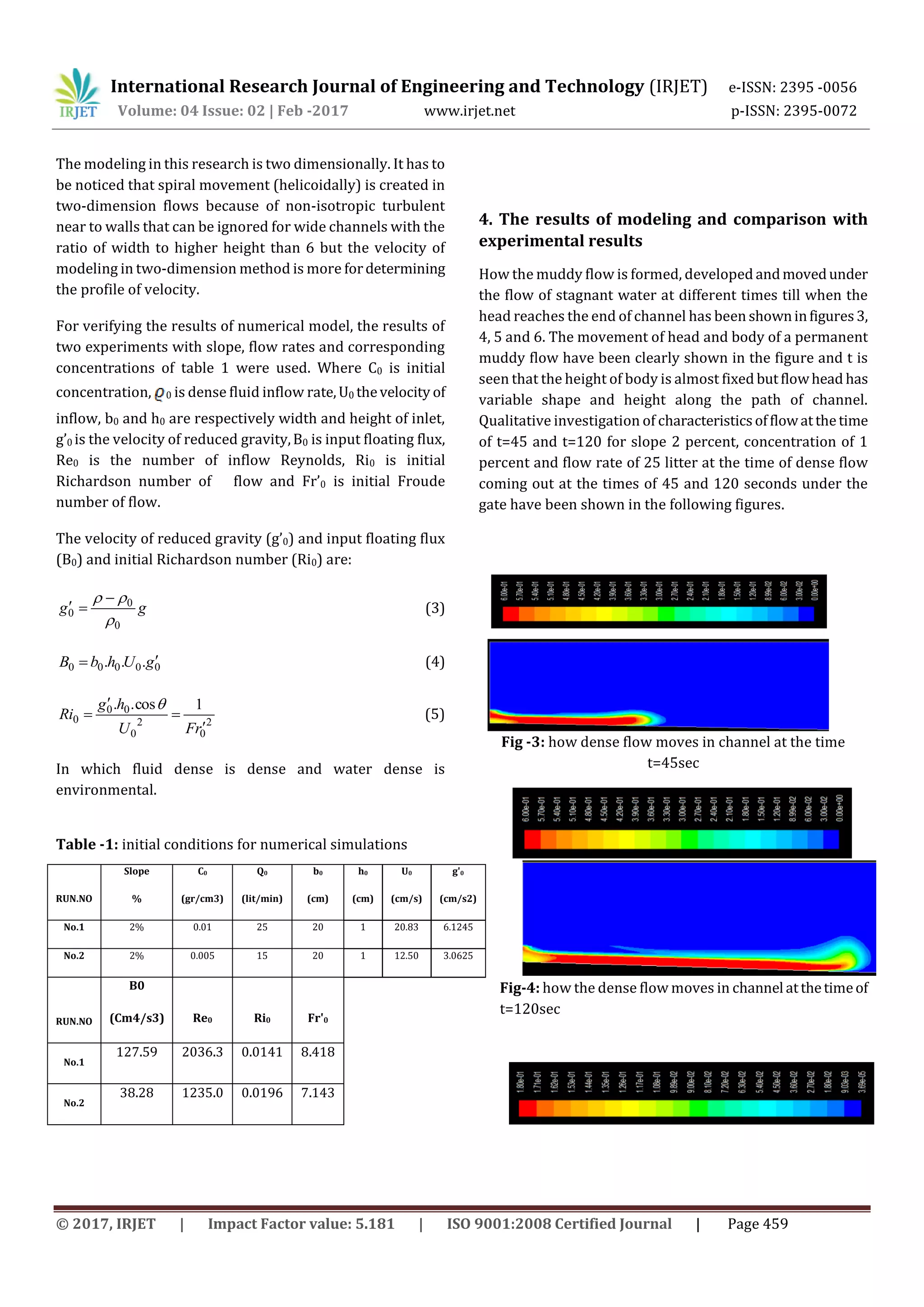
How the muddy flow is formed, developed andmovedunder
the flow of stagnant water at different times till when the
head reaches the end of channel has been showninfigures3,
4, 5 and 6. The movement of head and body of a permanent
muddy flow have been clearly shown in the figure and t is
seen that the height of body is almost fixed butflowhead has
variable shape and height along the path of channel.
Qualitative investigation of characteristicsofflowatthetime
of t=45 and t=120 for slope 2 percent, concentration of 1
percent and flow rate of 25 litter at the time of dense flow
coming out at the times of 45 and 120 seconds under the
gate have been shown in the following figures.
Fig -3: how dense flow moves in channel at the time
t=45sec
Fig-4: how the dense flow moves in channel atthetimeof
t=120sec
RUN.NO
Slope
%
C0
(gr/cm3)
Q0
(lit/min)
b0
(cm)
h0
(cm)
U0
(cm/s)
g'0
(cm/s2)
No.1 2% 0.01 25 20 1 20.83 6.1245
No.2 2% 0.005 15 20 1 12.50 3.0625
RUN.NO
B0
(Cm4/s3) Re0 Ri0 Fr'0
No.1
127.59 2036.3 0.0141 8.418
No.2
38.28 1235.0 0.0196 7.143
International Research Journal of Engineering and Technology (IRJET) e-ISSN: 2395 -0056
Volume: 04 Issue: 02 | Feb -2017 www.irjet.net p-ISSN: 2395-0072
© 2017, IRJET | Impact Factor value: 5.181 | ISO 9001:2008 Certified Journal | Page 460
Fig-5: velocity vectors of dense flows at the time t=120sec
Fig-6: velocity vectors of dense flows in head of flow
t=120sec
As following, the head frontal velocity of non-conservative
dense flows and the comparison of modeling results with
experimental results will be investigated. Being aware of
head frontal velocity in dense flows is very important in
many engineering functions. Based on this the results of
measuring velocity in head of muddy flows which have been
obtained using sound velocity meter system by previous
experimental researches [1] are used in this part.
How velocity changes, flow frontal velocity in different
distances of input using numerical model (fluent) for two
experiments have been used in figure 7. As it can be seen at
the beginning of input becauseofcreatedinstabilitiescaused
by the sudden withdrawal of dense fluid into environmental
fixed fluid, dispersion in measured velocity of fluid frontcan
be justified. In the distance about 3 meters till the end of
channel head frontal velocity is fixed. The experimental
results, obtained results of frontal velocity in flow head in
laboratory and numerical simulation (at the distance of 3 to
11 meters from channel input) have been estimated and
compared in figure 8.
In each level of numerical modeling dense flow with specific
concentration and flow rate enter the channel from one
centimeter down the hatches.Whentheflowreachesthe end
of channel, modeling will stop and considering head frontal
velocity is fixed in two-dimension flows along channel, it is
measured in middle depth of channel and then compared
with the relevant experimental results (whose
characteristics are in table 1).
Fig – 7: head frontal velocity of dense flows in different
distances of input considering obtained numerical model
(fluent)
Fig- 8: comparing the velocity of head movement of dense
flow in numerical model (fluent) with experimental results
in the distance of 3 to 11 meter from channel input
International Research Journal of Engineering and Technology (IRJET) e-ISSN: 2395 -0056
Volume: 04 Issue: 02 | Feb -2017 www.irjet.net p-ISSN: 2395-0072
© 2017, IRJET | Impact Factor value: 5.181 | ISO 9001:2008 Certified Journal | Page 461
Table-2: comparing the velocity of head movementofdense
flow in numerical model (fluent) with experimental results
in the distance of 3 to 11 meter from channel input
5. Conclusion
Non-conservative dense flow frontal velocity was simulated
in this research using numerical code Fluent through Euler-
Lagrange method and was assessed as a suitable tool for
hydrodynamic simulation of behaviorofexperimental dense
flows. The comparison of modeling obtained results with
experimental results, meanwhile has verified the results of
numerical model, it has greatly helped in analyzing the
pattern of fluid movement in different scales.
1- Head frontal velocity is fixed considering numerical and
experimental modeling in two-dimension mode in
distance (3 to 11 meter) from input. Comparing the
results of numerical modeling and experimental results,
it can be observed that the results have relatively good
accordance.
2- The position of forming vortices at the time of passing
head and after that can be well observed by numerical
model. The areas with high shear stress in the center of
dense fluid with environmental fluid can be also
observed.
3- Comparing numerical model and experimental data
showed that the models of Fluent numerical code that
have been established based on CFD can give relatively
confident results and is appropriate for simulating this
type of flows. Considering the results above, analytical
models from turbulentdense flowcanbecomparedwith
empirical results of this experiment and used with
higher confidence coefficient of these models for
estimating the volume of sedimentary in channels and
reservoirs behind dam and so on.
REFERENCES
[1] A. Hosseini, “Doctoral Dissertation” Sharif University
Tehran, Iran, 2006.
[2] J. E. Simpson, “Gravity Currents in the Laboratory,
Atmosphere and Ocean”, Ann. Ev Fluid Mech., Vol.14,
1982.
[3] Champiri, M. D., Sajjadi, S., Mousavizadegan, S. H., Moodi,
F., “Assessing of Distress Cause and Estimating Evaluation
Index for Marine Concrete Structures, American Journal of
Civil Engineering and Architecture, Science and Education
Publishing, 4(4), 142-152, 2016.
[4] Champiri, M. D., Sajjadi, S., Mousavizadegan, S. H., Moodi,
F., “A Fuzzy System for Evaluation of Deteriorated Marine
Steel Structures”, Journal of Intelligent and Fuzzy Systems,
IOS press, DOI:10.3233/JIFS-161411, 2017.
[5] F. Ghasemzadeh, S. Sajedi, M. Shekarchi, & H. Layssi, M.
Hallaji, “Performanceevaluationofdifferent repairconcretes
proposed for an existing deterioratedjettystructure. Journal
of Performance of Constructed Facilities”, 28(4), 04014013,
2013.
[6] J.R.L. Allen, “Mixing at turbidity current heads and its
geological implication”, J. Sediment Petrol., No.41, 97-113,
1971.
[7] A. Hamedi, M. Ketabdar, M. Fesharaki, & A. Manoori,
“Nappe Flow Regime Energy Loss in Stepped Chutes
Equipped with Reverse Inclined Steps: Experimental
Development.” Florida Civil Engineering Journal, 2:28-37,
2016.
[8] Hamedi, A., Mansoori, A., Shamsai,A.,&Amirahmadian,S.
“ The Effect of End Sill and Stepped Slope on Stepped
Spillway Energy Dissipation.” Journal of Water Sciences
Research, 6 :1-15, 2014.
[9] H. Sarkardeh, E. Jabbari, A. R. Zarrati, S. Tavakkol,
“Velocity field in a reservoir in the presence of an air-core
vortex.”, J. Water Manage, Vol. 164, No. 4, pp. 193-200, 2013.
[10] A. Hamedi, M. Hajigholizadeh, & A. Mansoori, “Flow
Simulation and Energy Loss Estimation in the Nappe Flow
Regime of Stepped Spillways with Inclined Steps and End
Sill: A Numerical Approach.” Civil Engineering.Journal.,2(9),
426-437, 2016.
[11] FLUENT 6.3.26 User’s Guide 2008.
[12] N. Georgoulas et al, " 3D numerical modelling of
turbidity currents" Laboratory of Hydraulics and Hydraulic
Structures, Department of Civil Engineering Democritus
University of Thrace, 2010.
[13] Gambit 2.2, Tutorial Guide.
Experiment
number
DescriptionExperimentFLUENTError
No.1S2C10Q254.514.86.43
No.2S2C5Q152.662.53-4.89
International Research Journal of Engineering and Technology (IRJET) e-ISSN: 2395 -0056
Volume: 04 Issue: 02 | Feb -2017 www.irjet.net p-ISSN: 2395-0072
© 2017, IRJET | Impact Factor value: 5.181 | ISO 9001:2008 Certified Journal | Page 462
[14] M. Baqersad, A. Eslami Haghighat, M. Rowshanzamir, H.
Mortazavi Bak, “Comparison of Coupled and Uncoupled
Consolidation Equations Using Finite Element Method in
Plane-Strain Condition.” Civil Engineering Journal, 2: 375-
388, 2016.
[15]Hamedi, A., Ketabdar, M. “Energy Loss Estimation and
Flow Simulation in the skimming flow Regime of Stepped
Spillways with Inclined Steps and End Sill: A Numerical
Model.” International Journal of Science and Engineering
Applications, 5(7), 399-407, 2016.
[16] Zeidi, S. M. J, Mahdi, M., “Evaluation of the physical
forces exerted on a spherical bubble inside the nozzle in a
cavitating flow with an Eulerian/Lagrangian approach”,
European journal of physics, 136(6), 2015.
[17] Zeidi, S. M. J, Mahdi, M., “Investigation effectsofinjection
pressure and compressibility and nozzle entry in diesel
injector nozzle’s flow”, journal of applied andcomputational
mechanics, 2(1), PP 83-94. ISSN: 2383-4536, 2015.
[18] Zeidi, S. M. J, Mahdi, M., “Effects of nozzle geometry and
fuel characteristics on cavitation phenomena in injection
nozzles”, The 22st Annual International Conference on
Mechanical Engineering-ISME2014, Tehran, Iran, 2014.
[19] Zeidi, S. M. J, Mahdi, M., “Investigation of viscosity effect
on velocity profile and cavitation formationindiesel injector
nozzle”, Proceedings of the 8-th International Conference on
Internal Combustion Engines, Tehran, Iran, 2014.

Numerical Investigation of Head Frontal Velocity of Non-conservative Dense Flows in Small Inclined Beds

  • 1.
    International Research Journalof Engineering and Technology (IRJET) e-ISSN: 2395 -0056 Volume: 04 Issue: 02 | Feb -2017 www.irjet.net p-ISSN: 2395-0072 © 2017, IRJET | Impact Factor value: 5.181 | ISO 9001:2008 Certified Journal | Page 457 Numerical Investigation of Head Frontal Velocity of Non-conservative Dense Flows in Small Inclined Beds Ehsan Hajibabaei1, Alireza Ghasmi1, Seyed Abbas Hosseini1 1Technical and Engineering Department, Science and Research Branch, Islamic Azad University, Tehran, Iran ---------------------------------------------------------------------***--------------------------------------------------------------------- Abstract - Non-conservative dense flow frontal velocityhas been simulated two dimensionally by fluent numerical code. The outcomes have been compared with experimental results. Numerical simulation was conducted as two-phase through Euler-Lagrange method. Reynolds-Stress Turbulent Model (RSM) with non-uniform grid and shredding mesh on the channel floor. The results obtained from numerical model of head frontal velocity show agoodcompliance withexperiment results and greatly help analyzing the pattern of fluid movement in different scales. Key Words: dense flow, fluent, head frontal velocity 1. INTRODUCTION The specific area of head is in frontal edge of dense flow that has been deeper than tail area and have different characteristics of flow body. Dynamic identification of head is very important because it is generally considered as a boundary condition for the flow [1]. Dense flows which stream on horizontal surface have almost semi-permanent head and a depth twice the depth of the body of flow but in a flow which passes on a slope, the depth of head always increase. The shape of head in gravity flows aren’t generalizable and severely depend on physical conditions, environmental fluid depth and other cases. Figure (1) represents the first experiments that are formed for modeling the head of a cold flow of wind in atmosphere using temperature difference. In figures (1-a) and (1-b), the head of flow with low Reynolds numberabout10, Rer= (Ur head velocity, hr is its height and v is kinematic viscosity) has been shown. When temperature gets more and the number of Reynolds increases, the form of head will change, its nose gets closer to the earth floor and severe mix occurs in front of and above the head. Figure (1-F) shows a flow whose Reynolds number is upper than 1000 in which some billows raise from high level and goes backwardly [2]. As it can be seen the head of flow is an area in which severe disorder and turbulent happen and there is high density gradient. When velocity and as result the number of Reynolds in flow increase, the form of head changes and mainly turn to more stretched mode. Whirlpool within head during rotation generates many vortices and pollens that in area above that breaks in three dimension and very complicated form andcreatessomeinstabilities. Thevelocity changes may create different types of damages such as erosion, abrasion and cavitation which are extensively reported for concrete and steel structures [3-5].Inheadarea because of great vortex, turbulence and mixing and inside mixture are also more and gradient of velocity and dense is stronger in this area. Mixture of dense flow with fluid of environment is an important process that occurs in head of flow through dense fluid suction behind and back of head as series of cross vortices [6]. Another example of turbulent flow with hydraulic jump,vortexandpressurefluctuationsis considered by Hamedi et al. in stepped spillways with horizontal and inclined steps. They reported thatinclination slightly increases the energy loss [7] Hamedi et al., also, mentoned that the combination of inclination and end sill increases the energy loss [8]. Also, velocity field in reservoir has been considered by Sarkardehetal.inpresenceofan air- core vortex as another example of turbulent flow [9]. Fig-1: The changes of radial velocity versus time Figure 1- transformation of head of experiment gravity flow through increasing Reynolds number a) Reynolds number less than 10, f) Reynolds more than 1000 [2] Using images with slow movement for tracking and following the form of billows in upper boundary of flow show that the wave and range of these billows can grow to the size of head and then they are collapsed and broken [1].
  • 2.
    International Research Journalof Engineering and Technology (IRJET) e-ISSN: 2395 -0056 Volume: 04 Issue: 02 | Feb -2017 www.irjet.net p-ISSN: 2395-0072 © 2017, IRJET | Impact Factor value: 5.181 | ISO 9001:2008 Certified Journal | Page 458 2. Theoretical principles Dominant equations on the movement of an incompressible viscous fluid at the state of chaos are expressed using averaged Navier-Stokes equations known as Reynolds (RANS). Hamedi et al. mentioned all numerical models which Fluent software is using to solve problems [10]. Continuity equation (conservation of mass) and motion (conservation of momentum) are mentioned below [11]: - Continuity equation = =0 (1) - Momentum equation + =- + + ( ) (2) Ui is the component of averaged velocity in the time to the direction of xi, p total pressure, fluid dense, gi the velocity of gravity to the direction of xi and is stress tensorthatin turbulent flows, it includes two terms and in addition to the stress caused by average component of flow,theotherstress derived from fluctuation component of velocity is created that is known as Reynolds stresses and is shown using Boussinesq’s idea. Modeling in this research id conducted through Euler- Lagrange method so that continuous phase of flow is solved using Euler equations that are Navier-Stokes equations and then second phase for example sedimentary particles are investigated at the points of view of Lagrange; so that the balance of all the forces acting on the particles in two directions of x and y and placing them in the equation of the size of Newton movement F=ma, give the velocity of particle that the position of particle will be found by putting the velocity of particle in the equation of up= that up is the velocity of particle and xp is spatial position of particle. Model DPM is one of capabilities of fluent in modeling two- phase flows [12] that its second phase can be formed by sedimentary particles or bubble or drops. Many researches in two-phase flows have noticed this model [12]. 3. Initial conditions and numerical solution of equations In order to solve field of flow and conducting some studies on model, Fluent software has been used. To numerically simulate the dominant equations on these flows, an existing numerical code known as Fluenthas beenused. Fluent is a strong software in the field of CFD. Continuity and Navier-Stokes equations are used in analyzing the flow. In case the flow is turbulent then dominant equations turn to Reynolds ones and one- equation, two-equation, five or six-equation modelsareused for determining eddy viscosity thatuserdeterminesthetype of model [11]. Fluent converts dominant equations to algebraic equations through the method of finite volumes and then solve them. Considering that Fluent software doesn’t generate network itself and the network should be generated in another software, Fluent is capable of reading mesh from other software such as Gambit, Geomesh and ANSIS. In this research in first step, the shape of problem is drawn in AutoCAD software and in the second step, meshing was formed on general geometry in Gambit software [13], meshing is non-uniformly and rectangular. Then the type of the boundaries of solution zone such as wall, input and output were specified, generated mesh is read in Fluent software and controlled in this software in case of probable problems such as negative volumes. Geometry and boundary conditions of flow have been represented in Figure 2. Fig-2: geometry and boundary conditions of flow For better accordance of results in the section, meshing is fine in 20 centimeters of channel floor that whatever we get closer to the bottom of channel, meshingwill besmaller.This meshing method also has been used by Baqersad et al. [14] and Hamedi and Ketabdar [15]. The configuration and topology which was defined by Zeidi et al. [16-19] was helpful to define mesh topology and boundary conditions.
  • 3.
    International Research Journalof Engineering and Technology (IRJET) e-ISSN: 2395 -0056 Volume: 04 Issue: 02 | Feb -2017 www.irjet.net p-ISSN: 2395-0072 © 2017, IRJET | Impact Factor value: 5.181 | ISO 9001:2008 Certified Journal | Page 459 The modeling in this research is two dimensionally. It has to be noticed that spiral movement (helicoidally) is created in two-dimension flows because of non-isotropic turbulent near to walls that can be ignored for wide channels with the ratio of width to higher height than 6 but the velocity of modeling in two-dimension method is more fordetermining the profile of velocity. For verifying the results of numerical model, the results of two experiments with slope, flow rates and corresponding concentrations of table 1 were used. Where C0 is initial concentration, 0 is dense fluid inflow rate,U0 thevelocity of inflow, b0 and h0 are respectively width and height of inlet, g’0 is the velocity of reduced gravity,B0 is input floating flux, Re0 is the number of inflow Reynolds, Ri0 is initial Richardson number of flow and Fr’0 is initial Froude number of flow. The velocity of reduced gravity (g’0) and input floating flux (B0) and initial Richardson number (Ri0) are: gg 0 0 0     (3) 00000 ... gUhbB  (4) 2 0 2 0 00 0 1cos.. rFU hg Ri      (5) In which fluid dense is dense and water dense is environmental. Table -1: initial conditions for numerical simulations 4. The results of modeling and comparison with experimental results How the muddy flow is formed, developed andmovedunder the flow of stagnant water at different times till when the head reaches the end of channel has been showninfigures3, 4, 5 and 6. The movement of head and body of a permanent muddy flow have been clearly shown in the figure and t is seen that the height of body is almost fixed butflowhead has variable shape and height along the path of channel. Qualitative investigation of characteristicsofflowatthetime of t=45 and t=120 for slope 2 percent, concentration of 1 percent and flow rate of 25 litter at the time of dense flow coming out at the times of 45 and 120 seconds under the gate have been shown in the following figures. Fig -3: how dense flow moves in channel at the time t=45sec Fig-4: how the dense flow moves in channel atthetimeof t=120sec RUN.NO Slope % C0 (gr/cm3) Q0 (lit/min) b0 (cm) h0 (cm) U0 (cm/s) g'0 (cm/s2) No.1 2% 0.01 25 20 1 20.83 6.1245 No.2 2% 0.005 15 20 1 12.50 3.0625 RUN.NO B0 (Cm4/s3) Re0 Ri0 Fr'0 No.1 127.59 2036.3 0.0141 8.418 No.2 38.28 1235.0 0.0196 7.143
  • 4.
    International Research Journalof Engineering and Technology (IRJET) e-ISSN: 2395 -0056 Volume: 04 Issue: 02 | Feb -2017 www.irjet.net p-ISSN: 2395-0072 © 2017, IRJET | Impact Factor value: 5.181 | ISO 9001:2008 Certified Journal | Page 460 Fig-5: velocity vectors of dense flows at the time t=120sec Fig-6: velocity vectors of dense flows in head of flow t=120sec As following, the head frontal velocity of non-conservative dense flows and the comparison of modeling results with experimental results will be investigated. Being aware of head frontal velocity in dense flows is very important in many engineering functions. Based on this the results of measuring velocity in head of muddy flows which have been obtained using sound velocity meter system by previous experimental researches [1] are used in this part. How velocity changes, flow frontal velocity in different distances of input using numerical model (fluent) for two experiments have been used in figure 7. As it can be seen at the beginning of input becauseofcreatedinstabilitiescaused by the sudden withdrawal of dense fluid into environmental fixed fluid, dispersion in measured velocity of fluid frontcan be justified. In the distance about 3 meters till the end of channel head frontal velocity is fixed. The experimental results, obtained results of frontal velocity in flow head in laboratory and numerical simulation (at the distance of 3 to 11 meters from channel input) have been estimated and compared in figure 8. In each level of numerical modeling dense flow with specific concentration and flow rate enter the channel from one centimeter down the hatches.Whentheflowreachesthe end of channel, modeling will stop and considering head frontal velocity is fixed in two-dimension flows along channel, it is measured in middle depth of channel and then compared with the relevant experimental results (whose characteristics are in table 1). Fig – 7: head frontal velocity of dense flows in different distances of input considering obtained numerical model (fluent) Fig- 8: comparing the velocity of head movement of dense flow in numerical model (fluent) with experimental results in the distance of 3 to 11 meter from channel input
  • 5.
    International Research Journalof Engineering and Technology (IRJET) e-ISSN: 2395 -0056 Volume: 04 Issue: 02 | Feb -2017 www.irjet.net p-ISSN: 2395-0072 © 2017, IRJET | Impact Factor value: 5.181 | ISO 9001:2008 Certified Journal | Page 461 Table-2: comparing the velocity of head movementofdense flow in numerical model (fluent) with experimental results in the distance of 3 to 11 meter from channel input 5. Conclusion Non-conservative dense flow frontal velocity was simulated in this research using numerical code Fluent through Euler- Lagrange method and was assessed as a suitable tool for hydrodynamic simulation of behaviorofexperimental dense flows. The comparison of modeling obtained results with experimental results, meanwhile has verified the results of numerical model, it has greatly helped in analyzing the pattern of fluid movement in different scales. 1- Head frontal velocity is fixed considering numerical and experimental modeling in two-dimension mode in distance (3 to 11 meter) from input. Comparing the results of numerical modeling and experimental results, it can be observed that the results have relatively good accordance. 2- The position of forming vortices at the time of passing head and after that can be well observed by numerical model. The areas with high shear stress in the center of dense fluid with environmental fluid can be also observed. 3- Comparing numerical model and experimental data showed that the models of Fluent numerical code that have been established based on CFD can give relatively confident results and is appropriate for simulating this type of flows. Considering the results above, analytical models from turbulentdense flowcanbecomparedwith empirical results of this experiment and used with higher confidence coefficient of these models for estimating the volume of sedimentary in channels and reservoirs behind dam and so on. REFERENCES [1] A. Hosseini, “Doctoral Dissertation” Sharif University Tehran, Iran, 2006. [2] J. E. Simpson, “Gravity Currents in the Laboratory, Atmosphere and Ocean”, Ann. Ev Fluid Mech., Vol.14, 1982. [3] Champiri, M. D., Sajjadi, S., Mousavizadegan, S. H., Moodi, F., “Assessing of Distress Cause and Estimating Evaluation Index for Marine Concrete Structures, American Journal of Civil Engineering and Architecture, Science and Education Publishing, 4(4), 142-152, 2016. [4] Champiri, M. D., Sajjadi, S., Mousavizadegan, S. H., Moodi, F., “A Fuzzy System for Evaluation of Deteriorated Marine Steel Structures”, Journal of Intelligent and Fuzzy Systems, IOS press, DOI:10.3233/JIFS-161411, 2017. [5] F. Ghasemzadeh, S. Sajedi, M. Shekarchi, & H. Layssi, M. Hallaji, “Performanceevaluationofdifferent repairconcretes proposed for an existing deterioratedjettystructure. Journal of Performance of Constructed Facilities”, 28(4), 04014013, 2013. [6] J.R.L. Allen, “Mixing at turbidity current heads and its geological implication”, J. Sediment Petrol., No.41, 97-113, 1971. [7] A. Hamedi, M. Ketabdar, M. Fesharaki, & A. Manoori, “Nappe Flow Regime Energy Loss in Stepped Chutes Equipped with Reverse Inclined Steps: Experimental Development.” Florida Civil Engineering Journal, 2:28-37, 2016. [8] Hamedi, A., Mansoori, A., Shamsai,A.,&Amirahmadian,S. “ The Effect of End Sill and Stepped Slope on Stepped Spillway Energy Dissipation.” Journal of Water Sciences Research, 6 :1-15, 2014. [9] H. Sarkardeh, E. Jabbari, A. R. Zarrati, S. Tavakkol, “Velocity field in a reservoir in the presence of an air-core vortex.”, J. Water Manage, Vol. 164, No. 4, pp. 193-200, 2013. [10] A. Hamedi, M. Hajigholizadeh, & A. Mansoori, “Flow Simulation and Energy Loss Estimation in the Nappe Flow Regime of Stepped Spillways with Inclined Steps and End Sill: A Numerical Approach.” Civil Engineering.Journal.,2(9), 426-437, 2016. [11] FLUENT 6.3.26 User’s Guide 2008. [12] N. Georgoulas et al, " 3D numerical modelling of turbidity currents" Laboratory of Hydraulics and Hydraulic Structures, Department of Civil Engineering Democritus University of Thrace, 2010. [13] Gambit 2.2, Tutorial Guide. Experiment number DescriptionExperimentFLUENTError No.1S2C10Q254.514.86.43 No.2S2C5Q152.662.53-4.89
  • 6.
    International Research Journalof Engineering and Technology (IRJET) e-ISSN: 2395 -0056 Volume: 04 Issue: 02 | Feb -2017 www.irjet.net p-ISSN: 2395-0072 © 2017, IRJET | Impact Factor value: 5.181 | ISO 9001:2008 Certified Journal | Page 462 [14] M. Baqersad, A. Eslami Haghighat, M. Rowshanzamir, H. Mortazavi Bak, “Comparison of Coupled and Uncoupled Consolidation Equations Using Finite Element Method in Plane-Strain Condition.” Civil Engineering Journal, 2: 375- 388, 2016. [15]Hamedi, A., Ketabdar, M. “Energy Loss Estimation and Flow Simulation in the skimming flow Regime of Stepped Spillways with Inclined Steps and End Sill: A Numerical Model.” International Journal of Science and Engineering Applications, 5(7), 399-407, 2016. [16] Zeidi, S. M. J, Mahdi, M., “Evaluation of the physical forces exerted on a spherical bubble inside the nozzle in a cavitating flow with an Eulerian/Lagrangian approach”, European journal of physics, 136(6), 2015. [17] Zeidi, S. M. J, Mahdi, M., “Investigation effectsofinjection pressure and compressibility and nozzle entry in diesel injector nozzle’s flow”, journal of applied andcomputational mechanics, 2(1), PP 83-94. ISSN: 2383-4536, 2015. [18] Zeidi, S. M. J, Mahdi, M., “Effects of nozzle geometry and fuel characteristics on cavitation phenomena in injection nozzles”, The 22st Annual International Conference on Mechanical Engineering-ISME2014, Tehran, Iran, 2014. [19] Zeidi, S. M. J, Mahdi, M., “Investigation of viscosity effect on velocity profile and cavitation formationindiesel injector nozzle”, Proceedings of the 8-th International Conference on Internal Combustion Engines, Tehran, Iran, 2014.