Journal of Engineering and Development, Vol. 16, No.2, June 2012 ISSN 1813- 7822
16
A Numerical Study of Low Reynolds Number
Incompressible Flow at Entrance and Disturbed Regions Of
Concentric Circular Pipes
Abstract:
The developing laminar flow in the entrance and disturbed regions of concentric circular
pipes has been studied numerically. Both main pipe and disturbed pipe are concentric and
stationary. Uniform developing flow occurs in entrance region of main pipe and inside
disturbed pipe at disturbed region. while non-uniform developing flow occurs in annular
concentric disturbed pipe at disturbed region. For the two-dimensional problem, numerical
solutions are obtained for a wide range of Reynolds number from 25 to 375. A computer
program and AutoFEA software were used to calculate the velocity and pressure drop
within the entire channel. The maximum velocity at the centerline of the pipe,
hydrodynamic boundary layer developed faster for the lower Reynolds number. However,
the flow field is similar for all studied cases. All the present work data are in good
agreement with AutoFEA software.
Keywords: entrance region, disturbed flow, incompressible, circular pipe
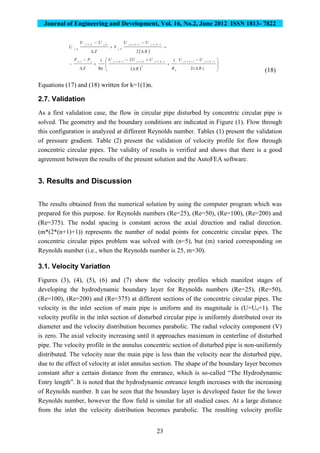
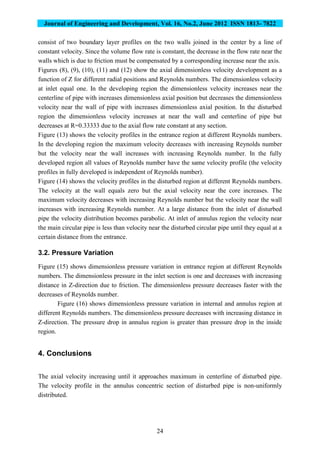
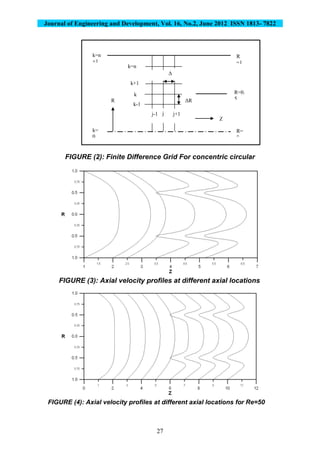
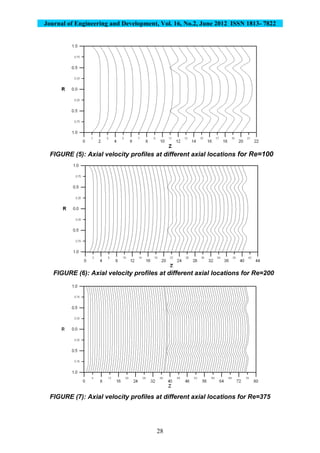
‫االعتراض‬ ‫منطقة‬ ‫و‬ ‫المدخل‬ ‫منطقة‬ ‫عند‬ ‫واطئ‬ ‫رينولدز‬ ‫بعدد‬ ‫انضغاطي‬ ‫ال‬ ‫لمائع‬ ‫عددية‬ ‫دراسة‬‫بأنبوبين‬
‫المر‬ ‫متحدي‬ ‫دائريين‬‫ك‬‫ز‬
‫الخالصة‬
‫ااا‬ ‫انياا‬‫ا‬‫ااالم‬ ‫االبااني‬ ‫الجريان‬‫ا‬ ‫مر‬ ‫ا‬‫ا‬ ‫ما‬ ‫ا‬ ‫اناي‬‫ا‬.‫دي‬‫م‬‫ا‬ ‫راالخركا‬ ‫ا‬‫ا‬‫اداارييناماياريينايبز‬‫ا‬‫باراواي‬ ‫ااااض‬‫ا‬ ‫وماطيمب‬ ‫اااالخا‬‫ا‬ ‫يمب‬
‫وما‬ ‫ااايا‬ ‫ااايمب‬ ‫ا‬ ‫االمانيااالخمابة‬ ‫قاالبا‬ ‫ايزا‬ ‫اطاننيبان‬ ‫ااالخركا‬ ‫براياااكماخانايبزا‬ ‫األاارباالرييسااطاألاااربااض‬
‫االخ‬ ‫ا‬‫ا‬‫ااايبز‬‫ا‬‫براي‬ ‫اربااض‬‫ا‬‫امااألاا‬‫ا‬‫اراواماو‬‫ا‬‫ب‬ ‫ااااض‬‫ا‬ ‫ااايمب‬‫ا‬ ‫اااط‬‫ا‬‫ايرراالرييس‬ ‫ا‬‫ا‬‫ارباال‬‫ا‬‫األاا‬‫ارا‬‫ا‬‫ي‬ ‫انياا‬‫ا‬‫االم‬ ‫ا‬‫ا‬‫قاالب‬ ‫ا‬‫ا‬‫ايز‬ ‫ا‬‫ا‬‫رك‬
‫ميااانمنييااا‬ ‫االزقارااال‬ ‫باراو‬ ‫ااااض‬ ‫ااايمب‬ ‫ا‬ ‫االخركا‬ ‫ايررايبزا‬ ‫باراواالا‬ ‫ياااياناواااربااض‬ ‫اااالزق‬ ‫ااالخمب‬ ‫ا‬ ‫الخمبة‬
‫انا‬‫ا‬‫واي‬ ‫ا‬‫ا‬‫اتا‬ ‫ا‬‫ا‬‫انداييمرل‬‫ا‬‫اناويز‬‫ا‬‫اااي‬‫ا‬.‫اطا‬ ‫ا‬‫ا‬‫ادالخ‬‫ا‬‫انماتخ‬‫ا‬ ‫األي‬52‫ا‬‫ا‬ ‫ا‬‫ا‬‫إل‬572‫ا‬ ‫اني‬‫ا‬‫اماطايرا‬‫ا‬‫اييس‬ ‫اني‬‫ا‬‫ادايرا‬ ‫اب‬‫ا‬.‫اا‬ ‫ا‬‫ا‬‫ات‬AutoFEA‫ا‬
‫لزسنباالسرعاطاالهارطاين‬‫ااالخبنوخااتمخاراو.ارعا‬ ‫ايزريااألاارباطاالبا‬ ‫م‬ ‫اا‬ ‫ا.ر‬ ‫اوزص‬ ‫اامحظاا‬ ‫منة‬ ‫لضغطايخناال‬
‫ااا‬‫ا‬‫االزنلي‬ ‫ا‬‫ا‬‫انااالاز‬‫ا‬‫امايينا‬‫ا‬‫اك‬ ‫اا‬‫ا‬.‫يط‬ ‫انضااالخ‬‫ا‬‫اماالز‬‫ا‬ ‫امال‬‫ا‬‫ايخنن‬ ‫ا‬‫ا‬‫اماالب‬‫ا‬ ‫اح‬ ‫اناا‬‫ا‬‫اغيرةاطنلخ‬‫ا‬‫ال‬ ‫ا‬‫ا‬‫اماييمرل‬ ‫ا‬‫ا‬ ‫اداو‬ ‫اب‬‫ا‬.‫اا‬ ‫ا‬‫ا‬‫م‬
‫ا‬ ‫اياازي‬ ‫ماجي‬ ‫ااسجخداي‬AutoFEA software‫ا‬
Ahmed Ali Shaker
College of Engineering
Al-Qadissiya University
Mechanical Engineering Department
ahmedalsaadi78@gmail.com
Journal of Engineering and Development, Vol. 16, No.2, June 2012 ISSN 1813- 7822
17
Nomenclature
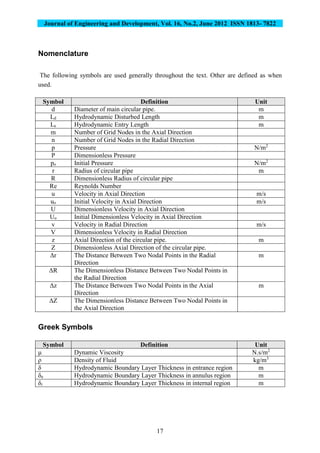
The following symbols are used generally throughout the text. Other are defined as when
used.
Symbol Definition Unit
d Diameter of main circular pipe. m
Ld Hydrodynamic Disturbed Length m
Le Hydrodynamic Entry Length m
m Number of Grid Nodes in the Axial Direction
n Number of Grid Nodes in the Radial Direction
p Pressure N/m2
P Dimensionless Pressure
po Initial Pressure N/m2
r Radius of circular pipe m
R Dimensionless Radius of circular pipe
Re Reynolds Number
u Velocity in Axial Direction m/s
uo Initial Velocity in Axial Direction m/s
U Dimensionless Velocity in Axial Direction
Uo Initial Dimensionless Velocity in Axial Direction
v Velocity in Radial Direction m/s
V Dimensionless Velocity in Radial Direction
z Axial Direction of the circular pipe. m
Z Dimensionless Axial Direction of the circular pipe.
Δr The Distance Between Two Nodal Points in the Radial
Direction
m
ΔR The Dimensionless Distance Between Two Nodal Points in
the Radial Direction
Δz The Distance Between Two Nodal Points in the Axial
Direction
m
ΔZ The Dimensionless Distance Between Two Nodal Points in
the Axial Direction
Greek Symbols
Symbol Definition Unit
μ Dynamic Viscosity N.s/m2
ρ Density of Fluid kg/m3
δ Hydrodynamic Boundary Layer Thickness in entrance region m
δa Hydrodynamic Boundary Layer Thickness in annulus region m
δi Hydrodynamic Boundary Layer Thickness in internal region m
Journal of Engineering and Development, Vol. 16, No.2, June 2012 ISSN 1813- 7822
18
Subscripts
Symbol Definition Unit
j,k The Index Increment Along the Axial and Radial Direction
i Inner
o Outer
1. Introduction
Flow through circular pipes with concentric disturbed pipe has important industrial
applications in the fields of thermal and fluid engineering. Particularly its importance is noted
in process industries under particular process requirement and in the design of heat –
exchanging equipment. The associated flow patterns developed due to the presence of such
disturbed pipe can be quite complex with the development of disturbed zones and their
interactions with the confined jet. It has great influence on heat transfer effectiveness and
pumping power requirement. This clearly shows the importance of study of such flow
hydrodynamics. The model geometry is shown in figure (1). Few works have been reported
for flow disturbed by concentric circular pipes.
Mohammad [8] numerically studied the problem of steady laminar forced convection in the
entry region of concentric annuli with rotating inner walls using fluent code. Due to the axi-
symmetry of the problem, a 2D axi-symmetric model is used. Focus is on rotation number
(Ro), annulus radius ratio (N) effects on heat transfer characteristics, and the torque required
to rotate the inner walls. Air and engine oil were used in the simulation. Reynolds number
(Re) of 500 based on inlet velocity and hydraulic diameter is kept constant over the whole
range of the considered rotation numbers and radius ratios.
Mandal and Chakrabarti [7] numerically investigated disturbances of blood flow through a
stenotic coronary artery for the restrictions of 10% to 90% with the Reynolds numbers
ranging from 25 to 375. Atherosclerotic plaque formation tends to start from very low flow
Reynolds number of 25 with 50% restriction. For Reynolds numbers of 100 and above, it
starts at 30% stenosed condition. Impact of percent stenosis on wall shear stress has been
noted to be more effective than Reynolds number.
Founargiotakis et al. [3] presented an integrated approach for the flow of Herschel–Bulkley
fluids in a concentric annulus, modeled as a slot, covering the full range of flow types,
laminar, transitional, and turbulent. Prior analytical solutions for laminar flow are utilized.
Turbulent flow solutions are developed using the Metzner–Reed Reynolds number after
determining the local power law parameters as functions of flow geometry and the Herschel–
Bulkley rheological parameters. The friction factor is estimated by modifying the pipe flow
equation. Transitional flow is solved introducing transitional Reynolds numbers which are
functions of the local power law index.
Journal of Engineering and Development, Vol. 16, No.2, June 2012 ISSN 1813- 7822
19
Nam and Young [9] numerically investigated the rotating flow in an annulus. The mean
diameter of particles was 0.1 cm and a material density of 2.55 g/cm3 were used in the
experiment.
Hua-Shu et al. [4] studied integrated axial flow in an annulus between two concentric
cylinders. The critical condition for turbulent transition in annulus flow is calculated with the
energy gradient method for various radius ratios. The critical flow rate and critical Reynolds
number are given for various radius ratios. The critical condition for the instability of full-
developed laminar flow in an annulus is given following the “energy gradient method.” The
criterion for instability is based on the energy gradient method for parallel flow instability. It
is shown that the critical flow rate and the critical Reynolds number for onset of turbulent
transition increase with the radius ratio of the annulus.
The purpose of the current work is to solve the two-dimensional developing laminar flow in
the entrance and disturbed regions of concentric circular pipes for a wide range of Reynolds
number from 25 to 375.
2. Theoretcal Formulation
The mathematical analysis is presented for the Partial Differential Equations which describe
developing laminar fluid flow in concentric circular pipes. Steady, Incompressible,
Newtonian and constant property flow is assumed for developing velocity profile in the
entrance region and disturbed region of the concentric circular pipes. One other aspect of this
type model is that the velocity profile at the inlet to the main pipe is assumed to be uniform.
The details of the geometry under study are shown in figure(1). The flow field is determined
by solving the following equations in the computational domain using an implicit finite
difference scheme.
2.1. Governing Equations
2.1.1. Equation of Continuity:
0
)(






r
vr
z
u
r (1)
2.1.2. Equation of Momentum:



















r
u
rr
u
dz
dp
r
u
v
z
u
u
11
2
2


(2)
Journal of Engineering and Development, Vol. 16, No.2, June 2012 ISSN 1813- 7822
20
2.2. Boundary Conditions
The requirement that the dependent variable or its derivative must be satisfied on the
boundary of the partial differential equation is called the boundary condition. the boundary
conditions according to the geometry will be written as follows
2.2.1. Entrance Region Boundary Conditions
Uniform velocity profile at the entrance region of main circular pipe is assumed. All entrance
boundary conditions can be written as follows [Hornbeck, 1973]:








o
o
pp
rv
uru
)0(
0),0(
),0(
(3)
2.2.1.1. Wall Boundary Conditions:
All velocity components are zero at walls, hence:





0),(
0),(
o
o
rzv
rzu
(4)
2.2.1.2. Centerline of circular pipe Boundary Conditions (symmetry line):








0)0,(
0)0,(
zv
z
r
u
(5)
2.2.2. DISturbed Region Boundary Conditions
2.2.2.1. Wall Boundary Conditions:











0),(
0),(
0),(
0),(
o
i
o
i
rzv
rzv
rzu
rzu
(6)
2.2.2.2 Centerline of circular pipe Boundary Conditions (symmetry line):








0)0,(
0)0,(
zv
z
r
u
(7)
Journal of Engineering and Development, Vol. 16, No.2, June 2012 ISSN 1813- 7822
21
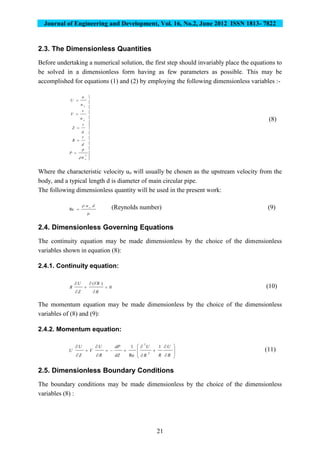
2.3. The Dimensionless Quantities
Before undertaking a numerical solution, the first step should invariably place the equations to
be solved in a dimensionless form having as few parameters as possible. This may be
accomplished for equations (1) and (2) by employing the following dimensionless variables :-



















2
o
o
o
u
p
P
d
r
R
d
z
Z
u
v
V
u
u
U

(8)
Where the characteristic velocity uo will usually be chosen as the upstream velocity from the
body, and a typical length d is diameter of main circular pipe.
The following dimensionless quantity will be used in the present work:

 du o
..
Re  (Reynolds number) (9)
2.4. Dimensionless Governing Equations
The continuity equation may be made dimensionless by the choice of the dimensionless
variables shown in equation (8):
2.4.1. Continuity equation:
0
)(






R
VR
Z
U
R (10)
The momentum equation may be made dimensionless by the choice of the dimensionless
variables of (8) and (9):
2.4.2. Momentum equation:



















R
U
RR
U
dZ
dP
R
U
V
Z
U
U
1
Re
1
2
2
(11)
2.5. Dimensionless Boundary Conditions
The boundary conditions may be made dimensionless by the choice of the dimensionless
variables (8) :
Journal of Engineering and Development, Vol. 16, No.2, June 2012 ISSN 1813- 7822
22
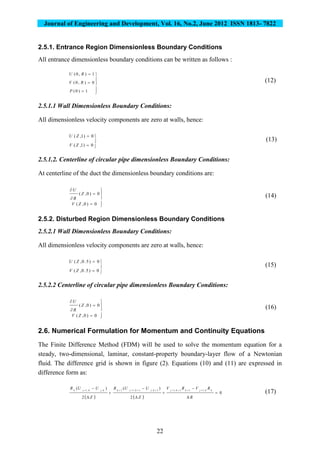
2.5.1. Entrance Region Dimensionless Boundary Conditions
All entrance dimensionless boundary conditions can be written as follows :








1)0(
0),0(
1),0(
P
RV
RU
(12)
2.5.1.1 Wall Dimensionless Boundary Conditions:
All dimensionless velocity components are zero at walls, hence:





0)1,(
0)1,(
ZV
ZU
(13)
2.5.1.2. Centerline of circular pipe dimensionless Boundary Conditions:
At centerline of the duct the dimensionless boundary conditions are:








0)0,(
0)0,(
ZV
Z
R
U
(14)
2.5.2. Disturbed Region Dimensionless Boundary Conditions
2.5.2.1 Wall Dimensionless Boundary Conditions:
All dimensionless velocity components are zero at walls, hence:





0)5.0,(
0)5.0,(
ZV
ZU
(15)
2.5.2.2 Centerline of circular pipe dimensionless Boundary Conditions:








0)0,(
0)0,(
ZV
Z
R
U
(16)
2.6. Numerical Formulation for Momentum and Continuity Equations
The Finite Difference Method (FDM) will be used to solve the momentum equation for a
steady, two-dimensional, laminar, constant-property boundary-layer flow of a Newtonian
fluid. The difference grid is shown in figure (2). Equations (10) and (11) are expressed in
difference form as:
   
0
2
)(
2
)( ,111,11,1,11,,1








 
R
RVRV
Z
UUR
Z
UUR kkjkkjkjkjkkjkjk
(17)
Journal of Engineering and Development, Vol. 16, No.2, June 2012 ISSN 1813- 7822
23
 





 
R
UU
V
Z
UU
U
kjkj
kj
kjkj
kj
2
1,11,1
,
,,1
,
  

















)(2
12
Re
1 1,11,1
2
1,1,11,11
R
UU
RR
UUU
Z
PP kjkj
k
kjkjkjjj
(18)
Equations (17) and (18) written for k=1(1)n.
2.7. Validation
As a first validation case, the flow in circular pipe disturbed by concentric circular pipe is
solved. The geometry and the boundary conditions are indicated in Figure (1). Flow through
this configuration is analyzed at different Reynolds number. Tables (1) present the validation
of pressure gradient. Table (2) present the validation of velocity profile for flow through
concentric circular pipes. The validity of results is verified and shows that there is a good
agreement between the results of the present solution and the AutoFEA software.
3. Results and Discussion
The results obtained from the numerical solution by using the computer program which was
prepared for this purpose. for Reynolds numbers (Re=25), (Re=50), (Re=100), (Re=200) and
(Re=375). The nodal spacing is constant across the axial direction and radial direction.
(m*(2*(n+1)+1)) represents the number of nodal points for concentric circular pipes. The
concentric circular pipes problem was solved with (n=5), but (m) varied corresponding on
Reynolds number (i.e., when the Reynolds number is 25, m=30).
3.1. Velocity VariatIon
Figures (3), (4), (5), (6) and (7) show the velocity profiles which manifest stages of
developing the hydrodynamic boundary layer for Reynolds numbers (Re=25), (Re=50),
(Re=100), (Re=200) and (Re=375) at different sections of the concentric circular pipes. The
velocity in the inlet section of main pipe is uniform and its magnitude is (U=Uo=1). The
velocity profile in the inlet section of disturbed circular pipe is uniformly distributed over its
diameter and the velocity distribution becomes parabolic. The radial velocity component (V)
is zero. The axial velocity increasing until it approaches maximum in centerline of disturbed
pipe. The velocity profile in the annulus concentric section of disturbed pipe is non-uniformly
distributed. The velocity near the main pipe is less than the velocity near the disturbed pipe,
due to the effect of velocity at inlet annulus section. The shape of the boundary layer becomes
constant after a certain distance from the entrance, which is so-called “The Hydrodynamic
Entry length”. It is noted that the hydrodynamic entrance length increases with the increasing
of Reynolds number. It can be seen that the boundary layer is developed faster for the lower
Reynolds number, however the flow field is similar for all studied cases. At a large distance
from the inlet the velocity distribution becomes parabolic. The resulting velocity profile
Journal of Engineering and Development, Vol. 16, No.2, June 2012 ISSN 1813- 7822
24
consist of two boundary layer profiles on the two walls joined in the center by a line of
constant velocity. Since the volume flow rate is constant, the decrease in the flow rate near the
walls which is due to friction must be compensated by a corresponding increase near the axis.
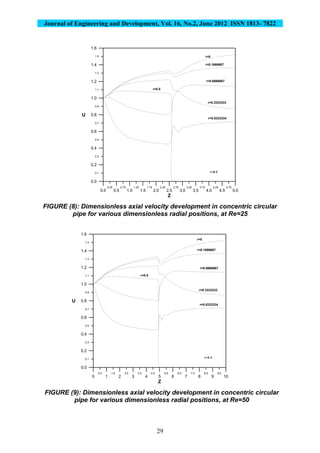
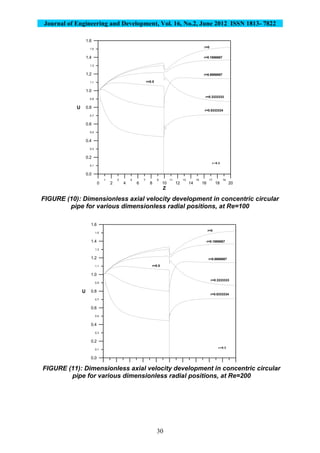
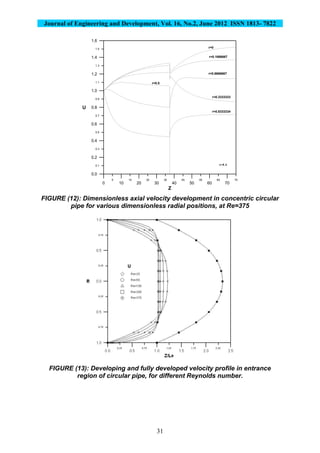
Figures (8), (9), (10), (11) and (12) show the axial dimensionless velocity development as a
function of Z for different radial positions and Reynolds numbers. The dimensionless velocity
at inlet equal one. In the developing region the dimensionless velocity increases near the
centerline of pipe with increases dimensionless axial position but decreases the dimensionless
velocity near the wall of pipe with increases dimensionless axial position. In the disturbed
region the dimensionless velocity increases at near the wall and centerline of pipe but
decreases at R=0.33333 due to the axial flow rate constant at any section.
Figure (13) shows the velocity profiles in the entrance region at different Reynolds numbers.
In the developing region the maximum velocity decreases with increasing Reynolds number
but the velocity near the wall increases with increasing Reynolds number. In the fully
developed region all values of Reynolds number have the same velocity profile (the velocity
profiles in fully developed is independent of Reynolds number).
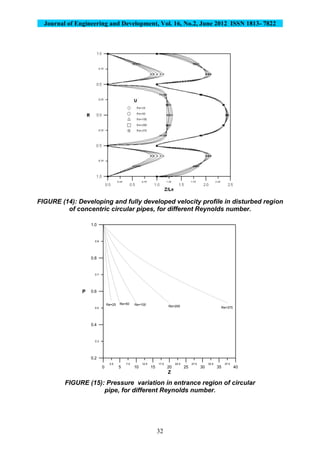
Figure (14) shows the velocity profiles in the disturbed region at different Reynolds numbers.
The velocity at the wall equals zero but the axial velocity near the core increases. The
maximum velocity decreases with increasing Reynolds number but the velocity near the wall
increases with increasing Reynolds number. At a large distance from the inlet of disturbed
pipe the velocity distribution becomes parabolic. At inlet of annulus region the velocity near
the main circular pipe is less than velocity near the disturbed circular pipe until they equal at a
certain distance from the entrance.
3.2. Pressure Variation
Figure (15) shows dimensionless pressure variation in entrance region at different Reynolds
numbers. The dimensionless pressure in the inlet section is one and decreases with increasing
distance in Z-direction due to friction. The dimensionless pressure decreases faster with the
decreases of Reynolds number.
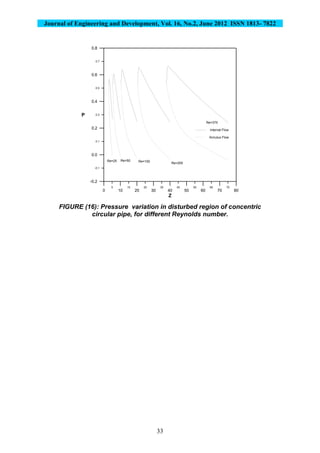
Figure (16) shows dimensionless pressure variation in internal and annulus region at
different Reynolds numbers. The dimensionless pressure decreases with increasing distance in
Z-direction. The pressure drop in annulus region is greater than pressure drop in the inside
region.
4. Conclusions
The axial velocity increasing until it approaches maximum in centerline of disturbed pipe.
The velocity profile in the annulus concentric section of disturbed pipe is non-uniformly
distributed.
Journal of Engineering and Development, Vol. 16, No.2, June 2012 ISSN 1813- 7822
25
The velocity near the main pipe less than the velocity near the disturbed pipe due to the effect
of velocity at inlet annulus section. Since the volume flow rate is constant, the decrease in the
flow rate near the walls which is due to friction must be compensated by a corresponding
increase near the axis. In the entrance region the maximum velocity decreases with increasing
Reynolds number but the velocity near the wall increases with increasing Reynolds number.
The velocity profiles in fully developed is independent of Reynolds number. At a large
distance from the inlet of disturbed pipe the velocity distribution becomes parabolic. The
dimensionless pressure in the inlet section is one and decreases with increasing distance in Z-
direction due to friction. The dimensionless pressure decreases faster with the decreases of
Reynolds number. The pressure drop in annulus region is greater than pressure drop in the
inside region.
5. References
[1] Adams, J.A. and Rogers D.F. “Computer-Aided Heat Transfer Analysis”, McGraw-
Hill Book Company, New York., 1973
[2] Anderson, D.A., Tannehill, J.C., and Pletcher, R.H. “Computational Fluid Mechanics
and Heat Transfer”, McGraw-Hill Book Company, New York., 1984
[3] Founargiotakis K., Kelessidis V.C. and Maglione R. “Laminar, transitional and
turbulent flow of Herschel-Bulkley fluids in concentric annulus” , the Canadian
Journal of Chemical Engineering, Vol. 86, pp. 676-683, August 2008.
[4] Hua-Shu Dou, Boo Cheong Khoo and Her Mann Tsai “Determining the critical
condition for low transition in a full-developed annulus flow” , Journal of Petroleum
Science and Engineering, Vol. 71, 2010, in press.
[5] Hornbeck, R.W. “Numerical Marching Techniques for Fluid Flows with Heat
Transfer”, National Aeronautics and Space Administration, Washington., 1973
[6] Incropera, F.P. and Dewitt, D.P. “Fundamentals of Heat and Mass Transfer”, John
Wiley & Sons, New York., 1996
[7] Mandal D.K. and Chakrabarti S. “Two dimensional simulation of steady blood flow
through a stenosed coronary artery” , International Journal of Dynamics of Fluids,
ISSN 0973-1784, Vol. 3, No. 2, pp. 187-209, 2007.
[8] Mohammad Abdulrahman Al-Shibl “Prediction of Flow and Heat Transfer in the
Entry Region of Concentric Cylinders with Rotating Inner Walls” , M.Sc. thesis,
Mechanical Engineering Department, King Fahd University of Petroleum and
Minerals, 2006.
[9] Nam Sub Woo and Young Kyu Hwang “A Study on the Rotating Flow in an Annulus”,
International Offshore and Polar Engineering Conference Vancouver, BC, Canada,
July 6-11, 2008.
Journal of Engineering and Development, Vol. 16, No.2, June 2012 ISSN 1813- 7822
26
Table (1): Validation Data for Flow through concentric circular pipes.
Re
Pressure Gradient
[dP/dZ]
at Entrance Region
Pressure Gradient
[dP/dZ]
at Disturbed Region
Entrance Length
[Le]
present
work
AutoFEA
present
work
AutoFEA
present
work
AutoFEA
250.54810350.5380.26870640.262.52.5
500.53902690.5290.26557660.25755
1000.53500660.5250.25177390.2431010
2000.53313930.5230.2450940.2372020
3750.53230370.5220.24037650.23237.537.5
‫ا‬
Table 3: Developing Velocity Profile for Flow through concentric circular pipes
‫ا‬
R
Re=25Re=50Re=100Re=200Re=375
U(Z=1)U(Z=1)U(Z=1)U(Z=1)U(Z=1)
present
work
AutoFEA
present
work
AutoFEA
present
work
AutoFEA
present
work
AutoFEA
present
work
AutoFEA
01.2176451.221.1337341.131.0740041.071.0385491.041.0208371.02
0.16666671.209851.211.1323241.131.0738711.071.0385381.041.0208371.02
0.33333341.1768981.181.1237131.121.0725291.071.0383971.041.0208231.02
0.51.0875021.091.0870191.091.0625811.061.0364471.041.0204511.02
0.6666667.88870850.89.96138510.961.0044061.011.0155471.021.0132981.01
0.8333334.52821930.53.62869240.63.74961030.75.85179730.85.91417250.92
10000000000
1 2
δ
e
iδ
aδ
oU
Hydrodynamic entrance region Hydrodynamic disturbed region
iR
oR
eL dL
R
Z
U (R,Z)
Inviscid flow region
Boundary layer region
FIGURE (1): Laminar, hydrodynamic boundary layer development
in a concentric circular pipe.
Journal of Engineering and Development, Vol. 16, No.2, June 2012 ISSN 1813- 7822
27
R
=1
R
R=
0
k=
0
Z
k=n
+1
j-1 j+1
k
k-1
k+1
k=n
Δ
Z
ΔR
R=0.
5
j
FIGURE (2): Finite Difference Grid For concentric circular
pipe.
FIGURE (3): Axial velocity profiles at different axial locations
for Re=25
FIGURE (4): Axial velocity profiles at different axial locations for Re=50
Journal of Engineering and Development, Vol. 16, No.2, June 2012 ISSN 1813- 7822
28
FIGURE (6): Axial velocity profiles at different axial locations for Re=200
FIGURE (7): Axial velocity profiles at different axial locations for Re=375
FIGURE (5): Axial velocity profiles at different axial locations for Re=100
Journal of Engineering and Development, Vol. 16, No.2, June 2012 ISSN 1813- 7822
29
0.25 0.75 1.25 1.75 2.25 2.75 3.25 3.75 4.25 4.75
0.0 0.5 1.0 1.5 2.0 2.5 3.0 3.5 4.0 4.5 5.0
Z
0.1
0.3
0.5
0.7
0.9
1.1
1.3
1.5
0.0
0.2
0.4
0.6
0.8
1.0
1.2
1.4
1.6
U
r=0
r=0.1666667
r=0.3333333
r=0.5
r=0.6666667
r=0.8333334
FIGURE (8): Dimensionless axial velocity development in concentric circular
pipe for various dimensionless radial positions, at Re=25
0.5 1.5 2.5 3.5 4.5 5.5 6.5 7.5 8.5 9.5
0 1 2 3 4 5 6 7 8 9 10
Z
0.1
0.3
0.5
0.7
0.9
1.1
1.3
1.5
0.0
0.2
0.4
0.6
0.8
1.0
1.2
1.4
1.6
U
r=0
r=0.1666667
r=0.3333333
r=0.5
r=0.6666667
r=0.8333334
FIGURE (9): Dimensionless axial velocity development in concentric circular
pipe for various dimensionless radial positions, at Re=50
Journal of Engineering and Development, Vol. 16, No.2, June 2012 ISSN 1813- 7822
30
FIGURE (10): Dimensionless axial velocity development in concentric circular
pipe for various dimensionless radial positions, at Re=100
2 6 10 14 18 22 26 30 34 38
0 4 8 12 16 20 24 28 32 36 40
Z
0.1
0.3
0.5
0.7
0.9
1.1
1.3
1.5
0.0
0.2
0.4
0.6
0.8
1.0
1.2
1.4
1.6
U
r=0
r=0.1666667
r=0.3333333
r=0.5
r=0.6666667
r=0.8333334
FIGURE (11): Dimensionless axial velocity development in concentric circular
pipe for various dimensionless radial positions, at Re=200
1 3 5 7 9 11 13 15 17 19
0 2 4 6 8 10 12 14 16 18 20
Z
0.1
0.3
0.5
0.7
0.9
1.1
1.3
1.5
0.0
0.2
0.4
0.6
0.8
1.0
1.2
1.4
1.6
U
r=0
r=0.1666667
r=0.3333333
r=0.5
r=0.6666667
r=0.8333334
Journal of Engineering and Development, Vol. 16, No.2, June 2012 ISSN 1813- 7822
31
5 15 25 35 45 55 65 75
0 10 20 30 40 50 60 70
Z
0.1
0.3
0.5
0.7
0.9
1.1
1.3
1.5
0.0
0.2
0.4
0.6
0.8
1.0
1.2
1.4
1.6
U
r=0
r=0.1666667
r=0.3333333
r=0.5
r=0.6666667
r=0.8333334
FIGURE (12): Dimensionless axial velocity development in concentric circular
pipe for various dimensionless radial positions, at Re=375
FIGURE (13): Developing and fully developed velocity profile in entrance
region of circular pipe, for different Reynolds number.
Journal of Engineering and Development, Vol. 16, No.2, June 2012 ISSN 1813- 7822
32
FIGURE (14): Developing and fully developed velocity profile in disturbed region
of concentric circular pipes, for different Reynolds number.
2.5 7.5 12.5 17.5 22.5 27.5 32.5 37.5
0 5 10 15 20 25 30 35 40
Z
0.3
0.5
0.7
0.9
0.2
0.4
0.6
0.8
1.0
P
Re=25 Re=50 Re=100 Re=200 Re=375
FIGURE (15): Pressure variation in entrance region of circular
pipe, for different Reynolds number.
Journal of Engineering and Development, Vol. 16, No.2, June 2012 ISSN 1813- 7822
33
5 15 25 35 45 55 65 75
0 10 20 30 40 50 60 70 80
Z
-0.1
0.1
0.3
0.5
0.7
-0.2
0.0
0.2
0.4
0.6
0.8
P
Re=25 Re=50 Re=100 Re=200
Re=375
Internal Flow
Annulus Flow
FIGURE (16): Pressure variation in disturbed region of concentric
circular pipe, for different Reynolds number.

67504

  • 1.
    Journal of Engineeringand Development, Vol. 16, No.2, June 2012 ISSN 1813- 7822 16 A Numerical Study of Low Reynolds Number Incompressible Flow at Entrance and Disturbed Regions Of Concentric Circular Pipes Abstract: The developing laminar flow in the entrance and disturbed regions of concentric circular pipes has been studied numerically. Both main pipe and disturbed pipe are concentric and stationary. Uniform developing flow occurs in entrance region of main pipe and inside disturbed pipe at disturbed region. while non-uniform developing flow occurs in annular concentric disturbed pipe at disturbed region. For the two-dimensional problem, numerical solutions are obtained for a wide range of Reynolds number from 25 to 375. A computer program and AutoFEA software were used to calculate the velocity and pressure drop within the entire channel. The maximum velocity at the centerline of the pipe, hydrodynamic boundary layer developed faster for the lower Reynolds number. However, the flow field is similar for all studied cases. All the present work data are in good agreement with AutoFEA software. Keywords: entrance region, disturbed flow, incompressible, circular pipe ‫االعتراض‬ ‫منطقة‬ ‫و‬ ‫المدخل‬ ‫منطقة‬ ‫عند‬ ‫واطئ‬ ‫رينولدز‬ ‫بعدد‬ ‫انضغاطي‬ ‫ال‬ ‫لمائع‬ ‫عددية‬ ‫دراسة‬‫بأنبوبين‬ ‫المر‬ ‫متحدي‬ ‫دائريين‬‫ك‬‫ز‬ ‫الخالصة‬ ‫ااا‬ ‫انياا‬‫ا‬‫ااالم‬ ‫االبااني‬ ‫الجريان‬‫ا‬ ‫مر‬ ‫ا‬‫ا‬ ‫ما‬ ‫ا‬ ‫اناي‬‫ا‬.‫دي‬‫م‬‫ا‬ ‫راالخركا‬ ‫ا‬‫ا‬‫اداارييناماياريينايبز‬‫ا‬‫باراواي‬ ‫ااااض‬‫ا‬ ‫وماطيمب‬ ‫اااالخا‬‫ا‬ ‫يمب‬ ‫وما‬ ‫ااايا‬ ‫ااايمب‬ ‫ا‬ ‫االمانيااالخمابة‬ ‫قاالبا‬ ‫ايزا‬ ‫اطاننيبان‬ ‫ااالخركا‬ ‫براياااكماخانايبزا‬ ‫األاارباالرييسااطاألاااربااض‬ ‫االخ‬ ‫ا‬‫ا‬‫ااايبز‬‫ا‬‫براي‬ ‫اربااض‬‫ا‬‫امااألاا‬‫ا‬‫اراواماو‬‫ا‬‫ب‬ ‫ااااض‬‫ا‬ ‫ااايمب‬‫ا‬ ‫اااط‬‫ا‬‫ايرراالرييس‬ ‫ا‬‫ا‬‫ارباال‬‫ا‬‫األاا‬‫ارا‬‫ا‬‫ي‬ ‫انياا‬‫ا‬‫االم‬ ‫ا‬‫ا‬‫قاالب‬ ‫ا‬‫ا‬‫ايز‬ ‫ا‬‫ا‬‫رك‬ ‫ميااانمنييااا‬ ‫االزقارااال‬ ‫باراو‬ ‫ااااض‬ ‫ااايمب‬ ‫ا‬ ‫االخركا‬ ‫ايررايبزا‬ ‫باراواالا‬ ‫ياااياناواااربااض‬ ‫اااالزق‬ ‫ااالخمب‬ ‫ا‬ ‫الخمبة‬ ‫انا‬‫ا‬‫واي‬ ‫ا‬‫ا‬‫اتا‬ ‫ا‬‫ا‬‫انداييمرل‬‫ا‬‫اناويز‬‫ا‬‫اااي‬‫ا‬.‫اطا‬ ‫ا‬‫ا‬‫ادالخ‬‫ا‬‫انماتخ‬‫ا‬ ‫األي‬52‫ا‬‫ا‬ ‫ا‬‫ا‬‫إل‬572‫ا‬ ‫اني‬‫ا‬‫اماطايرا‬‫ا‬‫اييس‬ ‫اني‬‫ا‬‫ادايرا‬ ‫اب‬‫ا‬.‫اا‬ ‫ا‬‫ا‬‫ات‬AutoFEA‫ا‬ ‫لزسنباالسرعاطاالهارطاين‬‫ااالخبنوخااتمخاراو.ارعا‬ ‫ايزريااألاارباطاالبا‬ ‫م‬ ‫اا‬ ‫ا.ر‬ ‫اوزص‬ ‫اامحظاا‬ ‫منة‬ ‫لضغطايخناال‬ ‫ااا‬‫ا‬‫االزنلي‬ ‫ا‬‫ا‬‫انااالاز‬‫ا‬‫امايينا‬‫ا‬‫اك‬ ‫اا‬‫ا‬.‫يط‬ ‫انضااالخ‬‫ا‬‫اماالز‬‫ا‬ ‫امال‬‫ا‬‫ايخنن‬ ‫ا‬‫ا‬‫اماالب‬‫ا‬ ‫اح‬ ‫اناا‬‫ا‬‫اغيرةاطنلخ‬‫ا‬‫ال‬ ‫ا‬‫ا‬‫اماييمرل‬ ‫ا‬‫ا‬ ‫اداو‬ ‫اب‬‫ا‬.‫اا‬ ‫ا‬‫ا‬‫م‬ ‫ا‬ ‫اياازي‬ ‫ماجي‬ ‫ااسجخداي‬AutoFEA software‫ا‬ Ahmed Ali Shaker College of Engineering Al-Qadissiya University Mechanical Engineering Department ahmedalsaadi78@gmail.com
  • 2.
    Journal of Engineeringand Development, Vol. 16, No.2, June 2012 ISSN 1813- 7822 17 Nomenclature The following symbols are used generally throughout the text. Other are defined as when used. Symbol Definition Unit d Diameter of main circular pipe. m Ld Hydrodynamic Disturbed Length m Le Hydrodynamic Entry Length m m Number of Grid Nodes in the Axial Direction n Number of Grid Nodes in the Radial Direction p Pressure N/m2 P Dimensionless Pressure po Initial Pressure N/m2 r Radius of circular pipe m R Dimensionless Radius of circular pipe Re Reynolds Number u Velocity in Axial Direction m/s uo Initial Velocity in Axial Direction m/s U Dimensionless Velocity in Axial Direction Uo Initial Dimensionless Velocity in Axial Direction v Velocity in Radial Direction m/s V Dimensionless Velocity in Radial Direction z Axial Direction of the circular pipe. m Z Dimensionless Axial Direction of the circular pipe. Δr The Distance Between Two Nodal Points in the Radial Direction m ΔR The Dimensionless Distance Between Two Nodal Points in the Radial Direction Δz The Distance Between Two Nodal Points in the Axial Direction m ΔZ The Dimensionless Distance Between Two Nodal Points in the Axial Direction Greek Symbols Symbol Definition Unit μ Dynamic Viscosity N.s/m2 ρ Density of Fluid kg/m3 δ Hydrodynamic Boundary Layer Thickness in entrance region m δa Hydrodynamic Boundary Layer Thickness in annulus region m δi Hydrodynamic Boundary Layer Thickness in internal region m
  • 3.
    Journal of Engineeringand Development, Vol. 16, No.2, June 2012 ISSN 1813- 7822 18 Subscripts Symbol Definition Unit j,k The Index Increment Along the Axial and Radial Direction i Inner o Outer 1. Introduction Flow through circular pipes with concentric disturbed pipe has important industrial applications in the fields of thermal and fluid engineering. Particularly its importance is noted in process industries under particular process requirement and in the design of heat – exchanging equipment. The associated flow patterns developed due to the presence of such disturbed pipe can be quite complex with the development of disturbed zones and their interactions with the confined jet. It has great influence on heat transfer effectiveness and pumping power requirement. This clearly shows the importance of study of such flow hydrodynamics. The model geometry is shown in figure (1). Few works have been reported for flow disturbed by concentric circular pipes. Mohammad [8] numerically studied the problem of steady laminar forced convection in the entry region of concentric annuli with rotating inner walls using fluent code. Due to the axi- symmetry of the problem, a 2D axi-symmetric model is used. Focus is on rotation number (Ro), annulus radius ratio (N) effects on heat transfer characteristics, and the torque required to rotate the inner walls. Air and engine oil were used in the simulation. Reynolds number (Re) of 500 based on inlet velocity and hydraulic diameter is kept constant over the whole range of the considered rotation numbers and radius ratios. Mandal and Chakrabarti [7] numerically investigated disturbances of blood flow through a stenotic coronary artery for the restrictions of 10% to 90% with the Reynolds numbers ranging from 25 to 375. Atherosclerotic plaque formation tends to start from very low flow Reynolds number of 25 with 50% restriction. For Reynolds numbers of 100 and above, it starts at 30% stenosed condition. Impact of percent stenosis on wall shear stress has been noted to be more effective than Reynolds number. Founargiotakis et al. [3] presented an integrated approach for the flow of Herschel–Bulkley fluids in a concentric annulus, modeled as a slot, covering the full range of flow types, laminar, transitional, and turbulent. Prior analytical solutions for laminar flow are utilized. Turbulent flow solutions are developed using the Metzner–Reed Reynolds number after determining the local power law parameters as functions of flow geometry and the Herschel– Bulkley rheological parameters. The friction factor is estimated by modifying the pipe flow equation. Transitional flow is solved introducing transitional Reynolds numbers which are functions of the local power law index.
  • 4.
    Journal of Engineeringand Development, Vol. 16, No.2, June 2012 ISSN 1813- 7822 19 Nam and Young [9] numerically investigated the rotating flow in an annulus. The mean diameter of particles was 0.1 cm and a material density of 2.55 g/cm3 were used in the experiment. Hua-Shu et al. [4] studied integrated axial flow in an annulus between two concentric cylinders. The critical condition for turbulent transition in annulus flow is calculated with the energy gradient method for various radius ratios. The critical flow rate and critical Reynolds number are given for various radius ratios. The critical condition for the instability of full- developed laminar flow in an annulus is given following the “energy gradient method.” The criterion for instability is based on the energy gradient method for parallel flow instability. It is shown that the critical flow rate and the critical Reynolds number for onset of turbulent transition increase with the radius ratio of the annulus. The purpose of the current work is to solve the two-dimensional developing laminar flow in the entrance and disturbed regions of concentric circular pipes for a wide range of Reynolds number from 25 to 375. 2. Theoretcal Formulation The mathematical analysis is presented for the Partial Differential Equations which describe developing laminar fluid flow in concentric circular pipes. Steady, Incompressible, Newtonian and constant property flow is assumed for developing velocity profile in the entrance region and disturbed region of the concentric circular pipes. One other aspect of this type model is that the velocity profile at the inlet to the main pipe is assumed to be uniform. The details of the geometry under study are shown in figure(1). The flow field is determined by solving the following equations in the computational domain using an implicit finite difference scheme. 2.1. Governing Equations 2.1.1. Equation of Continuity: 0 )(       r vr z u r (1) 2.1.2. Equation of Momentum:                    r u rr u dz dp r u v z u u 11 2 2   (2)
  • 5.
    Journal of Engineeringand Development, Vol. 16, No.2, June 2012 ISSN 1813- 7822 20 2.2. Boundary Conditions The requirement that the dependent variable or its derivative must be satisfied on the boundary of the partial differential equation is called the boundary condition. the boundary conditions according to the geometry will be written as follows 2.2.1. Entrance Region Boundary Conditions Uniform velocity profile at the entrance region of main circular pipe is assumed. All entrance boundary conditions can be written as follows [Hornbeck, 1973]:         o o pp rv uru )0( 0),0( ),0( (3) 2.2.1.1. Wall Boundary Conditions: All velocity components are zero at walls, hence:      0),( 0),( o o rzv rzu (4) 2.2.1.2. Centerline of circular pipe Boundary Conditions (symmetry line):         0)0,( 0)0,( zv z r u (5) 2.2.2. DISturbed Region Boundary Conditions 2.2.2.1. Wall Boundary Conditions:            0),( 0),( 0),( 0),( o i o i rzv rzv rzu rzu (6) 2.2.2.2 Centerline of circular pipe Boundary Conditions (symmetry line):         0)0,( 0)0,( zv z r u (7)
  • 6.
    Journal of Engineeringand Development, Vol. 16, No.2, June 2012 ISSN 1813- 7822 21 2.3. The Dimensionless Quantities Before undertaking a numerical solution, the first step should invariably place the equations to be solved in a dimensionless form having as few parameters as possible. This may be accomplished for equations (1) and (2) by employing the following dimensionless variables :-                    2 o o o u p P d r R d z Z u v V u u U  (8) Where the characteristic velocity uo will usually be chosen as the upstream velocity from the body, and a typical length d is diameter of main circular pipe. The following dimensionless quantity will be used in the present work:   du o .. Re  (Reynolds number) (9) 2.4. Dimensionless Governing Equations The continuity equation may be made dimensionless by the choice of the dimensionless variables shown in equation (8): 2.4.1. Continuity equation: 0 )(       R VR Z U R (10) The momentum equation may be made dimensionless by the choice of the dimensionless variables of (8) and (9): 2.4.2. Momentum equation:                    R U RR U dZ dP R U V Z U U 1 Re 1 2 2 (11) 2.5. Dimensionless Boundary Conditions The boundary conditions may be made dimensionless by the choice of the dimensionless variables (8) :
  • 7.
    Journal of Engineeringand Development, Vol. 16, No.2, June 2012 ISSN 1813- 7822 22 2.5.1. Entrance Region Dimensionless Boundary Conditions All entrance dimensionless boundary conditions can be written as follows :         1)0( 0),0( 1),0( P RV RU (12) 2.5.1.1 Wall Dimensionless Boundary Conditions: All dimensionless velocity components are zero at walls, hence:      0)1,( 0)1,( ZV ZU (13) 2.5.1.2. Centerline of circular pipe dimensionless Boundary Conditions: At centerline of the duct the dimensionless boundary conditions are:         0)0,( 0)0,( ZV Z R U (14) 2.5.2. Disturbed Region Dimensionless Boundary Conditions 2.5.2.1 Wall Dimensionless Boundary Conditions: All dimensionless velocity components are zero at walls, hence:      0)5.0,( 0)5.0,( ZV ZU (15) 2.5.2.2 Centerline of circular pipe dimensionless Boundary Conditions:         0)0,( 0)0,( ZV Z R U (16) 2.6. Numerical Formulation for Momentum and Continuity Equations The Finite Difference Method (FDM) will be used to solve the momentum equation for a steady, two-dimensional, laminar, constant-property boundary-layer flow of a Newtonian fluid. The difference grid is shown in figure (2). Equations (10) and (11) are expressed in difference form as:     0 2 )( 2 )( ,111,11,1,11,,1           R RVRV Z UUR Z UUR kkjkkjkjkjkkjkjk (17)
  • 8.
    Journal of Engineeringand Development, Vol. 16, No.2, June 2012 ISSN 1813- 7822 23          R UU V Z UU U kjkj kj kjkj kj 2 1,11,1 , ,,1 ,                     )(2 12 Re 1 1,11,1 2 1,1,11,11 R UU RR UUU Z PP kjkj k kjkjkjjj (18) Equations (17) and (18) written for k=1(1)n. 2.7. Validation As a first validation case, the flow in circular pipe disturbed by concentric circular pipe is solved. The geometry and the boundary conditions are indicated in Figure (1). Flow through this configuration is analyzed at different Reynolds number. Tables (1) present the validation of pressure gradient. Table (2) present the validation of velocity profile for flow through concentric circular pipes. The validity of results is verified and shows that there is a good agreement between the results of the present solution and the AutoFEA software. 3. Results and Discussion The results obtained from the numerical solution by using the computer program which was prepared for this purpose. for Reynolds numbers (Re=25), (Re=50), (Re=100), (Re=200) and (Re=375). The nodal spacing is constant across the axial direction and radial direction. (m*(2*(n+1)+1)) represents the number of nodal points for concentric circular pipes. The concentric circular pipes problem was solved with (n=5), but (m) varied corresponding on Reynolds number (i.e., when the Reynolds number is 25, m=30). 3.1. Velocity VariatIon Figures (3), (4), (5), (6) and (7) show the velocity profiles which manifest stages of developing the hydrodynamic boundary layer for Reynolds numbers (Re=25), (Re=50), (Re=100), (Re=200) and (Re=375) at different sections of the concentric circular pipes. The velocity in the inlet section of main pipe is uniform and its magnitude is (U=Uo=1). The velocity profile in the inlet section of disturbed circular pipe is uniformly distributed over its diameter and the velocity distribution becomes parabolic. The radial velocity component (V) is zero. The axial velocity increasing until it approaches maximum in centerline of disturbed pipe. The velocity profile in the annulus concentric section of disturbed pipe is non-uniformly distributed. The velocity near the main pipe is less than the velocity near the disturbed pipe, due to the effect of velocity at inlet annulus section. The shape of the boundary layer becomes constant after a certain distance from the entrance, which is so-called “The Hydrodynamic Entry length”. It is noted that the hydrodynamic entrance length increases with the increasing of Reynolds number. It can be seen that the boundary layer is developed faster for the lower Reynolds number, however the flow field is similar for all studied cases. At a large distance from the inlet the velocity distribution becomes parabolic. The resulting velocity profile
  • 9.
    Journal of Engineeringand Development, Vol. 16, No.2, June 2012 ISSN 1813- 7822 24 consist of two boundary layer profiles on the two walls joined in the center by a line of constant velocity. Since the volume flow rate is constant, the decrease in the flow rate near the walls which is due to friction must be compensated by a corresponding increase near the axis. Figures (8), (9), (10), (11) and (12) show the axial dimensionless velocity development as a function of Z for different radial positions and Reynolds numbers. The dimensionless velocity at inlet equal one. In the developing region the dimensionless velocity increases near the centerline of pipe with increases dimensionless axial position but decreases the dimensionless velocity near the wall of pipe with increases dimensionless axial position. In the disturbed region the dimensionless velocity increases at near the wall and centerline of pipe but decreases at R=0.33333 due to the axial flow rate constant at any section. Figure (13) shows the velocity profiles in the entrance region at different Reynolds numbers. In the developing region the maximum velocity decreases with increasing Reynolds number but the velocity near the wall increases with increasing Reynolds number. In the fully developed region all values of Reynolds number have the same velocity profile (the velocity profiles in fully developed is independent of Reynolds number). Figure (14) shows the velocity profiles in the disturbed region at different Reynolds numbers. The velocity at the wall equals zero but the axial velocity near the core increases. The maximum velocity decreases with increasing Reynolds number but the velocity near the wall increases with increasing Reynolds number. At a large distance from the inlet of disturbed pipe the velocity distribution becomes parabolic. At inlet of annulus region the velocity near the main circular pipe is less than velocity near the disturbed circular pipe until they equal at a certain distance from the entrance. 3.2. Pressure Variation Figure (15) shows dimensionless pressure variation in entrance region at different Reynolds numbers. The dimensionless pressure in the inlet section is one and decreases with increasing distance in Z-direction due to friction. The dimensionless pressure decreases faster with the decreases of Reynolds number. Figure (16) shows dimensionless pressure variation in internal and annulus region at different Reynolds numbers. The dimensionless pressure decreases with increasing distance in Z-direction. The pressure drop in annulus region is greater than pressure drop in the inside region. 4. Conclusions The axial velocity increasing until it approaches maximum in centerline of disturbed pipe. The velocity profile in the annulus concentric section of disturbed pipe is non-uniformly distributed.
  • 10.
    Journal of Engineeringand Development, Vol. 16, No.2, June 2012 ISSN 1813- 7822 25 The velocity near the main pipe less than the velocity near the disturbed pipe due to the effect of velocity at inlet annulus section. Since the volume flow rate is constant, the decrease in the flow rate near the walls which is due to friction must be compensated by a corresponding increase near the axis. In the entrance region the maximum velocity decreases with increasing Reynolds number but the velocity near the wall increases with increasing Reynolds number. The velocity profiles in fully developed is independent of Reynolds number. At a large distance from the inlet of disturbed pipe the velocity distribution becomes parabolic. The dimensionless pressure in the inlet section is one and decreases with increasing distance in Z- direction due to friction. The dimensionless pressure decreases faster with the decreases of Reynolds number. The pressure drop in annulus region is greater than pressure drop in the inside region. 5. References [1] Adams, J.A. and Rogers D.F. “Computer-Aided Heat Transfer Analysis”, McGraw- Hill Book Company, New York., 1973 [2] Anderson, D.A., Tannehill, J.C., and Pletcher, R.H. “Computational Fluid Mechanics and Heat Transfer”, McGraw-Hill Book Company, New York., 1984 [3] Founargiotakis K., Kelessidis V.C. and Maglione R. “Laminar, transitional and turbulent flow of Herschel-Bulkley fluids in concentric annulus” , the Canadian Journal of Chemical Engineering, Vol. 86, pp. 676-683, August 2008. [4] Hua-Shu Dou, Boo Cheong Khoo and Her Mann Tsai “Determining the critical condition for low transition in a full-developed annulus flow” , Journal of Petroleum Science and Engineering, Vol. 71, 2010, in press. [5] Hornbeck, R.W. “Numerical Marching Techniques for Fluid Flows with Heat Transfer”, National Aeronautics and Space Administration, Washington., 1973 [6] Incropera, F.P. and Dewitt, D.P. “Fundamentals of Heat and Mass Transfer”, John Wiley & Sons, New York., 1996 [7] Mandal D.K. and Chakrabarti S. “Two dimensional simulation of steady blood flow through a stenosed coronary artery” , International Journal of Dynamics of Fluids, ISSN 0973-1784, Vol. 3, No. 2, pp. 187-209, 2007. [8] Mohammad Abdulrahman Al-Shibl “Prediction of Flow and Heat Transfer in the Entry Region of Concentric Cylinders with Rotating Inner Walls” , M.Sc. thesis, Mechanical Engineering Department, King Fahd University of Petroleum and Minerals, 2006. [9] Nam Sub Woo and Young Kyu Hwang “A Study on the Rotating Flow in an Annulus”, International Offshore and Polar Engineering Conference Vancouver, BC, Canada, July 6-11, 2008.
  • 11.
    Journal of Engineeringand Development, Vol. 16, No.2, June 2012 ISSN 1813- 7822 26 Table (1): Validation Data for Flow through concentric circular pipes. Re Pressure Gradient [dP/dZ] at Entrance Region Pressure Gradient [dP/dZ] at Disturbed Region Entrance Length [Le] present work AutoFEA present work AutoFEA present work AutoFEA 250.54810350.5380.26870640.262.52.5 500.53902690.5290.26557660.25755 1000.53500660.5250.25177390.2431010 2000.53313930.5230.2450940.2372020 3750.53230370.5220.24037650.23237.537.5 ‫ا‬ Table 3: Developing Velocity Profile for Flow through concentric circular pipes ‫ا‬ R Re=25Re=50Re=100Re=200Re=375 U(Z=1)U(Z=1)U(Z=1)U(Z=1)U(Z=1) present work AutoFEA present work AutoFEA present work AutoFEA present work AutoFEA present work AutoFEA 01.2176451.221.1337341.131.0740041.071.0385491.041.0208371.02 0.16666671.209851.211.1323241.131.0738711.071.0385381.041.0208371.02 0.33333341.1768981.181.1237131.121.0725291.071.0383971.041.0208231.02 0.51.0875021.091.0870191.091.0625811.061.0364471.041.0204511.02 0.6666667.88870850.89.96138510.961.0044061.011.0155471.021.0132981.01 0.8333334.52821930.53.62869240.63.74961030.75.85179730.85.91417250.92 10000000000 1 2 δ e iδ aδ oU Hydrodynamic entrance region Hydrodynamic disturbed region iR oR eL dL R Z U (R,Z) Inviscid flow region Boundary layer region FIGURE (1): Laminar, hydrodynamic boundary layer development in a concentric circular pipe.
  • 12.
    Journal of Engineeringand Development, Vol. 16, No.2, June 2012 ISSN 1813- 7822 27 R =1 R R= 0 k= 0 Z k=n +1 j-1 j+1 k k-1 k+1 k=n Δ Z ΔR R=0. 5 j FIGURE (2): Finite Difference Grid For concentric circular pipe. FIGURE (3): Axial velocity profiles at different axial locations for Re=25 FIGURE (4): Axial velocity profiles at different axial locations for Re=50
  • 13.
    Journal of Engineeringand Development, Vol. 16, No.2, June 2012 ISSN 1813- 7822 28 FIGURE (6): Axial velocity profiles at different axial locations for Re=200 FIGURE (7): Axial velocity profiles at different axial locations for Re=375 FIGURE (5): Axial velocity profiles at different axial locations for Re=100
  • 14.
    Journal of Engineeringand Development, Vol. 16, No.2, June 2012 ISSN 1813- 7822 29 0.25 0.75 1.25 1.75 2.25 2.75 3.25 3.75 4.25 4.75 0.0 0.5 1.0 1.5 2.0 2.5 3.0 3.5 4.0 4.5 5.0 Z 0.1 0.3 0.5 0.7 0.9 1.1 1.3 1.5 0.0 0.2 0.4 0.6 0.8 1.0 1.2 1.4 1.6 U r=0 r=0.1666667 r=0.3333333 r=0.5 r=0.6666667 r=0.8333334 FIGURE (8): Dimensionless axial velocity development in concentric circular pipe for various dimensionless radial positions, at Re=25 0.5 1.5 2.5 3.5 4.5 5.5 6.5 7.5 8.5 9.5 0 1 2 3 4 5 6 7 8 9 10 Z 0.1 0.3 0.5 0.7 0.9 1.1 1.3 1.5 0.0 0.2 0.4 0.6 0.8 1.0 1.2 1.4 1.6 U r=0 r=0.1666667 r=0.3333333 r=0.5 r=0.6666667 r=0.8333334 FIGURE (9): Dimensionless axial velocity development in concentric circular pipe for various dimensionless radial positions, at Re=50
  • 15.
    Journal of Engineeringand Development, Vol. 16, No.2, June 2012 ISSN 1813- 7822 30 FIGURE (10): Dimensionless axial velocity development in concentric circular pipe for various dimensionless radial positions, at Re=100 2 6 10 14 18 22 26 30 34 38 0 4 8 12 16 20 24 28 32 36 40 Z 0.1 0.3 0.5 0.7 0.9 1.1 1.3 1.5 0.0 0.2 0.4 0.6 0.8 1.0 1.2 1.4 1.6 U r=0 r=0.1666667 r=0.3333333 r=0.5 r=0.6666667 r=0.8333334 FIGURE (11): Dimensionless axial velocity development in concentric circular pipe for various dimensionless radial positions, at Re=200 1 3 5 7 9 11 13 15 17 19 0 2 4 6 8 10 12 14 16 18 20 Z 0.1 0.3 0.5 0.7 0.9 1.1 1.3 1.5 0.0 0.2 0.4 0.6 0.8 1.0 1.2 1.4 1.6 U r=0 r=0.1666667 r=0.3333333 r=0.5 r=0.6666667 r=0.8333334
  • 16.
    Journal of Engineeringand Development, Vol. 16, No.2, June 2012 ISSN 1813- 7822 31 5 15 25 35 45 55 65 75 0 10 20 30 40 50 60 70 Z 0.1 0.3 0.5 0.7 0.9 1.1 1.3 1.5 0.0 0.2 0.4 0.6 0.8 1.0 1.2 1.4 1.6 U r=0 r=0.1666667 r=0.3333333 r=0.5 r=0.6666667 r=0.8333334 FIGURE (12): Dimensionless axial velocity development in concentric circular pipe for various dimensionless radial positions, at Re=375 FIGURE (13): Developing and fully developed velocity profile in entrance region of circular pipe, for different Reynolds number.
  • 17.
    Journal of Engineeringand Development, Vol. 16, No.2, June 2012 ISSN 1813- 7822 32 FIGURE (14): Developing and fully developed velocity profile in disturbed region of concentric circular pipes, for different Reynolds number. 2.5 7.5 12.5 17.5 22.5 27.5 32.5 37.5 0 5 10 15 20 25 30 35 40 Z 0.3 0.5 0.7 0.9 0.2 0.4 0.6 0.8 1.0 P Re=25 Re=50 Re=100 Re=200 Re=375 FIGURE (15): Pressure variation in entrance region of circular pipe, for different Reynolds number.
  • 18.
    Journal of Engineeringand Development, Vol. 16, No.2, June 2012 ISSN 1813- 7822 33 5 15 25 35 45 55 65 75 0 10 20 30 40 50 60 70 80 Z -0.1 0.1 0.3 0.5 0.7 -0.2 0.0 0.2 0.4 0.6 0.8 P Re=25 Re=50 Re=100 Re=200 Re=375 Internal Flow Annulus Flow FIGURE (16): Pressure variation in disturbed region of concentric circular pipe, for different Reynolds number.