FIREWALL
Introduction
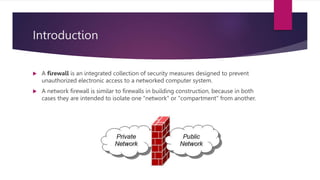
 A firewall is an integrated collection of security measures designed to prevent
unauthorized electronic access to a networked computer system.
 A network firewall is similar to firewalls in building construction, because in both
cases they are intended to isolate one "network" or "compartment" from another.
3
What a Firewall does
 Implement security policies at a single point
 Monitor security-related events (audit, log)
 Provide strong authentication
 Allow virtual private networks
Firewall Policies
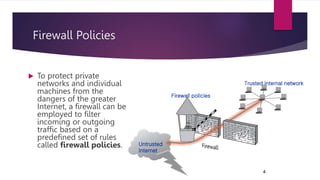
 To protect private
networks and individual
machines from the
dangers of the greater
Internet, a firewall can be
employed to filter
incoming or outgoing
traffic based on a
predefined set of rules
called firewall policies.
4
Trusted internal network
Firewall policies
Untrusted
Internet
Policy Actions
 Packets flowing through a firewall can have one of three outcomes:
 Accepted: permitted through the firewall
 Dropped: not allowed through with no indication of failure
 Rejected: not allowed through, accompanied by an attempt to inform the source
that the packet was rejected
 Policies used by the firewall to handle packets are based on several
properties of the packets being inspected, including the protocol
used, such as:
 TCP or UDP
 the source and destination IP addresses
 the source and destination ports
 the application-level payload of the packet (e.g., whether it contains a virus).
5
Blacklists and White Lists
 Two fundamental approaches to creating firewall policies (or
rulesets)
 Blacklist approach (default-allow)
 All packets are allowed through except those that fit the rules defined specifically
in a blacklist.
 Pros: flexible in ensuring that service to the internal network is not disrupted by
the firewall
 Cons: unexpected forms of malicious traffic could go through
 Whitelist approach (default-deny)
 Packets are dropped or rejected unless they are specifically allowed by the
firewall
 Pros: A safer approach to defining a firewall ruleset
 Cons: must consider all possible legitimate traffic in rulesets
6
Firewall Types
• packet filters (stateless)
– If a packet matches the packet filter's set of rules, the packet filter will drop or accept it
• "stateful" filters
– it maintains records of all connections passing through it and can
determine if a packet is either the start of a new connection, a part of an
existing connection, or is an invalid packet.
• application layer
– It works like a proxy it can “understand” certain applications and
protocols.
– It may inspect the contents of the traffic, blocking what it views as
inappropriate content (i.e. websites, viruses, vulnerabilities, ...)
7
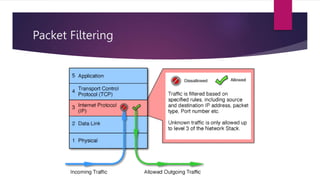
Packet Filter
 Work at the network level of the OSI model
 Each packet is compared to a set of criteria before it is forwarded
 Packet filtering firewalls is low cost and low impact on network performance
 Applies packet filters based on access rules
 Source address
 Destination address
 Application or protocol
 Source port number
 Destination port number
Packet Filtering
Rule
1
2
3
4
5
6
7
8
Direction
Out
Out
In
In & Out
In
In
Out
In
Source
Address
*
10.56*
10.122*
*
*
201.32.4.76
*
*
Destination
Address
10.56.199*
10.122*
10.56.199*
10.56.199*
*
*
*
10.56.199*
Protocol
*
TCP
TCP
TCP
TCP
*
TCP
TCP
# Source
Port
*
*
23 (Telnet)
*
*
*
*
*
# Destin.
Port
*
23 (Telnet)
*
25 (Mail)
513 (rlogin)
*
20 (FTP)
20 (FTP)
Action
Drop
Pass
Pass
Pass
Drop
Drop
Pass
Drop
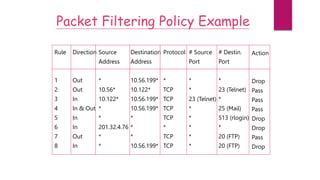
Packet Filtering Policy Example
Circuit level
 Circuit level gateways work at the session layer of the OSI model, or the TCP layer
of TCP/IP
 Monitor TCP handshaking between packets to determine whether a requested
session is legitimate.
Circuit Level
13
Application Gateway firewalls
 Similar to circuit-level gateways except that they are application
specific.
 Every connection between two networks is made via an application
program called a proxy
 Proxies are application or protocol specific
 Only protocols that have specific proxies configured are allowed
through the firewall; all other traffic is rejected.
 Gateway that is configured to be a web proxy will not allow any ftp,
gopher, telnet or other traffic through
Application Level
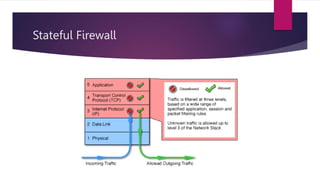
Stateful Inspection Firewalls
 Third generation firewall technology, often referred to as dynamic packet filtering
 Understands data in packets from the network layer (IP headers) up to the
Application Layer
 Tracks the state of communication
sessions
Stateful Firewall
General Performance

FIREWALL

  • 1.
  • 2.
    Introduction  A firewallis an integrated collection of security measures designed to prevent unauthorized electronic access to a networked computer system.  A network firewall is similar to firewalls in building construction, because in both cases they are intended to isolate one "network" or "compartment" from another.
  • 3.
    3 What a Firewalldoes  Implement security policies at a single point  Monitor security-related events (audit, log)  Provide strong authentication  Allow virtual private networks
  • 4.
    Firewall Policies  Toprotect private networks and individual machines from the dangers of the greater Internet, a firewall can be employed to filter incoming or outgoing traffic based on a predefined set of rules called firewall policies. 4 Trusted internal network Firewall policies Untrusted Internet
  • 5.
    Policy Actions  Packetsflowing through a firewall can have one of three outcomes:  Accepted: permitted through the firewall  Dropped: not allowed through with no indication of failure  Rejected: not allowed through, accompanied by an attempt to inform the source that the packet was rejected  Policies used by the firewall to handle packets are based on several properties of the packets being inspected, including the protocol used, such as:  TCP or UDP  the source and destination IP addresses  the source and destination ports  the application-level payload of the packet (e.g., whether it contains a virus). 5
  • 6.
    Blacklists and WhiteLists  Two fundamental approaches to creating firewall policies (or rulesets)  Blacklist approach (default-allow)  All packets are allowed through except those that fit the rules defined specifically in a blacklist.  Pros: flexible in ensuring that service to the internal network is not disrupted by the firewall  Cons: unexpected forms of malicious traffic could go through  Whitelist approach (default-deny)  Packets are dropped or rejected unless they are specifically allowed by the firewall  Pros: A safer approach to defining a firewall ruleset  Cons: must consider all possible legitimate traffic in rulesets 6
  • 7.
    Firewall Types • packetfilters (stateless) – If a packet matches the packet filter's set of rules, the packet filter will drop or accept it • "stateful" filters – it maintains records of all connections passing through it and can determine if a packet is either the start of a new connection, a part of an existing connection, or is an invalid packet. • application layer – It works like a proxy it can “understand” certain applications and protocols. – It may inspect the contents of the traffic, blocking what it views as inappropriate content (i.e. websites, viruses, vulnerabilities, ...) 7
  • 8.
    Packet Filter  Workat the network level of the OSI model  Each packet is compared to a set of criteria before it is forwarded  Packet filtering firewalls is low cost and low impact on network performance  Applies packet filters based on access rules  Source address  Destination address  Application or protocol  Source port number  Destination port number
  • 9.
  • 10.
    Rule 1 2 3 4 5 6 7 8 Direction Out Out In In & Out In In Out In Source Address * 10.56* 10.122* * * 201.32.4.76 * * Destination Address 10.56.199* 10.122* 10.56.199* 10.56.199* * * * 10.56.199* Protocol * TCP TCP TCP TCP * TCP TCP #Source Port * * 23 (Telnet) * * * * * # Destin. Port * 23 (Telnet) * 25 (Mail) 513 (rlogin) * 20 (FTP) 20 (FTP) Action Drop Pass Pass Pass Drop Drop Pass Drop Packet Filtering Policy Example
  • 11.
    Circuit level  Circuitlevel gateways work at the session layer of the OSI model, or the TCP layer of TCP/IP  Monitor TCP handshaking between packets to determine whether a requested session is legitimate.
  • 12.
  • 13.
    13 Application Gateway firewalls Similar to circuit-level gateways except that they are application specific.  Every connection between two networks is made via an application program called a proxy  Proxies are application or protocol specific  Only protocols that have specific proxies configured are allowed through the firewall; all other traffic is rejected.  Gateway that is configured to be a web proxy will not allow any ftp, gopher, telnet or other traffic through
  • 14.
  • 15.
    Stateful Inspection Firewalls Third generation firewall technology, often referred to as dynamic packet filtering  Understands data in packets from the network layer (IP headers) up to the Application Layer  Tracks the state of communication sessions
  • 16.
  • 17.