COURSE NAME: BASICELECTRONICS
COURSE CODE : EC 1001
LECTURE SERIES NO : 01(ONE)
CREDITS : 3
MODE OF DELIVERY : ONLINE (POWER POINT PRESENTATION)
FACULTY :
EMAIL-ID :
PROPOSED DATE OF DELIVERY:
B.TECH FIRST YEAR
ACADEMIC YEAR: 2020-2021
We usenumbers
. to communicate
. to perform tasks
. to quantify
. to measure
Numbers have become symbols of the present era
Many consider what is not expressible in terms of numbers is
not worth knowing
7.
A numbersystem can be used to represent
the number of students in a class or number
of viewers watching a certain TV program
etc.
The digital computer represents all kinds of
data and information in binary numbers.
It includes audio, graphics, video, text and
numbers.
The total number of digits used in a number
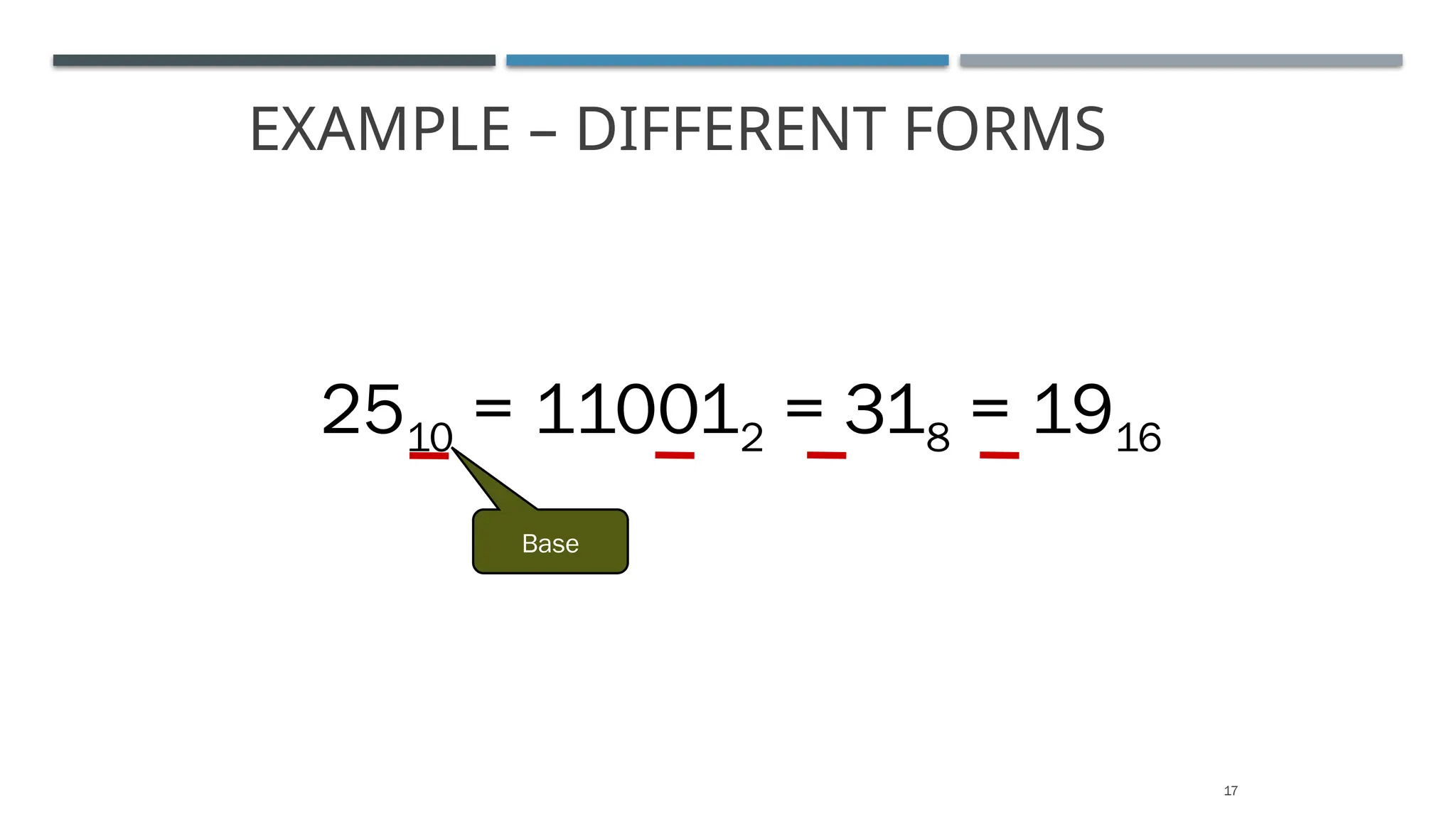
system is called its base or radix.
AKHILESH
MAITHANI
8.
Decimal NumberSystem
Binary Number System
Octal Number System
Hexadecimal Number System
AKHILESH
MAITHANI
9.
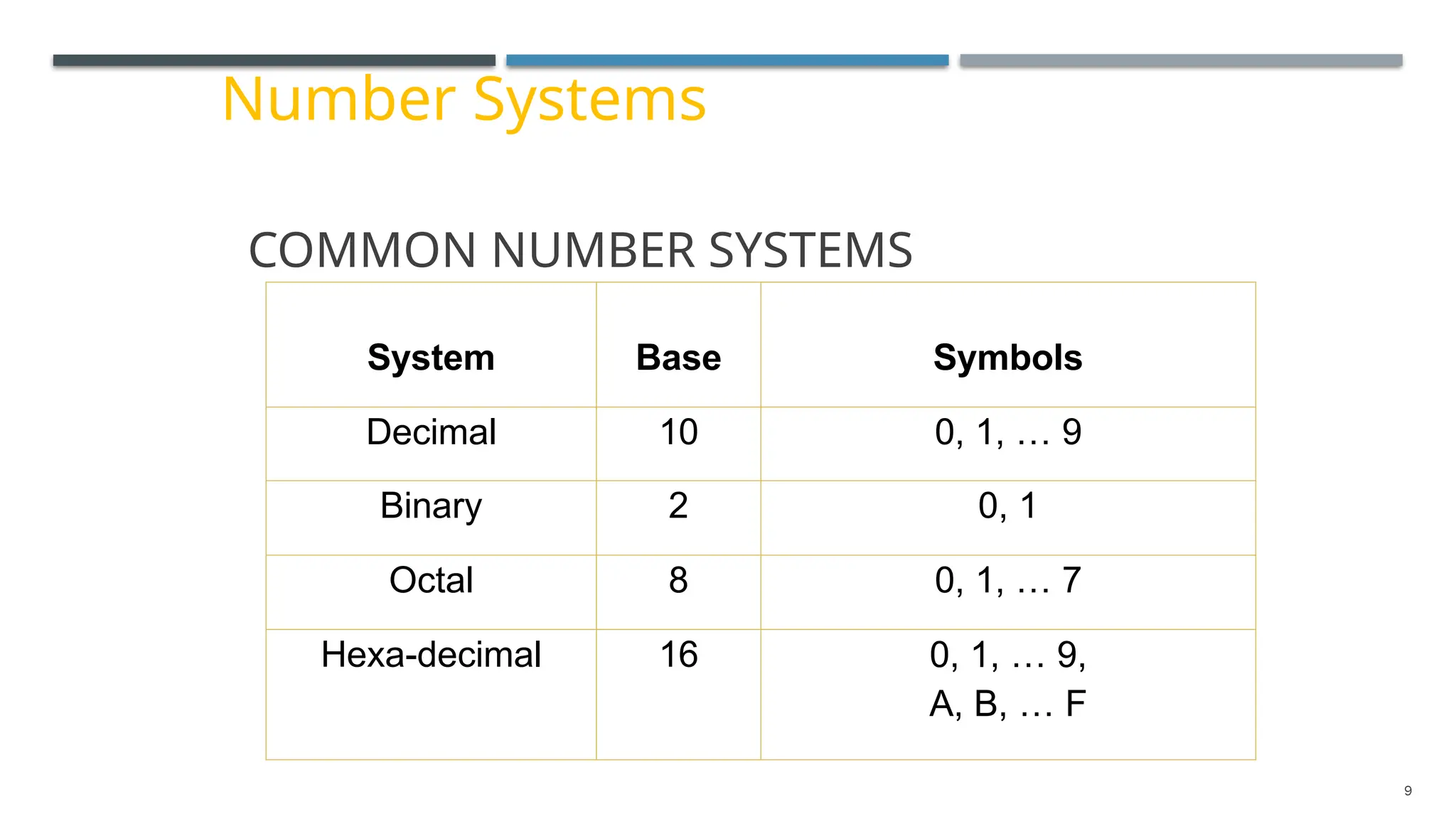
COMMON NUMBER SYSTEMS
NumberSystems
9
System Base Symbols
Decimal 10 0, 1, … 9
Binary 2 0, 1
Octal 8 0, 1, … 7
Hexa-decimal 16 0, 1, … 9,
A, B, … F
10.
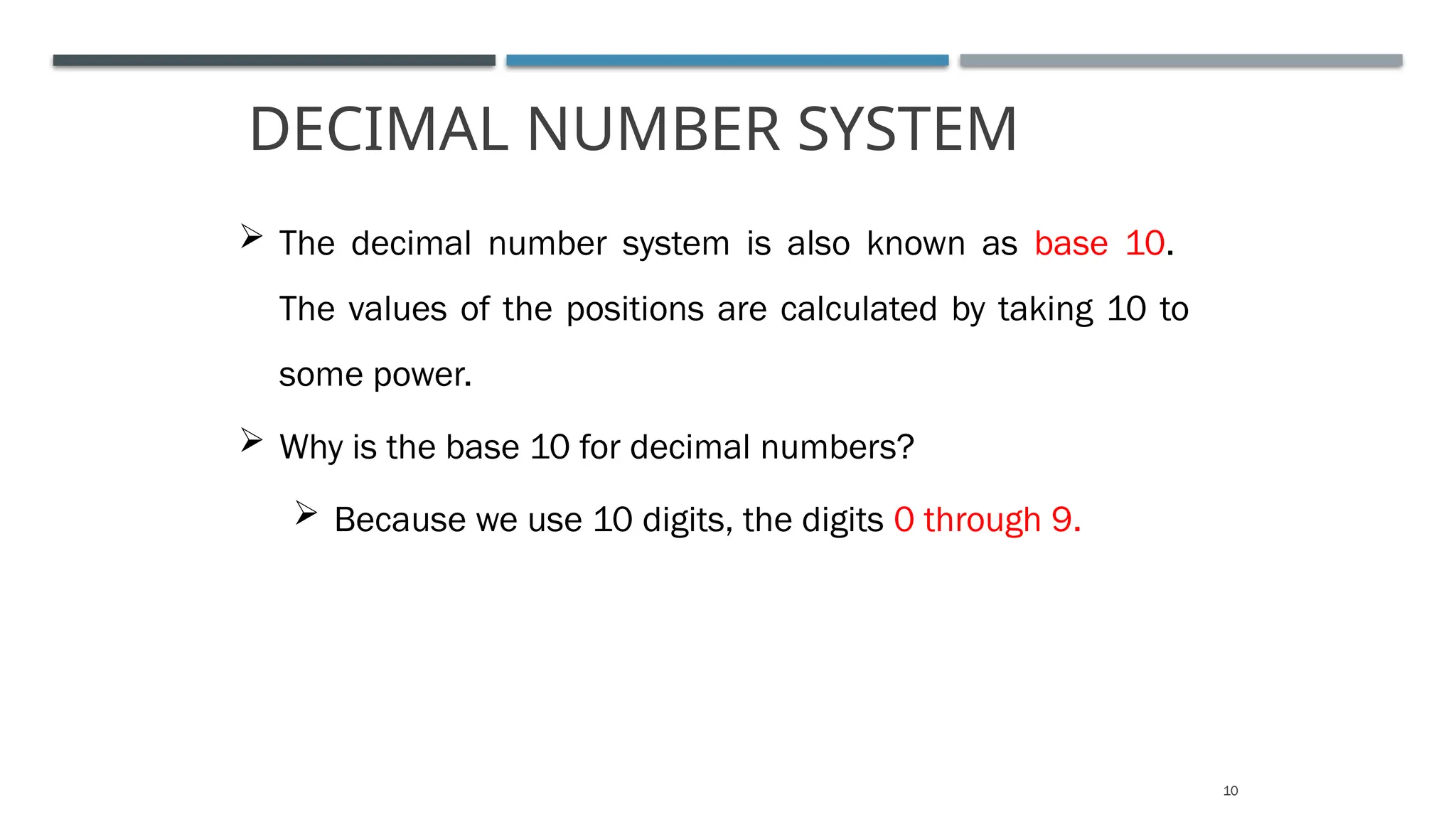
DECIMAL NUMBER SYSTEM
10
The decimal number system is also known as base 10.
The values of the positions are calculated by taking 10 to
some power.
Why is the base 10 for decimal numbers?
Because we use 10 digits, the digits 0 through 9.
11.
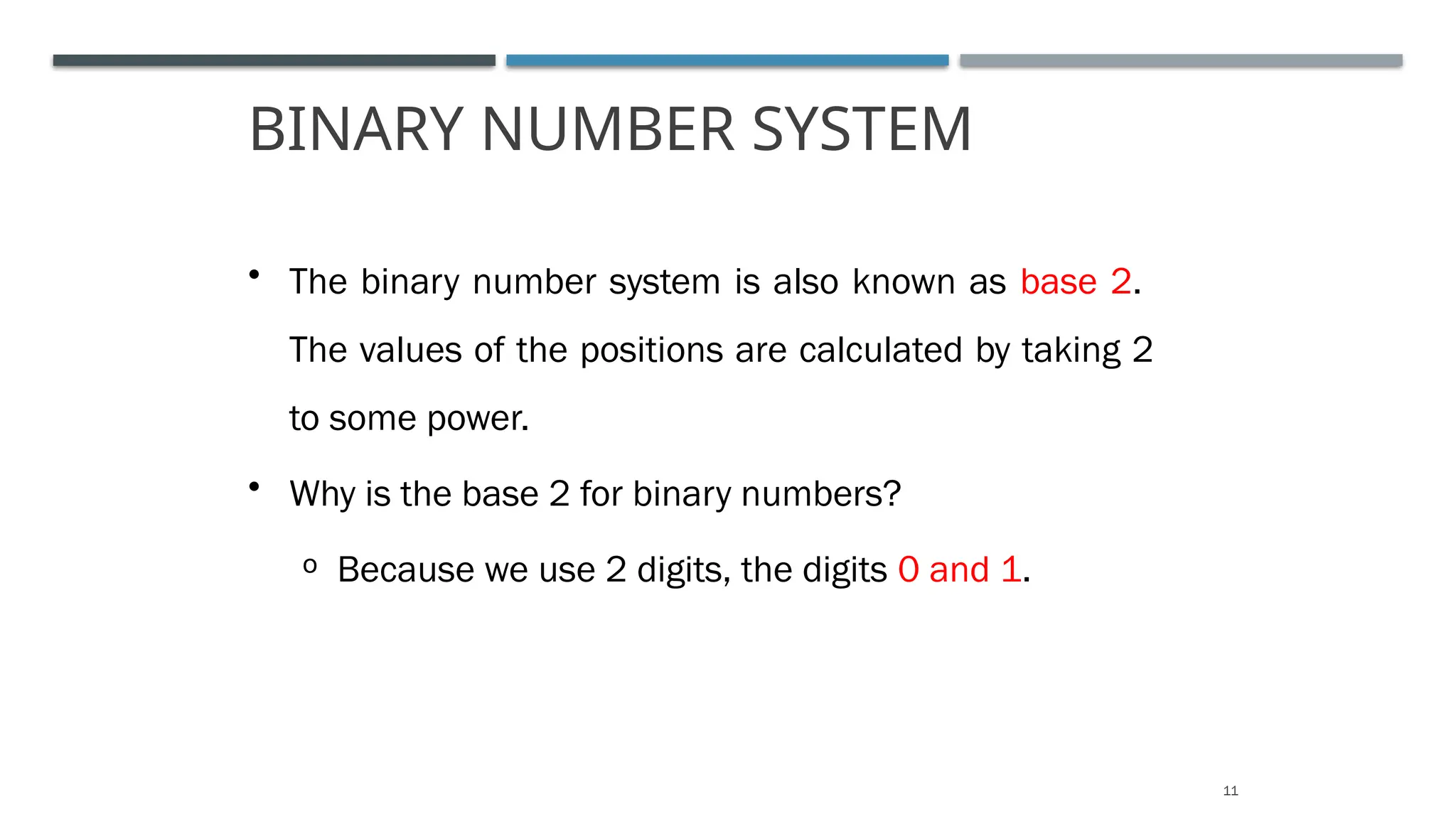
BINARY NUMBER SYSTEM
11
•The binary number system is also known as base 2.
The values of the positions are calculated by taking 2
to some power.
• Why is the base 2 for binary numbers?
o Because we use 2 digits, the digits 0 and 1.
12.
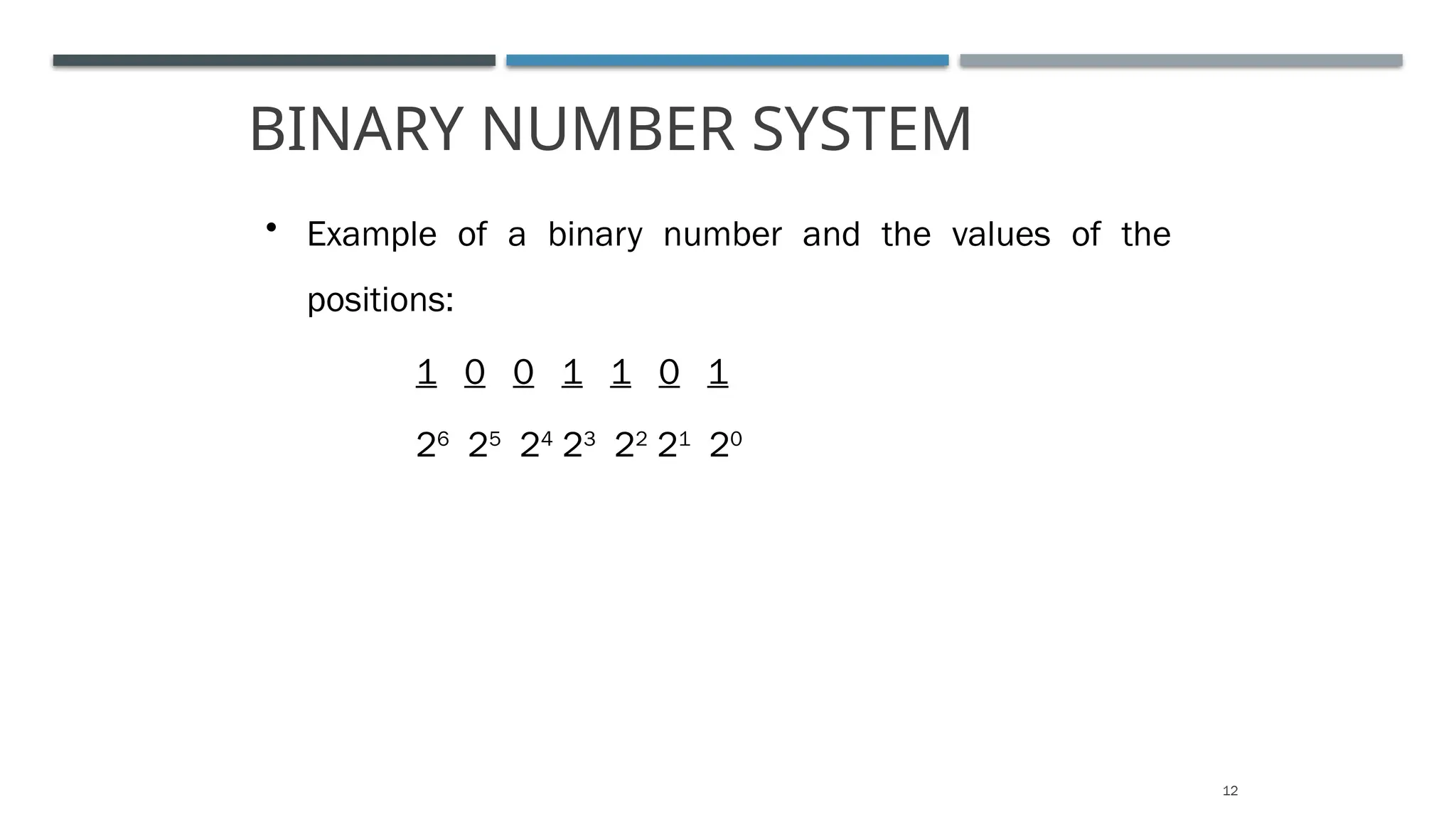
BINARY NUMBER SYSTEM
12
•Example of a binary number and the values of the
positions:
1 0 0 1 1 0 1
26
25
24
23
22
21
20
13.
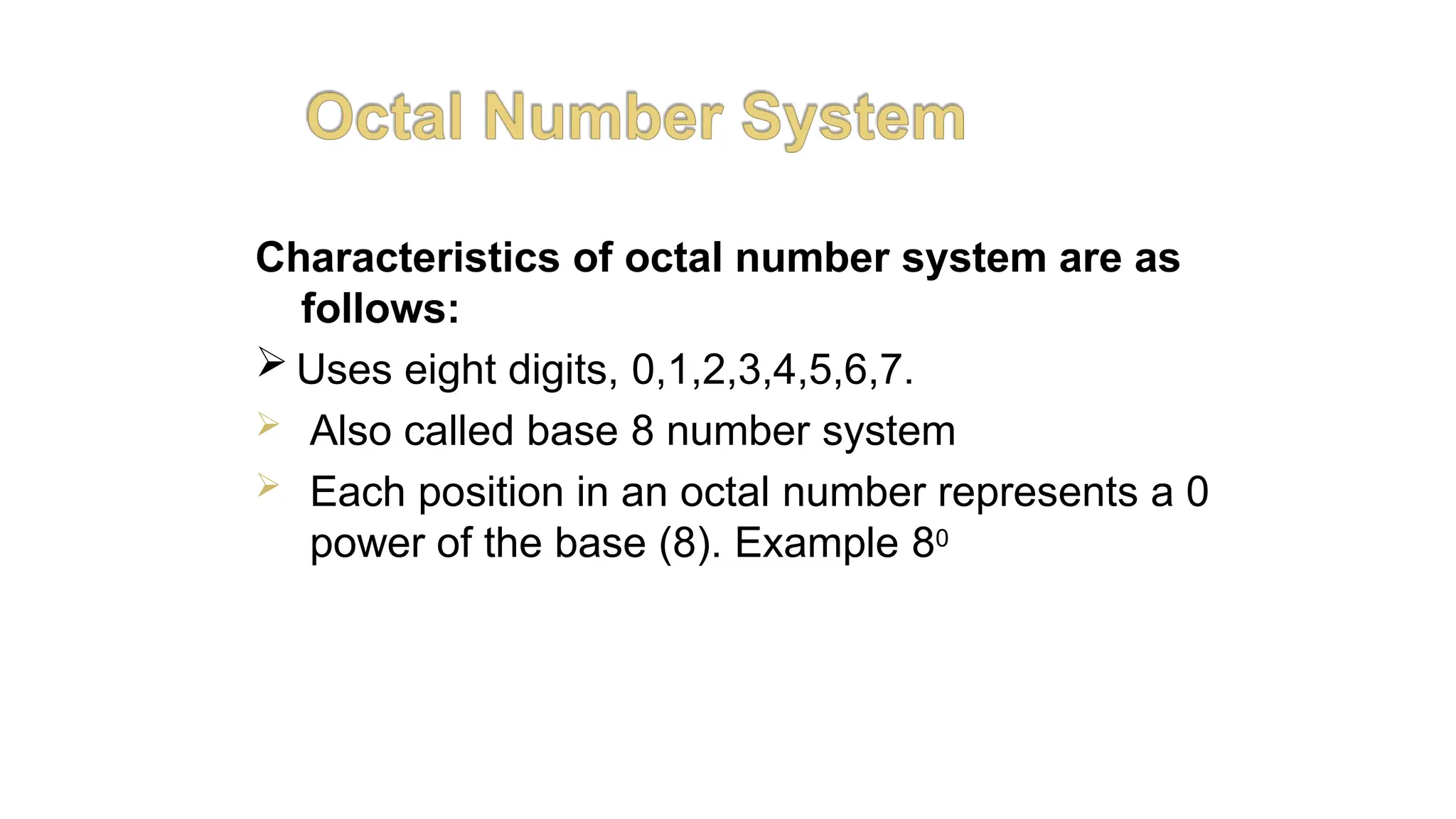
Characteristics of octalnumber system are as
follows:
Uses eight digits, 0,1,2,3,4,5,6,7.
Also called base 8 number system
Each position in an octal number represents a 0
power of the base (8). Example 80
AKHILESH
MAITHANI
14.
HEXADECIMAL NUMBER SYSTEM
14
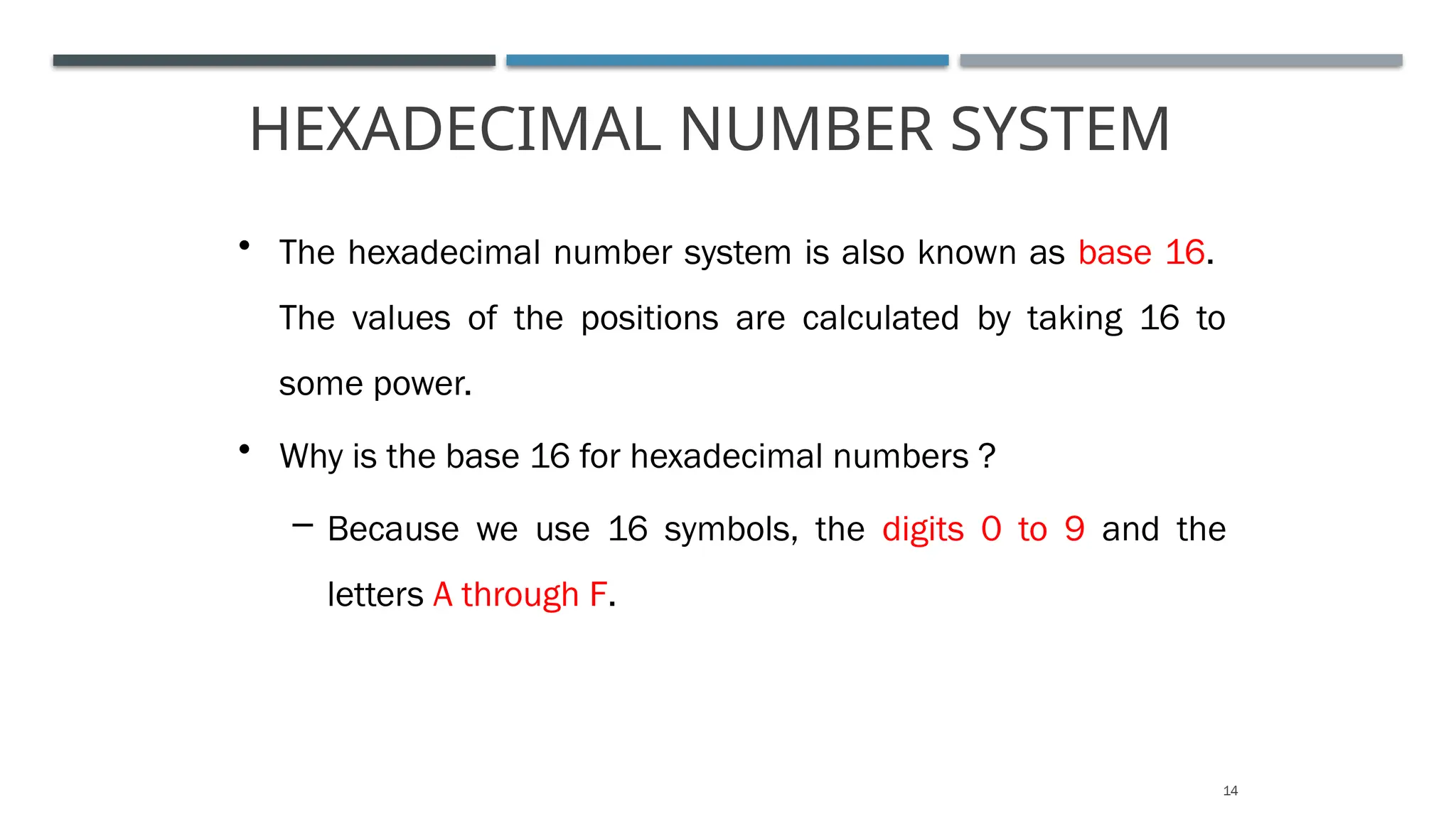
•The hexadecimal number system is also known as base 16.
The values of the positions are calculated by taking 16 to
some power.
• Why is the base 16 for hexadecimal numbers ?
– Because we use 16 symbols, the digits 0 to 9 and the
letters A through F.
18
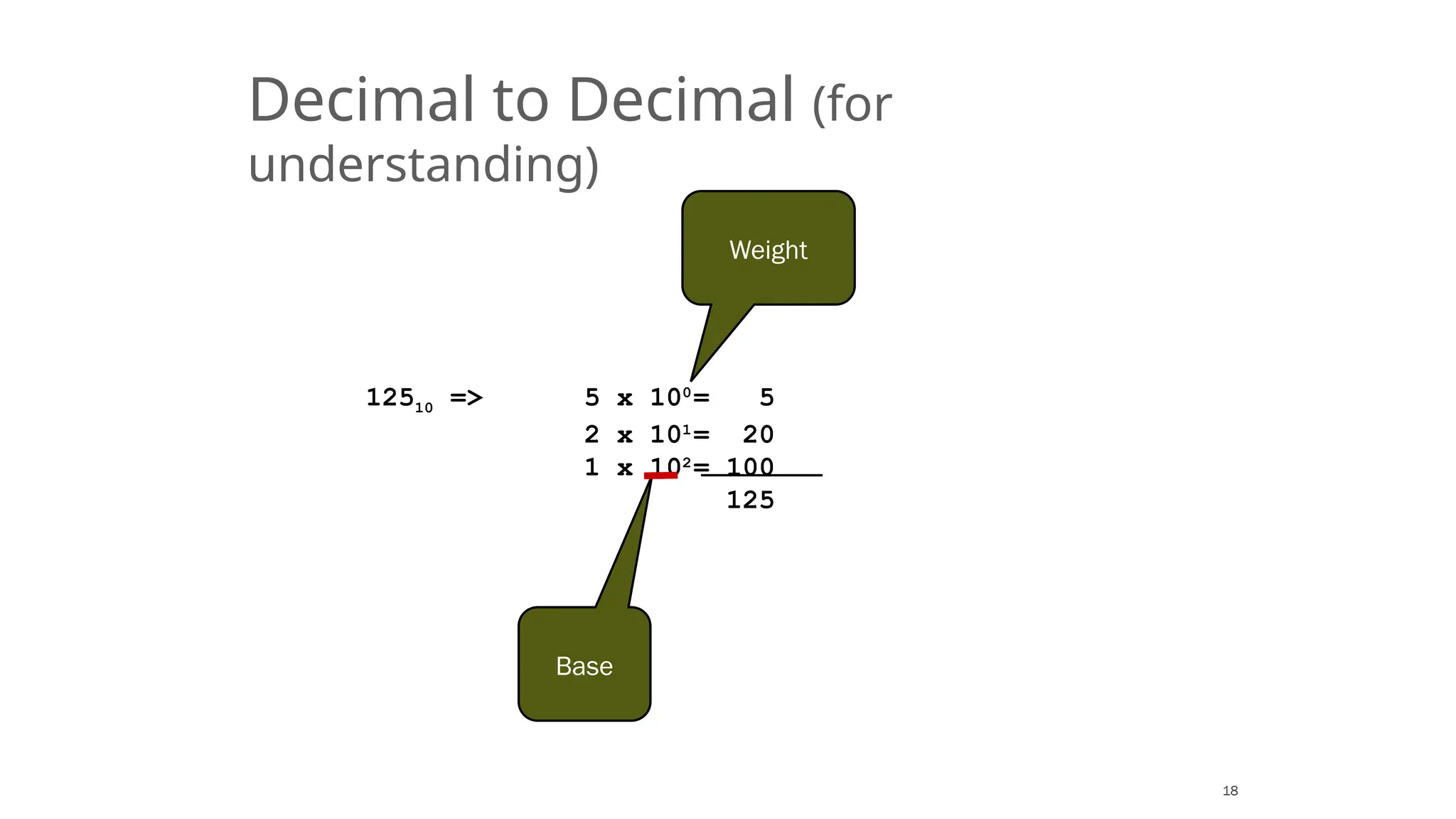
Decimal to Decimal(for
understanding)
12510 => 5 x 100
= 5
2 x 101
= 20
1 x 102
= 100
125
Base
Weight
19.
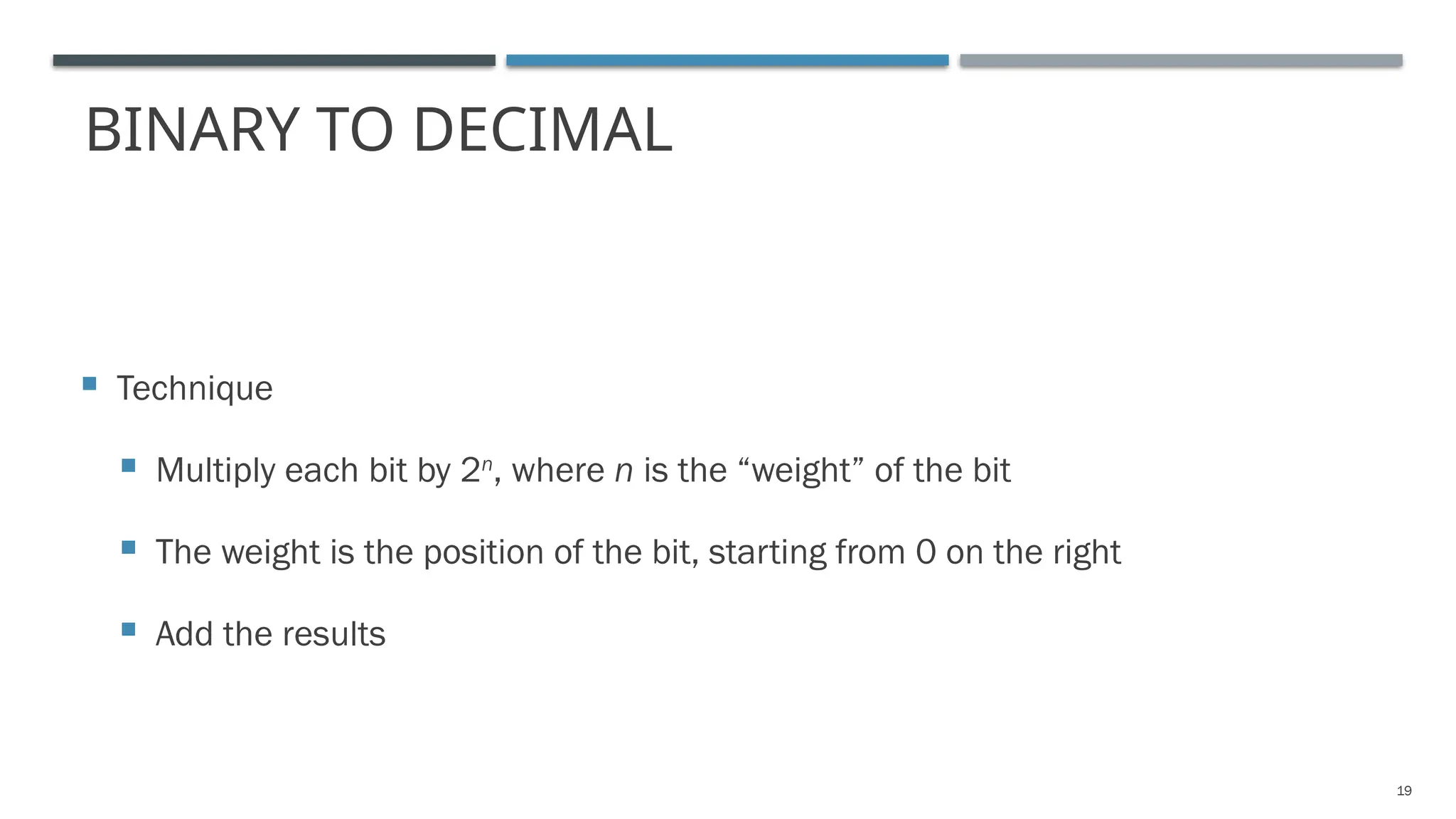
BINARY TO DECIMAL
Technique
Multiply each bit by 2n
, where n is the “weight” of the bit
The weight is the position of the bit, starting from 0 on the right
Add the results
19
20.
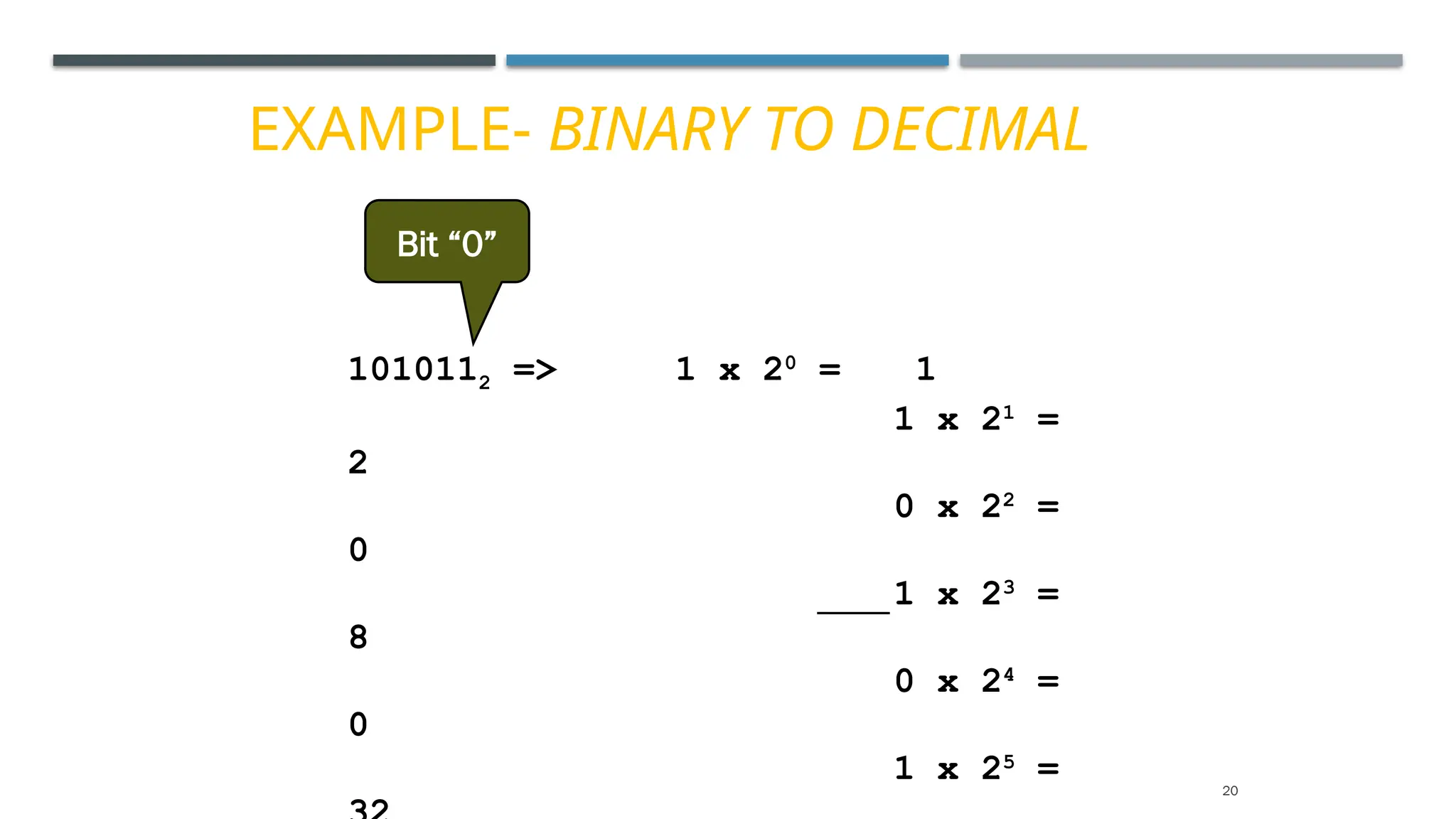
EXAMPLE- BINARY TODECIMAL
20
1010112 => 1 x 20
= 1
1 x 21
=
2
0 x 22
=
0
1 x 23
=
8
0 x 24
=
0
1 x 25
=
Bit “0”
21.
BINARY NUMBER SYSTEM
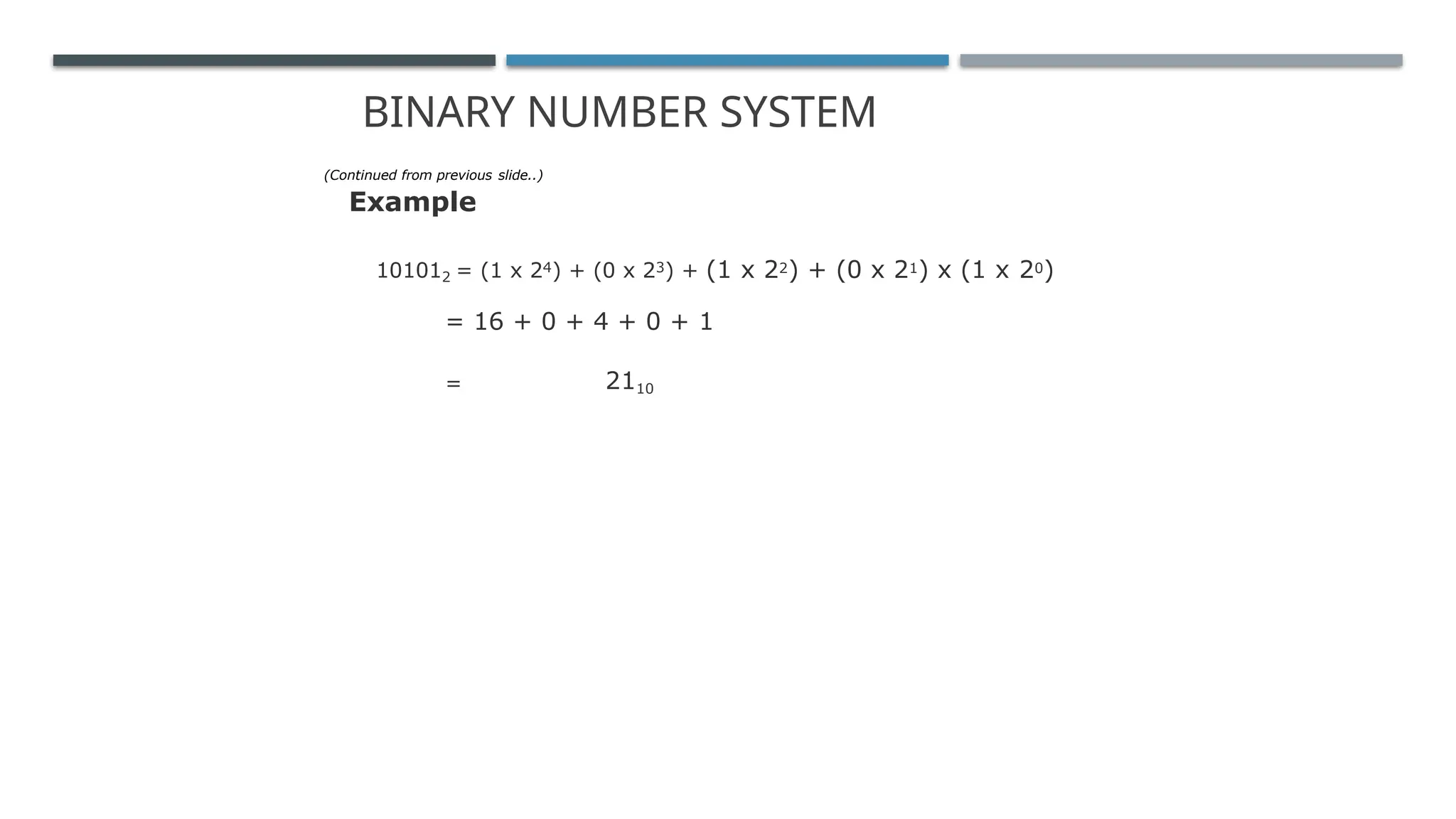
(Continuedfrom previous slide..)
Example
101012 = (1 x 24) + (0 x 23) + (1 x 22) + (0 x 21) x (1 x 20)
= 16 + 0 + 4 + 0 + 1
= 2110
OCTAL TO DECIMAL
Technique
Multiply each bit by 8n
, where n is the “weight” of the bit
The weight is the position of the bit, starting from 0 on the right
Add the results
23
24.
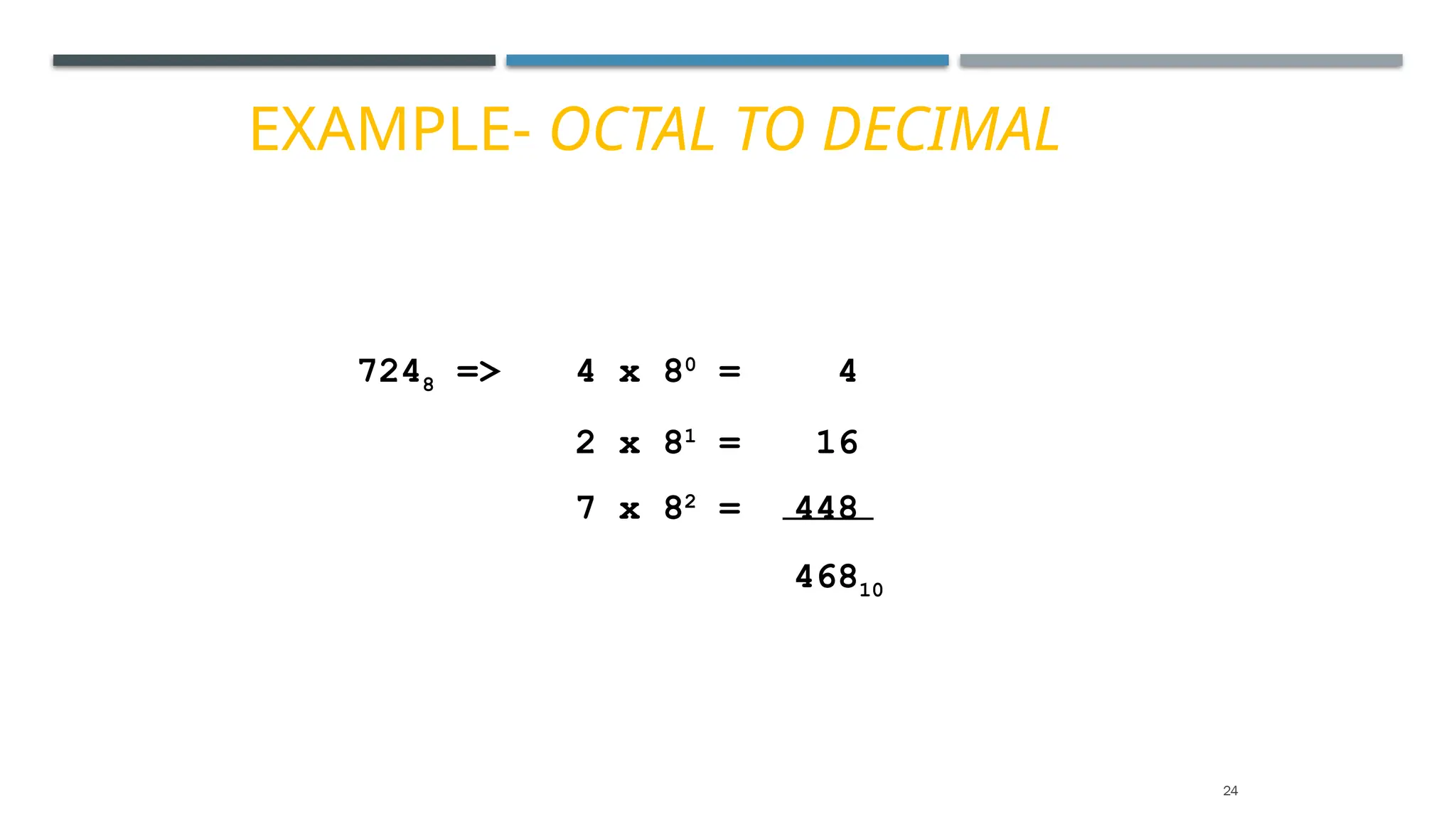
EXAMPLE- OCTAL TODECIMAL
7248 => 4 x 80
= 4
2 x 81
= 16
7 x 82
= 448
46810
24
25.
OCTAL NUMBER SYSTEM
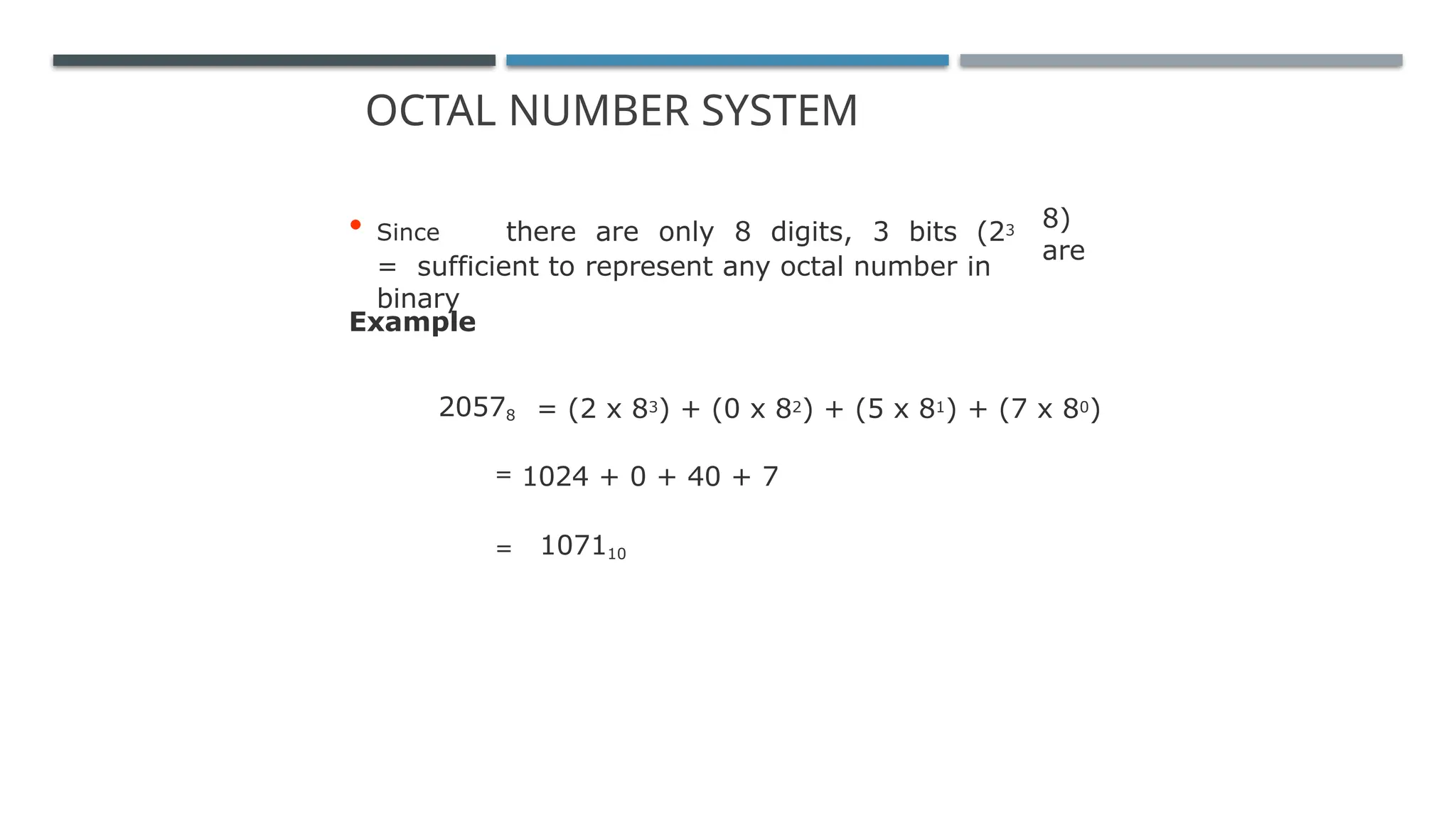
8)
are
•Since there are only 8 digits, 3 bits (23
= sufficient to represent any octal number in
binary
Example
20578 = (2 x 83) + (0 x 82) + (5 x 81) + (7 x 80)
= 1024 + 0 + 40 + 7
= 107110
26.
26
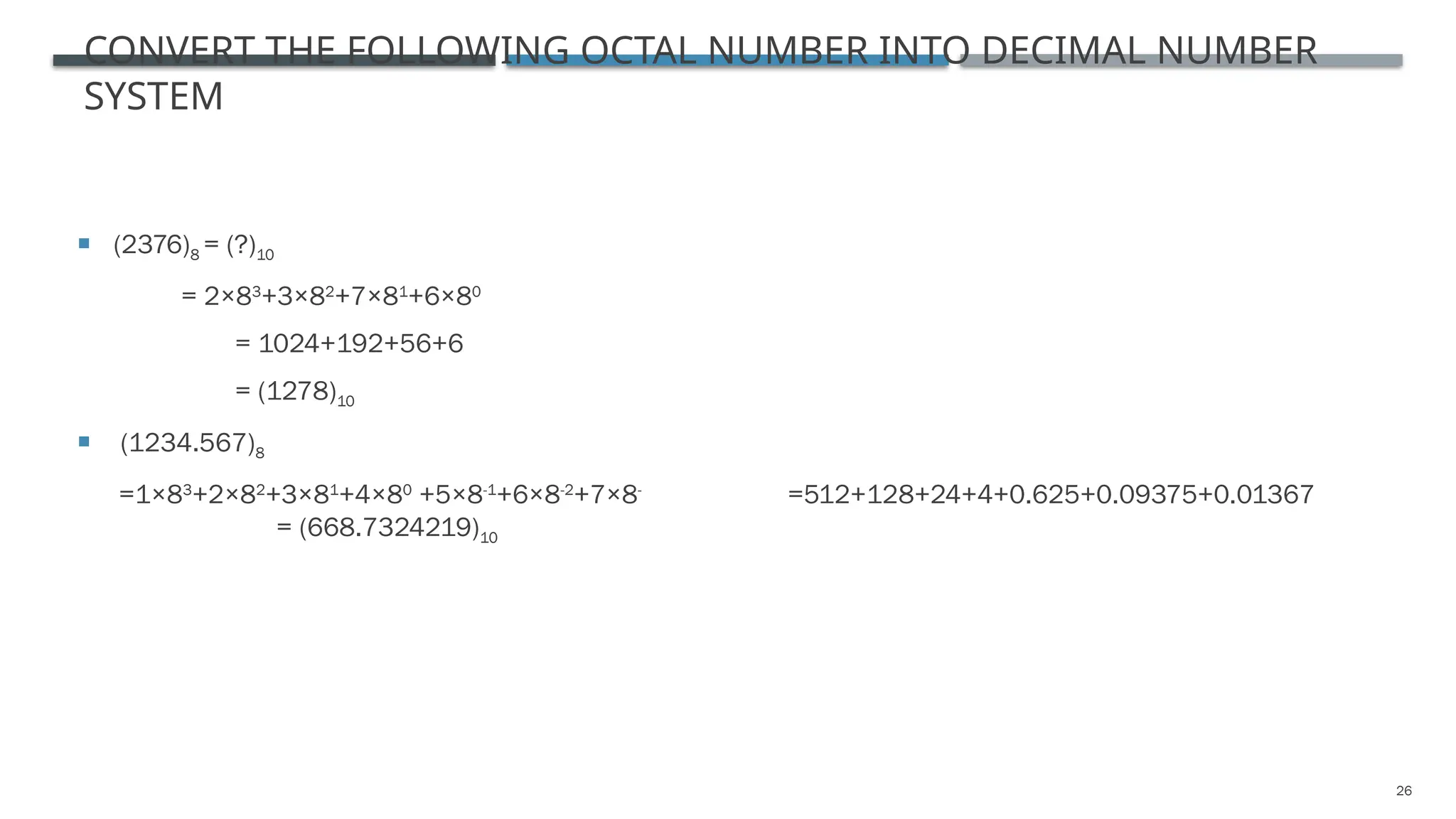
CONVERT THE FOLLOWINGOCTAL NUMBER INTO DECIMAL NUMBER
SYSTEM
(2376)8 = (?)10
= 2×83
+3×82
+7×81
+6×80
= 1024+192+56+6
= (1278)10
(1234.567)8
=1×83
+2×82
+3×81
+4×80
+5×8-1
+6×8-2
+7×8-
=512+128+24+4+0.625+0.09375+0.01367
= (668.7324219)10
27.
HEXADECIMAL TO DECIMAL
Technique
Multiply each bit by 16n
, where n is the “weight” of the bit
The weight is the position of the bit, starting from 0 on the right
Add the results
27
28.
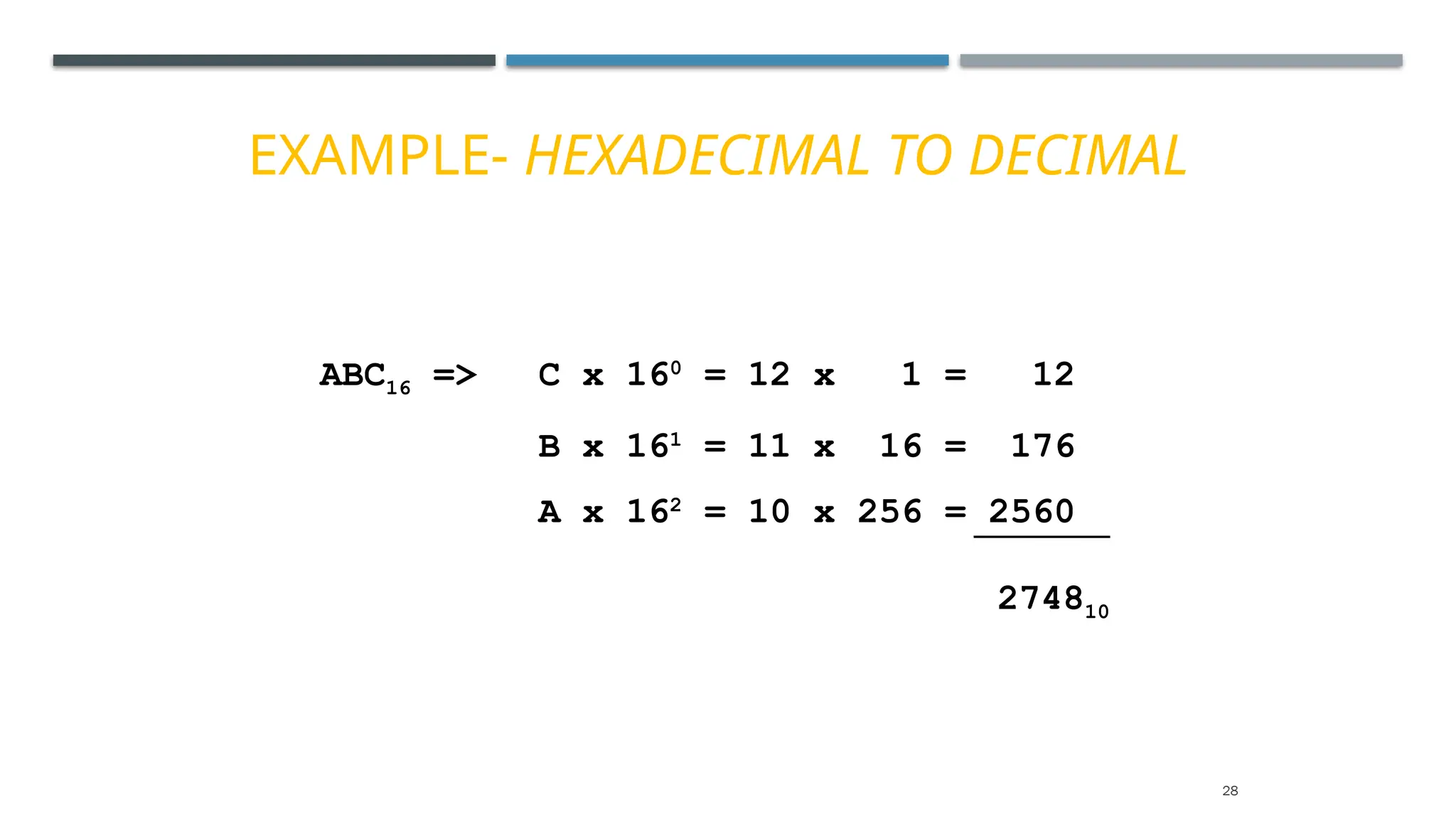
EXAMPLE- HEXADECIMAL TODECIMAL
ABC16 => C x 160
= 12 x 1 = 12
B x 161
= 11 x 16 = 176
A x 162
= 10 x 256 = 2560
274810
28
29.
HEXADECIMAL NUMBER SYSTEM
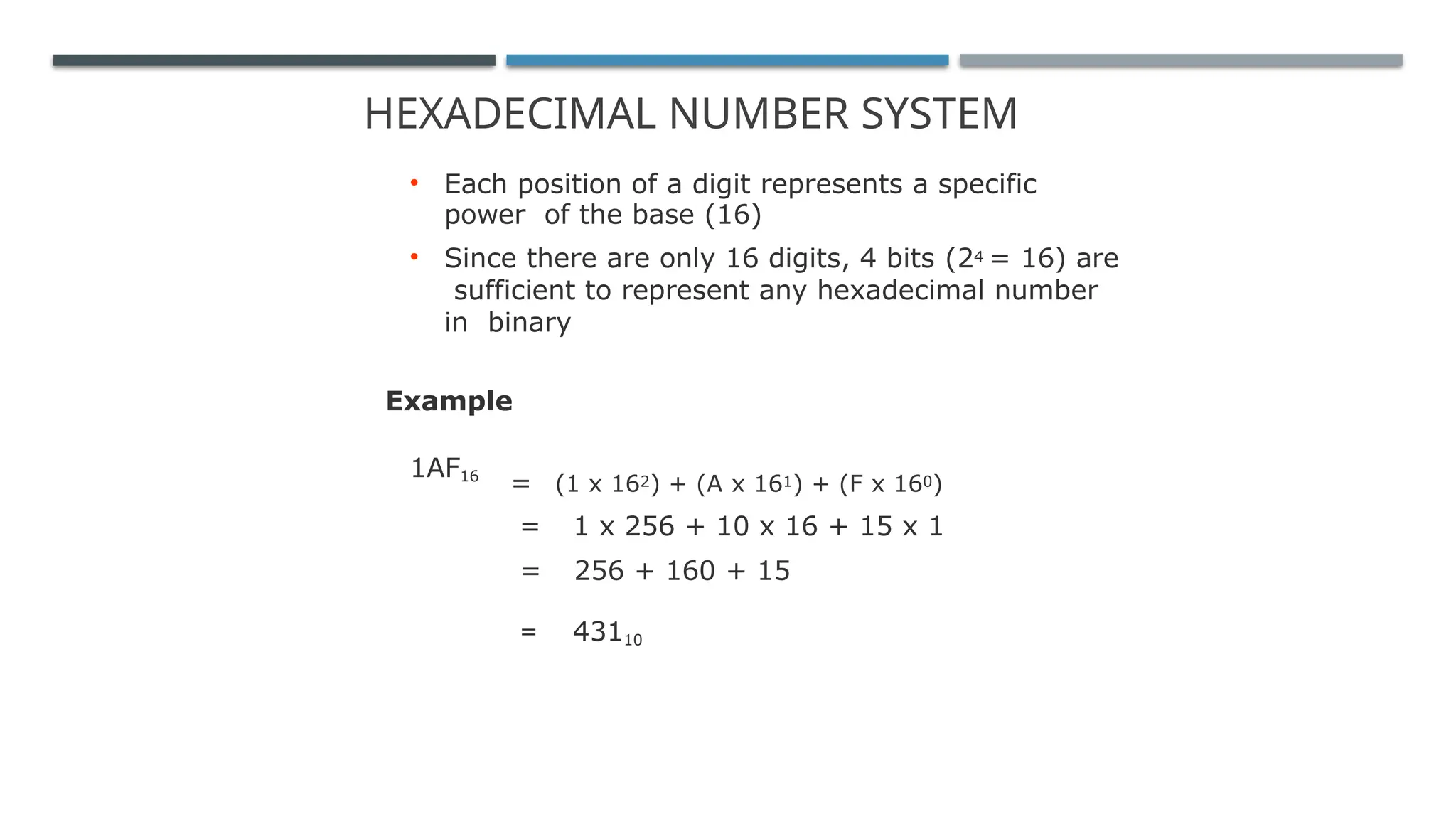
•Each position of a digit represents a specific
power of the base (16)
• Since there are only 16 digits, 4 bits (24 = 16) are
sufficient to represent any hexadecimal number
in binary
Example
1AF16
= (1 x 162) + (A x 161) + (F x 160)
= 1 x 256 + 10 x 16 + 15 x 1
= 256 + 160 + 15
= 43110
30.
30
CONVERT THE FOLLOWINGHEXADECIMAL NUMBER INTO DECIMAL
NUMBER SYSTEM
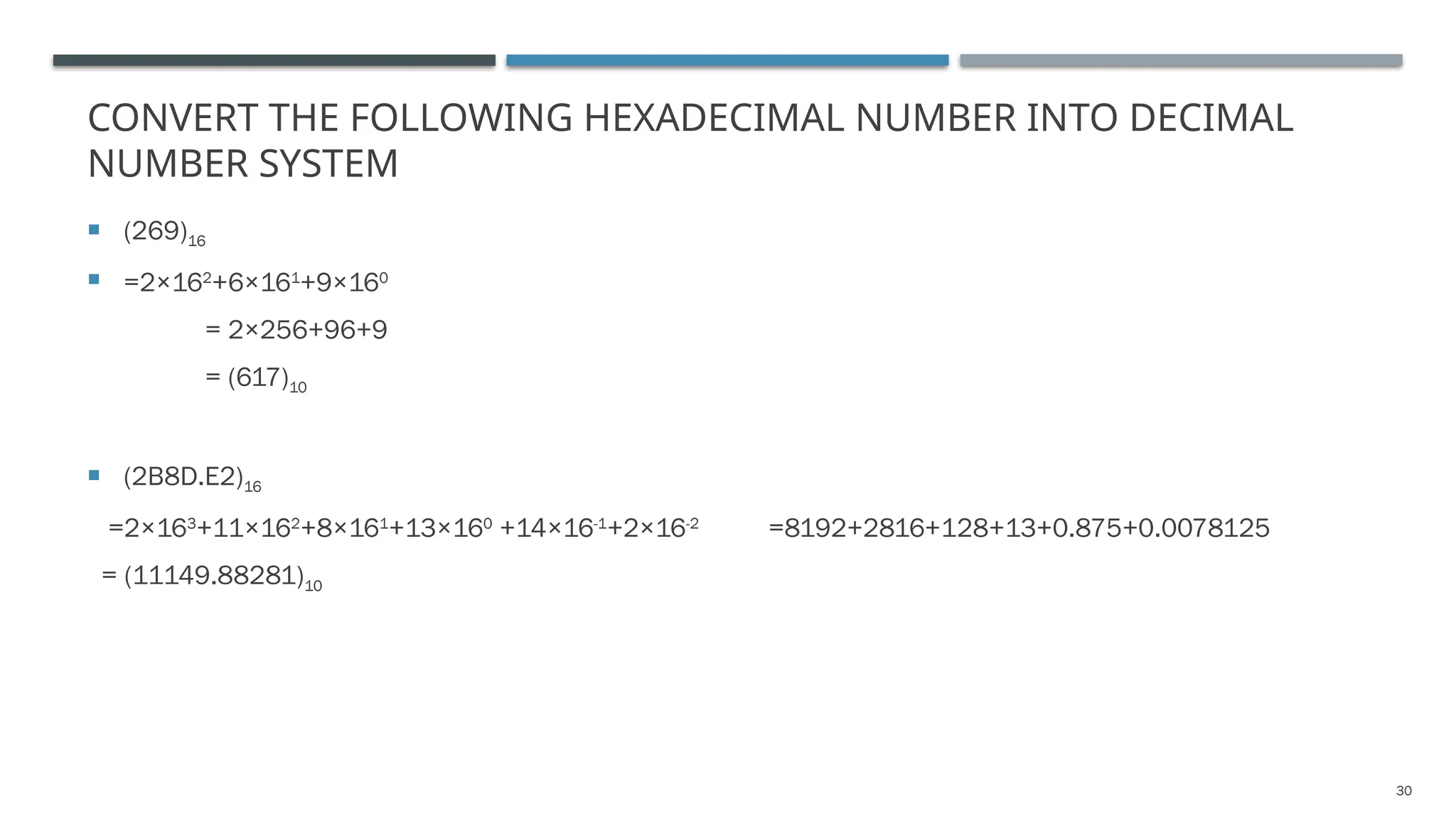
(269)16
=2×162
+6×161
+9×160
= 2×256+96+9
= (617)10
(2B8D.E2)16
=2×163
+11×162
+8×161
+13×160
+14×16-1
+2×16-2
=8192+2816+128+13+0.875+0.0078125
= (11149.88281)10
31.
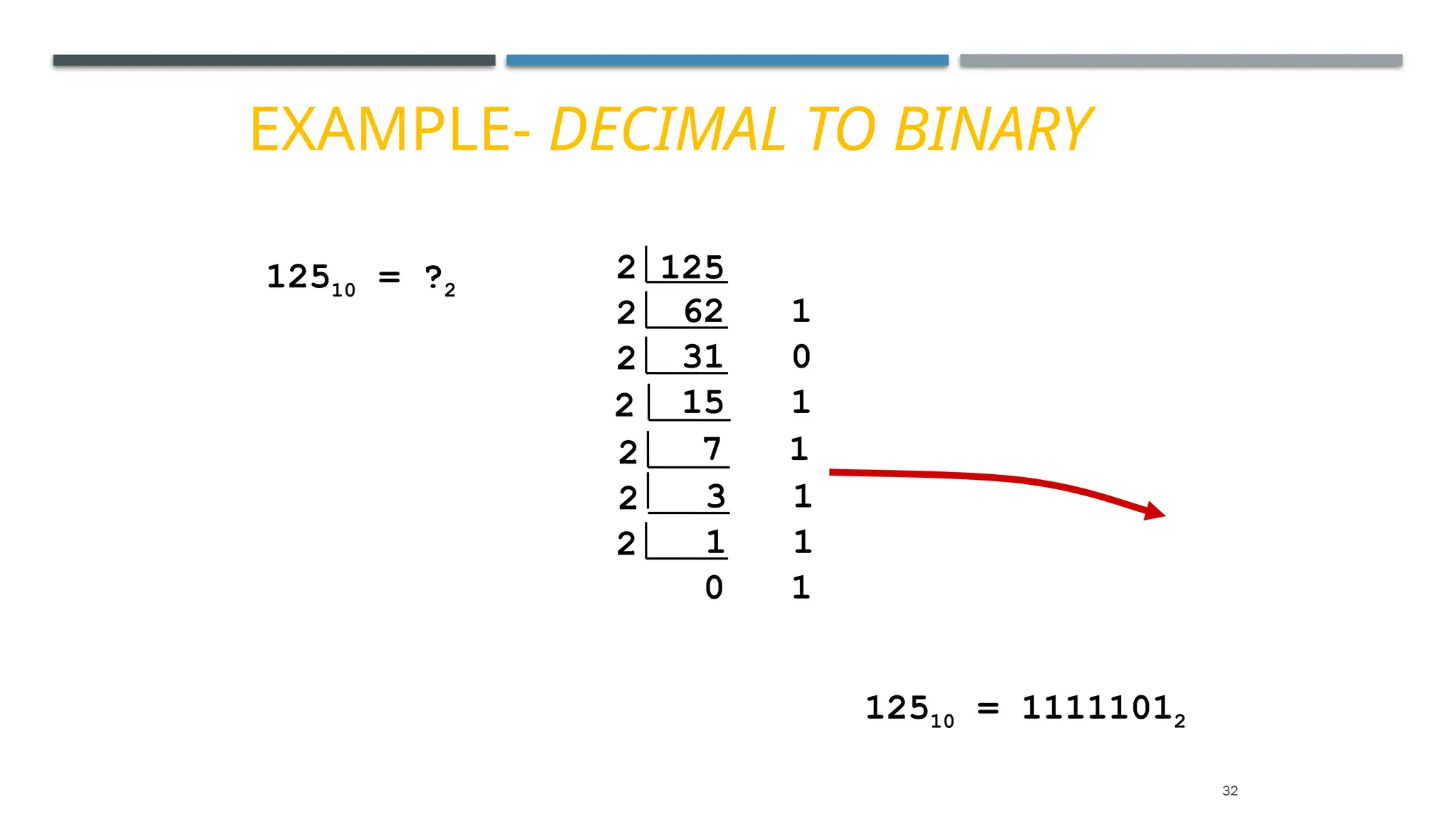
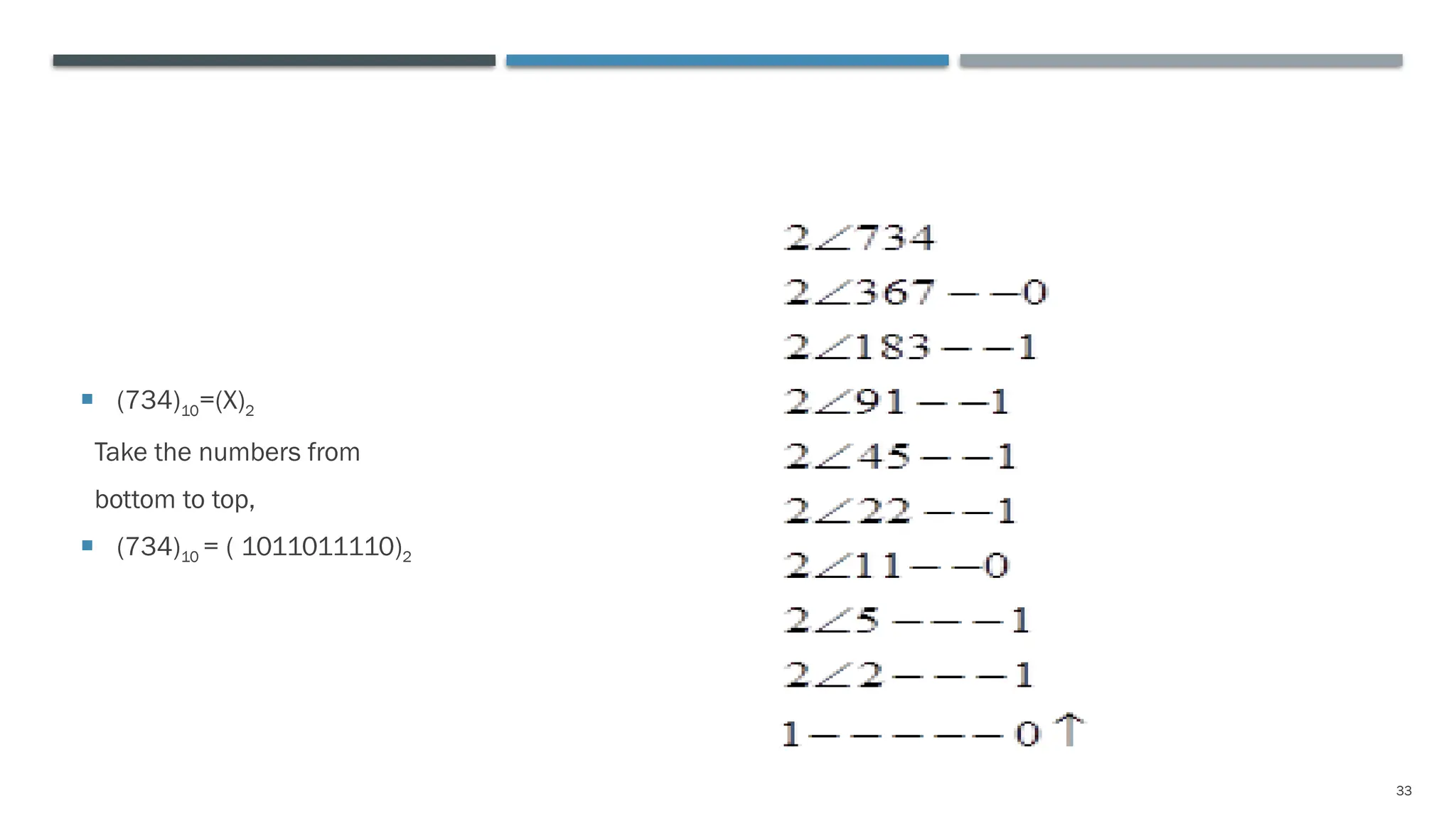
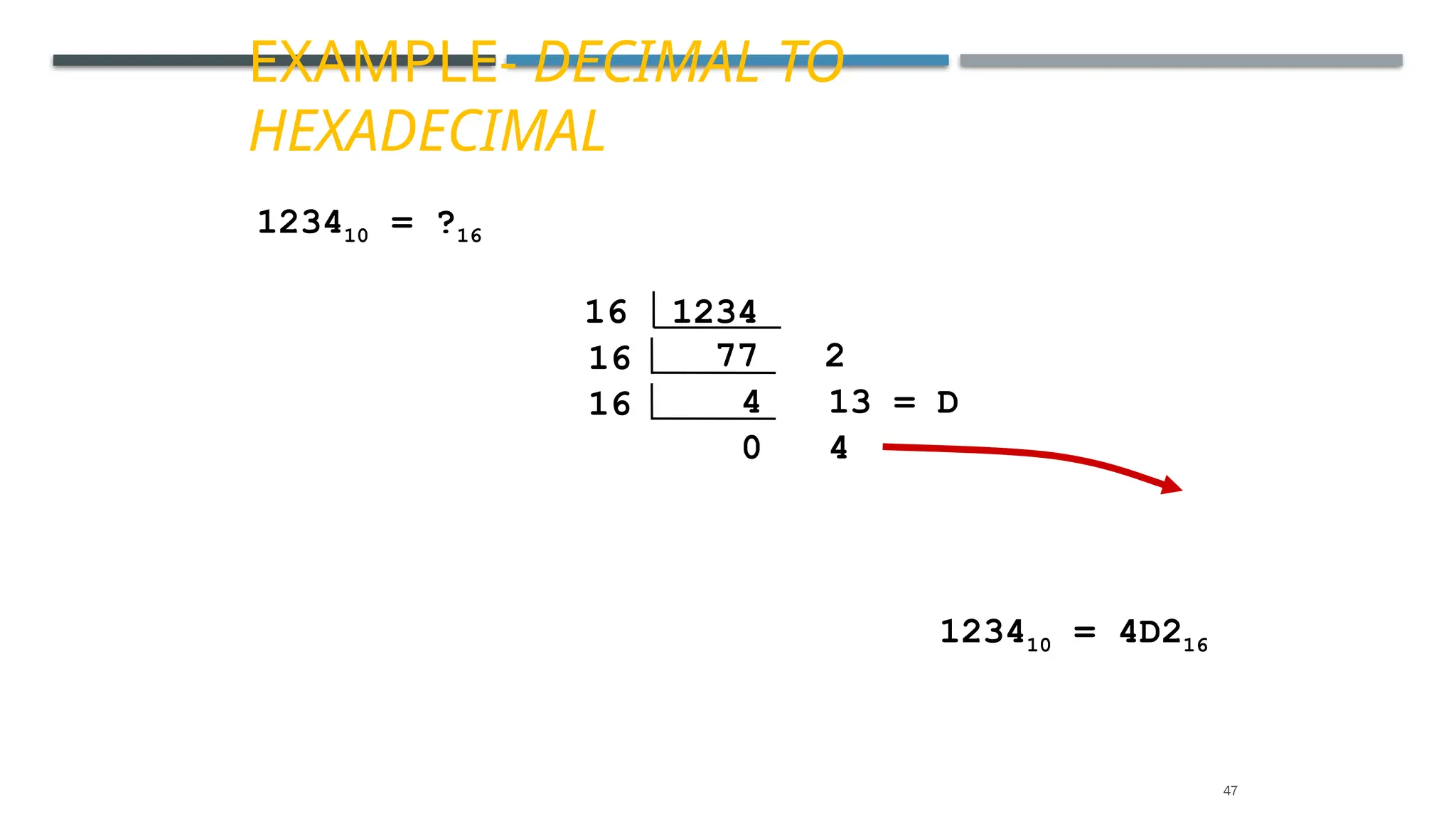
DECIMAL TO BINARY
Technique
Divide by two, keep track of the remainder
31
34
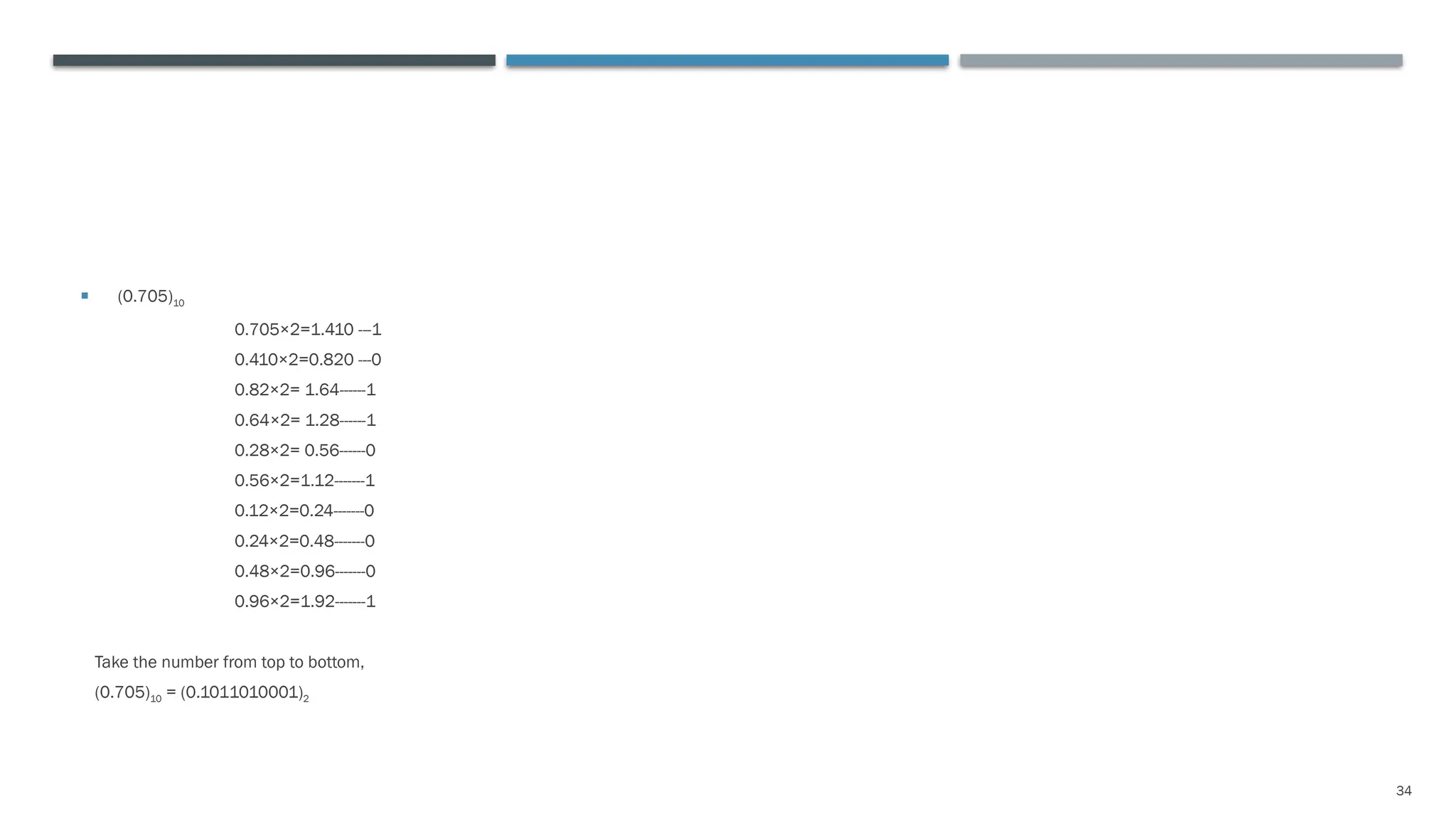
(0.705)10
0.705×2=1.410 ---1
0.410×2=0.820---0
0.82×2= 1.64------1
0.64×2= 1.28------1
0.28×2= 0.56------0
0.56×2=1.12-------1
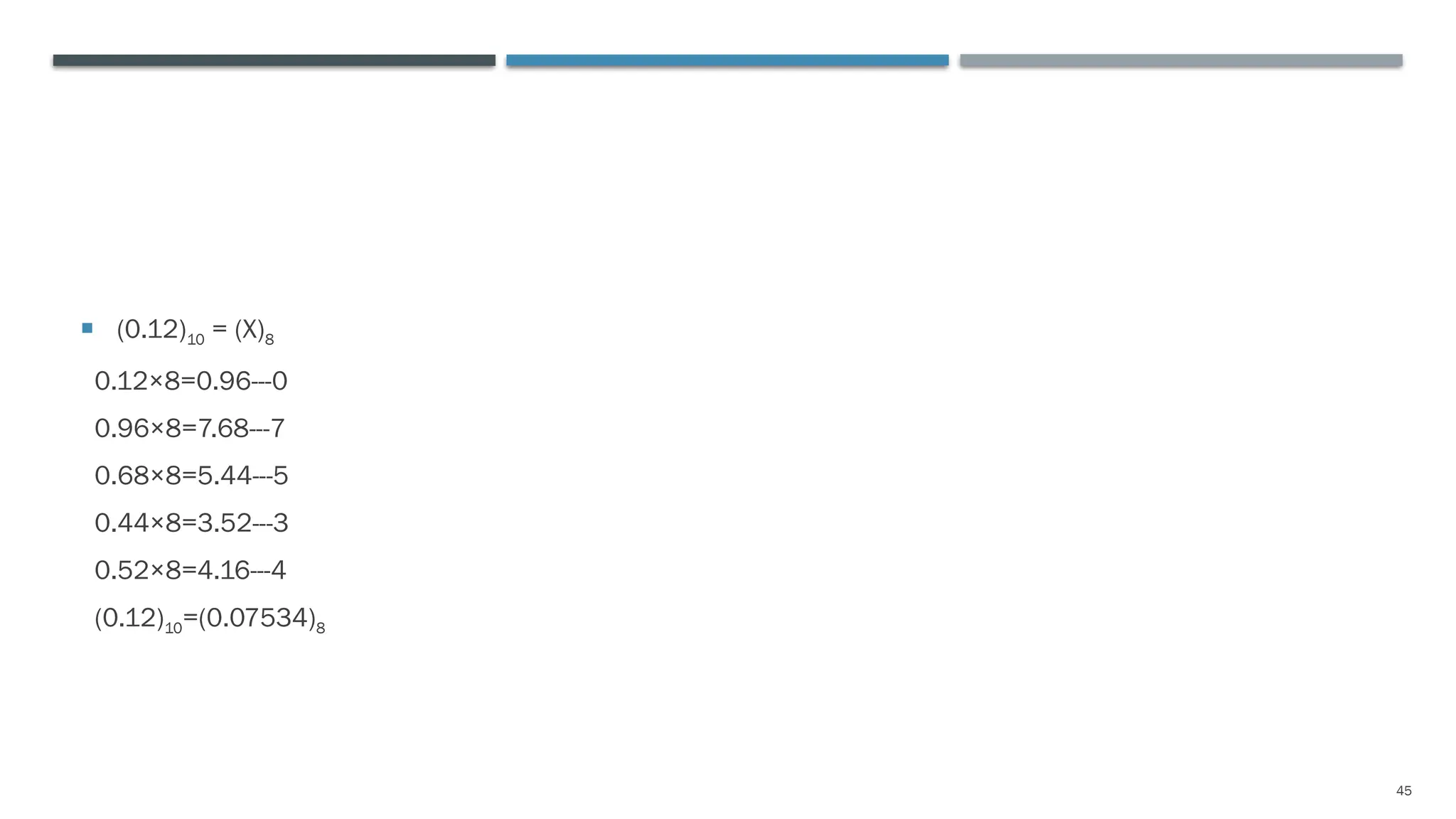
0.12×2=0.24-------0
0.24×2=0.48-------0
0.48×2=0.96-------0
0.96×2=1.92-------1
Take the number from top to bottom,
(0.705)10 = (0.1011010001)2
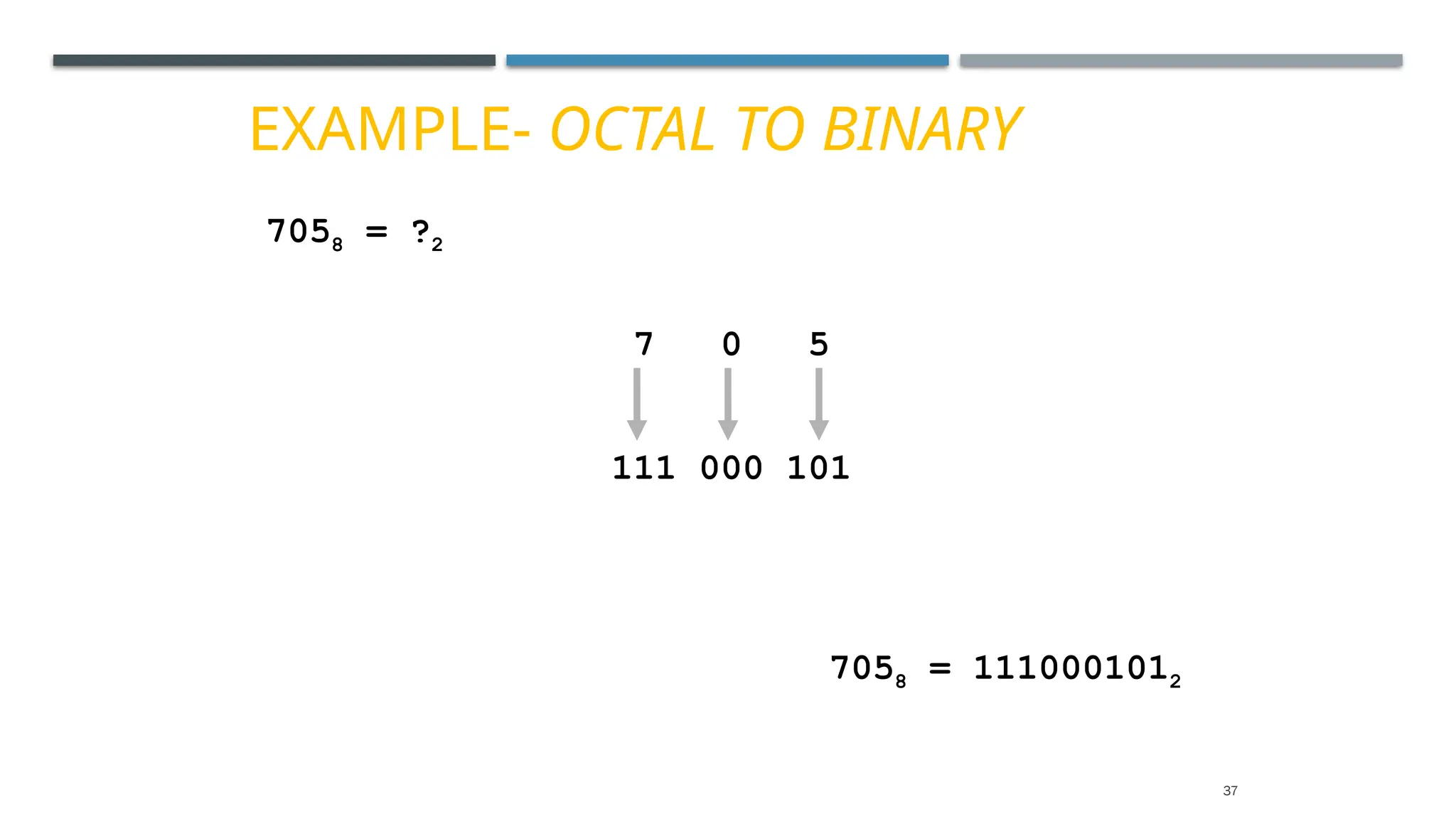
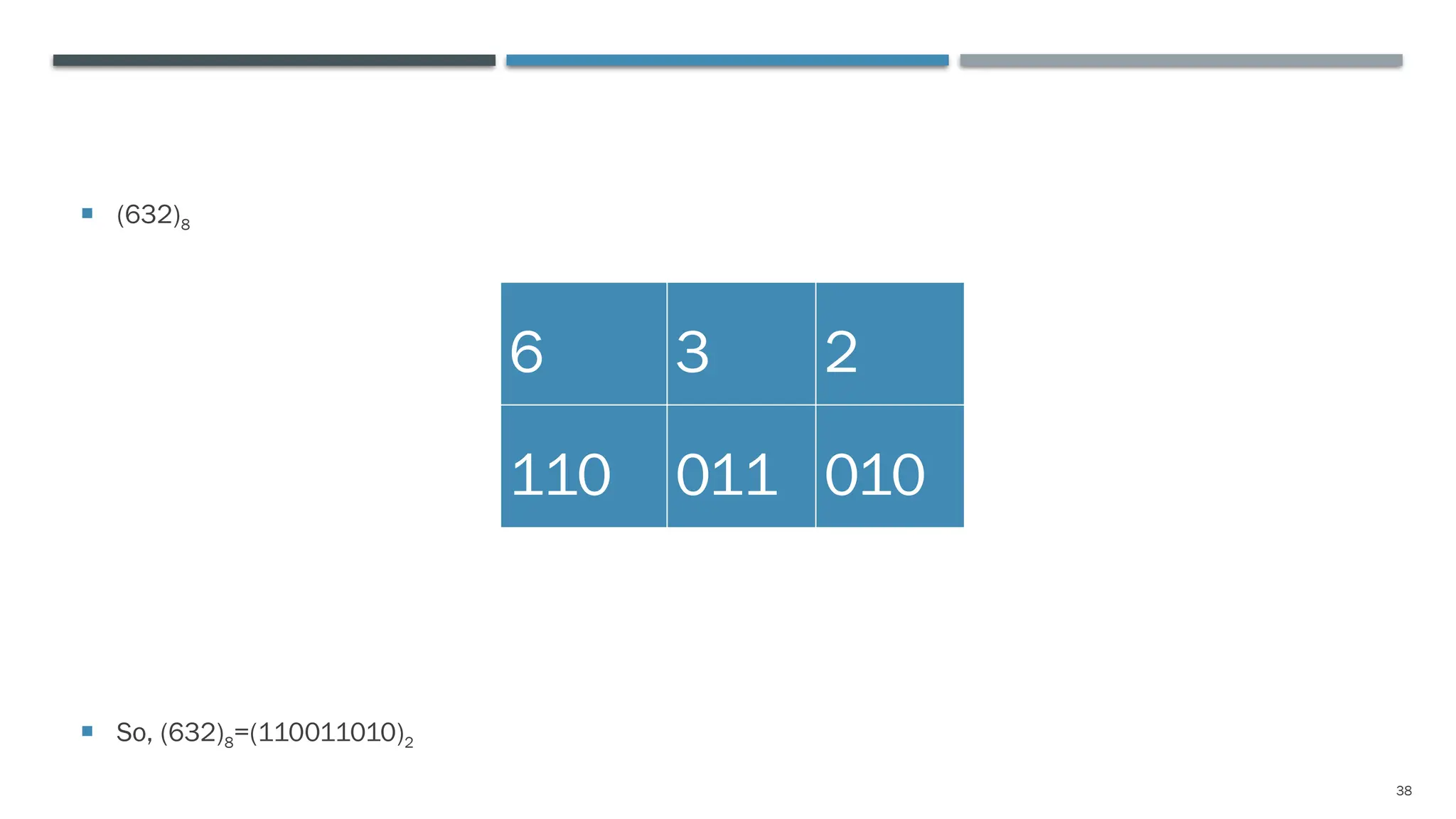
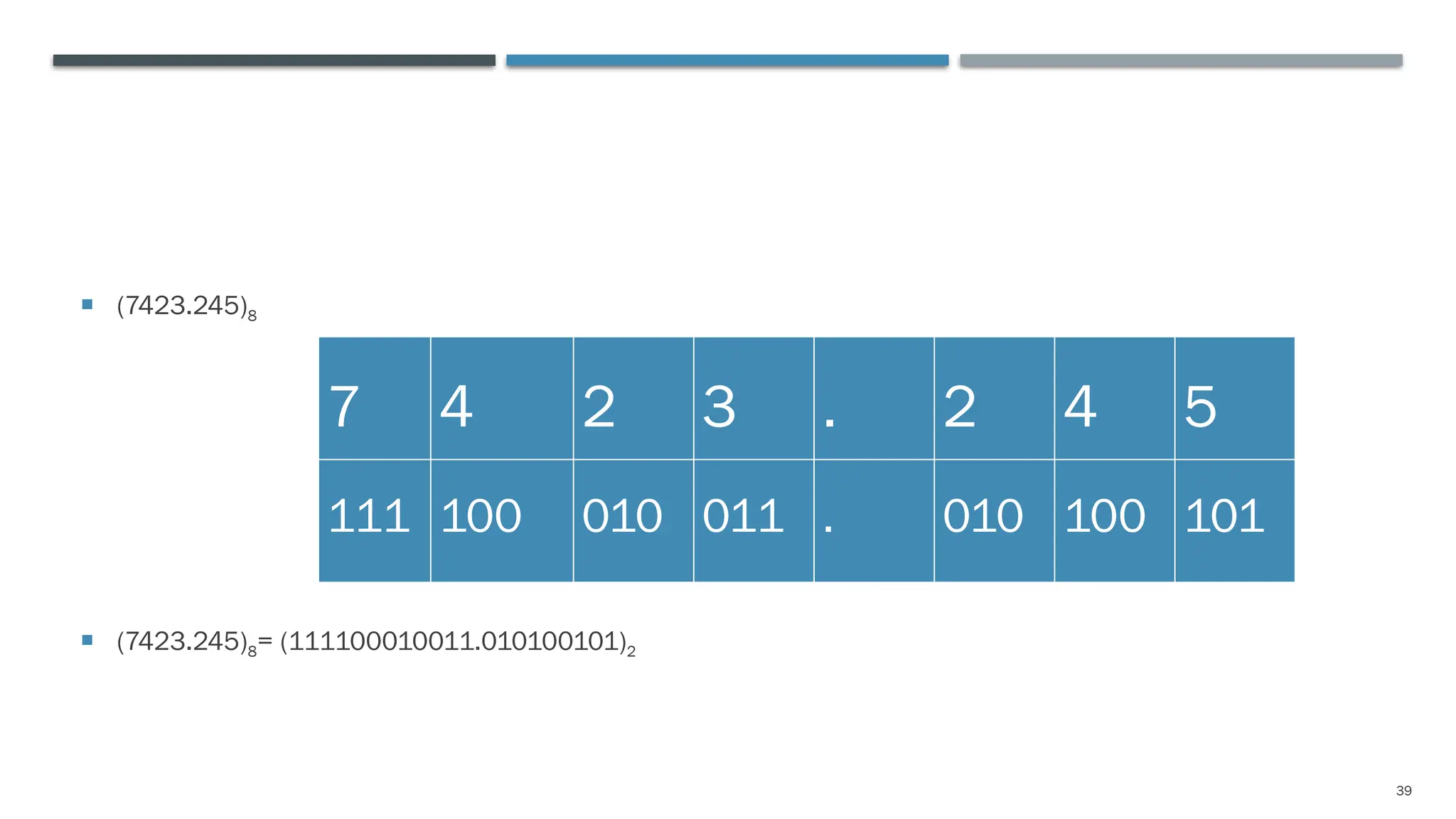
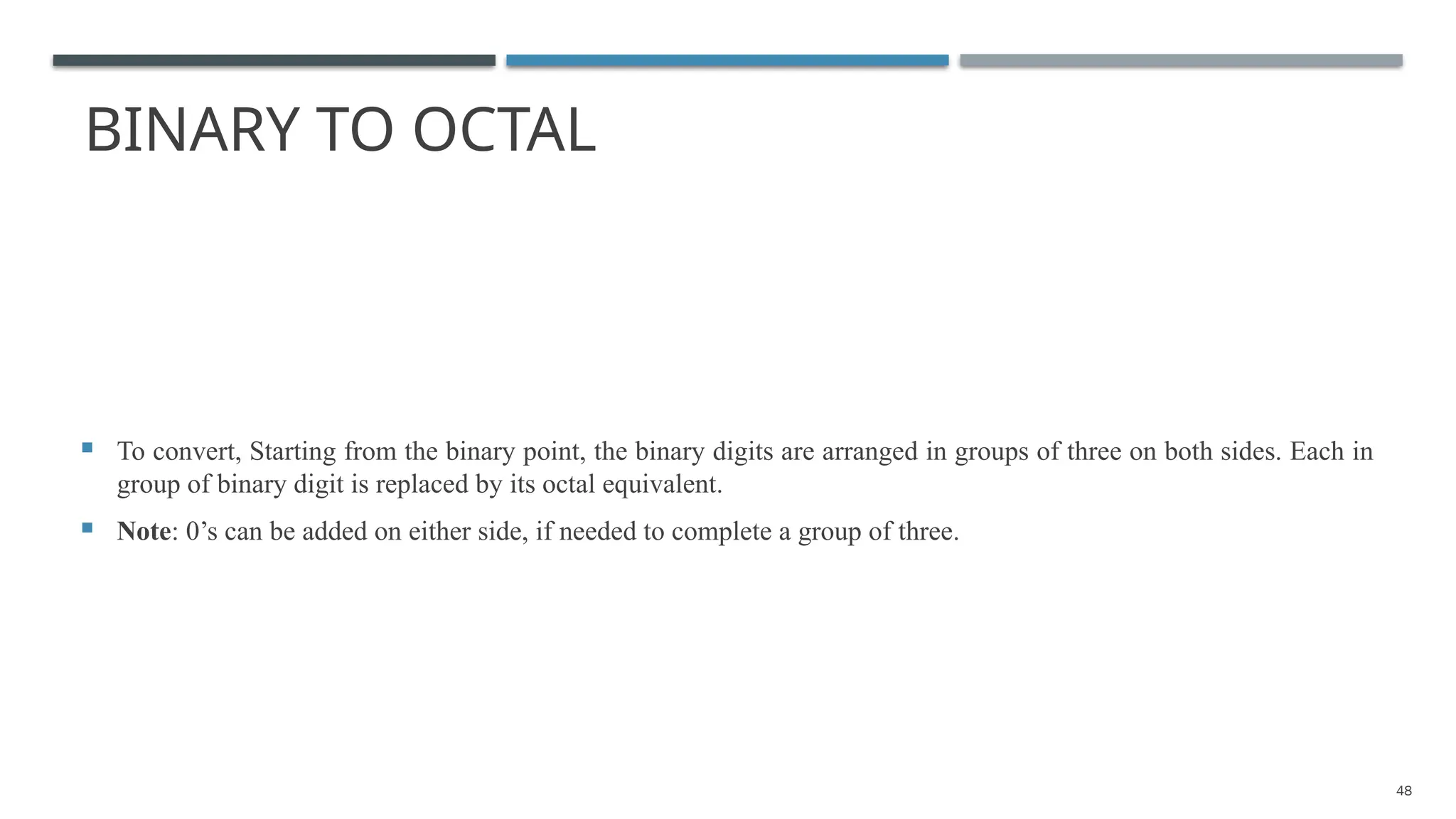
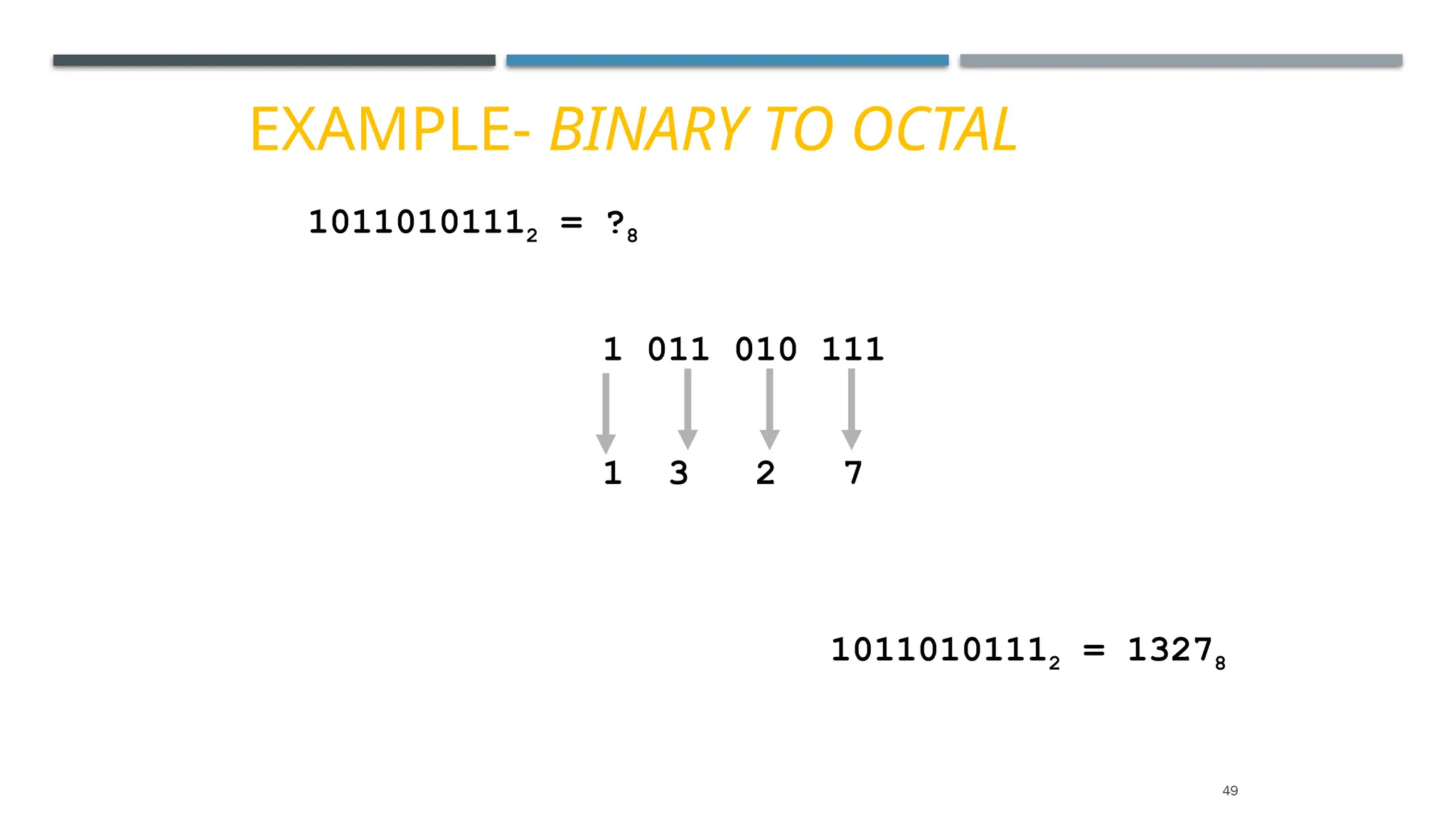
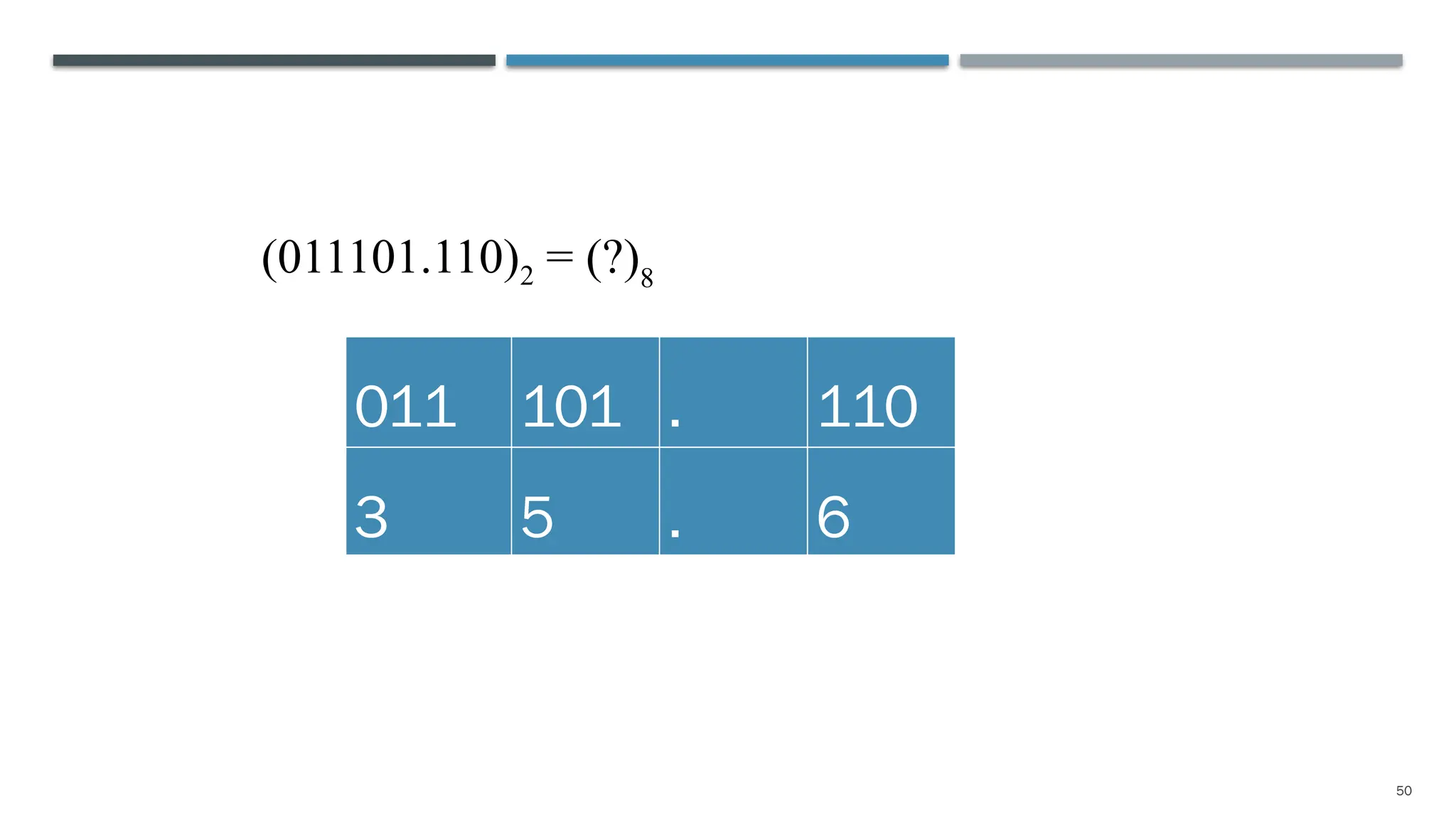
BINARY TO OCTAL
To convert, Starting from the binary point, the binary digits are arranged in groups of three on both sides. Each in
group of binary digit is replaced by its octal equivalent.
Note: 0’s can be added on either side, if needed to complete a group of three.
48
53
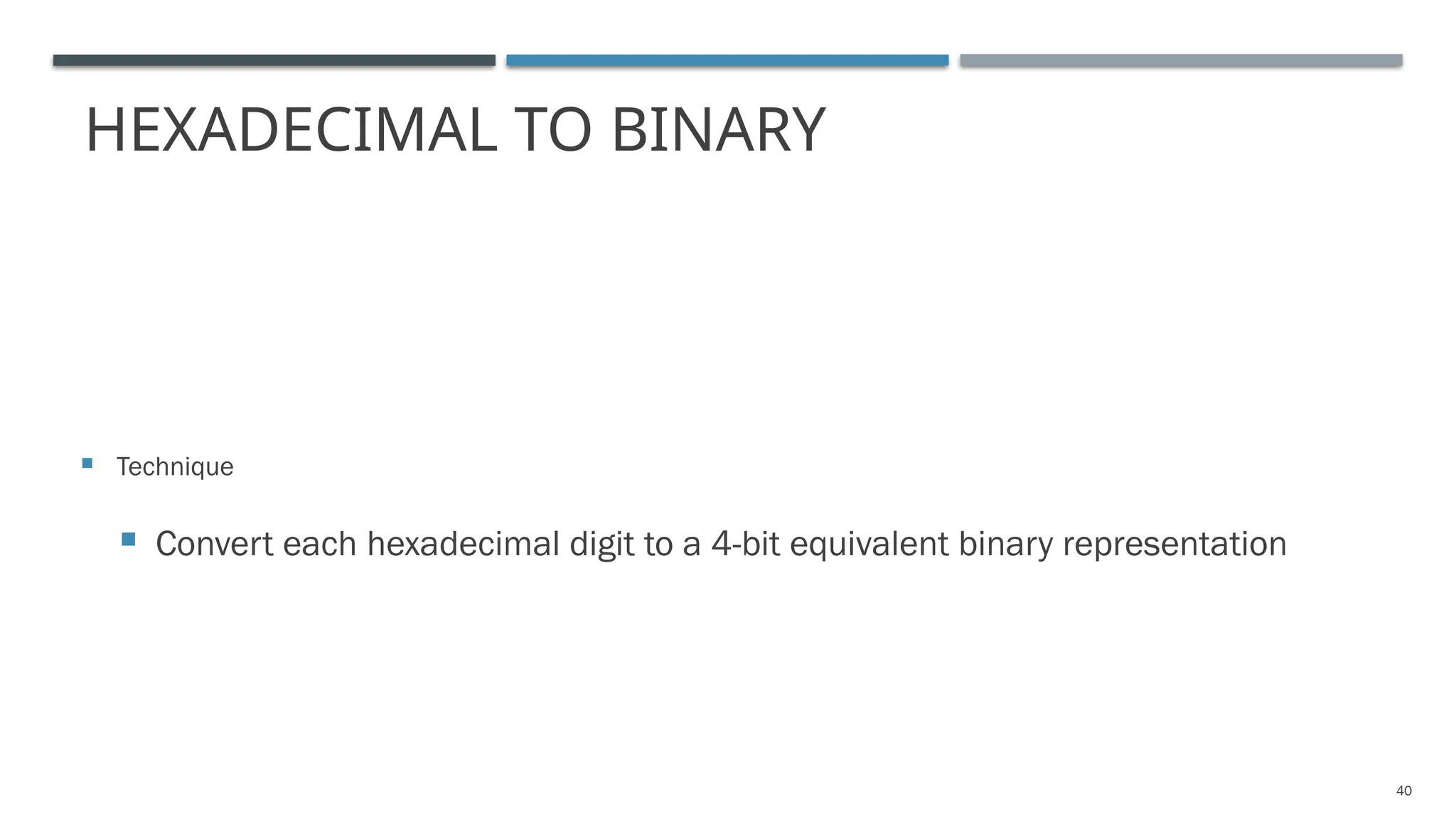
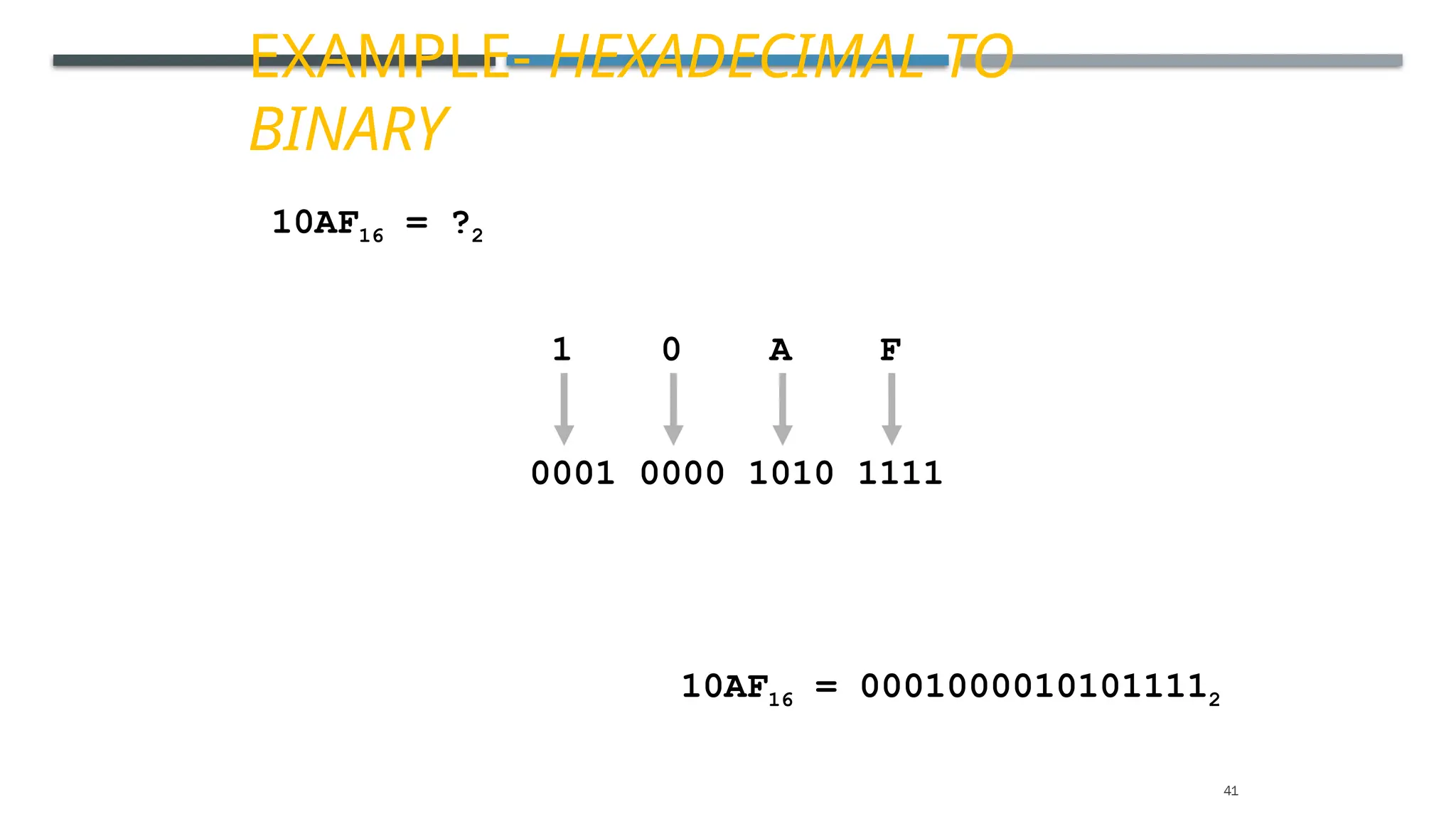
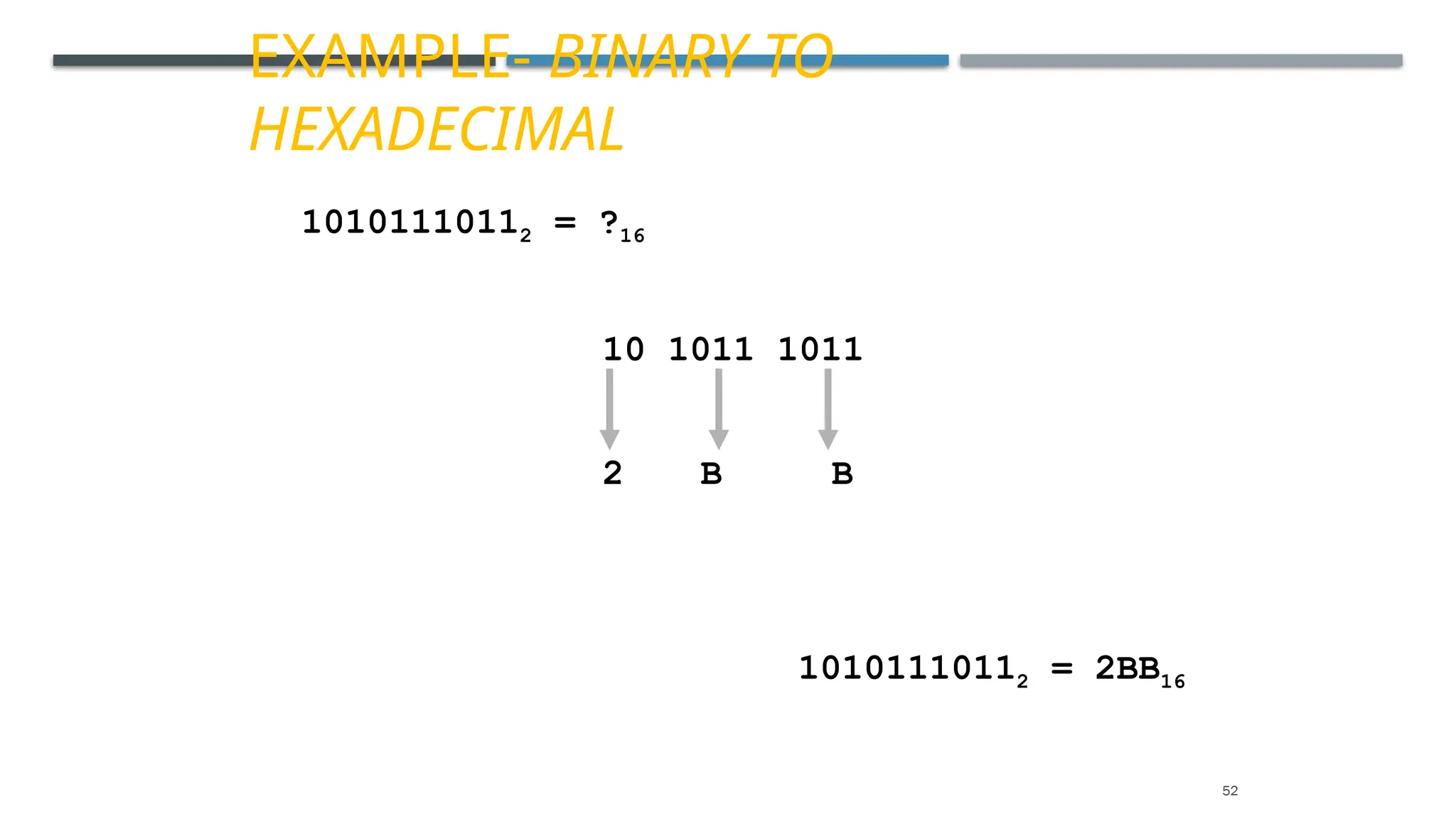
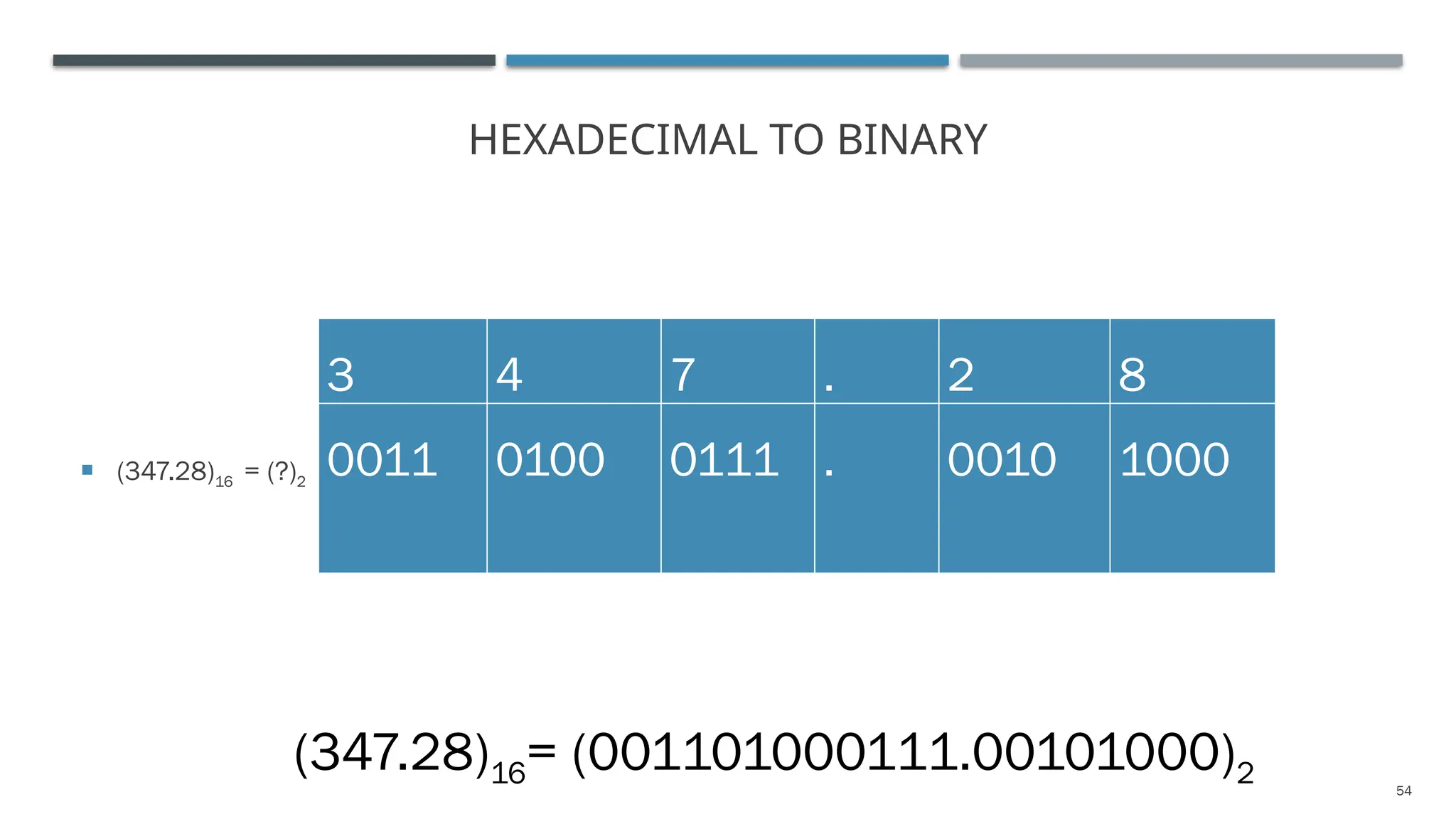
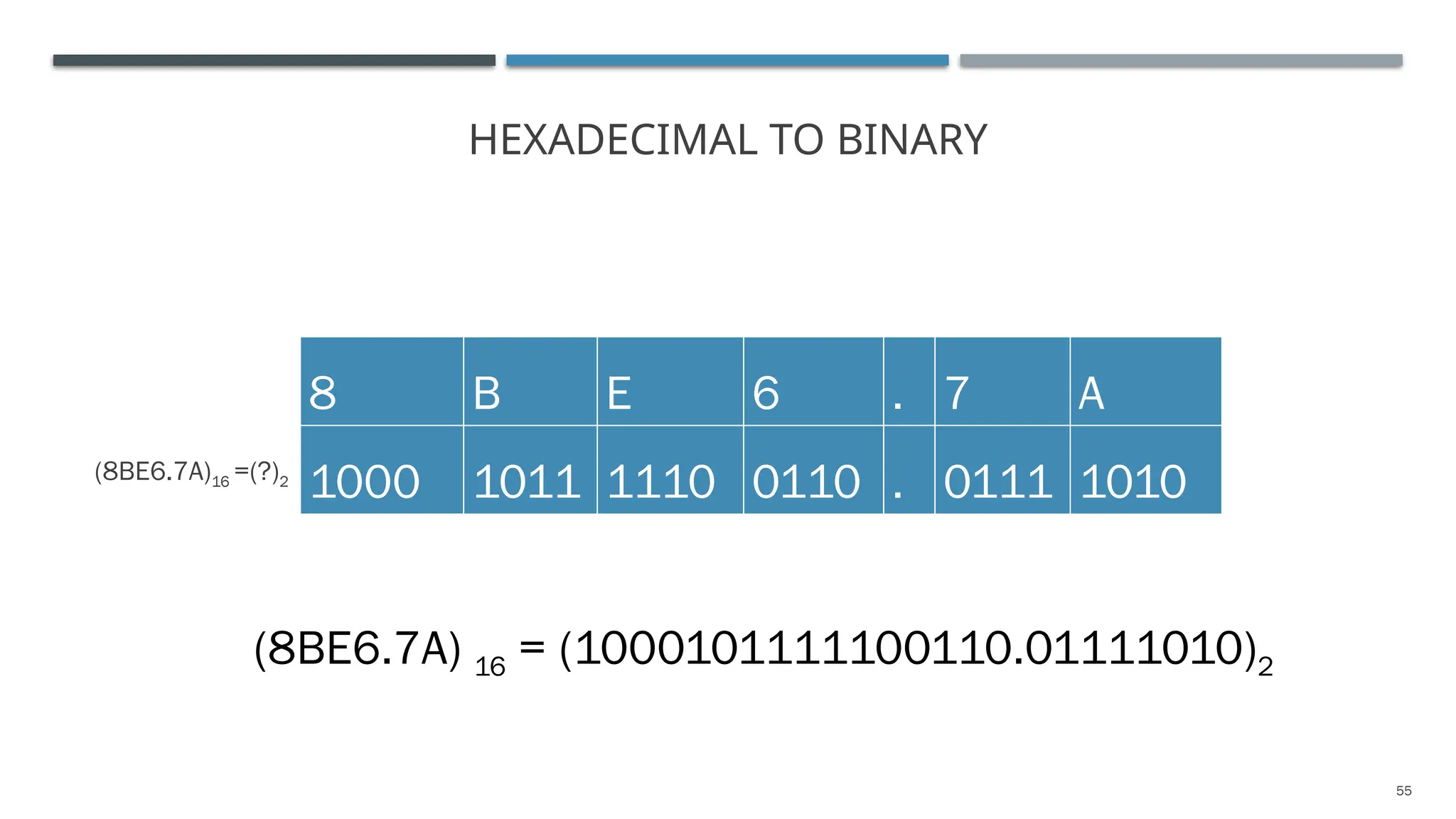
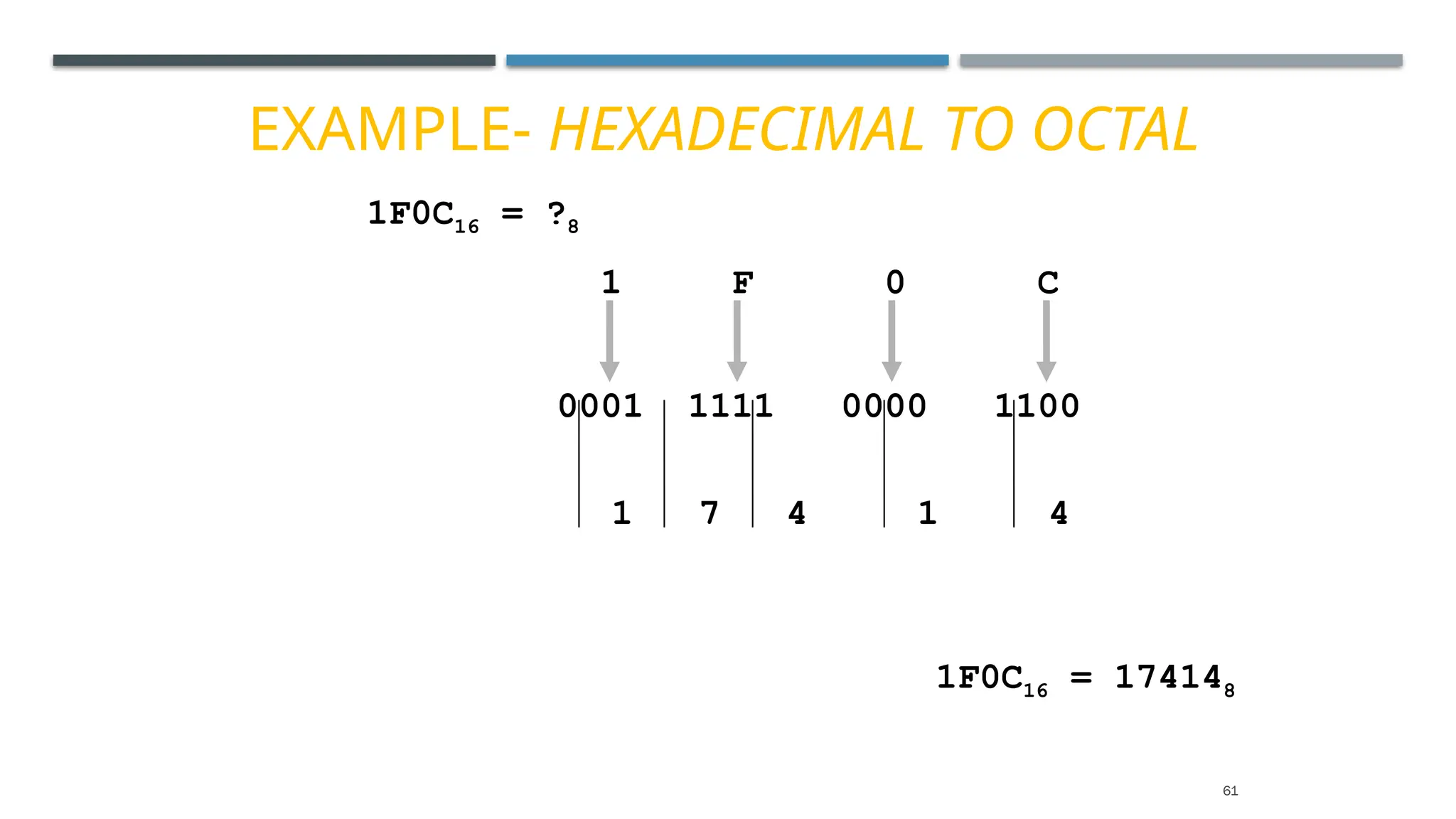
CONVERSION FROM HEXADECIMALTO BINARY
When a hexadecimal number is to be converted its equivalent binary number, each of its digits is replaced by
equivalent group of 4 binary digits.
OCTAL TO HEXADECIMAL
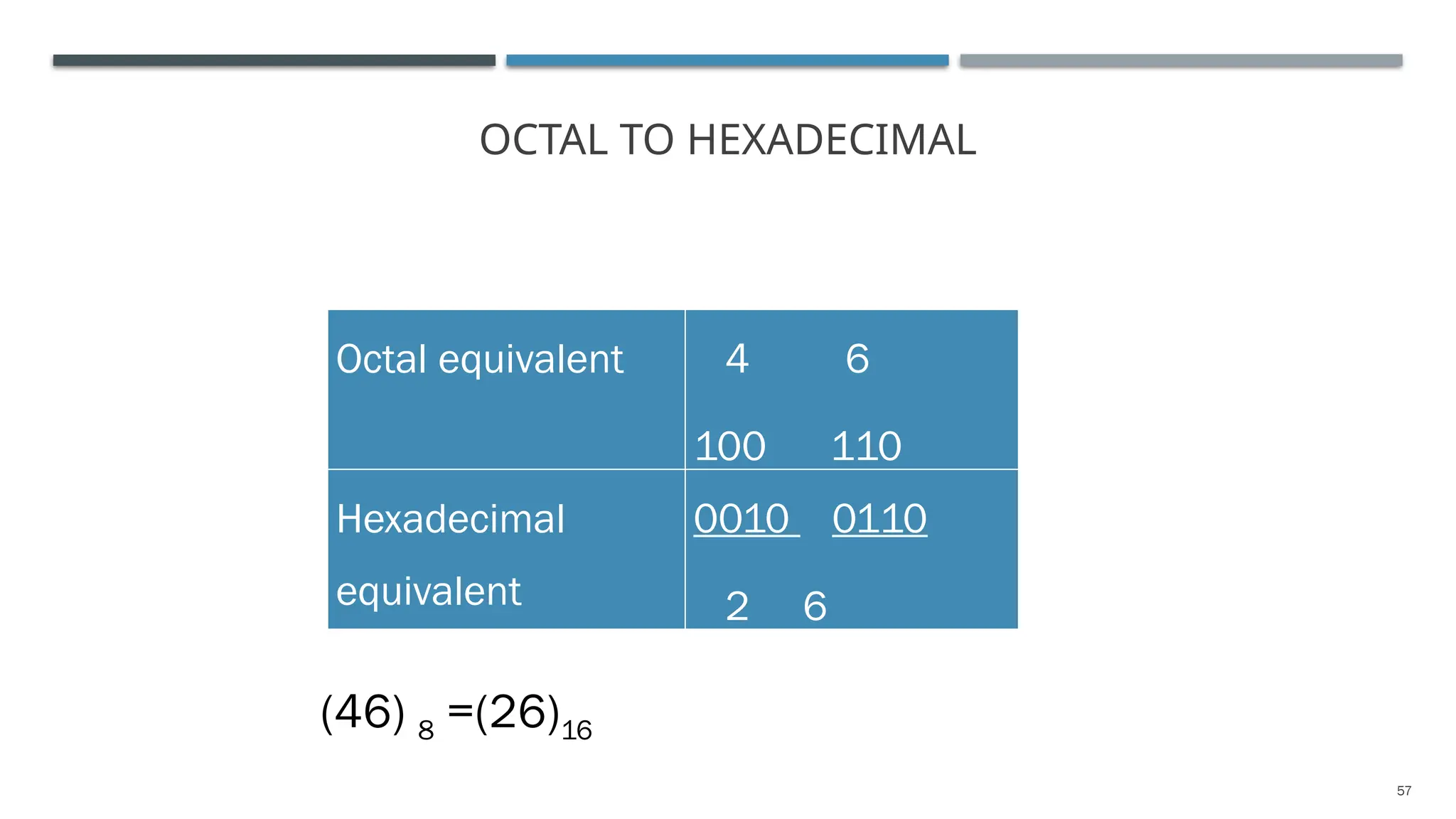
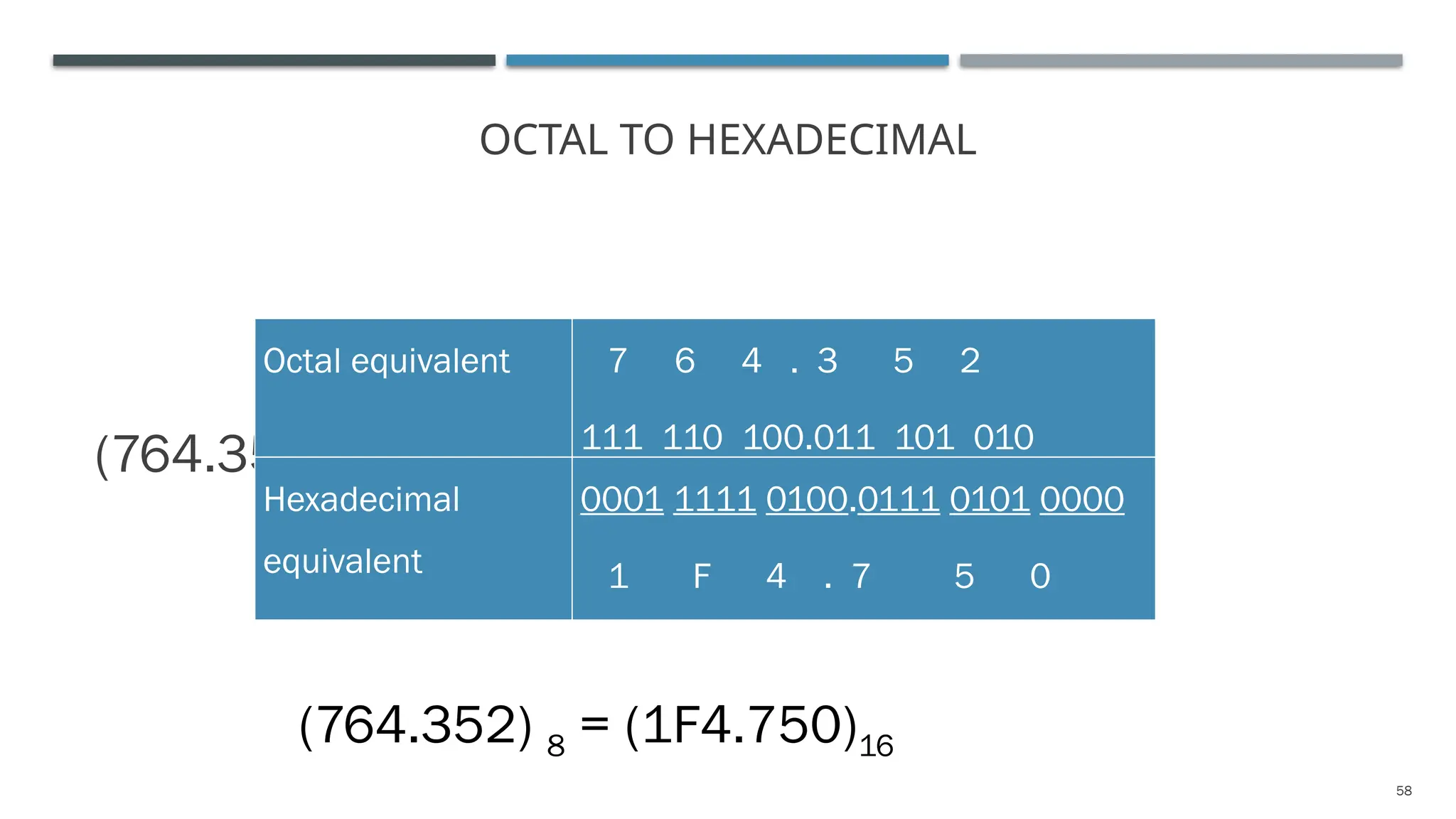
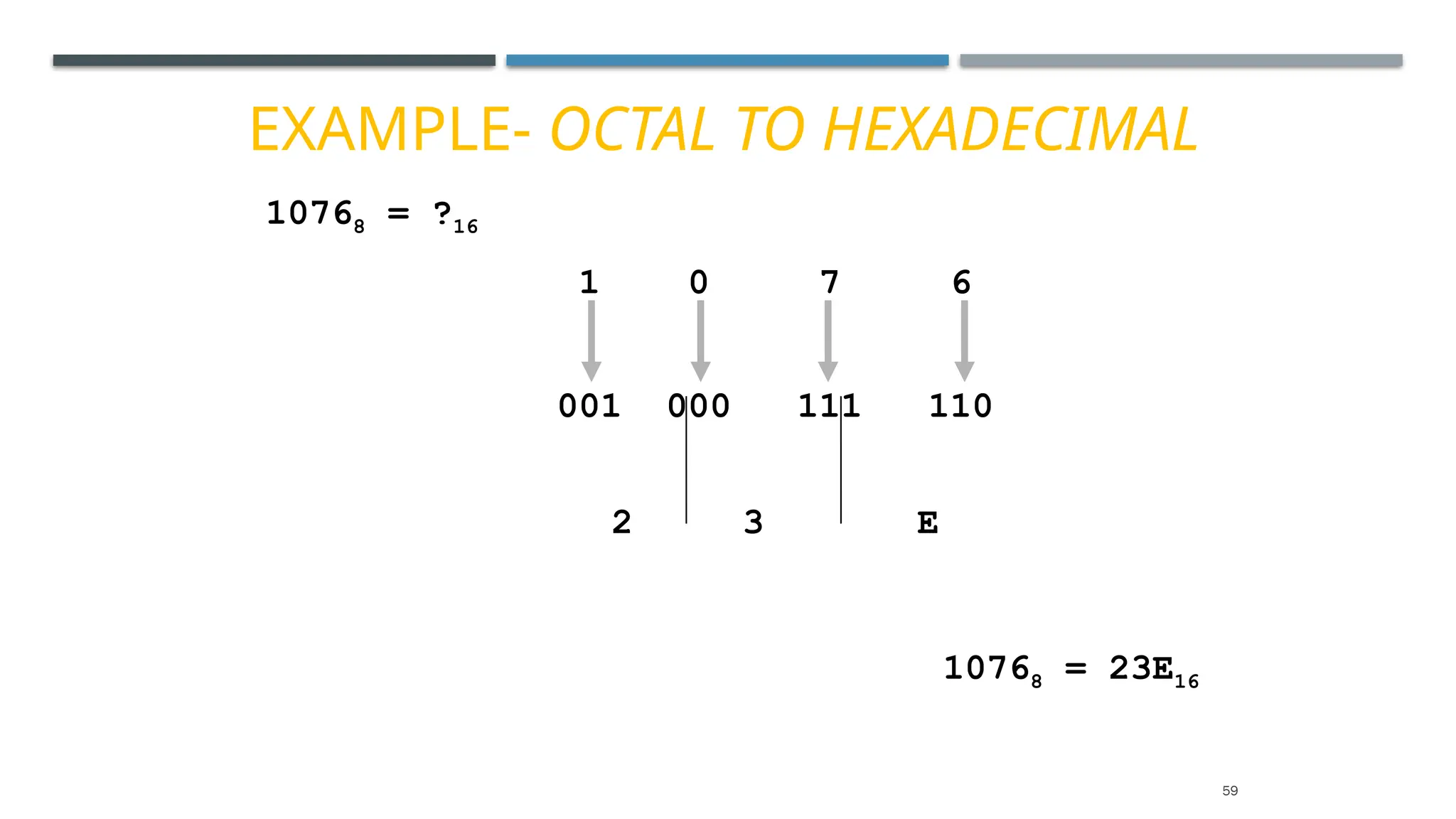
Writedown the three bit binary equivalent of octal digit and then rearranging into group of four bits with ‘0’s
added on either side of decimal point, if needed to complete the group of four.
56


![PROGRAM
OUTCOMES
MAPPING WITH
CO4
[PO1]
DEMONSTRATE DIFFERENT NUMBER SYSTEMS,
BOOLEAN EXPRESSIONS AND DIFFERENT
ELEMENTS OF COMMUNICATION SYSTEMS AND
TO PROMOTE DIFFERENT SKILLS TOWARDS
ELECTRONICS INDUSTRIES.](https://image.slidesharecdn.com/lecture34numbersystem-250809174549-f202142d/75/ees-pptfdgddrgncbfxdbfngdfxvcbnbcvdzfxv-cgn-4-2048.jpg)