NUMBER BASE SYSTEM
 BINARY AND DECIMAL
 OCTAL
 HEXADECIMAL
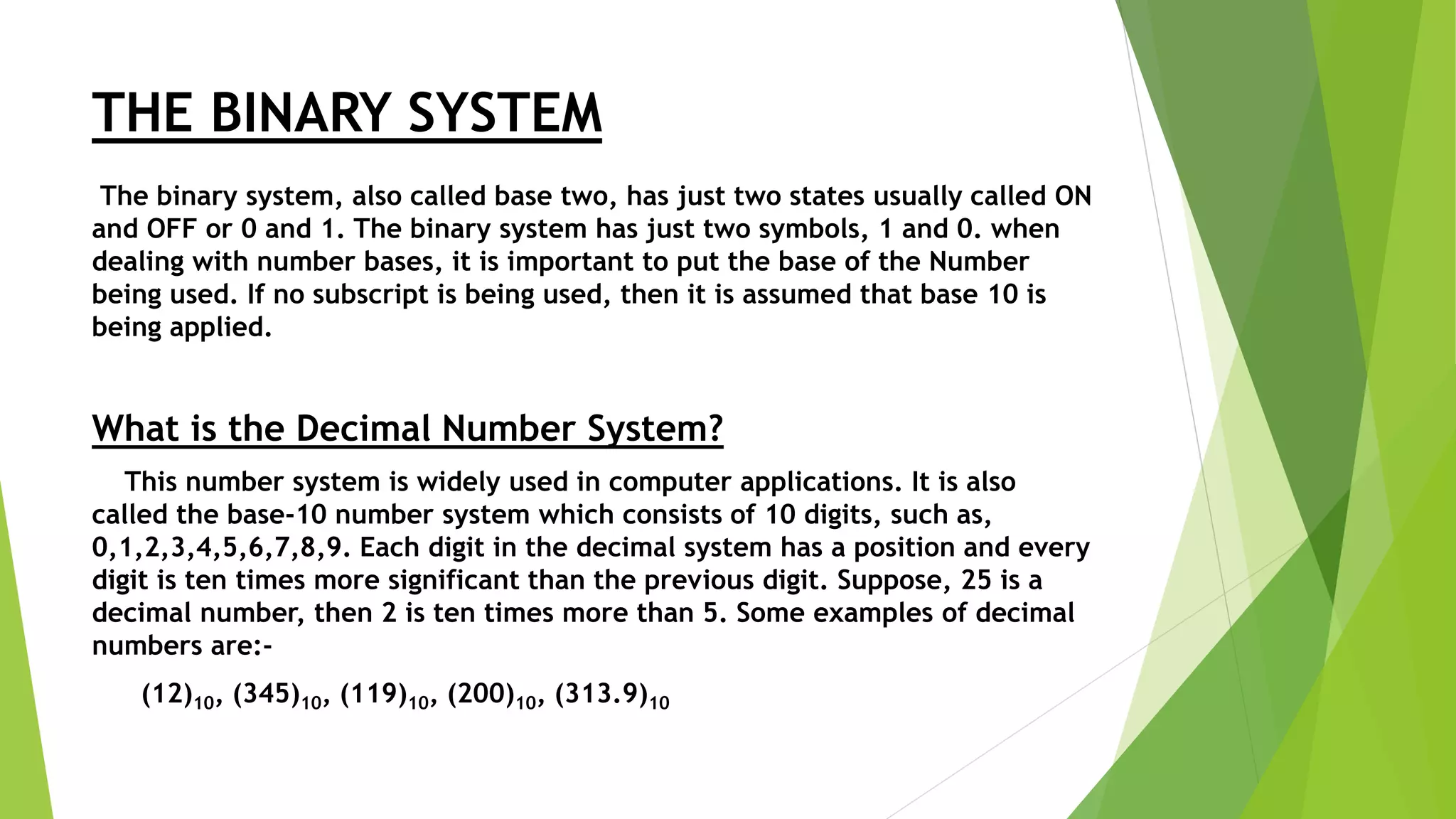
THE BINARY SYSTEM
The binary system, also called base two, has just two states usually called ON
and OFF or 0 and 1. The binary system has just two symbols, 1 and 0. when
dealing with number bases, it is important to put the base of the Number
being used. If no subscript is being used, then it is assumed that base 10 is
being applied.
What is the Decimal Number System?
This number system is widely used in computer applications. It is also
called the base-10 number system which consists of 10 digits, such as,
0,1,2,3,4,5,6,7,8,9. Each digit in the decimal system has a position and every
digit is ten times more significant than the previous digit. Suppose, 25 is a
decimal number, then 2 is ten times more than 5. Some examples of decimal
numbers are:-
(12)10, (345)10, (119)10, (200)10, (313.9)10
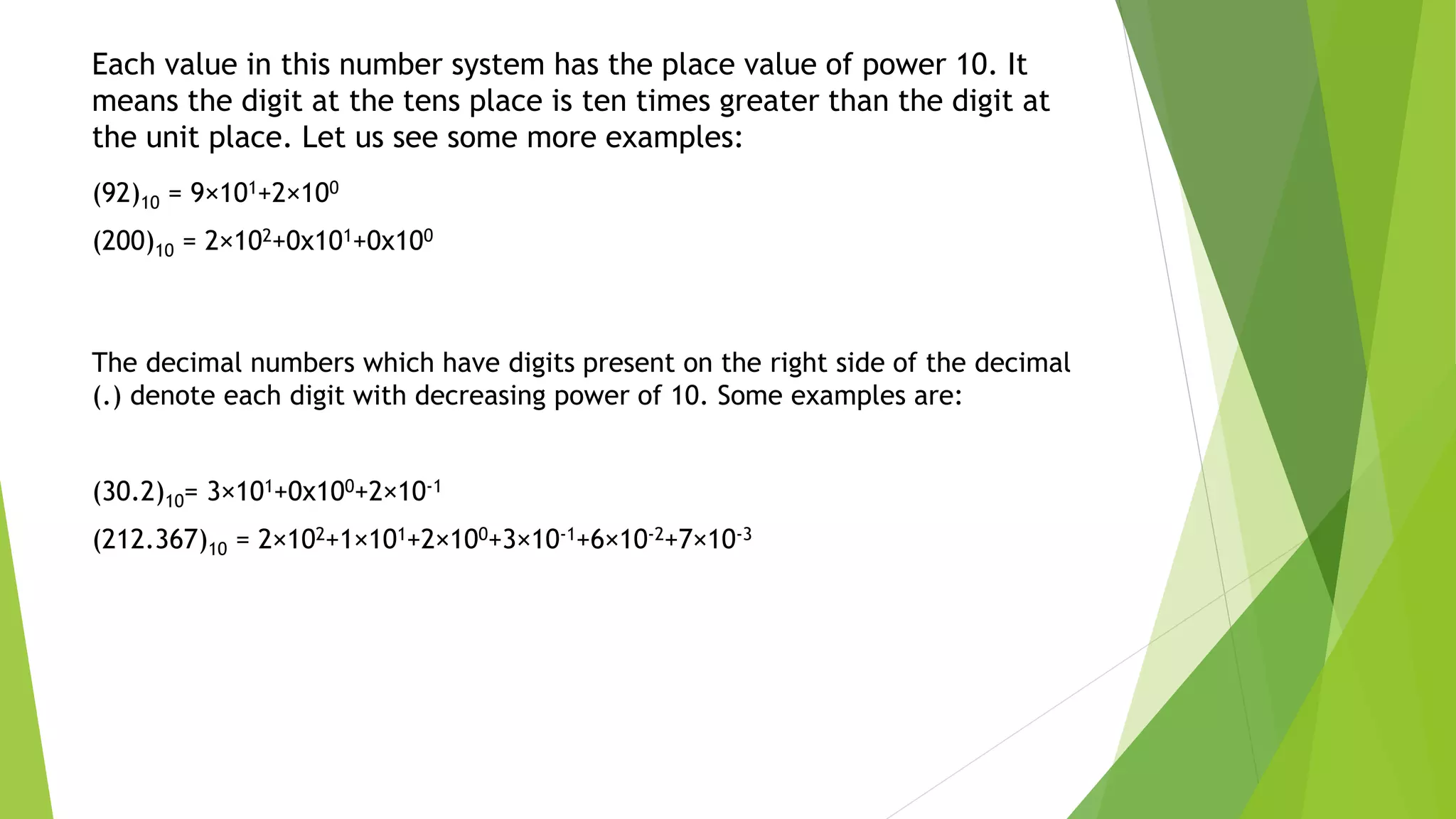
Each value in this number system has the place value of power 10. It
means the digit at the tens place is ten times greater than the digit at
the unit place. Let us see some more examples:
(92)10 = 9×101+2×100
(200)10 = 2×10²+0x101+0x100
The decimal numbers which have digits present on the right side of the decimal
(.) denote each digit with decreasing power of 10. Some examples are:
(30.2)10= 3×101+0x100+2×10⁻¹
(212.367)10 = 2×10²+1×101+2×100+3×10⁻¹+6×10⁻²+7×10⁻³
CONVERSION BETWEEN DECIMAL AND
BINARY SYSTEM
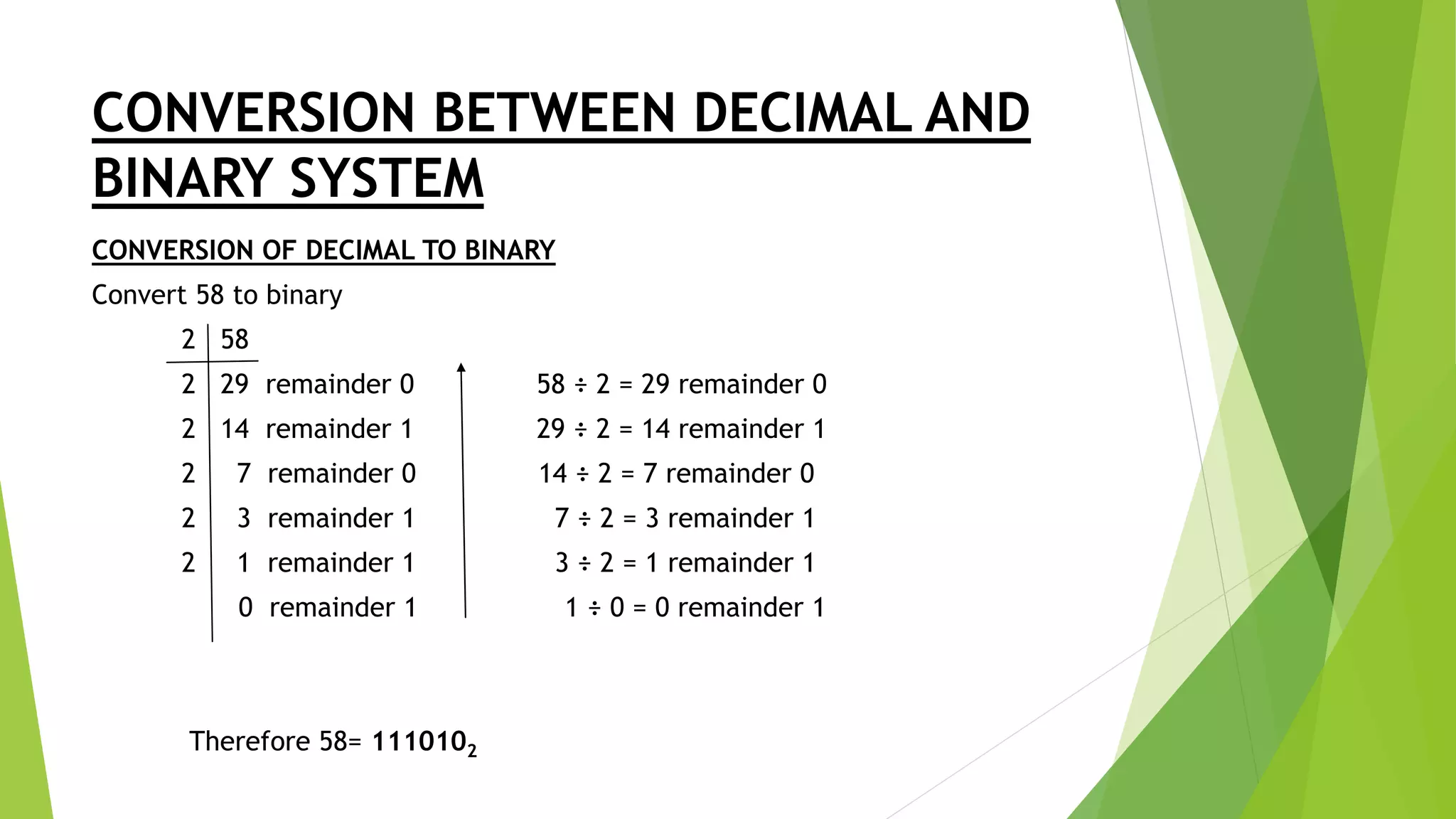
CONVERSION OF DECIMAL TO BINARY
Convert 58 to binary
2 58
2 29 remainder 0 58 ÷ 2 = 29 remainder 0
2 14 remainder 1 29 ÷ 2 = 14 remainder 1
2 7 remainder 0 14 ÷ 2 = 7 remainder 0
2 3 remainder 1 7 ÷ 2 = 3 remainder 1
2 1 remainder 1 3 ÷ 2 = 1 remainder 1
0 remainder 1 1 ÷ 0 = 0 remainder 1
Therefore 58= 1110102
Example 2
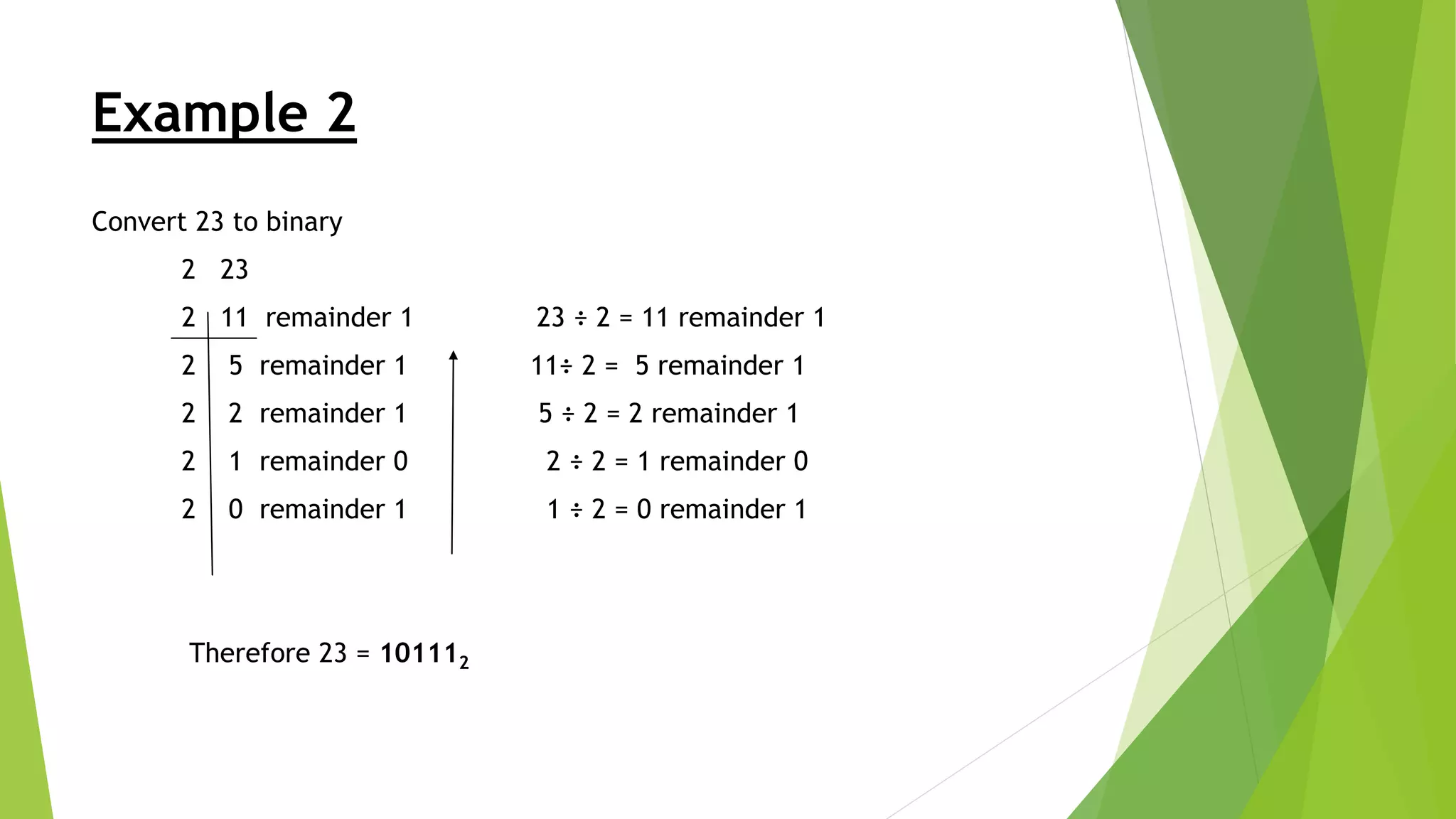
Convert 23 to binary
2 23
2 11 remainder 1 23 ÷ 2 = 11 remainder 1
2 5 remainder 1 11÷ 2 = 5 remainder 1
2 2 remainder 1 5 ÷ 2 = 2 remainder 1
2 1 remainder 0 2 ÷ 2 = 1 remainder 0
2 0 remainder 1 1 ÷ 2 = 0 remainder 1
Therefore 23 = 101112
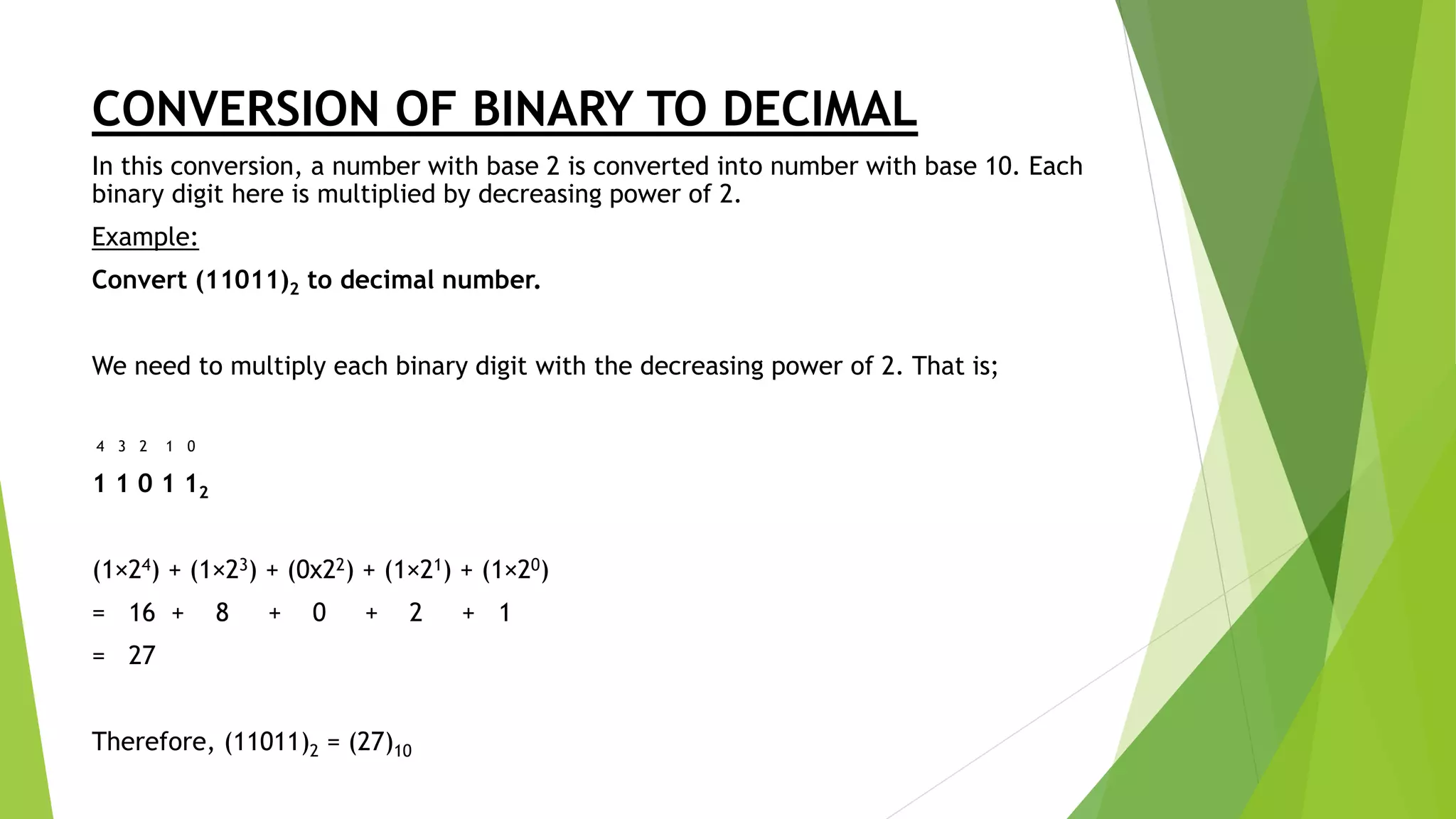
CONVERSION OF BINARY TO DECIMAL
In this conversion, a number with base 2 is converted into number with base 10. Each
binary digit here is multiplied by decreasing power of 2.
Example:
Convert (11011)2 to decimal number.
We need to multiply each binary digit with the decreasing power of 2. That is;
4 3 2 1 0
1 1 0 1 12
(1×24) + (1×23) + (0x22) + (1×21) + (1×20)
= 16 + 8 + 0 + 2 + 1
= 27
Therefore, (11011)2 = (27)10
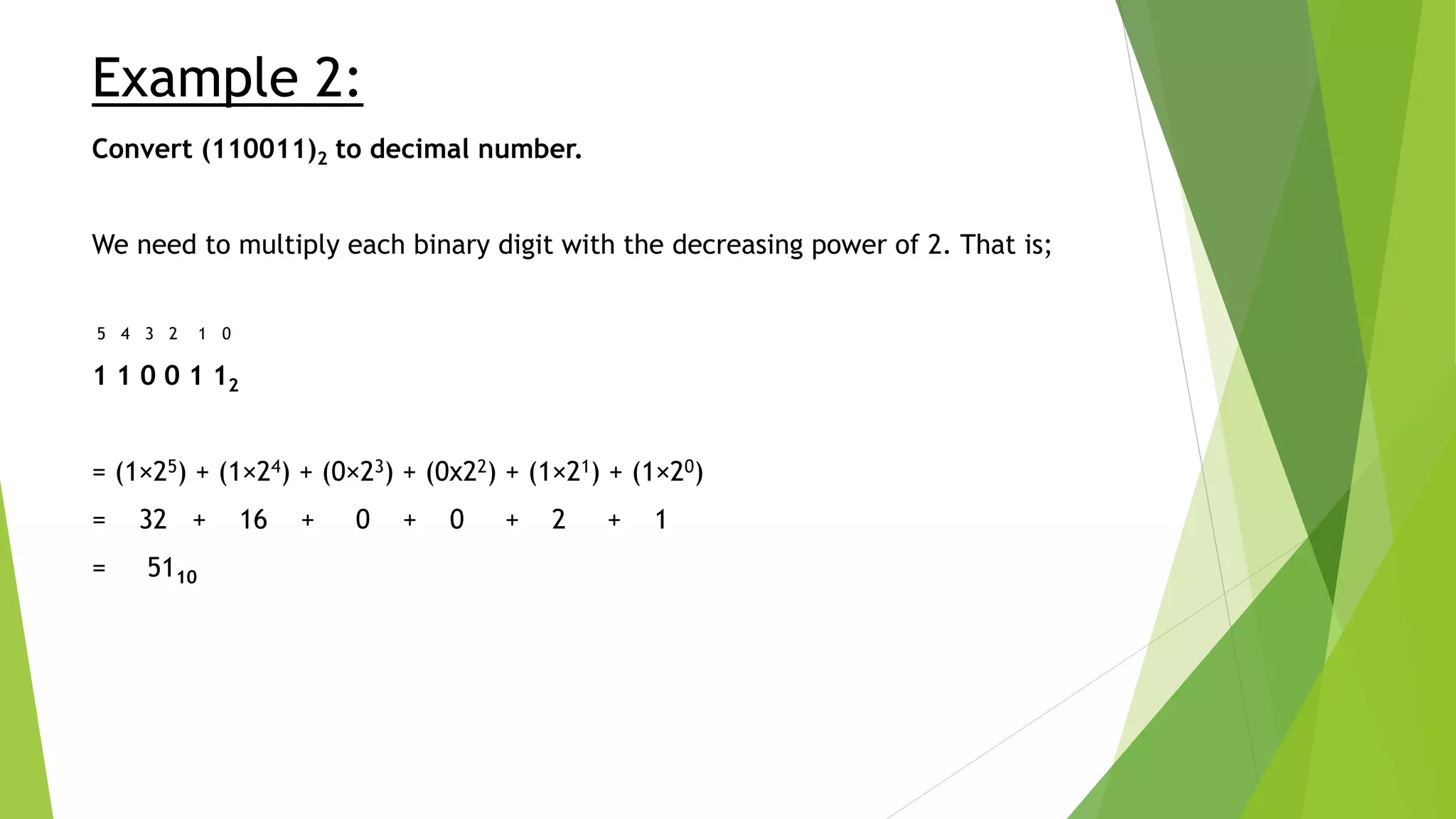
Example 2:
Convert (110011)2 to decimal number.
We need to multiply each binary digit with the decreasing power of 2. That is;
5 4 3 2 1 0
1 1 0 0 1 12
= (1×25) + (1×24) + (0×23) + (0x22) + (1×21) + (1×20)
= 32 + 16 + 0 + 0 + 2 + 1
= 5110
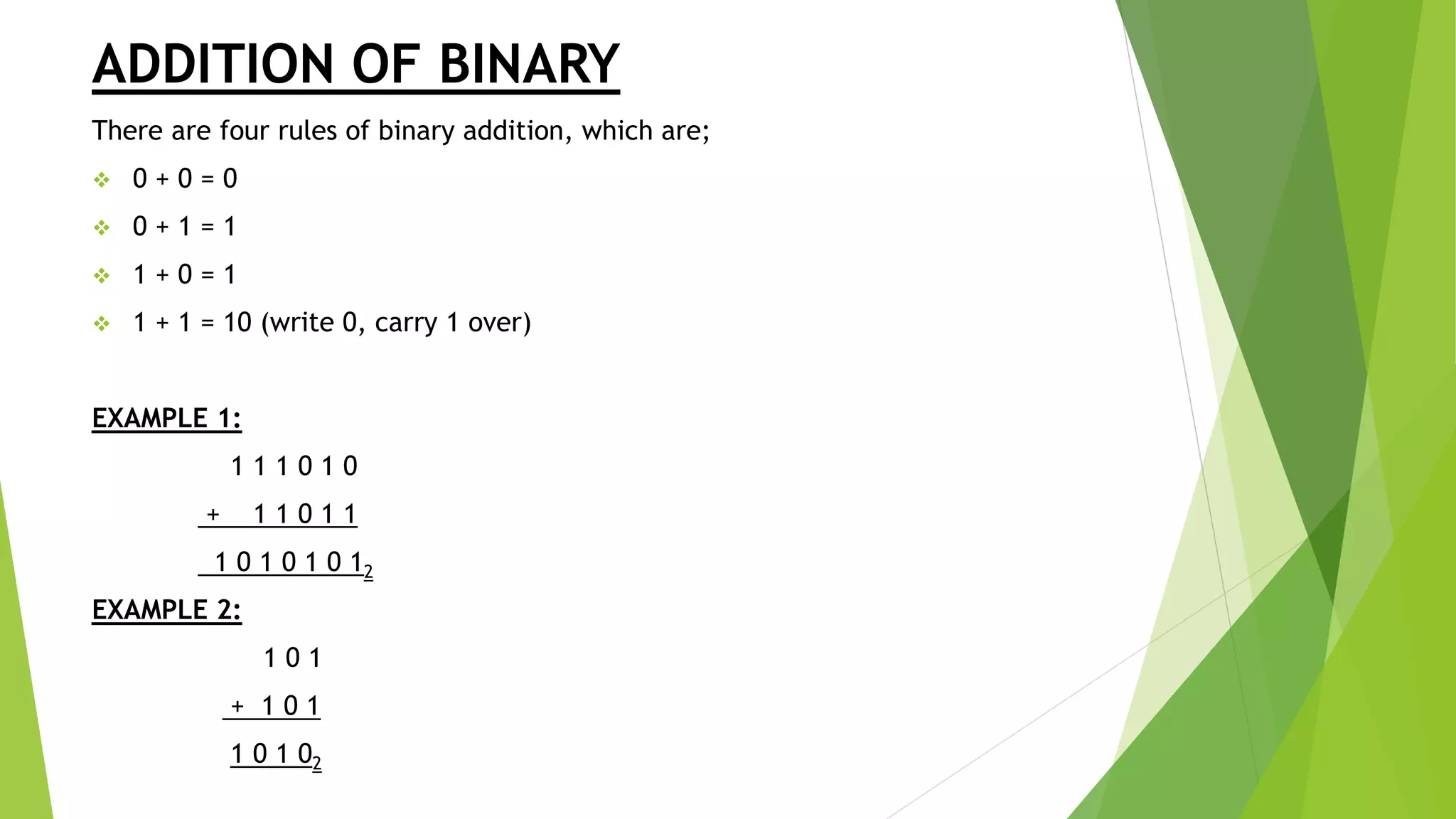
ADDITION OF BINARY
There are four rules of binary addition, which are;
 0 + 0 = 0
 0 + 1 = 1
 1 + 0 = 1
 1 + 1 = 10 (write 0, carry 1 over)
EXAMPLE 1:
1 1 1 0 1 0
+ 1 1 0 1 1
1 0 1 0 1 0 12
EXAMPLE 2:
1 0 1
+ 1 0 1
1 0 1 02
SUBTRACTION OF BINARY
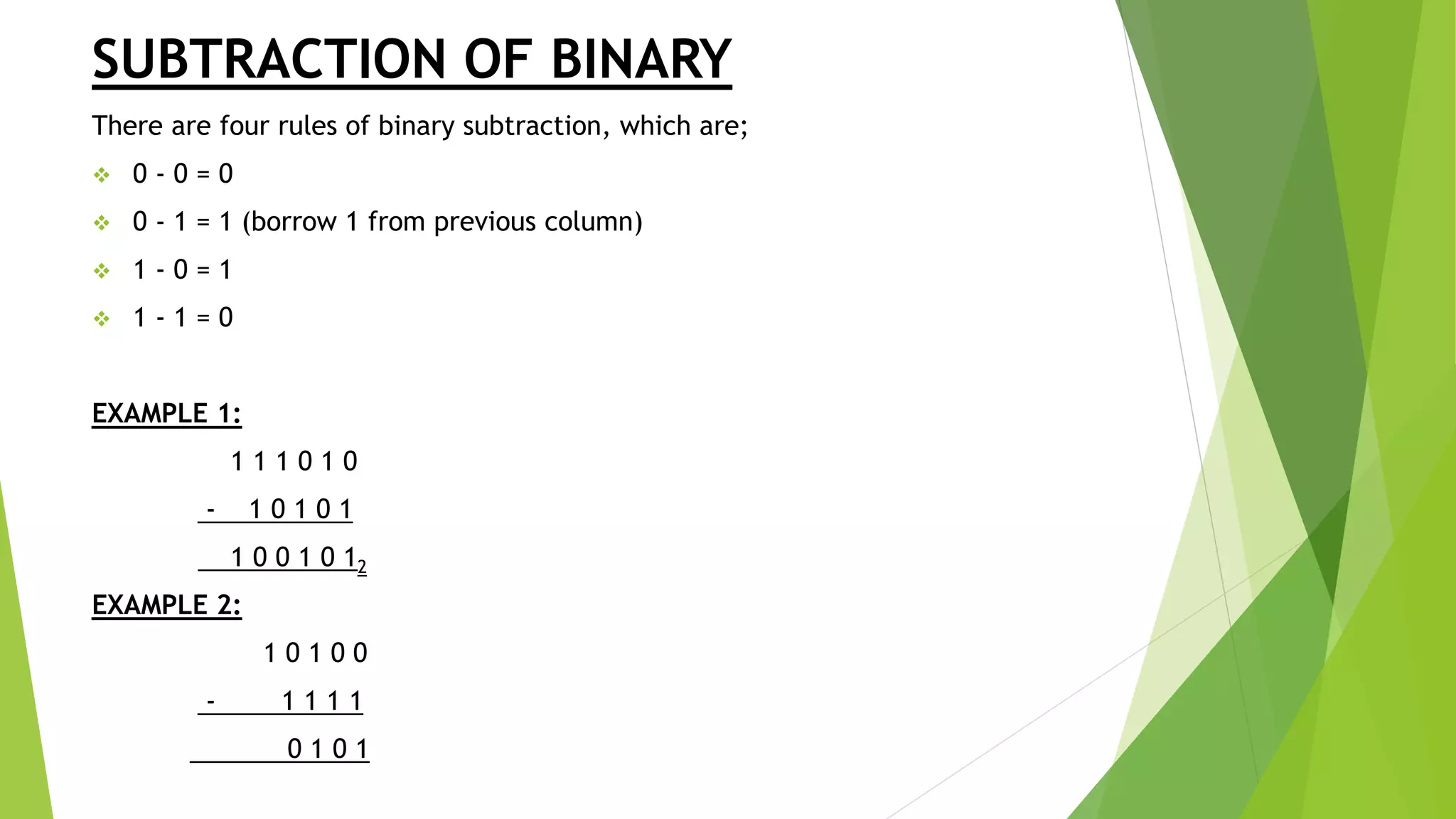
There are four rules of binary subtraction, which are;
 0 - 0 = 0
 0 - 1 = 1 (borrow 1 from previous column)
 1 - 0 = 1
 1 - 1 = 0
EXAMPLE 1:
1 1 1 0 1 0
- 1 0 1 0 1
1 0 0 1 0 12
EXAMPLE 2:
1 0 1 0 0
- 1 1 1 1
0 1 0 1
MULTIPLICATION OF BINARY
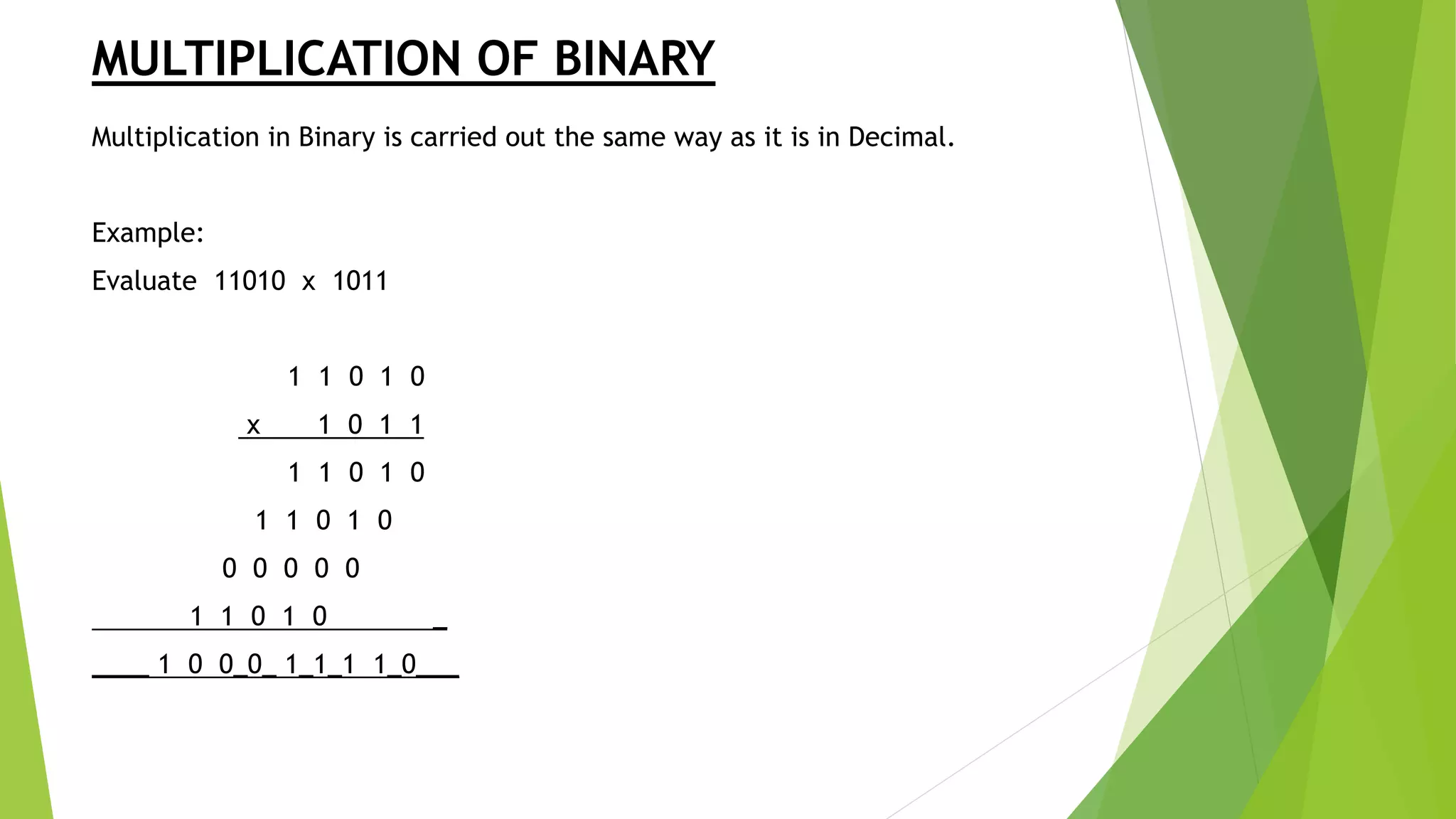
Multiplication in Binary is carried out the same way as it is in Decimal.
Example:
Evaluate 11010 x 1011
1 1 0 1 0
x 1 0 1 1
1 1 0 1 0
1 1 0 1 0
0 0 0 0 0
1 1 0 1 0 _
____ 1 0 0_0_ 1_1_1 1_0___
OTHER NUMBER BASES
OCTAL
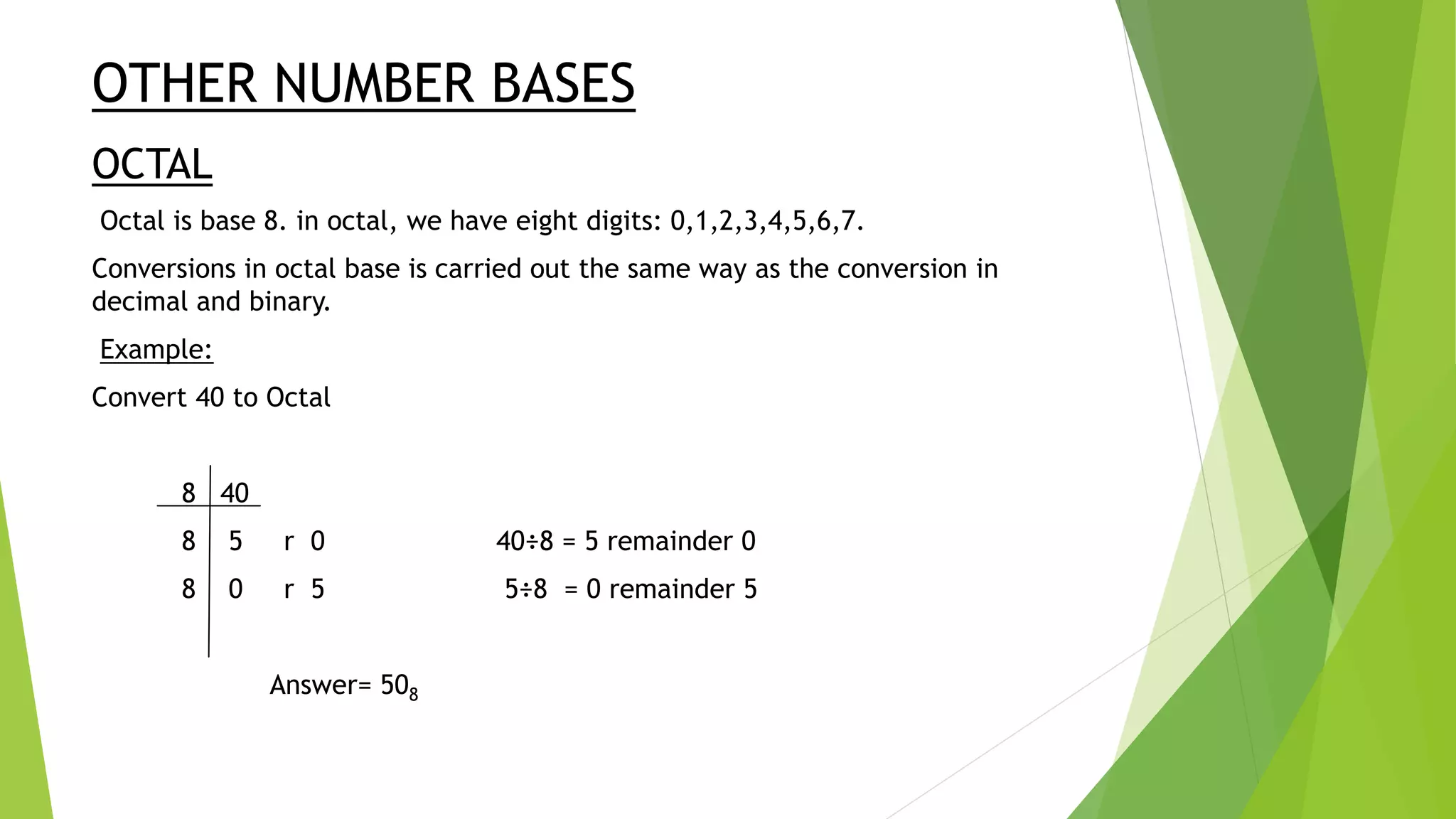
Octal is base 8. in octal, we have eight digits: 0,1,2,3,4,5,6,7.
Conversions in octal base is carried out the same way as the conversion in
decimal and binary.
Example:
Convert 40 to Octal
8 40
8 5 r 0 40÷8 = 5 remainder 0
8 0 r 5 5÷8 = 0 remainder 5
Answer= 508
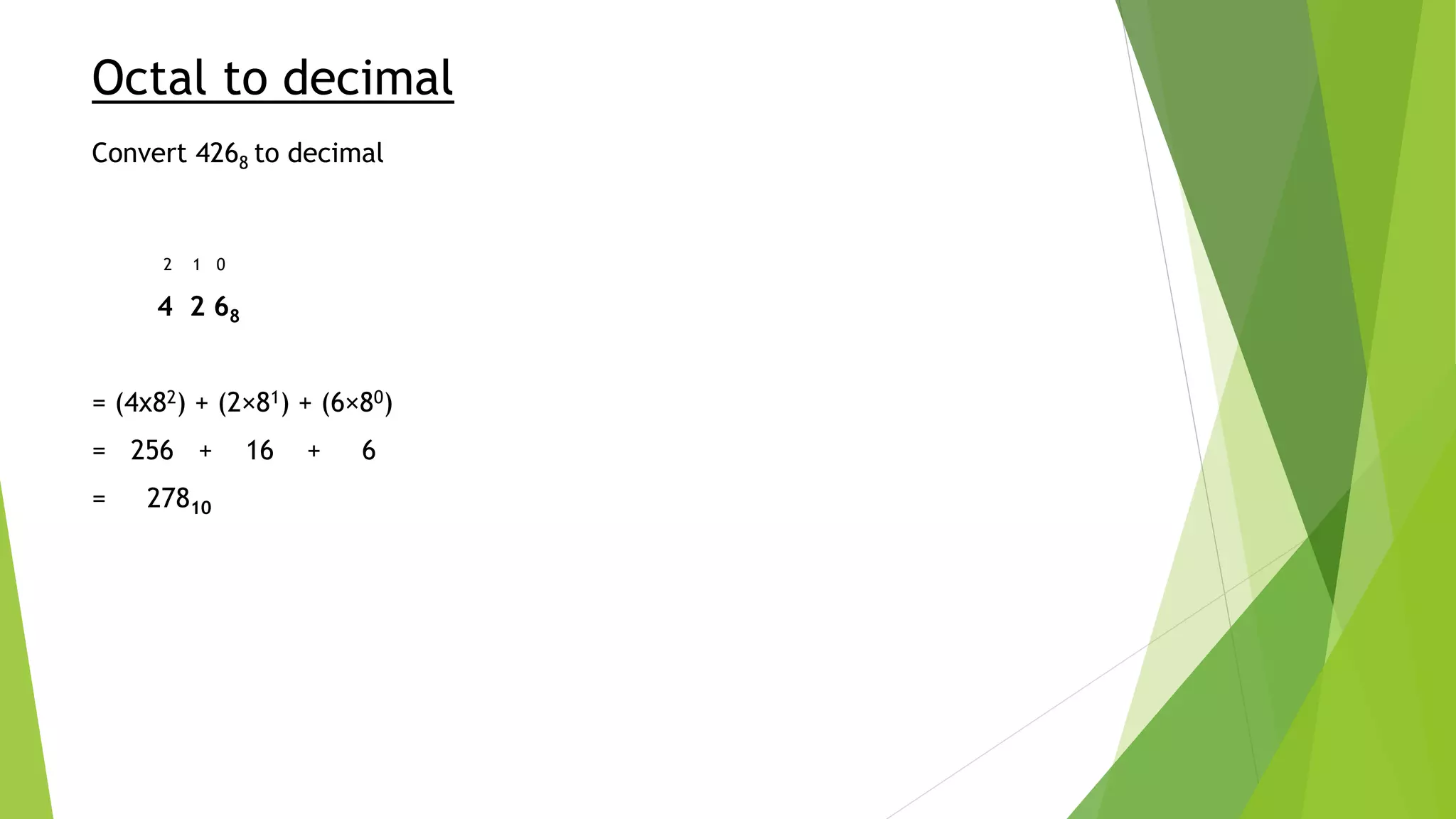
Octal to decimal
Convert 4268 to decimal
2 1 0
4 2 68
= (4x82) + (2×81) + (6×80)
= 256 + 16 + 6
= 27810
ADDITION OF OCTAL
Note: when the number crosses 7, it overturns then keep 1 to the previous
column
Example:
2 4 58
+ 1 68
2 6 38
2 3 68
+ 1 2 78
3 6 58
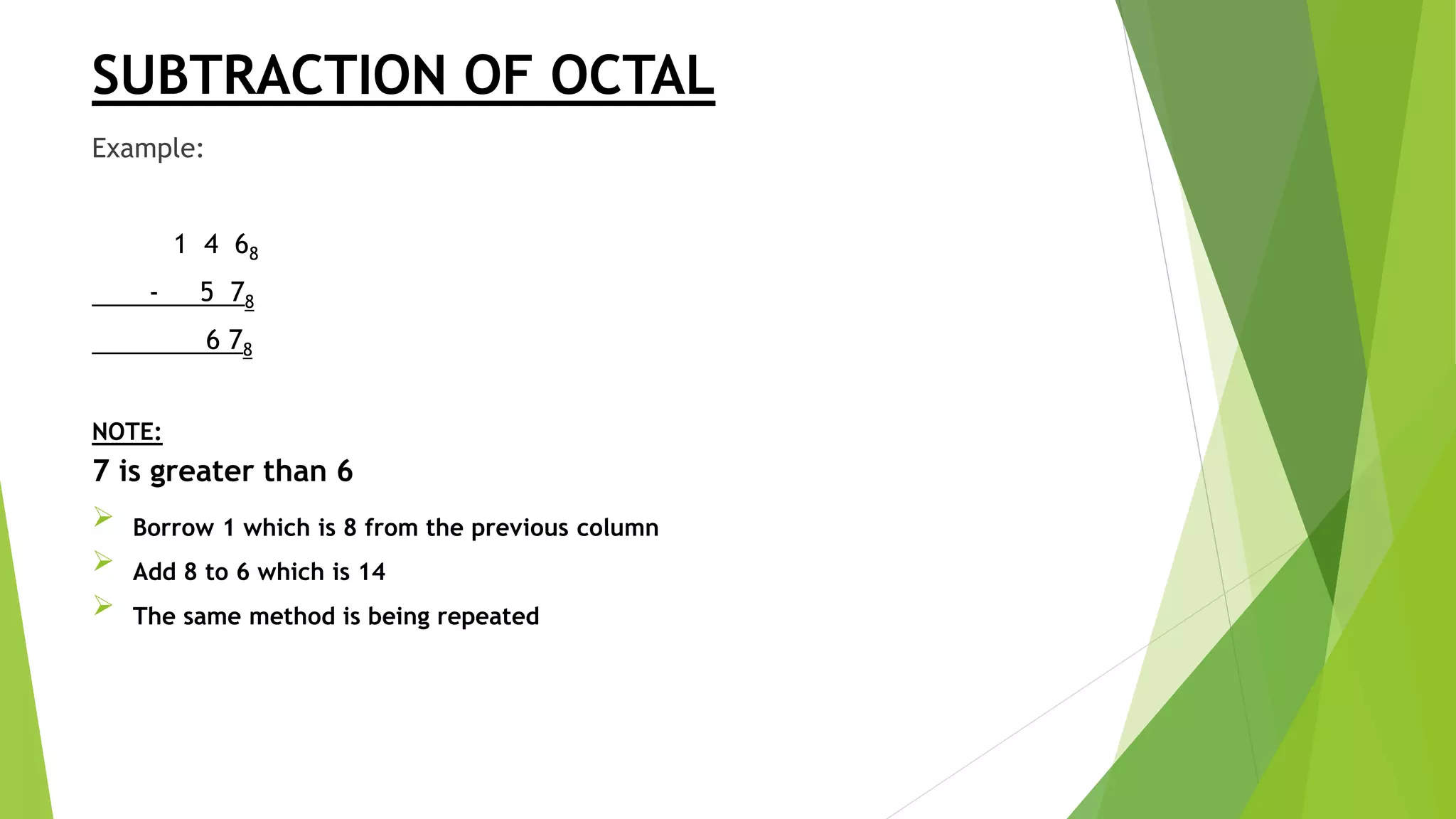
SUBTRACTION OF OCTAL
Example:
1 4 68
- 5 78
6 78
NOTE:
7 is greater than 6
 Borrow 1 which is 8 from the previous column
 Add 8 to 6 which is 14
 The same method is being repeated
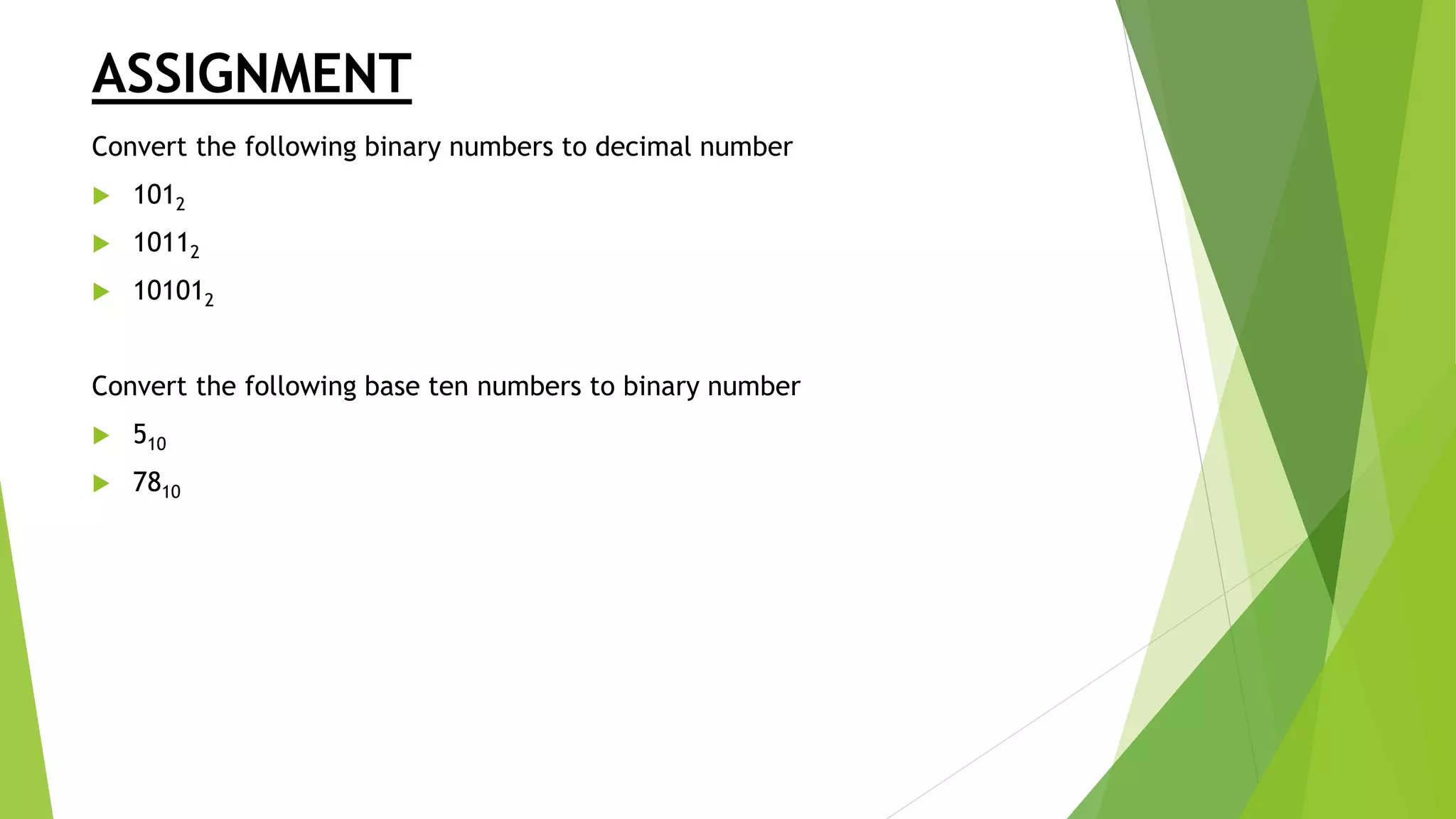
ASSIGNMENT
Convert the following binary numbers to decimal number
 1012
 10112
 101012
Convert the following base ten numbers to binary number
 510
 7810
HEXADECIMAL
NUMBER BASE SYSTEM.pptx

NUMBER BASE SYSTEM.pptx

  • 1.
    NUMBER BASE SYSTEM BINARY AND DECIMAL  OCTAL  HEXADECIMAL
  • 2.
    THE BINARY SYSTEM Thebinary system, also called base two, has just two states usually called ON and OFF or 0 and 1. The binary system has just two symbols, 1 and 0. when dealing with number bases, it is important to put the base of the Number being used. If no subscript is being used, then it is assumed that base 10 is being applied. What is the Decimal Number System? This number system is widely used in computer applications. It is also called the base-10 number system which consists of 10 digits, such as, 0,1,2,3,4,5,6,7,8,9. Each digit in the decimal system has a position and every digit is ten times more significant than the previous digit. Suppose, 25 is a decimal number, then 2 is ten times more than 5. Some examples of decimal numbers are:- (12)10, (345)10, (119)10, (200)10, (313.9)10
  • 3.
    Each value inthis number system has the place value of power 10. It means the digit at the tens place is ten times greater than the digit at the unit place. Let us see some more examples: (92)10 = 9×101+2×100 (200)10 = 2×10²+0x101+0x100 The decimal numbers which have digits present on the right side of the decimal (.) denote each digit with decreasing power of 10. Some examples are: (30.2)10= 3×101+0x100+2×10⁻¹ (212.367)10 = 2×10²+1×101+2×100+3×10⁻¹+6×10⁻²+7×10⁻³
  • 4.
    CONVERSION BETWEEN DECIMALAND BINARY SYSTEM CONVERSION OF DECIMAL TO BINARY Convert 58 to binary 2 58 2 29 remainder 0 58 ÷ 2 = 29 remainder 0 2 14 remainder 1 29 ÷ 2 = 14 remainder 1 2 7 remainder 0 14 ÷ 2 = 7 remainder 0 2 3 remainder 1 7 ÷ 2 = 3 remainder 1 2 1 remainder 1 3 ÷ 2 = 1 remainder 1 0 remainder 1 1 ÷ 0 = 0 remainder 1 Therefore 58= 1110102
  • 5.
    Example 2 Convert 23to binary 2 23 2 11 remainder 1 23 ÷ 2 = 11 remainder 1 2 5 remainder 1 11÷ 2 = 5 remainder 1 2 2 remainder 1 5 ÷ 2 = 2 remainder 1 2 1 remainder 0 2 ÷ 2 = 1 remainder 0 2 0 remainder 1 1 ÷ 2 = 0 remainder 1 Therefore 23 = 101112
  • 6.
    CONVERSION OF BINARYTO DECIMAL In this conversion, a number with base 2 is converted into number with base 10. Each binary digit here is multiplied by decreasing power of 2. Example: Convert (11011)2 to decimal number. We need to multiply each binary digit with the decreasing power of 2. That is; 4 3 2 1 0 1 1 0 1 12 (1×24) + (1×23) + (0x22) + (1×21) + (1×20) = 16 + 8 + 0 + 2 + 1 = 27 Therefore, (11011)2 = (27)10
  • 7.
    Example 2: Convert (110011)2to decimal number. We need to multiply each binary digit with the decreasing power of 2. That is; 5 4 3 2 1 0 1 1 0 0 1 12 = (1×25) + (1×24) + (0×23) + (0x22) + (1×21) + (1×20) = 32 + 16 + 0 + 0 + 2 + 1 = 5110
  • 8.
    ADDITION OF BINARY Thereare four rules of binary addition, which are;  0 + 0 = 0  0 + 1 = 1  1 + 0 = 1  1 + 1 = 10 (write 0, carry 1 over) EXAMPLE 1: 1 1 1 0 1 0 + 1 1 0 1 1 1 0 1 0 1 0 12 EXAMPLE 2: 1 0 1 + 1 0 1 1 0 1 02
  • 9.
    SUBTRACTION OF BINARY Thereare four rules of binary subtraction, which are;  0 - 0 = 0  0 - 1 = 1 (borrow 1 from previous column)  1 - 0 = 1  1 - 1 = 0 EXAMPLE 1: 1 1 1 0 1 0 - 1 0 1 0 1 1 0 0 1 0 12 EXAMPLE 2: 1 0 1 0 0 - 1 1 1 1 0 1 0 1
  • 10.
    MULTIPLICATION OF BINARY Multiplicationin Binary is carried out the same way as it is in Decimal. Example: Evaluate 11010 x 1011 1 1 0 1 0 x 1 0 1 1 1 1 0 1 0 1 1 0 1 0 0 0 0 0 0 1 1 0 1 0 _ ____ 1 0 0_0_ 1_1_1 1_0___
  • 11.
    OTHER NUMBER BASES OCTAL Octalis base 8. in octal, we have eight digits: 0,1,2,3,4,5,6,7. Conversions in octal base is carried out the same way as the conversion in decimal and binary. Example: Convert 40 to Octal 8 40 8 5 r 0 40÷8 = 5 remainder 0 8 0 r 5 5÷8 = 0 remainder 5 Answer= 508
  • 12.
    Octal to decimal Convert4268 to decimal 2 1 0 4 2 68 = (4x82) + (2×81) + (6×80) = 256 + 16 + 6 = 27810
  • 13.
    ADDITION OF OCTAL Note:when the number crosses 7, it overturns then keep 1 to the previous column Example: 2 4 58 + 1 68 2 6 38 2 3 68 + 1 2 78 3 6 58
  • 14.
    SUBTRACTION OF OCTAL Example: 14 68 - 5 78 6 78 NOTE: 7 is greater than 6  Borrow 1 which is 8 from the previous column  Add 8 to 6 which is 14  The same method is being repeated
  • 15.
    ASSIGNMENT Convert the followingbinary numbers to decimal number  1012  10112  101012 Convert the following base ten numbers to binary number  510  7810
  • 16.