Introduction to
Number Systems:
Base 10 and Base
2
Understanding Decimal and Binary Systems with
Conversion Examples
What is a Number System?
 A number system is a writing system for expressing
numbers. It is a mathematical notation for representing
numbers of a given set, using digits or other symbols in
a consistent manner.
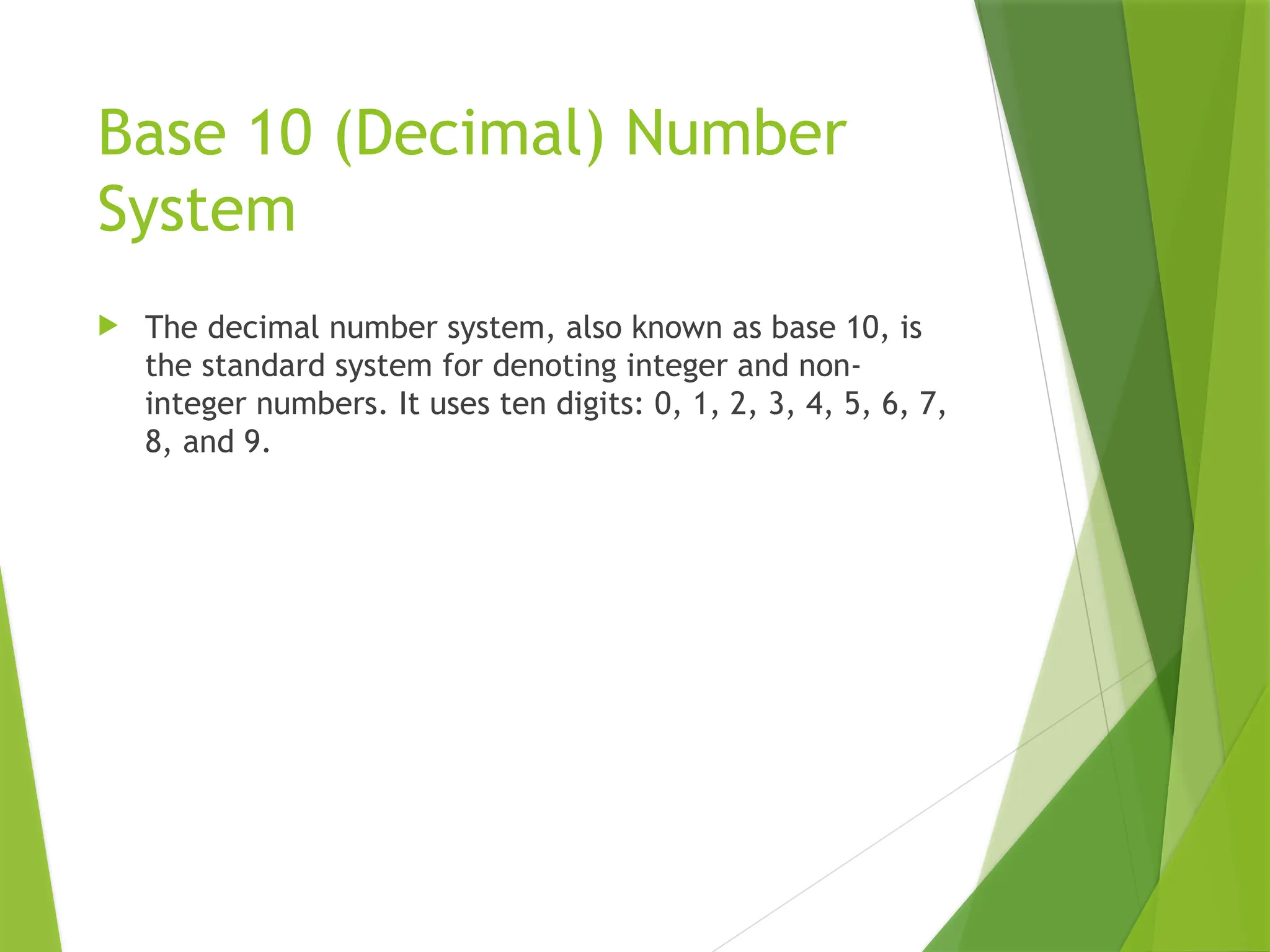
Base 10 (Decimal) Number
System
 The decimal number system, also known as base 10, is
the standard system for denoting integer and non-
integer numbers. It uses ten digits: 0, 1, 2, 3, 4, 5, 6, 7,
8, and 9.
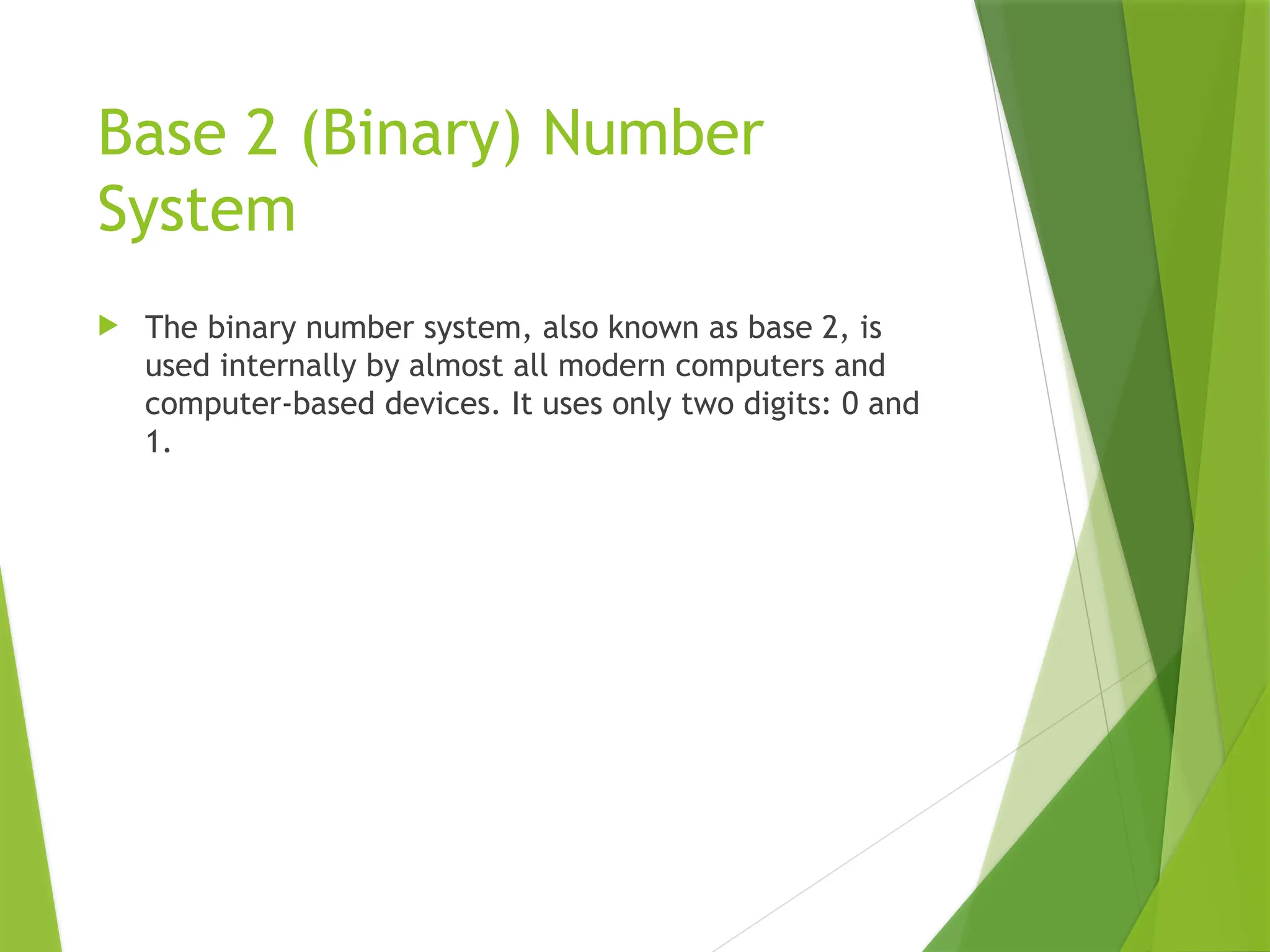
Base 2 (Binary) Number
System
 The binary number system, also known as base 2, is
used internally by almost all modern computers and
computer-based devices. It uses only two digits: 0 and
1.
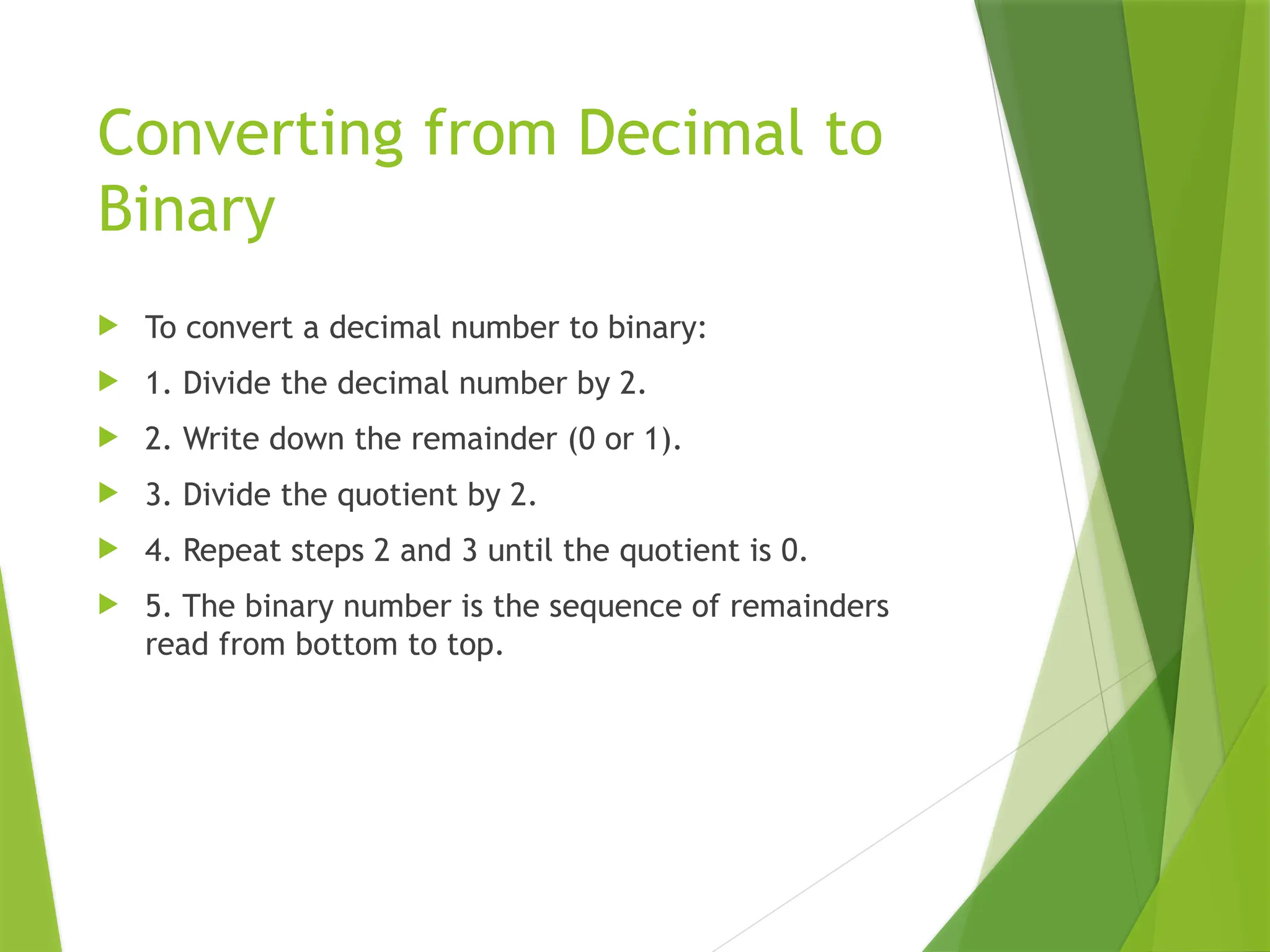
Converting from Decimal to
Binary
 To convert a decimal number to binary:
 1. Divide the decimal number by 2.
 2. Write down the remainder (0 or 1).
 3. Divide the quotient by 2.
 4. Repeat steps 2 and 3 until the quotient is 0.
 5. The binary number is the sequence of remainders
read from bottom to top.
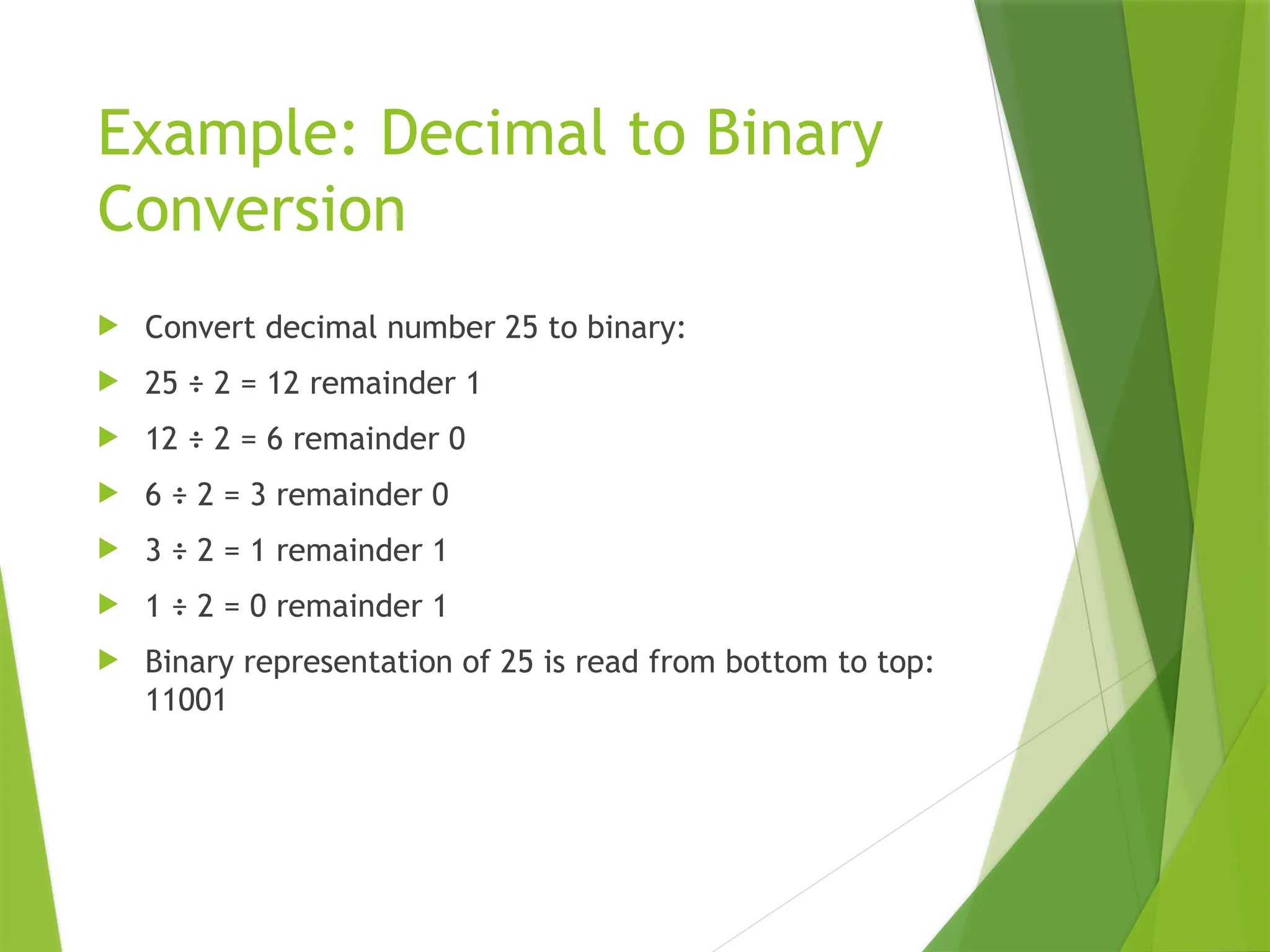
Example: Decimal to Binary
Conversion
 Convert decimal number 25 to binary:
 25 ÷ 2 = 12 remainder 1
 12 ÷ 2 = 6 remainder 0
 6 ÷ 2 = 3 remainder 0
 3 ÷ 2 = 1 remainder 1
 1 ÷ 2 = 0 remainder 1
 Binary representation of 25 is read from bottom to top:
11001
Converting from Binary to
Decimal
 To convert a binary number to decimal:
 1. Write down the binary number.
 2. Starting from the right, multiply each binary digit by
2 raised to the power of its position.
 3. Sum all the products.
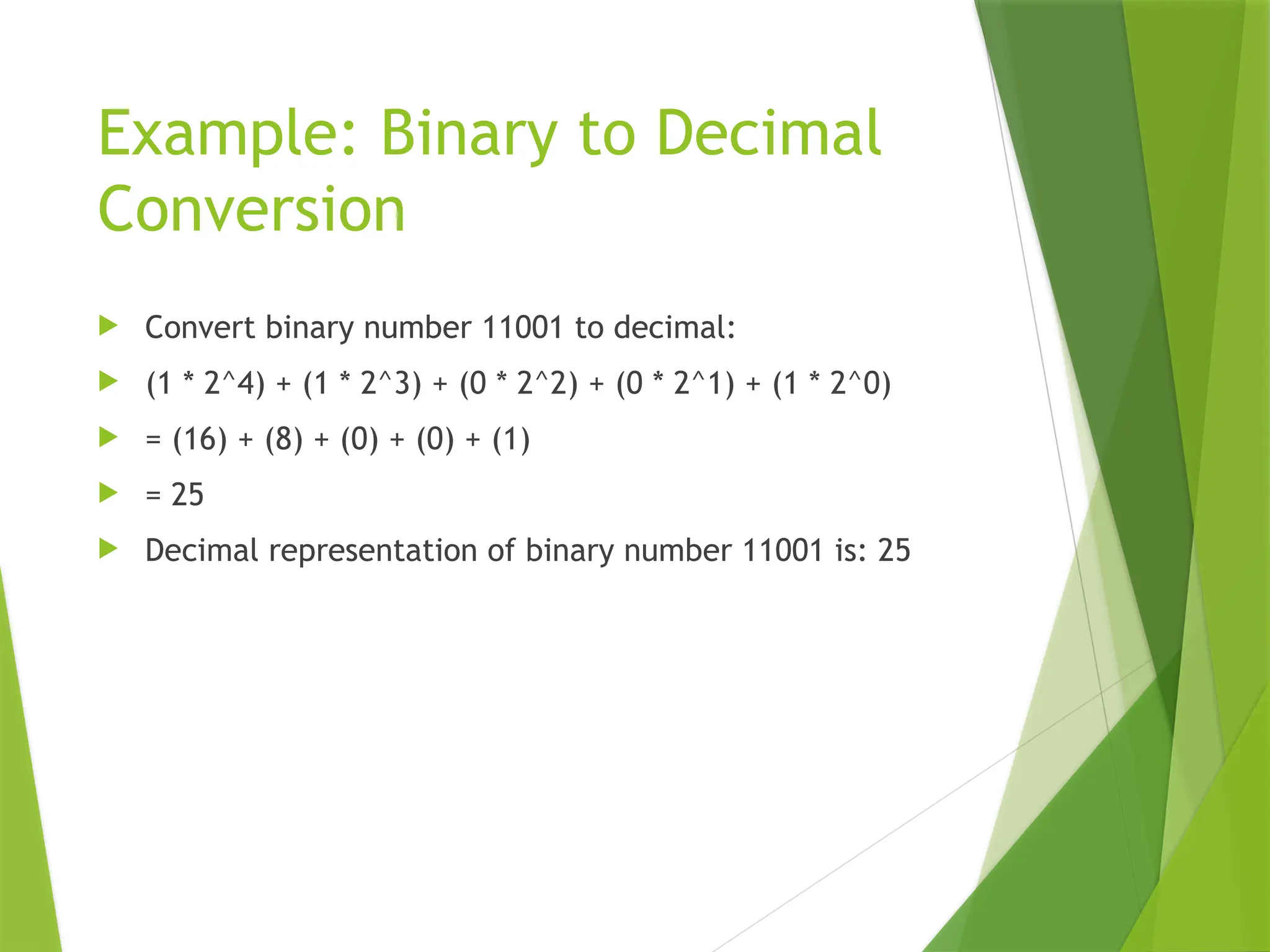
Example: Binary to Decimal
Conversion
 Convert binary number 11001 to decimal:
 (1 * 2^4) + (1 * 2^3) + (0 * 2^2) + (0 * 2^1) + (1 * 2^0)
 = (16) + (8) + (0) + (0) + (1)
 = 25
 Decimal representation of binary number 11001 is: 25
Conclusion
 Understanding base 10 and base 2 number systems is
fundamental in digital electronics and computer
science. The ability to convert between these systems
allows for better comprehension of how computers
process and store data.
Introduction_to_Base10_and_Base2_Number_Systems.pptx

  • 1.
    Introduction to Number Systems: Base10 and Base 2 Understanding Decimal and Binary Systems with Conversion Examples
  • 2.
    What is aNumber System?  A number system is a writing system for expressing numbers. It is a mathematical notation for representing numbers of a given set, using digits or other symbols in a consistent manner.
  • 3.
    Base 10 (Decimal)Number System  The decimal number system, also known as base 10, is the standard system for denoting integer and non- integer numbers. It uses ten digits: 0, 1, 2, 3, 4, 5, 6, 7, 8, and 9.
  • 4.
    Base 2 (Binary)Number System  The binary number system, also known as base 2, is used internally by almost all modern computers and computer-based devices. It uses only two digits: 0 and 1.
  • 5.
    Converting from Decimalto Binary  To convert a decimal number to binary:  1. Divide the decimal number by 2.  2. Write down the remainder (0 or 1).  3. Divide the quotient by 2.  4. Repeat steps 2 and 3 until the quotient is 0.  5. The binary number is the sequence of remainders read from bottom to top.
  • 6.
    Example: Decimal toBinary Conversion  Convert decimal number 25 to binary:  25 ÷ 2 = 12 remainder 1  12 ÷ 2 = 6 remainder 0  6 ÷ 2 = 3 remainder 0  3 ÷ 2 = 1 remainder 1  1 ÷ 2 = 0 remainder 1  Binary representation of 25 is read from bottom to top: 11001
  • 7.
    Converting from Binaryto Decimal  To convert a binary number to decimal:  1. Write down the binary number.  2. Starting from the right, multiply each binary digit by 2 raised to the power of its position.  3. Sum all the products.
  • 8.
    Example: Binary toDecimal Conversion  Convert binary number 11001 to decimal:  (1 * 2^4) + (1 * 2^3) + (0 * 2^2) + (0 * 2^1) + (1 * 2^0)  = (16) + (8) + (0) + (0) + (1)  = 25  Decimal representation of binary number 11001 is: 25
  • 9.
    Conclusion  Understanding base10 and base 2 number systems is fundamental in digital electronics and computer science. The ability to convert between these systems allows for better comprehension of how computers process and store data.