Data Types in Python
Swipe
Data Types in Python
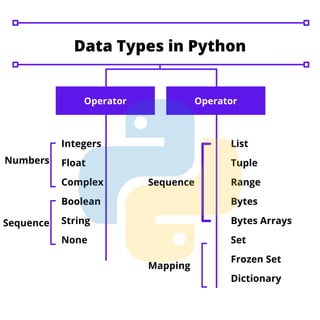
Operator Operator
Integers
Float
Complex
Boolean
String
None
List
Tuple
Range
Bytes
Bytes Arrays
Set
Frozen Set
Dictionary
Suite
Numbers
Sequence
Sequence
Mapping
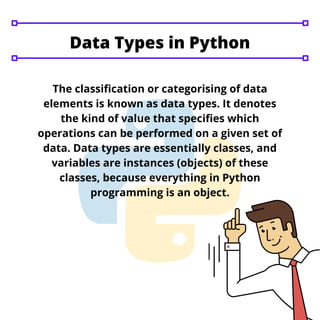
The classification or categorising of data
elements is known as data types. It denotes
the kind of value that specifies which
operations can be performed on a given set of
data. Data types are essentially classes, and
variables are instances (objects) of these
classes, because everything in Python
programming is an object.
Data Types in Python
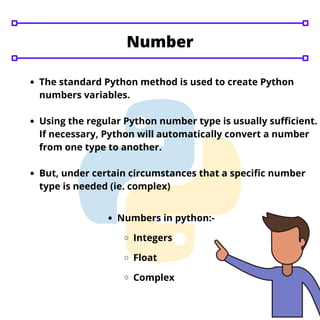
The standard Python method is used to create Python
numbers variables.
Using the regular Python number type is usually sufficient.
If necessary, Python will automatically convert a number
from one type to another.
But, under certain circumstances that a specific number
type is needed (ie. complex)
Numbers in python:-
Integers
Float
Complex
Number
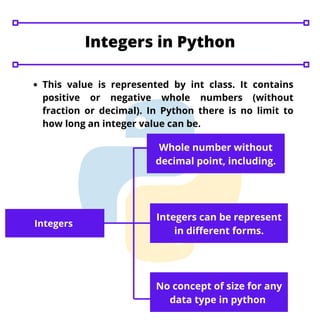
Integers in Python
This value is represented by int class. It contains
positive or negative whole numbers (without
fraction or decimal). In Python there is no limit to
how long an integer value can be.
Integers
Whole number without
decimal point, including.
Integers can be represent
in different forms.
No concept of size for any
data type in python
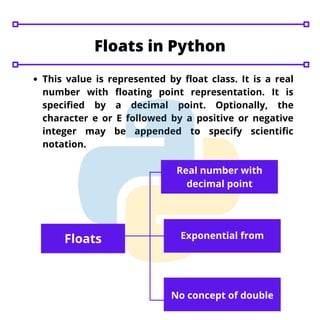
Floats in Python
This value is represented by float class. It is a real
number with floating point representation. It is
specified by a decimal point. Optionally, the
character e or E followed by a positive or negative
integer may be appended to specify scientific
notation.
Floats
Real number with
decimal point
Exponential from
No concept of double
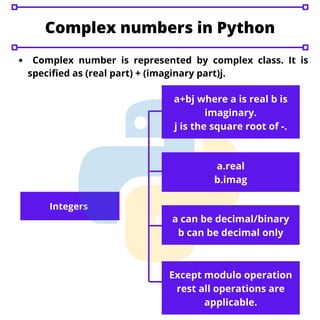
Complex numbers in Python
Integers
a+bj where a is real b is
imaginary.
j is the square root of -.
a.real
b.imag
a can be decimal/binary
b can be decimal only
Except modulo operation
rest all operations are
applicable.
Complex number is represented by complex class. It is
specified as (real part) + (imaginary part)j.
Data Types in Python
Mutable vs Immutable Data
type in Python
Stay Tuned with
Topics for next Post

Data types in python

  • 1.
    Data Types inPython Swipe
  • 2.
    Data Types inPython Operator Operator Integers Float Complex Boolean String None List Tuple Range Bytes Bytes Arrays Set Frozen Set Dictionary Suite Numbers Sequence Sequence Mapping
  • 3.
    The classification orcategorising of data elements is known as data types. It denotes the kind of value that specifies which operations can be performed on a given set of data. Data types are essentially classes, and variables are instances (objects) of these classes, because everything in Python programming is an object. Data Types in Python
  • 4.
    The standard Pythonmethod is used to create Python numbers variables. Using the regular Python number type is usually sufficient. If necessary, Python will automatically convert a number from one type to another. But, under certain circumstances that a specific number type is needed (ie. complex) Numbers in python:- Integers Float Complex Number
  • 5.
    Integers in Python Thisvalue is represented by int class. It contains positive or negative whole numbers (without fraction or decimal). In Python there is no limit to how long an integer value can be. Integers Whole number without decimal point, including. Integers can be represent in different forms. No concept of size for any data type in python
  • 6.
    Floats in Python Thisvalue is represented by float class. It is a real number with floating point representation. It is specified by a decimal point. Optionally, the character e or E followed by a positive or negative integer may be appended to specify scientific notation. Floats Real number with decimal point Exponential from No concept of double
  • 7.
    Complex numbers inPython Integers a+bj where a is real b is imaginary. j is the square root of -. a.real b.imag a can be decimal/binary b can be decimal only Except modulo operation rest all operations are applicable. Complex number is represented by complex class. It is specified as (real part) + (imaginary part)j.
  • 8.
    Data Types inPython Mutable vs Immutable Data type in Python Stay Tuned with Topics for next Post