Pyccel
Write Python code, get Fortran speed
Emily Bourne (Scientific IT and Application Support, EPFL),
Yaman Güçlü (Max Planck Institute for Plasma Physics, Garching)
SFSCON - 2023
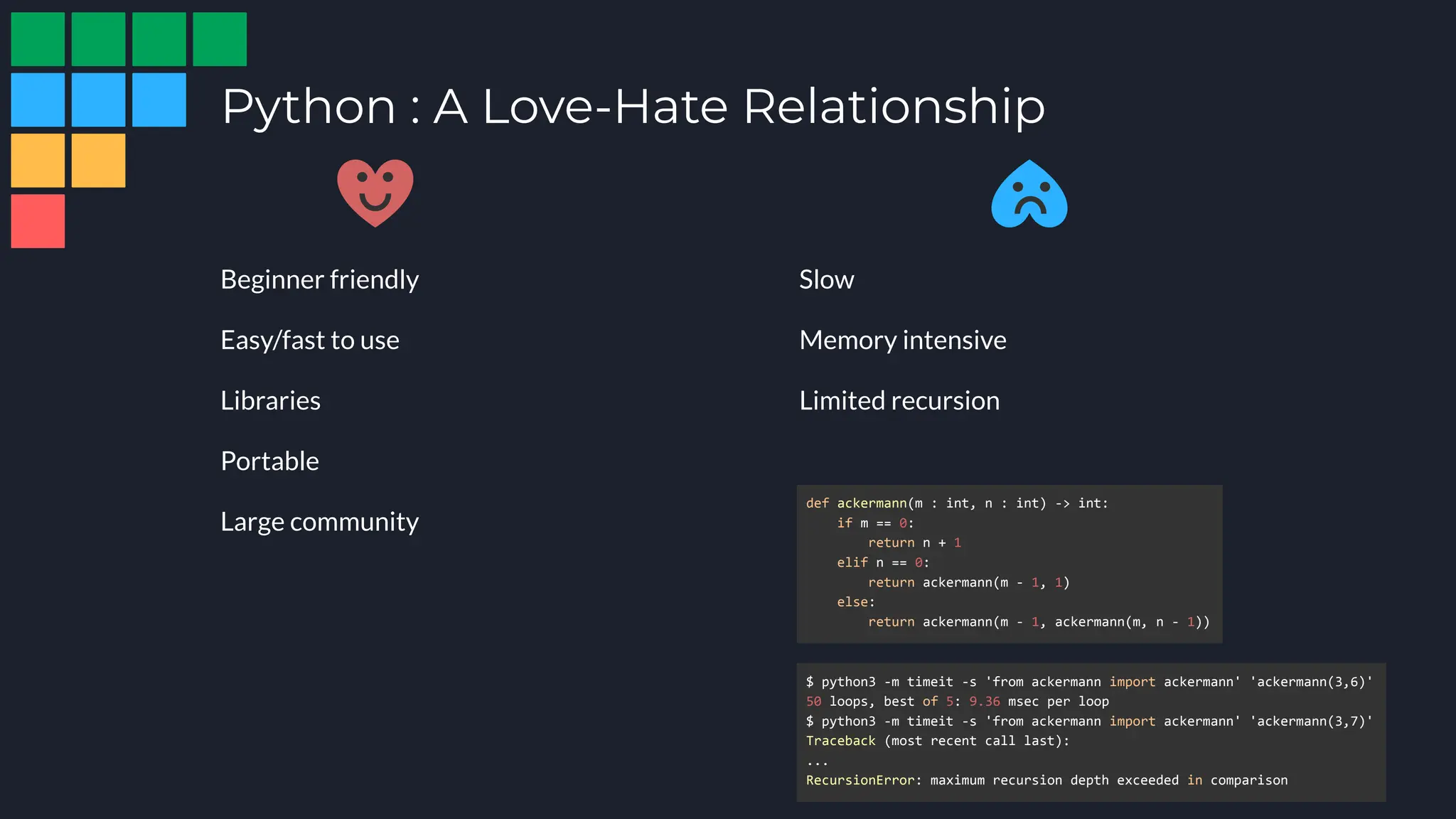
Python : A Love-Hate Relationship
Beginner friendly
Easy/fast to use
Libraries
Portable
Large community
Slow
Memory intensive
Limited recursion
def ackermann(m : int, n : int) -> int:
if m == 0:
return n + 1
elif n == 0:
return ackermann(m - 1, 1)
else:
return ackermann(m - 1, ackermann(m, n - 1))
$ python3 -m timeit -s 'from ackermann import ackermann' 'ackermann(3,6)'
50 loops, best of 5: 9.36 msec per loop
$ python3 -m timeit -s 'from ackermann import ackermann' 'ackermann(3,7)'
Traceback (most recent call last):
...
RecursionError: maximum recursion depth exceeded in comparison
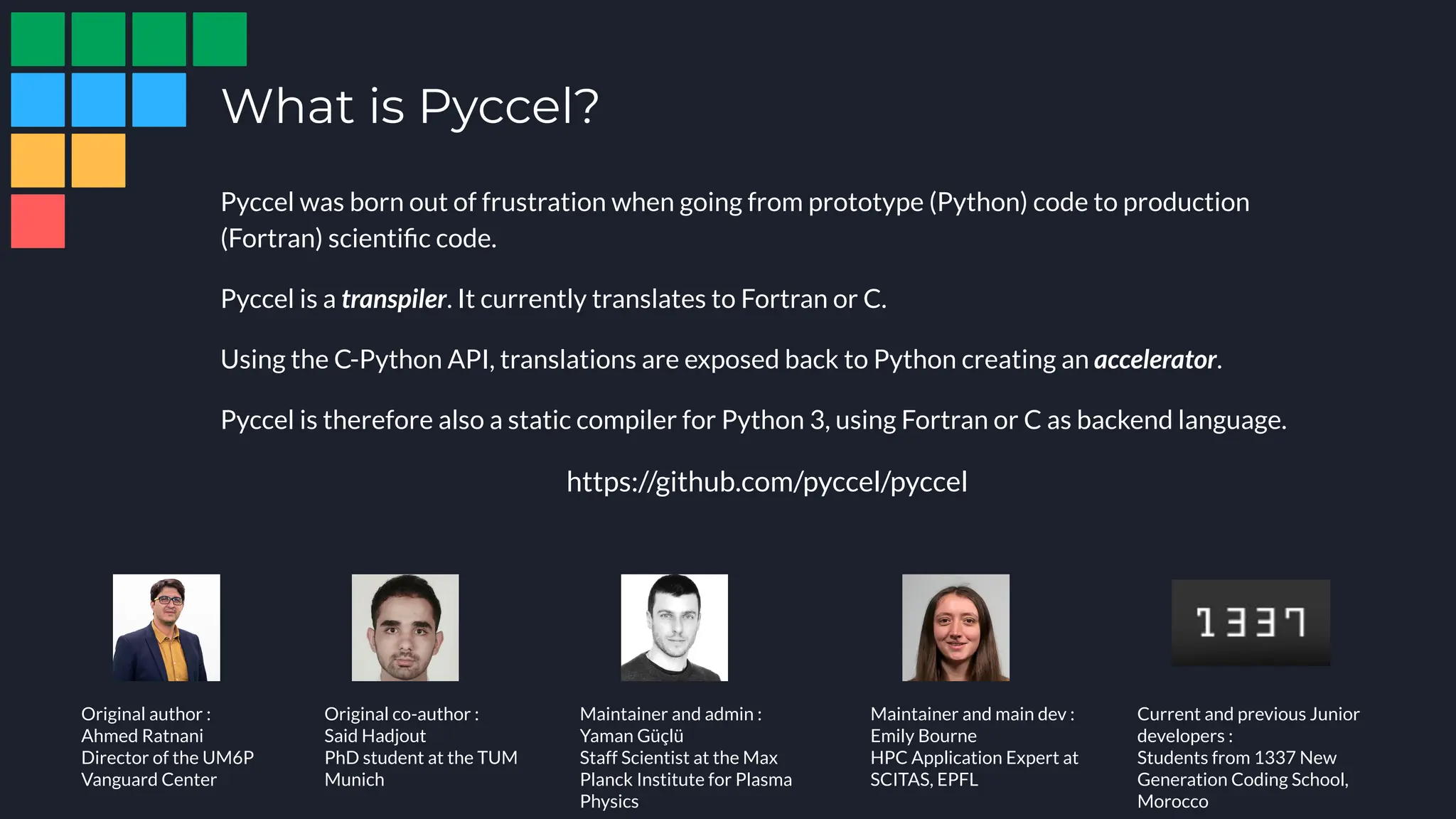
Pyccel was born out of frustration when going from prototype (Python) code to production
(Fortran) scientific code.
Pyccel is a transpiler. It currently translates to Fortran or C.
Using the C-Python API, translations are exposed back to Python creating an accelerator.
Pyccel is therefore also a static compiler for Python 3, using Fortran or C as backend language.
https://github.com/pyccel/pyccel
What is Pyccel?
Original author :
Ahmed Ratnani
Director of the UM6P
Vanguard Center
Maintainer and admin :
Yaman Güçlü
Staff Scientist at the Max
Planck Institute for Plasma
Physics
Maintainer and main dev :
Emily Bourne
HPC Application Expert at
SCITAS, EPFL
Current and previous Junior
developers :
Students from 1337 New
Generation Coding School,
Morocco
Original co-author :
Said Hadjout
PhD student at the TUM
Munich
Pyccel : The best of both worlds?
Solving a Linear Convection Equation with Finite Differences
Maximum memory (as measured by massif):
python3.10 linearconv_mod.py : 6.4 MB
./linearconv_mod : 61 KB
import numpy as np
def linearconv_1d(nx: int, dt: float, nt: int):
c = 1.0
dx = 2 / (nx-1)
x = np.linspace(0, 2, nx)
u = np.ones(nx)
u[int(0.5/dx) : int(1/dx + 1)] = 2
cp = c * dt / dx
un = np.zeros(nx)
for _ in range(nt):
un[:] = u[:]
for i in range(1, nx):
u[i] = un[i] - cp * (un[i] - un[i-1])
return x, u
if __name__ == '__main__':
x, u = linearconv_1d(2001, 0.0003, 3000)
$ python3.10 -m timeit -s 'from linearconv_1d_mod import linearconv_1d'
'x, u = linearconv_1d(2001, 0.0003, 3000)'
1 loop, best of 5: 1.47 sec per loop
$ pyccel linearconv_1d_mod.py
$ python3.10 -m timeit -s 'from linearconv_1d_mod import linearconv_1d'
'x, u = linearconv_1d(2001, 0.0003, 3000)'
200 loops, best of 5: 1.33 msec per loop
x 1105 !
x 105 !
Pyccel : The best of both worlds?
Solving a Linear Convection Equation with Finite Differences
module linearconv_1d_mod
use, intrinsic :: ISO_C_Binding, only : f64 => C_DOUBLE , i64 => &
C_INT64_T
implicit none
contains
!........................................
subroutine linearconv_1d(nx, dt, nt, x, u)
implicit none
real(f64), allocatable, intent(out) :: x(:)
real(f64), allocatable, intent(out) :: u(:)
integer(i64), value :: nx
real(f64), value :: dt
integer(i64), value :: nt
real(f64) :: c
real(f64) :: dx
real(f64) :: cp
real(f64), allocatable :: un(:)
integer(i64) :: Dummy_0000
integer(i64) :: i
integer(i64) :: linspace_index
c = 1._f64
dx = 2._f64 / Real((nx - 1_i64), f64)
allocate(x(0:nx - 1_i64))
x = [((0_i64 + linspace_index*Real((2_i64 - 0_i64), f64) / Real((nx &
- 1_i64), f64)), linspace_index = 0_i64,nx - 1_i64)]
x(nx - 1_i64) = 2._f64
allocate(u(0:nx - 1_i64))
u = 1._f64
u(Int(0._f64 / dx, i64):Int(1_i64 / dx + 1_i64, i64) - 1_i64) = &
2_i64
cp = c * dt / dx
allocate(un(0:nx - 1_i64))
un = 0._f64
do Dummy_0000 = 0_i64, nt - 1_i64, 1_i64
un(:) = u(:)
do i = 0_i64, nx - 1_i64, 1_i64
u(i) = un(i) - cp * (un(i) - un(i - 1_i64))
end do
end do
if (allocated(un)) then
deallocate(un)
end if
return
end subroutine linearconv_1d
!........................................
end module linearconv_1d_mod
Fortran translation
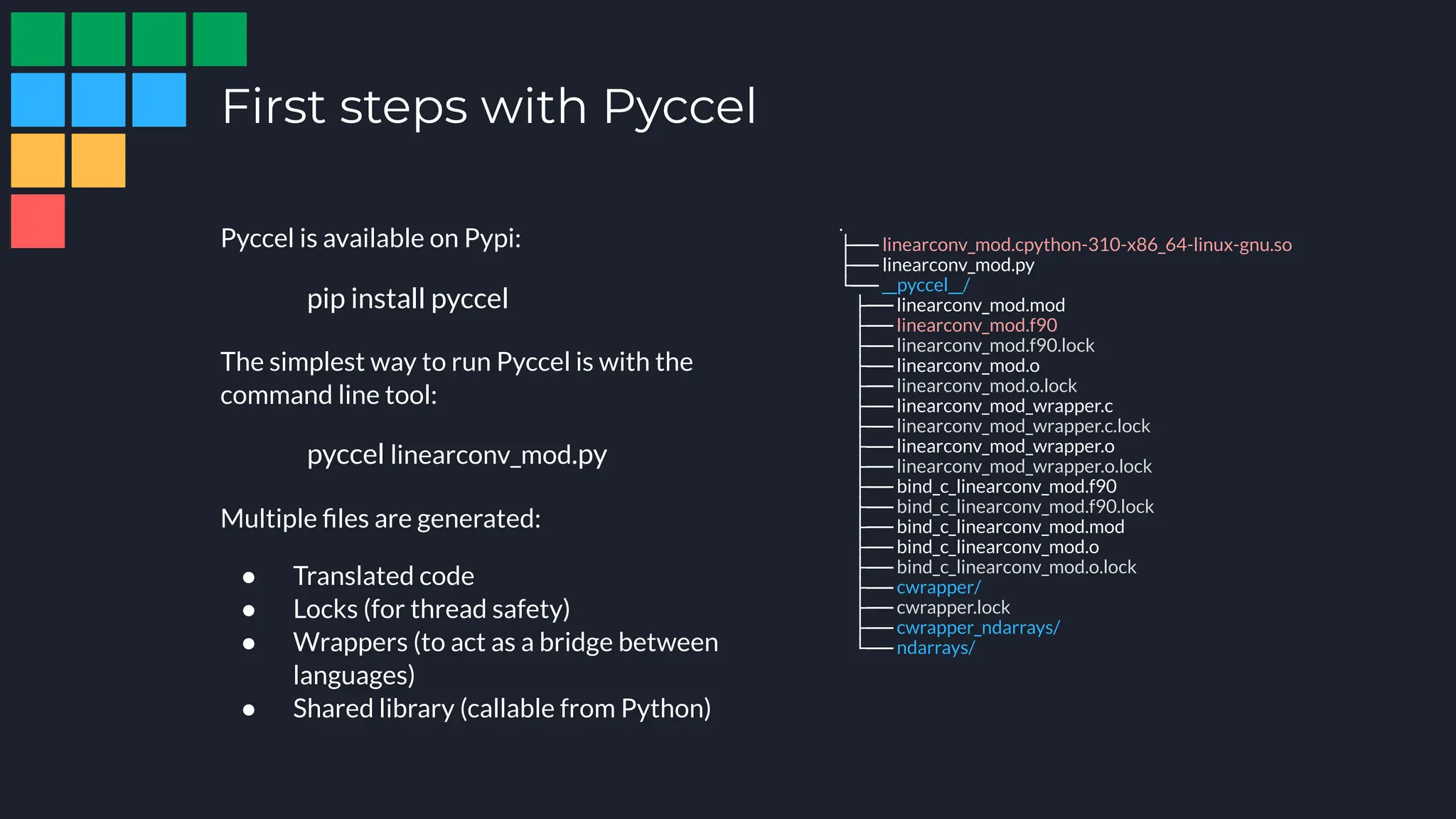
First steps with Pyccel
.
├── linearconv_mod.cpython-310-x86_64-linux-gnu.so
├── linearconv_mod.py
└── __pyccel__/
├── linearconv_mod.mod
├── linearconv_mod.f90
├── linearconv_mod.f90.lock
├── linearconv_mod.o
├── linearconv_mod.o.lock
├── linearconv_mod_wrapper.c
├── linearconv_mod_wrapper.c.lock
├── linearconv_mod_wrapper.o
├── linearconv_mod_wrapper.o.lock
├── bind_c_linearconv_mod.f90
├── bind_c_linearconv_mod.f90.lock
├── bind_c_linearconv_mod.mod
├── bind_c_linearconv_mod.o
├── bind_c_linearconv_mod.o.lock
├── cwrapper/
├── cwrapper.lock
├── cwrapper_ndarrays/
└── ndarrays/
Pyccel is available on Pypi:
The simplest way to run Pyccel is with the
command line tool:
Multiple files are generated:
● Translated code
● Locks (for thread safety)
● Wrappers (to act as a bridge between
languages)
● Shared library (callable from Python)
pyccel linearconv_mod.py
pip install pyccel
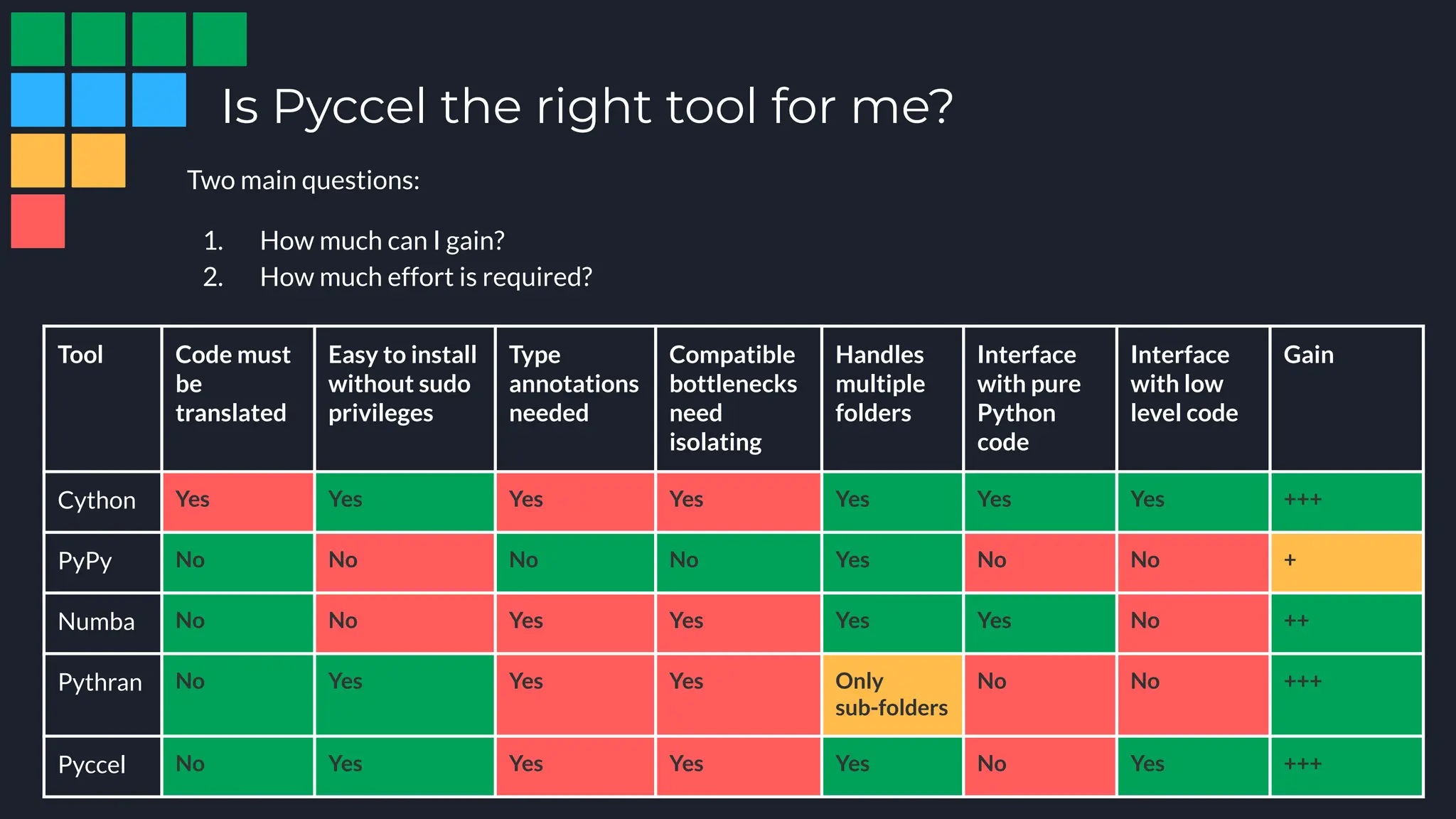
Is Pyccel the right tool for me?
Two main questions:
1. How much can I gain?
2. How much effort is required?
Tool Code must
be
translated
Easy to install
without sudo
privileges
Type
annotations
needed
Compatible
bottlenecks
need
isolating
Handles
multiple
folders
Interface
with pure
Python
code
Interface
with low
level code
Gain
Cython Yes Yes Yes Yes Yes Yes Yes +++
PyPy No No No No Yes No No +
Numba No No Yes Yes Yes Yes No ++
Pythran No Yes Yes Yes Only
sub-folders
No No +++
Pyccel No Yes Yes Yes Yes No Yes +++
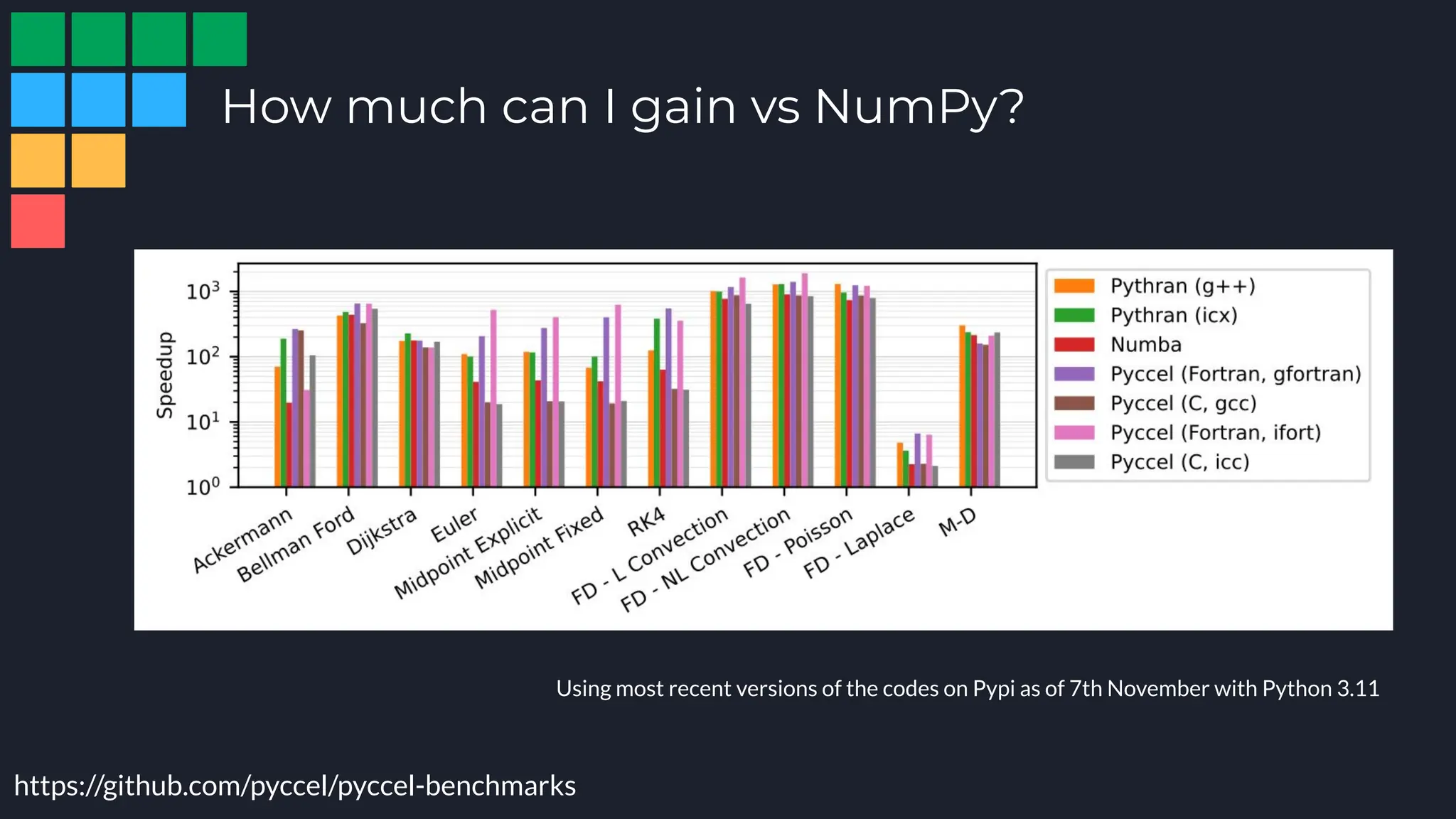
How much can I gain vs NumPy?
https://github.com/pyccel/pyccel-benchmarks
Using most recent versions of the codes on Pypi as of 7th November with Python 3.11
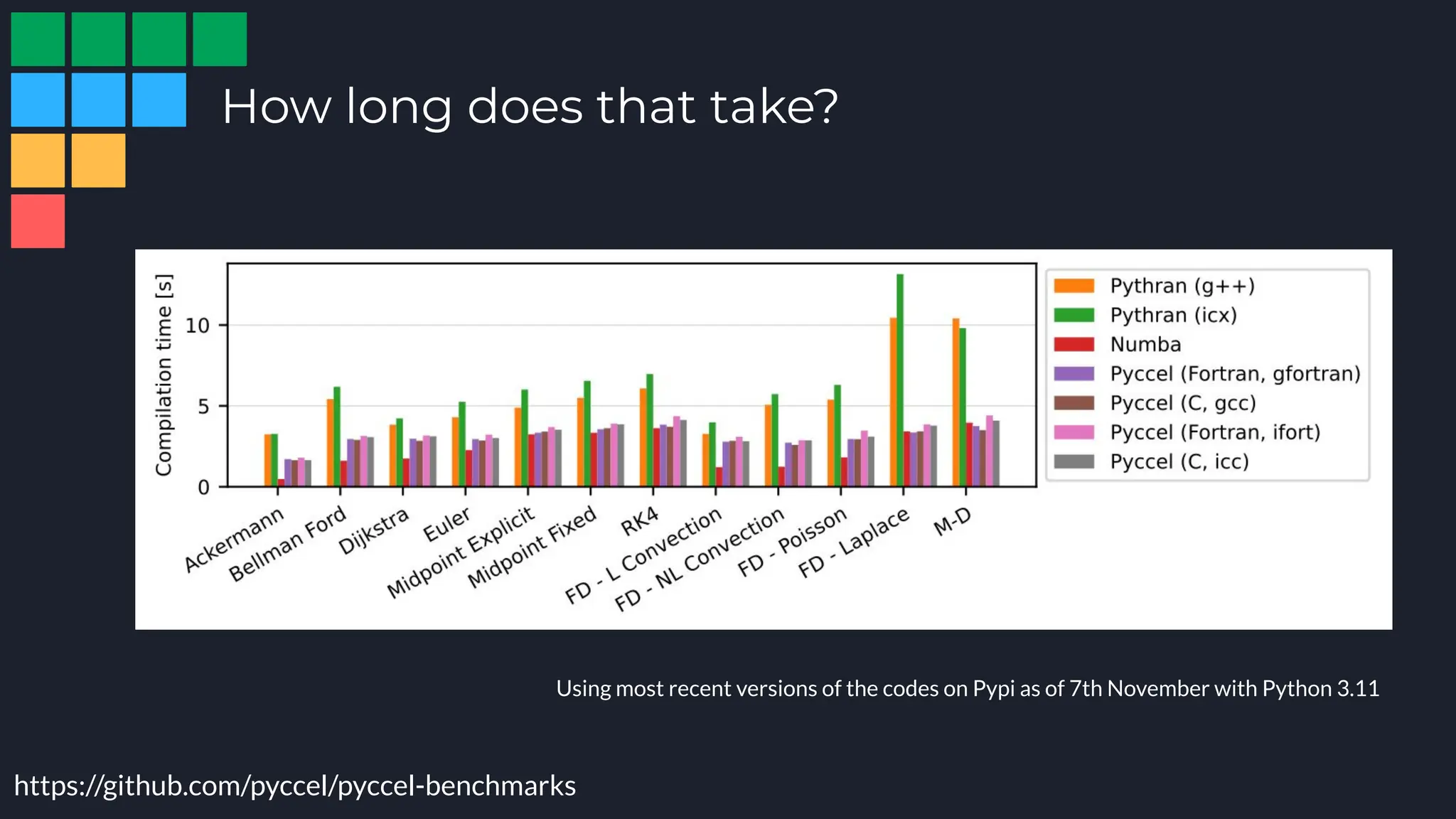
How long does that take?
https://github.com/pyccel/pyccel-benchmarks
Using most recent versions of the codes on Pypi as of 7th November with Python 3.11
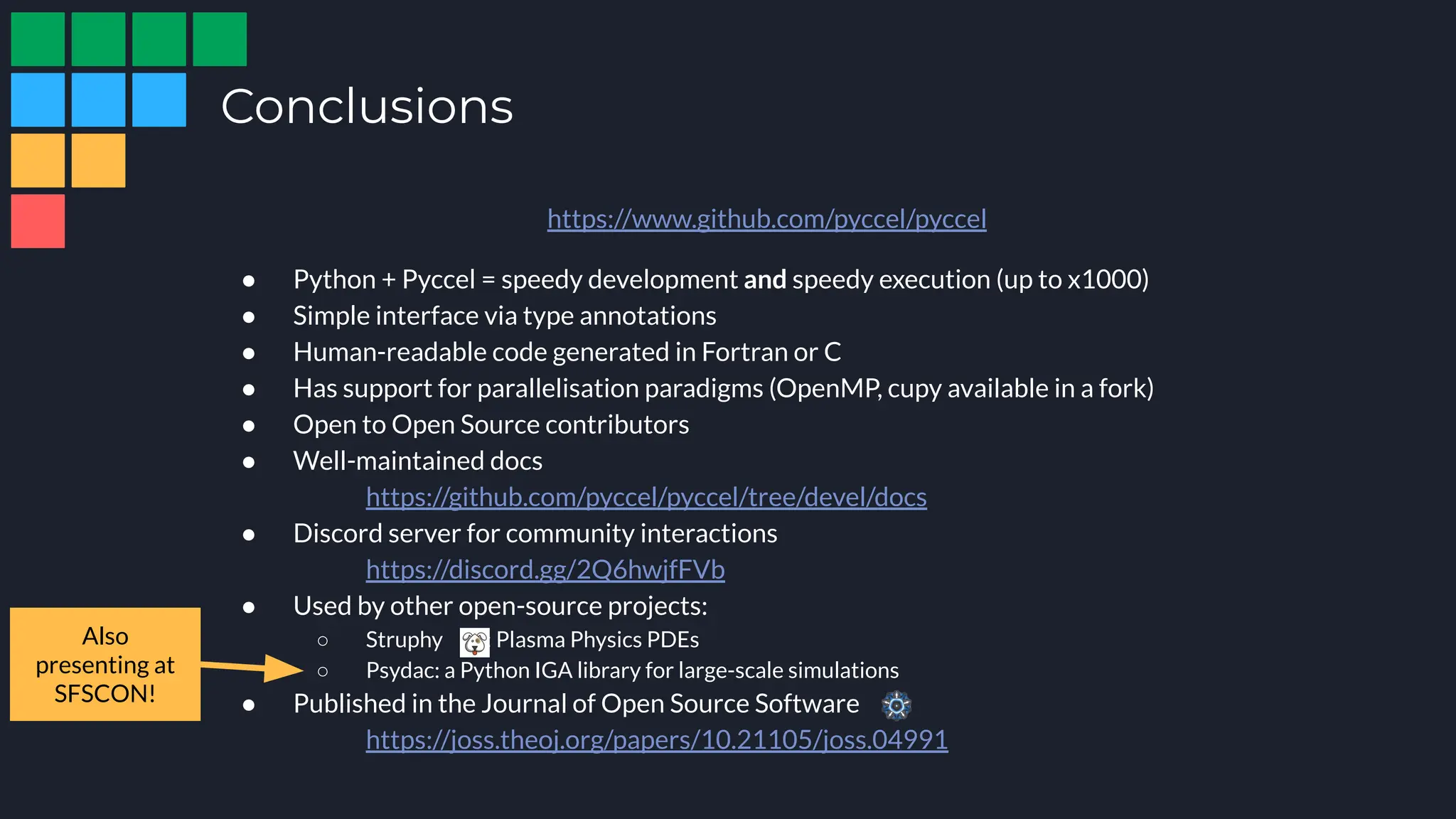
Conclusions
https://www.github.com/pyccel/pyccel
● Python + Pyccel = speedy development and speedy execution (up to x1000)
● Simple interface via type annotations
● Human-readable code generated in Fortran or C
● Has support for parallelisation paradigms (OpenMP, cupy available in a fork)
● Open to Open Source contributors
● Well-maintained docs
https://github.com/pyccel/pyccel/tree/devel/docs
● Discord server for community interactions
https://discord.gg/2Q6hwjfFVb
● Used by other open-source projects:
○ Struphy : Plasma Physics PDEs
○ Psydac: a Python IGA library for large-scale simulations
● Published in the Journal of Open Source Software
https://joss.theoj.org/papers/10.21105/joss.04991
Also
presenting at
SFSCON!
Type annotations
Supported types:
● built-in data types: bool, int, float, complex
● NumPy integer types: int8, int16, int32, int64
● NumPy real types: float32, float64, double
● NumPy complex types: complex64, complex128
● NumPy arrays of any of the above
def func(a : int):
def func(a : 'int'):
def func(a : 'int16'):
def func(arr : 'int[:,:](order=C)'):
def func(arr : 'int[:,:](order=F)'):
def func(arr : 'int[:,:]'):
Function templating
The same function can be used with multiple
types thanks to the template decorator
Similar to the UnionType but allows for more
fine-grain control
from pyccel.decorators import template
@template(name='T', types=[int,float])
def f(a : 'T', b : 'T'):
pass
from pyccel.decorators import template
@template(name='T', types=[int,float])
@template(name='Z', types=[int,float])
def f(a : 'T', b : 'Z'):
pass
from pyccel.decorators import template
@template(name='T', types=[int,float])
def f(a : 'T', b : 'T[:]', c: 'T[:,:]'):
pass
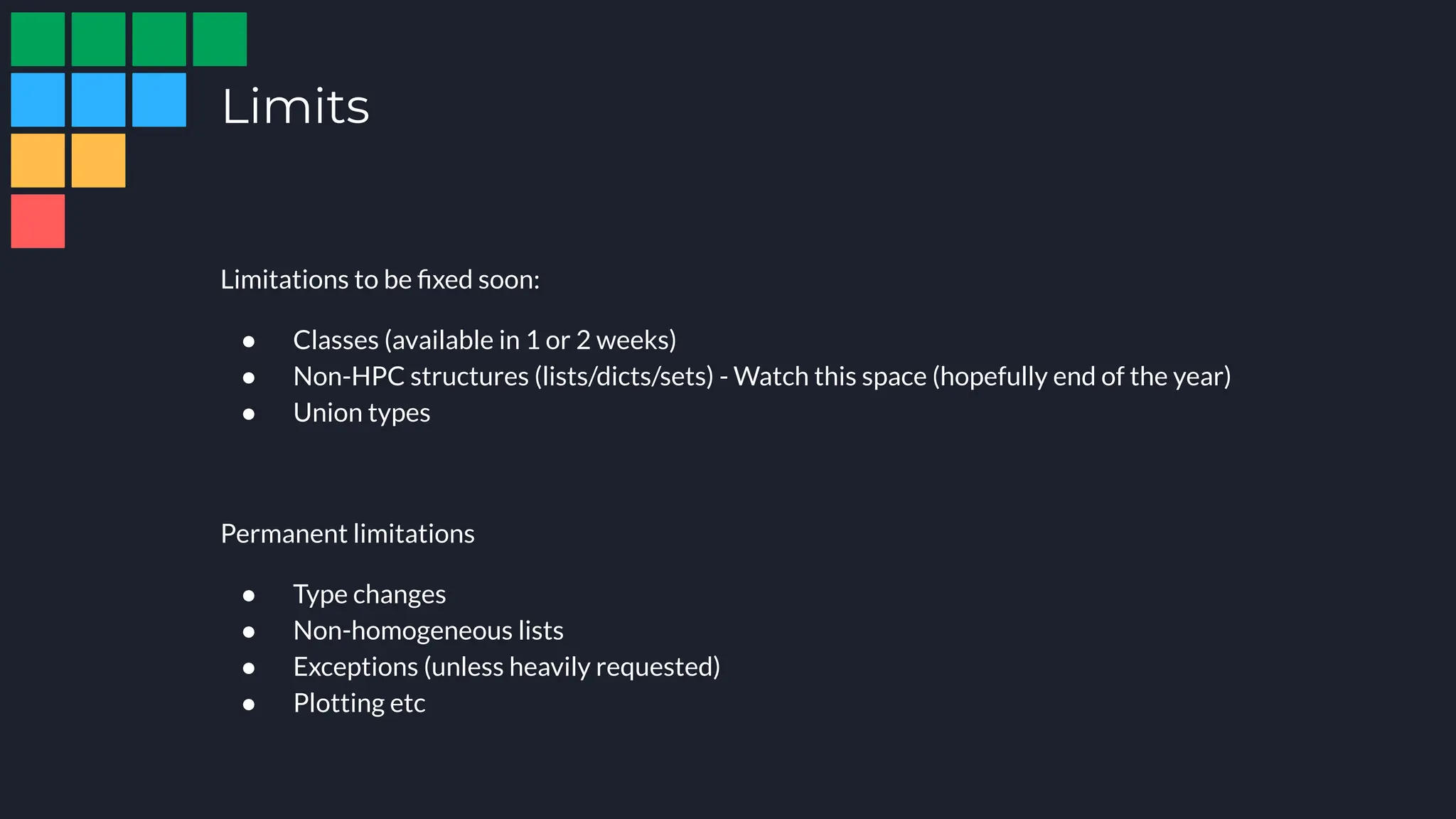
Limits
Limitations to be fixed soon:
● Classes (available in 1 or 2 weeks)
● Non-HPC structures (lists/dicts/sets) - Watch this space (hopefully end of the year)
● Union types
Permanent limitations
● Type changes
● Non-homogeneous lists
● Exceptions (unless heavily requested)
● Plotting etc
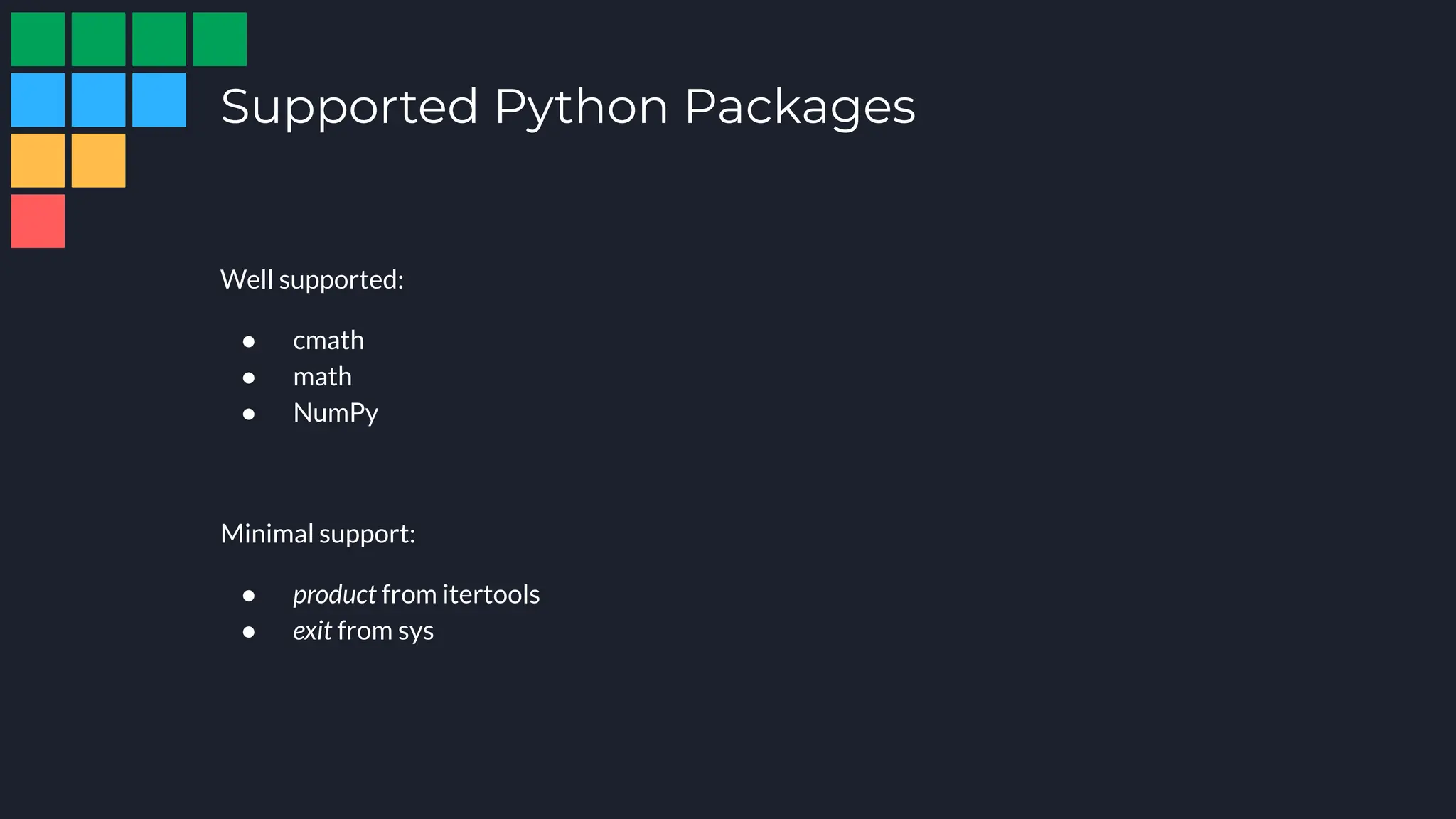
Well supported:
● cmath
● math
● NumPy
Minimal support:
● product from itertools
● exit from sys
Supported Python Packages
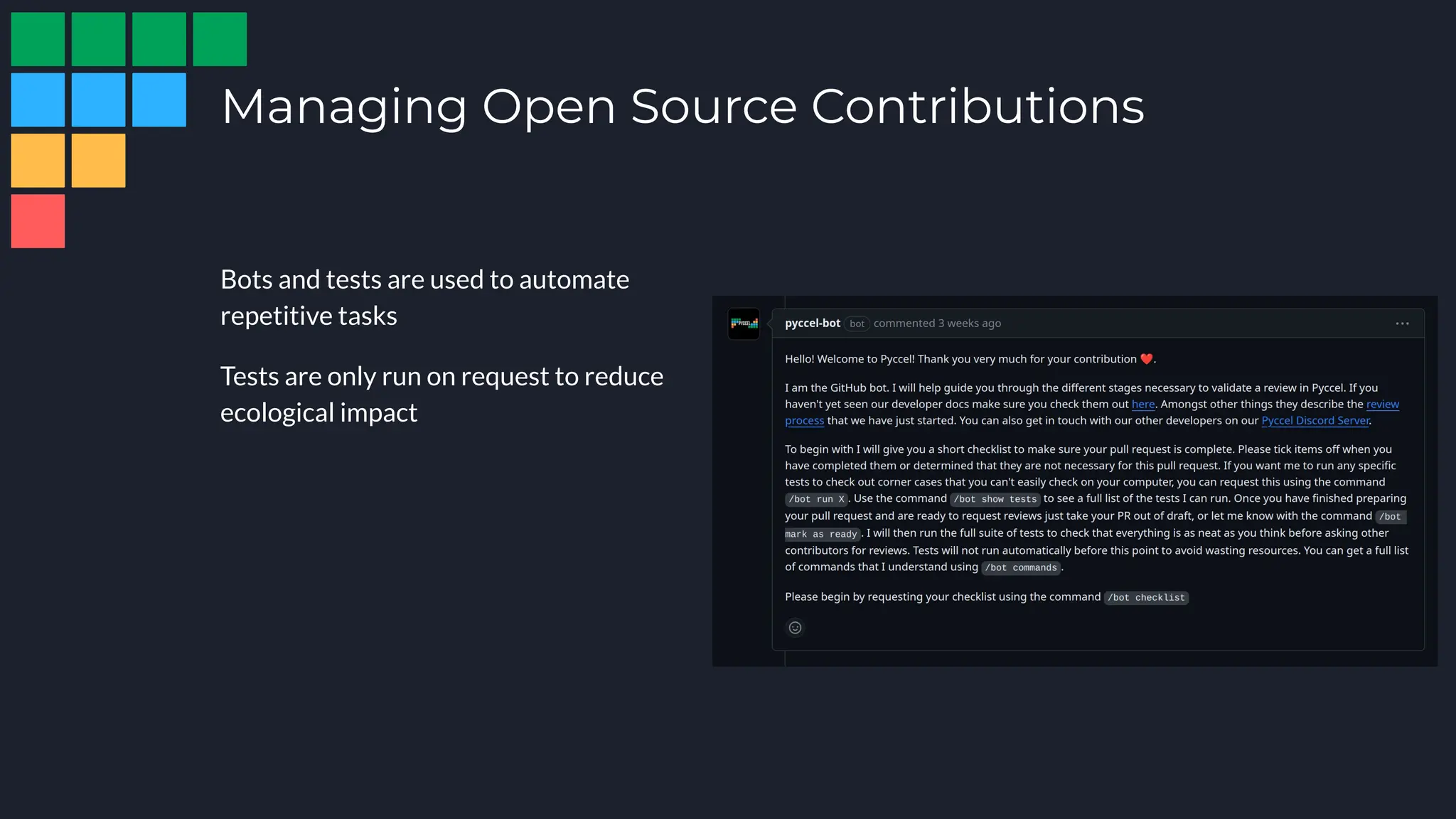
Managing Open Source Contributions
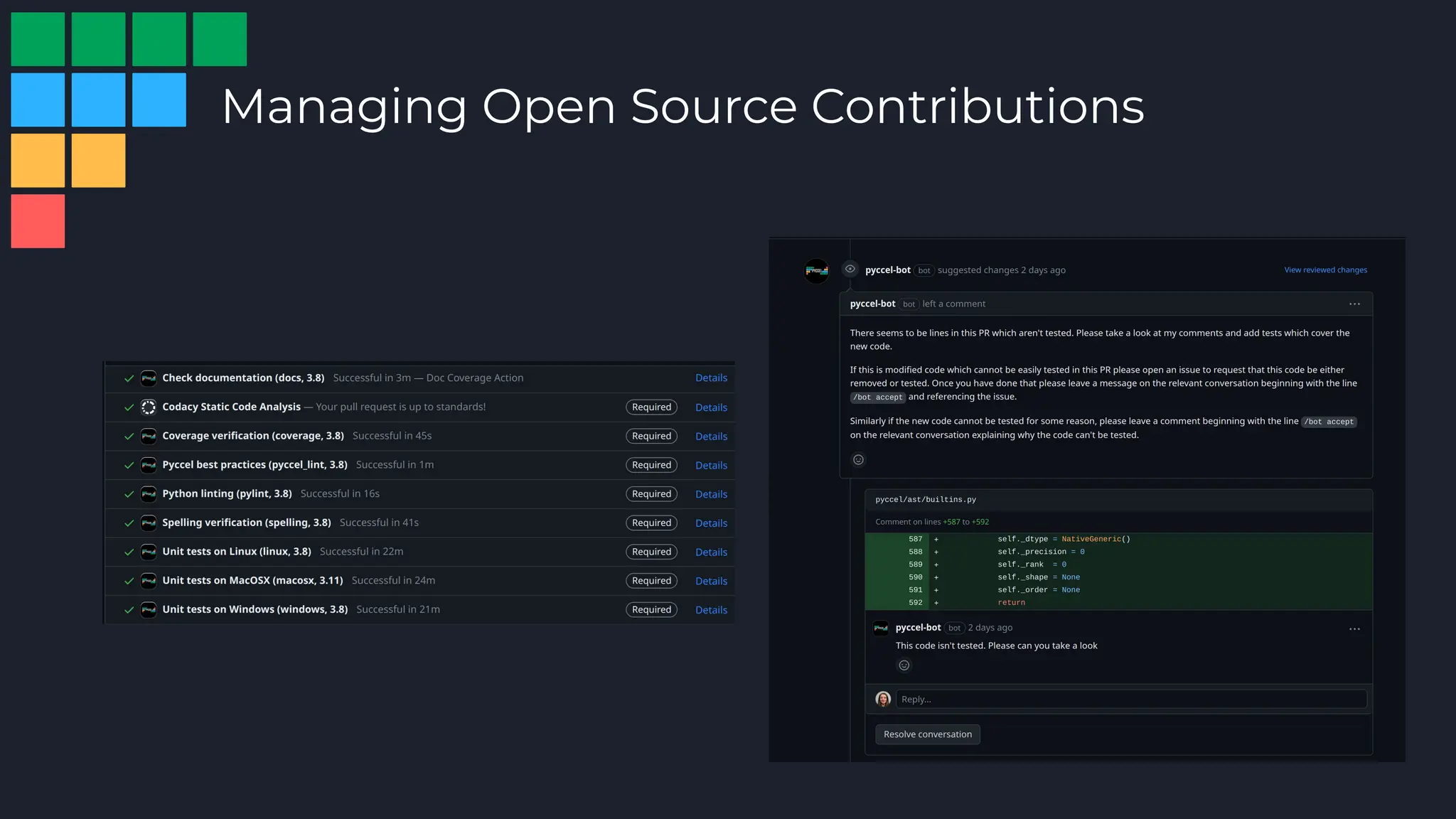
Bots and tests are used to automate
repetitive tasks
Tests are only run on request to reduce
ecological impact
Managing Open Source Contributions
OpenMP Support
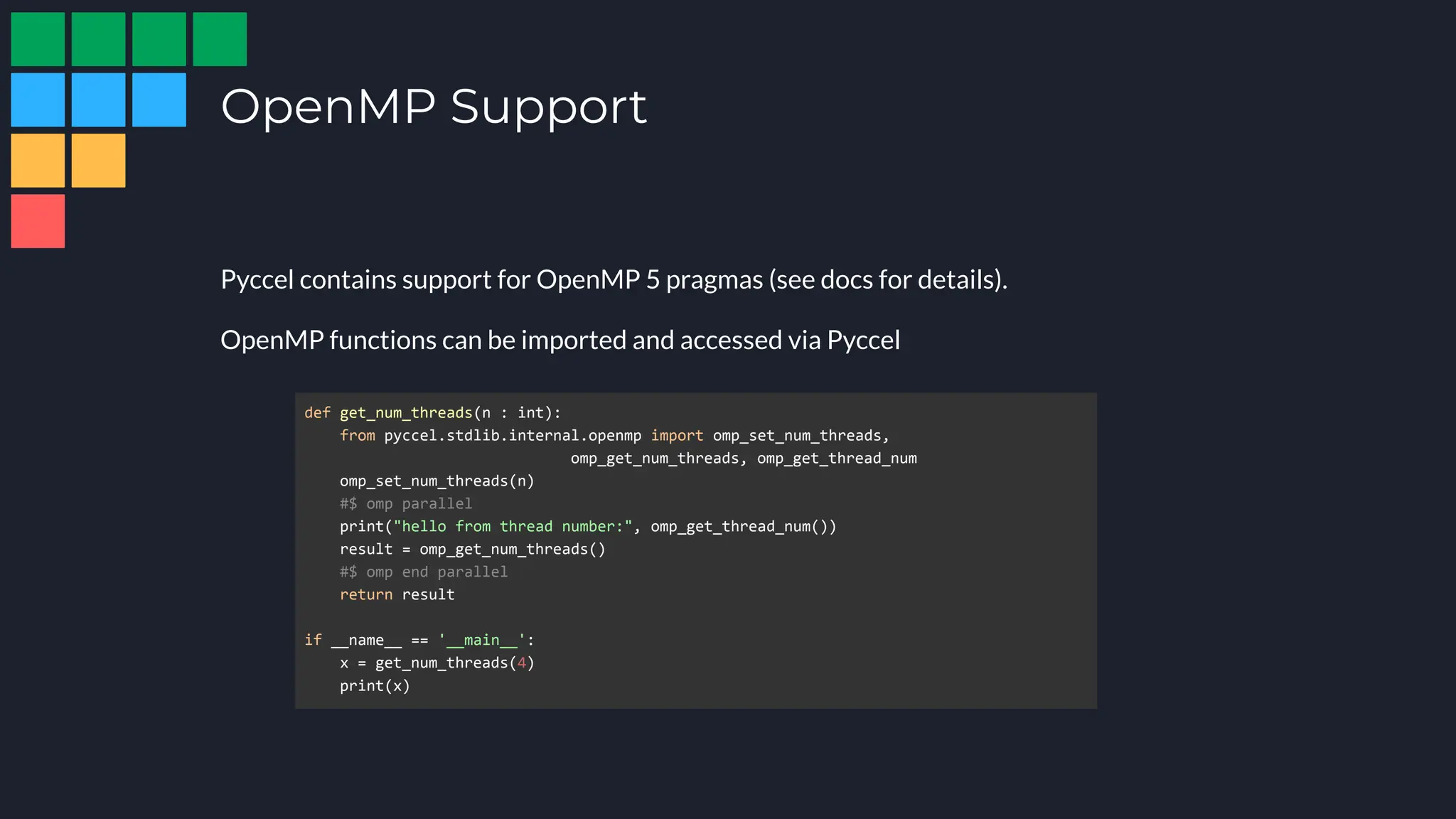
Pyccel contains support for OpenMP 5 pragmas (see docs for details).
OpenMP functions can be imported and accessed via Pyccel
def get_num_threads(n : int):
from pyccel.stdlib.internal.openmp import omp_set_num_threads,
omp_get_num_threads, omp_get_thread_num
omp_set_num_threads(n)
#$ omp parallel
print("hello from thread number:", omp_get_thread_num())
result = omp_get_num_threads()
#$ omp end parallel
return result
if __name__ == '__main__':
x = get_num_threads(4)
print(x)
OpenMP - Example
def my_sum(A: 'float[:,:]', n : int):
s = 0.
#$ omp parallel for collapse(2) reduction(+:s)
for i in range(n):
for j in range(n):
s += A[i,j]
return s
def my_sum(A: 'float[:,:]', n : int):
return sum(A)
function my_sum(A, n) result(s)
implicit none
real(f64) :: s
real(f64), intent(in) :: A(0:,0:)
integer(i64), value :: n
integer(i64) :: i
integer(i64) :: j
s = 0._f64
!$omp parallel do collapse(2) reduction(+:s)
do i = _i64, n - _i64, _i64
do j = _i64, n - _i64, _i64
s = s + A(j, i)
end do
end do
!$omp end parallel do
return
end function sum
Time to solution ≈ 17s
Time to solution ≈ 0.06s
Time to solution without OpenMP ≈ 0.12s
Time to solution with 2 OpenMP threads ≈ 0.06s

SFSCON23 - Emily Bourne Yaman Güçlü - Pyccel write Python code, get Fortran speed

  • 1.
    Pyccel Write Python code,get Fortran speed Emily Bourne (Scientific IT and Application Support, EPFL), Yaman Güçlü (Max Planck Institute for Plasma Physics, Garching) SFSCON - 2023
  • 2.
    Python : ALove-Hate Relationship Beginner friendly Easy/fast to use Libraries Portable Large community Slow Memory intensive Limited recursion def ackermann(m : int, n : int) -> int: if m == 0: return n + 1 elif n == 0: return ackermann(m - 1, 1) else: return ackermann(m - 1, ackermann(m, n - 1)) $ python3 -m timeit -s 'from ackermann import ackermann' 'ackermann(3,6)' 50 loops, best of 5: 9.36 msec per loop $ python3 -m timeit -s 'from ackermann import ackermann' 'ackermann(3,7)' Traceback (most recent call last): ... RecursionError: maximum recursion depth exceeded in comparison
  • 3.
    Pyccel was bornout of frustration when going from prototype (Python) code to production (Fortran) scientific code. Pyccel is a transpiler. It currently translates to Fortran or C. Using the C-Python API, translations are exposed back to Python creating an accelerator. Pyccel is therefore also a static compiler for Python 3, using Fortran or C as backend language. https://github.com/pyccel/pyccel What is Pyccel? Original author : Ahmed Ratnani Director of the UM6P Vanguard Center Maintainer and admin : Yaman Güçlü Staff Scientist at the Max Planck Institute for Plasma Physics Maintainer and main dev : Emily Bourne HPC Application Expert at SCITAS, EPFL Current and previous Junior developers : Students from 1337 New Generation Coding School, Morocco Original co-author : Said Hadjout PhD student at the TUM Munich
  • 4.
    Pyccel : Thebest of both worlds? Solving a Linear Convection Equation with Finite Differences Maximum memory (as measured by massif): python3.10 linearconv_mod.py : 6.4 MB ./linearconv_mod : 61 KB import numpy as np def linearconv_1d(nx: int, dt: float, nt: int): c = 1.0 dx = 2 / (nx-1) x = np.linspace(0, 2, nx) u = np.ones(nx) u[int(0.5/dx) : int(1/dx + 1)] = 2 cp = c * dt / dx un = np.zeros(nx) for _ in range(nt): un[:] = u[:] for i in range(1, nx): u[i] = un[i] - cp * (un[i] - un[i-1]) return x, u if __name__ == '__main__': x, u = linearconv_1d(2001, 0.0003, 3000) $ python3.10 -m timeit -s 'from linearconv_1d_mod import linearconv_1d' 'x, u = linearconv_1d(2001, 0.0003, 3000)' 1 loop, best of 5: 1.47 sec per loop $ pyccel linearconv_1d_mod.py $ python3.10 -m timeit -s 'from linearconv_1d_mod import linearconv_1d' 'x, u = linearconv_1d(2001, 0.0003, 3000)' 200 loops, best of 5: 1.33 msec per loop x 1105 ! x 105 !
  • 5.
    Pyccel : Thebest of both worlds? Solving a Linear Convection Equation with Finite Differences module linearconv_1d_mod use, intrinsic :: ISO_C_Binding, only : f64 => C_DOUBLE , i64 => & C_INT64_T implicit none contains !........................................ subroutine linearconv_1d(nx, dt, nt, x, u) implicit none real(f64), allocatable, intent(out) :: x(:) real(f64), allocatable, intent(out) :: u(:) integer(i64), value :: nx real(f64), value :: dt integer(i64), value :: nt real(f64) :: c real(f64) :: dx real(f64) :: cp real(f64), allocatable :: un(:) integer(i64) :: Dummy_0000 integer(i64) :: i integer(i64) :: linspace_index c = 1._f64 dx = 2._f64 / Real((nx - 1_i64), f64) allocate(x(0:nx - 1_i64)) x = [((0_i64 + linspace_index*Real((2_i64 - 0_i64), f64) / Real((nx & - 1_i64), f64)), linspace_index = 0_i64,nx - 1_i64)] x(nx - 1_i64) = 2._f64 allocate(u(0:nx - 1_i64)) u = 1._f64 u(Int(0._f64 / dx, i64):Int(1_i64 / dx + 1_i64, i64) - 1_i64) = & 2_i64 cp = c * dt / dx allocate(un(0:nx - 1_i64)) un = 0._f64 do Dummy_0000 = 0_i64, nt - 1_i64, 1_i64 un(:) = u(:) do i = 0_i64, nx - 1_i64, 1_i64 u(i) = un(i) - cp * (un(i) - un(i - 1_i64)) end do end do if (allocated(un)) then deallocate(un) end if return end subroutine linearconv_1d !........................................ end module linearconv_1d_mod Fortran translation
  • 6.
    First steps withPyccel . ├── linearconv_mod.cpython-310-x86_64-linux-gnu.so ├── linearconv_mod.py └── __pyccel__/ ├── linearconv_mod.mod ├── linearconv_mod.f90 ├── linearconv_mod.f90.lock ├── linearconv_mod.o ├── linearconv_mod.o.lock ├── linearconv_mod_wrapper.c ├── linearconv_mod_wrapper.c.lock ├── linearconv_mod_wrapper.o ├── linearconv_mod_wrapper.o.lock ├── bind_c_linearconv_mod.f90 ├── bind_c_linearconv_mod.f90.lock ├── bind_c_linearconv_mod.mod ├── bind_c_linearconv_mod.o ├── bind_c_linearconv_mod.o.lock ├── cwrapper/ ├── cwrapper.lock ├── cwrapper_ndarrays/ └── ndarrays/ Pyccel is available on Pypi: The simplest way to run Pyccel is with the command line tool: Multiple files are generated: ● Translated code ● Locks (for thread safety) ● Wrappers (to act as a bridge between languages) ● Shared library (callable from Python) pyccel linearconv_mod.py pip install pyccel
  • 7.
    Is Pyccel theright tool for me? Two main questions: 1. How much can I gain? 2. How much effort is required? Tool Code must be translated Easy to install without sudo privileges Type annotations needed Compatible bottlenecks need isolating Handles multiple folders Interface with pure Python code Interface with low level code Gain Cython Yes Yes Yes Yes Yes Yes Yes +++ PyPy No No No No Yes No No + Numba No No Yes Yes Yes Yes No ++ Pythran No Yes Yes Yes Only sub-folders No No +++ Pyccel No Yes Yes Yes Yes No Yes +++
  • 8.
    How much canI gain vs NumPy? https://github.com/pyccel/pyccel-benchmarks Using most recent versions of the codes on Pypi as of 7th November with Python 3.11
  • 9.
    How long doesthat take? https://github.com/pyccel/pyccel-benchmarks Using most recent versions of the codes on Pypi as of 7th November with Python 3.11
  • 10.
    Conclusions https://www.github.com/pyccel/pyccel ● Python +Pyccel = speedy development and speedy execution (up to x1000) ● Simple interface via type annotations ● Human-readable code generated in Fortran or C ● Has support for parallelisation paradigms (OpenMP, cupy available in a fork) ● Open to Open Source contributors ● Well-maintained docs https://github.com/pyccel/pyccel/tree/devel/docs ● Discord server for community interactions https://discord.gg/2Q6hwjfFVb ● Used by other open-source projects: ○ Struphy : Plasma Physics PDEs ○ Psydac: a Python IGA library for large-scale simulations ● Published in the Journal of Open Source Software https://joss.theoj.org/papers/10.21105/joss.04991 Also presenting at SFSCON!
  • 11.
    Type annotations Supported types: ●built-in data types: bool, int, float, complex ● NumPy integer types: int8, int16, int32, int64 ● NumPy real types: float32, float64, double ● NumPy complex types: complex64, complex128 ● NumPy arrays of any of the above def func(a : int): def func(a : 'int'): def func(a : 'int16'): def func(arr : 'int[:,:](order=C)'): def func(arr : 'int[:,:](order=F)'): def func(arr : 'int[:,:]'):
  • 12.
    Function templating The samefunction can be used with multiple types thanks to the template decorator Similar to the UnionType but allows for more fine-grain control from pyccel.decorators import template @template(name='T', types=[int,float]) def f(a : 'T', b : 'T'): pass from pyccel.decorators import template @template(name='T', types=[int,float]) @template(name='Z', types=[int,float]) def f(a : 'T', b : 'Z'): pass from pyccel.decorators import template @template(name='T', types=[int,float]) def f(a : 'T', b : 'T[:]', c: 'T[:,:]'): pass
  • 13.
    Limits Limitations to befixed soon: ● Classes (available in 1 or 2 weeks) ● Non-HPC structures (lists/dicts/sets) - Watch this space (hopefully end of the year) ● Union types Permanent limitations ● Type changes ● Non-homogeneous lists ● Exceptions (unless heavily requested) ● Plotting etc
  • 14.
    Well supported: ● cmath ●math ● NumPy Minimal support: ● product from itertools ● exit from sys Supported Python Packages
  • 15.
    Managing Open SourceContributions Bots and tests are used to automate repetitive tasks Tests are only run on request to reduce ecological impact
  • 16.
    Managing Open SourceContributions
  • 17.
    OpenMP Support Pyccel containssupport for OpenMP 5 pragmas (see docs for details). OpenMP functions can be imported and accessed via Pyccel def get_num_threads(n : int): from pyccel.stdlib.internal.openmp import omp_set_num_threads, omp_get_num_threads, omp_get_thread_num omp_set_num_threads(n) #$ omp parallel print("hello from thread number:", omp_get_thread_num()) result = omp_get_num_threads() #$ omp end parallel return result if __name__ == '__main__': x = get_num_threads(4) print(x)
  • 18.
    OpenMP - Example defmy_sum(A: 'float[:,:]', n : int): s = 0. #$ omp parallel for collapse(2) reduction(+:s) for i in range(n): for j in range(n): s += A[i,j] return s def my_sum(A: 'float[:,:]', n : int): return sum(A) function my_sum(A, n) result(s) implicit none real(f64) :: s real(f64), intent(in) :: A(0:,0:) integer(i64), value :: n integer(i64) :: i integer(i64) :: j s = 0._f64 !$omp parallel do collapse(2) reduction(+:s) do i = _i64, n - _i64, _i64 do j = _i64, n - _i64, _i64 s = s + A(j, i) end do end do !$omp end parallel do return end function sum Time to solution ≈ 17s Time to solution ≈ 0.06s Time to solution without OpenMP ≈ 0.12s Time to solution with 2 OpenMP threads ≈ 0.06s