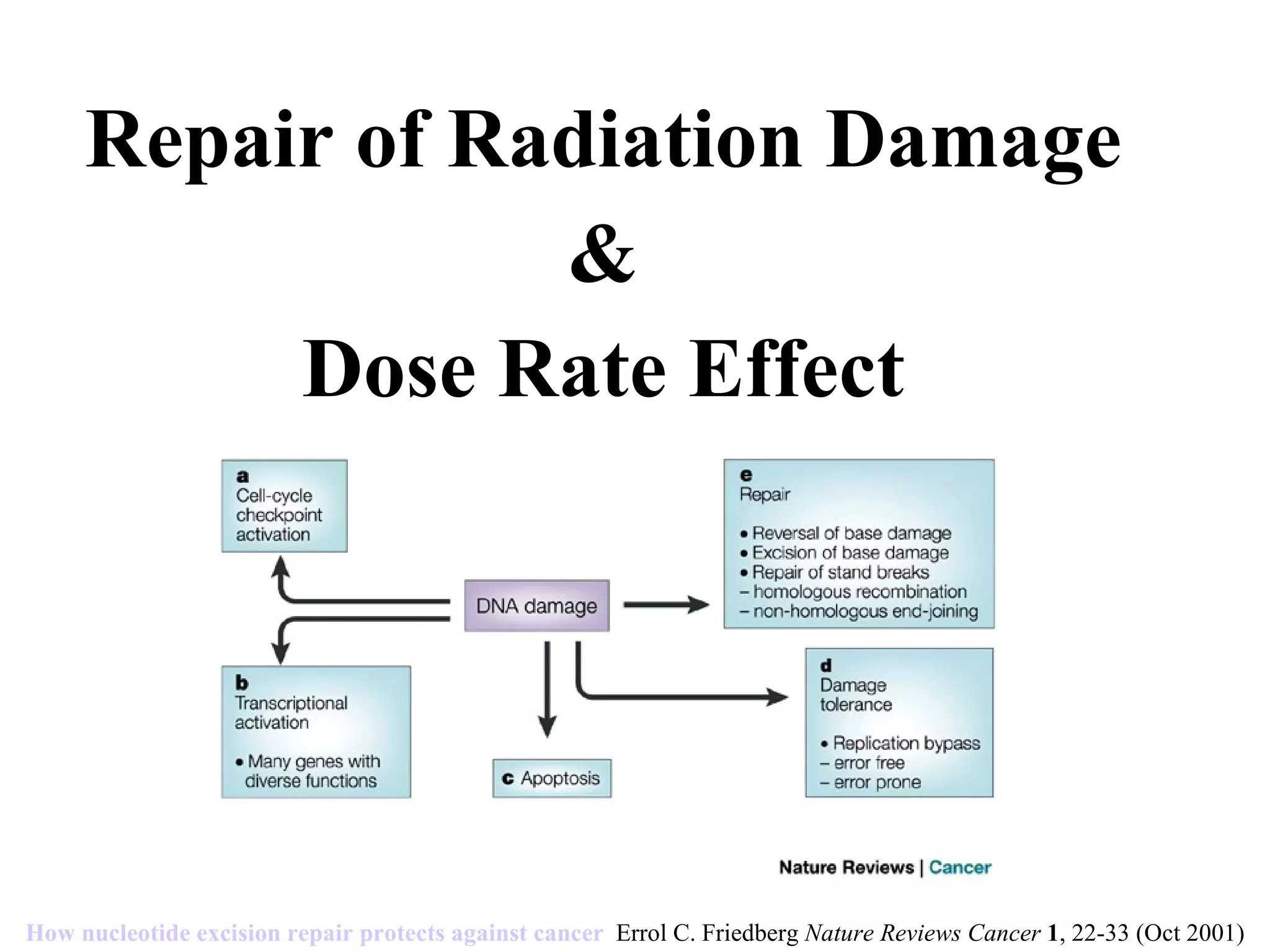
Repair of Radiation Damage & Dose Rate Effect How nucleotide excision repair protects against cancer   Errol C. Friedberg  Nature Reviews Cancer  1 , 22-33 (Oct 2001)
DNA Single Strand Repair
3 Pathways for Excision of damaged or inappropriate bases Base Excision Repair Mismatch Repair Nucleotide Excision Repair
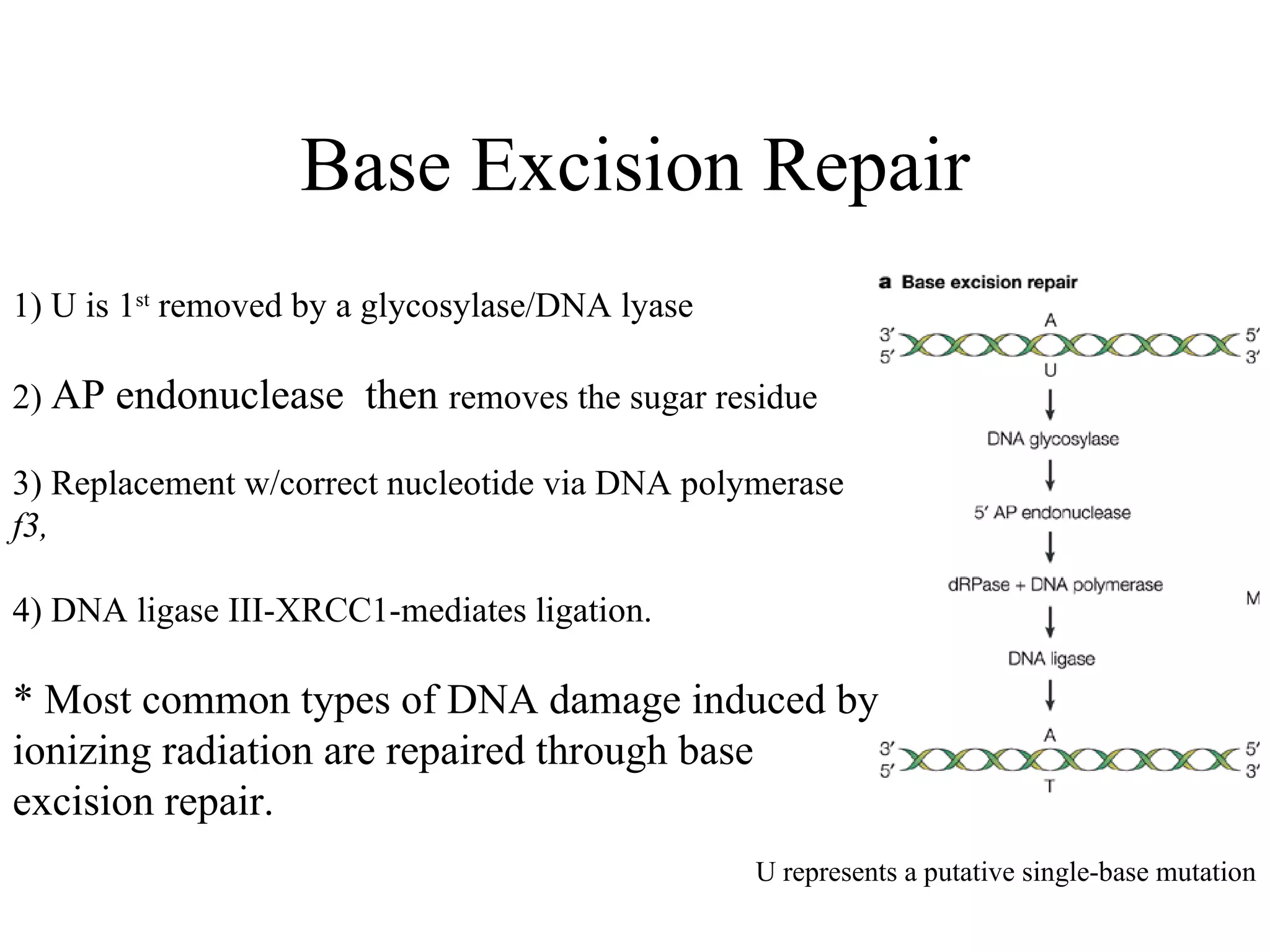
Base Excision Repair 1) U is 1 st  removed by a glycosylase/DNA lyase  2)  AP endonuclease  then  removes the sugar residue 3) Replacement w/correct nucleotide via DNA polymerase  f3,  4)   DNA ligase III-XRCC1-mediates ligation.  * Most common types of DNA damage induced by ionizing radiation are repaired through base excision repair.  U represents a putative single­base mutation
Base Excision Repair If >1 nucleotide mutated   RFC/PCNA/DNA polymerase 8/ E synthesizes the damaged strand  FENI endonuclease removes the Overhanging flap     Ligase I DNA strands are sealed
Nucleotide Excision Repair Nucleotide excision repair (NER) removes bulky adducts in the DNA, such as pyrimidine dimers
Nucleotide Excision Repair (1) Damage recognition  (XPC/HHRAD23B (R23, XPA, RPA, TFIIH and XPG) -(2) Unwind (TFII), DNA incisions   (XPG, ERCC1–XPF) around the lesion, usually 24 - 32 nucleotides in length -(3) Removal of the adducts -(4) Repair synthesis to fill in the gap  (TFII (XPB, XPD) -(5) DNA ligation (DNA Ligase)  How nucleotide excision repair protects against cancer   Errol C. Friedberg  Nature Reviews Cancer  1 , 22-33 (October 2001) e.g. Pyrimidine Dimer DNA Bubble
A mutation in NER genes  does NOT  lead to ionizing radiation sensitivity.  Increases sensitivity to UV-induced DNA damage & alkylating agents that induce adducts.  Nucleotide Excision Repair (NER) Germline mutations in NER  genes lead to human DNA repair deficiency disorders such as  xeroderma pigmentosum , in which patients are hypersensitive to UV light.
Mismatch Repair The mismatch repair pathway removes base-base mismatches in homologous recombination intermediates. Mutations in mismatch ( MSH, MLH,  and  PSM)  repair genes lead to  microsatellite instability   Precise Mechanism unknown Microsatellite Instability  (small base insertions or deletions) and cancer, especially hereditary nonpolyposis colon cancer (HNPCC).  How nucleotide excision repair protects against cancer   Errol C. Friedberg  Nature Reviews Cancer  1 , 22-33 (October 2001)
DNA Double Strand Repair   (including HRR and NHEJ) NHEJ is primary means of repairing dsDNA breaks Defects lead to:  IR sensitivity, chromosome aberrations
DNA Double Strand Repair Non Homologous End- Joining (NHEJ) 1)  Initiation  (End recognition):  - Binding of the Ku heterodimer to a dsDNA end  2)  End Processing  - Recruitment of DNA-dependent protein kinase catalytic subunit, DNAPKcs    Artemis activation  - Artemis: Endonuclease dependent cleavage of overhangs 3)  Synthesis : DNA polymerase  4)  Bridging/Joining : XRCC4/DNA ligase IV/XLF complex DNAPK: functions as a regulatory component of NHEJ, potentially facilitating and regulating the processing of the DNA ends. Recruits complex of three proteins, XRCC4, DNA ligase IV and XLF, which carry out the final rejoining step.   *Primary means of dsDNA break repair *Error prone* 2/2 in G1 w/no sister chromatid *Important for Ab diversity VDJ recombination
DNA Double Strand Repair Homologous Recombination (HR) ATM/ATR (damage sensor) PO4’s H2AX  H2AX Recruits RAD51 RAD51 Initiates strand resection/exchange (MREII) & loading of RAD51 onto ssDNA, a process assisted by the BRCA2 protein. RAD52/BLM protects against exonucleolytic degradation. 4) Strand invasion (RAD54)    D-loop    Holliday jxn 5) Strand extension by DNA synthesis using sister chromatid template 6) Termination of the Holliday junction Template = Error-free *replication fork* -H2AX recruits BRCA2
 
NHEJ and HRR are not mutually exclusive, as both have been found to be active in the late S/G 2  phase of the cell cycle (but rare) DNA Double Strand Repair
No (uses template) Yes Sequence Loss Decreases No effect Proliferation Dependent Independent BRCA  Dependent Independent ATM G2 G1 Phase of Cell Cycle No Yes Replication Associated HR NHEJ
DNA Repair Other Processes Single-strand annealing (SSA) plays a transitional role between HRR and NHEJ, and results in loss of genetic information owing to the exonuclease degradation of the DNA ends.  Cross-Link repair  pathways used for DNA-DNA or DNA-protein cross-link repair are still under in­vestigation.
PARP Nature Reviews Cancer   10 , 293-301 April 2010  OPINION:PARP inhibition: PARP1 and beyond  Rouleau, Patel, Hendzel, Kaufmann & Poirier Synthetic Lethality = increases SSB w/in DNA large amounsts of SSBs collapse of replication forks during S phase Accumulation of DSBs *Central role in  base excision repair  so loss is  Especially lethal in BRCA deficient cells  as cant manage dsDNA Breaks
Syndromes that exhibit hypersentivity to ionizing radiation…
AT Cell-cycle checkpoints and cancer   Michael B. Kastan and Jiri Bartek  Nature  432 , 316-323(18 November 2004) doi:10.1038/nature03097
ATR
SCID SCID mice are immunodeficient due to defective DNA-PKcs Such cells are defective in  nonhomologous recombination  and are extremely radiosensitive.    ·SCID humans are also  immune deficient and radiosensitive owing to a mutation in Artemis . Cells defective in Artemis are defective in  nonohomologous recombination and are radiosensitive .
SCID & NBS NBS  (Nijmegen Breakage Syndrome) is a very rare disorder that results in increased cancer incidence. Cells defective in NBS  lack an S phase checkpoint  and are radiosensitive.    ATLD  (AT-Like Disorder) patients are clinically similar to AT patients except that their defect lies in the  MRE7  7 gene . Cells from these patients are also sensitive to ionizing radiation.
Fanconi Anemia FA  (Fanconi Anemia) patients are characterized by their  hypersensitivity to cross-linking agents . Although fibroblasts derived from these patients are  not sensitive to ionizing radiation , tumors arising in these patients are hypersensitive. The reasons for this are currently unknown.
Operational Classifications of Radiation Damage Radiation damage to mammalian cells can be divided into… Lethal damage  – irreversible/irreparable and leads irrevocable to cell death Potentially lethal damage (PLD)  – that which can be modified by postirradiation conditions Sublethal damage (SLD)  – that which under normal conditions can be repaired unless additional sublethal damage is added
Potentially Lethal Damage The component of radiation damage that can be  modified by manipulation of the postirradiation conditions  is known as potentially lethal damage.   
Potentially Lethal Damage Potentially lethal damage repair  can occur if cells are prevented from dividing for 6 hours or more after irradiation ; this is manifest as an increase in survival. This repair can be demonstrated  in vitro  by keeping cells in saline or plateau phase for 6 hours after irradiation and  in vivo  by delayed removal and assay of animal tumors or cells of normal tissues.
Potentially Lethal Damage
Sublethal Damage The repair of  sublethal damage is simply the repair of double-strand breaks .  If a dose is  split  by a time interval, some double­strand breaks produced by the first dose are  repaired before  the second dose.  Recall that double strand “lethal” damage may be formed by  (1)  single-track or (2) multiple-track damage.  The component of cell killing resulting from single-track damage  is the same  whether the dose is a single exposure or fractionated. The  same is not true of multiple-track  damage.
Sublethal Damage
For x-rays, split fractionation separated by 1 to 4 hours, results in a marked increase in cell survival because of the prompt repair of sublethal damage (multi-track damage).  For neutrons, split fractionation offers little repair of sublethal damage (single track damage).  Sublethal Damage
Dose Rate Effect
Inverse Dose Rate
Dose Rate Effect There is a dose-rate effect, such that at  very low dose  rates (<0.01 G/min) there is  minimal checkpoint  activation, probably due to minimal ATM activation.  At  ~1 Gy/hr, only Late G2 checkpoint is triggered , leading to reassortment of cells at the G2/M interface (and resulting in the inverse dose rate effect). At  higher dose rates , cell cycle progression  is inhibited  at all checkpoints  EXAMPLE
Dose Rate Effect EXAMPLE
To better illustrate the concept of inverse dose rate consider that… At lower dose rates cells  may continue to progress through the cell cycle until they are arrested in G 2 , the most radiosensitive phase of the cycle leading to greater cell kill.  By contrast, at  higher dose rates, cells may become &quot;frozen&quot; in a more radioresistant phase  of the cycle leading to less cell kill.  Inverse Dose Rate
Brachytherapy
Brachytherapy
Brachytherapy
Brachytherapy
Radiolabeled Ig Therapy
Radiolabeled Ig Therapy  
Radiolabeled Ig Therapy
Questions Which of the following is NOT a characteristic of DNA-protein kinase (DNA-PK)?  A. DNA-PK consists of a catalytic subunit and two smaller accessory proteins, Ku70 (XRCC6) and Ku80 (XRCC5).  B. It participates in the repair of DNA double strand breaks primarily through homologous recombination.  C. Its loss in mice results in radiation sensitivity.  D. DNA-PK phosphorylates histone H2AX at sites of double strand breaks.  E. It is a phosphatidyl-inositol-3-kinase.
B DNA-PK is involved with non-homologous end-joining, not homologous recombination.  Answer
Which of the following proteins is  NOT  involved in DNA repair?  A. Artemis  B. RAD51  C. DNA-PKcs  D. CDK4  E. BRCA1  Questions
D CDK4 is a cyclin dependent kinase that plays an important role in the progression of cells through G 1  and into S phase. Artemis and DNA-PKcs play important roles in non-homologous end-joining of DNA double strand breaks, whereas RAD51 and BRCA1 are involved in the repair of double strand breaks through homologous recombination.  Answer
G1/S Phase Checkpoint
SCID mice are often used in radiobiology research because they:  A. are radioresistant  B. exhibit high levels of non-homologous end joining  C. have efficient immune systems  D. are better able to repair radiation damage  E. are useful hosts for growing human tumor xenografts  Questions
E SCID mice are immune deficient, making them good hosts for growing xenografts of human tumors. SCID mice are deficient in DNA-PK and are therefore radiosensitive. Cells from these mice have low levels of non-homologous end-joining.  Answer
Cells derived from individuals diagnosed with xeroderma pigmentosum are deficient in:  A. nucleotide excision repair  B. methyl-guanine transferase  C. mismatch repair  D. base excision repair  Questions
A People with xeroderma pigmentosum are deficient in one of the several proteins involved in  nucleotide excision repair . They are therefore extremely sensitive to UV irradiation because they are unable to repair the pyrimidine dimers produced in DNA, but they are not sensitive to ionizing radiation.  Answer
A mutation in NER genes does  NOT  lead to ionizing radiation sensitivity.  Increases sensitivity to UV-induced DNA damage & alkylating agents that induce adducts.  Nucleotide Excision Repair (NER) Germline mutations in NER  genes lead to human DNA repair deficiency disorders such as xeroderma pigmentosum, in which patients are hypersensitive to UV light.
Homologous recombinational repair of DNA double strand breaks is most likely to occur:  A. in G 0 B. in G 1 C. in early S phase  D. in G 2 E. throughout the cell cycle Questions
D Homologous recombinational repair requires the presence of a homologous DNA template, and is therefore  most likely to occur following DNA replication in G2   phase  (when complete,  sister chromatids  are present in the cell).  Answer
 
Which syndrome is caused by a deficiency in the repair-associated protein MRE11?  A. Werner’s syndrome  B. Ataxia-Telangiectasia-like disorder  C. Xeroderma Pigmentosum  D. Bloom’s syndrome  E. Cocayne’s syndrome Questions
B A deficiency in MRE11 results in an ataxia telangiectasia-like disorder.  Answer
DNA Double Strand Repair Homologous Recombination (HR) ATM/ATR (damage sensor) PO4’s H2AX  H2AX Recruits RAD51 RAD51 Initiates strand resection/exchange (MREII) & loading of RAD51 onto ssDNA, a process assisted by the BRCA2 protein. RAD52 protects against exonucleolytic degradation. 4) Strand invasion (RAD54)    D-loop    Holliday jxn 5) Strand extension by DNA synthesis using sister chromatid template 6) Termination of the Holliday junction Template = Error-free *replication fork* -H2AX recruits BRCA2
All the following statements are true concerning homologous recombinational repair of DNA double strand breaks, EXCEPT:  A. H2AX phosphorylation represents an important step in the formation of repair foci.  B. The BLM protein serves to coat single stranded DNA regions to prevent their degradation.  C. The MRN complex assists in producing single stranded regions following the induction of a DNA double strand break.  D. RAD51 is a recombinase and forms a nucleoprotein filament that facilitates strand invasion.  E. ATM is activated following irradiation by auto-phosphorylation and conversion from an inactive dimer to the active monomer.  Questions
B The RAD52/BLM protein is a helicase. RPA serves to coat single stranded DNA regions generated during homologous recombination to prevent their degradation.   Answer
DNA Double Strand Repair Homologous Recombination (HR) ATM/ATR (damage sensor) PO4’s H2AX  H2AX Recruits RAD51 RAD51 Initiates strand resection/exchange (MREII) & loading of RAD51 onto ssDNA, a process assisted by the BRCA2 protein.  RAD52  protects against exonucleolytic degradation. 4) Strand invasion (RAD54)    D-loop    Holliday jxn 5) Strand extension by DNA synthesis using sister chromatid template 6) Termination of the Holliday junction Template = Error-free *replication fork* -H2AX recruits BRCA2
All of the following statements about non-homologous end joining (NHEJ) are true, EXCEPT:  A. Artemis is primarily responsible for ligating broken DNA ends.  B. DNA ligase IV forms a tight complex with XRCC4.  C. DNA-PKcs associates with Ku70/80 to form the DNA-PK holo-enzyme.  D. The Ku heterodimer has a high affinity for DNA ends and forms a close-fitting asymmetrical ring that threads onto a free end of DNA.  E. NHEJ is an error-prone process.  Questions
A The main role for Artemis is to cleave (through its  nuclease  activity) any residual DNA loops or hairpins that form during non-homologous end-joining.  Answer
No (uses template) Yes Sequence Loss Decreases No effect Proliferation Dependent Independent BRCA  Dependent Independent ATM G2 G1 Phase of Cell Cycle No Yes Replication Associated HR NHEJ
Which of the following is NOT a substrate for ATM?  A. Ku70/80 (XRCC6/XRCC5)  B. BRCA1  C. NBS1  D. p53 (TP53)  E. CHK2 (CHEK2)  Questions
A All of the proteins listed are substrates for ATM  except for Ku70/80 .  Ku70/80 involved in NHEJ NHEJ is ATM independent Answer
DNA Double Strand Repair Non Homologous End- Joining (NHEJ) 1) Initiation (End recognition):  - Binding of the Ku heterodimer to a dsDNA end  2) End Processing  - Recruitment of DNA-dependent protein kinase catalytic subunit, DNAPKcs    Artemis activation  - Artemis: Endonuclease dependent cleavage of overhangs 3) Synthesis: DNA polymerase  4) Bridging/Joining: XRCC4/DNA ligase IV/XLF complex DNAPK: functions as a regulatory component of NHEJ, potentially facilitating and regulating the processing of the DNA ends. Recruits complex of three proteins, XRCC4, DNA ligase IV and XLF, which carry out the final rejoining step.   *error prone* 2/2 in G1 w/no sister chromatid *Important for Ab diversity VDJ recombination
Which of the following statements is TRUE concerning DNA repair processes?  A. Between 10-20% of the population is thought to be heterozygous for the types of mutations that are responsible for causing ataxia telangiectasia (AT).  B. Non-homologous end-joining requires the involvement of a sister chromatid.  C. Mutations in the genes that encode proteins involved in translesion DNA synthesis are typically present in people who develop hereditary non-polyposis colon cancer.  D. The most common types of DNA damage induced by ionizing radiation are repaired through base excision repair.  Questions
D The most common alterations produced in the DNA by radiation are  base damages  which are repaired by  base excision repair , a repair process that is usually rapid and accurate.  The proportion of the population that is heterozygous for the types of mutations that are found in people with AT – typically protein truncation mutations – is roughly 1-2%.  Non-homologous end joining does not require a sister chromatid.  Mutation of the genes involved with mismatch repair, primarily MSH2 and MLH1, are often present in people who develop hereditary non-polyposis colon cancer.  Homologous recombination is a relatively error-free process.  Answer
Normal tissue complications are most likely to be exhibited following conventional radiotherapy in patients suffering from:  A. ataxia telangiectasia  B. systemic lupus erythematosus  C. Bloom's syndrome  D. xeroderma pigmentosum  E. Fanconi's anemia  Questions
A Radiation injury would most likely occur in a person with  ataxia telangiectasia . People with this syndrome are  very sensitive to ionizing radiation  due to the absence of functional ATM protein, which plays a central role in the repair of DNA double strand breaks and regulation of the cell cycle following irradiation.  Answer
 
 
Repair of DNA double-strand breaks can be accomplished by which one of the following pathways?  A. mismatch repair  B. non-homologous end joining  C. base excision repair  D. nucleotide excision repair  E. photoreactivation  Questions
B Non-homologous end-joining represents the  principal means  by which human cells  repair DNA double strand breaks . Mismatch repair is primarily responsible for correction of errors made during DNA replication.  Base excision repair removes base damages. Nucleotide excision repair mainly removes bulky adducts from DNA such as UV-induced pyrimidine dimers and chemical adducts.  Photoreactivation involves the action of DNA photolyase which is activated by long wavelength UV and visible light to split  Answer
DNA Double Strand Repair   (including HRR and NHEJ) Depiction of the two main processes for repairing DNA dsb in mammalian cells.  In NHEJ, the break is processed and rejoined with the possibility of sequence information being lost and incorrect repair.  With HR an intact homolog is used as a template to ensure correct error free repair. : Eur J Pharmacol. Author manuscript; available in PMC 2010 June 25.  Eur J Pharmacol. 2009 December 25; 625(1-3): 151–155. Published online 2009 October 14. NHEJ is primary means of repairing dsDNA breaks Defects lead to: IR sensitivity, chromosome aberrations
RAD51 and BRCA2 function together:  A. as inhibitors of cyclin dependent kinases.  B. to phosphorylate H2AX and NBS1.  C. to enhance apoptosis by inhibiting p53 (TP53).  D. in the initial steps of homologous recombination.  E. to play a central role in nucleotide excision repair.  Questions
Answer D RAD51 and BRCA2 function DNA double strand breaks.
DNA Double Strand Repair Homologous Recombination (HR) ATM/ATR (damage sensor) PO4’s H2AX  H2AX Recruits RAD51 RAD51 Initiates strand resection/exchange (MREII) & loading of RAD51 onto ssDNA, a process assisted by the BRCA2 protein. RAD52/BLM protects against exonucleolytic degradation. 4) Strand invasion (RAD54)    D-loop    Holliday jxn 5) Strand extension by DNA synthesis using sister chromatid template 6) Termination of the Holliday junction Template = Error-free *replication fork* -H2AX recruits BRCA2

Chapter 5 -repair or radiation damage and dose-rate effect - jtl

  • 1.
    Repair of RadiationDamage & Dose Rate Effect How nucleotide excision repair protects against cancer Errol C. Friedberg Nature Reviews Cancer  1 , 22-33 (Oct 2001)
  • 2.
  • 3.
    3 Pathways forExcision of damaged or inappropriate bases Base Excision Repair Mismatch Repair Nucleotide Excision Repair
  • 4.
    Base Excision Repair1) U is 1 st removed by a glycosylase/DNA lyase 2) AP endonuclease then removes the sugar residue 3) Replacement w/correct nucleotide via DNA polymerase f3, 4) DNA ligase III-XRCC1-mediates ligation. * Most common types of DNA damage induced by ionizing radiation are repaired through base excision repair. U represents a putative single­base mutation
  • 5.
    Base Excision RepairIf >1 nucleotide mutated  RFC/PCNA/DNA polymerase 8/ E synthesizes the damaged strand  FENI endonuclease removes the Overhanging flap  Ligase I DNA strands are sealed
  • 6.
    Nucleotide Excision RepairNucleotide excision repair (NER) removes bulky adducts in the DNA, such as pyrimidine dimers
  • 7.
    Nucleotide Excision Repair(1) Damage recognition (XPC/HHRAD23B (R23, XPA, RPA, TFIIH and XPG) -(2) Unwind (TFII), DNA incisions (XPG, ERCC1–XPF) around the lesion, usually 24 - 32 nucleotides in length -(3) Removal of the adducts -(4) Repair synthesis to fill in the gap (TFII (XPB, XPD) -(5) DNA ligation (DNA Ligase) How nucleotide excision repair protects against cancer Errol C. Friedberg Nature Reviews Cancer  1 , 22-33 (October 2001) e.g. Pyrimidine Dimer DNA Bubble
  • 8.
    A mutation inNER genes does NOT lead to ionizing radiation sensitivity. Increases sensitivity to UV-induced DNA damage & alkylating agents that induce adducts. Nucleotide Excision Repair (NER) Germline mutations in NER genes lead to human DNA repair deficiency disorders such as xeroderma pigmentosum , in which patients are hypersensitive to UV light.
  • 9.
    Mismatch Repair Themismatch repair pathway removes base-base mismatches in homologous recombination intermediates. Mutations in mismatch ( MSH, MLH, and PSM) repair genes lead to microsatellite instability Precise Mechanism unknown Microsatellite Instability (small base insertions or deletions) and cancer, especially hereditary nonpolyposis colon cancer (HNPCC). How nucleotide excision repair protects against cancer Errol C. Friedberg Nature Reviews Cancer  1 , 22-33 (October 2001)
  • 10.
    DNA Double StrandRepair (including HRR and NHEJ) NHEJ is primary means of repairing dsDNA breaks Defects lead to: IR sensitivity, chromosome aberrations
  • 11.
    DNA Double StrandRepair Non Homologous End- Joining (NHEJ) 1) Initiation (End recognition): - Binding of the Ku heterodimer to a dsDNA end 2) End Processing - Recruitment of DNA-dependent protein kinase catalytic subunit, DNAPKcs  Artemis activation - Artemis: Endonuclease dependent cleavage of overhangs 3) Synthesis : DNA polymerase 4) Bridging/Joining : XRCC4/DNA ligase IV/XLF complex DNAPK: functions as a regulatory component of NHEJ, potentially facilitating and regulating the processing of the DNA ends. Recruits complex of three proteins, XRCC4, DNA ligase IV and XLF, which carry out the final rejoining step. *Primary means of dsDNA break repair *Error prone* 2/2 in G1 w/no sister chromatid *Important for Ab diversity VDJ recombination
  • 12.
    DNA Double StrandRepair Homologous Recombination (HR) ATM/ATR (damage sensor) PO4’s H2AX H2AX Recruits RAD51 RAD51 Initiates strand resection/exchange (MREII) & loading of RAD51 onto ssDNA, a process assisted by the BRCA2 protein. RAD52/BLM protects against exonucleolytic degradation. 4) Strand invasion (RAD54)  D-loop  Holliday jxn 5) Strand extension by DNA synthesis using sister chromatid template 6) Termination of the Holliday junction Template = Error-free *replication fork* -H2AX recruits BRCA2
  • 13.
  • 14.
    NHEJ and HRRare not mutually exclusive, as both have been found to be active in the late S/G 2 phase of the cell cycle (but rare) DNA Double Strand Repair
  • 15.
    No (uses template)Yes Sequence Loss Decreases No effect Proliferation Dependent Independent BRCA Dependent Independent ATM G2 G1 Phase of Cell Cycle No Yes Replication Associated HR NHEJ
  • 16.
    DNA Repair OtherProcesses Single-strand annealing (SSA) plays a transitional role between HRR and NHEJ, and results in loss of genetic information owing to the exonuclease degradation of the DNA ends. Cross-Link repair pathways used for DNA-DNA or DNA-protein cross-link repair are still under in­vestigation.
  • 17.
    PARP Nature ReviewsCancer   10 , 293-301 April 2010 OPINION:PARP inhibition: PARP1 and beyond Rouleau, Patel, Hendzel, Kaufmann & Poirier Synthetic Lethality = increases SSB w/in DNA large amounsts of SSBs collapse of replication forks during S phase Accumulation of DSBs *Central role in base excision repair so loss is Especially lethal in BRCA deficient cells as cant manage dsDNA Breaks
  • 18.
    Syndromes that exhibithypersentivity to ionizing radiation…
  • 19.
    AT Cell-cycle checkpointsand cancer Michael B. Kastan and Jiri Bartek Nature  432 , 316-323(18 November 2004) doi:10.1038/nature03097
  • 20.
  • 21.
    SCID SCID miceare immunodeficient due to defective DNA-PKcs Such cells are defective in nonhomologous recombination and are extremely radiosensitive.   ·SCID humans are also immune deficient and radiosensitive owing to a mutation in Artemis . Cells defective in Artemis are defective in nonohomologous recombination and are radiosensitive .
  • 22.
    SCID & NBSNBS (Nijmegen Breakage Syndrome) is a very rare disorder that results in increased cancer incidence. Cells defective in NBS lack an S phase checkpoint and are radiosensitive.   ATLD (AT-Like Disorder) patients are clinically similar to AT patients except that their defect lies in the MRE7 7 gene . Cells from these patients are also sensitive to ionizing radiation.
  • 23.
    Fanconi Anemia FA (Fanconi Anemia) patients are characterized by their hypersensitivity to cross-linking agents . Although fibroblasts derived from these patients are not sensitive to ionizing radiation , tumors arising in these patients are hypersensitive. The reasons for this are currently unknown.
  • 24.
    Operational Classifications ofRadiation Damage Radiation damage to mammalian cells can be divided into… Lethal damage – irreversible/irreparable and leads irrevocable to cell death Potentially lethal damage (PLD) – that which can be modified by postirradiation conditions Sublethal damage (SLD) – that which under normal conditions can be repaired unless additional sublethal damage is added
  • 25.
    Potentially Lethal DamageThe component of radiation damage that can be modified by manipulation of the postirradiation conditions is known as potentially lethal damage.  
  • 26.
    Potentially Lethal DamagePotentially lethal damage repair can occur if cells are prevented from dividing for 6 hours or more after irradiation ; this is manifest as an increase in survival. This repair can be demonstrated in vitro by keeping cells in saline or plateau phase for 6 hours after irradiation and in vivo by delayed removal and assay of animal tumors or cells of normal tissues.
  • 27.
  • 28.
    Sublethal Damage Therepair of sublethal damage is simply the repair of double-strand breaks . If a dose is split by a time interval, some double­strand breaks produced by the first dose are repaired before the second dose. Recall that double strand “lethal” damage may be formed by (1) single-track or (2) multiple-track damage. The component of cell killing resulting from single-track damage is the same whether the dose is a single exposure or fractionated. The same is not true of multiple-track damage.
  • 29.
  • 30.
    For x-rays, splitfractionation separated by 1 to 4 hours, results in a marked increase in cell survival because of the prompt repair of sublethal damage (multi-track damage). For neutrons, split fractionation offers little repair of sublethal damage (single track damage). Sublethal Damage
  • 31.
  • 32.
  • 33.
    Dose Rate EffectThere is a dose-rate effect, such that at very low dose rates (<0.01 G/min) there is minimal checkpoint activation, probably due to minimal ATM activation. At ~1 Gy/hr, only Late G2 checkpoint is triggered , leading to reassortment of cells at the G2/M interface (and resulting in the inverse dose rate effect). At higher dose rates , cell cycle progression is inhibited at all checkpoints EXAMPLE
  • 34.
  • 35.
    To better illustratethe concept of inverse dose rate consider that… At lower dose rates cells may continue to progress through the cell cycle until they are arrested in G 2 , the most radiosensitive phase of the cycle leading to greater cell kill. By contrast, at higher dose rates, cells may become &quot;frozen&quot; in a more radioresistant phase of the cycle leading to less cell kill. Inverse Dose Rate
  • 36.
  • 37.
  • 38.
  • 39.
  • 40.
  • 41.
  • 42.
  • 43.
    Questions Which ofthe following is NOT a characteristic of DNA-protein kinase (DNA-PK)? A. DNA-PK consists of a catalytic subunit and two smaller accessory proteins, Ku70 (XRCC6) and Ku80 (XRCC5). B. It participates in the repair of DNA double strand breaks primarily through homologous recombination. C. Its loss in mice results in radiation sensitivity. D. DNA-PK phosphorylates histone H2AX at sites of double strand breaks. E. It is a phosphatidyl-inositol-3-kinase.
  • 44.
    B DNA-PK isinvolved with non-homologous end-joining, not homologous recombination. Answer
  • 45.
    Which of thefollowing proteins is NOT involved in DNA repair? A. Artemis B. RAD51 C. DNA-PKcs D. CDK4 E. BRCA1 Questions
  • 46.
    D CDK4 isa cyclin dependent kinase that plays an important role in the progression of cells through G 1 and into S phase. Artemis and DNA-PKcs play important roles in non-homologous end-joining of DNA double strand breaks, whereas RAD51 and BRCA1 are involved in the repair of double strand breaks through homologous recombination. Answer
  • 47.
  • 48.
    SCID mice areoften used in radiobiology research because they: A. are radioresistant B. exhibit high levels of non-homologous end joining C. have efficient immune systems D. are better able to repair radiation damage E. are useful hosts for growing human tumor xenografts Questions
  • 49.
    E SCID miceare immune deficient, making them good hosts for growing xenografts of human tumors. SCID mice are deficient in DNA-PK and are therefore radiosensitive. Cells from these mice have low levels of non-homologous end-joining. Answer
  • 50.
    Cells derived fromindividuals diagnosed with xeroderma pigmentosum are deficient in: A. nucleotide excision repair B. methyl-guanine transferase C. mismatch repair D. base excision repair Questions
  • 51.
    A People withxeroderma pigmentosum are deficient in one of the several proteins involved in nucleotide excision repair . They are therefore extremely sensitive to UV irradiation because they are unable to repair the pyrimidine dimers produced in DNA, but they are not sensitive to ionizing radiation. Answer
  • 52.
    A mutation inNER genes does NOT lead to ionizing radiation sensitivity. Increases sensitivity to UV-induced DNA damage & alkylating agents that induce adducts. Nucleotide Excision Repair (NER) Germline mutations in NER genes lead to human DNA repair deficiency disorders such as xeroderma pigmentosum, in which patients are hypersensitive to UV light.
  • 53.
    Homologous recombinational repairof DNA double strand breaks is most likely to occur: A. in G 0 B. in G 1 C. in early S phase D. in G 2 E. throughout the cell cycle Questions
  • 54.
    D Homologous recombinationalrepair requires the presence of a homologous DNA template, and is therefore most likely to occur following DNA replication in G2 phase (when complete, sister chromatids are present in the cell). Answer
  • 55.
  • 56.
    Which syndrome iscaused by a deficiency in the repair-associated protein MRE11? A. Werner’s syndrome B. Ataxia-Telangiectasia-like disorder C. Xeroderma Pigmentosum D. Bloom’s syndrome E. Cocayne’s syndrome Questions
  • 57.
    B A deficiencyin MRE11 results in an ataxia telangiectasia-like disorder. Answer
  • 58.
    DNA Double StrandRepair Homologous Recombination (HR) ATM/ATR (damage sensor) PO4’s H2AX H2AX Recruits RAD51 RAD51 Initiates strand resection/exchange (MREII) & loading of RAD51 onto ssDNA, a process assisted by the BRCA2 protein. RAD52 protects against exonucleolytic degradation. 4) Strand invasion (RAD54)  D-loop  Holliday jxn 5) Strand extension by DNA synthesis using sister chromatid template 6) Termination of the Holliday junction Template = Error-free *replication fork* -H2AX recruits BRCA2
  • 59.
    All the followingstatements are true concerning homologous recombinational repair of DNA double strand breaks, EXCEPT: A. H2AX phosphorylation represents an important step in the formation of repair foci. B. The BLM protein serves to coat single stranded DNA regions to prevent their degradation. C. The MRN complex assists in producing single stranded regions following the induction of a DNA double strand break. D. RAD51 is a recombinase and forms a nucleoprotein filament that facilitates strand invasion. E. ATM is activated following irradiation by auto-phosphorylation and conversion from an inactive dimer to the active monomer. Questions
  • 60.
    B The RAD52/BLMprotein is a helicase. RPA serves to coat single stranded DNA regions generated during homologous recombination to prevent their degradation. Answer
  • 61.
    DNA Double StrandRepair Homologous Recombination (HR) ATM/ATR (damage sensor) PO4’s H2AX H2AX Recruits RAD51 RAD51 Initiates strand resection/exchange (MREII) & loading of RAD51 onto ssDNA, a process assisted by the BRCA2 protein. RAD52 protects against exonucleolytic degradation. 4) Strand invasion (RAD54)  D-loop  Holliday jxn 5) Strand extension by DNA synthesis using sister chromatid template 6) Termination of the Holliday junction Template = Error-free *replication fork* -H2AX recruits BRCA2
  • 62.
    All of thefollowing statements about non-homologous end joining (NHEJ) are true, EXCEPT: A. Artemis is primarily responsible for ligating broken DNA ends. B. DNA ligase IV forms a tight complex with XRCC4. C. DNA-PKcs associates with Ku70/80 to form the DNA-PK holo-enzyme. D. The Ku heterodimer has a high affinity for DNA ends and forms a close-fitting asymmetrical ring that threads onto a free end of DNA. E. NHEJ is an error-prone process. Questions
  • 63.
    A The mainrole for Artemis is to cleave (through its nuclease activity) any residual DNA loops or hairpins that form during non-homologous end-joining. Answer
  • 64.
    No (uses template)Yes Sequence Loss Decreases No effect Proliferation Dependent Independent BRCA Dependent Independent ATM G2 G1 Phase of Cell Cycle No Yes Replication Associated HR NHEJ
  • 65.
    Which of thefollowing is NOT a substrate for ATM? A. Ku70/80 (XRCC6/XRCC5) B. BRCA1 C. NBS1 D. p53 (TP53) E. CHK2 (CHEK2) Questions
  • 66.
    A All ofthe proteins listed are substrates for ATM except for Ku70/80 . Ku70/80 involved in NHEJ NHEJ is ATM independent Answer
  • 67.
    DNA Double StrandRepair Non Homologous End- Joining (NHEJ) 1) Initiation (End recognition): - Binding of the Ku heterodimer to a dsDNA end 2) End Processing - Recruitment of DNA-dependent protein kinase catalytic subunit, DNAPKcs  Artemis activation - Artemis: Endonuclease dependent cleavage of overhangs 3) Synthesis: DNA polymerase 4) Bridging/Joining: XRCC4/DNA ligase IV/XLF complex DNAPK: functions as a regulatory component of NHEJ, potentially facilitating and regulating the processing of the DNA ends. Recruits complex of three proteins, XRCC4, DNA ligase IV and XLF, which carry out the final rejoining step. *error prone* 2/2 in G1 w/no sister chromatid *Important for Ab diversity VDJ recombination
  • 68.
    Which of thefollowing statements is TRUE concerning DNA repair processes? A. Between 10-20% of the population is thought to be heterozygous for the types of mutations that are responsible for causing ataxia telangiectasia (AT). B. Non-homologous end-joining requires the involvement of a sister chromatid. C. Mutations in the genes that encode proteins involved in translesion DNA synthesis are typically present in people who develop hereditary non-polyposis colon cancer. D. The most common types of DNA damage induced by ionizing radiation are repaired through base excision repair. Questions
  • 69.
    D The mostcommon alterations produced in the DNA by radiation are base damages which are repaired by base excision repair , a repair process that is usually rapid and accurate. The proportion of the population that is heterozygous for the types of mutations that are found in people with AT – typically protein truncation mutations – is roughly 1-2%. Non-homologous end joining does not require a sister chromatid. Mutation of the genes involved with mismatch repair, primarily MSH2 and MLH1, are often present in people who develop hereditary non-polyposis colon cancer. Homologous recombination is a relatively error-free process. Answer
  • 70.
    Normal tissue complicationsare most likely to be exhibited following conventional radiotherapy in patients suffering from: A. ataxia telangiectasia B. systemic lupus erythematosus C. Bloom's syndrome D. xeroderma pigmentosum E. Fanconi's anemia Questions
  • 71.
    A Radiation injurywould most likely occur in a person with ataxia telangiectasia . People with this syndrome are very sensitive to ionizing radiation due to the absence of functional ATM protein, which plays a central role in the repair of DNA double strand breaks and regulation of the cell cycle following irradiation. Answer
  • 72.
  • 73.
  • 74.
    Repair of DNAdouble-strand breaks can be accomplished by which one of the following pathways? A. mismatch repair B. non-homologous end joining C. base excision repair D. nucleotide excision repair E. photoreactivation Questions
  • 75.
    B Non-homologous end-joiningrepresents the principal means by which human cells repair DNA double strand breaks . Mismatch repair is primarily responsible for correction of errors made during DNA replication. Base excision repair removes base damages. Nucleotide excision repair mainly removes bulky adducts from DNA such as UV-induced pyrimidine dimers and chemical adducts. Photoreactivation involves the action of DNA photolyase which is activated by long wavelength UV and visible light to split Answer
  • 76.
    DNA Double StrandRepair (including HRR and NHEJ) Depiction of the two main processes for repairing DNA dsb in mammalian cells. In NHEJ, the break is processed and rejoined with the possibility of sequence information being lost and incorrect repair. With HR an intact homolog is used as a template to ensure correct error free repair. : Eur J Pharmacol. Author manuscript; available in PMC 2010 June 25. Eur J Pharmacol. 2009 December 25; 625(1-3): 151–155. Published online 2009 October 14. NHEJ is primary means of repairing dsDNA breaks Defects lead to: IR sensitivity, chromosome aberrations
  • 77.
    RAD51 and BRCA2function together: A. as inhibitors of cyclin dependent kinases. B. to phosphorylate H2AX and NBS1. C. to enhance apoptosis by inhibiting p53 (TP53). D. in the initial steps of homologous recombination. E. to play a central role in nucleotide excision repair. Questions
  • 78.
    Answer D RAD51and BRCA2 function DNA double strand breaks.
  • 79.
    DNA Double StrandRepair Homologous Recombination (HR) ATM/ATR (damage sensor) PO4’s H2AX H2AX Recruits RAD51 RAD51 Initiates strand resection/exchange (MREII) & loading of RAD51 onto ssDNA, a process assisted by the BRCA2 protein. RAD52/BLM protects against exonucleolytic degradation. 4) Strand invasion (RAD54)  D-loop  Holliday jxn 5) Strand extension by DNA synthesis using sister chromatid template 6) Termination of the Holliday junction Template = Error-free *replication fork* -H2AX recruits BRCA2

Editor's Notes

  • #5 Base excision repair BER1, 12, 13, 14, 15, 16, 17  ( a ) is initiated by a class of DNA-repair-specific enzymes — DNA glycosylases — each of which recognizes a single or a small subset of chemically altered or inappropriate bases. For example, an enzyme called uracil DNA-glycosylase specifically recognizes uracil as an inappropriate base in DNA and catalyses hydrolysis of the  N -glycosyl bond that links the uracil base to the deoxyribose–phosphate backbone of DNA. Uracil is thus excised from the genome as a free base, leaving a site of base loss in the DNA — an apyrimidinic site in the case of uracil removal, or an apurinic site when a purine is lost. These so-called AP (or abasic) sites are repaired by a further series of biochemical events. How nucleotide excision repair protects against cancer Errol C. Friedberg Nature Reviews Cancer  1 , 22-33 (October 2001)
  • #8 a  | Nucleotide excision repair (NER) operates on base damage caused by exogenous agents (such as mutagenic and carcinogenic chemicals and photoproducts generated by sunlight exposure) that cause alterations in the chemistry and structure of the DNA duplex . b  | Such damage is recognized by a protein called XPC, which is stably bound to another protein called HHRAD23B (R23).  c  | The binding of the XPC–HHRAD23 heterodimeric subcomplex is followed by the binding of several other proteins (XPA, RPA, TFIIH and XPG). Of these, XPA and RPA are believed to facilitate specific recognition of base damage . TFIIH is a subcomplex of the RNA polymerase II transcription initiation machinery which also operates during NER. It consists of six subunits and contains two DNA helicase activities (XPB and XPD) that unwind the DNA duplex in the immediate vicinity of the base damage. This local denaturation generates a bubble in the DNA, the ends of which comprise junctions between duplex and single-stranded DNA.  d  | The subsequent binding of the ERCC1–XPF heterodimeric subcomplex generates a completely assembled NER multiprotein complex.  e  | XPG is a duplex/single-stranded DNA endonuclease that cuts the damaged strand at such junctions 3&apos; to the site of base damage. Conversely, the ERCC1–XPF heterodimeric protein is a duplex/single-stranded DNA endonuclease that cuts the damaged strand at such junctions 5&apos; to the site of base damage. This bimodal incision generates an oligonucleotide fragment  27–30 nucleotides in length which includes the damaged base.  f  | This fragment is excised from the genome, concomitant with restoring the potential 27–30 nucleotide gap by repair synthesis. Repair synthesis requires DNA polymerases   or  , as well as the accessory replication proteins PCNA, RPA and RFC . The covalent integrity of the damaged strand is then restored by DNA ligase .  g  | Collectively, these biochemical events return the damaged DNA to its native chemistry and configuration. ERCC1, excision repair cross-complementing 1; PCNA, proliferating cell nuclear antigen; POL, polymerase; RFC, replication factor C; RPA, replication protein A; TFIIH, transcription factor IIH; XP, xeroderma pigmentosum. 
  • #10 Mismatch repair MMR 1, 23, 24  ( b ) is a biochemical process dedicated primarily to the excision of nucleotides that are incorrectly paired with the (correct) nucleotide on the opposite DNA strand. Mispairing most frequently (but not exclusively) transpires during DNA replication because of the limited fidelity of the DNA replicative machinery. Hence, the incorrect base occurs in the newly synthesized DNA strand . All cells have specific mechanisms by which they discriminate between newly replicated and parental DNA strands. However, the precise mechanism of strand discrimination in eukaryotic cells is not known . In human cells, the recognition of small loops generated by insertion or deletion of nucleotides, as well as single base mismatches (A:X), is primarily accomplished by a complex called MUTS   — a heterodimer of MSH2 and MSH6 . Another heterodimer, MUTS   , comprising MSH2 and MSH3, can also operate in the recognition of small loops during MMR. The precise biochemical events subsequent to mismatch recognition in mammalian cells are not well understood, but are believed to involve other heterodimeric complexes, comprising proteins called MLH1, PMS2 and MLH3. As is the case with defective NER, defects in MMR in humans predispose to cancer, in this case primarily to colon cancer 86  but also to uterine 23 , ovarian and gastric cancer.
  • #11 Homologous recombination (HR) and non-homologous end-joining (NHEJ) represent two important double strand break (DSB) repair pathways. NHEJ is the major pathway for repairing non-replication associated breaks , which represent most of those induced by ionizing radiation (IR) . By contrast, DSBs arising at the replication fork and some IR-induced DSBs in G2 are repaired by HR . Consequently, cells defective in core NHEJ proteins are exquisitely radiosensitive. Depiction of the two main processes for repairing DNA dsb in mammalian cells. In NHEJ, the break is processed and rejoined with the possibility of sequence information being lost and incorrect repair. With HR an intact homolog is used as a template to ensure correct error free repair. : Eur J Pharmacol. Author manuscript; available in PMC 2010 June 25. Eur J Pharmacol. 2009 December 25; 625(1-3): 151–155. Published online 2009 October 14.
  • #12 NHEJ Initiating step in NHEJ is the binding of the Ku heterodimer to a double stranded DNA end . Recruits the DNA-dependent protein kinase catalytic subunit, DNAPKcs , resulting in assembly of the DNAPK complex and activation of its kinase activity. DNAPK: functions as a regulatory component of NHEJ , potentially facilitating and regulating the processing of the DNA ends. Recruits complex of three proteins, XRCC4, DNA ligase IV and XLF, which carry out the final rejoining step. 3) Joining: XRCC4, DNA ligase IV and XLF Ataxia telangiectasia (AT) cells repair most DSBs normally , demonstrating that most NHEJ-dependent DSB repair occurs independently of ataxia telangiectasia mutated (ATM) signalling . On the other hand, cells that lack NHEJ proteins arrest at cell cycle checkpoints. However, a subfraction (15%) of IR-induced DSBs require end-processing by ATM, Artemis and several other DNA damage response (DDR) proteins before repair. Epistasis analysis demonstrates that this process represents a component of NHEJ in non-cycling confluent cells. The precise nature of these DSBs has not been clearly defined, but as they require the nuclease, Artemis, it has been proposed that they represent complex DSBs that need additional processing . Thus, ATM regulates both repair and checkpoint functions . Artemis-defective cells, in contrast to AT cells, display normal cell cycle checkpoint arrest, suggesting that Artemis functions uniquely in the repair arm of ATM signalling.
  • #13 restore the functionality of replication forks with DNA double­strand breaks HR Initiated by strand resection and the recruitment and loading of RAD51 onto single stranded DNA, a process assisted by the BRCA2 protein. Strand invasion creating a D-loop and a Holliday junction then follows. Finally, strand extension by DNA synthesis, typically using the sister chromatid as a template, and resolution of the Holliday junction terminate the HR process. Depending on the cell cycle phase and the nature of the DSB (one-ended versus two-ended DSBs) different subpathways of HR exist (not shown in the figure)
  • #18 a  | Poly(ADP-ribose) polymerase 1 (PARP1) is shown with its DNA-binding (DBD), automodification (AD) and catalytic domains. The PARP signature sequence (yellow box within the catalytic domain) comprises the sequence most conserved among PARPs. Crucial residues for nicotinamide adenine dinucleotide (NAD+) binding (histidine; H and tyrosine; Y) and for polymerase activity (glutamic acid; E) are indicated.  b  | Consequences of PARP1 activation by DNA damage. Although not shown to simplify the scheme, PARP1 is active in a homodimeric form116, 117. PARP1 detects DNA damage through its DBD. This activates PARP1 to synthesize poly(ADP) ribose (pADPr; yellow beads) on acceptor proteins, including histones and PARP1. Owing to the dense negative charge of pADPr, PARP1 loses affinity for DNA, allowing the recruitment of repair proteins by pADPr to the damaged DNA (blue and purple circles). Poly(ADP-ribose) glycohydrolase (PARG) and possibly ADP-ribose hydrolase 3 (ARH3) hydrolyse pADPr into ADP-ribose molecules and free pADPr. ADP-ribose is further metabolized by the pyrophosphohydrolase NUDIX enzymes into AMP, raising AMP:ATP ratios, which in turn activate the metabolic sensor AMP-activated protein kinase (AMPK). NAD+ is replenished by the enzymatic conversion of nicotinamide into NAD+ at the expense of phosphoribosylpyrophosphate (PRPP) and ATP. Examples of proteins non-covalently (pADPr-binding proteins) or covalently poly(ADP-ribosyl)ated are shown with the functional consequences of modification (reviewed in Ref. 20). It is important to note that many potential protein acceptors of pADPr remain to be identified owing to the difficulty of purifying pADPr-binding proteins in vivo . PARP inhibitors prevent the synthesis of pADPr and hinder subsequent downstream repair processes, lengthening the lifetime of DNA lesions. ATM, ataxia telangiectasia-mutated; BER, base excision repair; BRCT, BRCA1 carboxy-terminal repeat motif; DNA-PKcs, DNA-protein kinase catalytic subunit; DSB, double-strand break; HR, homologous recombination; NHEJ, non-homologous end joining; NLS, nuclear localisation signal; PPi, inorganic pyrophosphate; SSB, single-strand break; Zn, zinc finger.
  • #20 AT = hypersensitive to IR XP = hypersensitive to UV
  • #21 AT = hypersensitive to IR
  • #22 SCID = Hypersensitive to IR
  • #27 Erlotinib or any drug that slows proliferation may result in modification of potentially lethal damage.
  • #28 b/c damage is immediate in direct acting IR w/neutrons and indirect w/photons
  • #29   Single-track lethal damage is shown to be composed of two components: damage that remains unrepaired in an interval between irradiation and assay, characterized by a very strong dependence on LET, with RBEs up to 20, potentially lethal damage, which is weakly dependent on LET with RBEs &lt; 3. Potentially lethal damage and sublethal damage depend similarly on LET as DNA dsb. 
  • #30 SUblethal repair occurs w/photons but NOT neutrons
  • #31 Neutrons are high LET and thus not affected by fractionation- single track damage causes blobs Multitrack damage causes predominate spurs
  • #32 There is a dose-rate effect, such that at very low dose rates (&lt;0.01 G/min) there is minimal checkpoint activation, probably due to minimal ATM activation. At ~1 Gy/hr, only Late G2 checkpoint is triggered, leading to reassortment of cells at the G2/M interface (and resulting in the inverse dose rate effect). At higher dose rates, cell cycle progression is inhibited at all checkpoints There are two distinct G2/M checkpoints ( PMID 11809797 ) A very rapid, dose-independent, ATM-dependent arrest of cells that were in G2 at the time of irradiation (and consequent failure to enter mitosis), which can be assayed using flow cytometry against phosphorylated histone H3 (a marker of mitosis) A slower, dose-dependent, ATM-independent accumulation in G2 of cells which were in earlier stages of the cell cycle at the time of irradiation , which can be assayed using standard propidium iodide flow cytometry
  • #34 There are two distinct G2/M checkpoints ( PMID 11809797 ) A very rapid, dose-independent, ATM-dependent arrest of cells that were in G2 at the time of irradiation (and consequent failure to enter mitosis), which can be assayed using flow cytometry against phosphorylated histone H3 (a marker of mitosis) A slower, dose-dependent, ATM-independent accumulation in G2 of cells which were in earlier stages of the cell cycle at the time of irradiation , which can be assayed using standard propidium iodide flow cytometry
  • #35 There are two distinct G2/M checkpoints ( PMID 11809797 ) A very rapid, dose-independent, ATM-dependent arrest of cells that were in G2 at the time of irradiation (and consequent failure to enter mitosis), which can be assayed using flow cytometry against phosphorylated histone H3 (a marker of mitosis) A slower, dose-dependent, ATM-independent accumulation in G2 of cells which were in earlier stages of the cell cycle at the time of irradiation , which can be assayed using standard propidium iodide flow cytometry Most cells accumulating in G2/M after IR come from S phase . Schematic representation of cell cycle progression after IR. Characterized checkpoints are labeled with asterisks. ① , G1checkpoint, which is p53 dependent and occurs at restriction point; ② , ATM-dependent S-phase checkpoint, which occurs throughout S phase; ③ , G2/M checkpoint, which is ATM dependent and occurs about 30 min prior to chromosome condensation. The early G2/M checkpoint measures the inhibition of cells that are in G2 at the time of IR from entering mitosis. G2/M accumulation, which is ATM independent , measures the accumulation of cells that were in S phase (or G1) at the time of irradiation. (B) HeLa [ATM(+/+)] and GM9607 [ATM(−/−)] cells were labeled with 30 μM BrdUrd for 30 min and then irradiated with 6 Gy . The top row shows flow-cytometric dot plots of BrdUrd labeling on the ordinate and DNA content on the abscissa before IR and 24 h after IR. The BrdUrd-positive cells (labeled R1) were gated and displayed as DNA content versus cell counts in the bottom row.
  • #42 Y-90 : pure beta emitter, average energy 0.94 MeV, tissue penetration 2.5 mm , maximum range 1.1 cm. Half life 64.2 hrs. Clinical use: hepatic microsphere therapy; Zevalin in NHL energetic electron beam is fired at a material like tungsten is due to the deceleration of these electrons as they get deflected by the electrostatic fields of the material’s atoms. This process results in what is called braking radiation - also more commonly known as  Bremsstrahlung , a German word meaning the same thing. The electrons in the beam experience the positive and negative electrostatic forces of the material’s atomic nuclei and orbiting electrons. An incoming electron can be deflected from its original direction by these forces and can loose energy which is emitted in the form of an X-ray photon. Typically, the electrons in the beam experience many such interactions before coming to rest. Occasionally, some of them may collide with atomic nuclei, which can give rise to the generation of an X-ray photon whose energy is equal to that of the incoming electron.
  • #43 The Zevalin Therapeutic Regimen The ZEVALIN therapeutic regimen is administered on an outpatient basis over the course of 7 to 9 days. The regimen consists of 3 main components:1 Imaging dose: premedication + rituximab + In-111 ZEVALIN Indium scan: gamma camera scan to assess In-111 ZEVALIN biodistribution Therapeutic dose: premedication + rituximab + Y-90 ZEVALIN RIT is a targeted therapeutic approach that combines a monoclonal antibody directed against a specific target antigen with a source of radiation. Although nonradiolabeled monoclonal antibodies can be effective anticancer agents on their own, RIT builds on their cytotoxic potential by adding a radioisotope. RIT permits delivery of a therapeutic dose of radiation directly to the tumor cells. The radiation emitted from the radiolabeled antibody affects not only the antibody-binding cell, but also the neighboring cells. RIT may be beneficial approach for treating non-Hodgkin’s lymphoma (NHL), which is considered to be inherently radiosensitive. The mechanism of action of RIT may be especially beneficial in treating patients with bulky or poorly vascularized tumors.2
  • #59 - restore the functionality of replication forks with DNA double­strand breaks
  • #62 - restore the functionality of replication forks with DNA double­strand breaks
  • #68 Homologous recombination (HR) and non-homologous end-joining (NHEJ) represent two important double strand break (DSB) repair pathways. NHEJ is the major pathway for repairing non-replication associated breaks , which represent most of those induced by ionizing radiation (IR) . By contrast, DSBs arising at the replication fork and some IR-induced DSBs in G2 are repaired by HR . Consequently, cells defective in core NHEJ proteins are exquisitely radiosensitive. NHEJ Initiating step in NHEJ is the binding of the Ku heterodimer to a double stranded DNA end. Recruits the DNA-dependent protein kinase catalytic subunit, DNAPKcs, resulting in assembly of the DNAPK complex and activation of its kinase activity. DNAPK: functions as a regulatory component of NHEJ, potentially facilitating and regulating the processing of the DNA ends. Recruits complex of three proteins, XRCC4, DNA ligase IV and XLF, which carry out the final rejoining step. 3) Joining: XRCC4, DNA ligase IV and XLF Ataxia telangiectasia (AT) cells repair most DSBs normally, demonstrating that most NHEJ-dependent DSB repair occurs independently of ataxia telangiectasia mutated (ATM) signalling . On the other hand, cells that lack NHEJ proteins arrest at cell cycle checkpoints. However, a subfraction (15%) of IR-induced DSBs require end-processing by ATM, Artemis and several other DNA damage response (DDR) proteins before repair. Epistasis analysis demonstrates that this process represents a component of NHEJ in non-cycling confluent cells. The precise nature of these DSBs has not been clearly defined, but as they require the nuclease, Artemis, it has been proposed that they represent complex DSBs that need additional processing. Thus, ATM regulates both repair and checkpoint functions. Artemis-defective cells, in contrast to AT cells, display normal cell cycle checkpoint arrest, suggesting that Artemis functions uniquely in the repair arm of ATM signalling. HR Initiated by strand resection and the recruitment and loading of RAD51 onto single stranded DNA, a process assisted by the BRCA2 protein 91 . Strand invasion creating a D-loop and a Holliday junction then follows. Finally, strand extension by DNA synthesis, typically using the sister chromatid as a template, and resolution of the Holliday junction terminate the HR process. Depending on the cell cycle phase and the nature of the DSB (one-ended versus two-ended DSBs) different subpathways of HR exist (not shown in the figure).
  • #73 Signal transduction pathways are activated by either ataxia telangiectasia mutated (ATM) or ataxia telangiectasia and RAD3-related (ATR). ATM responds to double strand breaks (DSBs), and evidence suggests an activating role for the NBS1–MRE11–RAD50 (MRN) complex 70 . ATR responds to single stranded regions of DNA, and requires ATR-interacting protein (ATRIP), RPA 71 , the RAD17–RFC2-5 complex, a complex of RAD9–HUS1–RAD1 (the 9–1–1 complex) 72 , TOPBP1 and claspin. The signalling pathways involve the mediator proteins (MDC1, 53BP1, the MRN complex and BRCA1), which amplify the signal, transducer kinases (CHK1 and CHK2) and effector proteins 17 . ATM and ATR show considerable overlap in their phosphorylation substrates but specificity also exists, with CHK1 and CHK2 being specific substrates of ATR and ATM, respectively. Two ATM-dependent G1/S checkpoints have been described. ATM activation by DSBs in G1 leads to CHK2 phosphorylation and subsequent phosphorylation of the phosphatase CDC25A. This increases the ubiquitylation and proteolytic degradation of CDC25A and prevents activating dephosphorylation of CDK2 at Thr14 and Tyr15 59, 73, 74 . As this pathway operates through post-translational modifications, initiation of the G1/S checkpoint occurs soon after damage induction. A second mechanism involves the tumour suppressor p53, which is activated and stabilized by ATM, either directly or indirectly through CHK2, and serves as a transcription factor for the cyclin-dependent kinase (CDK) inhibitor p21 (Refs  49 , 58 , 59 ). This pathway depends on the transcription of p21 and is therefore delayed after ionizing radiation (IR), suggesting that its role lies in the maintenance of the G1/S checkpoint 49, 57, 59, 75 . Collapsed or stalled replication forks in S phase activate ATR, leading to the phosphorylation of CHK1 and the subsequent phosphorylation and proteolysis of CDC25A 59 . This prevents initiation of new replication origins and slows down replication. A second branch of this intra-S phase checkpoint involves the MRN complex, BRCA1, FANCD2 and SMC1 76 (not shown in figure). DSBs in G2 can directly activate ATM, and indirectly, via ATM-dependent strand resection, can lead to ATR activation 64 . Similar to the rapid activation of the G1/S and intra-S phase checkpoints, the G2/M checkpoint is initiated by the phosphorylation of checkpoint kinases (CHK1 and CHK2) and phosphatases (probably CDC25C). This prevents dephosporylation of CDK1–cyclin B, which is required for progression into mitosis 23, 59 . Although p53 has an essential role in p21-dependent G1/S arrest , it promotes but is non-essential for the G2/M checkpoint . Roles include an affect on the maintenance of checkpoint arrest and on CDK1–cyclin B activity through transcriptional activation and regulation of GADD45 and 14-3-3
  • #80 - restore the functionality of replication forks with DNA double­strand breaks