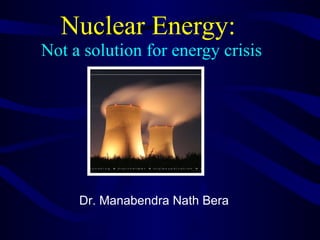
Nuclear Energy:  Not a solution for energy crisis Dr. Manabendra Nath Bera
1) Nuclear Physics: Radioactivity 2) Nuclear Power Plants 3) Nuclear Fuel 4) Nuclear Waste 5) Nuclear Safety 6) Conclusion Agenda
Nuclear Physics: Radioactivity
Nuclear Fission The reaction: 235U + n  141Ba + 92Kr +3 n  + Energy  144Cs + 90Rb +2n + Energy
Measuring Radioactivity Half-Life The time for a radioactive source to lose 50% of its radioactivity For each half-life time period, radioactivity drops by 50% 1/2; 1/4; 1/8; 1/16; 1/32; 1/64; 1/128; 1/256; … A half-life of 1 year means that radioactivity drops to <1% of its original intensity in seven years Intensity vs. half-life Intense radiation has a short half life, so decays more rapidly
Types of Radiation http://www.uic.com.au/wast.htm
Health Effects of Radiation Radiation changes living cells body repairs low dose rate damage body cannot repair large acute doses Cancer Degree of effect depends on dose intensity, length of exposure, and type of cell exposed
Nuclear Power Plants
Nuclear Heat   Heat Steam produced Steam Turbine Generator Electricity
Nuclear Fuel
Creating Uranium Fuel 50,000 tonnes of ore from mine  200 tonnes of uranium oxide concentrate (U 3 O 8 ) Milling process at mine 25 tonnes of enriched uranium oxide uranium oxide is converted into a gas, uranium hexafluoride (UF 6 ),  Every tonne of uranium hexafluoride separated into about 130 kg of enriched UF 6  (about 3.5% U-235) and 870 kg of 'depleted' UF 6  (mostly U-238).  The enriched UF6 is finally converted into uranium dioxide (UO 2 ) powder  Pressed into fuel pellets which are encased in zirconium alloy tubes to form fuel rods.
Creating Uranium Fuel Green house gases during these process
What Is the Nuclear Fuel Cycle? Mine the uranium Process the uranium to make the fuel Use it in the reactor Safely store the radioactive waste Decommission  the reactor
Nuclear Waste
Spent Fuel rods After about 3-4 years of use, the Fuel rods become spent-level of fission drops beneath a certain level Rods are taken out of reactor stored nearby in  water filled pools  or  dry casks Stored until they cool down enough to be shipped for permanent storage or to be recycled These storage facilities are next to the reactor plants, vulnerable to terrorist attack or accidents
Waste Burial Immobilize waste in an insoluble matrix E.g. borosilicate glass, Synroc (or leave them as uranium oxide fuel pellets - a ceramic)  Seal inside a corrosion-resistant container Usualy stainless steel  Locate deep underground in stable rock Site the repository in a remote location.  Most radioactivity decays within 10,000 years Remaining radioactivity similar to that of the naturally-occurring uranium ore, though more concentrated http://www.uic.com.au/wast.htm
http://www.uic.com.au/opinion6.html After 3 or 4 Years in a Reactor, Spent Fuel Rods Are Removed and Stored in Water
Dealing with Radioactive Wastes Produced by Nuclear Power Is a Difficult Problem High-level radioactive wastes   Must be stored safely for 1,000–24,000 years Where to store it Deep burial: safest and cheapest option Transportation concerns Would any method of burial last long enough? There is still no facility Cooled in a spent fuel pool: 10 to 20 years Onsite temporary dry storage: Until permanent site becomes available
Case Study: Experts Disagree about What to Do with Radioactive Wastes in the U.S. 1985: plans in the U.S. to build a repository for high-level radioactive wastes in the Yucca Mountain desert region (Nevada) Problems Cost: $58–100 billion Large number of shipments to the site: protection from attack? Rock fractures Earthquake zone Decrease national security
Nuclear Safety
List of dangers connected to NPPs Release of radioactive  element into environment Radioactive isotope pollution Water temperature increase The threat of nuclear accident Threat of nuclear terrorism Transportation of the waste can be risky During the operation of nuclear power plants, radioactive waste is produced, which in turn can be used for the production of nuclear weapons.
Worst Commercial Nuclear Power Plant Accident in the U.S. Three Mile Island March 29, 1979 Near Harrisburg, PA, U.S. Nuclear reactor lost its coolant Led to a partial uncovering and melting of the radioactive core  Unknown amounts of radioactivity escaped People fled the area Increased public concerns for safety Led to improved safety regulations in the U.S. Cleanup lasted 14 years; cost $975 million 51 US nuclear reactor orders canceled 1980-84.
April 26, 1986 Pripyat, Ukraine Catastrophic steam explosion   -Destroyed reactor -Plume of radioactive fallout spread far USSR, eastern Europe, Scandinavia,  UK, eastern US Belarus, Ukraine, and Russia hit hardest - 56 direct deaths; ~4,000 long-term deaths -350,000 people evacuated and resettled http://en.wikipedia.org/wiki/Chernobyl_accident Worst Nuclear Power Plant Accident in the World
What happened?  -Reactor No.4 was undergoing a  test  of the backup power supply in case of a power loss. -The experiment involved shutting down the coolant pumps, which caused the  coolant  to rapidly  heat up and boil. -All  control rods  were ordered to be  inserted . As the rods were inserted, they became  deformed and stuck . The reaction could not be stopped. -The  rods melted  and the steam pressure caused an  explosion , which blew a hole in the roof. A  fire  also resulted from the explosion. -To save money, the reactor was constructed with  only partial containment , which allowed the radiation to escape. 13%-30% of the material escaped.
Evacuation -Following the accident hundreds of thousands of people had to be evacuated and between 1990 and 1995 an additional 210,000 people were resettled. People evacuated: - May 2-3   (1 week later) 10 km area (45,000 people) - May 4   30 km area (116,000 people) http://library.thinkquest.org/3426/data/emergency/evacuation.html -50,000 people from Pripyat, Ukraine were evacuated 2 days after the accident.
Effects of Radiation Belarusian doctors identify the following effects from the Chernobyl disaster on the health of their people:  100% increase in the incidence of cancer and leukemia  250% increase in congenital birth deformities  “ Chernobyl AIDS”--the term doctors are using to describe illnesses associated with the damage done to the immune system Initial response These were firemen who helped put out the fires and helped clean up the radiation Most did not realize the dangers of radiation. Many later died from radiation, because they didn’t wear protection. An estimated 8,000-20,000 to date have died (20% from suicide) Approximately 300,000 to 600,000 people were involved in the  cleanup of the 30 km evacuation zone around the plant in the   years following the meltdown.
http://www.progettohumus.it/chernobyl.php?name=dimenticafoto Effects of Radiation
Victims
Victims
Fukushima Cause and Effects
Can Nuclear Power Reduce Dependence on Imported Oil, Reduce Global Warming? Nuclear power plants: no CO 2  emission Nuclear fuel cycle: emits CO 2 Opposing views on nuclear power and global warming Nuclear power advocates 2003 study by MIT researchers 2007: Oxford Research Group
Conclusion:  NPPs as an alternative source of energy
Fig. 15-21, p. 391 TRADE-OFFS Conventional Nuclear Fuel Cycle Large fuel supply Cannot compete economically without huge government subsidies Advantages Disadvantages Low net energy yield High environmental impact (with major accidents) Emits 1/6 as much CO 2  as coal Environmental costs not included in market price Risk of catastrophic accidents No widely acceptable solution for long-term storage of radioactive wastes Moderate land use Spreads knowledge and technology for building nuclear weapons Subject to terrorist attacks and Earth quake
Fig. 15-22, p. 392 TRADE-OFFS Coal vs. Nuclear Coal Nuclear Ample supply Ample supply of uranium High net energy yield Low net energy yield Very high air pollution Low air pollution High CO 2  emissions Low CO 2  emissions Much lower land disruption from surface mining High land disruption from surface mining High land use Moderate land use Low cost (with huge subsidies) High cost (even with huge subsidies)
Thank you
Extra
Reactor Safety Design Containment Vessel 1.5-inch thick steel   Shield Building Wall 3 foot thick reinforced concrete Dry Well Wall 5 foot thick reinforced concrete Bio Shield 4 foot thick leaded concrete with 1.5-inch thick steel lining inside and out Reactor Vessel 4 to 8 inches thick steel Reactor Fuel Weir Wall 1.5 foot thick concrete
Controlling Chain Reaction   Control rods Fuel  Assemblies Withdraw control rods, reaction increases Insert control rods, reaction decreases
Boiling Water Reactor
Human casualties 56 people lost their lives as a direct result of radiation poisoning or fire.  Thyroid cancer from drinking milk 10-12 thousand.
Can Nuclear Power Reduces Dependence on Imported Oil, Reduce Global Warming? Nuclear power plants: no CO 2  emission Nuclear fuel cycle: emits CO 2 Opposing views on nuclear power and global warming Nuclear power advocates 2003 study by MIT researchers 2007: Oxford Research Group

Save Our Environment, Stop Nuclear Energy Usage

  • 1.
    Nuclear Energy: Not a solution for energy crisis Dr. Manabendra Nath Bera
  • 2.
    1) Nuclear Physics:Radioactivity 2) Nuclear Power Plants 3) Nuclear Fuel 4) Nuclear Waste 5) Nuclear Safety 6) Conclusion Agenda
  • 3.
  • 4.
    Nuclear Fission Thereaction: 235U + n 141Ba + 92Kr +3 n + Energy 144Cs + 90Rb +2n + Energy
  • 5.
    Measuring Radioactivity Half-LifeThe time for a radioactive source to lose 50% of its radioactivity For each half-life time period, radioactivity drops by 50% 1/2; 1/4; 1/8; 1/16; 1/32; 1/64; 1/128; 1/256; … A half-life of 1 year means that radioactivity drops to <1% of its original intensity in seven years Intensity vs. half-life Intense radiation has a short half life, so decays more rapidly
  • 6.
    Types of Radiationhttp://www.uic.com.au/wast.htm
  • 7.
    Health Effects ofRadiation Radiation changes living cells body repairs low dose rate damage body cannot repair large acute doses Cancer Degree of effect depends on dose intensity, length of exposure, and type of cell exposed
  • 8.
  • 9.
    Nuclear Heat Heat Steam produced Steam Turbine Generator Electricity
  • 10.
  • 11.
    Creating Uranium Fuel50,000 tonnes of ore from mine 200 tonnes of uranium oxide concentrate (U 3 O 8 ) Milling process at mine 25 tonnes of enriched uranium oxide uranium oxide is converted into a gas, uranium hexafluoride (UF 6 ), Every tonne of uranium hexafluoride separated into about 130 kg of enriched UF 6 (about 3.5% U-235) and 870 kg of 'depleted' UF 6 (mostly U-238). The enriched UF6 is finally converted into uranium dioxide (UO 2 ) powder Pressed into fuel pellets which are encased in zirconium alloy tubes to form fuel rods.
  • 12.
    Creating Uranium FuelGreen house gases during these process
  • 13.
    What Is theNuclear Fuel Cycle? Mine the uranium Process the uranium to make the fuel Use it in the reactor Safely store the radioactive waste Decommission the reactor
  • 14.
  • 15.
    Spent Fuel rodsAfter about 3-4 years of use, the Fuel rods become spent-level of fission drops beneath a certain level Rods are taken out of reactor stored nearby in water filled pools or dry casks Stored until they cool down enough to be shipped for permanent storage or to be recycled These storage facilities are next to the reactor plants, vulnerable to terrorist attack or accidents
  • 16.
    Waste Burial Immobilizewaste in an insoluble matrix E.g. borosilicate glass, Synroc (or leave them as uranium oxide fuel pellets - a ceramic) Seal inside a corrosion-resistant container Usualy stainless steel Locate deep underground in stable rock Site the repository in a remote location. Most radioactivity decays within 10,000 years Remaining radioactivity similar to that of the naturally-occurring uranium ore, though more concentrated http://www.uic.com.au/wast.htm
  • 17.
    http://www.uic.com.au/opinion6.html After 3or 4 Years in a Reactor, Spent Fuel Rods Are Removed and Stored in Water
  • 18.
    Dealing with RadioactiveWastes Produced by Nuclear Power Is a Difficult Problem High-level radioactive wastes Must be stored safely for 1,000–24,000 years Where to store it Deep burial: safest and cheapest option Transportation concerns Would any method of burial last long enough? There is still no facility Cooled in a spent fuel pool: 10 to 20 years Onsite temporary dry storage: Until permanent site becomes available
  • 19.
    Case Study: ExpertsDisagree about What to Do with Radioactive Wastes in the U.S. 1985: plans in the U.S. to build a repository for high-level radioactive wastes in the Yucca Mountain desert region (Nevada) Problems Cost: $58–100 billion Large number of shipments to the site: protection from attack? Rock fractures Earthquake zone Decrease national security
  • 20.
  • 21.
    List of dangersconnected to NPPs Release of radioactive element into environment Radioactive isotope pollution Water temperature increase The threat of nuclear accident Threat of nuclear terrorism Transportation of the waste can be risky During the operation of nuclear power plants, radioactive waste is produced, which in turn can be used for the production of nuclear weapons.
  • 22.
    Worst Commercial NuclearPower Plant Accident in the U.S. Three Mile Island March 29, 1979 Near Harrisburg, PA, U.S. Nuclear reactor lost its coolant Led to a partial uncovering and melting of the radioactive core Unknown amounts of radioactivity escaped People fled the area Increased public concerns for safety Led to improved safety regulations in the U.S. Cleanup lasted 14 years; cost $975 million 51 US nuclear reactor orders canceled 1980-84.
  • 23.
    April 26, 1986Pripyat, Ukraine Catastrophic steam explosion -Destroyed reactor -Plume of radioactive fallout spread far USSR, eastern Europe, Scandinavia, UK, eastern US Belarus, Ukraine, and Russia hit hardest - 56 direct deaths; ~4,000 long-term deaths -350,000 people evacuated and resettled http://en.wikipedia.org/wiki/Chernobyl_accident Worst Nuclear Power Plant Accident in the World
  • 24.
    What happened? -Reactor No.4 was undergoing a test of the backup power supply in case of a power loss. -The experiment involved shutting down the coolant pumps, which caused the coolant to rapidly heat up and boil. -All control rods were ordered to be inserted . As the rods were inserted, they became deformed and stuck . The reaction could not be stopped. -The rods melted and the steam pressure caused an explosion , which blew a hole in the roof. A fire also resulted from the explosion. -To save money, the reactor was constructed with only partial containment , which allowed the radiation to escape. 13%-30% of the material escaped.
  • 25.
    Evacuation -Following theaccident hundreds of thousands of people had to be evacuated and between 1990 and 1995 an additional 210,000 people were resettled. People evacuated: - May 2-3 (1 week later) 10 km area (45,000 people) - May 4 30 km area (116,000 people) http://library.thinkquest.org/3426/data/emergency/evacuation.html -50,000 people from Pripyat, Ukraine were evacuated 2 days after the accident.
  • 26.
    Effects of RadiationBelarusian doctors identify the following effects from the Chernobyl disaster on the health of their people: 100% increase in the incidence of cancer and leukemia 250% increase in congenital birth deformities “ Chernobyl AIDS”--the term doctors are using to describe illnesses associated with the damage done to the immune system Initial response These were firemen who helped put out the fires and helped clean up the radiation Most did not realize the dangers of radiation. Many later died from radiation, because they didn’t wear protection. An estimated 8,000-20,000 to date have died (20% from suicide) Approximately 300,000 to 600,000 people were involved in the cleanup of the 30 km evacuation zone around the plant in the years following the meltdown.
  • 27.
  • 28.
  • 29.
  • 30.
  • 31.
    Can Nuclear PowerReduce Dependence on Imported Oil, Reduce Global Warming? Nuclear power plants: no CO 2 emission Nuclear fuel cycle: emits CO 2 Opposing views on nuclear power and global warming Nuclear power advocates 2003 study by MIT researchers 2007: Oxford Research Group
  • 32.
    Conclusion: NPPsas an alternative source of energy
  • 33.
    Fig. 15-21, p.391 TRADE-OFFS Conventional Nuclear Fuel Cycle Large fuel supply Cannot compete economically without huge government subsidies Advantages Disadvantages Low net energy yield High environmental impact (with major accidents) Emits 1/6 as much CO 2 as coal Environmental costs not included in market price Risk of catastrophic accidents No widely acceptable solution for long-term storage of radioactive wastes Moderate land use Spreads knowledge and technology for building nuclear weapons Subject to terrorist attacks and Earth quake
  • 34.
    Fig. 15-22, p.392 TRADE-OFFS Coal vs. Nuclear Coal Nuclear Ample supply Ample supply of uranium High net energy yield Low net energy yield Very high air pollution Low air pollution High CO 2 emissions Low CO 2 emissions Much lower land disruption from surface mining High land disruption from surface mining High land use Moderate land use Low cost (with huge subsidies) High cost (even with huge subsidies)
  • 35.
  • 36.
  • 37.
    Reactor Safety DesignContainment Vessel 1.5-inch thick steel Shield Building Wall 3 foot thick reinforced concrete Dry Well Wall 5 foot thick reinforced concrete Bio Shield 4 foot thick leaded concrete with 1.5-inch thick steel lining inside and out Reactor Vessel 4 to 8 inches thick steel Reactor Fuel Weir Wall 1.5 foot thick concrete
  • 38.
    Controlling Chain Reaction Control rods Fuel Assemblies Withdraw control rods, reaction increases Insert control rods, reaction decreases
  • 39.
  • 40.
    Human casualties 56people lost their lives as a direct result of radiation poisoning or fire. Thyroid cancer from drinking milk 10-12 thousand.
  • 41.
    Can Nuclear PowerReduces Dependence on Imported Oil, Reduce Global Warming? Nuclear power plants: no CO 2 emission Nuclear fuel cycle: emits CO 2 Opposing views on nuclear power and global warming Nuclear power advocates 2003 study by MIT researchers 2007: Oxford Research Group

Editor's Notes

  • #2 Target Audience: Middle School Includes: General Description: Introduction to the concepts of radiation and biological damage as well as numerous waste related terms (23 slides)