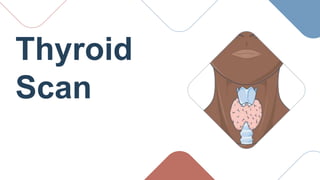
Thyroid
Scan
Illustration by Smart-Servier Medical Art
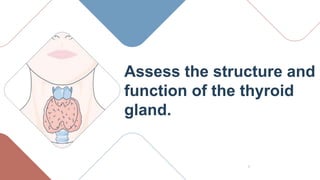
Assess the structure and
function of the thyroid
gland.
Radiopharmaceuticals
• Iodine ( I-123 , I-131 ) given orally
• Free Technetium (Tc99m) I.V injection of 2-
1OmCi
Patient Preparation
Medical History:
• Information about allergies, recent illnesses, surgeries, and current
medications.
• Stop Thyroid medication.
Iodine Contrast Agents:
• Avoid intake of iodine-containing contrast agents used in radiological
studies (e.g, CT scans with iodine contrast) for several weeks before the
thyroid scan, as iodine can interfere with the uptake of the radioactive tracer.
Imaging
Protocol
• Anterior
• Marker
• RAO
(45°)
• LAO
(45°)
01
02
03
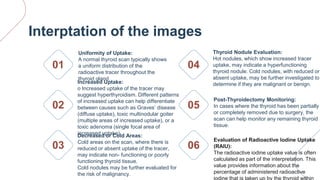
Interptation of the images
04
Uniformity of Uptake:
A normal thyroid scan typically shows
a uniform distribution of the
radioactive tracer throughout the
thyroid gland.
Increased Uptake:
o Increased uptake of the tracer may
suggest hyperthyroidism. Different patterns
of increased uptake can help differentiate
between causes such as Graves’ disease
(diffuse uptake), toxic multinodular goiter
(multiple areas of increased uptake), or a
toxic adenoma (single focal area of
increased uptake).
Decreased or Cold Areas:
Cold areas on the scan, where there is
reduced or absent uptake of the tracer,
may indicate non- functioning or poorly
functioning thyroid tissue.
Cold nodules may be further evaluated for
the risk of malignancy.
Thyroid Nodule Evaluation:
Hot nodules, which show increased tracer
uptake, may indicate a hyperfunctioning
thyroid nodule. Cold nodules, with reduced or
absent uptake, may be further investigated to
determine if they are malignant or benign.
05
06
Post-Thyroidectomy Monitoring:
In cases where the thyroid has been partially
or completely removed due to surgery, the
scan can help monitor any remaining thyroid
tissue.
Evaluation of Radioactive lodine Uptake
(RAIU):
The radioactive iodine uptake value is often
calculated as part of the interpretation. This
value provides information about the
percentage of administered radioactive
Illustration by Smart-Servier Medical Art
CREDITS: This presentation template was
created by Slidesgo, including icons by
Flaticon and infographics & images by
Freepik
Thanks
Follow for
more
Abdelhamid-elgohary

THYROID SCAN NUCLEAR MEDICINE How it works ?

  • 1.
  • 2.
    Illustration by Smart-ServierMedical Art Assess the structure and function of the thyroid gland.
  • 3.
    Radiopharmaceuticals • Iodine (I-123 , I-131 ) given orally • Free Technetium (Tc99m) I.V injection of 2- 1OmCi
  • 4.
    Patient Preparation Medical History: •Information about allergies, recent illnesses, surgeries, and current medications. • Stop Thyroid medication. Iodine Contrast Agents: • Avoid intake of iodine-containing contrast agents used in radiological studies (e.g, CT scans with iodine contrast) for several weeks before the thyroid scan, as iodine can interfere with the uptake of the radioactive tracer.
  • 5.
  • 6.
    01 02 03 Interptation of theimages 04 Uniformity of Uptake: A normal thyroid scan typically shows a uniform distribution of the radioactive tracer throughout the thyroid gland. Increased Uptake: o Increased uptake of the tracer may suggest hyperthyroidism. Different patterns of increased uptake can help differentiate between causes such as Graves’ disease (diffuse uptake), toxic multinodular goiter (multiple areas of increased uptake), or a toxic adenoma (single focal area of increased uptake). Decreased or Cold Areas: Cold areas on the scan, where there is reduced or absent uptake of the tracer, may indicate non- functioning or poorly functioning thyroid tissue. Cold nodules may be further evaluated for the risk of malignancy. Thyroid Nodule Evaluation: Hot nodules, which show increased tracer uptake, may indicate a hyperfunctioning thyroid nodule. Cold nodules, with reduced or absent uptake, may be further investigated to determine if they are malignant or benign. 05 06 Post-Thyroidectomy Monitoring: In cases where the thyroid has been partially or completely removed due to surgery, the scan can help monitor any remaining thyroid tissue. Evaluation of Radioactive lodine Uptake (RAIU): The radioactive iodine uptake value is often calculated as part of the interpretation. This value provides information about the percentage of administered radioactive
  • 7.
    Illustration by Smart-ServierMedical Art CREDITS: This presentation template was created by Slidesgo, including icons by Flaticon and infographics & images by Freepik Thanks Follow for more Abdelhamid-elgohary