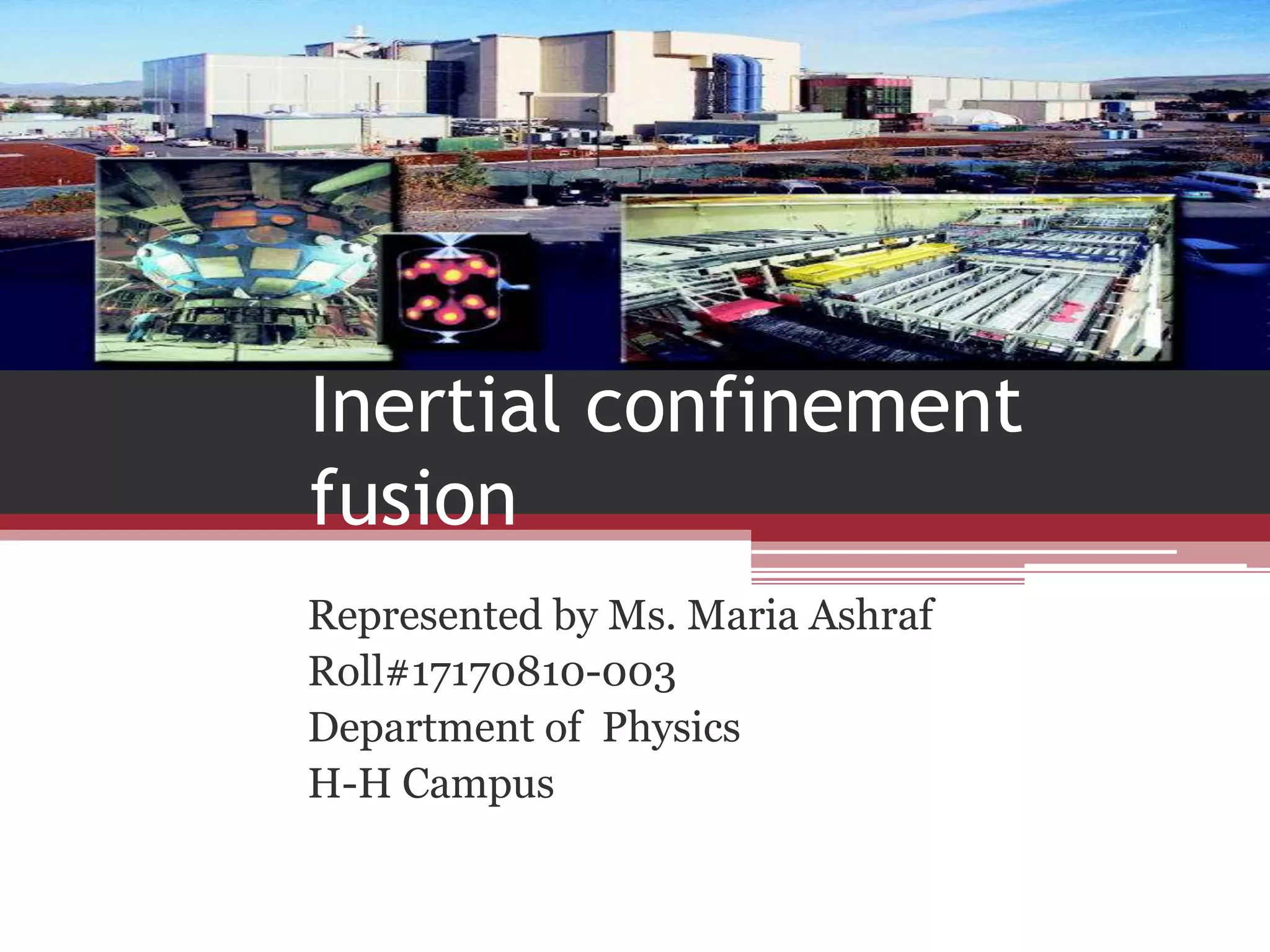
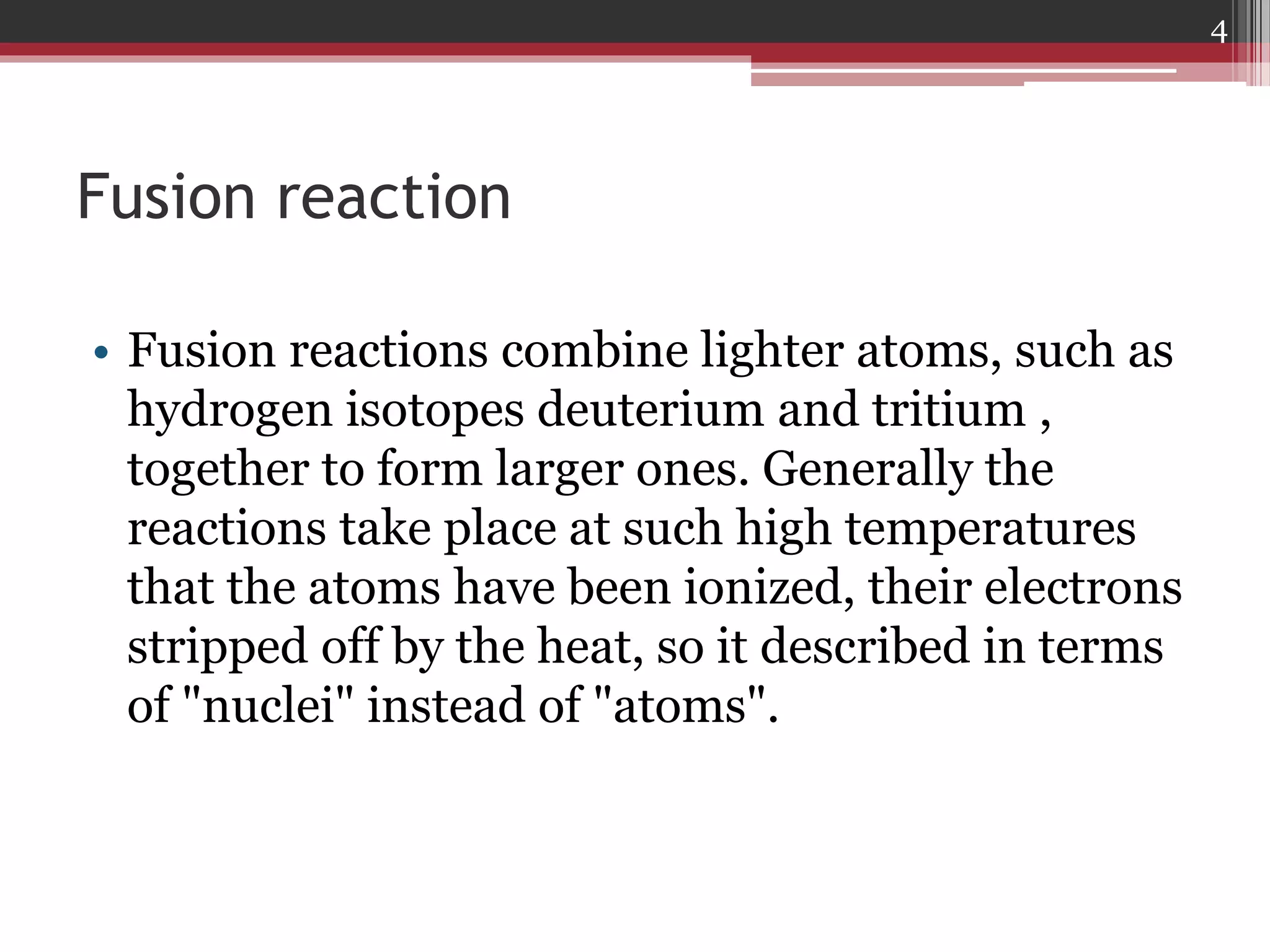
Inertial confinement
fusion
Represented by Ms. Maria Ashraf
Roll#17170810-003
Department of Physics
H-H Campus
1
Contents
• Introduction
• Fusion reaction
• Fusion Confinement ways
• Inertial confinement fusion
• Possible drivers
• Advantage
• Disadvantage
• Current work
2
Introduction
• Energy from the sun sporting the life on the earth in
more then one hundred million years ago.
• We also use energy from the fossil fuels which is
consuming.
• what energy resources will help in our future energy
demand?
• Thermo nuclear fusion has inexhaustible amount of
energy which help in our future energy demand.
• The best quality of fusion fuel is found in the oceans.
• About 71 percent of the Earth's surface is covered
with water and the oceans hold about 96.5 percent
of all Earth's water.
3
Fusion reaction
• Fusion reactions combine lighter atoms, such as
hydrogen isotopes deuterium and tritium ,
together to form larger ones. Generally the
reactions take place at such high temperatures
that the atoms have been ionized, their electrons
stripped off by the heat, so it described in terms
of "nuclei" instead of "atoms".
4
Fusion confinement ways
1- Magnetic confinement
2- Inertial confinement fusion
5
Magnetic confinement fusion is
an approach to generate
thermonuclear fusion power that uses
magnetic fields to confine the hot
fusion fuel in the form of a plasma.
The magnetic approach dates into the
1940s. But later it was clear the
instabilities in the plasma were a
serious problem.
Inertial confinement fusion
6
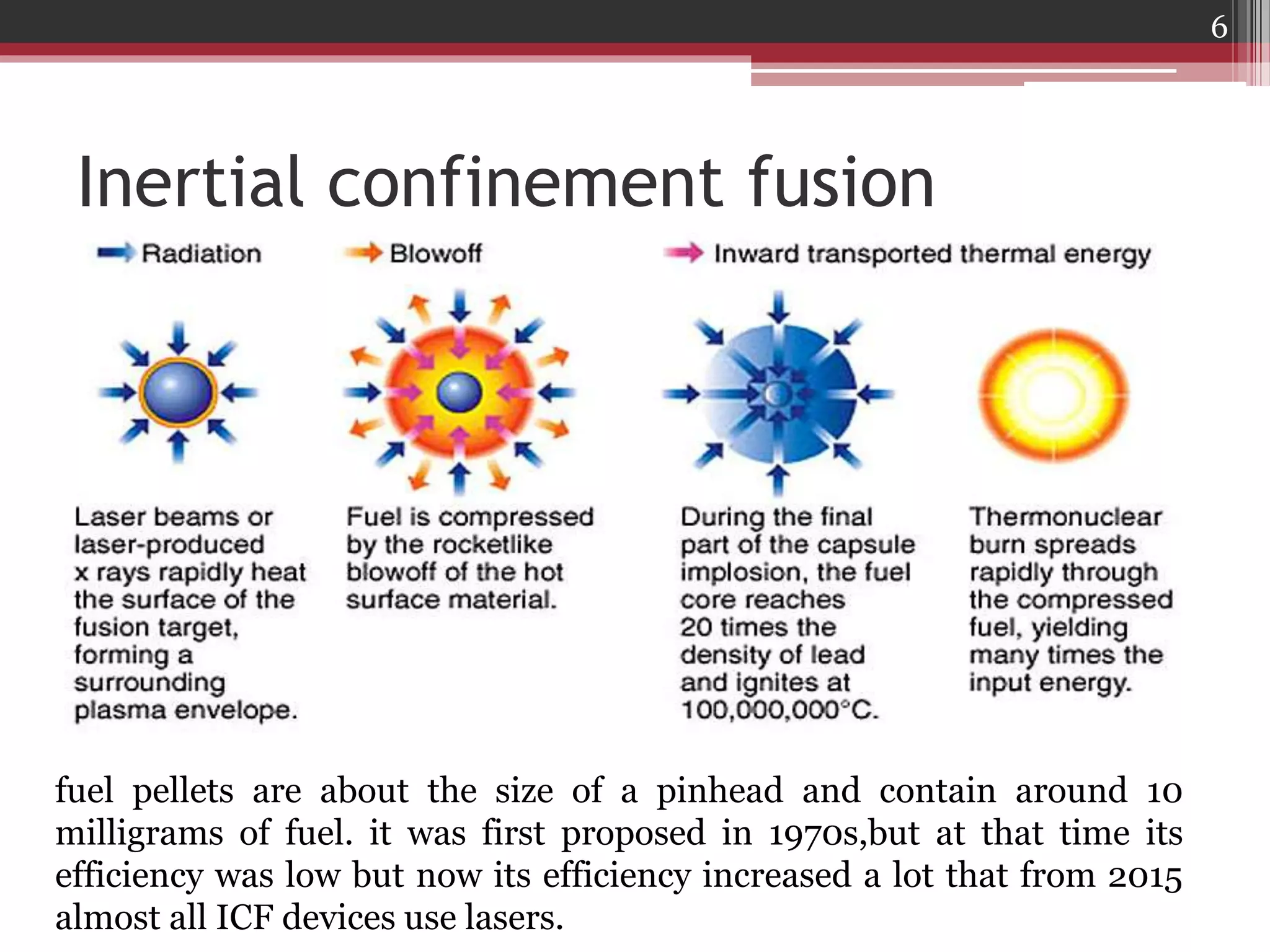
fuel pellets are about the size of a pinhead and contain around 10
milligrams of fuel. it was first proposed in 1970s,but at that time its
efficiency was low but now its efficiency increased a lot that from 2015
almost all ICF devices use lasers.
Inertial confinement fusion(ICF)
7
the deuterium and tritium high velocity positive charge nuclei collide with in off
force to over come the mutual electrostatic repulsion and due to bonding force
produce a helium nuclei called Alfa particle.
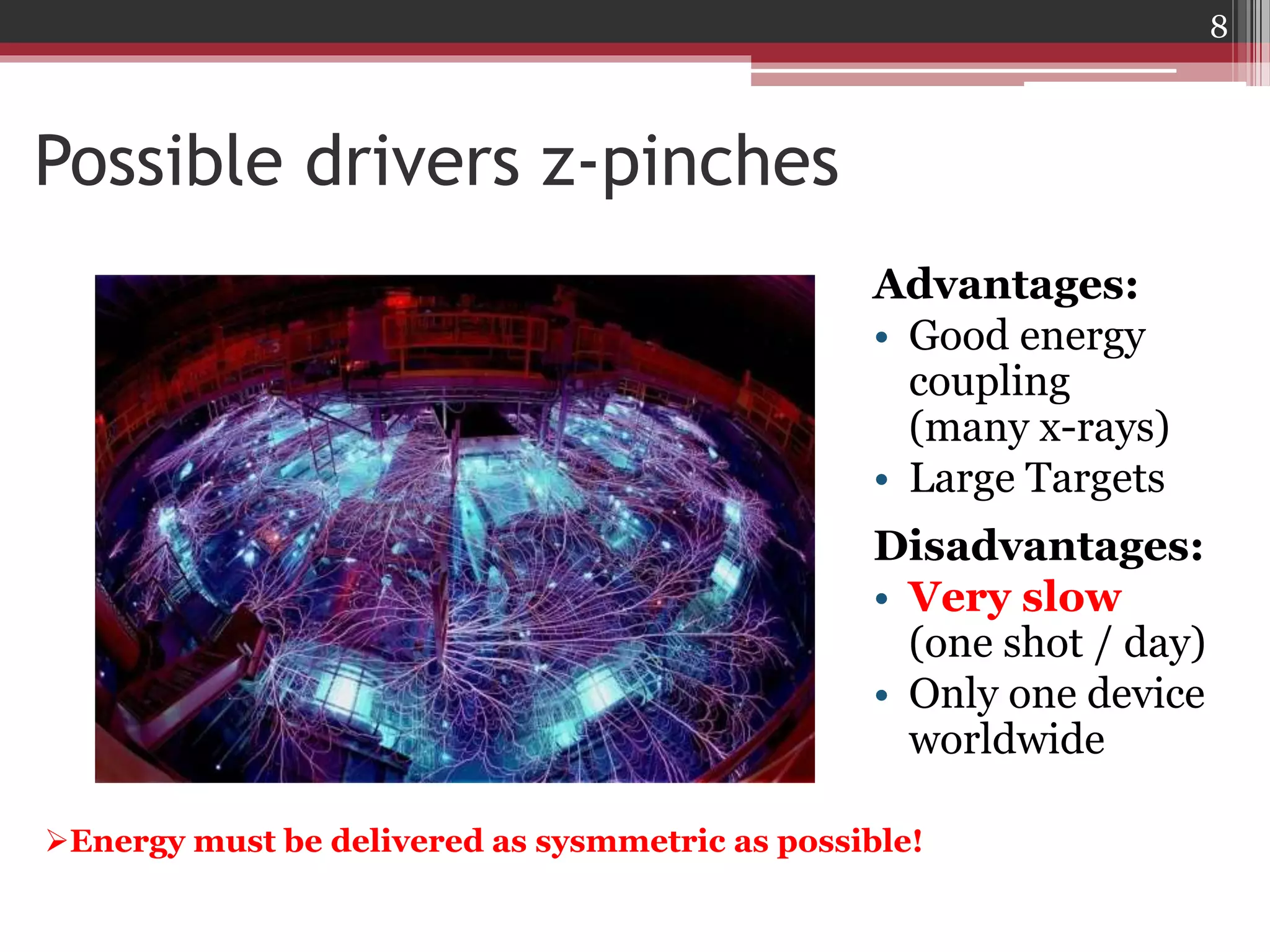
Possible drivers z-pinches
8
Advantages:
• Good energy
coupling
(many x-rays)
• Large Targets
Disadvantages:
• Very slow
(one shot / day)
• Only one device
worldwide
Energy must be delivered as sysmmetric as possible!
Ion Beams
9
Advantages:
• Excellent
conversion from
electric power to
beam energy
• Large targets
Disadvantages:
• Concept was
never tested
• Beam intensity
is still too low
Energy must be delivered as sysmmetric as possible!
Lasers (Best Shot) advantages and
disadvantages
10
Advantages:
• Well advanced
technology
• Good control of
energy release
Disadvantages:
• Bad energy
conversion
• Very expensive to
build
First most of the labs use long wavelength gas lasers then
after the engineers and scientists use powerful
neodymium glass laser in 1984 a very useful approach .
Interesting information
11
• National Ignition Facility (NIF, USA)
► More than 90% completed, first tests done
► First full scale experiments done ignition in 2010
• Laser Mega-Joule (LMJ, France)
► Commercialize (full scale) in 2011
• FIRE X I and FIRE X II ( Osaka, Japan)
►Fast Ignition Realization Experiment
► Fully integrated experiments in 2010 / 2011
• HiPER project (Europe.....)
► European fast ignition proposal based on NIF
► Design work funded last year; full funding
pending
NIF design (laser)
ignition is the point at which a nuclear fusion reaction becomes self-sustaining.
12
Artist view of the fast ignition experiment HiPER
HIPER. High Intensity Plasma
Experimental Research HIPER.
Any question
13
14

Inertial confinement fusion

  • 1.
    Inertial confinement fusion Represented byMs. Maria Ashraf Roll#17170810-003 Department of Physics H-H Campus 1
  • 2.
    Contents • Introduction • Fusionreaction • Fusion Confinement ways • Inertial confinement fusion • Possible drivers • Advantage • Disadvantage • Current work 2
  • 3.
    Introduction • Energy fromthe sun sporting the life on the earth in more then one hundred million years ago. • We also use energy from the fossil fuels which is consuming. • what energy resources will help in our future energy demand? • Thermo nuclear fusion has inexhaustible amount of energy which help in our future energy demand. • The best quality of fusion fuel is found in the oceans. • About 71 percent of the Earth's surface is covered with water and the oceans hold about 96.5 percent of all Earth's water. 3
  • 4.
    Fusion reaction • Fusionreactions combine lighter atoms, such as hydrogen isotopes deuterium and tritium , together to form larger ones. Generally the reactions take place at such high temperatures that the atoms have been ionized, their electrons stripped off by the heat, so it described in terms of "nuclei" instead of "atoms". 4
  • 5.
    Fusion confinement ways 1-Magnetic confinement 2- Inertial confinement fusion 5 Magnetic confinement fusion is an approach to generate thermonuclear fusion power that uses magnetic fields to confine the hot fusion fuel in the form of a plasma. The magnetic approach dates into the 1940s. But later it was clear the instabilities in the plasma were a serious problem.
  • 6.
    Inertial confinement fusion 6 fuelpellets are about the size of a pinhead and contain around 10 milligrams of fuel. it was first proposed in 1970s,but at that time its efficiency was low but now its efficiency increased a lot that from 2015 almost all ICF devices use lasers.
  • 7.
    Inertial confinement fusion(ICF) 7 thedeuterium and tritium high velocity positive charge nuclei collide with in off force to over come the mutual electrostatic repulsion and due to bonding force produce a helium nuclei called Alfa particle.
  • 8.
    Possible drivers z-pinches 8 Advantages: •Good energy coupling (many x-rays) • Large Targets Disadvantages: • Very slow (one shot / day) • Only one device worldwide Energy must be delivered as sysmmetric as possible!
  • 9.
    Ion Beams 9 Advantages: • Excellent conversionfrom electric power to beam energy • Large targets Disadvantages: • Concept was never tested • Beam intensity is still too low Energy must be delivered as sysmmetric as possible!
  • 10.
    Lasers (Best Shot)advantages and disadvantages 10 Advantages: • Well advanced technology • Good control of energy release Disadvantages: • Bad energy conversion • Very expensive to build First most of the labs use long wavelength gas lasers then after the engineers and scientists use powerful neodymium glass laser in 1984 a very useful approach .
  • 11.
    Interesting information 11 • NationalIgnition Facility (NIF, USA) ► More than 90% completed, first tests done ► First full scale experiments done ignition in 2010 • Laser Mega-Joule (LMJ, France) ► Commercialize (full scale) in 2011 • FIRE X I and FIRE X II ( Osaka, Japan) ►Fast Ignition Realization Experiment ► Fully integrated experiments in 2010 / 2011 • HiPER project (Europe.....) ► European fast ignition proposal based on NIF ► Design work funded last year; full funding pending NIF design (laser) ignition is the point at which a nuclear fusion reaction becomes self-sustaining.
  • 12.
    12 Artist view ofthe fast ignition experiment HiPER HIPER. High Intensity Plasma Experimental Research HIPER.
  • 13.
  • 14.