Grade 3 – Communities in the World
By: Joyce Cardinoza
GRADE 3 SOCIAL STUDIES UNIT PLAN
Grade 3 – Communities in the World
School/ District: Prairie Waters School – Rocky View School
Mission: At Prairie Waters, we facilitate every learner's unique pursuit of understanding through engaging, purposeful, collaborative experiences
which empowers each person to positively impact our diverse, ever-changing world.
We believe learners construct understanding andknowledge through inquiry. Risk-taking, mistakes, reflection, and feedback are essential to the
development of understanding.
Unique features of our school include a school wide trans-disciplinary Programme of Inquiry
Subject/Topic Area: Social Studies 3.1 Time Frame: 5 weeks
Overview: Grade 3 students will investigate life in four diverse communities around the world. The contemporary communities examined will be
drawn from India, Tunisia, Ukraine and Peru. Students will inquire into how geographic, social, cultural and linguistic factors affect quality of life in
communities in the world. Students will enrich their awareness and of how people live in other places. Theirunderstanding of global citizenship will be
further developed and they will recognize Canada’s involvement in other parts of the world.
General Outcome 3.1
Students will demonstrate an understanding and appreciation of how geographic, social, cultural and linguistic factors affect quality of life in
communities in India, Tunisia, Ukraine and Peru
Established Goals: Students will..
 Gain understanding of global community and the Canada’s role within it.
 Understand how communities from India, Peru, Tunisia, and Ukraine are similar/different from each other and from their own community
 Explore different factors such as geographical, social, cultural and linguistic affect quality of life in other parts of the world as well as their own.
 Acknowledge their roles and responsibilities as a citizen
 Appreciate Canada’s role and responsibilities in global citizenship in relation to other communities around world such as India, Tunisia, Ukraine
and Peru.
Grade 3 – Communities in the World
Evidence of Success:
 Students are respecting other people’s values and opinions
 Students are using correct terms within the context
 Students recognize their rights and responsibilities as citizens
 Students are engaged in group project and class discussion
 Students are collaborating with others to generate ideas and strategies to contribute to decision making process and problem solving.
 Students are applying their knowledge and skills to other disciplines and outside of classroom.
Misconceptions and Potential LearningObstacles:
 Students may have misconceptions that all community are the same since they look the same
 Students may or may not know the similarities/differences between rural and urban community
 Diversity in student’s background, culture and language can be learning barriers as students may have different understanding some of the key
concepts. (ie. quality of life, how decisions are made, traditions, customs, etc)
 Students may have different point of view to some content and results to disagreement and eliminating the facts.
 Students may struggle to distinguish what information is based on facts versus opinion that are found online.
Prior Understanding
In Kindergarten, Grade 1 and 2, students learned different concepts about
 Identity and self-esteemenhance their sense of belonging in the world
 Active members in a community contribute to the well being, growth and vitality of their group and communities
 Family and community changes over time
 Stories and events of the past connect to their families and communities to the present
 Canada’s diversity in culture and community
 We have responsibilities and rights at home, school and communities
 Geography, culture, language, heritage, economics and resources shape and change Canada’s communities.
Grade 3 – Communities in the World
BIG IDEAS UNDERSTANDINGS
(specific to grade 3 Social Studies)
ESSENTIAL QUESTIONS
Grade 3 friendly
Geographyinfluences
quality oflife
Geographyof India,Tunisia,Ukraine andPeru
influenceshumanactivitiesinthe community
 What determinesqualityof life?
 How wouldmyactionsinfluence the communityIlive in?
 Why doesthis communityexist?
 How wouldmylife be the same ordifferentif Ilivedina
communityfroma differentpartof the world?
 How can I contribute tothe people inothercommunitiesaround
the world?
 How can storiesfromotherplacesrelate toour currentlivesand
our owncommunity?
Communitiesare shaped by
how people live and
interact
India,Tunisia,Ukraine andPerucommunitieshave
unique social,cultural andlinguisticcharacteristics
that shape theiridentity.
Communitieshave a reason
to existwhere they do.
There are similaritiesanddifferencesamongpeople
and communitiesinotherpartsof the world
THRESHOLD CONCEPTS SKILLS/COMPETENCIES ATTITUDE FOCUS
 Qualityof life
 Community
 Diversity
 Culture
 History
 Geography
 Family
 Identity
 Global citizenship
 Use simple strategiestomake adecision.
 Compare and contrast.
 Simple mapskills
 Collaborate withpeers
 Readingandwritingskills
 Visual displaywithorwithouttechnology.
 Make interpretationfrompictures.
 Askquestionstolearnabout otherpeople and
communities.
 Use keywords.
 Conductbasicresearch
 Studentswill appreciate similaritiesand
differencesamongpeople and
communities
 Studentswill demonstrateleadership
and teamworkingroupactivities.
 Studentswill demonstratecooperative
behaviourtoensure all membersinthe
groupare includedandrespected
 Studentswill considerthe needsand
pointsof viewof
Grade 3 – Communities in the World
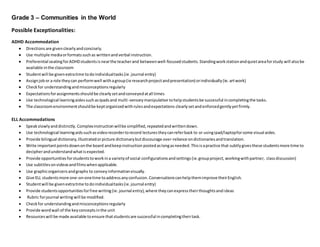
Possible Exceptionalities:
ADHD Accommodation
 Directionsare givenclearlyandconcisely.
 Use multiple mediaorformatssuchas writtenandverbal instruction.
 Preferential seatingforADHDstudentsisnearthe teacherand betweenwell-focusedstudents.Standingworkstationandquietareaforstudy will alsobe
available inthe classroom
 Studentwill be givenextratime todoindividualtasks(ie.journal entry)
 Assignjob or a role theycan performwell withagroup(ie researchprojectandpresentation) orindividually(ie.artwork)
 Checkfor understandingandmisconceptionsregularly
 Expectationsforassignmentsshouldbe clearlysetandconveyedatall times
 Use technological learningaidessuchasIpadsand multi-sensorymanipulative tohelpstudentsbe successful incompletingthe tasks.
 The classroomenvironmentshouldbe keptorganizedwithrulesandexpectations clearly setandenforcedgentlyyetfirmly.
ELL Accommodations
 Speakslowlyanddistinctly. Complexinstructionwillbe simplified,repeatedandwrittendown.
 Use technological learningaidssuchasvideorecordertorecord lecturestheycanreferback to or usingipad/laptopforsome visual aides.
 Provide bilingual dictionary,illustratedorpicture dictionarybutdiscourage over-reliance ondictionariesandtranslation.
 Write importantpointsdownonthe board andkeepinstruction postedaslongasneeded.Thisisapractice that subtlygivesthese studentsmore time to
decipherandunderstandwhatisexpected.
 Provide opportunitiesforstudentstoworkina varietyof social configurationsandsettings (ie.groupproject, workingwithpartner, classdiscussion)
 Use subtitlesonvideosandfilmswhenapplicable.
 Use graphicorganizersandgraphs to conveyinformationvisually.
 Give ELL studentsmore one-on-onetime toaddressanyconfusion.Conversations canhelpthemimprove theirEnglish.
 Studentwill be givenextratime todoindividualtasks(ie.journal entry)
 Provide studentsopportunitiesforfree writing(ie.journal entry),where theycanexpresstheirthoughtsandideas
 Rubric forjournal writingwill be modified.
 Checkfor understandingandmisconceptionsregularly
 Provide wordwall of the keyconcepts inthe unit
 Resourceswill be made available toensure thatstudentsare successful incompletingtheirtask.
Grade 3 – Communities in the World
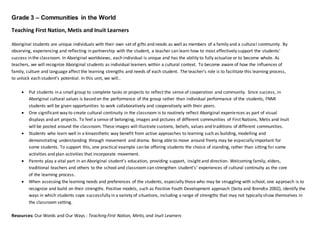
Teaching First Nation, Metis and Inuit Learners
Aboriginal students are unique individuals with their own set of gifts and needs as well as members of a family and a cultural community. By
observing, experiencing and reflecting in partnership with the student, a teacher can learn how to most effectively support the students’
success in the classroom. In Aboriginal worldviews, each individual is unique and has the ability to fully actualize or to become whole. As
teachers, we will recognize Aboriginal students as individual learners within a cultural context. To become aware of how the influences of
family, culture and language affect the learning strengths and needs of each student. The teacher’s role is to facilitate this learning process,
to unlock each student’s potential. In this unit, we will..
 Put students in a small group to complete tasks or projects to reflect the sense of cooperation and community. Since success, in
Aboriginal cultural values is based on the performance of the group rather than individual performance of the students, FNMI
students will be given opportunities to work collaboratively and cooperatively with their peers.
 One significant way to create cultural continuity in the classroom is to routinely reflect Aboriginal experiences as part of visual
displays and art projects. To feel a sense of belonging, images and pictures of different communities of First Nations, Metis and Inuit
will be posted around the classroom. These images will illustrate customs, beliefs, values and traditions of different communities.
 Students who learn well in a kinaesthetic way benefit from active approaches to learning such as building, modelling and
demonstrating understanding through movement and drama. Being able to move around freely may be especially important for
some students. To support this, one practical example can be offering students the choice of standing, rather than sitting for some
activities and plan activities that incorporate movement.
 Parents play a vital part in an Aboriginal student’s education, providing support, insight and direction. Welcoming family, elders,
traditional teachers and others to the school and classroom can strengthen student’s’ experiences of cultural continuity as the core
of the learning process.
 When assessing the learning needs and preferences of the students, especially those who may be struggling with school, one approach is to
recognize and build on their strengths. Positive models, such as Positive Youth Development approach (Seita and Brendto 2002), identify the
ways in which students cope successfully in a variety of situations, including a range of strengths that may not typically show themselves in
the classroom setting.
Resources: Our Words and Our Ways : Teaching First Nation, Metis, and Inuit Learners
Grade 3 – Communities in the World
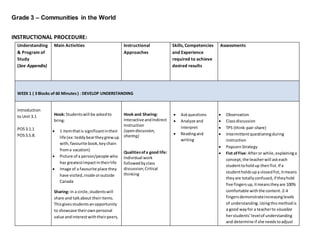
INSTRUCTIONAL PROCEDURE:
Understanding
& Program of
Study
(See Appendix)
Main Activities Instructional
Approaches
Skills, Competencies
and Experience
required to achieve
desired results
Assessments
WEEK 1 ( 3 Blocks of 60 Minutes) : DEVELOP UNDERSTANDING
Introduction
to Unit 3.1
POS3.1.1
POS3.S.8.
Hook: Studentswill be askedto
bring:
 1 itemthatis significantintheir
life (ex:teddybeartheygrewup
with,favourite book,keychain
froma vacation)
 Picture of a person/people who
has greatestimpactintheirlife
 Image of a favourite place they
have visited,inside oroutside
Canada
Sharing: In a circle,studentswill
share and talkabout theiritems.
Thisgivesstudentsanopportunity
to showcase theirownpersonal
value andinterestwiththeirpeers,
Hook and Sharing:
Interactive andIndirect
Instruction
(opendiscussion,
sharing)
Qualitiesofa good life:
Individual work
followedbyclass
discussion;Critical
thinking
 Askquestions
 Analyze and
interpret
 Readingand
writing
 Observation
 Classdiscussion
 TPS (think-pair-share)
 Intermittentquestioningduring
instruction
 PopcornStrategy
 Fist ofFive:Afteror while,explaininga
concept,the teacherwill askeach
studenttoholdup theirfist.If a
studentholdsupa closedfist,itmeans
theyare totallyconfused,if theyhold
five fingersup,itmeanstheyare 100%
comfortable withthe content.2-4
fingersdemonstrateincreasinglevels
of understanding.Usingthismethodis
a good wayfor a teacherto visualize
herstudents’levelof understanding
and determine if she needstoadjust
Grade 3 – Communities in the World
as well asto expose themto
differentcultures,traditionsor
practices.It alsohelpsstudents
embrace the diversityof studentsin
the classroomand inthe
community. Studentsalsohave
opportunitiestoaskquestionsto
learnmore abouttheirpeers.This
activitycreatesopportunityfor
studentstotake ownershipof their
learning, preparesstudentsfor
deeperlearningaboutcommunity
and extendingtheirthinking
globally.
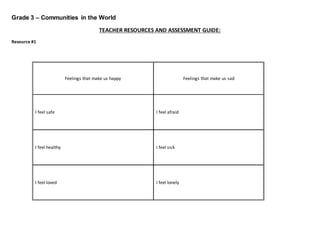
Qualitiesofa good life- Students
will determine whatfactorsaffect
(bothnegative andpositive) their
ownqualityof life.Compile all and
display. See Resource#1
herteachingapproachor strategyfor
the nextlessoninordertoclear up
misconceptionsthatsome students
may have.
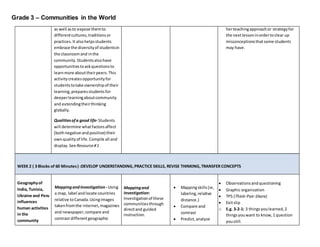
WEEK 2 ( 3 Blocks of 60 Minutes) :DEVELOP UNDERSTANDING,PRACTICE SKILLS, REVISE THINKING,TRANSFER CONCEPTS
Geographyof
India, Tunisia,
Ukraine and Peru
influences
human activities
in the
community
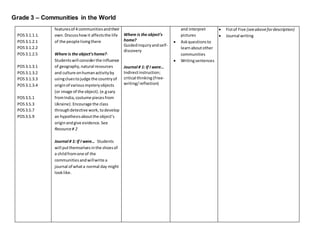
MappingandInvestigation - Using
a map, label andlocate countries
relative toCanada.Usingimages
takenfromthe internet,magazines
and newspaper,compare and
contrast differentgeographic
Mappingand
Investigation:
Investigationof these
communitiesthrough
directand guided
instruction.
 Mappingskills(ie,
labeling,relative
distance.)
 Compare and
contrast
 Predict,analyze
 Observationsandquestioning
 Graphic organization
 TPS (Think-Pair-Share)
 Exitslip
o E.g. 3-2-1: 3 thingsyoulearned,2
thingsyouwant to know,1 question
youstill.
Grade 3 – Communities in the World
POS3.1.1.1.
POS3.1.2.1
POS3.1.2.2
POS3.1.2.5
POS3.1.3.1
POS3.1.3.2
POS3.1.3.3
POS3.1.3.4
POS3.S.1
POS3.S.3
POS3.S.7
POS3.S.9
featuresof 4 communitiesandtheir
own.Discusshowit affectsthe life
of the people livingthere
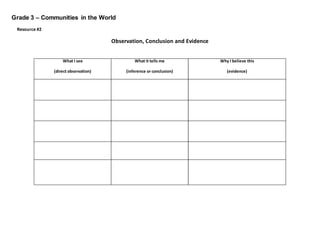
Where is the object’shome?-
Studentswill considerthe influence
of geography,natural resources
and culture onhumanactivityby
usingcluestojudge the countryof
originof variousmysteryobjects
(or image of the object). (e.gsary
fromIndia,costume piecesfrom
Ukraine).Encourage the class
throughdetective work,todevelop
an hypothesisaboutthe object’s
originandgive evidence. See
Resource# 2
Journal # 1: If I were… Students
will putthemselvesinthe shoesof
a childfromone of the
communitiesandwillwrite a
journal of whata normal day might
looklike.
Where is the object’s
home?
Guidedinquiryandself-
discovery
Journal # 1: If I were…
Indirectinstruction;
critical thinking(Free-
writing/reflection)
and interpret
pictures
 Askquestionsto
learnaboutother
communities
 Writingsentences
 Fistof Five (seeabovefordescription)
 Journal writing
Grade 3 – Communities in the World
WEEK 3 ( 3 Blocks of 60 minutes) : DEVELOP UNDERSTANDING,PRACTICE SKILLS, REVISE THINKING,TRANSFER CONCEPTS,BECOME EQUIPPED FOR
THE TASK
India, Tunisia,
Ukraine and Peru
communities
have unique
social,cultural
and linguistic
characteristics
that shape their
identity.
POS 3.1.1.1
POS 3.1.2.3
POS 3.1.2.4
POS 3.1.2.5
POS 3.1.3.1
POS 3.1.4.1
POS 3.1.4.2
POS 3.1.4.3
POS 3.S.1
POS 3.S.2
POS 3.S.3
POS 3.S.4
POS 3.S.5
POS 3.S.6
POS 3.S.7
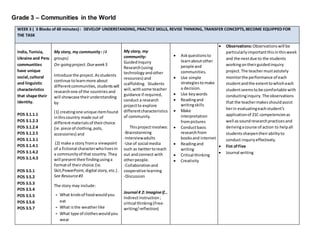
My story, my community: (4
groups)
On-goingproject.Dueweek5
Introduce the project.Asstudents
continue tolearnmore about
differentcommunities, studentswill
researchone of the countriesand
will showcase theirunderstanding
by
(1) creatingone unique itemfound
inthiscountry made out of
differentmaterialsof theirchoice
(ie.piece of clothing,pots,
accessories) and
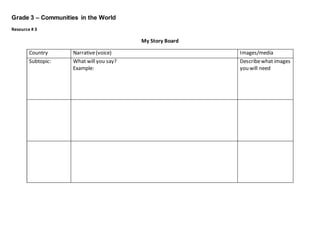
(2) make a story froma viewpoint
of a fictional characterwholivesin
a communityof that country. They
will presenttheirfindingusinga
formatof theirchoice.(ie.
Skit,PowerPoint,digital story,etc.) .
See Resource#3
The story may include:
- What kindsof foodwouldyou
eat
- What isthe weatherlike
- What type of clotheswouldyou
wear
My story, my
community:
GuidedInquiry
Research(using
technology andother
resources) and
scaffolding. Students
will,withsome teacher
guidance if required,
conduct a research
projectto explore
differentcharacteristics
of community.
Thisprojectinvolves:
-Brainstorming
-Interviewadults
-Use of social media
such as twittertoreach
out andconnect with
otherpeople.
-Collaborationand
cooperative learning
-Discussion
Journal # 2: Imagineif…
Indirectinstruction ;
critical thinking(Free-
writing/reflection)
 Askquestionsto
learnaboutother
people and
communities.
 Use simple
strategiestomake
a decision.
 Use keywords
 Readingand
writingskills
 Make
interpretation
frompictures
 Conductbasic
researchfrom
booksand internet
 Readingand
writing
 Critical thinking
 Creativity
 Observations:Observationswill be
particularlyimportantthisinthisweek
and the nextdue to the students
workingontheirguidedinquiry
project.The teachermustastutely
monitorthe performance of each
studentandthe extenttowhicheach
studentseemstobe comfortable with
conductinginquiry.The observations
that the teachermakesshouldassist
herin evaluatingeachstudent’s
applicationof 21C competenciesas
well assoundresearchpracticesand
derivingacourse of action to helpall
studentssharpentheirabilityto
conduct inquiryeffectively.
 Fist ofFive
 Journal writing
Grade 3 – Communities in the World
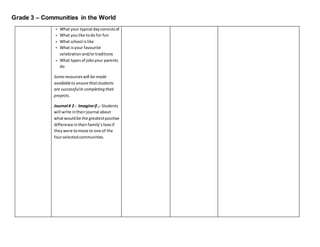
- What your typical dayconsistsof
- What youlike todo for fun
- What school islike
- What isyour favourite
celebrationand/ortraditions
- What typesof jobsyour parents
do
Someresourceswill be made
availableto ensurethatstudents
are successfulin completingtheir
projects.
Journal # 2 : Imagineif..- Students
will write intheirjournal about
whatwouldbe the greatestpositive
difference intheirfamily’slivesif
theywere tomove to one of the
fourselectedcommunities.
Grade 3 – Communities in the World
WEEK 4 ( 3 Blocks of 60 minutes) : DEVELOP UNDERSTANDING,PRACTICE SKILLS, REVISE THINKING,TRANSFER CONCEPTS,BECOME EQUIPPED FOR
THE TASKS, RECEIVE FEEDBACK
There are
similaritiesand
differences
among people
and communities
in other parts of
the world
POS 3.1.1.1
POS 3.1.2.6
POS 3.1.2.7
POS 3.1.2.8
POS 3.1.2.9
POS 3.1.2.10
POS 3.1.4.1
POS 3.1.4.2
POS 3.1.4.3
POS 3.S.1
POS 3.S.4
POS 3.S.5
POS 3.S.6
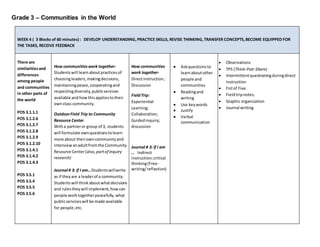
How communitieswork together-
Studentswill learnaboutpracticesof
choosingleaders,makingdecisions,
maintainingpeace,cooperatingand
respectingdiversity,publicservices
available andhowthisappliestotheir
ownclass community.
OutdoorField Trip to Community
Resource Center
Witha partneror group of 3, students
will formulate ownquestionstolearn
more about theirowncommunityand
interviewanadultfromthe Community
Resource Center(also, partof inquiry
research)
Journal # 3: If I am…Studentswillwrite
as if theyare a leaderof a community.
Studentswill thinkaboutwhatdecisions
and rulestheywill implement,howcan
people worktogetherpeacefully,what
publicserviceswill be made available
for people,etc.
How communities
work together-
Directinstruction;
Discussion
FieldTrip:
Experiential
Learning;
Collaboration;
Guidedinquiry;
discussion
Journal # 3: If I am
… Indirect
instruction;critical
thinking(Free-
writing/reflection)
 Askquestionsto
learnaboutother
people and
communities
 Readingand
writing
 Use keywords
 Justify
 Verbal
communication
 Observations
 TPS (Think-Pair-Share)
 Intermittentquestioningduringdirect
instruction
 Fistof Five.
 Fieldtripnotes.
 Graphic organization
 Journal writing
Grade 3 – Communities in the World
WEEK 5 (3 blocks for 60 minutes) : DEVELOP UNDERSTANDING,PRACTICE SKILLS, REVISE THINKING,TRANSFER CONCEPTS, BECOME EQUIPPED FOR
THE TASKS, REMEMBER AND RETRIEVE, RECEIVE FEEDBACK
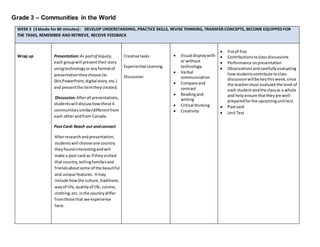
Wrap up Presentation:As partof inquiry,
each groupwill presenttheirstory
usingtechnologyoranyformatof
presentationtheychoose (ie.
Skit,PowerPoint,digital story,etc.)
and presentthe itemtheycreated.
Discussion:Afterall presentations,
studentswill discusshowthese 4
communitiessimilar/differentfrom
each otherandfrom Canada.
Post Card:Reach out andconnect
Afterresearchandpresentation,
studentswill choose one country
theyfoundinterestingandwill
make a post card as if theyvisited
that country,tellingfamiliesand
friendsaboutsome of the beautiful
and unique features. Itmay
include howthe culture,traditions,
wayof life,qualityof life,cuisine,
clothing,etc.inthe countrydiffer
fromthose that we experience
here.
Creative tasks
Experiential Learning
Discussion
 Visual displaywith
or without
technology.
 Verbal
communication
 Compare and
contrast
 Readingand
writing
 Critical thinking
 Creativity
 Fistof five
 Contributionstoclassdiscussions
 Performance onpresentation
 Observationsandcarefullyevaluating
howstudentscontribute toclass
discussionwillbe keythisweek,since
the teachermust evaluate the level of
each studentand the classas a whole
and helpensure thattheyare well-
preparedforthe upcomingunittest.
 Postcard
 Unit Test
Grade 3 – Communities in the World
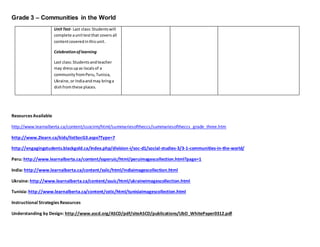
Resources Available
http://www.learnalberta.ca/content/ssocirm/html/summariesoftheccs/summariesoftheccs_grade_three.htm
http://www.2learn.ca/kids/listSocG3.aspx?Type=7
http://engagingstudents.blackgold.ca/index.php/division-i/soc-d1/social-studies-3/3-1-communities-in-the-world/
Peru: http://www.learnalberta.ca/content/ssperuic/html/peruimagescollection.html?page=1
India: http://www.learnalberta.ca/content/ssiic/html/indiaimagescollection.html
Ukraine: http://www.learnalberta.ca/content/ssuic/html/ukraineimagescollection.html
Tunisia: http://www.learnalberta.ca/content/sstic/html/tunisiaimagescollection.html
Instructional Strategies Resources
Understanding by Design: http://www.ascd.org/ASCD/pdf/siteASCD/publications/UbD_WhitePaper0312.pdf
UnitTest- Last class:Studentswill
complete aunittestthat covers all
contentcoveredinthisunit.
Celebrationoflearning
Last class:Studentsandteacher
may dressupas localsof a
communityfromPeru,Tunisia,
Ukraine,or Indiaandmay bringa
dishfromthese places.
Grade 3 – Communities in the World
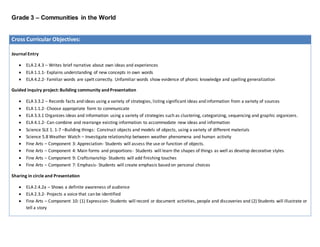
Cross Curricular Objectives:
Journal Entry
 ELA 2.4.3 – Writes brief narrative about own ideas and experiences
 ELA 1.1.1- Explains understanding of new concepts in own words
 ELA 4.2.2- Familiar words are spelt correctly. Unfamiliar words show evidence of phonic knowledge and spelling generalization
Guided inquiry project: Building community andPresentation
 ELA 3.3.2 – Records facts and ideas using a variety of strategies, listing significant ideas and information from a variety of sources
 ELA 1.1.2- Choose appropriate form to communicate
 ELA 3.3.1 Organizes ideas and information using a variety of strategies such as clustering, categorizing, sequencing and graphic organizers.
 ELA 4.1.2- Can combine and rearrange existing information to accommodate new ideas and information
 Science SLE 1. 1-7 –Building things: Construct objects and models of objects, using a variety of different materials
 Science 5.8 Weather Watch – Investigate relationship between weather phenomena and human activity
 Fine Arts – Component 3: Appreciation- Students will assess the use or function of objects.
 Fine Arts – Component 4: Main forms and proportions- Students will learn the shapes of things as well as develop decorative styles
 Fine Arts – Component 9: Craftsmanship- Students will add finishing touches
 Fine Arts – Component 7: Emphasis- Students will create emphasis based on personal choices
Sharing in circle and Presentation
 ELA 2.4.2a – Shows a definite awareness of audience
 ELA 2.3.2- Projects a voice that can be identified
 Fine Arts – Component 10: (1) Expression- Students will record or document activities, people and discoveries and (2) Students will illustrate or
tell a story
Grade 3 – Communities in the World
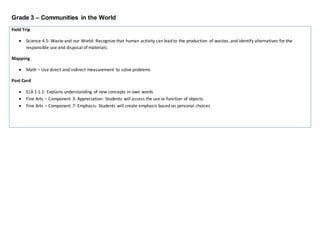
Field Trip
 Science 4.5- Waste and our World: Recognize that human activity can lead to the production of wastes, and identify alternatives for the
responsible use and disposal of materials.
Mapping
 Math – Use direct and indirect measurement to solve problems
Post Card
 ELA 1.1.1- Explains understanding of new concepts in own words
 Fine Arts – Component 3: Appreciation- Students will assess the use or function of objects.
 Fine Arts – Component 7: Emphasis- Students will create emphasis based on personal choices
Grade 3 – Communities in the World
Summative Assessment
Group Task : Guided Inquiry Research Project
Students will, with some teacher guidance if required, conduct a research project on
geographical, cultural, social and linguistic characteristic that shape a person’s identity from
these 4 communities. In keeping with the principles of inquiry-based learning, students will be
free to choose their sources (as long as they are referenced [links are acceptable,
conventional citations not required]) as well as the format of their delivery.
Part 1: Creating a unique item from one of the community and its significance
Part 2: Presentation Students will assemble in groups of 4 and create a form of presentation
of their findings wherein the characters (each from one of the cultures discussed in the unit)
Understandings 1, 2, 3
POS 3.1.1, 3.1.2, 3.1.3, 3.1.4
Visual Literacy
Geographical thinking
Historical Thinking
Critical and Creative Thinking
Social Participation
Inquiry-Based Learning
Communication
Individual Task:
Journal Entry- Students will write a weekly journal from different point of view
Post Card- Students will create a post card sharing about unique features of a community and
send it out to the recipient
Unit Test- Studentswill completeaunittestthat coversall contentcoveredinthisunit. The unittest
will include geographical,linguistics,social,culturalandpolitical characteristicsof the community.It
will be 5 matching(tomatch picturesof unique features tothe communityitbelongs),10multiple
choice and 1 short answeraboutcommunityinrelationtocommunityinCanada.
Understandings 1,2,3
POS 3.1.1, 3.1.2, 3.1.3, 3.1.4
Empathy
Communication
Critical and Creative thinking
Decision making and problem solving
Grade 3 – Communities in the World
Learners with Anxiety
Description: Alberta Education Special Education Criteria Code 53 for Mild/Moderate Emotional/Behavioural Disability
Anxiety is a serious issue in classrooms across Canada that can affect students of any and all ages. Anxiety is most often not neurobehavioral in nature,
meaning that contrary to ADHD, which is exclusively caused by biological factors, anxiety is not. Rather it can be thought of as “acquired” through
certain behaviors such as being too worried about the outcomes of certain tasks/events or “overdoing” a lot of things. That being said, some teachers,
according to Rachel Ehmke of the Child Mind Institute mistake anxiety for ADHD, which is a mistake of the highest magnitude because despite the fact
that there are highly effective accommodations for both, anxiety con often be treated entirely. Anxiety can also be caused by traumatic experience or
series thereof. Ken Shuster, as quoted by Ehmke states that anxiety “tends to lock up the brain.” The preoccupation and nervousness that are
characteristic of anxiety can have highly adverse effects on a student’s performance in school, which is why every effort must be made by teachers to
identify, accommodate, and take actions to eliminate this exceptionality in order to provide equal learning opportunities for all students.
Symptoms: *Note: All of these are possible symptoms of anxiety; it is not typical for any one student to demonstrate all of the symptoms listed below.
 Fidgetiness: Student has difficulty remaining still (shaking or wringing hands, rocking, etc.).
 Dependence: Student is highly or overly dependent on the teacher even when taking part in activities that are largely independent.
 Withdrawal/Difficulty Socializing: Student is either unwilling or unable to engage in social activities and/ormake friends. Student has no or a
few good friends. Students may be uncomfortable with working or being in large groups.
 Need for Extensive Clarification: The student may ask highly specific or redundant questions and may express at several points when working
on an assignment that (s)he does not think that (s)he is meeting expectations.
 Irregular diet: Student may demonstrate irregular eating habits or even an eating disorder, both of which can significantly and adversely affect
the student’s capacity of social, personal, and academic success.
 Irritability: Student is easily irritated and/or irritated severely by a few “pet peeves”.
 Mood swings: Student’s mood may change rapidly and substantially at certain times, sometimes initiated by certain triggers.
 Inconsistent academic performance: Student’s academic performance fluctuates unpredictably (sometimes related to the aforementioned
mood swings).
 Distractibility/Difficulty concentrating: Student is easily detracted from the lesson or the task at hand.
 Lack of confidence: Student often feels and expresses feelings of inadequacy.
 Depression: While an emotional/behavioural disability in and of itself, depression may occur as a result of unaddressed anxiety.
Grade 3 – Communities in the World
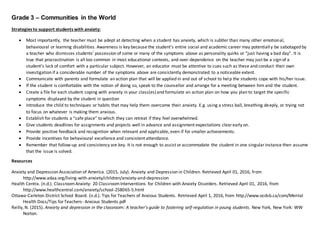
Strategies to support students with anxiety:
 Most importantly, the teacher must be adept at detecting when a student has anxiety, which is subtler than many other emotional,
behavioural or learning disabilities. Awareness is key because the student’s entire social and academic career may potentially be sabotaged by
a teacher who dismisses students’ possession of some or many of the symptoms above as personality quirks or “just having a bad day”. It is
true that procrastination is all too common in most educational contexts, and over-dependence on the teacher may just be a sign of a
student’s lack of comfort with a particular subject. However, an educator must be attentive to cues such as these and conduct their own
investigation if a considerable number of the symptoms above are consistently demonstrated to a noticeable extent.
 Communicate with parents and formulate an action plan that will be applied in and out of school to help the students cope with his/her issue.
 If the student is comfortable with the notion of doing so, speak to the counsellor and arrange for a meeting between him and the student.
 Create a file for each student coping with anxiety in your class(es)and formulate an action plan on how you plan to target the specific
symptoms displayed by the student in question
 Introduce the child to techniques or habits that may help them overcome their anxiety. E.g. using a stress ball, breathing deeply, or trying not
to focus on whatever is making them anxious.
 Establish for students a “safe place” to which they can retreat if they feel overwhelmed.
 Give students deadlines for assignments and projects well in advance and assignment expectations clearearly on.
 Provide positive feedback and recognition when relevant and applicable, even if for smaller achievements.
 Provide incentives for behavioural excellence and consistent attendance.
 Remember that follow-up and consistency are key. It is not enough to assist oraccommodate the student in one singularinstance then assume
that the issue is solved.
Resources
Anxiety and Depression Association of America. (2015, July). Anxiety and Depression in Children. Retrieved April 01, 2016, from
http://www.adaa.org/living-with-anxiety/children/anxiety-and-depression
Health Centra. (n.d.). ClassroomAnxiety: 20 ClassroomInterventions for Children with Anxiety Disorders. Retrieved April 01, 2016, from
http://www.healthcentral.com/anxiety/school-258065-5.html
Ottawa-Carleton District School Board. (n.d.). Tips for Teachers of Anxious Students. Retrieved April 1, 2016, from http://www.ocdsb.ca/com/Mental
Health Docs/Tips forTeachers- Anxious Students.pdf
Reilly, N. (2015). Anxiety and depression in the classroom: A teacher's guide to fostering self-regulation in young students. New York, New York: WW
Norton.
Grade 3 – Communities in the World
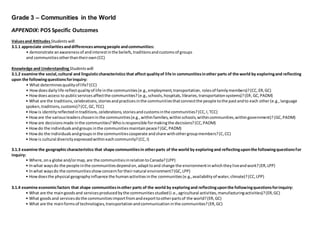
APPENDIX: POS Specific Outcomes
Valuesand AttitudesStudentswill:
3.1.1 appreciate similaritiesanddifferencesamongpeople andcommunities:
• demonstrate anawarenessof andinterestinthe beliefs,traditionsandcustomsof groups
and communitiesotherthantheirown(CC)
Knowledge and UnderstandingStudentswill:
3.1.2 examine the social,cultural and linguisticcharacteristics that affect qualityof life in communitiesinother parts of the world by exploringand reflecting
upon the followingquestionsforinquiry:
• What determinesqualityof life?(CC)
• Howdoesdailylife reflectqualityof life inthe communities(e.g.,employment,transportation, rolesof familymembers)?(CC,ER,GC)
• Howdoesaccess to publicservicesaffectthe communities?(e.g.,schools,hospitals,libraries,transportationsystems)?(ER,GC,PADM)
• What are the traditions,celebrations,storiesandpracticesinthe communitiesthatconnectthe people tothe pastandto each other(e.g.,language
spoken,traditions,customs)?(CC,GC,TCC)
• Howis identityreflectedintraditions,celebrations,storiesandcustomsinthe communities?(CC,I,TCC)
• Howare the variousleaderschoseninthe communities(e.g.,withinfamilies,withinschools,withincommunities,withingovernment)?(GC,PADM)
• Howare decisionsmade inthe communities?Whoisresponsible formakingthe decisions?(CC,PADM)
• Howdo the individualsandgroups inthe communitiesmaintainpeace?(GC,PADM)
• Howdo the individualsandgroupsinthe communitiescooperate andshare withothergroupmembers?(C,CC)
• Howis cultural diversityexpressedwithineachcommunity?(CC,I)
3.1.3 examine the geographiccharacteristics that shape communitiesin otherparts of the world by exploringand reflectinguponthe followingquestionsfor
inquiry:
• Where,ona globe and/ormap,are the communitiesinrelationtoCanada?(LPP)
• Inwhat waysdo the people inthe communitiesdependon,adapttoand change the environmentinwhichtheyliveandwork?(ER,LPP)
• Inwhat waysdo the communitiesshowconcernfortheirnatural environment?(GC,LPP)
• Howdoesthe physical geographyinfluence the humanactivitiesinthe communities(e.g.,availabilityof water,climate)?(CC,LPP)
3.1.4 examine economicfactors that shape communitiesinother parts of the world by exploringand reflectinguponthe followingquestionsforinquiry:
• What are the maingoodsand servicesproducedbythe communitiesstudied(i.e.,agricultural activities,manufacturingactivities)?(ER,GC)
• What goodsand servicesdothe communitiesimportfromandexporttootherpartsof the world?(ER,GC)
• What are the mainformsof technologies,transportationandcommunicationinthe communities?(ER,GC)
Grade 3 – Communities in the World
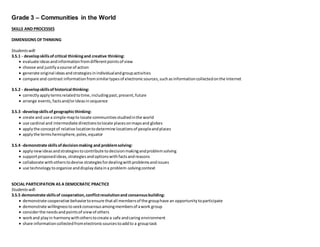
SKILLS AND PROCESSES
DIMENSIONS OFTHINKING
Studentswill:
3.S.1 - developskillsofcritical thinkingand creative thinking:
 evaluate ideasandinformationfromdifferentpointsof view
 choose and justifyacourse of action
 generate original ideasandstrategiesinindividualandgroupactivities
 compare and contrast informationfromsimilartypesof electronicsources,suchasinformationcollectedonthe Internet
3.S.2 - developskillsof historical thinking:
 correctlyapplytermsrelatedtotime,includingpast,present,future
 arrange events,factsand/orideasinsequence
3.S.3 -developskillsofgeographicthinking:
 create and use a simple mapto locate communitiesstudiedinthe world
 use cardinal and intermediate directionstolocate placesonmapsand globes
 applythe conceptof relative locationtodetermine locationsof peopleandplaces
 applythe termshemisphere, poles,equator
3.S.4 -demonstrate skillsofdecisionmaking and problemsolving:
 applynewideasandstrategiestocontribute todecisionmakingandproblemsolving
 supportproposedideas,strategiesandoptionswithfactsandreasons
 collaborate withotherstodevise strategiesfordealingwithproblemsandissues
 use technologytoorganize anddisplaydataina problem-solvingcontext
SOCIAL PARTICIPATION AS A DEMOCRATIC PRACTICE
Studentswill:
3.S.5 demonstrate skillsof cooperation,conflictresolutionand consensusbuilding:
 demonstrate cooperative behaviortoensure thatall membersof the grouphave an opportunitytoparticipate
 demonstrate willingnesstoseekconsensusamongmembersof awork group
 considerthe needsandpointsof viewof others
 workand playin harmonywithotherstocreate a safe andcaring environment
 share informationcollectedfromelectronicsourcestoaddto a grouptask
Grade 3 – Communities in the World
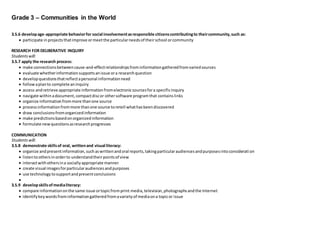
3.S.6 developage-appropriate behaviorfor social involvementasresponsible citizenscontributingto theircommunity,such as:
 participate inprojectsthatimprove ormeetthe particularneedsof theirschool orcommunity
RESEARCH FOR DELIBERATIVE INQUIRY
Studentswill:
3.S.7 apply the research process:
 make connectionsbetweencause-and-effectrelationshipsfrominformationgatheredfromvariedsources
 evaluate whetherinformationsupportsanissue ora researchquestion
 developquestionsthatreflectapersonal informationneed
 followaplanto complete aninquiry
 access andretrieve appropriate informationfromelectronicsourcesfora specificinquiry
 navigate withinadocument,compactdiscor othersoftware programthat containslinks
 organize informationfrommore thanone source
 processinformationfrommore thanone source toretell whathasbeendiscovered
 draw conclusionsfromorganizedinformation
 make predictionsbasedonorganizedinformation
 formulate newquestionsasresearchprogresses
COMMUNICATION
Studentswill:
3.S.8 demonstrate skillsof oral, writtenand visual literacy:
 organize andpresentinformation,suchaswrittenandoral reports,takingparticularaudiencesandpurposesintoconsideration
 listentoothersinorderto understandtheirpointsof view
 interactwithothersina sociallyappropriate manner
 create visual imagesforparticularaudiencesandpurposes
 use technologytosupportandpresentconclusions

3.S.9 developskillsofmedialiteracy:
 compare informationonthe same issue ortopicfromprint media,television,photographsandthe Internet
 identifykeywordsfrominformationgatheredfromavarietyof mediaona topicor issue
Grade 3 – Communities in the World
TEACHER RESOURCES AND ASSESSMENT GUIDE:
Resource #1
Feelings that make us happy Feelings that make us sad
I feel safe I feel afraid
I feel healthy I feel sick
I feel loved I feel lonely
Grade 3 – Communities in the World
Resource #2
Observation, Conclusion and Evidence
What I see
(direct observation)
What it tells me
(inference or conclusion)
Why I believe this
(evidence)
Grade 3 – Communities in the World
Resource # 3
My Story Board
Country Narrative(voice) Images/media
Subtopic: What will you say?
Example:
Describewhat images
you will need
Grade 3 – Communities in the World
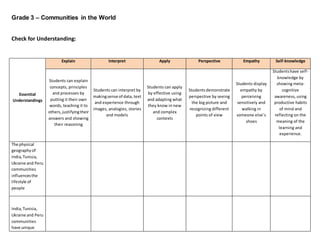
Check for Understanding:
Essential
Understandings
Explain Interpret Apply Perspective Empathy Self-knowledge
Students can explain
concepts, principles
and processes by
putting it their own
words, teaching it to
others,justifyingtheir
answers and showing
their reasoning
Students can interpret by
makingsense of data, text
and experience through
images, analogies, stories
and models
Students can apply
by effective using
and adapting what
they know in new
and complex
contexts
Studentsdemonstrate
perspective by seeing
the big picture and
recognizing different
points of view
Students display
empathy by
perceiving
sensitively and
walking in
someone else’s
shoes
Studentshave self-
knowledge by
showing meta-
cognitive
awareness, using
productive habits
of mind and
reflecting on the
meaning of the
learning and
experience.
The physical
geographyof
India,Tunisia,
Ukraine and Peru
communities
influencesthe
lifestyle of
people
India,Tunisia,
Ukraine and Peru
communities
have unique
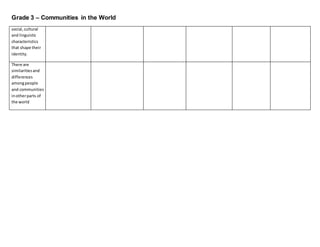
Grade 3 – Communities in the World
social,cultural
and linguistic
characteristics
that shape their
identity.
There are
similaritiesand
differences
amongpeople
and communities
inotherparts of
the world
Grade 3 – Communities in the World
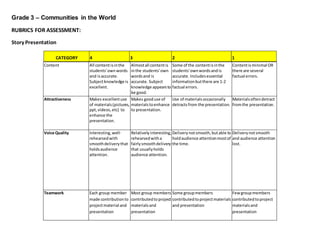
RUBRICS FOR ASSESSMENT:
Story Presentation
CATEGORY 4 3 2 1
Content All contentisinthe
students'ownwords
and isaccurate.
Subjectknowledge is
excellent.
Almostall contentis
inthe students'own
wordsand is
accurate. Subject
knowledge appearsto
be good.
Some of the contentisinthe
students'ownwordsandis
accurate. Includesessential
informationbutthere are 1-2
factual errors.
Contentisminimal OR
there are several
factual errors.
Attractiveness Makes excellentuse
of materials(pictures,
ppt,videos,etc) to
enhance the
presentation.
Makes gooduse of
materialstoenhance
to presentation.
Use of materialsoccasionally
detractsfrom the presentation.
Materialsoftendetract
fromthe presentation.
Voice Quality Interesting,well-
rehearsedwith
smoothdeliverythat
holdsaudience
attention.
Relativelyinteresting,
rehearsedwitha
fairlysmoothdelivery
that usuallyholds
audience attention.
Deliverynotsmooth,butable to
holdaudience attentionmostof
the time.
Deliverynotsmooth
and audience attention
lost.
Teamwork Each group member
made contributionto
projectmaterial and
presentation
Most group members
contributedtoproject
materialsand
presentation
Some groupmembers
contributedtoprojectmaterials
and presentation
Fewgroupmembers
contributedtoproject
materialsand
presentation
Grade 3 – Communities in the World
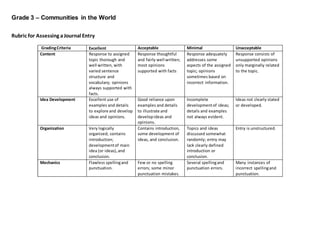
Rubric for Assessing aJournal Entry
GradingCriteria Excellent Acceptable Minimal Unacceptable
Content Response to assigned
topic thorough and
well written, with
varied sentence
structure and
vocabulary; opinions
always supported with
facts.
Response thoughtful
and fairly well written;
most opinions
supported with facts
Response adequately
addresses some
aspects of the assigned
topic; opinions
sometimes based on
incorrect information.
Response consists of
unsupported opinions
only marginally related
to the topic.
Idea Development Excellent use of
examples and details
to explore and develop
ideas and opinions.
Good reliance upon
examples and details
to illustrate and
developideas and
opinions.
Incomplete
developmentof ideas;
details and examples
not always evident.
Ideas not clearly stated
or developed.
Organization Very logically
organized; contains
introduction;
developmentof main
idea (or ideas),and
conclusion.
Contains introduction,
some development of
ideas, and conclusion.
Topics and ideas
discussed somewhat
randomly; entry may
lack clearly defined
introduction or
conclusion.
Entry is unstructured.
Mechanics Flawless spellingand
punctuation.
Few or no spelling
errors; some minor
punctuation mistakes.
Several spellingand
punctuation errors.
Many instances of
incorrect spellingand
punctuation.
Grade 3 – Communities in the World
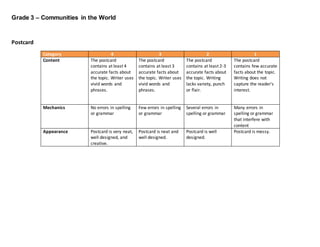
Postcard
Category 4 3 2 1
Content The postcard
contains at least 4
accurate facts about
the topic. Writer uses
vivid words and
phrases.
The postcard
contains at least 3
accurate facts about
the topic. Writer uses
vivid words and
phrases.
The postcard
contains at least 2-3
accurate facts about
the topic. Writing
lacks variety, punch
or flair.
The postcard
contains few accurate
facts about the topic.
Writing does not
capture the reader's
interest.
Mechanics No errors in spelling
or grammar
Few errors in spelling
or grammar
Several errors in
spelling or grammar
Many errors in
spelling or grammar
that interfere with
content
Appearance Postcard is very neat,
well designed, and
creative.
Postcard is neat and
well designed.
Postcard is well
designed.
Postcard is messy.
Grade 3 – Communities in the World

Grade 3 Social Studies Unit Plan

  • 1.
    Grade 3 –Communities in the World By: Joyce Cardinoza GRADE 3 SOCIAL STUDIES UNIT PLAN
  • 2.
    Grade 3 –Communities in the World School/ District: Prairie Waters School – Rocky View School Mission: At Prairie Waters, we facilitate every learner's unique pursuit of understanding through engaging, purposeful, collaborative experiences which empowers each person to positively impact our diverse, ever-changing world. We believe learners construct understanding andknowledge through inquiry. Risk-taking, mistakes, reflection, and feedback are essential to the development of understanding. Unique features of our school include a school wide trans-disciplinary Programme of Inquiry Subject/Topic Area: Social Studies 3.1 Time Frame: 5 weeks Overview: Grade 3 students will investigate life in four diverse communities around the world. The contemporary communities examined will be drawn from India, Tunisia, Ukraine and Peru. Students will inquire into how geographic, social, cultural and linguistic factors affect quality of life in communities in the world. Students will enrich their awareness and of how people live in other places. Theirunderstanding of global citizenship will be further developed and they will recognize Canada’s involvement in other parts of the world. General Outcome 3.1 Students will demonstrate an understanding and appreciation of how geographic, social, cultural and linguistic factors affect quality of life in communities in India, Tunisia, Ukraine and Peru Established Goals: Students will..  Gain understanding of global community and the Canada’s role within it.  Understand how communities from India, Peru, Tunisia, and Ukraine are similar/different from each other and from their own community  Explore different factors such as geographical, social, cultural and linguistic affect quality of life in other parts of the world as well as their own.  Acknowledge their roles and responsibilities as a citizen  Appreciate Canada’s role and responsibilities in global citizenship in relation to other communities around world such as India, Tunisia, Ukraine and Peru.
  • 3.
    Grade 3 –Communities in the World Evidence of Success:  Students are respecting other people’s values and opinions  Students are using correct terms within the context  Students recognize their rights and responsibilities as citizens  Students are engaged in group project and class discussion  Students are collaborating with others to generate ideas and strategies to contribute to decision making process and problem solving.  Students are applying their knowledge and skills to other disciplines and outside of classroom. Misconceptions and Potential LearningObstacles:  Students may have misconceptions that all community are the same since they look the same  Students may or may not know the similarities/differences between rural and urban community  Diversity in student’s background, culture and language can be learning barriers as students may have different understanding some of the key concepts. (ie. quality of life, how decisions are made, traditions, customs, etc)  Students may have different point of view to some content and results to disagreement and eliminating the facts.  Students may struggle to distinguish what information is based on facts versus opinion that are found online. Prior Understanding In Kindergarten, Grade 1 and 2, students learned different concepts about  Identity and self-esteemenhance their sense of belonging in the world  Active members in a community contribute to the well being, growth and vitality of their group and communities  Family and community changes over time  Stories and events of the past connect to their families and communities to the present  Canada’s diversity in culture and community  We have responsibilities and rights at home, school and communities  Geography, culture, language, heritage, economics and resources shape and change Canada’s communities.
  • 4.
    Grade 3 –Communities in the World BIG IDEAS UNDERSTANDINGS (specific to grade 3 Social Studies) ESSENTIAL QUESTIONS Grade 3 friendly Geographyinfluences quality oflife Geographyof India,Tunisia,Ukraine andPeru influenceshumanactivitiesinthe community  What determinesqualityof life?  How wouldmyactionsinfluence the communityIlive in?  Why doesthis communityexist?  How wouldmylife be the same ordifferentif Ilivedina communityfroma differentpartof the world?  How can I contribute tothe people inothercommunitiesaround the world?  How can storiesfromotherplacesrelate toour currentlivesand our owncommunity? Communitiesare shaped by how people live and interact India,Tunisia,Ukraine andPerucommunitieshave unique social,cultural andlinguisticcharacteristics that shape theiridentity. Communitieshave a reason to existwhere they do. There are similaritiesanddifferencesamongpeople and communitiesinotherpartsof the world THRESHOLD CONCEPTS SKILLS/COMPETENCIES ATTITUDE FOCUS  Qualityof life  Community  Diversity  Culture  History  Geography  Family  Identity  Global citizenship  Use simple strategiestomake adecision.  Compare and contrast.  Simple mapskills  Collaborate withpeers  Readingandwritingskills  Visual displaywithorwithouttechnology.  Make interpretationfrompictures.  Askquestionstolearnabout otherpeople and communities.  Use keywords.  Conductbasicresearch  Studentswill appreciate similaritiesand differencesamongpeople and communities  Studentswill demonstrateleadership and teamworkingroupactivities.  Studentswill demonstratecooperative behaviourtoensure all membersinthe groupare includedandrespected  Studentswill considerthe needsand pointsof viewof
  • 5.
    Grade 3 –Communities in the World Possible Exceptionalities: ADHD Accommodation  Directionsare givenclearlyandconcisely.  Use multiple mediaorformatssuchas writtenandverbal instruction.  Preferential seatingforADHDstudentsisnearthe teacherand betweenwell-focusedstudents.Standingworkstationandquietareaforstudy will alsobe available inthe classroom  Studentwill be givenextratime todoindividualtasks(ie.journal entry)  Assignjob or a role theycan performwell withagroup(ie researchprojectandpresentation) orindividually(ie.artwork)  Checkfor understandingandmisconceptionsregularly  Expectationsforassignmentsshouldbe clearlysetandconveyedatall times  Use technological learningaidessuchasIpadsand multi-sensorymanipulative tohelpstudentsbe successful incompletingthe tasks.  The classroomenvironmentshouldbe keptorganizedwithrulesandexpectations clearly setandenforcedgentlyyetfirmly. ELL Accommodations  Speakslowlyanddistinctly. Complexinstructionwillbe simplified,repeatedandwrittendown.  Use technological learningaidssuchasvideorecordertorecord lecturestheycanreferback to or usingipad/laptopforsome visual aides.  Provide bilingual dictionary,illustratedorpicture dictionarybutdiscourage over-reliance ondictionariesandtranslation.  Write importantpointsdownonthe board andkeepinstruction postedaslongasneeded.Thisisapractice that subtlygivesthese studentsmore time to decipherandunderstandwhatisexpected.  Provide opportunitiesforstudentstoworkina varietyof social configurationsandsettings (ie.groupproject, workingwithpartner, classdiscussion)  Use subtitlesonvideosandfilmswhenapplicable.  Use graphicorganizersandgraphs to conveyinformationvisually.  Give ELL studentsmore one-on-onetime toaddressanyconfusion.Conversations canhelpthemimprove theirEnglish.  Studentwill be givenextratime todoindividualtasks(ie.journal entry)  Provide studentsopportunitiesforfree writing(ie.journal entry),where theycanexpresstheirthoughtsandideas  Rubric forjournal writingwill be modified.  Checkfor understandingandmisconceptionsregularly  Provide wordwall of the keyconcepts inthe unit  Resourceswill be made available toensure thatstudentsare successful incompletingtheirtask.
  • 6.
    Grade 3 –Communities in the World Teaching First Nation, Metis and Inuit Learners Aboriginal students are unique individuals with their own set of gifts and needs as well as members of a family and a cultural community. By observing, experiencing and reflecting in partnership with the student, a teacher can learn how to most effectively support the students’ success in the classroom. In Aboriginal worldviews, each individual is unique and has the ability to fully actualize or to become whole. As teachers, we will recognize Aboriginal students as individual learners within a cultural context. To become aware of how the influences of family, culture and language affect the learning strengths and needs of each student. The teacher’s role is to facilitate this learning process, to unlock each student’s potential. In this unit, we will..  Put students in a small group to complete tasks or projects to reflect the sense of cooperation and community. Since success, in Aboriginal cultural values is based on the performance of the group rather than individual performance of the students, FNMI students will be given opportunities to work collaboratively and cooperatively with their peers.  One significant way to create cultural continuity in the classroom is to routinely reflect Aboriginal experiences as part of visual displays and art projects. To feel a sense of belonging, images and pictures of different communities of First Nations, Metis and Inuit will be posted around the classroom. These images will illustrate customs, beliefs, values and traditions of different communities.  Students who learn well in a kinaesthetic way benefit from active approaches to learning such as building, modelling and demonstrating understanding through movement and drama. Being able to move around freely may be especially important for some students. To support this, one practical example can be offering students the choice of standing, rather than sitting for some activities and plan activities that incorporate movement.  Parents play a vital part in an Aboriginal student’s education, providing support, insight and direction. Welcoming family, elders, traditional teachers and others to the school and classroom can strengthen student’s’ experiences of cultural continuity as the core of the learning process.  When assessing the learning needs and preferences of the students, especially those who may be struggling with school, one approach is to recognize and build on their strengths. Positive models, such as Positive Youth Development approach (Seita and Brendto 2002), identify the ways in which students cope successfully in a variety of situations, including a range of strengths that may not typically show themselves in the classroom setting. Resources: Our Words and Our Ways : Teaching First Nation, Metis, and Inuit Learners
  • 7.
    Grade 3 –Communities in the World INSTRUCTIONAL PROCEDURE: Understanding & Program of Study (See Appendix) Main Activities Instructional Approaches Skills, Competencies and Experience required to achieve desired results Assessments WEEK 1 ( 3 Blocks of 60 Minutes) : DEVELOP UNDERSTANDING Introduction to Unit 3.1 POS3.1.1 POS3.S.8. Hook: Studentswill be askedto bring:  1 itemthatis significantintheir life (ex:teddybeartheygrewup with,favourite book,keychain froma vacation)  Picture of a person/people who has greatestimpactintheirlife  Image of a favourite place they have visited,inside oroutside Canada Sharing: In a circle,studentswill share and talkabout theiritems. Thisgivesstudentsanopportunity to showcase theirownpersonal value andinterestwiththeirpeers, Hook and Sharing: Interactive andIndirect Instruction (opendiscussion, sharing) Qualitiesofa good life: Individual work followedbyclass discussion;Critical thinking  Askquestions  Analyze and interpret  Readingand writing  Observation  Classdiscussion  TPS (think-pair-share)  Intermittentquestioningduring instruction  PopcornStrategy  Fist ofFive:Afteror while,explaininga concept,the teacherwill askeach studenttoholdup theirfist.If a studentholdsupa closedfist,itmeans theyare totallyconfused,if theyhold five fingersup,itmeanstheyare 100% comfortable withthe content.2-4 fingersdemonstrateincreasinglevels of understanding.Usingthismethodis a good wayfor a teacherto visualize herstudents’levelof understanding and determine if she needstoadjust
  • 8.
    Grade 3 –Communities in the World as well asto expose themto differentcultures,traditionsor practices.It alsohelpsstudents embrace the diversityof studentsin the classroomand inthe community. Studentsalsohave opportunitiestoaskquestionsto learnmore abouttheirpeers.This activitycreatesopportunityfor studentstotake ownershipof their learning, preparesstudentsfor deeperlearningaboutcommunity and extendingtheirthinking globally. Qualitiesofa good life- Students will determine whatfactorsaffect (bothnegative andpositive) their ownqualityof life.Compile all and display. See Resource#1 herteachingapproachor strategyfor the nextlessoninordertoclear up misconceptionsthatsome students may have. WEEK 2 ( 3 Blocks of 60 Minutes) :DEVELOP UNDERSTANDING,PRACTICE SKILLS, REVISE THINKING,TRANSFER CONCEPTS Geographyof India, Tunisia, Ukraine and Peru influences human activities in the community MappingandInvestigation - Using a map, label andlocate countries relative toCanada.Usingimages takenfromthe internet,magazines and newspaper,compare and contrast differentgeographic Mappingand Investigation: Investigationof these communitiesthrough directand guided instruction.  Mappingskills(ie, labeling,relative distance.)  Compare and contrast  Predict,analyze  Observationsandquestioning  Graphic organization  TPS (Think-Pair-Share)  Exitslip o E.g. 3-2-1: 3 thingsyoulearned,2 thingsyouwant to know,1 question youstill.
  • 9.
    Grade 3 –Communities in the World POS3.1.1.1. POS3.1.2.1 POS3.1.2.2 POS3.1.2.5 POS3.1.3.1 POS3.1.3.2 POS3.1.3.3 POS3.1.3.4 POS3.S.1 POS3.S.3 POS3.S.7 POS3.S.9 featuresof 4 communitiesandtheir own.Discusshowit affectsthe life of the people livingthere Where is the object’shome?- Studentswill considerthe influence of geography,natural resources and culture onhumanactivityby usingcluestojudge the countryof originof variousmysteryobjects (or image of the object). (e.gsary fromIndia,costume piecesfrom Ukraine).Encourage the class throughdetective work,todevelop an hypothesisaboutthe object’s originandgive evidence. See Resource# 2 Journal # 1: If I were… Students will putthemselvesinthe shoesof a childfromone of the communitiesandwillwrite a journal of whata normal day might looklike. Where is the object’s home? Guidedinquiryandself- discovery Journal # 1: If I were… Indirectinstruction; critical thinking(Free- writing/reflection) and interpret pictures  Askquestionsto learnaboutother communities  Writingsentences  Fistof Five (seeabovefordescription)  Journal writing
  • 10.
    Grade 3 –Communities in the World WEEK 3 ( 3 Blocks of 60 minutes) : DEVELOP UNDERSTANDING,PRACTICE SKILLS, REVISE THINKING,TRANSFER CONCEPTS,BECOME EQUIPPED FOR THE TASK India, Tunisia, Ukraine and Peru communities have unique social,cultural and linguistic characteristics that shape their identity. POS 3.1.1.1 POS 3.1.2.3 POS 3.1.2.4 POS 3.1.2.5 POS 3.1.3.1 POS 3.1.4.1 POS 3.1.4.2 POS 3.1.4.3 POS 3.S.1 POS 3.S.2 POS 3.S.3 POS 3.S.4 POS 3.S.5 POS 3.S.6 POS 3.S.7 My story, my community: (4 groups) On-goingproject.Dueweek5 Introduce the project.Asstudents continue tolearnmore about differentcommunities, studentswill researchone of the countriesand will showcase theirunderstanding by (1) creatingone unique itemfound inthiscountry made out of differentmaterialsof theirchoice (ie.piece of clothing,pots, accessories) and (2) make a story froma viewpoint of a fictional characterwholivesin a communityof that country. They will presenttheirfindingusinga formatof theirchoice.(ie. Skit,PowerPoint,digital story,etc.) . See Resource#3 The story may include: - What kindsof foodwouldyou eat - What isthe weatherlike - What type of clotheswouldyou wear My story, my community: GuidedInquiry Research(using technology andother resources) and scaffolding. Students will,withsome teacher guidance if required, conduct a research projectto explore differentcharacteristics of community. Thisprojectinvolves: -Brainstorming -Interviewadults -Use of social media such as twittertoreach out andconnect with otherpeople. -Collaborationand cooperative learning -Discussion Journal # 2: Imagineif… Indirectinstruction ; critical thinking(Free- writing/reflection)  Askquestionsto learnaboutother people and communities.  Use simple strategiestomake a decision.  Use keywords  Readingand writingskills  Make interpretation frompictures  Conductbasic researchfrom booksand internet  Readingand writing  Critical thinking  Creativity  Observations:Observationswill be particularlyimportantthisinthisweek and the nextdue to the students workingontheirguidedinquiry project.The teachermustastutely monitorthe performance of each studentandthe extenttowhicheach studentseemstobe comfortable with conductinginquiry.The observations that the teachermakesshouldassist herin evaluatingeachstudent’s applicationof 21C competenciesas well assoundresearchpracticesand derivingacourse of action to helpall studentssharpentheirabilityto conduct inquiryeffectively.  Fist ofFive  Journal writing
  • 11.
    Grade 3 –Communities in the World - What your typical dayconsistsof - What youlike todo for fun - What school islike - What isyour favourite celebrationand/ortraditions - What typesof jobsyour parents do Someresourceswill be made availableto ensurethatstudents are successfulin completingtheir projects. Journal # 2 : Imagineif..- Students will write intheirjournal about whatwouldbe the greatestpositive difference intheirfamily’slivesif theywere tomove to one of the fourselectedcommunities.
  • 12.
    Grade 3 –Communities in the World WEEK 4 ( 3 Blocks of 60 minutes) : DEVELOP UNDERSTANDING,PRACTICE SKILLS, REVISE THINKING,TRANSFER CONCEPTS,BECOME EQUIPPED FOR THE TASKS, RECEIVE FEEDBACK There are similaritiesand differences among people and communities in other parts of the world POS 3.1.1.1 POS 3.1.2.6 POS 3.1.2.7 POS 3.1.2.8 POS 3.1.2.9 POS 3.1.2.10 POS 3.1.4.1 POS 3.1.4.2 POS 3.1.4.3 POS 3.S.1 POS 3.S.4 POS 3.S.5 POS 3.S.6 How communitieswork together- Studentswill learnaboutpracticesof choosingleaders,makingdecisions, maintainingpeace,cooperatingand respectingdiversity,publicservices available andhowthisappliestotheir ownclass community. OutdoorField Trip to Community Resource Center Witha partneror group of 3, students will formulate ownquestionstolearn more about theirowncommunityand interviewanadultfromthe Community Resource Center(also, partof inquiry research) Journal # 3: If I am…Studentswillwrite as if theyare a leaderof a community. Studentswill thinkaboutwhatdecisions and rulestheywill implement,howcan people worktogetherpeacefully,what publicserviceswill be made available for people,etc. How communities work together- Directinstruction; Discussion FieldTrip: Experiential Learning; Collaboration; Guidedinquiry; discussion Journal # 3: If I am … Indirect instruction;critical thinking(Free- writing/reflection)  Askquestionsto learnaboutother people and communities  Readingand writing  Use keywords  Justify  Verbal communication  Observations  TPS (Think-Pair-Share)  Intermittentquestioningduringdirect instruction  Fistof Five.  Fieldtripnotes.  Graphic organization  Journal writing
  • 13.
    Grade 3 –Communities in the World WEEK 5 (3 blocks for 60 minutes) : DEVELOP UNDERSTANDING,PRACTICE SKILLS, REVISE THINKING,TRANSFER CONCEPTS, BECOME EQUIPPED FOR THE TASKS, REMEMBER AND RETRIEVE, RECEIVE FEEDBACK Wrap up Presentation:As partof inquiry, each groupwill presenttheirstory usingtechnologyoranyformatof presentationtheychoose (ie. Skit,PowerPoint,digital story,etc.) and presentthe itemtheycreated. Discussion:Afterall presentations, studentswill discusshowthese 4 communitiessimilar/differentfrom each otherandfrom Canada. Post Card:Reach out andconnect Afterresearchandpresentation, studentswill choose one country theyfoundinterestingandwill make a post card as if theyvisited that country,tellingfamiliesand friendsaboutsome of the beautiful and unique features. Itmay include howthe culture,traditions, wayof life,qualityof life,cuisine, clothing,etc.inthe countrydiffer fromthose that we experience here. Creative tasks Experiential Learning Discussion  Visual displaywith or without technology.  Verbal communication  Compare and contrast  Readingand writing  Critical thinking  Creativity  Fistof five  Contributionstoclassdiscussions  Performance onpresentation  Observationsandcarefullyevaluating howstudentscontribute toclass discussionwillbe keythisweek,since the teachermust evaluate the level of each studentand the classas a whole and helpensure thattheyare well- preparedforthe upcomingunittest.  Postcard  Unit Test
  • 14.
    Grade 3 –Communities in the World Resources Available http://www.learnalberta.ca/content/ssocirm/html/summariesoftheccs/summariesoftheccs_grade_three.htm http://www.2learn.ca/kids/listSocG3.aspx?Type=7 http://engagingstudents.blackgold.ca/index.php/division-i/soc-d1/social-studies-3/3-1-communities-in-the-world/ Peru: http://www.learnalberta.ca/content/ssperuic/html/peruimagescollection.html?page=1 India: http://www.learnalberta.ca/content/ssiic/html/indiaimagescollection.html Ukraine: http://www.learnalberta.ca/content/ssuic/html/ukraineimagescollection.html Tunisia: http://www.learnalberta.ca/content/sstic/html/tunisiaimagescollection.html Instructional Strategies Resources Understanding by Design: http://www.ascd.org/ASCD/pdf/siteASCD/publications/UbD_WhitePaper0312.pdf UnitTest- Last class:Studentswill complete aunittestthat covers all contentcoveredinthisunit. Celebrationoflearning Last class:Studentsandteacher may dressupas localsof a communityfromPeru,Tunisia, Ukraine,or Indiaandmay bringa dishfromthese places.
  • 15.
    Grade 3 –Communities in the World Cross Curricular Objectives: Journal Entry  ELA 2.4.3 – Writes brief narrative about own ideas and experiences  ELA 1.1.1- Explains understanding of new concepts in own words  ELA 4.2.2- Familiar words are spelt correctly. Unfamiliar words show evidence of phonic knowledge and spelling generalization Guided inquiry project: Building community andPresentation  ELA 3.3.2 – Records facts and ideas using a variety of strategies, listing significant ideas and information from a variety of sources  ELA 1.1.2- Choose appropriate form to communicate  ELA 3.3.1 Organizes ideas and information using a variety of strategies such as clustering, categorizing, sequencing and graphic organizers.  ELA 4.1.2- Can combine and rearrange existing information to accommodate new ideas and information  Science SLE 1. 1-7 –Building things: Construct objects and models of objects, using a variety of different materials  Science 5.8 Weather Watch – Investigate relationship between weather phenomena and human activity  Fine Arts – Component 3: Appreciation- Students will assess the use or function of objects.  Fine Arts – Component 4: Main forms and proportions- Students will learn the shapes of things as well as develop decorative styles  Fine Arts – Component 9: Craftsmanship- Students will add finishing touches  Fine Arts – Component 7: Emphasis- Students will create emphasis based on personal choices Sharing in circle and Presentation  ELA 2.4.2a – Shows a definite awareness of audience  ELA 2.3.2- Projects a voice that can be identified  Fine Arts – Component 10: (1) Expression- Students will record or document activities, people and discoveries and (2) Students will illustrate or tell a story
  • 16.
    Grade 3 –Communities in the World Field Trip  Science 4.5- Waste and our World: Recognize that human activity can lead to the production of wastes, and identify alternatives for the responsible use and disposal of materials. Mapping  Math – Use direct and indirect measurement to solve problems Post Card  ELA 1.1.1- Explains understanding of new concepts in own words  Fine Arts – Component 3: Appreciation- Students will assess the use or function of objects.  Fine Arts – Component 7: Emphasis- Students will create emphasis based on personal choices
  • 17.
    Grade 3 –Communities in the World Summative Assessment Group Task : Guided Inquiry Research Project Students will, with some teacher guidance if required, conduct a research project on geographical, cultural, social and linguistic characteristic that shape a person’s identity from these 4 communities. In keeping with the principles of inquiry-based learning, students will be free to choose their sources (as long as they are referenced [links are acceptable, conventional citations not required]) as well as the format of their delivery. Part 1: Creating a unique item from one of the community and its significance Part 2: Presentation Students will assemble in groups of 4 and create a form of presentation of their findings wherein the characters (each from one of the cultures discussed in the unit) Understandings 1, 2, 3 POS 3.1.1, 3.1.2, 3.1.3, 3.1.4 Visual Literacy Geographical thinking Historical Thinking Critical and Creative Thinking Social Participation Inquiry-Based Learning Communication Individual Task: Journal Entry- Students will write a weekly journal from different point of view Post Card- Students will create a post card sharing about unique features of a community and send it out to the recipient Unit Test- Studentswill completeaunittestthat coversall contentcoveredinthisunit. The unittest will include geographical,linguistics,social,culturalandpolitical characteristicsof the community.It will be 5 matching(tomatch picturesof unique features tothe communityitbelongs),10multiple choice and 1 short answeraboutcommunityinrelationtocommunityinCanada. Understandings 1,2,3 POS 3.1.1, 3.1.2, 3.1.3, 3.1.4 Empathy Communication Critical and Creative thinking Decision making and problem solving
  • 18.
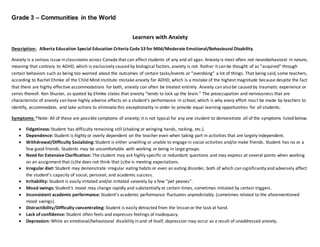
    Grade 3 –Communities in the World Learners with Anxiety Description: Alberta Education Special Education Criteria Code 53 for Mild/Moderate Emotional/Behavioural Disability Anxiety is a serious issue in classrooms across Canada that can affect students of any and all ages. Anxiety is most often not neurobehavioral in nature, meaning that contrary to ADHD, which is exclusively caused by biological factors, anxiety is not. Rather it can be thought of as “acquired” through certain behaviors such as being too worried about the outcomes of certain tasks/events or “overdoing” a lot of things. That being said, some teachers, according to Rachel Ehmke of the Child Mind Institute mistake anxiety for ADHD, which is a mistake of the highest magnitude because despite the fact that there are highly effective accommodations for both, anxiety con often be treated entirely. Anxiety can also be caused by traumatic experience or series thereof. Ken Shuster, as quoted by Ehmke states that anxiety “tends to lock up the brain.” The preoccupation and nervousness that are characteristic of anxiety can have highly adverse effects on a student’s performance in school, which is why every effort must be made by teachers to identify, accommodate, and take actions to eliminate this exceptionality in order to provide equal learning opportunities for all students. Symptoms: *Note: All of these are possible symptoms of anxiety; it is not typical for any one student to demonstrate all of the symptoms listed below.  Fidgetiness: Student has difficulty remaining still (shaking or wringing hands, rocking, etc.).  Dependence: Student is highly or overly dependent on the teacher even when taking part in activities that are largely independent.  Withdrawal/Difficulty Socializing: Student is either unwilling or unable to engage in social activities and/ormake friends. Student has no or a few good friends. Students may be uncomfortable with working or being in large groups.  Need for Extensive Clarification: The student may ask highly specific or redundant questions and may express at several points when working on an assignment that (s)he does not think that (s)he is meeting expectations.  Irregular diet: Student may demonstrate irregular eating habits or even an eating disorder, both of which can significantly and adversely affect the student’s capacity of social, personal, and academic success.  Irritability: Student is easily irritated and/or irritated severely by a few “pet peeves”.  Mood swings: Student’s mood may change rapidly and substantially at certain times, sometimes initiated by certain triggers.  Inconsistent academic performance: Student’s academic performance fluctuates unpredictably (sometimes related to the aforementioned mood swings).  Distractibility/Difficulty concentrating: Student is easily detracted from the lesson or the task at hand.  Lack of confidence: Student often feels and expresses feelings of inadequacy.  Depression: While an emotional/behavioural disability in and of itself, depression may occur as a result of unaddressed anxiety.
  • 19.
    Grade 3 –Communities in the World Strategies to support students with anxiety:  Most importantly, the teacher must be adept at detecting when a student has anxiety, which is subtler than many other emotional, behavioural or learning disabilities. Awareness is key because the student’s entire social and academic career may potentially be sabotaged by a teacher who dismisses students’ possession of some or many of the symptoms above as personality quirks or “just having a bad day”. It is true that procrastination is all too common in most educational contexts, and over-dependence on the teacher may just be a sign of a student’s lack of comfort with a particular subject. However, an educator must be attentive to cues such as these and conduct their own investigation if a considerable number of the symptoms above are consistently demonstrated to a noticeable extent.  Communicate with parents and formulate an action plan that will be applied in and out of school to help the students cope with his/her issue.  If the student is comfortable with the notion of doing so, speak to the counsellor and arrange for a meeting between him and the student.  Create a file for each student coping with anxiety in your class(es)and formulate an action plan on how you plan to target the specific symptoms displayed by the student in question  Introduce the child to techniques or habits that may help them overcome their anxiety. E.g. using a stress ball, breathing deeply, or trying not to focus on whatever is making them anxious.  Establish for students a “safe place” to which they can retreat if they feel overwhelmed.  Give students deadlines for assignments and projects well in advance and assignment expectations clearearly on.  Provide positive feedback and recognition when relevant and applicable, even if for smaller achievements.  Provide incentives for behavioural excellence and consistent attendance.  Remember that follow-up and consistency are key. It is not enough to assist oraccommodate the student in one singularinstance then assume that the issue is solved. Resources Anxiety and Depression Association of America. (2015, July). Anxiety and Depression in Children. Retrieved April 01, 2016, from http://www.adaa.org/living-with-anxiety/children/anxiety-and-depression Health Centra. (n.d.). ClassroomAnxiety: 20 ClassroomInterventions for Children with Anxiety Disorders. Retrieved April 01, 2016, from http://www.healthcentral.com/anxiety/school-258065-5.html Ottawa-Carleton District School Board. (n.d.). Tips for Teachers of Anxious Students. Retrieved April 1, 2016, from http://www.ocdsb.ca/com/Mental Health Docs/Tips forTeachers- Anxious Students.pdf Reilly, N. (2015). Anxiety and depression in the classroom: A teacher's guide to fostering self-regulation in young students. New York, New York: WW Norton.
  • 20.
    Grade 3 –Communities in the World APPENDIX: POS Specific Outcomes Valuesand AttitudesStudentswill: 3.1.1 appreciate similaritiesanddifferencesamongpeople andcommunities: • demonstrate anawarenessof andinterestinthe beliefs,traditionsandcustomsof groups and communitiesotherthantheirown(CC) Knowledge and UnderstandingStudentswill: 3.1.2 examine the social,cultural and linguisticcharacteristics that affect qualityof life in communitiesinother parts of the world by exploringand reflecting upon the followingquestionsforinquiry: • What determinesqualityof life?(CC) • Howdoesdailylife reflectqualityof life inthe communities(e.g.,employment,transportation, rolesof familymembers)?(CC,ER,GC) • Howdoesaccess to publicservicesaffectthe communities?(e.g.,schools,hospitals,libraries,transportationsystems)?(ER,GC,PADM) • What are the traditions,celebrations,storiesandpracticesinthe communitiesthatconnectthe people tothe pastandto each other(e.g.,language spoken,traditions,customs)?(CC,GC,TCC) • Howis identityreflectedintraditions,celebrations,storiesandcustomsinthe communities?(CC,I,TCC) • Howare the variousleaderschoseninthe communities(e.g.,withinfamilies,withinschools,withincommunities,withingovernment)?(GC,PADM) • Howare decisionsmade inthe communities?Whoisresponsible formakingthe decisions?(CC,PADM) • Howdo the individualsandgroups inthe communitiesmaintainpeace?(GC,PADM) • Howdo the individualsandgroupsinthe communitiescooperate andshare withothergroupmembers?(C,CC) • Howis cultural diversityexpressedwithineachcommunity?(CC,I) 3.1.3 examine the geographiccharacteristics that shape communitiesin otherparts of the world by exploringand reflectinguponthe followingquestionsfor inquiry: • Where,ona globe and/ormap,are the communitiesinrelationtoCanada?(LPP) • Inwhat waysdo the people inthe communitiesdependon,adapttoand change the environmentinwhichtheyliveandwork?(ER,LPP) • Inwhat waysdo the communitiesshowconcernfortheirnatural environment?(GC,LPP) • Howdoesthe physical geographyinfluence the humanactivitiesinthe communities(e.g.,availabilityof water,climate)?(CC,LPP) 3.1.4 examine economicfactors that shape communitiesinother parts of the world by exploringand reflectinguponthe followingquestionsforinquiry: • What are the maingoodsand servicesproducedbythe communitiesstudied(i.e.,agricultural activities,manufacturingactivities)?(ER,GC) • What goodsand servicesdothe communitiesimportfromandexporttootherpartsof the world?(ER,GC) • What are the mainformsof technologies,transportationandcommunicationinthe communities?(ER,GC)
  • 21.
    Grade 3 –Communities in the World SKILLS AND PROCESSES DIMENSIONS OFTHINKING Studentswill: 3.S.1 - developskillsofcritical thinkingand creative thinking:  evaluate ideasandinformationfromdifferentpointsof view  choose and justifyacourse of action  generate original ideasandstrategiesinindividualandgroupactivities  compare and contrast informationfromsimilartypesof electronicsources,suchasinformationcollectedonthe Internet 3.S.2 - developskillsof historical thinking:  correctlyapplytermsrelatedtotime,includingpast,present,future  arrange events,factsand/orideasinsequence 3.S.3 -developskillsofgeographicthinking:  create and use a simple mapto locate communitiesstudiedinthe world  use cardinal and intermediate directionstolocate placesonmapsand globes  applythe conceptof relative locationtodetermine locationsof peopleandplaces  applythe termshemisphere, poles,equator 3.S.4 -demonstrate skillsofdecisionmaking and problemsolving:  applynewideasandstrategiestocontribute todecisionmakingandproblemsolving  supportproposedideas,strategiesandoptionswithfactsandreasons  collaborate withotherstodevise strategiesfordealingwithproblemsandissues  use technologytoorganize anddisplaydataina problem-solvingcontext SOCIAL PARTICIPATION AS A DEMOCRATIC PRACTICE Studentswill: 3.S.5 demonstrate skillsof cooperation,conflictresolutionand consensusbuilding:  demonstrate cooperative behaviortoensure thatall membersof the grouphave an opportunitytoparticipate  demonstrate willingnesstoseekconsensusamongmembersof awork group  considerthe needsandpointsof viewof others  workand playin harmonywithotherstocreate a safe andcaring environment  share informationcollectedfromelectronicsourcestoaddto a grouptask
  • 22.
    Grade 3 –Communities in the World 3.S.6 developage-appropriate behaviorfor social involvementasresponsible citizenscontributingto theircommunity,such as:  participate inprojectsthatimprove ormeetthe particularneedsof theirschool orcommunity RESEARCH FOR DELIBERATIVE INQUIRY Studentswill: 3.S.7 apply the research process:  make connectionsbetweencause-and-effectrelationshipsfrominformationgatheredfromvariedsources  evaluate whetherinformationsupportsanissue ora researchquestion  developquestionsthatreflectapersonal informationneed  followaplanto complete aninquiry  access andretrieve appropriate informationfromelectronicsourcesfora specificinquiry  navigate withinadocument,compactdiscor othersoftware programthat containslinks  organize informationfrommore thanone source  processinformationfrommore thanone source toretell whathasbeendiscovered  draw conclusionsfromorganizedinformation  make predictionsbasedonorganizedinformation  formulate newquestionsasresearchprogresses COMMUNICATION Studentswill: 3.S.8 demonstrate skillsof oral, writtenand visual literacy:  organize andpresentinformation,suchaswrittenandoral reports,takingparticularaudiencesandpurposesintoconsideration  listentoothersinorderto understandtheirpointsof view  interactwithothersina sociallyappropriate manner  create visual imagesforparticularaudiencesandpurposes  use technologytosupportandpresentconclusions  3.S.9 developskillsofmedialiteracy:  compare informationonthe same issue ortopicfromprint media,television,photographsandthe Internet  identifykeywordsfrominformationgatheredfromavarietyof mediaona topicor issue
  • 23.
    Grade 3 –Communities in the World TEACHER RESOURCES AND ASSESSMENT GUIDE: Resource #1 Feelings that make us happy Feelings that make us sad I feel safe I feel afraid I feel healthy I feel sick I feel loved I feel lonely
  • 24.
    Grade 3 –Communities in the World Resource #2 Observation, Conclusion and Evidence What I see (direct observation) What it tells me (inference or conclusion) Why I believe this (evidence)
  • 25.
    Grade 3 –Communities in the World Resource # 3 My Story Board Country Narrative(voice) Images/media Subtopic: What will you say? Example: Describewhat images you will need
  • 26.
    Grade 3 –Communities in the World Check for Understanding: Essential Understandings Explain Interpret Apply Perspective Empathy Self-knowledge Students can explain concepts, principles and processes by putting it their own words, teaching it to others,justifyingtheir answers and showing their reasoning Students can interpret by makingsense of data, text and experience through images, analogies, stories and models Students can apply by effective using and adapting what they know in new and complex contexts Studentsdemonstrate perspective by seeing the big picture and recognizing different points of view Students display empathy by perceiving sensitively and walking in someone else’s shoes Studentshave self- knowledge by showing meta- cognitive awareness, using productive habits of mind and reflecting on the meaning of the learning and experience. The physical geographyof India,Tunisia, Ukraine and Peru communities influencesthe lifestyle of people India,Tunisia, Ukraine and Peru communities have unique
  • 27.
    Grade 3 –Communities in the World social,cultural and linguistic characteristics that shape their identity. There are similaritiesand differences amongpeople and communities inotherparts of the world
  • 28.
    Grade 3 –Communities in the World RUBRICS FOR ASSESSMENT: Story Presentation CATEGORY 4 3 2 1 Content All contentisinthe students'ownwords and isaccurate. Subjectknowledge is excellent. Almostall contentis inthe students'own wordsand is accurate. Subject knowledge appearsto be good. Some of the contentisinthe students'ownwordsandis accurate. Includesessential informationbutthere are 1-2 factual errors. Contentisminimal OR there are several factual errors. Attractiveness Makes excellentuse of materials(pictures, ppt,videos,etc) to enhance the presentation. Makes gooduse of materialstoenhance to presentation. Use of materialsoccasionally detractsfrom the presentation. Materialsoftendetract fromthe presentation. Voice Quality Interesting,well- rehearsedwith smoothdeliverythat holdsaudience attention. Relativelyinteresting, rehearsedwitha fairlysmoothdelivery that usuallyholds audience attention. Deliverynotsmooth,butable to holdaudience attentionmostof the time. Deliverynotsmooth and audience attention lost. Teamwork Each group member made contributionto projectmaterial and presentation Most group members contributedtoproject materialsand presentation Some groupmembers contributedtoprojectmaterials and presentation Fewgroupmembers contributedtoproject materialsand presentation
  • 29.
    Grade 3 –Communities in the World Rubric for Assessing aJournal Entry GradingCriteria Excellent Acceptable Minimal Unacceptable Content Response to assigned topic thorough and well written, with varied sentence structure and vocabulary; opinions always supported with facts. Response thoughtful and fairly well written; most opinions supported with facts Response adequately addresses some aspects of the assigned topic; opinions sometimes based on incorrect information. Response consists of unsupported opinions only marginally related to the topic. Idea Development Excellent use of examples and details to explore and develop ideas and opinions. Good reliance upon examples and details to illustrate and developideas and opinions. Incomplete developmentof ideas; details and examples not always evident. Ideas not clearly stated or developed. Organization Very logically organized; contains introduction; developmentof main idea (or ideas),and conclusion. Contains introduction, some development of ideas, and conclusion. Topics and ideas discussed somewhat randomly; entry may lack clearly defined introduction or conclusion. Entry is unstructured. Mechanics Flawless spellingand punctuation. Few or no spelling errors; some minor punctuation mistakes. Several spellingand punctuation errors. Many instances of incorrect spellingand punctuation.
  • 30.
    Grade 3 –Communities in the World Postcard Category 4 3 2 1 Content The postcard contains at least 4 accurate facts about the topic. Writer uses vivid words and phrases. The postcard contains at least 3 accurate facts about the topic. Writer uses vivid words and phrases. The postcard contains at least 2-3 accurate facts about the topic. Writing lacks variety, punch or flair. The postcard contains few accurate facts about the topic. Writing does not capture the reader's interest. Mechanics No errors in spelling or grammar Few errors in spelling or grammar Several errors in spelling or grammar Many errors in spelling or grammar that interfere with content Appearance Postcard is very neat, well designed, and creative. Postcard is neat and well designed. Postcard is well designed. Postcard is messy.
  • 31.
    Grade 3 –Communities in the World