PERSONALIZING ELEMENTARY
TEACHERPROFESSIONAL
LEARNINGON CT INTEGRATION
BASED UPON UNDERSTANDING
TEACHERREADINESS
Julie A. Evans, Ed.D.
Project Tomorrow
Teacher Readiness for Professional Learning on Computational Thinking (CT) Integration
Research Question:
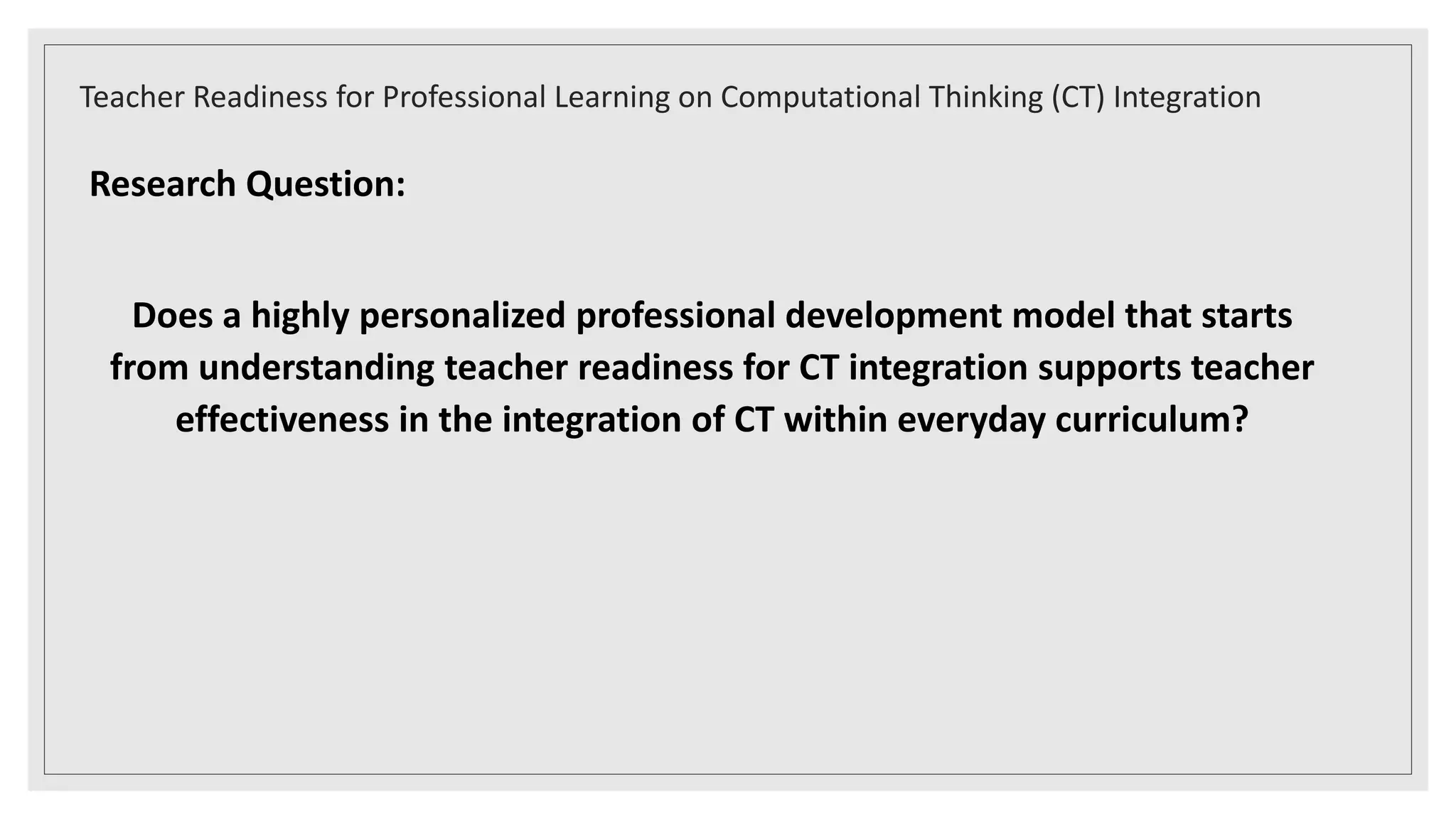
Does a highly personalized professional development model that starts
from understanding teacher readiness for CT integration supports teacher
effectiveness in the integration of CT within everyday curriculum?
Teacher Readiness for Professional Learning on Computational Thinking (CT) Integration
Project Description:
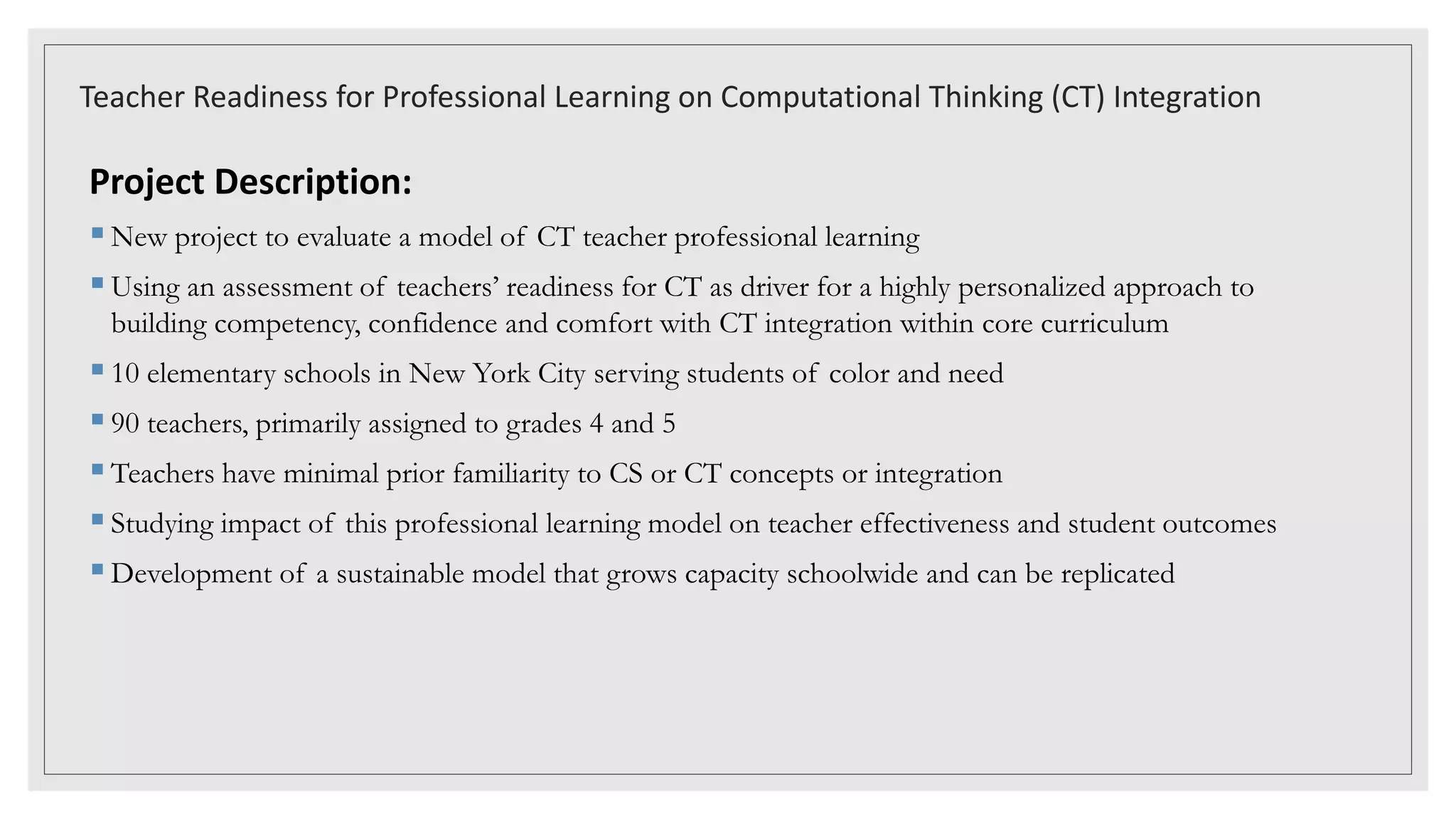
New project to evaluate a model of CT teacher professional learning
Using an assessment of teachers’ readiness for CT as driver for a highly personalized approach to
building competency, confidence and comfort with CT integration within core curriculum
10 elementary schools in New York City serving students of color and need
90 teachers, primarily assigned to grades 4 and 5
Teachers have minimal prior familiarity to CS or CT concepts or integration
Studying impact of this professional learning model on teacher effectiveness and student outcomes
Development of a sustainable model that grows capacity schoolwide and can be replicated
Problem factors:
Challenges with defining CT within an elementary classroom context
Teachers’ lack of knowledge about CT
Existing professional learning models do not always follow best practices
Relationship between technology skills and adoption of new teaching strategies
Second order barriers including teachers’ self-efficacy around CT abilities
Teacher Readiness for Professional Learning on Computational Thinking (CT) Integration
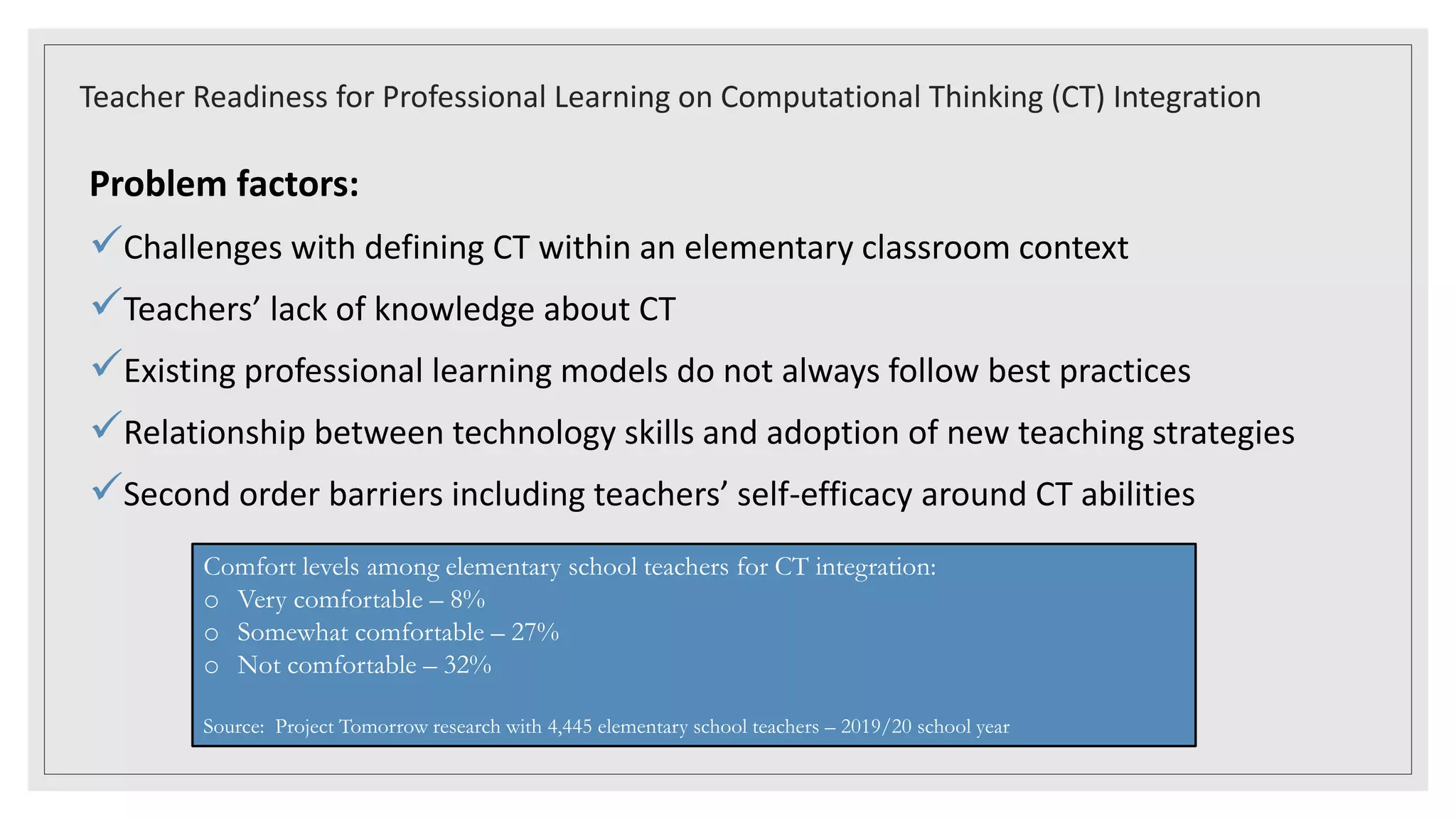
Comfort levels among elementary school teachers for CT integration:
o Very comfortable – 8%
o Somewhat comfortable – 27%
o Not comfortable – 32%
Source: Project Tomorrow research with 4,445 elementary school teachers – 2019/20 school year
Model elements:
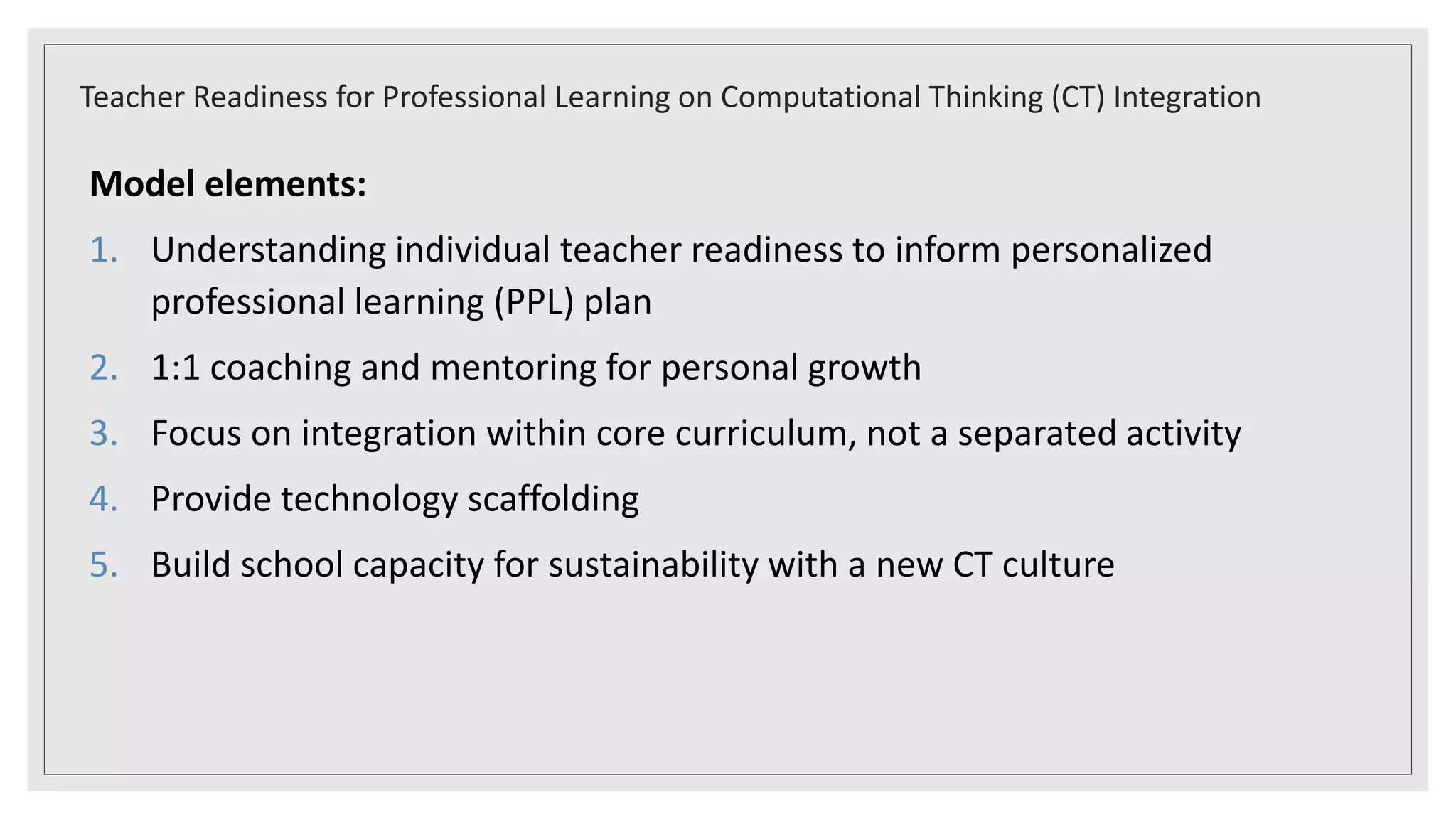
1. Understanding individual teacher readiness to inform personalized
professional learning (PPL) plan
2. 1:1 coaching and mentoring for personal growth
3. Focus on integration within core curriculum, not a separated activity
4. Provide technology scaffolding
5. Build school capacity for sustainability with a new CT culture
Teacher Readiness for Professional Learning on Computational Thinking (CT) Integration
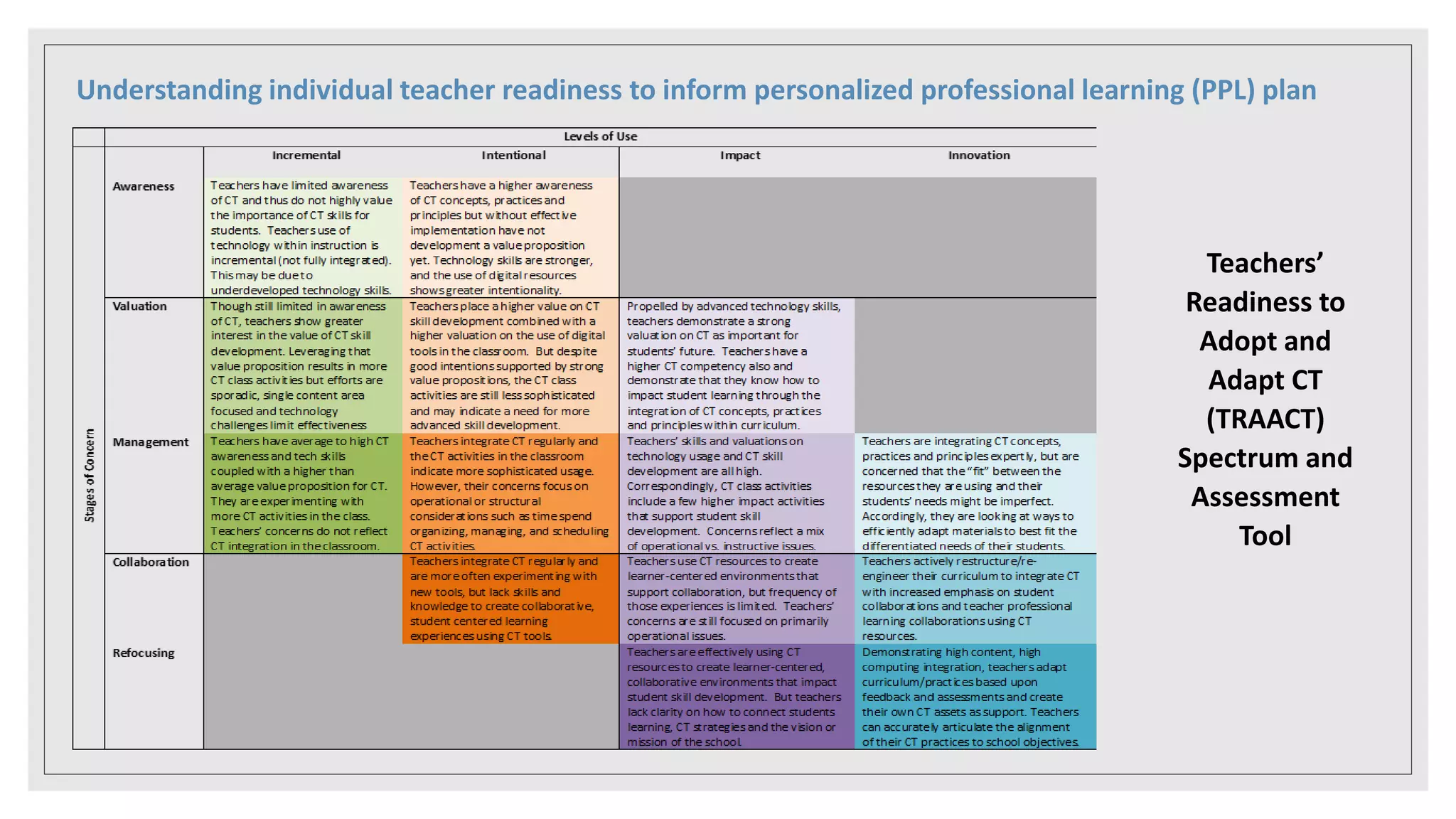
Understanding individual teacher readiness to inform personalized professional learning (PPL) plan
Teachers’
Readiness to
Adopt and
Adapt CT
(TRAACT)
Spectrum and
Assessment
Tool
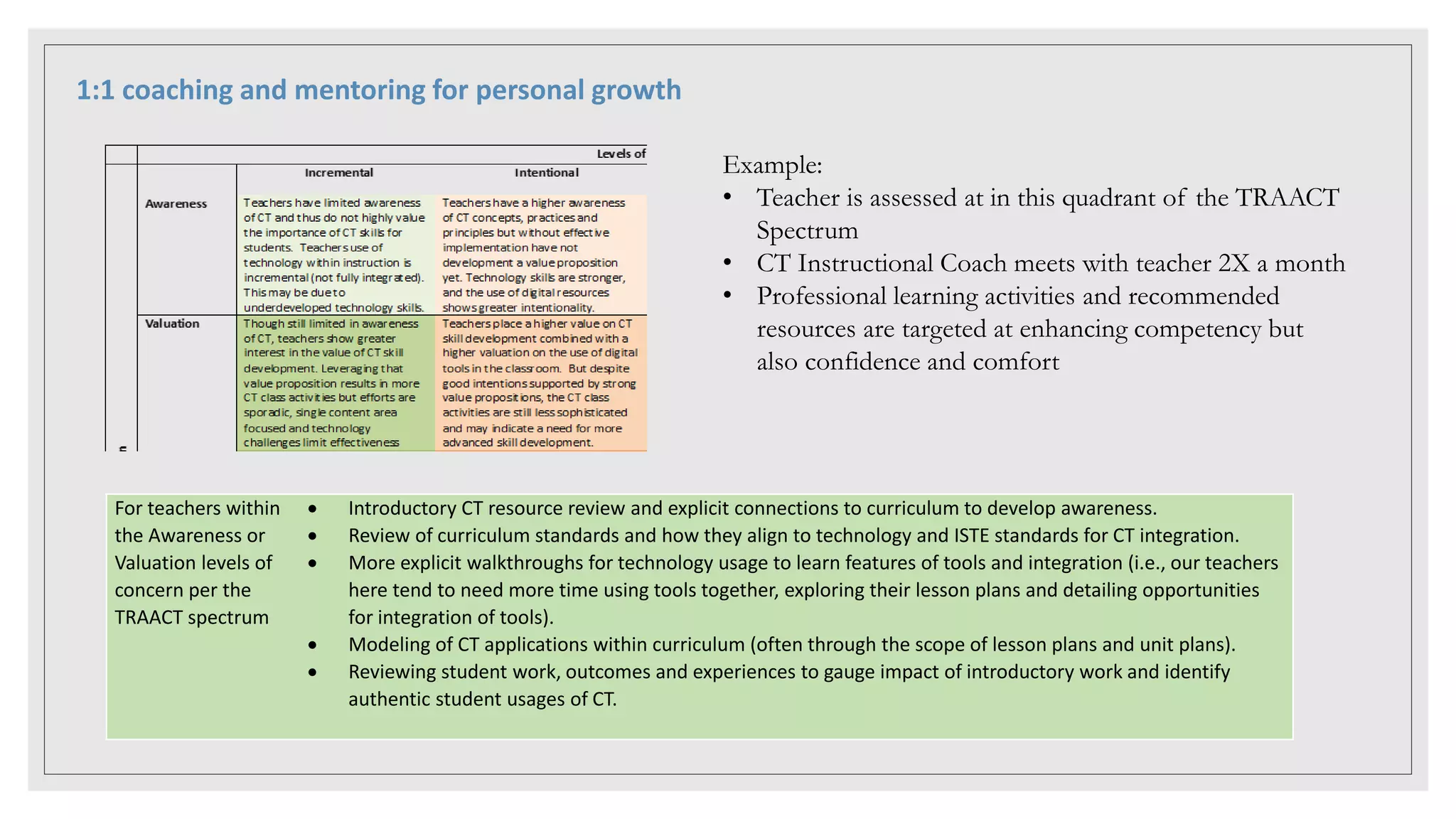
1:1 coaching and mentoring for personal growth
For teachers within
the Awareness or
Valuation levels of
concern per the
TRAACT spectrum
 Introductory CT resource review and explicit connections to curriculum to develop awareness.
 Review of curriculum standards and how they align to technology and ISTE standards for CT integration.
 More explicit walkthroughs for technology usage to learn features of tools and integration (i.e., our teachers
here tend to need more time using tools together, exploring their lesson plans and detailing opportunities
for integration of tools).
 Modeling of CT applications within curriculum (often through the scope of lesson plans and unit plans).
 Reviewing student work, outcomes and experiences to gauge impact of introductory work and identify
authentic student usages of CT.
Example:
• Teacher is assessed at in this quadrant of the TRAACT
Spectrum
• CT Instructional Coach meets with teacher 2X a month
• Professional learning activities and recommended
resources are targeted at enhancing competency but
also confidence and comfort
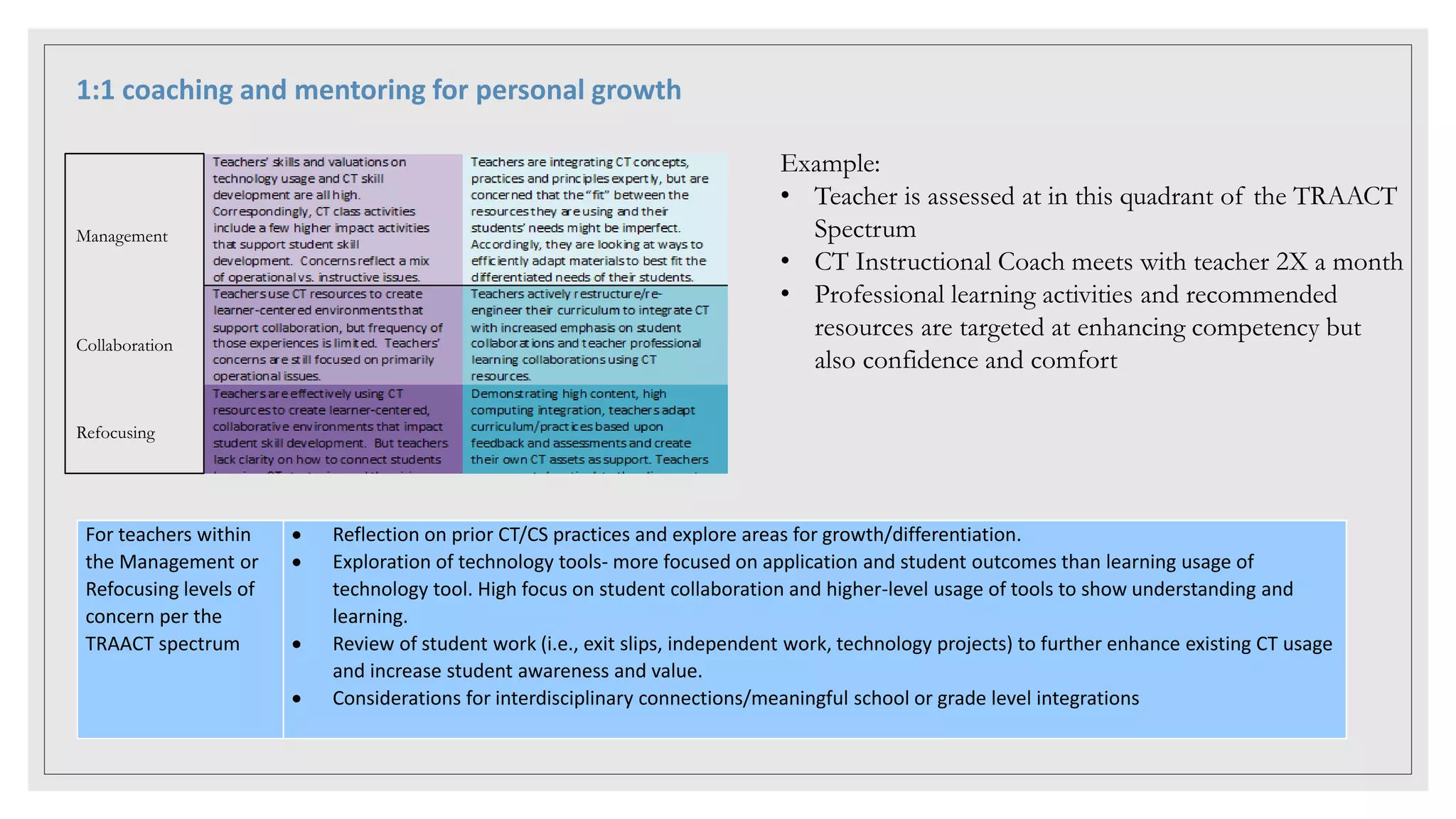
1:1 coaching and mentoring for personal growth
Example:
• Teacher is assessed at in this quadrant of the TRAACT
Spectrum
• CT Instructional Coach meets with teacher 2X a month
• Professional learning activities and recommended
resources are targeted at enhancing competency but
also confidence and comfort
Management
Collaboration
Refocusing
For teachers within
the Management or
Refocusing levels of
concern per the
TRAACT spectrum
 Reflection on prior CT/CS practices and explore areas for growth/differentiation.
 Exploration of technology tools- more focused on application and student outcomes than learning usage of
technology tool. High focus on student collaboration and higher-level usage of tools to show understanding and
learning.
 Review of student work (i.e., exit slips, independent work, technology projects) to further enhance existing CT usage
and increase student awareness and value.
 Considerations for interdisciplinary connections/meaningful school or grade level integrations
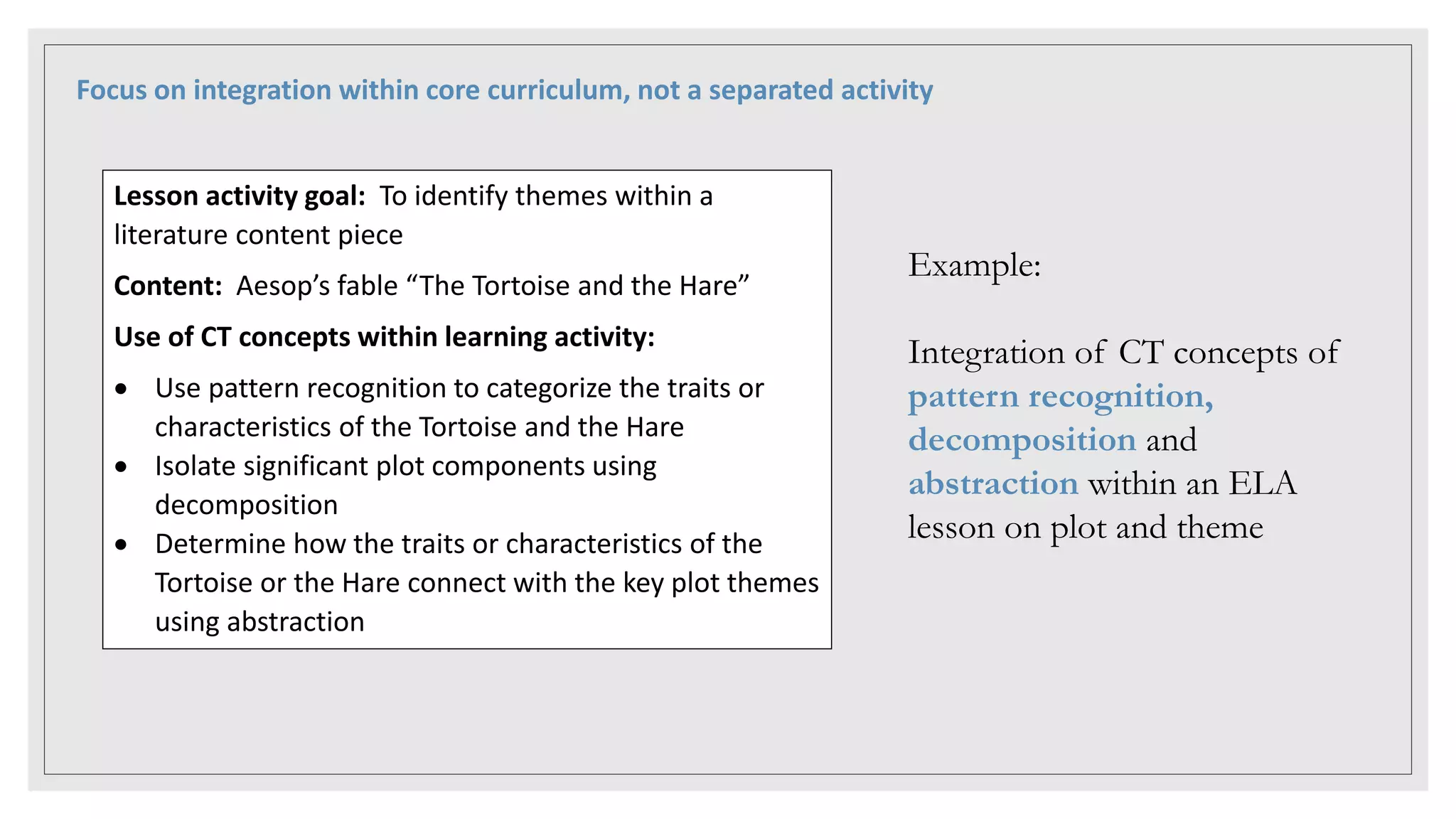
Focus on integration within core curriculum, not a separated activity
Lesson activity goal: To identify themes within a
literature content piece
Content: Aesop’s fable “The Tortoise and the Hare”
Use of CT concepts within learning activity:
 Use pattern recognition to categorize the traits or
characteristics of the Tortoise and the Hare
 Isolate significant plot components using
decomposition
 Determine how the traits or characteristics of the
Tortoise or the Hare connect with the key plot themes
using abstraction
Example:
Integration of CT concepts of
pattern recognition,
decomposition and
abstraction within an ELA
lesson on plot and theme
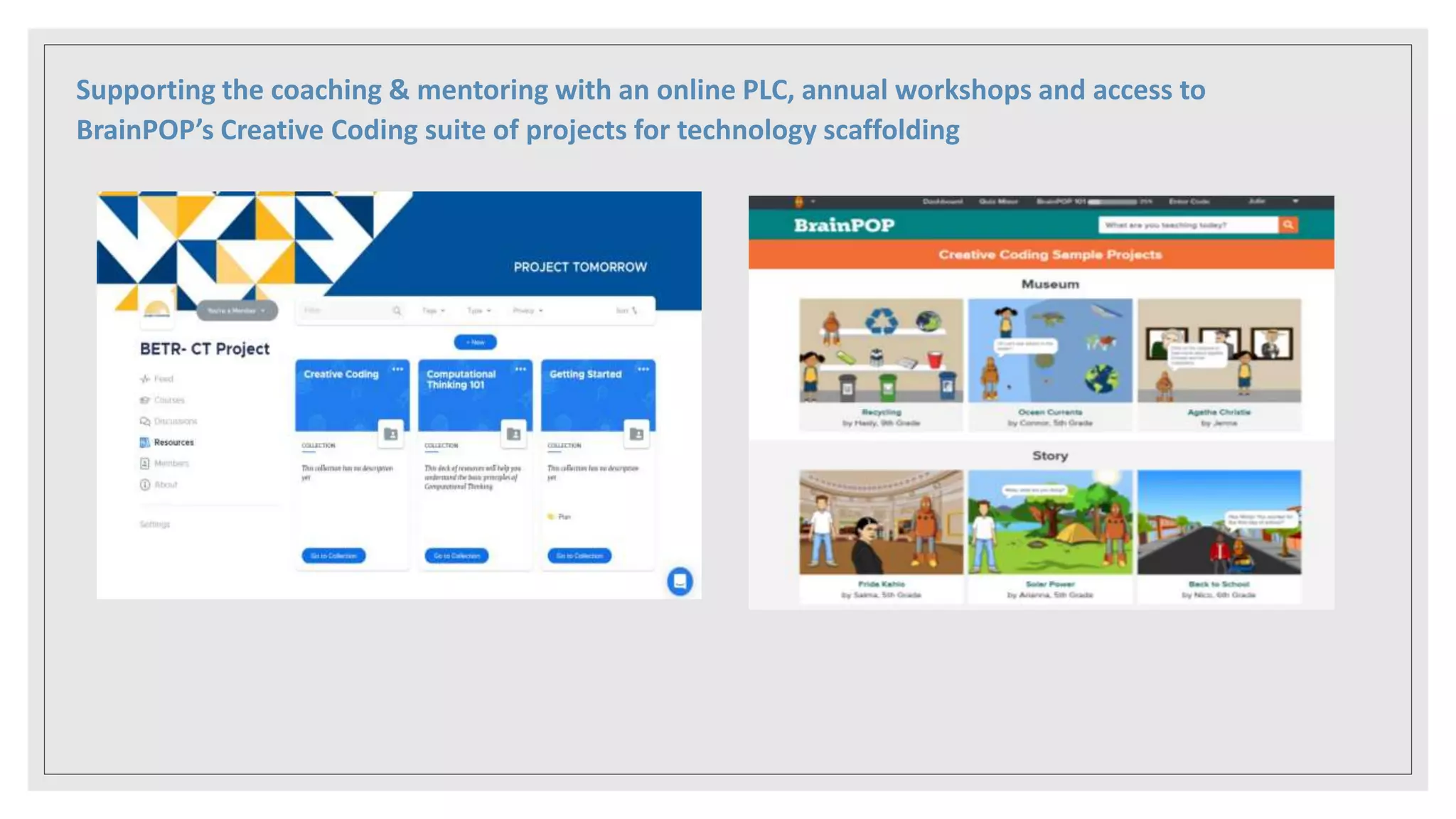
Supporting the coaching & mentoring with an online PLC, annual workshops and access to
BrainPOP’s Creative Coding suite of projects for technology scaffolding
Preliminary findings:
 Changes in TRAACT scores after first 6 months of intervention
 3 schools – 14 teachers
 Consistency of coaching and mentoring and engagement with additional resources
 Looking to validate model and tools
Teacher Readiness for Professional Learning on Computational Thinking (CT) Integration
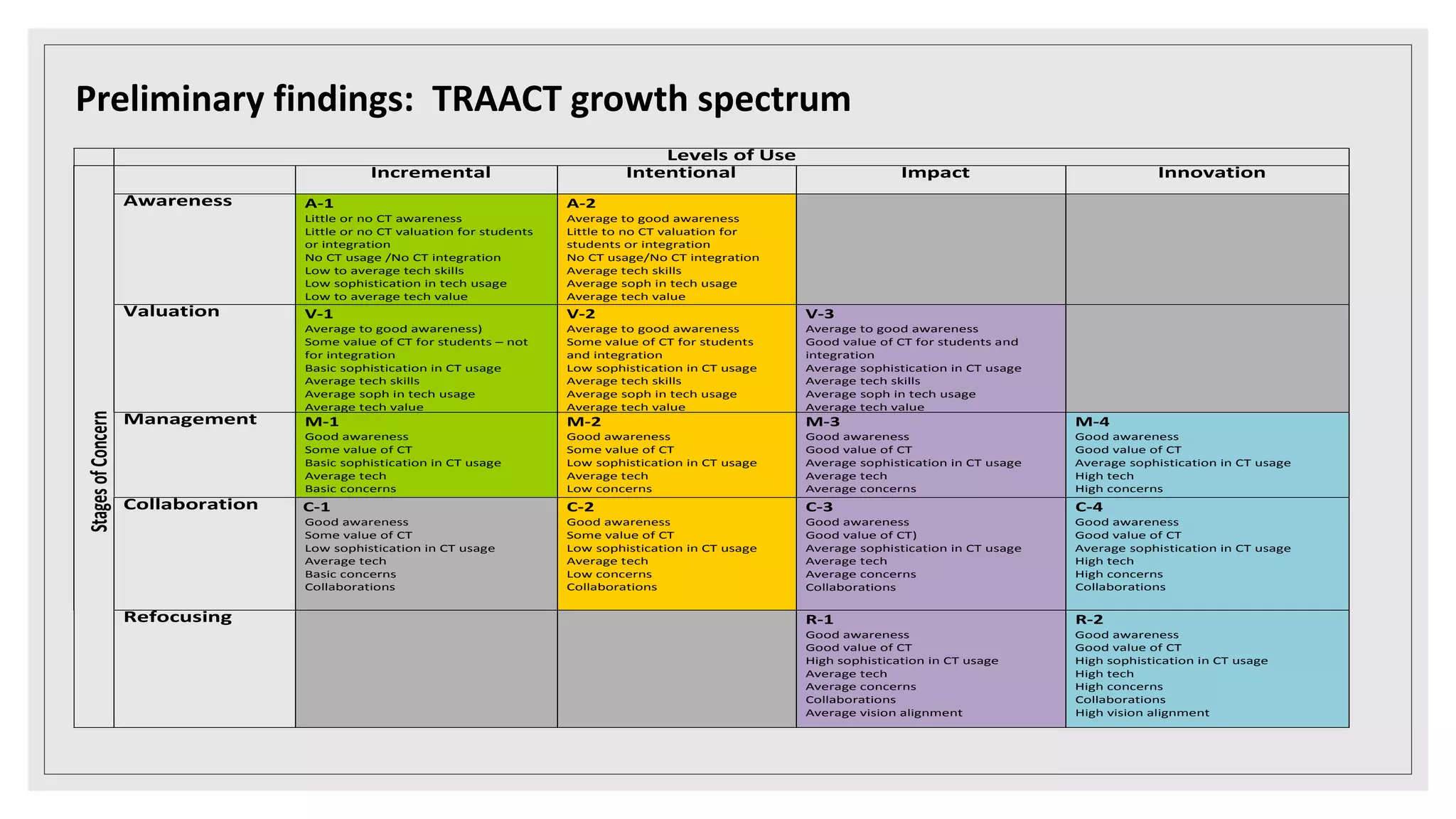
Preliminary findings: TRAACT growth spectrum
Levels of Use
Stages
of
Concern
Incremental Intentional Impact Innovation
Awareness A-1
Little or no CT awareness
Little or no CT valuation for students
or integration
No CT usage /No CT integration
Low to average tech skills
Low sophistication in tech usage
Low to average tech value
A-2
Average to good awareness
Little to no CT valuation for
students or integration
No CT usage/No CT integration
Average tech skills
Average soph in tech usage
Average tech value
Valuation V-1
Average to good awareness)
Some value of CT for students – not
for integration
Basic sophistication in CT usage
Average tech skills
Average soph in tech usage
Average tech value
V-2
Average to good awareness
Some value of CT for students
and integration
Low sophistication in CT usage
Average tech skills
Average soph in tech usage
Average tech value
V-3
Average to good awareness
Good value of CT for students and
integration
Average sophistication in CT usage
Average tech skills
Average soph in tech usage
Average tech value
Management M-1
Good awareness
Some value of CT
Basic sophistication in CT usage
Average tech
Basic concerns
M-2
Good awareness
Some value of CT
Low sophistication in CT usage
Average tech
Low concerns
M-3
Good awareness
Good value of CT
Average sophistication in CT usage
Average tech
Average concerns
M-4
Good awareness
Good value of CT
Average sophistication in CT usage
High tech
High concerns
Collaboration C-1
Good awareness
Some value of CT
Low sophistication in CT usage
Average tech
Basic concerns
Collaborations
C-2
Good awareness
Some value of CT
Low sophistication in CT usage
Average tech
Low concerns
Collaborations
C-3
Good awareness
Good value of CT)
Average sophistication in CT usage
Average tech
Average concerns
Collaborations
C-4
Good awareness
Good value of CT
Average sophistication in CT usage
High tech
High concerns
Collaborations
Refocusing R-1
Good awareness
Good value of CT
High sophistication in CT usage
Average tech
Average concerns
Collaborations
Average vision alignment
R-2
Good awareness
Good value of CT
High sophistication in CT usage
High tech
High concerns
Collaborations
High vision alignment
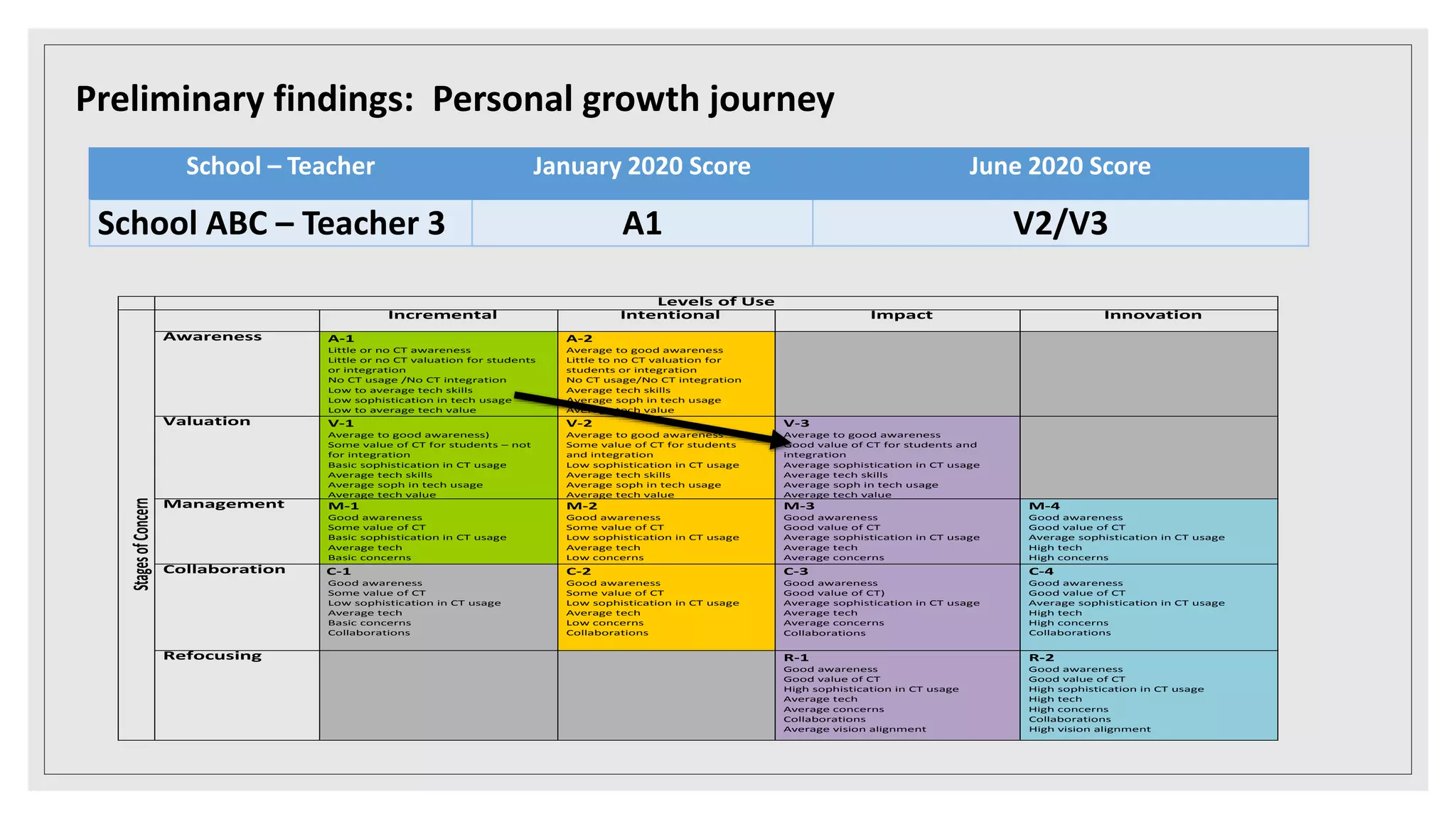
Preliminary findings: Personal growth journey
School – Teacher January 2020 Score June 2020 Score
School ABC – Teacher 3 A1 V2/V3
Levels of Use
Stages
of
Concern
Incremental Intentional Impact Innovation
Awareness A-1
Little or no CT awareness
Little or no CT valuation for students
or integration
No CT usage /No CT integration
Low to average tech skills
Low sophistication in tech usage
Low to average tech value
A-2
Average to good awareness
Little to no CT valuation for
students or integration
No CT usage/No CT integration
Average tech skills
Average soph in tech usage
Average tech value
Valuation V-1
Average to good awareness)
Some value of CT for students – not
for integration
Basic sophistication in CT usage
Average tech skills
Average soph in tech usage
Average tech value
V-2
Average to good awareness
Some value of CT for students
and integration
Low sophistication in CT usage
Average tech skills
Average soph in tech usage
Average tech value
V-3
Average to good awareness
Good value of CT for students and
integration
Average sophistication in CT usage
Average tech skills
Average soph in tech usage
Average tech value
Management M-1
Good awareness
Some value of CT
Basic sophistication in CT usage
Average tech
Basic concerns
M-2
Good awareness
Some value of CT
Low sophistication in CT usage
Average tech
Low concerns
M-3
Good awareness
Good value of CT
Average sophistication in CT usage
Average tech
Average concerns
M-4
Good awareness
Good value of CT
Average sophistication in CT usage
High tech
High concerns
Collaboration C-1
Good awareness
Some value of CT
Low sophistication in CT usage
Average tech
Basic concerns
Collaborations
C-2
Good awareness
Some value of CT
Low sophistication in CT usage
Average tech
Low concerns
Collaborations
C-3
Good awareness
Good value of CT)
Average sophistication in CT usage
Average tech
Average concerns
Collaborations
C-4
Good awareness
Good value of CT
Average sophistication in CT usage
High tech
High concerns
Collaborations
Refocusing R-1
Good awareness
Good value of CT
High sophistication in CT usage
Average tech
Average concerns
Collaborations
Average vision alignment
R-2
Good awareness
Good value of CT
High sophistication in CT usage
High tech
High concerns
Collaborations
High vision alignment
Preliminary findings: Personal growth journey
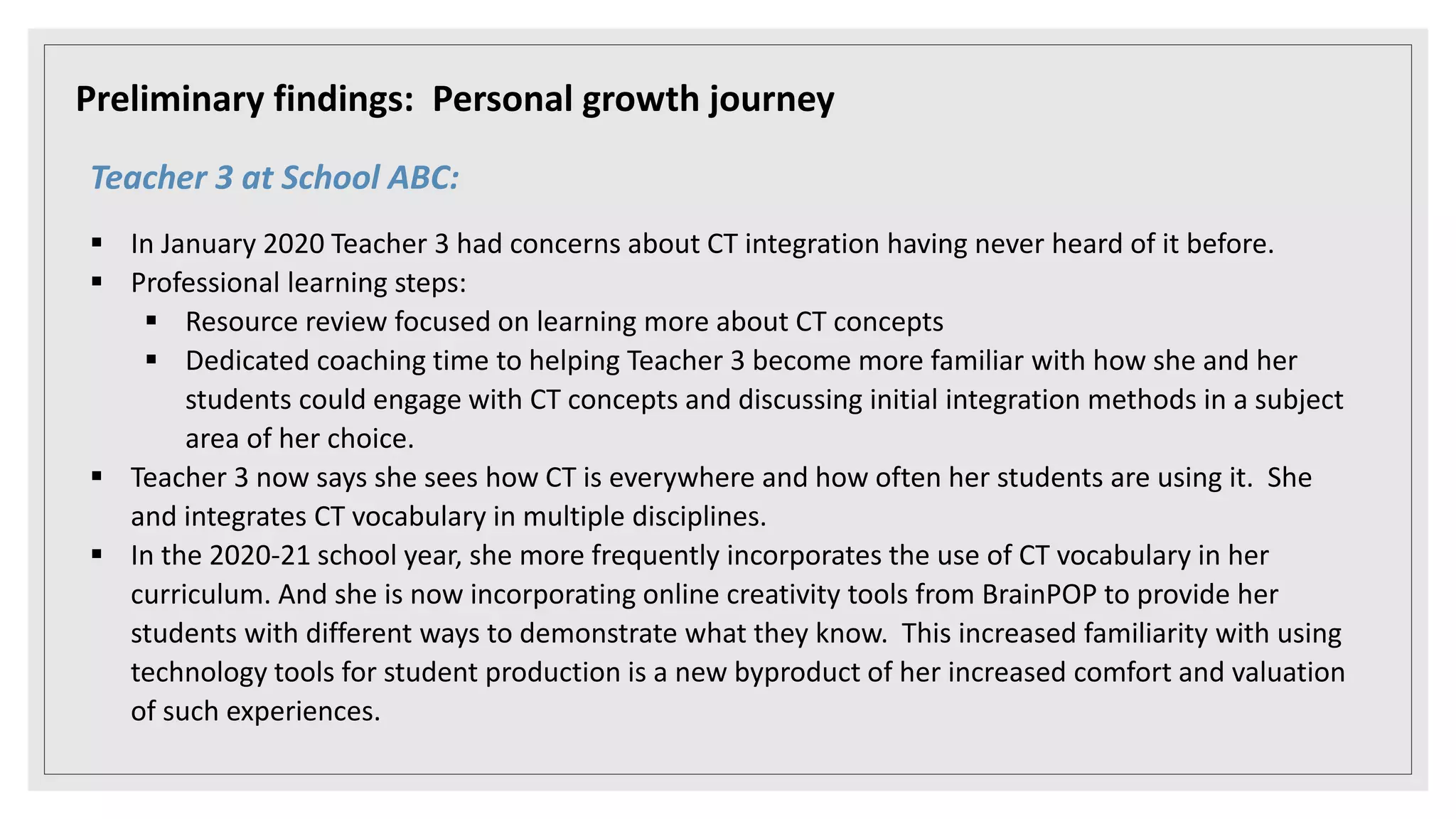
Teacher 3 at School ABC:
 In January 2020 Teacher 3 had concerns about CT integration having never heard of it before.
 Professional learning steps:
 Resource review focused on learning more about CT concepts
 Dedicated coaching time to helping Teacher 3 become more familiar with how she and her
students could engage with CT concepts and discussing initial integration methods in a subject
area of her choice.
 Teacher 3 now says she sees how CT is everywhere and how often her students are using it. She
and integrates CT vocabulary in multiple disciplines.
 In the 2020-21 school year, she more frequently incorporates the use of CT vocabulary in her
curriculum. And she is now incorporating online creativity tools from BrainPOP to provide her
students with different ways to demonstrate what they know. This increased familiarity with using
technology tools for student production is a new byproduct of her increased comfort and valuation
of such experiences.
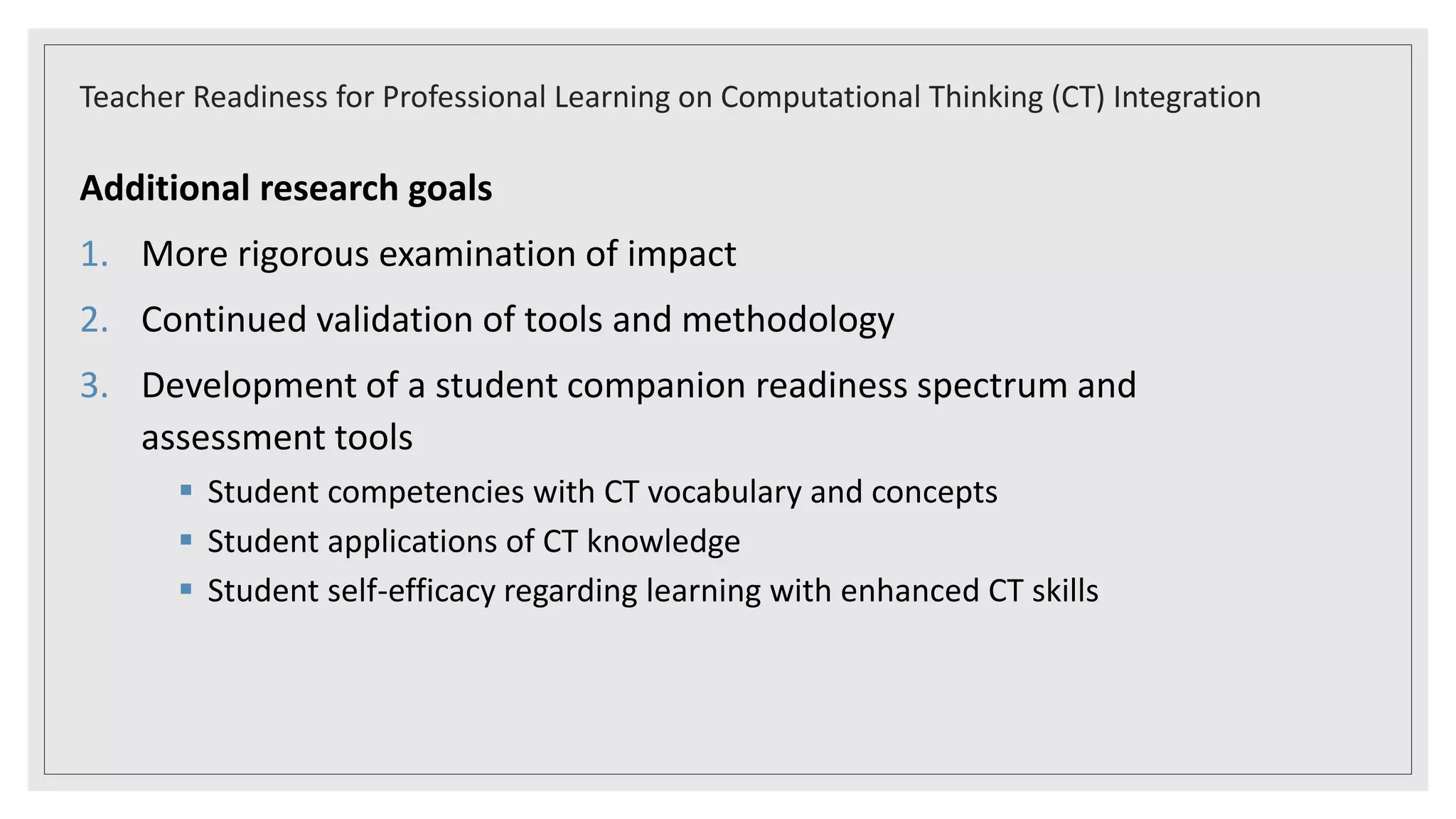
Additional research goals
1. More rigorous examination of impact
2. Continued validation of tools and methodology
3. Development of a student companion readiness spectrum and
assessment tools
 Student competencies with CT vocabulary and concepts
 Student applications of CT knowledge
 Student self-efficacy regarding learning with enhanced CT skills
Teacher Readiness for Professional Learning on Computational Thinking (CT) Integration
PERSONALIZING ELEMENTARY
TEACHERPROFESSIONAL
LEARNINGON CT INTEGRATION
BASED UPON UNDERSTANDING
TEACHERREADINESS
Julie A. Evans, Ed.D.
Project Tomorrow
jevans@tomorrow.org
949-609-4661
@JulieEvans_PT

Personalizing Elementary Teacher Professional Learning on CT Integration

  • 1.
    PERSONALIZING ELEMENTARY TEACHERPROFESSIONAL LEARNINGON CTINTEGRATION BASED UPON UNDERSTANDING TEACHERREADINESS Julie A. Evans, Ed.D. Project Tomorrow
  • 2.
    Teacher Readiness forProfessional Learning on Computational Thinking (CT) Integration Research Question: Does a highly personalized professional development model that starts from understanding teacher readiness for CT integration supports teacher effectiveness in the integration of CT within everyday curriculum?
  • 3.
    Teacher Readiness forProfessional Learning on Computational Thinking (CT) Integration Project Description: New project to evaluate a model of CT teacher professional learning Using an assessment of teachers’ readiness for CT as driver for a highly personalized approach to building competency, confidence and comfort with CT integration within core curriculum 10 elementary schools in New York City serving students of color and need 90 teachers, primarily assigned to grades 4 and 5 Teachers have minimal prior familiarity to CS or CT concepts or integration Studying impact of this professional learning model on teacher effectiveness and student outcomes Development of a sustainable model that grows capacity schoolwide and can be replicated
  • 4.
    Problem factors: Challenges withdefining CT within an elementary classroom context Teachers’ lack of knowledge about CT Existing professional learning models do not always follow best practices Relationship between technology skills and adoption of new teaching strategies Second order barriers including teachers’ self-efficacy around CT abilities Teacher Readiness for Professional Learning on Computational Thinking (CT) Integration Comfort levels among elementary school teachers for CT integration: o Very comfortable – 8% o Somewhat comfortable – 27% o Not comfortable – 32% Source: Project Tomorrow research with 4,445 elementary school teachers – 2019/20 school year
  • 5.
    Model elements: 1. Understandingindividual teacher readiness to inform personalized professional learning (PPL) plan 2. 1:1 coaching and mentoring for personal growth 3. Focus on integration within core curriculum, not a separated activity 4. Provide technology scaffolding 5. Build school capacity for sustainability with a new CT culture Teacher Readiness for Professional Learning on Computational Thinking (CT) Integration
  • 6.
    Understanding individual teacherreadiness to inform personalized professional learning (PPL) plan Teachers’ Readiness to Adopt and Adapt CT (TRAACT) Spectrum and Assessment Tool
  • 7.
    1:1 coaching andmentoring for personal growth For teachers within the Awareness or Valuation levels of concern per the TRAACT spectrum  Introductory CT resource review and explicit connections to curriculum to develop awareness.  Review of curriculum standards and how they align to technology and ISTE standards for CT integration.  More explicit walkthroughs for technology usage to learn features of tools and integration (i.e., our teachers here tend to need more time using tools together, exploring their lesson plans and detailing opportunities for integration of tools).  Modeling of CT applications within curriculum (often through the scope of lesson plans and unit plans).  Reviewing student work, outcomes and experiences to gauge impact of introductory work and identify authentic student usages of CT. Example: • Teacher is assessed at in this quadrant of the TRAACT Spectrum • CT Instructional Coach meets with teacher 2X a month • Professional learning activities and recommended resources are targeted at enhancing competency but also confidence and comfort
  • 8.
    1:1 coaching andmentoring for personal growth Example: • Teacher is assessed at in this quadrant of the TRAACT Spectrum • CT Instructional Coach meets with teacher 2X a month • Professional learning activities and recommended resources are targeted at enhancing competency but also confidence and comfort Management Collaboration Refocusing For teachers within the Management or Refocusing levels of concern per the TRAACT spectrum  Reflection on prior CT/CS practices and explore areas for growth/differentiation.  Exploration of technology tools- more focused on application and student outcomes than learning usage of technology tool. High focus on student collaboration and higher-level usage of tools to show understanding and learning.  Review of student work (i.e., exit slips, independent work, technology projects) to further enhance existing CT usage and increase student awareness and value.  Considerations for interdisciplinary connections/meaningful school or grade level integrations
  • 9.
    Focus on integrationwithin core curriculum, not a separated activity Lesson activity goal: To identify themes within a literature content piece Content: Aesop’s fable “The Tortoise and the Hare” Use of CT concepts within learning activity:  Use pattern recognition to categorize the traits or characteristics of the Tortoise and the Hare  Isolate significant plot components using decomposition  Determine how the traits or characteristics of the Tortoise or the Hare connect with the key plot themes using abstraction Example: Integration of CT concepts of pattern recognition, decomposition and abstraction within an ELA lesson on plot and theme
  • 10.
    Supporting the coaching& mentoring with an online PLC, annual workshops and access to BrainPOP’s Creative Coding suite of projects for technology scaffolding
  • 11.
    Preliminary findings:  Changesin TRAACT scores after first 6 months of intervention  3 schools – 14 teachers  Consistency of coaching and mentoring and engagement with additional resources  Looking to validate model and tools Teacher Readiness for Professional Learning on Computational Thinking (CT) Integration
  • 12.
    Preliminary findings: TRAACTgrowth spectrum Levels of Use Stages of Concern Incremental Intentional Impact Innovation Awareness A-1 Little or no CT awareness Little or no CT valuation for students or integration No CT usage /No CT integration Low to average tech skills Low sophistication in tech usage Low to average tech value A-2 Average to good awareness Little to no CT valuation for students or integration No CT usage/No CT integration Average tech skills Average soph in tech usage Average tech value Valuation V-1 Average to good awareness) Some value of CT for students – not for integration Basic sophistication in CT usage Average tech skills Average soph in tech usage Average tech value V-2 Average to good awareness Some value of CT for students and integration Low sophistication in CT usage Average tech skills Average soph in tech usage Average tech value V-3 Average to good awareness Good value of CT for students and integration Average sophistication in CT usage Average tech skills Average soph in tech usage Average tech value Management M-1 Good awareness Some value of CT Basic sophistication in CT usage Average tech Basic concerns M-2 Good awareness Some value of CT Low sophistication in CT usage Average tech Low concerns M-3 Good awareness Good value of CT Average sophistication in CT usage Average tech Average concerns M-4 Good awareness Good value of CT Average sophistication in CT usage High tech High concerns Collaboration C-1 Good awareness Some value of CT Low sophistication in CT usage Average tech Basic concerns Collaborations C-2 Good awareness Some value of CT Low sophistication in CT usage Average tech Low concerns Collaborations C-3 Good awareness Good value of CT) Average sophistication in CT usage Average tech Average concerns Collaborations C-4 Good awareness Good value of CT Average sophistication in CT usage High tech High concerns Collaborations Refocusing R-1 Good awareness Good value of CT High sophistication in CT usage Average tech Average concerns Collaborations Average vision alignment R-2 Good awareness Good value of CT High sophistication in CT usage High tech High concerns Collaborations High vision alignment
  • 13.
    Preliminary findings: Personalgrowth journey School – Teacher January 2020 Score June 2020 Score School ABC – Teacher 3 A1 V2/V3 Levels of Use Stages of Concern Incremental Intentional Impact Innovation Awareness A-1 Little or no CT awareness Little or no CT valuation for students or integration No CT usage /No CT integration Low to average tech skills Low sophistication in tech usage Low to average tech value A-2 Average to good awareness Little to no CT valuation for students or integration No CT usage/No CT integration Average tech skills Average soph in tech usage Average tech value Valuation V-1 Average to good awareness) Some value of CT for students – not for integration Basic sophistication in CT usage Average tech skills Average soph in tech usage Average tech value V-2 Average to good awareness Some value of CT for students and integration Low sophistication in CT usage Average tech skills Average soph in tech usage Average tech value V-3 Average to good awareness Good value of CT for students and integration Average sophistication in CT usage Average tech skills Average soph in tech usage Average tech value Management M-1 Good awareness Some value of CT Basic sophistication in CT usage Average tech Basic concerns M-2 Good awareness Some value of CT Low sophistication in CT usage Average tech Low concerns M-3 Good awareness Good value of CT Average sophistication in CT usage Average tech Average concerns M-4 Good awareness Good value of CT Average sophistication in CT usage High tech High concerns Collaboration C-1 Good awareness Some value of CT Low sophistication in CT usage Average tech Basic concerns Collaborations C-2 Good awareness Some value of CT Low sophistication in CT usage Average tech Low concerns Collaborations C-3 Good awareness Good value of CT) Average sophistication in CT usage Average tech Average concerns Collaborations C-4 Good awareness Good value of CT Average sophistication in CT usage High tech High concerns Collaborations Refocusing R-1 Good awareness Good value of CT High sophistication in CT usage Average tech Average concerns Collaborations Average vision alignment R-2 Good awareness Good value of CT High sophistication in CT usage High tech High concerns Collaborations High vision alignment
  • 14.
    Preliminary findings: Personalgrowth journey Teacher 3 at School ABC:  In January 2020 Teacher 3 had concerns about CT integration having never heard of it before.  Professional learning steps:  Resource review focused on learning more about CT concepts  Dedicated coaching time to helping Teacher 3 become more familiar with how she and her students could engage with CT concepts and discussing initial integration methods in a subject area of her choice.  Teacher 3 now says she sees how CT is everywhere and how often her students are using it. She and integrates CT vocabulary in multiple disciplines.  In the 2020-21 school year, she more frequently incorporates the use of CT vocabulary in her curriculum. And she is now incorporating online creativity tools from BrainPOP to provide her students with different ways to demonstrate what they know. This increased familiarity with using technology tools for student production is a new byproduct of her increased comfort and valuation of such experiences.
  • 15.
    Additional research goals 1.More rigorous examination of impact 2. Continued validation of tools and methodology 3. Development of a student companion readiness spectrum and assessment tools  Student competencies with CT vocabulary and concepts  Student applications of CT knowledge  Student self-efficacy regarding learning with enhanced CT skills Teacher Readiness for Professional Learning on Computational Thinking (CT) Integration
  • 16.
    PERSONALIZING ELEMENTARY TEACHERPROFESSIONAL LEARNINGON CTINTEGRATION BASED UPON UNDERSTANDING TEACHERREADINESS Julie A. Evans, Ed.D. Project Tomorrow jevans@tomorrow.org 949-609-4661 @JulieEvans_PT