Presented by :Akshita negi
( Bsc. Nursing 2nd Sem )
Nursing process
Nursing process
Nursing process is the critical thinking
process that professional nurse use to
apply the best available evidence to
caregiving and promoting human functions
and responses to health
-American nurses Association ,2019
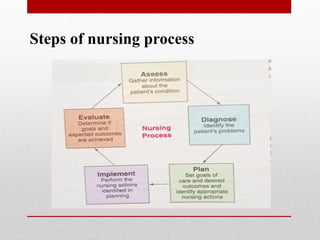
Steps of nursing process
Nursing process is a systematic series of 5
steps these are :
• Assessment
• Nursing diagnosis
• Outcome / planning
• Implementation
• Evaluation
Steps of nursing process
1. Assessment
• Assessment is the first step of the nursing
process .It involves the use of critical
thinking skills for data collection :
• Subjective data
• Objective data
• Subjected data are information perceived
only by the affected person it includes
feelings , perceptions , and self report of
symptoms .The data sometimes reflects
physiological changes which can be
explore through objective data collection
• example: feeling nervous ,nauseated or
chilly and experiencing pain
• Objective data ;These are observable
and measurable data that can be seen
,heard ,felt or measured by someone
other than the person experiencing them .
• The measurement of objective data is
based on an accepted standard such as
degree F or C
• Example :elevated temperature reading
(e.g.,102 degree F) ,skin that is moist
,refusal to look at or eat food .It is also
called as signs or overt data
2. Nursing diagnosis :
Nursing diagnosis is defined as a clinical
Judgement about individual ,family, or
community responses to actual and potential
health /life processes .Nursing diagnosis
provides the basis for selection of nursing
interventions to achieve outcomes for which the
nurse is accountable .
-North American nursing diagnosis Association ( NANDA) ,1993
Types of nursing diagnosis
• problem focused nursing diagnoses or
actual nursing diagnoses
• Risk nursing diagnoses or potential
nursing diagnoses
• Health promotion nursing diagnoses or
wellness nursing diagnoses
• Syndrome diagnoses
1. Actual nursing diagnoses describes
human responses to health conditions or
life processes that exist in an individual
,family or community .
• It is the clients actual problem present at
the time of assessment and it is based on
signs and symptoms
• Example : ineffective breathing pattern
• Disturbed sleep pattern
2. A risk nursing diagnoses describes
human responses to health condition or
life processes that may develop in a
vulnerable individual ,family or
community
• It has no subjective or objective cues
Example : risk for infection
• Risk for injury
3. Health promotion nursing diagnosis is
clinical judgement of a person’s ,
family’s or community’s motivation
,desire and readiness to increase well
being and actualize human health
potential as expressed in their readiness
to enhance specific health behaviors such
as nutrition and exercise .
• Example : readiness for enhanced
family coping
• Readiness for enhanced self esteem
4. A syndrome diagnosis is a cluster of
signs and symptoms ,which represents
complex clinical conditions requiring
expert nursing assessment and expert
nursing interventions
• Example : rape trauma syndrome ,disuse
syndrome ,post trauma syndrome
Components of nursing diagnosis
• It has typically 3 components
• The problem(diagnostic label )/definition
• The etiology and cause
• The defining characteristics
1. Problem
• The problem status describes the client
health status problem or response for
which nursing therapy is given and it
should be specific
• Each diagnostic label approved by
NANDA carries a definition that clarify
its meaning
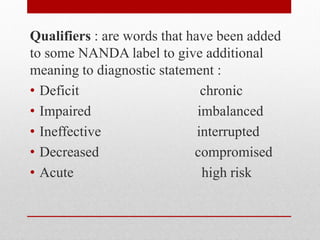
Qualifiers : are words that have been added
to some NANDA label to give additional
meaning to diagnostic statement :
• Deficit chronic
• Impaired imbalanced
• Ineffective interrupted
• Decreased compromised
• Acute high risk
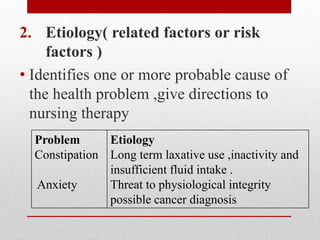
2. Etiology( related factors or risk
factors )
• Identifies one or more probable cause of
the health problem ,give directions to
nursing therapy
Problem
Constipation
Anxiety
Etiology
Long term laxative use ,inactivity and
insufficient fluid intake .
Threat to physiological integrity
possible cancer diagnosis
3. Defining characteristics
• The cluster of signs and symptoms that
indicate the presence of particular
diagnostic label
• Actual diagnosis :client sign and
symptoms
• Risk diagnosis : no subjective signs are
present
Formulating diagnostic statement
• One part statement
• Two parts statement
• Three parts statement
One part statement
• The diagnostic label are defined and tend
to become more specific ,the interventions
can be derived from the label itself
….etiology may not be needed .
• Syndrome and wellness diagnosis consist
NANDA label only
• Example :Rape trauma syndrome
• Spiritual well being
Two parts statement
• 1.problem : statement of clients response
• 2.etiology :factor contributing to or probable
cause of responses
• “ Related to” phrase implies a relationship
• Example :Constipation related to insufficient
fluid intake
• Acute pain related to presence of surgical
incision
Three parts statements ( also called as
PES format )
• Problem
• Etiology
• Sign and symptoms
• Actual nursing diagnosis can be
documented by using three part
statement not for risk diagnosis
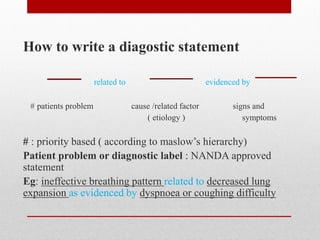
How to write a diagostic statement
related to evidenced by
# patients problem cause /related factor signs and
( etiology ) symptoms
# : priority based ( according to maslow’s hierarchy)
Patient problem or diagnostic label : NANDA approved
statement
Eg: ineffective breathing pattern related to decreased lung
expansion as evidenced by dyspnoea or coughing difficulty
Nursing care plan on :
Chronic obstructive
pulmonary disease (COPD)
NURSING DIAGNOSIS
1. Ineffective airway clearance related
to excessive mucus production as
evidenced by abnormal respiratory
sound and difficulty in breathing
2. Impaired gas exchange related to
decreased lung function as evidenced by
low oxygen saturation level .
3. Ineffective breathing pattern related to
increased airway resistance as
evidenced by rapid breathing .
4. Imbalanced nutrition , less than body
requirements related to difficulty in
breathing and decreased appetite as
evidenced by poor dietary pattern .
5. Activity intolerance related to shortness
of breath as evidenced by fatigue and
limited physical activity
6. Risk of infection related to weakened
immune system and frequent
respiratory infection as evidenced by
elevated wbc count
7. Knowledge deficit related to lack of
understanding of COPD and its
management as evidenced by patients
questions and concern .
7. Self-care deficit related to limited
ability to perform activities of daily
living as evidenced by difficulty with
grooming and dressing .
9. ineffective coping related to chronic
illness as evidenced by depression and
anxiety .
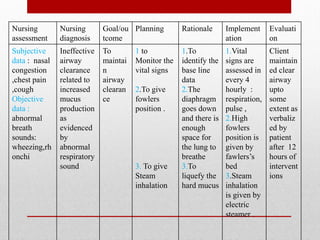
Nursing
assessment
Nursing
diagnosis
Goal/ou
tcome
Planning Rationale Implement
ation
Evaluati
on
Subjective
data : nasal
congestion
,chest pain
,cough
Objective
data :
abnormal
breath
sounds:
wheezing,rh
onchi
Ineffective
airway
clearance
related to
increased
mucus
production
as
evidenced
by
abnormal
respiratory
sound
To
maintai
n
airway
clearan
ce
1 to
Monitor the
vital signs
2.To give
fowlers
position .
3. To give
Steam
inhalation
1.To
identify the
base line
data
2.The
diaphragm
goes down
and there is
enough
space for
the lung to
breathe
3.To
liquefy the
hard mucus
1.Vital
signs are
assessed in
every 4
hourly :
respiration,
pulse ,
2.High
fowlers
position is
given by
fawlers’s
bed
3.Steam
inhalation
is given by
electric
steamer .
Client
maintain
ed clear
airway
upto
some
extent as
verbaliz
ed by
patient
after 12
hours of
intervent
ions
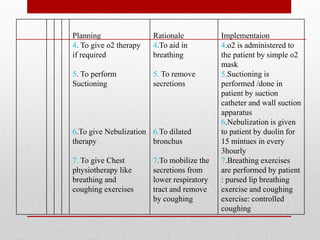
Planning
4. To give o2 therapy
if required
5. To perform
Suctioning
6.To give Nebulization
therapy
7. To give Chest
physiotherapy like
breathing and
coughing exercises
Rationale
4.To aid in
breathing
5. To remove
secretions
6.To dilated
bronchus
7.To mobilize the
secretions from
lower respiratory
tract and remove
by coughing
Implementaion
4.o2 is administered to
the patient by simple o2
mask
5.Suctioning is
performed /done in
patient by suction
catheter and wall suction
apparatus
6.Nebulization is given
to patient by duolin for
15 mintues in every
3hourly
7.Breathing exercises
are performed by patient
: pursed lip breathing
exercise and coughing
exercise: controlled
coughing
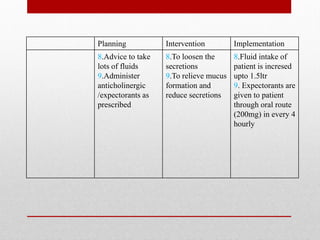
Planning Intervention Implementation
8.Advice to take
lots of fluids
9.Administer
anticholinergic
/expectorants as
prescribed
8.To loosen the
secretions
9.To relieve mucus
formation and
reduce secretions
8.Fluid intake of
patient is incresed
upto 1.5ltr
9. Expectorants are
given to patient
through oral route
(200mg) in every 4
hourly
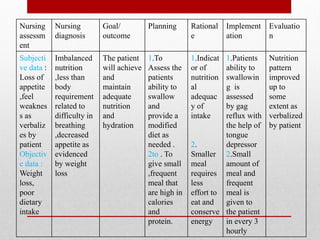
Nursing
assessm
ent
Nursing
diagnosis
Goal/
outcome
Planning Rational
e
Implement
ation
Evaluatio
n
Subjecti
ve data :
Loss of
appetite
,feel
weaknes
s as
verbaliz
es by
patient
Objectiv
e data :
Weight
loss,
poor
dietary
intake
Imbalanced
nutrition
,less than
body
requirement
related to
difficulty in
breathing
,decreased
appetite as
evidenced
by weight
loss
The patient
will achieve
and
maintain
adequate
nutrition
and
hydration
1.To
Assess the
patients
ability to
swallow
and
provide a
modified
diet as
needed .
2to . To
give small
,frequent
meal that
are high in
calories
and
protein.
1.Indicat
or of
nutrition
al
adequac
y of
intake
2.
Smaller
meal
requires
less
effort to
eat and
conserve
energy
1.Patients
ability to
swallowin
g is
assessed
by gag
reflux with
the help of
tongue
depressor
2.Small
amount of
meal and
frequent
meal is
given to
the patient
in every 3
hourly
Nutrition
pattern
improved
up to
some
extent as
verbalized
by patient
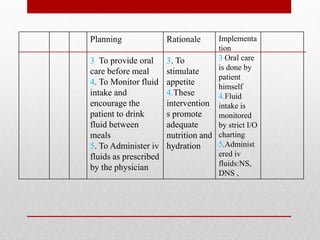
Planning
3 To provide oral
care before meal
4. To Monitor fluid
intake and
encourage the
patient to drink
fluid between
meals
5. To Administer iv
fluids as prescribed
by the physician
Rationale
3. To
stimulate
appetite
4.These
intervention
s promote
adequate
nutrition and
hydration
Implementa
tion
3 Oral care
is done by
patient
himself
4.Fluid
intake is
monitored
by strict I/O
charting
5.Administ
ered iv
fluids:NS,
DNS ,
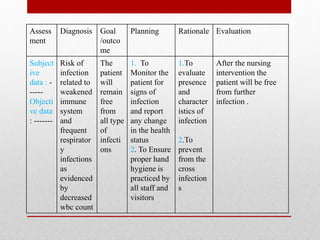
Assess
ment
Diagnosis Goal
/outco
me
Planning Rationale Evaluation
Subject
ive
data : -
-----
Objecti
ve data
: -------
Risk of
infection
related to
weakened
immune
system
and
frequent
respirator
y
infections
as
evidenced
by
decreased
wbc count
The
patient
will
remain
free
from
all type
of
infecti
ons
1. To
Monitor the
patient for
signs of
infection
and report
any change
in the health
status
2. To Ensure
proper hand
hygiene is
practiced by
all staff and
visitors
1.To
evaluate
presence
and
character
istics of
infection
2.To
prevent
from the
cross
infection
s
After the nursing
intervention the
patient will be free
from further
infection .
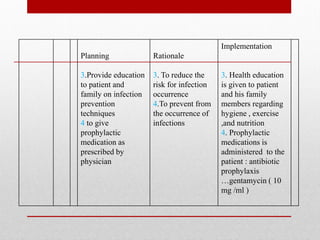
Planning
3.Provide education
to patient and
family on infection
prevention
techniques
4 to give
prophylactic
medication as
prescribed by
physician
Rationale
3. To reduce the
risk for infection
occurrence
4.To prevent from
the occurrence of
infections
Implementation
3. Health education
is given to patient
and his family
members regarding
hygiene , exercise
,and nutrition
4. Prophylactic
medications is
administered to the
patient : antibiotic
prophylaxis
…gentamycin ( 10
mg /ml )
Thank you

Nursing care plan

  • 1.
    Presented by :Akshitanegi ( Bsc. Nursing 2nd Sem ) Nursing process
  • 2.
    Nursing process Nursing processis the critical thinking process that professional nurse use to apply the best available evidence to caregiving and promoting human functions and responses to health -American nurses Association ,2019
  • 3.
    Steps of nursingprocess Nursing process is a systematic series of 5 steps these are : • Assessment • Nursing diagnosis • Outcome / planning • Implementation • Evaluation
  • 4.
  • 5.
    1. Assessment • Assessmentis the first step of the nursing process .It involves the use of critical thinking skills for data collection : • Subjective data • Objective data
  • 6.
    • Subjected dataare information perceived only by the affected person it includes feelings , perceptions , and self report of symptoms .The data sometimes reflects physiological changes which can be explore through objective data collection • example: feeling nervous ,nauseated or chilly and experiencing pain
  • 7.
    • Objective data;These are observable and measurable data that can be seen ,heard ,felt or measured by someone other than the person experiencing them . • The measurement of objective data is based on an accepted standard such as degree F or C
  • 8.
    • Example :elevatedtemperature reading (e.g.,102 degree F) ,skin that is moist ,refusal to look at or eat food .It is also called as signs or overt data
  • 9.
    2. Nursing diagnosis: Nursing diagnosis is defined as a clinical Judgement about individual ,family, or community responses to actual and potential health /life processes .Nursing diagnosis provides the basis for selection of nursing interventions to achieve outcomes for which the nurse is accountable . -North American nursing diagnosis Association ( NANDA) ,1993
  • 10.
    Types of nursingdiagnosis • problem focused nursing diagnoses or actual nursing diagnoses • Risk nursing diagnoses or potential nursing diagnoses • Health promotion nursing diagnoses or wellness nursing diagnoses • Syndrome diagnoses
  • 11.
    1. Actual nursingdiagnoses describes human responses to health conditions or life processes that exist in an individual ,family or community . • It is the clients actual problem present at the time of assessment and it is based on signs and symptoms • Example : ineffective breathing pattern • Disturbed sleep pattern
  • 12.
    2. A risknursing diagnoses describes human responses to health condition or life processes that may develop in a vulnerable individual ,family or community • It has no subjective or objective cues Example : risk for infection • Risk for injury
  • 13.
    3. Health promotionnursing diagnosis is clinical judgement of a person’s , family’s or community’s motivation ,desire and readiness to increase well being and actualize human health potential as expressed in their readiness to enhance specific health behaviors such as nutrition and exercise .
  • 14.
    • Example :readiness for enhanced family coping • Readiness for enhanced self esteem
  • 15.
    4. A syndromediagnosis is a cluster of signs and symptoms ,which represents complex clinical conditions requiring expert nursing assessment and expert nursing interventions • Example : rape trauma syndrome ,disuse syndrome ,post trauma syndrome
  • 16.
    Components of nursingdiagnosis • It has typically 3 components • The problem(diagnostic label )/definition • The etiology and cause • The defining characteristics
  • 17.
    1. Problem • Theproblem status describes the client health status problem or response for which nursing therapy is given and it should be specific • Each diagnostic label approved by NANDA carries a definition that clarify its meaning
  • 18.
    Qualifiers : arewords that have been added to some NANDA label to give additional meaning to diagnostic statement : • Deficit chronic • Impaired imbalanced • Ineffective interrupted • Decreased compromised • Acute high risk
  • 19.
    2. Etiology( relatedfactors or risk factors ) • Identifies one or more probable cause of the health problem ,give directions to nursing therapy Problem Constipation Anxiety Etiology Long term laxative use ,inactivity and insufficient fluid intake . Threat to physiological integrity possible cancer diagnosis
  • 20.
    3. Defining characteristics •The cluster of signs and symptoms that indicate the presence of particular diagnostic label • Actual diagnosis :client sign and symptoms • Risk diagnosis : no subjective signs are present
  • 21.
    Formulating diagnostic statement •One part statement • Two parts statement • Three parts statement
  • 22.
    One part statement •The diagnostic label are defined and tend to become more specific ,the interventions can be derived from the label itself ….etiology may not be needed . • Syndrome and wellness diagnosis consist NANDA label only • Example :Rape trauma syndrome • Spiritual well being
  • 23.
    Two parts statement •1.problem : statement of clients response • 2.etiology :factor contributing to or probable cause of responses • “ Related to” phrase implies a relationship • Example :Constipation related to insufficient fluid intake • Acute pain related to presence of surgical incision
  • 24.
    Three parts statements( also called as PES format ) • Problem • Etiology • Sign and symptoms • Actual nursing diagnosis can be documented by using three part statement not for risk diagnosis
  • 25.
    How to writea diagostic statement related to evidenced by # patients problem cause /related factor signs and ( etiology ) symptoms # : priority based ( according to maslow’s hierarchy) Patient problem or diagnostic label : NANDA approved statement Eg: ineffective breathing pattern related to decreased lung expansion as evidenced by dyspnoea or coughing difficulty
  • 26.
    Nursing care planon : Chronic obstructive pulmonary disease (COPD)
  • 27.
    NURSING DIAGNOSIS 1. Ineffectiveairway clearance related to excessive mucus production as evidenced by abnormal respiratory sound and difficulty in breathing
  • 28.
    2. Impaired gasexchange related to decreased lung function as evidenced by low oxygen saturation level . 3. Ineffective breathing pattern related to increased airway resistance as evidenced by rapid breathing .
  • 29.
    4. Imbalanced nutrition, less than body requirements related to difficulty in breathing and decreased appetite as evidenced by poor dietary pattern . 5. Activity intolerance related to shortness of breath as evidenced by fatigue and limited physical activity
  • 30.
    6. Risk ofinfection related to weakened immune system and frequent respiratory infection as evidenced by elevated wbc count 7. Knowledge deficit related to lack of understanding of COPD and its management as evidenced by patients questions and concern .
  • 31.
    7. Self-care deficitrelated to limited ability to perform activities of daily living as evidenced by difficulty with grooming and dressing .
  • 32.
    9. ineffective copingrelated to chronic illness as evidenced by depression and anxiety .
  • 33.
    Nursing assessment Nursing diagnosis Goal/ou tcome Planning Rationale Implement ation Evaluati on Subjective data: nasal congestion ,chest pain ,cough Objective data : abnormal breath sounds: wheezing,rh onchi Ineffective airway clearance related to increased mucus production as evidenced by abnormal respiratory sound To maintai n airway clearan ce 1 to Monitor the vital signs 2.To give fowlers position . 3. To give Steam inhalation 1.To identify the base line data 2.The diaphragm goes down and there is enough space for the lung to breathe 3.To liquefy the hard mucus 1.Vital signs are assessed in every 4 hourly : respiration, pulse , 2.High fowlers position is given by fawlers’s bed 3.Steam inhalation is given by electric steamer . Client maintain ed clear airway upto some extent as verbaliz ed by patient after 12 hours of intervent ions
  • 34.
    Planning 4. To giveo2 therapy if required 5. To perform Suctioning 6.To give Nebulization therapy 7. To give Chest physiotherapy like breathing and coughing exercises Rationale 4.To aid in breathing 5. To remove secretions 6.To dilated bronchus 7.To mobilize the secretions from lower respiratory tract and remove by coughing Implementaion 4.o2 is administered to the patient by simple o2 mask 5.Suctioning is performed /done in patient by suction catheter and wall suction apparatus 6.Nebulization is given to patient by duolin for 15 mintues in every 3hourly 7.Breathing exercises are performed by patient : pursed lip breathing exercise and coughing exercise: controlled coughing
  • 35.
    Planning Intervention Implementation 8.Adviceto take lots of fluids 9.Administer anticholinergic /expectorants as prescribed 8.To loosen the secretions 9.To relieve mucus formation and reduce secretions 8.Fluid intake of patient is incresed upto 1.5ltr 9. Expectorants are given to patient through oral route (200mg) in every 4 hourly
  • 36.
    Nursing assessm ent Nursing diagnosis Goal/ outcome Planning Rational e Implement ation Evaluatio n Subjecti ve data: Loss of appetite ,feel weaknes s as verbaliz es by patient Objectiv e data : Weight loss, poor dietary intake Imbalanced nutrition ,less than body requirement related to difficulty in breathing ,decreased appetite as evidenced by weight loss The patient will achieve and maintain adequate nutrition and hydration 1.To Assess the patients ability to swallow and provide a modified diet as needed . 2to . To give small ,frequent meal that are high in calories and protein. 1.Indicat or of nutrition al adequac y of intake 2. Smaller meal requires less effort to eat and conserve energy 1.Patients ability to swallowin g is assessed by gag reflux with the help of tongue depressor 2.Small amount of meal and frequent meal is given to the patient in every 3 hourly Nutrition pattern improved up to some extent as verbalized by patient
  • 37.
    Planning 3 To provideoral care before meal 4. To Monitor fluid intake and encourage the patient to drink fluid between meals 5. To Administer iv fluids as prescribed by the physician Rationale 3. To stimulate appetite 4.These intervention s promote adequate nutrition and hydration Implementa tion 3 Oral care is done by patient himself 4.Fluid intake is monitored by strict I/O charting 5.Administ ered iv fluids:NS, DNS ,
  • 38.
    Assess ment Diagnosis Goal /outco me Planning RationaleEvaluation Subject ive data : - ----- Objecti ve data : ------- Risk of infection related to weakened immune system and frequent respirator y infections as evidenced by decreased wbc count The patient will remain free from all type of infecti ons 1. To Monitor the patient for signs of infection and report any change in the health status 2. To Ensure proper hand hygiene is practiced by all staff and visitors 1.To evaluate presence and character istics of infection 2.To prevent from the cross infection s After the nursing intervention the patient will be free from further infection .
  • 39.
    Planning 3.Provide education to patientand family on infection prevention techniques 4 to give prophylactic medication as prescribed by physician Rationale 3. To reduce the risk for infection occurrence 4.To prevent from the occurrence of infections Implementation 3. Health education is given to patient and his family members regarding hygiene , exercise ,and nutrition 4. Prophylactic medications is administered to the patient : antibiotic prophylaxis …gentamycin ( 10 mg /ml )
  • 40.