Meaningful and useful Security metricsVladimir JirasekAbout.me/jirasek5st Oct 2011
About meSecurity professional (11 years), current work at Nokia as Enterprise Security architectFounding member and steering group member of (Common Assurance Maturity Model) CAMM (common-assurance.com)Director of Research, CSA UK & IrelandI love reading books: thrillers (Clive Cusler)  and business management (Jo Owen)
I will cover three topics todayInformation Security ModelMetrics for CIOMetrics for Operations managerMetrics for CISOMetrics for CEO and the Board
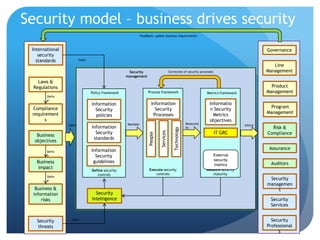
Security model – business drives securityFeedback: update business requirementsInternational security standardsGovernanceInputLine ManagementSecurity managementCorrection of security processesLaws & RegulationsProduct ManagementProcess frameworkPolicy frameworkMetrics frameworkDefineInformation Security Metrics objectivesInformation Security ProcessesInformation Security policiesProgram ManagementCompliancerequirementsMeasured byMandateInputInformInformation Security standardsRisk & ComplianceIT GRCBusiness objectivesTechnologyPeopleServicesAssuranceInformation Security guidelinesDefineExternal security metricsBusiness impactAuditorsMeasure security maturityExecute security controlsDefine security controlsDefineSecurity managementBusiness & information risksSecurity intelligenceSecurity ServicesSecurity ProfessionalsInputSecurity threats
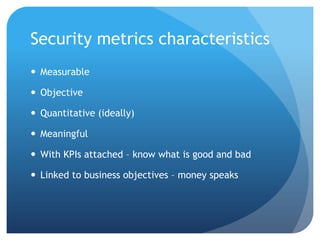
Security metrics characteristicsMeasurableObjectiveQuantitative (ideally)MeaningfulWith KPIs attached – know what is good and badLinked to business objectives – money speaks
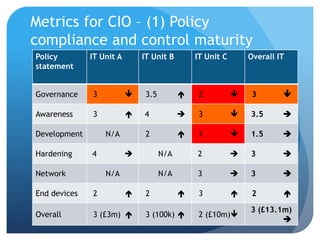
Metrics for CIO – (1) Policy compliance and control maturity
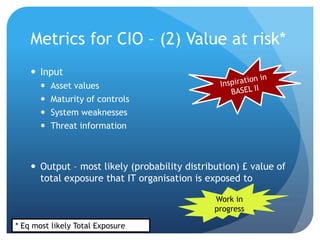
Metrics for CIO – (2) Value at risk*InputAsset valuesMaturity of controlsSystem weaknessesThreat informationOutput – most likely (probability distribution) £ value of total exposure that IT organisation is exposed toInspiration in BASEL IIWork in progress* Eq most likely Total Exposure
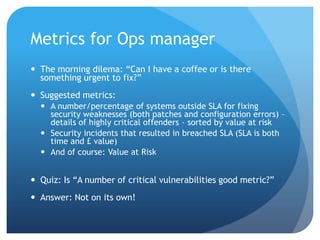
Metrics for Ops managerThe morning dilema: “Can I have a coffee or is there something urgent to fix?”Suggested metrics:A number/percentage of systems outside SLA for fixing security weaknesses (both patches and configuration errors) – details of highly critical offenders – sorted by value at riskSecurity incidents that resulted in breached SLA (SLA is both time and £ value) And of course: Value at RiskQuiz: Is “A number of critical vulnerabilities good metric?”Answer: Not on its own!
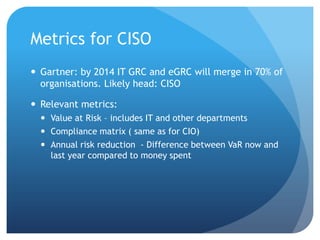
Metrics for CISOGartner: by 2014 IT GRC and eGRC will merge in 70% of organisations. Likely head: CISORelevant metrics:Value at Risk – includes IT and other departmentsCompliance matrix ( same as for CIO)Annual risk reduction  - Difference between VaR now and last year compared to money spent
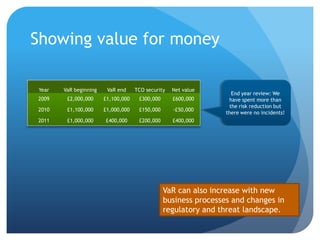
Showing value for moneyEnd year review: We have spent more than the risk reduction but there were no incidents!VaR can also increase with new business processes and changes in regulatory and threat landscape.
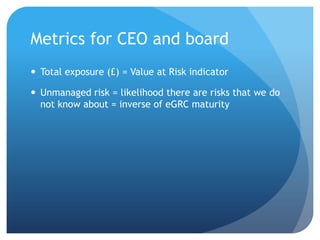
Metrics for CEO and boardTotal exposure (£) = Value at Risk indicatorUnmanaged risk = likelihood there are risks that we do not know about = inverse of eGRC maturity
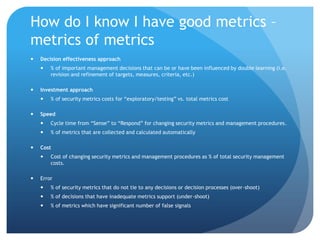
How do I know I have good metrics – metrics of metricsDecision effectiveness approach% of important management decisions that can be or have been influenced by double learning (i.e. revision and refinement of targets, measures, criteria, etc.)Investment approach% of security metrics costs for “exploratory/testing” vs. total metrics costSpeedCycle time from “Sense” to “Respond” for changing security metrics and management procedures.% of metrics that are collected and calculated automaticallyCostCost of changing security metrics and management procedures as % of total security management costs.Error% of security metrics that do not tie to any decisions or decision processes (over-shoot)% of decisions that have inadequate metrics support (under-shoot)% of metrics which have significant number of false signals
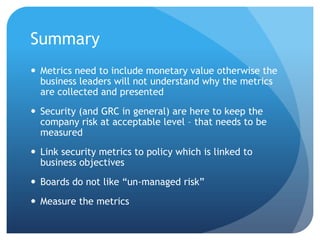
SummaryMetrics need to include monetary value otherwise the business leaders will not understand why the metrics are collected and presentedSecurity (and GRC in general) are here to keep the company risk at acceptable level – that needs to be measuredLink security metrics to policy which is linked to business objectivesBoards do not like “un-managed risk”Measure the metrics

Meaningfull security metrics

  • 1.
    Meaningful and usefulSecurity metricsVladimir JirasekAbout.me/jirasek5st Oct 2011
  • 2.
    About meSecurity professional(11 years), current work at Nokia as Enterprise Security architectFounding member and steering group member of (Common Assurance Maturity Model) CAMM (common-assurance.com)Director of Research, CSA UK & IrelandI love reading books: thrillers (Clive Cusler) and business management (Jo Owen)
  • 3.
    I will coverthree topics todayInformation Security ModelMetrics for CIOMetrics for Operations managerMetrics for CISOMetrics for CEO and the Board
  • 4.
    Security model –business drives securityFeedback: update business requirementsInternational security standardsGovernanceInputLine ManagementSecurity managementCorrection of security processesLaws & RegulationsProduct ManagementProcess frameworkPolicy frameworkMetrics frameworkDefineInformation Security Metrics objectivesInformation Security ProcessesInformation Security policiesProgram ManagementCompliancerequirementsMeasured byMandateInputInformInformation Security standardsRisk & ComplianceIT GRCBusiness objectivesTechnologyPeopleServicesAssuranceInformation Security guidelinesDefineExternal security metricsBusiness impactAuditorsMeasure security maturityExecute security controlsDefine security controlsDefineSecurity managementBusiness & information risksSecurity intelligenceSecurity ServicesSecurity ProfessionalsInputSecurity threats
  • 5.
    Security metrics characteristicsMeasurableObjectiveQuantitative(ideally)MeaningfulWith KPIs attached – know what is good and badLinked to business objectives – money speaks
  • 6.
    Metrics for CIO– (1) Policy compliance and control maturity
  • 7.
    Metrics for CIO– (2) Value at risk*InputAsset valuesMaturity of controlsSystem weaknessesThreat informationOutput – most likely (probability distribution) £ value of total exposure that IT organisation is exposed toInspiration in BASEL IIWork in progress* Eq most likely Total Exposure
  • 8.
    Metrics for OpsmanagerThe morning dilema: “Can I have a coffee or is there something urgent to fix?”Suggested metrics:A number/percentage of systems outside SLA for fixing security weaknesses (both patches and configuration errors) – details of highly critical offenders – sorted by value at riskSecurity incidents that resulted in breached SLA (SLA is both time and £ value) And of course: Value at RiskQuiz: Is “A number of critical vulnerabilities good metric?”Answer: Not on its own!
  • 9.
    Metrics for CISOGartner:by 2014 IT GRC and eGRC will merge in 70% of organisations. Likely head: CISORelevant metrics:Value at Risk – includes IT and other departmentsCompliance matrix ( same as for CIO)Annual risk reduction - Difference between VaR now and last year compared to money spent
  • 10.
    Showing value formoneyEnd year review: We have spent more than the risk reduction but there were no incidents!VaR can also increase with new business processes and changes in regulatory and threat landscape.
  • 11.
    Metrics for CEOand boardTotal exposure (£) = Value at Risk indicatorUnmanaged risk = likelihood there are risks that we do not know about = inverse of eGRC maturity
  • 12.
    How do Iknow I have good metrics – metrics of metricsDecision effectiveness approach% of important management decisions that can be or have been influenced by double learning (i.e. revision and refinement of targets, measures, criteria, etc.)Investment approach% of security metrics costs for “exploratory/testing” vs. total metrics costSpeedCycle time from “Sense” to “Respond” for changing security metrics and management procedures.% of metrics that are collected and calculated automaticallyCostCost of changing security metrics and management procedures as % of total security management costs.Error% of security metrics that do not tie to any decisions or decision processes (over-shoot)% of decisions that have inadequate metrics support (under-shoot)% of metrics which have significant number of false signals
  • 13.
    SummaryMetrics need toinclude monetary value otherwise the business leaders will not understand why the metrics are collected and presentedSecurity (and GRC in general) are here to keep the company risk at acceptable level – that needs to be measuredLink security metrics to policy which is linked to business objectivesBoards do not like “un-managed risk”Measure the metrics

Editor's Notes

  • #2 This model is used to link security technologies reference model and blueprints to business requirementsAll security technology must support at least one information security process otherwise should be deployedBy linking requirements to policies to processes and to technologies we can be assured that technologies we deploy are justifiable and, at the same time, we know there should be no gapsInformation Security is a journey not a project and needs to be treated accordinglyInformation Security Policy is driven by business, legal and regulatory requirements which then mandates what security processes must and should be implementedIT Security policy is based on ISF Standard of Good Practice (SoGP) which maps to major regulatory and international standardsSecurity processes are run by People using Technology and report to Information Security Centre where data is correlated, normalised and available for management decisions, all in appropriate level of detail for audienceThe effectiveness of security processes is measured by Internal security metrics that are based on accepted best practice metrics, hence Nokia’s information security status can be compared with other companies