CYBER SECURITY FOR
NON-TECHNICAL EXECUTIVE
Corporate Overview
AT-NET Services offers comprehensive engineering services for the
life cycle of your system; design, build, secure and manage
CYBER SECURITY FOR
NON-TECHNICAL
EXECUTIVE
ROGER.SWANSON@EXPERTIP.NET / 843-576-3773
@ROGER_SWANSON
HTTPS://WWW.LINKEDIN.COM/IN/ROGERSWANSON
CYBER SECURITY FOR
NON-TECHNICAL EXECUTIVE
AGENDA:
- 45 MIN PRESENTATION, 10-MINUTE BREAK,
- 30-MINUTE SECOND SESSION,
- QUESTION & ANSWER PERIOD
LEARNING OBJECTIVES
1.INTRODUCTION TO CYBER SECURITY
2.CYBER SECURITY PRINCIPLES
3.INFORMATION SECURITY LIFECYCLE MANAGEMENT
4.RISKS & VULNERABILITIES
5.PLANNING YOUR CYBER SECURITY PROGRAM
6.INCIDENT RESPONSE ACTIONS
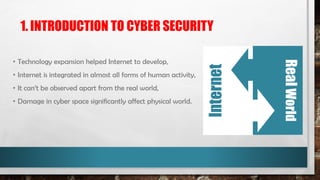
1. INTRODUCTION TO CYBER SECURITY
Internet
RealWorld
• Technology expansion helped Internet to develop,
• Internet is integrated in almost all forms of human activity,
• It can’t be observed apart from the real world,
• Damage in cyber space significantly affect physical world.
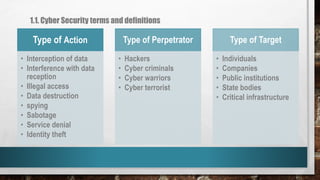
Type of Action
• Interception of data
• Interference with data
reception
• Illegal access
• Data destruction
• spying
• Sabotage
• Service denial
• Identity theft
Type of Perpetrator
• Hackers
• Cyber criminals
• Cyber warriors
• Cyber terrorist
Type of Target
• Individuals
• Companies
• Public institutions
• State bodies
• Critical infrastructure
1.1. Cyber Security terms and definitions
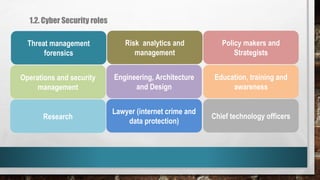
1.2. Cyber Security roles
Threat management
forensics
Risk analytics and
management
Policy makers and
Strategists
Engineering, Architecture
and Design
Education, training and
awareness
Operations and security
management
Lawyer (internet crime and
data protection)
Chief technology officersResearch
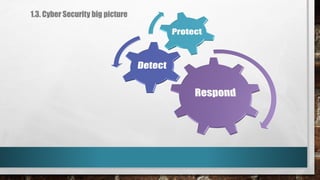
1.3. Cyber Security big picture
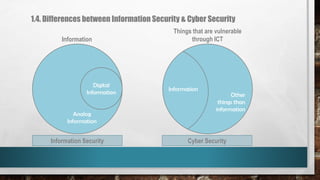
1.4. Differences between Information Security & Cyber Security
Digital
Information
Information
Other
things than
information
Analog
Information
Things that are vulnerable
through ICTInformation
Information Security Cyber Security
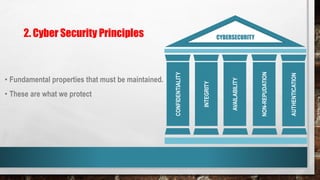
2. Cyber Security Principles
CONFIDENTIALITY
INTEGRITY
AVAILABILITY
NON-REPUDATION
AUTHENTICATION
CYBERSECURITY
• Fundamental properties that must be maintained.
• These are what we protect
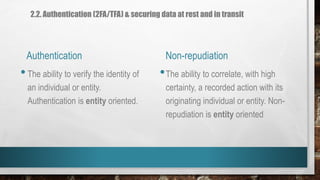
Authentication Non-repudiation
•The ability to verify the identity of
an individual or entity.
Authentication is entity oriented.
•The ability to correlate, with high
certainty, a recorded action with its
originating individual or entity. Non-
repudiation is entity oriented
2.2. Authentication (2FA/TFA) & securing data at rest and in transit
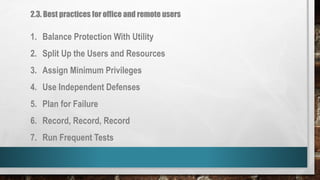
2.3. Best practices for office and remote users
1. Balance Protection With Utility
2. Split Up the Users and Resources
3. Assign Minimum Privileges
4. Use Independent Defenses
5. Plan for Failure
6. Record, Record, Record
7. Run Frequent Tests
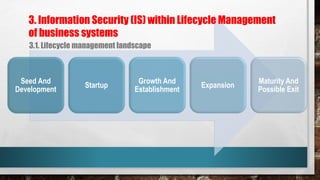
3.1. Lifecycle management landscape
Seed And
Development
Startup
Growth And
Establishment
Expansion
Maturity And
Possible Exit
3. Information Security (IS) within Lifecycle Management
of business systems
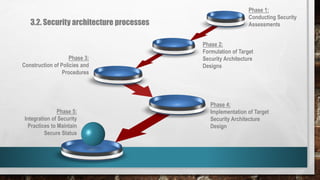
3.2. Security architecture processes
Phase 1:
Conducting Security
Assessments
Phase 5:
Integration of Security
Practices to Maintain
Secure Status
Phase 3:
Construction of Policies and
Procedures
Phase 2:
Formulation of Target
Security Architecture
Designs
Phase 4:
Implementation of Target
Security Architecture
Design
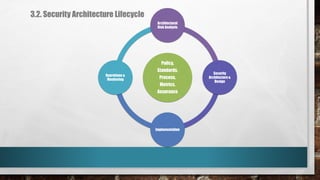
3.2. Security Architecture Lifecycle
Policy,
Standards,
Process,
Metrics,
Assurance
Architectural
Risk Analysis
Security
Architecture &
Design
Implementation
Operations &
Monitoring
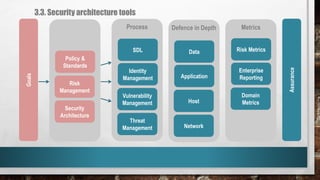
3.3. Security architecture tools
Process Defence in Depth Metrics
SDL
Identity
Management
Vulnerability
Management
Threat
Management
Data
Application
Host
Network
Risk Metrics
Enterprise
Reporting
Domain
Metrics
Assurance
Policy &
Standards
Risk
Management
Security
Architecture
Goals
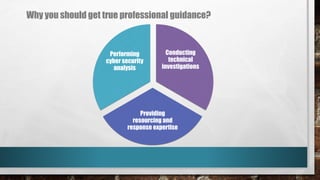
Why you should get true professional guidance?
Conducting
technical
investigations
Providing
resourcing and
response expertise
Performing
cyber security
analysis
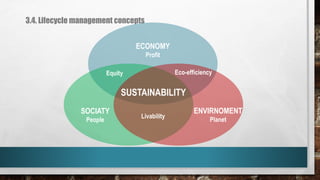
3.4. Lifecycle management concepts
ECONOMY
Profit
ENVIRNOMENT
Planet
SOCIATY
People
Livability
Eco-efficiencyEquity
SUSTAINABILITY
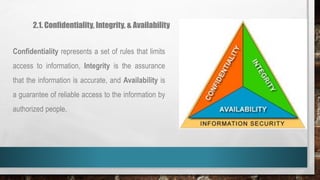
2.1. Confidentiality, Integrity, & Availability
Confidentiality represents a set of rules that limits
access to information, Integrity is the assurance
that the information is accurate, and Availability is
a guarantee of reliable access to the information by
authorized people.
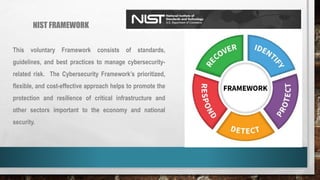
NIST FRAMEWORK
This voluntary Framework consists of standards,
guidelines, and best practices to manage cybersecurity-
related risk. The Cybersecurity Framework’s prioritized,
flexible, and cost-effective approach helps to promote the
protection and resilience of critical infrastructure and
other sectors important to the economy and national
security.
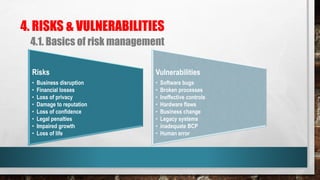
4. RISKS & VULNERABILITIES
4.1. Basics of risk management
Risks
• Business disruption
• Financial losses
• Loss of privacy
• Damage to reputation
• Loss of confidence
• Legal penalties
• Impaired growth
• Loss of life
Vulnerabilities
• Software bugs
• Broken processes
• Ineffective controls
• Hardware flaws
• Business change
• Legacy systems
• inadequate BCP
• Human error
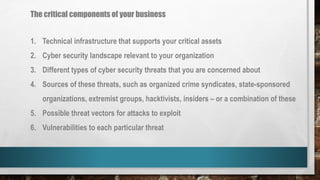
The critical components of your business
1. Technical infrastructure that supports your critical assets
2. Cyber security landscape relevant to your organization
3. Different types of cyber security threats that you are concerned about
4. Sources of these threats, such as organized crime syndicates, state-sponsored
organizations, extremist groups, hacktivists, insiders – or a combination of these
5. Possible threat vectors for attacks to exploit
6. Vulnerabilities to each particular threat
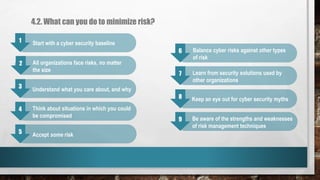
4.2. What can you do to minimize risk?
1
2
3
4
5
Start with a cyber security baseline
All organizations face risks, no matter
the size
Accept some risk
Think about situations in which you could
be compromised
Understand what you care about, and why
6
7
8
9
Balance cyber risks against other types
of risk
Learn from security solutions used by
other organizations
Keep an eye out for cyber security myths
Be aware of the strengths and weaknesses
of risk management techniques
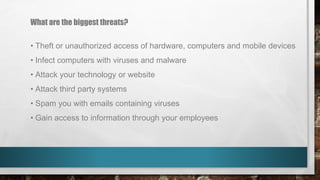
What are the biggest threats?
• Theft or unauthorized access of hardware, computers and mobile devices
• Infect computers with viruses and malware
• Attack your technology or website
• Attack third party systems
• Spam you with emails containing viruses
• Gain access to information through your employees
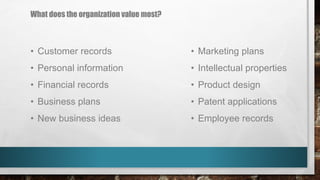
What does the organization value most?
• Customer records
• Personal information
• Financial records
• Business plans
• New business ideas
• Marketing plans
• Intellectual properties
• Product design
• Patent applications
• Employee records
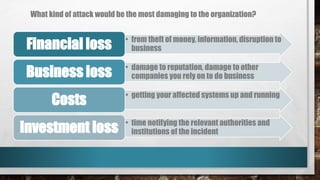
What kind of attack would be the most damaging to the organization?
• from theft of money, information, disruption to
businessFinancial loss
• damage to reputation, damage to other
companies you rely on to do businessBusiness loss
• getting your affected systems up and running
Costs
• time notifying the relevant authorities and
institutions of the incidentInvestment loss
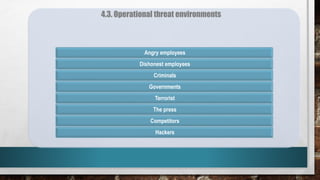
Angry employees
Dishonest employees
Criminals
Governments
Terrorist
The press
Competitors
Hackers
4.3. Operational threat environments
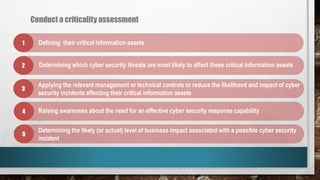
Conduct a criticality assessment
1
2
3
4
5
Defining their critical information assets
Determining which cyber security threats are most likely to affect these critical information assets
Determining the likely (or actual) level of business impact associated with a possible cyber security
incident
Raising awareness about the need for an effective cyber security response capability
Applying the relevant management or technical controls to reduce the likelihood and impact of cyber
security incidents affecting their critical information assets
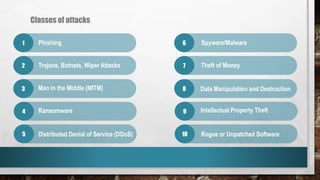
Classes of attacks
1
2
3
4
5
6
7
8
9
10
Phishing
Trojans, Botnets, Wiper Attacks
Distributed Denial of Service (DDoS)
Ransomware
Man in the Middle (MITM)
Spyware/Malware
Theft of Money
Data Manipulation and Destruction
Intellectual Property Theft
Rogue or Unpatched Software
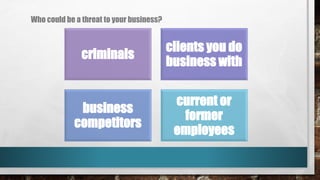
Who could be a threat to your business?
criminals
clients you do
business with
business
competitors
current or
former
employees
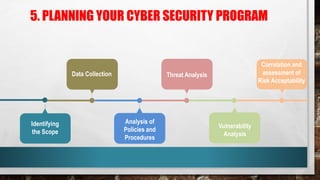
Data Collection
Identifying
the Scope
Analysis of
Policies and
Procedures
Threat Analysis
Vulnerability
Analysis
Correlation and
assessment of
Risk Acceptability
5. PLANNING YOUR CYBER SECURITY PROGRAM
This presentation – Cyber Security for Non-Tech Exec,
5.1. Templates for Immediate use
WWW.LINKEDIN.COM/IN/ROGERSWANSON (SLIDESHARE)
DR Checklist – action items listed for planning
https://www.slideshare.net/roger_swanson/12-point-disaster-checklist
Project Management - Cyber Planning NIST CSPW 04162018
https://www.slideshare.net/roger_swanson/framework-for-
improving-critical-infrastructure-cybersecurity-
nistcswp04162018
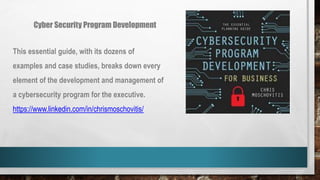
Cyber Security Program Development
This essential guide, with its dozens of
examples and case studies, breaks down every
element of the development and management of
a cybersecurity program for the executive.
https://www.linkedin.com/in/chrismoschovitis/
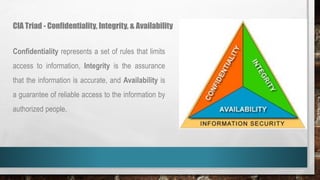
CIA Triad - Confidentiality, Integrity, & Availability
Confidentiality represents a set of rules that limits
access to information, Integrity is the assurance
that the information is accurate, and Availability is
a guarantee of reliable access to the information by
authorized people.
NIST FRAMEWORK
Cybersecurity Enhancement Act of 2014 –
CEA updated the role of the National Institute of Standards and Technology (NIST) to
“facilitate and support the development of” cybersecurity risk frameworks”.
Through CEA, NIST must identify:
“a prioritized, flexible, repeatable, performance-based, and cost-effective approach,
including information security measures and controls that may be voluntarily adopted by owners
and operators of critical infrastructure to help them identify, assess, and manage cyber risks.”
NIST FRAMEWORK
Cybersecurity Enhancement Act of 2014 –
CEA updated the role of the National Institute of Standards and Technology (NIST) to
“facilitate and support the development of” cybersecurity risk frameworks”.
Through CEA, NIST must identify:
“a prioritized, flexible, repeatable, performance-based, and cost-effective approach,
including information security measures and controls that may be voluntarily adopted by owners
and operators of critical infrastructure to help them identify, assess, and manage cyber risks.”
Copy this short cut to watch video - bit.ly/NIST-VIDEO-FRAMEWORK
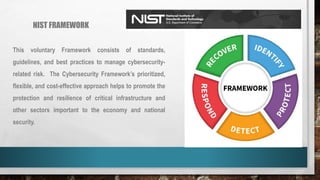
NIST FRAMEWORK
This voluntary Framework consists of standards,
guidelines, and best practices to manage cybersecurity-
related risk. The Cybersecurity Framework’s prioritized,
flexible, and cost-effective approach helps to promote the
protection and resilience of critical infrastructure and
other sectors important to the economy and national
security.
NIST FRAMEWORK
The Framework focuses on using business drivers to
guide cybersecurity activities and considering
cybersecurity risks as part of the organization’s risk
management processes. The Framework consists of three
parts: the Framework Core, the Implementation Tiers, and
the Framework Profiles
NIST FRAMEWORK
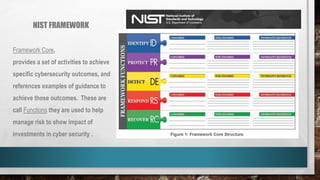
Framework Core,
provides a set of activities to achieve
specific cybersecurity outcomes, and
references examples of guidance to
achieve those outcomes. These are
call Functions they are used to help
manage risk to show impact of
investments in cyber security .
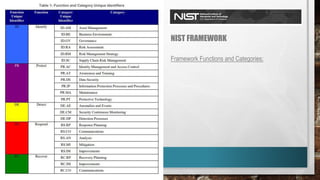
NIST FRAMEWORK
Framework Functions and Categories:
NIST FRAMEWORK
Implementation Tiers –
The Framework Implementation Tiers (“Tiers”) provide
context on how an organization views cybersecurity risk and
the processes in place to manage that risk. Ranging from
Partial (Tier 1) to Adaptive (Tier 4), Tiers describe an
increasing degree of rigor and sophistication in
cybersecurity risk management practices.
Implementation Tiers:
Tier 1 = not formalized, ad hoc
Tier 2 = aware not established
Tier 3 = formally approved, implemented
Tier 4 = formal program, using predictive &
risk informed tools with advanced
adaptive response to threats
NIST FRAMEWORK
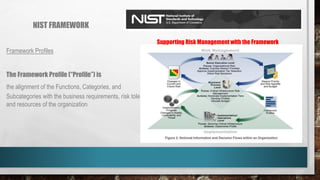
Framework Profiles
The Framework Profile (“Profile”) is
the alignment of the Functions, Categories, and
Subcategories with the business requirements, risk tolerance,
and resources of the organization
Supporting Risk Management with the Framework
NIST FRAMEWORK
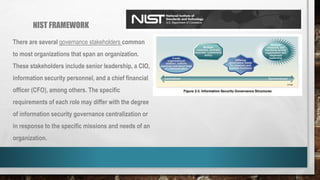
There are several governance stakeholders common
to most organizations that span an organization.
These stakeholders include senior leadership, a CIO,
information security personnel, and a chief financial
officer (CFO), among others. The specific
requirements of each role may differ with the degree
of information security governance centralization or
in response to the specific missions and needs of an
organization.
NIST FRAMEWORK
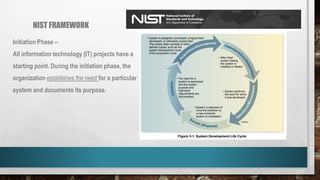
Initiation Phase –
All information technology (IT) projects have a
starting point. During the initiation phase, the
organization establishes the need for a particular
system and documents its purpose.
NIST FRAMEWORK
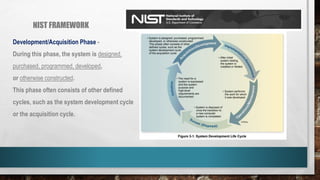
Development/Acquisition Phase -
During this phase, the system is designed,
purchased, programmed, developed,
or otherwise constructed.
This phase often consists of other defined
cycles, such as the system development cycle
or the acquisition cycle.
NIST FRAMEWORK
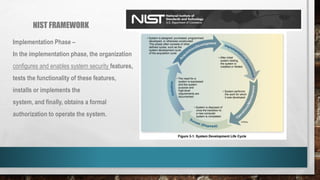
Implementation Phase –
In the implementation phase, the organization
configures and enables system security features,
tests the functionality of these features,
installs or implements the
system, and finally, obtains a formal
authorization to operate the system.
NIST FRAMEWORK
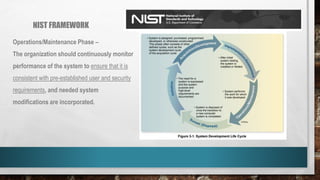
Operations/Maintenance Phase –
The organization should continuously monitor
performance of the system to ensure that it is
consistent with pre-established user and security
requirements, and needed system
modifications are incorporated.
NIST FRAMEWORK
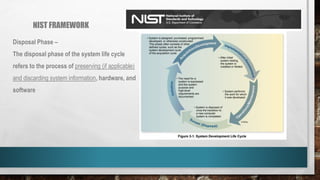
Disposal Phase –
The disposal phase of the system life cycle
refers to the process of preserving (if applicable)
and discarding system information, hardware, and
software
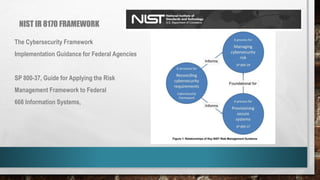
NIST IR 8170 FRAMEWORK
The Cybersecurity Framework
Implementation Guidance for Federal Agencies
SP 800-37, Guide for Applying the Risk
Management Framework to Federal
666 Information Systems,
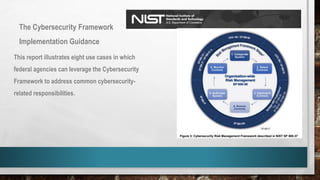
The Cybersecurity Framework
Implementation Guidance
This report illustrates eight use cases in which
federal agencies can leverage the Cybersecurity
Framework to address common cybersecurity-
related responsibilities.
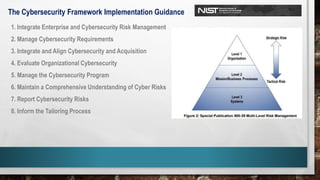
The Cybersecurity Framework Implementation Guidance
1. Integrate Enterprise and Cybersecurity Risk Management
2. Manage Cybersecurity Requirements
3. Integrate and Align Cybersecurity and Acquisition
4. Evaluate Organizational Cybersecurity
5. Manage the Cybersecurity Program
6. Maintain a Comprehensive Understanding of Cyber Risks
7. Report Cybersecurity Risks
8. Inform the Tailoring Process
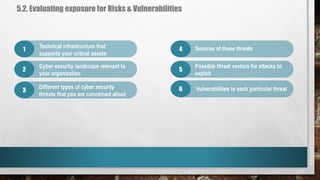
5.2. Evaluating exposure for Risks & Vulnerabilities
1
2
3
Technical infrastructure that
supports your critical assets
Cyber security landscape relevant to
your organization
Different types of cyber security
threats that you are concerned about
4
5
6
Possible threat vectors for attacks to
exploit
Sources of these threats
Vulnerabilities to each particular threat
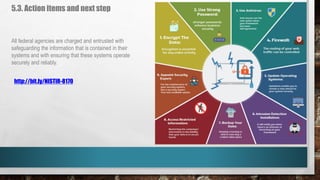
5.3. Action items and next step
All federal agencies are charged and entrusted with
safeguarding the information that is contained in their
systems and with ensuring that these systems operate
securely and reliably.
http://bit.ly/NISTIR-8170
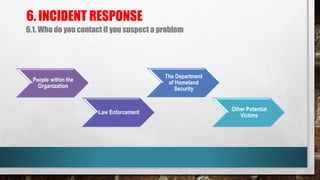
6.1. Who do you contact if you suspect a problem
People within the
Organization
Law Enforcement
The Department
of Homeland
Security
Other Potential
Victims
6. INCIDENT RESPONSE
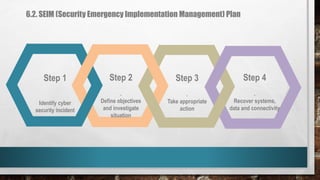
6.2. SEIM (Security Emergency Implementation Management) Plan
Step 1
Identify cyber
security incident
Step 2
.
Define objectives
and investigate
situation
Step 3
.
Take appropriate
action
Step 4
.
Recover systems,
data and connectivity
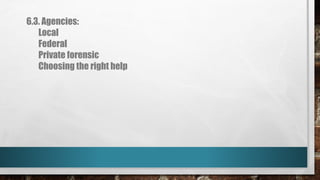
6.3. Agencies:
Local
Federal
Private forensic
Choosing the right help
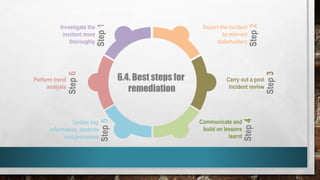
6.4. Best steps for
remediation
Investigate the
incident more
thoroughly
Step1
Report the incident
to relevant
stakeholders
Step2
Carry out a post
incident review
Step3
Perform trend
analysis
Step6
Communicate and
build on lessons
learnt
Step4
Update key
information, controls
and processes
Step5
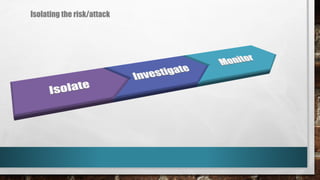
Isolating the risk/attack
6.5. Ongoing protection/prevention
• Develop clear policies and procedures for your business and employees.
• Produce a cyber security incident response management plan
• Train new and existing staff on your cyber security policies and procedures
• Keep your computers, website and Point-of-Sale (POS) systems up-to-date
• Ensure you back-up important data and information regularly
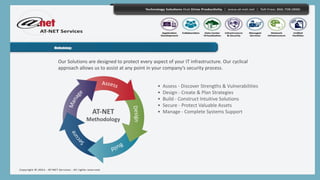
Methodology
Our Solutions are designed to protect every aspect of your IT infrastructure. Our cyclical
approach allows us to assist at any point in your company’s security process.
• Assess - Discover Strengths & Vulnerabilities
• Design - Create & Plan Strategies
• Build - Construct Intuitive Solutions
• Secure - Protect Valuable Assets
• Manage - Complete Systems Support
Locations:
Corporate Charlotte Office
3401 Vardell Lane, Suite D
Charlotte, NC 28217
Phone: 704.831.2500
Email: sales@at-net.net
Atlanta, GA Office
Phone: 866.275.4734
Charleston, SC Office
Phone: 843.576.3773
Columbia, SC Office
Phone: 803.929.5372
Greenville, SC Office
Phone: 864.679.0006
Knoxville, TN Office
Phone: 866.708.0886
Washington, DC Office
Phone: 877.734.4364
Questions & Answers
CYBER SECURITY FOR
NON-TECHNICAL
EXECUTIVE
ROGER.SWANSON@EXPERTIP.NET / 843-576-3773
@ROGER_SWANSON
HTTPS://WWW.LINKEDIN.COM/IN/ROGERSWANSON

Cyber Security for Non-Technical Executives (SC GMIS) Columbia, SC

  • 1.
  • 2.
    Corporate Overview AT-NET Servicesoffers comprehensive engineering services for the life cycle of your system; design, build, secure and manage
  • 3.
    CYBER SECURITY FOR NON-TECHNICAL EXECUTIVE ROGER.SWANSON@EXPERTIP.NET/ 843-576-3773 @ROGER_SWANSON HTTPS://WWW.LINKEDIN.COM/IN/ROGERSWANSON
  • 4.
    CYBER SECURITY FOR NON-TECHNICALEXECUTIVE AGENDA: - 45 MIN PRESENTATION, 10-MINUTE BREAK, - 30-MINUTE SECOND SESSION, - QUESTION & ANSWER PERIOD
  • 5.
    LEARNING OBJECTIVES 1.INTRODUCTION TOCYBER SECURITY 2.CYBER SECURITY PRINCIPLES 3.INFORMATION SECURITY LIFECYCLE MANAGEMENT 4.RISKS & VULNERABILITIES 5.PLANNING YOUR CYBER SECURITY PROGRAM 6.INCIDENT RESPONSE ACTIONS
  • 6.
    1. INTRODUCTION TOCYBER SECURITY Internet RealWorld • Technology expansion helped Internet to develop, • Internet is integrated in almost all forms of human activity, • It can’t be observed apart from the real world, • Damage in cyber space significantly affect physical world.
  • 8.
    Type of Action •Interception of data • Interference with data reception • Illegal access • Data destruction • spying • Sabotage • Service denial • Identity theft Type of Perpetrator • Hackers • Cyber criminals • Cyber warriors • Cyber terrorist Type of Target • Individuals • Companies • Public institutions • State bodies • Critical infrastructure 1.1. Cyber Security terms and definitions
  • 9.
    1.2. Cyber Securityroles Threat management forensics Risk analytics and management Policy makers and Strategists Engineering, Architecture and Design Education, training and awareness Operations and security management Lawyer (internet crime and data protection) Chief technology officersResearch
  • 10.
  • 11.
    1.4. Differences betweenInformation Security & Cyber Security Digital Information Information Other things than information Analog Information Things that are vulnerable through ICTInformation Information Security Cyber Security
  • 12.
    2. Cyber SecurityPrinciples CONFIDENTIALITY INTEGRITY AVAILABILITY NON-REPUDATION AUTHENTICATION CYBERSECURITY • Fundamental properties that must be maintained. • These are what we protect
  • 13.
    Authentication Non-repudiation •The abilityto verify the identity of an individual or entity. Authentication is entity oriented. •The ability to correlate, with high certainty, a recorded action with its originating individual or entity. Non- repudiation is entity oriented 2.2. Authentication (2FA/TFA) & securing data at rest and in transit
  • 14.
    2.3. Best practicesfor office and remote users 1. Balance Protection With Utility 2. Split Up the Users and Resources 3. Assign Minimum Privileges 4. Use Independent Defenses 5. Plan for Failure 6. Record, Record, Record 7. Run Frequent Tests
  • 15.
    3.1. Lifecycle managementlandscape Seed And Development Startup Growth And Establishment Expansion Maturity And Possible Exit 3. Information Security (IS) within Lifecycle Management of business systems
  • 16.
    3.2. Security architectureprocesses Phase 1: Conducting Security Assessments Phase 5: Integration of Security Practices to Maintain Secure Status Phase 3: Construction of Policies and Procedures Phase 2: Formulation of Target Security Architecture Designs Phase 4: Implementation of Target Security Architecture Design
  • 17.
    3.2. Security ArchitectureLifecycle Policy, Standards, Process, Metrics, Assurance Architectural Risk Analysis Security Architecture & Design Implementation Operations & Monitoring
  • 18.
    3.3. Security architecturetools Process Defence in Depth Metrics SDL Identity Management Vulnerability Management Threat Management Data Application Host Network Risk Metrics Enterprise Reporting Domain Metrics Assurance Policy & Standards Risk Management Security Architecture Goals
  • 19.
    Why you shouldget true professional guidance? Conducting technical investigations Providing resourcing and response expertise Performing cyber security analysis
  • 20.
    3.4. Lifecycle managementconcepts ECONOMY Profit ENVIRNOMENT Planet SOCIATY People Livability Eco-efficiencyEquity SUSTAINABILITY
  • 21.
    2.1. Confidentiality, Integrity,& Availability Confidentiality represents a set of rules that limits access to information, Integrity is the assurance that the information is accurate, and Availability is a guarantee of reliable access to the information by authorized people.
  • 22.
    NIST FRAMEWORK This voluntaryFramework consists of standards, guidelines, and best practices to manage cybersecurity- related risk. The Cybersecurity Framework’s prioritized, flexible, and cost-effective approach helps to promote the protection and resilience of critical infrastructure and other sectors important to the economy and national security.
  • 23.
    4. RISKS &VULNERABILITIES 4.1. Basics of risk management Risks • Business disruption • Financial losses • Loss of privacy • Damage to reputation • Loss of confidence • Legal penalties • Impaired growth • Loss of life Vulnerabilities • Software bugs • Broken processes • Ineffective controls • Hardware flaws • Business change • Legacy systems • inadequate BCP • Human error
  • 24.
    The critical componentsof your business 1. Technical infrastructure that supports your critical assets 2. Cyber security landscape relevant to your organization 3. Different types of cyber security threats that you are concerned about 4. Sources of these threats, such as organized crime syndicates, state-sponsored organizations, extremist groups, hacktivists, insiders – or a combination of these 5. Possible threat vectors for attacks to exploit 6. Vulnerabilities to each particular threat
  • 25.
    4.2. What canyou do to minimize risk? 1 2 3 4 5 Start with a cyber security baseline All organizations face risks, no matter the size Accept some risk Think about situations in which you could be compromised Understand what you care about, and why 6 7 8 9 Balance cyber risks against other types of risk Learn from security solutions used by other organizations Keep an eye out for cyber security myths Be aware of the strengths and weaknesses of risk management techniques
  • 26.
    What are thebiggest threats? • Theft or unauthorized access of hardware, computers and mobile devices • Infect computers with viruses and malware • Attack your technology or website • Attack third party systems • Spam you with emails containing viruses • Gain access to information through your employees
  • 27.
    What does theorganization value most? • Customer records • Personal information • Financial records • Business plans • New business ideas • Marketing plans • Intellectual properties • Product design • Patent applications • Employee records
  • 28.
    What kind ofattack would be the most damaging to the organization? • from theft of money, information, disruption to businessFinancial loss • damage to reputation, damage to other companies you rely on to do businessBusiness loss • getting your affected systems up and running Costs • time notifying the relevant authorities and institutions of the incidentInvestment loss
  • 29.
    Angry employees Dishonest employees Criminals Governments Terrorist Thepress Competitors Hackers 4.3. Operational threat environments
  • 30.
    Conduct a criticalityassessment 1 2 3 4 5 Defining their critical information assets Determining which cyber security threats are most likely to affect these critical information assets Determining the likely (or actual) level of business impact associated with a possible cyber security incident Raising awareness about the need for an effective cyber security response capability Applying the relevant management or technical controls to reduce the likelihood and impact of cyber security incidents affecting their critical information assets
  • 31.
    Classes of attacks 1 2 3 4 5 6 7 8 9 10 Phishing Trojans,Botnets, Wiper Attacks Distributed Denial of Service (DDoS) Ransomware Man in the Middle (MITM) Spyware/Malware Theft of Money Data Manipulation and Destruction Intellectual Property Theft Rogue or Unpatched Software
  • 32.
    Who could bea threat to your business? criminals clients you do business with business competitors current or former employees
  • 33.
    Data Collection Identifying the Scope Analysisof Policies and Procedures Threat Analysis Vulnerability Analysis Correlation and assessment of Risk Acceptability 5. PLANNING YOUR CYBER SECURITY PROGRAM
  • 34.
    This presentation –Cyber Security for Non-Tech Exec, 5.1. Templates for Immediate use WWW.LINKEDIN.COM/IN/ROGERSWANSON (SLIDESHARE) DR Checklist – action items listed for planning https://www.slideshare.net/roger_swanson/12-point-disaster-checklist Project Management - Cyber Planning NIST CSPW 04162018 https://www.slideshare.net/roger_swanson/framework-for- improving-critical-infrastructure-cybersecurity- nistcswp04162018
  • 35.
    Cyber Security ProgramDevelopment This essential guide, with its dozens of examples and case studies, breaks down every element of the development and management of a cybersecurity program for the executive. https://www.linkedin.com/in/chrismoschovitis/
  • 36.
    CIA Triad -Confidentiality, Integrity, & Availability Confidentiality represents a set of rules that limits access to information, Integrity is the assurance that the information is accurate, and Availability is a guarantee of reliable access to the information by authorized people.
  • 37.
    NIST FRAMEWORK Cybersecurity EnhancementAct of 2014 – CEA updated the role of the National Institute of Standards and Technology (NIST) to “facilitate and support the development of” cybersecurity risk frameworks”. Through CEA, NIST must identify: “a prioritized, flexible, repeatable, performance-based, and cost-effective approach, including information security measures and controls that may be voluntarily adopted by owners and operators of critical infrastructure to help them identify, assess, and manage cyber risks.”
  • 38.
    NIST FRAMEWORK Cybersecurity EnhancementAct of 2014 – CEA updated the role of the National Institute of Standards and Technology (NIST) to “facilitate and support the development of” cybersecurity risk frameworks”. Through CEA, NIST must identify: “a prioritized, flexible, repeatable, performance-based, and cost-effective approach, including information security measures and controls that may be voluntarily adopted by owners and operators of critical infrastructure to help them identify, assess, and manage cyber risks.” Copy this short cut to watch video - bit.ly/NIST-VIDEO-FRAMEWORK
  • 39.
    NIST FRAMEWORK This voluntaryFramework consists of standards, guidelines, and best practices to manage cybersecurity- related risk. The Cybersecurity Framework’s prioritized, flexible, and cost-effective approach helps to promote the protection and resilience of critical infrastructure and other sectors important to the economy and national security.
  • 40.
    NIST FRAMEWORK The Frameworkfocuses on using business drivers to guide cybersecurity activities and considering cybersecurity risks as part of the organization’s risk management processes. The Framework consists of three parts: the Framework Core, the Implementation Tiers, and the Framework Profiles
  • 41.
    NIST FRAMEWORK Framework Core, providesa set of activities to achieve specific cybersecurity outcomes, and references examples of guidance to achieve those outcomes. These are call Functions they are used to help manage risk to show impact of investments in cyber security .
  • 42.
  • 43.
    NIST FRAMEWORK Implementation Tiers– The Framework Implementation Tiers (“Tiers”) provide context on how an organization views cybersecurity risk and the processes in place to manage that risk. Ranging from Partial (Tier 1) to Adaptive (Tier 4), Tiers describe an increasing degree of rigor and sophistication in cybersecurity risk management practices. Implementation Tiers: Tier 1 = not formalized, ad hoc Tier 2 = aware not established Tier 3 = formally approved, implemented Tier 4 = formal program, using predictive & risk informed tools with advanced adaptive response to threats
  • 44.
    NIST FRAMEWORK Framework Profiles TheFramework Profile (“Profile”) is the alignment of the Functions, Categories, and Subcategories with the business requirements, risk tolerance, and resources of the organization Supporting Risk Management with the Framework
  • 45.
    NIST FRAMEWORK There areseveral governance stakeholders common to most organizations that span an organization. These stakeholders include senior leadership, a CIO, information security personnel, and a chief financial officer (CFO), among others. The specific requirements of each role may differ with the degree of information security governance centralization or in response to the specific missions and needs of an organization.
  • 46.
    NIST FRAMEWORK Initiation Phase– All information technology (IT) projects have a starting point. During the initiation phase, the organization establishes the need for a particular system and documents its purpose.
  • 47.
    NIST FRAMEWORK Development/Acquisition Phase- During this phase, the system is designed, purchased, programmed, developed, or otherwise constructed. This phase often consists of other defined cycles, such as the system development cycle or the acquisition cycle.
  • 48.
    NIST FRAMEWORK Implementation Phase– In the implementation phase, the organization configures and enables system security features, tests the functionality of these features, installs or implements the system, and finally, obtains a formal authorization to operate the system.
  • 49.
    NIST FRAMEWORK Operations/Maintenance Phase– The organization should continuously monitor performance of the system to ensure that it is consistent with pre-established user and security requirements, and needed system modifications are incorporated.
  • 50.
    NIST FRAMEWORK Disposal Phase– The disposal phase of the system life cycle refers to the process of preserving (if applicable) and discarding system information, hardware, and software
  • 51.
    NIST IR 8170FRAMEWORK The Cybersecurity Framework Implementation Guidance for Federal Agencies SP 800-37, Guide for Applying the Risk Management Framework to Federal 666 Information Systems,
  • 52.
    The Cybersecurity Framework ImplementationGuidance This report illustrates eight use cases in which federal agencies can leverage the Cybersecurity Framework to address common cybersecurity- related responsibilities.
  • 53.
    The Cybersecurity FrameworkImplementation Guidance 1. Integrate Enterprise and Cybersecurity Risk Management 2. Manage Cybersecurity Requirements 3. Integrate and Align Cybersecurity and Acquisition 4. Evaluate Organizational Cybersecurity 5. Manage the Cybersecurity Program 6. Maintain a Comprehensive Understanding of Cyber Risks 7. Report Cybersecurity Risks 8. Inform the Tailoring Process
  • 54.
    5.2. Evaluating exposurefor Risks & Vulnerabilities 1 2 3 Technical infrastructure that supports your critical assets Cyber security landscape relevant to your organization Different types of cyber security threats that you are concerned about 4 5 6 Possible threat vectors for attacks to exploit Sources of these threats Vulnerabilities to each particular threat
  • 55.
    5.3. Action itemsand next step All federal agencies are charged and entrusted with safeguarding the information that is contained in their systems and with ensuring that these systems operate securely and reliably. http://bit.ly/NISTIR-8170
  • 56.
    6.1. Who doyou contact if you suspect a problem People within the Organization Law Enforcement The Department of Homeland Security Other Potential Victims 6. INCIDENT RESPONSE
  • 57.
    6.2. SEIM (SecurityEmergency Implementation Management) Plan Step 1 Identify cyber security incident Step 2 . Define objectives and investigate situation Step 3 . Take appropriate action Step 4 . Recover systems, data and connectivity
  • 58.
  • 59.
    6.4. Best stepsfor remediation Investigate the incident more thoroughly Step1 Report the incident to relevant stakeholders Step2 Carry out a post incident review Step3 Perform trend analysis Step6 Communicate and build on lessons learnt Step4 Update key information, controls and processes Step5
  • 60.
  • 61.
    6.5. Ongoing protection/prevention •Develop clear policies and procedures for your business and employees. • Produce a cyber security incident response management plan • Train new and existing staff on your cyber security policies and procedures • Keep your computers, website and Point-of-Sale (POS) systems up-to-date • Ensure you back-up important data and information regularly
  • 62.
    Methodology Our Solutions aredesigned to protect every aspect of your IT infrastructure. Our cyclical approach allows us to assist at any point in your company’s security process. • Assess - Discover Strengths & Vulnerabilities • Design - Create & Plan Strategies • Build - Construct Intuitive Solutions • Secure - Protect Valuable Assets • Manage - Complete Systems Support
  • 63.
    Locations: Corporate Charlotte Office 3401Vardell Lane, Suite D Charlotte, NC 28217 Phone: 704.831.2500 Email: sales@at-net.net Atlanta, GA Office Phone: 866.275.4734 Charleston, SC Office Phone: 843.576.3773 Columbia, SC Office Phone: 803.929.5372 Greenville, SC Office Phone: 864.679.0006 Knoxville, TN Office Phone: 866.708.0886 Washington, DC Office Phone: 877.734.4364
  • 64.
  • 65.
    CYBER SECURITY FOR NON-TECHNICAL EXECUTIVE ROGER.SWANSON@EXPERTIP.NET/ 843-576-3773 @ROGER_SWANSON HTTPS://WWW.LINKEDIN.COM/IN/ROGERSWANSON