Non Steroidal Anti inflammatory
Drugs
 Hira shahid
OF NSAIDS
 It is a normal , protective response to tissues
injury caused by physical trauma, noxious
chemicals, or microbiologic agents.
 Inflammation is mediated by release of chemical
mediators from the injured tissues such as
histamine, prostaglandins, bradykinins, etc.
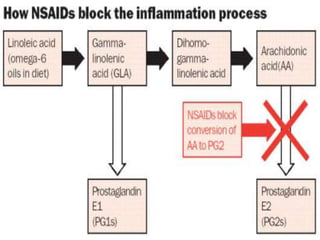
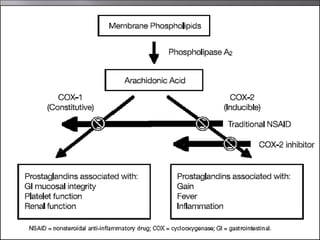
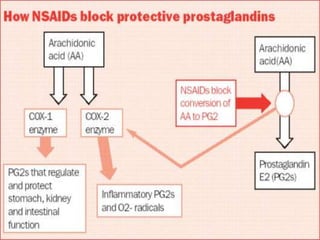
All of the NSAIDS basically act by
inhibiting the synthesis of
Prostaglandins
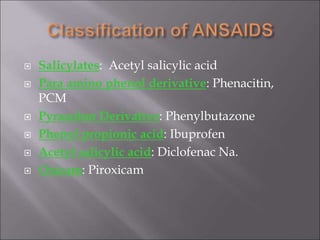
 Salicylates: Acetyl salicylic acid
 Para amino phenol derivative: Phenacitin,
PCM
 Pyrazolon Derivative: Phenylbutazone
 Phenyl propionic acid: Ibuprofen
 Acetyl salicylic acid: Diclofenac Na.
 Oxicam: Piroxicam
 Primary Character:
Origin:
Synthetics
 Pharmacologic groups:
 NSAIDS (Non-Steroidal anti inflammatory drugs)
 Pharmacokinetics:
 Bioavailability: 100%
 Protein binding: More than 99%
 Metabolism: Hepatic, no active metabolism
exist
 Half life: 1.2-2hrs
 Excretion: Biliary, only1%in urine
 High risk group:
 Pregnant females.
 Indication:
 To reduce inflammation as an analgesic in condition such
as arthritis or acute injury, menstrual pain,
dysmenorrheal, rheumatoid arthritis, osteoarthritis, dental
pain, spondylarthritis, gout attacks, pain management in
case of kidney stone and gall stones.
 Contraindication:
 Hypersensitivity to diclofenac, peptic ulcer, ulcerative
colitis, severs liver insufficiency, renal insufficiency.
 Sides’ effects:
 Diclofenac is better tolerated. However transient epigastic
pain, GI disturbances, headache, odema was observed.
Rarely peptic ulcer, skin rashes, pain at inj site.
 Interactions:
 Salicylates, methotrexate, lithium, digoxin, diuretics, cyclosporine,
anticoagulants , oralhypoglycaemics, quinolones,NSAIDS, steroids.
 Warning and precautions:
 A warning has been issued by FDA not to be used to treat patients
recovering from heart surgery, caution in patients with severe active
bleeding such as cerebral hemorrhage. Monitor patients on long
term treatment. Pregnancy, lactation. Hepatic porphyria
and elderly.
 Available dosage forms:
 Oral (Tablet, capsule), inject able (I/M, I/V), topical.
 Doses:
 Adult dose: 75-150 mg daily in two or three divided doses orally.
 Children: Over one year 1-3 mg/Kg body weight daily in divided doses
orally.
 Primary characters
 Origin ; synthetic
 Chemical class; propionic acid derivative
 Pharmacological group; NSAIDS , antipyretic ,non-narcotic
,analgesic
 PHARMACOKINETIC
 Volume of distribution; 0.14lL/kg
 Half life; 2-4 HR
 Plasma protien binding=,;99%
 HIGH RISK GROUP;
 pregnant women
 INDICATIONS;
 pain & fever
 CONTRAINDICATION
 ;hpersensitivity to NSAIDs ,(including symptoms of
asthma)
 ADVERSE DRUG REACTIONS;
 CHF, GI bleeding, nephrotoxicity, dry mouth, anorexia
 INTERACTIONS;
 amino glycosides , anti coagulants , ACE inhibitors , alpha blockers
 DOSE;
 adults 1200-1800mg thrice daily
 Max 2-4g daily
 DOSAGE FORM AVAILABE; ibuprofen Tab 200mg
 Brufen Tab 200mg.400mg,600mg
 Susp 5ml/100mg
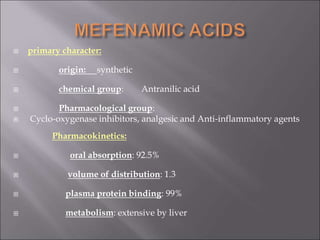
 primary character:
 origin: synthetic
 chemical group: Antranilic acid
 Pharmacological group:
 Cyclo-oxygenase inhibitors, analgesic and Anti-inflammatory agents
Pharmacokinetics:
 oral absorption: 92.5%
 volume of distribution: 1.3
 plasma protein binding: 99%
 metabolism: extensive by liver
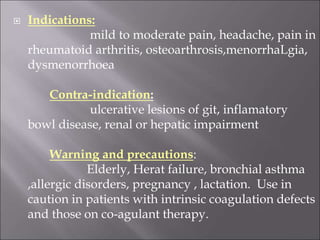
 Indications:
mild to moderate pain, headache, pain in
rheumatoid arthritis, osteoarthrosis,menorrhaLgia,
dysmenorrhoea
Contra-indication:
ulcerative lesions of git, inflamatory
bowl disease, renal or hepatic impairment
Warning and precautions:
Elderly, Herat failure, bronchial asthma
,allergic disorders, pregnancy , lactation. Use in
caution in patients with intrinsic coagulation defects
and those on co-agulant therapy.
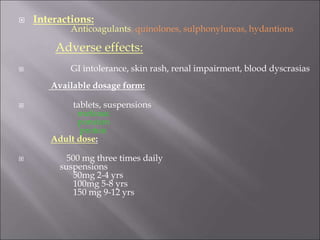
 Interactions:
Anticoagulants, quinolones, sulphonylureas, hydantions
Adverse effects:
 GI intolerance, skin rash, renal impairment, blood dyscrasias
Available dosage form:
 tablets, suspensions
mefanac
ponston
proton
Adult dose:
 500 mg three times daily
suspensions
50mg 2-4 yrs
100mg 5-8 yrs
150 mg 9-12 yrs
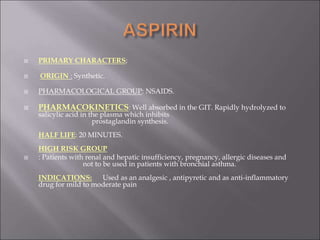
 PRIMARY CHARACTERS;
 ORIGIN : Synthetic.
 PHARMACOLOGICAL GROUP: NSAIDS.
 PHARMACOKINETICS: Well absorbed in the GIT. Rapidly hydrolyzed to
salicylic acid in the plasma which inhibits
prostaglandin synthesis.
HALF LIFE: 20 MINUTES.
HIGH RISK GROUP
 : Patients with renal and hepatic insufficiency, pregnancy, allergic diseases and
not to be used in patients with bronchial asthma.
INDICATIONS: Used as an analgesic , antipyretic and as anti-inflammatory
drug for mild to moderate pain
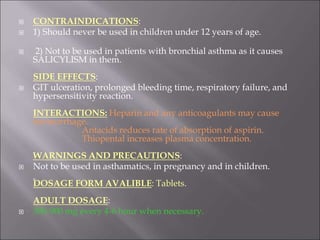
 CONTRAINDICATIONS:
 1) Should never be used in children under 12 years of age.
 2) Not to be used in patients with bronchial asthma as it causes
SALICYLISM in them.
SIDE EFFECTS:
 GIT ulceration, prolonged bleeding time, respiratory failure, and
hypersensitivity reaction.
INTERACTIONS: Heparin and any anticoagulants may cause
haemorrhage.
Antacids reduces rate of absorption of aspirin.
Thiopental increases plasma concentration.
WARNINGS AND PRECAUTIONS:
 Not to be used in asthamatics, in pregnancy and in children.
DOSAGE FORM AVALIBLE: Tablets.
ADULT DOSAGE:
 300-900 mg every 4-6 hour when necessary.
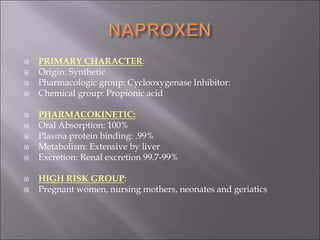
 PRIMARY CHARACTER:
 Origin: Synthetic
 Pharmacologic group: Cyclooxygenase Inhibitor:
 Chemical group: Propionic acid
 PHARMACOKINETIC:
 Oral Absorption: 100%
 Plasma protein binding: .99%
 Metabolism: Extensive by liver
 Excretion: Renal excretion 99.7-99%
 HIGH RISK GROUP:
 Pregnant women, nursing mothers, neonates and geriatics
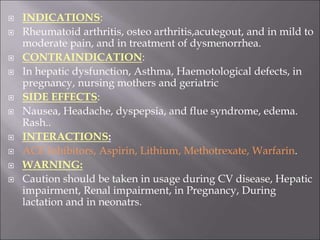
 INDICATIONS:
 Rheumatoid arthritis, osteo arthritis,acutegout, and in mild to
moderate pain, and in treatment of dysmenorrhea.
 CONTRAINDICATION:
 In hepatic dysfunction, Asthma, Haemotological defects, in
pregnancy, nursing mothers and geriatric
 SIDE EFFECTS:
 Nausea, Headache, dyspepsia, and flue syndrome, edema.
Rash..
 INTERACTIONS:
 ACE Inhibitors, Aspirin, Lithium, Methotrexate, Warfarin.
 WARNING:
 Caution should be taken in usage during CV disease, Hepatic
impairment, Renal impairment, in Pregnancy, During
lactation and in neonatrs.
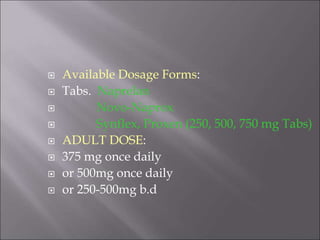
 Available Dosage Forms:
 Tabs. Naprelan
 Novo-Naprox
 Synflex, Proxen (250, 500, 750 mg Tabs)
 ADULT DOSE:
 375 mg once daily
 or 500mg once daily
 or 250-500mg b.d
 PRIMARY CHARACTERISTICS:
 Origin: Synthetic
 Pharmacological Group: : Non Opoid analgesic
 Chemical group: Aniline derivative
 PHARMACOKINETIC:
 Metabolism: Extensive by liver
 Excretion: Renal excretion 99.7-99%
 HIGH RISK GROUP:
 Pts with hepatic insufficiency
 INDICATIONS:
 Mild to moderate pain, for analgesia in Aspirin allergic patients. Fever
 CONTRAINDICATIONS:
 Hypersensitivity to acetaminophen, Impaired hepatic
function.
 INTERACTIONS:
 Anticoagulant, anti convalsants, Rifampicin, Ethanol,
Isoniazid
 SIDEEFFECTS:
 Dizziness, hypoglycemia, skin rashes, drug fever,
 LIVER: At therapeutic doses, mild increase in hepatic
enzyme but in case of injestion of 15g or more, causes severe
hepatotoxicity with liver necrosis.
 WARNING: in patients with Hepatic Insufficiency.
 DOSE:
 325-500MG q.d orally
 DOSAGE FORM AVAILABLE:
 Tabs. Elixirs, Suspensions, Syrups
 Paraheim.
 Paramac,Panadol, Panadol Extra.
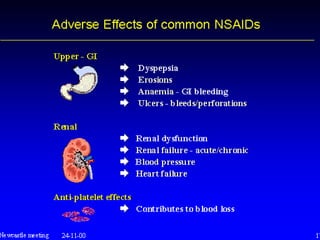
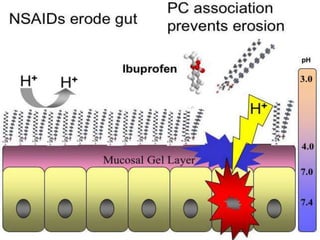
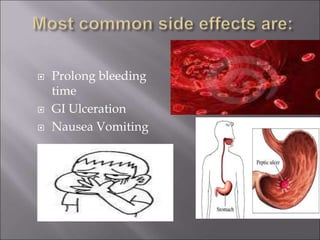
 Prolong bleeding
time
 GI Ulceration
 Nausea Vomiting
NSAIDS.ppt
NSAIDS.ppt

NSAIDS.ppt

  • 2.
    Non Steroidal Antiinflammatory Drugs
  • 3.
  • 4.
  • 5.
     It isa normal , protective response to tissues injury caused by physical trauma, noxious chemicals, or microbiologic agents.  Inflammation is mediated by release of chemical mediators from the injured tissues such as histamine, prostaglandins, bradykinins, etc.
  • 6.
    All of theNSAIDS basically act by inhibiting the synthesis of Prostaglandins
  • 9.
     Salicylates: Acetylsalicylic acid  Para amino phenol derivative: Phenacitin, PCM  Pyrazolon Derivative: Phenylbutazone  Phenyl propionic acid: Ibuprofen  Acetyl salicylic acid: Diclofenac Na.  Oxicam: Piroxicam
  • 12.
     Primary Character: Origin: Synthetics Pharmacologic groups:  NSAIDS (Non-Steroidal anti inflammatory drugs)  Pharmacokinetics:  Bioavailability: 100%  Protein binding: More than 99%
  • 13.
     Metabolism: Hepatic,no active metabolism exist  Half life: 1.2-2hrs  Excretion: Biliary, only1%in urine  High risk group:  Pregnant females.
  • 14.
     Indication:  Toreduce inflammation as an analgesic in condition such as arthritis or acute injury, menstrual pain, dysmenorrheal, rheumatoid arthritis, osteoarthritis, dental pain, spondylarthritis, gout attacks, pain management in case of kidney stone and gall stones.  Contraindication:  Hypersensitivity to diclofenac, peptic ulcer, ulcerative colitis, severs liver insufficiency, renal insufficiency.  Sides’ effects:  Diclofenac is better tolerated. However transient epigastic pain, GI disturbances, headache, odema was observed. Rarely peptic ulcer, skin rashes, pain at inj site.
  • 15.
     Interactions:  Salicylates,methotrexate, lithium, digoxin, diuretics, cyclosporine, anticoagulants , oralhypoglycaemics, quinolones,NSAIDS, steroids.  Warning and precautions:  A warning has been issued by FDA not to be used to treat patients recovering from heart surgery, caution in patients with severe active bleeding such as cerebral hemorrhage. Monitor patients on long term treatment. Pregnancy, lactation. Hepatic porphyria and elderly.  Available dosage forms:  Oral (Tablet, capsule), inject able (I/M, I/V), topical.  Doses:  Adult dose: 75-150 mg daily in two or three divided doses orally.  Children: Over one year 1-3 mg/Kg body weight daily in divided doses orally.
  • 16.
     Primary characters Origin ; synthetic  Chemical class; propionic acid derivative  Pharmacological group; NSAIDS , antipyretic ,non-narcotic ,analgesic  PHARMACOKINETIC  Volume of distribution; 0.14lL/kg  Half life; 2-4 HR  Plasma protien binding=,;99%
  • 17.
     HIGH RISKGROUP;  pregnant women  INDICATIONS;  pain & fever  CONTRAINDICATION  ;hpersensitivity to NSAIDs ,(including symptoms of asthma)  ADVERSE DRUG REACTIONS;  CHF, GI bleeding, nephrotoxicity, dry mouth, anorexia  INTERACTIONS;  amino glycosides , anti coagulants , ACE inhibitors , alpha blockers  DOSE;  adults 1200-1800mg thrice daily  Max 2-4g daily  DOSAGE FORM AVAILABE; ibuprofen Tab 200mg  Brufen Tab 200mg.400mg,600mg  Susp 5ml/100mg
  • 19.
     primary character: origin: synthetic  chemical group: Antranilic acid  Pharmacological group:  Cyclo-oxygenase inhibitors, analgesic and Anti-inflammatory agents Pharmacokinetics:  oral absorption: 92.5%  volume of distribution: 1.3  plasma protein binding: 99%  metabolism: extensive by liver
  • 20.
     Indications: mild tomoderate pain, headache, pain in rheumatoid arthritis, osteoarthrosis,menorrhaLgia, dysmenorrhoea Contra-indication: ulcerative lesions of git, inflamatory bowl disease, renal or hepatic impairment Warning and precautions: Elderly, Herat failure, bronchial asthma ,allergic disorders, pregnancy , lactation. Use in caution in patients with intrinsic coagulation defects and those on co-agulant therapy.
  • 21.
     Interactions: Anticoagulants, quinolones,sulphonylureas, hydantions Adverse effects:  GI intolerance, skin rash, renal impairment, blood dyscrasias Available dosage form:  tablets, suspensions mefanac ponston proton Adult dose:  500 mg three times daily suspensions 50mg 2-4 yrs 100mg 5-8 yrs 150 mg 9-12 yrs
  • 22.
     PRIMARY CHARACTERS; ORIGIN : Synthetic.  PHARMACOLOGICAL GROUP: NSAIDS.  PHARMACOKINETICS: Well absorbed in the GIT. Rapidly hydrolyzed to salicylic acid in the plasma which inhibits prostaglandin synthesis. HALF LIFE: 20 MINUTES. HIGH RISK GROUP  : Patients with renal and hepatic insufficiency, pregnancy, allergic diseases and not to be used in patients with bronchial asthma. INDICATIONS: Used as an analgesic , antipyretic and as anti-inflammatory drug for mild to moderate pain
  • 23.
     CONTRAINDICATIONS:  1)Should never be used in children under 12 years of age.  2) Not to be used in patients with bronchial asthma as it causes SALICYLISM in them. SIDE EFFECTS:  GIT ulceration, prolonged bleeding time, respiratory failure, and hypersensitivity reaction. INTERACTIONS: Heparin and any anticoagulants may cause haemorrhage. Antacids reduces rate of absorption of aspirin. Thiopental increases plasma concentration. WARNINGS AND PRECAUTIONS:  Not to be used in asthamatics, in pregnancy and in children. DOSAGE FORM AVALIBLE: Tablets. ADULT DOSAGE:  300-900 mg every 4-6 hour when necessary.
  • 24.
     PRIMARY CHARACTER: Origin: Synthetic  Pharmacologic group: Cyclooxygenase Inhibitor:  Chemical group: Propionic acid  PHARMACOKINETIC:  Oral Absorption: 100%  Plasma protein binding: .99%  Metabolism: Extensive by liver  Excretion: Renal excretion 99.7-99%  HIGH RISK GROUP:  Pregnant women, nursing mothers, neonates and geriatics
  • 25.
     INDICATIONS:  Rheumatoidarthritis, osteo arthritis,acutegout, and in mild to moderate pain, and in treatment of dysmenorrhea.  CONTRAINDICATION:  In hepatic dysfunction, Asthma, Haemotological defects, in pregnancy, nursing mothers and geriatric  SIDE EFFECTS:  Nausea, Headache, dyspepsia, and flue syndrome, edema. Rash..  INTERACTIONS:  ACE Inhibitors, Aspirin, Lithium, Methotrexate, Warfarin.  WARNING:  Caution should be taken in usage during CV disease, Hepatic impairment, Renal impairment, in Pregnancy, During lactation and in neonatrs.
  • 26.
     Available DosageForms:  Tabs. Naprelan  Novo-Naprox  Synflex, Proxen (250, 500, 750 mg Tabs)  ADULT DOSE:  375 mg once daily  or 500mg once daily  or 250-500mg b.d
  • 27.
     PRIMARY CHARACTERISTICS: Origin: Synthetic  Pharmacological Group: : Non Opoid analgesic  Chemical group: Aniline derivative  PHARMACOKINETIC:  Metabolism: Extensive by liver  Excretion: Renal excretion 99.7-99%  HIGH RISK GROUP:  Pts with hepatic insufficiency  INDICATIONS:  Mild to moderate pain, for analgesia in Aspirin allergic patients. Fever
  • 28.
     CONTRAINDICATIONS:  Hypersensitivityto acetaminophen, Impaired hepatic function.  INTERACTIONS:  Anticoagulant, anti convalsants, Rifampicin, Ethanol, Isoniazid  SIDEEFFECTS:  Dizziness, hypoglycemia, skin rashes, drug fever,  LIVER: At therapeutic doses, mild increase in hepatic enzyme but in case of injestion of 15g or more, causes severe hepatotoxicity with liver necrosis.  WARNING: in patients with Hepatic Insufficiency.  DOSE:  325-500MG q.d orally  DOSAGE FORM AVAILABLE:  Tabs. Elixirs, Suspensions, Syrups  Paraheim.  Paramac,Panadol, Panadol Extra.
  • 29.
     Prolong bleeding time GI Ulceration  Nausea Vomiting