

Haemostatic Agents
Dr. Pravin Prasad
M.B.B.S., MD Clinical Pharmacology
Lecturer, Lumbini Medical College
June 6, 2018 (Jestha 23, 2075), Wednesday
By the end of the class, MBBS
Semester II students will be able to:
 Classify drugs used as haemostatic agents
 Describe the pharmacology of Vitamin K
 List the agents used for local haemostasis
 Describe the pharmacology of antifibrinolytic
drugs
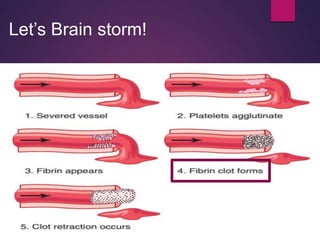
Lets Brain storm!
 Define:
Haemostasis
Haemophilia
 How is haemostasis achieved?
Let’s Brain storm!
Classification
 Coagulants
 Fresh whole blood/ plasma
 Vitamin K: K1 , K3
 Miscellaneous: Fibrinogen, Antihaemophilic factor
 Local Haemostatics
 Styptics: fibrin, thrombin, vasoconstrictors, astringents
 Sclerosing agents
 Anti-fibrinolytics
 Epsilon amino-caproic acid (EACA), Tranexamic acid
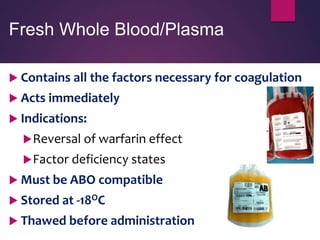
 Contains all the factors necessary for coagulation
 Acts immediately
 Indications:
Reversal of warfarin effect
Factor deficiency states
 Must be ABO compatible
 Stored at -18OC
 Thawed before administration
Fresh Whole Blood/Plasma
Vitamin K
 K1:
Phytonadione, Phylloquinone
Plant source, Fat soluble
 K3:
Synthetic
Fat soluble: Menadione, acetomenaphthone
Water soluble: Menadione sod. bisulphite,
menadione sod. diphosphate
Vitamin K
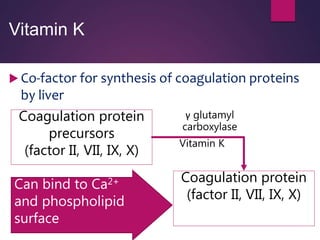
 Co-factor for synthesis of coagulation proteins
by liver
Coagulation protein
precursors
(factor II, VII, IX, X)
Coagulation protein
(factor II, VII, IX, X)
γ glutamyl
carboxylase
Vitamin K
Can bind to Ca2+
and phospholipid
surface
Vitamin K
 Absorption
Fat soluble: lymphatics of intestine, bile salts
required
Water soluble: portal blood
 Distribution: Temporarily stored in liver
 Metabolism: Liver (side chain cleavage and
glucuronidation)
 Excretion: bile and urine
Vitamin K: Uses
 Newborn baby
Prevent/treat haemorrhagic disease of the
newborn
 Overdose of oral anticoagulants
Phytonandione
 Prolonged high dose salicylate therapy
Vitamin K: Uses
 Dietary deficiency
 Prolonged antimicrobial therapy
 Obstructive jaundice
 Malabsorption syndromes
Sprue, Regional ileitis, Steatorrhoea
 Liver disease
Vitamin K: Adverse effects
 Oral, intra-muscular injection:
Safe
 Intra-venous injection:
 severe anaphylactoid reaction by emulsified
preparation
 Menadione, Water soluble K3:
Haemolysis in dose-dependent manner
Kernicterus in newborn
Miscellaneous
 Fibrinogen:
Fraction of human plasma
Indications:
Haemophilia
Anti-haemophilic globulin (AHG) deficiency
Acute afibrinogenemic states
Intra-venous infusion, 0.5 gm
Miscellaneous
 Anti-haemophilic factor(AHG):
Concentrated human AHG
Short lasting action
Indications: (along with human fibrinogen)
Haemophilia
AHG deficiency
Intra-venous infusion, 5-10U/kg, every 6-12 hrs
Miscellaneous
 Desmopressin:
Acts on V2 receptors (vascular endothelium)
Releases factor VIII and von Willebrand’s
factor from vascular endothelium
Also induces platelet aggregation
Indications:
Haemophilia
von Willebrand’s disease
Miscellaneous
 Ethamsylate:
Exerts anti-hyaluronidase action, corrects
abnormalities of platelet adhesion
Controls capillary bleeding with adequate
platelets
Indications: capillary bleeding states
Side effects: nausea, rash, headache, fall in BP
(on i.v. injection)
Miscellaneous
 Uncertain efficacy
Adrenochrome monosemicarbazone:
Probably acts by reducing capillary fragility
Control oozing from raw surface, prevent
micro-vessel bleeding
Rutin:
Plant glycoside
Reduces capillary bleeding
Local Haemostatics (Styptics)
 To control bleeding from approachable sites
 Non-pharmacological treatment
 Fibrin (sheet or foam)
Prepared from human plasma
 Gelatin foam, oxidised cellulose
 Thrombin powder
Bovine source
Local Haemostatics (Styptics)
Oxidised Cellulose sheet
Local Haemostatics (Styptics)
 Fibrin (sheet or foam), Gelatin foam, oxidised
cellulose, Thrombin powder
 Acts by:
Providing meshwork  activates clotting
mechanism
 Gets absorbed in 1-4 weeks
 Indication:
To stop oozing of blood: tooth socket,
abrasions, etc
Local Haemostatics (Styptics)
 Astringents
Tannic acid, metallic salts (Alum)
Precipitates proteins  toughens the
surface
Bleeding gums, bleeding piles
 Vasoconstrictors
Adrenaline 0.1%
Local Hemostatics (Styptics)
 Sclerosing agents
Sodium tetradecyl sulfate, Polidocanol
Irritants
Inflammation  coagulation  fibrosis
Injected locally
Haemorrhoids (piles), varicose vein mass
Antifibrinolytic Drugs
 Epsilon amino-capric acid (EACA), Tranexamic
acid
Binds to lysine binding site of plasminogen
and plasmin
Plasminogen
Plasmin
Fibrin (insoluble) Fibrin (soluble)
EACA, Tranexamic
acid
(-)
Antifibrinolytic drugs
 EACA-Indications:
Counteract the overt action of fibrinolytic
drugs
Specific antidote for fibrinolytic drugs
Adjunctive role in haemophiliacs undergoing
tooth extraction, prostatectomy, trauma
Hematuria (establish fibrinolysis prior using
EACA)
Antifibrinolytic drugs
 EACA-Adverse effects:
Rapid i.v. injection:
Hypotension, bradycardia, arrhythmia
Intravascular thrombosis
Ureteric obstruction when used in hematuria
Myopathy
Antifibrinolytic drugs
 Tranexamic acid
7 times more potent than EACA
Preferred over EACA
Uses:
Menorrhagia, especially due to intra uterine
contraceptive device
Recurrent epistaxis, peptic ulcer, hyphema
due to ocular trauma
Antifibrinolytic drugs
 Tranexamic acid-Adverse effects:
Nausea and diarrhoea
Thrombophlebitis of injected vein
Thromboembolic events, disturbed colour
vision, allergic reactions
Conclusion
 Haemostatic agents facilitate or checks
degradation of fibrin
 Phytonadione (Vitamin K1) is commonly used
preparation
Given oral intra-muscular
 Styptics are used locally to achieve haemostasis
 Tranexamic acid is preferred over Epsilon Amino
Capric Acid (EACA)
Questions??
Thank you!