




Global Consensus Sequence Development 
and Analysis of Dengue NS3 Conserved 
Domains
Introduction 
Umaira Kanwal 
Roll No.2021 
Department Of Biotechnology and Bioinformatics 
Government College University Faisalabad
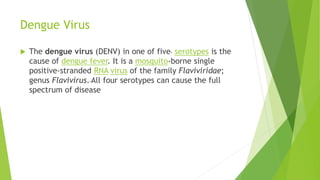
Dengue Virus 
 The dengue virus (DENV) in one of five serotypes is the 
cause of dengue fever. It is a mosquito-borne single 
positive-stranded RNA virus of the family Flaviviridae; 
genus Flavivirus. All four serotypes can cause the full 
spectrum of disease
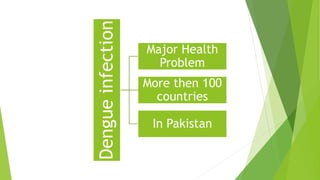
Dengue infection 
Major Health 
Problem 
More then 100 
countries 
In Pakistan
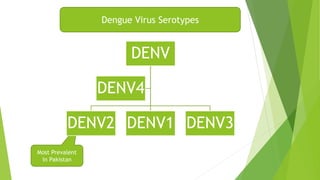
Most Prevalent 
in Pakistan 
Dengue Virus Serotypes 
DENV 
DENV4 
DENV2 DENV1 DENV3
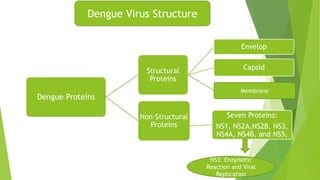
Dengue Proteins 
Structural 
Proteins 
Envelop 
Capsid 
Non-Structural 
Proteins 
Membrane 
Seven Proteins: 
NS1, NS2A,NS2B, NS3, 
NS4A, NS4B, and NS5, 
NS3: Enzymetic 
Reaction and Viral 
Replication 
Dengue Virus Structure
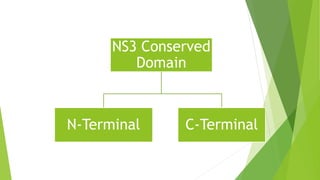
NS3 Conserved 
Domain 
N-Terminal C-Terminal
 It has also been reported that NS3 has DNA 
unwinding activity. Despite the high mutation rate 
of DENV, some residues that actively participate 
in viral replication remain conserved. These 
conserved residues can be important in 
developing specific antiviral agents and inhibitors 
against DENVs.
Methodology 
Kainat Arif 
Roll No. 2027 
Department Of Biotechnology and Bioinformatics 
Government College University Faisalabad
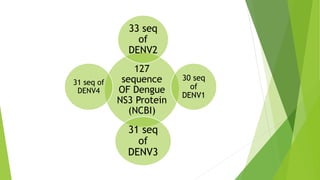
127 
sequence 
OF Dengue 
NS3 Protein 
(NCBI) 
30 seq 
of 
DENV1 
31 seq of 
DENV4 
33 seq 
of 
DENV2 
31 seq 
of 
DENV3
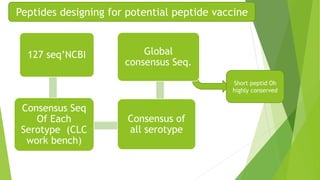
Peptides designing for potential peptide vaccine 
127 seq’NCBI 
Consensus Seq 
Of Each 
Serotype (CLC 
work bench) 
Global 
consensus Seq. 
Consensus of 
all serotype 
Short peptid Oh 
highly conserved
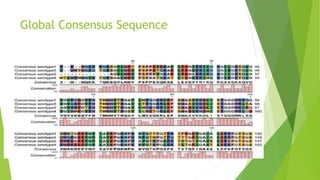
Global Consensus Sequence
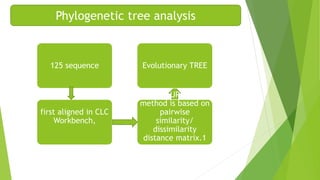
Phylogenetic tree analysis 
125 sequence 
first aligned in CLC 
Workbench, 
Evolutionary TREE 
The UPGMA 
method is based on 
pairwise 
similarity/ 
dissimilarity 
distance matrix.1
NS3 Result and Discussion 
Athar Hussain 
Department Of Biotechnology and Bioinformatics 
Government College University Faisalabad
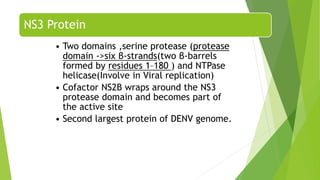
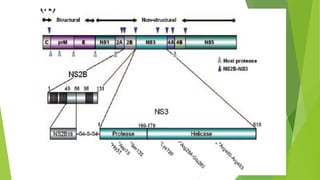
NS3 Protein 
• Two domains ,serine protease (protease 
domain ->six β-strands(two β-barrels 
formed by residues 1–180 ) and NTPase 
helicase(Involve in Viral replication) 
• Cofactor NS2B wraps around the NS3 
protease domain and becomes part of 
the active site 
• Second largest protein of DENV genome.
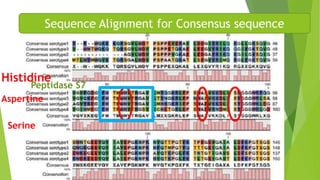
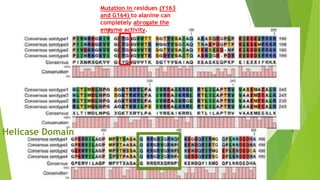
Sequence Alignment for Consensus sequence 
Histidine 
Peptidase S7 
Aspertine 
Serine
Mutation in residues (Y163 
and G164) to alanine can 
completely abrogate the 
enzyme activity. 
Helicase Domain
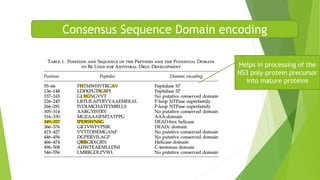
Consensus Sequence Domain encoding 
Helps in processing of the 
NS3 poly-protein precursor 
into mature proteins
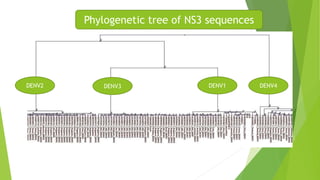
Phylogenetic tree of NS3 sequences 
DENV2 DENV3 DENV1 DENV4
Suggestions 
The consensus sequence alignment shows that: 
1.Residue L226 to L245 encodes the P-loop NTPase superfamily. It has two 
motifs [Walker A, GK(S/T), and Walker B, Dex (D/H)], designing antipeptides 
against the Walker A/Walker B region can significantly reduce RNA processing 
efficiency. 
2.I349 to R357 encodes helicase DEAD-box domain. Designing Antipeptides against 
DEAD-Box can control Viral activites 
3.The peptide string from 465 to 473 (QRR267 GR469 XGRN) is the part of the 
helicase domain , mutation in R467 and R469 that will reduce the activity of 
helicase 
4.Mutation in residues (Y159 and G160) to alanine can completely 
abrogate the enzyme activity
NS2 conserved Domain In Dengue Virus

NS2 conserved Domain In Dengue Virus

  • 2.
    Global Consensus SequenceDevelopment and Analysis of Dengue NS3 Conserved Domains
  • 3.
    Introduction Umaira Kanwal Roll No.2021 Department Of Biotechnology and Bioinformatics Government College University Faisalabad
  • 4.
    Dengue Virus The dengue virus (DENV) in one of five serotypes is the cause of dengue fever. It is a mosquito-borne single positive-stranded RNA virus of the family Flaviviridae; genus Flavivirus. All four serotypes can cause the full spectrum of disease
  • 5.
    Dengue infection MajorHealth Problem More then 100 countries In Pakistan
  • 6.
    Most Prevalent inPakistan Dengue Virus Serotypes DENV DENV4 DENV2 DENV1 DENV3
  • 7.
    Dengue Proteins Structural Proteins Envelop Capsid Non-Structural Proteins Membrane Seven Proteins: NS1, NS2A,NS2B, NS3, NS4A, NS4B, and NS5, NS3: Enzymetic Reaction and Viral Replication Dengue Virus Structure
  • 8.
    NS3 Conserved Domain N-Terminal C-Terminal
  • 9.
     It hasalso been reported that NS3 has DNA unwinding activity. Despite the high mutation rate of DENV, some residues that actively participate in viral replication remain conserved. These conserved residues can be important in developing specific antiviral agents and inhibitors against DENVs.
  • 10.
    Methodology Kainat Arif Roll No. 2027 Department Of Biotechnology and Bioinformatics Government College University Faisalabad
  • 11.
    127 sequence OFDengue NS3 Protein (NCBI) 30 seq of DENV1 31 seq of DENV4 33 seq of DENV2 31 seq of DENV3
  • 12.
    Peptides designing forpotential peptide vaccine 127 seq’NCBI Consensus Seq Of Each Serotype (CLC work bench) Global consensus Seq. Consensus of all serotype Short peptid Oh highly conserved
  • 13.
  • 14.
    Phylogenetic tree analysis 125 sequence first aligned in CLC Workbench, Evolutionary TREE The UPGMA method is based on pairwise similarity/ dissimilarity distance matrix.1
  • 15.
    NS3 Result andDiscussion Athar Hussain Department Of Biotechnology and Bioinformatics Government College University Faisalabad
  • 16.
    NS3 Protein •Two domains ,serine protease (protease domain ->six β-strands(two β-barrels formed by residues 1–180 ) and NTPase helicase(Involve in Viral replication) • Cofactor NS2B wraps around the NS3 protease domain and becomes part of the active site • Second largest protein of DENV genome.
  • 17.
    Sequence Alignment forConsensus sequence Histidine Peptidase S7 Aspertine Serine
  • 18.
    Mutation in residues(Y163 and G164) to alanine can completely abrogate the enzyme activity. Helicase Domain
  • 19.
    Consensus Sequence Domainencoding Helps in processing of the NS3 poly-protein precursor into mature proteins
  • 21.
    Phylogenetic tree ofNS3 sequences DENV2 DENV3 DENV1 DENV4
  • 22.
    Suggestions The consensussequence alignment shows that: 1.Residue L226 to L245 encodes the P-loop NTPase superfamily. It has two motifs [Walker A, GK(S/T), and Walker B, Dex (D/H)], designing antipeptides against the Walker A/Walker B region can significantly reduce RNA processing efficiency. 2.I349 to R357 encodes helicase DEAD-box domain. Designing Antipeptides against DEAD-Box can control Viral activites 3.The peptide string from 465 to 473 (QRR267 GR469 XGRN) is the part of the helicase domain , mutation in R467 and R469 that will reduce the activity of helicase 4.Mutation in residues (Y159 and G160) to alanine can completely abrogate the enzyme activity

Editor's Notes

  • #4 Ambreen Ayub, Usman A. Ashfaq, Sobia Idrees, and Asma Haque
  • #6 Dengue infection has become a major health problem in more than 100 countries in Africa, Asia, America, the Western Pacific. In the last decade, dengue infection has caused many endemics in Pakistan and has become a major health issue in Pakistan. World Health Organization, approximately infection occur 50–100 million/year, causing 500,000 cases of dengue hemorrhagic fever and 22,000 deaths.
  • #7 which has four different serotypes (DENV1–DENV4). it was found that DENV2 serotype is most prevalent serotype circulating in Pakistan. Dengue infection results in two type of infections ranging from a dengue fever to a more severe infection that can cause dengue hemorrhagic fever and dengue shock syndrome.
  • #8 Dengue virus is an enveloped, 11-kilobase-long RNA positive-strand virus with three structural proteins, C (capsid), M (membrane), and E(envelop), and seven nonstructural proteins that are important in viral pathology
  • #9 The NS3 N terminal : domain is about 180 residues long with a triad of active residues, histidine, aspartate, and serine, that form a catalytic triad that actively participates in the catalysis process of the enzyme. The C-terminal domain: consists of conserved motifs that are found in several nucleoside triphosphatases (NTPases) and help to increase the overall length of NS3, which results in enhanced enzymatic activity.
  • #10  In this study, a novel approach is used to produce a consensus sequence of NS3, which will be useful in designing peptides that may help in finding a possible cure for dengue infection. The present study was designed to draw a global consensus sequence of the NS3 protein of DENV, study the DENV NS3 conserved domain function, and draw a phylogenetic tree.
  • #12 DENV1., Cuba Indonecia ,Japan US,thyland,China DENV2. china US, Taiwan Singapor, DENV3., US,Brazil ,Singapor, French West Indies, DENV4, Taiwan Indonecia ,US,Chaina ,Thayland
  • #13 CLC work bench: Used to Analysis and vidualize sequence comperosion
  • #17 Serine Break peptide bod .protease domain ->six β-strands(two β-barrels formed by residues 1–180 ).The catalytic triad (His-51, Asp-75 and Ser-135),.and its activity is dependent on the presence of the NS2B cofactor. This cofactor wraps around the NS3 protease domain and becomes part of the active site. The remaining NS3 residues (180–618), form the three subdomains of the DENV helicase. A six-stranded parallel β-sheet surrounded by four α-helices make up subdomains I and II, and subdomain III is composed of 4 α-helices surrounded by three shorter α-helices and two antiparallel β-strands.
  • #18 The consensus sequence alignment shows that His56, Asp79, Ser144, and Ser146 are highly conserved among all serotypes. The consensus sequence alignment shows that L138 to L149 are highly conserved among all serotypes, while L141 has mutated to a serine in serotype 3.
  • #20 NS3 has three conserved domains: peptidase S7 family domain, helicase C-terminus conserved domain, and flavivirus DEAD domain.1 Residues (1–180)of the NS3 protease domain forms two b-barrels, and between these b-barrels there are three catalytic sites (His51, Asp75,and Ser135). All the remaining residues (180–618) of NS3 forms three subdomains (I, II, III) of the helicase domain
  • #22 A phylogenetic tree of 127 DENV NS3 sequences The tree shows that the different DENV serotypes have evolved from the serotype DENV4 DENV4 occupies the root of the tree, and the first serotype to evolve from DENV4 was DENV2. DENV2 bifurcates into two wings; from one wing, DENV3 evolved, and from the second, DENV2
  • #23 [Walker A, GK(S/T), and Walker B, Dex (D/H)] which are present in nucleotide binding proteins and participate in many cellular functions DEAD-box domain involved in nuclear transcription, nucleic acid unwinding, pre-mRNA splicing, nucleocytoplasmic transport, ribosome biogenesis translation, RNA decay, and organelle gene expression