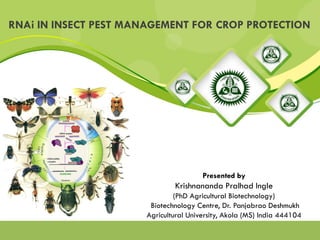
RNAi IN INSECT PEST MANAGEMENT FOR CROP PROTECTION
Presented by
Krishnananda Pralhad Ingle
(PhD Agricultural Biotechnology)
Biotechnology Centre, Dr. Panjabrao Deshmukh
Agricultural University, Akola (MS) India 444104
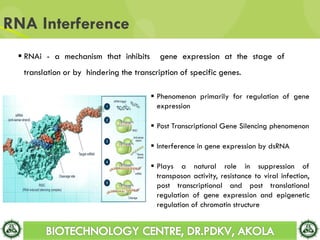
RNA Interference
 Phenomenon primarily for regulation of gene
expression
 Post Transcriptional Gene Silencing phenomenon
 Interference in gene expression by dsRNA
 Plays a natural role in suppression of
transposon activity, resistance to viral infection,
post transcriptional and post translational
regulation of gene expression and epigenetic
regulation of chromatin structure
 RNAi - a mechanism that inhibits gene expression at the stage of
translation or by hindering the transcription of specific genes.
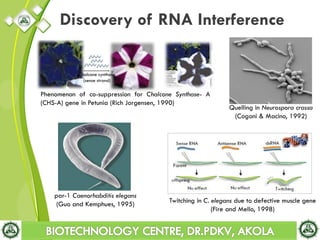
Discovery of RNA Interference
Quelling in Neurospora crassa
(Cogoni & Macino, 1992)
par-1 Caenorhabditis elegans
(Guo and Kemphues, 1995)
Chalcone synthase
(sense strand)
Phenomenon of co-suppression for Chalcone Synthase- A
(CHS-A) gene in Petunia (Rich Jorgensen, 1990)
Twitching in C. elegans due to defective muscle gene
(Fire and Mello, 1998)
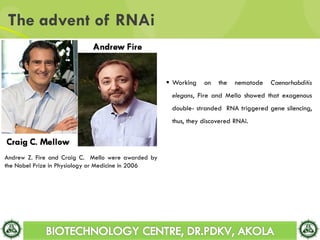
The advent of RNAi
Andrew Z. Fire and Craig C. Mello were awarded by
the Nobel Prize in Physiology or Medicine in 2006
 Working on the nematode Caenorhabditis
elegans, Fire and Mello showed that exogenous
double- stranded RNA triggered gene silencing,
thus, they discovered RNAi.
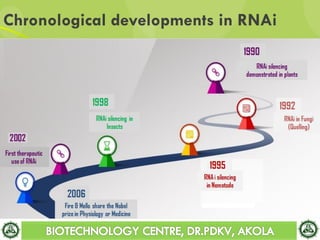
Chronological developments in RNAi
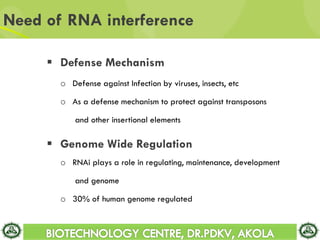
Need of RNA interference
 Defense Mechanism
o Defense against Infection by viruses, insects, etc
o As a defense mechanism to protect against transposons
and other insertional elements
 Genome Wide Regulation
o RNAi plays a role in regulating, maintenance, development
and genome
o 30% of human genome regulated
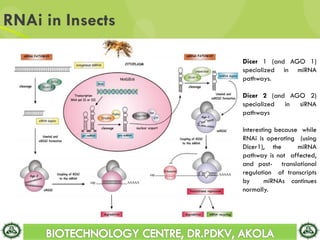
RNAi in Insects
Dicer 1 (and AGO 1)
specialized in miRNA
pathways.
Dicer 2 (and AGO 2)
specialized in siRNA
pathways
Interesting because while
RNAi is operating (using
Dicer1), the miRNA
pathway is not affected,
and post- translational
regulation of transcripts
by miRNAs continues
normally.
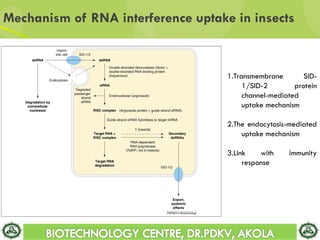
Mechanism of RNA interference uptake in insects
1.Transmembrane SID-
1/SID-2 protein
channel-mediated
uptake mechanism
2.The endocytosis-mediated
uptake mechanism
3.Link with immunity
response
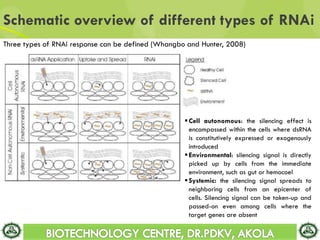
Schematic overview of different types of RNAi
Three types of RNAi response can be defined (Whangbo and Hunter, 2008)
Cell autonomous: the silencing effect is
encompassed within the cells where dsRNA
is constitutively expressed or exogenously
introduced
Environmental: silencing signal is directly
picked up by cells from the immediate
environment, such as gut or hemocoel
Systemic: the silencing signal spreads to
neighboring cells from an epicenter of
cells. Silencing signal can be taken-up and
passed-on even among cells where the
target genes are absent
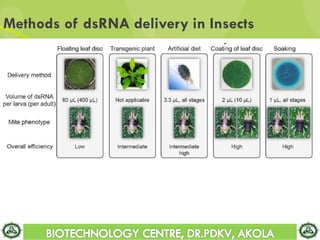
Methods of dsRNA delivery in Insects
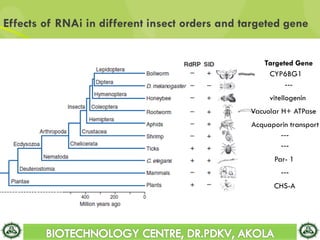
Effects of RNAi in different insect orders and targeted gene
Targeted Gene
CYP6BG1
---
vitellogenin
Vacuolar H+ ATPase
Acquaporin transport
Par- 1
CHS-A
---
---
---
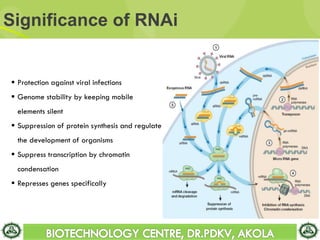
Significance of RNAi
 Protection against viral infections
 Genome stability by keeping mobile
elements silent
 Suppression of protein synthesis and regulate
the development of organisms
 Suppress transcription by chromatin
condensation
 Represses genes specifically
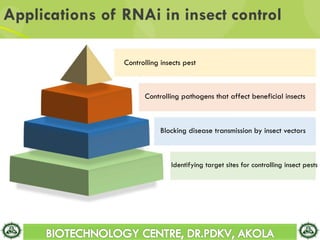
Applications of RNAi in insect control
Controlling pathogens that affect beneficial insects
Controlling insects pest
Blocking disease transmission by insect vectors
Identifying target sites for controlling insect pests
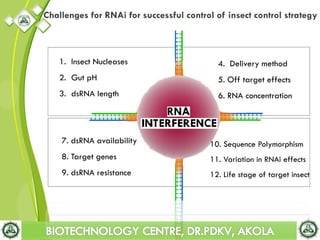
Challenges for RNAi for successful control of insect control strategy
1. Insect Nucleases
2. Gut pH
3. dsRNA length
4. Delivery method
5. Off target effects
6. RNA concentration
7. dsRNA availability
8. Target genes
9. dsRNA resistance
10. Sequence Polymorphism
11. Variation in RNAi effects
12. Life stage of target insect
Pros and Cons
RNAi analysis is also a
relatively inexpensive
method for analyzing
gene function
Comparative studies
between species
profoundly impact the
field of evolutionary
developmental
biology
Convenient way to
cause
gene loss of function in
a spatial temporal-
specific manner, when
using transgenic
techniques
Enable large scale
functional RNAi
experiments that allowed
the dissection of genetic
pathways & systematic
analysis of the genome as
classical genetic analysis is
laborious or impossible
Incomplete gene loss of
function and critical to
isolate/create genetic null
mutants to assess gene
importance
Does not elicit effective
and specific RNAi
response in all situations
For reliable results from
RNAi analysis, it is
advisable to use more
than one dsRNA/
siRNA/shRNA targeting
different parts of the
mRNA
Sustained exogenous
shRNA expression can
interfere with
endogenous microRNA
pathways/ time
consuming and can’t
replicate in insects
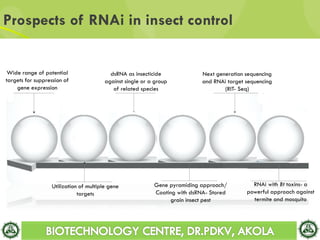
Prospects of RNAi in insect control
Wide range of potential
targets for suppression of
gene expression
Utilization of multiple gene
targets
dsRNA as insecticide
against single or a group
of related species
Gene pyramiding approach/
Coating with dsRNA- Stored
grain insect pest
Next generation sequencing
and RNAi target sequencing
(RIT- Seq)
RNAi with Bt toxins- a
powerful approach against
termite and mosquito
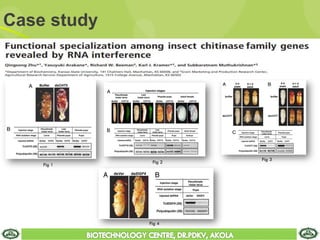
Case study
Fig 1
Fig 2
Fig 3
Fig 4
Rna interference in insect pest management

Rna interference in insect pest management

  • 1.
    RNAi IN INSECTPEST MANAGEMENT FOR CROP PROTECTION Presented by Krishnananda Pralhad Ingle (PhD Agricultural Biotechnology) Biotechnology Centre, Dr. Panjabrao Deshmukh Agricultural University, Akola (MS) India 444104
  • 2.
    RNA Interference  Phenomenonprimarily for regulation of gene expression  Post Transcriptional Gene Silencing phenomenon  Interference in gene expression by dsRNA  Plays a natural role in suppression of transposon activity, resistance to viral infection, post transcriptional and post translational regulation of gene expression and epigenetic regulation of chromatin structure  RNAi - a mechanism that inhibits gene expression at the stage of translation or by hindering the transcription of specific genes.
  • 3.
    Discovery of RNAInterference Quelling in Neurospora crassa (Cogoni & Macino, 1992) par-1 Caenorhabditis elegans (Guo and Kemphues, 1995) Chalcone synthase (sense strand) Phenomenon of co-suppression for Chalcone Synthase- A (CHS-A) gene in Petunia (Rich Jorgensen, 1990) Twitching in C. elegans due to defective muscle gene (Fire and Mello, 1998)
  • 4.
    The advent ofRNAi Andrew Z. Fire and Craig C. Mello were awarded by the Nobel Prize in Physiology or Medicine in 2006  Working on the nematode Caenorhabditis elegans, Fire and Mello showed that exogenous double- stranded RNA triggered gene silencing, thus, they discovered RNAi.
  • 5.
  • 6.
    Need of RNAinterference  Defense Mechanism o Defense against Infection by viruses, insects, etc o As a defense mechanism to protect against transposons and other insertional elements  Genome Wide Regulation o RNAi plays a role in regulating, maintenance, development and genome o 30% of human genome regulated
  • 7.
    RNAi in Insects Dicer1 (and AGO 1) specialized in miRNA pathways. Dicer 2 (and AGO 2) specialized in siRNA pathways Interesting because while RNAi is operating (using Dicer1), the miRNA pathway is not affected, and post- translational regulation of transcripts by miRNAs continues normally.
  • 8.
    Mechanism of RNAinterference uptake in insects 1.Transmembrane SID- 1/SID-2 protein channel-mediated uptake mechanism 2.The endocytosis-mediated uptake mechanism 3.Link with immunity response
  • 9.
    Schematic overview ofdifferent types of RNAi Three types of RNAi response can be defined (Whangbo and Hunter, 2008) Cell autonomous: the silencing effect is encompassed within the cells where dsRNA is constitutively expressed or exogenously introduced Environmental: silencing signal is directly picked up by cells from the immediate environment, such as gut or hemocoel Systemic: the silencing signal spreads to neighboring cells from an epicenter of cells. Silencing signal can be taken-up and passed-on even among cells where the target genes are absent
  • 10.
    Methods of dsRNAdelivery in Insects
  • 11.
    Effects of RNAiin different insect orders and targeted gene Targeted Gene CYP6BG1 --- vitellogenin Vacuolar H+ ATPase Acquaporin transport Par- 1 CHS-A --- --- ---
  • 12.
    Significance of RNAi Protection against viral infections  Genome stability by keeping mobile elements silent  Suppression of protein synthesis and regulate the development of organisms  Suppress transcription by chromatin condensation  Represses genes specifically
  • 13.
    Applications of RNAiin insect control Controlling pathogens that affect beneficial insects Controlling insects pest Blocking disease transmission by insect vectors Identifying target sites for controlling insect pests
  • 14.
    Challenges for RNAifor successful control of insect control strategy 1. Insect Nucleases 2. Gut pH 3. dsRNA length 4. Delivery method 5. Off target effects 6. RNA concentration 7. dsRNA availability 8. Target genes 9. dsRNA resistance 10. Sequence Polymorphism 11. Variation in RNAi effects 12. Life stage of target insect
  • 15.
    Pros and Cons RNAianalysis is also a relatively inexpensive method for analyzing gene function Comparative studies between species profoundly impact the field of evolutionary developmental biology Convenient way to cause gene loss of function in a spatial temporal- specific manner, when using transgenic techniques Enable large scale functional RNAi experiments that allowed the dissection of genetic pathways & systematic analysis of the genome as classical genetic analysis is laborious or impossible Incomplete gene loss of function and critical to isolate/create genetic null mutants to assess gene importance Does not elicit effective and specific RNAi response in all situations For reliable results from RNAi analysis, it is advisable to use more than one dsRNA/ siRNA/shRNA targeting different parts of the mRNA Sustained exogenous shRNA expression can interfere with endogenous microRNA pathways/ time consuming and can’t replicate in insects
  • 16.
    Prospects of RNAiin insect control Wide range of potential targets for suppression of gene expression Utilization of multiple gene targets dsRNA as insecticide against single or a group of related species Gene pyramiding approach/ Coating with dsRNA- Stored grain insect pest Next generation sequencing and RNAi target sequencing (RIT- Seq) RNAi with Bt toxins- a powerful approach against termite and mosquito
  • 17.
    Case study Fig 1 Fig2 Fig 3 Fig 4