Adjective/Noun
Agreement
It all has to match!
or
Agree! Agree!!! Agree!!!
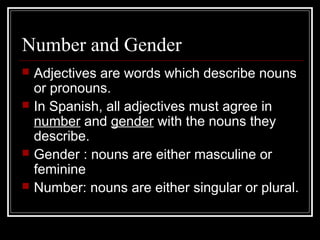
Number and Gender
 Adjectives are words which describe nouns
or pronouns.
 In Spanish, all adjectives must agree in
number and gender with the nouns they
describe.
 Gender : nouns are either masculine or
feminine
 Number: nouns are either singular or plural.
So what is a “masculine” noun
anyway?
 Masculine nouns usually end with the
letters L-O-N-E-R-S.
 Feminine nouns usually end in the letters
D-ión-Z-A.
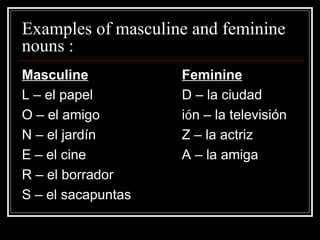
Examples of masculine and feminine
nouns :
Masculine Feminine
L – el papel D – la ciudad
O – el amigo ión – la televisión
N – el jardín Z – la actriz
E – el cine A – la amiga
R – el borrador
S – el sacapuntas
Are these nouns masculine or
feminine?
1. Lección
2. Tinta
3. Profesor
4. Edificio
5. Universidad
6. Pizarrón
Pluralization
 To make nouns or adjectives plural add
“s” to words ending with vowels and add
“es” to words ending with consonants.
Ex. El chico ---- Los chicos
el papel ---- Los papeles
 EXCEPTION: when a noun or adjective
ends in “z”, the “z” is changed to a “c”
before making it plural.
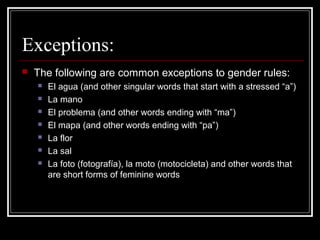
Exceptions:
 The following are common exceptions to gender rules:
 El agua (and other singular words that start with a stressed “a”)
 La mano
 El problema (and other words ending with “ma”)
 El mapa (and other words ending with “pa”)
 La flor
 La sal
 La foto (fotografía), la moto (motocicleta) and other words that
are short forms of feminine words
How to use adjectives
 Unlike English, in Spanish, adjectives
usually follow the nouns they describe.
Ex. : (m,s)Un chico trabajador
(m,p)Unos chicos trabajadores
(f,s) Una chica trabajadora
(f,p) Unas chicas trabajadoras
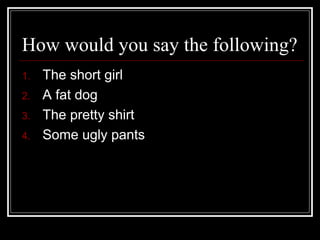
How would you say the following?
1. The short girl
2. A fat dog
3. The pretty shirt
4. Some ugly pants
How would you say the following?
1. The short girl
2. A fat dog
3. The pretty shirt
4. Some ugly pants

Adj agree ppt

  • 1.
    Adjective/Noun Agreement It all hasto match! or Agree! Agree!!! Agree!!!
  • 2.
    Number and Gender Adjectives are words which describe nouns or pronouns.  In Spanish, all adjectives must agree in number and gender with the nouns they describe.  Gender : nouns are either masculine or feminine  Number: nouns are either singular or plural.
  • 3.
    So what isa “masculine” noun anyway?  Masculine nouns usually end with the letters L-O-N-E-R-S.  Feminine nouns usually end in the letters D-ión-Z-A.
  • 4.
    Examples of masculineand feminine nouns : Masculine Feminine L – el papel D – la ciudad O – el amigo ión – la televisión N – el jardín Z – la actriz E – el cine A – la amiga R – el borrador S – el sacapuntas
  • 5.
    Are these nounsmasculine or feminine? 1. Lección 2. Tinta 3. Profesor 4. Edificio 5. Universidad 6. Pizarrón
  • 6.
    Pluralization  To makenouns or adjectives plural add “s” to words ending with vowels and add “es” to words ending with consonants. Ex. El chico ---- Los chicos el papel ---- Los papeles  EXCEPTION: when a noun or adjective ends in “z”, the “z” is changed to a “c” before making it plural.
  • 7.
    Exceptions:  The followingare common exceptions to gender rules:  El agua (and other singular words that start with a stressed “a”)  La mano  El problema (and other words ending with “ma”)  El mapa (and other words ending with “pa”)  La flor  La sal  La foto (fotografía), la moto (motocicleta) and other words that are short forms of feminine words
  • 8.
    How to useadjectives  Unlike English, in Spanish, adjectives usually follow the nouns they describe. Ex. : (m,s)Un chico trabajador (m,p)Unos chicos trabajadores (f,s) Una chica trabajadora (f,p) Unas chicas trabajadoras
  • 9.
    How would yousay the following? 1. The short girl 2. A fat dog 3. The pretty shirt 4. Some ugly pants
  • 10.
    How would yousay the following? 1. The short girl 2. A fat dog 3. The pretty shirt 4. Some ugly pants