Exploring Online Learning Communities What makes them tick? Rochelle Jensen - 2009
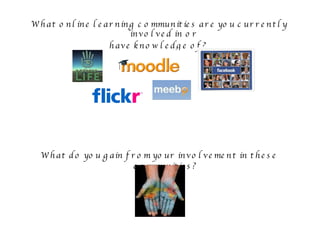
What online learning communities are you currently involved in or  have knowledge of?  What do you gain from your involvement in these communities?
IN GROUPS OF THREE DISCUSS: Would it be beneficial to set up an online learning community to  support this group? CONSIDER Why?  What would be its purpose? How might it look? What components? FEEDBACK Human Continuum Yes, No, Maybe -Justification
A glimpse at the research .... Heather Bell – Massey University – Conducting her thesis on “ How can blended learning communities be facilitated to support the professional learning of in-service  teacher educators?” Garrison and Vaughn (2008) -  Blended Learning in Higher Education: Framework, principles and guidelines. San Francisco: Jossey-Bass Lai, K.W., Pratt,K., Anderson, M.,  and Stigter, J. (2006) Literature Review and Synthesis: Online Communities of Practice. Wenger, E. 2001.  Communities of Practice: a brief introduction
“ Some online communities emerge out of nowhere, are totally unplanned and blossom.  But these are the minority.  There is a good  deal of evidence to suggest that careful planning is essential to the success of an online community”  (Australian Flexible Learning Framework, What are the characteristics of effective online learning communities? pg 7,  2003)
“ Online is not separate to the physical world – in teaching or in the development of Communities Of Practice – in reality hybrid models usually operate”.  (Australian Flexible Learning Framework, What are the characteristics of effective online learning communities? pg 4,  2003)
PL + ICT = EPL Poor Learning + ICT = Expensive Poor Learning
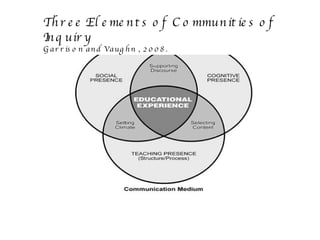
Three Elements of Communities of Inquiry Garrison and Vaughn , 2008.
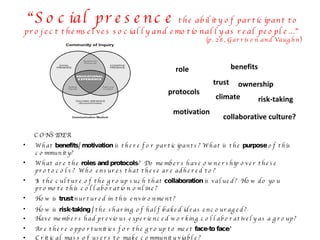
CONSIDER What  benefits/ motivation  is there for participants? What is the  purpose  of this community? What are the  roles and protocols ?  Do members have ownership over these protocols?  Who ensures that these are adhered to? Is the culture of the group such that  collaboration  is valued?  How do you promote this collaboration online?  How is  trust  nurtured in this environment? How is  risk-taking /  the sharing of half-baked ideas encouraged? Have members had previous experienced working collaboratively as a group? Are there opportunities for the group to meet  face-to face ? Critical mass of users to make community viable? “ Social presence  the ability of participant to project themselves socially and emotionally as real people…”  (p. 28, Garrison and Vaughn) benefits motivation role protocols ownership collaborative culture? trust risk-taking climate
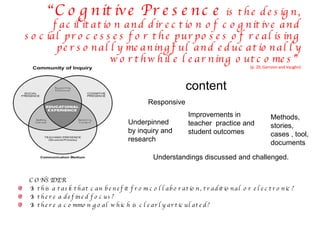
“ Cognitive Presence  is the design, facilitation and direction of cognitive and social processes for the purposes of realising personally meaningful and educationally worthwhile learning outcomes”  (p. 29, Garrsion and Vaughn) CONSIDER Is this a task that can benefit from collaboration, traditional or electronic? Is there a defined focus? Is there a common goal which is clearly articulated? Underpinned by inquiry and research Improvements in teacher  practice and student outcomes Responsive Methods, stories, cases , tool, documents Understandings discussed and challenged. content
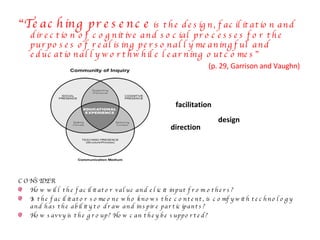
“ Teaching presence  is the design, facilitation and direction of cognitive and social processes for the purposes of realising personally meaningful and educationally worthwhile learning outcomes”  (p. 29, Garrison and Vaughn) facilitation design direction CONSIDER How will the facilitator value and elicit input from others? Is the facilitator someone who knows the content, is comfy with technology and has the ability to draw and inspire participants? How savvy is the group? How can they be supported?
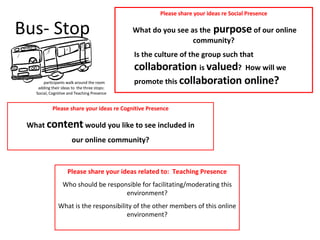
Bus- Stop  Please share your ideas re Social Presence What do you see as the  purpose  of our online community? Is the culture of the group such that  collaboration  is  valued ?  How will we promote this  collaboration online?   Please share your ideas related to:  Teaching Presence Who should be responsible for facilitating/moderating this environment? What is the responsibility of the other members of this online environment? Please share your ideas re Cognitive Presence What  content  would you like to see included in our online community? participants walk around the room adding their ideas to  the three stops: Social, Cognitive and Teaching Presence
Ideas from the  bus-stop  activity are collated to form the foundations of the online learning environment.
“ There is no absolute formula, this is a fluid and rapidly evolving medium; you will have to experiment and improvise”.  (Australian Flexible Learning Framework, What are the characteristics of effective online learning communities? pg 17,  2003)
Online learning communities have been developed for many years now but  few manage to actually provide more than just a repository for information  and ideas. Potter, 2004

Online Professional Learning Communities

  • 1.
    Exploring Online LearningCommunities What makes them tick? Rochelle Jensen - 2009
  • 2.
    What online learningcommunities are you currently involved in or have knowledge of? What do you gain from your involvement in these communities?
  • 3.
    IN GROUPS OFTHREE DISCUSS: Would it be beneficial to set up an online learning community to support this group? CONSIDER Why? What would be its purpose? How might it look? What components? FEEDBACK Human Continuum Yes, No, Maybe -Justification
  • 4.
    A glimpse atthe research .... Heather Bell – Massey University – Conducting her thesis on “ How can blended learning communities be facilitated to support the professional learning of in-service teacher educators?” Garrison and Vaughn (2008) - Blended Learning in Higher Education: Framework, principles and guidelines. San Francisco: Jossey-Bass Lai, K.W., Pratt,K., Anderson, M., and Stigter, J. (2006) Literature Review and Synthesis: Online Communities of Practice. Wenger, E. 2001. Communities of Practice: a brief introduction
  • 5.
    “ Some onlinecommunities emerge out of nowhere, are totally unplanned and blossom. But these are the minority. There is a good deal of evidence to suggest that careful planning is essential to the success of an online community” (Australian Flexible Learning Framework, What are the characteristics of effective online learning communities? pg 7, 2003)
  • 6.
    “ Online isnot separate to the physical world – in teaching or in the development of Communities Of Practice – in reality hybrid models usually operate”. (Australian Flexible Learning Framework, What are the characteristics of effective online learning communities? pg 4, 2003)
  • 7.
    PL + ICT= EPL Poor Learning + ICT = Expensive Poor Learning
  • 8.
    Three Elements ofCommunities of Inquiry Garrison and Vaughn , 2008.
  • 9.
    CONSIDER What benefits/ motivation is there for participants? What is the purpose of this community? What are the roles and protocols ? Do members have ownership over these protocols? Who ensures that these are adhered to? Is the culture of the group such that collaboration is valued? How do you promote this collaboration online? How is trust nurtured in this environment? How is risk-taking / the sharing of half-baked ideas encouraged? Have members had previous experienced working collaboratively as a group? Are there opportunities for the group to meet face-to face ? Critical mass of users to make community viable? “ Social presence the ability of participant to project themselves socially and emotionally as real people…” (p. 28, Garrison and Vaughn) benefits motivation role protocols ownership collaborative culture? trust risk-taking climate
  • 10.
    “ Cognitive Presence is the design, facilitation and direction of cognitive and social processes for the purposes of realising personally meaningful and educationally worthwhile learning outcomes” (p. 29, Garrsion and Vaughn) CONSIDER Is this a task that can benefit from collaboration, traditional or electronic? Is there a defined focus? Is there a common goal which is clearly articulated? Underpinned by inquiry and research Improvements in teacher practice and student outcomes Responsive Methods, stories, cases , tool, documents Understandings discussed and challenged. content
  • 11.
    “ Teaching presence is the design, facilitation and direction of cognitive and social processes for the purposes of realising personally meaningful and educationally worthwhile learning outcomes” (p. 29, Garrison and Vaughn) facilitation design direction CONSIDER How will the facilitator value and elicit input from others? Is the facilitator someone who knows the content, is comfy with technology and has the ability to draw and inspire participants? How savvy is the group? How can they be supported?
  • 12.
    Bus- Stop Please share your ideas re Social Presence What do you see as the purpose of our online community? Is the culture of the group such that collaboration is valued ? How will we promote this collaboration online? Please share your ideas related to: Teaching Presence Who should be responsible for facilitating/moderating this environment? What is the responsibility of the other members of this online environment? Please share your ideas re Cognitive Presence What content would you like to see included in our online community? participants walk around the room adding their ideas to the three stops: Social, Cognitive and Teaching Presence
  • 13.
    Ideas from the bus-stop activity are collated to form the foundations of the online learning environment.
  • 14.
    “ There isno absolute formula, this is a fluid and rapidly evolving medium; you will have to experiment and improvise”. (Australian Flexible Learning Framework, What are the characteristics of effective online learning communities? pg 17, 2003)
  • 15.
    Online learning communitieshave been developed for many years now but few manage to actually provide more than just a repository for information and ideas. Potter, 2004