
Living and Learning in
a Global Community
Innovative Schools Virtual
University
Housekeeping
Paperless handouts- coming
http://21stcenturylearning.wikispaces.com/
Sheryl Nussbaum-Beach
Co-Founder & CEO
Powerful Learning Practice, LLC
http://plpnetwork.com
sheryl@plpnetwork.com
President
21st
Century Collaborative, LLC
http://21stcenturycollabrative.com
6 Trends for the digital age
Analogue Digital
Tethered Mobile
Closed Open
Isolated Connected
Generic Personal
Consuming Creating
Source: David Wiley: Openness and the disaggregated
future of higher education
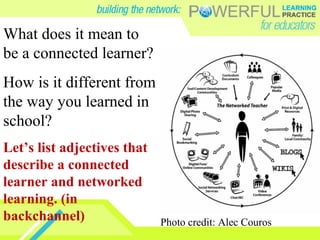
What does it mean to
be a connected learner?
How is it different from
the way you learned in
school?
Let’s list adjectives that
describe a connected
learner and networked
learning. (in
backchannel) Photo credit: Alec Couros
Inclination toward
being open minded
Dedication to the
ongoing development
of expertise
Creation of a culture of collegiality-
believing that "None of us is as good as
all of us" and that the contributions of
all can lead to improved individual
practice
Willingness to be a co-learner, co-
creator, and co-leader
Willingness to leaving one's comfort
zone to experiment with new strategies
and taking on new responsibilities
Dispositions and Values
Commitment to understanding
gained through listening and asking
good questions related to practice
Perseverance toward deep thought
by exploring ideas and concepts,
rethinking, revising, and continual
repacking and unpacking, resisting
urges to finish prematurely
Courage and initiative to engage in
discussions on difficult topics
Alacrity to share and contribute
Desire to be transparent in thinking
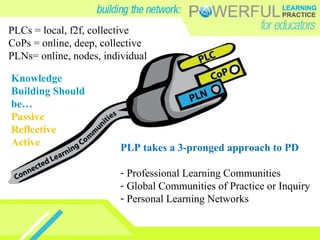
PLP takes a 3-pronged approach to PD
- Professional Learning Communities
- Global Communities of Practice or Inquiry
- Personal Learning Networks
PLCs = local, f2f, collective
CoPs = online, deep, collective
PLNs= online, nodes, individual
Knowledge
Building Should
be…
Passive
Reflective
Active
Define
Community
Define
Networks
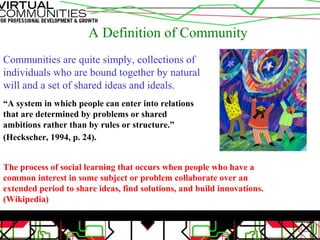
A Definition of Community
Communities are quite simply, collections of
individuals who are bound together by natural
will and a set of shared ideas and ideals.
“A system in which people can enter into relations
that are determined by problems or shared
ambitions rather than by rules or structure.”
(Heckscher, 1994, p. 24).
The process of social learning that occurs when people who have a
common interest in some subject or problem collaborate over an
extended period to share ideas, find solutions, and build innovations.
(Wikipedia)
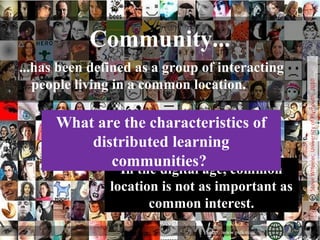
Community...
...has been defined as a group of interacting
people living in a common location.
http://www.psfk.com
In the digital age, common
location is not as important as
common interest.
What are the characteristics of
distributed learning
communities?
A Definition of Networks
From Wikipedia, the free encyclopedia
Networks are created through publishing and sharing ideas and
connecting with others who share passions around those ideas who
learn from each other.
Networked learning is a process of developing and maintaining
connections with people and information, and communicating in
such a way so as to support one another's learning.
Connectivism (theory of learning in networks) is the use of a
network with nodes and connections as a central metaphor for
learning. In this metaphor, a node is anything that can be
connected to another node: information, data, feelings, images.
Learning is the process of creating connections and developing a
network.
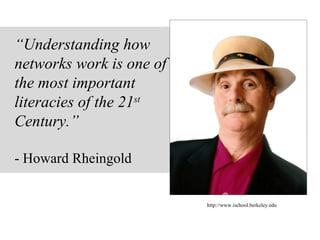
“Understanding how
networks work is one of
the most important
literacies of the 21st
Century.”
- Howard Rheingold
http://www.ischool.berkeley.edu
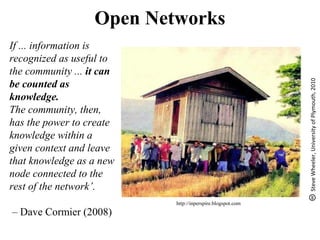
If ... information is
recognized as useful to
the community ... it can
be counted as
knowledge.
The community, then,
has the power to create
knowledge within a
given context and leave
that knowledge as a new
node connected to the
rest of the network’.
– Dave Cormier (2008)
SteveWheeler,UniversityofPlymouth,2010
Open Networks
http://inperspire.blogspot.com
My community work
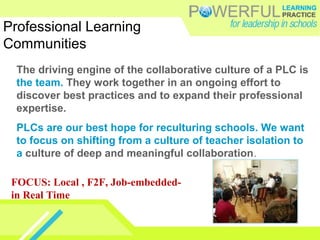
The driving engine of the collaborative culture of a PLC is
the team. They work together in an ongoing effort to
discover best practices and to expand their professional
expertise.
PLCs are our best hope for reculturing schools. We want
to focus on shifting from a culture of teacher isolation to
a culture of deep and meaningful collaboration.
Professional Learning
Communities
FOCUS: Local , F2F, Job-embedded-
in Real Time
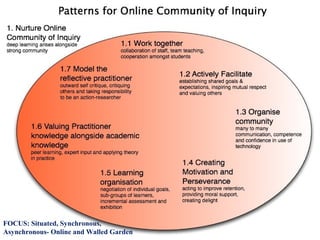
Communities of Practice
FOCUS: Situated, Synchronous,
Asynchronous- Online and Walled Garden
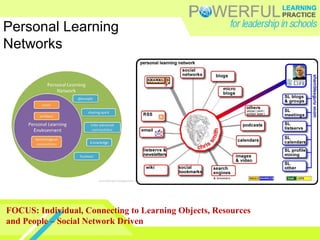
Personal Learning
Networks
FOCUS: Individual, Connecting to Learning Objects, Resources
and People – Social Network Driven
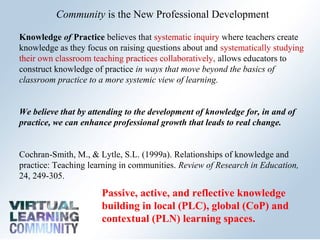
Community is the New Professional Development
Cochran-Smith and Lytle (1999a) describe three ways of knowing and constructing
knowledge that align closely with PLP's philosophy and are worth mentioning here.
Knowledge for Practice is often reflected in traditional PD efforts when a trainer shares
with teachers information produced by educational researchers. This knowledge presumes
a commonly accepted degree of correctness about what is being shared. The learner is
typically passive in this kind of "sit and get" experience. This kind of knowledge is
difficult for teachers to transfer to classrooms without support and follow through. After a
workshop, much of what was useful gets lost in the daily grind, pressures and isolation of
teaching.
Knowledge in Practice recognizes the importance of teacher experience and practical
knowledge in improving classroom practice. As a teacher tests out new strategies and
assimilates them into teaching routines they construct knowledge in practice. They learn
by doing. This knowledge is strengthened when teachers reflect and share with one
another lessons learned during specific teaching sessions and describe the tacit
knowledge embedded in their experiences.
Community is the New Professional Development
Knowledge of Practice believes that systematic inquiry where teachers create
knowledge as they focus on raising questions about and systematically studying
their own classroom teaching practices collaboratively, allows educators to
construct knowledge of practice in ways that move beyond the basics of
classroom practice to a more systemic view of learning.
We believe that by attending to the development of knowledge for, in and of
practice, we can enhance professional growth that leads to real change.
Cochran-Smith, M., & Lytle, S.L. (1999a). Relationships of knowledge and
practice: Teaching learning in communities. Review of Research in Education,
24, 249-305.
Passive, active, and reflective knowledge
building in local (PLC), global (CoP) and
contextual (PLN) learning spaces.
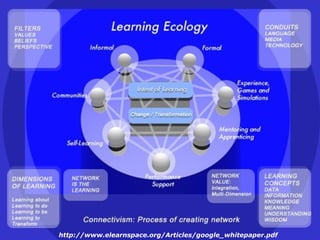
http://www.elearnspace.org/Articles/google_whitepaper.pdf
Virtual Community
A virtual space supported by
computer-based information
technology, centered upon
communication and interaction
of participants to generate
member-driven content,
resulting in relationships being
built up. (Lee & Vogel, 2003)
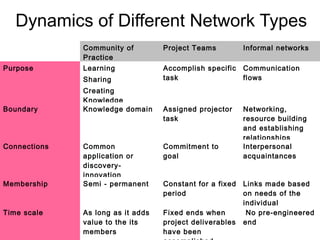
Dynamics of Different Network Types
Community of
Practice
Project Teams Informal networks
Purpose Learning
Sharing
Creating
Knowledge
Accomplish specific
task
Communication
flows
Boundary Knowledge domain Assigned projector
task
Networking,
resource building
and establishing
relationships
Connections Common
application or
discovery-
innovation
Commitment to
goal
Interpersonal
acquaintances
Membership Semi - permanent Constant for a fixed
period
Links made based
on needs of the
individual
Time scale As long as it adds
value to the its
members
Fixed ends when
project deliverables
have been
No pre-engineered
end
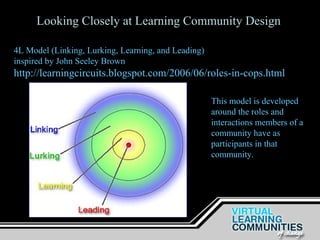
Looking Closely at Learning Community Design
4L Model (Linking, Lurking, Learning, and Leading)
inspired by John Seeley Brown
http://learningcircuits.blogspot.com/2006/06/roles-in-cops.html
This model is developed
around the roles and
interactions members of a
community have as
participants in that
community.
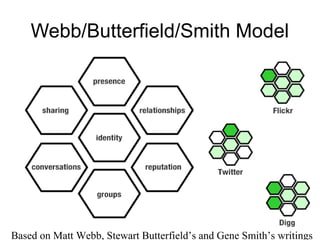
Webb/Butterfield/Smith Model
Based on Matt Webb, Stewart Butterfield’s and Gene Smith’s writings
CelebrationCelebration
Connection
ccSteveWheeler,UniversityofPlymouth,2010
http://i.imwx.com
ccSteveWheeler,UniversityofPlymouth,2010
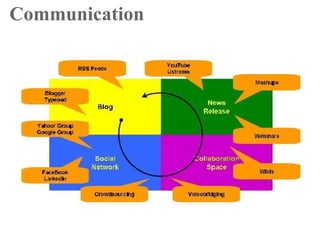
Communication
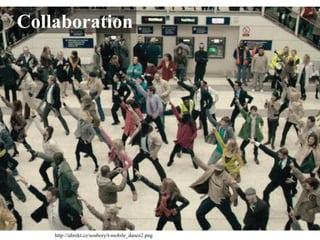
Collaboration
http://idirekt.cz/soubory/t-mobile_dance2.png
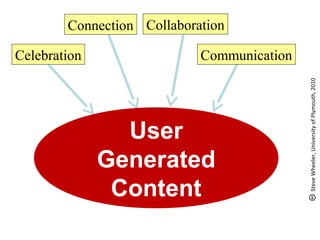
User
Generated
Content
Celebration
Connection
Communication
Collaboration
SteveWheeler,UniversityofPlymouth,2010
Creative Commons
Ultimately: Freedom to openly access,
use, copy, modify and share content
Community of Practice
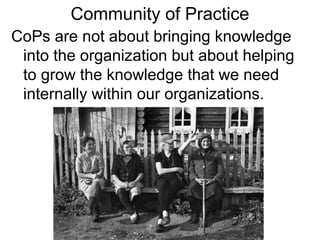
CoPs are not about bringing knowledge
into the organization but about helping
to grow the knowledge that we need
internally within our organizations.
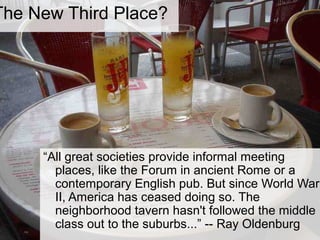
The New Third Place?
“All great societies provide informal meeting
places, like the Forum in ancient Rome or a
contemporary English pub. But since World War
II, America has ceased doing so. The
neighborhood tavern hasn't followed the middle
class out to the suburbs...” -- Ray Oldenburg
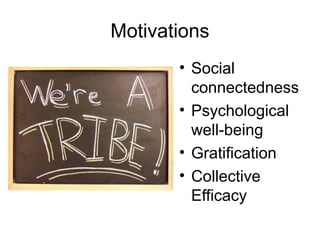
Motivations
• Social
connectedness
• Psychological
well-being
• Gratification
• Collective
Efficacy
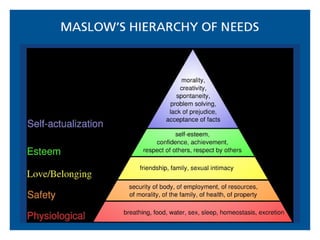
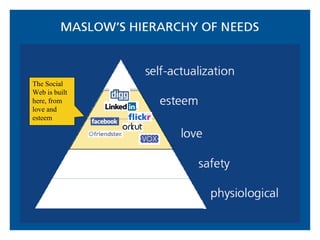
The Social
Web is built
here, from
love and
esteem
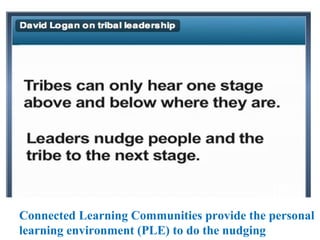
Connected Learning Communities provide the personal
learning environment (PLE) to do the nudging
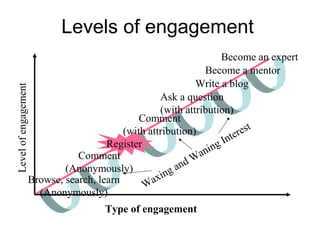
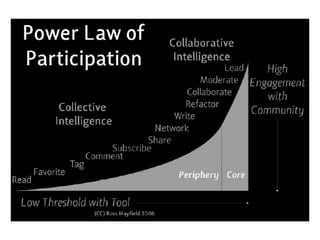
Levels of engagementLevelofengagement
Type of engagement
Browse, search, learn
(Anonymously)
Comment
(with attribution)
Ask a question
(with attribution)
Write a blog
Become a mentor
Become an expert
Register
Comment
(Anonymously)
Waxing and Waning Interest
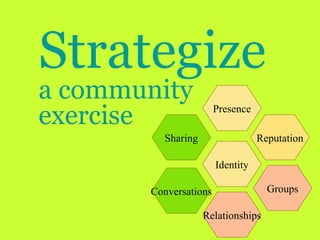
Strategize
a community
exercise Presence
Conversations
Sharing
Relationships
Groups
Reputation
Identity
“Strategy is
knowing what not
to do”
Michael Porter
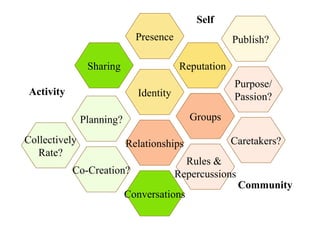
Presence
Conversations
Sharing
Relationships
Groups
Reputation
Identity
Self
Community
Activity
Rules &
Repercussions
Purpose/
Passion?
Co-Creation?
Planning?
Caretakers?Collectively
Rate?
Publish?
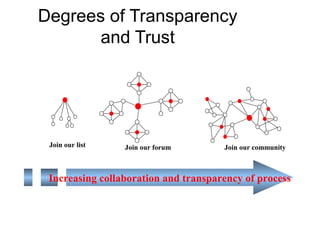
Degrees of Transparency
and Trust
Join our list Join our forum Join our community
Increasing collaboration and transparency of process
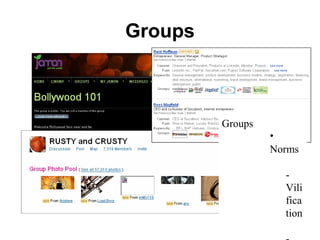
Groups
Groups
•
Norms
-
Vili
fica
tion
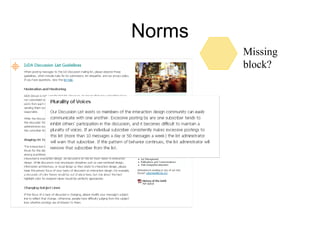
Norms
Missing
block?
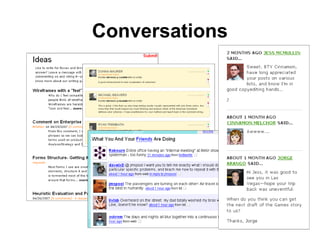
Conversations
You have to find a
way to spare the
group from scale.
Scale alone kills
conversations,
because
conversations
require dense two-
way conversations.
[Dunbar] found that the MAXIMUM
number of people that a person could
keep up with socially at any given
time, gossip maintenance, was 150.
This doesn't mean that people don't
have 150 people in their social
network, but that they only keep tabs
on 150 people max at any given point.
Simple (hard) Steps
• Have a compelling idea
• Seed
• Someone must live on the site
– Community manager or you
• Make the rules clear (and short)
– Tools not rules
• Punish swiftly and nicely
• Reward contributions- celebrate often
• Spread the work out
• Collective Norms
• Apologize publicly, swiftly and frequently
• Community platform and Web 2.0 spaces
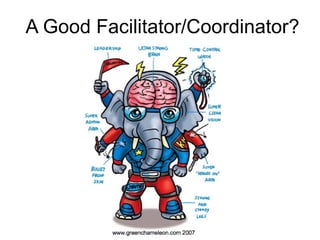
A Good Facilitator/Coordinator?
Community Leader
Facilitation and Coordination of a CoP includes:
• monitoring activity
• encouraging participation (facilitation techniques)
• felxible action plan
• reporting CoP activity – metrics, evaluations
• monitoring success criteria and impact
• behind the scenes
• managing CoP events
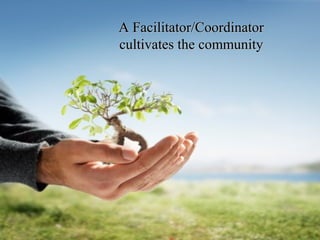
A Facilitator/CoordinatorA Facilitator/Coordinator
cultivates the communitycultivates the community
Metrics
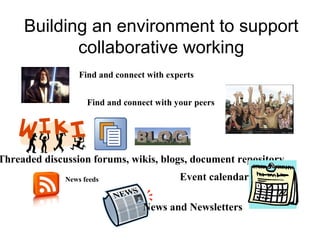
Building an environment to support
collaborative working
Find and connect with experts
Find and connect with your peers
Threaded discussion forums, wikis, blogs, document repository
News feeds Event calendar
News and Newsletters
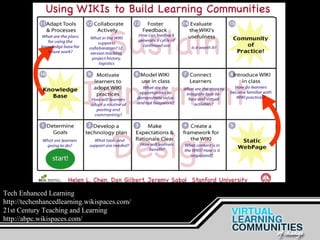
Tech Enhanced Learning
http://techenhancedlearning.wikispaces.com/
21st Century Teaching and Learning
http://abpc.wikispaces.com/
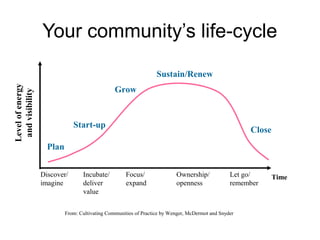
Your community’s life-cycle
Plan
Start-up
Grow
Sustain/Renew
Close
Levelofenergy
andvisibility
TimeDiscover/
imagine
Incubate/
deliver
value
Focus/
expand
Ownership/
openness
Let go/
remember
From: Cultivating Communities of Practice by Wenger, McDermot and Snyder
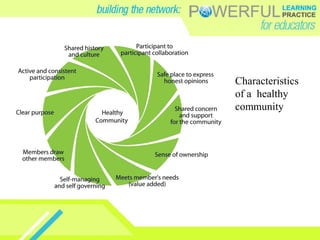
Characteristics
of a healthy
community
What is PLP?
YEAR 1:
Learning in the 21st Century: Networks and Communities
Focus: Understanding the global changes created by online
social technologies and the implications for teaching and
learning; provoking deep thinking about professional and
personal learning practice; understanding practical and
pedagogical implications for classrooms; conducting action
research that is aligned to school improvement goals; initiating
district-wide conversations and planning around long-term
change and the scaling of these ideas and technologies.
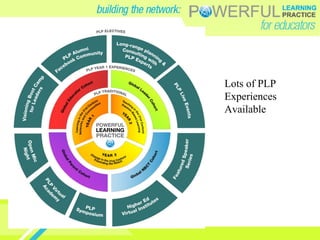
Lots of PLP
Experiences
Available
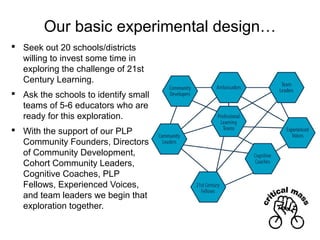
Our basic experimental design…
 Seek out 20 schools/districts
willing to invest some time in
exploring the challenge of 21st
Century Learning.
 Ask the schools to identify small
teams of 5-6 educators who are
ready for this exploration.
 With the support of our PLP
Community Founders, Directors
of Community Development,
Cohort Community Leaders,
Cognitive Coaches, PLP
Fellows, Experienced Voices,
and team leaders we begin that
exploration together.
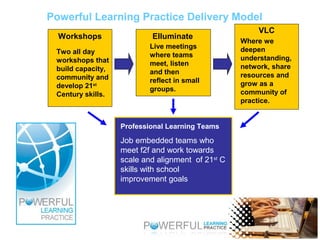
Two all day
workshops that
build capacity,
community and
develop 21st
Century skills.
Workshops
Live meetings
where teams
meet, listen
and then
reflect in small
groups.
Elluminate
Where we
deepen
understanding,
network, share
resources and
grow as a
community of
practice.
VLC
Professional Learning Teams
Job embedded teams who
meet f2f and work towards
scale and alignment of 21st
C
skills with school
improvement goals
Powerful Learning Practice Delivery Model
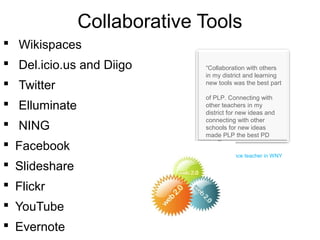
Collaborative Tools
 Wikispaces
 Del.icio.us and Diigo
 Twitter
 Elluminate
 NING
 Facebook
 Slideshare
 Flickr
 YouTube
 Evernote
“Collaboration with others
in my district and learning
new tools was the best part
of PLP. Connecting with
other teachers in my
district for new ideas and
connecting with other
schools for new ideas
made PLP the best PD
ever!”
~ Science teacher in WNY
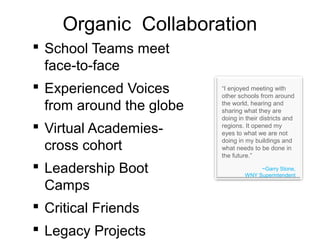
Organic Collaboration
 School Teams meet
face-to-face
 Experienced Voices
from around the globe
 Virtual Academies-
cross cohort
 Leadership Boot
Camps
 Critical Friends
 Legacy Projects
“I enjoyed meeting with
other schools from around
the world, hearing and
sharing what they are
doing in their districts and
regions. It opened my
eyes to what we are not
doing in my buildings and
what needs to be done in
the future.”
~Garry Stone,
WNY Superintendent
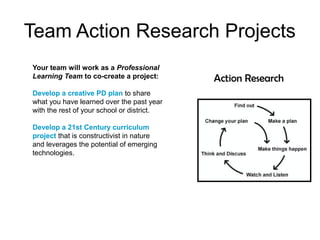
Team Action Research Projects
Your team will work as a Professional
Learning Team to co-create a project:
Develop a creative PD plan to share
what you have learned over the past year
with the rest of your school or district.
Develop a 21st Century curriculum
project that is constructivist in nature
and leverages the potential of emerging
technologies.
Action Research
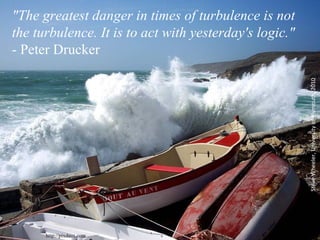
"The greatest danger in times of turbulence is not
the turbulence. It is to act with yesterday's logic."
- Peter Drucker
http://pixdaus.com
SteveWheeler,UniversityofPlymouth,2010

Clc ecoo

  • 1.
    Living and Learningin a Global Community Innovative Schools Virtual University
  • 2.
    Housekeeping Paperless handouts- coming http://21stcenturylearning.wikispaces.com/ SherylNussbaum-Beach Co-Founder & CEO Powerful Learning Practice, LLC http://plpnetwork.com sheryl@plpnetwork.com President 21st Century Collaborative, LLC http://21stcenturycollabrative.com
  • 3.
    6 Trends forthe digital age Analogue Digital Tethered Mobile Closed Open Isolated Connected Generic Personal Consuming Creating Source: David Wiley: Openness and the disaggregated future of higher education
  • 4.
    What does itmean to be a connected learner? How is it different from the way you learned in school? Let’s list adjectives that describe a connected learner and networked learning. (in backchannel) Photo credit: Alec Couros
  • 5.
    Inclination toward being openminded Dedication to the ongoing development of expertise Creation of a culture of collegiality- believing that "None of us is as good as all of us" and that the contributions of all can lead to improved individual practice Willingness to be a co-learner, co- creator, and co-leader Willingness to leaving one's comfort zone to experiment with new strategies and taking on new responsibilities Dispositions and Values Commitment to understanding gained through listening and asking good questions related to practice Perseverance toward deep thought by exploring ideas and concepts, rethinking, revising, and continual repacking and unpacking, resisting urges to finish prematurely Courage and initiative to engage in discussions on difficult topics Alacrity to share and contribute Desire to be transparent in thinking
  • 6.
    PLP takes a3-pronged approach to PD - Professional Learning Communities - Global Communities of Practice or Inquiry - Personal Learning Networks PLCs = local, f2f, collective CoPs = online, deep, collective PLNs= online, nodes, individual Knowledge Building Should be… Passive Reflective Active
  • 7.
  • 8.
    A Definition ofCommunity Communities are quite simply, collections of individuals who are bound together by natural will and a set of shared ideas and ideals. “A system in which people can enter into relations that are determined by problems or shared ambitions rather than by rules or structure.” (Heckscher, 1994, p. 24). The process of social learning that occurs when people who have a common interest in some subject or problem collaborate over an extended period to share ideas, find solutions, and build innovations. (Wikipedia)
  • 9.
    Community... ...has been definedas a group of interacting people living in a common location. http://www.psfk.com In the digital age, common location is not as important as common interest. What are the characteristics of distributed learning communities?
  • 10.
    A Definition ofNetworks From Wikipedia, the free encyclopedia Networks are created through publishing and sharing ideas and connecting with others who share passions around those ideas who learn from each other. Networked learning is a process of developing and maintaining connections with people and information, and communicating in such a way so as to support one another's learning. Connectivism (theory of learning in networks) is the use of a network with nodes and connections as a central metaphor for learning. In this metaphor, a node is anything that can be connected to another node: information, data, feelings, images. Learning is the process of creating connections and developing a network.
  • 11.
    “Understanding how networks workis one of the most important literacies of the 21st Century.” - Howard Rheingold http://www.ischool.berkeley.edu
  • 12.
    If ... informationis recognized as useful to the community ... it can be counted as knowledge. The community, then, has the power to create knowledge within a given context and leave that knowledge as a new node connected to the rest of the network’. – Dave Cormier (2008) SteveWheeler,UniversityofPlymouth,2010 Open Networks http://inperspire.blogspot.com
  • 13.
  • 14.
    The driving engineof the collaborative culture of a PLC is the team. They work together in an ongoing effort to discover best practices and to expand their professional expertise. PLCs are our best hope for reculturing schools. We want to focus on shifting from a culture of teacher isolation to a culture of deep and meaningful collaboration. Professional Learning Communities FOCUS: Local , F2F, Job-embedded- in Real Time
  • 15.
    Communities of Practice FOCUS:Situated, Synchronous, Asynchronous- Online and Walled Garden
  • 16.
    Personal Learning Networks FOCUS: Individual,Connecting to Learning Objects, Resources and People – Social Network Driven
  • 17.
    Community is theNew Professional Development Cochran-Smith and Lytle (1999a) describe three ways of knowing and constructing knowledge that align closely with PLP's philosophy and are worth mentioning here. Knowledge for Practice is often reflected in traditional PD efforts when a trainer shares with teachers information produced by educational researchers. This knowledge presumes a commonly accepted degree of correctness about what is being shared. The learner is typically passive in this kind of "sit and get" experience. This kind of knowledge is difficult for teachers to transfer to classrooms without support and follow through. After a workshop, much of what was useful gets lost in the daily grind, pressures and isolation of teaching. Knowledge in Practice recognizes the importance of teacher experience and practical knowledge in improving classroom practice. As a teacher tests out new strategies and assimilates them into teaching routines they construct knowledge in practice. They learn by doing. This knowledge is strengthened when teachers reflect and share with one another lessons learned during specific teaching sessions and describe the tacit knowledge embedded in their experiences.
  • 18.
    Community is theNew Professional Development Knowledge of Practice believes that systematic inquiry where teachers create knowledge as they focus on raising questions about and systematically studying their own classroom teaching practices collaboratively, allows educators to construct knowledge of practice in ways that move beyond the basics of classroom practice to a more systemic view of learning. We believe that by attending to the development of knowledge for, in and of practice, we can enhance professional growth that leads to real change. Cochran-Smith, M., & Lytle, S.L. (1999a). Relationships of knowledge and practice: Teaching learning in communities. Review of Research in Education, 24, 249-305. Passive, active, and reflective knowledge building in local (PLC), global (CoP) and contextual (PLN) learning spaces.
  • 19.
  • 20.
    Virtual Community A virtualspace supported by computer-based information technology, centered upon communication and interaction of participants to generate member-driven content, resulting in relationships being built up. (Lee & Vogel, 2003)
  • 21.
    Dynamics of DifferentNetwork Types Community of Practice Project Teams Informal networks Purpose Learning Sharing Creating Knowledge Accomplish specific task Communication flows Boundary Knowledge domain Assigned projector task Networking, resource building and establishing relationships Connections Common application or discovery- innovation Commitment to goal Interpersonal acquaintances Membership Semi - permanent Constant for a fixed period Links made based on needs of the individual Time scale As long as it adds value to the its members Fixed ends when project deliverables have been No pre-engineered end
  • 22.
    Looking Closely atLearning Community Design 4L Model (Linking, Lurking, Learning, and Leading) inspired by John Seeley Brown http://learningcircuits.blogspot.com/2006/06/roles-in-cops.html This model is developed around the roles and interactions members of a community have as participants in that community.
  • 24.
    Webb/Butterfield/Smith Model Based onMatt Webb, Stewart Butterfield’s and Gene Smith’s writings
  • 25.
  • 26.
  • 27.
  • 28.
  • 29.
  • 30.
    Creative Commons Ultimately: Freedomto openly access, use, copy, modify and share content
  • 31.
    Community of Practice CoPsare not about bringing knowledge into the organization but about helping to grow the knowledge that we need internally within our organizations.
  • 32.
    The New ThirdPlace? “All great societies provide informal meeting places, like the Forum in ancient Rome or a contemporary English pub. But since World War II, America has ceased doing so. The neighborhood tavern hasn't followed the middle class out to the suburbs...” -- Ray Oldenburg
  • 33.
  • 35.
    The Social Web isbuilt here, from love and esteem
  • 37.
    Connected Learning Communitiesprovide the personal learning environment (PLE) to do the nudging
  • 38.
    Levels of engagementLevelofengagement Typeof engagement Browse, search, learn (Anonymously) Comment (with attribution) Ask a question (with attribution) Write a blog Become a mentor Become an expert Register Comment (Anonymously) Waxing and Waning Interest
  • 40.
  • 41.
    “Strategy is knowing whatnot to do” Michael Porter
  • 42.
  • 43.
    Degrees of Transparency andTrust Join our list Join our forum Join our community Increasing collaboration and transparency of process
  • 44.
  • 45.
  • 46.
  • 47.
    You have tofind a way to spare the group from scale. Scale alone kills conversations, because conversations require dense two- way conversations. [Dunbar] found that the MAXIMUM number of people that a person could keep up with socially at any given time, gossip maintenance, was 150. This doesn't mean that people don't have 150 people in their social network, but that they only keep tabs on 150 people max at any given point.
  • 48.
    Simple (hard) Steps •Have a compelling idea • Seed • Someone must live on the site – Community manager or you • Make the rules clear (and short) – Tools not rules • Punish swiftly and nicely • Reward contributions- celebrate often • Spread the work out • Collective Norms • Apologize publicly, swiftly and frequently • Community platform and Web 2.0 spaces
  • 49.
  • 50.
    Community Leader Facilitation andCoordination of a CoP includes: • monitoring activity • encouraging participation (facilitation techniques) • felxible action plan • reporting CoP activity – metrics, evaluations • monitoring success criteria and impact • behind the scenes • managing CoP events
  • 51.
  • 52.
  • 53.
    Building an environmentto support collaborative working Find and connect with experts Find and connect with your peers Threaded discussion forums, wikis, blogs, document repository News feeds Event calendar News and Newsletters
  • 54.
    Tech Enhanced Learning http://techenhancedlearning.wikispaces.com/ 21stCentury Teaching and Learning http://abpc.wikispaces.com/
  • 56.
  • 57.
  • 58.
    What is PLP? YEAR1: Learning in the 21st Century: Networks and Communities Focus: Understanding the global changes created by online social technologies and the implications for teaching and learning; provoking deep thinking about professional and personal learning practice; understanding practical and pedagogical implications for classrooms; conducting action research that is aligned to school improvement goals; initiating district-wide conversations and planning around long-term change and the scaling of these ideas and technologies.
  • 59.
  • 60.
    Our basic experimentaldesign…  Seek out 20 schools/districts willing to invest some time in exploring the challenge of 21st Century Learning.  Ask the schools to identify small teams of 5-6 educators who are ready for this exploration.  With the support of our PLP Community Founders, Directors of Community Development, Cohort Community Leaders, Cognitive Coaches, PLP Fellows, Experienced Voices, and team leaders we begin that exploration together.
  • 62.
    Two all day workshopsthat build capacity, community and develop 21st Century skills. Workshops Live meetings where teams meet, listen and then reflect in small groups. Elluminate Where we deepen understanding, network, share resources and grow as a community of practice. VLC Professional Learning Teams Job embedded teams who meet f2f and work towards scale and alignment of 21st C skills with school improvement goals Powerful Learning Practice Delivery Model
  • 63.
    Collaborative Tools  Wikispaces Del.icio.us and Diigo  Twitter  Elluminate  NING  Facebook  Slideshare  Flickr  YouTube  Evernote “Collaboration with others in my district and learning new tools was the best part of PLP. Connecting with other teachers in my district for new ideas and connecting with other schools for new ideas made PLP the best PD ever!” ~ Science teacher in WNY
  • 64.
    Organic Collaboration  SchoolTeams meet face-to-face  Experienced Voices from around the globe  Virtual Academies- cross cohort  Leadership Boot Camps  Critical Friends  Legacy Projects “I enjoyed meeting with other schools from around the world, hearing and sharing what they are doing in their districts and regions. It opened my eyes to what we are not doing in my buildings and what needs to be done in the future.” ~Garry Stone, WNY Superintendent
  • 65.
    Team Action ResearchProjects Your team will work as a Professional Learning Team to co-create a project: Develop a creative PD plan to share what you have learned over the past year with the rest of your school or district. Develop a 21st Century curriculum project that is constructivist in nature and leverages the potential of emerging technologies. Action Research
  • 66.
    "The greatest dangerin times of turbulence is not the turbulence. It is to act with yesterday's logic." - Peter Drucker http://pixdaus.com SteveWheeler,UniversityofPlymouth,2010

Editor's Notes

  • #25 Identity Presence Relationships Conversations Groups Reputation Sharing I'll describe each of these, as I see them, critiquing AOL Instant Messanger (just as an exmaple), and then describe how we put them into use. Identity | Your identity is shown by a screenname, which remains persistent through time. There are incentives not to change this, like having your list of friends stored on the server and only accessible through your screenname. This acts as a pressure to not change identity. Having a persistent identity is more important than having one brought in from the physical world. Presence | Presence is awareness of sharing the same space, and this is implemented as seeing when your friends are online, or busy. AIM isn't particularly good at group presence and visibility of communication, although other chat systems (such as IRC and early Talkers) use the concept of "rooms" and whispers. Relationships | AIM lets you add people as buddies. From that moment, their presence is visible on your screen. This is a relationship, you're allowed them to have an effect on your environment. Not terribly nuanced however. Conversations | Conversations are implemented as synchronous messaging. There's a difference between messaging and conversations. Messaging is just an exchange of text with no obligation, but conversations have their own presence and want to be continued. AIM does this by having a window for a conversation. It's difficult to drift out of it, it hangs there, requesting you continue. Contrast this with email which often is just messaging, and conversations die easily. Groups | AIM isn't great at groups. Although you can have group chats, the group is transient. People have more loyalty to a group when there's some kind of joining step, when they've made some investment in it. Entering a window just doesn't do that, and there's no property of the group that exists outside the individual user's accounts. Reputation | Reputation is used more in systems which allow meeting new individuals. AIM's simple version of this is "warning". Any user may "warn" any other user. A users total "warn" level (a figure up to 100) is shown to everyone they communicate with. Unfortunately, it's not a trustworthy reputation system, and reputation is notoriously difficult -- but humans are great at dealing with it themselves, given certain affordances: persistence identities, and being able to discuss those identities with other people. AIM's simplistic relationship system makes reputation not so important though. Sharing | People like to share. With AIM, sharing is often as simple as giving a friend a link to follow. Other systems, such as Flikr, are about sharing photographs. These act as small transactions that build genuine group feeling.
  • #44 How a knowledge and learning culture was successfully developed using Communities of Practice (CoP) Most users were familiar with distribution lists – e.g. newsletters and e-bulletins. In fact over 30,000 local government employees subscribe to the IDeA e-bulletin. There were also users familiar with using forums – the IDeA web site supports a large number of fairly active forums. But these are not ‘communities of practice’. Certainly there was an element of collaboration using the forums, but there was no concept of trust or transparency, and no access to a common (domain-specific) library of material. The website itself was designed as a broadcast medium (Web1.0) and not as a resource to enable connections to be made between users. The key to moving forward was to develop a compelling business case that would emphasise the enormous potential that could be gained by encouraging connections with and between users and allowing the conversations to flow. So, it was one final step to developing the concept of a ‘community’, which would encourage greater collaboration through a variety of social networking tools and social media applications. The early adopters – as you will probably guess – are those who were already familiar with forums and maybe even social networking sites (Myspace, Facebook, Flickr etc.)
  • #45 Groups can be implicit, created by a shared tag or life goal as in 43 things, or they can be explicit such as discussion and sharing groups. Explicitly choosing to join a group will create greater commitment to nurture that group. Implicit is fun, but rarely creates more than happy serendipity…. Community comes from opting in, and the more the effort the higher the commitment and the deeper the staying power. The well is a paid community with legs, X% of the IAI say they pay the 40 bucks a year for the mailing list. Relationships can become groups as implicit gets articulated as explicit.
  • #47 Conversations, communication, that’s the heart and soul of community. No how much software we build, people build the relationships and they build it out of words first. If you don’t’ have a place for people to put their words, no community is every possible; only a viewership. And that is a weak tie. There are no fanfiction sites that have outlived their original inspiration. Communities last if they can talk to each other. Conversation can take many forms. Forums and comments on stories are public, conversations in productivity aps such as basecamp and PublicSquare are antoehr. PublicSquare and Yahoo suggest encourages group creations of stories features. Cambrian House uses conversations to bring ideas into products. Twitter blends presence with conversation with little tweats of “I am here, alive! Aware!” Interestingly enough, Amazon has made it impossible to conduct conversation because of their usefulness rating. Unable to guarantee chronological display of their comments, reviewers can only broadcast their views.