Archetypal criticism by Northrop Frye
• Name – Solanki Mayuri .m
• Roll no – 22
• Enrollment no – 2069108420180050
• Course – Literary Theory and Criticism
• Batch – 2017-19
• Email id – mayuribensolanki24@gmail.com
• Submitted to – Department of English
introduction
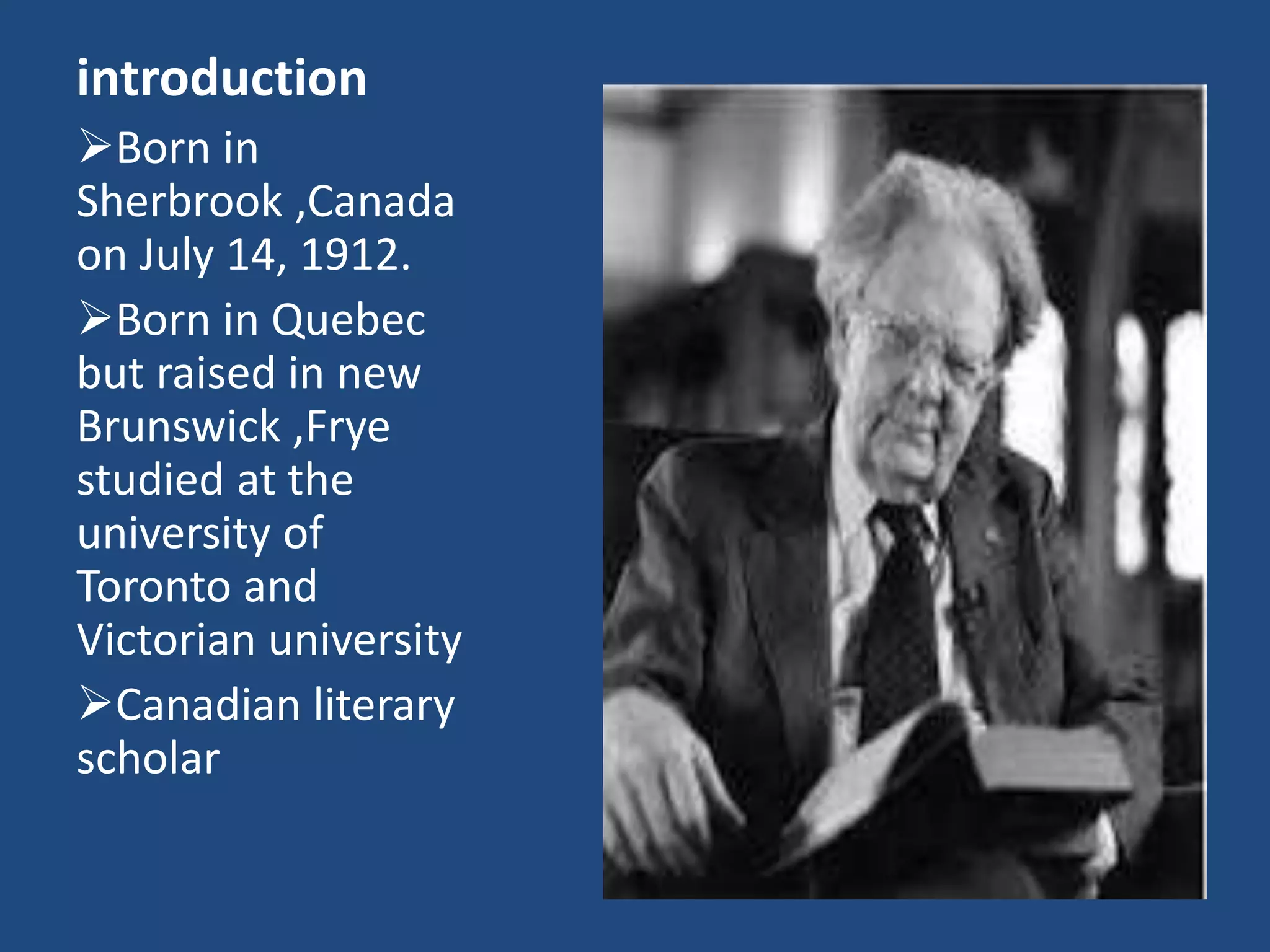
Born in
Sherbrook ,Canada
on July 14, 1912.
Born in Quebec
but raised in new
Brunswick ,Frye
studied at the
university of
Toronto and
Victorian university
Canadian literary
scholar
Who is Northrop Frye ?
• He was ordained to the ministry of the united
church of Canada and studied at oxford before
returning to voft.
• One of the most recognized authors of literary
criticism world –wide.
• Northrop Frye studied at both the university of
Toronto and oxford.
Herman Northrop Frye was a Canadian literary
critic and literary theorist , considered one of the
most influential of the 20th century.
What is an archetype ?
• According to the oxford dictionary;
• A very typical example of a certain person or
thing
• An original which has been imitated ; a
prototype mythology .
• In Jungian theory ,a primitive mental image
inherited from the earliest human ancestors
,and supposed to be present in the collective
unconscious.
Other meaning …..
• There are different meaning of archetypal
criticism;
• An image or symbol that is used repeatedly in art
or literature. The archetypal criticism means
identifying patterns of action character types,
and themes in literature as well as in myth ,
dreams and social rituals.
• The Archetypal critic Observes the symbol,
myths, pattern of action and applies it to any
particular literature .
Archetype of Literature
• Archetypes are universal symbol .
• Certain concept are also archetypes.
• Archetype are the residue of innumerable
experiences of the same type undergone by
the mind.
• Same experience when repeated over
centuries of a eons leave a trace or mark on
the human mind.
• The solar cycle ,seasonal cycle and life cycle
are such repetitive phenomena.
Frye’s scientific approach
• In “The Anatomy of criticism”, Frye looks with
dismay at literary criticism dependent on
personal judgment , instead, he offers a more
scientific approach to criticism by looking at
“identifiable patterns in myth and archetype.”
• Frye's work is similar in that he identifies
phases of myth and the archetype associared
with four phases
Four phases
 spring
Summer
Autumn
Winter
The archetypes of life
Solar cycle Seasonal
cycle
Life cycle Literary cycle
dawn spring birth Myth of birth of the hero ,revival
,resurrection, creation
noon summer youth Myth about entering paradise sacred
marriage ,myth of apotheosis
sunset autumn Death
phase
Myth of fall, dying god ,isolation of the
hero, sacrifices
darkness winter dissolution Myth of dark power triumphing flood
return of chaos detect of hero
• Northrop Frye developed a theory of literature
based on myths and archetypes.
• He says literature is not reflection of life not
expression of personality.
• Seasonal myths appears in hamlet .
• Frye wanted to develop a unifying theory of criticism
something like the Darwinian theory of evolution for
literature.
• He call it as a kind of literary anthropology
• He detects an archetype or myth in every kind of
literature.
The dawn ,spring and the birth
• Myth of the hero, of revival and resurrection ,of
creation and because the four phases are a cycle of
the defeat of the powers of darkness ,winter and
death
• Subordinate characters ; the father and the mother
• The archetype of romance and of most dithyrambic
and rhapsodic poetry .
The zenith, summer and marriage
• Myths of apotheosis ,of the sacred marriage and of
entering into paradise.
• Subordinate character ; the companion and the
bride.
• The archetype of comedy ,pastoral and idyll.
The sunset ,autumn and death
• Myth of fall, of the dying god , of violent death and
sacrifice and of the isolation of the hero.
• Subordinate character; the traitor and the siren .
• The archetype of tragedy and elegy .
The darkness ,winter and dissolution
• Myth of the triumph of these powers , myths of
floods and the return of chaos and of the defeat of
the hero.
• Subordinates character ; the ogre and the witch .
• The archetype of satire .
• The quest of the hero also tends to assimilate the
oracular.
રુમઝુમ આવ્યા વર્ાારાણી;
ખોબે ખોબા લાવ્યા પાણી.
નદીઓ નાળા છાલકાયા;
ખેતર, જ ંગલ મલકાયા.
ચારે કોર પાણી પાણી;
રુમઝુમ આવ્યા વર્ાારાણી.
લીલી લીલી ધરતી ખીલી;
ફોરે ફૂલો ફોરાં ખીલી.
કરતા પ્રભુ જળની લ્હાણી;
રુમઝુમ આવ્યા વર્ાારાણી.
પંખી પ્રાણી રાજી રાજી;
વરસે વાદળ ગાજી ગાજી.
બાળો મોજ રહ્યા છે માણી;
રુમઝુમ આવ્યા વર્ાારાણી.
- Jayshree
Similar and different archetype
Simmilar – focusing on Saas
Bahu
• Kyuki sas bhi kabhi bahu thi
• Saathiya
• Ye hai Mohabbate
Different archetype from
common theme
• Kulfi kumar Bajewala
• Bepanah Mohabbate
archetypal criticism by nortrope frye

archetypal criticism by nortrope frye

  • 1.
    Archetypal criticism byNorthrop Frye • Name – Solanki Mayuri .m • Roll no – 22 • Enrollment no – 2069108420180050 • Course – Literary Theory and Criticism • Batch – 2017-19 • Email id – mayuribensolanki24@gmail.com • Submitted to – Department of English
  • 2.
    introduction Born in Sherbrook ,Canada onJuly 14, 1912. Born in Quebec but raised in new Brunswick ,Frye studied at the university of Toronto and Victorian university Canadian literary scholar
  • 3.
    Who is NorthropFrye ? • He was ordained to the ministry of the united church of Canada and studied at oxford before returning to voft. • One of the most recognized authors of literary criticism world –wide. • Northrop Frye studied at both the university of Toronto and oxford. Herman Northrop Frye was a Canadian literary critic and literary theorist , considered one of the most influential of the 20th century.
  • 4.
    What is anarchetype ? • According to the oxford dictionary; • A very typical example of a certain person or thing • An original which has been imitated ; a prototype mythology . • In Jungian theory ,a primitive mental image inherited from the earliest human ancestors ,and supposed to be present in the collective unconscious.
  • 5.
    Other meaning ….. •There are different meaning of archetypal criticism; • An image or symbol that is used repeatedly in art or literature. The archetypal criticism means identifying patterns of action character types, and themes in literature as well as in myth , dreams and social rituals. • The Archetypal critic Observes the symbol, myths, pattern of action and applies it to any particular literature .
  • 6.
    Archetype of Literature •Archetypes are universal symbol . • Certain concept are also archetypes. • Archetype are the residue of innumerable experiences of the same type undergone by the mind. • Same experience when repeated over centuries of a eons leave a trace or mark on the human mind. • The solar cycle ,seasonal cycle and life cycle are such repetitive phenomena.
  • 7.
    Frye’s scientific approach •In “The Anatomy of criticism”, Frye looks with dismay at literary criticism dependent on personal judgment , instead, he offers a more scientific approach to criticism by looking at “identifiable patterns in myth and archetype.” • Frye's work is similar in that he identifies phases of myth and the archetype associared with four phases
  • 8.
  • 9.
    The archetypes oflife Solar cycle Seasonal cycle Life cycle Literary cycle dawn spring birth Myth of birth of the hero ,revival ,resurrection, creation noon summer youth Myth about entering paradise sacred marriage ,myth of apotheosis sunset autumn Death phase Myth of fall, dying god ,isolation of the hero, sacrifices darkness winter dissolution Myth of dark power triumphing flood return of chaos detect of hero
  • 10.
    • Northrop Fryedeveloped a theory of literature based on myths and archetypes. • He says literature is not reflection of life not expression of personality. • Seasonal myths appears in hamlet . • Frye wanted to develop a unifying theory of criticism something like the Darwinian theory of evolution for literature. • He call it as a kind of literary anthropology • He detects an archetype or myth in every kind of literature.
  • 11.
    The dawn ,springand the birth • Myth of the hero, of revival and resurrection ,of creation and because the four phases are a cycle of the defeat of the powers of darkness ,winter and death • Subordinate characters ; the father and the mother • The archetype of romance and of most dithyrambic and rhapsodic poetry .
  • 12.
    The zenith, summerand marriage • Myths of apotheosis ,of the sacred marriage and of entering into paradise. • Subordinate character ; the companion and the bride. • The archetype of comedy ,pastoral and idyll.
  • 13.
    The sunset ,autumnand death • Myth of fall, of the dying god , of violent death and sacrifice and of the isolation of the hero. • Subordinate character; the traitor and the siren . • The archetype of tragedy and elegy .
  • 14.
    The darkness ,winterand dissolution • Myth of the triumph of these powers , myths of floods and the return of chaos and of the defeat of the hero. • Subordinates character ; the ogre and the witch . • The archetype of satire . • The quest of the hero also tends to assimilate the oracular.
  • 15.
    રુમઝુમ આવ્યા વર્ાારાણી; ખોબેખોબા લાવ્યા પાણી. નદીઓ નાળા છાલકાયા; ખેતર, જ ંગલ મલકાયા. ચારે કોર પાણી પાણી; રુમઝુમ આવ્યા વર્ાારાણી. લીલી લીલી ધરતી ખીલી; ફોરે ફૂલો ફોરાં ખીલી. કરતા પ્રભુ જળની લ્હાણી; રુમઝુમ આવ્યા વર્ાારાણી. પંખી પ્રાણી રાજી રાજી; વરસે વાદળ ગાજી ગાજી. બાળો મોજ રહ્યા છે માણી; રુમઝુમ આવ્યા વર્ાારાણી. - Jayshree
  • 16.
    Similar and differentarchetype Simmilar – focusing on Saas Bahu • Kyuki sas bhi kabhi bahu thi • Saathiya • Ye hai Mohabbate Different archetype from common theme • Kulfi kumar Bajewala • Bepanah Mohabbate