City of Brockville
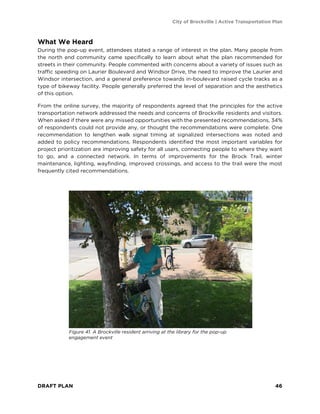
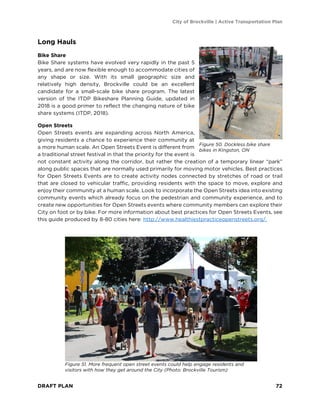
Active Transportation Plan
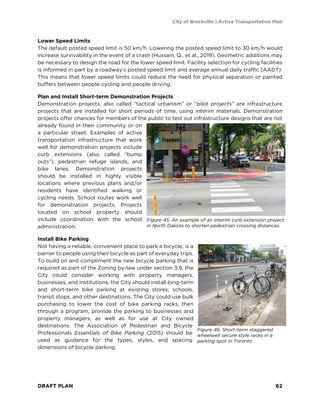
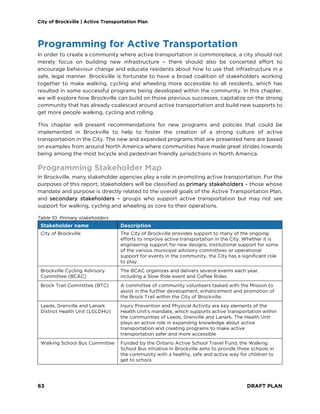
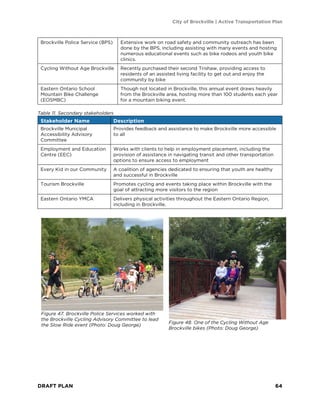
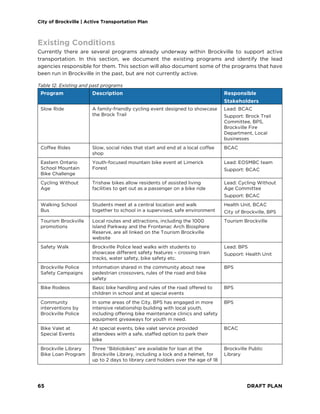
Draft - September 2019
Page intentionally left blank
City of Brockville | Active Transportation Plan
1 DRAFT PLAN
Acknowledgements
Thank you to the following stakeholders for their involvement on this plan:
Brockville Cycling Advisory Committee
Brock Trail Committee
Leeds Grenville and Lanark District Health Unit
Residents of Brockville
Cover photo by Doug George
All photos within the plan are by Alta Planning + Design unless otherwise noted.
City of Brockville | Active Transportation Plan
DRAFT PLAN 2
Executive Summary
The City of Brockville Active Transportation Plan recommends initiatives, improvements, and
new infrastructure facilities in the City of Brockville to support and encourage residents and
visitors to walk and cycle as a feasible, convenient, and attractive way to get around the
community. The plan is a long-term planning document, with recommendations for short-term
(0-5 year), mid-term (5-10 year), and long-term (10-20+ year) implementation.
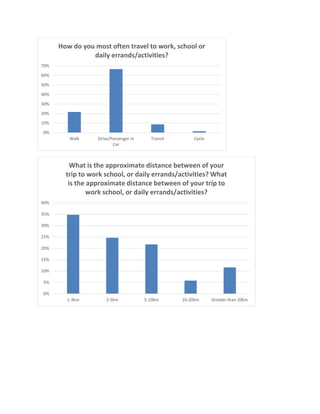
The City’s compact urban form means that everyday destinations are not more than 8
kilometres away, making active transportation an easy way to get where you need to go.
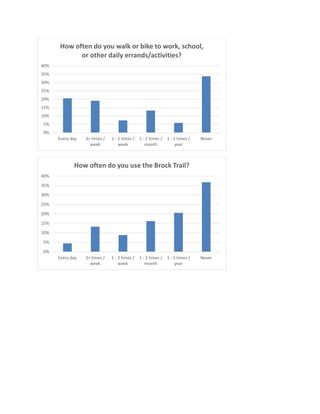
Despite this, only around 1% of people bike to work, and 11% of people walk. The city already
has an extensive network of pedestrian facilities, such as sidewalks, but does not have a
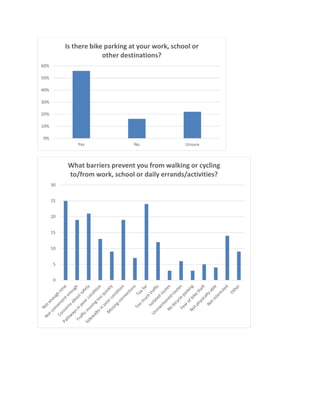
connected cycling network. The lack of a connected, low stress network of cycling facilities
was cited as a top barrier preventing people from cycling in the city.
The plan was developed using best practice from Ontario and North America, with reference
to the Transportation Association of Canada Geometric Design Guide for Canadian Roads and
the Ontario Traffic Council Book 18: Cycling Facilities. The plan was developed based on best
practices and a methodology which considered existing and planned facilities, the existing road
network, and feedback from the public.
The public and stakeholders were engaged early on in the process through two pop-up style
engagement events and an online platform that allowed people to add their comments to an
interactive map. This round of engagement sought feedback on peoples’ experiences with and
barriers to using active transportation, in order to identify opportunities and challenges for the
plan to address. Over 50 people were engaged during the pop-up events and 524 people
participated on the online platform during this phase of engagement. A second round of public
engagement included one pop-up event at the library, and sought feedback on the draft
recommendations to identify any missing recommendations, or where the plan was especially
successful at addressing the principles from the network development process. There were 43
responses to the survey, and 70 people attended the pop-up event during this phase.
City of Brockville | Active Transportation Plan
3 DRAFT PLAN
The plan provides a vision of a comprehensive cycling network and pedestrian improvements
making active transportation a more attractive and feasible option for people to use as part of
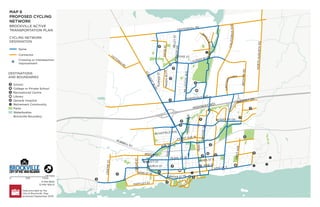
everyday life. The recommendations include 42 km of cycling spine routes which are
connected, all ages and abilities facilities that reach every part of the City. This is complimented
by 39 km of cycling connector routes which include a variety of facilities connecting people to
spine routes and additional destinations throughout the City. The plan also includes
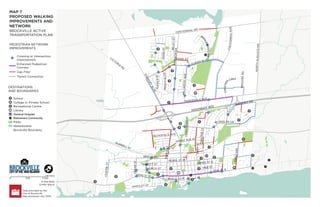
recommendations for pedestrian network improvements, involving resolving existing gaps in
the sidewalk network, pedestrian linkages to transit stops, and designation of enhanced
pedestrian corridors, which will have improved pedestrian crossings and an improved public
realm.
In addition to these new infrastructure facility recommendations, the plan includes policy
recommendations including revisions to current by-laws, as well as new City policies, such as
lengthening crossing time at signalized crossings near schools, retirement communities, and
hospitals, and lowering speed limits City-wide, recognizing the impact that vehicle speeds have
on the severity of pedestrian and cyclist-involved collisions.
Program recommendations in the plan recognize the social component of promoting and
encouraging active transportation. The recommendations are split into four groups, Staffing
and Funding, Scaling Up, Sprints, and Long Hauls to provide both short-term and longer-term
initiatives for the City to pursue to support residents and visitors using active transportation.
The recommendations consider the various stakeholders involved in leading and supporting
activities such as bike rodeos for youth, distance mapping communication, and an open streets
event.
City of Brockville | Active Transportation Plan
DRAFT PLAN 4
Table of Contents
Executive Summary ......................................................................................................................................................2
What is Active Transportation?...............................................................................................................................6
Why is Planning for Active Transportation Important?........................................................................7
Community Background.............................................................................................................................................9
Relevant Documents and Plans.....................................................................................................................10
The Brock Trail....................................................................................................................................................... 11
Public Engagement ...................................................................................................................................................... 11
First Round of Engagement................................................................................................................................ 13
How We Engaged................................................................................................................................................ 13
What We Heard................................................................................................................................................... 28
Second Round of Engagement.......................................................................................................................... 17
How We Engaged................................................................................................................................................ 17
What We Heard...................................................................................................................................................46
Existing Conditions ..................................................................................................................................................... 17
Existing Active Transportation Facilities................................................................................................... 18
Existing Conditions Analysis.......................................................................................................................... 22
Network Development.............................................................................................................................................. 32
Active Transportation Facility Types ............................................................................................................. 32
Intersection and Crossing Projects .............................................................................................................36
Plan Network Designations ............................................................................................................................40
Rationale for the Networks ............................................................................................................................44
Common Network Challenges ......................................................................................................................46
City of Brockville | Active Transportation Plan
5 DRAFT PLAN
Network Implementation.........................................................................................................................................46
Implementation Opportunities......................................................................................................................47
Cycling Network Project Prioritization......................................................................................................48
Pedestrian Improvement Prioritization .....................................................................................................49
Funding Opportunities ..................................................................................................................................... 52
Maintenance and Operations......................................................................................................................... 53
Policy Recommendations........................................................................................................................................59
Traffic By-Law......................................................................................................................................................59
Parking By-law Recommendations.............................................................................................................60
Additional Policy Recommendations..........................................................................................................61
Programming for Active Transportation ..........................................................................................................63
Programming Stakeholder Map........................................................................................................................63
Existing Conditions ................................................................................................................................................65
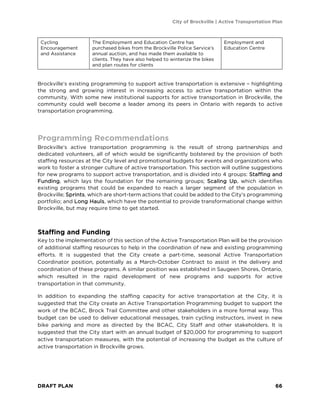
Programming Recommendations....................................................................................................................66
Staffing and Funding.........................................................................................................................................66
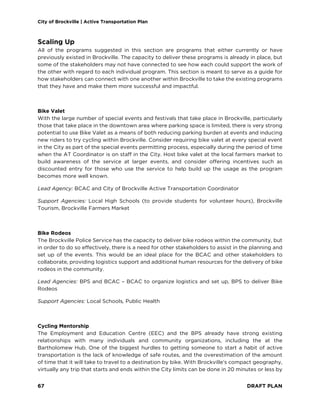
Scaling Up..............................................................................................................................................................67
Sprints......................................................................................................................................................................69
Long Hauls............................................................................................................................................................. 72
References ..................................................................................................................................................................... 73
City of Brockville | Active Transportation Plan
DRAFT PLAN 6
What is Active Transportation?
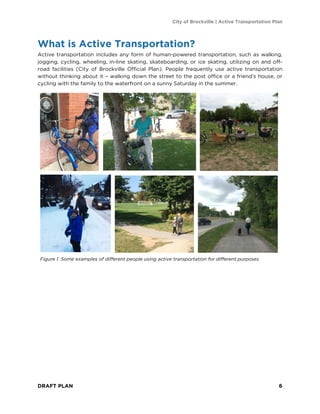
Active transportation includes any form of human-powered transportation, such as walking,
jogging, cycling, wheeling, in-line skating, skateboarding, or ice skating, utilizing on and off-
road facilities (City of Brockville Official Plan). People frequently use active transportation
without thinking about it – walking down the street to the post office or a friend’s house, or
cycling with the family to the waterfront on a sunny Saturday in the summer.
Figure 1. Some examples of different people using active transportation for different purposes
City of Brockville | Active Transportation Plan
7 DRAFT PLAN
Why is Planning for Active Transportation Important?
The City of Brockville has identified in previous planning studies that active transportation
should be encouraged and a network of facilities that provide the opportunity for people to
use active transportation should be expanded. Active transportation is important for building
a great place to live, work, and play. In addition to being part of the City’s vision, active
transportation offers important benefits.
Health (Personal and Public)
• Active transportation allows people to be physically active throughout
their day, integrated into their schedule
• 69% of Canadian adults and 91% of Canadian children and youth are not
getting the recommended levels of daily physical activity (Colley et al. 2011)
• Numerous studies and recent research from across Canada have linked the lack of
physical activity as a key contributor to Canada’s high (and growing) obesity rates
(Bryan and Katzmarzyk, 2011)
• It is estimated that if all Canadians engaged in 60 minutes of physical activity per day,
33% of all deaths related to coronary heart disease, 25% of deaths related to stroke, 20%
of deaths related to type 2 diabetes, and 20% of deaths related to hypertension could
be avoided (Warburton et al., 2007)
• Using active transportation provides people with more opportunity to be immersed in
greenspace, which has positive impacts for an individual’s mental health (Litman, 2013)
Access/Equity
• Significant portion of the population does not have access or the ability
to drive a car due to age, disability, or economic factors
• Active transportation is a low/no cost way to get around
• People using public transportation most often use active transportation to
get to public transit
Environment
• Active transportation has a lower environmental impact
• Increased use of active transportation can lower air and noise pollution
compared to driving motor vehicles
Economic
• A city’s bike-friendliness is a factor for people’s decision to move there
• A healthier population has lower health care costs, saving taxpayer money
• People that use active transportation mean business. Numerous studies
have identified the economic impacts of people walking and cycling, as well
as tourism related economic impacts
• Reduces need for costly road expansion projects
City of Brockville | Active Transportation Plan
DRAFT PLAN 8
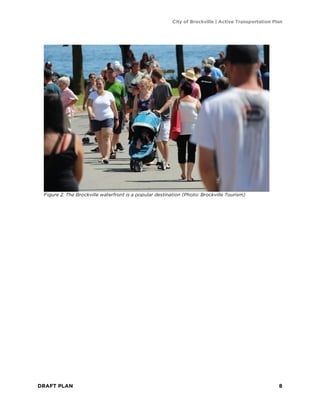
Figure 2. The Brockville waterfront is a popular destination (Photo: Brockville Tourism)
City of Brockville | Active Transportation Plan
9 DRAFT PLAN
Community Background
The City of Brockville is a small urban municipality on the St. Lawrence River in eastern Ontario.
While the City is independent, it is also the county seat of the United Counties of Leeds and
Grenville, which surrounds the City. The City is split into north and south areas by Highway 401.
There are three roads that cross the highway; Stewart Boulevard, Ormond Street, and North
Augusta Road. The Canadian National (CN) and VIA railways also run through the City, with
multiple at-grade crossings along both rail
corridors.
The City has modest population and employment
growth projections to 2031 of around 1-2%. The
percentage of the population over the age of 65 is
expected to grow by 7%.
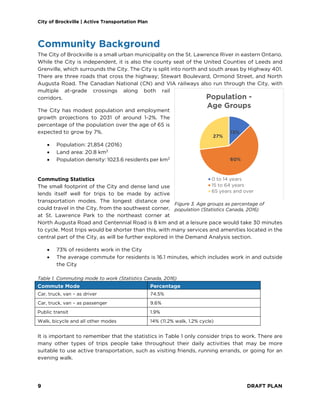
• Population: 21,854 (2016)
• Land area: 20.8 km2
• Population density: 1023.6 residents per km2
Commuting Statistics
The small footprint of the City and dense land use
lends itself well for trips to be made by active
transportation modes. The longest distance one
could travel in the City, from the southwest corner,
at St. Lawrence Park to the northeast corner at
North Augusta Road and Centennial Road is 8 km and at a leisure pace would take 30 minutes
to cycle. Most trips would be shorter than this, with many services and amenities located in the
central part of the City, as will be further explored in the Demand Analysis section.
• 73% of residents work in the City
• The average commute for residents is 16.1 minutes, which includes work in and outside
the City
Table 1. Commuting mode to work (Statistics Canada, 2016)
Commute Mode Percentage
Car, truck, van – as driver 74.5%
Car, truck, van – as passenger 9.6%
Public transit 1.9%
Walk, bicycle and all other modes 14% (11.2% walk, 1.2% cycle)
It is important to remember that the statistics in Table 1 only consider trips to work. There are
many other types of trips people take throughout their daily activities that may be more
suitable to use active transportation, such as visiting friends, running errands, or going for an
evening walk.
13%
60%
27%
Population -
Age Groups
0 to 14 years
15 to 64 years
65 years and over
Figure 3. Age groups as percentage of
population (Statistics Canada, 2016)
City of Brockville | Active Transportation Plan
DRAFT PLAN 10
Relevant Documents and Plans
Official Plan (2012)
The Official Plan refers to active transportation in specific objective under each of its four
planning goals:
• A Sustainable, Healthy and Vital City
• An Economically Strong and Diverse City
• A High Quality of City Services and Amenities
• A Well-Planned and Responsive City
These planning goals include objectives that consistently refer to the need to support active
transportation options in the City, such as “provide, enhance and encourage active
transportation options throughout the City.”
Section 5.2.5, Active Transportation Systems, specifically sets out a vision and policy for the
city in relation to active transportation. Schedule 5 of the Official Plan shows existing active
transportation facilities such as the Brock Trail and Waterfront Trail route, and identifies
potential future routes that would create a network for active transportation travel. The text
from Section 5.2.5 of the Official Plan and Schedule 5 map are included in Appendix 1 of this
plan.
Sustainability Plan (2012)
The City of Brockville Sustainability Plan identifies the need for the City to encourage and
increase the opportunity for active transportation throughout the City, including expanding the
Brock Trail, increasing walkability, and developing an on-street cycling network. As part of the
consultation for this plan, people were asked to rank the priority of various initiatives, of which
a Transportation Master Plan (including active transportation) was identified as a priority. The
plan acknowledges the creation of the Brock Trail Committee and Cycling Advisory Committee
as positive initiatives towards accomplishing active transportation related goals and objectives.
Road Standards
The City of Brockville has standard cross sections for each kind of road within the City’s road
network. The standards establish the road width and features based on the road classification.
Arterial, collector, and subdivision road standards have concrete sidewalks on both sides of the
road, setback from the roadway by a boulevard. All the sidewalks in the standards are 1.5m
wide. Cycling facilities are not included in the cross-section standards.
By-laws
Traffic By-law
The City’s Traffic By-law outlines the City’s laws and regulations related to traffic and
transportation. The by-law includes definitions for pedestrians, motor vehicles, and vehicles
which includes people cycling. The by-law also includes roadway prohibitions such as one-way
streets (Section 19), and streets where no trucks are allowed (Section 23).
City of Brockville | Active Transportation Plan
11 DRAFT PLAN
Parking By-law
The City’s Parking By-law outlines laws and regulations related to parking. The by-law includes
parking and stopping prohibitions such as the city-wide three-hour parking limit for on-street
parking between 7 am and 11 pm (Subsection 81(a)).
The Brock Trail
The Brock Trail is a multi-use trail system that runs along linear parks and roadways from the
St. Lawrence River to the northern boundary of the City. The trail system has mostly flat terrain.
The Brock Trail Committee is an Ad Hoc Committee of Community Volunteers that was formed
in 2011. The committee assists with the development, enhancement, and promotion of the trail
system.
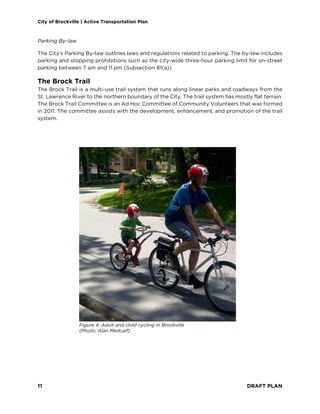
Figure 4. Adult and child cycling in Brockville
(Photo: Alan Medcalf)
City of Brockville | Active Transportation Plan
DRAFT PLAN 12
Public Engagement
Engaging with the public was identified as an important process for the development of the
Active Transportation Plan. Public input was sought to better understand the experience of
people currently using active transportation in Brockville, as well as barriers that discourage or
prevent people from using active transportation. To inform the development of the plan, the
first round of public engagement ran during the initial stages of the project, from December
2018 to the end of March 2019. A second engagement round sought public feedback on the
draft recommendations of the plan from July to August 2019.
To reach a wide range of the public, different outreach methods and platforms were used. The
intention of using pop-up style in-person events instead of conventional public meetings was
to seek feedback from incidental participants (i.e., people walking by) in addition to
participants who are actively involved. The event locations at community facilities supported
participation from a broad spectrum of people, including people that may normally not attend
public meetings. The event style facilitated deeper interactions with people, by allowing for
one on one conversations for over 5 minutes as opposed to only hearing from people who
choose to speak at public meetings. This allowed for conversations with people that were
nuanced and in-depth to understand the variety of specific concerns people individually had.
The in-person events and the online Social Pinpoint platform were promoted through
promotional materials, social media and on the City’s website, and was covered by the local
media.
The following section summarizes the engagement approaches and events from both rounds
of engagement. A summary of what was heard from the public during the first round is included
in the Existing Conditions chapter. A summary of what was heard during the second round is
included in the Network Development chapter. Appendix 2 includes materials used for the
engagement and survey results.
City of Brockville | Active Transportation Plan
13 DRAFT PLAN
First Round of Engagement
How We Engaged
Stakeholder Engagement
Many stakeholder groups were identified early on
in the project and targeted to share their ideas and
insights on issues related to active transportation in
Brockville. Groups included:
• Brockville Cycling Advisory Committee
• Municipal Accessibility Advisory
Committee
• Brock Trail Committee
• Laurier Citizens Group
• Leeds, Grenville, and Lanark District
Health Unit
Pop-Up Events
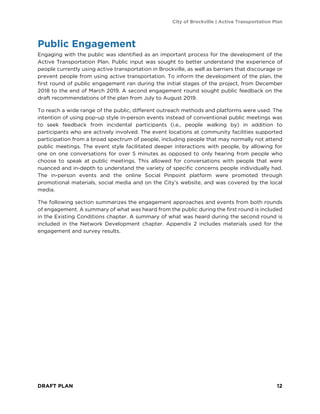
City staff and members of the consulting team set up pop-up booths at the Winter Classic
Alumni Game and at the Brockville Public Library. By setting up at these popular destinations,
the project was given a higher profile by people who wouldn’t necessarily know about the plan
or have attended a dedicated public meeting on it. At the booths, people were asked to share
their experiences, identify challenges and opportunities on the existing conditions map, and
talk with staff.
Figure 6. Photos from the pop-up events at the library (left) and Memorial Centre (right)
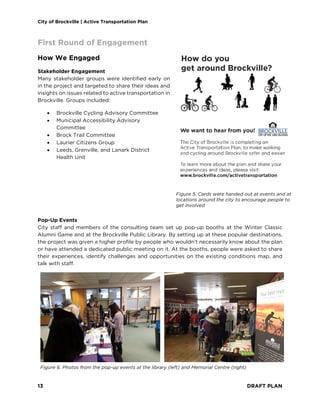
Figure 5. Cards were handed out at events and at
locations around the city to encourage people to
get involved
City of Brockville | Active Transportation Plan
DRAFT PLAN 14
Online Platform
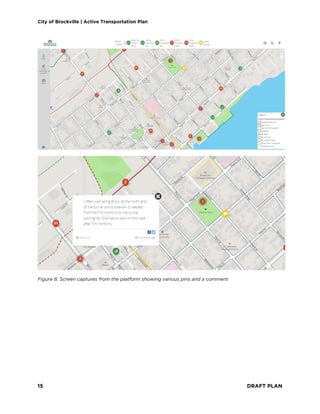
The Social Pinpoint engagement platform was used to organize online engagement. The
platform included information on different types of active transportation concepts with photos
of examples. People could also place pins on an interactive map with the existing active
transportation network. The pins were organized by themes including:
• Where I like to walk or bike to
• Walking improvement idea
• Cycling improvement idea
• Walking improvement needed
• Cycling improvement needed
• General comment
People could explain in detail on the pin. People were also able to view other people’s pins and
comments. People could also complete a survey on the website which prompted people to talk
about how they get around Brockville, barriers they experience, and what they think the
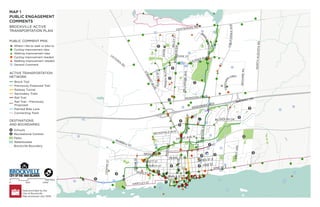
priorities are for this plan. The pins are presented on Map 1.
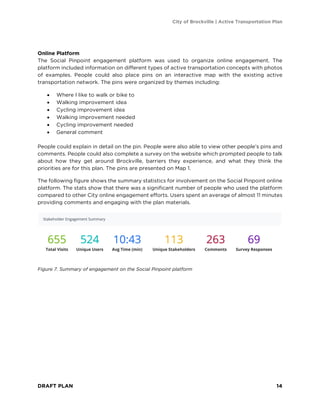
The following figure shows the summary statistics for involvement on the Social Pinpoint online
platform. The stats show that there was a significant number of people who used the platform
compared to other City online engagement efforts. Users spent an average of almost 11 minutes
providing comments and engaging with the plan materials.
Figure 7. Summary of engagement on the Social Pinpoint platform
City of Brockville | Active Transportation Plan
15 DRAFT PLAN
Figure 8. Screen captures from the platform showing various pins and a comment
!
(
!
(
!
(
!
(
!
(
!
(
!
(
!
(
!
(
"
)
#
*
!
(
#
*
#
*#
*
"
)
"
)
"
)
#
*
"
)
^
_
^
_
^
_
^
_
^
_
^
_
#
*
"
)
#
*
#
*
^
_
#
*
#
*
!
(
!
(
#
*
!
(
#
*
"
)
#
*
!
(
#
*
^
_
"
)
"
)
"
)
!
(
#
*
!
(
!
(
"
)
^
_
^
_
^
_
#
*
#
*
^
_
^
_
^
_
^
_
^
_
^
_^
_ #
*
#
*
"
)
#
*
^
_
"
)
"
)
!
(
#
*
#
*
"
)
^
_
!
(
^
_
!
(
#
*
#
*
#
*
!
(
!
(
!
(
!
(
!
(
#
*
^
_
!
(
!
(
!
(
!
(
!
(
!
(
#
*
"
)
"
)
!
(
^
_
!
(
!
(
"
)
"
)
"
)
"
)"
) "
)
^
_
^
_
"
)
"
)
^
_
#
*
!
(
!
(
"
)
"
)
"
)
"
)
"
)
"
)
!
(
"
)
"
)
"
)
"
)
"
)
#
*
"
)
^
_
"
)
"
)
#
*
^
_
"
)
!
(
#
*
"
)
^
_
#
*
#
*
!
(
!
(
"
)
^
_
!
(
#
*
!
(
#
*
!
(
"
)
"
)
#
*"
)
#
*
"
)
#
*"
)
"
)
"
)
"
)
#
*
^
_
^
_ ^
_
^
_
^
_
^
_
^
_
^
_
^
_
^
_
^
_
^
_
^
_
^
_
"
)
"
)
!
(
!
( !
(
"
)
!
(
#
*
#
*
#
*
!
(
#
*
#
*
#
*
!
(
#
*
#
*
#
*
!
(
"
)
#
*
"
)
"
)
#
*
#
*
!
(
#
*
#
*
#
*
!
(
#
*
#
*
#
*
"
)
#
*
#
*
!
(
!
(
#
*
"
)
^
_ ^
_
!
(
!
(
#
*
#
*
!
(
!
( !
(
!
(
!
(
!
(
^
_
^
_
#
*
#
*
#
*
#
*
#
*
#
*
#
*
#
*
#
*
#
*
#
*
!
(
#
* #
*
#
* #
*
#
*
#
*
#
*
#
*
#
*
#
*
#
*
#
*
#
*
#
*
#
*
"
)
#
*
"
)
"
)
"
)
"
)
#
*
HIGHWAY 401
HARTLEY ST
WATER ST W
P
E
D
E
N
B
L
V
D
T
U
P
P
E
R
S
T
M
IL
LW
O
O
D
A
V
E
C
E
N
T
R
E
S
T
F
IR
S
T
A
V
E
FRONT AVE W
F
E
R
G
U
S
O
N
D
R
JAMES ST E
ABBOTT ST
PAR
K
ST
BU
EL
L
ST
PINE ST
CHURCH ST
DA
NA
ST
WAVERLY DR
BR
OO
ME
RD
C
R
O
C
K
E
R
CRES
B
R
I
D
L
E
W
O
O
D
D
R
DUKE ST
O
R
M
O
N
D
S
T
SCHOFIELD AVE
B
E
L
E
Y
S
T
VICTO
RIA
RD
HUBBELL ST
PEARL ST W
KING ST W
LAURIER BLVD
P
E
R
T
H
S
T
NO
RT
H
AU
GU
ST
A
RD
KING ST E
CEDAR
ST
REYNOLDS DR
CENTENNIAL RD
PARKEDALE AVE
W
IN
D
S
O
R
D
R
BROCK ST
S
T
E
W
A
R
T
B
L
V
D
C
A
L
I
F
O
R
N
I
A
A
V
E
ACTIVE TRANSPORTATION
NETWORK
DESTINATIONS
AND BOUNDARIES
Brock Trail
Previously Proposed Trail
Railway Tunnel
Secondary Trails
Rail Trail
Rail Trail - Previously
Proposed
Painted Bike Lane
Connecting Trails
Schools
Recreational Centres
Parks
Waterbodies
Brockville Boundary
0 500 1,000
METRES
I
Data provided by the
City of Brockville.
Map produced July 2019.
MAP 1
PUBLIC ENGAGEMENT
COMMENTS
BROCKVILLE ACTIVE
TRANSPORTATION PLAN
PUBLIC COMMENT PINS
^
_ Where I like to walk or bike to
!
( Cycling improvement idea
#
* Walking improvement idea
!
( Cycling improvement needed
#
* Walking improvement needed
"
) General Comment
City of Brockville | Active Transportation Plan
17 DRAFT PLAN
Second Round of Engagement
How We Engaged
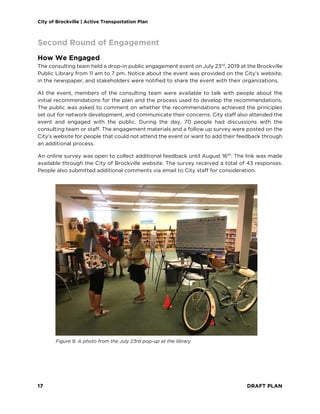
The consulting team held a drop-in public engagement event on July 23rd
, 2019 at the Brockville
Public Library from 11 am to 7 pm. Notice about the event was provided on the City’s website,
in the newspaper, and stakeholders were notified to share the event with their organizations.
At the event, members of the consulting team were available to talk with people about the
initial recommendations for the plan and the process used to develop the recommendations.
The public was asked to comment on whether the recommendations achieved the principles
set out for network development, and communicate their concerns. City staff also attended the
event and engaged with the public. During the day, 70 people had discussions with the
consulting team or staff. The engagement materials and a follow up survey were posted on the
City’s website for people that could not attend the event or want to add their feedback through
an additional process.
An online survey was open to collect additional feedback until August 16th
. The link was made
available through the City of Brockville website. The survey received a total of 43 responses.
People also submitted additional comments via email to City staff for consideration.
Figure 9. A photo from the July 23rd pop-up at the library
City of Brockville | Active Transportation Plan
DRAFT PLAN 18
Existing Conditions
Existing Active Transportation Facilities
Brockville’s existing active transportation facilities are described in the following section. They
are described based on the network that they belong to; the Brock Trail, the sidewalk and
walkway network, the cycling network, as well as a description on the existing types of road
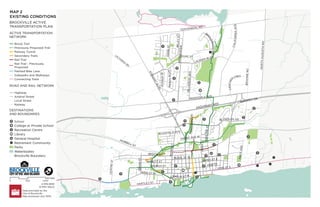
crossing treatments used in the City. These networks are illustrated on Map 2.
Brock Trail Network
The Brock Trail network is comprised of primary
trails, secondary trails, and the railway tunnel.
The trail network can be used by people using
any active transportation mode, except in the
railway tunnel and along the waterfront
boardwalk where people are asked to walk their
bikes. The Rail Trail is also part of the City’s trail
network. There are planned extensions to the
Brock Trail which are shown on the Existing
Conditions map.
At minor crossings, signed and marked
pedestrian crossovers have been installed in
some areas. Where the trail crosses busier roads,
activated pedestrian crossovers have been installed in some locations. While pedestrian
crossovers give pedestrians priority, people cycling are required to dismount and walk across
the intersection.
The primary Brock Trail network is currently 11.4 km in length with sections along the waterfront,
out to St. Lawrence Park in the southwest, through the central part of the city, and north to
Centennial Road on the central east side. The primary trail network is comprised of off-road
and road adjacent facilities, and crosses roadways with various crossing treatments. The
majority of primary trails are asphalt or concrete but there are also brick, wood, and gravel
surface primary trails. The trail is not currently lit, but the Brock Trail Committee is working
towards installing lighting on a section of the trail. The committee has also identified locations
along the trail that are barriers to the accessibility of the trail. The trail is not currently cleared
in the winter.
Secondary trails are short extensions or spurs that feed into the primary trails in the network.
There are currently 1.4 km of secondary trails, which are all located south of Highway 401. Most
secondary trails have an asphalt surface.
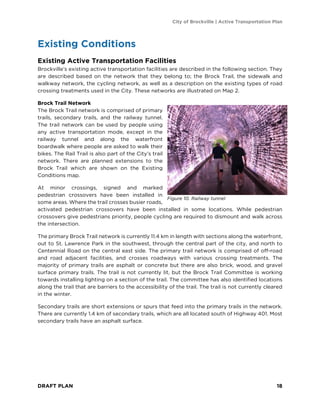
Figure 10. Railway tunnel
City of Brockville | Active Transportation Plan
19 DRAFT PLAN
The Railway Tunnel is pedestrian pathway in a tunnel
that formerly operated as a railway tunnel, and has
historic importance as Canada’s first railway tunnel.
The tunnel is 525 m in length, travelling from the
waterfront to just north of Pearl Street West. Primary
trails connect to either end of the tunnel. The tunnel
is closed during the winter.
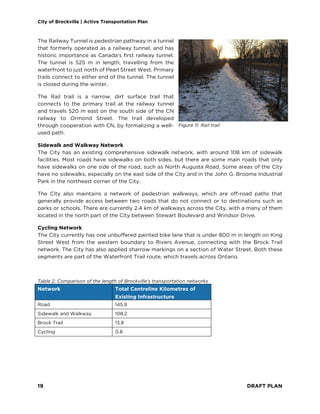
The Rail trail is a narrow, dirt surface trail that
connects to the primary trail at the railway tunnel
and travels 520 m east on the south side of the CN
railway to Ormond Street. The trail developed
through cooperation with CN, by formalizing a well-
used path.
Sidewalk and Walkway Network
The City has an existing comprehensive sidewalk network, with around 108 km of sidewalk
facilities. Most roads have sidewalks on both sides, but there are some main roads that only
have sidewalks on one side of the road, such as North Augusta Road. Some areas of the City
have no sidewalks, especially on the east side of the City and in the John G. Broome Industrial
Park in the northeast corner of the City.
The City also maintains a network of pedestrian walkways, which are off-road paths that
generally provide access between two roads that do not connect or to destinations such as
parks or schools. There are currently 2.4 km of walkways across the City, with a many of them
located in the north part of the City between Stewart Boulevard and Windsor Drive.
Cycling Network
The City currently has one unbuffered painted bike lane that is under 800 m in length on King
Street West from the western boundary to Rivers Avenue, connecting with the Brock Trail
network. The City has also applied sharrow markings on a section of Water Street. Both these
segments are part of the Waterfront Trail route, which travels across Ontario.
Table 2. Comparison of the length of Brockville's transportation networks
Network Total Centreline Kilometres of
Existing Infrastructure
Road 145.9
Sidewalk and Walkway 108.2
Brock Trail 13.8
Cycling 0.8
Figure 11. Rail trail
!
R
!
R
!
R
!
R
!
R
HIGHWAY 401
HARTLEY ST
WATER ST W
P
E
D
E
N
B
L
V
D
T
U
P
P
E
R
S
T
M
IL
LW
O
O
D
A
V
E
C
E
N
T
R
E
S
T
F
IR
S
T
A
V
E
FRONT AVE W
F
E
R
G
U
S
O
N
D
R
JAMES ST E
ABBOTT ST
PAR
K
ST
PINE ST
CHURCH ST
DA
NA
ST
WAVERLY DR
BR
OO
ME
RD
C
R
O
C
K
E
R
CRES
B
R
I
D
L
E
W
O
O
D
D
R
DUKE ST
O
R
M
O
N
D
S
T
SCHOFIELD AVE
B
E
L
E
Y
S
T
VICTO
RIA
RD
HUBBELL ST
PEARL ST W
KING ST W
LAURIER BLVD
P
E
R
T
H
S
T
NO
RT
H
AU
GU
ST
A
RD
KING ST E
CEDAR
ST
REYNOLDS DR
CENTENNIAL RD
PARKEDALE AVE
W
IN
D
S
O
R
D
R
BROCK ST
S
T
E
W
A
R
T
B
L
V
D
C
A
L
I
F
O
R
N
I
A
A
V
E
DESTINATIONS
AND BOUNDARIES
MAP 2
EXISTING CONDITIONS
BROCKVILLE ACTIVE
TRANSPORTATION PLAN
ACTIVE TRANSPORTATION
NETWORK
Brock Trail
Previously Proposed Trail
Railway Tunnel
Secondary Trails
Rail Trail
Rail Trail - Previously
Proposed
Painted Bike Lane
Sidewalks and Walkways
Connecting Trails
School
College or Private School
Recreation Centre
Library
General Hospital
!
R Retirement Community
Parks
Waterbodies
Brockville Boundary
0 500 1,000
METRES
I
Data provided by the
City of Brockville.
Map produced July 2019.
4 MIN BIKE
12 MIN WALK
ROAD AND RAIL NETWORK
Highway
Arterial Street
Local Street
Railway
City of Brockville | Active Transportation Plan
21 DRAFT PLAN
Crossings
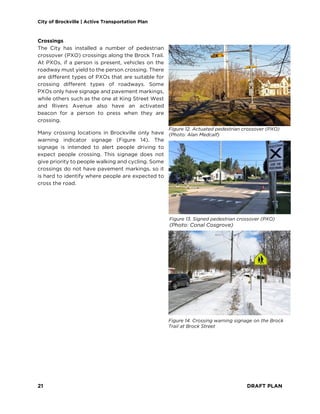
The City has installed a number of pedestrian
crossover (PXO) crossings along the Brock Trail.
At PXOs, if a person is present, vehicles on the
roadway must yield to the person crossing. There
are different types of PXOs that are suitable for
crossing different types of roadways. Some
PXOs only have signage and pavement markings,
while others such as the one at King Street West
and Rivers Avenue also have an activated
beacon for a person to press when they are
crossing.
Many crossing locations in Brockville only have
warning indicator signage (Figure 14). The
signage is intended to alert people driving to
expect people crossing. This signage does not
give priority to people walking and cycling. Some
crossings do not have pavement markings, so it
is hard to identify where people are expected to
cross the road.
Figure 14. Crossing warning signage on the Brock
Trail at Brock Street
Figure 12. Actuated pedestrian crossover (PXO)
(Photo: Alan Medcalf)
Figure 13. Signed pedestrian crossover (PXO)
(Photo: Conal Cosgrove)
City of Brockville | Active Transportation Plan
DRAFT PLAN 22
Existing Conditions Analysis
In order to plan and develop a successful network of well used active transportation facilities,
the facilities need to connect to where people are going, and be attractive for use by a majority
of the population. The following Demand and Level of Traffic Stress analyses consider the
existing conditions that have a significant impact on the usage of active transportation facilities
in order to leverage future investment.
Demand
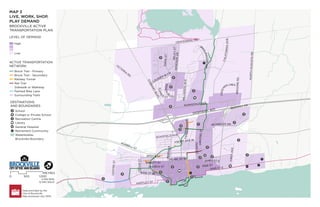
Demand is illustrated on Map 3, representing where people live, work (or go to school), shop,
play, and access transit. The map was developed by synthesizing population density, zoning,
and land use data and defining areas based on the intensity of activities that are in that area.
Key destinations and the existing active transportation network are overlaid on top. This allows
for a comparison of how the existing active transportation network serves areas of demand.
The map shows considerable gaps between areas of high population density, destinations, and
the existing network.
In the downtown and south end, the Brock Trail can be used to help people travel closer to
their destination, and the sidewalk network is well connected to help people travel throughout
the area. At present, there are no cycling facilities for people to travel from the Brock Trail to
destinations. The east end is particularly underserved, while there are schools, the hospital and
other destinations.
In the north end, the majority of the population lives west of the Brock Trail. Schools are spread
out west of Windsor Drive, with Ange-Gabriel on Kensington Parkway, St. John Bosco at Laurier
and Windsor, Vanier on Vanier Drive, and Thousand Islands SS on Parkedale. Many major
destinations are centred along Parkedale Avenue, including St. Lawrence College and
Thousand Islands Mall. The industrial park east of the Brock Trail was identified as a popular
destination for shopping and workplaces. There are no sidewalk facilities in the industrial park
to support pedestrian travel. There are no east-west cycling facilities to support travel across
the north end, or to the
Brock Trail, which
facilitates north-south
travel.
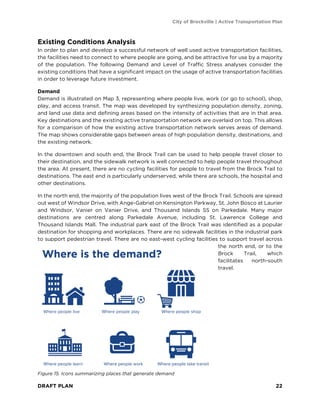
Figure 15. Icons summarizing places that generate demand
!
R !
R
!
R
!
R
!
R
HIGHWAY 401
HARTLEY ST
P
E
D
E
N
B
LVD
T
U
P
P
E
R
ST
M
IL
LW
O
O
D
A
V
E
C
E
N
T
R
E
S
T
F
IR
S
T
A
V
E
FRONT AVE W
F
E
R
G
U
S
O
N
D
R
JAMES ST E
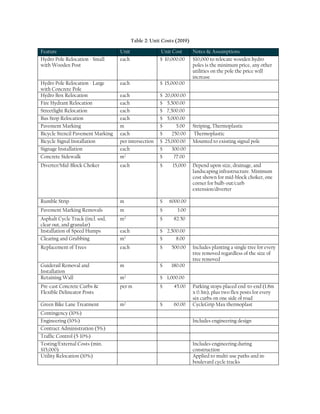
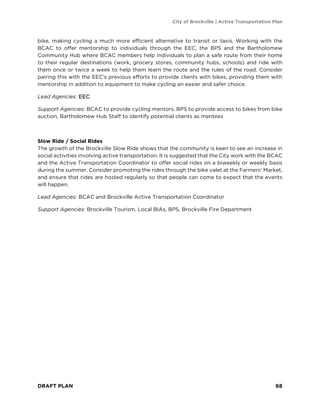
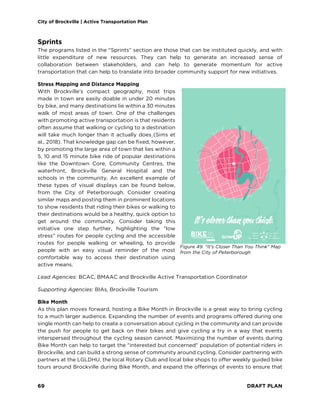
ABBOTT ST
PA
RK
ST
PINE ST
CHURCH ST
D
A
N
A
ST
WAVERLY DR
BR
OO
ME
RD
C
R
O
C
K
ER CRES
B
R
I
D
L
E
W
O
O
D
D
R
O
R
M
O
N
D
S
T
SCHOFIELD AVE
B
E
L
E
Y
S
T
VICTO
RIA
RD
HUBBELL ST
PEARL ST W
KING ST W
LAURIER BLVD
P
E
R
T
H
S
T
NO
RT
H
AU
GU
ST
A
RD
KING ST E
CEDAR
ST
REYNOLDS DR
CENTENNIAL RD
PARKEDALE AVE
W
IN
D
S
O
R
D
R
BROCK ST
S
T
E
W
A
R
T
B
L
V
D
C
A
L
I
F
O
R
N
I
A
A
V
E
MAP 3
LIVE, WORK, SHOP,
PLAY DEMAND
LEVEL OF DEMAND
DESTINATIONS
AND BOUNDARIES
BROCKVILLE ACTIVE
TRANSPORTATION PLAN
Brock Trail - Primary
Brock Trail - Secondary
Railway Tunnel
Rail Trail
Sidewalk or Walkway
Painted Bike Lane
Surrounding Trails
School
College or Private School
Recreation Centre
Library
General Hospital
!
R Retirement Community
Waterbodies
Brockville Boundary
0 500 1,000
METRES
I
Data provided by the
City of Brockville.
Map produced July 2019.
4 MIN BIKE
12 MIN WALK
High
Low
ACTIVE TRANSPORTATION
NETWORK
City of Brockville | Active Transportation Plan
DRAFT PLAN 24
Cycling Level of Traffic Stress
The cycling level of traffic stress (LTS) analysis summarizes the experience of cycling on roads
based on the posted speed limit, number of lanes, and presence of existing cycling facilities.
The LTS analysis considers these variables, with an output score for every road. The scores
range from one – which has the lowest level of stress, to four – which has the highest level of
stress. The LTS analysis completed as part of this study does not consider intersections or
crossings. The analysis helps to visualize the experience of existing roadways to understand
why people may not be cycling along certain roads.
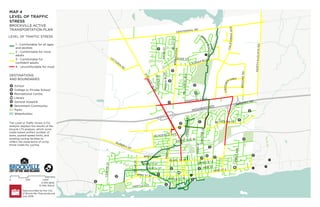
Considering the results of the analysis on Map 4, the Brock Trail is the only facility that received
an LTS score of one – or low stress. The Brock Trail acts as a good low stress spine throughout
the City. Ormond Street received an LTS score of four north of Central Avenue. This stretch
also has a score of one as this is where the Brock Trail is, providing a low stress facility adjacent
to the roadway. Another location that had an improved LTS score because of an existing facility
was on King Street West. The majority of the road scored three, but the section with painted
bike lanes scored a two, as the facility lowers the stress. While many minor roads received a
score of two, many roads that provide a direct route received a score of three or four.
Research has found that large segments of the population who are willing to cycle, do not cycle
because the facilities are inadequate or non-existent and thus do not provide them with a
feeling of safety. The LTS analysis provides insight by visualizing how people experience the
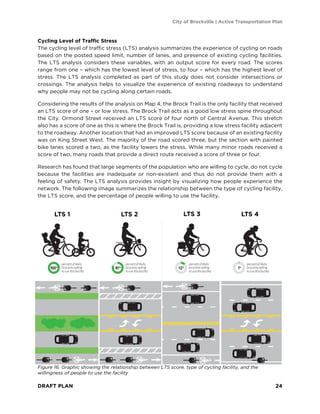
network. The following image summarizes the relationship between the type of cycling facility,
the LTS score, and the percentage of people willing to use the facility.
Figure 16. Graphic showing the relationship between LTS score, type of cycling facility, and the
willingness of people to use the facility
LTS 1 LTS 2 LTS 3 LTS 4
!
R
!
R
!
R
!
R
!
R
HIGHWAY 401
HARTLEY ST
WATER ST W
P
E
D
E
N
B
L
V
D
T
U
P
P
E
R
S
T
M
IL
LW
O
O
D
A
V
E
C
E
N
T
R
E
S
T
F
IR
S
T
A
V
E
FRONT AVE W
F
E
R
G
U
S
O
N
D
R
JAMES ST E
ABBOTT ST
PAR
K
ST
PINE ST
CHURCH ST
DA
NA
ST
WAVERLY DR
BR
OO
ME
RD
C
R
O
C
K
E
R
CRES
B
R
I
D
L
E
W
O
O
D
D
R
DUKE ST
O
R
M
O
N
D
S
T
SCHOFIELD AVE
B
E
L
E
Y
S
T
VICTO
RIA
RD
HUBBELL ST
PEARL ST W
KING ST W
LAURIER BLVD
P
E
R
T
H
S
T
NO
RT
H
AU
GU
ST
A
RD
KING ST E
CEDAR
ST
REYNOLDS DR
CENTENNIAL RD
PARKEDALE AVE
W
IN
D
S
O
R
D
R
BROCK ST
S
T
E
W
A
R
T
B
L
V
D
C
A
L
I
F
O
R
N
I
A
A
V
E
MAP 4
LEVEL OF TRAFFIC
STRESS
LEVEL OF TRAFFIC STRESS
DESTINATIONS
AND BOUNDARIES
BROCKVILLE ACTIVE
TRANSPORTATION PLAN
1 - Comfortable for all ages
and abilities
2 - Comfortable for most
adults
3 - Comfortable for
confident adults
4 - Uncomfortable for most
School
College or Private School
Recreational Centre
Library
General Hospital
!
R Retirement Community
Parks
Waterbodies
0 500 1,000
METRES
I
Data provided by the City
of Brockville. Map produced
July 2019.
4 MIN BIKE
12 MIN WALK
The Level of Traffic Stress (LTS)
analysis displays the results of the
bicycle LTS analysis, which score
roads based ontheir number of
lanes, posted speed limits, and
existing cycling facilites to
reflect the experience of using
those roads for cycling.
City of Brockville | Active Transportation Plan
DRAFT PLAN 26
Gap Analysis
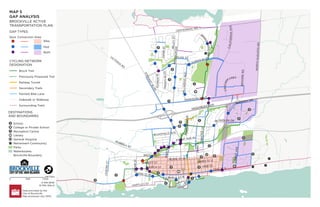
The Gap Analysis builds on the Demand and LTS analyses as well as the existing conditions and
field review to identify where facilities do not exist or are insufficient in the City. There are three
types of gaps which are part of the analysis:
• Spot gaps are localized obstacles or barriers to using a facility. They can exist
throughout the length of a facility. Examples of spot gaps include a lack of curb ramp,
an unmarked crossing, or an obstacle in the facility, such as a utility pole in the middle
of the sidewalk. An example of a cycling spot gap is where no curb ramp exists
providing access for people cycling onto a shared use path from the road. The person
must dismount and wheel their bike over the curb, or risk falling trying to ride up or
down the curb
• Connection gaps are areas between existing facilities where no facilities exist. This
creates a barrier for people using active transportation modes. An example could be
a sidewalk that ends a block before there is a crossing to another sidewalk. This
situation might deter someone from walking to a destination. Otherwise, the situation
may create an unpleasant or even hazardous travel experience
• Network gaps are areas where no facilities exist at all, and therefore act as a barrier
to people traveling by active transportation modes to, from, within or through that
area
By overlaying the Demand and LTS analyses with the Gap Analysis, additional gaps can be
identified, such as roads with a high level of stress, or areas with a high level of demand, but a
lack of facilities. The Gap Analysis map is included below as Map 5.
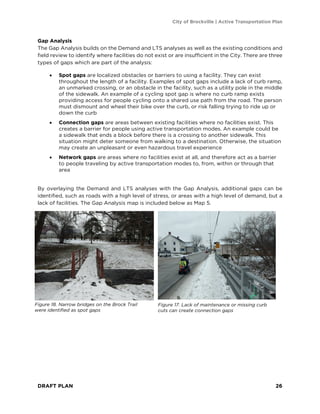
Figure 18. Narrow bridges on the Brock Trail
were identified as spot gaps
Figure 17. Lack of maintenance or missing curb
cuts can create connection gaps
MAP 5
GAP ANALYSIS
CYCLING NETWORK
DESIGNATION
DESTINATIONS
AND BOUNDARIES
BROCKVILLE ACTIVE
TRANSPORTATION PLAN
Brock Trail
Previously Proposed Trail
Railway Tunnel
Secondary Trails
Painted Bike Lane
Sidewalk or Walkway
Surrounding Trails
School
College or Private School
Recreation Centre
Library
General Hospital
!
R Retirement Community
Parks
Waterbodies
Brockville Boundary
0 500 1,000
METRES
I
Data provided by the
City of Brockville.
Map produced July 2019.
4 MIN BIKE
12 MIN WALK
!
R !
R
!
R
!
R
!
R
HIGHWAY 401
HARTLEY ST
WATER ST W
P
E
D
E
N
B
L
V
D
T
U
P
P
E
R
S
T
M
IL
LW
O
O
D
A
V
E
C
E
N
T
R
E
S
T
F
IR
S
T
A
V
E
FRONT AVE W
F
E
R
G
U
S
O
N
D
R
JAMES ST E
ABBOTT ST
PAR
K
ST
PINE ST
CHURCH ST
DA
NA
ST
WAVERLY DR
BR
OO
ME
RD
C
R
O
C
K
E
R
CRES
B
R
I
D
L
E
W
O
O
D
D
R
DUKE ST
O
R
M
O
N
D
S
T
SCHOFIELD AVE
B
E
L
E
Y
S
T
VICTO
RIA
RD
HUBBELL ST
PEARL ST W
KING ST W
LAURIER BLVD
P
E
R
T
H
S
T
NO
RT
H
AU
GU
ST
A
RD
KING ST E
CEDAR
ST
REYNOLDS DR
CENTENNIAL RD
PARKEDALE AVE
W
IN
D
S
O
R
D
R
BROCK ST
S
T
E
W
A
R
T
B
L
V
D
C
A
L
I
F
O
R
N
I
A
A
V
E
GAP TYPES
Spot Connection Area
Bike
Ped
Both
City of Brockville | Active Transportation Plan
DRAFT PLAN 28
What We Heard
Throughout the first round of public engagement, we
heard that many people are already walking and cycling to
get around the City. People are walking and cycling to go
to work or school, get groceries, see friends, or for
recreation. While some people are using active
transportation already, they acknowledged that there is a
need for improvement as many roads and crossings in
Brockville are not comfortable to bike on and gaps in the
sidewalk network discourage walking.
Themes
The following themes were heard throughout the
engagement process.
Destinations
• Downtown – Many people identified
destinations throughout the downtown area
that they like to walk and cycle to, including
the library, arts centre, restaurants, and cafes
• Mac Johnson Wildlife Area – Many people
commented that it is challenging to get to the trails in the wildlife area as there is no
connection on or across Centennial Road, or connection from the Brock Trail
• Parkedale Avenue – This corridor was identified as a destination for many people, with
many stores, the movie theatre, Thousand Islands Secondary School, and St. Lawrence
College
Barriers
• Speeding traffic – Vehicles going too fast, creating a stressful environment to walk and
cycle in, was identified on roads throughout Brockville
• Lack of infrastructure – Many people identified places they would like to go, but they
feel unsafe doing so due to the lack of infrastructure for cycling
• Spot gaps – Numerous locations were identified as being inaccessible or unsafe to use,
whether it is due to bollards, poor maintenance, drainage issues, or lack of infrastructure,
such as desired crossing locations
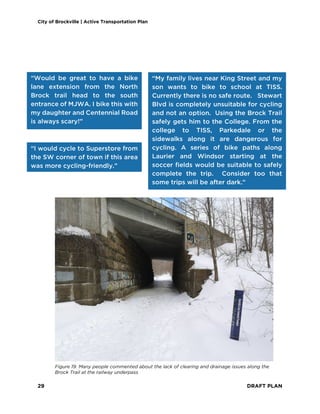
• Winter maintenance – People feel unsafe or unable to walk and cycle in Brockville during
the winter season due to inadequate winter maintenance
Many of the site-specific barriers were added to the Gap analysis.
“I live in this neighbourhood
[north end] and would LOVE
to bike to work downtown,
but I don't feel safe without
bike lane development.”
“I use this route [Brock Trail] to
walk to work from Pearl Street
West to downtown, it is a lovely
walk and I really appreciate
having the trail as a commuting
option.”
City of Brockville | Active Transportation Plan
29 DRAFT PLAN
“Would be great to have a bike
lane extension from the North
Brock trail head to the south
entrance of MJWA. I bike this with
my daughter and Centennial Road
is always scary!”
“I would cycle to Superstore from
the SW corner of town if this area
was more cycling-friendly.”
“My family lives near King Street and my
son wants to bike to school at TISS.
Currently there is no safe route. Stewart
Blvd is completely unsuitable for cycling
and not an option. Using the Brock Trail
safely gets him to the College. From the
college to TISS, Parkedale or the
sidewalks along it are dangerous for
cycling. A series of bike paths along
Laurier and Windsor starting at the
soccer fields would be suitable to safely
complete the trip. Consider too that
some trips will be after dark.”
Figure 19. Many people commented about the lack of clearing and drainage issues along the
Brock Trail at the railway underpass
City of Brockville | Active Transportation Plan
DRAFT PLAN 30
Survey Results
The survey on the online platform asked important questions regarding the direction and goals
of this plan. The responses to those questions are shown below. What they show is a strong
desire for the expansion of walking and cycling infrastructure that can be used by all ages and
abilities. Improving maintenance is another priority identified through these questions. The
complete results from the survey can be found in Appendix 2. A sample of survey results are
provided below.
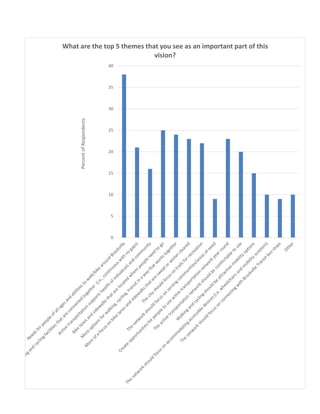
The top 5 themes that were identified as an important part of this vision were:
1. Needs for people of all ages and abilities to walk/bike around Brockville
2. Bike lanes and sidewalks that are located where people need to go
3. More options for walking, cycling, transit in a way that works together
4. More of a focus on bike lanes and sidewalks that are swept or winter cleared
5. Create opportunities for people to use the active transportation network year round
The top 3 focuses of this plan were identified as:
1. Expanding network - proposing new walking and cycling facilities throughout the City
of Brockville
2. Connectivity - enhancing connectivity and crossings of existing facilities
3. Maintenance - providing recommendations for maintenance of existing trails
0
5
10
15
20
25
30
What network upgrades should be the top priorities for
Brockville [select up to three]:
City of Brockville | Active Transportation Plan
31 DRAFT PLAN
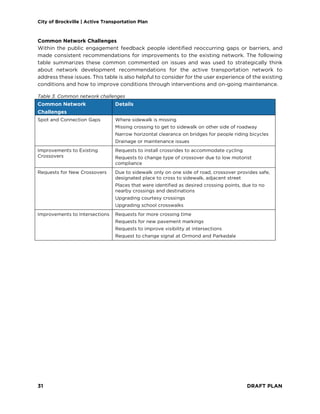
Common Network Challenges
Within the public engagement feedback people identified reoccurring gaps or barriers, and
made consistent recommendations for improvements to the existing network. The following
table summarizes these common commented on issues and was used to strategically think
about network development recommendations for the active transportation network to
address these issues. This table is also helpful to consider for the user experience of the existing
conditions and how to improve conditions through interventions and on-going maintenance.
Table 3. Common network challenges
Common Network
Challenges
Details
Spot and Connection Gaps Where sidewalk is missing
Missing crossing to get to sidewalk on other side of roadway
Narrow horizontal clearance on bridges for people riding bicycles
Drainage or maintenance issues
Improvements to Existing
Crossovers
Requests to install crossrides to accommodate cycling
Requests to change type of crossover due to low motorist
compliance
Requests for New Crossovers Due to sidewalk only on one side of road, crossover provides safe,
designated place to cross to sidewalk, adjacent street
Places that were identified as desired crossing points, due to no
nearby crossings and destinations
Upgrading courtesy crossings
Upgrading school crosswalks
Improvements to Intersections Requests for more crossing time
Requests for new pavement markings
Requests to improve visibility at intersections
Request to change signal at Ormond and Parkedale
City of Brockville | Active Transportation Plan
DRAFT PLAN 32
Network Development
The development of an Active Transportation Network is based on a number of inputs: existing
conditions; feedback from the public engagement process; and the technical analysis (demand,
LTS and gaps). The Active Transportation Network (Schedule 5) from the Official Plan was also
used as a starting point. Together these form the rationale for how the proposed network was
developed.
This section will identify the types of active transportation facilities that are recommended in
the plan. The facilities are summarized under Network Designations. The Network Designation
categories distinguish the role that each segment plays in the network, in order to prioritize
and build higher quality facilities where it has been identified there is a need to do so.
During the development of the plan, direction was given by the City for specific analysis related
to the north end, focusing on the Laurier Boulevard and Windsor Drive area. Refer to Appendix
3 for additional information. The conclusions from the memo have been integrated directly into
the active transportation network presented in this chapter and the Network Implementation
chapter. For example, in the prioritization section, Laurier Boulevard from Kensington to Peden
is recommended for short-term implementation.
Active Transportation Facility Types
The following section presents the available toolbox of facility options for walking and cycling.
The recommendations provide a summary of the facility, but do not replace guidance
documents relevant in Ontario for pedestrian and cycling facilities. The facilities are organized
into three groups, based on the type of separation they provide from motor vehicle traffic. The
guidance documents that should be referred to for recommended application and design
considerations include:
• Ontario Traffic Council (OTC), Book 18: Cycling Facilities (2013 - Update currently in
progress)
• Ontario Traffic Council (OTC), Book 15: Pedestrian Crossing Facilities (2016)
• Transportation Association of Canada (TAC), Geometric Design Guide for Canadian
Roads (2017)
Additional resources for the City to consider when designing pedestrian and cycling facilities
are the National Association of City Transportation Officials (NACTO) Urban Bikeway Design
Guide and the Federal Highway Administration (FHWA) Small Town and Rural Multi Modal
Networks guide.
City of Brockville | Active Transportation Plan
33 DRAFT PLAN
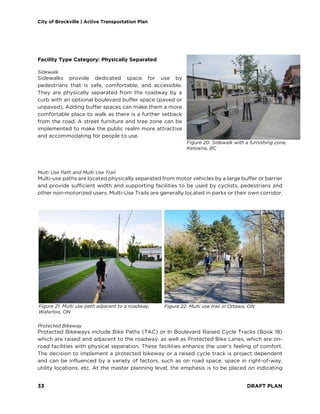
Facility Type Category: Physically Separated
Sidewalk
Sidewalks provide dedicated space for use by
pedestrians that is safe, comfortable, and accessible.
They are physically separated from the roadway by a
curb with an optional boulevard buffer space (paved or
unpaved). Adding buffer spaces can make them a more
comfortable place to walk as there is a further setback
from the road. A street furniture and tree zone can be
implemented to make the public realm more attractive
and accommodating for people to use.
Multi Use Path and Multi Use Trail
Multi-use paths are located physically separated from motor vehicles by a large buffer or barrier
and provide sufficient width and supporting facilities to be used by cyclists, pedestrians and
other non-motorized users. Multi-Use Trails are generally located in parks or their own corridor.
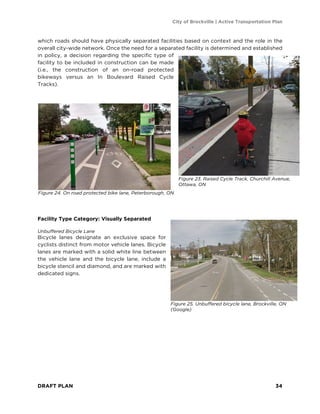
Protected Bikeway
Protected Bikeways include Bike Paths (TAC) or In Boulevard Raised Cycle Tracks (Book 18)
which are raised and adjacent to the roadway, as well as Protected Bike Lanes, which are on-
road facilities with physical separation. These facilities enhance the user’s feeling of comfort.
The decision to implement a protected bikeway or a raised cycle track is project dependent
and can be influenced by a variety of factors, such as on road space, space in right-of-way,
utility locations, etc. At the master planning level, the emphasis is to be placed on indicating
Figure 20. Sidewalk with a furnishing zone,
Kelowna, BC
Figure 21. Multi use path adjacent to a roadway,
Waterloo, ON
Figure 22. Multi use trail in Ottawa, ON
City of Brockville | Active Transportation Plan
DRAFT PLAN 34
which roads should have physically separated facilities based on context and the role in the
overall city-wide network. Once the need for a separated facility is determined and established
in policy, a decision regarding the specific type of
facility to be included in construction can be made
(i.e., the construction of an on-road protected
bikeways versus an In Boulevard Raised Cycle
Tracks).
Facility Type Category: Visually Separated
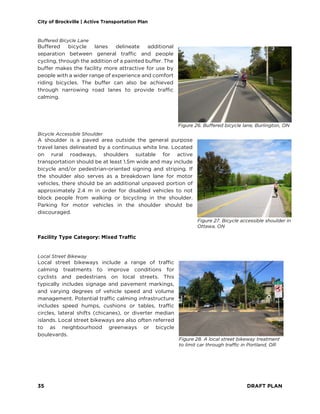
Unbuffered Bicycle Lane
Bicycle lanes designate an exclusive space for
cyclists distinct from motor vehicle lanes. Bicycle
lanes are marked with a solid white line between
the vehicle lane and the bicycle lane, include a
bicycle stencil and diamond, and are marked with
dedicated signs.
Figure 23. Raised Cycle Track, Churchill Avenue,
Ottawa, ON
Figure 24. On road protected bike lane, Peterborough, ON
Figure 25. Unbuffered bicycle lane, Brockville, ON
(Google)
City of Brockville | Active Transportation Plan
35 DRAFT PLAN
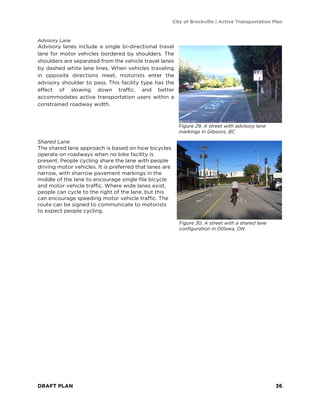
Buffered Bicycle Lane
Buffered bicycle lanes delineate additional
separation between general traffic and people
cycling, through the addition of a painted buffer. The
buffer makes the facility more attractive for use by
people with a wider range of experience and comfort
riding bicycles. The buffer can also be achieved
through narrowing road lanes to provide traffic
calming.
Bicycle Accessible Shoulder
A shoulder is a paved area outside the general purpose
travel lanes delineated by a continuous white line. Located
on rural roadways, shoulders suitable for active
transportation should be at least 1.5m wide and may include
bicycle and/or pedestrian-oriented signing and striping. If
the shoulder also serves as a breakdown lane for motor
vehicles, there should be an additional unpaved portion of
approximately 2.4 m in order for disabled vehicles to not
block people from walking or bicycling in the shoulder.
Parking for motor vehicles in the shoulder should be
discouraged.
Facility Type Category: Mixed Traffic
Local Street Bikeway
Local street bikeways include a range of traffic
calming treatments to improve conditions for
cyclists and pedestrians on local streets. This
typically includes signage and pavement markings,
and varying degrees of vehicle speed and volume
management. Potential traffic calming infrastructure
includes speed humps, cushions or tables, traffic
circles, lateral shifts (chicanes), or diverter median
islands. Local street bikeways are also often referred
to as neighbourhood greenways or bicycle
boulevards.
Figure 26. Buffered bicycle lane, Burlington, ON
Figure 27. Bicycle accessible shoulder in
Ottawa, ON
Figure 28. A local street bikeway treatment
to limit car through traffic in Portland, OR
City of Brockville | Active Transportation Plan
DRAFT PLAN 36
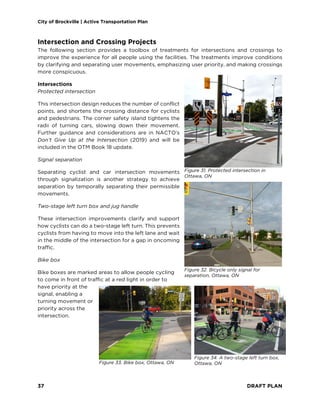
Advisory Lane
Advisory lanes include a single bi-directional travel
lane for motor vehicles bordered by shoulders. The
shoulders are separated from the vehicle travel lanes
by dashed white lane lines. When vehicles traveling
in opposite directions meet, motorists enter the
advisory shoulder to pass. This facility type has the
effect of slowing down traffic, and better
accommodates active transportation users within a
constrained roadway width.
Shared Lane
The shared lane approach is based on how bicycles
operate on roadways when no bike facility is
present. People cycling share the lane with people
driving motor vehicles. It is preferred that lanes are
narrow, with sharrow pavement markings in the
middle of the lane to encourage single file bicycle
and motor vehicle traffic. Where wide lanes exist,
people can cycle to the right of the lane, but this
can encourage speeding motor vehicle traffic. The
route can be signed to communicate to motorists
to expect people cycling.
Figure 29. A street with advisory lane
markings in Gibsons, BC
Figure 30. A street with a shared lane
configuration in Ottawa, ON
City of Brockville | Active Transportation Plan
37 DRAFT PLAN
Intersection and Crossing Projects
The following section provides a toolbox of treatments for intersections and crossings to
improve the experience for all people using the facilities. The treatments improve conditions
by clarifying and separating user movements, emphasizing user priority, and making crossings
more conspicuous.
Intersections
Protected intersection
This intersection design reduces the number of conflict
points, and shortens the crossing distance for cyclists
and pedestrians. The corner safety island tightens the
radii of turning cars, slowing down their movement.
Further guidance and considerations are in NACTO’s
Don’t Give Up at the Intersection (2019) and will be
included in the OTM Book 18 update.
Signal separation
Separating cyclist and car intersection movements
through signalization is another strategy to achieve
separation by temporally separating their permissible
movements.
Two-stage left turn box and jug handle
These intersection improvements clarify and support
how cyclists can do a two-stage left turn. This prevents
cyclists from having to move into the left lane and wait
in the middle of the intersection for a gap in oncoming
traffic.
Bike box
Bike boxes are marked areas to allow people cycling
to come in front of traffic at a red light in order to
have priority at the
signal, enabling a
turning movement or
priority across the
intersection.
Figure 33. Bike box, Ottawa, ON
Figure 32. Bicycle only signal for
separation, Ottawa, ON
Figure 31. Protected intersection in
Ottawa, ON
Figure 34. A two-stage left turn box,
Ottawa, ON
City of Brockville | Active Transportation Plan
DRAFT PLAN 38
Crossings
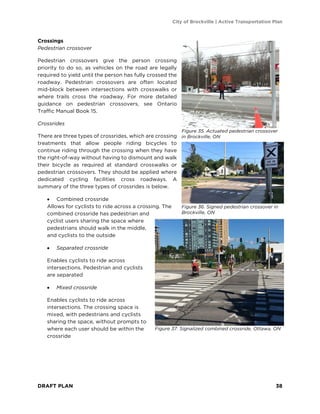
Pedestrian crossover
Pedestrian crossovers give the person crossing
priority to do so, as vehicles on the road are legally
required to yield until the person has fully crossed the
roadway. Pedestrian crossovers are often located
mid-block between intersections with crosswalks or
where trails cross the roadway. For more detailed
guidance on pedestrian crossovers, see Ontario
Traffic Manual Book 15.
Crossrides
There are three types of crossrides, which are crossing
treatments that allow people riding bicycles to
continue riding through the crossing when they have
the right-of-way without having to dismount and walk
their bicycle as required at standard crosswalks or
pedestrian crossovers. They should be applied where
dedicated cycling facilities cross roadways. A
summary of the three types of crossrides is below.
• Combined crossride
Allows for cyclists to ride across a crossing. The
combined crossride has pedestrian and
cyclist users sharing the space where
pedestrians should walk in the middle,
and cyclists to the outside
• Separated crossride
Enables cyclists to ride across
intersections. Pedestrian and cyclists
are separated
• Mixed crossride
Enables cyclists to ride across
intersections. The crossing space is
mixed, with pedestrians and cyclists
sharing the space, without prompts to
where each user should be within the
crossride
Figure 37. Signalized combined crossride, Ottawa, ON
Figure 35. Actuated pedestrian crossover
in Brockville, ON
Figure 36. Signed pedestrian crossover in
Brockville, ON
City of Brockville | Active Transportation Plan
39 DRAFT PLAN
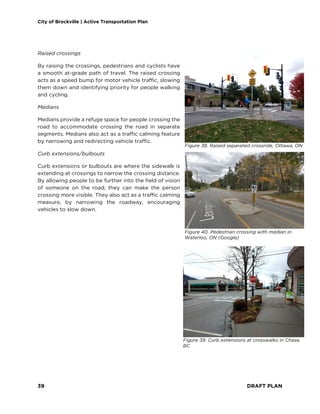
Raised crossings
By raising the crossings, pedestrians and cyclists have
a smooth at-grade path of travel. The raised crossing
acts as a speed bump for motor vehicle traffic, slowing
them down and identifying priority for people walking
and cycling.
Medians
Medians provide a refuge space for people crossing the
road to accommodate crossing the road in separate
segments. Medians also act as a traffic calming feature
by narrowing and redirecting vehicle traffic.
Curb extensions/bulbouts
Curb extensions or bulbouts are where the sidewalk is
extending at crossings to narrow the crossing distance.
By allowing people to be further into the field of vision
of someone on the road, they can make the person
crossing more visible. They also act as a traffic calming
measure, by narrowing the roadway, encouraging
vehicles to slow down.
Figure 38. Raised separated crossride, Ottawa, ON
Figure 39. Curb extensions at crosswalks in Chase,
BC
Figure 40. Pedestrian crossing with median in
Waterloo, ON (Google)
City of Brockville | Active Transportation Plan
DRAFT PLAN 40
Plan Network Designations
The Brock Trail, Cycling Network, and Pedestrian
Network represent the three networks which make up
the complete Active Transportation Network. Each of
these networks have designations or classifications
which differentiate the different types of facilities and
assigns the role that the route plays within the network.
Brock Trail
The Brock Trail designations are already identified
in the existing conditions section of the plan.
• Primary
• Secondary
• Rail Trail
• Railway Tunnel
Cycling Network
The cycling network is presented in Map 6. There are
two route designations that make up the network;
spine and connector routes.
Spine Routes
Spine routes are made up of separated and low
stress facilities. Spine routes should allow people to
travel between the different areas of Brockville on a
connected network. Spine routes can include the
Brock Trail, as those segments of the Brock Trail
satisfy the standards of the facilities outlined to be
considered part of the network. Spine routes should
have a higher priority for investment. Facilities that
can be part of the Spine designated Cycling Network
include:
• Multi Use Path and Trail
• Protected Bikeway
• Buffered Bike Lane
• Local Street Bikeway
• Advisory Lane
Principles of the Active
Transportation Network
• Continue to invest in the
Brock Trail
• Improve walkability on
commercial corridors such as
Parkedale Avenue
• Implement intersection and
crossing improvements
• Focus on implementing
improvements around schools
• Implement network in JG
Broome Industrial Park
• Walking to transit
• East-west cycling connections
• Connections to adjacent
communities
• Tourism
Active
Transportation
Network
Cycling
Network
Brock
Trail
Pedestrian
Network
City of Brockville | Active Transportation Plan
41 DRAFT PLAN
Connector Routes
Connector routes include cycling facilities that
connect from neighbourhoods or destinations, and
provide alternative routes. This may include
alternative routes or facilities that connect to spine
routes. Facilities or conditions that can be part of the
Connector designated Cycling Network include:
• Multi Use Path
• Protected Bikeway
• Buffered Bike Lane
• Unbuffered Bike Lane
• Bicycle Accessible Shoulder
• Local Street Bikeway
• Advisory Lane
• Shared Lane
Table 4. Total length of proposed cycling network designations
Cycling Network
Designations
Total Kilometres
Spine 42
Connector 39
Total 81
Spine Routes
• Reaches all parts of the city
• Connected network
• Corresponds with destinations
and where demand is
• Higher order of protection for
people on bikes
• Priority for investment
Connector Routes
• Helping people get to and
from spine routes
• Lower priority for
implementation, maintenance,
and operations
MAP 6
PROPOSED CYCLING
NETWORK
CYCLING NETWORK
DESIGNATION
DESTINATIONS
AND BOUNDARIES
BROCKVILLE ACTIVE
TRANSPORTATION PLAN
Spine
Connector
Crossing or Interesection
Improvement
School
College or Private School
Recreational Centre
Library
General Hospital
!
R Retirement Community
Parks
Waterbodies
Brockville Boundary
0 500 1,000
METRES
I
Data provided by the
City of Brockville. Map
produced September 2019.
4 MIN BIKE
12 MIN WALK
!
R !
R
!
R
!
R
!
R
HIGHWAY 401
HARTLEY ST
WATER ST W
P
E
D
E
N
B
L
V
D
T
U
P
P
E
R
S
T
M
IL
LW
O
O
D
A
V
E
C
E
N
T
R
E
S
T
F
IR
S
T
A
V
E
FRONT AVE W
F
E
R
G
U
S
O
N
D
R
JAMES ST E
ABBOTT ST
PAR
K
ST
PINE ST
CHURCH ST
DA
NA
ST
WAVERLY DR
BR
OO
ME
RD
C
R
O
C
K
E
R
CRES
B
R
I
D
L
E
W
O
O
D
D
R
DUKE ST
O
R
M
O
N
D
S
T
SCHOFIELD AVE
B
E
L
E
Y
S
T
VICTO
RIA
RD
HUBBELL ST
PEARL ST W
KING ST W
LAURIER BLVD
P
E
R
T
H
S
T
NO
RT
H
AU
GU
ST
A
RD
KING ST E
CEDAR
ST
REYNOLDS DR
CENTENNIAL RD
PARKEDALE AVE
W
IN
D
S
O
R
D
R
BROCK ST
S
T
E
W
A
R
T
B
L
V
D
C
A
L
I
F
O
R
N
I
A
A
V
E
City of Brockville | Active Transportation Plan
43 DRAFT PLAN
Pedestrian Network
The pedestrian network is presented in Map 7. The pedestrian network varies from the
approach used for the cycling network because as described in the Existing Conditions chapter,
Brockville already has a very dense network of sidewalks. Therefore, the approach to improving
the existing network focuses on specific deficiencies which are categorized by the three
designations described below. The City should commit to completing on-going improvements
to the existing sidewalk and walkway facilities as part of future reconstruction projects. These
improvements could include widening sidewalks, accessibility improvements, additional
crossings, and adding a boulevard to setback the sidewalk from the roadway.
Gap filler
Pedestrian facilities identified as gap fillers connect to existing facilities, resolving gaps that
were identified as part of the gap analysis, as connection and spot gaps. These projects should
be prioritized to resolve existing gaps.
Transit connection
Transit connections are pedestrian improvements that support people getting to or from transit
stops.
Enhanced pedestrian corridor
This designation can be added to roads that should be a priority for pedestrian improvements,
based on their adjacent land use, and the number of people walking along the road.
Improvements can include prioritized maintenance, new crossing treatments, additional long-
term improvements such as sidewalk setbacks to make the pedestrian experience more
attractive and accessible to people using mobility devices.
!
R
!
R
!
R
!
R
!
R
HIGHWAY 401
HARTLEY ST
WATER ST W
P
E
D
E
N
B
L
V
D
T
U
P
P
E
R
S
T
M
IL
LW
O
O
D
A
V
E
C
E
N
T
R
E
S
T
F
IR
S
T
A
V
E
FRONT AVE W
F
E
R
G
U
S
O
N
D
R
JAMES ST E
ABBOTT ST
PAR
K
ST
PINE ST
CHURCH ST
DA
NA
ST
WAVERLY DR
BR
OO
ME
RD
C
R
O
C
K
E
R
CRES
B
R
I
D
L
E
W
O
O
D
D
R
DUKE ST
O
R
M
O
N
D
S
T
SCHOFIELD AVE
B
E
L
E
Y
S
T
VICTO
RIA
RD
HUBBELL ST
PEARL ST W
KING ST W
LAURIER BLVD
P
E
R
T
H
S
T
NO
RT
H
AU
GU
ST
A
RD
KING ST E
CEDAR
ST
REYNOLDS DR
CENTENNIAL RD
PARKEDALE AVE
W
IN
D
S
O
R
D
R
BROCK ST
S
T
E
W
A
R
T
B
L
V
D
C
A
L
I
F
O
R
N
I
A
A
V
E
MAP 7
PROPOSED WALKING
IMPROVEMENTS AND
NETWORK
PEDESTRIAN NETWORK
IMPROVEMENTS
DESTINATIONS
AND BOUNDARIES
BROCKVILLE ACTIVE
TRANSPORTATION PLAN
Crossing or Intersection
Improvement
Enhanced Pedestrian
Corridor
Gap Filler
Transit Connection
School
College or Private School
Recreational Centre
Library
General Hospital
!
R Retirement Community
Parks
Waterbodies
Brockville Boundary
0 500 1,000
METRES
I
Data provided by the
City of Brockville.
Map produced July 2019.
4 MIN BIKE
12 MIN WALK
City of Brockville | Active Transportation Plan
45 DRAFT PLAN
Rationale for the Active Transportation Network
The network shows where cycling and pedestrian facilities should be implemented, and the role
they play in the network based on their designation. Each proposed facility in the network was
considered by the following variables:
• Existing facilities and previously planned
o Acknowledged where investments have been made previously and future
improvements, including the Official Plan, Capital Works projects, Brock Trail
plans, and changing land use
o Proposed routes complement the existing and planned Brock Trail system, with
facilities proposed to get people to and from destinations via the trail system
• Public engagement
o Considered pins added to specific locations and comments, as well as feedback
from in person engagement events
• Analysis
o Demand analysis developed a map defining areas based on their level of activity
and demand based on origins, destinations, and feedback from public
engagement. Applied routes to reach areas of higher demand, and destinations
such as schools
o For cycling facilities, a level of traffic stress analysis used a validated framework
to categorize the existing conditions of roadways based on road lanes and
posted speed limits. The implemented facility must consider how it will lower the
current LTS score of the roadway, for example, implementing a shared use lane
will not lower the LTS score on an arterial roadway. A protected bikeway or
buffered painted bike lane is likely required to lower the LTS score
o Gap analysis identified and categorized gaps in the existing walking and cycling
networks into three categories: spot, connection, and area. New proposed routes
sought to resolve existing gaps
• Role it plays in the network
o Cycling routes were identified that provide direct connections to destinations.
Proposed routes were considered for how they relate to other proposed routes,
in terms of network frequency and coverage while also achieving a network that
connects to important destinations and areas with high demand
o Spine routes were designated at approximately an 800 m frequency to provide
coverage across the city while also providing route options
o As an example, from the south west corner of the city, the Brock Trail is identified
as part of the spine, instead of King Street, because the Brock Trail is an existing
off-road facility, that meets the goals and principles of the plan. Investment
should be focused on improving its trail crossings. Adding cycling facilities to
King Street would require more significant changes to the roadway
o Pedestrian designations for improvements resolve gaps in existing network,
support transit, and identify key corridors for improved pedestrian experience
City of Brockville | Active Transportation Plan
DRAFT PLAN 46
What We Heard
During the pop-up event, attendees stated a range of interest in the plan. Many people from
the north end community came specifically to learn about what the plan recommended for
streets in their community. People commented with concerns about a variety of issues such as
traffic speeding on Laurier Boulevard and Windsor Drive, the need to improve the Laurier and
Windsor intersection, and a general preference towards in-boulevard raised cycle tracks as a
type of bikeway facility. People generally preferred the level of separation and the aesthetics
of this option.
From the online survey, the majority of respondents agreed that the principles for the active
transportation network addressed the needs and concerns of Brockville residents and visitors.
When asked if there were any missed opportunities with the presented recommendations, 34%
of respondents could not provide any, or thought the recommendations were complete. One
recommendation to lengthen walk signal timing at signalized intersections was noted and
added to policy recommendations. Respondents identified the most important variables for
project prioritization are improving safety for all users, connecting people to where they want
to go, and a connected network. In terms of improvements for the Brock Trail, winter
maintenance, lighting, wayfinding, improved crossings, and access to the trail were the most
frequently cited recommendations.
Figure 41. A Brockville resident arriving at the library for the pop-up
engagement event
City of Brockville | Active Transportation Plan
47 DRAFT PLAN
Network Implementation
This chapter provides recommendations on how the projects that make up the active
transportation network may be implemented. This includes the prioritization of the projects in
the cycling network, a framework to implement pedestrian improvements, a discussion on cost
estimating and planning for the costs associated with these projects, funding opportunities,
and maintenance and operations considerations.
Implementation Opportunities
Projects can be implemented in a variety of ways. Projects can be implemented independently,
or as part of planned capital works projects. The types of treatments used will likely depend on
the type of project implementation. If a project is being implemented as part of a road
resurfacing, more interim materials and treatments may be used. If the City is completing a
road reconstruction, this presents an opportunity for a more holistic redesign of the street.
Capital Works Projects
The inclusion of active transportation projects as part of planned capital works project can be
an effective way to implement projects, as it leverages savings through reduction of separate
construction projects. Recommended projects from this plan should be reviewed regularly by
staff to identify opportunities to align and coordinate projects with other planned capital works
projects. Tying active transportation improvements into road resurfacing and road
reconstruction provides greater opportunity to reconfigure and redesign road right-of-ways.
Interim Projects
The City should pursue interim implementation of projects if there are no plans for capital works
projects in the matching implementation period. Interim projects involve redesigning the
existing road right-of way with active transportation improvements without major
reconstruction. The materials and elements used in interim installations can vary but should be
installed to a standard that is appropriate to the expected lifespan of the installation until
reconstruction can be achieved as part of a capital works project.
Pilot and Demonstration Projects
The City may consider implementing pilot or demonstration projects in order to quickly
implement active transportation improvements. These projects should consist of materials that
can easily be installed or removed such as paint and flexible delineator posts, and bollards. The
projects can be useful to test out different variations of elements and road geometries prior to
an interim or permanent installation.
City of Brockville | Active Transportation Plan
DRAFT PLAN 48
Cycling Network Project Prioritization
The proposed cycling network represents the ultimate vision for the cycling network as part of
the active transportation network. The proposed projects in the cycling network will ultimately
be implemented over the next 20+ years. In order to guide the implementation of the projects
that form the proposed networks, the projects have been assessed on their priority for
implementation into three groups:
• Short-term (0 to 5 years)
• Medium-term (6-10 years)
• Long-term (11-20 years)
Projects are prioritized based on the role they play in the network and the principles established
as part of the network development process, such as prioritizing projects that connect to or
are part of the Brock Trail or Waterfront Trail, or projects that are spine routes.
Recommendations for the prioritization of projects will also reflect the importance of resolving
gaps or completing important connections to destinations such as school and areas where
there is demand as identified in the Demand Analysis.
These criteria build on and address the feedback from the public during engagement where
the following considerations were identified as the top priorities:
• Brock Trail – Expansion and Improvements
• More sidewalks
• Physically separated bike lanes
• Intersection and crossing improvements
While some projects may be identified as high priority based on these criteria, the final
prioritization will consider the complexity and feasibility of the project. It is acknowledged that
more complex projects require sufficient time to undergo additional planning and design work.
The criteria used for prioritization are summarized in the following table.
Table 5. Project prioritization criteria
Criteria Detail for Priority
Designation Part of Brock Trail
Part of Waterfront Trail
Spine route
Network Connectivity Connects to Brock Trail
Connects to Waterfront Trail
Resolves identified gap
Origin and Destinations, and
Demand
Access to school
Access to Brockville General Hospital
Access to high demand area
Complexity and Feasibility Potential for pilot or demonstration project
Potential for interim implementation
Aligning with planned capital works project
City of Brockville | Active Transportation Plan
49 DRAFT PLAN
The recommended prioritization of the cycling networks is summarized in Map 8. The total
length of facilities recommended to be built based on priority are also summarized by network
designation in the following table.
Table 6. Total kilometres of network by prioritization
Network Short-term Mid-term Long-term
Spine 22 10 8
Connector 7 16 16
Total 29 km 26 km 24 km
Pedestrian Improvement Prioritization
Recommendations for pedestrian infrastructure improvements can also be prioritized for
implementation based on variety of criteria. Criteria are listed below that represent some
rationale to prioritize the implementation of recommended pedestrian improvements (Map 7).
Table 7. Prioritization rationale for pedestrian designations
Designation Detail for Priority
Gap Filler Gaps near schools, on LTS 3 and 4
roads, to other destinations should be
highest priority.
Crossing Improvement Based on adjacent destinations,
reported conflicts at intersection,
feasibility
Transit Connection At stops near destinations
Enhanced Pedestrian Corridor As feasibility permits
Generally, pedestrian improvements should be included as part of any planned capital works
project, but could also be implemented on an interim basis. The Policy Recommendations
chapter outlines a Complete Streets policy which summarizes a general vision for decision-
making and reorienting of streets to incorporate improvements that will enhance the
pedestrian experience.
DESTINATIONS
AND BOUNDARIES
MAP 8
PROPOSED CYCLING
NETWORK PRIORITY
BROCKVILLE ACTIVE
TRANSPORTATION PLAN
PRIORITY
Short-term
Mid-term
Long-term
School
College or Private School
Recreational Centre
Library
General Hospital
!
R Retirement Community
Parks
Waterbodies
Brockville Boundary
0 500 1,000
METRES
I
Data provided by the
City of Brockville.
Map produced August 2019.
4 MIN BIKE
12 MIN WALK
!
R
!
R
!
R
!
R
!
R
HIGHWAY 401
HARTLEY ST
WATER ST W
P
E
D
E
N
B
L
V
D
T
U
P
P
E
R
S
T
M
IL
LW
O
O
D
A
V
E
C
E
N
T
R
E
S
T
F
IR
S
T
A
V
E
FRONT AVE W
F
E
R
G
U
S
O
N
D
R
JAMES ST E
ABBOTT ST
PAR
K
ST
PINE ST
CHURCH ST
DA
NA
ST
WAVERLY DR
BR
OO
ME
RD
C
R
O
C
K
E
R
CRES
B
R
I
D
L
E
W
O
O
D
D
R
DUKE ST
O
R
M
O
N
D
S
T
SCHOFIELD AVE
B
E
L
E
Y
S
T
VICTO
RIA
RD
HUBBELL ST
PEARL ST W
KING ST W
LAURIER BLVD
P
E
R
T
H
S
T
NO
RT
H
AU
GU
ST
A
RD
KING ST E
CEDAR
ST
REYNOLDS DR
CENTENNIAL RD
PARKEDALE AVE
W
IN
D
S
O
R
D
R
BROCK ST
S
T
E
W
A
R
T
B
L
V
D
C
A
L
I
F
O
R
N
I
A
A
V
E
City of Brockville | Active Transportation Plan
51 DRAFT PLAN
Project Costs
Brockville, like other cities around Ontario, is doing more to improve safety, comfort, and
connectivity for pedestrians and cyclists. Brockville has already made significant steps with the
new additions to the Brock Trail network and new PXO crossings. The City has a
comprehensive sidewalk network which requires maintenance but also has areas for
improvement.
Enhancing safety, comfort, and connectivity for cycling requires physically separated space
depending on the roadway context and intersection treatments. The costs associated with the
construction of protected bikeways include pavement markings, separator (concrete curb,
planter, flexible delineator), signage, special pavement treatments (e.g. thermoplast), and
additional traffic signals. NACTO’s publication Don’t Give up at the Intersection (2019)
highlights the need to include intersection improvements as part of a successful project. Similar
design consideration also applies to where cycling and walking facilities meet transit stops.
Often in Ontario, implementation of walking and cycling infrastructure occurs as part of a road
renewal project. They are often coupled with improvements associated with AODA such as
curb cuts, push buttons, and tactile walking strip indicators. Through this approach, obtaining
independent costs associated to solely walking and cycling infrastructure becomes more
challenging. Through a complete streets approach, cities consider costs for all transportation
infrastructure in a more comprehensive manner.
Building over-sized roads with the intention that they provide use for walking and cycling is
expensive and does not provide the additional benefits of a narrower roadway with dedicated
walking and cycling facilities. The return on investment is lacking based on a variety of factors:
• The cost of the road base for motor vehicles costs significantly more than the base for
walking and cycling facilities
• Wider roads correlate to the poorer safety and higher speeds travelled (Karim, 2015)
• A conventional roadway does not translate into a street where people of all ages and
abilities are willing to cycle
This plan is about providing a mandate to develop complete streets on roads identified in the
cycling and pedestrian networks. The plan provides the direction for how to consider what kind
of improvements should be made to the street. The cost of building cycling facilities is often
framed as a City committing to provide dedicated money each year for active transportation
improvements. It should be recognized based on the above information that the cost is more
appropriately framed as being a part of capital project funding, just as any conventional road
improvements would be.
The City is already familiar with the costs for trails and sidewalks. Brockville has been improving
these for a while now and has a handle on their cost. To support the City to plan for the
construction of the active transportation network, high-level base costs have been included in
Appendix 4.
City of Brockville | Active Transportation Plan
DRAFT PLAN 52
Funding Opportunities
City Mechanisms
Development Charges
(Pending changes to the Development Charges Act through Bill 108)
It is recommended that the City of Brockville update the development charges by-law, to
include fees as part of the Roads and Related Services charge. These funds could be dedicated
towards the active transportation network.
Community Benefit Charge
As part of the changes through Bill 108, municipalities must prepare a background strategy
identifying community facilities to be funded as part of this new charge. As it is replacing the
parkland dedication mechanism, it would be most applicable for building and upgrading parts
of the Brock Trail.
Grants and Other Funding Sources
BuildON - The BuildON is a provincial infrastructure funding program which has funded active
transportation infrastructure such as sidewalks, trails, and bike lanes in urban and rural
communities across the province.
Federal Gas Tax Fund - Gas tax is collected annually by the federal government. Jurisdictions
receive a proportion of the federal dollars based on their populations through the Community
Works Fund (Federal Gas Tax Program). The Gas Tax Program supports environmentally
sustainable municipal infrastructure by funding projects that reduce reliance on motor vehicles.
Green Municipal Funds - The Federation of Canadian Municipalities (FCM) manages the Green
Municipal Fund (GMF). Eligible capital projects include transportation that must demonstrate
the potential to reduce vehicle kilometres travelled in a single occupancy vehicle by
encouraging active transportation. Matched funds are required.
Infrastructure Canada - The programs of Infrastructure Canada are the Active Transportation
Fund, New Building Canada Fund (NBCF) and the aforementioned Gas Tax Fund. Typically, the
federal government contributes one-third of the cost of municipal infrastructure projects.
Provincial and municipal governments contribute the remaining funds and, in some instances,
there may be private sector investment as well. The NBCF supports projects of national,
regional and local significance that promote economic growth, job creation and productivity.
A number of active transportation projects and roadway and transit projects with active
transportation elements have been funded through this program.
Volunteer and Private Sector - The City could seek out partnerships for funding plan
recommendations. Funding for improvements and ongoing maintenance could be funded
partially through volunteers and donations, either from individuals or service clubs and trail
groups. Advertising on trail elements or development of a program for sponsorship could also
be used to fund new infrastructure and improvements.
City of Brockville | Active Transportation Plan
53 DRAFT PLAN
Maintenance and Operations
Maintenance and operations for roadways and other transportation routes typically fall under
the following themes:
• Inspections
• Pavement sweeping/blowing
• Snow plowing/ice removal
• Litter removal
• Shoulder plant trimming (weeds, trees, brambles)
• Tree and shrub plantings, trimming
• Culvert, gutter and drainage grate inspection/repair
• Sign replacement
• Crack sealing and repair
• Pothole repair
• Pavement marking replacement
• Asphalt repaving and reconstruction
• Major damage response (washouts, fallen trees, flooding)
Existing City Policies and Practices
In the development of recommendations to improve maintenance and operations practices for
the City’s active transportation network it is important to first look at current practices:
Capital Works and Road Resurfacing
For road resurfacing the typical interval is between 20 to 30 years. Every fall, the City rates the
road condition of every roadway using a modified version of the MTO system. The road
condition assessment is used to determine which roads will be resurfaced the following spring,
prioritizing the roads in Condition 5 first. The roads are assessed again in the spring to
determine if road damage occurred during the winter months (potholes, snow plow damage,
etc.)
General Maintenance
For street sweeping, a priority list has been established indicating the order of streets to be
cleared. Pavement markings are done twice a year. All markings are repainted in the spring.
Additional touching up of higher volume areas is done in the fall. In terms of landscaping, grass
is cut weekly in most parks, and bi-weekly in other grass areas. Additional landscaping work is
completed based on the type of landscaping. Some flower beds have seasonal dedicated staff
that attend to pruning and watering. Less labour-intensive areas are addressed bi-weekly or as
needed.
Winter Maintenance
For snow clearing, the City has a priority system based on road classification, traffic volumes
(AADT), and road use (i.e., school zone, transit route, etc). A standard is in place for how much
snow cover can be on a road before snow clearing is initiated. When the depth is reached, snow
clearing begins starting with the highest class of roadway. In the event of prolonged snowfall
and accumulation, a second pass is done on Class 2 roads before roads lower on the list are
cleared for the first time.
City of Brockville | Active Transportation Plan
DRAFT PLAN 54
For local roadways (class 4-6), the policy is to provide centre bare pavement when plowing
snow. This results in the turning lanes not being plowed during the initial pass of these streets
and results in snow accumulation along the curbs. Cycling facilities along the edge of pavement
are not cleared during this initial snow plowing pass with the current winter maintenance policy.
Overall, active transportation infrastructure that can be plowed with a truck or snow plow is
preferable from a maintenance perspective (as compared with a sidewalk plow). For sidewalks,
the City begins to clear them once 2 inches of snow has accumulated. The priority for which
sidewalks are cleared first is based on their location.
• 1st
Priority is downtown core and arterial and collector roads
• 2nd
Priority are school zones and transit routes
• 3rd
Priority are residential streets
• 4th
Priority is the Brock Trail
Minimum Maintenance Standards for Municipal Highways
In 2018, the Province of Ontario updated O. Reg. 239/02: Minimum Maintenance Standards for
Municipal Highways, part of the Municipal Act (Province of Ontario, 2018). The updated
regulation establishes non-prescriptive minimum maintenance standards for addressing snow
accumulation on on-road and in-boulevard cycling facilities. The following table sets out the
desired depth that snow should be equal to or less than, to provide a minimum bicycle lane
width of either one metre or the actual bicycle lane width – whichever is less.
Table 8. O. Reg. 239/02 Snow removal – Bicycle lane winter maintenance
Class of Highway/Adjacent Highway Depth Time
1 2.5 cm 8 hours
2 5 cm 12 hours
3 8 cm 24 hours
4 8 cm 24 hours
5 10 cm 24 hours
Best Practice in Maintaining Active Transportation Infrastructure
Maintaining the network protects the public investment, ensures adequate safety levels, and
supports a high quality of life for residents. Maintenance generally refers to the operations,
repair, and service standards. When considering a budget for a project, the ongoing costs are
often not included within that price tag. It needs to be recognized that these ongoing costs can
be significant for any type of municipal infrastructure project, and must be included when
making decisions about projects. Asset Management plans need to evolve as the city’s policy
and infrastructure changes. As such, new practices will have to be developed to respond to the
new types of bikeways being recommended in this plan.
City of Brockville | Active Transportation Plan
55 DRAFT PLAN
Maintenance activities include but are not limited sweeping, snow plowing, weeding, litter
removal, crack sealing and repair, sign replacement, pavement marking painting, landscape
maintenance, repaving, and eventual replacement. Some of these activities must completed
multiple times per year, while others are every 5, 10, or 20 years. Refer to Table 11 for
recommendations on the frequency of various maintenance activities. Accounting and
budgeting for this planned maintenance is important to ensure the ongoing quality of the
facility.
Figure 42. Sweeping maintenance removes built-up debris on bike lanes,
which can limit usable operating space of a bike lane
City of Brockville | Active Transportation Plan
DRAFT PLAN 56
Table 9. Recommended cycling facility maintenance activities
Maintenance Activity Why Frequency
Inspections Ensure bikeway conditions are safe,
elements and surface of bikeway are
satisfactory
Seasonally
Pavement
sweeping/blowing
Remove debris, gravel, and broken
glass to provide a usable, safer
bikeway surface
As needed, with higher
frequency in the early
spring and fall
Pavement sealing Provides a flat, smooth surface and
extends the roadway life by
preventing further damage
As needed
Pothole repair Potholes can pose a safety risk to
people cycling. Providing a smooth,
flat surface improves comfort and
safety
Soon after report or
inspection
identification
Culvert and drainage
grate inspection
Ensure that water is not pooling
in/around bikeway. The drainage
grates should have a pattern that
bicycle tires cannot fit into
Before winter and
after major storms
Pavement markings
replacement
Replacing pavement markings
maintains visual separation
enhancing user comfort
As needed due to
fading paint
Signage replacement Ensure that signage is up-to-date,
and is not damaged due to wear or
vandalism
As needed when
damaged
Shoulder plant trimming
(weeds, trees, brambles)
Maintaining a usable clearway by
removing overhanging and impeding
vegetation
Seasonally as needed,
with attention to the
middle of growing
season and early fall
Tree and shrub plantings,
trimming
Replacing and trimming vegetation
along bikeways makes it an
attractive and usable facility
As needed every few
years
Major damage response
(washouts, fallen trees,
flooding)
Ensure that bikeways are usable and
free of damage and debris as soon as
possible after a major weather event
or incident along the bikeway
As soon as possible
Snow/ice clearing and
removal
Clearing and removing snow and ice
from bikeways ensures they are safe
and comfortable to use year-round
See the following
section for detailed
winter maintenance
recommendations
City of Brockville | Active Transportation Plan
57 DRAFT PLAN
Best Practice in Winter Maintenance
A significant barrier to people cycling year-round is that bicycle facilities are often not
maintained, or if they are, they are low priority and are not reliably cleared, making them
unpredictable and cycling a less attractive option for travel during winter. In Canada, there is
latent demand for cycling through all seasons, under certain conditions, including separated
facilities (Miranda-Moreno et al., 2013; Fisher, 2014).
Similar to the approach for roadways, identifying a winter priority network selects the most
important routes to be cleared first after a snowfall event as well as receive an application of
de-icing material in anticipation of a snowfall or freezing event. These routes often correspond
with the routes with the highest volumes, that provide access to major destinations, such as
schools, and the downtown.
Best practices for winter maintenance are
dependent on the context of the city, and
consider the type of winter weather and
the types of bikeway facilities. In cities with
consistent sub-zero temperatures, bicycle
facilities are designed to have more room
for snow storage. Snow removal
operations are also common. In similar
cities with regular freeze-thaw cycles,
winter maintenance should focus on
clearing access to drainage and de-icing
strategies. Cycling facilities should be
designed to accommodate the clearway of
a snow operations vehicle. Clearway space
is wider than the actual vehicle width to
allow for a margin of error, preventing plow
hits and damage to infrastructure.
The type of de-icing surface application depends on the city. Proactive de-icing in anticipation
of a snowfall or freezing event has been found to reduce the need for plowing afterwards. There
are a variety of de-icing materials that can be used, but their usage is dependent on their
availability and the types of maintenance vehicles and applicators that the city has in its
maintenance fleet. More detailed information on materials and other considerations can be
found in the Alta Planning + Design, White Paper #2: Winter Bike Lane Maintenance (Alta
Planning + Design, 2014).
Figure 43. The Laurier protected bike lane in Ottawa was
designed to accomodate the width of sidewalk plows for
winter clearing
City of Brockville | Active Transportation Plan
DRAFT PLAN 58
Recommendations for Asset Management of Active Transportation Infrastructure
Based on the considerations and best practices available, there are a variety of
recommendations for the City to consider related to the asset management and maintenance
of active transportation infrastructure:
1. All new cycling facilities must include a program for maintenance funding as part of
construction. These can include agency partnerships, developer paid maintenance
mechanism, or other means
2. The City should develop an average cost for year-round maintenance of bikeways based
on existing and new practices. Maintenance funding is vital to ensuring long term
sustainability of the facility
3. Prioritize clearing of key active transportation routes such as Brock Trail segments and
spine routes
4. The City should develop a Level of Service plan in order to identify equipment required
to maintain the trail and bicycle facilities, the staff required and the materials needed.
This would include a clear indication of any special maintenance needs for a specific
design implemented (i.e., bicycle signal, green thermoplastic, type of surface)
5. Winter Maintenance requirements are also to be reviewed in the Level of Service
document. This includes consideration by the City for a higher-level policy related to a
winter priority network and a framework for winter maintenance of sections of the Brock
Trail
6. The City should review its current fleet and equipment to determine if new or more
equipment is required to provide adequate service snow accumulation on pedestrian
and cycling facilities
City of Brockville | Active Transportation Plan
59 DRAFT PLAN
Policy Recommendations
The City’s policies, including by-laws are important to consider from an active transportation
perspective to ensure that they reflect best practice, considering peoples’ safety, comfort, and
ability to access and use active transportation modes. The following section provides
recommendations for specific City by-laws, as well as additional policy recommendations
addressing sections of the Brock Trail, traffic speeds, and an overall Complete Streets policy.
Traffic By-Law
Recommended Revisions
1.24 Motor vehicle definition
The Province of Ontario is currently reviewing their definitions of motor assisted bicycles with
the technological advancement and growing popularity of electric and electric assist bicycles
and other micromobility devices such as scooters. The City should review the provincial
definitions and adopt these definitions to align with other jurisdictions in the province. This will
likely include removing motor assisted bicycles from the motor vehicle definition and adding
new definitions to the by-law.
1.34 Sidewalk definition
The sidewalk definition currently encompasses the Brock Trail but only allows pedestrians.
“Multi-use paths” should be added to the definitions, which are places where people walking,
cycling, rollerblading etc. may do so, such as most segments of the Brock Trail. On multi-use
paths, pedestrians have the right-of-way. This could be part of adopting provincially
recognized facility terminology as recommended below. This ensures that multi-use paths and
sidewalks will be recognized as different. Bicycles should not be permitted to use the sidewalk
with exception of children. Additional recommendations about facility definitions are included
in New Recommended Policies in Traffic By-law section.
9.2 Riding abreast on highway
Cycling is just one way to get around, and
people cycling should not be restricted from
cycling beside another person when it is
feasible to do so, just as pedestrians currently
do. Updated cycling facility guidance is taking
into account in the design that riding beside
someone should be feasible through the
design of the cycling facility. Furthermore, if
people cycling are allowed to “take the lane”,
there should be adequate space to ride
beside another person cycling.
Figure 44. Side by side riding is a common way
parents feel comfortable riding on a street with
their children
City of Brockville | Active Transportation Plan
DRAFT PLAN 60
8.2 No skateboards or rollerskating allowed to enter roadways
Skateboarding and rollerskating are two modes of active transportation that people may use
either for everyday travel or for recreation. They are generally operated at speeds closest to a
person riding a bicycle. They are also more enjoyable to use on smooth paved surfaces, instead
of on sidewalks, which have joints. Therefore, it is recommended that these modes, as well as
push scooters should be allowed to use roadways, whether for the purpose of a Brock Trail
road crossing, or for travel down a street. Defining that they can use cycling facilities could
resolve a lack of clarity around this issue as well.
9.4 Bicycle parking
Under subsection (a), “no person shall park a bicycle on any roadway, shoulder, bicycle route
or combined facility.” This by-law will need to be amended if the City decides to implement on-
road bicycle parking corrals.
New Recommended Policies in Traffic By-law
Cycling Facility terminology
Reserved bicycle use – will have signage or pavement markings with the reserved diamond
symbol to denote that the space is reserved for use by people cycling. By-law could define
further that people rollerblading, skateboarding, using low speed micromobility devices, and
people using mobility scooters may also use these facilities.
Mixed traffic facilities – Some cycling facilities do not include the provision of reserved space
for people using bicycles, rather, they focus on enhancing the conditions for cycling on the
road. These facilities should include signage and appropriate pavement marking denoting it is
a bicycle route.
The City should adopt the language used in Ontario Traffic Manual Book 18: Cycling Facilities
to ensure consistent language with other jurisdictions in Ontario
Signing of bike routes
The City should use the standards set out in the Ontario Traffic Manual Book 18: Cycling
Facilities to determine the appropriate signing standards
Parking By-law Recommendations
71.6 Parking restricted within 6 m of crosswalk at all times
Ontario Traffic Manual Book 15: Pedestrian Crossing Facilities identifies parking and other sight
obstruction prohibition within at least 30 m of crossings at stop controlled or yield controlled
pedestrian crossings, and a 15 m stopping prohibition minimum as an optional component. The
by-law could be updated to match these distances
The City should add parking restrictions at trail crossings and entrances. This could be 30 m
parking and stopping prohibitions shall be added at formalized trail crossings, and trail
entrances.
City of Brockville | Active Transportation Plan
61 DRAFT PLAN
Additional Policy Recommendations
Brock Trail “Walk Your Wheels” Segments
There are existing older segments of the Brock Trail, especially along the waterfront at Hardy
Park and Blockhouse Island which are narrow, with limited sightlines and varying surface
materials. These sections have also been identified as busy segments with high pedestrian
traffic due to the destinations and events in the area. Ultimately, these sections should be
rebuilt to current multi-use trail and AODA standards, similar to new segments of the Brock
Trail. Another option would be to rebuild these segments as separated use trails, to separate
pedestrian and wheeled traffic.
In the meantime, the City should designate the following segments of the Brock Trail as
“Pedestrian Priority Zones”. These areas do not prohibit use of bicycles, rollerblades,
skateboards etc. but include signage emphasizing that people using these devices should travel
slowly and yield to pedestrians. This acknowledges that some people may not be able to easily
dismount and walk and use their device as a mobility support. The geometry of people walking
their bicycle is also wider than someone riding their bicycle, so a requirement to “Walk Your
Wheels” may further crowd the narrow segments of trail.
Walk Signal Timing
The City should review walk signal timing at signalized intersections to ensure that there is
sufficient timing for people to cross roadways, using Section 3.4.1 of OTM Book 15: Pedestrian
Crossing Facilities as a guide. At intersections with high pedestrian usage, as well as near
retirement communities, hospitals, and schools, the City should consider increased signal
timing, through a slower walking speed of 0.8 m/s.
Courtesy Crossings
The City should upgrade existing courtesy crossings to pedestrian crossovers where possible,
to prioritize pedestrians and make pedestrian priority more common to reduce the confusion
between courtesy crossings and pedestrian crossovers.
Complete Streets Policy/Lens
The City should adopt a complete streets policy that mandates that all users and uses of road
rights-of-way are factored into decision-making for road improvements. The NACTO Urban
Street Design Guide (2013) emphasizes this approach to thinking about how streets can
provide variety of benefits if designed to better accommodate them. These uses could include:
• People walking/using a mobility
device
• People using transit
• People cycling
• People driving a car
• Movement of goods
• Ecological functions
• Economic functions
• Social functions
Examples of other Canadian municipal complete street policies can be found at
www.completestreetsforcanada.ca. Road improvements such as reduction of curb radii,
medians, traffic calming elements can support the increased function of the roadway for
various functions.
City of Brockville | Active Transportation Plan
DRAFT PLAN 62
Lower Speed Limits
The default posted speed limit is 50 km/h. Lowering the posted speed limit to 30 km/h would
increase survivability in the event of a crash (Hussain, Q., et al., 2019). Geometric additions may
be necessary to design the road for the lower speed limit. Facility selection for cycling facilities
is informed in part by a roadway’s posted speed limit and average annual daily traffic (AADT).
This means that lower speed limits could reduce the need for physical separation or painted
buffers between people cycling and people driving.
Plan and Install Short-term Demonstration Projects
Demonstration projects, also called “tactical urbanism” or “pilot projects” are infrastructure
projects that are installed for short periods of time, using interim materials. Demonstration
projects offer chances for members of the public to test out infrastructure designs that are not
already found in their community or on
a particular street. Examples of active
transportation infrastructure that work
well for demonstration projects include
curb extensions (also called “bump
outs”), pedestrian refuge islands, and
bike lanes. Demonstration projects
should be installed in highly visible
locations where previous plans and/or
residents have identified walking or
cycling needs. School routes work well
for demonstration projects. Projects
located on school property should
include coordination with the school
administration.
Install Bike Parking
Not having a reliable, convenient place to park a bicycle, is a
barrier to people using their bicycle as part of everyday trips.
To build on and compliment the new bicycle parking that is
required as part of the Zoning by-law under section 3.9, the
City could consider working with property managers,
businesses, and institutions, the City should install long-term
and short-term bike parking at existing stores, schools,
transit stops, and other destinations. The City could use bulk
purchasing to lower the cost of bike parking racks, then
through a program, provide the parking to businesses and
property managers, as well as for use at City owned
destinations. The Association of Pedestrian and Bicycle
Professionals Essentials of Bike Parking (2015) should be
used as guidance for the types, styles, and spacing
dimensions of bicycle parking.
Figure 45. An example of an interim curb extension project
in North Dakota to shorten pedestrian crossing distances
Figure 46. Short-term staggered
wheelwell secure style racks in a
parking spot in Toronto
City of Brockville | Active Transportation Plan
63 DRAFT PLAN
Programming for Active Transportation
In order to create a community where active transportation is commonplace, a city should not
merely focus on building new infrastructure – there should also be concerted effort to
encourage behaviour change and educate residents about how to use that infrastructure in a
safe, legal manner. Brockville is fortunate to have a broad coalition of stakeholders working
together to make walking, cycling and wheeling more accessible to all residents, which has
resulted in some successful programs being developed within the community. In this chapter,
we will explore how Brockville can build on those previous successes, capitalize on the strong
community that has already coalesced around active transportation and build new supports to
get more people walking, cycling and rolling.
This chapter will present recommendations for new programs and policies that could be
implemented in Brockville to help to foster the creation of a strong culture of active
transportation in the City. The new and expanded programs that are presented here are based
on examples from around North America where communities have made great strides towards
being among the most bicycle and pedestrian friendly jurisdictions in North America.
Programming Stakeholder Map
In Brockville, many stakeholder agencies play a role in promoting active transportation. For the
purposes of this report, stakeholders will be classified as primary stakeholders – those whose
mandate and purpose is directly related to the overall goals of the Active Transportation Plan,
and secondary stakeholders – groups who support active transportation but may not see
support for walking, cycling and wheeling as core to their operations.
Table 10. Primary stakeholders
Stakeholder name Description
City of Brockville The City of Brockville provides support to many of the ongoing
efforts to improve active transportation in the City. Whether it is
engineering support for new designs, institutional support for some
of the various municipal advisory committees or operational
support for events in the community, the City has a significant role
to play.
Brockville Cycling Advisory
Committee (BCAC)
The BCAC organizes and delivers several events each year,
including a Slow Ride event and Coffee Rides
Brock Trail Committee (BTC) A committee of community volunteers tasked with the Mission to
assist in the further development, enhancement and promotion of
the Brock Trail within the City of Brockville.
Leeds, Grenville and Lanark
District Health Unit (LGLDHU)
Injury Prevention and Physical Activity are key elements of the
Health Unit’s mandate, which supports active transportation within
the communities of Leeds, Grenville and Lanark. The Health Unit
plays an active role in expanding knowledge about active
transportation and creating programs to make active
transportation safer and more accessible
Walking School Bus Committee Funded by the Ontario Active School Travel Fund, the Walking
School Bus initiative in Brockville aims to provide three schools in
the community with a healthy, safe and active way for children to
get to school.
City of Brockville | Active Transportation Plan
DRAFT PLAN 64
Brockville Police Service (BPS) Extensive work on road safety and community outreach has been
done by the BPS, including assisting with many events and hosting
numerous educational events such as bike rodeos and youth bike
clinics.
Cycling Without Age Brockville Recently purchased their second Trishaw, providing access to
residents of an assisted living facility to get out and enjoy the
community by bike
Eastern Ontario School
Mountain Bike Challenge
(EOSMBC)
Though not located in Brockville, this annual event draws heavily
from the Brockville area, hosting more than 100 students each year
for a mountain biking event.
Table 11. Secondary stakeholders
Stakeholder Name Description
Brockville Municipal
Accessibility Advisory
Committee
Provides feedback and assistance to make Brockville more accessible
to all
Employment and Education
Centre (EEC)
Works with clients to help in employment placement, including the
provision of assistance in navigating transit and other transportation
options to ensure access to employment
Every Kid in our Community A coalition of agencies dedicated to ensuring that youth are healthy
and successful in Brockville
Tourism Brockville Promotes cycling and events taking place within Brockville with the
goal of attracting more visitors to the region
Eastern Ontario YMCA Delivers physical activities throughout the Eastern Ontario Region,
including in Brockville.
Figure 47. Brockville Police Services worked with
the Brockville Cycling Advisory Committee to lead
the Slow Ride event (Photo: Doug George)
Figure 48. One of the Cycling Without Age
Brockville bikes (Photo: Doug George)
City of Brockville | Active Transportation Plan
65 DRAFT PLAN
Existing Conditions
Currently there are several programs already underway within Brockville to support active
transportation. In this section, we document the existing programs and identify the lead
agencies responsible for them. This section will also document some of the programs that have
been run in Brockville in the past, but are not currently active.
Table 12. Existing and past programs
Program Description Responsible
Stakeholders
Slow Ride A family-friendly cycling event designed to showcase
the Brock Trail
Lead: BCAC
Support: Brock Trail
Committee, BPS,
Brockville Fire
Department, Local
businesses
Coffee Rides Slow, social rides that start and end at a local coffee
shop
BCAC
Eastern Ontario
School Mountain
Bike Challenge
Youth-focused mountain bike event at Limerick
Forest
Lead: EOSMBC team
Support: BCAC
Cycling Without
Age
Trishaw bikes allow residents of assisted living
facilities to get out as a passenger on a bike ride
Lead: Cycling Without
Age Committee
Support: BCAC
Walking School
Bus
Students meet at a central location and walk
together to school in a supervised, safe environment
Health Unit, BCAC
City of Brockville, BPS
Tourism Brockville
promotions
Local routes and attractions, including the 1000
Island Parkway and the Frontenac Arch Biosphere
Reserve, are all linked on the Tourism Brockville
website
Tourism Brockville
Safety Walk Brockville Police lead walks with students to
showcase different safety features – crossing train
tracks, water safety, bike safety etc.
Lead: BPS
Support: Health Unit
Brockville Police
Safety Campaigns
Information shared in the community about new
pedestrian crossovers, rules of the road and bike
safety
BPS
Bike Rodeos Basic bike handling and rules of the road offered to
children in school and at special events
BPS
Community
interventions by
Brockville Police
In some areas of the City, BPS has engaged in more
intensive relationship building with local youth,
including offering bike maintenance clinics and safety
equipment giveaways for youth in need.
BPS
Bike Valet at
Special Events
At special events, bike valet service provided
attendees with a safe, staffed option to park their
bike
BCAC
Brockville Library
Bike Loan Program
Three “Bibliobikes” are available for loan at the
Brockville Library, including a lock and a helmet, for
up to 2 days to library card holders over the age of 18
Brockville Public
Library
City of Brockville | Active Transportation Plan
DRAFT PLAN 66
Cycling
Encouragement
and Assistance
The Employment and Education Centre has
purchased bikes from the Brockville Police Service’s
annual auction, and has made them available to
clients. They have also helped to winterize the bikes
and plan routes for clients
Employment and
Education Centre
Brockville’s existing programming to support active transportation is extensive – highlighting
the strong and growing interest in increasing access to active transportation within the
community. With some new institutional supports for active transportation in Brockville, the
community could well become a leader among its peers in Ontario with regards to active
transportation programming.
Programming Recommendations
Brockville’s active transportation programming is the result of strong partnerships and
dedicated volunteers, all of which would be significantly bolstered by the provision of both
staffing resources at the City level and promotional budgets for events and organizations who
work to foster a stronger culture of active transportation. This section will outline suggestions
for new programs to support active transportation, and is divided into 4 groups: Staffing and
Funding, which lays the foundation for the remaining groups; Scaling Up, which identifies
existing programs that could be expanded to reach a larger segment of the population in
Brockville; Sprints, which are short-term actions that could be added to the City’s programming
portfolio; and Long Hauls, which have the potential to provide transformational change within
Brockville, but may require time to get started.
Staffing and Funding
Key to the implementation of this section of the Active Transportation Plan will be the provision
of additional staffing resources to help in the coordination of new and existing programming
efforts. It is suggested that the City create a part-time, seasonal Active Transportation
Coordinator position, potentially as a March-October Contract to assist in the delivery and
coordination of these programs. A similar position was established in Saugeen Shores, Ontario,
which resulted in the rapid development of new programs and supports for active
transportation in that community.
In addition to expanding the staffing capacity for active transportation at the City, it is
suggested that the City create an Active Transportation Programming budget to support the
work of the BCAC, Brock Trail Committee and other stakeholders in a more formal way. This
budget can be used to deliver educational messages, train cycling instructors, invest in new
bike parking and more as directed by the BCAC, City Staff and other stakeholders. It is
suggested that the City start with an annual budget of $20,000 for programming to support
active transportation measures, with the potential of increasing the budget as the culture of
active transportation in Brockville grows.
City of Brockville | Active Transportation Plan
67 DRAFT PLAN
Scaling Up
All of the programs suggested in this section are programs that either currently or have
previously existed in Brockville. The capacity to deliver these programs is already in place, but
some of the stakeholders may not have connected to see how each could support the work of
the other with regard to each individual program. This section is meant to serve as a guide for
how stakeholders can connect with one another within Brockville to take the existing programs
that they have and make them more successful and impactful.
Bike Valet
With the large number of special events and festivals that take place in Brockville, particularly
those that take place in the downtown area where parking space is limited, there is very strong
potential to use Bike Valet as a means of both reducing parking burden at events and inducing
new riders to try cycling within Brockville. Consider requiring bike valet at every special event
in the City as part of the special events permitting process, especially during the period of time
when the AT Coordinator is on staff in the City. Host bike valet at the local farmers market to
build awareness of the service at larger events, and consider offering incentives such as
discounted entry for those who use the service to help build up the usage as the program
becomes more well known.
Lead Agency: BCAC and City of Brockville Active Transportation Coordinator
Support Agencies: Local High Schools (to provide students for volunteer hours), Brockville
Tourism, Brockville Farmers Market
Bike Rodeos
The Brockville Police Service has the capacity to deliver bike rodeos within the community, but
in order to do so effectively, there is a need for other stakeholders to assist in the planning and
set up of the events. This would be an ideal place for the BCAC and other stakeholders to
collaborate, providing logistics support and additional human resources for the delivery of bike
rodeos in the community.
Lead Agencies: BPS and BCAC – BCAC to organize logistics and set up, BPS to deliver Bike
Rodeos
Support Agencies: Local Schools, Public Health
Cycling Mentorship
The Employment and Education Centre (EEC) and the BPS already have strong existing
relationships with many individuals and community organizations, including the at the
Bartholomew Hub. One of the biggest hurdles to getting someone to start a habit of active
transportation is the lack of knowledge of safe routes, and the overestimation of the amount
of time that it will take to travel to a destination by bike. With Brockville’s compact geography,
virtually any trip that starts and ends within the City limits can be done in 20 minutes or less by
City of Brockville | Active Transportation Plan
DRAFT PLAN 68
bike, making cycling a much more efficient alternative to transit or taxis. Working with the
BCAC to offer mentorship to individuals through the EEC, the BPS and the Bartholomew
Community Hub where BCAC members help individuals to plan a safe route from their home
to their regular destinations (work, grocery stores, community hubs, schools) and ride with
them once or twice a week to help them learn the route and the rules of the road. Consider
pairing this with the EEC’s previous efforts to provide clients with bikes, providing them with
mentorship in addition to equipment to make cycling an easier and safer choice.
Lead Agencies: EEC
Support Agencies: BCAC to provide cycling mentors, BPS to provide access to bikes from bike
auction, Bartholomew Hub Staff to identify potential clients as mentees
Slow Ride / Social Rides
The growth of the Brockville Slow Ride shows that the community is keen to see an increase in
social activities involving active transportation. It is suggested that the City work with the BCAC
and the Active Transportation Coordinator to offer social rides on a biweekly or weekly basis
during the summer. Consider promoting the rides through the bike valet at the Farmers’ Market,
and ensure that rides are hosted regularly so that people can come to expect that the events
will happen.
Lead Agencies: BCAC and Brockville Active Transportation Coordinator
Support Agencies: Brockville Tourism, Local BIAs, BPS, Brockville Fire Department
City of Brockville | Active Transportation Plan
69 DRAFT PLAN
Sprints
The programs listed in the “Sprints” section are those that can be instituted quickly, and with
little expenditure of new resources. They can help to generate an increased sense of
collaboration between stakeholders, and can help to generate momentum for active
transportation that can help to translate into broader community support for new initiatives.
Stress Mapping and Distance Mapping
With Brockville’s compact geography, most trips
made in town are easily doable in under 20 minutes
by bike, and many destinations lie within a 30 minutes
walk of most areas of town. One of the challenges
with promoting active transportation is that residents
often assume that walking or cycling to a destination
will take much longer than it actually does (Sims et
al., 2018). That knowledge gap can be fixed, however,
by promoting the large area of town that lies within a
5, 10 and 15 minute bike ride of popular destinations
like the Downtown Core, Community Centres, the
waterfront, Brockville General Hospital and the
schools in the community. An excellent example of
these types of visual displays can be found below,
from the City of Peterborough. Consider creating
similar maps and posting them in prominent locations
to show residents that riding their bikes or walking to
their destinations would be a healthy, quick option to
get around the community. Consider taking this
initiative one step further, highlighting the “low
stress” routes for people cycling and the accessible
routes for people walking or wheeling, to provide
people with an easy visual reminder of the most
comfortable way to access their destination using
active means.
Lead Agencies: BCAC, BMAAC and Brockville Active Transportation Coordinator
Supporting Agencies: BIAs, Brockville Tourism
Bike Month
As this plan moves forward, hosting a Bike Month in Brockville is a great way to bring cycling
to a much larger audience. Expanding the number of events and programs offered during one
single month can help to create a conversation about cycling in the community and can provide
the push for people to get back on their bikes and give cycling a try in a way that events
interspersed throughout the cycling season cannot. Maximizing the number of events during
Bike Month can help to target the "interested but concerned" population of potential riders in
Brockville, and can build a strong sense of community around cycling. Consider partnering with
partners at the LGLDHU, the local Rotary Club and local bike shops to offer weekly guided bike
tours around Brockville during Bike Month, and expand the offerings of events to ensure that
Figure 49. "It's Closer Than You Think" Map
from the City of Peterborough
City of Brockville | Active Transportation Plan
DRAFT PLAN 70
June is a month-long celebration of cycling in Brockville. Consider hosting the Annual Slow
Ride at the end of Bike Month as a finale, and a way to culminate the success of the month.
Bike Month Planning guide
Planning and delivering a Bike Month doesn’t have to be a huge undertaking. By bringing
different partners and interested community members together, a community can
create a great Bike Month without placing the burden of organizing multiple events on
any one stakeholder.
Step 1: A Bike Month Committee
The most important aspect of a good Bike Month is to have multiple stakeholders
participating. By spreading out the work across many partners, you can create a full
Bike Month schedule without unduly burdening any one organizer. Suggestions for
stakeholders to invite to your Bike Month Committee are:
• Local Cycling Clubs
• Local Bike Shops
• BCAC
• Brockville Police Service
• Public Health
• Municipal Events / Active Transportation Staff
• Large Employers
• Service Clubs (Rotary, Lions, etc.)
It is suggested that you begin hosting Bike Month Committee meetings in March or April
to give the group enough time to plan events during late May and June.
Step 2: Build your Calendar
A great Bike Month can be achieved with as few as 4 events over the span of the month
– one event each week can help to keep cycling on the agenda and give residents
multiple opportunities to engage in cycling in a positive way. Consider “bookending”
your Bike Month with more significant events – for example, a complimentary Bike to
Work Day Breakfast at City Hall to start the month and a Brock Trail Slow Ride to end
it. Intervening events can be smaller and easier to organize – for example, host a
community coffee shop tour, a trail ride, a bike repair workshop or a “dust off your bike”
event where bike mechanics volunteer their time to be on-site for basic repair (inflating
tires, greasing chains) for bikes that have been in the garage for a little bit too long. For
more ideas about events that could be hosted, see these Bike Event “Recipe Cards” for
inspiration. Empower interested residents to plan and lead the rides to reduce the
planning burden on municipal staff.
Step 3: Promote your Events
Producing a printed calendar of events to distribute around the community can help to
reach residents that might not know about the events otherwise. Be sure to make use
of the networks of your key stakeholders, including BCAC and the members of your
City of Brockville | Active Transportation Plan
71 DRAFT PLAN
Bike Month Committee, to spread the word. Publish each event to the Bike Month
website (if you have one), and work with local partners to produce a regional Bike Month
Calendar.
Step 4: Evaluate
Be sure to document the results of your Bike Month. Track the number of people that
attend the events, gather feedback from them about where they heard about the event
and what types of things they would like to see in the future. This type of feedback can
be a significant benefit when planning subsequent Bike Months!
Lead Agencies: BCAC, Brock Trail Committee and Brockville Active Transportation Coordinator
Supporting Agencies: Service Clubs, BPS, BIAs and local businesses, Brockville Tourism,
LGLDHU
Cycling Instructor Training
In order to deliver high-quality cycling education, it is recommended that the City invest in
training for new cycling instructors for the first 2 years of this plan. By training certified
instructors, Brockville will ensure that courses are taught in a consistent fashion that meets
existing cycling education standards. In order to deliver cycling education throughout the
community, it is recommended that the City invest in 2 cycling instructor training courses
within the first 2 years of this plan, training up to a maximum of 12 Instructors. Having a large
instructor pool will provide Brockville with the option to run new cycling education
programming into the future, and is an investment in the long-term sustainability of the City’s
educational efforts.
In order to be able to deliver cycling education in an effective manner to a variety of audiences
in the Community, it is recommended that the town focus on training at least one instructor
from the following groups:
• Women
• Seniors
• School teachers
• BPS Officers
• Bilingual residents
• Town Parks and Recreation Staff
• EEC Staff
By having each of these groups represented in the pool of certified instructors, the City
increases the likelihood that the various communities represented within Brockville can find a
cycling course that is being taught by someone that they can relate to.
Lead Agencies: BCAC, Brockville Active Transportation Coordinator
Supporting Agencies: LGLDHU, Eastern Ontario YMCA, BPS, EEC
City of Brockville | Active Transportation Plan
DRAFT PLAN 72
Long Hauls
Bike Share
Bike Share systems have evolved very rapidly in the past 5
years, and are now flexible enough to accommodate cities of
any shape or size. With its small geographic size and
relatively high density, Brockville could be an excellent
candidate for a small-scale bike share program. The latest
version of the ITDP Bikeshare Planning Guide, updated in
2018 is a good primer to reflect the changing nature of bike
share systems (ITDP, 2018).
Open Streets
Open Streets events are expanding across North America,
giving residents a chance to experience their community at
a more human scale. An Open Streets Event is different from
a traditional street festival in that the priority for the event is
not constant activity along the corridor, but rather the creation of a temporary linear “park”
along public spaces that are normally used primarily for moving motor vehicles. Best practices
for Open Streets Events are to create activity nodes connected by stretches of road or trail
that are closed to vehicular traffic, providing residents with the space to move, explore and
enjoy their community at a human scale. Look to incorporate the Open Streets idea into existing
community events which already focus on the pedestrian and community experience, and to
create new opportunities for Open Streets events where community members can explore their
City on foot or by bike. For more information about best practices for Open Streets Events, see
this guide produced by 8-80 cities here: http://www.healthiestpracticeopenstreets.org/.
Figure 51. More frequent open street events could help engage residents and
visitors with how they get around the City (Photo: Brockville Tourism)
Figure 50. Dockless bike share
bikes in Kingston, ON
City of Brockville | Active Transportation Plan
73 DRAFT PLAN
References
Alta Planning + Design. Winter Bike Lane Maintenance: A Review of National and International
Best Practices, 2014. https://altaplanning.com/wp-content/uploads/winter-bike-riding-white-
paper-alta.pdf
Association of Pedestrian and Bicycle Professionals. Essentials of Bike Parking, 2015.
https://cdn.ymaws.com/www.apbp.org/resource/resmgr/Bicycle_Parking/EssentialsofBikeP
arking_FINA.pdf
Bryan SN, Katzmarzyk PT. The association between meeting physical activity guidelines and
chronic diseases among Canadian adults. Journal of Physical Activity and Health. 2011;8(1).
Colley RC, Garriguet D, Janssen I, Craig CL, Clarke J, Tremblay MS. Physical activity of
Canadian children and youth: Accelerometer results from the 2007 to 2009 Canadian Health
Measures Survey, 2011. Health Rep, 22(1):15-23.
Federal Highway Administration (FHWA). Small Town and Rural Multi Modal Networks, 2016.
Federal Highway Administration (FHWA). Guidebook for Measuring Multimodal Network
Connectivity, 2018.
Fisher, C. Cycling Through Winter, Plan Canada, Winter 2014.
Hussain, Q., Feng, H., Grzebieta, R., Brijs, T., Olivier, J. The Relationship Between Impact Speed
and the Probability of Pedestrian Fatality during a Vehicle-Pedestrian Crash: A Systematic
Review and Meta-Analysis. Accident Analysis & Prevention, Vol. 129, August 2019.
Institute for Transportation and Development Policy. The Bikeshare Planning Guide. 2018.
https://www.itdp.org/2018/06/13/the-bike-share-planning-guide-2/
Karim, D.M. Narrower Lanes, Safer Streets. CITE Accepted Paper, 2015.
Litman, T. Transportation and Public Health, Annual Review of Public Health, Vol. 34:217-233,
2013.
Miranda-Moreno, LF., Nosal, T., Kho, C. If We Clear Them, Will They Come? Study to Identify
Determinants of Winter Bicycling in Two Cold Canadian Cities, Transportation Research
Board, 2013.
National Association of City Transportation Officials (NACTO). Urban Bikeway Design Guide,
2014.
National Association of City Transportation Officials (NACTO). Don’t Give up at the
Intersection, 2019.
Ontario Traffic Council. Ontario Traffic Manual Book 15: Pedestrian Crossing Facilities, 2016.
Ontario Traffic Council. Ontario Traffic Manual Book 18: Cycling Facilities, 2013.
Province of Ontario. O. Regi. 239/02: Minimum Maintenance Standards for Municipal
Highways (May 3, 2018), Municipal Act, 2001.
City of Brockville | Active Transportation Plan
DRAFT PLAN 74
Sims, D., Matthews, S.A., Bopp, M.J., Rovniak, L.S., Poole, E. Predicting discordance between
perceived and estimated walk and bike times among university faculty, staff, and students.
Transportmetrica A: Transport Science, Vol. 14(8), 2018.
Statistics Canada. Census of Canada. 2016.
Transportation Association of Canada. Geometric Design Guide for Canadian Roads, 2017.
Warburton D.E.R., Katzmarzyk P.T., Rhodes R.E., Shephard R.J. Evidence-informed physical
activity guidelines for Canadian adults. Applied Physiology, Nutrition and Metabolism.
2007;32(suppl.2E):S16-S68.
5-12 | February 9, 2012 | Approved by MMAH | City of Brockville Official Plan
4. The City shall achieve higher transit usage by supporting improvements
in service, convenient access and good urban design, including the
following:
i. minimizing walking distance to planned and existing transit
stops through measures such as the provision of walkways,
sidewalks and more direct street patterns;
ii. connecting transit stops directly to sidewalks and adjacent
buildings in the Downtown and Central Waterfront Area;
iii. providing bus bays, transit shelters and bus loops with
sufficient lighting;
iv. directing medium- and high-density urban development to
transit corridors;
v. creating a system of parking and drop-off facilities for
commuters;
vi. providing transit service on mid-block collectors;
vii. giving priority to pedestrian and cycling access to transit
through site plan control by providing access to transit
facilities, on-site cycling facilities, and on and off-road trails
and cycling routes; and
viii. requiring all new development applications to demonstrate the
proposal’s approach to mobility and transit.
5. The City shall encourage the Township of Elizabethtown-Kitley to
work with the City to provide a viable transit services for individuals
traveling into and within the City.
5.2.5 ACTIVE TRANSPORTATION
SYSTEMS
A shift towards active lifestyles and increasing demands for sustainable
modes of transportation presents a need for a useful and accessible walking
and cycling network in the City. This Plan recognizes that bicycle and
pedestrian trails and paths contribute to healthy communities and supports
such sustainable modes of travel. The City encourages the development
and enhancement of pedestrian and shared use of non-motorized trails and
bicycle routes.
It shall be the policy of the City that:
1. The City shall work towards providing safe bicycle and pedestrian
paths, both separated from the roadway, on existing and proposed
roads, on abandoned rail corridors, and within parks and open spaces,
as appropriate.
2. The City shall consider adapting roads to provide safer travel for
bicycles and pedestrians on road pathways, where feasible and
appropriate.
Appendix 1. Official Plan
City of Brockville Official Plan | Approved by MMAH | February 9, 2012 | 5-13
3. The City shall undertake to complete connections along the Brock
Trail, including the Waterfront Trail System, and to interconnect
existing walking trails and bicycle paths to the Brock Trail, where
feasible and appropriate to provide continuous trail system linkages.
Routes should provide continuous access between both the north and
south-ends of the City in Neighbourhood and Neighbourhood
Development Areas, Parks and Open Space Areas, Institutional Areas,
the Downtown and Central Waterfront Areas, and Mixed Use and
Commercial Areas.
4. The City shall undertake to complete extensions to the Brock Trail at
the west and the north to the Mac Johnson Wildlife Area.
5. The City shall promote accessible and convenient trail systems within a
reasonable distance from the all of the City’s larger Parks and Open
Space Areas and from the Downtown and Central Waterfront Area.
6. The City shall ensure that trail and path systems provide places to sit,
and include the use of diverse paving, high quality landscape materials,
and pedestrian scaled directional lighting.
7. The City shall promote aesthetically pleasing trail systems, particularly
for recreational purposes. Particular attention shall be given to trail
systems associated with natural assets including the waterfront, parks,
and natural features.
8. The implementation of trail systems shall be feasible given the
consideration of the costs and benefits associated with the route
selection. This shall take into consideration healthy lifestyles,
sustainability, and the quality of neighbourhood character.
9. The City shall encourage the integration of bicycle path and walkway
systems into the design of transportation facilities by including
facilities such as sufficient and protected bicycle storage areas at places
of employment and major community, institutional, educational,
cultural and shopping locations, where appropriate.
10. The City shall implement and operate an effective trail system
maintenance program.
11. The City shall promote opportunities for public access to the waterfront
and the development of a continuous waterfront trail system and open
space linkages along the St. Lawrence River.
12. The City shall support the creation of the primary bicycle network as
identified on Schedule 5.
5.2.6 RAIL SYSTEMS
The City supports the continuation of a safe and efficient railway network
within the City and the rail station as an intermodal facility. Development
adjacent to railways shall be carefully controlled to eliminate land use
conflicts and ensure the safe and continued operation of the rail line.
HIGHWAY 401
HIGHWAY 401
CENTENNIAL RD
KING ST W
S
T
E
W
A
R
T
B
L
V
D
KING ST E
ORM
OND
ST
N
A
U
G
U
S
T
A
R
D
W
IN
D
S
O
R
D
R
P
E
R
T
H
S
T
O
X
F
O
R
D
A
V
E
PARKEDALE AVE
CENTRAL
AVE E
PEARL ST E
CENTRAL AVE W
W
ILL
IA
M
ST
W
AL
L
ST
N
A
U
G
U
S
T
A
R
D
CONCESSION 3
6
7
8
9
10
11
12
13
14
15
16
LOT 17
CONCESSION 1
8
9 7
11
13
15 12 10
16
14
LOT 17 6
CONCESSION 2
Ü
Active Transportation Network
Legend
Brock Trail
Future Brock Trail
Potential Spine Cycling Routes
Potential Neighbourhood Cycling Routes
Waterfront Trail
Provincial Highway
Railway
Future Roads
Approved by MMAH February 9, 2012
St. Lawrence River
TOWNSHIP OF
ELIZABETHTOWN-
KITLEY
TOWNSHIP OF
ELIZABETHTOWN-
KITLEY
Schedule 5
Interpretation Note: This
Schedule will be read and
interpreted in conjunction
with the Official Plan in its
entirety.
0 1
0.5
km
Appendix 2. Public Engagement Materials
and Results
February 2019
Brockville Active Transportation Plan
The City of Brockville wants to make it safer and more
convenient for residents to walk, cycle and access transit
within the community.
Whether it’s your neighbour going for an evening walk, a
family biking to the park, walking down the street to the
store, taking the bus to work, or children walking to school,
people use active transportation for a variety of trip types.
The plan will propose new infrastructure and outline where
improvements should be implemented to support people
walking and cycling. Some examples of improvements are
shown on the other side of this page. The plan is not about
one street in particular, but focused on how all the walking
and cycling infrastructure in Brockville works as a network.
The City wants to promote active transportation because it:
 Supports health and well-being
 Is inclusive of different ages and abilities
 Is a fun way to get around
 Reduces congestion
 Has lower environmental impacts (noise and air
pollution)
We want to hear from you!
 Where are places that you walk or bike to?
 Where do you want to walk or bike to?
 What are things that prevent or discourage you from
walking and biking?
 Where are these barriers?
You can share your thoughts on our interactive map!
Learn more about the plan and share your experiences and ideas at:
www.brockville.com/activetransportation
For more information contact Matt Locke, 613-342-8772 or mlocke@brockville.com
Walking along the Brock Trail
People walking along King Street
February 2019
What are examples of walking and cycling improvements?
To help think about what improvements for walking and cycling could look like, here are some
examples:
Unbuffered Bike Lane (Ottawa, ON)
Buffered Bike Lane
(Toronto, ON)
Sidewalk with Furnishing Zone
(Toronto, ON)
Pedestrian Crossover
(Brockville, ON)
Raised Crossing of Pathway
(Ottawa, ON)
Multi-use Pathway (Ottawa, ON) Raised Cycle Track / Bike Path
(Kelowna, BC)
On-road Protected Bike Lane
(Hamilton, ON)
Traffic Calming (Kelowna, BC)
0%
10%
20%
30%
40%
50%
60%
70%
Walk Drive/Passenger in
Car
Transit Cycle
How do you most often travel to work, school or
daily errands/activities?
0%
5%
10%
15%
20%
25%
30%
35%
40%
1-3km 3-5km 5-10km 10-20km Greater than 20km
What is the approximate distance between of your
trip to work school, or daily errands/activities? What
is the approximate distance between of your trip to
work school, or daily errands/activities?
0%
5%
10%
15%
20%
25%
30%
35%
40%
Every day 3+ times /
week
1 - 2 times /
week
1 - 2 times /
month
1 - 2 times /
year
Never
How often do you walk or bike to work, school,
or other daily errands/activities?
0%
5%
10%
15%
20%
25%
30%
35%
40%
Every day 3+ times /
week
1 - 2 times /
week
1 - 2 times /
month
1 - 2 times /
year
Never
How often do you use the Brock Trail?
0%
10%
20%
30%
40%
50%
60%
Yes No Unsure
Is there bike parking at your work, school or
other destinations?
0
5
10
15
20
25
30
What barriers prevent you from walking or cycling
to/from work, school or daily errands/activities?
0%
10%
20%
30%
40%
50%
60%
Yes No, but interested No, not interested
Do you ever walk or cycle to neighbourhood
retailers such as grocery, clothing, and / or
convenience stores, banks, restaurants, etc.?
0%
5%
10%
15%
20%
25%
30%
35%
40%
45%
Yes No, but interested No, not interested
Do you ever cycle to community buildings /
facilities such as libraries, parks, sports fields,
arenas, etc.?
0
5
10
15
20
25
30
What network upgrades should be the top priorities for
Brockville [select up to three]:
0
5
10
15
20
25
30
35
40
Percent
of
Respondents
What are the top 5 themes that you see as an important part of this
vision?
What should be the top 3 focuses of this plan?
1. Expanding network - proposing new walking and cycling facilities throughout the City
of Brockville
2. Connectivity - enhancing connectivity and crossings of existing facilities
3. Maintenance - providing recommendations for maintenance of existing trails
45 Spencer Street, Unit 101
Ottawa, ON K1Y 2P5
(613) 319-0336
www.altaplanning.com
Date: September 26th
, 2019
To: Matt Locke, Supervisor of Transportation Services, City of Brockville
From: Kate Whitfield, P.Eng., MCIP, RPP, Alta Planning + Design
Cc: Conal Cosgrove, P.Eng., Director of Operations, City of Brockville
Nataliya Pekar, EIT., Alta Planning + Design
Re: City of Brockville Active Transportation Plan – North End Spine Network Concept Memo
Introduction
The City of Brockville is developing an Active Transportation (AT) Plan in order to address community needs for all
non-motorized forms of transportation. The North End is a part of this plan. Defined loosely by the borders of
Parkedale, Stewart, Centennial, and N Augusta, the North End has schools, churches, community centers, and
residential, commercial, and industrial zones. The area already has active transportation assets, particularly the Brock
Trail that connects Parkedale to Centennial. There are also challenges, including high accident intersections and
higher stress cycling conditions. This memo will evaluate the North End for cycling improvement opportunities
through evaluation of existing conditions, public engagement, and materials developed by the Brockville Cycling
Advisory committee and provide a strategic approach to the northern streets as part of an overall goal for a connected
and accessible network for all ages and abilities in the City of Brockville.
Background
The Laurier and Windsor corridors have been discussed from a planning level for cycling facilities for some time. The
City’s Official Plan (2012) identified Laurier Boulevard and Windsor Drive as “Potential Spine Cycling Routes”. The
Brockville Cycling Advisory Committee identified Laurier Boulevard as a “Quiet On Road or Bicycle Lanes Cycle
Route” and Windsor Drive as an “Experienced On Road Cycle Route” as part of their planning exercise. A resident
petition was developed by a group of residents that were opposed to a proposal for bike lanes on the street. A
resolution was achieved by having the Active Transportation Plan specifically review these corridors and include the
group opposed to the bike lanes as a stakeholder.
Memorandum
Appendix 3. North End Spine Network Concept Memo | 2
Active Transportation Network
The AT Plan includes a Proposed Cycling Network Map as well as additional background information on how the
network was developed (i.e., existing conditions, related municipal policy, community engagement, and technical
analysis). As represented in the network map, two designations are used to establish the network. These are the Spine
Network and the Connector Network and are defined below.
Spine Network
• Reaches all parts of the city
• Is a connected network
• Corresponds with origins (demand) and destinations
• Has higher order of protection for people on bikes
• Is a priority for investment
Connector Network
• Helps people to get to and from the
Spine network
• Is a lower priority for implementation,
maintenance, and operations
Overall, using the Spine and Connector designations, the creation of the active transportation network is based on a
set of principles which reflect priorities for the City of Brockville. These principles are to
• Continue investment in the Brock Trail
• Improve walkability on commercial corridors such as Parkedale
• Implement intersection and crossing improvements
• Focus on implementation around schools
• Implement a network in JG Broom Industrial Park
• Support walking to transit
• Implement east-west cycling connections
• Support connections to adjacent communities
• Consider tourism opportunities
Spine Network
In the North End, there are a number of streets to be designated as part of the Spine Network. These routes were
selected based on the criteria defined above, namely developing a connected network with direct routes to and from
key areas of demand, with a focus on reaching schools. The Spine Network in the North End also compliments a larger
network with decision-making ensuring that cycling routes are available at regular intervals and that they correspond
to priorities developed in the Official Plan Schedule 5. The Spine Network designates priority for investment and
maintenance and includes a range of potential higher-order and standard facility types, these are multi-use trails,
multi-use paths, protected bikeways, buffered bike lanes, or local street bikeways.
Appendix 3. North End Spine Network Concept Memo | 3
Purpose of the Memo
Given that the Cycling Network includes a number of North End streets as Spine routes, this memo will present
concepts to visualize options for these streets. In addition to facility options, the memo will provide a strategic path
forward on implementation and impacts, particularly for Windsor and Laurier. The analysis shown will place the
North End in context, detailing existing conditions, summarizing engagement feedback, and providing options for
next steps that prioritize connectivity, higher quality cycling facilities, intersection improvements, best practices, and
safety for all. A particular focus is placed on clear east to west and north to south connectors, strengthening tie-ins to
the Brock Trail, and prioritizing investments to streets that connect origins to destinations such as schools, shopping
centers, churches, and recreation areas. These streets are shown in Figure 1 below.
Figure 1: Draft Proposed Cycling Network
North End in Context
The following summary of existing conditions in the North End is a combination of both derived data on volumes,
roadway conditions (Table 1), and general analysis, as well as information gathered from engagement.
Table 1: Existing Roadway Conditions in the North End
Category Laurier Windsor
Road Classification Arterial Street
Speed Limits 50 km/h
52.5 km/h 85th percentile speed
50 km/h,
40 km/h: 32.8 m north of Parkedale to 4.5 m
south of Peden when safety zone lights flashingi
AADT 7000+ 5000+
Trucks Prohibited Stewart to Californiaii
Snow Clearing High Priority – bare at 24 hours past storm completion, 5 cm max before plowingiii
Intersections Pedestrian Crossover at Bridlewood
Signalized at Stewart and at California
4-way stop at Windsor
Signalized at Parkedale
Courtesy
Crosswalks
Kensington – east side
Dana – west side
Flanders – west side
Durham – north side
Cuthbertson – south side
Appendix 3. North End Spine Network Concept Memo | 4
Bus Routesiv Blue Route – hourly from 7 am to 6 pm
on weekdays, 9 am to 6 pm on Saturday,
15-minute peak period routes
6 school bus stops
Blue Route
Yellow Route – hourly weekdays from 7 pm to 9
pm
Road Width Approximately 13 m curb to curb
11 m between Kensington and Peden
7.5 m section east of California
Approximately 13 m curb to curb
Sidewalks No sidewalk: Bridlewood to California
One side: Peden to Bridlewood
Both sides: Stewart to Peden, 44 m west
of Windsor
No sidewalk: Centennial to MacKenzie
One side: MacKenzie to Cuthbertson
Both sides: Cuthbertson to Parkedale
Pavement
Conditionv
Good to Excellent
Poor from C.P.R. to Broome
Fair
Good to Excellent from Duke to Centennial
Parkingvi
No Parking At Any Time:
41 m W of Stewart to W Limit of St (S)
45 m W of Peden to Stewart (N)
53 m W of Stewart to W Limit of St (N)
Windsor to 23.5 m Westerly (N)
Briarwood to 38.4 m W (S)
No Stopping Anytime:
27 m E of Borden to 32 m E (S)
Windsor to 59 m W & to 37.5 m E (S)
Windsor to 57.5 E (N)
No Stopping for 7 am to 5 pm M-F
28 m E of Borden to 33 m E (S)
No Parking At Any Time:
21 m S Bethel Christian Church to 45 m N (E)
Durham to 49 m N (E/W)
Durham to 9.5 m S (E/W)
Laurier to 36 m S (W)
PXO at Cuthbertson to 18 m N (W)
Laurier to 60 m S (E)
Parkedale to Peden (W)
Along the Laurier and Windsor corridors the roadway cross-section varies, but a sample of the existing condition is
depicted in Figure 2. There are varying traffic signs conveying instructions to drivers and pedestrians, of particular
note is a “high accident intersection” sign at Windsor and Laurier. There is also a Canadian Pacific Railway crossing
near the Brock Trail. The City of Brockville has defined parking rules outside of specific prohibitions defined in Table
1, these are no parking within (a) 6 m of a crosswalk and (b) 3 m of any fire hydrant, or, where signs are on display, (a)
within 30 m of a pedestrian crossover on both sides, (b) within 50 m or less of an intersection, and (c) within 50 m of a
level railway crossingvii. Additionally, no stopping is permitted within 6 m of a crosswalk or within 25 m of a
crosswalk at a signalized intersection, within 15 m of a signed bus stop, or 3 m of a railway crossing, or, where signs are
on display, within 50 m or less of an intersectionviii.
Figure 2: Representative Existing Cross-Section on Laurier and Windsor
Appendix 3. North End Spine Network Concept Memo | 5
Engagement with residents and citizens yielded information regarding the way people use the streets and move
through the North End. On church days and for events, high parking utilization is reported by residents. Similarly,
visitors to the soccer fields at Memorial Park park on the south side of Laurier east of Windsor. Movement to schools
is highly concentrated between Kensington and the three schools west of Windsor and south of Laurier, these are St.
John Bosco Catholic School, Vanier Public School, and Thousand Islands Secondary School. The comments provided
correspond well to the completed Demand Analysis shown in Figure 3. For more information about the demand map,
refer to the AT Plan.
Figure 3: Excerpt from City of Brockville Demand Analysis
Appendix 3. North End Spine Network Concept Memo | 6
Engagement Results
Discussions on the installation of cycling infrastructure on Laurier and Windsor have been underway for a number of
years. Written submissions to municipal staff, delegations, and committee reports have been utilized as background
material for the development of the overall AT Plan. During the consultation process for the plan, additional feedback
was obtained through stakeholder meetings, pop-up engagement events, on-line consultation (including an online
interactive map), and additional written submissions to municipal staff. The following is a high-level summary of the
feedback received:
• General concerns of
o Speeding on Laurier and Windsor
o High volume of vehicles on the streets
o Trucks on both corridors despite restrictions
o Volume, frequency, and safety for school buses
o Unsafe conditions at intersection of Laurier and Windsor
• Also heard that
o School walking groups have challenges getting to their drop-off points
o People want an option to be able to comfortably cycle downtown
o Parking is utilized during events, at places of worship, and south side of Laurier at soccer fields
• Cycling infrastructure concerns of
o Driveway access implications
o Safety when reversing out of driveways
o Loss of street parking for holidays, visitors and service vehicles and which side will have parking
o Damage to property due to cyclist collisions with parked vehicles
o Accommodation of ambulances, fire trucks, and school buses
o Winter maintenance and access for snow ploughs
o Garbage bin placement
o Fading of paint for cycle lanes
o How the parking lane will function alongside bike lane when parking is not utilized
o Aesthetics of a bikeway and whether it will look nice
• Infrastructure comments that
o Existing volumes do not warrant cycling infrastructure
o Cyclists should ride on sidewalks
o Existing conditions do not pose a problem for cycling and there are no bike-related accidents
o Wide shared lanes are sufficient for cycling
o There is not a clear interest in adding sidewalks where they are not currently placed
• Public suggested interventions and ideas to
o Define parking bays to narrow the road
o Install raised cycle tracks
o Ban trucks
o Increase speed enforcement
o Use greenbelt behind houses north of Laurier between Kensington and Fitzsimmons Drive
o Signalize intersection of Laurier and Windsor
o Install crossover at Laurier and Kensington for school crossing
o Implement multi-use pathway on east side of Windsor
o Use bi-directional over parking protected (note: parking protected is seen as unsafe and complicated)
Appendix 3. North End Spine Network Concept Memo | 7
Approach to North End
The following section will summarize technical guidance used to develop recommendations, discuss the approach to
concept development, and present concept maps for the key North End streets.
Guidance Documents related to Cycling Facility Selection
Before presenting the various concepts for the North End streets, a brief discussion focused on guidance documents
has been prepared. These documents represent best practice and inform concept development.
Transportation Association of Canada
The Transportation Association of Canada (TAC) published an updated Geometric Design Guide (GDG) for Canadian
Roads in 2017ix. The TAC GDG Section 5.4 provides a selection framework for bikeway facilities. The GDG defines a
“design user group” for which design recommendations are intended. This design user group “represents the broader
range of bicycle riders for whom many municipalities and provinces/territories are striving to design appropriate
bicycle facilities” and “typically embodies the widest practical range of ages and abilities.” The GDG references
AASHTO’s “Casual and Less Confident” riders and Rick Geller’s “Interested but Concerned” riders to define the
majority of cyclists and the design user group. Such cyclists typically only ride on low-traffic streets or separated paths
and feel significant barriers to riding on shared roadways. Planning for this defined user group is consistent with an
approach to build facilities for all ages and abilities.
Figure 4 (Figure 5.4.1 in TAC GDGCR) utilizes motor vehicle speeds in identifying a suitable facility. Black-shaded
ranges identify a suitable facility while grey-shaded ranges may be appropriate dependent on context such as vehicle
volumes for which additional guidance is provided below. The speed used is the roadway posted speed and motor
vehicle volumes used in this framework are average daily traffic in both directions of the roadway. For facilities on
roads with 40-50 km/h (see Table 1 for information on Windsor and Laurier), black-shaded areas are shown for
protected bike lanes and bike paths / multi-use paths. Generally, higher speeds correspond to increased separation for
cyclist safety and comfort.
Figure 4: Excerpt from TAC Geometric Design Guide for Canadian Roads (2017)
For motor vehicle speeds between 30 to 50 km/h, the GDG states that “cyclists should be separated from motor vehicle
traffic by a painted line at a minimum” and for 4000 veh/day or more (see Table 1), “protected bike lanes or bike paths/
multi-use paths are more suitable.” Moreover, if there are heavy vehicles including transit buses, protected bike lanes
or bike paths / multi-use paths should be used. For motor vehicle speeds of greater than 50 km/h, “cyclists should be
separated from motor vehicle traffic by a physical barrier or be placed outside of the roadway cross-section.”
Appendix 3. North End Spine Network Concept Memo | 8
Ontario Traffic Manual Book 18, Cycling Facilities
The Ontario Ministry of Transportation published the Ontario Traffic Manual Book 18, Cycling Facility in 2013 (OTM
Book 18)x. OTM Book 18 Chapter 3 includes a Bicycle Facility Selection Tool. OTM Book 18 recognizes that separation
of cyclists and motor vehicles becomes increasingly important as traffic volumes and operating speeds increase. The
selection and design of a cycling facility is a three-step process with guidance provided in steps 1 and 2:
• Step 1: Pre-select desirable bicycle facility type based on motor vehicle operating speed and ADT through a
nomograph shown in Figure 5
• Step 2: Incorporate site-specific conditions to determine appropriateness of pre-selected facility
For a suburban environment with speeds (85th percentile) greater than 50 km/h, and volumes above 5000 AADT, the
nomograph is generally in the red space, indicating consideration of an alternate road or separated facility such as an
active transportation pathway in boulevard, buffered paved shoulders, or separated bicycles lanes or cycle tracks.
Figure 5: OTM Book 18 Facility Pre-Selection Nomograph
Appendix 3. North End Spine Network Concept Memo | 9
For Step 2, OTM Book 18 identifies primary and secondary design criteria to aid practitioners in making context-
sensitive decisions. These criteria are summarized in a series of tables with recommendations provided corresponding
to existing conditions. The following is a summary of primary and secondary criteria meant to provide a basic overview
of Book 18 guidance, for all criteria and further information, refer directly to OTM Book 18 Chapter 3. An important
note to address is the suggestion of wide curb lanes as an option in certain circumstances such as insufficient
availability of space. In all scenarios, wide curb lanes are presented as a compromise or secondary option, where bike
lanes or separated facilities are not feasible. Wide curb lanes are not cycling facilities in themselves, nor are they
representative of a strategy to support cycling for all ages and abilities. Ultimately, they do not adhere to the principles
of the Spine Network for priority investment and high order facilities.
Key relevant guidance is summarized below:
• 85th
percentile motor vehicle operating speeds (OTM Book 18 Table 3.1): for 50 to 69 km/h speeds an
exclusive operating space for both bicycles and motor vehicles is recommended
• Motor vehicle volumes (OTM Book 18 Table 3.2): for 2000 to 10,000 vpd some level of formal bicycle facility
is recommended
• Function of street, roadway or highway (OTM Book 18 Table 3.3): mobility roads such as arterials and major
collectors recommend some level of formal bicycle facility such as a bicycle lane or separated facility
The following secondary criteria are also notable:
• Anticipated users in terms of skill (OTM Book 18 Table 3.8): child cyclists require separated facilities free of
conflicts with motor vehicle traffic. Separated facilities should be considered near schools, parks and
neighbourhoods
• Level of Bicycle Use (OTM Book 18 Table 3.9): low bicycle volumes (<10 per hour) wide curb lanes may be
adequate in some cases. However, practitioners should carefully consider whether the low bicycle volumes
represent a lack of cyclist demand or inadequate existing facilities
• Function of Route within Bicycle Facility Network (OTM Book 18 Table 3.10): new route that provides
access to a neighbourhood, suburb or other locality should have bicycle lanes and separated facilities
• On-street parking: (OTM Book 18 Table 3.12): Parallel on-street parking is permitted but demand is low:
Opportunities to remove, restrict or relocate parking in favour of providing bicycle lanes should be considered
Concept Development Assumptions and Options Discussion
Concept maps have been prepared for the North End Streets with a particular focus on Laurier and Windsor. There
were a number of variables factored into the development of the concepts as presented. Primarily, it was understood
based on public feedback that a proposal for an on-road protected bikeway (Figure 8) would be a challenging starting
point. A similar assumption was made for raised cycle tracks along the full length of Laurier and Windsor, in addition
to the cost-prohibitive nature of such a project in the short-term (Figure 13). However, raised cycle-tracks are a strong
consideration for the long-term when their construction can be bundled with road reconstruction or sewer work.
Significant public concerns regarding parking availability were a primary consideration in concept development and
broad removal of parking was not a starting point. Where space permitted for provision of both parking and safe,
accessible cycling facilities, parking was maintained. Information from engagement on key parking locations, as well as
careful consideration of safety (ex. side street visibility), were also included in decision-making. With these challenges
and considerations in mind, the following concepts provide a plan for installing on-road protected bikeways on the
path towards raised cycle-tracks.
Appendix 3. North End Spine Network Concept Memo | 10
Ultimately, the concepts had to satisfy the requirement to design for all ages and abilities according to best practice.
On-road protected bikeways with curbside parking and a painted buffer are not adequate for Laurier and Windsor and
will not satisfy this standard (Figure 6). Due to the lower utilization of on-street parking, empty parking bays will
prompt cyclists to ride near the curb as opposed to within the designated bike lane. The same result will occur with
any exclusive use of paint to delineate a bike lane or shared lane, once the paint ultimately fades, the benefits of a
dedicated facility will disappear and cyclists will ride near the curb. As such, some form of physical separation within
a bikeway buffer is necessary on Windsor and Laurier consistent with recommendations from TAC GDG and MTO
Book 18. While a bi-directional bikeway on one-side of a two-way road is not best practice, it can be an option
depending on driveway position, type and position of intersections, land use, and need for an interim measure.
Figure 6: On-Road Protected Bikeway with Curbside Parking and Painted Bufferxi
Overall, there is potential to see these concepts as a Complete Streets project and not a bikeway project, where
benefits are widespread for pedestrians, traffic calming, street beautification, and safety for all modes.
Elements of the Concept Maps
In development of concept maps, which are found at the end of this memo, the roadway has been broken down into
segments with corresponding proposals for each section. The segments were developed using the following rationale:
• The current roadway condition (i.e., parking permissions)
• The relationship of the segment to Existing Pathways and Key Roadway Connections
• The position of key intersections
• The potential to address issues identified through engagement (including the online interactive map)
• Ideas around implementation (i.e., logical start and end, sufficient length)
The segments are identified and described with a variety of labels. Existing Pathways have been highlighted on the
maps to reflect an existing city asset where a gain could be made by improving the connection to this space. Key
Roadway Connections are identified based on connections to a school, a direct path to another part of the City (ex.
from Laurier to Peden to Windsor to Parkedale), a designated Connector or Spine route in the AT plan, and results of
the live, work, and play analysis. Intersection Concept denotes where ideas are proposed for existing intersections to
improve connectivity. For example, a change from a stop-controlled intersection with courtesy crossing to a 3-way
stop-controlled. The concepts presented are high-level and would require additional engineering evaluation, but ideas
shown here emphasize potential for improved connectivity and safety for all modes.
The legend includes a reference to where there would be changes to the existing parking condition. Where the red line
is not shown and on-street parking is currently permitted, the concept plan represents no change. Specific reference to
key parking rules in the parking by-law are included in the existing conditions summary.
Appendix 3. North End Spine Network Concept Memo | 11
Cycling Facility Selection
Several options are available for each type of street, with option selection reflecting best practices and existing
conditions with regards to speeds and volumes. It is important to note that for a bikeway to meet the criteria of a
Spine route in the AT Plan, a higher order cycling facility is required (i.e., multi-use trails, multi-use paths, protected
bikeways, buffered bike lanes, and local street bikeways). For several segments, removal of parking on at least one side
is necessary for provision of adequate space for all modes in accordance with best practice. The number of parking
spaces removed would be confirmed as part of a detailed design process.
Segment 1 – Laurier: Kensington to Peden
The proposal for Segment 1 is as follows (refer to Map 1):
• North side – Protected Bike Lane (note: parking currently not permitted from 45 m west of Peden to Stewart)
• South side – Parking Protected Bike Lane (note: maintains existing parking on south side)
The focus for Segment 1 is improving connectivity between Kensington and Peden, both of which provide key
connections to schools in the area. During the engagement process, this section was identified as having a higher
volume of school travel. Parking would be maintained along this segment with the exception of a section 45 m east of
Peden to Peden as restrictions currently apply to 45 m west of Peden to Stewart on the north side. Map 1 includes an
option to extend this segment westward which would bring cyclists closer to Stewart, as well as providing
connections to and from residential areas along Tupper and a pathway to Brockmount Place. A concept is highlighted
for the intersection of Kensington and Laurier to improve pedestrian access by implementing a full stop-controlled
intersection. Public engagement included such a suggestion with reference to high volumes of school crossings and a
desire for safer connections.
Figure 7 below includes a representative cross-section of the proposed bikeway and Figure 8 shows a sample photo.
Figure 7: Representative Cross-Section of Physically Separated Parking Protected Bikeway and Buffered Bike Lanes
Figure 8: Parking Protected Bikeway with Physical Separation (Middle St, Portsmouth, NH)
Appendix 3. North End Spine Network Concept Memo | 12
The absence of permitted parking on the north side creates an opportunity for the City to implement an on-road
separated bikeway in the near term. The north side would have a buffered bike lane with some form of physical
separation and the south side would have a parking protected bike lane (also with physical separation within the
buffer). Implementation on this corridor would allow for the City to evaluate installation of this type of facility and
monitor impacts of material selection, installation and maintenance. Residents would experience using such a cycling
facility from a variety of perspectives (riding a bike, walking, driving a car or bus, and parking a car).
Segment 2 – Laurier: Peden to Dana
The proposal for Segment 2 is as follows (refer to Map 2):
• North Side – Parking Protected Bike Lane (note: maintains existing parking on north side)
• South Side – Protected Bike Lane (note: parking removal chosen for south side due to visibility concerns at
side streets and existing stopping restrictions)
The focus for Segment 2 is improving connectivity to Peden, Borden and Dana via Laurier. Extension to Dana from
Peden provides further school connections to Vanier Public School and St. John Bosco Catholic School via Borden and
a pathway to the east. On-street parking would no longer be permitted on the south side. Currently, there are no-
stopping restrictions 28 m east of Borden to 33 m easterly from 7 am to 5 pm from Monday to Friday. The south side
was chosen for parking removal due to considerations for visibility at side streets and existing parking restrictions.
Intersection improvements are also suggested for the corridor. Curb radii adjustments at Peden and Borden would
reduce pedestrian crossing distances and slow vehicles down as they complete right turns. At the intersection of Dana
and Laurier, an all-way stop is proposed to improve safety for at the existing courtesy crossing.
Figure 7 above is applicable to this section with the exception of the parking protected bikeway being positioned on
the north side of the street. Figure 9 shows a conceptual plan view near Borden and Dana.
Figure 9: Conceptual Plan View of On-Street Parking Protected and Protected BIkeway
Appendix 3. North End Spine Network Concept Memo | 13
Segment 3 – Laurier: Dana to Windsor
The proposal for Segment 3 is as follows (refer to Map 2):
• North Side – Protected Bike Lane (note: parking removal due to curb space restrictions)
• South Side – Protected Bike Lane (note: parking removal due to curb space restrictions)
The focus for Segment 3 is providing an improved connection to Windsor drive from Laurier as Windsor is designated
as a key north/south route in the Spine Network. On-street parking would no longer be permitted on either side due to
space restrictions at the curb. Due to the curvature of the street and the frequency of narrow driveways, parking
cannot be accommodated on this segment. Currently, there are restrictions on both the north and south sides in the
approaches to Windsor, specifically 23.5 m west of the intersection on the north side (no parking) and 59 m west of
the intersection on the south side (no stopping). Intersection improvements are also suggested for the intersection of
Windsor and Laurier, specifically to provide signalization, based on its designation as a high accident intersection
(roadway signage) and numerous expressions of concern from the public through engagement. However, a warrant
and traffic analysis should be done. Figure 10 shows a representative cross-section.
Figure 10: Representative Cross-Section of Physically Separated Buffered Bike Lanes (No On-Street Parking)
Segment 4 – Laurier: Windsor to Briarwood
The proposal for Segment 4 is as follows (refer to Map 3):
• North Side – Protected Bike Lane (note: parking removal due to side street access and existing parking
restrictions)
• South Side – Parking Protected Bike Lane (note: parking to remain)
The focus for Segment 4 is providing an improved connection along Laurier to Millwood, Briarwood, and westerly to
Windsor. Millwood is included in the AT Plan and provides key connections to St. Lawrence College and a direct
route to Parkedale. On-street parking would no longer be permitted on the south side. The south side is proposed to
lose parking due to side street visibility as well as bus stops for the Blue Line which runs eastbound for Segment 4.
Existing parking restrictions are present for 37.5 m east from Windsor on the south side, and 57.5 m east on the north
side as well as 27 m west of Briarwood on the south side. Stopping is also restricted within 15 m of a signed bus stop.
Curb radii adjustments are proposed for Millwood, Linden, and Briarwood to reduce pedestrian crossing distances and
slow vehicles on right turns.
Figure 7 shows a representative cross-section.
Appendix 3. North End Spine Network Concept Memo | 14
Segment 5 – Laurier: Briarwood to Bridlewood
The proposal for Segment 5 is as follows (refer to Map 4):
• North Side – In-Boulevard Bi-Directional Trail (Note: shoulder removed, potential to incorporate sidewalk)
• South Side – South side parking remains for soccer field access
The focus for Segment 5 is providing a connection along Laurier to the Brock Trail and Bridlewood, both of which are
incorporated in the AT Plan. The Brock Trail is an established route running from the North End to the lake and
satisfies an expressed desire for routes into downtown from the engagement. This corridor is a candidate for a
separated bi-directional trail due to absence of intersections along the stretch. Several factors determine whether to
locate the facility on the north or south side, including available right-of-way, existing sidewalk, ditches, utility poles,
and community feedback. The configuration shown removes shoulder parking on the north side, retaining it on the
south side due to feedback indicating frequent use for access to the Goldie Christopher Ball Park Soccer Fields.
Locating the facility on the north side also provides an opportunity to extend safe pedestrian access with a sidewalk or
a multi-use path from workplaces (438 and 458 Laurier) to transit stops. Switching the position of the trail and
parking is also an option that can be explored in future detailed design. Another option is to provide both parking and
the trail on the south side, utilizing an opportunity to acquire space from soccer fields property, where not constrained
by the ditch. If the design were to remain within the existing right-of-way, it would likely result in needing to shift the
centreline of the roadway to accommodate the trail, parking, and a lane of traffic on the south side. Moreover, where
parking is placed beside a trail, a buffer is required between the two to prevent vehicle encroachment onto the trail
and to protect from dooring. Consideration must also be made to ensure feasibility of extending the bi-directional trail
east past the fields to California Avenue. Detailed design will need to address constrained areas in all configurations
due to a row of utility poles on the north side and ditches on both the north and south sides.
Intersection improvements may be warranted for Briarwood to allow for a safe transition between a unidirectional and
a bi-directional facility. Both controlled and uncontrolled crossings would be an option for this transition.
Implementing a controlled crossing, such as stop/yield signs or intersection pedestrian signals (IPS) would provide
cyclists (and pedestrians) the right-of-way, resulting in a more comfortable condition for all ages and abilities. In such
a scenario, a crossride would be provided with the addition of bike signals at an IPS. OTM Book 12 and OTM Book 15
should be consulted for whether traffic signals are warranted. While controlled crossings provide comfort on roads
with higher speeds, they are costly and may introduce delay. At an uncontrolled crossing, where cyclists do not have
the right-of-way and must look for gaps in traffic, a crossride or green surface treatment would not be provided, but a
median refuge island can be considered to reduce crossing distances. While uncontrolled crossings for cyclists may be
implemented adjacent to a PXO, this option does not require vehicles to yield to cyclists. Contextual factors regarding
speed, crossing distance, sight distance, and volumes all contribute to whether an uncontrolled crossing is appropriate.
Figure 11 below shows a representative cross-section.
Figure 11: Representative Cross-Section In-Boulevard Bi-Directional Trail
Appendix 3. North End Spine Network Concept Memo | 15
Segment 6 – Laurier: Bridlewood to California
The proposal for Segment 6 is as follows (refer to Map 5):
• North Side – In-Boulevard Bi-Directional Trail (Note: shoulder removed, potential to incorporate sidewalk)
• South Side – South side shoulder remains
The focus for Segment 6 is providing an improved connection to along Laurier to California. California is included in
the AT Plan and provides connections to commercial and industrial workplaces, retail and amenities both north to
Centennial and south to Parkedale. A bi-directional trail is proposed on this segment to provide continuity easterly
from Briarwood and due to absence of high-volume intersections or driveways. Bi-directional bike paths often offer
installation cost-savings. There is also an opportunity to bundle provision for pedestrian on the north side to provide
access to transit stops from workplaces along Laurier. Parking within the shoulder would be removed on the north
side. However, the impact is reduced given dedicated parking provided by workplaces along Segment 6 as well as
existing parking and stopping restrictions 50 m west from the signalized intersection at California and 50 m east from
the railway crossing. Additional options for placement of the cycling facility and parking are explored in Segment 5.
Figure 11 above shows a representative cross-section.
Segment 7 – Windsor: Laurier to Peden
The proposal for Segment 7 is as follows (refer to Map 6 and Map 7):
• East Side – Parking Protected Bike Lane (note: parking maintained)
• West Side – Protected Bike Lane (note: parking removed)
The focus for Segment 7 is providing an improved connection to along Windsor from Laurier to Peden. Access along
Windsor to Durham and various pathways provide connections to Vanier Public School on the west side and two
places of worship on the east side. On-street parking would no longer be permitted on the west side to allow space for
implementation of uni-directional bikeways. Parking restrictions are already in place on the west side 36 m south of
Laurier, 49 m north of Durham and 9.5 m south of Durham, and 18 m north of the PXO at Cuthbertson. Intersections
improvements are also proposed for Durham St. Durham currently has a courtesy crossing across Windsor which can
be altered to an all-way stop to provide safer crossing for access to schools and places of worship nearby.
Figure 6 shows a representative cross-section.
Segment 8 – Windsor: Peden to Parkedale
The proposal for Segment 8 is as follows (refer to Map 7):
• East Side – Parking protected bike lane (Note: parking remains)
• West Side – Protected bike lane (Note: parking removed)
The focus for Segment 7 is providing an improved connection to Peden and Parkedale alone Windsor. Peden is
included in the AT and provides connections north to Laurier and to Thousand Islands Secondary School. On-street
parking would no longer be permitted on the West side to provide continuity from Laurier and due to existing
restrictions from Peden south to Parkedale. Intersection improvements are proposed at Peden where no current
crossing exists and Peden is stop-controlled. An all-way stop would provide safer connections for pedestrians and
cyclists.
Figure 6 shows a representative cross-section.
Appendix 3. North End Spine Network Concept Memo | 16
Note on Implementation
For the North End plan, there is an opportunity to install incrementally. One incremental approach is to implement
the plan in phases on priority corridors. This will allow for cost-efficiency as well as providing an opportunity for the
City to evaluate decisions for material selection, installation, and maintenance while giving the public a chance to
experience use of the facility from a variety of perspectives (cyclist, walker, driver, etc.). Segment 1 from Kensington to
Peden with the optional extension, and Segment 2 from Peden to Dana on Laurier provide an opportunity for initial
implementation of an on-road separated bikeway in the near term due to significant engagement focus on school
routes and safety at crossings, as well as minimal parking and fewer driveway impacts. Another location that is a
candidate for a phased approach due to proximity to schools and reduced parking and driveway impacts is Segment 8
from Peden to Parkedale on Windsor. Moreover, the intersection of Windsor and Laurier and implementation near
Bridlewood and the Brock Trail on Segment 5 and Segment 6 provide opportunities for intersection improvements
and broader connections to the City and existing assets.
As previously mentioned, another incremental approach is to install protected buffered bikeways with the intention to
transition to raised cycle tracks upon road reconstruction or sewer work. Targeting full reconstruction opportunities
for raised cycle tracks is consistent with treatment of these corridors in the Spine Network as high-priority and
warranting higher order cycling facilities that accommodate all ages and abilities. Ultimately, the final phase would
resemble the representative section in Figure 12 but several options would be available, including different boulevard
treatments and different variations of sidewalk availability depending on the existing condition and type of cycling
facility. Photo examples of raised cycle tracks are seen in Figure 13.
Figure 12: Representative Cross-Section of Raised Cycle Tracks with Parking on one Side - Full Road Reconstruction
Figure 13: Raised Cycle Tracksxiixiii
Appendix 3. North End Spine Network Concept Memo | 17
Separation Treatments for On-Road Protected Bikeways
The following section shows examples of physical separation options through photos. Separation types include
parking lane, flex bollards, planters, precast concrete curb, cast-in-place concrete curb, rubber curb, jersey barriers,
guide rail. A cycle track would have a mountable curb or a barrier curb. Figure 14 and Figure 15 provide examples of
integration of bikeways with driveways where Figure 14 shows a parking protected bikeway at a driveway with
physical separation, and Figure 15 shows a protected bikeway at a driveway without parking.
Figure 14: Parking Protected Bikeway at Driveway with Physical Separation in Winnipeg (Google Maps)
Appendix 3. North End Spine Network Concept Memo | 18
Figure 15: Buffered Bike Lane at Driveway with Physical Separation (Google Maps)xiv
Appendix 3. North End Spine Network Concept Memo | 19
Figure 16: Planters (Demonstration Project)xv
Figure 17: Multi-Use Path with Curb and Grassy Boulevard (City
of Waterloo)
Figure 18: Cast-in-Place Concrete Curb Figure 19: Flex Bollards + Plastic Curbxvi
Figure 20: Rubber Curbxvii
Figure 21: Pre-Cast Concrete Curb
Appendix 3. North End Spine Network Concept Memo | 20
Figure 22: Guard Rail Figure 23: Jersey Barrier (SFMTA)
Figure 24: Landscaping + Surface Treatment + Parking Protected (Rosemead Blvd in Temple City)
Appendix 3. North End Spine Network Concept Memo | 21
Conclusion
The City of Brockville has requested a memo detailing concepts specific to the North End as an extension of the AT
Plan. Development of the concepts drew heavily from principles established in the AT plan, particularly its designation
of Spine and Collector routes, as well as an assessment of existing conditions in the North End, feedback from the
public, and a technical analysis. Priority was placed on addressing and mitigating concerns expressed in engagement,
namely those of speeding, unsafe crossings, and parking concerns. Suggestions have also focused on leveraging
opportunities to provide cost-efficient options, take an incremental approach to providing a cycling network, and
bundle opportunities for cycling improvements with improvements for safety and pedestrian infrastructure. By
analyzing two key corridors within the Spine Network, Windsor and Laurier, segment by segment, the conceptual
plan has visualized options for these streets. In short, the following two key recommendations are reflected in the
memo:
• Recommendation 1: Development of a bikeway facility for Segment 1 and option for Segment 2 in the short
term with the rationale that installation on these routes would
o Connect where people live to schools and beyond
o Have minimal parking impacts due to existing restrictions
o Allow people to experience a protected bikeway
o Provide a chance for the City to learn from implementation
• Recommendation 2: Progression towards including further segments with significant opportunities for
connections to schools and minimal parking impacts, specifically the intersection of Windsor and Laurier,
Segment 8 from Peden to Parkedale on Windsor, and development of connections near Bridlewood and the
Brock Trail on Segment 5 and Segment 6 in order to
o Incorporate intersection improvements
o Connect to the rest of the City
o Begin to consider implications of transition from interim measures to full raise cycle tracks
The recommendations presented are an acknowledgement of the need for the road to change. While raised cycle tracks
are the ultimate target for Windsor and Laurier as part of the Spine Network, this goal will not occur overnight. Yet,
the existing condition or implementation of painted lanes will not result in meaningful change or facilities that
encourage bike riding, particularly among the “Interested but Concerned” who comprise the majority of the
population. The AT Plan is a long-term vision, but achievable and incremental steps can be taken in the near-term to
provide feasible and safe routes to school, libraries, places of worship, to the Brock Trail, or into downtown. Improving
the street for cycling is an opportunity for slowing speeds, improving intersections for safety and access, street
beautification, and extending pedestrian and transit access. In the end, a cycling plan for the North End is a chance for
a Complete Streets approach where changes can provide benefits for all modes.
Appendix 3. North End Spine Network Concept Memo | 22
i City of Brockville. Traffic By-Law. (Amended May 27th, 2018)
ii Ibid.
iii City of Brockville. “City of Brockville – Snow & Ice Control.”
https://brockville.com/index.cfm?ID=193&FAQID=183&showtext=no
iv City of Brockville. “Conventional Transit System.”
https://brockville.com/images/sitepicts/Brockville%20Transit%20Map%202016.pdf
v City of Brockville. Traffic By-Law.
vi City of Brockville. Parking By-Law. (Amended March 2017)
vii Ibid.
viii Ibid.
ix Transportation Association of Canada. Geometric Design Guide for Canadian Roads. (2017)
x Province of Ontario. Ontario Traffic Manual Book 18. (2013)
xi ZICLA. “Understanding Bike Lanes.” https://www.zicla.com/en/blog/bike-lanes-types/
xii Maus, Jonathan. The new cycle track on Cully. May 19th, 2011. BikePortland, https://bikeportland.org/2011/05/19/riding-
portlands-first-real-cycle-track-on-cully-blvd-53320
xiii Google Maps
xiv City of Burlington. “Union Street Protected Bicycle Lane.” https://www.burlingtonvt.gov/DPW/UnionStreetPBL
xv BikeNWA. “2018-2019 Pilot Projects.” https://www.bikenwa.org/pilotprojects/#anchor-fay
xvi City of Burlington. “Union Street Protected Bicycle Lane.”
xvii BikeNWA. “2018-2019 Pilot Projects.”
Appendix 4: Facility and Unit Costing
To support the City of Brockville in planning for active transportation projects, this appendix includes costing
resources. Facility costs are shown in Table 1 with associated assumptions regarding the scope of work. In addition,
unit costs are shown in Table 2 to provide detail and allow for flexibility in altering facility costs depending on site
or corridor-specific context.
The costs associated with the construction of protected bikeways include pavement markings, separation
treatments, signage, thermoplastic, and additional traffic signals. Curb re-alignment and drainage works are
associated with capital works project for road reconstruction or resurfacing.
Table 1: Facility Costs - City of Brockville
Facility Cost (per km,
as part of road
reconstruction)
Notes & Assumptions
Local Street
Bikeway
$65,000 • Sharrows every 75 m
• “Bike Route” sign every 400 m
• Speed humps every 150 m
• One installation of a mid-block choker or intersection diverter
• Excludes roadway restriping (centerline removal)
Protected
Bikeway: In-
Boulevard Cycle
Track
$580, 000 • 1.8 m asphalt cycle track including sod, clearing, granular)
• Bicycle stencil every 200 m
• Bicycle signals (3 intersections per km)
• Includes utility relocation contingency
• Bicycle lane signs every 100 m
• Green Bike Lane treatment at intersections, assume 20 m x 2 m, 10
installations/km
• Excludes intersection reconstruction
Protected
Bikeway:
Protected Bike
Lanes
$210,000 • Bike lane and buffer including 3 m of paint per m
• Bicycle stencil every 200 m
• Bicycle lane signs every 100 m
• Bicycle signals (1 intersection per km)
• Concrete curbs and flexible delineator posts, assuming 30% gaps
due to driveways and roadways
• Green Bike Lane treatment at intersections, assume 20 m x 2 m, 10
installations/km
• Excludes road restriping/lane conversion and intersection
reconstruction
Buffered Bicycle
Lane
$70,000 • Bike lane and buffer including 3 m of paint per m
• Bicycle stencil every 200 m
• Bicycle lane signs every 200 m
• Excludes roadway tie-ins, road restriping/lane conversion
Multi-use Path or
Multi-use Trail
$390, 000 • Solid yellow centre lane line for full length
• Shared use pathway signs every 200 m
• 3.0 m wide asphalt path (including sod, clearing, granular)
• Includes utility relocation contingency
• Excludes roadway tie-ins, lighting, access management (bollards)
Advisory Bike
Lane
$30, 000 • Bicycle Stencil every 200 m
• “Bike Route” sign every 200 metres
• Bike lane markings and centerline
• Excludes regulatory signage
Unbuffered
Bicycle Lane
$40, 000 • Bike lane line
• Bicycle stencil every 200 m
• Bicycle lane signs every 200 m
• Excludes roadway re-stripping/lane conversion
*all estimates include both sides of the road for uni-directional facilities
*all costs include contingency, engineering, contract administration, traffic control, and testing/external cost minimum unless
otherwise specified
Table 2: Unit Costs (2019)
Feature Unit Unit Cost Notes & Assumptions
Hydro Pole Relocation - Small
with Wooden Post
each $ 10,000.00 $10,000 to relocate wooden hydro
poles is the minimum price, any other
utilities on the pole the price will
increase
Hydro Pole Relocation - Large
with Concrete Pole
each $ 15,000.00
Hydro Box Relocation each $ 20,000.00
Fire Hydrant Relocation each $ 5,500.00
Streetlight Relocation each $ 7,500.00
Bus Stop Relocation each $ 5,000.00
Pavement Marking m $ 5.00 Striping, Thermoplastic
Bicycle Stencil Pavement Marking each $ 250.00 Thermoplastic
Bicycle Signal Installation per intersection $ 25,000.00 Mounted to existing signal pole
Signage Installation each $ 300.00
Concrete Sidewalk m2 $ 77.00
Diverter/Mid-Block Choker each $ 15,000 Depend upon size, drainage, and
landscaping infrastructure. Minimum
cost shown for mid-block choker, one
corner for bulb-out/curb
extension/diverter
Rumble Strip m $ 6000.00
Pavement Marking Removals m $ 3.00
Asphalt Cycle Track (incl. sod,
clear out, and granular)
m2 $ 82.50
Installation of Speed Humps each $ 2,500.00
Clearing and Grubbing m2 $ 8.00
Replacement of Trees each $ 500.00 Includes planting a single tree for every
tree removed regardless of the size of
tree removed
Guiderail Removal and
Installation
m $ 180.00
Retaining Wall m2 $ 1,000.00
Pre-cast Concrete Curbs &
Flexible Delineator Posts
per m $ 45.00 Parking stops placed end-to-end (1.8m
x 0.3m), plus two flex posts for every
six curbs on one side of road
Green Bike Lane Treatment m2 $ 60.00 CycleGrip Max thermoplast
Contingency (10%)
Engineering (10%) Includes engineering design
Contract Administration (5%)
Traffic Control (5-10%)
Testing/External Costs (min.
$15,000)
Includes engineering during
construction
Utility Relocation (10%) Applied to multi-use paths and in-
boulevard cycle tracks

Brockville-Active-Transportation-Full-Plan.pdf

  • 1.
    City of Brockville ActiveTransportation Plan Draft - September 2019
  • 2.
  • 3.
    City of Brockville| Active Transportation Plan 1 DRAFT PLAN Acknowledgements Thank you to the following stakeholders for their involvement on this plan: Brockville Cycling Advisory Committee Brock Trail Committee Leeds Grenville and Lanark District Health Unit Residents of Brockville Cover photo by Doug George All photos within the plan are by Alta Planning + Design unless otherwise noted.
  • 4.
    City of Brockville| Active Transportation Plan DRAFT PLAN 2 Executive Summary The City of Brockville Active Transportation Plan recommends initiatives, improvements, and new infrastructure facilities in the City of Brockville to support and encourage residents and visitors to walk and cycle as a feasible, convenient, and attractive way to get around the community. The plan is a long-term planning document, with recommendations for short-term (0-5 year), mid-term (5-10 year), and long-term (10-20+ year) implementation. The City’s compact urban form means that everyday destinations are not more than 8 kilometres away, making active transportation an easy way to get where you need to go. Despite this, only around 1% of people bike to work, and 11% of people walk. The city already has an extensive network of pedestrian facilities, such as sidewalks, but does not have a connected cycling network. The lack of a connected, low stress network of cycling facilities was cited as a top barrier preventing people from cycling in the city. The plan was developed using best practice from Ontario and North America, with reference to the Transportation Association of Canada Geometric Design Guide for Canadian Roads and the Ontario Traffic Council Book 18: Cycling Facilities. The plan was developed based on best practices and a methodology which considered existing and planned facilities, the existing road network, and feedback from the public. The public and stakeholders were engaged early on in the process through two pop-up style engagement events and an online platform that allowed people to add their comments to an interactive map. This round of engagement sought feedback on peoples’ experiences with and barriers to using active transportation, in order to identify opportunities and challenges for the plan to address. Over 50 people were engaged during the pop-up events and 524 people participated on the online platform during this phase of engagement. A second round of public engagement included one pop-up event at the library, and sought feedback on the draft recommendations to identify any missing recommendations, or where the plan was especially successful at addressing the principles from the network development process. There were 43 responses to the survey, and 70 people attended the pop-up event during this phase.
  • 5.
    City of Brockville| Active Transportation Plan 3 DRAFT PLAN The plan provides a vision of a comprehensive cycling network and pedestrian improvements making active transportation a more attractive and feasible option for people to use as part of everyday life. The recommendations include 42 km of cycling spine routes which are connected, all ages and abilities facilities that reach every part of the City. This is complimented by 39 km of cycling connector routes which include a variety of facilities connecting people to spine routes and additional destinations throughout the City. The plan also includes recommendations for pedestrian network improvements, involving resolving existing gaps in the sidewalk network, pedestrian linkages to transit stops, and designation of enhanced pedestrian corridors, which will have improved pedestrian crossings and an improved public realm. In addition to these new infrastructure facility recommendations, the plan includes policy recommendations including revisions to current by-laws, as well as new City policies, such as lengthening crossing time at signalized crossings near schools, retirement communities, and hospitals, and lowering speed limits City-wide, recognizing the impact that vehicle speeds have on the severity of pedestrian and cyclist-involved collisions. Program recommendations in the plan recognize the social component of promoting and encouraging active transportation. The recommendations are split into four groups, Staffing and Funding, Scaling Up, Sprints, and Long Hauls to provide both short-term and longer-term initiatives for the City to pursue to support residents and visitors using active transportation. The recommendations consider the various stakeholders involved in leading and supporting activities such as bike rodeos for youth, distance mapping communication, and an open streets event.
  • 6.
    City of Brockville| Active Transportation Plan DRAFT PLAN 4 Table of Contents Executive Summary ......................................................................................................................................................2 What is Active Transportation?...............................................................................................................................6 Why is Planning for Active Transportation Important?........................................................................7 Community Background.............................................................................................................................................9 Relevant Documents and Plans.....................................................................................................................10 The Brock Trail....................................................................................................................................................... 11 Public Engagement ...................................................................................................................................................... 11 First Round of Engagement................................................................................................................................ 13 How We Engaged................................................................................................................................................ 13 What We Heard................................................................................................................................................... 28 Second Round of Engagement.......................................................................................................................... 17 How We Engaged................................................................................................................................................ 17 What We Heard...................................................................................................................................................46 Existing Conditions ..................................................................................................................................................... 17 Existing Active Transportation Facilities................................................................................................... 18 Existing Conditions Analysis.......................................................................................................................... 22 Network Development.............................................................................................................................................. 32 Active Transportation Facility Types ............................................................................................................. 32 Intersection and Crossing Projects .............................................................................................................36 Plan Network Designations ............................................................................................................................40 Rationale for the Networks ............................................................................................................................44 Common Network Challenges ......................................................................................................................46
  • 7.
    City of Brockville| Active Transportation Plan 5 DRAFT PLAN Network Implementation.........................................................................................................................................46 Implementation Opportunities......................................................................................................................47 Cycling Network Project Prioritization......................................................................................................48 Pedestrian Improvement Prioritization .....................................................................................................49 Funding Opportunities ..................................................................................................................................... 52 Maintenance and Operations......................................................................................................................... 53 Policy Recommendations........................................................................................................................................59 Traffic By-Law......................................................................................................................................................59 Parking By-law Recommendations.............................................................................................................60 Additional Policy Recommendations..........................................................................................................61 Programming for Active Transportation ..........................................................................................................63 Programming Stakeholder Map........................................................................................................................63 Existing Conditions ................................................................................................................................................65 Programming Recommendations....................................................................................................................66 Staffing and Funding.........................................................................................................................................66 Scaling Up..............................................................................................................................................................67 Sprints......................................................................................................................................................................69 Long Hauls............................................................................................................................................................. 72 References ..................................................................................................................................................................... 73
  • 8.
    City of Brockville| Active Transportation Plan DRAFT PLAN 6 What is Active Transportation? Active transportation includes any form of human-powered transportation, such as walking, jogging, cycling, wheeling, in-line skating, skateboarding, or ice skating, utilizing on and off- road facilities (City of Brockville Official Plan). People frequently use active transportation without thinking about it – walking down the street to the post office or a friend’s house, or cycling with the family to the waterfront on a sunny Saturday in the summer. Figure 1. Some examples of different people using active transportation for different purposes
  • 9.
    City of Brockville| Active Transportation Plan 7 DRAFT PLAN Why is Planning for Active Transportation Important? The City of Brockville has identified in previous planning studies that active transportation should be encouraged and a network of facilities that provide the opportunity for people to use active transportation should be expanded. Active transportation is important for building a great place to live, work, and play. In addition to being part of the City’s vision, active transportation offers important benefits. Health (Personal and Public) • Active transportation allows people to be physically active throughout their day, integrated into their schedule • 69% of Canadian adults and 91% of Canadian children and youth are not getting the recommended levels of daily physical activity (Colley et al. 2011) • Numerous studies and recent research from across Canada have linked the lack of physical activity as a key contributor to Canada’s high (and growing) obesity rates (Bryan and Katzmarzyk, 2011) • It is estimated that if all Canadians engaged in 60 minutes of physical activity per day, 33% of all deaths related to coronary heart disease, 25% of deaths related to stroke, 20% of deaths related to type 2 diabetes, and 20% of deaths related to hypertension could be avoided (Warburton et al., 2007) • Using active transportation provides people with more opportunity to be immersed in greenspace, which has positive impacts for an individual’s mental health (Litman, 2013) Access/Equity • Significant portion of the population does not have access or the ability to drive a car due to age, disability, or economic factors • Active transportation is a low/no cost way to get around • People using public transportation most often use active transportation to get to public transit Environment • Active transportation has a lower environmental impact • Increased use of active transportation can lower air and noise pollution compared to driving motor vehicles Economic • A city’s bike-friendliness is a factor for people’s decision to move there • A healthier population has lower health care costs, saving taxpayer money • People that use active transportation mean business. Numerous studies have identified the economic impacts of people walking and cycling, as well as tourism related economic impacts • Reduces need for costly road expansion projects
  • 10.
    City of Brockville| Active Transportation Plan DRAFT PLAN 8 Figure 2. The Brockville waterfront is a popular destination (Photo: Brockville Tourism)
  • 11.
    City of Brockville| Active Transportation Plan 9 DRAFT PLAN Community Background The City of Brockville is a small urban municipality on the St. Lawrence River in eastern Ontario. While the City is independent, it is also the county seat of the United Counties of Leeds and Grenville, which surrounds the City. The City is split into north and south areas by Highway 401. There are three roads that cross the highway; Stewart Boulevard, Ormond Street, and North Augusta Road. The Canadian National (CN) and VIA railways also run through the City, with multiple at-grade crossings along both rail corridors. The City has modest population and employment growth projections to 2031 of around 1-2%. The percentage of the population over the age of 65 is expected to grow by 7%. • Population: 21,854 (2016) • Land area: 20.8 km2 • Population density: 1023.6 residents per km2 Commuting Statistics The small footprint of the City and dense land use lends itself well for trips to be made by active transportation modes. The longest distance one could travel in the City, from the southwest corner, at St. Lawrence Park to the northeast corner at North Augusta Road and Centennial Road is 8 km and at a leisure pace would take 30 minutes to cycle. Most trips would be shorter than this, with many services and amenities located in the central part of the City, as will be further explored in the Demand Analysis section. • 73% of residents work in the City • The average commute for residents is 16.1 minutes, which includes work in and outside the City Table 1. Commuting mode to work (Statistics Canada, 2016) Commute Mode Percentage Car, truck, van – as driver 74.5% Car, truck, van – as passenger 9.6% Public transit 1.9% Walk, bicycle and all other modes 14% (11.2% walk, 1.2% cycle) It is important to remember that the statistics in Table 1 only consider trips to work. There are many other types of trips people take throughout their daily activities that may be more suitable to use active transportation, such as visiting friends, running errands, or going for an evening walk. 13% 60% 27% Population - Age Groups 0 to 14 years 15 to 64 years 65 years and over Figure 3. Age groups as percentage of population (Statistics Canada, 2016)
  • 12.
    City of Brockville| Active Transportation Plan DRAFT PLAN 10 Relevant Documents and Plans Official Plan (2012) The Official Plan refers to active transportation in specific objective under each of its four planning goals: • A Sustainable, Healthy and Vital City • An Economically Strong and Diverse City • A High Quality of City Services and Amenities • A Well-Planned and Responsive City These planning goals include objectives that consistently refer to the need to support active transportation options in the City, such as “provide, enhance and encourage active transportation options throughout the City.” Section 5.2.5, Active Transportation Systems, specifically sets out a vision and policy for the city in relation to active transportation. Schedule 5 of the Official Plan shows existing active transportation facilities such as the Brock Trail and Waterfront Trail route, and identifies potential future routes that would create a network for active transportation travel. The text from Section 5.2.5 of the Official Plan and Schedule 5 map are included in Appendix 1 of this plan. Sustainability Plan (2012) The City of Brockville Sustainability Plan identifies the need for the City to encourage and increase the opportunity for active transportation throughout the City, including expanding the Brock Trail, increasing walkability, and developing an on-street cycling network. As part of the consultation for this plan, people were asked to rank the priority of various initiatives, of which a Transportation Master Plan (including active transportation) was identified as a priority. The plan acknowledges the creation of the Brock Trail Committee and Cycling Advisory Committee as positive initiatives towards accomplishing active transportation related goals and objectives. Road Standards The City of Brockville has standard cross sections for each kind of road within the City’s road network. The standards establish the road width and features based on the road classification. Arterial, collector, and subdivision road standards have concrete sidewalks on both sides of the road, setback from the roadway by a boulevard. All the sidewalks in the standards are 1.5m wide. Cycling facilities are not included in the cross-section standards. By-laws Traffic By-law The City’s Traffic By-law outlines the City’s laws and regulations related to traffic and transportation. The by-law includes definitions for pedestrians, motor vehicles, and vehicles which includes people cycling. The by-law also includes roadway prohibitions such as one-way streets (Section 19), and streets where no trucks are allowed (Section 23).
  • 13.
    City of Brockville| Active Transportation Plan 11 DRAFT PLAN Parking By-law The City’s Parking By-law outlines laws and regulations related to parking. The by-law includes parking and stopping prohibitions such as the city-wide three-hour parking limit for on-street parking between 7 am and 11 pm (Subsection 81(a)). The Brock Trail The Brock Trail is a multi-use trail system that runs along linear parks and roadways from the St. Lawrence River to the northern boundary of the City. The trail system has mostly flat terrain. The Brock Trail Committee is an Ad Hoc Committee of Community Volunteers that was formed in 2011. The committee assists with the development, enhancement, and promotion of the trail system. Figure 4. Adult and child cycling in Brockville (Photo: Alan Medcalf)
  • 14.
    City of Brockville| Active Transportation Plan DRAFT PLAN 12 Public Engagement Engaging with the public was identified as an important process for the development of the Active Transportation Plan. Public input was sought to better understand the experience of people currently using active transportation in Brockville, as well as barriers that discourage or prevent people from using active transportation. To inform the development of the plan, the first round of public engagement ran during the initial stages of the project, from December 2018 to the end of March 2019. A second engagement round sought public feedback on the draft recommendations of the plan from July to August 2019. To reach a wide range of the public, different outreach methods and platforms were used. The intention of using pop-up style in-person events instead of conventional public meetings was to seek feedback from incidental participants (i.e., people walking by) in addition to participants who are actively involved. The event locations at community facilities supported participation from a broad spectrum of people, including people that may normally not attend public meetings. The event style facilitated deeper interactions with people, by allowing for one on one conversations for over 5 minutes as opposed to only hearing from people who choose to speak at public meetings. This allowed for conversations with people that were nuanced and in-depth to understand the variety of specific concerns people individually had. The in-person events and the online Social Pinpoint platform were promoted through promotional materials, social media and on the City’s website, and was covered by the local media. The following section summarizes the engagement approaches and events from both rounds of engagement. A summary of what was heard from the public during the first round is included in the Existing Conditions chapter. A summary of what was heard during the second round is included in the Network Development chapter. Appendix 2 includes materials used for the engagement and survey results.
  • 15.
    City of Brockville| Active Transportation Plan 13 DRAFT PLAN First Round of Engagement How We Engaged Stakeholder Engagement Many stakeholder groups were identified early on in the project and targeted to share their ideas and insights on issues related to active transportation in Brockville. Groups included: • Brockville Cycling Advisory Committee • Municipal Accessibility Advisory Committee • Brock Trail Committee • Laurier Citizens Group • Leeds, Grenville, and Lanark District Health Unit Pop-Up Events City staff and members of the consulting team set up pop-up booths at the Winter Classic Alumni Game and at the Brockville Public Library. By setting up at these popular destinations, the project was given a higher profile by people who wouldn’t necessarily know about the plan or have attended a dedicated public meeting on it. At the booths, people were asked to share their experiences, identify challenges and opportunities on the existing conditions map, and talk with staff. Figure 6. Photos from the pop-up events at the library (left) and Memorial Centre (right) Figure 5. Cards were handed out at events and at locations around the city to encourage people to get involved
  • 16.
    City of Brockville| Active Transportation Plan DRAFT PLAN 14 Online Platform The Social Pinpoint engagement platform was used to organize online engagement. The platform included information on different types of active transportation concepts with photos of examples. People could also place pins on an interactive map with the existing active transportation network. The pins were organized by themes including: • Where I like to walk or bike to • Walking improvement idea • Cycling improvement idea • Walking improvement needed • Cycling improvement needed • General comment People could explain in detail on the pin. People were also able to view other people’s pins and comments. People could also complete a survey on the website which prompted people to talk about how they get around Brockville, barriers they experience, and what they think the priorities are for this plan. The pins are presented on Map 1. The following figure shows the summary statistics for involvement on the Social Pinpoint online platform. The stats show that there was a significant number of people who used the platform compared to other City online engagement efforts. Users spent an average of almost 11 minutes providing comments and engaging with the plan materials. Figure 7. Summary of engagement on the Social Pinpoint platform
  • 17.
    City of Brockville| Active Transportation Plan 15 DRAFT PLAN Figure 8. Screen captures from the platform showing various pins and a comment
  • 18.
    ! ( ! ( ! ( ! ( ! ( ! ( ! ( ! ( ! ( " ) # * ! ( # * # *# * " ) " ) " ) # * " ) ^ _ ^ _ ^ _ ^ _ ^ _ ^ _ # * " ) # * # * ^ _ # * # * ! ( ! ( # * ! ( # * " ) # * ! ( # * ^ _ " ) " ) " ) ! ( # * ! ( ! ( " ) ^ _ ^ _ ^ _ # * # * ^ _ ^ _ ^ _ ^ _ ^ _ ^ _^ _ # * # * " ) # * ^ _ " ) " ) ! ( # * # * " ) ^ _ ! ( ^ _ ! ( # * # * # * ! ( ! ( ! ( ! ( ! ( # * ^ _ ! ( ! ( ! ( ! ( ! ( ! ( # * " ) " ) ! ( ^ _ ! ( ! ( " ) " ) " ) " )" ) " ) ^ _ ^ _ " ) " ) ^ _ # * ! ( ! ( " ) " ) " ) " ) " ) " ) ! ( " ) " ) " ) " ) " ) # * " ) ^ _ " ) " ) # * ^ _ " ) ! ( # * " ) ^ _ # * # * ! ( ! ( " ) ^ _ ! ( # * ! ( # * ! ( " ) " ) # *" ) # * " ) # *" ) " ) " ) " ) # * ^ _ ^ _^ _ ^ _ ^ _ ^ _ ^ _ ^ _ ^ _ ^ _ ^ _ ^ _ ^ _ ^ _ " ) " ) ! ( ! ( ! ( " ) ! ( # * # * # * ! ( # * # * # * ! ( # * # * # * ! ( " ) # * " ) " ) # * # * ! ( # * # * # * ! ( # * # * # * " ) # * # * ! ( ! ( # * " ) ^ _ ^ _ ! ( ! ( # * # * ! ( ! ( ! ( ! ( ! ( ! ( ^ _ ^ _ # * # * # * # * # * # * # * # * # * # * # * ! ( # * # * # * # * # * # * # * # * # * # * # * # * # * # * # * " ) # * " ) " ) " ) " ) # * HIGHWAY 401 HARTLEY ST WATER ST W P E D E N B L V D T U P P E R S T M IL LW O O D A V E C E N T R E S T F IR S T A V E FRONT AVE W F E R G U S O N D R JAMES ST E ABBOTT ST PAR K ST BU EL L ST PINE ST CHURCH ST DA NA ST WAVERLY DR BR OO ME RD C R O C K E R CRES B R I D L E W O O D D R DUKE ST O R M O N D S T SCHOFIELD AVE B E L E Y S T VICTO RIA RD HUBBELL ST PEARL ST W KING ST W LAURIER BLVD P E R T H S T NO RT H AU GU ST A RD KING ST E CEDAR ST REYNOLDS DR CENTENNIAL RD PARKEDALE AVE W IN D S O R D R BROCK ST S T E W A R T B L V D C A L I F O R N I A A V E ACTIVE TRANSPORTATION NETWORK DESTINATIONS AND BOUNDARIES Brock Trail Previously Proposed Trail Railway Tunnel Secondary Trails Rail Trail Rail Trail - Previously Proposed Painted Bike Lane Connecting Trails Schools Recreational Centres Parks Waterbodies Brockville Boundary 0 500 1,000 METRES I Data provided by the City of Brockville. Map produced July 2019. MAP 1 PUBLIC ENGAGEMENT COMMENTS BROCKVILLE ACTIVE TRANSPORTATION PLAN PUBLIC COMMENT PINS ^ _ Where I like to walk or bike to ! ( Cycling improvement idea # * Walking improvement idea ! ( Cycling improvement needed # * Walking improvement needed " ) General Comment
  • 19.
    City of Brockville| Active Transportation Plan 17 DRAFT PLAN Second Round of Engagement How We Engaged The consulting team held a drop-in public engagement event on July 23rd , 2019 at the Brockville Public Library from 11 am to 7 pm. Notice about the event was provided on the City’s website, in the newspaper, and stakeholders were notified to share the event with their organizations. At the event, members of the consulting team were available to talk with people about the initial recommendations for the plan and the process used to develop the recommendations. The public was asked to comment on whether the recommendations achieved the principles set out for network development, and communicate their concerns. City staff also attended the event and engaged with the public. During the day, 70 people had discussions with the consulting team or staff. The engagement materials and a follow up survey were posted on the City’s website for people that could not attend the event or want to add their feedback through an additional process. An online survey was open to collect additional feedback until August 16th . The link was made available through the City of Brockville website. The survey received a total of 43 responses. People also submitted additional comments via email to City staff for consideration. Figure 9. A photo from the July 23rd pop-up at the library
  • 20.
    City of Brockville| Active Transportation Plan DRAFT PLAN 18 Existing Conditions Existing Active Transportation Facilities Brockville’s existing active transportation facilities are described in the following section. They are described based on the network that they belong to; the Brock Trail, the sidewalk and walkway network, the cycling network, as well as a description on the existing types of road crossing treatments used in the City. These networks are illustrated on Map 2. Brock Trail Network The Brock Trail network is comprised of primary trails, secondary trails, and the railway tunnel. The trail network can be used by people using any active transportation mode, except in the railway tunnel and along the waterfront boardwalk where people are asked to walk their bikes. The Rail Trail is also part of the City’s trail network. There are planned extensions to the Brock Trail which are shown on the Existing Conditions map. At minor crossings, signed and marked pedestrian crossovers have been installed in some areas. Where the trail crosses busier roads, activated pedestrian crossovers have been installed in some locations. While pedestrian crossovers give pedestrians priority, people cycling are required to dismount and walk across the intersection. The primary Brock Trail network is currently 11.4 km in length with sections along the waterfront, out to St. Lawrence Park in the southwest, through the central part of the city, and north to Centennial Road on the central east side. The primary trail network is comprised of off-road and road adjacent facilities, and crosses roadways with various crossing treatments. The majority of primary trails are asphalt or concrete but there are also brick, wood, and gravel surface primary trails. The trail is not currently lit, but the Brock Trail Committee is working towards installing lighting on a section of the trail. The committee has also identified locations along the trail that are barriers to the accessibility of the trail. The trail is not currently cleared in the winter. Secondary trails are short extensions or spurs that feed into the primary trails in the network. There are currently 1.4 km of secondary trails, which are all located south of Highway 401. Most secondary trails have an asphalt surface. Figure 10. Railway tunnel
  • 21.
    City of Brockville| Active Transportation Plan 19 DRAFT PLAN The Railway Tunnel is pedestrian pathway in a tunnel that formerly operated as a railway tunnel, and has historic importance as Canada’s first railway tunnel. The tunnel is 525 m in length, travelling from the waterfront to just north of Pearl Street West. Primary trails connect to either end of the tunnel. The tunnel is closed during the winter. The Rail trail is a narrow, dirt surface trail that connects to the primary trail at the railway tunnel and travels 520 m east on the south side of the CN railway to Ormond Street. The trail developed through cooperation with CN, by formalizing a well- used path. Sidewalk and Walkway Network The City has an existing comprehensive sidewalk network, with around 108 km of sidewalk facilities. Most roads have sidewalks on both sides, but there are some main roads that only have sidewalks on one side of the road, such as North Augusta Road. Some areas of the City have no sidewalks, especially on the east side of the City and in the John G. Broome Industrial Park in the northeast corner of the City. The City also maintains a network of pedestrian walkways, which are off-road paths that generally provide access between two roads that do not connect or to destinations such as parks or schools. There are currently 2.4 km of walkways across the City, with a many of them located in the north part of the City between Stewart Boulevard and Windsor Drive. Cycling Network The City currently has one unbuffered painted bike lane that is under 800 m in length on King Street West from the western boundary to Rivers Avenue, connecting with the Brock Trail network. The City has also applied sharrow markings on a section of Water Street. Both these segments are part of the Waterfront Trail route, which travels across Ontario. Table 2. Comparison of the length of Brockville's transportation networks Network Total Centreline Kilometres of Existing Infrastructure Road 145.9 Sidewalk and Walkway 108.2 Brock Trail 13.8 Cycling 0.8 Figure 11. Rail trail
  • 22.
    ! R ! R ! R ! R ! R HIGHWAY 401 HARTLEY ST WATERST W P E D E N B L V D T U P P E R S T M IL LW O O D A V E C E N T R E S T F IR S T A V E FRONT AVE W F E R G U S O N D R JAMES ST E ABBOTT ST PAR K ST PINE ST CHURCH ST DA NA ST WAVERLY DR BR OO ME RD C R O C K E R CRES B R I D L E W O O D D R DUKE ST O R M O N D S T SCHOFIELD AVE B E L E Y S T VICTO RIA RD HUBBELL ST PEARL ST W KING ST W LAURIER BLVD P E R T H S T NO RT H AU GU ST A RD KING ST E CEDAR ST REYNOLDS DR CENTENNIAL RD PARKEDALE AVE W IN D S O R D R BROCK ST S T E W A R T B L V D C A L I F O R N I A A V E DESTINATIONS AND BOUNDARIES MAP 2 EXISTING CONDITIONS BROCKVILLE ACTIVE TRANSPORTATION PLAN ACTIVE TRANSPORTATION NETWORK Brock Trail Previously Proposed Trail Railway Tunnel Secondary Trails Rail Trail Rail Trail - Previously Proposed Painted Bike Lane Sidewalks and Walkways Connecting Trails School College or Private School Recreation Centre Library General Hospital ! R Retirement Community Parks Waterbodies Brockville Boundary 0 500 1,000 METRES I Data provided by the City of Brockville. Map produced July 2019. 4 MIN BIKE 12 MIN WALK ROAD AND RAIL NETWORK Highway Arterial Street Local Street Railway
  • 23.
    City of Brockville| Active Transportation Plan 21 DRAFT PLAN Crossings The City has installed a number of pedestrian crossover (PXO) crossings along the Brock Trail. At PXOs, if a person is present, vehicles on the roadway must yield to the person crossing. There are different types of PXOs that are suitable for crossing different types of roadways. Some PXOs only have signage and pavement markings, while others such as the one at King Street West and Rivers Avenue also have an activated beacon for a person to press when they are crossing. Many crossing locations in Brockville only have warning indicator signage (Figure 14). The signage is intended to alert people driving to expect people crossing. This signage does not give priority to people walking and cycling. Some crossings do not have pavement markings, so it is hard to identify where people are expected to cross the road. Figure 14. Crossing warning signage on the Brock Trail at Brock Street Figure 12. Actuated pedestrian crossover (PXO) (Photo: Alan Medcalf) Figure 13. Signed pedestrian crossover (PXO) (Photo: Conal Cosgrove)
  • 24.
    City of Brockville| Active Transportation Plan DRAFT PLAN 22 Existing Conditions Analysis In order to plan and develop a successful network of well used active transportation facilities, the facilities need to connect to where people are going, and be attractive for use by a majority of the population. The following Demand and Level of Traffic Stress analyses consider the existing conditions that have a significant impact on the usage of active transportation facilities in order to leverage future investment. Demand Demand is illustrated on Map 3, representing where people live, work (or go to school), shop, play, and access transit. The map was developed by synthesizing population density, zoning, and land use data and defining areas based on the intensity of activities that are in that area. Key destinations and the existing active transportation network are overlaid on top. This allows for a comparison of how the existing active transportation network serves areas of demand. The map shows considerable gaps between areas of high population density, destinations, and the existing network. In the downtown and south end, the Brock Trail can be used to help people travel closer to their destination, and the sidewalk network is well connected to help people travel throughout the area. At present, there are no cycling facilities for people to travel from the Brock Trail to destinations. The east end is particularly underserved, while there are schools, the hospital and other destinations. In the north end, the majority of the population lives west of the Brock Trail. Schools are spread out west of Windsor Drive, with Ange-Gabriel on Kensington Parkway, St. John Bosco at Laurier and Windsor, Vanier on Vanier Drive, and Thousand Islands SS on Parkedale. Many major destinations are centred along Parkedale Avenue, including St. Lawrence College and Thousand Islands Mall. The industrial park east of the Brock Trail was identified as a popular destination for shopping and workplaces. There are no sidewalk facilities in the industrial park to support pedestrian travel. There are no east-west cycling facilities to support travel across the north end, or to the Brock Trail, which facilitates north-south travel. Figure 15. Icons summarizing places that generate demand
  • 25.
    ! R ! R ! R ! R ! R HIGHWAY 401 HARTLEYST P E D E N B LVD T U P P E R ST M IL LW O O D A V E C E N T R E S T F IR S T A V E FRONT AVE W F E R G U S O N D R JAMES ST E ABBOTT ST PA RK ST PINE ST CHURCH ST D A N A ST WAVERLY DR BR OO ME RD C R O C K ER CRES B R I D L E W O O D D R O R M O N D S T SCHOFIELD AVE B E L E Y S T VICTO RIA RD HUBBELL ST PEARL ST W KING ST W LAURIER BLVD P E R T H S T NO RT H AU GU ST A RD KING ST E CEDAR ST REYNOLDS DR CENTENNIAL RD PARKEDALE AVE W IN D S O R D R BROCK ST S T E W A R T B L V D C A L I F O R N I A A V E MAP 3 LIVE, WORK, SHOP, PLAY DEMAND LEVEL OF DEMAND DESTINATIONS AND BOUNDARIES BROCKVILLE ACTIVE TRANSPORTATION PLAN Brock Trail - Primary Brock Trail - Secondary Railway Tunnel Rail Trail Sidewalk or Walkway Painted Bike Lane Surrounding Trails School College or Private School Recreation Centre Library General Hospital ! R Retirement Community Waterbodies Brockville Boundary 0 500 1,000 METRES I Data provided by the City of Brockville. Map produced July 2019. 4 MIN BIKE 12 MIN WALK High Low ACTIVE TRANSPORTATION NETWORK
  • 26.
    City of Brockville| Active Transportation Plan DRAFT PLAN 24 Cycling Level of Traffic Stress The cycling level of traffic stress (LTS) analysis summarizes the experience of cycling on roads based on the posted speed limit, number of lanes, and presence of existing cycling facilities. The LTS analysis considers these variables, with an output score for every road. The scores range from one – which has the lowest level of stress, to four – which has the highest level of stress. The LTS analysis completed as part of this study does not consider intersections or crossings. The analysis helps to visualize the experience of existing roadways to understand why people may not be cycling along certain roads. Considering the results of the analysis on Map 4, the Brock Trail is the only facility that received an LTS score of one – or low stress. The Brock Trail acts as a good low stress spine throughout the City. Ormond Street received an LTS score of four north of Central Avenue. This stretch also has a score of one as this is where the Brock Trail is, providing a low stress facility adjacent to the roadway. Another location that had an improved LTS score because of an existing facility was on King Street West. The majority of the road scored three, but the section with painted bike lanes scored a two, as the facility lowers the stress. While many minor roads received a score of two, many roads that provide a direct route received a score of three or four. Research has found that large segments of the population who are willing to cycle, do not cycle because the facilities are inadequate or non-existent and thus do not provide them with a feeling of safety. The LTS analysis provides insight by visualizing how people experience the network. The following image summarizes the relationship between the type of cycling facility, the LTS score, and the percentage of people willing to use the facility. Figure 16. Graphic showing the relationship between LTS score, type of cycling facility, and the willingness of people to use the facility LTS 1 LTS 2 LTS 3 LTS 4
  • 27.
    ! R ! R ! R ! R ! R HIGHWAY 401 HARTLEY ST WATERST W P E D E N B L V D T U P P E R S T M IL LW O O D A V E C E N T R E S T F IR S T A V E FRONT AVE W F E R G U S O N D R JAMES ST E ABBOTT ST PAR K ST PINE ST CHURCH ST DA NA ST WAVERLY DR BR OO ME RD C R O C K E R CRES B R I D L E W O O D D R DUKE ST O R M O N D S T SCHOFIELD AVE B E L E Y S T VICTO RIA RD HUBBELL ST PEARL ST W KING ST W LAURIER BLVD P E R T H S T NO RT H AU GU ST A RD KING ST E CEDAR ST REYNOLDS DR CENTENNIAL RD PARKEDALE AVE W IN D S O R D R BROCK ST S T E W A R T B L V D C A L I F O R N I A A V E MAP 4 LEVEL OF TRAFFIC STRESS LEVEL OF TRAFFIC STRESS DESTINATIONS AND BOUNDARIES BROCKVILLE ACTIVE TRANSPORTATION PLAN 1 - Comfortable for all ages and abilities 2 - Comfortable for most adults 3 - Comfortable for confident adults 4 - Uncomfortable for most School College or Private School Recreational Centre Library General Hospital ! R Retirement Community Parks Waterbodies 0 500 1,000 METRES I Data provided by the City of Brockville. Map produced July 2019. 4 MIN BIKE 12 MIN WALK The Level of Traffic Stress (LTS) analysis displays the results of the bicycle LTS analysis, which score roads based ontheir number of lanes, posted speed limits, and existing cycling facilites to reflect the experience of using those roads for cycling.
  • 28.
    City of Brockville| Active Transportation Plan DRAFT PLAN 26 Gap Analysis The Gap Analysis builds on the Demand and LTS analyses as well as the existing conditions and field review to identify where facilities do not exist or are insufficient in the City. There are three types of gaps which are part of the analysis: • Spot gaps are localized obstacles or barriers to using a facility. They can exist throughout the length of a facility. Examples of spot gaps include a lack of curb ramp, an unmarked crossing, or an obstacle in the facility, such as a utility pole in the middle of the sidewalk. An example of a cycling spot gap is where no curb ramp exists providing access for people cycling onto a shared use path from the road. The person must dismount and wheel their bike over the curb, or risk falling trying to ride up or down the curb • Connection gaps are areas between existing facilities where no facilities exist. This creates a barrier for people using active transportation modes. An example could be a sidewalk that ends a block before there is a crossing to another sidewalk. This situation might deter someone from walking to a destination. Otherwise, the situation may create an unpleasant or even hazardous travel experience • Network gaps are areas where no facilities exist at all, and therefore act as a barrier to people traveling by active transportation modes to, from, within or through that area By overlaying the Demand and LTS analyses with the Gap Analysis, additional gaps can be identified, such as roads with a high level of stress, or areas with a high level of demand, but a lack of facilities. The Gap Analysis map is included below as Map 5. Figure 18. Narrow bridges on the Brock Trail were identified as spot gaps Figure 17. Lack of maintenance or missing curb cuts can create connection gaps
  • 29.
    MAP 5 GAP ANALYSIS CYCLINGNETWORK DESIGNATION DESTINATIONS AND BOUNDARIES BROCKVILLE ACTIVE TRANSPORTATION PLAN Brock Trail Previously Proposed Trail Railway Tunnel Secondary Trails Painted Bike Lane Sidewalk or Walkway Surrounding Trails School College or Private School Recreation Centre Library General Hospital ! R Retirement Community Parks Waterbodies Brockville Boundary 0 500 1,000 METRES I Data provided by the City of Brockville. Map produced July 2019. 4 MIN BIKE 12 MIN WALK ! R ! R ! R ! R ! R HIGHWAY 401 HARTLEY ST WATER ST W P E D E N B L V D T U P P E R S T M IL LW O O D A V E C E N T R E S T F IR S T A V E FRONT AVE W F E R G U S O N D R JAMES ST E ABBOTT ST PAR K ST PINE ST CHURCH ST DA NA ST WAVERLY DR BR OO ME RD C R O C K E R CRES B R I D L E W O O D D R DUKE ST O R M O N D S T SCHOFIELD AVE B E L E Y S T VICTO RIA RD HUBBELL ST PEARL ST W KING ST W LAURIER BLVD P E R T H S T NO RT H AU GU ST A RD KING ST E CEDAR ST REYNOLDS DR CENTENNIAL RD PARKEDALE AVE W IN D S O R D R BROCK ST S T E W A R T B L V D C A L I F O R N I A A V E GAP TYPES Spot Connection Area Bike Ped Both
  • 30.
    City of Brockville| Active Transportation Plan DRAFT PLAN 28 What We Heard Throughout the first round of public engagement, we heard that many people are already walking and cycling to get around the City. People are walking and cycling to go to work or school, get groceries, see friends, or for recreation. While some people are using active transportation already, they acknowledged that there is a need for improvement as many roads and crossings in Brockville are not comfortable to bike on and gaps in the sidewalk network discourage walking. Themes The following themes were heard throughout the engagement process. Destinations • Downtown – Many people identified destinations throughout the downtown area that they like to walk and cycle to, including the library, arts centre, restaurants, and cafes • Mac Johnson Wildlife Area – Many people commented that it is challenging to get to the trails in the wildlife area as there is no connection on or across Centennial Road, or connection from the Brock Trail • Parkedale Avenue – This corridor was identified as a destination for many people, with many stores, the movie theatre, Thousand Islands Secondary School, and St. Lawrence College Barriers • Speeding traffic – Vehicles going too fast, creating a stressful environment to walk and cycle in, was identified on roads throughout Brockville • Lack of infrastructure – Many people identified places they would like to go, but they feel unsafe doing so due to the lack of infrastructure for cycling • Spot gaps – Numerous locations were identified as being inaccessible or unsafe to use, whether it is due to bollards, poor maintenance, drainage issues, or lack of infrastructure, such as desired crossing locations • Winter maintenance – People feel unsafe or unable to walk and cycle in Brockville during the winter season due to inadequate winter maintenance Many of the site-specific barriers were added to the Gap analysis. “I live in this neighbourhood [north end] and would LOVE to bike to work downtown, but I don't feel safe without bike lane development.” “I use this route [Brock Trail] to walk to work from Pearl Street West to downtown, it is a lovely walk and I really appreciate having the trail as a commuting option.”
  • 31.
    City of Brockville| Active Transportation Plan 29 DRAFT PLAN “Would be great to have a bike lane extension from the North Brock trail head to the south entrance of MJWA. I bike this with my daughter and Centennial Road is always scary!” “I would cycle to Superstore from the SW corner of town if this area was more cycling-friendly.” “My family lives near King Street and my son wants to bike to school at TISS. Currently there is no safe route. Stewart Blvd is completely unsuitable for cycling and not an option. Using the Brock Trail safely gets him to the College. From the college to TISS, Parkedale or the sidewalks along it are dangerous for cycling. A series of bike paths along Laurier and Windsor starting at the soccer fields would be suitable to safely complete the trip. Consider too that some trips will be after dark.” Figure 19. Many people commented about the lack of clearing and drainage issues along the Brock Trail at the railway underpass
  • 32.
    City of Brockville| Active Transportation Plan DRAFT PLAN 30 Survey Results The survey on the online platform asked important questions regarding the direction and goals of this plan. The responses to those questions are shown below. What they show is a strong desire for the expansion of walking and cycling infrastructure that can be used by all ages and abilities. Improving maintenance is another priority identified through these questions. The complete results from the survey can be found in Appendix 2. A sample of survey results are provided below. The top 5 themes that were identified as an important part of this vision were: 1. Needs for people of all ages and abilities to walk/bike around Brockville 2. Bike lanes and sidewalks that are located where people need to go 3. More options for walking, cycling, transit in a way that works together 4. More of a focus on bike lanes and sidewalks that are swept or winter cleared 5. Create opportunities for people to use the active transportation network year round The top 3 focuses of this plan were identified as: 1. Expanding network - proposing new walking and cycling facilities throughout the City of Brockville 2. Connectivity - enhancing connectivity and crossings of existing facilities 3. Maintenance - providing recommendations for maintenance of existing trails 0 5 10 15 20 25 30 What network upgrades should be the top priorities for Brockville [select up to three]:
  • 33.
    City of Brockville| Active Transportation Plan 31 DRAFT PLAN Common Network Challenges Within the public engagement feedback people identified reoccurring gaps or barriers, and made consistent recommendations for improvements to the existing network. The following table summarizes these common commented on issues and was used to strategically think about network development recommendations for the active transportation network to address these issues. This table is also helpful to consider for the user experience of the existing conditions and how to improve conditions through interventions and on-going maintenance. Table 3. Common network challenges Common Network Challenges Details Spot and Connection Gaps Where sidewalk is missing Missing crossing to get to sidewalk on other side of roadway Narrow horizontal clearance on bridges for people riding bicycles Drainage or maintenance issues Improvements to Existing Crossovers Requests to install crossrides to accommodate cycling Requests to change type of crossover due to low motorist compliance Requests for New Crossovers Due to sidewalk only on one side of road, crossover provides safe, designated place to cross to sidewalk, adjacent street Places that were identified as desired crossing points, due to no nearby crossings and destinations Upgrading courtesy crossings Upgrading school crosswalks Improvements to Intersections Requests for more crossing time Requests for new pavement markings Requests to improve visibility at intersections Request to change signal at Ormond and Parkedale
  • 34.
    City of Brockville| Active Transportation Plan DRAFT PLAN 32 Network Development The development of an Active Transportation Network is based on a number of inputs: existing conditions; feedback from the public engagement process; and the technical analysis (demand, LTS and gaps). The Active Transportation Network (Schedule 5) from the Official Plan was also used as a starting point. Together these form the rationale for how the proposed network was developed. This section will identify the types of active transportation facilities that are recommended in the plan. The facilities are summarized under Network Designations. The Network Designation categories distinguish the role that each segment plays in the network, in order to prioritize and build higher quality facilities where it has been identified there is a need to do so. During the development of the plan, direction was given by the City for specific analysis related to the north end, focusing on the Laurier Boulevard and Windsor Drive area. Refer to Appendix 3 for additional information. The conclusions from the memo have been integrated directly into the active transportation network presented in this chapter and the Network Implementation chapter. For example, in the prioritization section, Laurier Boulevard from Kensington to Peden is recommended for short-term implementation. Active Transportation Facility Types The following section presents the available toolbox of facility options for walking and cycling. The recommendations provide a summary of the facility, but do not replace guidance documents relevant in Ontario for pedestrian and cycling facilities. The facilities are organized into three groups, based on the type of separation they provide from motor vehicle traffic. The guidance documents that should be referred to for recommended application and design considerations include: • Ontario Traffic Council (OTC), Book 18: Cycling Facilities (2013 - Update currently in progress) • Ontario Traffic Council (OTC), Book 15: Pedestrian Crossing Facilities (2016) • Transportation Association of Canada (TAC), Geometric Design Guide for Canadian Roads (2017) Additional resources for the City to consider when designing pedestrian and cycling facilities are the National Association of City Transportation Officials (NACTO) Urban Bikeway Design Guide and the Federal Highway Administration (FHWA) Small Town and Rural Multi Modal Networks guide.
  • 35.
    City of Brockville| Active Transportation Plan 33 DRAFT PLAN Facility Type Category: Physically Separated Sidewalk Sidewalks provide dedicated space for use by pedestrians that is safe, comfortable, and accessible. They are physically separated from the roadway by a curb with an optional boulevard buffer space (paved or unpaved). Adding buffer spaces can make them a more comfortable place to walk as there is a further setback from the road. A street furniture and tree zone can be implemented to make the public realm more attractive and accommodating for people to use. Multi Use Path and Multi Use Trail Multi-use paths are located physically separated from motor vehicles by a large buffer or barrier and provide sufficient width and supporting facilities to be used by cyclists, pedestrians and other non-motorized users. Multi-Use Trails are generally located in parks or their own corridor. Protected Bikeway Protected Bikeways include Bike Paths (TAC) or In Boulevard Raised Cycle Tracks (Book 18) which are raised and adjacent to the roadway, as well as Protected Bike Lanes, which are on- road facilities with physical separation. These facilities enhance the user’s feeling of comfort. The decision to implement a protected bikeway or a raised cycle track is project dependent and can be influenced by a variety of factors, such as on road space, space in right-of-way, utility locations, etc. At the master planning level, the emphasis is to be placed on indicating Figure 20. Sidewalk with a furnishing zone, Kelowna, BC Figure 21. Multi use path adjacent to a roadway, Waterloo, ON Figure 22. Multi use trail in Ottawa, ON
  • 36.
    City of Brockville| Active Transportation Plan DRAFT PLAN 34 which roads should have physically separated facilities based on context and the role in the overall city-wide network. Once the need for a separated facility is determined and established in policy, a decision regarding the specific type of facility to be included in construction can be made (i.e., the construction of an on-road protected bikeways versus an In Boulevard Raised Cycle Tracks). Facility Type Category: Visually Separated Unbuffered Bicycle Lane Bicycle lanes designate an exclusive space for cyclists distinct from motor vehicle lanes. Bicycle lanes are marked with a solid white line between the vehicle lane and the bicycle lane, include a bicycle stencil and diamond, and are marked with dedicated signs. Figure 23. Raised Cycle Track, Churchill Avenue, Ottawa, ON Figure 24. On road protected bike lane, Peterborough, ON Figure 25. Unbuffered bicycle lane, Brockville, ON (Google)
  • 37.
    City of Brockville| Active Transportation Plan 35 DRAFT PLAN Buffered Bicycle Lane Buffered bicycle lanes delineate additional separation between general traffic and people cycling, through the addition of a painted buffer. The buffer makes the facility more attractive for use by people with a wider range of experience and comfort riding bicycles. The buffer can also be achieved through narrowing road lanes to provide traffic calming. Bicycle Accessible Shoulder A shoulder is a paved area outside the general purpose travel lanes delineated by a continuous white line. Located on rural roadways, shoulders suitable for active transportation should be at least 1.5m wide and may include bicycle and/or pedestrian-oriented signing and striping. If the shoulder also serves as a breakdown lane for motor vehicles, there should be an additional unpaved portion of approximately 2.4 m in order for disabled vehicles to not block people from walking or bicycling in the shoulder. Parking for motor vehicles in the shoulder should be discouraged. Facility Type Category: Mixed Traffic Local Street Bikeway Local street bikeways include a range of traffic calming treatments to improve conditions for cyclists and pedestrians on local streets. This typically includes signage and pavement markings, and varying degrees of vehicle speed and volume management. Potential traffic calming infrastructure includes speed humps, cushions or tables, traffic circles, lateral shifts (chicanes), or diverter median islands. Local street bikeways are also often referred to as neighbourhood greenways or bicycle boulevards. Figure 26. Buffered bicycle lane, Burlington, ON Figure 27. Bicycle accessible shoulder in Ottawa, ON Figure 28. A local street bikeway treatment to limit car through traffic in Portland, OR
  • 38.
    City of Brockville| Active Transportation Plan DRAFT PLAN 36 Advisory Lane Advisory lanes include a single bi-directional travel lane for motor vehicles bordered by shoulders. The shoulders are separated from the vehicle travel lanes by dashed white lane lines. When vehicles traveling in opposite directions meet, motorists enter the advisory shoulder to pass. This facility type has the effect of slowing down traffic, and better accommodates active transportation users within a constrained roadway width. Shared Lane The shared lane approach is based on how bicycles operate on roadways when no bike facility is present. People cycling share the lane with people driving motor vehicles. It is preferred that lanes are narrow, with sharrow pavement markings in the middle of the lane to encourage single file bicycle and motor vehicle traffic. Where wide lanes exist, people can cycle to the right of the lane, but this can encourage speeding motor vehicle traffic. The route can be signed to communicate to motorists to expect people cycling. Figure 29. A street with advisory lane markings in Gibsons, BC Figure 30. A street with a shared lane configuration in Ottawa, ON
  • 39.
    City of Brockville| Active Transportation Plan 37 DRAFT PLAN Intersection and Crossing Projects The following section provides a toolbox of treatments for intersections and crossings to improve the experience for all people using the facilities. The treatments improve conditions by clarifying and separating user movements, emphasizing user priority, and making crossings more conspicuous. Intersections Protected intersection This intersection design reduces the number of conflict points, and shortens the crossing distance for cyclists and pedestrians. The corner safety island tightens the radii of turning cars, slowing down their movement. Further guidance and considerations are in NACTO’s Don’t Give Up at the Intersection (2019) and will be included in the OTM Book 18 update. Signal separation Separating cyclist and car intersection movements through signalization is another strategy to achieve separation by temporally separating their permissible movements. Two-stage left turn box and jug handle These intersection improvements clarify and support how cyclists can do a two-stage left turn. This prevents cyclists from having to move into the left lane and wait in the middle of the intersection for a gap in oncoming traffic. Bike box Bike boxes are marked areas to allow people cycling to come in front of traffic at a red light in order to have priority at the signal, enabling a turning movement or priority across the intersection. Figure 33. Bike box, Ottawa, ON Figure 32. Bicycle only signal for separation, Ottawa, ON Figure 31. Protected intersection in Ottawa, ON Figure 34. A two-stage left turn box, Ottawa, ON
  • 40.
    City of Brockville| Active Transportation Plan DRAFT PLAN 38 Crossings Pedestrian crossover Pedestrian crossovers give the person crossing priority to do so, as vehicles on the road are legally required to yield until the person has fully crossed the roadway. Pedestrian crossovers are often located mid-block between intersections with crosswalks or where trails cross the roadway. For more detailed guidance on pedestrian crossovers, see Ontario Traffic Manual Book 15. Crossrides There are three types of crossrides, which are crossing treatments that allow people riding bicycles to continue riding through the crossing when they have the right-of-way without having to dismount and walk their bicycle as required at standard crosswalks or pedestrian crossovers. They should be applied where dedicated cycling facilities cross roadways. A summary of the three types of crossrides is below. • Combined crossride Allows for cyclists to ride across a crossing. The combined crossride has pedestrian and cyclist users sharing the space where pedestrians should walk in the middle, and cyclists to the outside • Separated crossride Enables cyclists to ride across intersections. Pedestrian and cyclists are separated • Mixed crossride Enables cyclists to ride across intersections. The crossing space is mixed, with pedestrians and cyclists sharing the space, without prompts to where each user should be within the crossride Figure 37. Signalized combined crossride, Ottawa, ON Figure 35. Actuated pedestrian crossover in Brockville, ON Figure 36. Signed pedestrian crossover in Brockville, ON
  • 41.
    City of Brockville| Active Transportation Plan 39 DRAFT PLAN Raised crossings By raising the crossings, pedestrians and cyclists have a smooth at-grade path of travel. The raised crossing acts as a speed bump for motor vehicle traffic, slowing them down and identifying priority for people walking and cycling. Medians Medians provide a refuge space for people crossing the road to accommodate crossing the road in separate segments. Medians also act as a traffic calming feature by narrowing and redirecting vehicle traffic. Curb extensions/bulbouts Curb extensions or bulbouts are where the sidewalk is extending at crossings to narrow the crossing distance. By allowing people to be further into the field of vision of someone on the road, they can make the person crossing more visible. They also act as a traffic calming measure, by narrowing the roadway, encouraging vehicles to slow down. Figure 38. Raised separated crossride, Ottawa, ON Figure 39. Curb extensions at crosswalks in Chase, BC Figure 40. Pedestrian crossing with median in Waterloo, ON (Google)
  • 42.
    City of Brockville| Active Transportation Plan DRAFT PLAN 40 Plan Network Designations The Brock Trail, Cycling Network, and Pedestrian Network represent the three networks which make up the complete Active Transportation Network. Each of these networks have designations or classifications which differentiate the different types of facilities and assigns the role that the route plays within the network. Brock Trail The Brock Trail designations are already identified in the existing conditions section of the plan. • Primary • Secondary • Rail Trail • Railway Tunnel Cycling Network The cycling network is presented in Map 6. There are two route designations that make up the network; spine and connector routes. Spine Routes Spine routes are made up of separated and low stress facilities. Spine routes should allow people to travel between the different areas of Brockville on a connected network. Spine routes can include the Brock Trail, as those segments of the Brock Trail satisfy the standards of the facilities outlined to be considered part of the network. Spine routes should have a higher priority for investment. Facilities that can be part of the Spine designated Cycling Network include: • Multi Use Path and Trail • Protected Bikeway • Buffered Bike Lane • Local Street Bikeway • Advisory Lane Principles of the Active Transportation Network • Continue to invest in the Brock Trail • Improve walkability on commercial corridors such as Parkedale Avenue • Implement intersection and crossing improvements • Focus on implementing improvements around schools • Implement network in JG Broome Industrial Park • Walking to transit • East-west cycling connections • Connections to adjacent communities • Tourism Active Transportation Network Cycling Network Brock Trail Pedestrian Network
  • 43.
    City of Brockville| Active Transportation Plan 41 DRAFT PLAN Connector Routes Connector routes include cycling facilities that connect from neighbourhoods or destinations, and provide alternative routes. This may include alternative routes or facilities that connect to spine routes. Facilities or conditions that can be part of the Connector designated Cycling Network include: • Multi Use Path • Protected Bikeway • Buffered Bike Lane • Unbuffered Bike Lane • Bicycle Accessible Shoulder • Local Street Bikeway • Advisory Lane • Shared Lane Table 4. Total length of proposed cycling network designations Cycling Network Designations Total Kilometres Spine 42 Connector 39 Total 81 Spine Routes • Reaches all parts of the city • Connected network • Corresponds with destinations and where demand is • Higher order of protection for people on bikes • Priority for investment Connector Routes • Helping people get to and from spine routes • Lower priority for implementation, maintenance, and operations
  • 44.
    MAP 6 PROPOSED CYCLING NETWORK CYCLINGNETWORK DESIGNATION DESTINATIONS AND BOUNDARIES BROCKVILLE ACTIVE TRANSPORTATION PLAN Spine Connector Crossing or Interesection Improvement School College or Private School Recreational Centre Library General Hospital ! R Retirement Community Parks Waterbodies Brockville Boundary 0 500 1,000 METRES I Data provided by the City of Brockville. Map produced September 2019. 4 MIN BIKE 12 MIN WALK ! R ! R ! R ! R ! R HIGHWAY 401 HARTLEY ST WATER ST W P E D E N B L V D T U P P E R S T M IL LW O O D A V E C E N T R E S T F IR S T A V E FRONT AVE W F E R G U S O N D R JAMES ST E ABBOTT ST PAR K ST PINE ST CHURCH ST DA NA ST WAVERLY DR BR OO ME RD C R O C K E R CRES B R I D L E W O O D D R DUKE ST O R M O N D S T SCHOFIELD AVE B E L E Y S T VICTO RIA RD HUBBELL ST PEARL ST W KING ST W LAURIER BLVD P E R T H S T NO RT H AU GU ST A RD KING ST E CEDAR ST REYNOLDS DR CENTENNIAL RD PARKEDALE AVE W IN D S O R D R BROCK ST S T E W A R T B L V D C A L I F O R N I A A V E
  • 45.
    City of Brockville| Active Transportation Plan 43 DRAFT PLAN Pedestrian Network The pedestrian network is presented in Map 7. The pedestrian network varies from the approach used for the cycling network because as described in the Existing Conditions chapter, Brockville already has a very dense network of sidewalks. Therefore, the approach to improving the existing network focuses on specific deficiencies which are categorized by the three designations described below. The City should commit to completing on-going improvements to the existing sidewalk and walkway facilities as part of future reconstruction projects. These improvements could include widening sidewalks, accessibility improvements, additional crossings, and adding a boulevard to setback the sidewalk from the roadway. Gap filler Pedestrian facilities identified as gap fillers connect to existing facilities, resolving gaps that were identified as part of the gap analysis, as connection and spot gaps. These projects should be prioritized to resolve existing gaps. Transit connection Transit connections are pedestrian improvements that support people getting to or from transit stops. Enhanced pedestrian corridor This designation can be added to roads that should be a priority for pedestrian improvements, based on their adjacent land use, and the number of people walking along the road. Improvements can include prioritized maintenance, new crossing treatments, additional long- term improvements such as sidewalk setbacks to make the pedestrian experience more attractive and accessible to people using mobility devices.
  • 46.
    ! R ! R ! R ! R ! R HIGHWAY 401 HARTLEY ST WATERST W P E D E N B L V D T U P P E R S T M IL LW O O D A V E C E N T R E S T F IR S T A V E FRONT AVE W F E R G U S O N D R JAMES ST E ABBOTT ST PAR K ST PINE ST CHURCH ST DA NA ST WAVERLY DR BR OO ME RD C R O C K E R CRES B R I D L E W O O D D R DUKE ST O R M O N D S T SCHOFIELD AVE B E L E Y S T VICTO RIA RD HUBBELL ST PEARL ST W KING ST W LAURIER BLVD P E R T H S T NO RT H AU GU ST A RD KING ST E CEDAR ST REYNOLDS DR CENTENNIAL RD PARKEDALE AVE W IN D S O R D R BROCK ST S T E W A R T B L V D C A L I F O R N I A A V E MAP 7 PROPOSED WALKING IMPROVEMENTS AND NETWORK PEDESTRIAN NETWORK IMPROVEMENTS DESTINATIONS AND BOUNDARIES BROCKVILLE ACTIVE TRANSPORTATION PLAN Crossing or Intersection Improvement Enhanced Pedestrian Corridor Gap Filler Transit Connection School College or Private School Recreational Centre Library General Hospital ! R Retirement Community Parks Waterbodies Brockville Boundary 0 500 1,000 METRES I Data provided by the City of Brockville. Map produced July 2019. 4 MIN BIKE 12 MIN WALK
  • 47.
    City of Brockville| Active Transportation Plan 45 DRAFT PLAN Rationale for the Active Transportation Network The network shows where cycling and pedestrian facilities should be implemented, and the role they play in the network based on their designation. Each proposed facility in the network was considered by the following variables: • Existing facilities and previously planned o Acknowledged where investments have been made previously and future improvements, including the Official Plan, Capital Works projects, Brock Trail plans, and changing land use o Proposed routes complement the existing and planned Brock Trail system, with facilities proposed to get people to and from destinations via the trail system • Public engagement o Considered pins added to specific locations and comments, as well as feedback from in person engagement events • Analysis o Demand analysis developed a map defining areas based on their level of activity and demand based on origins, destinations, and feedback from public engagement. Applied routes to reach areas of higher demand, and destinations such as schools o For cycling facilities, a level of traffic stress analysis used a validated framework to categorize the existing conditions of roadways based on road lanes and posted speed limits. The implemented facility must consider how it will lower the current LTS score of the roadway, for example, implementing a shared use lane will not lower the LTS score on an arterial roadway. A protected bikeway or buffered painted bike lane is likely required to lower the LTS score o Gap analysis identified and categorized gaps in the existing walking and cycling networks into three categories: spot, connection, and area. New proposed routes sought to resolve existing gaps • Role it plays in the network o Cycling routes were identified that provide direct connections to destinations. Proposed routes were considered for how they relate to other proposed routes, in terms of network frequency and coverage while also achieving a network that connects to important destinations and areas with high demand o Spine routes were designated at approximately an 800 m frequency to provide coverage across the city while also providing route options o As an example, from the south west corner of the city, the Brock Trail is identified as part of the spine, instead of King Street, because the Brock Trail is an existing off-road facility, that meets the goals and principles of the plan. Investment should be focused on improving its trail crossings. Adding cycling facilities to King Street would require more significant changes to the roadway o Pedestrian designations for improvements resolve gaps in existing network, support transit, and identify key corridors for improved pedestrian experience
  • 48.
    City of Brockville| Active Transportation Plan DRAFT PLAN 46 What We Heard During the pop-up event, attendees stated a range of interest in the plan. Many people from the north end community came specifically to learn about what the plan recommended for streets in their community. People commented with concerns about a variety of issues such as traffic speeding on Laurier Boulevard and Windsor Drive, the need to improve the Laurier and Windsor intersection, and a general preference towards in-boulevard raised cycle tracks as a type of bikeway facility. People generally preferred the level of separation and the aesthetics of this option. From the online survey, the majority of respondents agreed that the principles for the active transportation network addressed the needs and concerns of Brockville residents and visitors. When asked if there were any missed opportunities with the presented recommendations, 34% of respondents could not provide any, or thought the recommendations were complete. One recommendation to lengthen walk signal timing at signalized intersections was noted and added to policy recommendations. Respondents identified the most important variables for project prioritization are improving safety for all users, connecting people to where they want to go, and a connected network. In terms of improvements for the Brock Trail, winter maintenance, lighting, wayfinding, improved crossings, and access to the trail were the most frequently cited recommendations. Figure 41. A Brockville resident arriving at the library for the pop-up engagement event
  • 49.
    City of Brockville| Active Transportation Plan 47 DRAFT PLAN Network Implementation This chapter provides recommendations on how the projects that make up the active transportation network may be implemented. This includes the prioritization of the projects in the cycling network, a framework to implement pedestrian improvements, a discussion on cost estimating and planning for the costs associated with these projects, funding opportunities, and maintenance and operations considerations. Implementation Opportunities Projects can be implemented in a variety of ways. Projects can be implemented independently, or as part of planned capital works projects. The types of treatments used will likely depend on the type of project implementation. If a project is being implemented as part of a road resurfacing, more interim materials and treatments may be used. If the City is completing a road reconstruction, this presents an opportunity for a more holistic redesign of the street. Capital Works Projects The inclusion of active transportation projects as part of planned capital works project can be an effective way to implement projects, as it leverages savings through reduction of separate construction projects. Recommended projects from this plan should be reviewed regularly by staff to identify opportunities to align and coordinate projects with other planned capital works projects. Tying active transportation improvements into road resurfacing and road reconstruction provides greater opportunity to reconfigure and redesign road right-of-ways. Interim Projects The City should pursue interim implementation of projects if there are no plans for capital works projects in the matching implementation period. Interim projects involve redesigning the existing road right-of way with active transportation improvements without major reconstruction. The materials and elements used in interim installations can vary but should be installed to a standard that is appropriate to the expected lifespan of the installation until reconstruction can be achieved as part of a capital works project. Pilot and Demonstration Projects The City may consider implementing pilot or demonstration projects in order to quickly implement active transportation improvements. These projects should consist of materials that can easily be installed or removed such as paint and flexible delineator posts, and bollards. The projects can be useful to test out different variations of elements and road geometries prior to an interim or permanent installation.
  • 50.
    City of Brockville| Active Transportation Plan DRAFT PLAN 48 Cycling Network Project Prioritization The proposed cycling network represents the ultimate vision for the cycling network as part of the active transportation network. The proposed projects in the cycling network will ultimately be implemented over the next 20+ years. In order to guide the implementation of the projects that form the proposed networks, the projects have been assessed on their priority for implementation into three groups: • Short-term (0 to 5 years) • Medium-term (6-10 years) • Long-term (11-20 years) Projects are prioritized based on the role they play in the network and the principles established as part of the network development process, such as prioritizing projects that connect to or are part of the Brock Trail or Waterfront Trail, or projects that are spine routes. Recommendations for the prioritization of projects will also reflect the importance of resolving gaps or completing important connections to destinations such as school and areas where there is demand as identified in the Demand Analysis. These criteria build on and address the feedback from the public during engagement where the following considerations were identified as the top priorities: • Brock Trail – Expansion and Improvements • More sidewalks • Physically separated bike lanes • Intersection and crossing improvements While some projects may be identified as high priority based on these criteria, the final prioritization will consider the complexity and feasibility of the project. It is acknowledged that more complex projects require sufficient time to undergo additional planning and design work. The criteria used for prioritization are summarized in the following table. Table 5. Project prioritization criteria Criteria Detail for Priority Designation Part of Brock Trail Part of Waterfront Trail Spine route Network Connectivity Connects to Brock Trail Connects to Waterfront Trail Resolves identified gap Origin and Destinations, and Demand Access to school Access to Brockville General Hospital Access to high demand area Complexity and Feasibility Potential for pilot or demonstration project Potential for interim implementation Aligning with planned capital works project
  • 51.
    City of Brockville| Active Transportation Plan 49 DRAFT PLAN The recommended prioritization of the cycling networks is summarized in Map 8. The total length of facilities recommended to be built based on priority are also summarized by network designation in the following table. Table 6. Total kilometres of network by prioritization Network Short-term Mid-term Long-term Spine 22 10 8 Connector 7 16 16 Total 29 km 26 km 24 km Pedestrian Improvement Prioritization Recommendations for pedestrian infrastructure improvements can also be prioritized for implementation based on variety of criteria. Criteria are listed below that represent some rationale to prioritize the implementation of recommended pedestrian improvements (Map 7). Table 7. Prioritization rationale for pedestrian designations Designation Detail for Priority Gap Filler Gaps near schools, on LTS 3 and 4 roads, to other destinations should be highest priority. Crossing Improvement Based on adjacent destinations, reported conflicts at intersection, feasibility Transit Connection At stops near destinations Enhanced Pedestrian Corridor As feasibility permits Generally, pedestrian improvements should be included as part of any planned capital works project, but could also be implemented on an interim basis. The Policy Recommendations chapter outlines a Complete Streets policy which summarizes a general vision for decision- making and reorienting of streets to incorporate improvements that will enhance the pedestrian experience.
  • 52.
    DESTINATIONS AND BOUNDARIES MAP 8 PROPOSEDCYCLING NETWORK PRIORITY BROCKVILLE ACTIVE TRANSPORTATION PLAN PRIORITY Short-term Mid-term Long-term School College or Private School Recreational Centre Library General Hospital ! R Retirement Community Parks Waterbodies Brockville Boundary 0 500 1,000 METRES I Data provided by the City of Brockville. Map produced August 2019. 4 MIN BIKE 12 MIN WALK ! R ! R ! R ! R ! R HIGHWAY 401 HARTLEY ST WATER ST W P E D E N B L V D T U P P E R S T M IL LW O O D A V E C E N T R E S T F IR S T A V E FRONT AVE W F E R G U S O N D R JAMES ST E ABBOTT ST PAR K ST PINE ST CHURCH ST DA NA ST WAVERLY DR BR OO ME RD C R O C K E R CRES B R I D L E W O O D D R DUKE ST O R M O N D S T SCHOFIELD AVE B E L E Y S T VICTO RIA RD HUBBELL ST PEARL ST W KING ST W LAURIER BLVD P E R T H S T NO RT H AU GU ST A RD KING ST E CEDAR ST REYNOLDS DR CENTENNIAL RD PARKEDALE AVE W IN D S O R D R BROCK ST S T E W A R T B L V D C A L I F O R N I A A V E
  • 53.
    City of Brockville| Active Transportation Plan 51 DRAFT PLAN Project Costs Brockville, like other cities around Ontario, is doing more to improve safety, comfort, and connectivity for pedestrians and cyclists. Brockville has already made significant steps with the new additions to the Brock Trail network and new PXO crossings. The City has a comprehensive sidewalk network which requires maintenance but also has areas for improvement. Enhancing safety, comfort, and connectivity for cycling requires physically separated space depending on the roadway context and intersection treatments. The costs associated with the construction of protected bikeways include pavement markings, separator (concrete curb, planter, flexible delineator), signage, special pavement treatments (e.g. thermoplast), and additional traffic signals. NACTO’s publication Don’t Give up at the Intersection (2019) highlights the need to include intersection improvements as part of a successful project. Similar design consideration also applies to where cycling and walking facilities meet transit stops. Often in Ontario, implementation of walking and cycling infrastructure occurs as part of a road renewal project. They are often coupled with improvements associated with AODA such as curb cuts, push buttons, and tactile walking strip indicators. Through this approach, obtaining independent costs associated to solely walking and cycling infrastructure becomes more challenging. Through a complete streets approach, cities consider costs for all transportation infrastructure in a more comprehensive manner. Building over-sized roads with the intention that they provide use for walking and cycling is expensive and does not provide the additional benefits of a narrower roadway with dedicated walking and cycling facilities. The return on investment is lacking based on a variety of factors: • The cost of the road base for motor vehicles costs significantly more than the base for walking and cycling facilities • Wider roads correlate to the poorer safety and higher speeds travelled (Karim, 2015) • A conventional roadway does not translate into a street where people of all ages and abilities are willing to cycle This plan is about providing a mandate to develop complete streets on roads identified in the cycling and pedestrian networks. The plan provides the direction for how to consider what kind of improvements should be made to the street. The cost of building cycling facilities is often framed as a City committing to provide dedicated money each year for active transportation improvements. It should be recognized based on the above information that the cost is more appropriately framed as being a part of capital project funding, just as any conventional road improvements would be. The City is already familiar with the costs for trails and sidewalks. Brockville has been improving these for a while now and has a handle on their cost. To support the City to plan for the construction of the active transportation network, high-level base costs have been included in Appendix 4.
  • 54.
    City of Brockville| Active Transportation Plan DRAFT PLAN 52 Funding Opportunities City Mechanisms Development Charges (Pending changes to the Development Charges Act through Bill 108) It is recommended that the City of Brockville update the development charges by-law, to include fees as part of the Roads and Related Services charge. These funds could be dedicated towards the active transportation network. Community Benefit Charge As part of the changes through Bill 108, municipalities must prepare a background strategy identifying community facilities to be funded as part of this new charge. As it is replacing the parkland dedication mechanism, it would be most applicable for building and upgrading parts of the Brock Trail. Grants and Other Funding Sources BuildON - The BuildON is a provincial infrastructure funding program which has funded active transportation infrastructure such as sidewalks, trails, and bike lanes in urban and rural communities across the province. Federal Gas Tax Fund - Gas tax is collected annually by the federal government. Jurisdictions receive a proportion of the federal dollars based on their populations through the Community Works Fund (Federal Gas Tax Program). The Gas Tax Program supports environmentally sustainable municipal infrastructure by funding projects that reduce reliance on motor vehicles. Green Municipal Funds - The Federation of Canadian Municipalities (FCM) manages the Green Municipal Fund (GMF). Eligible capital projects include transportation that must demonstrate the potential to reduce vehicle kilometres travelled in a single occupancy vehicle by encouraging active transportation. Matched funds are required. Infrastructure Canada - The programs of Infrastructure Canada are the Active Transportation Fund, New Building Canada Fund (NBCF) and the aforementioned Gas Tax Fund. Typically, the federal government contributes one-third of the cost of municipal infrastructure projects. Provincial and municipal governments contribute the remaining funds and, in some instances, there may be private sector investment as well. The NBCF supports projects of national, regional and local significance that promote economic growth, job creation and productivity. A number of active transportation projects and roadway and transit projects with active transportation elements have been funded through this program. Volunteer and Private Sector - The City could seek out partnerships for funding plan recommendations. Funding for improvements and ongoing maintenance could be funded partially through volunteers and donations, either from individuals or service clubs and trail groups. Advertising on trail elements or development of a program for sponsorship could also be used to fund new infrastructure and improvements.
  • 55.
    City of Brockville| Active Transportation Plan 53 DRAFT PLAN Maintenance and Operations Maintenance and operations for roadways and other transportation routes typically fall under the following themes: • Inspections • Pavement sweeping/blowing • Snow plowing/ice removal • Litter removal • Shoulder plant trimming (weeds, trees, brambles) • Tree and shrub plantings, trimming • Culvert, gutter and drainage grate inspection/repair • Sign replacement • Crack sealing and repair • Pothole repair • Pavement marking replacement • Asphalt repaving and reconstruction • Major damage response (washouts, fallen trees, flooding) Existing City Policies and Practices In the development of recommendations to improve maintenance and operations practices for the City’s active transportation network it is important to first look at current practices: Capital Works and Road Resurfacing For road resurfacing the typical interval is between 20 to 30 years. Every fall, the City rates the road condition of every roadway using a modified version of the MTO system. The road condition assessment is used to determine which roads will be resurfaced the following spring, prioritizing the roads in Condition 5 first. The roads are assessed again in the spring to determine if road damage occurred during the winter months (potholes, snow plow damage, etc.) General Maintenance For street sweeping, a priority list has been established indicating the order of streets to be cleared. Pavement markings are done twice a year. All markings are repainted in the spring. Additional touching up of higher volume areas is done in the fall. In terms of landscaping, grass is cut weekly in most parks, and bi-weekly in other grass areas. Additional landscaping work is completed based on the type of landscaping. Some flower beds have seasonal dedicated staff that attend to pruning and watering. Less labour-intensive areas are addressed bi-weekly or as needed. Winter Maintenance For snow clearing, the City has a priority system based on road classification, traffic volumes (AADT), and road use (i.e., school zone, transit route, etc). A standard is in place for how much snow cover can be on a road before snow clearing is initiated. When the depth is reached, snow clearing begins starting with the highest class of roadway. In the event of prolonged snowfall and accumulation, a second pass is done on Class 2 roads before roads lower on the list are cleared for the first time.
  • 56.
    City of Brockville| Active Transportation Plan DRAFT PLAN 54 For local roadways (class 4-6), the policy is to provide centre bare pavement when plowing snow. This results in the turning lanes not being plowed during the initial pass of these streets and results in snow accumulation along the curbs. Cycling facilities along the edge of pavement are not cleared during this initial snow plowing pass with the current winter maintenance policy. Overall, active transportation infrastructure that can be plowed with a truck or snow plow is preferable from a maintenance perspective (as compared with a sidewalk plow). For sidewalks, the City begins to clear them once 2 inches of snow has accumulated. The priority for which sidewalks are cleared first is based on their location. • 1st Priority is downtown core and arterial and collector roads • 2nd Priority are school zones and transit routes • 3rd Priority are residential streets • 4th Priority is the Brock Trail Minimum Maintenance Standards for Municipal Highways In 2018, the Province of Ontario updated O. Reg. 239/02: Minimum Maintenance Standards for Municipal Highways, part of the Municipal Act (Province of Ontario, 2018). The updated regulation establishes non-prescriptive minimum maintenance standards for addressing snow accumulation on on-road and in-boulevard cycling facilities. The following table sets out the desired depth that snow should be equal to or less than, to provide a minimum bicycle lane width of either one metre or the actual bicycle lane width – whichever is less. Table 8. O. Reg. 239/02 Snow removal – Bicycle lane winter maintenance Class of Highway/Adjacent Highway Depth Time 1 2.5 cm 8 hours 2 5 cm 12 hours 3 8 cm 24 hours 4 8 cm 24 hours 5 10 cm 24 hours Best Practice in Maintaining Active Transportation Infrastructure Maintaining the network protects the public investment, ensures adequate safety levels, and supports a high quality of life for residents. Maintenance generally refers to the operations, repair, and service standards. When considering a budget for a project, the ongoing costs are often not included within that price tag. It needs to be recognized that these ongoing costs can be significant for any type of municipal infrastructure project, and must be included when making decisions about projects. Asset Management plans need to evolve as the city’s policy and infrastructure changes. As such, new practices will have to be developed to respond to the new types of bikeways being recommended in this plan.
  • 57.
    City of Brockville| Active Transportation Plan 55 DRAFT PLAN Maintenance activities include but are not limited sweeping, snow plowing, weeding, litter removal, crack sealing and repair, sign replacement, pavement marking painting, landscape maintenance, repaving, and eventual replacement. Some of these activities must completed multiple times per year, while others are every 5, 10, or 20 years. Refer to Table 11 for recommendations on the frequency of various maintenance activities. Accounting and budgeting for this planned maintenance is important to ensure the ongoing quality of the facility. Figure 42. Sweeping maintenance removes built-up debris on bike lanes, which can limit usable operating space of a bike lane
  • 58.
    City of Brockville| Active Transportation Plan DRAFT PLAN 56 Table 9. Recommended cycling facility maintenance activities Maintenance Activity Why Frequency Inspections Ensure bikeway conditions are safe, elements and surface of bikeway are satisfactory Seasonally Pavement sweeping/blowing Remove debris, gravel, and broken glass to provide a usable, safer bikeway surface As needed, with higher frequency in the early spring and fall Pavement sealing Provides a flat, smooth surface and extends the roadway life by preventing further damage As needed Pothole repair Potholes can pose a safety risk to people cycling. Providing a smooth, flat surface improves comfort and safety Soon after report or inspection identification Culvert and drainage grate inspection Ensure that water is not pooling in/around bikeway. The drainage grates should have a pattern that bicycle tires cannot fit into Before winter and after major storms Pavement markings replacement Replacing pavement markings maintains visual separation enhancing user comfort As needed due to fading paint Signage replacement Ensure that signage is up-to-date, and is not damaged due to wear or vandalism As needed when damaged Shoulder plant trimming (weeds, trees, brambles) Maintaining a usable clearway by removing overhanging and impeding vegetation Seasonally as needed, with attention to the middle of growing season and early fall Tree and shrub plantings, trimming Replacing and trimming vegetation along bikeways makes it an attractive and usable facility As needed every few years Major damage response (washouts, fallen trees, flooding) Ensure that bikeways are usable and free of damage and debris as soon as possible after a major weather event or incident along the bikeway As soon as possible Snow/ice clearing and removal Clearing and removing snow and ice from bikeways ensures they are safe and comfortable to use year-round See the following section for detailed winter maintenance recommendations
  • 59.
    City of Brockville| Active Transportation Plan 57 DRAFT PLAN Best Practice in Winter Maintenance A significant barrier to people cycling year-round is that bicycle facilities are often not maintained, or if they are, they are low priority and are not reliably cleared, making them unpredictable and cycling a less attractive option for travel during winter. In Canada, there is latent demand for cycling through all seasons, under certain conditions, including separated facilities (Miranda-Moreno et al., 2013; Fisher, 2014). Similar to the approach for roadways, identifying a winter priority network selects the most important routes to be cleared first after a snowfall event as well as receive an application of de-icing material in anticipation of a snowfall or freezing event. These routes often correspond with the routes with the highest volumes, that provide access to major destinations, such as schools, and the downtown. Best practices for winter maintenance are dependent on the context of the city, and consider the type of winter weather and the types of bikeway facilities. In cities with consistent sub-zero temperatures, bicycle facilities are designed to have more room for snow storage. Snow removal operations are also common. In similar cities with regular freeze-thaw cycles, winter maintenance should focus on clearing access to drainage and de-icing strategies. Cycling facilities should be designed to accommodate the clearway of a snow operations vehicle. Clearway space is wider than the actual vehicle width to allow for a margin of error, preventing plow hits and damage to infrastructure. The type of de-icing surface application depends on the city. Proactive de-icing in anticipation of a snowfall or freezing event has been found to reduce the need for plowing afterwards. There are a variety of de-icing materials that can be used, but their usage is dependent on their availability and the types of maintenance vehicles and applicators that the city has in its maintenance fleet. More detailed information on materials and other considerations can be found in the Alta Planning + Design, White Paper #2: Winter Bike Lane Maintenance (Alta Planning + Design, 2014). Figure 43. The Laurier protected bike lane in Ottawa was designed to accomodate the width of sidewalk plows for winter clearing
  • 60.
    City of Brockville| Active Transportation Plan DRAFT PLAN 58 Recommendations for Asset Management of Active Transportation Infrastructure Based on the considerations and best practices available, there are a variety of recommendations for the City to consider related to the asset management and maintenance of active transportation infrastructure: 1. All new cycling facilities must include a program for maintenance funding as part of construction. These can include agency partnerships, developer paid maintenance mechanism, or other means 2. The City should develop an average cost for year-round maintenance of bikeways based on existing and new practices. Maintenance funding is vital to ensuring long term sustainability of the facility 3. Prioritize clearing of key active transportation routes such as Brock Trail segments and spine routes 4. The City should develop a Level of Service plan in order to identify equipment required to maintain the trail and bicycle facilities, the staff required and the materials needed. This would include a clear indication of any special maintenance needs for a specific design implemented (i.e., bicycle signal, green thermoplastic, type of surface) 5. Winter Maintenance requirements are also to be reviewed in the Level of Service document. This includes consideration by the City for a higher-level policy related to a winter priority network and a framework for winter maintenance of sections of the Brock Trail 6. The City should review its current fleet and equipment to determine if new or more equipment is required to provide adequate service snow accumulation on pedestrian and cycling facilities
  • 61.
    City of Brockville| Active Transportation Plan 59 DRAFT PLAN Policy Recommendations The City’s policies, including by-laws are important to consider from an active transportation perspective to ensure that they reflect best practice, considering peoples’ safety, comfort, and ability to access and use active transportation modes. The following section provides recommendations for specific City by-laws, as well as additional policy recommendations addressing sections of the Brock Trail, traffic speeds, and an overall Complete Streets policy. Traffic By-Law Recommended Revisions 1.24 Motor vehicle definition The Province of Ontario is currently reviewing their definitions of motor assisted bicycles with the technological advancement and growing popularity of electric and electric assist bicycles and other micromobility devices such as scooters. The City should review the provincial definitions and adopt these definitions to align with other jurisdictions in the province. This will likely include removing motor assisted bicycles from the motor vehicle definition and adding new definitions to the by-law. 1.34 Sidewalk definition The sidewalk definition currently encompasses the Brock Trail but only allows pedestrians. “Multi-use paths” should be added to the definitions, which are places where people walking, cycling, rollerblading etc. may do so, such as most segments of the Brock Trail. On multi-use paths, pedestrians have the right-of-way. This could be part of adopting provincially recognized facility terminology as recommended below. This ensures that multi-use paths and sidewalks will be recognized as different. Bicycles should not be permitted to use the sidewalk with exception of children. Additional recommendations about facility definitions are included in New Recommended Policies in Traffic By-law section. 9.2 Riding abreast on highway Cycling is just one way to get around, and people cycling should not be restricted from cycling beside another person when it is feasible to do so, just as pedestrians currently do. Updated cycling facility guidance is taking into account in the design that riding beside someone should be feasible through the design of the cycling facility. Furthermore, if people cycling are allowed to “take the lane”, there should be adequate space to ride beside another person cycling. Figure 44. Side by side riding is a common way parents feel comfortable riding on a street with their children
  • 62.
    City of Brockville| Active Transportation Plan DRAFT PLAN 60 8.2 No skateboards or rollerskating allowed to enter roadways Skateboarding and rollerskating are two modes of active transportation that people may use either for everyday travel or for recreation. They are generally operated at speeds closest to a person riding a bicycle. They are also more enjoyable to use on smooth paved surfaces, instead of on sidewalks, which have joints. Therefore, it is recommended that these modes, as well as push scooters should be allowed to use roadways, whether for the purpose of a Brock Trail road crossing, or for travel down a street. Defining that they can use cycling facilities could resolve a lack of clarity around this issue as well. 9.4 Bicycle parking Under subsection (a), “no person shall park a bicycle on any roadway, shoulder, bicycle route or combined facility.” This by-law will need to be amended if the City decides to implement on- road bicycle parking corrals. New Recommended Policies in Traffic By-law Cycling Facility terminology Reserved bicycle use – will have signage or pavement markings with the reserved diamond symbol to denote that the space is reserved for use by people cycling. By-law could define further that people rollerblading, skateboarding, using low speed micromobility devices, and people using mobility scooters may also use these facilities. Mixed traffic facilities – Some cycling facilities do not include the provision of reserved space for people using bicycles, rather, they focus on enhancing the conditions for cycling on the road. These facilities should include signage and appropriate pavement marking denoting it is a bicycle route. The City should adopt the language used in Ontario Traffic Manual Book 18: Cycling Facilities to ensure consistent language with other jurisdictions in Ontario Signing of bike routes The City should use the standards set out in the Ontario Traffic Manual Book 18: Cycling Facilities to determine the appropriate signing standards Parking By-law Recommendations 71.6 Parking restricted within 6 m of crosswalk at all times Ontario Traffic Manual Book 15: Pedestrian Crossing Facilities identifies parking and other sight obstruction prohibition within at least 30 m of crossings at stop controlled or yield controlled pedestrian crossings, and a 15 m stopping prohibition minimum as an optional component. The by-law could be updated to match these distances The City should add parking restrictions at trail crossings and entrances. This could be 30 m parking and stopping prohibitions shall be added at formalized trail crossings, and trail entrances.
  • 63.
    City of Brockville| Active Transportation Plan 61 DRAFT PLAN Additional Policy Recommendations Brock Trail “Walk Your Wheels” Segments There are existing older segments of the Brock Trail, especially along the waterfront at Hardy Park and Blockhouse Island which are narrow, with limited sightlines and varying surface materials. These sections have also been identified as busy segments with high pedestrian traffic due to the destinations and events in the area. Ultimately, these sections should be rebuilt to current multi-use trail and AODA standards, similar to new segments of the Brock Trail. Another option would be to rebuild these segments as separated use trails, to separate pedestrian and wheeled traffic. In the meantime, the City should designate the following segments of the Brock Trail as “Pedestrian Priority Zones”. These areas do not prohibit use of bicycles, rollerblades, skateboards etc. but include signage emphasizing that people using these devices should travel slowly and yield to pedestrians. This acknowledges that some people may not be able to easily dismount and walk and use their device as a mobility support. The geometry of people walking their bicycle is also wider than someone riding their bicycle, so a requirement to “Walk Your Wheels” may further crowd the narrow segments of trail. Walk Signal Timing The City should review walk signal timing at signalized intersections to ensure that there is sufficient timing for people to cross roadways, using Section 3.4.1 of OTM Book 15: Pedestrian Crossing Facilities as a guide. At intersections with high pedestrian usage, as well as near retirement communities, hospitals, and schools, the City should consider increased signal timing, through a slower walking speed of 0.8 m/s. Courtesy Crossings The City should upgrade existing courtesy crossings to pedestrian crossovers where possible, to prioritize pedestrians and make pedestrian priority more common to reduce the confusion between courtesy crossings and pedestrian crossovers. Complete Streets Policy/Lens The City should adopt a complete streets policy that mandates that all users and uses of road rights-of-way are factored into decision-making for road improvements. The NACTO Urban Street Design Guide (2013) emphasizes this approach to thinking about how streets can provide variety of benefits if designed to better accommodate them. These uses could include: • People walking/using a mobility device • People using transit • People cycling • People driving a car • Movement of goods • Ecological functions • Economic functions • Social functions Examples of other Canadian municipal complete street policies can be found at www.completestreetsforcanada.ca. Road improvements such as reduction of curb radii, medians, traffic calming elements can support the increased function of the roadway for various functions.
  • 64.
    City of Brockville| Active Transportation Plan DRAFT PLAN 62 Lower Speed Limits The default posted speed limit is 50 km/h. Lowering the posted speed limit to 30 km/h would increase survivability in the event of a crash (Hussain, Q., et al., 2019). Geometric additions may be necessary to design the road for the lower speed limit. Facility selection for cycling facilities is informed in part by a roadway’s posted speed limit and average annual daily traffic (AADT). This means that lower speed limits could reduce the need for physical separation or painted buffers between people cycling and people driving. Plan and Install Short-term Demonstration Projects Demonstration projects, also called “tactical urbanism” or “pilot projects” are infrastructure projects that are installed for short periods of time, using interim materials. Demonstration projects offer chances for members of the public to test out infrastructure designs that are not already found in their community or on a particular street. Examples of active transportation infrastructure that work well for demonstration projects include curb extensions (also called “bump outs”), pedestrian refuge islands, and bike lanes. Demonstration projects should be installed in highly visible locations where previous plans and/or residents have identified walking or cycling needs. School routes work well for demonstration projects. Projects located on school property should include coordination with the school administration. Install Bike Parking Not having a reliable, convenient place to park a bicycle, is a barrier to people using their bicycle as part of everyday trips. To build on and compliment the new bicycle parking that is required as part of the Zoning by-law under section 3.9, the City could consider working with property managers, businesses, and institutions, the City should install long-term and short-term bike parking at existing stores, schools, transit stops, and other destinations. The City could use bulk purchasing to lower the cost of bike parking racks, then through a program, provide the parking to businesses and property managers, as well as for use at City owned destinations. The Association of Pedestrian and Bicycle Professionals Essentials of Bike Parking (2015) should be used as guidance for the types, styles, and spacing dimensions of bicycle parking. Figure 45. An example of an interim curb extension project in North Dakota to shorten pedestrian crossing distances Figure 46. Short-term staggered wheelwell secure style racks in a parking spot in Toronto
  • 65.
    City of Brockville| Active Transportation Plan 63 DRAFT PLAN Programming for Active Transportation In order to create a community where active transportation is commonplace, a city should not merely focus on building new infrastructure – there should also be concerted effort to encourage behaviour change and educate residents about how to use that infrastructure in a safe, legal manner. Brockville is fortunate to have a broad coalition of stakeholders working together to make walking, cycling and wheeling more accessible to all residents, which has resulted in some successful programs being developed within the community. In this chapter, we will explore how Brockville can build on those previous successes, capitalize on the strong community that has already coalesced around active transportation and build new supports to get more people walking, cycling and rolling. This chapter will present recommendations for new programs and policies that could be implemented in Brockville to help to foster the creation of a strong culture of active transportation in the City. The new and expanded programs that are presented here are based on examples from around North America where communities have made great strides towards being among the most bicycle and pedestrian friendly jurisdictions in North America. Programming Stakeholder Map In Brockville, many stakeholder agencies play a role in promoting active transportation. For the purposes of this report, stakeholders will be classified as primary stakeholders – those whose mandate and purpose is directly related to the overall goals of the Active Transportation Plan, and secondary stakeholders – groups who support active transportation but may not see support for walking, cycling and wheeling as core to their operations. Table 10. Primary stakeholders Stakeholder name Description City of Brockville The City of Brockville provides support to many of the ongoing efforts to improve active transportation in the City. Whether it is engineering support for new designs, institutional support for some of the various municipal advisory committees or operational support for events in the community, the City has a significant role to play. Brockville Cycling Advisory Committee (BCAC) The BCAC organizes and delivers several events each year, including a Slow Ride event and Coffee Rides Brock Trail Committee (BTC) A committee of community volunteers tasked with the Mission to assist in the further development, enhancement and promotion of the Brock Trail within the City of Brockville. Leeds, Grenville and Lanark District Health Unit (LGLDHU) Injury Prevention and Physical Activity are key elements of the Health Unit’s mandate, which supports active transportation within the communities of Leeds, Grenville and Lanark. The Health Unit plays an active role in expanding knowledge about active transportation and creating programs to make active transportation safer and more accessible Walking School Bus Committee Funded by the Ontario Active School Travel Fund, the Walking School Bus initiative in Brockville aims to provide three schools in the community with a healthy, safe and active way for children to get to school.
  • 66.
    City of Brockville| Active Transportation Plan DRAFT PLAN 64 Brockville Police Service (BPS) Extensive work on road safety and community outreach has been done by the BPS, including assisting with many events and hosting numerous educational events such as bike rodeos and youth bike clinics. Cycling Without Age Brockville Recently purchased their second Trishaw, providing access to residents of an assisted living facility to get out and enjoy the community by bike Eastern Ontario School Mountain Bike Challenge (EOSMBC) Though not located in Brockville, this annual event draws heavily from the Brockville area, hosting more than 100 students each year for a mountain biking event. Table 11. Secondary stakeholders Stakeholder Name Description Brockville Municipal Accessibility Advisory Committee Provides feedback and assistance to make Brockville more accessible to all Employment and Education Centre (EEC) Works with clients to help in employment placement, including the provision of assistance in navigating transit and other transportation options to ensure access to employment Every Kid in our Community A coalition of agencies dedicated to ensuring that youth are healthy and successful in Brockville Tourism Brockville Promotes cycling and events taking place within Brockville with the goal of attracting more visitors to the region Eastern Ontario YMCA Delivers physical activities throughout the Eastern Ontario Region, including in Brockville. Figure 47. Brockville Police Services worked with the Brockville Cycling Advisory Committee to lead the Slow Ride event (Photo: Doug George) Figure 48. One of the Cycling Without Age Brockville bikes (Photo: Doug George)
  • 67.
    City of Brockville| Active Transportation Plan 65 DRAFT PLAN Existing Conditions Currently there are several programs already underway within Brockville to support active transportation. In this section, we document the existing programs and identify the lead agencies responsible for them. This section will also document some of the programs that have been run in Brockville in the past, but are not currently active. Table 12. Existing and past programs Program Description Responsible Stakeholders Slow Ride A family-friendly cycling event designed to showcase the Brock Trail Lead: BCAC Support: Brock Trail Committee, BPS, Brockville Fire Department, Local businesses Coffee Rides Slow, social rides that start and end at a local coffee shop BCAC Eastern Ontario School Mountain Bike Challenge Youth-focused mountain bike event at Limerick Forest Lead: EOSMBC team Support: BCAC Cycling Without Age Trishaw bikes allow residents of assisted living facilities to get out as a passenger on a bike ride Lead: Cycling Without Age Committee Support: BCAC Walking School Bus Students meet at a central location and walk together to school in a supervised, safe environment Health Unit, BCAC City of Brockville, BPS Tourism Brockville promotions Local routes and attractions, including the 1000 Island Parkway and the Frontenac Arch Biosphere Reserve, are all linked on the Tourism Brockville website Tourism Brockville Safety Walk Brockville Police lead walks with students to showcase different safety features – crossing train tracks, water safety, bike safety etc. Lead: BPS Support: Health Unit Brockville Police Safety Campaigns Information shared in the community about new pedestrian crossovers, rules of the road and bike safety BPS Bike Rodeos Basic bike handling and rules of the road offered to children in school and at special events BPS Community interventions by Brockville Police In some areas of the City, BPS has engaged in more intensive relationship building with local youth, including offering bike maintenance clinics and safety equipment giveaways for youth in need. BPS Bike Valet at Special Events At special events, bike valet service provided attendees with a safe, staffed option to park their bike BCAC Brockville Library Bike Loan Program Three “Bibliobikes” are available for loan at the Brockville Library, including a lock and a helmet, for up to 2 days to library card holders over the age of 18 Brockville Public Library
  • 68.
    City of Brockville| Active Transportation Plan DRAFT PLAN 66 Cycling Encouragement and Assistance The Employment and Education Centre has purchased bikes from the Brockville Police Service’s annual auction, and has made them available to clients. They have also helped to winterize the bikes and plan routes for clients Employment and Education Centre Brockville’s existing programming to support active transportation is extensive – highlighting the strong and growing interest in increasing access to active transportation within the community. With some new institutional supports for active transportation in Brockville, the community could well become a leader among its peers in Ontario with regards to active transportation programming. Programming Recommendations Brockville’s active transportation programming is the result of strong partnerships and dedicated volunteers, all of which would be significantly bolstered by the provision of both staffing resources at the City level and promotional budgets for events and organizations who work to foster a stronger culture of active transportation. This section will outline suggestions for new programs to support active transportation, and is divided into 4 groups: Staffing and Funding, which lays the foundation for the remaining groups; Scaling Up, which identifies existing programs that could be expanded to reach a larger segment of the population in Brockville; Sprints, which are short-term actions that could be added to the City’s programming portfolio; and Long Hauls, which have the potential to provide transformational change within Brockville, but may require time to get started. Staffing and Funding Key to the implementation of this section of the Active Transportation Plan will be the provision of additional staffing resources to help in the coordination of new and existing programming efforts. It is suggested that the City create a part-time, seasonal Active Transportation Coordinator position, potentially as a March-October Contract to assist in the delivery and coordination of these programs. A similar position was established in Saugeen Shores, Ontario, which resulted in the rapid development of new programs and supports for active transportation in that community. In addition to expanding the staffing capacity for active transportation at the City, it is suggested that the City create an Active Transportation Programming budget to support the work of the BCAC, Brock Trail Committee and other stakeholders in a more formal way. This budget can be used to deliver educational messages, train cycling instructors, invest in new bike parking and more as directed by the BCAC, City Staff and other stakeholders. It is suggested that the City start with an annual budget of $20,000 for programming to support active transportation measures, with the potential of increasing the budget as the culture of active transportation in Brockville grows.
  • 69.
    City of Brockville| Active Transportation Plan 67 DRAFT PLAN Scaling Up All of the programs suggested in this section are programs that either currently or have previously existed in Brockville. The capacity to deliver these programs is already in place, but some of the stakeholders may not have connected to see how each could support the work of the other with regard to each individual program. This section is meant to serve as a guide for how stakeholders can connect with one another within Brockville to take the existing programs that they have and make them more successful and impactful. Bike Valet With the large number of special events and festivals that take place in Brockville, particularly those that take place in the downtown area where parking space is limited, there is very strong potential to use Bike Valet as a means of both reducing parking burden at events and inducing new riders to try cycling within Brockville. Consider requiring bike valet at every special event in the City as part of the special events permitting process, especially during the period of time when the AT Coordinator is on staff in the City. Host bike valet at the local farmers market to build awareness of the service at larger events, and consider offering incentives such as discounted entry for those who use the service to help build up the usage as the program becomes more well known. Lead Agency: BCAC and City of Brockville Active Transportation Coordinator Support Agencies: Local High Schools (to provide students for volunteer hours), Brockville Tourism, Brockville Farmers Market Bike Rodeos The Brockville Police Service has the capacity to deliver bike rodeos within the community, but in order to do so effectively, there is a need for other stakeholders to assist in the planning and set up of the events. This would be an ideal place for the BCAC and other stakeholders to collaborate, providing logistics support and additional human resources for the delivery of bike rodeos in the community. Lead Agencies: BPS and BCAC – BCAC to organize logistics and set up, BPS to deliver Bike Rodeos Support Agencies: Local Schools, Public Health Cycling Mentorship The Employment and Education Centre (EEC) and the BPS already have strong existing relationships with many individuals and community organizations, including the at the Bartholomew Hub. One of the biggest hurdles to getting someone to start a habit of active transportation is the lack of knowledge of safe routes, and the overestimation of the amount of time that it will take to travel to a destination by bike. With Brockville’s compact geography, virtually any trip that starts and ends within the City limits can be done in 20 minutes or less by
  • 70.
    City of Brockville| Active Transportation Plan DRAFT PLAN 68 bike, making cycling a much more efficient alternative to transit or taxis. Working with the BCAC to offer mentorship to individuals through the EEC, the BPS and the Bartholomew Community Hub where BCAC members help individuals to plan a safe route from their home to their regular destinations (work, grocery stores, community hubs, schools) and ride with them once or twice a week to help them learn the route and the rules of the road. Consider pairing this with the EEC’s previous efforts to provide clients with bikes, providing them with mentorship in addition to equipment to make cycling an easier and safer choice. Lead Agencies: EEC Support Agencies: BCAC to provide cycling mentors, BPS to provide access to bikes from bike auction, Bartholomew Hub Staff to identify potential clients as mentees Slow Ride / Social Rides The growth of the Brockville Slow Ride shows that the community is keen to see an increase in social activities involving active transportation. It is suggested that the City work with the BCAC and the Active Transportation Coordinator to offer social rides on a biweekly or weekly basis during the summer. Consider promoting the rides through the bike valet at the Farmers’ Market, and ensure that rides are hosted regularly so that people can come to expect that the events will happen. Lead Agencies: BCAC and Brockville Active Transportation Coordinator Support Agencies: Brockville Tourism, Local BIAs, BPS, Brockville Fire Department
  • 71.
    City of Brockville| Active Transportation Plan 69 DRAFT PLAN Sprints The programs listed in the “Sprints” section are those that can be instituted quickly, and with little expenditure of new resources. They can help to generate an increased sense of collaboration between stakeholders, and can help to generate momentum for active transportation that can help to translate into broader community support for new initiatives. Stress Mapping and Distance Mapping With Brockville’s compact geography, most trips made in town are easily doable in under 20 minutes by bike, and many destinations lie within a 30 minutes walk of most areas of town. One of the challenges with promoting active transportation is that residents often assume that walking or cycling to a destination will take much longer than it actually does (Sims et al., 2018). That knowledge gap can be fixed, however, by promoting the large area of town that lies within a 5, 10 and 15 minute bike ride of popular destinations like the Downtown Core, Community Centres, the waterfront, Brockville General Hospital and the schools in the community. An excellent example of these types of visual displays can be found below, from the City of Peterborough. Consider creating similar maps and posting them in prominent locations to show residents that riding their bikes or walking to their destinations would be a healthy, quick option to get around the community. Consider taking this initiative one step further, highlighting the “low stress” routes for people cycling and the accessible routes for people walking or wheeling, to provide people with an easy visual reminder of the most comfortable way to access their destination using active means. Lead Agencies: BCAC, BMAAC and Brockville Active Transportation Coordinator Supporting Agencies: BIAs, Brockville Tourism Bike Month As this plan moves forward, hosting a Bike Month in Brockville is a great way to bring cycling to a much larger audience. Expanding the number of events and programs offered during one single month can help to create a conversation about cycling in the community and can provide the push for people to get back on their bikes and give cycling a try in a way that events interspersed throughout the cycling season cannot. Maximizing the number of events during Bike Month can help to target the "interested but concerned" population of potential riders in Brockville, and can build a strong sense of community around cycling. Consider partnering with partners at the LGLDHU, the local Rotary Club and local bike shops to offer weekly guided bike tours around Brockville during Bike Month, and expand the offerings of events to ensure that Figure 49. "It's Closer Than You Think" Map from the City of Peterborough
  • 72.
    City of Brockville| Active Transportation Plan DRAFT PLAN 70 June is a month-long celebration of cycling in Brockville. Consider hosting the Annual Slow Ride at the end of Bike Month as a finale, and a way to culminate the success of the month. Bike Month Planning guide Planning and delivering a Bike Month doesn’t have to be a huge undertaking. By bringing different partners and interested community members together, a community can create a great Bike Month without placing the burden of organizing multiple events on any one stakeholder. Step 1: A Bike Month Committee The most important aspect of a good Bike Month is to have multiple stakeholders participating. By spreading out the work across many partners, you can create a full Bike Month schedule without unduly burdening any one organizer. Suggestions for stakeholders to invite to your Bike Month Committee are: • Local Cycling Clubs • Local Bike Shops • BCAC • Brockville Police Service • Public Health • Municipal Events / Active Transportation Staff • Large Employers • Service Clubs (Rotary, Lions, etc.) It is suggested that you begin hosting Bike Month Committee meetings in March or April to give the group enough time to plan events during late May and June. Step 2: Build your Calendar A great Bike Month can be achieved with as few as 4 events over the span of the month – one event each week can help to keep cycling on the agenda and give residents multiple opportunities to engage in cycling in a positive way. Consider “bookending” your Bike Month with more significant events – for example, a complimentary Bike to Work Day Breakfast at City Hall to start the month and a Brock Trail Slow Ride to end it. Intervening events can be smaller and easier to organize – for example, host a community coffee shop tour, a trail ride, a bike repair workshop or a “dust off your bike” event where bike mechanics volunteer their time to be on-site for basic repair (inflating tires, greasing chains) for bikes that have been in the garage for a little bit too long. For more ideas about events that could be hosted, see these Bike Event “Recipe Cards” for inspiration. Empower interested residents to plan and lead the rides to reduce the planning burden on municipal staff. Step 3: Promote your Events Producing a printed calendar of events to distribute around the community can help to reach residents that might not know about the events otherwise. Be sure to make use of the networks of your key stakeholders, including BCAC and the members of your
  • 73.
    City of Brockville| Active Transportation Plan 71 DRAFT PLAN Bike Month Committee, to spread the word. Publish each event to the Bike Month website (if you have one), and work with local partners to produce a regional Bike Month Calendar. Step 4: Evaluate Be sure to document the results of your Bike Month. Track the number of people that attend the events, gather feedback from them about where they heard about the event and what types of things they would like to see in the future. This type of feedback can be a significant benefit when planning subsequent Bike Months! Lead Agencies: BCAC, Brock Trail Committee and Brockville Active Transportation Coordinator Supporting Agencies: Service Clubs, BPS, BIAs and local businesses, Brockville Tourism, LGLDHU Cycling Instructor Training In order to deliver high-quality cycling education, it is recommended that the City invest in training for new cycling instructors for the first 2 years of this plan. By training certified instructors, Brockville will ensure that courses are taught in a consistent fashion that meets existing cycling education standards. In order to deliver cycling education throughout the community, it is recommended that the City invest in 2 cycling instructor training courses within the first 2 years of this plan, training up to a maximum of 12 Instructors. Having a large instructor pool will provide Brockville with the option to run new cycling education programming into the future, and is an investment in the long-term sustainability of the City’s educational efforts. In order to be able to deliver cycling education in an effective manner to a variety of audiences in the Community, it is recommended that the town focus on training at least one instructor from the following groups: • Women • Seniors • School teachers • BPS Officers • Bilingual residents • Town Parks and Recreation Staff • EEC Staff By having each of these groups represented in the pool of certified instructors, the City increases the likelihood that the various communities represented within Brockville can find a cycling course that is being taught by someone that they can relate to. Lead Agencies: BCAC, Brockville Active Transportation Coordinator Supporting Agencies: LGLDHU, Eastern Ontario YMCA, BPS, EEC
  • 74.
    City of Brockville| Active Transportation Plan DRAFT PLAN 72 Long Hauls Bike Share Bike Share systems have evolved very rapidly in the past 5 years, and are now flexible enough to accommodate cities of any shape or size. With its small geographic size and relatively high density, Brockville could be an excellent candidate for a small-scale bike share program. The latest version of the ITDP Bikeshare Planning Guide, updated in 2018 is a good primer to reflect the changing nature of bike share systems (ITDP, 2018). Open Streets Open Streets events are expanding across North America, giving residents a chance to experience their community at a more human scale. An Open Streets Event is different from a traditional street festival in that the priority for the event is not constant activity along the corridor, but rather the creation of a temporary linear “park” along public spaces that are normally used primarily for moving motor vehicles. Best practices for Open Streets Events are to create activity nodes connected by stretches of road or trail that are closed to vehicular traffic, providing residents with the space to move, explore and enjoy their community at a human scale. Look to incorporate the Open Streets idea into existing community events which already focus on the pedestrian and community experience, and to create new opportunities for Open Streets events where community members can explore their City on foot or by bike. For more information about best practices for Open Streets Events, see this guide produced by 8-80 cities here: http://www.healthiestpracticeopenstreets.org/. Figure 51. More frequent open street events could help engage residents and visitors with how they get around the City (Photo: Brockville Tourism) Figure 50. Dockless bike share bikes in Kingston, ON
  • 75.
    City of Brockville| Active Transportation Plan 73 DRAFT PLAN References Alta Planning + Design. Winter Bike Lane Maintenance: A Review of National and International Best Practices, 2014. https://altaplanning.com/wp-content/uploads/winter-bike-riding-white- paper-alta.pdf Association of Pedestrian and Bicycle Professionals. Essentials of Bike Parking, 2015. https://cdn.ymaws.com/www.apbp.org/resource/resmgr/Bicycle_Parking/EssentialsofBikeP arking_FINA.pdf Bryan SN, Katzmarzyk PT. The association between meeting physical activity guidelines and chronic diseases among Canadian adults. Journal of Physical Activity and Health. 2011;8(1). Colley RC, Garriguet D, Janssen I, Craig CL, Clarke J, Tremblay MS. Physical activity of Canadian children and youth: Accelerometer results from the 2007 to 2009 Canadian Health Measures Survey, 2011. Health Rep, 22(1):15-23. Federal Highway Administration (FHWA). Small Town and Rural Multi Modal Networks, 2016. Federal Highway Administration (FHWA). Guidebook for Measuring Multimodal Network Connectivity, 2018. Fisher, C. Cycling Through Winter, Plan Canada, Winter 2014. Hussain, Q., Feng, H., Grzebieta, R., Brijs, T., Olivier, J. The Relationship Between Impact Speed and the Probability of Pedestrian Fatality during a Vehicle-Pedestrian Crash: A Systematic Review and Meta-Analysis. Accident Analysis & Prevention, Vol. 129, August 2019. Institute for Transportation and Development Policy. The Bikeshare Planning Guide. 2018. https://www.itdp.org/2018/06/13/the-bike-share-planning-guide-2/ Karim, D.M. Narrower Lanes, Safer Streets. CITE Accepted Paper, 2015. Litman, T. Transportation and Public Health, Annual Review of Public Health, Vol. 34:217-233, 2013. Miranda-Moreno, LF., Nosal, T., Kho, C. If We Clear Them, Will They Come? Study to Identify Determinants of Winter Bicycling in Two Cold Canadian Cities, Transportation Research Board, 2013. National Association of City Transportation Officials (NACTO). Urban Bikeway Design Guide, 2014. National Association of City Transportation Officials (NACTO). Don’t Give up at the Intersection, 2019. Ontario Traffic Council. Ontario Traffic Manual Book 15: Pedestrian Crossing Facilities, 2016. Ontario Traffic Council. Ontario Traffic Manual Book 18: Cycling Facilities, 2013. Province of Ontario. O. Regi. 239/02: Minimum Maintenance Standards for Municipal Highways (May 3, 2018), Municipal Act, 2001.
  • 76.
    City of Brockville| Active Transportation Plan DRAFT PLAN 74 Sims, D., Matthews, S.A., Bopp, M.J., Rovniak, L.S., Poole, E. Predicting discordance between perceived and estimated walk and bike times among university faculty, staff, and students. Transportmetrica A: Transport Science, Vol. 14(8), 2018. Statistics Canada. Census of Canada. 2016. Transportation Association of Canada. Geometric Design Guide for Canadian Roads, 2017. Warburton D.E.R., Katzmarzyk P.T., Rhodes R.E., Shephard R.J. Evidence-informed physical activity guidelines for Canadian adults. Applied Physiology, Nutrition and Metabolism. 2007;32(suppl.2E):S16-S68.
  • 77.
    5-12 | February9, 2012 | Approved by MMAH | City of Brockville Official Plan 4. The City shall achieve higher transit usage by supporting improvements in service, convenient access and good urban design, including the following: i. minimizing walking distance to planned and existing transit stops through measures such as the provision of walkways, sidewalks and more direct street patterns; ii. connecting transit stops directly to sidewalks and adjacent buildings in the Downtown and Central Waterfront Area; iii. providing bus bays, transit shelters and bus loops with sufficient lighting; iv. directing medium- and high-density urban development to transit corridors; v. creating a system of parking and drop-off facilities for commuters; vi. providing transit service on mid-block collectors; vii. giving priority to pedestrian and cycling access to transit through site plan control by providing access to transit facilities, on-site cycling facilities, and on and off-road trails and cycling routes; and viii. requiring all new development applications to demonstrate the proposal’s approach to mobility and transit. 5. The City shall encourage the Township of Elizabethtown-Kitley to work with the City to provide a viable transit services for individuals traveling into and within the City. 5.2.5 ACTIVE TRANSPORTATION SYSTEMS A shift towards active lifestyles and increasing demands for sustainable modes of transportation presents a need for a useful and accessible walking and cycling network in the City. This Plan recognizes that bicycle and pedestrian trails and paths contribute to healthy communities and supports such sustainable modes of travel. The City encourages the development and enhancement of pedestrian and shared use of non-motorized trails and bicycle routes. It shall be the policy of the City that: 1. The City shall work towards providing safe bicycle and pedestrian paths, both separated from the roadway, on existing and proposed roads, on abandoned rail corridors, and within parks and open spaces, as appropriate. 2. The City shall consider adapting roads to provide safer travel for bicycles and pedestrians on road pathways, where feasible and appropriate. Appendix 1. Official Plan
  • 78.
    City of BrockvilleOfficial Plan | Approved by MMAH | February 9, 2012 | 5-13 3. The City shall undertake to complete connections along the Brock Trail, including the Waterfront Trail System, and to interconnect existing walking trails and bicycle paths to the Brock Trail, where feasible and appropriate to provide continuous trail system linkages. Routes should provide continuous access between both the north and south-ends of the City in Neighbourhood and Neighbourhood Development Areas, Parks and Open Space Areas, Institutional Areas, the Downtown and Central Waterfront Areas, and Mixed Use and Commercial Areas. 4. The City shall undertake to complete extensions to the Brock Trail at the west and the north to the Mac Johnson Wildlife Area. 5. The City shall promote accessible and convenient trail systems within a reasonable distance from the all of the City’s larger Parks and Open Space Areas and from the Downtown and Central Waterfront Area. 6. The City shall ensure that trail and path systems provide places to sit, and include the use of diverse paving, high quality landscape materials, and pedestrian scaled directional lighting. 7. The City shall promote aesthetically pleasing trail systems, particularly for recreational purposes. Particular attention shall be given to trail systems associated with natural assets including the waterfront, parks, and natural features. 8. The implementation of trail systems shall be feasible given the consideration of the costs and benefits associated with the route selection. This shall take into consideration healthy lifestyles, sustainability, and the quality of neighbourhood character. 9. The City shall encourage the integration of bicycle path and walkway systems into the design of transportation facilities by including facilities such as sufficient and protected bicycle storage areas at places of employment and major community, institutional, educational, cultural and shopping locations, where appropriate. 10. The City shall implement and operate an effective trail system maintenance program. 11. The City shall promote opportunities for public access to the waterfront and the development of a continuous waterfront trail system and open space linkages along the St. Lawrence River. 12. The City shall support the creation of the primary bicycle network as identified on Schedule 5. 5.2.6 RAIL SYSTEMS The City supports the continuation of a safe and efficient railway network within the City and the rail station as an intermodal facility. Development adjacent to railways shall be carefully controlled to eliminate land use conflicts and ensure the safe and continued operation of the rail line.
  • 79.
    HIGHWAY 401 HIGHWAY 401 CENTENNIALRD KING ST W S T E W A R T B L V D KING ST E ORM OND ST N A U G U S T A R D W IN D S O R D R P E R T H S T O X F O R D A V E PARKEDALE AVE CENTRAL AVE E PEARL ST E CENTRAL AVE W W ILL IA M ST W AL L ST N A U G U S T A R D CONCESSION 3 6 7 8 9 10 11 12 13 14 15 16 LOT 17 CONCESSION 1 8 9 7 11 13 15 12 10 16 14 LOT 17 6 CONCESSION 2 Ü Active Transportation Network Legend Brock Trail Future Brock Trail Potential Spine Cycling Routes Potential Neighbourhood Cycling Routes Waterfront Trail Provincial Highway Railway Future Roads Approved by MMAH February 9, 2012 St. Lawrence River TOWNSHIP OF ELIZABETHTOWN- KITLEY TOWNSHIP OF ELIZABETHTOWN- KITLEY Schedule 5 Interpretation Note: This Schedule will be read and interpreted in conjunction with the Official Plan in its entirety. 0 1 0.5 km
  • 80.
    Appendix 2. PublicEngagement Materials and Results
  • 81.
    February 2019 Brockville ActiveTransportation Plan The City of Brockville wants to make it safer and more convenient for residents to walk, cycle and access transit within the community. Whether it’s your neighbour going for an evening walk, a family biking to the park, walking down the street to the store, taking the bus to work, or children walking to school, people use active transportation for a variety of trip types. The plan will propose new infrastructure and outline where improvements should be implemented to support people walking and cycling. Some examples of improvements are shown on the other side of this page. The plan is not about one street in particular, but focused on how all the walking and cycling infrastructure in Brockville works as a network. The City wants to promote active transportation because it:  Supports health and well-being  Is inclusive of different ages and abilities  Is a fun way to get around  Reduces congestion  Has lower environmental impacts (noise and air pollution) We want to hear from you!  Where are places that you walk or bike to?  Where do you want to walk or bike to?  What are things that prevent or discourage you from walking and biking?  Where are these barriers? You can share your thoughts on our interactive map! Learn more about the plan and share your experiences and ideas at: www.brockville.com/activetransportation For more information contact Matt Locke, 613-342-8772 or mlocke@brockville.com Walking along the Brock Trail People walking along King Street
  • 82.
    February 2019 What areexamples of walking and cycling improvements? To help think about what improvements for walking and cycling could look like, here are some examples: Unbuffered Bike Lane (Ottawa, ON) Buffered Bike Lane (Toronto, ON) Sidewalk with Furnishing Zone (Toronto, ON) Pedestrian Crossover (Brockville, ON) Raised Crossing of Pathway (Ottawa, ON) Multi-use Pathway (Ottawa, ON) Raised Cycle Track / Bike Path (Kelowna, BC) On-road Protected Bike Lane (Hamilton, ON) Traffic Calming (Kelowna, BC)
  • 83.
    0% 10% 20% 30% 40% 50% 60% 70% Walk Drive/Passenger in Car TransitCycle How do you most often travel to work, school or daily errands/activities? 0% 5% 10% 15% 20% 25% 30% 35% 40% 1-3km 3-5km 5-10km 10-20km Greater than 20km What is the approximate distance between of your trip to work school, or daily errands/activities? What is the approximate distance between of your trip to work school, or daily errands/activities?
  • 84.
    0% 5% 10% 15% 20% 25% 30% 35% 40% Every day 3+times / week 1 - 2 times / week 1 - 2 times / month 1 - 2 times / year Never How often do you walk or bike to work, school, or other daily errands/activities? 0% 5% 10% 15% 20% 25% 30% 35% 40% Every day 3+ times / week 1 - 2 times / week 1 - 2 times / month 1 - 2 times / year Never How often do you use the Brock Trail?
  • 85.
    0% 10% 20% 30% 40% 50% 60% Yes No Unsure Isthere bike parking at your work, school or other destinations? 0 5 10 15 20 25 30 What barriers prevent you from walking or cycling to/from work, school or daily errands/activities?
  • 86.
    0% 10% 20% 30% 40% 50% 60% Yes No, butinterested No, not interested Do you ever walk or cycle to neighbourhood retailers such as grocery, clothing, and / or convenience stores, banks, restaurants, etc.? 0% 5% 10% 15% 20% 25% 30% 35% 40% 45% Yes No, but interested No, not interested Do you ever cycle to community buildings / facilities such as libraries, parks, sports fields, arenas, etc.?
  • 87.
    0 5 10 15 20 25 30 What network upgradesshould be the top priorities for Brockville [select up to three]:
  • 88.
    0 5 10 15 20 25 30 35 40 Percent of Respondents What are thetop 5 themes that you see as an important part of this vision?
  • 89.
    What should bethe top 3 focuses of this plan? 1. Expanding network - proposing new walking and cycling facilities throughout the City of Brockville 2. Connectivity - enhancing connectivity and crossings of existing facilities 3. Maintenance - providing recommendations for maintenance of existing trails
  • 90.
    45 Spencer Street,Unit 101 Ottawa, ON K1Y 2P5 (613) 319-0336 www.altaplanning.com Date: September 26th , 2019 To: Matt Locke, Supervisor of Transportation Services, City of Brockville From: Kate Whitfield, P.Eng., MCIP, RPP, Alta Planning + Design Cc: Conal Cosgrove, P.Eng., Director of Operations, City of Brockville Nataliya Pekar, EIT., Alta Planning + Design Re: City of Brockville Active Transportation Plan – North End Spine Network Concept Memo Introduction The City of Brockville is developing an Active Transportation (AT) Plan in order to address community needs for all non-motorized forms of transportation. The North End is a part of this plan. Defined loosely by the borders of Parkedale, Stewart, Centennial, and N Augusta, the North End has schools, churches, community centers, and residential, commercial, and industrial zones. The area already has active transportation assets, particularly the Brock Trail that connects Parkedale to Centennial. There are also challenges, including high accident intersections and higher stress cycling conditions. This memo will evaluate the North End for cycling improvement opportunities through evaluation of existing conditions, public engagement, and materials developed by the Brockville Cycling Advisory committee and provide a strategic approach to the northern streets as part of an overall goal for a connected and accessible network for all ages and abilities in the City of Brockville. Background The Laurier and Windsor corridors have been discussed from a planning level for cycling facilities for some time. The City’s Official Plan (2012) identified Laurier Boulevard and Windsor Drive as “Potential Spine Cycling Routes”. The Brockville Cycling Advisory Committee identified Laurier Boulevard as a “Quiet On Road or Bicycle Lanes Cycle Route” and Windsor Drive as an “Experienced On Road Cycle Route” as part of their planning exercise. A resident petition was developed by a group of residents that were opposed to a proposal for bike lanes on the street. A resolution was achieved by having the Active Transportation Plan specifically review these corridors and include the group opposed to the bike lanes as a stakeholder. Memorandum
  • 91.
    Appendix 3. NorthEnd Spine Network Concept Memo | 2 Active Transportation Network The AT Plan includes a Proposed Cycling Network Map as well as additional background information on how the network was developed (i.e., existing conditions, related municipal policy, community engagement, and technical analysis). As represented in the network map, two designations are used to establish the network. These are the Spine Network and the Connector Network and are defined below. Spine Network • Reaches all parts of the city • Is a connected network • Corresponds with origins (demand) and destinations • Has higher order of protection for people on bikes • Is a priority for investment Connector Network • Helps people to get to and from the Spine network • Is a lower priority for implementation, maintenance, and operations Overall, using the Spine and Connector designations, the creation of the active transportation network is based on a set of principles which reflect priorities for the City of Brockville. These principles are to • Continue investment in the Brock Trail • Improve walkability on commercial corridors such as Parkedale • Implement intersection and crossing improvements • Focus on implementation around schools • Implement a network in JG Broom Industrial Park • Support walking to transit • Implement east-west cycling connections • Support connections to adjacent communities • Consider tourism opportunities Spine Network In the North End, there are a number of streets to be designated as part of the Spine Network. These routes were selected based on the criteria defined above, namely developing a connected network with direct routes to and from key areas of demand, with a focus on reaching schools. The Spine Network in the North End also compliments a larger network with decision-making ensuring that cycling routes are available at regular intervals and that they correspond to priorities developed in the Official Plan Schedule 5. The Spine Network designates priority for investment and maintenance and includes a range of potential higher-order and standard facility types, these are multi-use trails, multi-use paths, protected bikeways, buffered bike lanes, or local street bikeways.
  • 92.
    Appendix 3. NorthEnd Spine Network Concept Memo | 3 Purpose of the Memo Given that the Cycling Network includes a number of North End streets as Spine routes, this memo will present concepts to visualize options for these streets. In addition to facility options, the memo will provide a strategic path forward on implementation and impacts, particularly for Windsor and Laurier. The analysis shown will place the North End in context, detailing existing conditions, summarizing engagement feedback, and providing options for next steps that prioritize connectivity, higher quality cycling facilities, intersection improvements, best practices, and safety for all. A particular focus is placed on clear east to west and north to south connectors, strengthening tie-ins to the Brock Trail, and prioritizing investments to streets that connect origins to destinations such as schools, shopping centers, churches, and recreation areas. These streets are shown in Figure 1 below. Figure 1: Draft Proposed Cycling Network North End in Context The following summary of existing conditions in the North End is a combination of both derived data on volumes, roadway conditions (Table 1), and general analysis, as well as information gathered from engagement. Table 1: Existing Roadway Conditions in the North End Category Laurier Windsor Road Classification Arterial Street Speed Limits 50 km/h 52.5 km/h 85th percentile speed 50 km/h, 40 km/h: 32.8 m north of Parkedale to 4.5 m south of Peden when safety zone lights flashingi AADT 7000+ 5000+ Trucks Prohibited Stewart to Californiaii Snow Clearing High Priority – bare at 24 hours past storm completion, 5 cm max before plowingiii Intersections Pedestrian Crossover at Bridlewood Signalized at Stewart and at California 4-way stop at Windsor Signalized at Parkedale Courtesy Crosswalks Kensington – east side Dana – west side Flanders – west side Durham – north side Cuthbertson – south side
  • 93.
    Appendix 3. NorthEnd Spine Network Concept Memo | 4 Bus Routesiv Blue Route – hourly from 7 am to 6 pm on weekdays, 9 am to 6 pm on Saturday, 15-minute peak period routes 6 school bus stops Blue Route Yellow Route – hourly weekdays from 7 pm to 9 pm Road Width Approximately 13 m curb to curb 11 m between Kensington and Peden 7.5 m section east of California Approximately 13 m curb to curb Sidewalks No sidewalk: Bridlewood to California One side: Peden to Bridlewood Both sides: Stewart to Peden, 44 m west of Windsor No sidewalk: Centennial to MacKenzie One side: MacKenzie to Cuthbertson Both sides: Cuthbertson to Parkedale Pavement Conditionv Good to Excellent Poor from C.P.R. to Broome Fair Good to Excellent from Duke to Centennial Parkingvi No Parking At Any Time: 41 m W of Stewart to W Limit of St (S) 45 m W of Peden to Stewart (N) 53 m W of Stewart to W Limit of St (N) Windsor to 23.5 m Westerly (N) Briarwood to 38.4 m W (S) No Stopping Anytime: 27 m E of Borden to 32 m E (S) Windsor to 59 m W & to 37.5 m E (S) Windsor to 57.5 E (N) No Stopping for 7 am to 5 pm M-F 28 m E of Borden to 33 m E (S) No Parking At Any Time: 21 m S Bethel Christian Church to 45 m N (E) Durham to 49 m N (E/W) Durham to 9.5 m S (E/W) Laurier to 36 m S (W) PXO at Cuthbertson to 18 m N (W) Laurier to 60 m S (E) Parkedale to Peden (W) Along the Laurier and Windsor corridors the roadway cross-section varies, but a sample of the existing condition is depicted in Figure 2. There are varying traffic signs conveying instructions to drivers and pedestrians, of particular note is a “high accident intersection” sign at Windsor and Laurier. There is also a Canadian Pacific Railway crossing near the Brock Trail. The City of Brockville has defined parking rules outside of specific prohibitions defined in Table 1, these are no parking within (a) 6 m of a crosswalk and (b) 3 m of any fire hydrant, or, where signs are on display, (a) within 30 m of a pedestrian crossover on both sides, (b) within 50 m or less of an intersection, and (c) within 50 m of a level railway crossingvii. Additionally, no stopping is permitted within 6 m of a crosswalk or within 25 m of a crosswalk at a signalized intersection, within 15 m of a signed bus stop, or 3 m of a railway crossing, or, where signs are on display, within 50 m or less of an intersectionviii. Figure 2: Representative Existing Cross-Section on Laurier and Windsor
  • 94.
    Appendix 3. NorthEnd Spine Network Concept Memo | 5 Engagement with residents and citizens yielded information regarding the way people use the streets and move through the North End. On church days and for events, high parking utilization is reported by residents. Similarly, visitors to the soccer fields at Memorial Park park on the south side of Laurier east of Windsor. Movement to schools is highly concentrated between Kensington and the three schools west of Windsor and south of Laurier, these are St. John Bosco Catholic School, Vanier Public School, and Thousand Islands Secondary School. The comments provided correspond well to the completed Demand Analysis shown in Figure 3. For more information about the demand map, refer to the AT Plan. Figure 3: Excerpt from City of Brockville Demand Analysis
  • 95.
    Appendix 3. NorthEnd Spine Network Concept Memo | 6 Engagement Results Discussions on the installation of cycling infrastructure on Laurier and Windsor have been underway for a number of years. Written submissions to municipal staff, delegations, and committee reports have been utilized as background material for the development of the overall AT Plan. During the consultation process for the plan, additional feedback was obtained through stakeholder meetings, pop-up engagement events, on-line consultation (including an online interactive map), and additional written submissions to municipal staff. The following is a high-level summary of the feedback received: • General concerns of o Speeding on Laurier and Windsor o High volume of vehicles on the streets o Trucks on both corridors despite restrictions o Volume, frequency, and safety for school buses o Unsafe conditions at intersection of Laurier and Windsor • Also heard that o School walking groups have challenges getting to their drop-off points o People want an option to be able to comfortably cycle downtown o Parking is utilized during events, at places of worship, and south side of Laurier at soccer fields • Cycling infrastructure concerns of o Driveway access implications o Safety when reversing out of driveways o Loss of street parking for holidays, visitors and service vehicles and which side will have parking o Damage to property due to cyclist collisions with parked vehicles o Accommodation of ambulances, fire trucks, and school buses o Winter maintenance and access for snow ploughs o Garbage bin placement o Fading of paint for cycle lanes o How the parking lane will function alongside bike lane when parking is not utilized o Aesthetics of a bikeway and whether it will look nice • Infrastructure comments that o Existing volumes do not warrant cycling infrastructure o Cyclists should ride on sidewalks o Existing conditions do not pose a problem for cycling and there are no bike-related accidents o Wide shared lanes are sufficient for cycling o There is not a clear interest in adding sidewalks where they are not currently placed • Public suggested interventions and ideas to o Define parking bays to narrow the road o Install raised cycle tracks o Ban trucks o Increase speed enforcement o Use greenbelt behind houses north of Laurier between Kensington and Fitzsimmons Drive o Signalize intersection of Laurier and Windsor o Install crossover at Laurier and Kensington for school crossing o Implement multi-use pathway on east side of Windsor o Use bi-directional over parking protected (note: parking protected is seen as unsafe and complicated)
  • 96.
    Appendix 3. NorthEnd Spine Network Concept Memo | 7 Approach to North End The following section will summarize technical guidance used to develop recommendations, discuss the approach to concept development, and present concept maps for the key North End streets. Guidance Documents related to Cycling Facility Selection Before presenting the various concepts for the North End streets, a brief discussion focused on guidance documents has been prepared. These documents represent best practice and inform concept development. Transportation Association of Canada The Transportation Association of Canada (TAC) published an updated Geometric Design Guide (GDG) for Canadian Roads in 2017ix. The TAC GDG Section 5.4 provides a selection framework for bikeway facilities. The GDG defines a “design user group” for which design recommendations are intended. This design user group “represents the broader range of bicycle riders for whom many municipalities and provinces/territories are striving to design appropriate bicycle facilities” and “typically embodies the widest practical range of ages and abilities.” The GDG references AASHTO’s “Casual and Less Confident” riders and Rick Geller’s “Interested but Concerned” riders to define the majority of cyclists and the design user group. Such cyclists typically only ride on low-traffic streets or separated paths and feel significant barriers to riding on shared roadways. Planning for this defined user group is consistent with an approach to build facilities for all ages and abilities. Figure 4 (Figure 5.4.1 in TAC GDGCR) utilizes motor vehicle speeds in identifying a suitable facility. Black-shaded ranges identify a suitable facility while grey-shaded ranges may be appropriate dependent on context such as vehicle volumes for which additional guidance is provided below. The speed used is the roadway posted speed and motor vehicle volumes used in this framework are average daily traffic in both directions of the roadway. For facilities on roads with 40-50 km/h (see Table 1 for information on Windsor and Laurier), black-shaded areas are shown for protected bike lanes and bike paths / multi-use paths. Generally, higher speeds correspond to increased separation for cyclist safety and comfort. Figure 4: Excerpt from TAC Geometric Design Guide for Canadian Roads (2017) For motor vehicle speeds between 30 to 50 km/h, the GDG states that “cyclists should be separated from motor vehicle traffic by a painted line at a minimum” and for 4000 veh/day or more (see Table 1), “protected bike lanes or bike paths/ multi-use paths are more suitable.” Moreover, if there are heavy vehicles including transit buses, protected bike lanes or bike paths / multi-use paths should be used. For motor vehicle speeds of greater than 50 km/h, “cyclists should be separated from motor vehicle traffic by a physical barrier or be placed outside of the roadway cross-section.”
  • 97.
    Appendix 3. NorthEnd Spine Network Concept Memo | 8 Ontario Traffic Manual Book 18, Cycling Facilities The Ontario Ministry of Transportation published the Ontario Traffic Manual Book 18, Cycling Facility in 2013 (OTM Book 18)x. OTM Book 18 Chapter 3 includes a Bicycle Facility Selection Tool. OTM Book 18 recognizes that separation of cyclists and motor vehicles becomes increasingly important as traffic volumes and operating speeds increase. The selection and design of a cycling facility is a three-step process with guidance provided in steps 1 and 2: • Step 1: Pre-select desirable bicycle facility type based on motor vehicle operating speed and ADT through a nomograph shown in Figure 5 • Step 2: Incorporate site-specific conditions to determine appropriateness of pre-selected facility For a suburban environment with speeds (85th percentile) greater than 50 km/h, and volumes above 5000 AADT, the nomograph is generally in the red space, indicating consideration of an alternate road or separated facility such as an active transportation pathway in boulevard, buffered paved shoulders, or separated bicycles lanes or cycle tracks. Figure 5: OTM Book 18 Facility Pre-Selection Nomograph
  • 98.
    Appendix 3. NorthEnd Spine Network Concept Memo | 9 For Step 2, OTM Book 18 identifies primary and secondary design criteria to aid practitioners in making context- sensitive decisions. These criteria are summarized in a series of tables with recommendations provided corresponding to existing conditions. The following is a summary of primary and secondary criteria meant to provide a basic overview of Book 18 guidance, for all criteria and further information, refer directly to OTM Book 18 Chapter 3. An important note to address is the suggestion of wide curb lanes as an option in certain circumstances such as insufficient availability of space. In all scenarios, wide curb lanes are presented as a compromise or secondary option, where bike lanes or separated facilities are not feasible. Wide curb lanes are not cycling facilities in themselves, nor are they representative of a strategy to support cycling for all ages and abilities. Ultimately, they do not adhere to the principles of the Spine Network for priority investment and high order facilities. Key relevant guidance is summarized below: • 85th percentile motor vehicle operating speeds (OTM Book 18 Table 3.1): for 50 to 69 km/h speeds an exclusive operating space for both bicycles and motor vehicles is recommended • Motor vehicle volumes (OTM Book 18 Table 3.2): for 2000 to 10,000 vpd some level of formal bicycle facility is recommended • Function of street, roadway or highway (OTM Book 18 Table 3.3): mobility roads such as arterials and major collectors recommend some level of formal bicycle facility such as a bicycle lane or separated facility The following secondary criteria are also notable: • Anticipated users in terms of skill (OTM Book 18 Table 3.8): child cyclists require separated facilities free of conflicts with motor vehicle traffic. Separated facilities should be considered near schools, parks and neighbourhoods • Level of Bicycle Use (OTM Book 18 Table 3.9): low bicycle volumes (<10 per hour) wide curb lanes may be adequate in some cases. However, practitioners should carefully consider whether the low bicycle volumes represent a lack of cyclist demand or inadequate existing facilities • Function of Route within Bicycle Facility Network (OTM Book 18 Table 3.10): new route that provides access to a neighbourhood, suburb or other locality should have bicycle lanes and separated facilities • On-street parking: (OTM Book 18 Table 3.12): Parallel on-street parking is permitted but demand is low: Opportunities to remove, restrict or relocate parking in favour of providing bicycle lanes should be considered Concept Development Assumptions and Options Discussion Concept maps have been prepared for the North End Streets with a particular focus on Laurier and Windsor. There were a number of variables factored into the development of the concepts as presented. Primarily, it was understood based on public feedback that a proposal for an on-road protected bikeway (Figure 8) would be a challenging starting point. A similar assumption was made for raised cycle tracks along the full length of Laurier and Windsor, in addition to the cost-prohibitive nature of such a project in the short-term (Figure 13). However, raised cycle-tracks are a strong consideration for the long-term when their construction can be bundled with road reconstruction or sewer work. Significant public concerns regarding parking availability were a primary consideration in concept development and broad removal of parking was not a starting point. Where space permitted for provision of both parking and safe, accessible cycling facilities, parking was maintained. Information from engagement on key parking locations, as well as careful consideration of safety (ex. side street visibility), were also included in decision-making. With these challenges and considerations in mind, the following concepts provide a plan for installing on-road protected bikeways on the path towards raised cycle-tracks.
  • 99.
    Appendix 3. NorthEnd Spine Network Concept Memo | 10 Ultimately, the concepts had to satisfy the requirement to design for all ages and abilities according to best practice. On-road protected bikeways with curbside parking and a painted buffer are not adequate for Laurier and Windsor and will not satisfy this standard (Figure 6). Due to the lower utilization of on-street parking, empty parking bays will prompt cyclists to ride near the curb as opposed to within the designated bike lane. The same result will occur with any exclusive use of paint to delineate a bike lane or shared lane, once the paint ultimately fades, the benefits of a dedicated facility will disappear and cyclists will ride near the curb. As such, some form of physical separation within a bikeway buffer is necessary on Windsor and Laurier consistent with recommendations from TAC GDG and MTO Book 18. While a bi-directional bikeway on one-side of a two-way road is not best practice, it can be an option depending on driveway position, type and position of intersections, land use, and need for an interim measure. Figure 6: On-Road Protected Bikeway with Curbside Parking and Painted Bufferxi Overall, there is potential to see these concepts as a Complete Streets project and not a bikeway project, where benefits are widespread for pedestrians, traffic calming, street beautification, and safety for all modes. Elements of the Concept Maps In development of concept maps, which are found at the end of this memo, the roadway has been broken down into segments with corresponding proposals for each section. The segments were developed using the following rationale: • The current roadway condition (i.e., parking permissions) • The relationship of the segment to Existing Pathways and Key Roadway Connections • The position of key intersections • The potential to address issues identified through engagement (including the online interactive map) • Ideas around implementation (i.e., logical start and end, sufficient length) The segments are identified and described with a variety of labels. Existing Pathways have been highlighted on the maps to reflect an existing city asset where a gain could be made by improving the connection to this space. Key Roadway Connections are identified based on connections to a school, a direct path to another part of the City (ex. from Laurier to Peden to Windsor to Parkedale), a designated Connector or Spine route in the AT plan, and results of the live, work, and play analysis. Intersection Concept denotes where ideas are proposed for existing intersections to improve connectivity. For example, a change from a stop-controlled intersection with courtesy crossing to a 3-way stop-controlled. The concepts presented are high-level and would require additional engineering evaluation, but ideas shown here emphasize potential for improved connectivity and safety for all modes. The legend includes a reference to where there would be changes to the existing parking condition. Where the red line is not shown and on-street parking is currently permitted, the concept plan represents no change. Specific reference to key parking rules in the parking by-law are included in the existing conditions summary.
  • 100.
    Appendix 3. NorthEnd Spine Network Concept Memo | 11 Cycling Facility Selection Several options are available for each type of street, with option selection reflecting best practices and existing conditions with regards to speeds and volumes. It is important to note that for a bikeway to meet the criteria of a Spine route in the AT Plan, a higher order cycling facility is required (i.e., multi-use trails, multi-use paths, protected bikeways, buffered bike lanes, and local street bikeways). For several segments, removal of parking on at least one side is necessary for provision of adequate space for all modes in accordance with best practice. The number of parking spaces removed would be confirmed as part of a detailed design process. Segment 1 – Laurier: Kensington to Peden The proposal for Segment 1 is as follows (refer to Map 1): • North side – Protected Bike Lane (note: parking currently not permitted from 45 m west of Peden to Stewart) • South side – Parking Protected Bike Lane (note: maintains existing parking on south side) The focus for Segment 1 is improving connectivity between Kensington and Peden, both of which provide key connections to schools in the area. During the engagement process, this section was identified as having a higher volume of school travel. Parking would be maintained along this segment with the exception of a section 45 m east of Peden to Peden as restrictions currently apply to 45 m west of Peden to Stewart on the north side. Map 1 includes an option to extend this segment westward which would bring cyclists closer to Stewart, as well as providing connections to and from residential areas along Tupper and a pathway to Brockmount Place. A concept is highlighted for the intersection of Kensington and Laurier to improve pedestrian access by implementing a full stop-controlled intersection. Public engagement included such a suggestion with reference to high volumes of school crossings and a desire for safer connections. Figure 7 below includes a representative cross-section of the proposed bikeway and Figure 8 shows a sample photo. Figure 7: Representative Cross-Section of Physically Separated Parking Protected Bikeway and Buffered Bike Lanes Figure 8: Parking Protected Bikeway with Physical Separation (Middle St, Portsmouth, NH)
  • 101.
    Appendix 3. NorthEnd Spine Network Concept Memo | 12 The absence of permitted parking on the north side creates an opportunity for the City to implement an on-road separated bikeway in the near term. The north side would have a buffered bike lane with some form of physical separation and the south side would have a parking protected bike lane (also with physical separation within the buffer). Implementation on this corridor would allow for the City to evaluate installation of this type of facility and monitor impacts of material selection, installation and maintenance. Residents would experience using such a cycling facility from a variety of perspectives (riding a bike, walking, driving a car or bus, and parking a car). Segment 2 – Laurier: Peden to Dana The proposal for Segment 2 is as follows (refer to Map 2): • North Side – Parking Protected Bike Lane (note: maintains existing parking on north side) • South Side – Protected Bike Lane (note: parking removal chosen for south side due to visibility concerns at side streets and existing stopping restrictions) The focus for Segment 2 is improving connectivity to Peden, Borden and Dana via Laurier. Extension to Dana from Peden provides further school connections to Vanier Public School and St. John Bosco Catholic School via Borden and a pathway to the east. On-street parking would no longer be permitted on the south side. Currently, there are no- stopping restrictions 28 m east of Borden to 33 m easterly from 7 am to 5 pm from Monday to Friday. The south side was chosen for parking removal due to considerations for visibility at side streets and existing parking restrictions. Intersection improvements are also suggested for the corridor. Curb radii adjustments at Peden and Borden would reduce pedestrian crossing distances and slow vehicles down as they complete right turns. At the intersection of Dana and Laurier, an all-way stop is proposed to improve safety for at the existing courtesy crossing. Figure 7 above is applicable to this section with the exception of the parking protected bikeway being positioned on the north side of the street. Figure 9 shows a conceptual plan view near Borden and Dana. Figure 9: Conceptual Plan View of On-Street Parking Protected and Protected BIkeway
  • 102.
    Appendix 3. NorthEnd Spine Network Concept Memo | 13 Segment 3 – Laurier: Dana to Windsor The proposal for Segment 3 is as follows (refer to Map 2): • North Side – Protected Bike Lane (note: parking removal due to curb space restrictions) • South Side – Protected Bike Lane (note: parking removal due to curb space restrictions) The focus for Segment 3 is providing an improved connection to Windsor drive from Laurier as Windsor is designated as a key north/south route in the Spine Network. On-street parking would no longer be permitted on either side due to space restrictions at the curb. Due to the curvature of the street and the frequency of narrow driveways, parking cannot be accommodated on this segment. Currently, there are restrictions on both the north and south sides in the approaches to Windsor, specifically 23.5 m west of the intersection on the north side (no parking) and 59 m west of the intersection on the south side (no stopping). Intersection improvements are also suggested for the intersection of Windsor and Laurier, specifically to provide signalization, based on its designation as a high accident intersection (roadway signage) and numerous expressions of concern from the public through engagement. However, a warrant and traffic analysis should be done. Figure 10 shows a representative cross-section. Figure 10: Representative Cross-Section of Physically Separated Buffered Bike Lanes (No On-Street Parking) Segment 4 – Laurier: Windsor to Briarwood The proposal for Segment 4 is as follows (refer to Map 3): • North Side – Protected Bike Lane (note: parking removal due to side street access and existing parking restrictions) • South Side – Parking Protected Bike Lane (note: parking to remain) The focus for Segment 4 is providing an improved connection along Laurier to Millwood, Briarwood, and westerly to Windsor. Millwood is included in the AT Plan and provides key connections to St. Lawrence College and a direct route to Parkedale. On-street parking would no longer be permitted on the south side. The south side is proposed to lose parking due to side street visibility as well as bus stops for the Blue Line which runs eastbound for Segment 4. Existing parking restrictions are present for 37.5 m east from Windsor on the south side, and 57.5 m east on the north side as well as 27 m west of Briarwood on the south side. Stopping is also restricted within 15 m of a signed bus stop. Curb radii adjustments are proposed for Millwood, Linden, and Briarwood to reduce pedestrian crossing distances and slow vehicles on right turns. Figure 7 shows a representative cross-section.
  • 103.
    Appendix 3. NorthEnd Spine Network Concept Memo | 14 Segment 5 – Laurier: Briarwood to Bridlewood The proposal for Segment 5 is as follows (refer to Map 4): • North Side – In-Boulevard Bi-Directional Trail (Note: shoulder removed, potential to incorporate sidewalk) • South Side – South side parking remains for soccer field access The focus for Segment 5 is providing a connection along Laurier to the Brock Trail and Bridlewood, both of which are incorporated in the AT Plan. The Brock Trail is an established route running from the North End to the lake and satisfies an expressed desire for routes into downtown from the engagement. This corridor is a candidate for a separated bi-directional trail due to absence of intersections along the stretch. Several factors determine whether to locate the facility on the north or south side, including available right-of-way, existing sidewalk, ditches, utility poles, and community feedback. The configuration shown removes shoulder parking on the north side, retaining it on the south side due to feedback indicating frequent use for access to the Goldie Christopher Ball Park Soccer Fields. Locating the facility on the north side also provides an opportunity to extend safe pedestrian access with a sidewalk or a multi-use path from workplaces (438 and 458 Laurier) to transit stops. Switching the position of the trail and parking is also an option that can be explored in future detailed design. Another option is to provide both parking and the trail on the south side, utilizing an opportunity to acquire space from soccer fields property, where not constrained by the ditch. If the design were to remain within the existing right-of-way, it would likely result in needing to shift the centreline of the roadway to accommodate the trail, parking, and a lane of traffic on the south side. Moreover, where parking is placed beside a trail, a buffer is required between the two to prevent vehicle encroachment onto the trail and to protect from dooring. Consideration must also be made to ensure feasibility of extending the bi-directional trail east past the fields to California Avenue. Detailed design will need to address constrained areas in all configurations due to a row of utility poles on the north side and ditches on both the north and south sides. Intersection improvements may be warranted for Briarwood to allow for a safe transition between a unidirectional and a bi-directional facility. Both controlled and uncontrolled crossings would be an option for this transition. Implementing a controlled crossing, such as stop/yield signs or intersection pedestrian signals (IPS) would provide cyclists (and pedestrians) the right-of-way, resulting in a more comfortable condition for all ages and abilities. In such a scenario, a crossride would be provided with the addition of bike signals at an IPS. OTM Book 12 and OTM Book 15 should be consulted for whether traffic signals are warranted. While controlled crossings provide comfort on roads with higher speeds, they are costly and may introduce delay. At an uncontrolled crossing, where cyclists do not have the right-of-way and must look for gaps in traffic, a crossride or green surface treatment would not be provided, but a median refuge island can be considered to reduce crossing distances. While uncontrolled crossings for cyclists may be implemented adjacent to a PXO, this option does not require vehicles to yield to cyclists. Contextual factors regarding speed, crossing distance, sight distance, and volumes all contribute to whether an uncontrolled crossing is appropriate. Figure 11 below shows a representative cross-section. Figure 11: Representative Cross-Section In-Boulevard Bi-Directional Trail
  • 104.
    Appendix 3. NorthEnd Spine Network Concept Memo | 15 Segment 6 – Laurier: Bridlewood to California The proposal for Segment 6 is as follows (refer to Map 5): • North Side – In-Boulevard Bi-Directional Trail (Note: shoulder removed, potential to incorporate sidewalk) • South Side – South side shoulder remains The focus for Segment 6 is providing an improved connection to along Laurier to California. California is included in the AT Plan and provides connections to commercial and industrial workplaces, retail and amenities both north to Centennial and south to Parkedale. A bi-directional trail is proposed on this segment to provide continuity easterly from Briarwood and due to absence of high-volume intersections or driveways. Bi-directional bike paths often offer installation cost-savings. There is also an opportunity to bundle provision for pedestrian on the north side to provide access to transit stops from workplaces along Laurier. Parking within the shoulder would be removed on the north side. However, the impact is reduced given dedicated parking provided by workplaces along Segment 6 as well as existing parking and stopping restrictions 50 m west from the signalized intersection at California and 50 m east from the railway crossing. Additional options for placement of the cycling facility and parking are explored in Segment 5. Figure 11 above shows a representative cross-section. Segment 7 – Windsor: Laurier to Peden The proposal for Segment 7 is as follows (refer to Map 6 and Map 7): • East Side – Parking Protected Bike Lane (note: parking maintained) • West Side – Protected Bike Lane (note: parking removed) The focus for Segment 7 is providing an improved connection to along Windsor from Laurier to Peden. Access along Windsor to Durham and various pathways provide connections to Vanier Public School on the west side and two places of worship on the east side. On-street parking would no longer be permitted on the west side to allow space for implementation of uni-directional bikeways. Parking restrictions are already in place on the west side 36 m south of Laurier, 49 m north of Durham and 9.5 m south of Durham, and 18 m north of the PXO at Cuthbertson. Intersections improvements are also proposed for Durham St. Durham currently has a courtesy crossing across Windsor which can be altered to an all-way stop to provide safer crossing for access to schools and places of worship nearby. Figure 6 shows a representative cross-section. Segment 8 – Windsor: Peden to Parkedale The proposal for Segment 8 is as follows (refer to Map 7): • East Side – Parking protected bike lane (Note: parking remains) • West Side – Protected bike lane (Note: parking removed) The focus for Segment 7 is providing an improved connection to Peden and Parkedale alone Windsor. Peden is included in the AT and provides connections north to Laurier and to Thousand Islands Secondary School. On-street parking would no longer be permitted on the West side to provide continuity from Laurier and due to existing restrictions from Peden south to Parkedale. Intersection improvements are proposed at Peden where no current crossing exists and Peden is stop-controlled. An all-way stop would provide safer connections for pedestrians and cyclists. Figure 6 shows a representative cross-section.
  • 105.
    Appendix 3. NorthEnd Spine Network Concept Memo | 16 Note on Implementation For the North End plan, there is an opportunity to install incrementally. One incremental approach is to implement the plan in phases on priority corridors. This will allow for cost-efficiency as well as providing an opportunity for the City to evaluate decisions for material selection, installation, and maintenance while giving the public a chance to experience use of the facility from a variety of perspectives (cyclist, walker, driver, etc.). Segment 1 from Kensington to Peden with the optional extension, and Segment 2 from Peden to Dana on Laurier provide an opportunity for initial implementation of an on-road separated bikeway in the near term due to significant engagement focus on school routes and safety at crossings, as well as minimal parking and fewer driveway impacts. Another location that is a candidate for a phased approach due to proximity to schools and reduced parking and driveway impacts is Segment 8 from Peden to Parkedale on Windsor. Moreover, the intersection of Windsor and Laurier and implementation near Bridlewood and the Brock Trail on Segment 5 and Segment 6 provide opportunities for intersection improvements and broader connections to the City and existing assets. As previously mentioned, another incremental approach is to install protected buffered bikeways with the intention to transition to raised cycle tracks upon road reconstruction or sewer work. Targeting full reconstruction opportunities for raised cycle tracks is consistent with treatment of these corridors in the Spine Network as high-priority and warranting higher order cycling facilities that accommodate all ages and abilities. Ultimately, the final phase would resemble the representative section in Figure 12 but several options would be available, including different boulevard treatments and different variations of sidewalk availability depending on the existing condition and type of cycling facility. Photo examples of raised cycle tracks are seen in Figure 13. Figure 12: Representative Cross-Section of Raised Cycle Tracks with Parking on one Side - Full Road Reconstruction Figure 13: Raised Cycle Tracksxiixiii
  • 106.
    Appendix 3. NorthEnd Spine Network Concept Memo | 17 Separation Treatments for On-Road Protected Bikeways The following section shows examples of physical separation options through photos. Separation types include parking lane, flex bollards, planters, precast concrete curb, cast-in-place concrete curb, rubber curb, jersey barriers, guide rail. A cycle track would have a mountable curb or a barrier curb. Figure 14 and Figure 15 provide examples of integration of bikeways with driveways where Figure 14 shows a parking protected bikeway at a driveway with physical separation, and Figure 15 shows a protected bikeway at a driveway without parking. Figure 14: Parking Protected Bikeway at Driveway with Physical Separation in Winnipeg (Google Maps)
  • 107.
    Appendix 3. NorthEnd Spine Network Concept Memo | 18 Figure 15: Buffered Bike Lane at Driveway with Physical Separation (Google Maps)xiv
  • 108.
    Appendix 3. NorthEnd Spine Network Concept Memo | 19 Figure 16: Planters (Demonstration Project)xv Figure 17: Multi-Use Path with Curb and Grassy Boulevard (City of Waterloo) Figure 18: Cast-in-Place Concrete Curb Figure 19: Flex Bollards + Plastic Curbxvi Figure 20: Rubber Curbxvii Figure 21: Pre-Cast Concrete Curb
  • 109.
    Appendix 3. NorthEnd Spine Network Concept Memo | 20 Figure 22: Guard Rail Figure 23: Jersey Barrier (SFMTA) Figure 24: Landscaping + Surface Treatment + Parking Protected (Rosemead Blvd in Temple City)
  • 110.
    Appendix 3. NorthEnd Spine Network Concept Memo | 21 Conclusion The City of Brockville has requested a memo detailing concepts specific to the North End as an extension of the AT Plan. Development of the concepts drew heavily from principles established in the AT plan, particularly its designation of Spine and Collector routes, as well as an assessment of existing conditions in the North End, feedback from the public, and a technical analysis. Priority was placed on addressing and mitigating concerns expressed in engagement, namely those of speeding, unsafe crossings, and parking concerns. Suggestions have also focused on leveraging opportunities to provide cost-efficient options, take an incremental approach to providing a cycling network, and bundle opportunities for cycling improvements with improvements for safety and pedestrian infrastructure. By analyzing two key corridors within the Spine Network, Windsor and Laurier, segment by segment, the conceptual plan has visualized options for these streets. In short, the following two key recommendations are reflected in the memo: • Recommendation 1: Development of a bikeway facility for Segment 1 and option for Segment 2 in the short term with the rationale that installation on these routes would o Connect where people live to schools and beyond o Have minimal parking impacts due to existing restrictions o Allow people to experience a protected bikeway o Provide a chance for the City to learn from implementation • Recommendation 2: Progression towards including further segments with significant opportunities for connections to schools and minimal parking impacts, specifically the intersection of Windsor and Laurier, Segment 8 from Peden to Parkedale on Windsor, and development of connections near Bridlewood and the Brock Trail on Segment 5 and Segment 6 in order to o Incorporate intersection improvements o Connect to the rest of the City o Begin to consider implications of transition from interim measures to full raise cycle tracks The recommendations presented are an acknowledgement of the need for the road to change. While raised cycle tracks are the ultimate target for Windsor and Laurier as part of the Spine Network, this goal will not occur overnight. Yet, the existing condition or implementation of painted lanes will not result in meaningful change or facilities that encourage bike riding, particularly among the “Interested but Concerned” who comprise the majority of the population. The AT Plan is a long-term vision, but achievable and incremental steps can be taken in the near-term to provide feasible and safe routes to school, libraries, places of worship, to the Brock Trail, or into downtown. Improving the street for cycling is an opportunity for slowing speeds, improving intersections for safety and access, street beautification, and extending pedestrian and transit access. In the end, a cycling plan for the North End is a chance for a Complete Streets approach where changes can provide benefits for all modes.
  • 111.
    Appendix 3. NorthEnd Spine Network Concept Memo | 22 i City of Brockville. Traffic By-Law. (Amended May 27th, 2018) ii Ibid. iii City of Brockville. “City of Brockville – Snow & Ice Control.” https://brockville.com/index.cfm?ID=193&FAQID=183&showtext=no iv City of Brockville. “Conventional Transit System.” https://brockville.com/images/sitepicts/Brockville%20Transit%20Map%202016.pdf v City of Brockville. Traffic By-Law. vi City of Brockville. Parking By-Law. (Amended March 2017) vii Ibid. viii Ibid. ix Transportation Association of Canada. Geometric Design Guide for Canadian Roads. (2017) x Province of Ontario. Ontario Traffic Manual Book 18. (2013) xi ZICLA. “Understanding Bike Lanes.” https://www.zicla.com/en/blog/bike-lanes-types/ xii Maus, Jonathan. The new cycle track on Cully. May 19th, 2011. BikePortland, https://bikeportland.org/2011/05/19/riding- portlands-first-real-cycle-track-on-cully-blvd-53320 xiii Google Maps xiv City of Burlington. “Union Street Protected Bicycle Lane.” https://www.burlingtonvt.gov/DPW/UnionStreetPBL xv BikeNWA. “2018-2019 Pilot Projects.” https://www.bikenwa.org/pilotprojects/#anchor-fay xvi City of Burlington. “Union Street Protected Bicycle Lane.” xvii BikeNWA. “2018-2019 Pilot Projects.”
  • 119.
    Appendix 4: Facilityand Unit Costing To support the City of Brockville in planning for active transportation projects, this appendix includes costing resources. Facility costs are shown in Table 1 with associated assumptions regarding the scope of work. In addition, unit costs are shown in Table 2 to provide detail and allow for flexibility in altering facility costs depending on site or corridor-specific context. The costs associated with the construction of protected bikeways include pavement markings, separation treatments, signage, thermoplastic, and additional traffic signals. Curb re-alignment and drainage works are associated with capital works project for road reconstruction or resurfacing.
  • 120.
    Table 1: FacilityCosts - City of Brockville Facility Cost (per km, as part of road reconstruction) Notes & Assumptions Local Street Bikeway $65,000 • Sharrows every 75 m • “Bike Route” sign every 400 m • Speed humps every 150 m • One installation of a mid-block choker or intersection diverter • Excludes roadway restriping (centerline removal) Protected Bikeway: In- Boulevard Cycle Track $580, 000 • 1.8 m asphalt cycle track including sod, clearing, granular) • Bicycle stencil every 200 m • Bicycle signals (3 intersections per km) • Includes utility relocation contingency • Bicycle lane signs every 100 m • Green Bike Lane treatment at intersections, assume 20 m x 2 m, 10 installations/km • Excludes intersection reconstruction Protected Bikeway: Protected Bike Lanes $210,000 • Bike lane and buffer including 3 m of paint per m • Bicycle stencil every 200 m • Bicycle lane signs every 100 m • Bicycle signals (1 intersection per km) • Concrete curbs and flexible delineator posts, assuming 30% gaps due to driveways and roadways • Green Bike Lane treatment at intersections, assume 20 m x 2 m, 10 installations/km • Excludes road restriping/lane conversion and intersection reconstruction Buffered Bicycle Lane $70,000 • Bike lane and buffer including 3 m of paint per m • Bicycle stencil every 200 m • Bicycle lane signs every 200 m • Excludes roadway tie-ins, road restriping/lane conversion Multi-use Path or Multi-use Trail $390, 000 • Solid yellow centre lane line for full length • Shared use pathway signs every 200 m • 3.0 m wide asphalt path (including sod, clearing, granular) • Includes utility relocation contingency • Excludes roadway tie-ins, lighting, access management (bollards) Advisory Bike Lane $30, 000 • Bicycle Stencil every 200 m • “Bike Route” sign every 200 metres • Bike lane markings and centerline • Excludes regulatory signage Unbuffered Bicycle Lane $40, 000 • Bike lane line • Bicycle stencil every 200 m • Bicycle lane signs every 200 m • Excludes roadway re-stripping/lane conversion *all estimates include both sides of the road for uni-directional facilities *all costs include contingency, engineering, contract administration, traffic control, and testing/external cost minimum unless otherwise specified
  • 121.
    Table 2: UnitCosts (2019) Feature Unit Unit Cost Notes & Assumptions Hydro Pole Relocation - Small with Wooden Post each $ 10,000.00 $10,000 to relocate wooden hydro poles is the minimum price, any other utilities on the pole the price will increase Hydro Pole Relocation - Large with Concrete Pole each $ 15,000.00 Hydro Box Relocation each $ 20,000.00 Fire Hydrant Relocation each $ 5,500.00 Streetlight Relocation each $ 7,500.00 Bus Stop Relocation each $ 5,000.00 Pavement Marking m $ 5.00 Striping, Thermoplastic Bicycle Stencil Pavement Marking each $ 250.00 Thermoplastic Bicycle Signal Installation per intersection $ 25,000.00 Mounted to existing signal pole Signage Installation each $ 300.00 Concrete Sidewalk m2 $ 77.00 Diverter/Mid-Block Choker each $ 15,000 Depend upon size, drainage, and landscaping infrastructure. Minimum cost shown for mid-block choker, one corner for bulb-out/curb extension/diverter Rumble Strip m $ 6000.00 Pavement Marking Removals m $ 3.00 Asphalt Cycle Track (incl. sod, clear out, and granular) m2 $ 82.50 Installation of Speed Humps each $ 2,500.00 Clearing and Grubbing m2 $ 8.00 Replacement of Trees each $ 500.00 Includes planting a single tree for every tree removed regardless of the size of tree removed Guiderail Removal and Installation m $ 180.00 Retaining Wall m2 $ 1,000.00 Pre-cast Concrete Curbs & Flexible Delineator Posts per m $ 45.00 Parking stops placed end-to-end (1.8m x 0.3m), plus two flex posts for every six curbs on one side of road Green Bike Lane Treatment m2 $ 60.00 CycleGrip Max thermoplast Contingency (10%) Engineering (10%) Includes engineering design Contract Administration (5%) Traffic Control (5-10%) Testing/External Costs (min. $15,000) Includes engineering during construction Utility Relocation (10%) Applied to multi-use paths and in- boulevard cycle tracks