MATERNAL
PELVIS
BONY PELVIS
 The pelvis is made up of two innominate bones,
sacrum, coccyx.
 The pelvis may be divided by linea terminalis
into an upper part known as pelvis major or false
pelvis and a lower part known as pelvis minor or
true pelvis.
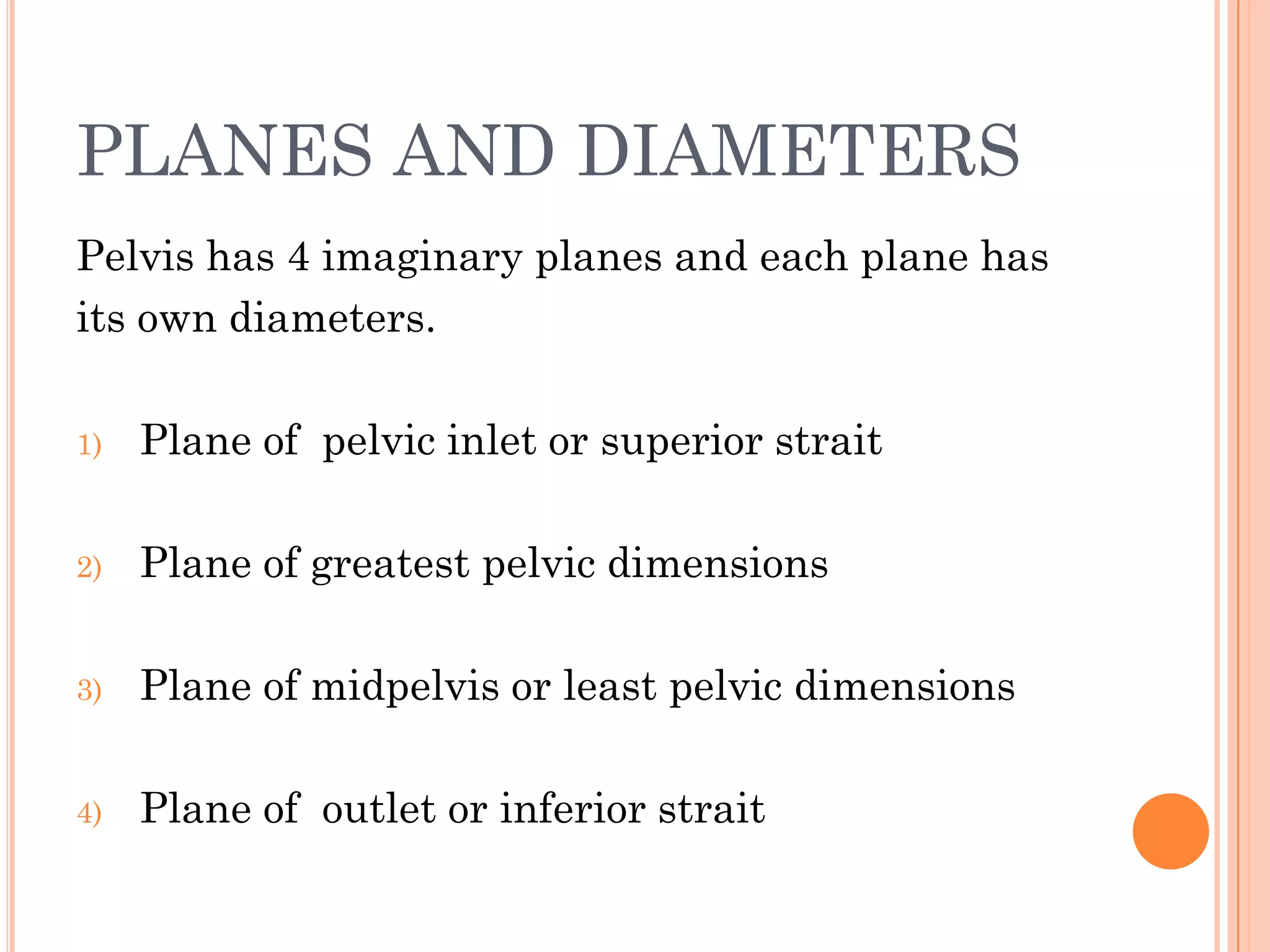
PLANES AND DIAMETERS
Pelvis has 4 imaginary planes and each plane has
its own diameters.
1) Plane of pelvic inlet or superior strait
2) Plane of greatest pelvic dimensions
3) Plane of midpelvis or least pelvic dimensions
4) Plane of outlet or inferior strait
TRUE PELVIS
 Anterior wall and posterior wall of the true pelvis
measures 5 cm and 10 cm respectively.
 In the standing position, upper part of pelvic
canal is directed downwards and backwards and
the lower part curves and is directed downwards
and forwards.
 The side walls of true pelvis converge a little.
 The true pelvis is divided into 3 parts:
 Inlet
 Cavity
 Outlet
PELVIC INLET
 Boundaries:
 Posteriorly by: Sacral promontory and alae of the
sacrum.
 Laterally by: Linea terminalis.
 Anteriorly by: Horizontal rami of Pubic bones and
pubic symphysis.
 Typically round than ovoid.
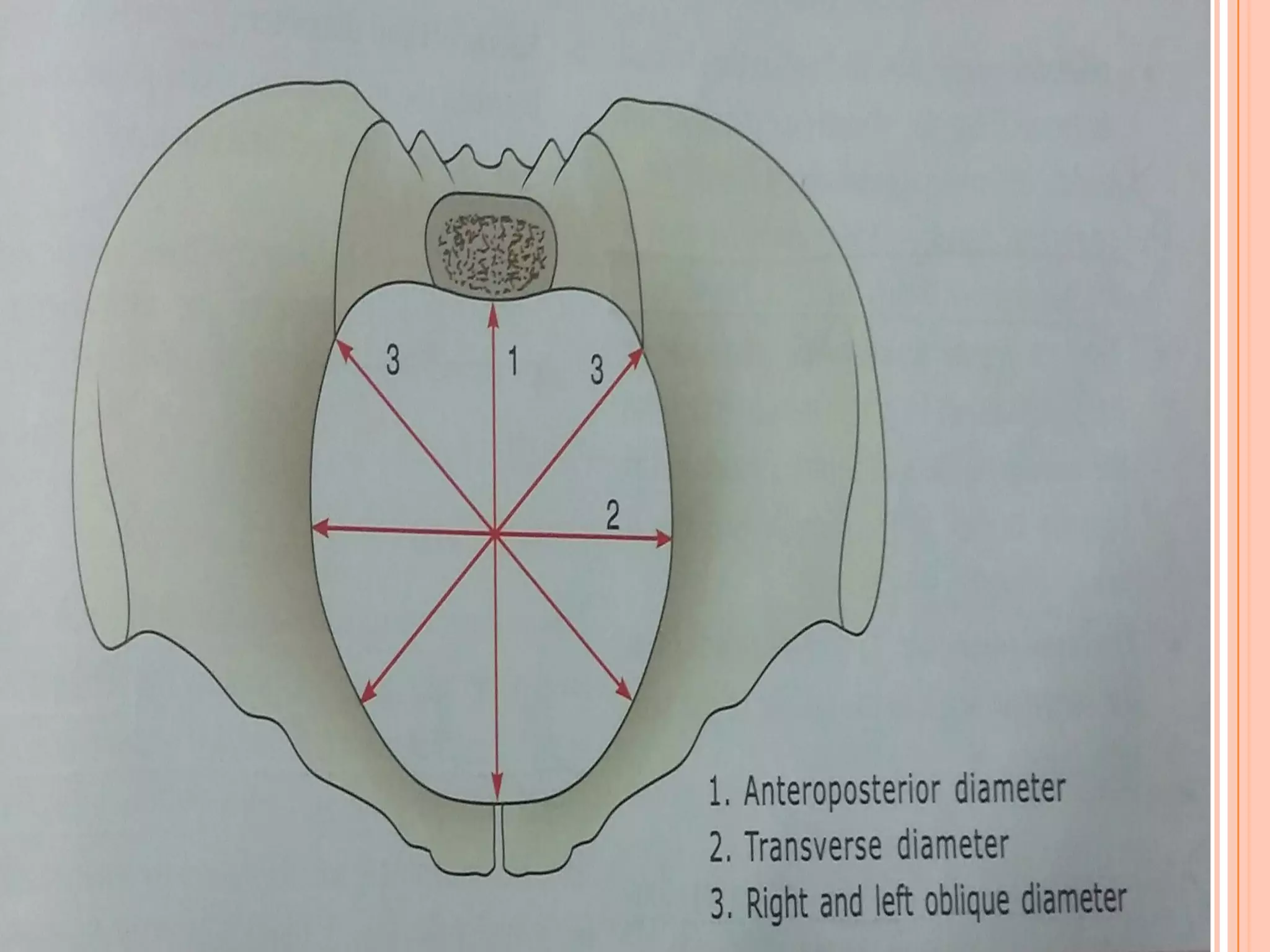
 DIAMETERS :
1. Anteroposterior diameter.
 Obstetric conjugate(10.5 cm): shortest
distance from symphysis pubis to the
middle of sacral promontory.
 Most important AP diameter.
 Presenting part of Fetus should pass
through it.
 True conjugate/Anatomic
conjugate/Conjugate vera(11 cm):
distance from middle of sacral promontory
to the superior surface of the pubic
symphysis.
 Diagonal Conjugate(12.5 cm) extends from
subpubic angle to the middle of sacral
promontory.
 Importance:
 Can be measured clinically
 Subtracting 1.5 cm from this gives obstetric
conjugate.
 The inlet is adequate for a normal fetus if
the diagonal conjugate is 12cm or more.
2.Transverse diameter(13.5cm)
o Widest distance between iliopectineal lines
o Widest diameter of the inlet
o Most fetuses engage in transverse or oblique
diameter
3.Oblique diameters(12.5cm)
o Extends from sacroiliac joint of one side to
opposite iliopectineal eminence
4.Posterior saggital diameters(5cm)
o Extends from point of intersection of obstetric
conjugate and transvese diameter to middle of
sacral promontory
5.Sacrocotyloid diameter(9.5cm)
 Distance between the midpoint of sacral
promontory and the ipsilateral iliopectineal
eminence
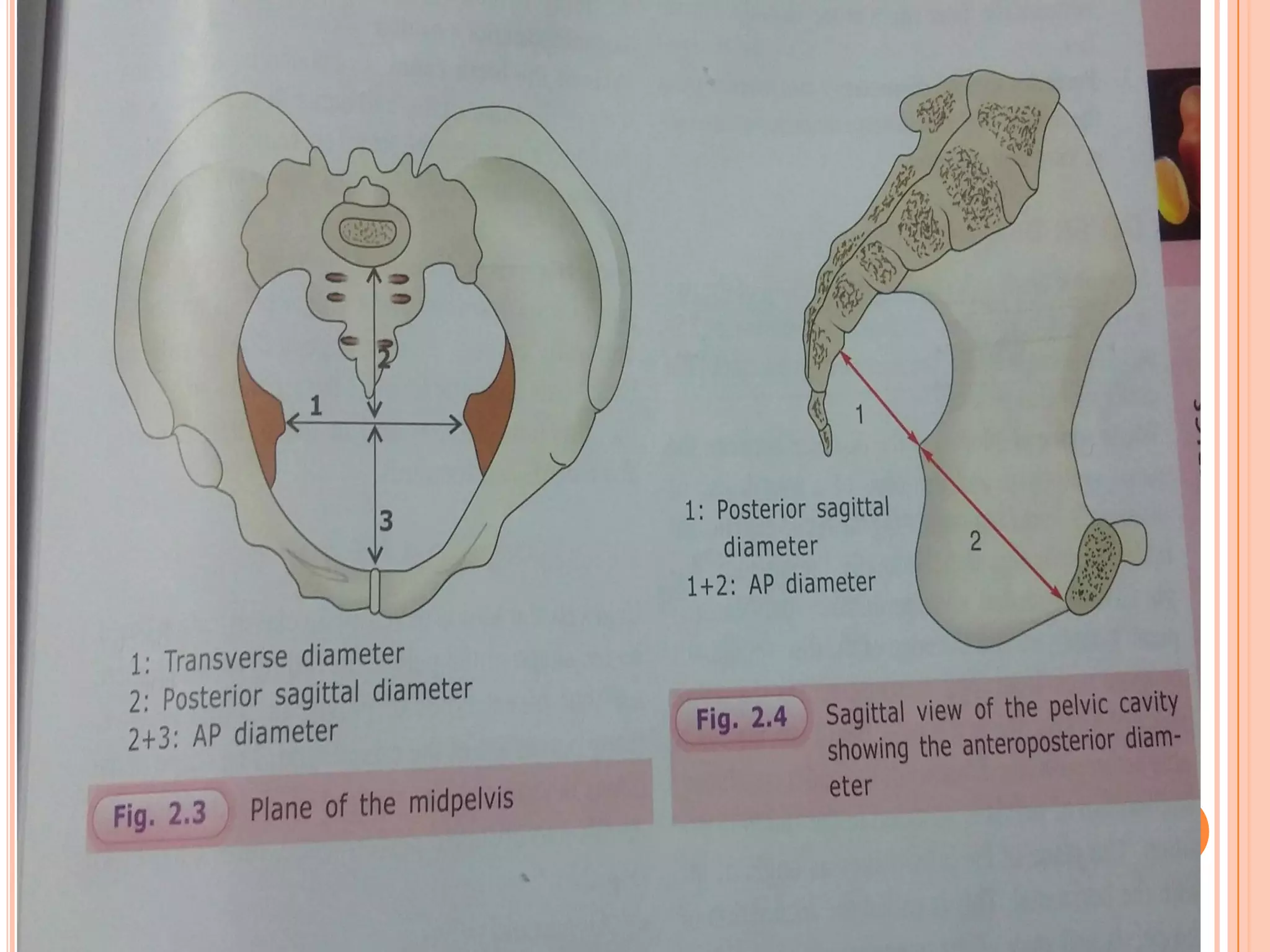
MIDPELVIS
 Most important plane of the pelvis at the level of the
ischial spines.
 Cardinal movements of engagement and internal
rotation occur here.
 Bounded by 4th & 5th sacral vertebrae,white
line,ischial spines,sacrospinous ligaments and pubic
symphysis .
• Diameters :
1. Anteroposterior diameter(11.5cm):
extends from junction of 4th and 5th sacral vertebrae to
the lower border of public symphysis.
2. Transverse diameter(10.5 cm):
is between ischial spines.
3. Posterior sagittal diameter(6 cm):
extends from the interspinous diameter to the junction of
4th and 5th sacral vertebrae.
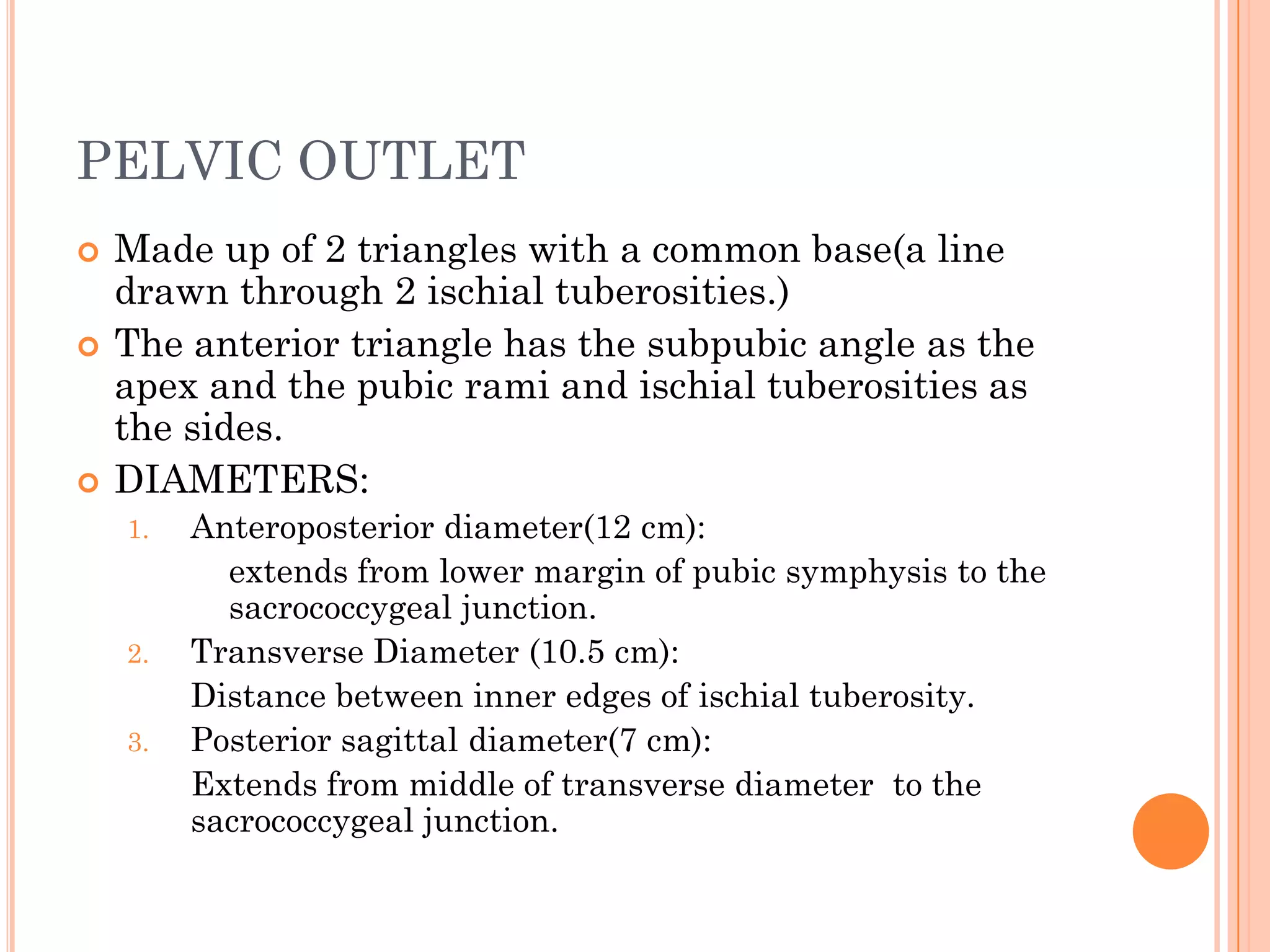
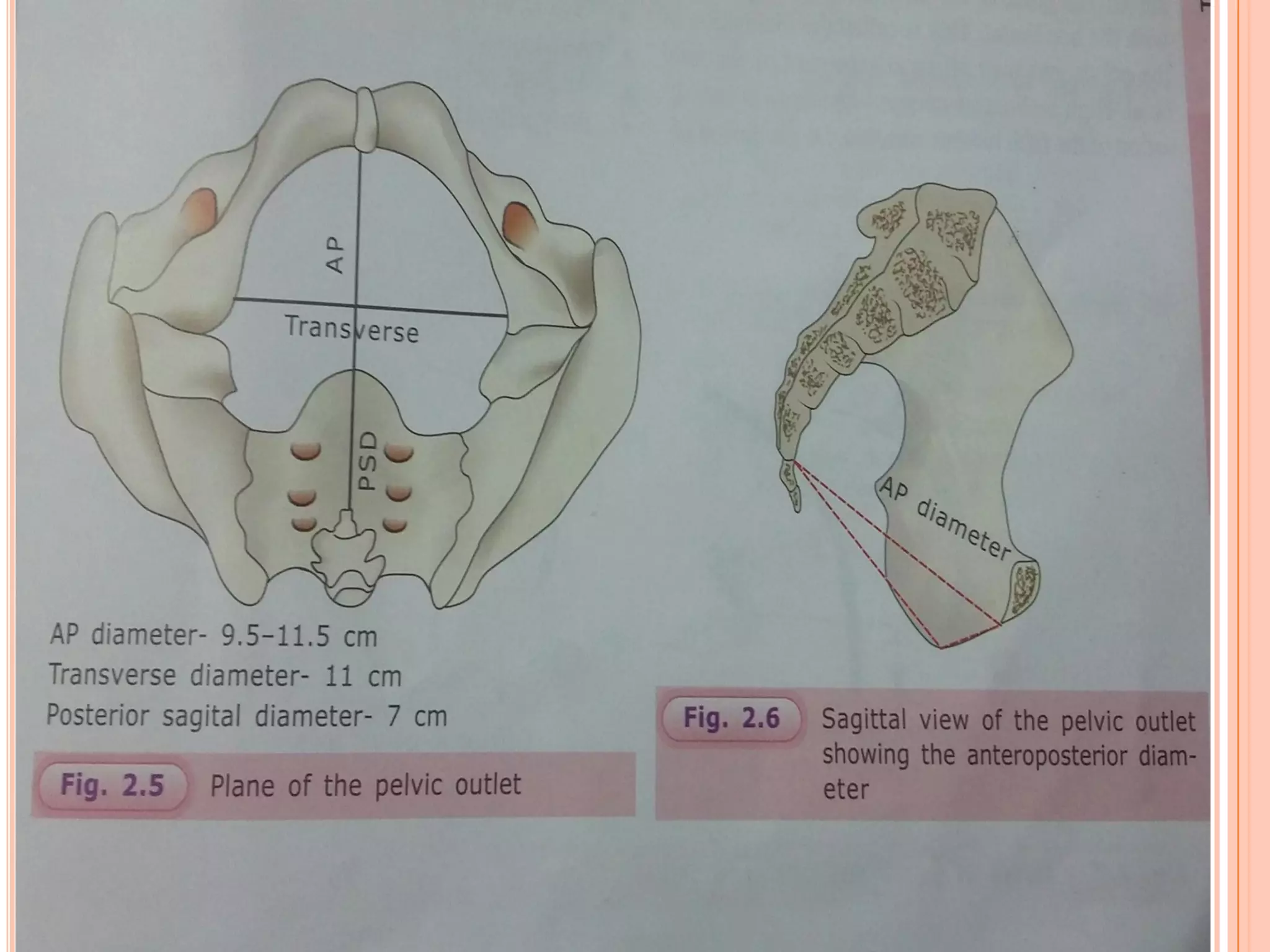
PELVIC OUTLET
 Made up of 2 triangles with a common base(a line
drawn through 2 ischial tuberosities.)
 The anterior triangle has the subpubic angle as the
apex and the pubic rami and ischial tuberosities as
the sides.
 DIAMETERS:
1. Anteroposterior diameter(12 cm):
extends from lower margin of pubic symphysis to the
sacrococcygeal junction.
2. Transverse Diameter (10.5 cm):
Distance between inner edges of ischial tuberosity.
3. Posterior sagittal diameter(7 cm):
Extends from middle of transverse diameter to the
sacrococcygeal junction.
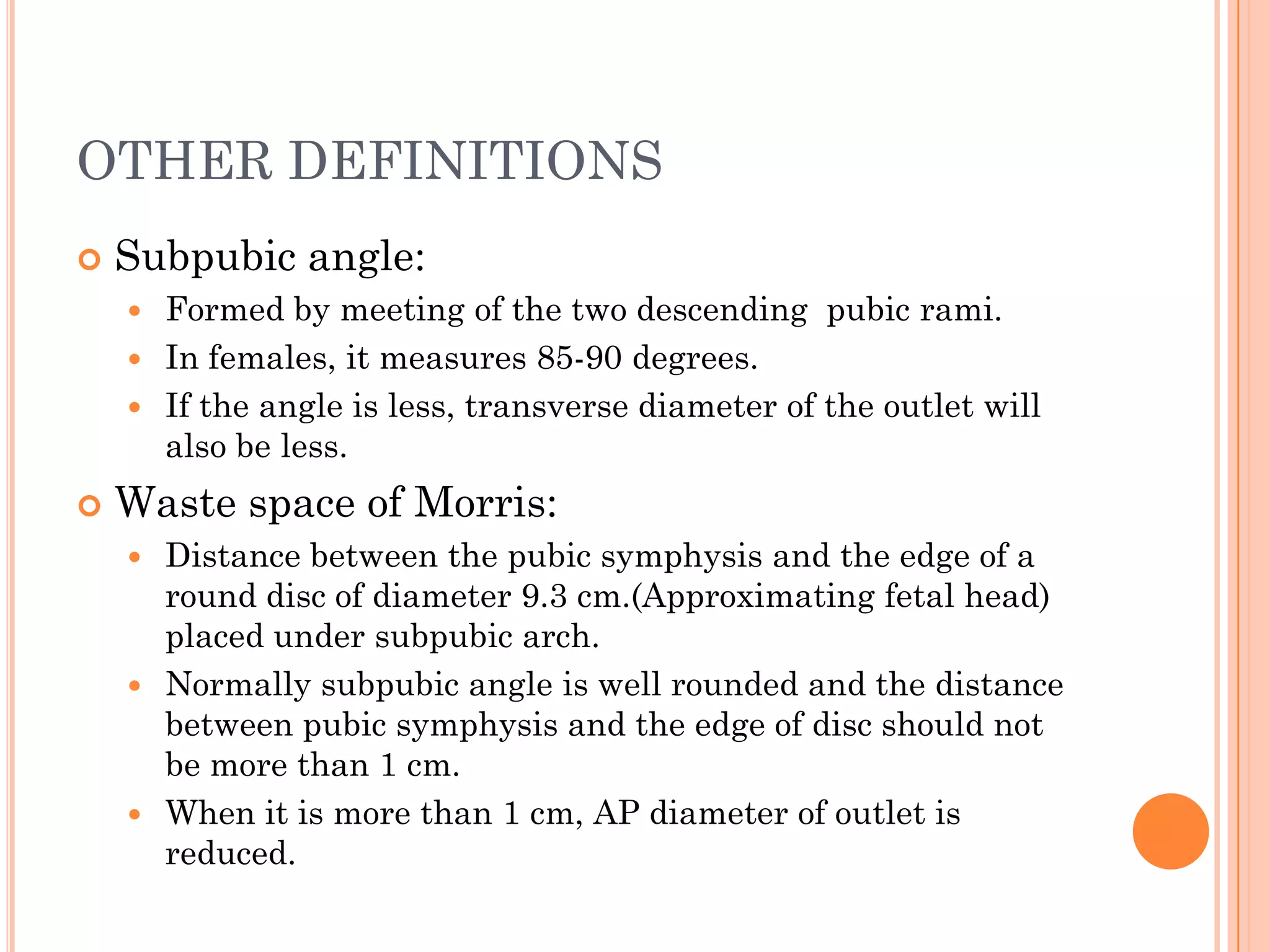
OTHER DEFINITIONS
 Subpubic angle:
 Formed by meeting of the two descending pubic rami.
 In females, it measures 85-90 degrees.
 If the angle is less, transverse diameter of the outlet will
also be less.
 Waste space of Morris:
 Distance between the pubic symphysis and the edge of a
round disc of diameter 9.3 cm.(Approximating fetal head)
placed under subpubic arch.
 Normally subpubic angle is well rounded and the distance
between pubic symphysis and the edge of disc should not
be more than 1 cm.
 When it is more than 1 cm, AP diameter of outlet is
reduced.
 Axis Of Birth Canal:
 Obtained by joining the axes of inlet, cavity
and outlet.
 It is a curve with the convexity fitting the
sacral curvature and is called anatomical
pelvic axis or the curve of Carus.
 Inclination of Pelvis(assessed in standing
position):
 The plane of inlet makes 60 degree with the
horizontal.
 Affect engagement of the fetal head.
 Obstetric axis:
 Course taken by the presenting part as it
moves down through the pelvis.
 At first it goes downwards and backwards upto
the level of ischial spine.
 Then, the direction changes and at the outlet it
moves downwards and forwards.
CLASSIFICATION OF PELVIS
(BY CALDWELL AND MOLOY)
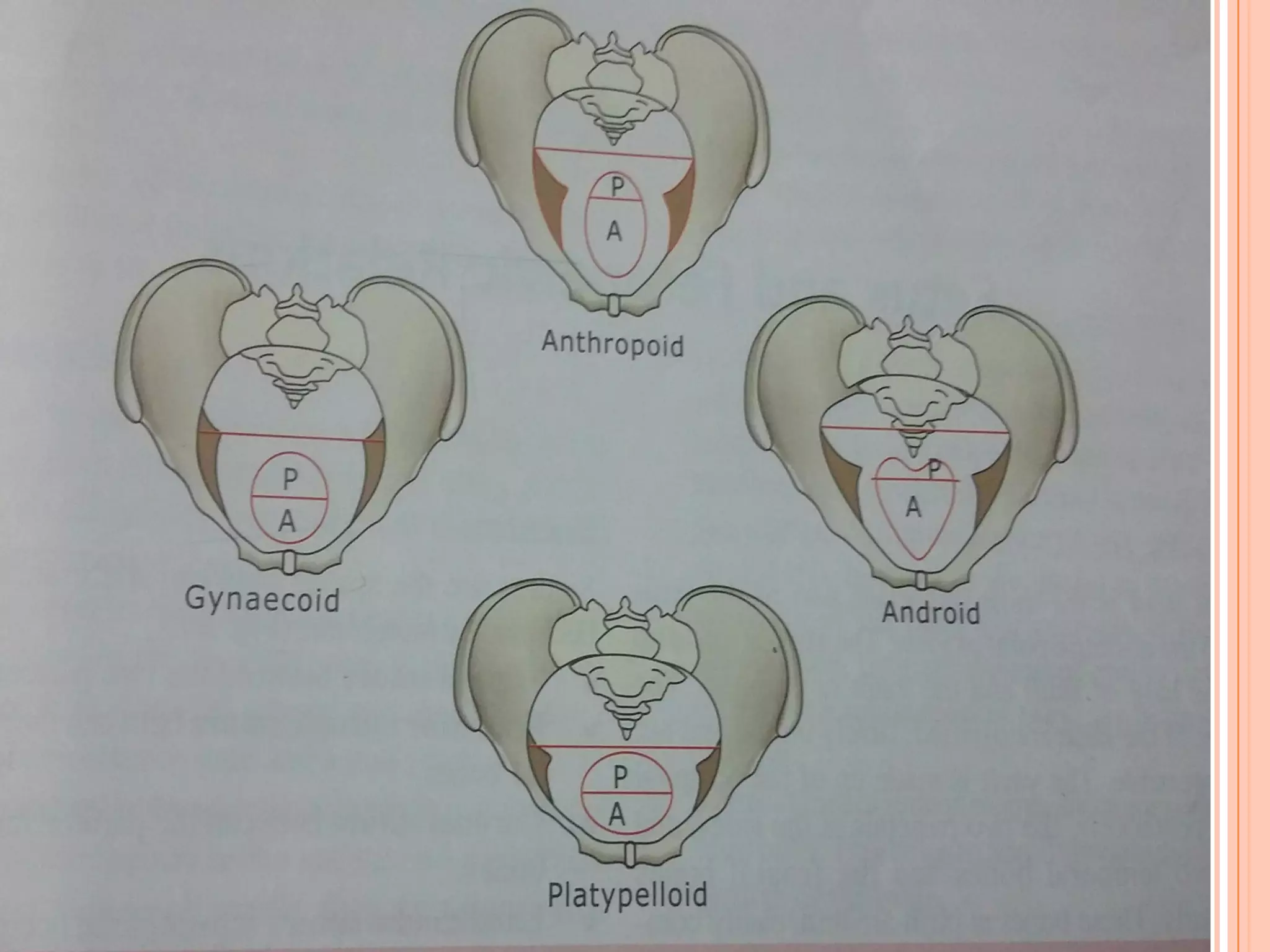
 Based on shape of pelvis:
1. Gynaecoid pelvis
 Inlet is slightly oval or round(Transverse
diameter equal to or greater than AP
diameter)
 In the midpelvis, sidewalls of pelvis are
straight and the spines are not prominent.
 At the outlet, pubic arch is wide.
2. Android Pelvis
• At the inlet, posterior sagittal
diam.<Anterior Sagittal diam.
• In the midpelvis, sidewalls are
convergent, ischial spines are prominent.
• At the outlet, subpubic arch is narrow.
5. Anthropoid Pelvis
• At the inlet, AP diam.>Transverse diam.
• In the midpelvis, sidewalls are
convergent, ischial spines are likely to be
prominent.
• At the outlet, subpubic arch is narrowed,
but well shaped.
4. Platypelloid pelvis:
• Flattened gynaecoid pelvis with a short
AP and a wide transverse diameter.
Maternal pelvis
Maternal pelvis

Maternal pelvis

  • 1.
  • 2.
    BONY PELVIS  Thepelvis is made up of two innominate bones, sacrum, coccyx.  The pelvis may be divided by linea terminalis into an upper part known as pelvis major or false pelvis and a lower part known as pelvis minor or true pelvis.
  • 3.
    PLANES AND DIAMETERS Pelvishas 4 imaginary planes and each plane has its own diameters. 1) Plane of pelvic inlet or superior strait 2) Plane of greatest pelvic dimensions 3) Plane of midpelvis or least pelvic dimensions 4) Plane of outlet or inferior strait
  • 4.
    TRUE PELVIS  Anteriorwall and posterior wall of the true pelvis measures 5 cm and 10 cm respectively.  In the standing position, upper part of pelvic canal is directed downwards and backwards and the lower part curves and is directed downwards and forwards.  The side walls of true pelvis converge a little.  The true pelvis is divided into 3 parts:  Inlet  Cavity  Outlet
  • 5.
    PELVIC INLET  Boundaries: Posteriorly by: Sacral promontory and alae of the sacrum.  Laterally by: Linea terminalis.  Anteriorly by: Horizontal rami of Pubic bones and pubic symphysis.  Typically round than ovoid.
  • 6.
     DIAMETERS : 1.Anteroposterior diameter.  Obstetric conjugate(10.5 cm): shortest distance from symphysis pubis to the middle of sacral promontory.  Most important AP diameter.  Presenting part of Fetus should pass through it.  True conjugate/Anatomic conjugate/Conjugate vera(11 cm): distance from middle of sacral promontory to the superior surface of the pubic symphysis.
  • 7.
     Diagonal Conjugate(12.5cm) extends from subpubic angle to the middle of sacral promontory.  Importance:  Can be measured clinically  Subtracting 1.5 cm from this gives obstetric conjugate.  The inlet is adequate for a normal fetus if the diagonal conjugate is 12cm or more.
  • 8.
    2.Transverse diameter(13.5cm) o Widestdistance between iliopectineal lines o Widest diameter of the inlet o Most fetuses engage in transverse or oblique diameter 3.Oblique diameters(12.5cm) o Extends from sacroiliac joint of one side to opposite iliopectineal eminence 4.Posterior saggital diameters(5cm) o Extends from point of intersection of obstetric conjugate and transvese diameter to middle of sacral promontory
  • 9.
    5.Sacrocotyloid diameter(9.5cm)  Distancebetween the midpoint of sacral promontory and the ipsilateral iliopectineal eminence
  • 12.
    MIDPELVIS  Most importantplane of the pelvis at the level of the ischial spines.  Cardinal movements of engagement and internal rotation occur here.  Bounded by 4th & 5th sacral vertebrae,white line,ischial spines,sacrospinous ligaments and pubic symphysis . • Diameters : 1. Anteroposterior diameter(11.5cm): extends from junction of 4th and 5th sacral vertebrae to the lower border of public symphysis. 2. Transverse diameter(10.5 cm): is between ischial spines. 3. Posterior sagittal diameter(6 cm): extends from the interspinous diameter to the junction of 4th and 5th sacral vertebrae.
  • 14.
    PELVIC OUTLET  Madeup of 2 triangles with a common base(a line drawn through 2 ischial tuberosities.)  The anterior triangle has the subpubic angle as the apex and the pubic rami and ischial tuberosities as the sides.  DIAMETERS: 1. Anteroposterior diameter(12 cm): extends from lower margin of pubic symphysis to the sacrococcygeal junction. 2. Transverse Diameter (10.5 cm): Distance between inner edges of ischial tuberosity. 3. Posterior sagittal diameter(7 cm): Extends from middle of transverse diameter to the sacrococcygeal junction.
  • 16.
    OTHER DEFINITIONS  Subpubicangle:  Formed by meeting of the two descending pubic rami.  In females, it measures 85-90 degrees.  If the angle is less, transverse diameter of the outlet will also be less.  Waste space of Morris:  Distance between the pubic symphysis and the edge of a round disc of diameter 9.3 cm.(Approximating fetal head) placed under subpubic arch.  Normally subpubic angle is well rounded and the distance between pubic symphysis and the edge of disc should not be more than 1 cm.  When it is more than 1 cm, AP diameter of outlet is reduced.
  • 17.
     Axis OfBirth Canal:  Obtained by joining the axes of inlet, cavity and outlet.  It is a curve with the convexity fitting the sacral curvature and is called anatomical pelvic axis or the curve of Carus.  Inclination of Pelvis(assessed in standing position):  The plane of inlet makes 60 degree with the horizontal.  Affect engagement of the fetal head.
  • 18.
     Obstetric axis: Course taken by the presenting part as it moves down through the pelvis.  At first it goes downwards and backwards upto the level of ischial spine.  Then, the direction changes and at the outlet it moves downwards and forwards.
  • 19.
    CLASSIFICATION OF PELVIS (BYCALDWELL AND MOLOY)  Based on shape of pelvis: 1. Gynaecoid pelvis  Inlet is slightly oval or round(Transverse diameter equal to or greater than AP diameter)  In the midpelvis, sidewalls of pelvis are straight and the spines are not prominent.  At the outlet, pubic arch is wide. 2. Android Pelvis • At the inlet, posterior sagittal diam.<Anterior Sagittal diam. • In the midpelvis, sidewalls are convergent, ischial spines are prominent. • At the outlet, subpubic arch is narrow.
  • 20.
    5. Anthropoid Pelvis •At the inlet, AP diam.>Transverse diam. • In the midpelvis, sidewalls are convergent, ischial spines are likely to be prominent. • At the outlet, subpubic arch is narrowed, but well shaped. 4. Platypelloid pelvis: • Flattened gynaecoid pelvis with a short AP and a wide transverse diameter.