By Dr DEEPAK KUMAR DAS
MOD- PROF. R. KAPOOR
PGIMER, CHANDIGARH
ANATOMY
 Located anterior and inferior to thyroid
cartilage
 Consists of two lateral lobes connected by
central isthmus
 Lateral lobes extend superiorly to the level
of midthyroid cartilage and inferiorly to
the sixth tracheal ring
 Lateral extent is just medial to common
carotid artery
 Recurrent laryngeal nerve, sympathetic
trunk and phrenic nerve are immediately
posterior to the gland
BLOOD SUPPLY
AND LYMPHATIC
DRAINAGE
 Blood supply is by paired superior thyroid
artery ( branch of external carotid artery)
and inferior thyroid artery
 First-echelon nodes for thyroid metastasis
are located in level 6( paralaryngeal,
paratracheal and prelaryngeal nodes)
 Second-echelon nodal spread is to level 3
and 4, supraclavicular nodes and upper
mediastinal nodes ( level 7)
 Retropharyngeal node involvement is
unusual and can be encountered in case of
advanced disease
PHYSIOLOGY
ETIOLOGY
 Most important risk factor for differentiated thyroid cancer is previous
irradiation, especially before the age of 16 years
 Other predisposing factors are:
- Genetic predisposition
- Hashimoto’ s disease
- Iodine content of the diet
PATHOLOGICAL CLASSIFICATION
 Follicular epithelial cell
-Differentiated thyroid cancer
 papillary and mixed cell variant
 Classic
 Papillary microcarcinoma
 Encapsulated variant
 Follicular variant
 Aggressive variants
a. Diffuse sclerosing
b. Tall cell variant
c. Columnar cell variant
 Follicular cancer
a. Classic morphology- Follicular carcinoma
b. Hurthle cell variant
- Poorly differentiated thyroid cancer
- Insular carcinoma
-Undifferentiated thyroid cancer( anaplastic carcinoma)
Parafollicular cell ( C cell)
Medullary carcinoma
 Non epithelial tumors
- Lymphoma
- sarcoma
- hemangioendothelioma
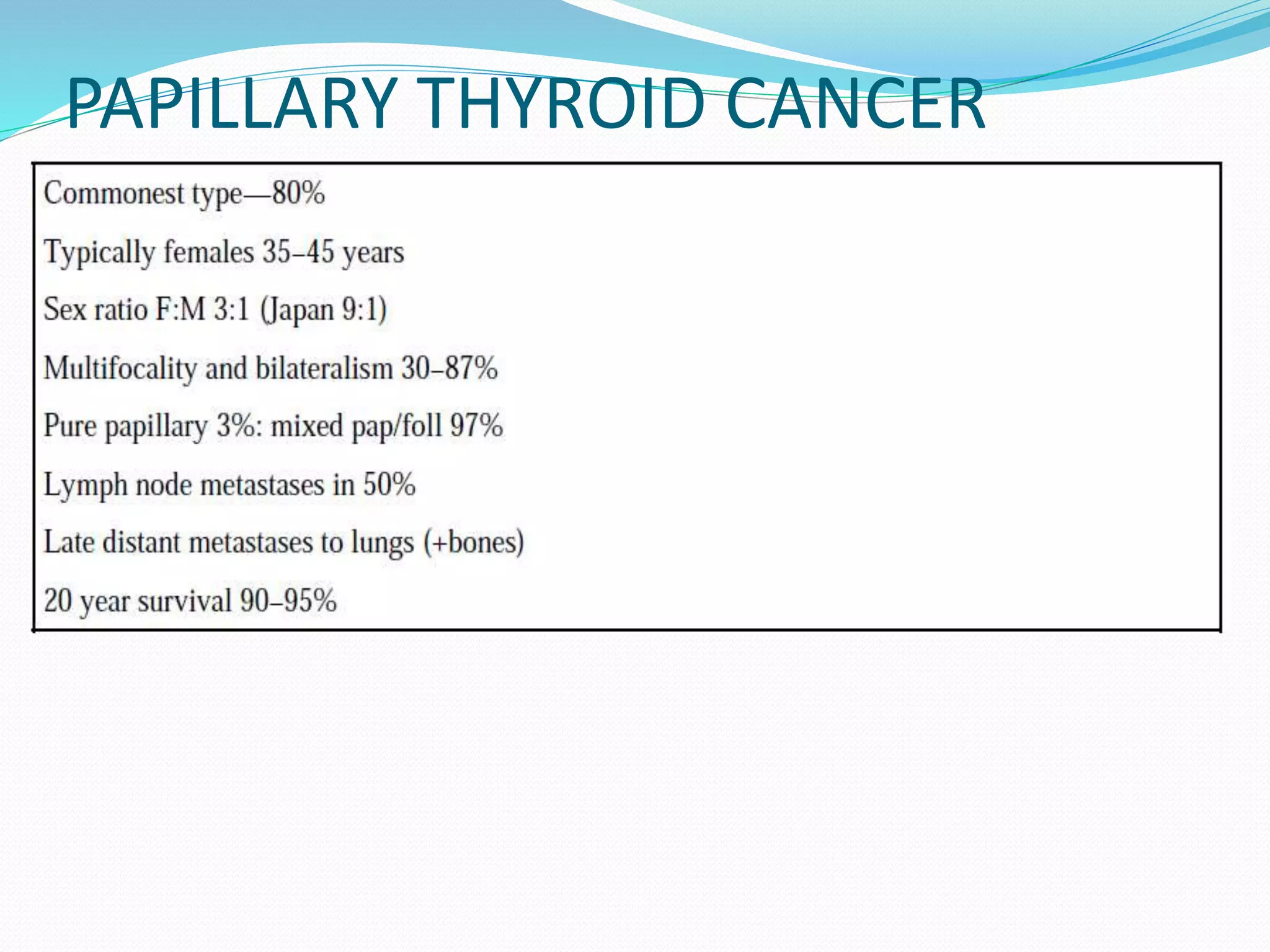
PAPILLARY THYROID CANCER
PATHOLOGIC FINDINGS
- Nuclear enlargement, hypochromasia, nuclear pseudoinclusions,
nuclear grooves and distinct nucleoli
- After formalin fixation nucleus resemble “ Orphan Annie’s eyes”
Tall cell variant
- At least 70% of the carcinoma is composed of cells that are at least
twice as tall as they are wide
( papillary thyroid cancer) ( tall cell variant)
FOLLICULAR CARCINOMA
Diagnosis of FC is dependent on the presence of one of two histologic features
 Tumor invasion through the entire tumour capsule or
 Tumor invasion into a blood vessel located in the tumour capsule or immediately
outside the tumour capsule
HURTHLE CELL CARCINOMA
-Also called as oncocytic carcinoma
-Characterised by large cells with abundant granular eosinophilic cytoplasm
- At least 75% of the tumour must be comprised of Hurthle cells to designate it
Hurthle cell carcinoma
ANAPLASTIC THYROID CARCINOMA
-Comprise <5% of all malignant thyroid neoplasms
- Most aggressive form of thyroid carcinoma
- Most patients are diagnosed at the age of 65 years or older
- Usually accompanied by bulky mediastinal lymphadenopathy and distant
metastatic spread
-Mean overall survival from the time of diagnosis is 3-6 month
MEDULLARY THYROID CARCINOMA
-Comprise 5-10% of all thyroid cancer
- Seen sporadically( 80%) or in association with familial multiple endocrine
neoplasia( MEN IIA, MEN IIB, pure familial MTC)
-50-70% of MEN associated tumour is multifocal, but sporadic tumors are more often
unifocal
-Prognosis depends on the tumour subtype
Non MEN familial> MEN associated> sporadic > MEN
- Overall mean 10 year survival is 75-80%
CLINICAL PRESENTATION
Thyroid nodule ( 10-50% of solitary
nodule)
 Cervical lymphadenopathy
 Hoarseness
 Haemoptysis
 Stridor
 Dysphagea
 Hyperthyroidism
 Diarrhoea
INVESTIGATIVE WORK UP
 Complete hemogram, biochemistry
 CXR
 FNAC
- safe, easy, cheap and reliable test to distinguish between benign and
malignant thyroid nodule
RESULTS OF FNAC
 Degenerative condition( 75%)
 Thyroid cyst
-Fluid should be sent for malignant cytology
 Degenerative or colloid nodule
- < 1% risk of malignancy
 Neoplastic condition( 4% positive, 11% suspicious)
 Papillary neoplasm
- 90% accuracy in positive cases
- 60% accuracy in suspicious reports
Follicular neoplasm
- Unable to distinguish between adenoma and well differentiated follicular
carcinoma: biopsy required
 Medullary carcinoma
- Reliable test when combined with calcitonin staining
 Anaplastic carcinoma
- Usually diagnostic but may not distinguish from lymphoma or metastatic
carcinoma
 Lymphoma
- Open biopsy required for immunohistochemistry
 Inconclusive(10% cases)
-FNAC should be repeated under USG guidance
ULTRASONOGRAPHY
-Most sensitive method for evaluating thyroid nodule
- Ideally used in combination with FNAC for preliminary assessment
- Distinguishes solitary thyroid nodule from dominant thyroid nodule in a multi-
nodular goitre
- Assessing size and position of cervical lymphadenopathy
RADIONUCLIDE SCANNING
TECHNETIUM 99m
 Uptake by thyroid gland is low.
 Scans are neither sensitive nor
specific
 Information is provided in terms
of hot or cold nodules
I123
Ideal
 No longer used as a first line investigation of thyroid nodule
 Involuble for total body imaging post total thyroidectomy in case of
well differentiated thyroid cancer
DMSA AND MIBG scan
 May locate recurrent or metastatic disease in case of medullary carcinoma
 Not taken by cells as readily as I123 in differentiated cancer and positive
scans occur only in 30% cases
CT/MR IMAGING
INDICATION
NECK
 Possible bilateral involvement
 Extrathyroid invasion of trachea, larynx, esophagus, carotid vessels
 LN involvement
THORAX
 Retrosternal spread
 Superior mediastinal nodes involvement
 Pulmonary metastasis in MTC/ anaplastic carcinoma
ABDOMEN
 Exclusion of pheochromocytoma in MTC
 Liver metastasis in MTC/ anaplastic carcinoma
 Lymphoma staging
Main disadvantage with CT scan is the necessary administration of
iodine contrast which can block both diagnostic and therapeutic use
of radioiodine for 6 months.
 MR involves neither radiation or iodine and with better diagnostic ability
is the investigation of choice in differentiated thyroid cancer
TFT- Free serum T3, T4 and TSH
- Indicated in all patients of thyroid cancer
 Thyroid autoantibodies- Anti-microsomal, antithyroglobulin
- Indicated if Hashimoto’s disease or
thyroid lymphoma suspected
 Tumor markers- Thyroglobulin, calcitonin, CEA
- Preoperatively in all cases
- Proven role in monitoring and follow up
- Calcitonin also helps in initial diagnosis
Peak calcium infusion
- less than or equal to 130 pg/ml in males
- less than or equal to 90 pg/ml in females
 Basal calcitonin levels are high in most patients with sporadic MTC but
are normal in those with familial MTC or MEN type 2
 So in these patients a calcium infusion provocative test or pentagastrin
infusion test is used todetect the abnormality
CALCITONIN
OTHER INVESTIGATION
 Indirect or fibreoptic laryngoscopy to assess vocal cord
and/or intratracheal disease is indicated in all patients with
suspected thyroid malignancy.
 Mandatory for both preoperative and post operative
assessment
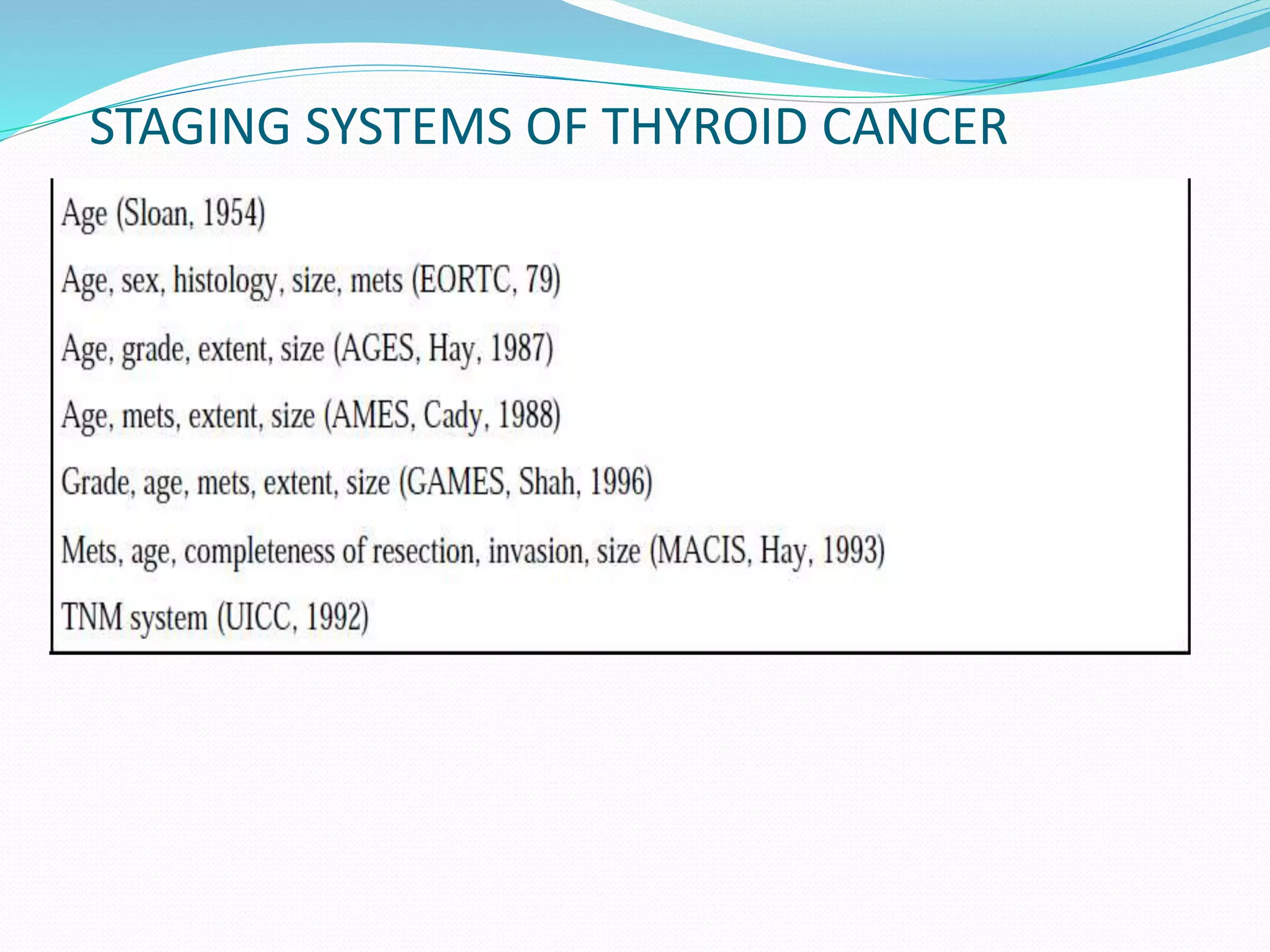
STAGING SYSTEMS OF THYROID CANCER
AGES, Mayo clinic, 1987
Age>40, grade>1, extrathyroid extension, size>3 cm
AMES( Lahey clinic, 1988)
40 year survival for low risk group was 95% and 45% for high risk group
GAMES( MSKCC 1992)
Grade>2, age>45 years, distant metastasis, extension beyond thyroid capsule,
Size> 4 cm
MACIS( Mayo Clinic, 1993)
Metastasis, Age>40, Completeness of resection, Extrathyroid invasion, Size
DAMES( Karolinska Institute, 1992)
DNA ploidy, Age> 40 year in female and 50 year in male, Metastasis, Extension beyond
Thyroid capsule, Size> 5 cm
AJCC 2010 TNM STAGING SYSTEM
Tx Primary tumour cannot be assessed
T0 No evidence of primary tumour
T1 Tumour 2 cm or less in greatest dimension and limited to the thyroid gland
T1a Tumour 1 cm or less in greatest dimension and limited to the thyroid gland
T1b Tumour > 1cm but not > 2 cm in greatest dimension and limited to thyroid gland
T2 Tumour > 2 cm but not > 4 cm in greatest dimension and limited to the thyroid
gland
T3 Tunour > 4cm in greatest dimension limited to the thyroid or any tumour with
minimal extrathyroidal extension to the sternothyroid muscle or perithyroid soft
tissue
T4 Advanced disease defined as more than minimal extrathyroid extension
T4a Tumor of any size extending beyond the thyroid capsule to invade subcutaneous
soft tissue, larynx, trachea, esophagus, or recurrent laryngeal nerve
T4b Tumor invades prevertebral fascia, encases carotid artery or mediastinal vessels
STAGING CONT......
 All anaplastic carcinomas are considered T4 tumors
T4a Intrathyroidal anaplastic carcinoma
T4b Anaplastic carcinoma with gross extrathyroidal extension
Regional lymph node(N)
Nx Regional LN cannot be assessed
N0 No evidence of regional LN metastasis
N1 Regional LN metastasis
N1a Metastasis to level VI
N1b Metastasis to unilateral, bilateral, contralateral cervical or retropharyngeal
or superior mediastinal LN
Distant metastasis
M0 No distant metastasis
M1 Distant metastasis
COMPOSITE STAGING
MANAGEMENT
 Surgery
-Lobectomy or total thyroidectomy
- Extent of neck dissection
 Hormonal therapy
 Radioactive iodine therapy
 EBRT
 Chemotherapy
SURGERY
 Surgery is the primary treatment of localised thyroid cancer of all
histologies
 Total thyroidectomy is the preferred oncologic procedure, because
- The gland is surgically accessible
- Its primary endocrine function can be replaced by exogenous
hormones
 Even a total thyroidectomy leaves residual thyroid tissue that will have
major implication for subsequent therapy and disease monitoring
-The ligament connecting the posterior surface of thyroid capsule
to the trachea harbors microscopic nests of thyroid tissue and is
rarely completely resected in order to reduce the risk of tracheal
injury
- Recurrent laryngeal nerve is embedded in thyroid tissue at the
point where nerve enters the larynx and it is not possible to
remove all of the thyroid tissue without injuring the nerve and
compromising voice quality and laryngeal function
There are three critical issues regarding the surgical management of thyroid
Cancer
 When is surgery indicated for the evaluation of a thyroid nodule with non-
diagnostic cytology
 When is it safe to consider hemithyroidectomy for thyroid carcinoma
 What is the appropriate extent of neck dissection
SURGICAL EVALUATION OF THYROID NODULE
 Cytology is suspicious for PTC
 Cytology contains follicular cells with no concordant
functioning nodule on an RAI scan, especially with low to
normal range serum TSH
 Cytology contains Hurthle cell neoplasm, which does not
warrant an RAI study and should be managed with
lobectomy or total thyroidectomy, depending on the lesion’
s size and other risk factors
 Growing nodules, even in the face of benign cytology
LOBECTOMY IN THE MANAGEMENT OF THYROID CANCER
 Age between the age of 15 and 45 years with PTC tumor <4 cm
 No prior radiotherapy
 No distant metastasis
 No cervical LN metastasis
 No extrathyroidal extension
 Absence of aggressive histologic variant
Completion thyroidectomy is indicated in
 Tumor > 4 cm in diametre
 Positive margin
 Gross extrathyroid extension
 Macroscopic multifocal disease
 Macroscopic nodal metastasis
 Confirmed contralateral disease
 Vascular invasion
ADVANTAGE OF TOTAL THYROIDECTOMY
NECK DISSECTION IN THYROID CANCER
 Elective neck dissection is not performed for DTC of follicular cell
origin
 Modified radical neck dissection is done for thyroid cancer when there
is visible or palpable positive node
RECOMMENDATION
 Central compartmental ( level VI) is recommended for all patients with
clinically involved nodes
 Prophylactic central neck dissection in clinically N0 patients with T3 or
T4 tumors
 Lateral level II to level IV should only be reserved for biopsy proven
metastatic lateral cervical LAP
 Level I, V, VII should only be dissected when clinically suspicious
 Central and lateral neck dissection are part of standard primary
therapy for all patients with sporadic and hereditary forms of
medullary thyroid cancer
RADIOACTIVE IODINE THERAPY
BIOCONCENTRATION
Radioactive iodine is taken up by thyroid tissue, including DTC of follicuar epithelial
Origin at a rate 6.6 times more than most tissues of the body.
RADIOACTIVE DECAY OF IODINE-131
 I-131 is produced from the fission of uranium atoms durin the operation
of nuclear reactors
 I-131 decays by beta decay to Xe- 131
 This first transition results in a beta particle with a range of energies
from 250 to 800 KeV
 Because energies of this energy range will deposit their energy within a
milimeter, only the cells taking up the I-131 are affected.
 In the second decay step, unstable Xe-131 decays to stable xenon,
releasing photon of energy 364 KeV
 This product is therapeutically undesirable, because the photon will
travel far from the source where iodine is concentrated.
 It contributes very little cytotoxicity to thyroid cancer cells and
increases the total body dose, however it is this property that makes
RAI useful for diagnostic imaging, forming the foundation for DxWBS
and RxWBS.
GOALS OF RADIOACTIVE IODINE THERAPY
Two basic purposes are
a) Thyroid remnant ablation
b) Adjuvant therapy for residual microscopic disease
I. RAI provides potent cytotoxicity by targeting thyroid cancer cells
remaining in the operative bed, occult LN metastasis, and distant
metastasis
II. Rx WBS provides critical informatiopn including staging, prognosis,
and determining which patients are likely to require additional
treattments
III. Ablation of the remaining thyroid tissue facilitates the use of serum
Tg as a very sensitive and specific marker for disease persistence after
primary therapy
PATIENT SELECTION FOR RAI
 All patients with distant metastasis
 Gross extrathyroidal extension of the tumour regardless of tumour size
 Primary tumor size> 4 cm, even in the absence of other higher risk
features
 Patients with 1-4 cm thyroid tumor with high risk features
 LN metastasis
 Age> 45 years
 Intra thyroid vascular invasion
 Aggressive histologic variants ( tall cell, columnar cell, or insular carcinoma
 All patients with follicular and Hurthle cell variants except those with
smallest unifocal FCs manifesting as only capsular invasion and
without vascular invasion
 Patients with persistent disease
RAI is not recommended in
 Unifocal PTCs< 1 cm
 Without high risk features
 When all the foci in multifocal disease are < 1 cm
 Patients without residual disease or high risk histology, when post op
Tg < 1 ng/ml and anti-Tg antibodies and RAI imaging are negative
SELECTION OF I-131 ACTIVITY
FORMS AVAILABLE
I131 is available in the form of
 Capsule
 Liquid preparation
 Intravenous
Capsule is the most common used because of safety and easy
of administration
PATIENT PREPARATION FOR I-131
Low iodine diet -A diet that is low in iodine( <
50mcg/day) for 2 weeks before,
and 2 days after I-131
- Salty product to be avoided
Intravenous iodine exposure -Should be avoided
- Who recieved iodine contrast within 6
months of RAI should have therapy
delayed for 3-6 months and require 24
hr urinary iodine measurement
Urinary iodine measurement -Only done in patient with history
of iodinated contrast exposure
within 6 months
- 24 hr urinary iodine on day 7 of a
low iodine diet < 150 mcg/ml
rhTSH 0.9 mg im injection 2 day and 1 day
before I-131 administration
Stop thyroid
hormone
replacement
Levothyroxine and other thyroid replacement should
be withheld 6 weeks before I-131 unless rhTSH is
administered in which case stop T4 and T3 3 days
before and the day of I-131 administration
Lithium carbonate
to increase the
potency of I-131
Lithium carbonate is administered at 20mg/kg/day for 7
days beginning 5 days before I-131 administration
PRECAUTION AFTER RAI
CONTRAINDICATION
ADVERSE EFFECT OF RADIOACTIVE IODINE THERAPY
PGI PROTOCOL
Criteria Low Intermediate High
Histology & Tg Non aggressive
histology
Aggressive histology(
tall cell, columnar &
vascular invasion)
Possibly Tg out of
proportion to post
therapy scan
Tumour status Macroscopic
tumour resected
completely& no
microscopic
invasion
Microscopic invasion Incomplete
tumour resection/
macroscopic
tumour invasion
Metastasis No local or distant
metastasis
Cervical LN
metastasis
Distant metastasis
Post therapy
I131
No uptake outside
thyroid bed
Uptake outside
thyroid bed
Distant metastasis
Low risk: 30-50 mCi
Inermediate risk: 100-150 mCi
High risk: 200 mCi
TSH SUPPRESSION FOR DIFFERENTIATED THYROID
CANCER
Rationale- Administartion of subtherapeutic doses of T4 in an effort to
drive the TSH below detectable limits( < 0.1 Miu/L), thereby decreasing
stimulation of residual benign and malignant follicular derived
thyroid cells
RECOMMENDATION
 TSH suppression to just below 0.1 Mu/L for high risk patients
 Maintainance of TSH at or slightly below the lower limit of normal(
0.1-0.5 Mu/l) in low risk patients
LIMITATION
 Subclinical and even overt thyrotoxicosis
 Tachyarrhythmia
 Conduction abnormalities
 Ventricular hypertrophy
 Systolic and diastolic dysfunction
EBRT
CONVENTIONAL FIELD MARGINS
Position- supine with neck extended and
arm lying by the side
 Superior- angle of mandible
 Inferior- angle of loui
 Lateral- to cover the neck
CONFORMAL RADIOTHERAPY
 High risk CTV: region at highest risk for residual disease
: Positive margin, ETE, LN with extracapsular extension,
gross residual disease
 Standard risk CTV: Moderate risk for residual disease
 Dose to high risk PTV: 66-70 Gy, 2 Gy per #
 Dose to standard risk PTV: 54-56 Gy, 2 Gy per #
Contouring of high risk and standard risk PTV
TOXICITY OF EBRT
ACUTE TOXICITY LATE TOXICITY
Mucositis Fibrosis and atrophy of skin, lung
apices, musculature
Taste changes Tracheal stenosis
Xerostomia Esophageal stenosis
Pharyngitis
Dysphagea
Hoarseness
Radiation dermatitis
Weight loss
Malnutrition
RESULTS OF EBRT
CHEMOTHERAPY IN DTC
 Systemic chemotherapy has no significant role in the management of
DTC
 Poor response rate on the order of 25- 40%
 The most commonly used agent is doxorubicin, either alone or in
combination with cisplatin.
MANAGEMENT OF MTC
 All patients with MTC should be tested for RET mutation, Including
sporadic cases
 Primary management of localised is total thyroidectomy, which is the
only completely effective therapy
 Central neck dissection should be performed in all cases
 Compartment-oriented lateral neck dissection is indicated when
clinically involved
 No role of adjuvant RAI
INDICATION OF EBRT
CHILDREN(<18 YEARS)
 Palliation of symptoms from tumors not amenable to other treatment
 When tumour progression is likely to cause normal tissue damage
ADULTS
Treatment of unresectable gross disease
Positive margin
T4 primary tumors
Nodal metastasis with extensive extracapsular extension
CHEMOTHERAPY IN MTC
MOLECULAR TARGETED AGENTS IN MTC
ROLE OF OCTREOTIDE IN MTC
Octreotide is recommended to manage symptoms due to elevated
calcitonin level in medullary thyroid cancer like diarrhoea
Dose is
 100-250 mcg tid sc
 Octrotide LAR 20-30 mg im every 4 week
ROLE OF I131 MIBG THERAPY IN MTC
 MIBG( meta-iodo benzyl guanidine) is a radiopharmaceutical specific
for tumors originating from neural crest, including MTC. It is
structurally similar to norepinephrine.
 It is taken up actively and transported to the catecholamine storing
granules of sympathomedullary tissues
INDICATION
 Patients with tumour progrssion
 Quality of life compromising symptoms including diarrhoea
 Should be indicated when conventional therapies and chemotherapy
fails
 Surgical options should be excluded
 Diagnostic MIBG scan should be prominent to allow successful
treatment
 Medications interfering with MIBG like sympathomimetics, calcium
channel blockers, reserpine should be withdrawn according to
biological half life.
Dose: 200-300 mCi
Infusion should last 45-60 minutes to prevent acute side effects
Management of rise of BP should be managed by alpha blockers
MANAGEMENT OF ATC
 Complete surgical excision should be the goal of initial therapy, when
feasible
 Surgery should be avoided when complete excision is not possible as
debulking does not improve outcomes
 No therapeutic role for RAI
 EBRT is the standard of care for palliation of local symptoms from
unresectable disease or as adjuvant therapy in rare case a completely
resected tumor
TREATMENT ALGORITHM
CONCLUSION
 Surgery is the primary treatment modality in localised thyroid cancer
of all histologies.
 Total thyroidectomy is preferred surgical procedure in most cases.
 LN dissection is indicated when clinically involved except MTC where
level VI is indicated in all cases.
 In DTC, RAI is indicated in patients with distant metastasis or high risk
histopathological features
 EBRT is indicated in DTC when there is gross residual tumor or gross
ETE which is not amenable for surgery or RAI.
 EBRT is the standard of care for palliation of symptoms in ATC.

Thyroid ca

  • 1.
    By Dr DEEPAKKUMAR DAS MOD- PROF. R. KAPOOR PGIMER, CHANDIGARH
  • 2.
    ANATOMY  Located anteriorand inferior to thyroid cartilage  Consists of two lateral lobes connected by central isthmus  Lateral lobes extend superiorly to the level of midthyroid cartilage and inferiorly to the sixth tracheal ring  Lateral extent is just medial to common carotid artery  Recurrent laryngeal nerve, sympathetic trunk and phrenic nerve are immediately posterior to the gland
  • 3.
    BLOOD SUPPLY AND LYMPHATIC DRAINAGE Blood supply is by paired superior thyroid artery ( branch of external carotid artery) and inferior thyroid artery  First-echelon nodes for thyroid metastasis are located in level 6( paralaryngeal, paratracheal and prelaryngeal nodes)  Second-echelon nodal spread is to level 3 and 4, supraclavicular nodes and upper mediastinal nodes ( level 7)  Retropharyngeal node involvement is unusual and can be encountered in case of advanced disease
  • 4.
  • 5.
    ETIOLOGY  Most importantrisk factor for differentiated thyroid cancer is previous irradiation, especially before the age of 16 years  Other predisposing factors are: - Genetic predisposition - Hashimoto’ s disease - Iodine content of the diet
  • 6.
    PATHOLOGICAL CLASSIFICATION  Follicularepithelial cell -Differentiated thyroid cancer  papillary and mixed cell variant  Classic  Papillary microcarcinoma  Encapsulated variant  Follicular variant  Aggressive variants a. Diffuse sclerosing b. Tall cell variant c. Columnar cell variant  Follicular cancer a. Classic morphology- Follicular carcinoma b. Hurthle cell variant
  • 7.
    - Poorly differentiatedthyroid cancer - Insular carcinoma -Undifferentiated thyroid cancer( anaplastic carcinoma) Parafollicular cell ( C cell) Medullary carcinoma  Non epithelial tumors - Lymphoma - sarcoma - hemangioendothelioma
  • 8.
  • 9.
    PATHOLOGIC FINDINGS - Nuclearenlargement, hypochromasia, nuclear pseudoinclusions, nuclear grooves and distinct nucleoli - After formalin fixation nucleus resemble “ Orphan Annie’s eyes” Tall cell variant - At least 70% of the carcinoma is composed of cells that are at least twice as tall as they are wide ( papillary thyroid cancer) ( tall cell variant)
  • 10.
  • 11.
    Diagnosis of FCis dependent on the presence of one of two histologic features  Tumor invasion through the entire tumour capsule or  Tumor invasion into a blood vessel located in the tumour capsule or immediately outside the tumour capsule
  • 12.
    HURTHLE CELL CARCINOMA -Alsocalled as oncocytic carcinoma -Characterised by large cells with abundant granular eosinophilic cytoplasm - At least 75% of the tumour must be comprised of Hurthle cells to designate it Hurthle cell carcinoma ANAPLASTIC THYROID CARCINOMA -Comprise <5% of all malignant thyroid neoplasms - Most aggressive form of thyroid carcinoma - Most patients are diagnosed at the age of 65 years or older - Usually accompanied by bulky mediastinal lymphadenopathy and distant metastatic spread -Mean overall survival from the time of diagnosis is 3-6 month MEDULLARY THYROID CARCINOMA -Comprise 5-10% of all thyroid cancer - Seen sporadically( 80%) or in association with familial multiple endocrine neoplasia( MEN IIA, MEN IIB, pure familial MTC)
  • 13.
    -50-70% of MENassociated tumour is multifocal, but sporadic tumors are more often unifocal -Prognosis depends on the tumour subtype Non MEN familial> MEN associated> sporadic > MEN - Overall mean 10 year survival is 75-80%
  • 14.
    CLINICAL PRESENTATION Thyroid nodule( 10-50% of solitary nodule)  Cervical lymphadenopathy  Hoarseness  Haemoptysis  Stridor  Dysphagea  Hyperthyroidism  Diarrhoea
  • 16.
    INVESTIGATIVE WORK UP Complete hemogram, biochemistry  CXR  FNAC - safe, easy, cheap and reliable test to distinguish between benign and malignant thyroid nodule RESULTS OF FNAC  Degenerative condition( 75%)  Thyroid cyst -Fluid should be sent for malignant cytology  Degenerative or colloid nodule - < 1% risk of malignancy  Neoplastic condition( 4% positive, 11% suspicious)  Papillary neoplasm - 90% accuracy in positive cases - 60% accuracy in suspicious reports
  • 17.
    Follicular neoplasm - Unableto distinguish between adenoma and well differentiated follicular carcinoma: biopsy required  Medullary carcinoma - Reliable test when combined with calcitonin staining  Anaplastic carcinoma - Usually diagnostic but may not distinguish from lymphoma or metastatic carcinoma  Lymphoma - Open biopsy required for immunohistochemistry  Inconclusive(10% cases) -FNAC should be repeated under USG guidance
  • 18.
    ULTRASONOGRAPHY -Most sensitive methodfor evaluating thyroid nodule - Ideally used in combination with FNAC for preliminary assessment - Distinguishes solitary thyroid nodule from dominant thyroid nodule in a multi- nodular goitre - Assessing size and position of cervical lymphadenopathy
  • 19.
    RADIONUCLIDE SCANNING TECHNETIUM 99m Uptake by thyroid gland is low.  Scans are neither sensitive nor specific  Information is provided in terms of hot or cold nodules
  • 20.
    I123 Ideal  No longerused as a first line investigation of thyroid nodule  Involuble for total body imaging post total thyroidectomy in case of well differentiated thyroid cancer
  • 21.
    DMSA AND MIBGscan  May locate recurrent or metastatic disease in case of medullary carcinoma  Not taken by cells as readily as I123 in differentiated cancer and positive scans occur only in 30% cases
  • 22.
    CT/MR IMAGING INDICATION NECK  Possiblebilateral involvement  Extrathyroid invasion of trachea, larynx, esophagus, carotid vessels  LN involvement THORAX  Retrosternal spread  Superior mediastinal nodes involvement  Pulmonary metastasis in MTC/ anaplastic carcinoma ABDOMEN  Exclusion of pheochromocytoma in MTC  Liver metastasis in MTC/ anaplastic carcinoma  Lymphoma staging
  • 23.
    Main disadvantage withCT scan is the necessary administration of iodine contrast which can block both diagnostic and therapeutic use of radioiodine for 6 months.  MR involves neither radiation or iodine and with better diagnostic ability is the investigation of choice in differentiated thyroid cancer
  • 24.
    TFT- Free serumT3, T4 and TSH - Indicated in all patients of thyroid cancer  Thyroid autoantibodies- Anti-microsomal, antithyroglobulin - Indicated if Hashimoto’s disease or thyroid lymphoma suspected  Tumor markers- Thyroglobulin, calcitonin, CEA - Preoperatively in all cases - Proven role in monitoring and follow up - Calcitonin also helps in initial diagnosis
  • 25.
    Peak calcium infusion -less than or equal to 130 pg/ml in males - less than or equal to 90 pg/ml in females  Basal calcitonin levels are high in most patients with sporadic MTC but are normal in those with familial MTC or MEN type 2  So in these patients a calcium infusion provocative test or pentagastrin infusion test is used todetect the abnormality CALCITONIN
  • 26.
    OTHER INVESTIGATION  Indirector fibreoptic laryngoscopy to assess vocal cord and/or intratracheal disease is indicated in all patients with suspected thyroid malignancy.  Mandatory for both preoperative and post operative assessment
  • 27.
    STAGING SYSTEMS OFTHYROID CANCER
  • 28.
    AGES, Mayo clinic,1987 Age>40, grade>1, extrathyroid extension, size>3 cm
  • 29.
    AMES( Lahey clinic,1988) 40 year survival for low risk group was 95% and 45% for high risk group
  • 30.
    GAMES( MSKCC 1992) Grade>2,age>45 years, distant metastasis, extension beyond thyroid capsule, Size> 4 cm
  • 31.
    MACIS( Mayo Clinic,1993) Metastasis, Age>40, Completeness of resection, Extrathyroid invasion, Size
  • 32.
    DAMES( Karolinska Institute,1992) DNA ploidy, Age> 40 year in female and 50 year in male, Metastasis, Extension beyond Thyroid capsule, Size> 5 cm
  • 33.
    AJCC 2010 TNMSTAGING SYSTEM Tx Primary tumour cannot be assessed T0 No evidence of primary tumour T1 Tumour 2 cm or less in greatest dimension and limited to the thyroid gland T1a Tumour 1 cm or less in greatest dimension and limited to the thyroid gland T1b Tumour > 1cm but not > 2 cm in greatest dimension and limited to thyroid gland T2 Tumour > 2 cm but not > 4 cm in greatest dimension and limited to the thyroid gland T3 Tunour > 4cm in greatest dimension limited to the thyroid or any tumour with minimal extrathyroidal extension to the sternothyroid muscle or perithyroid soft tissue T4 Advanced disease defined as more than minimal extrathyroid extension T4a Tumor of any size extending beyond the thyroid capsule to invade subcutaneous soft tissue, larynx, trachea, esophagus, or recurrent laryngeal nerve T4b Tumor invades prevertebral fascia, encases carotid artery or mediastinal vessels
  • 34.
    STAGING CONT......  Allanaplastic carcinomas are considered T4 tumors T4a Intrathyroidal anaplastic carcinoma T4b Anaplastic carcinoma with gross extrathyroidal extension Regional lymph node(N) Nx Regional LN cannot be assessed N0 No evidence of regional LN metastasis N1 Regional LN metastasis N1a Metastasis to level VI N1b Metastasis to unilateral, bilateral, contralateral cervical or retropharyngeal or superior mediastinal LN Distant metastasis M0 No distant metastasis M1 Distant metastasis
  • 35.
  • 37.
    MANAGEMENT  Surgery -Lobectomy ortotal thyroidectomy - Extent of neck dissection  Hormonal therapy  Radioactive iodine therapy  EBRT  Chemotherapy
  • 38.
    SURGERY  Surgery isthe primary treatment of localised thyroid cancer of all histologies  Total thyroidectomy is the preferred oncologic procedure, because - The gland is surgically accessible - Its primary endocrine function can be replaced by exogenous hormones  Even a total thyroidectomy leaves residual thyroid tissue that will have major implication for subsequent therapy and disease monitoring -The ligament connecting the posterior surface of thyroid capsule to the trachea harbors microscopic nests of thyroid tissue and is rarely completely resected in order to reduce the risk of tracheal injury - Recurrent laryngeal nerve is embedded in thyroid tissue at the point where nerve enters the larynx and it is not possible to remove all of the thyroid tissue without injuring the nerve and compromising voice quality and laryngeal function
  • 39.
    There are threecritical issues regarding the surgical management of thyroid Cancer  When is surgery indicated for the evaluation of a thyroid nodule with non- diagnostic cytology  When is it safe to consider hemithyroidectomy for thyroid carcinoma  What is the appropriate extent of neck dissection
  • 40.
    SURGICAL EVALUATION OFTHYROID NODULE  Cytology is suspicious for PTC  Cytology contains follicular cells with no concordant functioning nodule on an RAI scan, especially with low to normal range serum TSH  Cytology contains Hurthle cell neoplasm, which does not warrant an RAI study and should be managed with lobectomy or total thyroidectomy, depending on the lesion’ s size and other risk factors  Growing nodules, even in the face of benign cytology
  • 41.
    LOBECTOMY IN THEMANAGEMENT OF THYROID CANCER  Age between the age of 15 and 45 years with PTC tumor <4 cm  No prior radiotherapy  No distant metastasis  No cervical LN metastasis  No extrathyroidal extension  Absence of aggressive histologic variant Completion thyroidectomy is indicated in  Tumor > 4 cm in diametre  Positive margin  Gross extrathyroid extension  Macroscopic multifocal disease  Macroscopic nodal metastasis  Confirmed contralateral disease  Vascular invasion
  • 42.
    ADVANTAGE OF TOTALTHYROIDECTOMY
  • 43.
    NECK DISSECTION INTHYROID CANCER  Elective neck dissection is not performed for DTC of follicular cell origin  Modified radical neck dissection is done for thyroid cancer when there is visible or palpable positive node RECOMMENDATION  Central compartmental ( level VI) is recommended for all patients with clinically involved nodes  Prophylactic central neck dissection in clinically N0 patients with T3 or T4 tumors  Lateral level II to level IV should only be reserved for biopsy proven metastatic lateral cervical LAP  Level I, V, VII should only be dissected when clinically suspicious  Central and lateral neck dissection are part of standard primary therapy for all patients with sporadic and hereditary forms of medullary thyroid cancer
  • 44.
    RADIOACTIVE IODINE THERAPY BIOCONCENTRATION Radioactiveiodine is taken up by thyroid tissue, including DTC of follicuar epithelial Origin at a rate 6.6 times more than most tissues of the body.
  • 46.
    RADIOACTIVE DECAY OFIODINE-131  I-131 is produced from the fission of uranium atoms durin the operation of nuclear reactors  I-131 decays by beta decay to Xe- 131  This first transition results in a beta particle with a range of energies from 250 to 800 KeV  Because energies of this energy range will deposit their energy within a milimeter, only the cells taking up the I-131 are affected.  In the second decay step, unstable Xe-131 decays to stable xenon, releasing photon of energy 364 KeV  This product is therapeutically undesirable, because the photon will travel far from the source where iodine is concentrated.  It contributes very little cytotoxicity to thyroid cancer cells and increases the total body dose, however it is this property that makes RAI useful for diagnostic imaging, forming the foundation for DxWBS and RxWBS.
  • 47.
    GOALS OF RADIOACTIVEIODINE THERAPY Two basic purposes are a) Thyroid remnant ablation b) Adjuvant therapy for residual microscopic disease I. RAI provides potent cytotoxicity by targeting thyroid cancer cells remaining in the operative bed, occult LN metastasis, and distant metastasis II. Rx WBS provides critical informatiopn including staging, prognosis, and determining which patients are likely to require additional treattments III. Ablation of the remaining thyroid tissue facilitates the use of serum Tg as a very sensitive and specific marker for disease persistence after primary therapy
  • 48.
    PATIENT SELECTION FORRAI  All patients with distant metastasis  Gross extrathyroidal extension of the tumour regardless of tumour size  Primary tumor size> 4 cm, even in the absence of other higher risk features  Patients with 1-4 cm thyroid tumor with high risk features  LN metastasis  Age> 45 years  Intra thyroid vascular invasion  Aggressive histologic variants ( tall cell, columnar cell, or insular carcinoma  All patients with follicular and Hurthle cell variants except those with smallest unifocal FCs manifesting as only capsular invasion and without vascular invasion  Patients with persistent disease
  • 49.
    RAI is notrecommended in  Unifocal PTCs< 1 cm  Without high risk features  When all the foci in multifocal disease are < 1 cm  Patients without residual disease or high risk histology, when post op Tg < 1 ng/ml and anti-Tg antibodies and RAI imaging are negative
  • 50.
  • 51.
    FORMS AVAILABLE I131 isavailable in the form of  Capsule  Liquid preparation  Intravenous Capsule is the most common used because of safety and easy of administration
  • 52.
    PATIENT PREPARATION FORI-131 Low iodine diet -A diet that is low in iodine( < 50mcg/day) for 2 weeks before, and 2 days after I-131 - Salty product to be avoided Intravenous iodine exposure -Should be avoided - Who recieved iodine contrast within 6 months of RAI should have therapy delayed for 3-6 months and require 24 hr urinary iodine measurement Urinary iodine measurement -Only done in patient with history of iodinated contrast exposure within 6 months - 24 hr urinary iodine on day 7 of a low iodine diet < 150 mcg/ml rhTSH 0.9 mg im injection 2 day and 1 day before I-131 administration
  • 53.
    Stop thyroid hormone replacement Levothyroxine andother thyroid replacement should be withheld 6 weeks before I-131 unless rhTSH is administered in which case stop T4 and T3 3 days before and the day of I-131 administration Lithium carbonate to increase the potency of I-131 Lithium carbonate is administered at 20mg/kg/day for 7 days beginning 5 days before I-131 administration
  • 54.
  • 56.
  • 57.
    ADVERSE EFFECT OFRADIOACTIVE IODINE THERAPY
  • 59.
    PGI PROTOCOL Criteria LowIntermediate High Histology & Tg Non aggressive histology Aggressive histology( tall cell, columnar & vascular invasion) Possibly Tg out of proportion to post therapy scan Tumour status Macroscopic tumour resected completely& no microscopic invasion Microscopic invasion Incomplete tumour resection/ macroscopic tumour invasion Metastasis No local or distant metastasis Cervical LN metastasis Distant metastasis Post therapy I131 No uptake outside thyroid bed Uptake outside thyroid bed Distant metastasis
  • 60.
    Low risk: 30-50mCi Inermediate risk: 100-150 mCi High risk: 200 mCi
  • 61.
    TSH SUPPRESSION FORDIFFERENTIATED THYROID CANCER Rationale- Administartion of subtherapeutic doses of T4 in an effort to drive the TSH below detectable limits( < 0.1 Miu/L), thereby decreasing stimulation of residual benign and malignant follicular derived thyroid cells RECOMMENDATION  TSH suppression to just below 0.1 Mu/L for high risk patients  Maintainance of TSH at or slightly below the lower limit of normal( 0.1-0.5 Mu/l) in low risk patients LIMITATION  Subclinical and even overt thyrotoxicosis  Tachyarrhythmia  Conduction abnormalities  Ventricular hypertrophy  Systolic and diastolic dysfunction
  • 62.
  • 63.
    CONVENTIONAL FIELD MARGINS Position-supine with neck extended and arm lying by the side  Superior- angle of mandible  Inferior- angle of loui  Lateral- to cover the neck
  • 64.
    CONFORMAL RADIOTHERAPY  Highrisk CTV: region at highest risk for residual disease : Positive margin, ETE, LN with extracapsular extension, gross residual disease  Standard risk CTV: Moderate risk for residual disease  Dose to high risk PTV: 66-70 Gy, 2 Gy per #  Dose to standard risk PTV: 54-56 Gy, 2 Gy per #
  • 65.
    Contouring of highrisk and standard risk PTV
  • 68.
    TOXICITY OF EBRT ACUTETOXICITY LATE TOXICITY Mucositis Fibrosis and atrophy of skin, lung apices, musculature Taste changes Tracheal stenosis Xerostomia Esophageal stenosis Pharyngitis Dysphagea Hoarseness Radiation dermatitis Weight loss Malnutrition
  • 69.
  • 71.
    CHEMOTHERAPY IN DTC Systemic chemotherapy has no significant role in the management of DTC  Poor response rate on the order of 25- 40%  The most commonly used agent is doxorubicin, either alone or in combination with cisplatin.
  • 72.
    MANAGEMENT OF MTC All patients with MTC should be tested for RET mutation, Including sporadic cases  Primary management of localised is total thyroidectomy, which is the only completely effective therapy  Central neck dissection should be performed in all cases  Compartment-oriented lateral neck dissection is indicated when clinically involved  No role of adjuvant RAI INDICATION OF EBRT CHILDREN(<18 YEARS)  Palliation of symptoms from tumors not amenable to other treatment  When tumour progression is likely to cause normal tissue damage
  • 73.
    ADULTS Treatment of unresectablegross disease Positive margin T4 primary tumors Nodal metastasis with extensive extracapsular extension
  • 74.
  • 77.
  • 78.
    ROLE OF OCTREOTIDEIN MTC Octreotide is recommended to manage symptoms due to elevated calcitonin level in medullary thyroid cancer like diarrhoea Dose is  100-250 mcg tid sc  Octrotide LAR 20-30 mg im every 4 week
  • 79.
    ROLE OF I131MIBG THERAPY IN MTC  MIBG( meta-iodo benzyl guanidine) is a radiopharmaceutical specific for tumors originating from neural crest, including MTC. It is structurally similar to norepinephrine.  It is taken up actively and transported to the catecholamine storing granules of sympathomedullary tissues INDICATION  Patients with tumour progrssion  Quality of life compromising symptoms including diarrhoea  Should be indicated when conventional therapies and chemotherapy fails  Surgical options should be excluded  Diagnostic MIBG scan should be prominent to allow successful treatment  Medications interfering with MIBG like sympathomimetics, calcium channel blockers, reserpine should be withdrawn according to biological half life.
  • 80.
    Dose: 200-300 mCi Infusionshould last 45-60 minutes to prevent acute side effects Management of rise of BP should be managed by alpha blockers
  • 81.
    MANAGEMENT OF ATC Complete surgical excision should be the goal of initial therapy, when feasible  Surgery should be avoided when complete excision is not possible as debulking does not improve outcomes  No therapeutic role for RAI  EBRT is the standard of care for palliation of local symptoms from unresectable disease or as adjuvant therapy in rare case a completely resected tumor
  • 82.
  • 83.
    CONCLUSION  Surgery isthe primary treatment modality in localised thyroid cancer of all histologies.  Total thyroidectomy is preferred surgical procedure in most cases.  LN dissection is indicated when clinically involved except MTC where level VI is indicated in all cases.  In DTC, RAI is indicated in patients with distant metastasis or high risk histopathological features  EBRT is indicated in DTC when there is gross residual tumor or gross ETE which is not amenable for surgery or RAI.  EBRT is the standard of care for palliation of symptoms in ATC.