The International Federation
          of Head and Neck Oncologic Societies
Current Concepts in Head and Neck Surgery and Oncology 2012


    Radiation Therapy for
Laryngeal Function Preservation

                 Brian O Sullivan


                                                          1
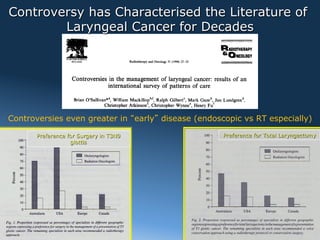
Controversy has Characterised the Literature of
        Laryngeal Cancer for Decades


Controversies even greater in early disease (endoscopic vs RT especially)

         Preference for Surgery in T3N0            Preference for Total Laryngectomy
                     glottis


  2012
Histology
       >95% SCC
        – Variations :
          •  verrucous carcinoma, spindle cell
           carcinoma, basaloid SCC, and
           papillary SCC
          •  hyperplasia, dysplasia, CIS
2012
2012
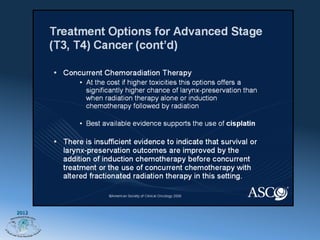
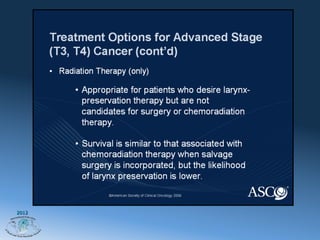
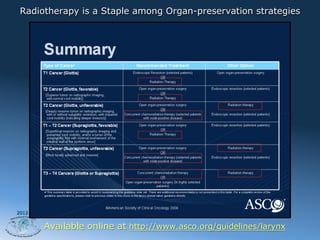
Radiotherapy is a Staple among Organ-preservation strategies


2012


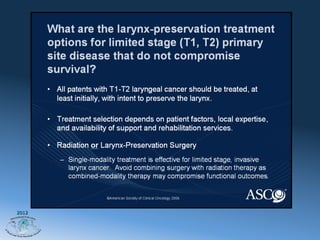
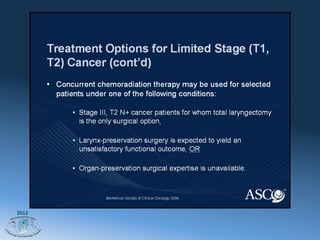
       Available online at http://www.asco.org/guidelines/larynx
Does Increasing Use of Radiotherapy Over 3
Decades Worsen the Outcome for Laryngeal
                 Cancer ?
       “A Population-Based Study of 13,808 US Patients”

•  Radiotherapy with its advantage of organ preservation
       has been used to treat laryngeal cancer (LC) for
       several decades.

•  Authors studied 3 periods:

       –  1988 - 1993, 1994 - 1999, 2000 – 2006

•  Conclusion: No negative impact of radiotherapy on
       cancer survival of glottic or supraglottic larynx cancer
2012


                                             Zhang, H., Travis, L. B., Chen, R., et al
                                          Cancer 118 (5) 1276–1287, 1 March 2012
2012
General Philosophy of laryngeal preservation
     in management of laryngeal cancer

       •  Major local modalities:
         –  Surgery and/or radiotherapy
       •  Treatment choice depends on:
         –  stage, and tumor volume and extension
         –  laryngeal tumor location: anterior commissure
            and subglottic involvement
         –  Patient factors: co-morbidity, smoking, male
            gender, and anemia
         –  likelihood of functional preservation,
         –  patient preference
2012
Regional Spread in Laryngeal Cancer
       •  Except for glottic T1, and some early T2s

       •  Regional lymph nodes must be accounted for:
          –  Midline nature – bilateral involvement is possible and treatment
            must address

          –  Levels II, III, IV are at risk

          –  Risk is increased by size, stage, supraglottic, tumor differentiation

       •  Influences the radiation volumes used

       •  Meticulous attention to post treatment imaging 8-12 weeks
         after completion of radiotherapy is essential to safeguard
         against uncontrolled disease that may be avoided by neck
2012
         dissection.
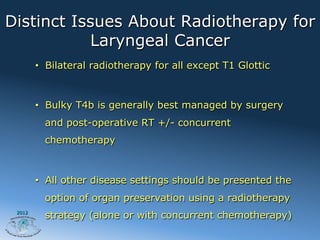
Distinct Issues About Radiotherapy for
           Laryngeal Cancer
        •  Bilateral radiotherapy for all except T1 Glottic


        •  Bulky T4b is generally best managed by surgery
          and post-operative RT +/- concurrent
          chemotherapy


        •  All other disease settings should be presented the
          option of organ preservation using a radiotherapy
 2012
          strategy (alone or with concurrent chemotherapy)
2012
2012
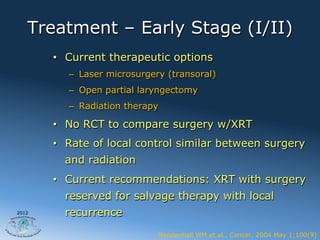
Treatment – Early Stage (I/II)
       •  Current therapeutic options
          –  Laser microsurgery (transoral)
          –  Open partial laryngectomy
          –  Radiation therapy

       •  No RCT to compare surgery w/XRT
       •  Rate of local control similar between surgery
         and radiation
       •  Current recommendations: XRT with surgery
         reserved for salvage therapy with local
2012     recurrence
                             Mendenhall WM et al., Cancer. 2004 May 1;100(9)
Randomized
trials
recommended to
resolve these
controversies:
Need to consider
the challenges in
a disease with so
few events.


    2012
Radiotherapy of T1 Glottic Cancer (1)

  •  Traditionally one of the most straightforward
       techniques in radiation oncology
       –  Small volume

       –  Reproducible anatomy

       –  Regional nodes do not need to be considered

  •  Emerging evidence that IMRT with contralateral
       carotid preservation may be possible
2012
Radiotherapy of T1 Glottic Cancer (2)
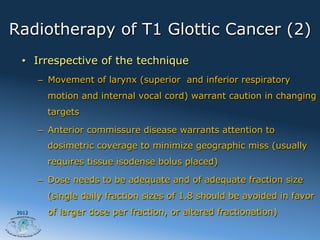
 •  Irrespective of the technique
       –  Movement of larynx (superior and inferior respiratory
         motion and internal vocal cord) warrant caution in changing
         targets

       –  Anterior commissure disease warrants attention to
         dosimetric coverage to minimize geographic miss (usually
         requires tissue isodense bolus placed)

       –  Dose needs to be adequate and of adequate fraction size
         (single daily fraction sizes of 1.8 should be avoided in favor
2012     of larger dose per fraction, or altered fractionation)
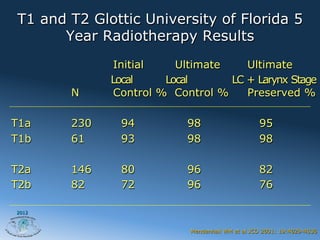
T1 and T2 Glottic University of Florida 5
      Year Radiotherapy Results
              Initial    Ultimate    Ultimate
             Local     Local      LC + Larynx Stage
       N      Control % Control %    Preserved %

T1a    230    94           98                    95
T1b    61     93           98                    98

T2a    146    80           96                    82
T2b    82     72           96                    76

2012


                           Mendenhall WM et al JCO 2001: 19:4029-4036
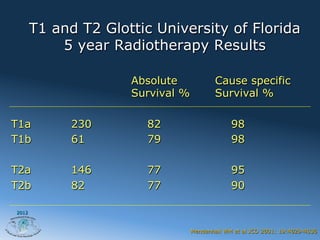
T1 and T2 Glottic University of Florida
           5 year Radiotherapy Results

                     Absolute             Cause specific
                     Survival %           Survival %

T1a          230        82                     98
T1b          61         79                     98

T2a          146        77                     95
T2b          82         77                     90

2012


                                  Mendenhall WM et al JCO 2001: 19:4029-4036
Dose Fractionation in Early Disease
       •  Yu et al., 1997 [1]
         –  Retrospective study – 5 yr local ctr rate of XRT on T1
           glottic CA
         –  Daily fx > 2 Gy (50 Gy/2.5Gy QD & 65.25Gy/2.25 Gy QD)
           had 5 yr local ctr rate of 84%
         –  Daily fx = 2 Gy had 5 yr local ctr 65.6%

       •  Yamazaki et al., 2006 [2]
         –  RTC – in T1 glottic CA addressing dose per fraction

       •  Andy Trotti et al, RTOG 95-12 – closed [3]
         –  Randomized pts with T2 glottic cancer to 70Gy/2Gy QD vs
           79.2 Gy/1.2 Gy BID
2012
                                   1  Yu E. et al., Int J Radiat Oncol Biol Phys. 1997 Feb 1;37(3):587-91
                              2   Yamazaki H et al., Int J Radiat Oncol Biol Phys. 2006 Jan 1;64(1):77-82
                     3 Trotti A, IJRBOP Volume 66, Issue 3, Supplement 1, 1 November 2006, Page S15
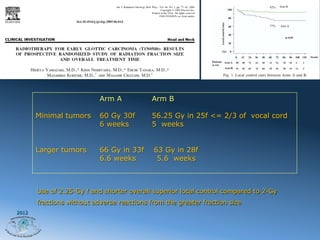
Arm A            Arm B

       Minimal tumors      60 Gy 30f        56.25 Gy in 25f <= 2/3 of vocal cord
                           6 weeks          5 weeks


       Larger tumors       66 Gy in 33f     63 Gy in 28f
                           6.6 weeks         5.6 weeks


       Use of 2.25-Gy f and shorter overall superior local control compared to 2-Gy
       fractions without adverse reactions from the greater fraction size
2012
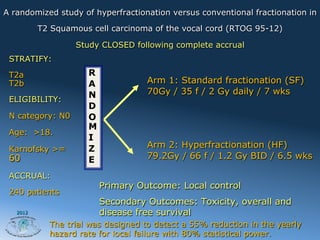
A randomized study of hyperfractionation versus conventional fractionation in

          T2 Squamous cell carcinoma of the vocal cord (RTOG 95-12)

                  Study CLOSED following complete accrual
 STRATIFY:

 T2a                 R
 T2b                 A              Arm 1: Standard fractionation (SF)
                     N              70Gy / 35 f / 2 Gy daily / 7 wks
 ELIGIBILITY:
                     D
 N category: N0      O
                     M
 Age: >18.
                     I
 Karnofsky >=        Z              Arm 2: Hyperfractionation (HF)
 60                  E              79.2Gy / 66 f / 1.2 Gy BID / 6.5 wks

 ACCRUAL:
                         Primary Outcome: Local control
 240 patients
                         Secondary Outcomes: Toxicity, overall and
   2012                  disease free survival
            The trial was designed to detect a 55% reduction in the yearly
            hazard rate for local failure with 80% statistical power.
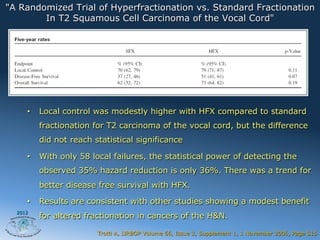
"A Randomized Trial of Hyperfractionation vs. Standard Fractionation
        In T2 Squamous Cell Carcinoma of the Vocal Cord"


     •    Local control was modestly higher with HFX compared to standard
          fractionation for T2 carcinoma of the vocal cord, but the difference
          did not reach statistical significance

     •    With only 58 local failures, the statistical power of detecting the
          observed 35% hazard reduction is only 36%. There was a trend for
          better disease free survival with HFX.

     •    Results are consistent with other studies showing a modest benefit
  2012
          for altered fractionation in cancers of the H&N.

                         Trotti A, IJRBOP Volume 66, Issue 3, Supplement 1, 1 November 2006, Page S15
IMRT for Early Glottic Cancer
       •  Pros
           –  Potential normal tissue sparing:
           –  Carotid arteries
           –  Potential reduction in the incidence of
              CVA
       •  Cons
           –  Results with IMRT uncertain
           –  Good results with conventional planning
           –  Severe complications rare
2012
           –  Target miss with IMRT
                     Albert Tiong, Waldron J, O Sullivan B et al
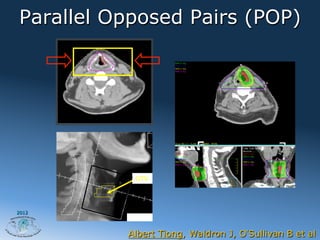
Parallel Opposed Pairs (POP)


           GTV


2012


          Albert Tiong, Waldron J, O Sullivan B et al
Radiotherapy Technique (IMRT)


        Cord

           PRV


          PTV


         CTV

 2012
2012
2012
2012
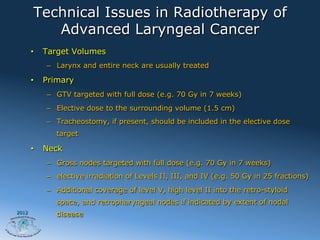
Technical Issues in Radiotherapy of
           Advanced Laryngeal Cancer
       •    Target Volumes
            –  Larynx and entire neck are usually treated

       •    Primary
            –  GTV targeted with full dose (e.g. 70 Gy in 7 weeks)
            –  Elective dose to the surrounding volume (1.5 cm)
            –  Tracheostomy, if present, should be included in the elective dose
               target

       •    Neck
            –  Gross nodes targeted with full dose (e.g. 70 Gy in 7 weeks)
            –  elective irradiation of Levels II, III, and IV (e.g. 50 Gy in 25 fractions)
            –  Additional coverage of level V, high level II into the retro-styloid
               space, and retropharyngeal nodes if indicated by extent of nodal
2012
               disease
Landmark Studies: Laryngeal Preservation
  in Locally Advanced Laryngeal Cancer

        •  The Department of Veterans Affairs
         Laryngeal Cancer Study Group (1991)

        •  The European Organization for Research
         and Treatment of Cancer (1996)

        •  Radiation Therapy Oncology Group 91-11
         (2003)
 2012


         Evaluation of place of standard radiotherapy with several strategies
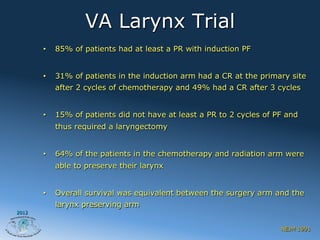
VA Larynx Trial
       •    85% of patients had at least a PR with induction PF


       •    31% of patients in the induction arm had a CR at the primary site
            after 2 cycles of chemotherapy and 49% had a CR after 3 cycles


       •    15% of patients did not have at least a PR to 2 cycles of PF and
            thus required a laryngectomy


       •    64% of the patients in the chemotherapy and radiation arm were
            able to preserve their larynx


       •    Overall survival was equivalent between the surgery arm and the
            larynx preserving arm
2012


                                                                       NEJM 1991
Intergroup 91-11

  •  Built on questions raised by the VA
       study

  •  We can preserve the larynx but is
       chemotherapy plus radiation better
       than radiation alone?

  •  What about concurrent chemoradiation?
2012
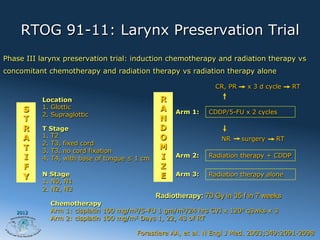
RTOG 91-11: Larynx Preservation Trial
Phase III larynx preservation trial: induction chemotherapy and radiation therapy vs
concomitant chemotherapy and radiation therapy vs radiation therapy alone

                                                                CR, PR    x 3 d cycle    RT

          Location                             R
     S    1. Glottic                           A
          2. Supraglottic                           Arm 1:    CDDP/5-FU x 2 cycles
     T                                         N
     R    T Stage                              D
     A    1. T2                                O                 NR      surgery   RT
          2. T3, fixed cord
     T    3. T3, no cord fixation
                                               M
     I    4. T4, with base of tongue ≤ 1 cm    I    Arm 2:    Radiation therapy + CDDP
     F                                         Z
     Y    N Stage                              E    Arm 3:    Radiation therapy alone
          1. N0, N1
          2. N2, N3
                                              Radiotherapy: 70 Gy in 35 f in 7 weeks
             Chemotherapy
   2012      Arm 1: cisplatin 100 mg/m2/5-FU 1 gm/m2/24 hrs CVI x 120o q3wks x 3
             Arm 2: cisplatin 100 mg/m2 Days 1, 22, 43 of RT

                                       Forastiere AA, et al. N Engl J Med. 2003;349:2091-2098
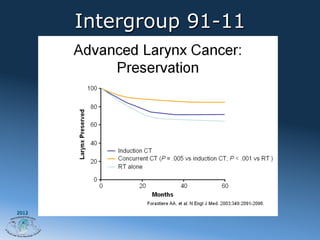
Intergroup 91-11


2012
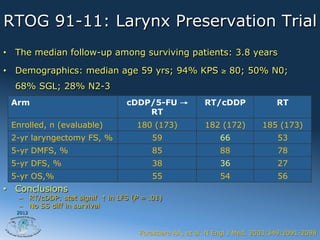
RTOG 91-11: Larynx Preservation Trial
•  The median follow-up among surviving patients: 3.8 years

•  Demographics: median age 59 yrs; 94% KPS ≥ 80; 50% N0;
  68% SGL; 28% N2-3
 Arm                              cDDP/5-FU →            RT/cDDP               RT
                                      RT
 Enrolled, n (evaluable)             180 (173)           182 (172)         185 (173)
 2-yr laryngectomy FS, %                  59                  66                53
 5-yr DMFS, %                             85                  88                78
 5-yr DFS, %                              38                  36                27
 5-yr OS,%                                55                  54                56
•  Conclusions
   –  RT/cDDP: stat signif ↑ in LFS (P = .01)
   –  No SS diff in survival
  2012


                                      Forastiere AA, et al. N Engl J Med. 2003;349:2091-2098
Intergroup 91-11
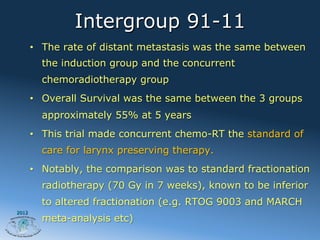
       •  The rate of distant metastasis was the same between
         the induction group and the concurrent
         chemoradiotherapy group
       •  Overall Survival was the same between the 3 groups
         approximately 55% at 5 years
       •  This trial made concurrent chemo-RT the standard of
         care for larynx preserving therapy.
       •  Notably, the comparison was to standard fractionation
         radiotherapy (70 Gy in 7 weeks), known to be inferior
         to altered fractionation (e.g. RTOG 9003 and MARCH
2012
         meta-analysis etc)
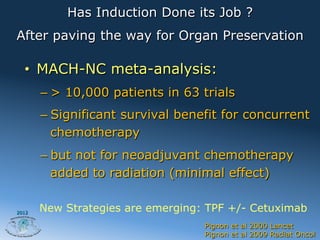
Has Induction Done its Job ?
After paving the way for Organ Preservation

  •  MACH-NC meta-analysis:
       –  > 10,000 patients in 63 trials
       –  Significant survival benefit for concurrent
          chemotherapy
       –  but not for neoadjuvant chemotherapy
          added to radiation (minimal effect)

2012
       New Strategies are emerging: TPF +/- Cetuximab
                                   Pignon et al 2000 Lancet
                                   Pignon et al 2009 Radiat Oncol
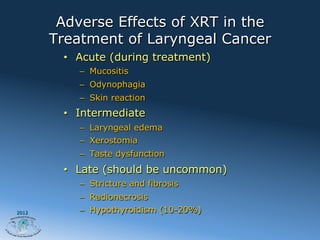
Adverse Effects of XRT in the
       Treatment of Laryngeal Cancer
        •  Acute (during treatment)
           –  Mucositis
           –  Odynophagia
           –  Skin reaction
        •  Intermediate
           –  Laryngeal edema
           –  Xerostomia
           –  Taste dysfunction
        •  Late (should be uncommon)
           –  Stricture and fibrosis
           –  Radionecrosis
2012       –  Hypothyroidism (10-20%)
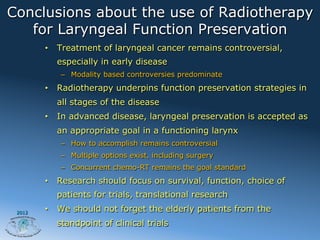
Conclusions about the use of Radiotherapy
   for Laryngeal Function Preservation
        •  Treatment of laryngeal cancer remains controversial,
          especially in early disease
           –  Modality based controversies predominate
        •  Radiotherapy underpins function preservation strategies in
          all stages of the disease
        •  In advanced disease, laryngeal preservation is accepted as
          an appropriate goal in a functioning larynx
           –  How to accomplish remains controversial
           –  Multiple options exist, including surgery
           –  Concurrent chemo-RT remains the goal standard
        •  Research should focus on survival, function, choice of
          patients for trials, translational research
 2012
        •  We should not forget the elderly patients from the
          standpoint of clinical trials

Radiation therapy for laryngeal function preservation by Brian O'Sullivan

  • 1.
    The International Federation of Head and Neck Oncologic Societies Current Concepts in Head and Neck Surgery and Oncology 2012 Radiation Therapy for Laryngeal Function Preservation Brian O Sullivan 1
  • 2.
    Controversy has Characterisedthe Literature of Laryngeal Cancer for Decades Controversies even greater in early disease (endoscopic vs RT especially) Preference for Surgery in T3N0 Preference for Total Laryngectomy glottis 2012
  • 3.
    Histology >95% SCC – Variations : •  verrucous carcinoma, spindle cell carcinoma, basaloid SCC, and papillary SCC •  hyperplasia, dysplasia, CIS 2012
  • 4.
  • 5.
    Radiotherapy is aStaple among Organ-preservation strategies 2012 Available online at http://www.asco.org/guidelines/larynx
  • 6.
    Does Increasing Useof Radiotherapy Over 3 Decades Worsen the Outcome for Laryngeal Cancer ? “A Population-Based Study of 13,808 US Patients” •  Radiotherapy with its advantage of organ preservation has been used to treat laryngeal cancer (LC) for several decades. •  Authors studied 3 periods: –  1988 - 1993, 1994 - 1999, 2000 – 2006 •  Conclusion: No negative impact of radiotherapy on cancer survival of glottic or supraglottic larynx cancer 2012 Zhang, H., Travis, L. B., Chen, R., et al Cancer 118 (5) 1276–1287, 1 March 2012
  • 7.
  • 8.
    General Philosophy oflaryngeal preservation in management of laryngeal cancer •  Major local modalities: –  Surgery and/or radiotherapy •  Treatment choice depends on: –  stage, and tumor volume and extension –  laryngeal tumor location: anterior commissure and subglottic involvement –  Patient factors: co-morbidity, smoking, male gender, and anemia –  likelihood of functional preservation, –  patient preference 2012
  • 9.
    Regional Spread inLaryngeal Cancer •  Except for glottic T1, and some early T2s •  Regional lymph nodes must be accounted for: –  Midline nature – bilateral involvement is possible and treatment must address –  Levels II, III, IV are at risk –  Risk is increased by size, stage, supraglottic, tumor differentiation •  Influences the radiation volumes used •  Meticulous attention to post treatment imaging 8-12 weeks after completion of radiotherapy is essential to safeguard against uncontrolled disease that may be avoided by neck 2012 dissection.
  • 10.
    Distinct Issues AboutRadiotherapy for Laryngeal Cancer •  Bilateral radiotherapy for all except T1 Glottic •  Bulky T4b is generally best managed by surgery and post-operative RT +/- concurrent chemotherapy •  All other disease settings should be presented the option of organ preservation using a radiotherapy 2012 strategy (alone or with concurrent chemotherapy)
  • 11.
  • 12.
  • 13.
    Treatment – EarlyStage (I/II) •  Current therapeutic options –  Laser microsurgery (transoral) –  Open partial laryngectomy –  Radiation therapy •  No RCT to compare surgery w/XRT •  Rate of local control similar between surgery and radiation •  Current recommendations: XRT with surgery reserved for salvage therapy with local 2012 recurrence Mendenhall WM et al., Cancer. 2004 May 1;100(9)
  • 14.
    Randomized trials recommended to resolve these controversies: Needto consider the challenges in a disease with so few events. 2012
  • 15.
    Radiotherapy of T1Glottic Cancer (1) •  Traditionally one of the most straightforward techniques in radiation oncology –  Small volume –  Reproducible anatomy –  Regional nodes do not need to be considered •  Emerging evidence that IMRT with contralateral carotid preservation may be possible 2012
  • 16.
    Radiotherapy of T1Glottic Cancer (2) •  Irrespective of the technique –  Movement of larynx (superior and inferior respiratory motion and internal vocal cord) warrant caution in changing targets –  Anterior commissure disease warrants attention to dosimetric coverage to minimize geographic miss (usually requires tissue isodense bolus placed) –  Dose needs to be adequate and of adequate fraction size (single daily fraction sizes of 1.8 should be avoided in favor 2012 of larger dose per fraction, or altered fractionation)
  • 17.
    T1 and T2Glottic University of Florida 5 Year Radiotherapy Results Initial Ultimate Ultimate Local Local LC + Larynx Stage N Control % Control % Preserved % T1a 230 94 98 95 T1b 61 93 98 98 T2a 146 80 96 82 T2b 82 72 96 76 2012 Mendenhall WM et al JCO 2001: 19:4029-4036
  • 18.
    T1 and T2Glottic University of Florida 5 year Radiotherapy Results Absolute Cause specific Survival % Survival % T1a 230 82 98 T1b 61 79 98 T2a 146 77 95 T2b 82 77 90 2012 Mendenhall WM et al JCO 2001: 19:4029-4036
  • 19.
    Dose Fractionation inEarly Disease •  Yu et al., 1997 [1] –  Retrospective study – 5 yr local ctr rate of XRT on T1 glottic CA –  Daily fx > 2 Gy (50 Gy/2.5Gy QD & 65.25Gy/2.25 Gy QD) had 5 yr local ctr rate of 84% –  Daily fx = 2 Gy had 5 yr local ctr 65.6% •  Yamazaki et al., 2006 [2] –  RTC – in T1 glottic CA addressing dose per fraction •  Andy Trotti et al, RTOG 95-12 – closed [3] –  Randomized pts with T2 glottic cancer to 70Gy/2Gy QD vs 79.2 Gy/1.2 Gy BID 2012 1 Yu E. et al., Int J Radiat Oncol Biol Phys. 1997 Feb 1;37(3):587-91 2 Yamazaki H et al., Int J Radiat Oncol Biol Phys. 2006 Jan 1;64(1):77-82 3 Trotti A, IJRBOP Volume 66, Issue 3, Supplement 1, 1 November 2006, Page S15
  • 20.
    Arm A Arm B Minimal tumors 60 Gy 30f 56.25 Gy in 25f <= 2/3 of vocal cord 6 weeks 5 weeks Larger tumors 66 Gy in 33f 63 Gy in 28f 6.6 weeks 5.6 weeks Use of 2.25-Gy f and shorter overall superior local control compared to 2-Gy fractions without adverse reactions from the greater fraction size 2012
  • 21.
    A randomized studyof hyperfractionation versus conventional fractionation in T2 Squamous cell carcinoma of the vocal cord (RTOG 95-12) Study CLOSED following complete accrual STRATIFY: T2a R T2b A Arm 1: Standard fractionation (SF) N 70Gy / 35 f / 2 Gy daily / 7 wks ELIGIBILITY: D N category: N0 O M Age: >18. I Karnofsky >= Z Arm 2: Hyperfractionation (HF) 60 E 79.2Gy / 66 f / 1.2 Gy BID / 6.5 wks ACCRUAL: Primary Outcome: Local control 240 patients Secondary Outcomes: Toxicity, overall and 2012 disease free survival The trial was designed to detect a 55% reduction in the yearly hazard rate for local failure with 80% statistical power.
  • 22.
    "A Randomized Trialof Hyperfractionation vs. Standard Fractionation In T2 Squamous Cell Carcinoma of the Vocal Cord" •  Local control was modestly higher with HFX compared to standard fractionation for T2 carcinoma of the vocal cord, but the difference did not reach statistical significance •  With only 58 local failures, the statistical power of detecting the observed 35% hazard reduction is only 36%. There was a trend for better disease free survival with HFX. •  Results are consistent with other studies showing a modest benefit 2012 for altered fractionation in cancers of the H&N. Trotti A, IJRBOP Volume 66, Issue 3, Supplement 1, 1 November 2006, Page S15
  • 23.
    IMRT for EarlyGlottic Cancer •  Pros –  Potential normal tissue sparing: –  Carotid arteries –  Potential reduction in the incidence of CVA •  Cons –  Results with IMRT uncertain –  Good results with conventional planning –  Severe complications rare 2012 –  Target miss with IMRT Albert Tiong, Waldron J, O Sullivan B et al
  • 24.
    Parallel Opposed Pairs(POP) GTV 2012 Albert Tiong, Waldron J, O Sullivan B et al
  • 25.
    Radiotherapy Technique (IMRT) Cord PRV PTV CTV 2012
  • 26.
  • 27.
  • 28.
  • 29.
    Technical Issues inRadiotherapy of Advanced Laryngeal Cancer •  Target Volumes –  Larynx and entire neck are usually treated •  Primary –  GTV targeted with full dose (e.g. 70 Gy in 7 weeks) –  Elective dose to the surrounding volume (1.5 cm) –  Tracheostomy, if present, should be included in the elective dose target •  Neck –  Gross nodes targeted with full dose (e.g. 70 Gy in 7 weeks) –  elective irradiation of Levels II, III, and IV (e.g. 50 Gy in 25 fractions) –  Additional coverage of level V, high level II into the retro-styloid space, and retropharyngeal nodes if indicated by extent of nodal 2012 disease
  • 30.
    Landmark Studies: LaryngealPreservation in Locally Advanced Laryngeal Cancer •  The Department of Veterans Affairs Laryngeal Cancer Study Group (1991) •  The European Organization for Research and Treatment of Cancer (1996) •  Radiation Therapy Oncology Group 91-11 (2003) 2012 Evaluation of place of standard radiotherapy with several strategies
  • 31.
    VA Larynx Trial •  85% of patients had at least a PR with induction PF •  31% of patients in the induction arm had a CR at the primary site after 2 cycles of chemotherapy and 49% had a CR after 3 cycles •  15% of patients did not have at least a PR to 2 cycles of PF and thus required a laryngectomy •  64% of the patients in the chemotherapy and radiation arm were able to preserve their larynx •  Overall survival was equivalent between the surgery arm and the larynx preserving arm 2012 NEJM 1991
  • 32.
    Intergroup 91-11 •  Built on questions raised by the VA study •  We can preserve the larynx but is chemotherapy plus radiation better than radiation alone? •  What about concurrent chemoradiation? 2012
  • 33.
    RTOG 91-11: LarynxPreservation Trial Phase III larynx preservation trial: induction chemotherapy and radiation therapy vs concomitant chemotherapy and radiation therapy vs radiation therapy alone CR, PR x 3 d cycle RT Location R S 1. Glottic A 2. Supraglottic Arm 1: CDDP/5-FU x 2 cycles T N R T Stage D A 1. T2 O NR surgery RT 2. T3, fixed cord T 3. T3, no cord fixation M I 4. T4, with base of tongue ≤ 1 cm I Arm 2: Radiation therapy + CDDP F Z Y N Stage E Arm 3: Radiation therapy alone 1. N0, N1 2. N2, N3 Radiotherapy: 70 Gy in 35 f in 7 weeks Chemotherapy 2012 Arm 1: cisplatin 100 mg/m2/5-FU 1 gm/m2/24 hrs CVI x 120o q3wks x 3 Arm 2: cisplatin 100 mg/m2 Days 1, 22, 43 of RT Forastiere AA, et al. N Engl J Med. 2003;349:2091-2098
  • 34.
  • 35.
    RTOG 91-11: LarynxPreservation Trial •  The median follow-up among surviving patients: 3.8 years •  Demographics: median age 59 yrs; 94% KPS ≥ 80; 50% N0; 68% SGL; 28% N2-3 Arm cDDP/5-FU → RT/cDDP RT RT Enrolled, n (evaluable) 180 (173) 182 (172) 185 (173) 2-yr laryngectomy FS, % 59 66 53 5-yr DMFS, % 85 88 78 5-yr DFS, % 38 36 27 5-yr OS,% 55 54 56 •  Conclusions –  RT/cDDP: stat signif ↑ in LFS (P = .01) –  No SS diff in survival 2012 Forastiere AA, et al. N Engl J Med. 2003;349:2091-2098
  • 36.
    Intergroup 91-11 •  The rate of distant metastasis was the same between the induction group and the concurrent chemoradiotherapy group •  Overall Survival was the same between the 3 groups approximately 55% at 5 years •  This trial made concurrent chemo-RT the standard of care for larynx preserving therapy. •  Notably, the comparison was to standard fractionation radiotherapy (70 Gy in 7 weeks), known to be inferior to altered fractionation (e.g. RTOG 9003 and MARCH 2012 meta-analysis etc)
  • 37.
    Has Induction Doneits Job ? After paving the way for Organ Preservation •  MACH-NC meta-analysis: –  > 10,000 patients in 63 trials –  Significant survival benefit for concurrent chemotherapy –  but not for neoadjuvant chemotherapy added to radiation (minimal effect) 2012 New Strategies are emerging: TPF +/- Cetuximab Pignon et al 2000 Lancet Pignon et al 2009 Radiat Oncol
  • 38.
    Adverse Effects ofXRT in the Treatment of Laryngeal Cancer •  Acute (during treatment) –  Mucositis –  Odynophagia –  Skin reaction •  Intermediate –  Laryngeal edema –  Xerostomia –  Taste dysfunction •  Late (should be uncommon) –  Stricture and fibrosis –  Radionecrosis 2012 –  Hypothyroidism (10-20%)
  • 39.
    Conclusions about theuse of Radiotherapy for Laryngeal Function Preservation •  Treatment of laryngeal cancer remains controversial, especially in early disease –  Modality based controversies predominate •  Radiotherapy underpins function preservation strategies in all stages of the disease •  In advanced disease, laryngeal preservation is accepted as an appropriate goal in a functioning larynx –  How to accomplish remains controversial –  Multiple options exist, including surgery –  Concurrent chemo-RT remains the goal standard •  Research should focus on survival, function, choice of patients for trials, translational research 2012 •  We should not forget the elderly patients from the standpoint of clinical trials