Small cell lung cancer Dr C Faivre-Finn Manchester Lung Cancer Group Manchester Radiation Related Research Group 10 th  ESO-ESMO Masterclass 6 th  April 2011 Manchester Lung Cancer Group
‘ Progress in the therapy of SCLC has been painfully slow’. In fact you could argue that little or no therapeutic advances have been made for extensive- stage SCLC in more than 20 years’ Gandara and Lara. J Clin Oncol 2008; 26: 4236-38
Facts Incidence of SCLC is declining-less than 10-15% of all lung cancer cases  Govindan JCO 2006   One third present with limited stage disease Excellent responses to CT and RT but few patients will be long term survivors High risk of local relapse High risk of distant spread (brain)
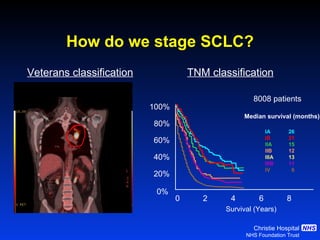
How do we stage SCLC? Veterans classification TNM classification 0 2 4 6 8 Survival (Years) 0% 20% 40% 60% 80% 100% IA IB IIA IIB IIIA IIIB IV 26 21 15 12 13 11 6 Median survival (months) 8008 patients
CHEMOTHERAPY Platinum-etoposide  is the standard CT regime for the treatment of SCLC
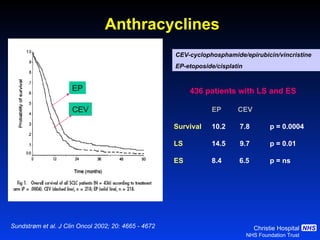
Anthracyclines Sundstr øm et al. J Clin Oncol 2002; 20: 4665 - 4672 436 patients with LS and ES   EP CEV Survival   10.2  7.8 p = 0.0004 LS   14.5  9.7 p = 0.01 ES   8.4  6.5  p = ns EP CEV CEV-cyclophosphamide/epirubicin/vincristine  EP-etoposide/cisplatin
Platinum vs non-Platinum 21 trials extensive stage SCLC cisplatin  vs no cisplatin median survival 9.5 vs 7.1 months, p = 0.002 cisplatin based therapy independent predictor of survival p = 0.04 Chute et al, J Clin Oncol 1999 Meta-analysis 19 trials 4054 pts cisplatin  vs no cisplatin Cisplatin - 4.4% survival benefit at 1 year   Pujol et al Br J Cancer 2000 Cochrane meta-analysis 2008 29 trials, 5530 patients No difference in 6, 12 or 24 month survival No difference OR rate Higher CR rate for platinum Higher toxicity rates with platinum Amarasena et al.  Cochrane Library 2009
Carboplatin A reasonable alternative to cisplatin in patients with poor prognostic factors Less toxicity compared to cisplatin Median survival with cispatin-etoposide is comparable to  with carboplatin-etoposide in ES patients. Toxicity was significantly less for carboplatin arm. Study not powered for equivalence Skarlos et al.  Ann Oncol 1994
Cisplatin is the best radiosensitiser Cisplatin plays a major role in the treatment of LS-SCLC EP can be delivered at full dose with thoracic RT with an acceptable toxicity profile CTRT combinations
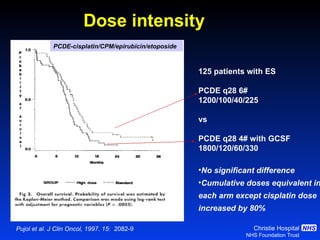
Pujol et al. J Clin Oncol, 1997. 15:  2082-9 125 patients with ES PCDE q28 6# 1200/100/40/225 vs PCDE q28 4# with GCSF 1800/120/60/330 No significant difference Cumulative doses equivalent in  each arm except cisplatin dose  increased by 80% Dose intensity PCDE-cisplatin/CPM/epirubicin/etoposide
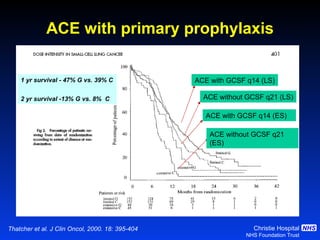
ACE with primary prophylaxis Thatcher et al. J Clin Oncol, 2000. 18: 395-404 ACE with GCSF q14 (LS) ACE without GCSF q21 (LS) ACE with GCSF q14 (ES)  ACE without GCSF q21 (ES) 1 yr survival - 47% G vs. 39% C  2 yr survival -13% G vs. 8%  C
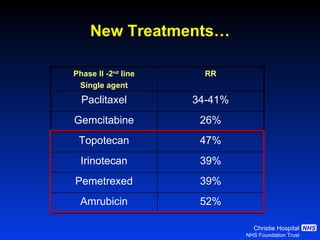
New Treatments… 47% Topotecan RR Phase II -2 nd  line Single agent 52% Amrubicin 39% Pemetrexed 39% Irinotecan 26% Gemcitabine 34-41% Paclitaxel
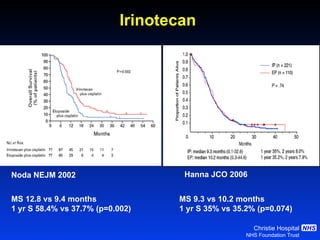
Irinotecan  Noda NEJM 2002 Hanna JCO 2006 MS 12.8 vs 9.4 months 1 yr S 58.4% vs 37.7% (p=0.002) MS 9.3 vs 10.2 months  1 yr S 35% vs 35.2% (p=0.074)
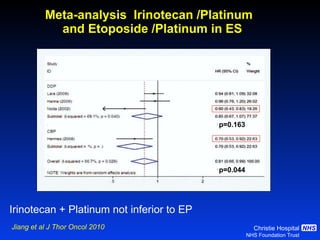
Meta-analysis  Irinotecan /Platinum   and Etoposide /Platinum in ES Jiang et al J Thor Oncol 2010 Irinotecan + Platinum not inferior to EP   p=0.044 p=0.163
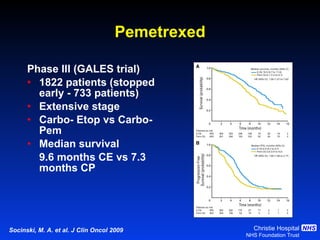
Pemetrexed Phase III (GALES trial) 1822 patients (stopped early -  733 patients) Extensive stage Carbo- Etop vs Carbo-Pem Median survival  9.6 months CE vs 7.3 months CP Socinski, M. A. et al. J Clin Oncol 2009
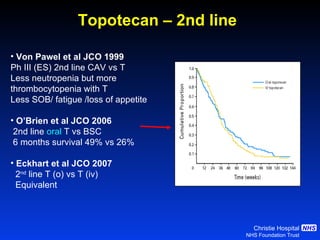
Topotecan – 2nd line Von Pawel et al JCO 1999  Ph III (ES) 2nd line CAV vs T  Less neutropenia but more thrombocytopenia with T Less SOB/ fatigue /loss of appetite   O’Brien et al JCO 2006 2 nd line  oral   T vs BSC 6 months survival 49% vs 26% Eckhart et al JCO 2007 2 nd  line  T (o) vs T (iv) Equivalent
Amrubicin Two phase II second line studies have demontrated encouraging survival rates A number of phase III studies are ongoing to evaluate this treatment in the first and second line setting
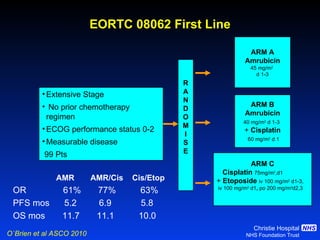
EORTC 08062 First Line Extensive Stage No prior chemotherapy regimen ECOG performance status 0-2 Measurable disease 99 Pts R A N D O M I S E O`Brien et al ASCO 2010   AMR   AMR/Cis  Cis/Etop OR  61%  77%  63% PFS mos  5.2   6.9  5.8 OS mos  11.7  11.1  10.0 ARM A Amrubicin 45 mg/m 2   d 1-3 ARM B Amrubicin 40 mg/m 2  d 1-3   +  Cisplatin 60 mg/m 2  d 1 ARM C Cisplatin  75mg/m 2 ,d1 +  Etoposide   iv 100   mg/m 2   d1-3, iv 100   mg/m 2   d1 ,  po 200   mg/m 2 d2,3
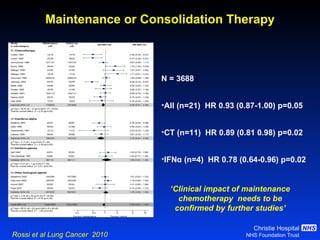
Maintenance or Consolidation Therapy Rossi et al Lung Cancer  2010 N = 3688 All (n=21)  HR 0.93 (0.87-1.00) p=0.05 CT (n=11)  HR 0.89 (0.81 0.98) p=0.02  IFN α  (n=4)  HR 0.78 (0.64-0.96) p=0.02 ‘ Clinical impact of maintenance chemotherapy  needs to be confirmed by further studies’
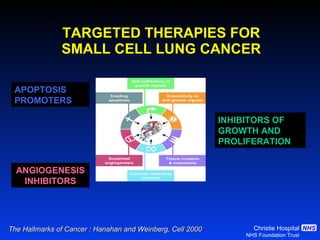
TARGETED THERAPIES FOR SMALL CELL LUNG CANCER The Hallmarks of Cancer : Hanahan and Weinberg, Cell 2000 ANGIOGENESIS INHIBITORS INHIBITORS OF GROWTH AND PROLIFERATION  APOPTOSIS PROMOTERS
Conclusions High RR with  chemotherapy BUT high rates of local and distant relapses Many newer combinations as good, but none convincingly better PE is the standard treatment in SCLC Disappointing results so far with targeted therapies  The way forward - a better understanding of the biology of the disease in order to develop more effective therapies
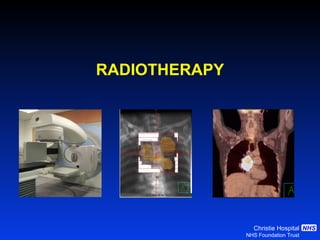
RADIOTHERAPY
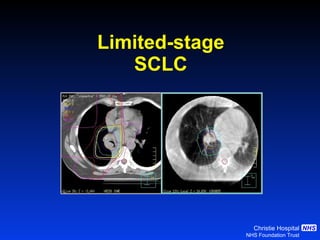
Limited-stage SCLC
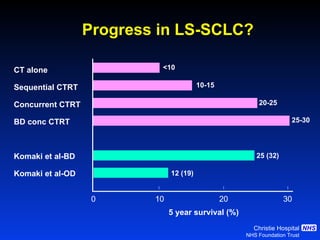
Progress in LS-SCLC?  CT alone Sequential CTRT Concurrent CTRT BD conc CTRT Komaki et al-BD Komaki et al-OD 0 10 20 30 5 year survival (%) <10 10-15 20-25 25-30 25 (32) 12 (19)
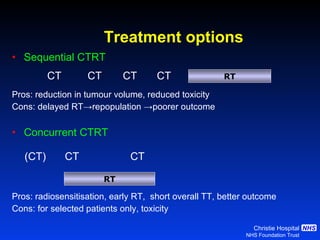
Treatment options Sequential CTRT   Pros: reduction in tumour volume, reduced toxicity Cons: delayed RT -> repopulation  ->poorer outcome Concurrent CTRT Pros: radiosensitisation, early RT,  short overall TT, better outcome Cons: for selected patients only, toxicity RT CT CT CT CT CT RT CT (CT)
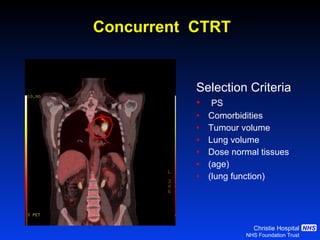
Concurrent  CTRT Selection Crit eria PS Comorbidities Tumour volume  Lung volume Dose normal tissues (age) (lung function)
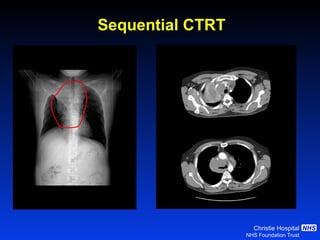
Sequential CTRT
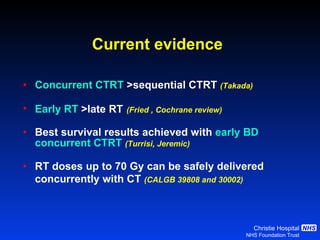
Current evidence Concurrent CTRT   >sequential CTRT  (Takada) Early RT   >late RT   (Fried , Cochrane review) Best survival results achieved with  early BD   concurrent CTRT   (Turrisi, Jeremic) RT doses up to 70 Gy can be safely delivered  concurrently with CT  (CALGB 39808 and 30002)
Timing of thoracic RT with chemotherapy J Clin Oncol. 2004;22:4837-45   7 RCTs Advantage of early (<9 weeks) radiotherapy 2 yr % NNT for benefit P All (1524) Platinum Platinum+ HART +5.2 [0.6-9.7] 20 0.03 +9.8 [3.8-15.9] 10 0.001 +16.7 [9.4-26] 6 0.001
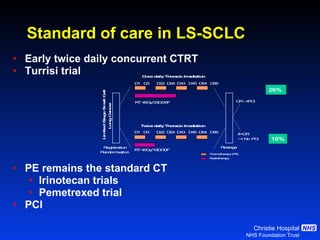
Standard of care in LS-SCLC Early twice daily concurrent CTRT Turrisi trial PE remains the standard CT  Irinotecan trials Pemetrexed trial PCI
Establish a  standard regimen in LS-SCLC Toxicity and outcome data with modern RT techniques   Importance of  the  RT dose ? the  overall treatment time ? Translational research  Why CONVERT
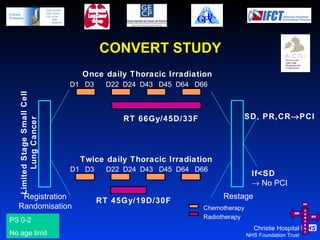
Once daily Thoracic Irradiation D1  D3   D22  D24  D43  D45  D64  D66   RT 66Gy/45D/33F Twice daily Thoracic Irradiation D1  D3   D22  D24  D43  D45  D64  D66 RT 45Gy/19D/30F Limited Stage Small Cell Lung Cancer SD, PR,CR  PCI If<SD    No PCI Registration Randomisation Restage Chemotherapy Radiotherapy CONVERT STUDY PS 0-2 No age limit Manchester Lung Cancer Group
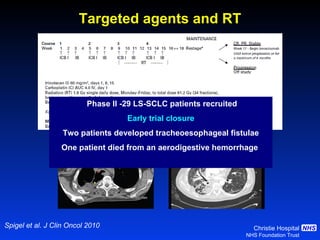
Targeted agents and RT Spigel et al. J Clin Oncol 2010 Phase II -29 LS-SCLC patients recruited Early trial closure Two patients developed tracheoesophageal fistulae One patient died from an aerodigestive hemorrhage
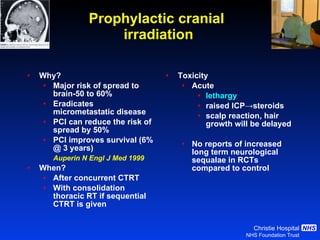
Prophylactic cranial  irradiation Why? Major risk of spread to brain-50 to 60% Eradicates micrometastatic disease  PCI can reduce the risk of spread by 50% PCI improves survival (6% @ 3 years) Auperin N Engl J Med 1999 When? After concurrent CTRT With consolidation thoracic RT if sequential CTRT is given Toxicity Acute lethargy raised ICP ->steroids scalp reaction, hair growth will be delayed No reports of increased long term neurological sequalae in RCTs  compared to control
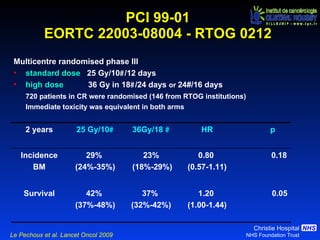
PCI 99-01 EORTC 22003-08004 - RTOG  0212     Le Pechoux et al. Lancet Oncol 2009 Multicentre randomised phase III standard dose   25 Gy/10  /12 days high dose   36 Gy in 18  /24 days  or  24#/16 days 720 patients in CR were randomised (146 from RTOG institutions) Immediate toxicity was equivalent in both arms 0.05 1.20  (1.00-1.44) 37%  (32%-42%) 42%  (37%-48%) Survival 0.18 0.80  (0.57-1.11) 23% (18%-29%) 29%  (24%-35%) Incidence BM p HR 36Gy/18   25 Gy/10  2 years
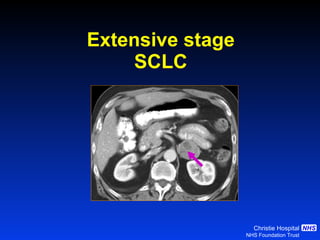
Extensive stage SCLC
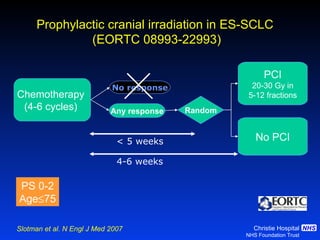
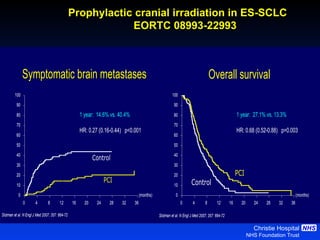
Prophylactic cranial irradiation in ES-SCLC  (EORTC 08993-22993) PCI 20-30 Gy in 5-12 fractions No PCI Random Any response PS 0-2 Age  75 < 5 weeks 4-6 weeks No response Chemotherapy (4-6 cycles) Slotman et al. N Engl J Med 2007
Prophylactic cranial irradiation in ES-SCLC  EORTC 08993-22993
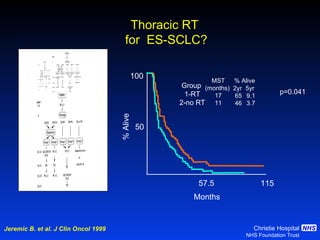
Jeremic B. et al. J Clin Oncol 1999 100 50 57.5 115 Months p=0.041 Group  1-RT 2-no RT MST (months)  17 11 2yr  65 46 5yr  9.1 3.7 % Alive % Alive Thoracic RT  for  ES-SCLC?
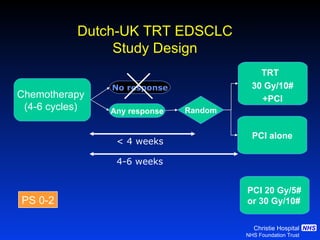
Dutch-UK TRT EDSCLC Study Design PCI alone Random Any response PS 0-2 < 4 weeks 4-6 weeks No response Chemotherapy (4-6 cycles) PCI 20 Gy/5# or 30 Gy/10# TRT  30 Gy/10# +PCI
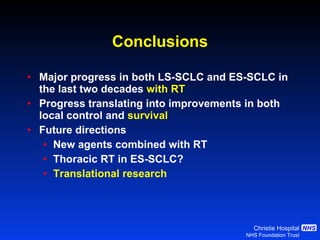
Conclusions Major progress in both LS-SCLC and ES-SCLC in the last two decades  with RT Progress translating into improvements in both local control and  survival Future directions New agents combined with RT Thoracic RT in ES-SCLC? Translational research

MCO 2011 - Slide 28 - C. Faivre-Finn - SCLC

  • 1.
    Small cell lungcancer Dr C Faivre-Finn Manchester Lung Cancer Group Manchester Radiation Related Research Group 10 th ESO-ESMO Masterclass 6 th April 2011 Manchester Lung Cancer Group
  • 2.
    ‘ Progress inthe therapy of SCLC has been painfully slow’. In fact you could argue that little or no therapeutic advances have been made for extensive- stage SCLC in more than 20 years’ Gandara and Lara. J Clin Oncol 2008; 26: 4236-38
  • 3.
    Facts Incidence ofSCLC is declining-less than 10-15% of all lung cancer cases Govindan JCO 2006 One third present with limited stage disease Excellent responses to CT and RT but few patients will be long term survivors High risk of local relapse High risk of distant spread (brain)
  • 4.
    How do westage SCLC? Veterans classification TNM classification 0 2 4 6 8 Survival (Years) 0% 20% 40% 60% 80% 100% IA IB IIA IIB IIIA IIIB IV 26 21 15 12 13 11 6 Median survival (months) 8008 patients
  • 5.
    CHEMOTHERAPY Platinum-etoposide is the standard CT regime for the treatment of SCLC
  • 6.
    Anthracyclines Sundstr ømet al. J Clin Oncol 2002; 20: 4665 - 4672 436 patients with LS and ES EP CEV Survival 10.2 7.8 p = 0.0004 LS 14.5 9.7 p = 0.01 ES 8.4 6.5 p = ns EP CEV CEV-cyclophosphamide/epirubicin/vincristine EP-etoposide/cisplatin
  • 7.
    Platinum vs non-Platinum21 trials extensive stage SCLC cisplatin vs no cisplatin median survival 9.5 vs 7.1 months, p = 0.002 cisplatin based therapy independent predictor of survival p = 0.04 Chute et al, J Clin Oncol 1999 Meta-analysis 19 trials 4054 pts cisplatin vs no cisplatin Cisplatin - 4.4% survival benefit at 1 year Pujol et al Br J Cancer 2000 Cochrane meta-analysis 2008 29 trials, 5530 patients No difference in 6, 12 or 24 month survival No difference OR rate Higher CR rate for platinum Higher toxicity rates with platinum Amarasena et al. Cochrane Library 2009
  • 8.
    Carboplatin A reasonablealternative to cisplatin in patients with poor prognostic factors Less toxicity compared to cisplatin Median survival with cispatin-etoposide is comparable to with carboplatin-etoposide in ES patients. Toxicity was significantly less for carboplatin arm. Study not powered for equivalence Skarlos et al. Ann Oncol 1994
  • 9.
    Cisplatin is thebest radiosensitiser Cisplatin plays a major role in the treatment of LS-SCLC EP can be delivered at full dose with thoracic RT with an acceptable toxicity profile CTRT combinations
  • 10.
    Pujol et al.J Clin Oncol, 1997. 15: 2082-9 125 patients with ES PCDE q28 6# 1200/100/40/225 vs PCDE q28 4# with GCSF 1800/120/60/330 No significant difference Cumulative doses equivalent in each arm except cisplatin dose increased by 80% Dose intensity PCDE-cisplatin/CPM/epirubicin/etoposide
  • 11.
    ACE with primaryprophylaxis Thatcher et al. J Clin Oncol, 2000. 18: 395-404 ACE with GCSF q14 (LS) ACE without GCSF q21 (LS) ACE with GCSF q14 (ES) ACE without GCSF q21 (ES) 1 yr survival - 47% G vs. 39% C 2 yr survival -13% G vs. 8% C
  • 12.
    New Treatments… 47%Topotecan RR Phase II -2 nd line Single agent 52% Amrubicin 39% Pemetrexed 39% Irinotecan 26% Gemcitabine 34-41% Paclitaxel
  • 13.
    Irinotecan NodaNEJM 2002 Hanna JCO 2006 MS 12.8 vs 9.4 months 1 yr S 58.4% vs 37.7% (p=0.002) MS 9.3 vs 10.2 months 1 yr S 35% vs 35.2% (p=0.074)
  • 14.
    Meta-analysis Irinotecan/Platinum and Etoposide /Platinum in ES Jiang et al J Thor Oncol 2010 Irinotecan + Platinum not inferior to EP p=0.044 p=0.163
  • 15.
    Pemetrexed Phase III(GALES trial) 1822 patients (stopped early - 733 patients) Extensive stage Carbo- Etop vs Carbo-Pem Median survival 9.6 months CE vs 7.3 months CP Socinski, M. A. et al. J Clin Oncol 2009
  • 16.
    Topotecan – 2ndline Von Pawel et al JCO 1999 Ph III (ES) 2nd line CAV vs T Less neutropenia but more thrombocytopenia with T Less SOB/ fatigue /loss of appetite O’Brien et al JCO 2006 2 nd line oral T vs BSC 6 months survival 49% vs 26% Eckhart et al JCO 2007 2 nd line T (o) vs T (iv) Equivalent
  • 17.
    Amrubicin Two phaseII second line studies have demontrated encouraging survival rates A number of phase III studies are ongoing to evaluate this treatment in the first and second line setting
  • 18.
    EORTC 08062 FirstLine Extensive Stage No prior chemotherapy regimen ECOG performance status 0-2 Measurable disease 99 Pts R A N D O M I S E O`Brien et al ASCO 2010 AMR AMR/Cis Cis/Etop OR 61% 77% 63% PFS mos 5.2 6.9 5.8 OS mos 11.7 11.1 10.0 ARM A Amrubicin 45 mg/m 2 d 1-3 ARM B Amrubicin 40 mg/m 2 d 1-3 + Cisplatin 60 mg/m 2 d 1 ARM C Cisplatin 75mg/m 2 ,d1 + Etoposide iv 100 mg/m 2 d1-3, iv 100 mg/m 2 d1 , po 200 mg/m 2 d2,3
  • 19.
    Maintenance or ConsolidationTherapy Rossi et al Lung Cancer 2010 N = 3688 All (n=21) HR 0.93 (0.87-1.00) p=0.05 CT (n=11) HR 0.89 (0.81 0.98) p=0.02 IFN α (n=4) HR 0.78 (0.64-0.96) p=0.02 ‘ Clinical impact of maintenance chemotherapy needs to be confirmed by further studies’
  • 20.
    TARGETED THERAPIES FORSMALL CELL LUNG CANCER The Hallmarks of Cancer : Hanahan and Weinberg, Cell 2000 ANGIOGENESIS INHIBITORS INHIBITORS OF GROWTH AND PROLIFERATION APOPTOSIS PROMOTERS
  • 21.
    Conclusions High RRwith chemotherapy BUT high rates of local and distant relapses Many newer combinations as good, but none convincingly better PE is the standard treatment in SCLC Disappointing results so far with targeted therapies The way forward - a better understanding of the biology of the disease in order to develop more effective therapies
  • 22.
  • 23.
  • 24.
    Progress in LS-SCLC? CT alone Sequential CTRT Concurrent CTRT BD conc CTRT Komaki et al-BD Komaki et al-OD 0 10 20 30 5 year survival (%) <10 10-15 20-25 25-30 25 (32) 12 (19)
  • 25.
    Treatment options SequentialCTRT Pros: reduction in tumour volume, reduced toxicity Cons: delayed RT -> repopulation ->poorer outcome Concurrent CTRT Pros: radiosensitisation, early RT, short overall TT, better outcome Cons: for selected patients only, toxicity RT CT CT CT CT CT RT CT (CT)
  • 26.
    Concurrent CTRTSelection Crit eria PS Comorbidities Tumour volume Lung volume Dose normal tissues (age) (lung function)
  • 27.
  • 28.
    Current evidence ConcurrentCTRT >sequential CTRT (Takada) Early RT >late RT (Fried , Cochrane review) Best survival results achieved with early BD concurrent CTRT (Turrisi, Jeremic) RT doses up to 70 Gy can be safely delivered concurrently with CT (CALGB 39808 and 30002)
  • 29.
    Timing of thoracicRT with chemotherapy J Clin Oncol. 2004;22:4837-45 7 RCTs Advantage of early (<9 weeks) radiotherapy 2 yr % NNT for benefit P All (1524) Platinum Platinum+ HART +5.2 [0.6-9.7] 20 0.03 +9.8 [3.8-15.9] 10 0.001 +16.7 [9.4-26] 6 0.001
  • 30.
    Standard of carein LS-SCLC Early twice daily concurrent CTRT Turrisi trial PE remains the standard CT Irinotecan trials Pemetrexed trial PCI
  • 31.
    Establish a standard regimen in LS-SCLC Toxicity and outcome data with modern RT techniques Importance of the RT dose ? the overall treatment time ? Translational research Why CONVERT
  • 32.
    Once daily ThoracicIrradiation D1 D3 D22 D24 D43 D45 D64 D66 RT 66Gy/45D/33F Twice daily Thoracic Irradiation D1 D3 D22 D24 D43 D45 D64 D66 RT 45Gy/19D/30F Limited Stage Small Cell Lung Cancer SD, PR,CR  PCI If<SD  No PCI Registration Randomisation Restage Chemotherapy Radiotherapy CONVERT STUDY PS 0-2 No age limit Manchester Lung Cancer Group
  • 33.
    Targeted agents andRT Spigel et al. J Clin Oncol 2010 Phase II -29 LS-SCLC patients recruited Early trial closure Two patients developed tracheoesophageal fistulae One patient died from an aerodigestive hemorrhage
  • 34.
    Prophylactic cranial irradiation Why? Major risk of spread to brain-50 to 60% Eradicates micrometastatic disease PCI can reduce the risk of spread by 50% PCI improves survival (6% @ 3 years) Auperin N Engl J Med 1999 When? After concurrent CTRT With consolidation thoracic RT if sequential CTRT is given Toxicity Acute lethargy raised ICP ->steroids scalp reaction, hair growth will be delayed No reports of increased long term neurological sequalae in RCTs compared to control
  • 35.
    PCI 99-01 EORTC22003-08004 - RTOG 0212 Le Pechoux et al. Lancet Oncol 2009 Multicentre randomised phase III standard dose 25 Gy/10  /12 days high dose 36 Gy in 18  /24 days or 24#/16 days 720 patients in CR were randomised (146 from RTOG institutions) Immediate toxicity was equivalent in both arms 0.05 1.20 (1.00-1.44) 37% (32%-42%) 42% (37%-48%) Survival 0.18 0.80 (0.57-1.11) 23% (18%-29%) 29% (24%-35%) Incidence BM p HR 36Gy/18  25 Gy/10  2 years
  • 36.
  • 37.
    Prophylactic cranial irradiationin ES-SCLC (EORTC 08993-22993) PCI 20-30 Gy in 5-12 fractions No PCI Random Any response PS 0-2 Age  75 < 5 weeks 4-6 weeks No response Chemotherapy (4-6 cycles) Slotman et al. N Engl J Med 2007
  • 38.
    Prophylactic cranial irradiationin ES-SCLC EORTC 08993-22993
  • 39.
    Jeremic B. etal. J Clin Oncol 1999 100 50 57.5 115 Months p=0.041 Group 1-RT 2-no RT MST (months) 17 11 2yr 65 46 5yr 9.1 3.7 % Alive % Alive Thoracic RT for ES-SCLC?
  • 40.
    Dutch-UK TRT EDSCLCStudy Design PCI alone Random Any response PS 0-2 < 4 weeks 4-6 weeks No response Chemotherapy (4-6 cycles) PCI 20 Gy/5# or 30 Gy/10# TRT 30 Gy/10# +PCI
  • 41.
    Conclusions Major progressin both LS-SCLC and ES-SCLC in the last two decades with RT Progress translating into improvements in both local control and survival Future directions New agents combined with RT Thoracic RT in ES-SCLC? Translational research

Editor's Notes

  • #4 Decrease in incidence of SCLC- decrease in incidence of smokers, change of cigarette composition (decreased tar and nicotine)
  • #5 IASLC - LD-SCLC is defined as tumour confined to one hemithorax with regional lymph node metastasis including both ipsilateral and contralateral hilar, supraclavicular and mediastinal nodes, as well as ipsilateral pleural effusion [1]. However, most studies have excluded LD patients with pleural effusion. More recently t he International Association for the Study of Lung Cancer recommended the use of the new TNM classification for the staging of SCLC based on an analysis of 8088 cases of SCLC
  • #6 Donc, comment est-ce qu’on en est arrive la?
  • #7 L’etude de Sundstrom a montre que les regimes contenant des anthracyclines etaient inferieurs. CEV-cyclophosphamide/epirubicin/vincristine
  • #8 We have 2 meta-analyses that show survival benefit for platinum, but a recent meta-analyisi that shows no difference. How can you resolve this. Well there may be a benefit in ED, this is modest and not reliable. Furthermore, some non-platinum regimens are also good. oxicity is also an isues, particularly with cisplatin, and ongoing toxicity means poorer uptake of RT. He answer probably lies somewhere in this combination o factors
  • #9 Donc comment est-ce que l’on peut ameliorer la toxicite de nos traitements?… En particulier, a toxicite renale et la nausee. Cela-dit le cisplatine reste le traitement optimale pour les patients de stade limite…
  • #10 Le cisplatine est radiosensibilisant. Il y a une synergie entre le cisplatine et la radiotherapie. Le but du traitement est de guerir le patient.
  • #11 Est ce que l’intensite de dose peut augmenter le taux de survie? ICi, les courbes de survie demontre que l’augmentation des doses de chimiotherapie n’ameliore pas le taux de survie.
  • #12 Cette etude a demontree une augmentation du taux de survie pour les patients avec une augmentation de l’intensite de dose (qu’ils soient de stade localise ou etendu) mais il n’y a actuellement aucun consensus pour l’intensite de dose car la plupart des essais, dont une meta-analyse etaient negatifs. Taux de survie a 1an 47% et 39% pour les groupes G et C et 13% et 8% a 2ans. Plus de thrombocytopénie (36% vs 25%) et de transfusions sanguines (25% vs 18%) dans le groupe G mais moins de neutropénie par rapport au group C (21% vs 83%). (WHO grade 2-4)
  • #13 La, ca devient plus deprimant…. Nous savons que toutes ces chimiotherapies sont actifs en traitements de deuxieme ligne en tant qu’agents seuls. Je vais me concentrer sur les 4 derniers mais les resultats d’essais sont decevants.
  • #14 Alors, l’irinotecan…. Il y a eu une vague d’excitation dans le monde d’oncologie medicale quand les resultats de l’essai JAponais de Noda et coll ont ete publies. Cet essai a demontre que l’ajout du CPT11 au cisplatine etait superieur en termes de survie que le regime EP. Mais malheureusement, ca n’a pas dure car l’etude americaine de Hanna et coll n’a pas demontre que l’irinotecan etait superieur. Pourquoi cette difference? Elle a ete explique par les differences pharmacogenetiques entre les populations asiatiques et occidentales. Notamment le gene UGT1A1*28 qui est implique dans le metabolisme du CPT11. Ce gene est plus prevalent dans les populations occidentales….
  • #16 Alors, encore plus decevant est le pemetrexed… Le pemetrexed est un agent de chimiotherapie qui est tres bien tolere mais malheureusement n’a pas ete demontre comme etant mieux que le regime carboplatine/etoposide.
  • #17 Alors, le topotecan represente une avance importante dans le traitement de deuxieme ligne du CPC. Le topotecan est le premier agent chimiotherapeutique qui ete demontre comme etant superieur que les soins de support en traitement de deuxieme ligne. C’est un agent qui peut etre donne a voie orale ce qui est important dans le contexte palliatifs puisque les patients n’ont pas a etre hospitalise.
  • #18 L’amrubicine est peut-etre plus prometteur. Des essais sont en cours pour evaluer ce traitement.
  • #19 Phase III studies ongoing - Amrubicin vs Carboplatin + Etoposide Amrubicin vs Topotecan Amrubicin + Cisplatin vs Etoposide + Cisplatin
  • #20 Meta-Analysis 3688 pts Maintenance/consolidation metaanalysis 14 RCTs CT increased OS 1 yr by 9% , 2yr by 4% Bozcuk et al Cancer 2005 To my mind, hard to say there isn’t something in it, and 9% increase in 1 year survival not to be laughted at. It reminds me of the argument in NSCLC Toxicity was less of a problem for chemotherapy than for IFN and other agents, and few patients discontiued maintenance therapy because of toxicity
  • #21 Jusqu’a present aucune therapie ciblee a ete demontre comme etant efficace pour le traitement du CPC. L’espoir pour les therapies ciblee est que l’on puisse maintenir les reponses apres la chimiotherapie d’induction avec ou sans la radiotheraie avec un traitement de maintien. Que l’on puisse augmenter les taux de reponse et la duree de reponse apres le traitement initial en associant la chimio a une therapie ciblee. Que l;on puisse identifier de meilleurs traitements de 2eme et 3eme ligne. At least X agents have been, are currently or are proposed for testing in SCLC X have been tested in phase III (or randomised ) trials Do we have a targeted therapy yet ------no Are we close ? Here is a snapshot of targeted agents that have either been tested or are currently undergoing testing in SCLC Major focus on antiangiogenics
  • #25 Slides for the sceptics! ACE/PE median FU for patients alive is still only 2.5 years Komaki- concurrent CTRT 5 year survival in PCI group 32% BD vs 19% OD G 3 Oesophagitis 21% BD vs 9.2% OD Retrospective Study done between 1985-98 324 patients
  • #26 ?what is done in the UK AP survey
  • #27 Show CT William Parkinson
  • #28 Poumon atelectatique Volume large (&gt;15 cm cranio-caudale)
  • #29 LU21 15 months in VICE arm
  • #30 Trials published after 1985 Seven RCT
  • #32 Modern RT techniques=conformal, no ENI
  • #34 Phase II For the limited-stage small-cell lung cancer trial, 29 patients were enrolled beginning April 2006, and closed early due to toxicity in March 2007 (14-month median follow-up). (one resulting in death), prompting early study closure.Athird patient died from an aerodigestive hemorrhage (autopsy not performed). All three patients had grade 3 esophagitis during chemoradiotherapy and bevacizumab induction therapy.
  • #36 Participation RTOG IPC trt standrd dans LSSCLC Metaanalyse-gain a 3 ans de 6% chez les patients en RC ( bas é sur RP)
  • #42 New agents combined with RT once we have established a standard of care for LSSCLC