Done By,
Sapna Devi
NON BANKING FINANTIAL INTERMEDIARIES
ABOUT
 Company registered under the Companies Act, 1956
 Regulated by the Central Bank i.e. Reserve Bank of India under RBI Act, 1934
 Provides loans and advances, credit facility, savings and investment products, trading
in the money market, managing portfolios of stocks, transfer of money and so on.
NBFC IS DIVIDED IN 3 CATEGORIES
 Asset Companies
 Loan Companies
 Investment Companies
BANKS
 Banks are the financial institution
 conduct banking activity like accepting deposits, granting credit, managing
withdrawals pay interest
 It acts as a financial intermediary, between the depositors and borrowers,
that ensures smooth functioning of the economy.
Types of Banks
 Private
 Public
 Foreign banks.
They are responsible for making loans, creating credit, mobilisation
of deposits, safe and time bound transfer of money and providing publicutility
services.
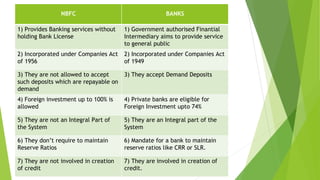
NBFC BANKS
1) Provides Banking services without
holding Bank License
1) Government authorised Finantial
Intermediary aims to provide service
to general public
2) Incorporated under Companies Act
of 1956
2) Incorporated under Companies Act
of 1949
3) They are not allowed to accept
such deposits which are repayable on
demand
3) They accept Demand Deposits
4) Foreign investment up to 100% is
allowed
4) Private banks are eligible for
Foreign Investment upto 74%
5) They are not an Integral Part of
the System
5) They are an Integral part of the
System
6) They don’t require to maintain
Reserve Ratios
6) Mandate for a bank to maintain
reserve ratios like CRR or SLR.
7) They are not involved in creation
of credit
7) They are involved in creation of
credit.
NATURE OF NON BANKING FINANTIAL
INSTITUTION
 Bank supplement
 Brokers of Loanable Funds
 mobilization of saving
 Provide Liquidity
 Lenders and NBFIs both Earn
 Help the Business Sector
 Unsecured
 Cannot accept demand deposit
ROLES OF NON FINANTIAL INTERMEDIARIES
1) Reduce Hoarding
2) Help the Household Sector
3) Help the Business Sector
4) Help the State and Local Government
5) Help the Central Government
REGULATORY FRAMEWORK
The RBI Act was amended in 1997 to provide for comprehensive regulatory
framework for NBFCs. As per the RBI (Amendment) Act 1997, the RBI can issue
directions to NBFCs & its auditors, prohibit deposit acceptance and alienation of
assets by NBFCs and initiate action for winding up of NBFCs. The new regulations
provide:
 Compulsory registration for all NBFCs, irrespective of their holding of public
deposits, for commencing and carrying on business of a non-business financial
institution
 The amended act also classified NBFCs into three broad categories
i) NBFCs accepting public deposits
ii) NBFCs not accepting/holding public deposits
iii) core investment companies (i.e. those acquiring shares/securities of their
group/holding/subsidiary companies to the extent of not less than 90% of total
assets and which do not accept public deposits.)
 Minimum entry point net-worth of Rs 2.5 million which was subsequently
revised upwards to Rs 20 million
 Deposit mobilization linked to net-worth, business activities and credit rating
 Maintenance of 12.5% of their deposits in liquid assets
 Creation of a Reserve Fund and transfer of 20% of profit after tax butbefore
dividend to the fund
 Ceiling on maximum rate of interest that NBFCs can pay on their public deposits
 NBFCs with an asset size of at least Rs 1 billion or a deposit base of at least Rs 200
million
are required to have Asset-Liability Management systems and constitute anAsset-
Liability Management Committee
Nbfc

Nbfc

  • 1.
  • 2.
    NON BANKING FINANTIALINTERMEDIARIES ABOUT  Company registered under the Companies Act, 1956  Regulated by the Central Bank i.e. Reserve Bank of India under RBI Act, 1934  Provides loans and advances, credit facility, savings and investment products, trading in the money market, managing portfolios of stocks, transfer of money and so on. NBFC IS DIVIDED IN 3 CATEGORIES  Asset Companies  Loan Companies  Investment Companies
  • 3.
    BANKS  Banks arethe financial institution  conduct banking activity like accepting deposits, granting credit, managing withdrawals pay interest  It acts as a financial intermediary, between the depositors and borrowers, that ensures smooth functioning of the economy. Types of Banks  Private  Public  Foreign banks. They are responsible for making loans, creating credit, mobilisation of deposits, safe and time bound transfer of money and providing publicutility services.
  • 4.
    NBFC BANKS 1) ProvidesBanking services without holding Bank License 1) Government authorised Finantial Intermediary aims to provide service to general public 2) Incorporated under Companies Act of 1956 2) Incorporated under Companies Act of 1949 3) They are not allowed to accept such deposits which are repayable on demand 3) They accept Demand Deposits 4) Foreign investment up to 100% is allowed 4) Private banks are eligible for Foreign Investment upto 74% 5) They are not an Integral Part of the System 5) They are an Integral part of the System 6) They don’t require to maintain Reserve Ratios 6) Mandate for a bank to maintain reserve ratios like CRR or SLR. 7) They are not involved in creation of credit 7) They are involved in creation of credit.
  • 5.
    NATURE OF NONBANKING FINANTIAL INSTITUTION  Bank supplement  Brokers of Loanable Funds  mobilization of saving  Provide Liquidity  Lenders and NBFIs both Earn  Help the Business Sector  Unsecured  Cannot accept demand deposit
  • 6.
    ROLES OF NONFINANTIAL INTERMEDIARIES 1) Reduce Hoarding 2) Help the Household Sector 3) Help the Business Sector 4) Help the State and Local Government 5) Help the Central Government
  • 7.
    REGULATORY FRAMEWORK The RBIAct was amended in 1997 to provide for comprehensive regulatory framework for NBFCs. As per the RBI (Amendment) Act 1997, the RBI can issue directions to NBFCs & its auditors, prohibit deposit acceptance and alienation of assets by NBFCs and initiate action for winding up of NBFCs. The new regulations provide:  Compulsory registration for all NBFCs, irrespective of their holding of public deposits, for commencing and carrying on business of a non-business financial institution  The amended act also classified NBFCs into three broad categories i) NBFCs accepting public deposits ii) NBFCs not accepting/holding public deposits iii) core investment companies (i.e. those acquiring shares/securities of their group/holding/subsidiary companies to the extent of not less than 90% of total assets and which do not accept public deposits.)
  • 8.
     Minimum entrypoint net-worth of Rs 2.5 million which was subsequently revised upwards to Rs 20 million  Deposit mobilization linked to net-worth, business activities and credit rating  Maintenance of 12.5% of their deposits in liquid assets  Creation of a Reserve Fund and transfer of 20% of profit after tax butbefore dividend to the fund  Ceiling on maximum rate of interest that NBFCs can pay on their public deposits  NBFCs with an asset size of at least Rs 1 billion or a deposit base of at least Rs 200 million are required to have Asset-Liability Management systems and constitute anAsset- Liability Management Committee