By -Pawan Singh Raikhola
12/3/20181
Non-Banking Financial
Company
(N.B.F.C.)
What is NBFC?
12/3/20182
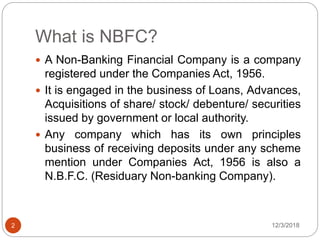
 A Non-Banking Financial Company is a company
registered under the Companies Act, 1956.
 It is engaged in the business of Loans, Advances,
Acquisitions of share/ stock/ debenture/ securities
issued by government or local authority.
 Any company which has its own principles
business of receiving deposits under any scheme
mention under Companies Act, 1956 is also a
N.B.F.C. (Residuary Non-banking Company).
Historical Background
12/3/20183
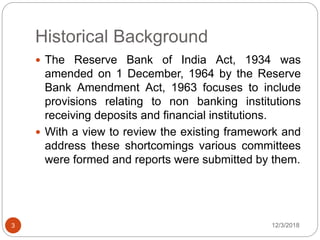
 The Reserve Bank of India Act, 1934 was
amended on 1 December, 1964 by the Reserve
Bank Amendment Act, 1963 focuses to include
provisions relating to non banking institutions
receiving deposits and financial institutions.
 With a view to review the existing framework and
address these shortcomings various committees
were formed and reports were submitted by them.
The Committees
12/3/20184
 James Raj Committee (1974)
 Formed by RBI on 1974.
 Suggested for ban on Prize Chit and Other
Schemes.
 Dr. A.C. Committee (1992)
 Agenda for reforms in the NBFC sector.
 Vasudev Committee (1998)
 It focuses on flow of credits from bank to NBFCs
 Consider a suitable ratio as between secured and
unsecured deposits for NBFCs.
Registration of NBFCs
12/3/20185
 In terms of Section 45-IA of the RBI Act, 1934, it
is mandatory that every NBFC should be
registered with RBI to commence or carry on any
business of non-banking financial institution as
defined in clause (a) of Section 45 I of the RBI
Act, 1934.
Role of NBFCs
12/3/20186
 Development of sectors like Transport &
Infrastructure.
 Substantial employment generation.
 Help and increase wealth creation.
 Broad base economic development.
 Major thrust on semi-urban, rural areas & first
time buyers/ user.
 To finance economically weaker sections.
Importance of NBFCs
12/3/20187
 It is impossible for bank to cater need of society
alone so NBFC and Micro Finance Companies
become indispensable.
 NBFCs in India have become prominent in wide
range of activities.
 To help in developing the large number of
industries as well as entrepreneur in different
sectors of different areas.
 To cover all the areas which are untouched by
RBI or other FCIs.
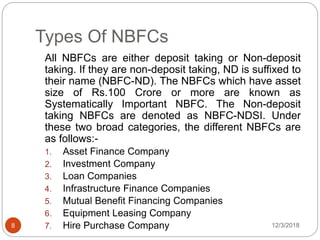
Types Of NBFCs
12/3/20188
All NBFCs are either deposit taking or Non-deposit
taking. If they are non-deposit taking, ND is suffixed to
their name (NBFC-ND). The NBFCs which have asset
size of Rs.100 Crore or more are known as
Systematically Important NBFC. The Non-deposit
taking NBFCs are denoted as NBFC-NDSI. Under
these two broad categories, the different NBFCs are
as follows:-
1. Asset Finance Company
2. Investment Company
3. Loan Companies
4. Infrastructure Finance Companies
5. Mutual Benefit Financing Companies
6. Equipment Leasing Company
7. Hire Purchase Company
12/3/20189
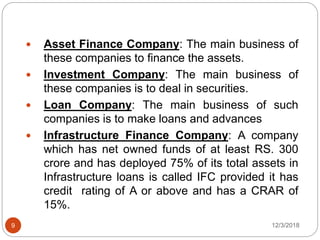
 Asset Finance Company: The main business of
these companies to finance the assets.
 Investment Company: The main business of
these companies is to deal in securities.
 Loan Company: The main business of such
companies is to make loans and advances
 Infrastructure Finance Company: A company
which has net owned funds of at least RS. 300
crore and has deployed 75% of its total assets in
Infrastructure loans is called IFC provided it has
credit rating of A or above and has a CRAR of
15%.
12/3/201810
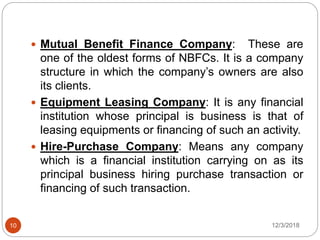
 Mutual Benefit Finance Company: These are
one of the oldest forms of NBFCs. It is a company
structure in which the company’s owners are also
its clients.
 Equipment Leasing Company: It is any financial
institution whose principal is business is that of
leasing equipments or financing of such an activity.
 Hire-Purchase Company: Means any company
which is a financial institution carrying on as its
principal business hiring purchase transaction or
financing of such transaction.
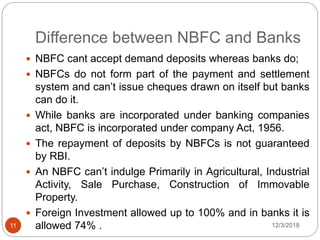
Difference between NBFC and Banks
12/3/201811
 NBFC cant accept demand deposits whereas banks do;
 NBFCs do not form part of the payment and settlement
system and can’t issue cheques drawn on itself but banks
can do it.
 While banks are incorporated under banking companies
act, NBFC is incorporated under company Act, 1956.
 The repayment of deposits by NBFCs is not guaranteed
by RBI.
 An NBFC can’t indulge Primarily in Agricultural, Industrial
Activity, Sale Purchase, Construction of Immovable
Property.
 Foreign Investment allowed up to 100% and in banks it is
allowed 74% .
Major NBFCs in India
12/3/201812
 Birla Global Finance
 Cholamandalam Investment & Finance Co. Ltd
 First Leasing Company of India
 LIC Housing Finance
 Sundaram Finance
 CanFin Homes
 Countrywide Finance
 Housing Development Finance Comapny Sakura
Capital India Ltd
Regulations
12/3/201813
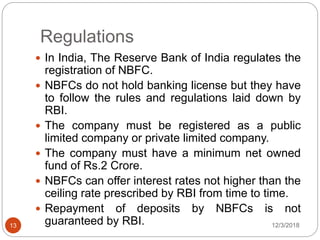
 In India, The Reserve Bank of India regulates the
registration of NBFC.
 NBFCs do not hold banking license but they have
to follow the rules and regulations laid down by
RBI.
 The company must be registered as a public
limited company or private limited company.
 The company must have a minimum net owned
fund of Rs.2 Crore.
 NBFCs can offer interest rates not higher than the
ceiling rate prescribed by RBI from time to time.
 Repayment of deposits by NBFCs is not
guaranteed by RBI.
12/3/201814
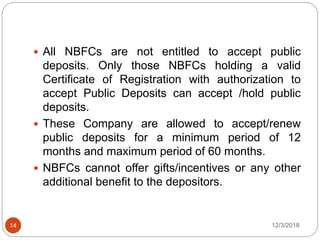
 All NBFCs are not entitled to accept public
deposits. Only those NBFCs holding a valid
Certificate of Registration with authorization to
accept Public Deposits can accept /hold public
deposits.
 These Company are allowed to accept/renew
public deposits for a minimum period of 12
months and maximum period of 60 months.
 NBFCs cannot offer gifts/incentives or any other
additional benefit to the depositors.
12/3/201815

Non banking financial company

  • 1.
    By -Pawan SinghRaikhola 12/3/20181 Non-Banking Financial Company (N.B.F.C.)
  • 2.
    What is NBFC? 12/3/20182 A Non-Banking Financial Company is a company registered under the Companies Act, 1956.  It is engaged in the business of Loans, Advances, Acquisitions of share/ stock/ debenture/ securities issued by government or local authority.  Any company which has its own principles business of receiving deposits under any scheme mention under Companies Act, 1956 is also a N.B.F.C. (Residuary Non-banking Company).
  • 3.
    Historical Background 12/3/20183  TheReserve Bank of India Act, 1934 was amended on 1 December, 1964 by the Reserve Bank Amendment Act, 1963 focuses to include provisions relating to non banking institutions receiving deposits and financial institutions.  With a view to review the existing framework and address these shortcomings various committees were formed and reports were submitted by them.
  • 4.
    The Committees 12/3/20184  JamesRaj Committee (1974)  Formed by RBI on 1974.  Suggested for ban on Prize Chit and Other Schemes.  Dr. A.C. Committee (1992)  Agenda for reforms in the NBFC sector.  Vasudev Committee (1998)  It focuses on flow of credits from bank to NBFCs  Consider a suitable ratio as between secured and unsecured deposits for NBFCs.
  • 5.
    Registration of NBFCs 12/3/20185 In terms of Section 45-IA of the RBI Act, 1934, it is mandatory that every NBFC should be registered with RBI to commence or carry on any business of non-banking financial institution as defined in clause (a) of Section 45 I of the RBI Act, 1934.
  • 6.
    Role of NBFCs 12/3/20186 Development of sectors like Transport & Infrastructure.  Substantial employment generation.  Help and increase wealth creation.  Broad base economic development.  Major thrust on semi-urban, rural areas & first time buyers/ user.  To finance economically weaker sections.
  • 7.
    Importance of NBFCs 12/3/20187 It is impossible for bank to cater need of society alone so NBFC and Micro Finance Companies become indispensable.  NBFCs in India have become prominent in wide range of activities.  To help in developing the large number of industries as well as entrepreneur in different sectors of different areas.  To cover all the areas which are untouched by RBI or other FCIs.
  • 8.
    Types Of NBFCs 12/3/20188 AllNBFCs are either deposit taking or Non-deposit taking. If they are non-deposit taking, ND is suffixed to their name (NBFC-ND). The NBFCs which have asset size of Rs.100 Crore or more are known as Systematically Important NBFC. The Non-deposit taking NBFCs are denoted as NBFC-NDSI. Under these two broad categories, the different NBFCs are as follows:- 1. Asset Finance Company 2. Investment Company 3. Loan Companies 4. Infrastructure Finance Companies 5. Mutual Benefit Financing Companies 6. Equipment Leasing Company 7. Hire Purchase Company
  • 9.
    12/3/20189  Asset FinanceCompany: The main business of these companies to finance the assets.  Investment Company: The main business of these companies is to deal in securities.  Loan Company: The main business of such companies is to make loans and advances  Infrastructure Finance Company: A company which has net owned funds of at least RS. 300 crore and has deployed 75% of its total assets in Infrastructure loans is called IFC provided it has credit rating of A or above and has a CRAR of 15%.
  • 10.
    12/3/201810  Mutual BenefitFinance Company: These are one of the oldest forms of NBFCs. It is a company structure in which the company’s owners are also its clients.  Equipment Leasing Company: It is any financial institution whose principal is business is that of leasing equipments or financing of such an activity.  Hire-Purchase Company: Means any company which is a financial institution carrying on as its principal business hiring purchase transaction or financing of such transaction.
  • 11.
    Difference between NBFCand Banks 12/3/201811  NBFC cant accept demand deposits whereas banks do;  NBFCs do not form part of the payment and settlement system and can’t issue cheques drawn on itself but banks can do it.  While banks are incorporated under banking companies act, NBFC is incorporated under company Act, 1956.  The repayment of deposits by NBFCs is not guaranteed by RBI.  An NBFC can’t indulge Primarily in Agricultural, Industrial Activity, Sale Purchase, Construction of Immovable Property.  Foreign Investment allowed up to 100% and in banks it is allowed 74% .
  • 12.
    Major NBFCs inIndia 12/3/201812  Birla Global Finance  Cholamandalam Investment & Finance Co. Ltd  First Leasing Company of India  LIC Housing Finance  Sundaram Finance  CanFin Homes  Countrywide Finance  Housing Development Finance Comapny Sakura Capital India Ltd
  • 13.
    Regulations 12/3/201813  In India,The Reserve Bank of India regulates the registration of NBFC.  NBFCs do not hold banking license but they have to follow the rules and regulations laid down by RBI.  The company must be registered as a public limited company or private limited company.  The company must have a minimum net owned fund of Rs.2 Crore.  NBFCs can offer interest rates not higher than the ceiling rate prescribed by RBI from time to time.  Repayment of deposits by NBFCs is not guaranteed by RBI.
  • 14.
    12/3/201814  All NBFCsare not entitled to accept public deposits. Only those NBFCs holding a valid Certificate of Registration with authorization to accept Public Deposits can accept /hold public deposits.  These Company are allowed to accept/renew public deposits for a minimum period of 12 months and maximum period of 60 months.  NBFCs cannot offer gifts/incentives or any other additional benefit to the depositors.
  • 15.