NON-AMD CNVM
Introduction
• Choroidal neovascularization (CNV) denotes the pathologic growth of new blood
vessels from pre-existing choroidal vessels into the subretinal space
• The newly formed vessels lie between the choroid and the retinal pigment
epithelium (RPE) or between the RPE and the neurosensory retina
• The importance of CNV is that it is the determinant of the disciform process; the
disc-shaped, subretinal, fibrovascular membrane ultimately progresses to
cicatrization, and loss of macular function
CAUSES- not just ARMD
 Congenital or hereditary
• Rubella retinopathy
• Best’s disease
• Cone dystrophy
 Degenerative
• ARMD
• Myopia
• Angioid streaks
 Inflammatory
• POHS
• Birdshot chorioretinopathy
• AMPPE
• Serpiginous choroidopathy
• VKH
• Chronic uveitis
• Toxoplasmosis
• Toxocariasis
 Traumatic
• Choroidal rupture
• Photocoagulation
 Neoplastic
• Choroidal osteoma
• Choroidal naevus
• Choroidal melanoma
• Choroidal haemagioma
• Choroidal metastases
 Idiopathic
• Exact pathogenesis is unknown.
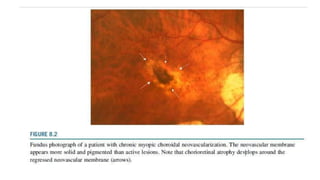
• 5.3-11.3 % with pathological myopia
• But elongation of axial length and the changes associated with it should be the
principal cause.
• Disruption of the stretched Bruch’s membrane is one of the mechanisms. In fact,
the presence of lacquer cracks, which represent breaks in the Bruch’s
membrane, is associated with the development of mCNV.
• Another hypothesis: change in chorioidal circulation due to the stretching of the
Bruch’s membrane and choroid
CNV in Myopia
Diagnosis:
• mCNV is typically type 2 CNV and shows small grayish tissue on
funduscopy and slit-lamp biomicroscopy
• Fluorescein angiography (FA) generally shows classic CNV pattern.
• Characterized by well circumscribed hyperfluorescence in the early phase and
active leakage in the late phase.
• Subretinal hemorrhage is commonly seen, but prominent pigment epithelium
detachment is rare
• High-to-moderate reflectivity above the RPE on optical coherence tomography
(OCT).
• In chronic stage, hyperfluorescent staining of the fibrous tissue with minimal
leakage is observed on FA.
• A well circumscribed, hyper reflective material is observed beneath the retina
on OCT.
Spectral-domain OCT scans of myopic CNV. Intra-
and subretinal fluid associated with an active
myopic CNV .
After treatment with intravitreal anti-VEGF
injection, there was complete resolution of both
intra- and subretinal fluid. The lesion becomes more
compact and the boundary between the lesion and
retina becomes apparent. The anterior border of
the CNV lesion also demonstrated increased in
hyper-reflectivity
Treatment:
• Visual prognosis in mCNV is poor unless treated. It is reported that visual acuity
declines to <6/60 in 89% of the cases in 5 years and in 96% of the cases in 10
years.
• Laser photocoagulation
• PDT
• Anti-VEGF (RADIANCE and MYRROR trial)- Ranibizumab, Bevacizumab, Aflibercept
• Surgical- Surgical removal of mCNV with or without macular translocation was
tried before the era of photodynamic therapy (PDT) and antivascular endothelial
growth factor (anti-VEGF) therapy.
*RADIANCE ,MYRROR – MYOPIC CNVM
MINNERVA-NON AMD AND NON MYOPIC CNVM
• Rare cases of macular detachment and macular hole formation have been
reported after intravitreal bevacizumab injections.
• Progressive chorioretinal atrophy around the CNV is the main cause of poor
vision in patients with myopic CNV; however, these complications may also be
part of the natural history of pathologic myopia.
• A recent study by Ohno-Matsui et al found that eyes that had intravitreal anti-
VEGF therapy appeared to have reduced risk of Bruch’s membrane rupture in
myopic CNV, which in turn was associated with a smaller area of macular atrophy
CNVM IN ANGIOD STREAK:
• Irregular break in Bruch ‘s membrane with atrophic change in RPE with calcific
degeneration.
• MMP-9 : destruction of Bruch s membrane and angiogenesis.
• Full-thickness defect of the Bruch’s membrane may occur followed by atrophy of
the choriocapillaris, RPE, and photoreceptors.
• Fibrovascular proliferation from the choroid may occur through the Bruch’s
membrane break, resulting in CNV and subsequent development of a disciform
scar.
Systemic association:
• Pseudoxanthoma elasticum(Grönbald–strandberg syndrome)
• Osteitis deformans(Paget disease)
• Fibrodysplasia hyperelastica (Ehlers– danlos syndrome)
• Acromegaly,
• Marfan syndrome
• Blood dyscrasias such as sickle-cell anemia, thalassemia,spherocytosis
• Development of CNV, which is often bilateral and occurs in 72–86% of eyes with
angioid streaks.
• CNV is usually bilateral but asymmetric(interval of average 18 months)
• High risk in PXE
• Fundus photo showing peripapillary
hemorrhage associated with angioid streaks
• late-phase fluorescein angiography showing
leakage from the CNV
Treatment
• Laser photocoagulation
• Trans pupillary thermotherapy
• Anti VEGF
• Surgical treatment
• The incidence of CNV is reported to be approximately 1-40% in patients with
posterior uveitis/panuveitis.
• Common causes:
• punctate inner choroidopathy (PIC),
• multifocal choroiditis (MFC, also known as MFC with panuveitis),
• serpiginous choroiditis,
• VKH,
• Presumed ocular histoplasmosis syndrome (POHS )
• Infected endophthalmitis
CNV in Inflammatory diseases
Pathogenesis
• Exact pathogenesis of inflammation-associated CNV is not known.
• Upregulation of proangiogenic factors such as VEGF in case of active
inflammation would play a significant role in the etiology.
• Ischemia due to vasculitis can also induce VEGF upregulation.
• In case of infectious uveitis such as POHS or toxoplasmosis, immune reaction to
the pathogen is likely to be involved in the breakdown of the Bruch’s membrane
Diagnosis
• CNVM can also sometimes manifest only with macular edema or serous retinal
detachment. However, macular edema and serous retinal detachment can also represent
signs of inflammation due to uveitis, causing difficulty in accurately assessing the CNV
activity.
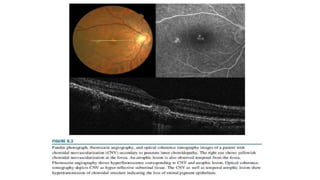
• Careful ophthalmoscopic inspection of chorioretinal scarring or choroidal granuloma may
reveal inflammatory CNV that develops adjacent to these lesions.
• Fluorescein angiography is indicated to assess the presence and activity of CNV
in uveitic patients, showing early hyperfluorescence in the choroidal phase and
late leakage.
• CNV caused by inflammatory diseases is generally type 2 ,shows a classic FA
pattern.
• Abnormal findings such as drusen-like material, vitreous cells, choroidal
hyperreflectivity, and chorioretinal atrophy can be seen on OCT.
Treatment
• the use of corticosteroids and immunosuppressive therapy might be required to
ensure adequate control of uveitis to prevent or stop the development of
inflammatory CNV.
• Early detection of CNV and prompt treatment with anti-VEGF agents can also
preserve vision.
PRESUMED OCLAR HISTOPLASMOSIS SYNDROME
A clinical diagnosis is based on the presence of at least two of the following fundus
lesions in one or both eyes in the absence of ocular inflammation:
• Discrete, focal, atrophic (i.e., punched-out) choroidal scars in the macula or
the periphery, smaller in size than the optic disc (histo spots)
• Peripapillary chorioretinal scarring (i.e., peripapillary atrophy)
• CNV or associated sequelae (hemorrhagic retinal detachment, fibrovascular
disciform scar)
Peripheral histo spots Macular histo spots. Larger
lesion with pigment proliferation
may represent spontaneously
regressed choroidal
neovascularization (CNV)
Peripapillary lesion superotemporal
and within the peripapillary scarring
probably represents spontaneously
regressed CNV
• CNV formation may be promoted by multiple factors at the site of the atrophic
scar.
• Disruption of Bruch’s membrane
• The fragile vessels are prone to hemorrhage and exudation, often ultimately
resulting in disorganization of the RPE and neurosensory retina and, ultimately, a
fibrovascular scar.
Focal choroiditis–
predisciform stage
Involvement of RPE and
choriocapillaris
Hemorrhagic disciform
retinal detachment
Fibrovascular disciform scar
Focal atrophic
chorioretinal scar
Serous retinal detachment
and choroidal
neovascularization
Hemorrhagic
disciform retinal
detachment
Treatment:
• Anti VEGF
• Laser photocoagulation
• IVTA
• Previously- oral steroids
• Surgical
CNVM secondary to CSCR
• 2% to 9% cases
• more than 80% of CNV cases occurred in subjects older than 50 years of age.
• Chronic alterations of Bruch membrane and RPE are the main causative factors of
CNV formation
• Previous laser photocoagulation treatment for CSCR may also lead to the
subsequent development of CNV, as high-energy laser burns could disrupt and
damage the RPE.
• Studies using OCTA showed the presence of type 1 CNV
• More than one-third of cases were found to have associated polypoidal
structures, leading to the hypothesis that CSR, CSR-associated type 1 CNV, and
polypoidal choroidal vasculopathy (PCV) may belong to the same spectrum of
pachychoroid
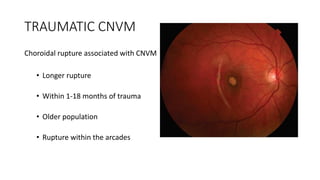
TRAUMATIC CNVM
Choroidal rupture associated with CNVM
• Longer rupture
• Within 1-18 months of trauma
• Older population
• Rupture within the arcades
Treatment
• Laser photocoagulation
• PDT
• Surgical
• Anti VEGF
MACULAR TELANGIECTASIA
fibrovascular scar with chorioretinal anastomosis can be the endpoint of the pathogenic process of macular
telangiectasia type 2, and is indistinguishable from disciform scarring in wet ARMD. However, there is a lack
of drusen, and usually the retinal pigment hyperplasia is prominent
• The development of neovascularization is often preceded by the right-angle
venule and the intraretinal pigment hyperplasia that is often temporal to the
fovea.
• The neovascularization is most commonly seen temporal to the fovea.
• Retinal hard exudates, intraretinal edema, and subretinal or intraretinal
hemorrhage may occur .
• These neovascular complexes are retinal in origin, as seen by the feeder vessel
from the retinal arteries and the drainage into venules
IDIOPATHIC CNVM
• Idiopathic CNV is a diagnosis of exclusion
• more common in younger patients.
• unilateral CNV, and they appear to have a low risk of developing CNV in their fellow eyes.
• more favorable natural history and treatment outcome .
• recurrence of CNV developed in 30.8% of patients.
• Most recurrences were noted within 14 months, but the timing of the recurrence varied
from 7 to 49 months
• Treatment –Anti VEGF
CNVM AAOCIATED WITH CHOROIDAL
OSTEOMA
• One third of patients
• Subretinal fluid, hemorrhage, and serous retinal detachment can occur in
choroidal osteoma frequently in the absence of CNV.
• In cases where leakage or hyperfluorescence from the underlying disease
obscures the appearance of CNV on FA, OCTA may assist in the detection of CNV
A- Fundus photo showing subfoveal CNV with macular edema at the inferior border of the choroidal osteoma
B-Late-phase FA showed dye leakage from the CNV
C-after ranibizumab injection, a fundus photo showed resolution of macular hemorrhage
D- late-phase FA showed absence of leakage with fibrosis of the CNV lesion .
IATROGENIC CNVM
• occur in patients with choroidal rupture after direct posterior pole injury by laser
and surgical procedures.
• Although the exact pathogenesis is unknown, it appears that the process begins
with damage to Bruch’s membrane and the subsequent repair process, which
triggers the release of angiogenic factors.

NON AMD CNVM

  • 1.
  • 2.
    Introduction • Choroidal neovascularization(CNV) denotes the pathologic growth of new blood vessels from pre-existing choroidal vessels into the subretinal space • The newly formed vessels lie between the choroid and the retinal pigment epithelium (RPE) or between the RPE and the neurosensory retina • The importance of CNV is that it is the determinant of the disciform process; the disc-shaped, subretinal, fibrovascular membrane ultimately progresses to cicatrization, and loss of macular function
  • 3.
    CAUSES- not justARMD  Congenital or hereditary • Rubella retinopathy • Best’s disease • Cone dystrophy  Degenerative • ARMD • Myopia • Angioid streaks
  • 4.
     Inflammatory • POHS •Birdshot chorioretinopathy • AMPPE • Serpiginous choroidopathy • VKH • Chronic uveitis • Toxoplasmosis • Toxocariasis
  • 5.
     Traumatic • Choroidalrupture • Photocoagulation  Neoplastic • Choroidal osteoma • Choroidal naevus • Choroidal melanoma • Choroidal haemagioma • Choroidal metastases  Idiopathic
  • 6.
    • Exact pathogenesisis unknown. • 5.3-11.3 % with pathological myopia • But elongation of axial length and the changes associated with it should be the principal cause. • Disruption of the stretched Bruch’s membrane is one of the mechanisms. In fact, the presence of lacquer cracks, which represent breaks in the Bruch’s membrane, is associated with the development of mCNV. • Another hypothesis: change in chorioidal circulation due to the stretching of the Bruch’s membrane and choroid CNV in Myopia
  • 7.
    Diagnosis: • mCNV istypically type 2 CNV and shows small grayish tissue on funduscopy and slit-lamp biomicroscopy • Fluorescein angiography (FA) generally shows classic CNV pattern. • Characterized by well circumscribed hyperfluorescence in the early phase and active leakage in the late phase. • Subretinal hemorrhage is commonly seen, but prominent pigment epithelium detachment is rare
  • 8.
    • High-to-moderate reflectivityabove the RPE on optical coherence tomography (OCT). • In chronic stage, hyperfluorescent staining of the fibrous tissue with minimal leakage is observed on FA. • A well circumscribed, hyper reflective material is observed beneath the retina on OCT.
  • 9.
    Spectral-domain OCT scansof myopic CNV. Intra- and subretinal fluid associated with an active myopic CNV . After treatment with intravitreal anti-VEGF injection, there was complete resolution of both intra- and subretinal fluid. The lesion becomes more compact and the boundary between the lesion and retina becomes apparent. The anterior border of the CNV lesion also demonstrated increased in hyper-reflectivity
  • 12.
    Treatment: • Visual prognosisin mCNV is poor unless treated. It is reported that visual acuity declines to <6/60 in 89% of the cases in 5 years and in 96% of the cases in 10 years. • Laser photocoagulation • PDT • Anti-VEGF (RADIANCE and MYRROR trial)- Ranibizumab, Bevacizumab, Aflibercept • Surgical- Surgical removal of mCNV with or without macular translocation was tried before the era of photodynamic therapy (PDT) and antivascular endothelial growth factor (anti-VEGF) therapy. *RADIANCE ,MYRROR – MYOPIC CNVM MINNERVA-NON AMD AND NON MYOPIC CNVM
  • 13.
    • Rare casesof macular detachment and macular hole formation have been reported after intravitreal bevacizumab injections. • Progressive chorioretinal atrophy around the CNV is the main cause of poor vision in patients with myopic CNV; however, these complications may also be part of the natural history of pathologic myopia. • A recent study by Ohno-Matsui et al found that eyes that had intravitreal anti- VEGF therapy appeared to have reduced risk of Bruch’s membrane rupture in myopic CNV, which in turn was associated with a smaller area of macular atrophy
  • 14.
    CNVM IN ANGIODSTREAK: • Irregular break in Bruch ‘s membrane with atrophic change in RPE with calcific degeneration. • MMP-9 : destruction of Bruch s membrane and angiogenesis. • Full-thickness defect of the Bruch’s membrane may occur followed by atrophy of the choriocapillaris, RPE, and photoreceptors. • Fibrovascular proliferation from the choroid may occur through the Bruch’s membrane break, resulting in CNV and subsequent development of a disciform scar.
  • 15.
    Systemic association: • Pseudoxanthomaelasticum(Grönbald–strandberg syndrome) • Osteitis deformans(Paget disease) • Fibrodysplasia hyperelastica (Ehlers– danlos syndrome) • Acromegaly, • Marfan syndrome • Blood dyscrasias such as sickle-cell anemia, thalassemia,spherocytosis
  • 16.
    • Development ofCNV, which is often bilateral and occurs in 72–86% of eyes with angioid streaks. • CNV is usually bilateral but asymmetric(interval of average 18 months) • High risk in PXE
  • 17.
    • Fundus photoshowing peripapillary hemorrhage associated with angioid streaks • late-phase fluorescein angiography showing leakage from the CNV
  • 18.
    Treatment • Laser photocoagulation •Trans pupillary thermotherapy • Anti VEGF • Surgical treatment
  • 19.
    • The incidenceof CNV is reported to be approximately 1-40% in patients with posterior uveitis/panuveitis. • Common causes: • punctate inner choroidopathy (PIC), • multifocal choroiditis (MFC, also known as MFC with panuveitis), • serpiginous choroiditis, • VKH, • Presumed ocular histoplasmosis syndrome (POHS ) • Infected endophthalmitis CNV in Inflammatory diseases
  • 20.
    Pathogenesis • Exact pathogenesisof inflammation-associated CNV is not known. • Upregulation of proangiogenic factors such as VEGF in case of active inflammation would play a significant role in the etiology. • Ischemia due to vasculitis can also induce VEGF upregulation. • In case of infectious uveitis such as POHS or toxoplasmosis, immune reaction to the pathogen is likely to be involved in the breakdown of the Bruch’s membrane
  • 21.
    Diagnosis • CNVM canalso sometimes manifest only with macular edema or serous retinal detachment. However, macular edema and serous retinal detachment can also represent signs of inflammation due to uveitis, causing difficulty in accurately assessing the CNV activity. • Careful ophthalmoscopic inspection of chorioretinal scarring or choroidal granuloma may reveal inflammatory CNV that develops adjacent to these lesions.
  • 22.
    • Fluorescein angiographyis indicated to assess the presence and activity of CNV in uveitic patients, showing early hyperfluorescence in the choroidal phase and late leakage. • CNV caused by inflammatory diseases is generally type 2 ,shows a classic FA pattern. • Abnormal findings such as drusen-like material, vitreous cells, choroidal hyperreflectivity, and chorioretinal atrophy can be seen on OCT.
  • 24.
    Treatment • the useof corticosteroids and immunosuppressive therapy might be required to ensure adequate control of uveitis to prevent or stop the development of inflammatory CNV. • Early detection of CNV and prompt treatment with anti-VEGF agents can also preserve vision.
  • 25.
    PRESUMED OCLAR HISTOPLASMOSISSYNDROME A clinical diagnosis is based on the presence of at least two of the following fundus lesions in one or both eyes in the absence of ocular inflammation: • Discrete, focal, atrophic (i.e., punched-out) choroidal scars in the macula or the periphery, smaller in size than the optic disc (histo spots) • Peripapillary chorioretinal scarring (i.e., peripapillary atrophy) • CNV or associated sequelae (hemorrhagic retinal detachment, fibrovascular disciform scar)
  • 26.
    Peripheral histo spotsMacular histo spots. Larger lesion with pigment proliferation may represent spontaneously regressed choroidal neovascularization (CNV) Peripapillary lesion superotemporal and within the peripapillary scarring probably represents spontaneously regressed CNV
  • 27.
    • CNV formationmay be promoted by multiple factors at the site of the atrophic scar. • Disruption of Bruch’s membrane • The fragile vessels are prone to hemorrhage and exudation, often ultimately resulting in disorganization of the RPE and neurosensory retina and, ultimately, a fibrovascular scar.
  • 28.
    Focal choroiditis– predisciform stage Involvementof RPE and choriocapillaris Hemorrhagic disciform retinal detachment Fibrovascular disciform scar Focal atrophic chorioretinal scar Serous retinal detachment and choroidal neovascularization Hemorrhagic disciform retinal detachment
  • 29.
    Treatment: • Anti VEGF •Laser photocoagulation • IVTA • Previously- oral steroids • Surgical
  • 30.
    CNVM secondary toCSCR • 2% to 9% cases • more than 80% of CNV cases occurred in subjects older than 50 years of age. • Chronic alterations of Bruch membrane and RPE are the main causative factors of CNV formation • Previous laser photocoagulation treatment for CSCR may also lead to the subsequent development of CNV, as high-energy laser burns could disrupt and damage the RPE.
  • 31.
    • Studies usingOCTA showed the presence of type 1 CNV • More than one-third of cases were found to have associated polypoidal structures, leading to the hypothesis that CSR, CSR-associated type 1 CNV, and polypoidal choroidal vasculopathy (PCV) may belong to the same spectrum of pachychoroid
  • 32.
    TRAUMATIC CNVM Choroidal ruptureassociated with CNVM • Longer rupture • Within 1-18 months of trauma • Older population • Rupture within the arcades
  • 33.
    Treatment • Laser photocoagulation •PDT • Surgical • Anti VEGF
  • 34.
    MACULAR TELANGIECTASIA fibrovascular scarwith chorioretinal anastomosis can be the endpoint of the pathogenic process of macular telangiectasia type 2, and is indistinguishable from disciform scarring in wet ARMD. However, there is a lack of drusen, and usually the retinal pigment hyperplasia is prominent
  • 35.
    • The developmentof neovascularization is often preceded by the right-angle venule and the intraretinal pigment hyperplasia that is often temporal to the fovea. • The neovascularization is most commonly seen temporal to the fovea. • Retinal hard exudates, intraretinal edema, and subretinal or intraretinal hemorrhage may occur . • These neovascular complexes are retinal in origin, as seen by the feeder vessel from the retinal arteries and the drainage into venules
  • 36.
    IDIOPATHIC CNVM • IdiopathicCNV is a diagnosis of exclusion • more common in younger patients. • unilateral CNV, and they appear to have a low risk of developing CNV in their fellow eyes. • more favorable natural history and treatment outcome . • recurrence of CNV developed in 30.8% of patients. • Most recurrences were noted within 14 months, but the timing of the recurrence varied from 7 to 49 months • Treatment –Anti VEGF
  • 37.
    CNVM AAOCIATED WITHCHOROIDAL OSTEOMA • One third of patients • Subretinal fluid, hemorrhage, and serous retinal detachment can occur in choroidal osteoma frequently in the absence of CNV. • In cases where leakage or hyperfluorescence from the underlying disease obscures the appearance of CNV on FA, OCTA may assist in the detection of CNV
  • 38.
    A- Fundus photoshowing subfoveal CNV with macular edema at the inferior border of the choroidal osteoma B-Late-phase FA showed dye leakage from the CNV C-after ranibizumab injection, a fundus photo showed resolution of macular hemorrhage D- late-phase FA showed absence of leakage with fibrosis of the CNV lesion .
  • 39.
    IATROGENIC CNVM • occurin patients with choroidal rupture after direct posterior pole injury by laser and surgical procedures. • Although the exact pathogenesis is unknown, it appears that the process begins with damage to Bruch’s membrane and the subsequent repair process, which triggers the release of angiogenic factors.