5G Highlights
• 5G Technology Workshop Potential Technology for 3GPP Rel-15
• Kaohsiung, Taiwan - 15 October 2016
• Benoist Sébire, Nokia
11/10/20162 © Nokia 2016
• Quality of Service
• Network Slicing
• Latency and Radio
• Network Architecture
5G Highlights
Content Overview
11/10/20163 © Nokia 2016
Quality of Service
11/10/20164 © Nokia 2016
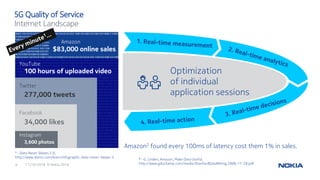
Optimization
of individual
application sessions
5G Quality of Service
1 – Data Never Sleeps 2.0,
http://www.domo.com/learn/infographic-data-never-sleeps-2
Facebook
Instagram
34,000 likes
3,600 photos
Twitter
277,000 tweets
YouTube
100 hours of uploaded video
Amazon
$83,000 online sales
2 – G. Linden, Amazon, Make Data Useful,
http://www.gduchamp.com/media/StanfordDataMining.2006-11-28.pdf
Amazon2 found every 100ms of latency cost them 1% in sales.
Internet Landscape
11/10/20165 © Nokia 2016
5G Quality of Service
Internet Landscape
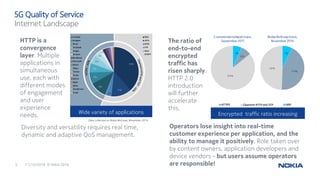
HTTP is a
convergence
layer. Multiple
applications in
simultaneous
use, each with
different modes
of engagement
and user
experience
needs.
Wide variety of applications
Diversity and versatility requires real time,
dynamic and adaptive QoS management.
The ratio of
end-to-end
encrypted
traffic has
risen sharply.
HTTP 2.0
introduction
will further
accelerate
this.
Operators lose insight into real-time
customer experience per application, and the
ability to manage it positively. Role taken over
by content owners, application developers and
device vendors – but users assume operators
are responsible!
Data collected on Nokia NetLeap, November 2014.
Encrypted traffic ratio increasing
11/10/20166 © Nokia 2016
• LTE QoS architecture
- Static or semi-dynamic, rule based policy enforcement in the core and
- Bearer centric, radio efficiency driven QoS enforcement at the air interface
• Drawbacks
- Incapable of providing personalized experience
• no efficient means to adapt itself to the specifics of the user sessions
- Simultaneous applications of the same user are not differentiated properly
- Class based operation, with limited number of QoS classes
5G Quality of Service
Drawbacks of LTE QoS architecture
11/10/20167 © Nokia 2016
5G Quality of Service
Drawbacks of LTE QoS architecture
1st
RTT 2nd
RTT 3rd
RTT 4th
RTT 5th
RTT 6th
RTT 7th
RTT
0,17
Mbps
0,34
Mbps
0,68
Mbps
2,74
Mbps
5,47
Mbps
1,37
Mbps
10,94
Mbps
Bandwidth need of the web page download in time
Bandwidth required to download the web page within
5 sec, assuming constant rate traffic: 2,88 Mbps
Example:
Download of an 1,8MByte web page;
RTT=200 ms; MSS=1420 Byte
The rate of a TCP connection
depends on the e2e RTT and
on the congestion window
value.
Only a part of the RTT is
spent in the mobile system
Predefined QoS parameters
are not appropriate.
Adaptive, context dependent
QoS architecture is needed
Example:
Download of a 1,8MByte web page;
Outer RTT=50ms; MSS=1420Byte,
Initial window = 10MSS
Bandwidth required to download the web page within 5 sec,
assuming constant rate traffic and no TCP Slow Start: 2,88 Mbps.
11/10/20168 © Nokia 2016
• High Level Principles
• Detection and differentiation of very short-lived service flows in order to provide a
good application experience
• Real-time application awareness in both Core and RAN
• Enforcement actions derived in a coherent way for UL and DL by the enforcement
points according to the current context of the user plane traffic mix, simultaneous
competing flows, network status and resource availability and policies received from
Core CP
• Each end-to-end OTT protocol has a feedback mechanism (TCP, QUIC, TCP friendly rate control
for UDP, etc.) → UL and DL are always strongly coupled
• Policies sent by the Core to the RAN may either provide explicit QoS targets (transport level
QoS policies) for some flows or they may provide high level guidelines and policies to the RAN
about the QoS to apply (Intent level QoS policies) for other flows.
5G Quality of Service
High Level Principles
11/10/20169 © Nokia 2016
5G Quality of Service
High Level Principles
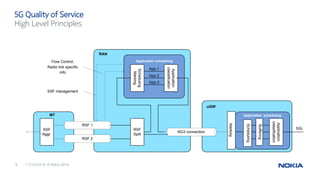
RSF
Split
RAN
uGW
NG3 connection
RSF 1
RSF 2
MT
Application
classification
Scheduling
Marking
App.3
Application scheduling
App.2
App.1
SSF
Aggr.
Flow Control,
Radio link specific
info
SSF management
SGi
Application
classification
Buffering
Application scheduling
Marking
Scheduling
11/10/201610 © Nokia 2016
5G Quality of Service
High Level Principles
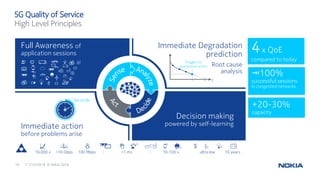
Immediate Degradation
prediction
Root cause
analysis
Decision making
powered by self-learning
Full Awareness of
application sessions
Immediate action
before problems arise
Unique Nokia
solution available
TODAY
100%
successful sessions
in congested networks
+20-30%
capacity
4x QoE
compared to today
Seconds
10 years100 Mbps 10-100 x10,000 x ultra low>10 Gbps <1 ms
t
Trigger for
preventive action
11/10/201611 © Nokia 2016
Network Slicing
11/10/201612 © Nokia 2016
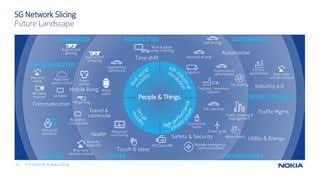
5G Network Slicing
Future Landscape
Augmented
shopping
Smart
clothes
Virtual 3D
presence
Factory
automation Real-time
remote control
Assisted driving
Logistics
Traffic steering &
management
Smart grids
Connected
home
Real time
cloud access
4k Video
VR gaming
Real-time
remote control
Remote
Diagnosis
Communication
Mobile living
3D printing
Automotive
Toll collection
HD Cams NW
REVOLUTIONIZED
Traffic Mgmt.
SUPEREFFICIENT
Waste mgmt.
Reliable emergency
communications
Tracking / inventory
systems
AUGMENTED
Augmented
dashboard
INTERCONNECTED
8k Video
beamer
TACTILEVIRTUAL
Smart
watch
Augmented
gaming
Self driving
Maintenance
optimization
Touch & steer
AUTONOMOUS
Travel &
commute
Health
Time shift
Utility & EnergySafety & Security
Work & game
while traveling
REDEDICATED
People & Things
Real time
work in cloud
Industry 4.0
Advanced
monitoring
Personal
robot
11/10/201613 © Nokia 2016
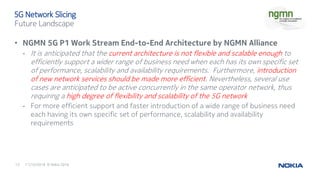
• NGMN 5G P1 Work Stream End-to-End Architecture by NGMN Alliance
- It is anticipated that the current architecture is not flexible and scalable enough to
efficiently support a wider range of business need when each has its own specific set
of performance, scalability and availability requirements. Furthermore, introduction
of new network services should be made more efficient. Nevertheless, several use
cases are anticipated to be active concurrently in the same operator network, thus
requiring a high degree of flexibility and scalability of the 5G network
- For more efficient support and faster introduction of a wide range of business need
each having its own specific set of performance, scalability and availability
requirements
5G Network Slicing
Future Landscape
11/10/201614 © Nokia 2016
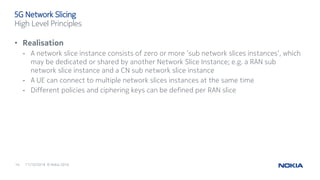
• Realisation
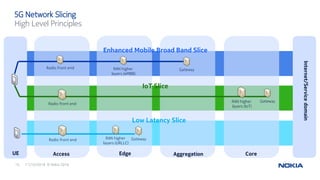
- A network slice instance consists of zero or more ’sub network slices instances’, which
may be dedicated or shared by another Network Slice Instance; e.g. a RAN sub
network slice instance and a CN sub network slice instance
- A UE can connect to multiple network slices instances at the same time
- Different policies and ciphering keys can be defined per RAN slice
5G Network Slicing
High Level Principles
11/10/201615 © Nokia 2016
5G Network Slicing
High Level Principles
UE Edge Aggregation Core
Internet/Servicedomain
Access
Enhanced Mobile Broad Band Slice
IoT Slice
Low Latency Slice
Radio front end RAN higher
layers (eMBB)
Gateway
Radio front end
RAN higher
layers (IoT)
Gateway
Radio front end RAN higher
layers (URLLC)
Gateway
11/10/201616 © Nokia 2016
Latency
11/10/201617 © Nokia 2016
5G Latency
Evolution and Target
0
5
10
15
20
25
HSPA LTE 5G
ms
End-to-end latency
Transport + core
BTS processing
UE processing
Scheduling
Buffering
Uplink transmission
Downlink transmission
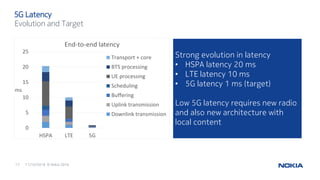
Strong evolution in latency
• HSPA latency 20 ms
• LTE latency 10 ms
• 5G latency 1 ms (target)
Low 5G latency requires new radio
and also new architecture with
local content
11/10/201618 © Nokia 2016
5G Latency
Evolution and Target
HSPA LTE 5G
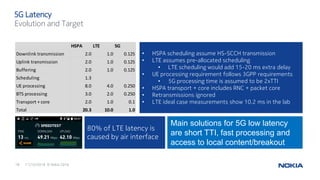
Downlink transmission 2.0 1.0 0.125
Uplink transmission 2.0 1.0 0.125
Buffering 2.0 1.0 0.125
Scheduling 1.3
UE processing 8.0 4.0 0.250
BTS processing 3.0 2.0 0.250
Transport + core 2.0 1.0 0.1
Total 20.3 10.0 1.0
• HSPA scheduling assume HS-SCCH transmission
• LTE assumes pre-allocated scheduling
• LTE scheduling would add 15-20 ms extra delay
• UE processing requirement follows 3GPP requirements
• 5G processing time is assumed to be 2xTTI
• HSPA transport + core includes RNC + packet core
• Retransmissions ignored
• LTE ideal case measurements show 10.2 ms in the lab
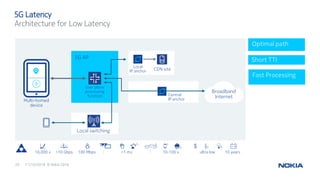
Main solutions for 5G low latency
are short TTI, fast processing and
access to local content/breakout
80% of LTE latency is
caused by air interface
11/10/201619 © Nokia 2016
5G Latency
WiFi Reference
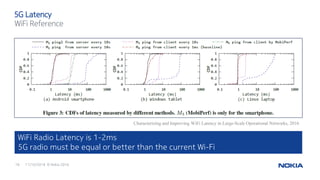
Characterizing and Improving WiFi Latency in Large-Scale Operational Networks, 2016
WiFi Radio Latency is 1-2ms
5G radio must be equal or better than the current Wi-Fi
11/10/201620 © Nokia 2016
5G Latency
Architecture for Low Latency
CDN site
Broadband
Internet
Fast Processing
Short TTI
Optimal path
10 years100 Mbps 10-100 x10,000 x ultra low>10 Gbps <1 ms
5G AP
Multi-homed
device
Local switching
Local
IP anchor
User plane
processing
function Central
IP anchor
11/10/201621 © Nokia 2016
Network Architecture
11/10/201622 © Nokia 2016
5G Architecture
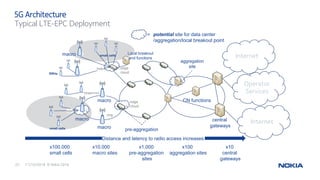
Typical LTE-EPC Deployment
macro
macro
pre-aggregationsmall cells
small cellsmacro
x10.000
macro sites
x100.000
small cells
x1.000
pre-aggregation
sites
central
gateways
CN functions
x100
aggregation sites
x10
central
gateways
aggregation
site
Internet
Operator
Services
edge
cloud
edge
cloud
star
chain
tree
Internet
ring
= potential site for data center
/aggregation/local breakout point
RRHs
macro
Distance and latency to radio access increases
Local breakout
and functions
11/10/201623 © Nokia 2016
5G Architecture
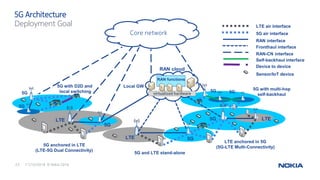
Deployment Goal
5G
Core network
LTE
5G
LTE 5G
LTE5G
5G anchored in LTE
(LTE-5G Dual Connectivity)
5G and LTE stand-alone
LTE anchored in 5G
(5G-LTE Multi-Connectivity)
5G 5G with multi-hop
self-backhaul
5G
RAN cloud
virtualized hardware
5G with D2D and
local switching5G
Local GW
RAN functions
LTE air interface
5G air interface
Fronthaul interface
RAN-CN interface
Self-backhaul interface
RAN interface
Device to device
Sensor/IoT device
11/10/201624 © Nokia 2016
5G Architecture
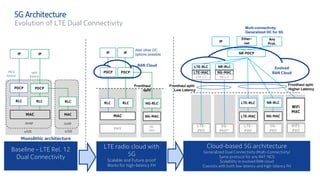
Evolution of LTE Dual Connectivity
MCG
bearer
split
bearer
PDCP
RLC
PDCP
RLC
MAC MAC
RLC
MeNB SeNB
PDCP
RLC
PDCP
RLC
MAC NG-MAC
NG-RLC
Fronthaul
split
RAN Cloud
NR-PDCP
Fronthaul split:
Low Latency
IP IP
IP
Ether-
net
Any
Prot.
Evolved
RAN Cloud
Also other DC
options possible
LTE-RLC
LTE-MAC
NR-RLC
NG-MAC
PHY
WiFi
MAC
Monolithic architecture
eNB eNB
5G-
PHY
LTE-
PHY
LTE-
PHY
5G-
PHY
WiFI-
PHY
Multi-connectivity:
Generalized DC for 5G
Cloud-based 5G architecture
Generalized Dual Connectivity (Multi-Connectivity)
Same protocol for any RAT: NCS
Scalability in evolved RAN cloud
Coexists with both low-latency and high-latency FH
LTE radio cloud with
5G
Scalable and Future proof
Works for high-latency FH
Baseline – LTE Rel. 12
Dual Connectivity
IP IP
NR-RLC
NG-MAC
5G-L1’
5G-
PHY’’
LTE-RLC
LTE-MAC
LTE-L1’
Fronthaul split:
Higher Latency
11/10/201625 © Nokia 2016
5G Architecture
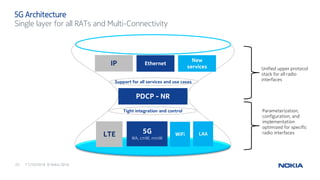
Single layer for all RATs and Multi-Connectivity
PDCP - NR
IP Ethernet
New
services
LTE 5G
WA, cmW, mmW
WiFi LAA
Tight integration and control
Support for all services and use cases
Unified upper protocol
stack for all radio
interfaces
Parameterization,
configuration, and
implementation
optimized for specific
radio interfaces
11/10/201626 © Nokia 2016

Nokia 5G Workshop Taiwan Oct 2016

  • 1.
    5G Highlights • 5GTechnology Workshop Potential Technology for 3GPP Rel-15 • Kaohsiung, Taiwan - 15 October 2016 • Benoist Sébire, Nokia
  • 2.
    11/10/20162 © Nokia2016 • Quality of Service • Network Slicing • Latency and Radio • Network Architecture 5G Highlights Content Overview
  • 3.
    11/10/20163 © Nokia2016 Quality of Service
  • 4.
    11/10/20164 © Nokia2016 Optimization of individual application sessions 5G Quality of Service 1 – Data Never Sleeps 2.0, http://www.domo.com/learn/infographic-data-never-sleeps-2 Facebook Instagram 34,000 likes 3,600 photos Twitter 277,000 tweets YouTube 100 hours of uploaded video Amazon $83,000 online sales 2 – G. Linden, Amazon, Make Data Useful, http://www.gduchamp.com/media/StanfordDataMining.2006-11-28.pdf Amazon2 found every 100ms of latency cost them 1% in sales. Internet Landscape
  • 5.
    11/10/20165 © Nokia2016 5G Quality of Service Internet Landscape HTTP is a convergence layer. Multiple applications in simultaneous use, each with different modes of engagement and user experience needs. Wide variety of applications Diversity and versatility requires real time, dynamic and adaptive QoS management. The ratio of end-to-end encrypted traffic has risen sharply. HTTP 2.0 introduction will further accelerate this. Operators lose insight into real-time customer experience per application, and the ability to manage it positively. Role taken over by content owners, application developers and device vendors – but users assume operators are responsible! Data collected on Nokia NetLeap, November 2014. Encrypted traffic ratio increasing
  • 6.
    11/10/20166 © Nokia2016 • LTE QoS architecture - Static or semi-dynamic, rule based policy enforcement in the core and - Bearer centric, radio efficiency driven QoS enforcement at the air interface • Drawbacks - Incapable of providing personalized experience • no efficient means to adapt itself to the specifics of the user sessions - Simultaneous applications of the same user are not differentiated properly - Class based operation, with limited number of QoS classes 5G Quality of Service Drawbacks of LTE QoS architecture
  • 7.
    11/10/20167 © Nokia2016 5G Quality of Service Drawbacks of LTE QoS architecture 1st RTT 2nd RTT 3rd RTT 4th RTT 5th RTT 6th RTT 7th RTT 0,17 Mbps 0,34 Mbps 0,68 Mbps 2,74 Mbps 5,47 Mbps 1,37 Mbps 10,94 Mbps Bandwidth need of the web page download in time Bandwidth required to download the web page within 5 sec, assuming constant rate traffic: 2,88 Mbps Example: Download of an 1,8MByte web page; RTT=200 ms; MSS=1420 Byte The rate of a TCP connection depends on the e2e RTT and on the congestion window value. Only a part of the RTT is spent in the mobile system Predefined QoS parameters are not appropriate. Adaptive, context dependent QoS architecture is needed Example: Download of a 1,8MByte web page; Outer RTT=50ms; MSS=1420Byte, Initial window = 10MSS Bandwidth required to download the web page within 5 sec, assuming constant rate traffic and no TCP Slow Start: 2,88 Mbps.
  • 8.
    11/10/20168 © Nokia2016 • High Level Principles • Detection and differentiation of very short-lived service flows in order to provide a good application experience • Real-time application awareness in both Core and RAN • Enforcement actions derived in a coherent way for UL and DL by the enforcement points according to the current context of the user plane traffic mix, simultaneous competing flows, network status and resource availability and policies received from Core CP • Each end-to-end OTT protocol has a feedback mechanism (TCP, QUIC, TCP friendly rate control for UDP, etc.) → UL and DL are always strongly coupled • Policies sent by the Core to the RAN may either provide explicit QoS targets (transport level QoS policies) for some flows or they may provide high level guidelines and policies to the RAN about the QoS to apply (Intent level QoS policies) for other flows. 5G Quality of Service High Level Principles
  • 9.
    11/10/20169 © Nokia2016 5G Quality of Service High Level Principles RSF Split RAN uGW NG3 connection RSF 1 RSF 2 MT Application classification Scheduling Marking App.3 Application scheduling App.2 App.1 SSF Aggr. Flow Control, Radio link specific info SSF management SGi Application classification Buffering Application scheduling Marking Scheduling
  • 10.
    11/10/201610 © Nokia2016 5G Quality of Service High Level Principles Immediate Degradation prediction Root cause analysis Decision making powered by self-learning Full Awareness of application sessions Immediate action before problems arise Unique Nokia solution available TODAY 100% successful sessions in congested networks +20-30% capacity 4x QoE compared to today Seconds 10 years100 Mbps 10-100 x10,000 x ultra low>10 Gbps <1 ms t Trigger for preventive action
  • 11.
    11/10/201611 © Nokia2016 Network Slicing
  • 12.
    11/10/201612 © Nokia2016 5G Network Slicing Future Landscape Augmented shopping Smart clothes Virtual 3D presence Factory automation Real-time remote control Assisted driving Logistics Traffic steering & management Smart grids Connected home Real time cloud access 4k Video VR gaming Real-time remote control Remote Diagnosis Communication Mobile living 3D printing Automotive Toll collection HD Cams NW REVOLUTIONIZED Traffic Mgmt. SUPEREFFICIENT Waste mgmt. Reliable emergency communications Tracking / inventory systems AUGMENTED Augmented dashboard INTERCONNECTED 8k Video beamer TACTILEVIRTUAL Smart watch Augmented gaming Self driving Maintenance optimization Touch & steer AUTONOMOUS Travel & commute Health Time shift Utility & EnergySafety & Security Work & game while traveling REDEDICATED People & Things Real time work in cloud Industry 4.0 Advanced monitoring Personal robot
  • 13.
    11/10/201613 © Nokia2016 • NGMN 5G P1 Work Stream End-to-End Architecture by NGMN Alliance - It is anticipated that the current architecture is not flexible and scalable enough to efficiently support a wider range of business need when each has its own specific set of performance, scalability and availability requirements. Furthermore, introduction of new network services should be made more efficient. Nevertheless, several use cases are anticipated to be active concurrently in the same operator network, thus requiring a high degree of flexibility and scalability of the 5G network - For more efficient support and faster introduction of a wide range of business need each having its own specific set of performance, scalability and availability requirements 5G Network Slicing Future Landscape
  • 14.
    11/10/201614 © Nokia2016 • Realisation - A network slice instance consists of zero or more ’sub network slices instances’, which may be dedicated or shared by another Network Slice Instance; e.g. a RAN sub network slice instance and a CN sub network slice instance - A UE can connect to multiple network slices instances at the same time - Different policies and ciphering keys can be defined per RAN slice 5G Network Slicing High Level Principles
  • 15.
    11/10/201615 © Nokia2016 5G Network Slicing High Level Principles UE Edge Aggregation Core Internet/Servicedomain Access Enhanced Mobile Broad Band Slice IoT Slice Low Latency Slice Radio front end RAN higher layers (eMBB) Gateway Radio front end RAN higher layers (IoT) Gateway Radio front end RAN higher layers (URLLC) Gateway
  • 16.
  • 17.
    11/10/201617 © Nokia2016 5G Latency Evolution and Target 0 5 10 15 20 25 HSPA LTE 5G ms End-to-end latency Transport + core BTS processing UE processing Scheduling Buffering Uplink transmission Downlink transmission Strong evolution in latency • HSPA latency 20 ms • LTE latency 10 ms • 5G latency 1 ms (target) Low 5G latency requires new radio and also new architecture with local content
  • 18.
    11/10/201618 © Nokia2016 5G Latency Evolution and Target HSPA LTE 5G Downlink transmission 2.0 1.0 0.125 Uplink transmission 2.0 1.0 0.125 Buffering 2.0 1.0 0.125 Scheduling 1.3 UE processing 8.0 4.0 0.250 BTS processing 3.0 2.0 0.250 Transport + core 2.0 1.0 0.1 Total 20.3 10.0 1.0 • HSPA scheduling assume HS-SCCH transmission • LTE assumes pre-allocated scheduling • LTE scheduling would add 15-20 ms extra delay • UE processing requirement follows 3GPP requirements • 5G processing time is assumed to be 2xTTI • HSPA transport + core includes RNC + packet core • Retransmissions ignored • LTE ideal case measurements show 10.2 ms in the lab Main solutions for 5G low latency are short TTI, fast processing and access to local content/breakout 80% of LTE latency is caused by air interface
  • 19.
    11/10/201619 © Nokia2016 5G Latency WiFi Reference Characterizing and Improving WiFi Latency in Large-Scale Operational Networks, 2016 WiFi Radio Latency is 1-2ms 5G radio must be equal or better than the current Wi-Fi
  • 20.
    11/10/201620 © Nokia2016 5G Latency Architecture for Low Latency CDN site Broadband Internet Fast Processing Short TTI Optimal path 10 years100 Mbps 10-100 x10,000 x ultra low>10 Gbps <1 ms 5G AP Multi-homed device Local switching Local IP anchor User plane processing function Central IP anchor
  • 21.
    11/10/201621 © Nokia2016 Network Architecture
  • 22.
    11/10/201622 © Nokia2016 5G Architecture Typical LTE-EPC Deployment macro macro pre-aggregationsmall cells small cellsmacro x10.000 macro sites x100.000 small cells x1.000 pre-aggregation sites central gateways CN functions x100 aggregation sites x10 central gateways aggregation site Internet Operator Services edge cloud edge cloud star chain tree Internet ring = potential site for data center /aggregation/local breakout point RRHs macro Distance and latency to radio access increases Local breakout and functions
  • 23.
    11/10/201623 © Nokia2016 5G Architecture Deployment Goal 5G Core network LTE 5G LTE 5G LTE5G 5G anchored in LTE (LTE-5G Dual Connectivity) 5G and LTE stand-alone LTE anchored in 5G (5G-LTE Multi-Connectivity) 5G 5G with multi-hop self-backhaul 5G RAN cloud virtualized hardware 5G with D2D and local switching5G Local GW RAN functions LTE air interface 5G air interface Fronthaul interface RAN-CN interface Self-backhaul interface RAN interface Device to device Sensor/IoT device
  • 24.
    11/10/201624 © Nokia2016 5G Architecture Evolution of LTE Dual Connectivity MCG bearer split bearer PDCP RLC PDCP RLC MAC MAC RLC MeNB SeNB PDCP RLC PDCP RLC MAC NG-MAC NG-RLC Fronthaul split RAN Cloud NR-PDCP Fronthaul split: Low Latency IP IP IP Ether- net Any Prot. Evolved RAN Cloud Also other DC options possible LTE-RLC LTE-MAC NR-RLC NG-MAC PHY WiFi MAC Monolithic architecture eNB eNB 5G- PHY LTE- PHY LTE- PHY 5G- PHY WiFI- PHY Multi-connectivity: Generalized DC for 5G Cloud-based 5G architecture Generalized Dual Connectivity (Multi-Connectivity) Same protocol for any RAT: NCS Scalability in evolved RAN cloud Coexists with both low-latency and high-latency FH LTE radio cloud with 5G Scalable and Future proof Works for high-latency FH Baseline – LTE Rel. 12 Dual Connectivity IP IP NR-RLC NG-MAC 5G-L1’ 5G- PHY’’ LTE-RLC LTE-MAC LTE-L1’ Fronthaul split: Higher Latency
  • 25.
    11/10/201625 © Nokia2016 5G Architecture Single layer for all RATs and Multi-Connectivity PDCP - NR IP Ethernet New services LTE 5G WA, cmW, mmW WiFi LAA Tight integration and control Support for all services and use cases Unified upper protocol stack for all radio interfaces Parameterization, configuration, and implementation optimized for specific radio interfaces
  • 26.