
Key Note: 5G – Business Case Drivers & Barriers
Ulrike Eberhard
CRC International Workshop Cartagena, 17th of July 2018
2
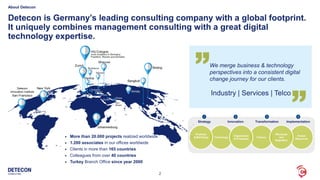
Detecon is Germany’s leading consulting company with a global footprint.
It uniquely combines management consulting with a great digital
technology expertise.
 More than 20.000 projects realized worldwide
 1.200 associates in our offices worldwide
 Clients in more than 165 countries
 Colleagues from over 40 countries
 Turkey Branch Office since year 2000
We merge business & technology
perspectives into a consistent digital
change journey for our clients.
Industry | Services | Telco
About Detecon
Transformation
3
Implementation
4
Strategy
1
Innovation
2
Technology
Human
Resources
Finance
Wholesale
and
Regulation
Organization
& Processes
Products
& Marketing
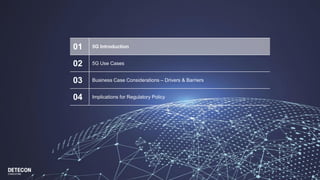
01 5G Introduction
02 5G Use Cases
03 Business Case Considerations – Drivers & Barriers
04 Implications for Regulatory Policy
4
5G Introduction
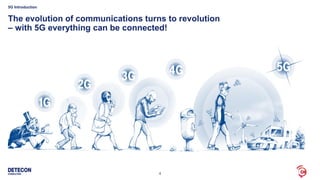
The evolution of communications turns to revolution
– with 5G everything can be connected!
5
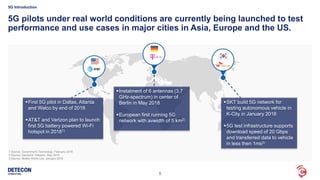
5G pilots under real world conditions are currently being launched to test
performance and use cases in major cities in Asia, Europe and the US.
5G Introduction
▪First 5G pilot in Dallas, Atlanta
and Walco by end of 2018
▪AT&T and Verizon plan to launch
first 5G battery powered Wi-Fi
hotspot in 20181)
▪Instalment of 6 antennas (3,7
GHz-spectrum) in center of
Berlin in May 2018
▪European first running 5G
network with avwidth of 5 km2)
▪SKT build 5G network for
testing autonomous vehicle in
K-City in January 2018
▪5G test infrastructure supports
download speed of 20 Gbps
and transferred data to vehicle
in less then 1ms3)
1 Source: Government Technology, February 2018
2 Source: Deutsche Telekom, May 2018
3 Source: Mobile World Live, January 2018
6
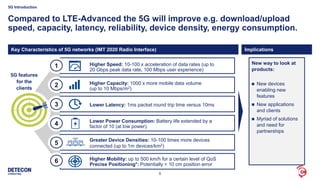
Compared to LTE-Advanced the 5G will improve e.g. download/upload
speed, capacity, latency, reliability, device density, energy consumption.
5G Introduction
5G features
for the
clients
1
5
4
3
2
6
Higher Speed: 10-100 x acceleration of data rates (up to
20 Gbps peak data rate, 100 Mbps user experience)
Higher Capacity: 1000 x more mobile data volume
(up to 10 Mbps/m2)
Lower Latency: 1ms packet round trip time versus 10ms
Lower Power Consumption: Battery life extended by a
factor of 10 (at low power).
Greater Device Densities: 10-100 times more devices
connected (up to 1m devices/km2)
Higher Mobility: up to 500 km/h for a certain level of QoS
Precise Positioning*: Potentially < 10 cm position error
New way to look at
products:
 New devices
enabling new
features
 New applications
and clients
 Myriad of solutions
and need for
partnerships
Key Characteristics of 5G networks (IMT 2020 Radio Interface) Implications
7
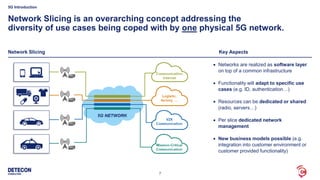
Network Slicing is an overarching concept addressing the
diversity of use cases being coped with by one physical 5G network.
5G Introduction
Network Slicing Key Aspects
 Networks are realized as software layer
on top of a common infrastructure
 Functionality will adapt to specific use
cases (e.g. ID, authentication…)
 Resources can be dedicated or shared
(radio, servers…)
 Per slice dedicated network
management
 New business models possible (e.g.
integration into customer environment or
customer provided functionality)
8
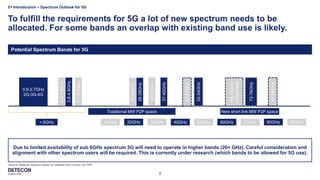
To fulfill the requirements for 5G a lot of new spectrum needs to be
allocated. For some bands an overlap with existing band use is likely.
01 Introduction – Spectrum Outlook for 5G
Potential Spectrum Bands for 5G
Due to limited availability of sub 6GHz spectrum 5G will need to operate in higher bands (20+ GHz). Careful consideration and
alignment with other spectrum users will be required. This is currently under research (which bands to be allowed for 5G use).
< 6GHz
3.4-3.8GHz
3.8-4.9GHz
5.7-5.9GHz
0.6-2.7GHz
2G-3G-4G
10GHz 20GHz 30GHz 40GHz 50GHz 60GHz 70GHz 80GHz 90GHz
26-28GHz
24-26GHz
37-40GHz
32-33GHz
47-51GHz
52-54GHz
66-72GHz
(unlicensed)
72-76GHz
81-86GHz
Traditional MW P2P space New short link MW P2P space
Source: Detecon research based on material from ni.com, 5G PPP
9
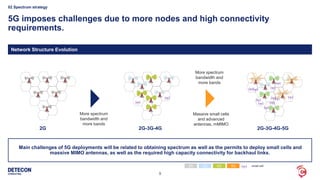
5G imposes challenges due to more nodes and high connectivity
requirements.
02 Spectrum strategy
Network Structure Evolution
Main challenges of 5G deployments will be related to obtaining spectrum as well as the permits to deploy small cells and
massive MIMO antennas, as well as the required high capacity connectivity for backhaul links.
2G 2G-3G-4G 2G-3G-4G-5G
2G 3G 4G 5G small cell
More spectrum
bandwidth and
more bands
Massive small cells
and advanced
antennas, mMIMO
More spectrum
bandwidth and
more bands
01 5G Introduction
02 5G Use Cases (Selected)
03 Business Case Considerations – Drivers & Barriers
04 Implications for Regulatory Policy
11
5G – Use Cases
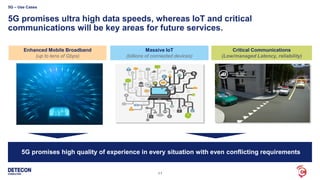
5G promises ultra high data speeds, whereas IoT and critical
communications will be key areas for future services.
5G promises high quality of experience in every situation with even conflicting requirements
Ultra
Low
Latency
High
Data
Rates
Critical Communications
(Low/managed Latency, reliability)
Massive IoT
(billions of connected devices)
Enhanced Mobile Broadband
(up to tens of Gbps)
12
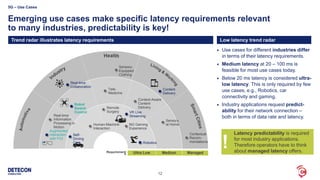
Emerging use cases make specific latency requirements relevant
to many industries, predictability is key!
5G – Use Cases
Real-time
Information
Processing in
Motion
 Use cases for different industries differ
in terms of their latency requirements.
 Medium latency at 20 – 100 ms is
feasible for most use cases today.
 Below 20 ms latency is considered ultra-
low latency. This is only required by few
use cases, e.g., Robotics, car
connectivity and gaming.
 Industry applications request predict-
ability for their network connection –
both in terms of data rate and latency.
Latency predictability is required
for most industry applications.
Therefore operators have to think
about managed latency offers.ManagedUltra Low MediumRequirement
s
Augmented
Interaction
with POI
Self-
Driving
Cars
Robot
Swarm
Control VR Live
Streaming
Content
Delivery
Real-time
Collaboration
Robotics
Human-Machine
Interaction
NG Gaming
Experience
Sensory
at Home
Contextual
Recom-
mendations
Context-Aware
Content
DeliveryRemote
Surgery
Tele-
Medicine
Sensory-
Equipped
Clothing
Low latency trend radar
!
Trend radar illustrates latency requirements
13
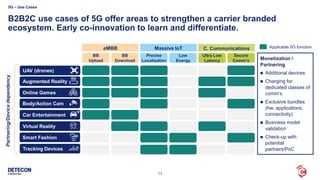
B2B2C use cases of 5G offer areas to strengthen a carrier branded
ecosystem. Early co-innovation to learn and differentiate.
5G – Use Cases
Applicable 5G function
UAV (drones)
Tracking Devices
Car Entertainment
Virtual Reality
Augmented Reality
Online Games
Body/Action Cam
Smart Fashion
Monetization /
Partnering
 Additional devices
 Charging for
dedicated classes of
comm‘s
 Exclusive bundles
(hw, applications,
connectivity)
 Business model
validation
 Check-up with
potential
partners/PoC
BB
Upload
BB
Download
Precise
Localization
Low
Energy
Ultra Low
Latency
Secure
Comm‘s
C. CommunicationsMassive IoTeMBB
Partnering/Devicedependency
14
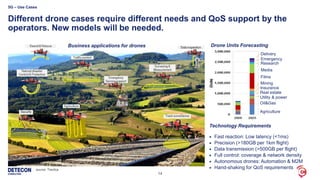
Different drone cases require different needs and QoS support by the
operators. New models will be needed.
5G – Use Cases
Business applications for drones
source: Tractica
Drone Units Forecasting
Agriculture
Oil&Gas
Utility & power
Real estate
Insurance
Mining
Films
Media
Research
Emergency
Delivery
Technology Requirements
 Fast reaction: Low latency (<1ms)
 Precision (>180GB per 1km flight)
 Data transmission (>500GB per flight)
 Full control: coverage & network density
 Autonomous drones: Automation & M2M
 Hand-shaking for QoS requirements
15
5G – Use Cases
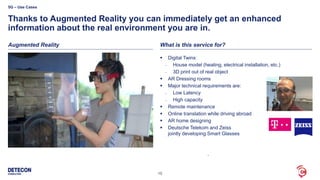
Thanks to Augmented Reality you can immediately get an enhanced
information about the real environment you are in.
▪ Digital Twins:
 House model (heating, electrical installation, etc.)
 3D print out of real object
▪ AR Dressing rooms
▪ Major technical requirements are:
 Low Latency
 High capacity
▪ Remote maintenance
▪ Online translation while driving abroad
▪ AR home designing
▪ Deutsche Telekom and Zeiss
jointly developing Smart Glasses
Augmented Reality What is this service for?
16
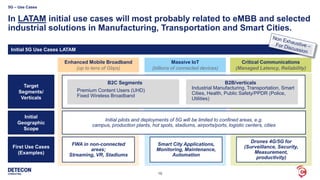
In LATAM initial use cases will most probably related to eMBB and selected
industrial solutions in Manufacturing, Transportation and Smart Cities.
5G – Use Cases
Initial 5G Use Cases LATAM
Initial pilots and deployments of 5G will be limited to confined areas, e.g.
campus, production plants, hot spots, stadiums, airports/ports, logistic centers, cities
FWA in non-connected
areas;
Streaming, VR, Stadiums
Drones 4G/5G for
(Surveillance, Security,
Measurement,
productivity)
Critical Communications
(Managed Latency, Reliability)
Massive IoT
(billions of connected devices)
Enhanced Mobile Broadband
(up to tens of Gbps)
Initial
Geographic
Scope
Target
Segments/
Verticals
First Use Cases
(Examples)
Smart City Applications,
Monitoring, Maintenance,
Automation
B2C Segments B2B/verticals
Premium Content Users (UHD)
Fixed Wireless Broadband
Industrial Manufacturing, Transportation, Smart
Cities, Health, Public Safety/PPDR (Police,
Utilities)
01 5G Introduction
02 5G Use Cases (Selected)
03 Business Case Considerations – Drivers & Barriers
04 Implications for Regulatory Policy
18
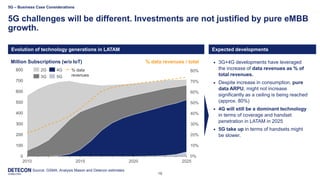
5G challenges will be different. Investments are not justified by pure eMBB
growth.
400
200
0
300
100
500
600
700
800
0%
10%
20%
30%
40%
50%
60%
70%
80%
2010 2015 2020 2025
2G
3G
4G
5G
Million Subscriptions (w/o IoT) % data revenues / total
Source: GSMA, Analysis Mason and Detecon estimates
Evolution of technology generations in LATAM Expected developments
% data
revenues
 3G+4G developments have leveraged
the increase of data revenues as % of
total revenues.
 Despite increase in consumption, pure
data ARPU, might not increase
significantly as a ceiling is being reached
(approx. 80%)
 4G will still be a dominant technology
in terms of coverage and handset
penetration in LATAM in 2025
 5G take up in terms of handsets might
be slower.
5G – Business Case Considerations
19
Why invest in 5G?
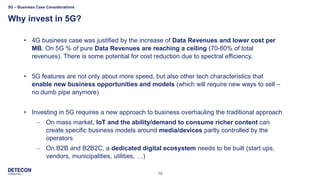
• 4G business case was justified by the increase of Data Revenues and lower cost per
MB. On 5G % of pure Data Revenues are reaching a ceiling (70-80% of total
revenues). There is some potential for cost reduction due to spectral efficiency.
• 5G features are not only about more speed, but also other tech characteristics that
enable new business opportunities and models (which will require new ways to sell –
no dumb pipe anymore)
• Investing in 5G requires a new approach to business overhauling the traditional approach
 On mass market, IoT and the ability/demand to consume richer content can
create specific business models around media/devices partly controlled by the
operators
 On B2B and B2B2C, a dedicated digital ecosystem needs to be built (start ups,
vendors, municipalities, utilities, …)
5G – Business Case Considerations
20
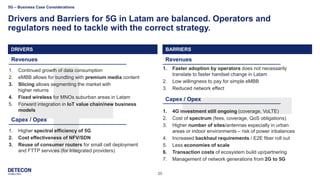
Drivers and Barriers for 5G in Latam are balanced. Operators and
regulators need to tackle with the correct strategy.
Drivers
1. Continued growth of data consumption
2. eMBB allows for bundling with premium media content
3. Slicing allows segmenting the market with
higher returns
4. Fixed wireless for MNOs suburban areas in Latam
5. Forward integration in IoT value chain/new business
models
1. Higher spectral efficiency of 5G
2. Cost effectiveness of NFV/SDN
3. Reuse of consumer routers for small cell deployment
and FTTP services (for Integrated providers)
1. Faster adoption by operators does not necessarily
translate to faster handset change in Latam
2. Low willingness to pay for simple eMBB
3. Reduced network effect
1. 4G investment still ongoing (coverage, VoLTE)
2. Cost of spectrum (fees, coverage, QoS obligations)
3. Higher number of sites/antennas especially in urban
areas or indoor environments – risk of power inbalances
4. Increased backhaul requirements / E2E fiber roll out
5. Less economies of scale
6. Transaction costs of ecosystem build up/partnering
7. Management of network generations from 2G to 5G
Revenues
Capex / Opex
Revenues
Capex / Opex
DRIVERSDRIVERS BARRIERS
5G – Business Case Considerations
21
Rationale
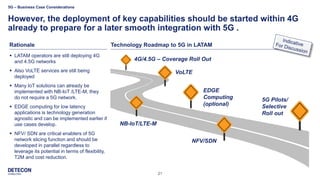
However, the deployment of key capabilities should be started within 4G
already to prepare for a later smooth integration with 5G .
Technology Roadmap to 5G in LATAM
EDGE
Computing
(optional)
4G/4.5G – Coverage Roll Out
5G Pilots/
Selective
Roll out
VoLTE
NB-IoT/LTE-M
NFV/SDN
▪ LATAM operators are still deploying 4G
and 4.5G networks
▪ Also VoLTE services are still being
deployed
▪ Many IoT solutions can already be
implemented with NB-IoT /LTE-M, they
do not require a 5G network.
▪ EDGE computing for low latency
applications is technology generation
agnostic and can be implemented earlier if
use cases develop.
▪ NFV/ SDN are critical enablers of 5G
network slicing function and should be
developed in parallel regardless to
leverage its potential in terms of flexibility,
T2M and cost reduction.
5G – Business Case Considerations
01 5G Introduction
02 5G Use Cases Selection
03 Business Case Considerations – Drivers & Barriers
04 Implications for Regulatory Policy
23
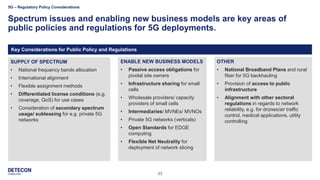
Spectrum issues and enabling new business models are key areas of
public policies and regulations for 5G deployments.
5G – Regulatory Policy Considerations
Key Considerations for Public Policy and Regulations
ENABLE NEW BUSINESS MODELS
• Passive access obligations for
pivotal site owners
• Infrastructure sharing for small
cells
• Wholesale providers/ capacity
providers of small cells
• Intermediaries/ MVNEs/ MVNOs
• Private 5G networks (verticals)
• Open Standards for EDGE
computing
• Flexible Net Neutrality for
deployment of network slicing
SUPPLY OF SPECTRUM
• National frequency bands allocation
• International alignment
• Flexible assignment methods
• Differentiated license conditions (e.g.
coverage, QoS) for use cases
• Consideration of secondary spectrum
usage/ subleasing for e.g. private 5G
networks
OTHER
• National Broadband Plans and rural
fiber for 5G backhauling
• Provision of access to public
infrastructure
• Alignment with other sectoral
regulations in regards to network
reliability, e.g. for drones/air traffic
control, medical applications, utility
controlling
Your contact!
Detecon International GmbH
Sternengasse 14-16
50676 Cologne, Germany
e-mail info@detecon.com
web www.detecon.com
Ulrike Eberhard
Managing Partner Latin America
Mobile +49 170 228 3963
E-mail Ulrike.Eberhard@detecon.com

e-conectividad 5G clave para la innovación

  • 1.
    Key Note: 5G– Business Case Drivers & Barriers Ulrike Eberhard CRC International Workshop Cartagena, 17th of July 2018
  • 2.
    2 Detecon is Germany’sleading consulting company with a global footprint. It uniquely combines management consulting with a great digital technology expertise.  More than 20.000 projects realized worldwide  1.200 associates in our offices worldwide  Clients in more than 165 countries  Colleagues from over 40 countries  Turkey Branch Office since year 2000 We merge business & technology perspectives into a consistent digital change journey for our clients. Industry | Services | Telco About Detecon Transformation 3 Implementation 4 Strategy 1 Innovation 2 Technology Human Resources Finance Wholesale and Regulation Organization & Processes Products & Marketing
  • 3.
    01 5G Introduction 025G Use Cases 03 Business Case Considerations – Drivers & Barriers 04 Implications for Regulatory Policy
  • 4.
    4 5G Introduction The evolutionof communications turns to revolution – with 5G everything can be connected!
  • 5.
    5 5G pilots underreal world conditions are currently being launched to test performance and use cases in major cities in Asia, Europe and the US. 5G Introduction ▪First 5G pilot in Dallas, Atlanta and Walco by end of 2018 ▪AT&T and Verizon plan to launch first 5G battery powered Wi-Fi hotspot in 20181) ▪Instalment of 6 antennas (3,7 GHz-spectrum) in center of Berlin in May 2018 ▪European first running 5G network with avwidth of 5 km2) ▪SKT build 5G network for testing autonomous vehicle in K-City in January 2018 ▪5G test infrastructure supports download speed of 20 Gbps and transferred data to vehicle in less then 1ms3) 1 Source: Government Technology, February 2018 2 Source: Deutsche Telekom, May 2018 3 Source: Mobile World Live, January 2018
  • 6.
    6 Compared to LTE-Advancedthe 5G will improve e.g. download/upload speed, capacity, latency, reliability, device density, energy consumption. 5G Introduction 5G features for the clients 1 5 4 3 2 6 Higher Speed: 10-100 x acceleration of data rates (up to 20 Gbps peak data rate, 100 Mbps user experience) Higher Capacity: 1000 x more mobile data volume (up to 10 Mbps/m2) Lower Latency: 1ms packet round trip time versus 10ms Lower Power Consumption: Battery life extended by a factor of 10 (at low power). Greater Device Densities: 10-100 times more devices connected (up to 1m devices/km2) Higher Mobility: up to 500 km/h for a certain level of QoS Precise Positioning*: Potentially < 10 cm position error New way to look at products:  New devices enabling new features  New applications and clients  Myriad of solutions and need for partnerships Key Characteristics of 5G networks (IMT 2020 Radio Interface) Implications
  • 7.
    7 Network Slicing isan overarching concept addressing the diversity of use cases being coped with by one physical 5G network. 5G Introduction Network Slicing Key Aspects  Networks are realized as software layer on top of a common infrastructure  Functionality will adapt to specific use cases (e.g. ID, authentication…)  Resources can be dedicated or shared (radio, servers…)  Per slice dedicated network management  New business models possible (e.g. integration into customer environment or customer provided functionality)
  • 8.
    8 To fulfill therequirements for 5G a lot of new spectrum needs to be allocated. For some bands an overlap with existing band use is likely. 01 Introduction – Spectrum Outlook for 5G Potential Spectrum Bands for 5G Due to limited availability of sub 6GHz spectrum 5G will need to operate in higher bands (20+ GHz). Careful consideration and alignment with other spectrum users will be required. This is currently under research (which bands to be allowed for 5G use). < 6GHz 3.4-3.8GHz 3.8-4.9GHz 5.7-5.9GHz 0.6-2.7GHz 2G-3G-4G 10GHz 20GHz 30GHz 40GHz 50GHz 60GHz 70GHz 80GHz 90GHz 26-28GHz 24-26GHz 37-40GHz 32-33GHz 47-51GHz 52-54GHz 66-72GHz (unlicensed) 72-76GHz 81-86GHz Traditional MW P2P space New short link MW P2P space Source: Detecon research based on material from ni.com, 5G PPP
  • 9.
    9 5G imposes challengesdue to more nodes and high connectivity requirements. 02 Spectrum strategy Network Structure Evolution Main challenges of 5G deployments will be related to obtaining spectrum as well as the permits to deploy small cells and massive MIMO antennas, as well as the required high capacity connectivity for backhaul links. 2G 2G-3G-4G 2G-3G-4G-5G 2G 3G 4G 5G small cell More spectrum bandwidth and more bands Massive small cells and advanced antennas, mMIMO More spectrum bandwidth and more bands
  • 10.
    01 5G Introduction 025G Use Cases (Selected) 03 Business Case Considerations – Drivers & Barriers 04 Implications for Regulatory Policy
  • 11.
    11 5G – UseCases 5G promises ultra high data speeds, whereas IoT and critical communications will be key areas for future services. 5G promises high quality of experience in every situation with even conflicting requirements Ultra Low Latency High Data Rates Critical Communications (Low/managed Latency, reliability) Massive IoT (billions of connected devices) Enhanced Mobile Broadband (up to tens of Gbps)
  • 12.
    12 Emerging use casesmake specific latency requirements relevant to many industries, predictability is key! 5G – Use Cases Real-time Information Processing in Motion  Use cases for different industries differ in terms of their latency requirements.  Medium latency at 20 – 100 ms is feasible for most use cases today.  Below 20 ms latency is considered ultra- low latency. This is only required by few use cases, e.g., Robotics, car connectivity and gaming.  Industry applications request predict- ability for their network connection – both in terms of data rate and latency. Latency predictability is required for most industry applications. Therefore operators have to think about managed latency offers.ManagedUltra Low MediumRequirement s Augmented Interaction with POI Self- Driving Cars Robot Swarm Control VR Live Streaming Content Delivery Real-time Collaboration Robotics Human-Machine Interaction NG Gaming Experience Sensory at Home Contextual Recom- mendations Context-Aware Content DeliveryRemote Surgery Tele- Medicine Sensory- Equipped Clothing Low latency trend radar ! Trend radar illustrates latency requirements
  • 13.
    13 B2B2C use casesof 5G offer areas to strengthen a carrier branded ecosystem. Early co-innovation to learn and differentiate. 5G – Use Cases Applicable 5G function UAV (drones) Tracking Devices Car Entertainment Virtual Reality Augmented Reality Online Games Body/Action Cam Smart Fashion Monetization / Partnering  Additional devices  Charging for dedicated classes of comm‘s  Exclusive bundles (hw, applications, connectivity)  Business model validation  Check-up with potential partners/PoC BB Upload BB Download Precise Localization Low Energy Ultra Low Latency Secure Comm‘s C. CommunicationsMassive IoTeMBB Partnering/Devicedependency
  • 14.
    14 Different drone casesrequire different needs and QoS support by the operators. New models will be needed. 5G – Use Cases Business applications for drones source: Tractica Drone Units Forecasting Agriculture Oil&Gas Utility & power Real estate Insurance Mining Films Media Research Emergency Delivery Technology Requirements  Fast reaction: Low latency (<1ms)  Precision (>180GB per 1km flight)  Data transmission (>500GB per flight)  Full control: coverage & network density  Autonomous drones: Automation & M2M  Hand-shaking for QoS requirements
  • 15.
    15 5G – UseCases Thanks to Augmented Reality you can immediately get an enhanced information about the real environment you are in. ▪ Digital Twins:  House model (heating, electrical installation, etc.)  3D print out of real object ▪ AR Dressing rooms ▪ Major technical requirements are:  Low Latency  High capacity ▪ Remote maintenance ▪ Online translation while driving abroad ▪ AR home designing ▪ Deutsche Telekom and Zeiss jointly developing Smart Glasses Augmented Reality What is this service for?
  • 16.
    16 In LATAM initialuse cases will most probably related to eMBB and selected industrial solutions in Manufacturing, Transportation and Smart Cities. 5G – Use Cases Initial 5G Use Cases LATAM Initial pilots and deployments of 5G will be limited to confined areas, e.g. campus, production plants, hot spots, stadiums, airports/ports, logistic centers, cities FWA in non-connected areas; Streaming, VR, Stadiums Drones 4G/5G for (Surveillance, Security, Measurement, productivity) Critical Communications (Managed Latency, Reliability) Massive IoT (billions of connected devices) Enhanced Mobile Broadband (up to tens of Gbps) Initial Geographic Scope Target Segments/ Verticals First Use Cases (Examples) Smart City Applications, Monitoring, Maintenance, Automation B2C Segments B2B/verticals Premium Content Users (UHD) Fixed Wireless Broadband Industrial Manufacturing, Transportation, Smart Cities, Health, Public Safety/PPDR (Police, Utilities)
  • 17.
    01 5G Introduction 025G Use Cases (Selected) 03 Business Case Considerations – Drivers & Barriers 04 Implications for Regulatory Policy
  • 18.
    18 5G challenges willbe different. Investments are not justified by pure eMBB growth. 400 200 0 300 100 500 600 700 800 0% 10% 20% 30% 40% 50% 60% 70% 80% 2010 2015 2020 2025 2G 3G 4G 5G Million Subscriptions (w/o IoT) % data revenues / total Source: GSMA, Analysis Mason and Detecon estimates Evolution of technology generations in LATAM Expected developments % data revenues  3G+4G developments have leveraged the increase of data revenues as % of total revenues.  Despite increase in consumption, pure data ARPU, might not increase significantly as a ceiling is being reached (approx. 80%)  4G will still be a dominant technology in terms of coverage and handset penetration in LATAM in 2025  5G take up in terms of handsets might be slower. 5G – Business Case Considerations
  • 19.
    19 Why invest in5G? • 4G business case was justified by the increase of Data Revenues and lower cost per MB. On 5G % of pure Data Revenues are reaching a ceiling (70-80% of total revenues). There is some potential for cost reduction due to spectral efficiency. • 5G features are not only about more speed, but also other tech characteristics that enable new business opportunities and models (which will require new ways to sell – no dumb pipe anymore) • Investing in 5G requires a new approach to business overhauling the traditional approach  On mass market, IoT and the ability/demand to consume richer content can create specific business models around media/devices partly controlled by the operators  On B2B and B2B2C, a dedicated digital ecosystem needs to be built (start ups, vendors, municipalities, utilities, …) 5G – Business Case Considerations
  • 20.
    20 Drivers and Barriersfor 5G in Latam are balanced. Operators and regulators need to tackle with the correct strategy. Drivers 1. Continued growth of data consumption 2. eMBB allows for bundling with premium media content 3. Slicing allows segmenting the market with higher returns 4. Fixed wireless for MNOs suburban areas in Latam 5. Forward integration in IoT value chain/new business models 1. Higher spectral efficiency of 5G 2. Cost effectiveness of NFV/SDN 3. Reuse of consumer routers for small cell deployment and FTTP services (for Integrated providers) 1. Faster adoption by operators does not necessarily translate to faster handset change in Latam 2. Low willingness to pay for simple eMBB 3. Reduced network effect 1. 4G investment still ongoing (coverage, VoLTE) 2. Cost of spectrum (fees, coverage, QoS obligations) 3. Higher number of sites/antennas especially in urban areas or indoor environments – risk of power inbalances 4. Increased backhaul requirements / E2E fiber roll out 5. Less economies of scale 6. Transaction costs of ecosystem build up/partnering 7. Management of network generations from 2G to 5G Revenues Capex / Opex Revenues Capex / Opex DRIVERSDRIVERS BARRIERS 5G – Business Case Considerations
  • 21.
    21 Rationale However, the deploymentof key capabilities should be started within 4G already to prepare for a later smooth integration with 5G . Technology Roadmap to 5G in LATAM EDGE Computing (optional) 4G/4.5G – Coverage Roll Out 5G Pilots/ Selective Roll out VoLTE NB-IoT/LTE-M NFV/SDN ▪ LATAM operators are still deploying 4G and 4.5G networks ▪ Also VoLTE services are still being deployed ▪ Many IoT solutions can already be implemented with NB-IoT /LTE-M, they do not require a 5G network. ▪ EDGE computing for low latency applications is technology generation agnostic and can be implemented earlier if use cases develop. ▪ NFV/ SDN are critical enablers of 5G network slicing function and should be developed in parallel regardless to leverage its potential in terms of flexibility, T2M and cost reduction. 5G – Business Case Considerations
  • 22.
    01 5G Introduction 025G Use Cases Selection 03 Business Case Considerations – Drivers & Barriers 04 Implications for Regulatory Policy
  • 23.
    23 Spectrum issues andenabling new business models are key areas of public policies and regulations for 5G deployments. 5G – Regulatory Policy Considerations Key Considerations for Public Policy and Regulations ENABLE NEW BUSINESS MODELS • Passive access obligations for pivotal site owners • Infrastructure sharing for small cells • Wholesale providers/ capacity providers of small cells • Intermediaries/ MVNEs/ MVNOs • Private 5G networks (verticals) • Open Standards for EDGE computing • Flexible Net Neutrality for deployment of network slicing SUPPLY OF SPECTRUM • National frequency bands allocation • International alignment • Flexible assignment methods • Differentiated license conditions (e.g. coverage, QoS) for use cases • Consideration of secondary spectrum usage/ subleasing for e.g. private 5G networks OTHER • National Broadband Plans and rural fiber for 5G backhauling • Provision of access to public infrastructure • Alignment with other sectoral regulations in regards to network reliability, e.g. for drones/air traffic control, medical applications, utility controlling
  • 24.
    Your contact! Detecon InternationalGmbH Sternengasse 14-16 50676 Cologne, Germany e-mail info@detecon.com web www.detecon.com Ulrike Eberhard Managing Partner Latin America Mobile +49 170 228 3963 E-mail Ulrike.Eberhard@detecon.com